
In lab-grown diamond wholesale, MOQ is often misinterpreted as a simple price barrier. In reality, especially when sourcing matched pairs and calibrated stones for jewelry brand production, a supplier’s minimum order quantity reveals far more about how they operate, where their stones come from, and whether they can reliably deliver what you expect. A low MOQ can mask inconsistent quality or limited selection, while a high MOQ may signal manufacturing scale but lock you into inventory you cannot move quickly.
For the full framework, read Wholesale Lab-Grown Diamonds for Jewelers and Brands.
This article breaks down what MOQ actually tells you about a supplier’s reliability, grading consistency, and long-term fit for your business. It helps you evaluate whether to push for flexibility, walk away from a deal, or commit to scaling a relationship.
| What You Are Evaluating | High MOQ Supplier (50+ stones) | Low MOQ Supplier (10 stones) |
|---|---|---|
| Operating model | Direct manufacturer; batch production | Middleman or small stockist |
| Per-stone cost at minimum tier | Lower (10-20% premium vs bulk) | Higher per unit |
| Selection breadth | Fancy shapes, broader grades | Limited to liquid inventory (round G-H, VS-SI) |
| Grading consistency expectation | More reliable across repeat orders | Less repeatable; test before scaling |
| Negotiation leverage | Earned after 2-3 clean transactions | Limited room; try order structuring |
| Custom spec availability | Likely feasible | Rare; usually requires higher MOQ |
Quick Questions Before You Read
Q: Is a low MOQ always better for new buyers?
Not necessarily. A low MOQ lets you test the relationship with a smaller financial commitment, but per-stone costs are higher and selection narrower. It is only better if you verify grading consistency and communication quality during that first order.
Q: Does MOQ apply per SKU or per total order?
It depends on the supplier. Some set the minimum per individual stone shape and grade, which makes it harder to mix a small order. Others allow you to combine different stones to reach a single total. Confirm this explicitly before ordering.
Q: Can you negotiate a lower MOQ?
You may negotiate by adjusting the order structure (e.g., fewer SKUs) or by starting with a test order that shows you are serious. A supplier is unlikely to drop their MOQ for a first-time buyer with no transaction history.
Q: How do you know if a supplier’s MOQ is backed by reliable inventory?
Place two independent orders at the same MOQ tier and compare grading reports, appearance, and delivery timing. Consistent results across both orders indicate repeatability; inconsistency suggests the MOQ number alone does not guarantee quality.
What Does MOQ Actually Mean in Lab-Grown Diamond Wholesale?
Most buyers treat minimum order quantity as a hurdle to negotiate down. That approach misses the point. MOQ is one of the clearest signals a supplier sends about how they operate, what they carry, and who they are built to serve. Reading it correctly tells you more about the supplier than the price list does.
Why MOQ Exists: Inventory Cost, Cutting Commitments, and Grading Risk
A lab-grown diamond manufacturer does not produce stones one at a time. They commit to a production batch — a block of rough material that goes through growth, cutting, and polishing before any single stone is graded. Once the batch is finished, every stone incurs grading fees, handling costs, and inventory carrying risk until it sells. The MOQ represents how many stones the supplier needs to move in a single transaction to cover those fixed costs and still make the economics work at the quoted price.
A low-MOQ supplier absorbs this risk differently. They may hold already-graded inventory and sell individual stones at a markup that reflects their holding cost. A high-MOQ supplier, especially one with direct manufacturing, structures their pricing around moving larger volumes in fewer transactions. The MOQ number is not arbitrary. It is a direct reflection of how the supplier manages grading cost, stock risk, and handling overhead. The same MOQ number from two different suppliers means two entirely different cost structures underneath.
MOQ as a Business Signal: What Minimums Reveal About Supplier Model
A supplier offering an MOQ of one or two stones is not necessarily being generous. They may be a trading intermediary who pulls from pooled inventory, marks up per stone, and carries no production risk. This model gives flexibility but typically offers thinner selection and less control over grading consistency across repeat orders.
A supplier with an MOQ of fifty or more stones is almost certainly a different type of operation. They have direct manufacturing access, rough allocation capability, and a wholesale service structure built around repeat volume. Their pricing assumes batch-level efficiency, not per-stone retail logic. The MOQ flags which model you are dealing with. A buyer who tries to force a high-MOQ manufacturer down to five stones is asking them to operate against their own cost structure. It rarely works well for either side.
The Most Common MOQ Tiers and What They Typically Cover
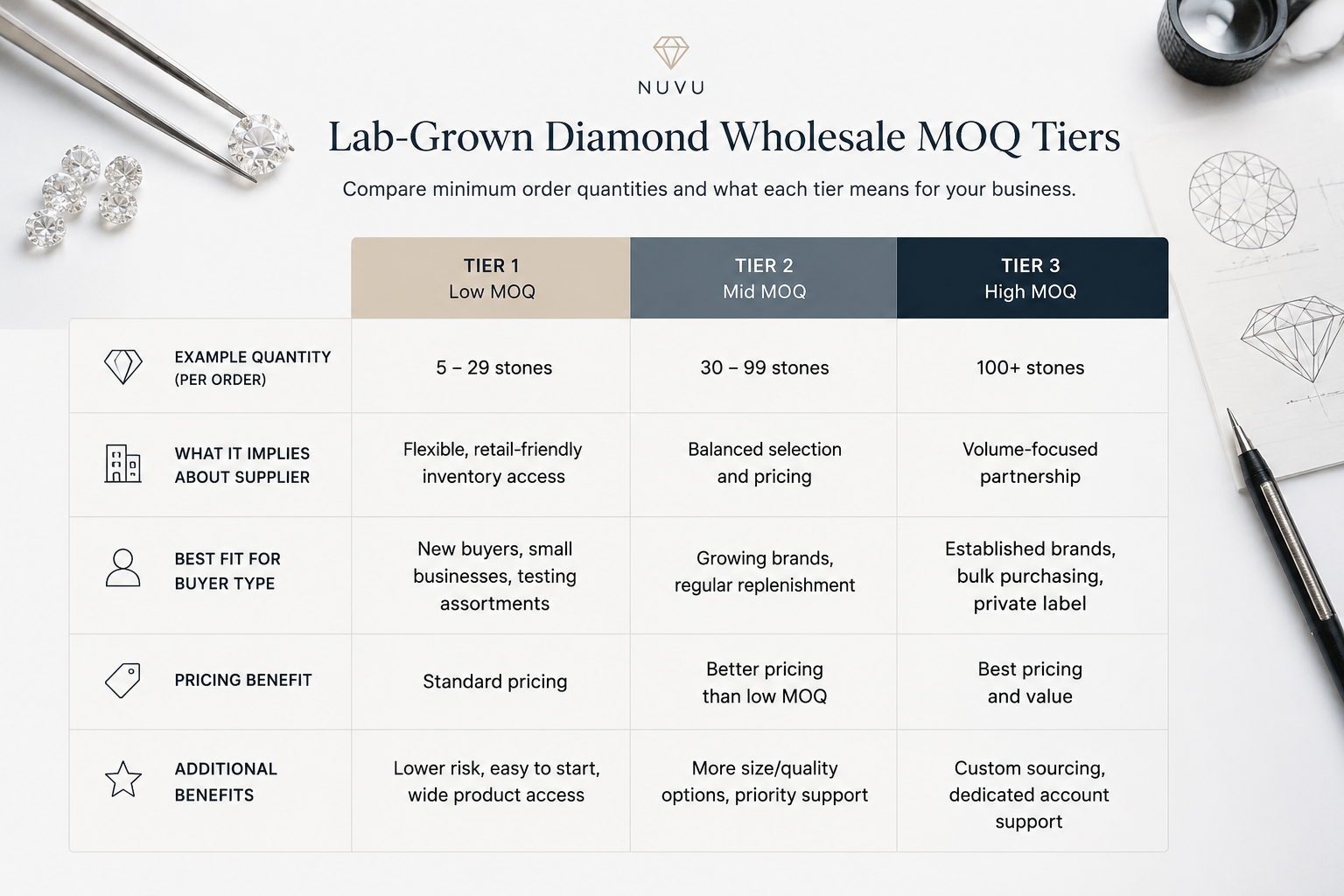
In the China wholesale market, three realistic tiers dominate.
Individual stone sales, MOQ of one, target retail buyers and small studios. The buyer pays a per-stone premium, often 10 to 20 percent above wholesale volume pricing, and the selection is usually limited to fast-moving shapes and grades. This tier works for sample evaluation or one-off projects but does not reflect the pricing or consistency available at higher tiers.
Small batch orders, typically five to twenty stones, are the most common entry point for new wholesale buyers. This tier allows the supplier to spread grading and handling costs across a small group of stones while still keeping the transaction efficient. The per-stone price is closer to wholesale volumes than the single-stone tier, but grading consistency across the batch should still be verified rather than assumed.
Wholesale volume orders start around fifty stones and run to three hundred or more. At this level, the supplier treats the buyer as a commercial partner. Per-stone pricing reaches its floor, batch-level grading consistency is usually locked in tighter, and the supplier is more willing to accommodate non-standard specifications. This tier requires working capital and a clear inventory plan, but it also unlocks the most favorable terms.
What to Confirm Before Relying on a Supplier’s MOQ Statement
MOQ means different things to different suppliers. Some define it per stone. Others define it per shape, per batch, or per order line. A supplier may state an MOQ of ten, but they may mean ten stones of the exact same shape and size, not ten mixed stones across different categories. Confirm whether the MOQ resets every order or applies per SKU. Ask if a mixed order of multiple shapes or sizes counts toward one MOQ. Write every confirmation into the first purchase communication so there is no ambiguity when the invoice arrives.
Low-MOQ vs High-MOQ Suppliers: How the Buyer Profile Changes
A high MOQ is not better than a low one, and the reverse is equally true. The right MOQ depends entirely on the buyer’s stage of business, inventory strategy, and repeat order pattern. The mistake is assuming that lower always wins or that higher always signals a better partner.
Who Benefits from a Low-MOQ Supplier
Independent designers and small retail operations benefit most from low-MOQ suppliers. A designer testing a new shape category does not want to commit to fifty stones before confirming demand. A small studio building a bridal collection across multiple silhouettes needs one or two of each, not a batch of identical stones. Low MOQ gives these buyers the flexibility to validate product-market fit without tying up working capital.
The tradeoff is real. A low-MOQ buyer pays a higher per-stone price and accepts narrower selection. The supplier stocks only what moves fast. Fancy shapes, unusual color-clarity combinations, or matched pairs may simply not be available at the single-stone tier. Grading consistency across separate orders is also less reliable because each low-MOQ order pulls from whatever is in inventory that day, not from a controlled batch.
Who Should Look for Higher MOQ Partners
Commercial jewelers, multi-store buyers, and ecommerce operations that sell repeatable inventory are the natural audience for higher MOQ suppliers. When a business needs consistent stones across carat, color, and clarity combinations — order after order — the high-MOQ supplier’s batch-level control becomes an advantage, not a burden.
Higher MOQ unlocks better per-stone pricing, tighter grading consistency within each batch, and preferential lead time. A supplier who knows you will order fifty stones every month schedules production accordingly. But the commitment requires working capital and a clear inventory plan. A buyer who takes a high MOQ without knowing how fast they sell through each specification will sit on unsold stock, which erases any pricing advantage.
Why the Middle Ground Matters: Small Test Orders Before Scale
The most practical path is neither the lowest nor the highest MOQ. It is the test order — a small batch at the supplier’s minimum tier that serves as a discovery tool. Place one small order to evaluate grading consistency against visual appearance, communication speed, and shipping reliability. If the supplier delivers exactly what was quoted and the stones look consistent across the batch, scale to a higher MOQ on the next round.
This approach spreads discovery risk. A failed test order costs a few stones, not a full batch. A successful test order gives concrete data to reference when negotiating the next MOQ tier. It also builds the relationship. A supplier who sees a buyer complete a test order cleanly is more willing to offer better terms on the second order.
What to Check in a Test Order Before Scaling MOQ
Review the test batch for grading report accuracy against visual appearance. A certificate may say G color, but if two stones labeled G look visibly different under natural light, the grading consistency within the batch is unreliable. Check whether all stones within the same spec range look similar. Compare the per-stone price from the test order against the quoted volume price to understand exactly how much markup the low-MOQ tier carries. Document every deviation. Use the results to negotiate the next MOQ tier with concrete evidence rather than general requests.
Samples, Small Batches, and the Gap Between MOQ and Long-Term Cooperation
MOQ describes the first order. It does not predict the quality of the tenth order. The gap between them reveals whether the supplier supports buyer growth or treats small buyers as a secondary channel they serve only when convenient.
What a Sample or Small Batch Can and Cannot Verify
A sample or small batch verifies cut quality, color appearance in hand, and certificate accuracy for those specific stones. It tells you whether the supplier ships what they represent. It does not verify batch-level consistency across multiple orders. A supplier can send a strong first batch and a weaker second batch, and the sample order will not warn you. It does not test grading stability across different production runs. A supplier may switch rough sources or growth methods between seasons, and the sample order will not flag it. It also does not verify after-sales behavior — how the supplier handles a return, a complaint, or a grading dispute. Buyers who skip the sample order and commit directly to a full MOQ discover these gaps only after they are financially exposed.
How Repeat Orders Change MOQ Terms
Many suppliers do not advertise this, but repeat orders often change MOQ terms. A buyer who completes two or three orders with on-time payments, clear specifications, and no returns earns a different relationship. The supplier may offer a lower effective minimum on subsequent orders or better pricing without requiring a volume increase.
This shift is not automatic. It depends on the relationship, not on MOQ policy. A buyer using wholesale price list comparison as part of supplier evaluation should still understand that a buyer who treats every order as a one-off transaction will not earn flexibility. A buyer who communicates consistently and orders predictably builds leverage. The MOQ stated on the first invoice is often negotiable by the fifth order if the buyer has demonstrated reliability.
When MOQ Becomes a Barrier vs a Filter
A high MOQ that is non-negotiable for any first order is not necessarily unfair. It may indicate that the supplier prioritizes volume buyers and has structured their operation around batch economics that do not accommodate small transactions. That supplier is filtering for serious commercial partners. For a buyer who needs volume, this is efficient. For a buyer who needs flexibility, it is a barrier worth respecting.
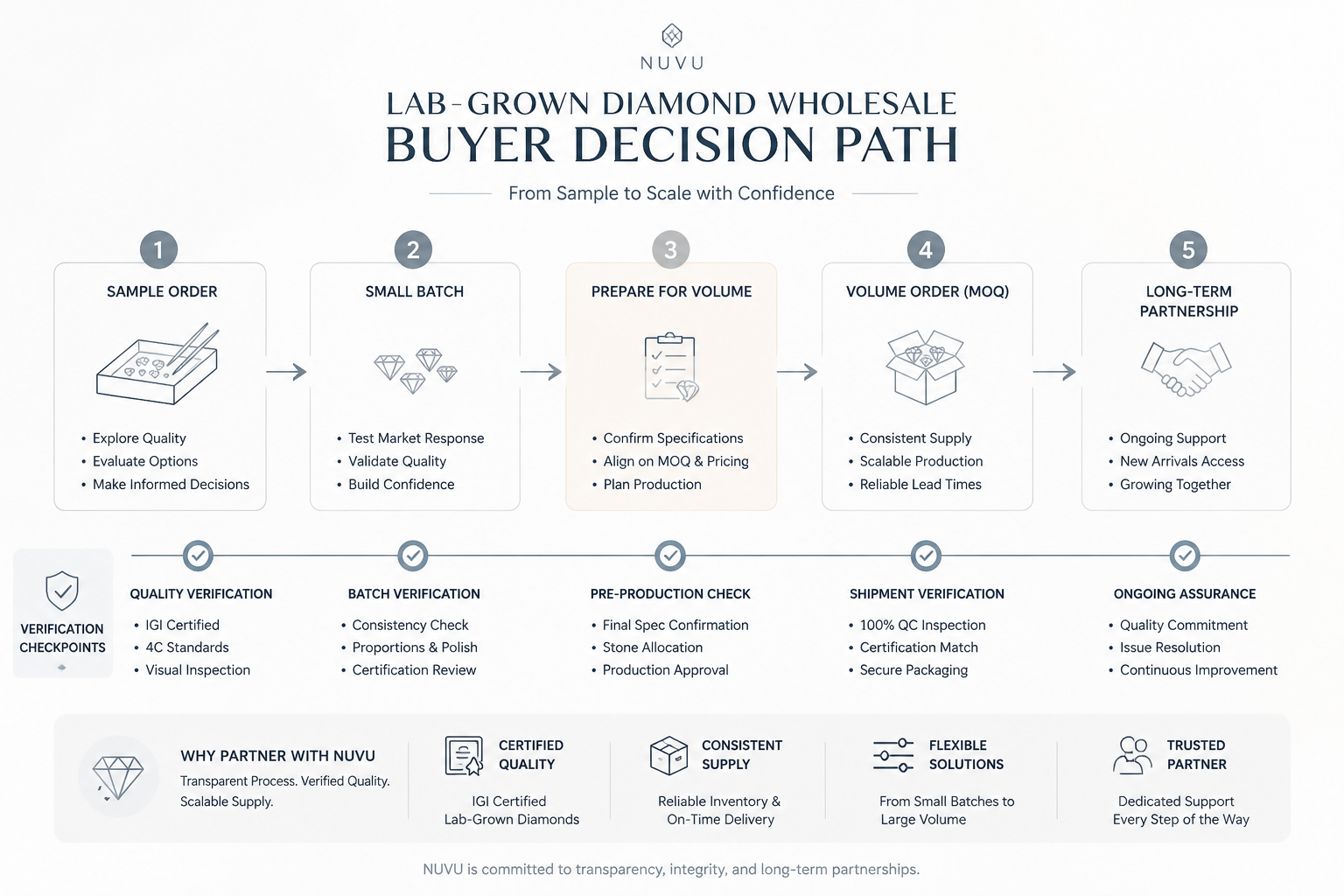
A supplier who offers a graduated MOQ path — sample, then small batch, then volume — signals something different. They are willing to invest in buyer growth. They understand that a small first order can lead to a large tenth order. This supplier treats MOQ as a relationship tool, not just an operational constraint. The buyer should evaluate MOQ as a filter for the kind of partnership they want, not just a price filter.
Buyer Verification Checklist for First-Order MOQ Evaluation
Before placing the first order, document the answers to four questions. Does the supplier state MOQ per SKU or per order total? Will they accept a mixed batch of different shapes and sizes toward one MOQ? What price tier applies to a first order meeting only the minimum MOQ — is it the same pricing as a larger order or a higher tier? Are repeat-order terms the same as the first order, or do they improve? Write the answers into the purchase communication. A supplier who answers clearly and consistently is more reliable than one who hedges.
How MOQ Affects Per-Stone Pricing and Selection Breadth
MOQ does not just determine how many stones you must buy. It determines what you pay per stone and which stones are available to you in the first place. Treating MOQ as a purely administrative hurdle misses the point. The number tells you something about the supplier’s cost structure and inventory strategy, and that information directly affects the economics of your order.
The Pricing Gradient: Why MOQ and Per-Stone Cost Are Inversely Related
Every diamond order carries fixed costs that do not change with the number of stones. Grading fees, packaging, documentation, and handling overhead apply whether the batch is five stones or fifty[1]. A supplier who moves a 50-stone order spreads those fixed costs across more units, which lowers the per-stone burden. A 5-stone order concentrates the same overhead on far fewer stones.
This is why buyers consistently see a markup at the lowest MOQ tier. It is not arbitrary pricing or punitive treatment. It reflects cost recovery. Expect a premium of 10 to 20 percent or more per stone when you order at the supplier’s minimum threshold. That premium does not mean the supplier is overcharging. It means the supplier’s cost structure does not change just because the order is small. The buyer absorbs the difference.
Shape, Size, and Grade Availability at Different MOQ Levels
A low-MOQ supplier typically carries only the most liquid inventory. That means round brilliants in the most common color and clarity combinations — G-H, VS-SI — because those stones turn over quickly and do not tie up capital. If you need fancy shapes, unusual carat weights, or less common grade combinations, a low-MOQ supplier may simply not stock them.
A high-MOQ supplier operates differently. Because the supplier expects volume across multiple orders, the inventory must cover broader demand. Fancy shapes, broader color ranges, and lower clarity grades become economically viable to carry. The supplier can absorb the holding cost because the stones are likely to sell across several repeat orders. MOQ does not just affect price. It affects what the buyer can even see as an option.
Practical note for buyers: The availability gap between low and high MOQ tiers is not always visible on a price list. A supplier may show prices for fancy shapes but stock only a handful of stones in that category. When you need multiple stones in an unusual shape or grade, it is worth asking how many the supplier actually holds at each MOQ level before building an order around an advertised price.
How MOQ Interacts with Custom or Non-Standard Orders
Custom or non-standard specifications shift risk from the buyer to the supplier. A specific proportion request, a very low color grade, or a batch of matched melee stones requires the supplier to deviate from standard production. That deviation consumes sorting time, grading attention, and sometimes a dedicated production run. Standard catalog stones carry lower MOQ thresholds because the supplier already holds them or cuts them routinely. Custom specs raise the supplier’s risk, and that risk is reflected in a higher MOQ.
If the order requires matching across multiple stones — same diameter, same depth, consistent crown angle across the batch — expect the MOQ to climb. The supplier needs enough stones in the batch to select from, and a small batch cannot deliver reliable matching.
Stone-to-Setting Fit Check When Ordering at Minimum MOQ
A small batch at minimum MOQ does not guarantee measurement consistency. Two stones with the same carat weight and the same color-clarity grade can have measurably different diameters, depths, or table percentages. If your settings are pre-manufactured or standardized, verify that the stone measurements in the batch are compatible before shipment. Ask the supplier for a measurement list covering diameter, depth, table size, and crown angle for every stone in the order. A mismatch discovered after delivery means resetting costs or unusable inventory.
Reading MOQ Alongside Other Supplier Indicators
MOQ is one data point. It becomes useful only when evaluated alongside grading lab policy, lead time, and after-sales behavior. A low MOQ from a supplier who delivers inconsistent grading reports, unpredictable shipping, or no return support is not an advantage. It is a risk disguised as flexibility.
Grading Lab and Report Consistency Across MOQ Tiers
Some suppliers use different grading laboratories depending on the MOQ level. A low-MOQ order may come with a report from a less widely recognized lab, which keeps the per-stone cost down. A higher-MOQ order may include IGI or GIA verification as part of the price tier[2]. The buyer should confirm whether grading lab consistency is tied to MOQ or available at all levels.
If the supplier offers IGI at high MOQ but a lower-tier lab at the minimum, the lower MOQ order may carry additional risk. A less recognized report may be accepted differently by your own customers or by setting partners. Confirm the lab policy before placing the order, not after.
For practical evaluation: the grading lab used at a given MOQ tier is itself a data point about the supplier’s operating margins. A switch in labs between tiers suggests that the supplier is adjusting cost structure, not just order volume. The buyer should verify not just which lab appears on the report, but whether that lab’s grading approach is consistent with what the buyer’s own customers or downstream partners expect.
Lead Time Variability at Low vs High MOQ
Low-MOQ orders typically ship from existing stock, which means shorter lead times. High-MOQ orders may require a production run, especially if the specs are non-standard. A longer lead time is not inherently a quality problem, but it creates planning exposure. If the supplier quotes a lead time without clarifying whether the order is from stock or production, the buyer cannot reliably schedule inventory.
Ask directly: Is this lead time based on current stock or a production cycle? If production, what is the buffer for grading delays or batch rejection? Lead time variability matters most when the buyer is coordinating with a retail calendar or a custom production timeline.
After-Sales Returns and MOQ Policy
Most wholesale MOQ guarantees apply before shipment, not after. Once the stones leave the supplier, return options are often limited. Understanding the return policy — whether returns are allowed at all, whether they apply per stone or per batch, and whether a handling fee reduces the refund — is as important as the MOQ number itself.
Some suppliers accept returns on individual stones within a batch. Others require the full batch to be returned. A handling fee of 10 to 15 percent is common and may make a partial return uneconomical. Clarify this before committing to the MOQ tier. A return policy that looks generous on the surface may not work in practice once fees are applied.
Certificate and Visual Review Check Before Committing to MOQ Terms
Before committing to a specific MOQ tier, ask the supplier to provide example grading reports for stones at that tier. Compare the report detail across two or three stones — proportions, symmetry grade, fluorescence, and comment lines. A tier with high report variability at low MOQ may produce unpredictable results as the order size grows.
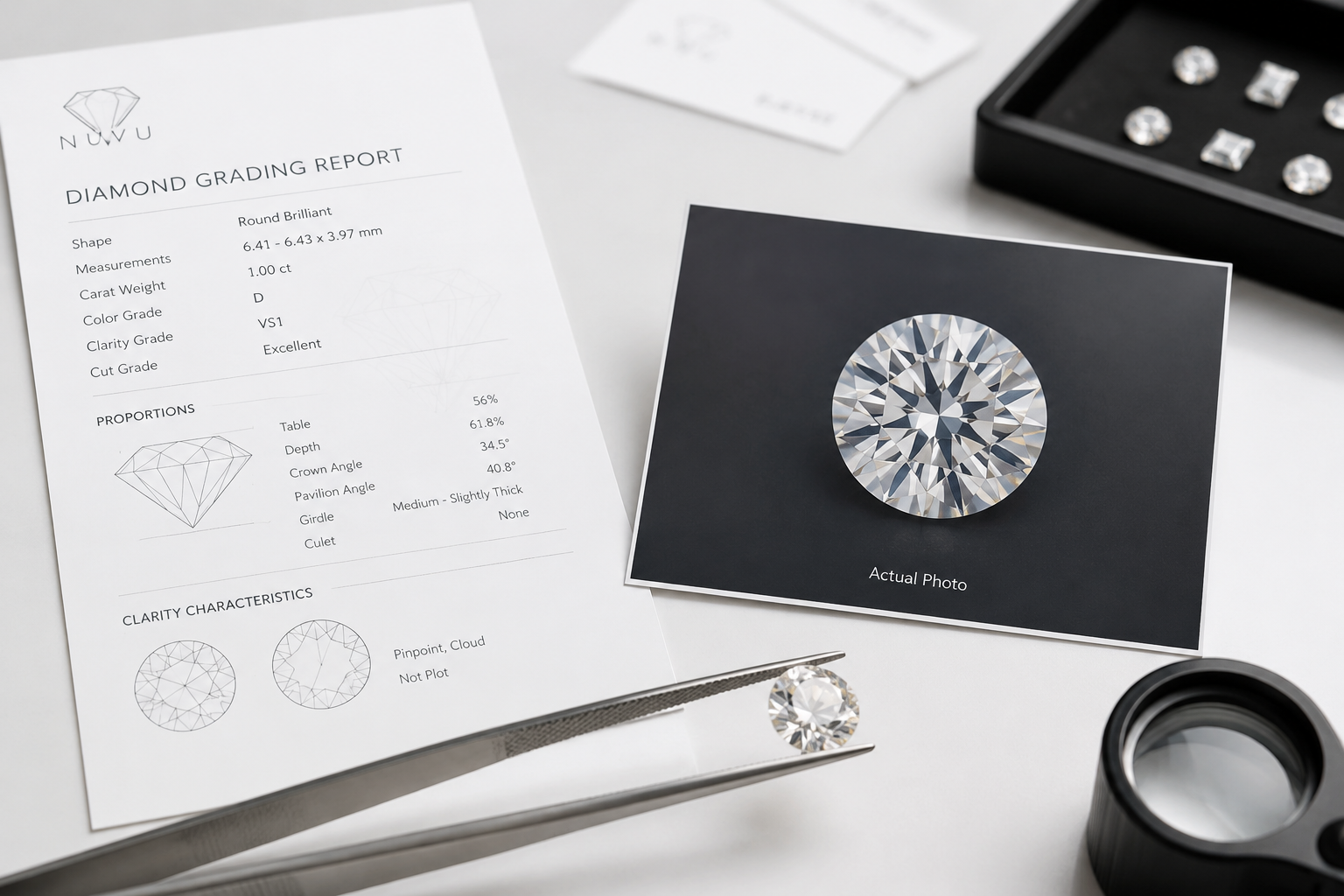
Visual review matters here because the report does not show how the stone actually appears in hand. A batch that looks consistent on paper may reveal visible differences in color or clarity when you see the stones side by side. The visual check is not optional. It is the only way to verify that the grading tier actually delivers what the document describes.
When a grading report is available across any MOQ tier, buyers should verify the report details through the issuing laboratory’s official report-check tool where available. This verification step helps confirm that the stone presented matches the report identifier, but it does not replace a visual inspection of the batch. A verified report number is one layer of documentation; side-by-side stone appearance under natural light remains the practical test of grading consistency within the same tier.
All diamonds discussed in this article with grading reports have been verified against official lab records where applicable. For stones graded by GIA, IGI, or HRD Antwerp, the grading consistency referenced across different MOQ tiers is based on report-to-stone matching protocols that are standard practice in the wholesale supply chain. We recommend requesting the grading report identifier for each stone in your order and independently verifying it through the issuing lab’s online check service as a routine step before finalizing payment.
Independent verification of grading reports is available through GIA’s online report check service for GIA-graded stones, and through equivalent systems operated by IGI and HRD Antwerp. This verification step provides an additional layer of confidence when evaluating a new supplier’s grading consistency at any MOQ tier.
Negotiating MOQ: What Is Flexible and What Is Not
Negotiation is possible, but only within limits that reflect the supplier’s actual cost structure. A buyer who assumes every MOQ is negotiable risks wasting time on suppliers whose model cannot support it. A buyer who understands where the flexibility lies can negotiate structure, not just numbers.
What Can Realistically Be Negotiated in a First Order
For a first-time buyer without a reference, the MOQ number itself is rarely waived entirely. The supplier has no reason to absorb the risk of a smaller order on the first transaction. What is negotiable is the structure of that minimum. A supplier may accept a mixed batch — multiple shapes or sizes — toward the same minimum, rather than requiring a separate MOQ per SKU. The supplier may also allow the buyer to pay for grading a few extra stones to widen selection within the same tier.
A trial MOQ at a slightly higher per-stone price is another realistic option. Within the logic of a lab grown diamond wholesale guide, the supplier concedes on volume but recovers margin on unit price. The negotiation should focus on finding a structure that works for both sides, not on demanding a lower number.
What Cannot Be Negotiated Without Existing Relationship
A high-MOQ supplier who operates direct manufacturing has fixed batch economics. The production line runs at a minimum efficient volume. Cutting a 300-stone batch to 10 stones is not profitable regardless of negotiation skill. The supplier loses money on grading, handling, and production setup.
The buyer who needs very small minimums should pursue suppliers whose model already supports that — small-batch producers or intermediaries who aggregate from multiple sources. Trying to change a high-volume supplier’s model is not negotiation. It is asking the supplier to operate at a loss. That request will be declined, and it may damage the relationship before it starts.
How to Use Trial MOQ to Build Negotiating Power for the Next Order
A buyer who completes a trial MOQ with consistent payment, clear specification, and no returns has real leverage. The supplier now has data: this buyer pays on time, communicates clearly, and does not create after-sale problems. That track record is worth more than any verbal request for a lower minimum.
Use the first order performance to negotiate the next tier. Ask for a reduced MOQ on the second order, better pricing, or acceptance of non-standard specs at the same minimum. The supplier is more likely to grant these concessions because the relationship already carries less risk. MOQ negotiation is earned through behavior, not demanded in the first conversation.
What to Document Before Negotiating MOQ for a Repeat Order
Record the exact terms of the first MOQ: number of stones, price per stone, grading lab, lead time, and any concessions the supplier made. When requesting a lower MOQ on the next order, reference these terms directly. Cite concrete data — on-time payment, zero returns, speed of the repeat order. The negotiation must be factual, not emotional. A supplier who sees a clean record is more likely to adjust terms than one who receives a demand without supporting evidence.
How MOQ Shapes Long-Term Cooperation and Supply Chain Stability
MOQ terms from a first order are useful, but how those terms behave over time tells a more complete story. A supplier who maintains consistent minimums across multiple quarters is signaling something important: they plan production and grading in advance, and they have the inventory depth to support repeat buyers. A supplier who frequently adjusts MOQ minimums is often managing inventory risk reactively, not strategically. Short-term changes can happen when a specific shape or size runs low, but long-term drift in MOQ policy may indicate operational instability. A buyer tracking this history gains a reliable relationship signal that no single order can provide.
Predictability over Time: Why Stable MOQ Matters
When MOQ terms remain steady across multiple order cycles, the buyer can plan inventory with confidence. A stable minimum means the supplier is not scrambling to clear overstock or shifting strategy between batches. This predictability allows the buyer to forecast cost per stone, set retail pricing, and avoid last-minute sourcing scrambles. At NUVU, our team treats a supplier’s MOQ history as a practical compatibility check. A supplier who has kept the same minimums through at least two quarters is far more likely to deliver consistent grading and lead time on the third order. Stability in MOQ is stability in the supply line.
How MOQ Affects Your Own Inventory Planning
A recurring MOQ commitment creates a predictable supply line. The buyer can forecast how many stones arrive per month, what grades to expect, and when to reorder. This makes matching easier, reduces emergency purchases at higher prices, and allows the business to hold only the cash it needs in inventory. The alternative is worse. When a supplier’s MOQ changes unpredictably, the buyer is forced to either overstock to meet a suddenly higher minimum or risk stockouts because a lower MOQ was discontinued. Long-term MOQ consistency benefits both sides because it removes guesswork from the inventory equation.
One aspect that buyers sometimes overlook is how MOQ stability interacts with seasonal demand cycles. A supplier whose MOQ remains consistent through the end of a quarter or during a holiday ramp-up period is more likely to have reliable production scheduling. If a supplier routinely lowers MOQ at the end of a quarter, it may simply be clearing inventory — which can offer a short-term price advantage but does not represent the standard cost structure the buyer should plan around.
When MOQ Alone Is Not Enough to Judge a Supplier
A low MOQ is attractive, but it does not compensate for poor grading consistency, slow shipping, or unreliable after-sales support. A low minimum that produces unpredictable results is worse than a higher MOQ from a supplier who delivers exactly what was ordered every time. MOQ must be weighed against communication quality, report accuracy, lead time reliability, and the supplier’s willingness to stand behind a batch. A supplier who answers questions slowly or ships stones that do not match their grading reports is not a good partner at any MOQ level.
How to Verify This Before Committing to a Multi-Order MOQ Agreement
The safest way to test a supplier before a long-term commitment is to run at least two independent orders at the same MOQ tier. The first order shows whether the supplier can deliver once. The second order reveals whether they can repeat that performance. Compare grading reports, stone appearance under natural light, delivery timing, and any after-sales issues. If the second order matches the first, the supplier has demonstrated repeatability. If it does not, the MOQ tier alone does not guarantee consistency across batches. That pattern will almost certainly persist as the relationship scales.
Beyond the Number: How MOQ Reflects Supplier Stability and Buyer Fit
When evaluating a supplier, MOQ is often treated as a single transactional detail. But for buyers who plan to grow with a supplier, the MOQ number and its behavior over time offer signals about operational stability that are more valuable than the price list itself. Understanding these signals helps avoid situations where a supplier’s cost structure changes or their inventory depth proves inadequate just when the buyer is ready to scale.
MOQ History as a Signal of Production Discipline
A supplier who can state a clear MOQ and maintain it across multiple inquiry cycles is demonstrating production discipline. They know their batch sizes, their grading capacity, and their inventory velocity well enough to quote a figure that does not change on the second conversation[1]. A supplier whose MOQ shifts depending on how many stones they currently hold or what shape is in fashion is managing order flow reactively. That reactive approach may still deliver good stones on a given order, but it makes long-term inventory planning difficult for the buyer. A buyer who needs predictable supply should favor the supplier whose MOQ is a stable policy, not a moving target.
How MOQ Scalability Indicates Supplier Capacity
Some suppliers can handle an MOQ of ten stones but cannot scale to an MOQ of one hundred without significant changes to their sourcing or production pipeline. Other suppliers have the rough allocation, cutting capacity, and grading bandwidth to scale minimums smoothly as the buyer’s business grows[3]. A buyer who plans to expand should ask the supplier directly about their maximum comfortable batch size, their lead time for larger orders, and whether they have ever turned down a buyer because they could not meet a higher MOQ requirement. The supplier’s answer reveals whether they are a growth partner or a short-term stop.
Why MOQ Structure Reflects Service Model, Not Just Price
A supplier who structures MOQ by individual SKU is optimizing for order management simplicity, not buyer flexibility. A supplier who allows mixed batches and pooled minimums is signaling a service model built around buyer relationships. Neither approach is wrong, but they serve different buyer types. The SKU-based minimum works well for a buyer who knows exactly what they need and orders repeat specifications in volume. The flexible minimum suits a buyer who is still exploring shapes and grades. Matching the supplier’s MOQ structure to the buyer’s purchasing pattern reduces friction over time.
Verifying MOQ Structure Before a Long-Term Agreement
Before signing a multi-order agreement, verify the supplier’s MOQ policy in writing across at least two different purchase cycles. Ask for a sample order to test the SKU versus pooled minimum distinction. Confirm that the policy for mixed batches is documented and that the price tier for a mixed order does not differ from a single-SKU order at the same total count. A verbal agreement that is not written into the order terms will not hold if a dispute arises.
Documentation and Traceability: How MOQ Relates to Supply Chain Transparency
MOQ discussions often focus on pricing and volume, but the minimum order quantity also interacts with how much documentation a buyer can request. A higher MOQ order may give the buyer more leverage to ask for batch-level grading summaries, rough source documentation, or growth method details. In sourcing conversations, documentation, consistency, and communication often matter as much as the headline specification. A buyer ordering at the supplier’s lowest MOQ tier should not assume that detailed documentation will be provided without a specific request.
For wholesale buyers, asking about traceability at the same time as MOQ terms is a practical approach. If the supplier can provide batch reference numbers or rough source information at a given MOQ level, that signals a more structured operation. If the supplier declines or states that such information is only available for orders above a certain volume, the buyer knows the documentation limit before committing. Transparency in documentation is not guaranteed by any MOQ tier — it should be confirmed in writing as part of the order terms.
In sourcing or wholesale conversations, documentation, consistency, and communication often matter as much as the headline specification. Buyers should ask about grading report identifier formats, batch reference numbers, and growth method documentation at the initial MOQ inquiry stage. A supplier who can provide these details across tiers is more likely to support traceability as the relationship scales.
Compliance and Consumer Trust: What MOQ Does Not Tell You About Sourcing Claims
When evaluating a supplier’s MOQ, buyers should be aware that the minimum order quantity itself does not provide information about how a supplier documents its stones. A low MOQ may be offered by a supplier that does not clearly distinguish laboratory-grown diamonds from natural diamonds in its inventory records. A high MOQ does not automatically mean the supplier provides better traceability or more reliable disclosure. The buyer should verify that the supplier’s documentation consistently identifies each stone as laboratory-grown wherever relevant, and that any environmental, ethical, or sourcing claims are supported by specific information rather than broad statements.
Environmental and sustainability claims are especially important to verify independently. Some suppliers may describe their laboratory-grown diamonds as “eco-friendly,” “sustainable,” or “green” without providing substantiating documentation about energy sources, production methods, or carbon accounting. These claims should be treated as marketing language unless the supplier can provide specific, verifiable information about their production practices. A buyer who relies on unsupported sustainability claims when marketing to their own customers assumes legal and reputational risk. The MOQ tier does not change this — a supplier’s documentation and disclosure practices should be evaluated separately from their volume requirements.
Similarly, ethical claims about laboratory-grown diamonds need clear support. A supplier may imply that lab-grown stones are inherently “conflict-free” or “ethical” by virtue of being laboratory-created. While laboratory-grown diamonds offer a different sourcing path from mined diamonds, the ethical profile of any given supplier still depends on their labor practices, supply chain oversight, and business transparency. Buyers should ask suppliers for written disclosure about their rough material sources, growth methods, and any third-party audits that support ethical claims. These questions should be raised during the initial MOQ negotiation, not after the relationship is established.
For wholesale buyers, the safest approach is to treat all sourcing claims — whether about sustainability, ethics, or origin — as claims that require documentation, not as inherent attributes of the product category. A grading report documents characteristics such as carat weight, color, clarity, and cut; it is not a guarantee of ethical sourcing, environmental impact, or investment value. Buyers should request separate documentation for any environmental or ethical claim the supplier makes, and should verify that claim through independent sources where possible. The MOQ tier may influence the supplier’s willingness to provide such documentation, but it should not determine whether the buyer asks for it.
[1] GIA, “G&G Lab Notes: Lab-Grown Diamonds,” Gems & Gemology, 2023. GIA article on lab-grown diamond grading and identification.
[2] IGI, “IGI Diamond Grading Reports for Lab-Grown Diamonds,” International Gemological Institute. IGI website on laboratory-grown diamond grading reports.
[3] FTC, “FTC Jewelry Guides: Guides for the Jewelry, Precious Metals, and Pewter Industries,” Federal Trade Commission, 16 CFR Part 23, 2018. FTC guidance on advertising and terminology for diamond products.
Disclosure: This article is for general educational purposes only. Diamond grading, pricing, availability, specifications, and seller policies can change, and readers should verify important details through grading reports, official laboratory tools, seller documentation, or qualified professionals before making a purchase decision. Laboratory-grown diamonds should be clearly distinguished from natural diamonds, and environmental or sourcing claims should be supported by specific documentation.