
When buying lab-grown diamonds wholesale, a grading report is the first thing you reach for—but it is not the final word on quality or value. Certificates from labs like GIA, IGI, and GCAL standardize the 4Cs, yet they cannot confirm authenticity, real-world appearance, or hidden durability issues. For jewelry brands, a certificate should function within a repeatable diamond sourcing system, because relying on a report number alone leaves you exposed to counterfeits, mismatched stones, and costly rejects that only surface during setting. This article walks through precisely what to verify on a certificate, how to cross-check the stone against its paperwork, and which traits—like fluorescence, growth lines, or internal strain—are never captured in a grade. By the end, you will have a clear inspection protocol that turns any grading report from a sales sheet into a genuine verification tool.
For the full framework, read Lab-Grown Diamond Suppliers and Wholesale Buying Guide.
| Report Item | What It Shows | What You Must Verify |
|---|---|---|
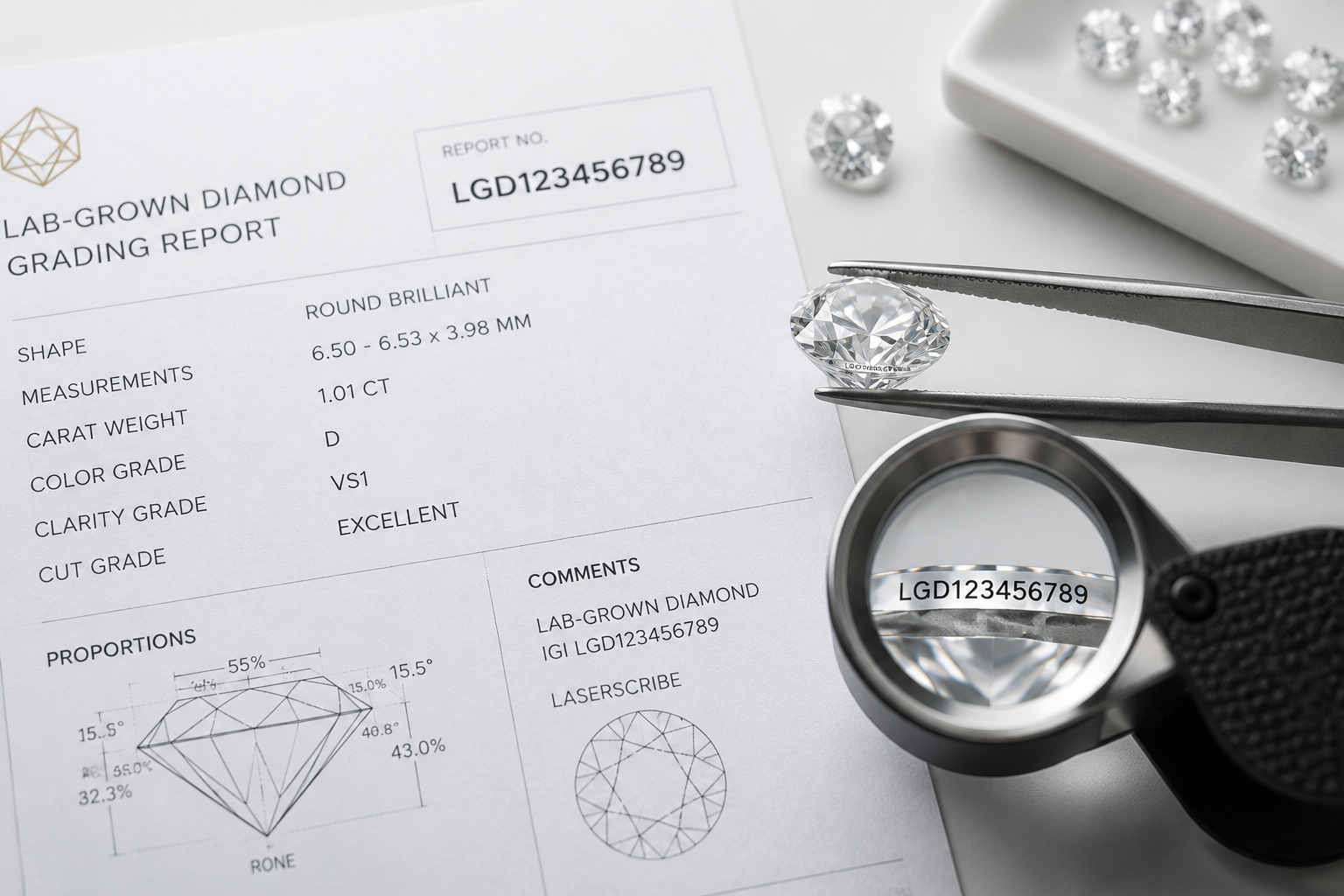
| Report number & laser inscription | Unique ID linking stone to certificate | Number matches girdle inscription; verify online via lab database |
| Weight, measurements, and grade | Carat, dimensions, color, clarity | Weigh and measure the physical stone; confirm face-up clarity with loupe |
| Lab grown method (HPHT or CVD) | Production process | HPHT may cause blue tint; CVD risks internal strain—inspect under magnification |
| Polish and symmetry grade | Surface finish and alignment | Excellent and Very Good are visually similar for most inventory; confirm with magnification |
| Fancy shape proportions | Length-to-width ratio, table, depth | No universal cut grade—compare L/W and pavilion angles against your design requirements |
| Fluorescence grade | Reaction under UV light | Strong or very strong can cause haziness; always request a daylight video |
| Growth lines & internal strain (not listed) | Hidden durability risks | Physically inspect CVD stones for unplotted lines; check for chipping risk during setting |
Quick Questions Before You Read
Q: Can I trust a grading report without checking the stone itself?
No. A certificate standardizes measurements but cannot confirm the stone’s identity, real-world clarity, or hidden strain. Always cross-check the report number, inscription, and dimensions with the physical diamond.
Q: Do lab-grown diamonds have different certificate concerns than natural stones?
Yes. Growth method (HPHT or CVD) and unplotted growth lines can affect durability and appearance. These traits are not captured in a grade and require physical inspection and a daylight video to evaluate.
Q: What is the most common mistake wholesale buyers make with certificates?
Treating the report as a quality guarantee instead of a starting point. Mismatched inscriptions, counterfeit database numbers, and hidden fluorescence or strain are all missed when buyers do not follow a structured verification protocol.
Q: Does a certificate from GIA, IGI, or GCAL automatically mean the stone is high quality?
No. The lab grade standardizes the 4Cs but omits visual and durability factors like fluorescence, growth lines, and internal strain. A high lab grade does not guarantee a stone is fit for your design or free of setting risks.
The Role of Certificates in Wholesale Diamond Sourcing: Risk vs. Trust
A grading report reduces uncertainty in a wholesale transaction, but it does not eliminate it. The report is a standardized summary of a stone’s measurable attributes, produced by a third-party laboratory. It tells you the carat weight, color grade, clarity grade, and cut quality according to that lab’s specific criteria. What it does not tell you is whether the stone in front of you is the same stone described on the paper, whether that paper is authentic, or how the diamond will actually perform in a finished piece. For a wholesale buyer working with volume, speed, and margin, this distinction matters. Treating a certificate as a guarantee rather than a reference point is one of the fastest ways to introduce risk into a purchase.
Why Certificates Are Non-Negotiable in Wholesale Buying
Without a grading report, every stone requires individual expert evaluation. That works for a single purchase, but it does not scale. In wholesale, the certificate standardizes the 4Cs across a supplier’s inventory, letting you compare stones by grade rather than by memory or opinion. GIA, IGI, and GCAL each use slightly different scales and terminology, but within a single lab’s system, the grades create a consistent pricing language. This baseline matters not just for price comparison but for financing, insurance, and eventual resale. A stone without a recognized report is harder to value, harder to finance, and harder to sell to a retail buyer. The certificate is not optional in B2B buying because the market has made it the universal reference point.
For the wholesale buyer, the practical tradeoff is clear: a certificate provides a shared language for comparing stones, but it does not replace the need to verify that the stone in hand matches the report. Relying on a certificate alone, without confirming the report number online and inspecting the stone physically, introduces a gap that can lead to costly mismatches. The certificate is a tool for efficient sourcing, not a substitute for due diligence.
The Limit of a Grading Report: What a Certificate Cannot Tell You
A grading report records what can be measured and classified under controlled conditions. It confirms carat weight, color, clarity, and cut grade. It does not confirm how the stone looks in the varied lighting of a retail showroom or a dining room. It does not confirm whether the stone’s fluorescence makes it appear hazy under broad daylight. It does not confirm whether the proportions will fit a specific engagement ring setting. A report also cannot prove ethical sourcing or responsible production. That claim depends on documentation from the grower, not the grading lab. The report is a measurement tool, not a trust document. In wholesale buying, the gap between what the report says and what the stone actually delivers is where the risk lives.
What to Check Before You Decide
Before committing to a wholesale purchase, treat the report as the starting point for verification. Confirm the report number matches the laser inscription on the stone’s girdle. If possible, measure the stone yourself and compare the dimensions to the report. These numbers should be identical, not just close. Ask the supplier for origin documentation in addition to the grading report. If the stone is already mounted or packaged, request unmounted photos or video. A face-up view under normal lighting tells you more about how the stone will perform than any single line on a certificate.
Key Certificate-Report Fields: The B2B Buyer’s Audit Checklist
Not every field on a grading report carries equal weight. Some fields are straightforward descriptors. Others are the primary tools for verifying whether the report actually belongs to the stone. A wholesale buyer needs to know the difference and must treat the verification fields as non-negotiable checkpoints.
Report Number, Date, and Lab Name
Every authentic grading report carries a unique number. GIA reports begin with a GIA prefix, IGI reports with IGI, and GCAL reports with GCAL. The report date should be recent. An older report may have been issued for a different stone or a previous transaction, and counterfeit reports frequently recycle valid numbers from older documents. The only reliable way to confirm authenticity is to enter the report number into the issuing lab’s public online database. If the database returns data that does not match the document in your hand, or if it returns nothing at all, reject the stone. This check takes less than a minute and should be standard practice before any payment is made.
Shape, Cutting Style, and Measurements
The shape and cutting style listed on the report must match the physical stone. This seems obvious, but mismatches happen more often than buyers expect, especially in bulk transactions where stones are handled by multiple parties. The measurements—length, width, and depth—are the most reliable verification tool. These numbers are recorded at the time of grading and are unique to that individual stone. A matched stone must have identical measurements. Close is not good enough. If the measurements differ, the report does not belong to the stone, regardless of what the laser inscription says.
Clarity, Color, Cut, and Polish/Symmetry
Each grade on the report directly affects pricing. A VVS1 stone costs more than a VS2 stone at the same weight. Colorless grades (D, E, F) are rarer and more expensive than near-colorless (G, H, I). For round brilliants, the cut grade determines light return and face-up brightness, and it should be at least Very Good for any stone you intend to sell. Polish and symmetry grades affect surface quality and facet alignment. Excellent and Very Good are the standard thresholds for resale-ready inventory. For fancy shapes, there is no official cut grade, so the buyer must rely on proportions and visual symmetry instead.
In practice, the grade on the report is a starting point, not a final verdict. A stone graded VS2 may appear cleaner face-up than a VS1 with inclusions clustered near the center of the table. Similarly, a color grade of G from one lab may look slightly different from the same grade issued by another. The report provides a framework for comparison, but the final judgment about a stone’s suitability for a specific customer or setting should always include a visual review under normal lighting.
Buyer Verification Checklist
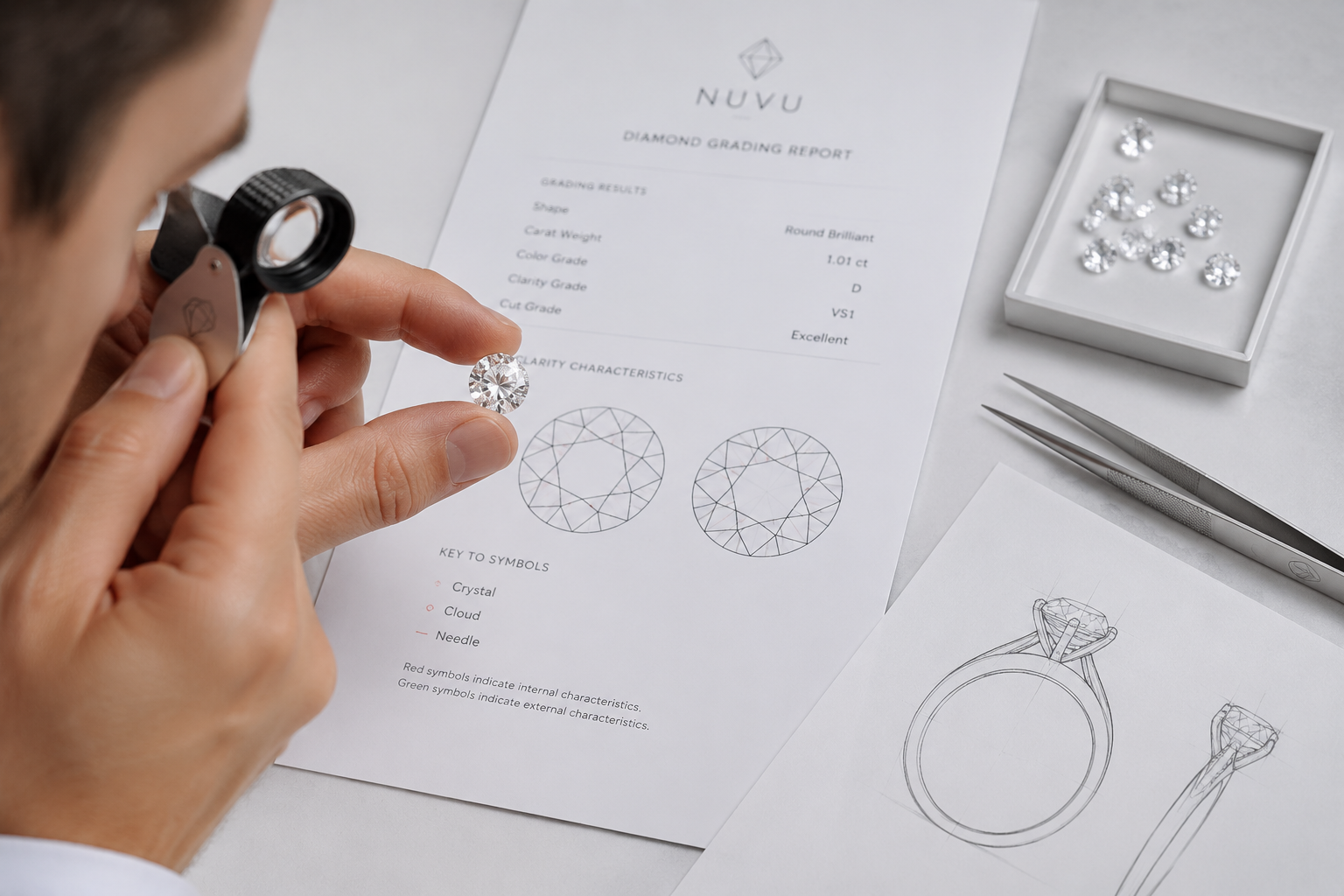
Review the clarity plot on the report against the actual stone under 10x magnification. The plotted inclusions should match what you see. Confirm the color grade by viewing the stone face-up under normal lighting. For round brilliants, confirm the cut grade is at least Very Good. For fancy shapes, verify the length-to-width ratio against your setting requirements before purchasing. Request video footage to evaluate face-up brightness and pattern, because a report cannot show you how the stone actually sparkles.
Growth Method Identification: HPHT vs. CVD on the Certificate
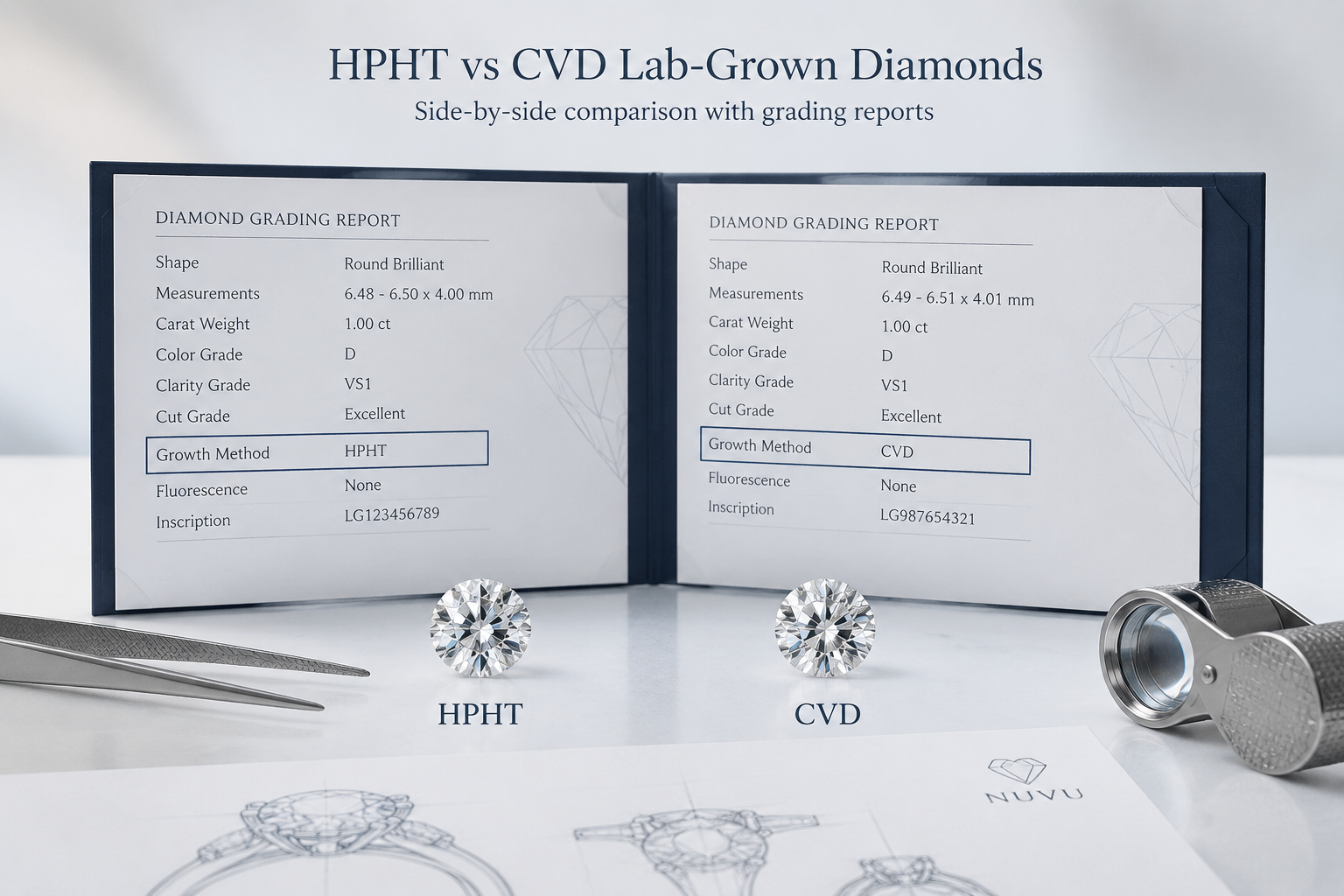
The growth method is not a minor detail on the report. It affects pricing, inventory planning, and resale potential. Every grading report for a lab-grown diamond must identify whether the stone was produced through HPHT (High Pressure High Temperature) or CVD (Chemical Vapor Deposition). These two methods produce diamonds with different characteristics, and a wholesale buyer should understand how each one affects the stone’s value and suitability.
HPHT (High Pressure High Temperature) Designation
HPHT diamonds are grown under extreme pressure and temperature, replicating the natural formation process in a controlled environment. These stones often achieve higher clarity grades because the growth method produces fewer internal features. The report will clearly state “Growth Method: HPHT.” One tradeoff is that HPHT diamonds can pick up a blue or brown tint from boron or nitrogen exposure during the growth process. This tint affects the color grade and must be factored into pricing. A well-grown HPHT stone with no tint and high clarity commands a premium in the wholesale market.
CVD (Chemical Vapor Deposition) Designation
CVD diamonds grow in a vacuum chamber at lower pressure, depositing carbon atoms layer by layer. This method tends to produce larger stones with more consistent color, but the layered growth can create visible growth lines, internal strain, or residual stress. The report will state “Growth Method: CVD.” CVD stones are generally less expensive than HPHT diamonds of comparable size and grade, but the pricing difference narrows at higher quality levels. A CVD stone with strong color, no visible growth lines, and high clarity can still command a strong price in retail.
For wholesale buyers, the growth method influences not just pricing but also how the stone communicates with end customers. Some retail buyers may prefer HPHT for its closer resemblance to natural diamond formation, while others may be indifferent. The key is to understand the characteristics of each method and to be able to explain them clearly. A stone that appears flawless on paper but has visible growth lines under magnification may be a poor fit for a customer who values visual perfection above all else.
Stone-to-Setting Fit Check
The growth method influences what happens after the stone leaves the chamber. HPHT stones can be annealed to remove unwanted color, and this post-growth treatment should be disclosed on the report. CVD stones may require further processing to improve clarity or reduce strain. Both treatments affect the stone’s durability and how it behaves during setting. If the stone is HPHT, confirm whether it has been treated. If CVD, inspect for internal strain lines under magnification, because excessive strain can make the stone brittle during mounting. A beautiful stone that cracks during setting is a total loss.
The Industry Standard for Disclosure: What the FTC and GIA Require
The requirement to clearly disclose a diamond as lab-grown is not merely a market convention—it is grounded in official trade guidance. The Federal Trade Commission (FTC) has published Jewelry Guides that address how lab-grown diamonds should be described in advertising and on certificates. These guides state that a diamond created in a laboratory must be identified using clear, unambiguous terms such as “laboratory-grown,” “laboratory-created,” or a similar phrasing that avoids implying the stone is natural. Using the shorthand “lab-grown” or “synthetic” alone without further context can create confusion, and industry best practice is to use the terminology adopted by the major grading labs on their own reports.[1]
GIA has published its own guidance on the terminology for lab-grown diamonds, emphasizing that the growth method—whether HPHT or CVD—is a descriptive fact about the stone’s origin, not a quality judgment.[2] Both GIA and IGI now include a dedicated field titled “Laboratory-Grown” or “Growth Method” on their grading reports, which is the only universally accepted way to confirm the stone’s origin. As a wholesale buyer, this field is your primary tool for distinguishing inventory. A report that does not explicitly state the growth method, or that uses ambiguous phrasing, should be treated with caution. The presence of a clear “Growth Method: HPHT” or “Growth Method: CVD” designation on a GIA, IGI, or GCAL report is a direct compliance signal that the stone’s origin has been verified by a third party.[3]
For B2B transactions, this disclosure has a direct impact on contract terms. A supplier who provides a certificate that does not clearly state the growth method is not meeting the disclosure standard that most wholesale buyers require for inventory management. If the certificate does not state “Laboratory-Grown,” or if it is a natural diamond report issued for a lab-grown stone, it is not a valid supporting document for a lab-grown diamond transaction. The buyer should reject the stone or demand a corrected certificate before payment. Any ambiguity about the growth method at the wholesale stage will only create larger problems when the stone is sold to a retailer or consumer.
Disclosure Checklist for Buyers
When reviewing a certificate for a lab-grown diamond and evaluating sourcing requirements for matched pairs and calibrated stones, the following checks should be non-negotiable for any jewelry brand assessing consistency, grading accuracy, and quality control:
- Confirm the report is specifically issued for a lab-grown diamond, not a natural stone.
- Verify that the “Growth Method” field is present and states either “HPHT” or “CVD.”
- If the certificate does not include this field, ask the supplier for a revised certificate or a written statement of the growth method from the issuing lab.
- Ensure the terminology used in accompanying sales materials matches the disclosure on the certificate, avoiding any language that could imply the stone is natural.
These steps protect the buyer from receiving inventory that cannot be legally or clearly resold. A stone with proper disclosure is a standard inventory asset. A stone without clear origin documentation is a liability.
The Laser Inscription: The Physical Link Between Stone and Report
A grading report is only useful if it actually belongs to the diamond you are buying. The laser inscription on the girdle is the most direct way to confirm that link. Without it, you are relying on secondary checks that leave more room for error.
Standard Inscription Format
Most lab-grown diamonds carry a laser inscription on the girdle that matches the report number. This is a deliberate feature, not an afterthought. The inscription is measured in microns and is invisible to the naked eye. You need a 10x loupe or a microscope to read it. If the inscription is present and matches the report number exactly, the certificate is very likely authentic. This is the simplest verification step in wholesale buying, and it should never be skipped.
When the Inscription Is Missing or Mismatched
Not every stone has a laser inscription. Smaller diamonds or lower-value stones are sometimes shipped without one to save cost. In other cases, the inscription may be partially worn, poorly aligned, or placed in a location that makes it hard to read. When the inscription is missing or mismatched, the certificate alone does not prove ownership. The buyer must verify every other field on the report against the physical stone — measurements, carat weight, color grade, and clarity plot. If any of those fields do not match, the report should be treated as invalid. Request a new certificate from the supplier or reject the stone entirely.
From a practical standpoint, a missing inscription is not automatically a red flag, but it does shift the burden of proof entirely onto the buyer. Without that direct link, you are forced to rely on measurements and visual inspection alone. For a wholesale buyer managing volume, this extra step can slow down the process. One useful approach is to establish a clear policy with your supplier upfront: if a stone arrives without an inscription, the supplier is responsible for providing additional verification, such as a magnified photo or a video showing the stone from multiple angles. This sets expectations and reduces the risk of accepting a mismatched stone.
Certificate and Visual Review Check
Inspect every loose diamond with tweezers under a loupe or microscope before accepting delivery. Locate the inscription on the girdle and compare it character by character to the report number. If you cannot read the inscription because of its size or location, ask the supplier for a magnified photo or a better view. If the inscription does not match, do not accept the stone under any circumstance. If there is no inscription at all, proceed to verify every other field on the report, starting with the dimensions. A stone without an inscription is not automatically fraudulent, but it demands a higher level of scrutiny before payment is released.
Polishing and Symmetry Grades: The Wholesale Buyer’s Hidden Pricing Indicators
Carat weight, color, and clarity get most of the attention, but polish and symmetry grades often separate a good deal from a bad one. These two fields directly affect how the stone looks face-up and how much it costs. For wholesale buyers, understanding them is a practical pricing skill.
Polish Grade: Surface Quality and Light Return
Polish grade measures how smooth the diamond’s facets are. Excellent polish means no visible surface defects, even under 10x magnification. Very Good polish may have slight imperfections that are not visible to the naked eye. Good polish can show minor defects under magnification that may mildly affect light return. Lower polish grades reduce the stone’s brightness because light scatters off surface irregularities instead of passing through cleanly. For wholesale inventory, Excellent and Very Good are the standard thresholds. Good polish may be acceptable for lower-cost stock, but it will reduce resale value and visual appeal compared to a higher-graded stone of the same weight and clarity.
Symmetry Grade: Facet Alignment and Pattern
Symmetry grade measures how well the facets align with each other. Excellent symmetry means the facets are perfectly matched, producing an even, balanced pattern. Very Good symmetry has minor misalignments that are not visible to the naked eye. Good symmetry may have noticeable misalignments that affect the stone’s visual pattern, especially in fancy shapes. For rounds, poor symmetry can make the diamond appear lopsided under direct light. For fancy shapes like ovals and pears, symmetry is even more important because misalignment creates an uneven silhouette that is immediately visible to the untrained eye. Avoid symmetry grades below Very Good for any stone you intend to sell to a retail customer.
What This Means in a Real Purchase
When comparing two diamonds with identical carat weight, color, and clarity, the stone with Excellent polish and symmetry will always cost more. The question for a wholesale buyer is whether that premium is justified. For most inventory, Very Good polish and symmetry represent a cost-effective threshold. The stone looks identical to Excellent to the naked eye, but carries a lower wholesale price. For high-margin or bridal pieces, where the buyer expects the best possible grade on paper, Excellent is the safer choice. The difference matters more on the resale sheet than in the display case.
One nuance that wholesale buyers should be aware of is that the polish and symmetry grades are assigned by the lab based on standardized criteria, but the visual impact of a Very Good vs. Excellent grade can vary significantly depending on the stone’s cut and shape. A round brilliant with Very Good symmetry may still appear perfectly balanced to the naked eye, while a fancy shape with the same grade may show a subtle asymmetry that is more noticeable. The buyer’s judgment should be guided by the specific stone and its intended use, not just the grade on the report.
Fancy Shape Certificates: Additional Fields You Cannot Ignore
Round brilliant diamonds follow a standardized cut grading system. Fancy shapes do not. Because there is no universal cut grade for ovals, pears, cushions, or emerald cuts, the report fields that describe proportions become the primary tool for evaluating quality. Ignoring them is one of the most common mistakes in wholesale fancy-shape buying.
Length-to-Width Ratio (L/W)
The L/W ratio determines the silhouette of a fancy-shaped diamond. For ovals, pears, marquise cuts, and cushions, this ratio is the single most important visual descriptor. A lower ratio, roughly 1.30 to 1.35, creates a squarer appearance. A higher ratio, around 1.45 to 1.50, creates a more elongated look. Neither is inherently better — the ideal ratio depends on the setting and the end buyer’s preference. For engagement rings, 1.35 to 1.45 is the most common range. For earrings, a slightly higher ratio is often preferred because the elongation complements the vertical line of the ear. If you are sourcing for a specific setting, confirm the acceptable L/W range with the jeweler or designer before ordering.
Table Percentage and Crown/Pavilion Angles
For fancy shapes, the table percentage and crown and pavilion angles directly affect brilliance. A table percentage between 55 and 65 percent is standard. Crown angles in the 34- to 35-degree range paired with pavilion angles between 40.6 and 41.8 degrees produce strong light return. If any of these values fall outside the ideal range, the stone may appear dark in the center, washed out, or develop a “fish-eye” effect where the girdle reflects as a visible ring. These problems cannot be corrected by the setting. They are permanent structural issues. Always check these values on the report before purchasing, and reject any stone whose proportions fall outside the standard range, regardless of price.
It is worth noting that the ideal proportion ranges for fancy shapes are not universally agreed upon by all labs or industry experts. Different cutters and designers may have slightly different preferences. The ranges provided here represent a commonly accepted starting point, but the final decision should be guided by how the stone performs visually. A stone with proportions just outside the standard range may still perform well if the crown and pavilion angles are well-matched. The report provides the data, but visual inspection under real lighting conditions is the ultimate test.
Stone-to-Setting Fit Check
Before buying a fancy shape for a specific setting, confirm the L/W ratio and total depth with the person making the ring. A three-stone ring, for example, works best with an oval that has a ratio of 1.40 to 1.50, because the center stone needs to visually balance the two side stones. A stone that is too deep may require a higher setting, which can cause the ring to sit uncomfortably or snag on clothing. The total depth, which combines the crown height and pavilion depth, is listed on the report. If the depth is above 65 percent, the stone may sit too high for a standard prong setting. For a wholesale buyer, this is not a minor detail — it determines whether the stone will fit the intended inventory or require costly custom work.
Fluorescence, Strain, and Internal Growth Features
A grading report tells you most of what you need to know about a diamond’s internal characteristics, but it does not tell you everything. Three features in particular—fluorescence, growth strain, and internal inclusions—require more than a grade on paper. For wholesale buyers planning to resell or set these stones, understanding how these features behave in real light and under magnification is essential.
Fluorescence: What the Report Says vs. What You See
The report will list fluorescence as None, Faint, Medium, Strong, or Very Strong. In lab-grown diamonds, strong fluorescence is uncommon but not unheard of. The practical issue is not the fluorescence grade itself but how the stone reacts to daylight. A diamond with strong fluorescence can appear hazy or milky under broad-spectrum lighting, which dramatically reduces its visual appeal.
For most inventory, faint to medium fluorescence is acceptable and rarely causes visible issues. Strong or very strong fluorescence is a different category. It can make a colorless or near-colorless stone look washed out, which destroys resale value. If a report lists strong or very strong fluorescence, do not rely on the grade alone. Request a video of the stone under daylight or a broad-spectrum light source. If the stone looks hazy, reject it, regardless of its other grades.
Internal Growth Features and Strain
The clarity plot on the report shows where internal features such as crystals, clouds, feathers, and pinpoints are located. But for lab-grown diamonds, the most common internal issue is not always plotted: growth lines and strain. This is especially true for CVD stones. Growth lines may appear as faint bands under magnification, and strain can show up as a dark or colored band running through the stone.
Strain matters because it affects durability. A stone with excessive internal strain can be brittle during setting, increasing the risk of chipping or breaking under pressure from a prong or bezel. Even if the clarity grade is high, a CVD stone with visible strain lines may not be a safe choice for a mounting that requires tension or a tight fit.
For wholesale buyers, the challenge with growth lines and strain is that they are not always visible under standard 10x magnification. A stone may appear clean on the clarity plot and under a loupe, but under higher magnification or with polarized light, strain bands may become apparent. If you are sourcing CVD stones for high-end settings or designs that require tight-fitting prongs, it is worth investing in a polarized filter or working with a supplier who can provide detailed imaging. This extra step can prevent a stone from failing during setting, which is a costly and time-consuming problem.
Buyer Verification Checklist
If the report shows multiple clarity features clustered near the center of the table, ask for a close-up photo or video of the stone face-up. A cluster of inclusions near the table can become visible to the naked eye once the diamond is set. For CVD stones, ask the supplier to confirm whether growth lines or strain are visible under 10x magnification. If the stone shows significant strain or growth lines across the center of the table, it may not be suitable for a high-end setting where visual clarity matters most.
Verification of Internal Features Through Imaging
One of the most effective ways to bridge the gap between the report and the physical stone is through high-resolution imaging. A report’s clarity plot uses standardized symbols to represent inclusions, but it cannot show the actual visual impact of those features. For wholesale buyers, requesting digital images or videos that focus on the clarity plot areas can confirm whether the plotted inclusions are as benign as the grade suggests, or whether they are clustered in a way that detracts from the stone’s face-up appearance. This is especially relevant for stones with a clarity grade of SI1 or SI2, where the location and size of inclusions can vary widely between stones that share the same grade.
Polarized light imaging is another tool worth understanding. While not standard in most wholesale transactions, polarized light can reveal internal strain in CVD diamonds that is invisible under regular magnification. If a supplier is able to provide this type of imaging for their CVD inventory, it represents a higher level of transparency about the stone’s structural integrity. For a buyer sourcing stones that will be set in tension settings or designs with high mechanical pressure, this additional imaging information can be a valuable risk-reduction step.
Certificate Verification Tools: How to Confirm Your Report Is Real
A grading report is only as reliable as the stone it came with. Counterfeit and altered reports exist in the wholesale market, and the buyer is responsible for confirmation. Fortunately, the major labs provide free tools that make verification straightforward.
Online Verification Databases
GIA, IGI, and GCAL each maintain a public online database. Enter the report number, and the system returns the stored data for that stone. GIA’s Report Check service is free and displays the full grading details, including carat weight, color, clarity, cut, and measurements. IGI’s lookup is also free but may not show every field depending on the report version. GCAL’s verification tool includes a reference image of the stone, which adds a visual confirmation layer.
Always check the report number against the database before committing to a purchase. If the database returns different data—a different carat weight, a different clarity grade, or different measurements—the report is fraudulent. Do not negotiate. Reject the stone.
It is worth noting that the databases from different labs do not all offer the same level of detail. GIA’s Report Check is the most comprehensive, providing full grading data and a digital image of the stone. IGI’s lookup is generally reliable for core fields like weight and measurements, but some older reports may have more limited data, a point that is especially relevant in a lab grown diamond wholesale guide where report consistency supports supplier evaluation. GCAL’s tool includes a reference image, which adds a useful visual confirmation layer. For high-value stones or large orders, consider verifying the report through multiple channels or requesting a new report directly from the lab to eliminate any doubt.
QR Codes and Digital Signatures
Many modern reports include a QR code printed on the document. Scanning the code should take you directly to the lab’s verification page, not a third-party site. Some reports also feature a digital signature or watermark designed to prevent counterfeiting. These security features make forgery harder but not impossible.
For high-value stones, do not rely on a photocopy or a scanned PDF. Request a new report issued directly from the lab, or ask the supplier to provide a certificate that was printed at the time of grading. A report that was scanned, photocopied, or forwarded through multiple hands should be treated with extra scrutiny.
How to Verify This Before Buying
Before sending payment for a wholesale order, verify the report number on the lab’s website. For GIA reports, use the GIA Report Check service. For IGI, use the IGI Report Lookup. For GCAL, use the GCAL Verification tool. If the online database returns different data for carat weight, color, clarity, or measurements, reject the stone immediately. For large orders or high-value individual stones, consider requesting a new report from the supplier or submitting the stone to a third-party lab for independent verification.
Understanding the Limitations of Online Verification
Online verification databases are an essential tool, but they are not infallible. A stone can pass an online report check and still be mismatched if the laser inscription was fraudulently applied. This is rare, but it has occurred in the wholesale market. The online check confirms that the report number exists in the lab’s records, but it does not confirm that the physical stone you are holding is the one described. That final link depends on physically matching the inscription and measurements.
Additionally, some older or non-standard reports may not be fully searchable in online databases. GIA reports issued prior to the early 2000s, for example, may not appear in the digital Report Check system. In such cases, the buyer should request additional documentation from the supplier, including proof of original grading or a new report. For lab-grown diamonds, which are a more recent category, this issue is less common, but it is worth being aware of for any inventory that includes older stock or stones from less commonly used labs.
Building a Wholesale Verification Protocol: From Report to Inventory
Running these checks once is not enough. To protect your inventory and your reputation, the verification process must be repeatable. Every stone that enters your stock should go through the same sequence, from the initial report review to the final physical inspection.
Your Pre-Trade Checklist
Before you buy, run the report number through the lab’s database. Confirm that the growth method matches your inventory needs—HPHT stones and CVD stones have different price structures and different visual characteristics. Check the fluorescence rating. For fancy shapes, verify the L/W ratio against your setting requirements. Compare the stated measurements to the dimensions needed for the intended mounting. Review the polish and symmetry grades to ensure they meet your threshold for resale. If every field on the checklist passes, proceed to the physical inspection.
Your Post-Trade Physical Inspection
When the stone arrives, do not skip the physical check. Start with the laser inscription on the girdle. Compare it to the report number using a 10x loupe or microscope. Then measure the stone’s length, width, and depth using a calibrated gauge or digital caliper. The measurements must match the report exactly, not approximately. Inspect the stone under magnification for visible inclusions, growth lines, or strain that were not obvious on the clarity plot. View the stone face-up under daylight to check for haziness, especially if fluorescence was listed as strong or very strong.
If everything matches, log the stone into inventory with the report number and verification date. If anything is off, flag the stone immediately and contact the supplier. Do not assume a minor mismatch is an error. A difference in measurements or a missing inscription is grounds for rejection.
Aligning Your Protocol with Industry Standards
An effective verification protocol is not just about internal efficiency—it also aligns your purchasing process with the compliance standards that apply to the broader diamond trade. The FTC’s Jewelry Guides emphasize that any claim about a product’s origin, including whether a diamond is lab-grown, must be clearly and conspicuously disclosed.[4] By verifying that every stone arrives with a certificate that uses the correct terminology and comes from a recognized lab, you are building a documentation trail that supports your own compliance efforts when you sell to retailers or consumers.
GIA has also published guidance on what to look for in a lab-grown diamond report, noting that the report should clearly state the growth method and that buyers can use the lab’s online Report Check service to verify the document’s authenticity.[5] Including this step in your standard operating procedure ensures that your team’s verification practices are consistent with the recommendations of the world’s most recognized gemological laboratory. For a wholesale buyer, there is no stronger defense against counterfeit documentation than a verification step that is itself based on official industry guidance.
Over time, a well-documented verification protocol does more than prevent individual errors—it builds a reputation for reliability with your own buyers. Retailers who purchase from a wholesaler with a clear, documented, and repeatable verification process can trust that the inventory they are receiving is properly described, correctly graded, and fully traceable back to an official grading report. This trust is a market advantage that compounds over time, reducing the number of returns and disputes and strengthening long-term customer relationships.
Documentation Management for Long-Term Traceability
Beyond the initial verification, traceability depends on how you manage documentation over the life of the inventory. Every report number, verification date, and supplier communication should be logged in a system that allows quick retrieval. For a wholesale buyer managing hundreds or thousands of stones, this documentation is the only way to prove the chain of custody if a question arises months or years later. Digital storage of report PDFs, verification screenshots, and inspection notes creates a durable record that outlasts any single transaction. In a dispute, this record is more persuasive than a supplier’s verbal assurance.
It is also worth considering how your documentation practices communicate trust to your own downstream buyers. When you sell a stone that has been verified through a documented, repeatable process, you can share that verification history with retailers. This reduces the time they spend verifying stones themselves and increases confidence in your inventory. For a wholesale business, documentation is not just a back-office task—it is a competitive differentiator that signals operational discipline to other professionals in the supply chain.
Establishing Your Certification Policy
To make your verification protocol a permanent part of your business, codify it in a written policy. The policy should specify:
- The minimum acceptable lab (e.g., GIA, IGI, or GCAL) for all stones above a specific weight or value.
- The required fields on the certificate (report number, growth method, measurements, fluorescence, and all 4Cs).
- The steps for physical inspection, including loupe and measurement checks.
- How to handle rejected stones, including the process for requesting corrected documentation from the supplier.
Distribute this policy to your purchasing team and review it annually. A written policy turns best practices into enforceable standards, protecting your business from the cost of counterfeit or mismatched inventory.
Managing Supplier Relationships Through Transparent Verification
An often-overlooked benefit of a structured verification protocol is the clarity it brings to supplier transactions. When a buyer consistently documents their verification steps—report number checks, measurement confirmations, and inscription reviews—it creates a transparent record that can be shared with suppliers. This transparency reduces the likelihood of disputes, because both parties agree on what was inspected and what was accepted. For long-term wholesale relationships, this shared documentation builds trust by removing ambiguity about the condition of the inventory at the time of delivery.
If a mismatch or issue is discovered during verification, a documented process allows the buyer to present clear evidence to the supplier. A request for a corrected certificate or a replacement stone is far more persuasive when accompanied by a verification log that pinpoints exactly where the discrepancy occurred. Over time, suppliers who know that a buyer uses a rigorous verification protocol are more likely to prioritize accurate documentation and quality control in their own shipments. This mutual accountability strengthens the entire supply chain, reducing errors before they reach the buyer’s inventory.
Communication Checklist for Supplier Discrepancies
When a stone does not match its certificate, a clear communication path is essential for resolution. The following steps help maintain a professional and efficient process:
- Immediately flag the discrepancy to the supplier, including the report number, the specific mismatched field, and photographic or video evidence where possible.
- Request the supplier’s preferred resolution method: a replacement stone, a corrected certificate from the issuing lab, or a return authorization.
- Document all communications and the supplier’s response for future reference and for inclusion in your inventory tracking system.
- If the discrepancy is a recurring issue with a specific supplier, schedule a review of their quality assurance processes to identify the root cause.
This structured approach turns a potential conflict into a routine business process, minimizing disruption and preserving the professional relationship.
Certificate and Visual Review Check
Create a standard operating procedure for your purchasing team. The sequence should be: verify the report number online first, confirm the laser inscription on the stone, measure the stone’s dimensions against the report, inspect under magnification for inclusions and strain, and compare the reported color and clarity grades to what you see under normal lighting. Document every step. A written record protects you in disputes with suppliers and provides an audit trail for quality control. This protocol reduces the risk of accepting a mismatched or counterfeit stone and gives your team a clear process to follow on every order.
When a grading report is available, buyers should verify the report details through the issuing laboratory’s official report-check tool where available. For GIA reports, this means using the GIA Report Check service. For IGI and GCAL reports, the respective online lookup tools serve the same purpose. Relying on a certificate without this verification step introduces a gap that can only be closed by cross-referencing the physical stone against the report’s recorded data.
[1] Federal Trade Commission, “Guides for the Jewelry, Precious Metals, and Pewter Industries,” 16 CFR Part 23, especially Section 23.4 (use of name “diamond” for laboratory-created stones), available at: ftc.gov.
[2] GIA, “Lab-Grown Diamonds Terminology and Identification,” GIA.edu, laboratory-grown diamond learning page.
[3] GIA, “Lab-Grown Diamonds,” GIA.edu, educational resource on how GIA identifies and grades lab-grown diamonds.
[4] Federal Trade Commission, “Guides for the Jewelry, Precious Metals, and Pewter Industries,” 16 CFR Part 23, Section 23.4.
[5] GIA, “How to Verify a GIA Report,” GIA Report Check service, GIA.edu.
Disclosure: This article is for general educational purposes only. Diamond grading, pricing, availability, specifications, and seller policies can change, and readers should verify important details through grading reports, official laboratory tools, seller documentation, or qualified professionals before making a purchase decision. Laboratory-grown diamonds should be clearly distinguished from natural diamonds, and environmental or sourcing claims should be supported by specific documentation. The verification methods described are intended as buyer guidance and do not constitute a guarantee of a stone’s quality, authenticity, or suitability for any particular use.