
Custom lab-grown diamond jewelry sourcing from China works best when the buyer treats it as a managed production process, not a simple order. The real challenge is aligning the design, stones, metals, size range, branding, packaging, and timing against China wholesale order planning expectations before a supplier starts making samples. If any of those details are vague, quotes become unreliable and the first sample often misses the target.
For the full framework, read China Lab-Grown Diamond Supply Chain Guide.
Laboratory-grown diamonds should be clearly identified as laboratory-grown, and they should not be presented as mined diamonds. They are diamonds with a laboratory-grown origin, not diamond simulants, and buyer-facing descriptions should keep that origin clear across product pages, invoices, packaging, and documentation.
This article shows how OEM and private label projects move from brief to CAD, sample, batch production, and final inspection. It helps readers judge when to approve a design, how to compare stones and finishes, and what to check before scaling beyond a test run. The goal is to reduce avoidable revisions, protect product quality, and choose a supplier that can repeat the approved result consistently.
| Stage | What to Confirm | Common Risk |
|---|---|---|
| Project brief | Design, metal, stone specs, quantity, branding, packaging | Quotes based on guesswork |
| CAD review | Stone fit, proportions, setting height, logo placement | Good design that cannot be manufactured well |
| Stone selection | Center-stone grading, melee batch standards, visual match | Inconsistent appearance across pieces |
| Sample approval | Comfort, finish, prong look, engraving, durability | Passing a sample that still has wear issues |
| Test run | Repeatability, sizing, packaging, customer response | Scaling a design before it proves stable |
| Final QC | Stone security, quantity, finish, packaging, labeling | Shipment errors that are expensive to fix |
Quick Questions Before You Read
Q: What is the difference between OEM and private label?
OEM turns your design into a product. Private label adds your branding, packaging, and retail presentation.
Q: Why does CAD approval matter if a sample will be made anyway?
CAD is where fit, proportions, and setting details are checked before time and money are spent on production.
Q: Do lab-grown diamond certificates solve everything?
No. They help verify the stone, but design fit, matching, and finish still need separate review.
A grading report helps document key characteristics, but it should not be treated as a guarantee of beauty, value, sourcing ethics, or long-term market performance.
Q: Why do brands test small batches before placing larger orders?
Small runs show whether the piece is comfortable, repeatable, and packaged correctly before full scaling.
How China-Based OEM and Private Label Jewelry Production Usually Works
Custom lab-grown diamond jewelry from China usually works as a coordinated production process, not a simple product order. A buyer is not just choosing a ring from a catalog. They are asking a supplier to interpret a design, source or match stones, create production-ready files, make a sample, confirm details, and then repeat the result across a batch with acceptable consistency.
The strongest China-based suppliers are often valued for flexibility and coordination. A project may involve CAD support, stone matching, metal production, setting, finishing, logo work, packaging, inspection, and delivery preparation under one workflow. Price still matters, but it should not be the only reason to choose a China lab-grown diamond jewelry supplier. A lower unit cost is not useful if the CAD is misunderstood, the stones are inconsistent, or the sample is approved without enough review.
China-linked supply chains can offer manufacturing depth and scale in some categories, but buyers still need to evaluate consistency, documentation, communication, and quality control for the specific supplier and product type.
In practical buying, the most useful supplier comparison is rarely a single headline number. A quote should be read together with the assumed metal purity, diamond specifications, grading report requirements, melee matching standard, packaging scope, revision process, and inspection method. If two suppliers quote different prices, the first question should be whether they are pricing the same product and the same level of control.
Prices can change with market conditions, report type, seller channel, stone-specific details, metal costs, packaging choices, and production requirements, so exact comparisons should be verified at the time of purchase.
Traceability in an OEM project is created through records that connect each decision to the next stage: the brief, quoted specification, CAD version, stone standard, sample approval, batch instruction, packaging artwork, and final QC review. These records do not need to be complicated, but they should be organized enough that a buyer can understand which version was approved and which materials or stones belong to each SKU.
The typical project flow from idea to finished jewelry
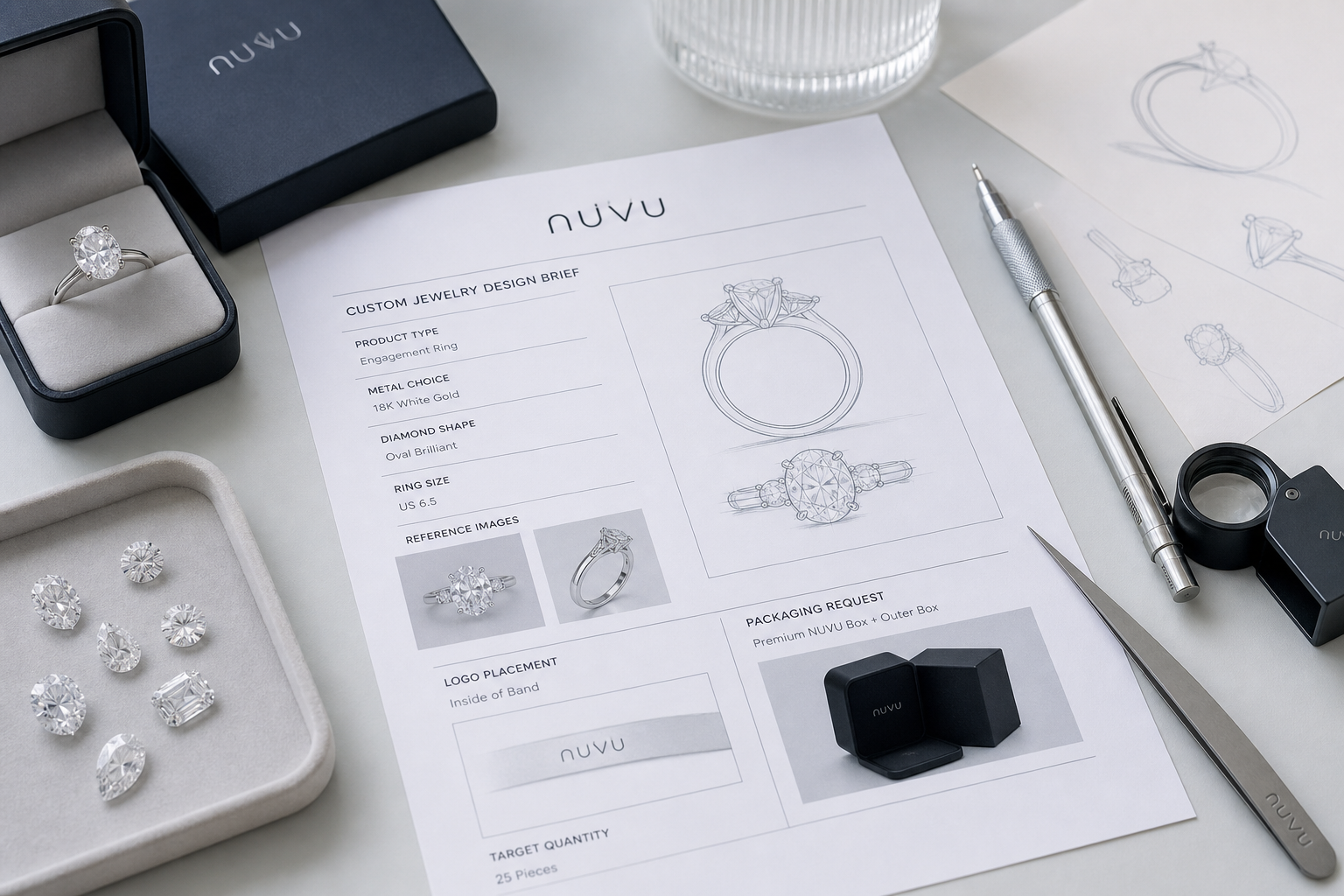
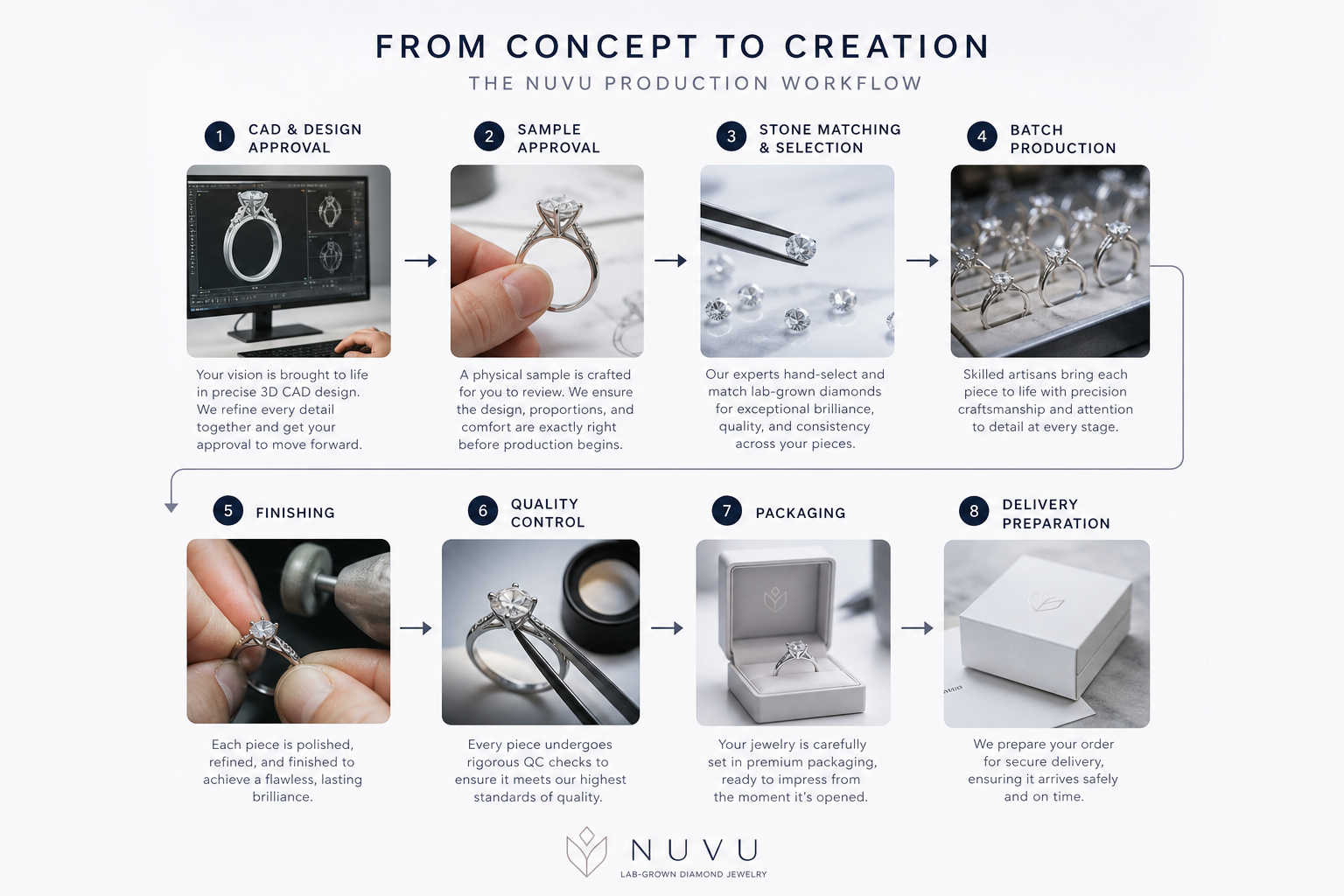
Most OEM jewelry manufacturing projects begin with a design brief. The buyer shares the product type, visual direction, metal preference, stone requirements, size range, quantity target, and any branding or packaging needs. The supplier uses that information to quote the project, discuss feasibility, and decide whether CAD design is needed before sampling.
Once the brief is clear, the supplier usually moves into CAD jewelry design or rendering. This step translates the concept into a production plan. After CAD review, the supplier confirms stone selection or stone matching, then creates a sample or prototype. The sample is the first real test of proportion, comfort, setting style, finish, logo placement, and overall presentation.
After the buyer approves the sample and final specifications, the project moves into batch production. At that point, changes become more expensive and more disruptive because materials, stones, molds, settings, packaging, and labor have already been planned around the approved version. Quality control and delivery preparation usually happen near the end, but buyer expectations for inspection should be discussed much earlier.
Actual timelines vary. A simple solitaire ring with available stones may move faster than a multi-SKU collection with pavé settings, mixed metals, custom packaging, and several ring sizes. Order quantity, stone availability, supplier workload, design revisions, and packaging requirements can all change the schedule. A reliable process is less about speed alone and more about whether each approval point is documented before the next stage begins.
What OEM means in custom lab-grown diamond jewelry
OEM means the supplier manufactures jewelry based on the buyer’s design, specifications, or product concept. In custom lab-grown diamond jewelry, that may include creating a ring, pendant, bracelet, earring, or collection according to the buyer’s requested metal, stone shape, setting style, size range, and finish. The buyer controls the product direction; the supplier handles the production execution.
The practical advantage of OEM jewelry manufacturing is that it can turn a brand’s idea into a repeatable item. This is especially useful for brands that want more control than standard wholesale catalog buying allows. A boutique seller, for example, may want a specific oval lab-grown diamond ring with a lower setting, a slightly wider band, and a hidden halo that matches its design language. OEM production makes that possible, but only if the brief, CAD, sample, and approval process are handled carefully.
The main risk is assuming that “custom” means the supplier will automatically understand the buyer’s expectations. Factories work from specifications, not vague taste. If the buyer does not define the stone size range, metal type, setting height, ring sizes, finish, and target quantity, the quote may be incomplete and the first sample may miss the mark.
What private label means for jewelry brands
Private label jewelry is different from OEM, although the two often overlap. In a private label project, the supplier may produce jewelry that is sold under the buyer’s brand name. The product may be custom-designed, modified from an existing supplier style, or selected from available designs with brand-specific adjustments. The brand presentation matters as much as the physical product.
For jewelry brands, private label work often includes logo engraving, branded boxes, pouches, jewelry cards, care cards, SKU labels, or packaging coordination. These details should not be treated as decoration added at the last minute. Packaging size, logo placement, insert cards, and product labeling can affect customer experience, inventory handling, and whether the final order feels retail-ready.
A private label jewelry supplier may be a good fit for one brand and a poor fit for another. A supplier that handles simple solitaire rings well may not be the right partner for a packaging-heavy launch with multiple SKUs, strict color matching, and detailed barcode labeling. The better question is not “Can this supplier make jewelry?” but “Can this supplier support the exact product and brand workflow this project requires?”
What to Clarify Before the First Supplier Conversation
Before contacting a supplier, buyers should be clear about the project type, target customer, design direction, stone requirements, metal preference, approximate quantity, and whether the project is OEM, private label, or both. This does not mean every technical detail must be finalized before the first message. It does mean the supplier needs enough information to judge feasibility and quote the project responsibly.
The most important early distinction is whether the buyer wants a fully custom design, a modification of an existing style, or a private label version of a supplier’s available product. Those paths require different levels of CAD work, sampling, and production review. A buyer who only needs logo packaging for an existing pendant should not manage the project the same way as a brand developing a new engagement ring setting from scratch.
It is also worth clarifying the decision timeline. If a brand is still testing market response, a small batch may be safer than moving directly into a large order. If the design is already proven and the specifications are fixed, the conversation can focus more on production consistency, stone matching, packaging, and QC. The better the buyer defines the stage of the project, the easier it is to choose the right supplier process.
Starting with a Design Brief That a Factory Can Actually Use
Good custom jewelry production starts before CAD. A supplier cannot quote accurately or create useful CAD files from a vague request like “make a delicate oval ring” or “we want a luxury tennis bracelet.” The factory needs practical specifications that connect the design idea to materials, measurements, stone requirements, production quantity, and brand presentation.
A strong custom jewelry design brief reduces unnecessary revisions. It also protects the buyer from comparing misleading quotes. Two suppliers may quote very different prices because one assumes 10K gold and lower-color accent stones, while another assumes 14K gold, tighter stone matching, custom engraving, and branded packaging. Without a clear OEM jewelry brief, the cheapest quote may simply be based on a different product.
A useful brief separates fixed requirements from preferences. For example, metal purity, ring size range, center-stone measurements, and required logo placement may be non-negotiable, while prong shape or packaging material may allow some supplier input. This distinction helps the supplier suggest workable production choices without accidentally changing the parts of the design that define the brand.
Product details the supplier needs before quoting
The first details should define what is being made. A supplier needs to know whether the project is an engagement ring, wedding band, pendant, necklace, bracelet, earring, tennis bracelet, or multi-piece collection. The product category affects CAD work, casting, setting labor, stone matching, finishing, packaging, and inspection.
The brief should also include target order quantity. A request for a few sample pieces is different from a request for a finished batch across several sizes. Quantity affects material planning, stone sourcing, mold use, packaging, and lead time. If the buyer is unsure, it is better to state the intended path: for example, “We want to test a small batch first, then reorder more if the sample and first batch perform well.” That gives the supplier a clearer production context.
For ring projects, size range matters early. A design that looks balanced in a U.S. size 6 may need adjustment for smaller or larger sizes, especially with side stones, eternity details, or wraparound motifs. For bracelets and necklaces, length and clasp type should be discussed before quoting because they influence metal weight, comfort, and production cost.
Reference images, sketches, and brand style direction
Reference images are useful, but they should guide direction rather than request direct copying. A buyer can use images to explain proportion, setting style, prong style, band shape, stone orientation, or finish. They should not ask a supplier to reproduce protected designs from another brand. Besides the legal and ethical concern, copying can also produce weak results because the factory may not understand which parts of the design are essential and which are just visual references.
Simple sketches can be just as valuable as polished visual references. A hand-marked image showing “lower basket,” “thinner prongs,” “logo inside shank,” or “brushed finish on side surface” can prevent multiple rounds of clarification. The goal is not artistic perfection. The goal is to give the supplier enough direction to translate the concept into CAD jewelry design without guessing.
Brand style direction also matters. A minimalist bridal brand, a bold fashion jewelry label, and a classic fine jewelry retailer may all request an oval lab-grown diamond ring, but the correct proportions will not be the same. If the brand prefers low-profile settings, soft edges, heavier metal feel, or ultra-delicate silhouettes, that preference should be stated before CAD begins.
Metal, stone, size, and finish requirements
Metal choice should be specific. “Gold ring” is not enough. The supplier needs to know whether the project uses 10K, 14K, 18K, platinum, or another metal, and whether the color is white, yellow, or rose. If plating is involved, that should be discussed as part of the finish expectation rather than assumed. Metal selection affects appearance, cost, durability, weight, and production behavior.
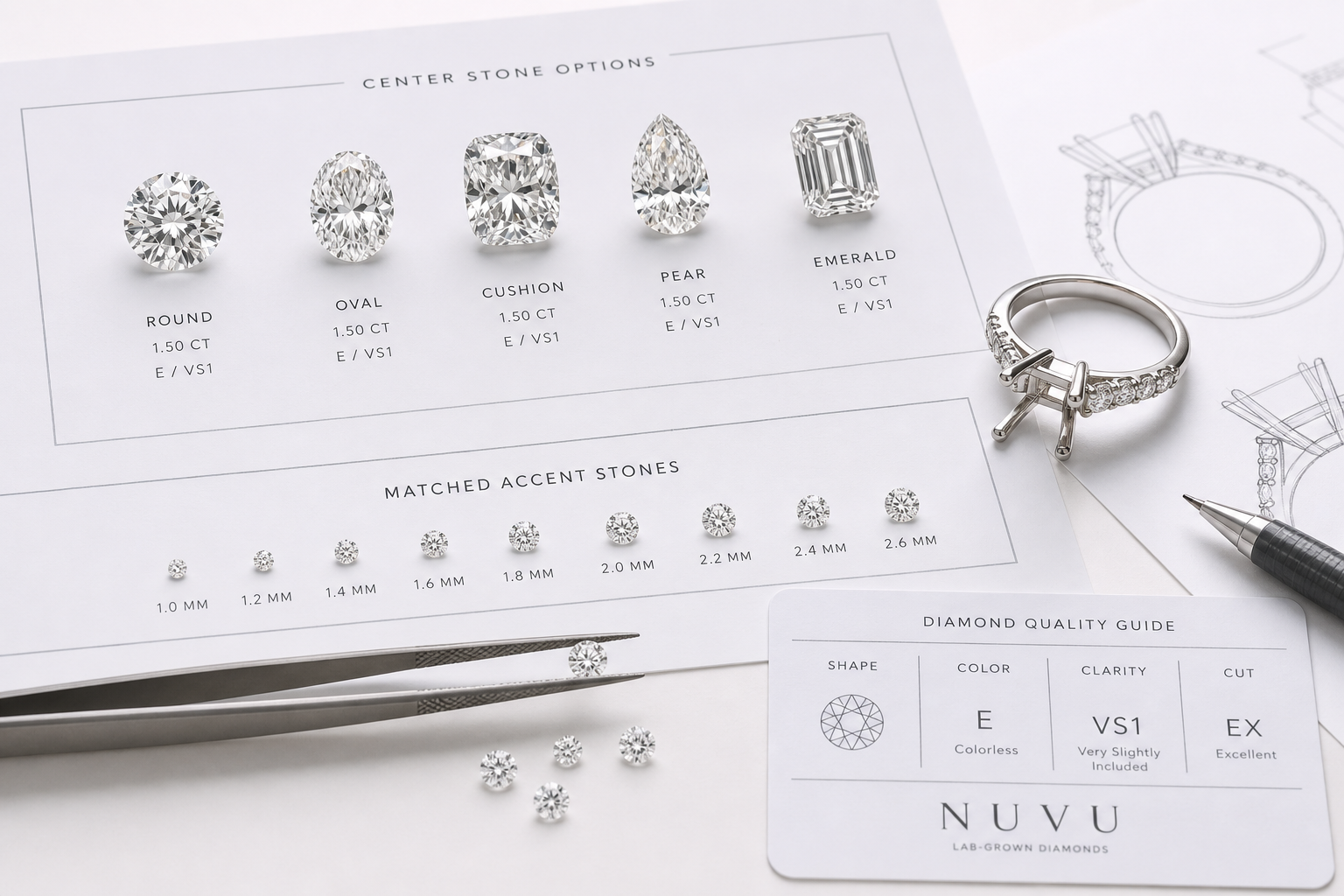
Stone requirements should be practical rather than only aspirational. The buyer should specify diamond shape, approximate carat weight or measurement range, color and clarity expectations, and whether the design uses a certified center stone, matching accent stones, melee diamonds, or a combination. For example, an oval center stone in one size range creates a different setting plan from a larger oval with specific measurements.
For custom jewelry, stone measurements and setting compatibility should be confirmed before finalizing a purchase or production approval. Carat weight can guide planning, but the actual length, width, depth, and shape proportions affect CAD fit and finished appearance.
Finish requirements also belong in the first brief. High polish, matte finish, brushed surfaces, two-tone details, black rhodium accents, milgrain, engraving, and logo placement all affect production. If these details are added late, they can change the CAD, sample, price, and timeline.
Consider a U.S. boutique brand planning a 14K white gold oval lab-grown diamond solitaire with a hidden halo. If the brand has not yet tested demand, ordering a small first batch may be more sensible than moving directly into a larger order. The first batch can confirm whether the setting height, stone size, ring size mix, and hidden halo detail match customer expectations. Moving straight to a larger order may reduce unit cost, but it also multiplies any design mistake.
A Practical Brief Checklist for First-Time OEM Buyers
- Product type, such as ring, pendant, bracelet, earring, or collection
- Design direction with sketches, marked reference images, or style notes
- Metal type, purity, and color
- Diamond shape, approximate carat weight, measurement range, and quality expectations
- Setting style, stone layout, and any special design details
- Ring sizes, bracelet lengths, necklace lengths, or earring dimensions
- Finish requirements, including polish, matte, texture, plating, or engraving
- Logo placement on the jewelry, if needed
- Packaging needs, including boxes, pouches, cards, labels, or inserts
- Target sample quantity, first batch quantity, and expected reorder direction
The most useful brief is not necessarily the longest one. It is the one that removes guessing from the supplier’s first quote and gives the CAD team a clear starting point. If a detail affects appearance, cost, durability, or customer experience, it should be included before the supplier begins production planning.
CAD Design and Rendering: Turning the Brief into a Production Plan
CAD jewelry design is the bridge between a buyer’s concept and the factory’s production work. A rendering may look like a polished preview, but the real value is technical. The CAD file defines proportions, stone fit, setting structure, ring size, logo placement, and whether the design can be made consistently beyond one sample.
This is where many custom projects either become controlled or start drifting. If the buyer approves CAD only because the rendering looks attractive, they may miss issues that become obvious only after casting and stone setting. A ring can look elegant on screen but feel too tall on the hand, too thin for daily wear, or poorly balanced for the center stone size.
Why CAD is more than a visual preview
A 3D jewelry model gives the supplier a production reference. It helps the factory plan casting, stone seats, prong placement, under-gallery structure, band thickness, engraving position, and finishing access. For custom engagement ring CAD, this is especially important because small changes in setting height, prong angle, or band width can change both the appearance and wearability of the finished ring.
The buyer should treat CAD approval as a technical checkpoint, not just a design mood board. A beautiful render does not guarantee comfort, durability, or stone security. If the ring is meant for everyday wear, the design has to balance delicacy with enough metal support. Very thin bands can work in some designs, but they should not be approved casually when paired with a larger center stone or intricate side details.
CAD also helps prevent misunderstanding between the buyer and supplier. Words like “low profile,” “thin prongs,” “soft curve,” or “modern basket” can mean different things to different teams. A CAD file turns those preferences into measurable design decisions that can be reviewed before money and time are committed to sampling.
Design details that should be checked before sampling
The first CAD review should focus on the details most likely to affect the finished product. Band width, band thickness, setting height, prong thickness, stone seat, under-gallery shape, and side-stone placement should all be reviewed before the sample is made. These are not minor technicalities. They affect how the ring looks from the top, how it feels on the finger, how secure the stones are, and whether the product can be repeated across sizes.
Stone fit is one of the most important review points. A CAD made around a general “1 carat oval” may not fit every 1 carat oval equally well because lab-grown diamonds of the same carat weight can have different measurements. For center-stone jewelry, the supplier should work from approximate or confirmed stone dimensions, not carat weight alone. Carat describes weight, while the CAD must accommodate physical length, width, and depth.
A grading report can support this step because it usually records measurements and key stone characteristics, but it should not be treated as a design approval by itself. The report does not show how the stone will sit in a specific basket, whether the prongs look balanced, or whether the finished ring profile suits the wearer. For buyers, the practical point is to compare the report, stone media, CAD seat, and intended setting together.
For custom design, trust comes from matching the stone to the setting, budget, and wearer’s daily use—not from choosing grades in isolation. NUVU’s buyer-first approach is to make the comparison clearer: what the report shows, what the visuals reveal, and whether the stone fits the intended piece.
Logo engraving position should also be checked at this stage. An inside-shank logo may be straightforward on a plain band but more complicated on a narrow ring, an eternity style, or a design with sizing limitations. If the logo is too large or placed too late in the process, it can look crowded or interfere with required markings.
Common CAD revision points in custom lab-grown diamond jewelry
Common CAD revisions include lowering or raising the setting, adjusting prong size, changing band width, refining the basket, modifying side-stone spacing, altering the hidden halo position, and moving logo engraving. These revisions are normal, but they should be controlled. Too many changes at once can make it difficult to know which adjustment solved the problem and which one created a new issue.
A frequent mistake is pushing every design toward the thinnest possible look. Thin bands and delicate prongs photograph well, but they may not be the best choice for repeated wear, larger stones, or higher return-risk products. A better decision is to define the intended use. A statement ring worn occasionally may allow more delicate proportions than an engagement ring expected to handle daily wear.
Another common issue is reviewing only the top view. The side profile often reveals whether the setting looks bulky, whether the center stone sits too high, and whether the under-gallery matches the brand’s style. For rings, the side view can be the difference between a design that feels refined and one that looks heavy in person.
CAD Review Points Before You Approve a Sample
- Band width and thickness, especially for everyday-wear rings
- Setting height and side profile, not only the top view
- Prong thickness, shape, and placement around the stone
- Stone seat dimensions based on actual or target stone measurements
- Under-gallery structure and comfort against the finger
- Side-stone spacing, halo alignment, and pavé layout where relevant
- Ring size and whether the design scales properly across the intended range
- Logo engraving position, size, and visibility
- Casting feasibility and whether delicate areas need strengthening
Approving CAD too quickly is one of the easiest ways to create avoidable sample problems. The better approach is to review the file as a production plan: what looks good, what supports the stone, what can be made consistently, and what may become a complaint once the customer wears the jewelry.
Lab-Grown Diamond Selection and Stone Matching for Custom Jewelry
In custom lab-grown diamond jewelry, stone selection is not separate from design. The diamond has to fit the setting, the product category, the price target, and the repeatability needs of the order. A single custom engagement ring may revolve around one carefully chosen center stone. A private label collection, by contrast, may depend more on whether the supplier can match dozens or hundreds of smaller stones consistently across rings, earrings, bracelets, or necklaces.
Lab-grown diamonds and natural diamonds have different origins, and that origin should be disclosed clearly when stones are described, documented, labeled, or marketed, especially in sourcing contexts such as loose lab grown diamonds from China. A laboratory-grown diamond should not be described in a way that could make a buyer think it is a mined diamond.
This is where buyers often make the wrong comparison. They focus on the headline grade of one diamond, then overlook how the full group of stones will look together once set. For OEM production, consistency can matter as much as individual specifications. A halo ring with slightly mismatched melee diamonds, or a pair of earrings with uneven shape proportions, will look less controlled even if each stone is technically within an acceptable grade range.
Center stones versus accent stones in OEM production
Center stone selection usually deserves the most individual review because it defines the piece visually. For custom engagement rings, solitaire pendants, or statement pieces, the buyer should confirm the stone shape, carat weight, measurements, color, clarity, cut quality, and whether a grading report is required. The most important practical point is fit: an oval diamond, for example, can look very different depending on its length-to-width ratio, and that difference affects both the CAD proportions and the finished ring’s appearance.
Accent stones are evaluated differently. Side stones, halo diamonds, pavé stones, and melee diamonds need to support the design without drawing attention for the wrong reason. Individual perfection is usually less important than uniform appearance. If the accent stones vary too much in color, size, or brightness, the finished jewelry may look uneven even when the center stone is strong.
For repeated OEM jewelry manufacturing, the supplier’s ability to source and sort accent stones becomes a production issue, not just a diamond issue. A three-stone ring needs side stones that balance the center. A pavé band needs stones that sit evenly and reflect light in a consistent way. Tennis bracelets and hoop earrings require even more discipline because small mismatches repeat across the entire piece and become easier to notice.
Matching color, clarity, size, and shape across a batch
Lab-grown diamond stone matching should start with the visual outcome the buyer wants, not just a list of grades. Color consistency is often the first concern, especially when stones sit close together. If a center stone is specified in a near-colorless range, the surrounding accent stones should not appear noticeably warmer by comparison. In many designs, a slight grade difference may be acceptable, but visible contrast is not.
Clarity matters differently depending on stone size and placement. For a center stone, buyers usually want enough clarity that inclusions do not distract the eye. For small melee diamonds, the practical question is whether the stones look clean and bright when set, not whether each one has an individual high-clarity report. Overpaying for unnecessarily high clarity in tiny accent stones can raise the cost without improving the finished appearance.
Shape matching is especially important for fancy shapes. Ovals, pears, emerald cuts, cushions, and marquise diamonds can vary noticeably in outline even at the same carat weight. In earrings, mismatched outlines are easy to spot because the stones are viewed as a pair. In halo or side-stone designs, shape inconsistency can make the setting look slightly off even if the metalwork is accurate.
Measurements should be reviewed alongside carat weight. Two diamonds with the same carat weight may not face up the same size, and this can create problems in CAD seats, prong placement, and visual balance. For batch production, buyers should ask how the supplier controls acceptable measurement ranges, especially for matched pairs, three-stone rings, eternity bands, and tennis bracelets.
When grading reports matter and when batch specifications matter more
Certified lab-grown diamonds are most relevant when the stone is large enough or important enough for the buyer to need individual documentation. Center stones in engagement rings commonly fall into this category, especially when they are marketed as specific carat, color, clarity, and cut grades. A grading report can help confirm the identity and major characteristics of the stone, but it should not replace visual review, measurements, and setting compatibility.
It is also important not to read a grading report as a promise of beauty or value. Reports document characteristics such as measurements and grades under the issuing laboratory’s system, while visual performance depends on how the stone looks in motion, how the cut interacts with the shape, and how the setting presents it. Two stones with similar report grades may still look different once mounted, especially in fancy shapes.
When a grading report is available, buyers should verify the report details through the issuing laboratory’s official report-check tool where available and compare those details with the stone’s measurements, media, and intended setting.
Very small melee diamonds are usually handled through batch specifications rather than individual reports. This is normal in jewelry production because issuing separate reports for tiny stones is often impractical and unnecessary. The better control point is a clear batch standard: agreed color range, clarity range, size range, shape, quantity, and visual matching expectations.
The mistake is treating reports and batch standards as interchangeable. A report helps define one important stone. Batch specifications help control consistency across many stones. For custom lab-grown diamond jewelry, both can be useful, but they solve different problems. Buyers should use reports for stones that carry the value and identity of the piece, and use batch standards for stones that need to perform consistently as a group.
Documentation checkpoints for lab-grown diamond orders
Before a buyer approves stones for an OEM or private label order, it is helpful to separate three types of documentation: individual grading reports, supplier-provided batch specifications, and production approval records. An individual report may be important for a center stone; a batch specification may be more useful for melee or accent stones; and the production approval record connects those stone details back to the exact CAD, sample, and order quantity.
Buyers should also confirm how lab-grown diamonds will be described in customer-facing materials. The wording should be clear and consistent across product pages, invoices, labels, packaging inserts, and any certificate-style cards provided by the brand. Avoid mixing terms in a way that could confuse a shopper about whether the stone is lab-grown or natural. If a supplier provides wording, the buyer should still review it against the brand’s market requirements and legal-advertising responsibilities.
When growth method or post-growth treatment is relevant, buyers should look for clear disclosure in the grading report or seller documentation. HPHT and CVD may refer to laboratory diamond growth methods, while any post-growth treatment should be disclosed when applicable and supported by available documentation.
For projects using stones from different batches or different production periods, documentation should show which stone group belongs to which SKU or production run. This is especially useful when a brand reorders the same style later. If the first batch used one color range, shape range, or melee standard, the reorder should refer back to that approved standard rather than relying on memory or a general description like “same as last time.”
A traceable stone record does not need to be a dramatic certificate package for every component. In practice, it may be a clear table that links SKU, stone type, quantity, size range, color range, clarity range, report numbers where applicable, approved media, and the production run. This kind of record helps buyers compare what was ordered, what was approved, and what is being repeated in future batches.
Certificate and Visual Review Check
- Confirm whether the center stone needs an individual grading report based on product value, customer expectations, and sales channel requirements.
- Review the center stone’s measurements, not just carat weight, to make sure it fits the approved CAD and setting style.
- Ask how melee diamonds and accent stones will be sorted for color, clarity, size, and shape consistency.
- Request photos or video when visual matching is important, especially for pairs, halo designs, three-stone rings, and tennis bracelets.
- Make sure the approved stone specifications are written clearly before the order moves into sample or batch production.
For a custom project, the strongest stone choice is rarely the highest grade on paper. It is the stone or stone group that fits the design, supports the price point, and can be repeated without creating visible inconsistency.
Sample Making: Testing the Design Before Batch Production
Jewelry sample production is a control stage, not a formality. A CAD file can show proportion and structure, but a physical sample shows how the design behaves as an actual piece of jewelry. It reveals whether the ring sits too high, whether the prongs look heavier than expected, whether the band feels comfortable, whether the logo engraving is readable, and whether the finished piece matches the brand’s intended look.
Skipping or rushing the sample stage is one of the most expensive mistakes in OEM jewelry production. If a design issue appears in one custom jewelry sample, it can usually be corrected. If the same issue appears across a larger finished batch, the buyer is dealing with inventory, customer complaints, and possible remake costs.
What a jewelry sample is meant to prove
A custom jewelry sample should prove that the approved design can be produced in a way that looks, feels, and functions as intended. This includes the overall proportions, stone setting, metal finish, comfort, engraving placement, and any brand presentation details that are part of the product experience.
For a lab-grown diamond ring sample, the buyer should pay close attention to the relationship between the stone and the setting. A center stone may be attractive on its own, but the ring can still fail if the setting height feels bulky, the prongs overpower the diamond, or the stone sits in a way that makes daily wear less practical. A delicate design may look appealing in a rendering but need structural adjustment once translated into metal.
Sampling also helps test whether the factory can repeat the design cleanly. A sample that requires constant manual correction may not be a good candidate for larger batch production unless the supplier can explain how those adjustments will be controlled in the production run.
What to inspect when the first sample arrives
The first sample should be reviewed slowly and in good lighting. Buyers should inspect the front view, side profile, under-gallery, prong shape, stone alignment, surface finish, ring size, engraving, and any logo or hallmark placement. Photos are useful, but video often gives a better sense of height, sparkle, and proportion as the jewelry moves.
Comfort matters more than many first-time OEM buyers expect. A ring that looks good in a straight-on photo may feel too tall, too sharp, or too thin in real use. Earrings may feel heavier than expected. A bracelet may need better flexibility or clasp confidence. These issues are not minor if the product is meant for daily wear.
General planning ranges should be treated carefully. After a complete brief, CAD may take several business days depending on complexity and revisions. Sample production timing depends on stone sourcing, metal choice, design difficulty, factory schedule, and how quickly feedback is returned. The supplier should confirm actual timing for the specific project rather than relying on a generic estimate.
How sample revisions should be documented
Sample feedback should be specific, written, and tied to images or video whenever possible. Vague comments such as “make it more elegant” or “the ring looks heavy” are easy to misinterpret. Clearer feedback would identify the exact issue: lower the setting height, reduce the prong thickness, narrow the band from the approved width only if durability remains acceptable, move the logo engraving, adjust the stone seat, or change the polish finish.
Each revision should be attached to a new CAD version or written specification update. This prevents the factory from working from an outdated file and gives both sides a record of what changed. If several people on the buyer’s team are reviewing the sample, one person should consolidate feedback before sending it to the supplier. Conflicting comments create avoidable delay and increase the chance of production errors.
Not every requested change should automatically be accepted. If a buyer asks for a thinner band, smaller prongs, or lower setting, the supplier should be able to explain whether the change affects durability, stone security, or casting feasibility. The better decision is not always the most delicate-looking version; it is the version that balances appearance with reliable wear.
What This Means in a Real Purchase
Consider a U.S. boutique brand developing a 14K white gold oval lab-grown diamond ring with a hidden halo. The CAD looks clean, so the buyer approves it quickly. When the sample arrives, the center stone sits higher than expected and the hidden halo makes the side profile look bulky. If the brand accepts that sample and produces a full batch, the issue becomes a repeatable product problem.
A better approach is to treat the sample as a warning signal. The buyer requests one targeted CAD revision, asks the supplier to lower the setting while keeping stone security intact, and reviews updated images before production approval. That extra step may add time, but it protects the brand from launching a ring that customers may find uncomfortable or visually heavier than promised.
Approval Process: Locking the Specifications Before Production
The approval process is the point where a custom project becomes a production order. Before this stage, changes are expected. After this stage, changes can affect cost, lead time, material planning, stone matching, packaging, and consistency across the order. Buyers should treat jewelry production approval as a formal checkpoint, not a casual message saying the sample “looks good.”
For OEM and private label jewelry orders, the risk is rarely one single misunderstanding. It is usually a chain of small assumptions: the wrong CAD version, a slightly different stone range, an engraving position that was discussed but not confirmed, or packaging that was approved in concept but not in exact material or size. Written production confirmation reduces these gaps before they become physical inventory.
What should be approved before batch production starts
Before batch production starts, the buyer should approve the exact CAD version, final sample photos or video, metal type and purity, stone specifications, ring sizes or size range, finish, engraving, logo placement, packaging, quantity, and production schedule. If tolerances apply to measurements, stone sizes, or finished weight, those tolerances should be confirmed by the supplier instead of assumed by the buyer.
Stone details deserve special attention. For center stones, the approval may include shape, carat range, color, clarity, measurements, cut quality, and grading report requirements. For accent stones or melee diamonds, approval should focus on batch specifications and matching standards. If the buyer only approves the center stone but leaves accent stones vague, the finished piece may not match the visual standard of the sample.
Packaging should also be approved before production if it is part of the private label jewelry order. A ring box, pouch, jewelry card, care card, or SKU label can have its own lead time and minimum quantity. Leaving packaging until the end may delay delivery preparation even when the jewelry itself is finished.
Why written confirmation reduces production errors
Written confirmation creates one shared production reference. This matters because a custom jewelry project may pass through CAD design, stone sourcing, casting, setting, polishing, engraving, packaging, and inspection. A verbal decision made early in the process can easily be lost unless it is recorded in the final production details.
The most useful approval records are simple and specific. A buyer should be able to look at the final confirmation and know exactly what is being made, in what quantity, with which stones, in which sizes, with which finish, and with which branding details. If the record does not answer those questions, it is not ready to guide batch production.
Written approval also helps separate a true production error from a late preference change. If the buyer approved polished yellow gold and later decides on brushed yellow gold, that is a revision, not a factory mistake. Clear documentation protects both sides and makes problem-solving more practical if something needs to be corrected.
How revision requests affect timing and consistency
Revision requests are normal in custom jewelry production, but timing matters. A change before sample approval may be straightforward. A change after stones have been sourced, molds prepared, packaging ordered, or batch production started can create delays and inconsistency. The later the revision, the more likely it is to affect cost or require partial rework.
Buyers should be especially careful with changes that seem small but affect multiple production steps. Adjusting a center stone size may require CAD changes, new stone seats, different prong positions, and revised visual balance. Changing a logo placement may affect engraving setup or packaging artwork. Changing ring sizes after production planning may alter metal use and scheduling.
The best approval discipline is to resolve design uncertainty before production begins. If the buyer is still unsure about setting height, band width, stone proportions, or logo placement, it is usually better to pause for clarification than to push the order forward and hope the batch looks right.
Approval Checklist Before Production Begins
- Final CAD version and any revised technical details
- Approved sample photos or video, including front, side, and detail views
- Metal type, purity, finish, plating details if applicable, and stamping requirements
- Center stone specifications and grading report requirements if applicable
- Accent stone or melee diamond batch specifications and matching expectations
- Ring sizes, bracelet lengths, earring pair requirements, or other size details
- Engraving text, logo placement, and brand marking position
- Packaging type, artwork, labels, cards, boxes, or pouches if included
- Order quantity by SKU, size, metal, stone option, or design variation
- Supplier-confirmed tolerances, production timeline, and milestone review points
Once these details are locked, the project can move from development into production with fewer avoidable surprises. The goal is not to eliminate every possible issue, but to make sure the factory is building from one clear, approved version of the product.
Batch Production and Small-Batch Testing with China-Based Suppliers
Once the sample is approved, the project shifts from proving one piece to repeating that piece consistently. This is where China-based custom jewelry production is often most useful for brands: not simply because of lower unit costs, but because many suppliers can coordinate CAD files, stone sourcing, casting, setting, finishing, packaging, and batch documentation within one production workflow.
The risk is assuming that an approved sample automatically guarantees a perfect batch. A sample proves the design can work. Batch production proves whether the supplier can repeat it across multiple sizes, stones, finishes, and packaging requirements without visible drift. For a private label jewelry manufacturing project, that repeatability matters more than a small difference in unit price.
Why small-batch testing can reduce product risk
Small-batch jewelry production gives a brand room to test the product before committing to a larger run. A new ring, pendant, bracelet, or earring design may look strong in a single sample, but the real questions appear when customers start handling it: Does the ring sit comfortably? Do the sizes sell as expected? Does the packaging protect the piece during fulfillment? Does the finish hold up to normal inspection? Does the product photograph consistently for online sales?
For a new design, a brand might test a small first batch before ordering a much larger run. That range is not a rule. Minimums depend on the China jewelry factory, metal type, stone requirements, packaging choices, production schedule, and whether the design requires special tooling or unusual components. The practical value of a test batch is not just lower commitment; it gives the buyer evidence before scaling.
Small batches are especially useful for designs with multiple variables, such as several ring sizes, pavé accents, mixed diamond shapes, two-tone metals, or branded packaging. The more variables a product has, the more opportunities there are for small inconsistencies to become expensive at scale. A simple solitaire may be easier to repeat than a pavé-heavy band with multiple stone sizes and tight finishing expectations.
What changes when production moves from sample to batch
Batch production changes the supplier’s challenge. Instead of making one approved piece carefully, the factory must maintain the same design standard across many pieces while coordinating materials, labor steps, and inspection timing. The buyer should expect more attention to production control at this stage, not less.
Several things can shift during OEM jewelry batch production. Casting may vary slightly from piece to piece. Stone setting needs to remain even across multiple units. Ring sizes must match the approved size list. Polishing must not soften edges, distort logo engraving, or create inconsistent surface finish. If rhodium plating is used on white gold, the finish should look even across the batch. None of these issues are unusual in jewelry production, but they become costly if the buyer only reviews them after shipment.
The most important judgment is whether the supplier understands which details are design-critical. A small hidden variation may not matter. A visible difference in stone height, prong shape, color matching, engraving position, or finish quality can affect customer perception immediately. Buyers should make those priority details clear before batch work begins.
How suppliers coordinate stones, settings, sizes, and finishes
A custom lab-grown diamond jewelry supplier has to coordinate the batch around both the jewelry design and the stones. For center-stone pieces, that may mean reserving stones that match the approved shape, measurements, color range, clarity range, and visual style. For accent-stone designs, it may mean preparing melee in consistent sizes and color ranges so halos, pavé rows, side stones, or matched earrings do not look uneven.
Size coordination also matters. A ring produced in several sizes is not just the same design stretched across different measurements. Prong position, side-stone spacing, shank thickness, and engraving placement may need attention so each size still looks intentional. This is one reason buyers should avoid approving a batch from a single sample without confirming how the design will be handled across the full size range.
Finish standards should be discussed at the batch level as well. High polish, matte finish, brushed texture, milgrain, black rhodium, yellow gold tone, or rose gold tone all create different inspection points. If the brand expects a specific look, photo references from the approved sample are useful, but written confirmation is stronger because it gives the supplier a standard to check against during production.
Batch traceability across SKUs and reorders
When a project includes multiple SKUs, sizes, metals, or stone options, traceability should be built into the batch plan before production begins. A buyer should be able to connect each finished item to an approved design version, stone specification, size breakdown, packaging version, and QC reference. This is especially important for private label collections where similar items may differ only by stone shape, metal color, or ring size.
Reorders are where weak records usually become visible. If the original order was approved only through chat messages and sample photos, the next production run may drift in stone color range, prong shape, engraving position, packaging tone, or finish. A clearer reorder file should include the previous approved CAD, sample reference, batch standard, packaging artwork, and any lessons learned from the first shipment.
Batch Consistency Checks to Confirm Early
Before a batch begins, the buyer should confirm which details will be checked against the approved sample and which tolerances are acceptable. The list does not need to be complicated, but it should be specific enough to prevent avoidable disputes.
- Approved CAD version and sample reference
- Metal type, purity, color, and finish
- Ring size range or product size specifications
- Center-stone specifications, measurements, and report requirements if applicable
- Accent-stone size, color, clarity, and matching expectations
- Prong style, stone height, setting alignment, and security checks
- Logo engraving position, depth, and orientation
- Packaging version, insert cards, labels, and SKU details
- Photo or video review points before shipment
The strongest batch orders are not the ones with the most instructions; they are the ones where the important instructions are clear. If a buyer cares most about stone matching and finish consistency, those details should be treated as priority checks from the start rather than discovered during final review.
Branding, Logo, and Packaging Options in Private Label Jewelry
Private label jewelry adds a brand-presentation layer to the physical product. The jewelry itself may be custom, semi-custom, or based on an existing supplier model, but the private label part is about how that product reaches the customer under the buyer’s brand. This can include logo engraving, branded jewelry boxes, pouches, care cards, information cards, SKU labels, barcode labels, and product inserts.
The mistake is treating packaging as an afterthought. A well-made ring can still feel poorly executed if the box, card, label, and presentation do not match the brand’s price point. On the other hand, expensive packaging cannot fix a weak product, and the China lab grown diamond supply chain should be understood alongside packaging decisions because product quality should come first, but private label jewelry packaging shapes the customer’s first impression and must be coordinated before production is too far along.
If a brand plans to make sustainability, origin, or responsible-sourcing statements in its retail presentation, those claims should be handled as documentation questions rather than marketing language alone. Lab-grown diamonds can offer a different sourcing path from mined diamonds, but the buyer should still ask what information the supplier can provide about stone origin, production route when relevant, metal sourcing, packaging materials, and any claim that will appear on cards or product pages.
Environmental and sustainability claims should be specific, documented, and limited to what can be substantiated. Broad claims are less useful than clear statements tied to available evidence, such as packaging material specifications, stone-origin disclosure, production-route information, or seller documentation.
Product branding versus packaging branding
Product branding is applied to the jewelry or jewelry-related components. This may include logo engraving inside a ring shank, a brand mark on a pendant tag, a metal stamp, or a small branded charm. These choices need to work with the physical design. A logo that looks clean on a flat card may not engrave well inside a narrow ring or on a curved surface.
Packaging branding sits outside the jewelry. It includes boxes, pouches, paper sleeves, polishing cloths, jewelry cards, care cards, warranty-style information cards, and outer labels. This part of the project often involves separate materials, separate approvals, and sometimes a separate minimum order quantity. A buyer should not assume that a private label jewelry supplier includes fully custom packaging by default.
The practical distinction is important: product branding is harder to change once jewelry production begins, while packaging can sometimes be adjusted separately. If the brand mark is engraved in the wrong position or scaled poorly, the jewelry itself may need to be remade or refinished. If a card design needs revision, the fix may be simpler, but it can still delay fulfillment if not approved early.
Logo placement should be chosen based on the product’s shape and the customer experience. Inside-ring engraving is common for rings, but there must be enough surface area for the mark to remain legible without weakening the design or looking crowded. Pendants and bracelets may use a small tag, clasp plate, or back surface. Earrings are more limited, and branding may be better handled through cards or packaging rather than forcing a mark onto a small piece.
For boxes and cards, buyers should review logo size, color, foil stamping, embossing, printing method, and material finish. A minimal logo on a rigid box may suit a fine jewelry brand, while a softer pouch-and-card system may work better for lower-volume collections or travel-friendly packaging. The best choice depends on how the jewelry is sold, stored, shipped, and presented.
Logo files should be production-ready. Vector files are usually preferred for clean printing, stamping, or engraving because they scale without losing sharpness. Low-resolution screenshots or social media graphics often create poor results. If the supplier has to rebuild the artwork, the buyer should approve the corrected version before it is used on jewelry or packaging.
Packaging approvals, samples, and minimum quantities
Packaging has its own production logic. A supplier may be able to produce a small jewelry batch, but the branded box supplier may require a higher quantity for custom colors, foil stamping, or special materials. This is why private label details should be discussed before the buyer assumes a launch quantity is realistic.
Packaging samples are useful when the brand is testing a new presentation. Photos can confirm general layout, but they do not always show material weight, hinge feel, lining quality, color accuracy, or how the jewelry sits inside the box. For higher-end products, a weak insert or loose fit can make the piece feel less secure and less refined, even if the jewelry is made correctly.
Lead time is another common friction point. Custom boxes, printed cards, and labels may not move on the same schedule as jewelry production. If packaging approval happens late, finished jewelry may sit waiting for boxes, or the brand may be forced to ship with temporary packaging. That kind of compromise is avoidable when packaging is treated as part of the production plan.
Evidence behind customer-facing claims
Private label packaging can create compliance risk when it uses broad claims that are not backed by clear evidence. Words such as “eco-friendly,” “sustainable,” “ethical,” “carbon neutral,” or “conflict-free” should not be treated as decorative copy. If a brand wants to use these claims, it should ask what documentation supports the exact statement, whether the claim applies to the diamond, the metal, the packaging, the production process, or the entire product, and whether the wording is narrow enough to avoid misleading customers.
Sustainability claims should be specific and documented. Broad green language is less useful than clear information about production, energy, sourcing, packaging material, and seller transparency. If the available records are limited, the customer-facing wording should also be limited.
The same discipline applies to origin and production-route language. If a card says the diamond is lab-grown, the wording should be consistent with the invoice, product listing, and any stone documentation. If the brand mentions a growth method, supplier location, recycled metal, or packaging material, the buyer should keep supporting records with the production file. The safer approach is to use specific, verifiable language rather than broad claims that sound appealing but are hard to substantiate.
For many brands, the best private label insert is simple: care guidance, product description, metal and stone disclosure, and brand contact information. A clear card that accurately describes the jewelry is usually more valuable than a complicated claim-heavy card that creates questions the brand cannot answer later.
Private Label Details to Confirm in Writing
Before approving a private label jewelry order, the buyer should confirm the branding system in the same disciplined way as the jewelry specifications. The goal is to prevent mismatched pieces, inconsistent presentation, or packaging that arrives too late for launch.
- Logo file format and approved logo version
- Logo placement on jewelry, tags, cards, boxes, or pouches
- Engraving size, depth, orientation, and sample image
- Box style, color, material, insert type, and interior fit
- Care card, information card, certificate-style card, or product insert details
- Barcode labels, SKU labels, product names, and item codes
- Packaging sample approval process
- Packaging MOQ, lead time, and reorder requirements
For custom jewelry branding, consistency matters more than decoration. A simple box, clean logo, and accurate product labeling will usually serve a young brand better than complicated packaging that is difficult to reorder or hard to keep consistent across future batches.
Quality Control Before Delivery: What Buyers Should Ask to Review
Quality control before delivery is the buyer’s last practical chance to catch visible production issues before the order leaves the supplier. It should not be treated as a vague promise that the factory will “check everything.” A useful pre-shipment inspection is tied to the approved CAD, sample, stone specifications, packaging details, and quantity list.
For OEM jewelry QC, the priority is not to inspect jewelry in an abstract way. The priority is to confirm that the finished batch matches what was approved. This is where written specifications, sample references, and photo or video review become valuable. If expectations were never documented, the final review becomes subjective and harder to resolve.
Jewelry-level checks before shipment
Jewelry-level checks should start with the basics: correct product style, correct metal, correct size, correct stone arrangement, correct finish, and correct quantity. These may sound obvious, but batch orders can include multiple SKUs, ring sizes, stone shapes, or packaging versions. Errors often happen at the point where similar items are sorted, labeled, or packed.
Ring size should match the approved size list. Earrings should be checked as matched pairs. Pendants should be reviewed for bail alignment and chain compatibility if chains are included. Bracelets should be checked for length, clasp function, and stone layout. The more similar the items are, the more important labeling becomes because a small sorting mistake can create fulfillment problems later.
Buyers should request clear photos or videos of finished pieces before shipment, especially for first batches or higher-value orders. A professional third-party inspection may be worth considering for larger or more complex orders, but it is not automatically necessary for every project. The key is matching the review level to the value, complexity, and risk of the order.
Stone, setting, engraving, and finish review
Stone security is one of the most important checks in lab-grown diamond jewelry QC. Prongs should be aligned and seated properly, stones should not appear tilted, and pavé or melee stones should look even across the piece. For rings and earrings, symmetry is often what the customer notices first, even before they understand the technical issue.
Stone matching should be reviewed against the approved specification. In a batch of rings, earrings, or bracelets, obvious differences in color, size, or brightness can make the product look inconsistent. Very small accent stones are usually controlled by batch specifications rather than individual grading reports, so the buyer should focus on visible consistency as well as stated specs.
Engraving should be checked for spelling, position, depth, and orientation. A logo that is slightly off-center may be acceptable on some hidden interior marks, but unacceptable on a visible pendant tag or branded charm. Metal stamps should be present and placed as agreed. Finish should also be reviewed: polish lines, uneven plating, rough interiors, sharp edges, or cloudy surfaces can all make a product feel unfinished.
Packaging and quantity verification
Packaging QC is not separate from product QC for private label orders. The buyer should verify that each item is paired with the correct box, pouch, card, label, SKU, and any requested insert. A perfect piece placed in the wrong branded box can create the same customer-service problem as a production defect.
Quantity verification should be specific. If the order includes rings across several sizes, the review should confirm the count by size, not only the total number of rings. If the order includes multiple diamond shapes or metal colors, the count should be separated by SKU. This is especially important for online sellers that depend on accurate inventory before launch.
Photos of grouped items, labels, packaging interiors, and final packed cartons can help the buyer identify mismatches before delivery preparation is complete. These checks do not replace trust in the supplier, but they reduce the chance that a simple packing or labeling issue becomes expensive after the goods arrive.
Pre-Shipment Review Checklist
A practical pre-shipment review should focus on the details that would create real problems if missed. The buyer should confirm the review format with the supplier in advance, including whether photos, videos, item counts, or inspection notes will be provided.
- Finished pieces match the approved CAD, sample, and production confirmation
- Metal type, color, stamp, finish, and plating if applicable are correct
- Ring sizes, bracelet lengths, chain lengths, or product measurements match the order
- Center stones and accent stones match approved specifications and visual expectations
- Prongs, settings, pavé rows, halos, and side stones appear secure and aligned
- Logo engraving, personalization, and metal stamps are accurate
- Polish, texture, edges, and interior surfaces are clean and consistent
- Packaging, cards, labels, SKUs, and item counts match the approved list
- Photos or videos are reviewed before shipment release
The best QC process is not the most complicated one. It is the one that checks the details most likely to affect customer complaints, returns, or brand presentation once the jewelry is in the buyer’s hands.
Communication, Timelines, and Risk Control in OEM Jewelry Projects
In OEM jewelry production, communication is not separate from quality control. A clear message at the wrong time can still create problems if the supplier has already moved from CAD to sample making, or from sample approval into batch production. The most reliable projects are usually managed by milestones, not by casual updates.
This matters especially when working with a China jewelry supplier across time zones, languages, and production departments. A buyer may be communicating with a sales representative, while CAD designers, stone sourcing staff, setters, polishers, packaging vendors, and QC teams are all involved behind the scenes. If the instructions are loose, each handoff creates room for interpretation.
Why clear milestones matter in custom jewelry production
Clear milestones turn a custom jewelry production timeline into a controlled process. Instead of asking whether the order is “in progress,” the buyer should know which stage has been completed, which stage is waiting for approval, and which details are locked.
The most important milestones usually include brief confirmation, quotation, CAD approval, stone confirmation, sample approval, production start, QC review, packaging confirmation, and delivery preparation. These checkpoints are not formalities. They prevent a supplier from making reasonable but incorrect assumptions about ring size distribution, stone color range, logo placement, plating finish, or packaging format.
The mistake to avoid is approving a stage based on incomplete information. For example, approving a CAD rendering without checking the side profile may lead to a ring that looks correct from the top but sits too high on the finger. Approving a sample without confirming the exact stone range may result in batch pieces that are technically similar but visually less consistent than expected. In private label jewelry project management, the small missed detail is often the detail that repeats across the entire order.
Timeline variables that can change the schedule
There is no single standard timeline for custom lab-grown diamond jewelry from China. A simple solitaire design with available stones and standard packaging may move faster than a multi-SKU collection with pavé settings, custom engraving, branded boxes, and multiple ring sizes. The schedule depends less on geography alone and more on design complexity, stone availability, revision history, metal choice, order quantity, and how quickly the buyer responds at approval points.
As a planning approach, quotation and CAD may take several business days after a complete brief, while sample and batch production require additional time based on the design, material, stone sourcing, factory workload, quantity, setting complexity, finishing standards, packaging readiness, and QC requirements. These ranges should be treated as planning references, not promises; every serious project needs supplier-confirmed timing before production begins.
The biggest timeline risk is not always slow production. More often, delays come from unclear revisions. A buyer may ask to “make the ring more delicate,” while the factory needs to know whether that means reducing band width, lowering the setting, changing prong shape, adjusting the hidden halo, or modifying the side profile. Vague feedback can create extra CAD rounds, and each round can shift sample timing.
How to reduce misunderstandings across design and production
Good OEM jewelry communication should be specific, visual, and traceable. Written approvals should include version numbers, annotated images, measurements, stone specifications, metal details, finish requirements, packaging references, and quantity breakdowns. Voice calls can be useful for alignment, but the final decision should be documented in writing so the production team is not relying on memory or interpretation.
Buyers should also avoid mixing old and new instructions in the same message thread without clarification. If the first CAD showed one band width and the revision changes it, the approved version should be clearly identified. If the logo moves from the inside shank to a tag or packaging card, that change should be confirmed as final. A China lab-grown diamond jewelry supplier may be coordinating several departments at once, so clean documentation protects both sides.
The practical standard is simple: if a detail would be expensive or frustrating to correct later, it should be confirmed before production moves forward. This includes stone matching, engraving, ring sizes, finish, packaging, labeling, and item counts. Communication cannot remove every jewelry sourcing risk, but it can prevent the most avoidable errors—the ones caused by unclear expectations rather than manufacturing difficulty.
Project Milestones to Track From Brief to Delivery
- Brief confirmation: Confirm product type, design direction, materials, stones, size range, quantity, branding needs, and packaging expectations.
- Quotation and feasibility review: Check that the supplier can produce the design within the expected specifications, not just quote a low unit price.
- CAD approval: Review proportions, setting height, prong design, stone fit, engraving location, and production practicality before sampling.
- Stone confirmation: Confirm center stone details, melee specifications, color range, clarity range, shape consistency, and whether reports are required.
- Sample approval: Review the physical sample for comfort, appearance, finish, stone setting, logo placement, and packaging fit before batch production.
- Production start: Confirm final quantity, size breakdown, approved sample reference, packaging details, and expected production schedule.
- QC review: Request photos, videos, measurements, item counts, packaging checks, and any agreed inspection details before shipment preparation.
- Delivery preparation: Confirm final packing method, labeling, documents, and shipment readiness before goods leave the supplier.
How to Evaluate Whether a China-Based Custom Jewelry Supplier Fits Your Project
The right China custom jewelry supplier is not simply the one with the lowest quote or the fastest reply. Supplier fit depends on whether the factory’s strengths match the buyer’s product category, design complexity, stone requirements, branding needs, and expected production rhythm. A supplier that performs well on one type of jewelry may be the wrong fit for another.
For custom lab-grown diamond sourcing, the strongest evaluation starts with capability alignment. A buyer should look at what the supplier has already produced, how clearly they communicate technical details, how they handle samples and revisions, and whether they can document the specifications that matter before production starts.
In sourcing or wholesale conversations, documentation, consistency, and communication often matter as much as the headline specification. A supplier that can explain how records are kept, how samples are linked to production files, and how reorders are matched to prior approvals gives the buyer a stronger basis for decision-making than a supplier that relies only on broad assurances.
Match supplier capability to your product category
A lab-grown diamond jewelry manufacturer may be very capable in solitaire engagement rings but less suitable for pavé-heavy bands, tennis bracelets, matched earring pairs, or branded multi-SKU collections. The production skills are related, but they are not identical. A solitaire project depends heavily on center stone fit, setting proportions, and finishing. A pavé collection adds more risk around melee consistency, stone security, alignment, and repeatability across many pieces.
Product category should drive supplier selection. If the project involves custom engagement rings, review CAD quality, stone setting, prong structure, comfort, and sample finishing. If the project involves private label fashion-fine jewelry, review batch consistency, packaging support, SKU labeling, and the supplier’s ability to repeat the same look across different sizes or metals. If the project involves matched earrings or bracelets, stone matching and layout consistency become more important than a single impressive sample photo.
The warning sign is a supplier that says yes to every product without asking detailed questions. A serious OEM jewelry supplier should clarify design files, stone specifications, tolerance expectations, metal options, branding details, and production quantities before treating the project as straightforward.
Evaluate communication before evaluating price
Price matters, but communication quality often predicts production quality more accurately than the first quote. A low price is not useful if the supplier cannot explain what is included, what is excluded, what stone range is being used, how revisions are handled, or what must be approved before production.
Strong China jewelry supplier communication is specific. The supplier should be able to confirm CAD timing, sample process, stone availability, packaging options, expected production stages, and QC review methods in clear terms. They do not need to have every answer instantly, but they should show a disciplined way of getting the answer. Slow but accurate communication is usually safer than fast but vague agreement.
For a private label jewelry supplier, communication also needs to cover brand presentation. If the project includes logo engraving, branded jewelry boxes, care cards, barcode labels, or SKU packaging, those details should be handled as production specifications, not as afterthoughts. Packaging mistakes can damage the buyer’s retail presentation even when the jewelry itself is acceptable.
Review samples, documentation, and QC transparency
A sample is the most practical test of supplier fit. Portfolio images show what a supplier wants to present; a sample shows how they translate one buyer’s actual brief into a finished piece. Buyers should judge the sample against the approved CAD, stone specifications, finish requirements, logo placement, comfort, and overall consistency with the intended brand position.
Documentation is equally important. The supplier should be able to keep track of approved CAD versions, stone details, metal specifications, ring sizes, packaging approvals, and QC references. If these details are scattered across chat messages with no clear final confirmation, the project becomes harder to control as soon as it moves into batch production.
QC transparency does not mean a supplier can eliminate every possible issue. It means the buyer can see enough before shipment to make an informed decision. Photos, videos, item counts, measurement checks, packaging review, and agreed inspection points help identify problems while they can still be addressed. For larger or higher-risk orders, third-party inspection may also be worth considering, especially when the batch includes multiple designs, stones, sizes, and branded components.
At NUVU, we usually treat supplier fit as a practical match between design needs, stone requirements, communication discipline, and repeatability. A supplier does not need to be ideal for every jewelry category; they need to be reliable for the specific project in front of them.
Verification questions that protect buyer trust
Before choosing a supplier, buyers should ask how important claims will be verified, not just how the jewelry will be made. For center stones, this may include report availability, report matching to the stone, measurements, inscriptions if present, and pre-shipment media. For batch stones, it may include the sorting standard, accepted color and clarity range, how matched pairs are selected, and how rejected stones are handled.
Buyers should also ask how the supplier manages version control. A reliable supplier should be able to identify the final CAD file, approved sample image, final stone specification, packaging artwork, engraving file, and size breakdown. If the project is later reordered, these records become the evidence base for repeating the product rather than rebuilding it from memory.
Finally, ask what the supplier will not claim. A cautious supplier that avoids unsupported promises about sustainability, origin, grading strictness, or guaranteed resale value may be more reliable than one that uses impressive language without documentation. In custom lab-grown diamond jewelry, trust is built through clear specifications, traceable approvals, and claims that match the records available.
When a grading report is provided, buyers should compare the report details with the issuing laboratory’s verification tools where available, then confirm that the stone, CAD, sample, and production records all refer to the same approved specification.
Supplier Fit Checklist for OEM and Private Label Projects
- Product category fit: Does the supplier have relevant experience with the specific jewelry type, setting style, stone layout, and production complexity?
- CAD capability: Can the supplier create and revise CAD files with enough technical detail for accurate sampling and batch production?
- Stone matching process: Can they explain how center stones, accent stones, melee, color range, clarity range, and shape consistency will be handled?
- Sample discipline: Is the sample reviewed against approved specifications rather than treated as a loose design suggestion?
- Communication quality: Are answers specific, documented, and tied to production stages, or mostly informal and vague?
- Packaging support: Can the supplier coordinate logo placement, boxes, pouches, cards, labels, and packaging approval if private label presentation matters?
- QC visibility: Will the buyer receive useful pre-shipment photos, videos, measurements, item counts, and packaging checks?
- Batch flexibility: Can the supplier support the intended order size without forcing a production model that does not fit the buyer’s risk level?
- Written specification control: Are final details confirmed clearly before production, including CAD version, stone specs, metal, sizes, finish, branding, packaging, and quantity?
The best supplier choice is the one that reduces uncertainty at each stage of the project. For OEM and private label jewelry, that usually means choosing a partner who can translate the brief accurately, communicate production limits honestly, document approvals clearly, and repeat the approved result beyond the first sample.
Disclosure: This article is for general educational purposes only. Diamond grading, pricing, availability, specifications, and seller policies can change, and readers should verify important details through grading reports, official laboratory tools where available, seller documentation, or qualified professionals before making a purchase decision. Laboratory-grown diamonds should be clearly distinguished from natural diamonds, and environmental or sourcing claims should be supported by specific documentation.