
Buying loose lab-grown diamonds from China can open access to broader inventory, competitive production capacity, and repeatable sourcing options, but it also adds responsibility for verification within the OEM private label process. Retailers and jewelers cannot judge a supplier by price or certificate alone. The real decision is whether the stones, paperwork, media, measurements, packing, and communication are strong enough to support your sales model without creating delays, mismatches, or costly remakes.
For the full framework, read China Lab-Grown Diamond Supply Chain Guide.
This article helps you decide when China sourcing makes sense, what to confirm before requesting quotes, and how to compare offers beyond the lowest unit price. It focuses on practical buying judgment: defining specifications clearly, checking certificates against actual stones, reviewing videos and measurements, evaluating parcels by consistency, and setting approval rules for substitutions, reorders, and calibrated inventory.
Throughout this guide, “lab-grown diamond” means a laboratory-grown diamond with the same diamond material category as diamond, but with a laboratory-created origin rather than a mined origin. Laboratory-grown diamonds should be clearly identified as laboratory-grown, and they should not be presented as natural diamonds or mined diamonds. Diamond simulants are a separate category and should not be described as lab-grown diamonds.
| Buying Situation | What to Check First | Best Judgment |
|---|---|---|
| Repeat retail or online programs | SKU specs, reorder support, parcel consistency | Good fit if requirements are documented |
| Custom settings or calibrated stones | Millimeter size, ratio, silhouette, setting tolerance | Prioritize physical fit over carat weight |
| Certified single stones | Report number, measurements, media, identity match | Use grading reports as filters, not final proof |
| Mixed parcels | Weakest acceptable stone, shape consistency, spread | Judge the parcel, not the best example |
| Urgent one-stone customer order | Lead time, approval speed, replacement risk | Domestic sourcing may be safer |
| Lowest-price quote | MOQ, substitutions, quote validity, after-sale support | Compare total sourcing value, not price alone |
Quick Questions Before You Read
Q: Is buying loose lab-grown diamonds from China mainly about getting a lower price?
No. Price matters, but consistency, documentation, verification, lead time, and reorder reliability often matter more for retailers and jewelers.
Q: Are certificates enough to approve a stone?
No. Report details should be checked against the actual stone, including measurements, visuals, labels, and shipment records.
Q: When is China sourcing a strong fit?
It works best for buyers with clear specs, repeatable demand, and time to review reports, videos, parcel details, and approvals.
Q: What is the biggest mistake to avoid with parcels?
Do not judge by the best stone shown. Check the consistency of size, silhouette, shape, and the weakest stone you would accept.
Why China matters in loose lab-grown diamond sourcing
Buying loose lab-grown diamonds from China is not just a question of finding another supplier. For retailers, jewelers, online stores, custom designers, and small wholesale buyers, it changes how the sourcing process needs to be managed. Distance, time zones, documentation habits, parcel control, and repeat-order planning all become part of the buying decision.
The opportunity is real, but it is not automatic. China-based suppliers can be useful for buyers who need access to loose stones across shapes, sizes, and order volumes, especially when they are building repeatable product lines or comparing multiple sourcing channels. The risk is that a quote can look attractive before the buyer has confirmed whether the stones, documents, communication process, and replenishment path are actually reliable enough for the business model.
Compliance boundaries for trade buyers
Trade buyers should keep commercial language precise from the first inquiry. A laboratory-grown diamond has a different origin from a natural diamond, and that origin should remain clear in quotes, invoices, product listings, customer descriptions, and any grading report references. If a seller uses vague terms such as “real diamond,” “synthetic,” “created,” or “diamond alternative,” ask for exact wording so the product is not confused with a mined diamond or with a non-diamond simulant.
Environmental, ethical, and sourcing claims also need careful handling. Lab-grown diamonds may appeal to buyers looking for an alternative to mined origin, but broad claims such as sustainable, eco-friendly, conflict-free, carbon-neutral, or ethical should not be repeated unless the supplier provides specific documentation that supports the exact claim being made. Environmental and sustainability claims should be specific, documented, and limited to what can be substantiated.
Price language should be equally disciplined. Prices can change with market conditions, report type, seller channel, availability, size, shape, matching difficulty, and stone-specific details, so exact comparisons should be verified at the time of purchase. A lower quote can be useful, but it should not be treated as proof of better value unless the stones, documentation, service terms, and usable fit are being compared on the same basis.
What changes when the sourcing channel is China
The biggest change is that the buyer has to evaluate the process, not only the stones. With a domestic supplier, a jeweler may be able to see inventory faster, communicate in the same business day, and resolve small mismatches with less friction. When buying loose lab-grown diamonds from China, the same issues can still be handled well, but they need to be handled earlier and more explicitly.
A retailer comparing a domestic parcel with a China-based parcel for a recurring pendant or bridal line should not only ask, “Which quote is lower?” The better question is, “Which source can help me maintain the same product standard across the first order, the reorder, and the replacement stone?” If the first parcel looks good but the next shipment arrives with different measurements, inconsistent documentation, or unclear substitutions, the lower starting cost may not create better value.
This is where China sourcing becomes a business decision rather than a simple purchasing decision. It can affect inventory depth, production timing, product photography consistency, customer replacement policies, and how confidently a retailer can sell the same design again. A one-time stone purchase and a repeatable retail program are very different sourcing problems.
Traceability starts before the first quote
For loose stone sourcing, traceability is not only a laboratory report or a supplier statement. It is the ability to follow a specific stone or parcel from inquiry to quote, approval, packing, receiving, and later reorder. A buyer should be able to connect the original specification, quoted line item, report reference where applicable, video file, measurement confirmation, invoice description, and parcel label without relying on memory.
This matters because many sourcing errors are not dramatic quality failures. They are identity and communication problems: a video belongs to one stone while the invoice line describes another, a replacement is approved in chat but never marked as an exception, or a parcel is packed correctly but received without labels that match the buyer’s SKU system. A simple traceability record makes the commercial history of the order easier to check.
In sourcing or wholesale conversations, documentation, consistency, and communication often matter as much as the headline specification. Buyers do not need unnecessary paperwork for its own sake, but they do need enough records to confirm what was approved, what changed, and what should be repeated next time.
Which buyers benefit most from this route
China-based loose stone sourcing tends to make the most sense for buyers who already know what they need and can communicate requirements clearly. That includes retailers building stock programs, online sellers managing repeat listings, custom designers using similar center-stone footprints, and small wholesale buyers who need access to multiple stones rather than a single showcase diamond.
The fit is weaker for buyers who need an immediate one-stone solution, have no tolerance for back-and-forth verification, or cannot review details before payment and shipment. In those cases, a closer domestic source may be cleaner even if the quoted unit cost is higher. Speed, simplicity, and lower communication burden can be worth paying for when the order is small or urgent.
The practical advantage of China sourcing is not simply “lower price.” A stronger reason is range and scalability when the buyer has a defined purchasing process. If a jeweler can specify the type of loose lab-grown diamonds needed, review documentation carefully, and manage approvals in writing, the sourcing channel may support broader inventory planning. Without that discipline, it can create avoidable mistakes.
What this guide will and will not cover
This guide focuses on sourcing judgment for loose lab-grown diamonds from China. It is written for trade-facing buyers who need to compare suppliers, request quotes, review documentation, judge consistency, and protect repeat orders. The goal is to help buyers ask better questions before committing to a parcel or supplier relationship.
It will not act as a general introduction to lab-grown diamonds, a broad explanation of diamond grading, or a claim that China is always the best sourcing route. It also will not treat price as the only decision point. For retailers and jewelers, the more important issue is whether the stones can be verified, matched, documented, and reordered in a way that supports real selling conditions.
At NUVU, wholesale and sourcing conversations usually come back to the same practical point: a low quote does not help much if the buyer cannot confirm what is being supplied or repeat the order with confidence. The stronger sourcing decision is the one that balances access, communication, verification, and operational fit.
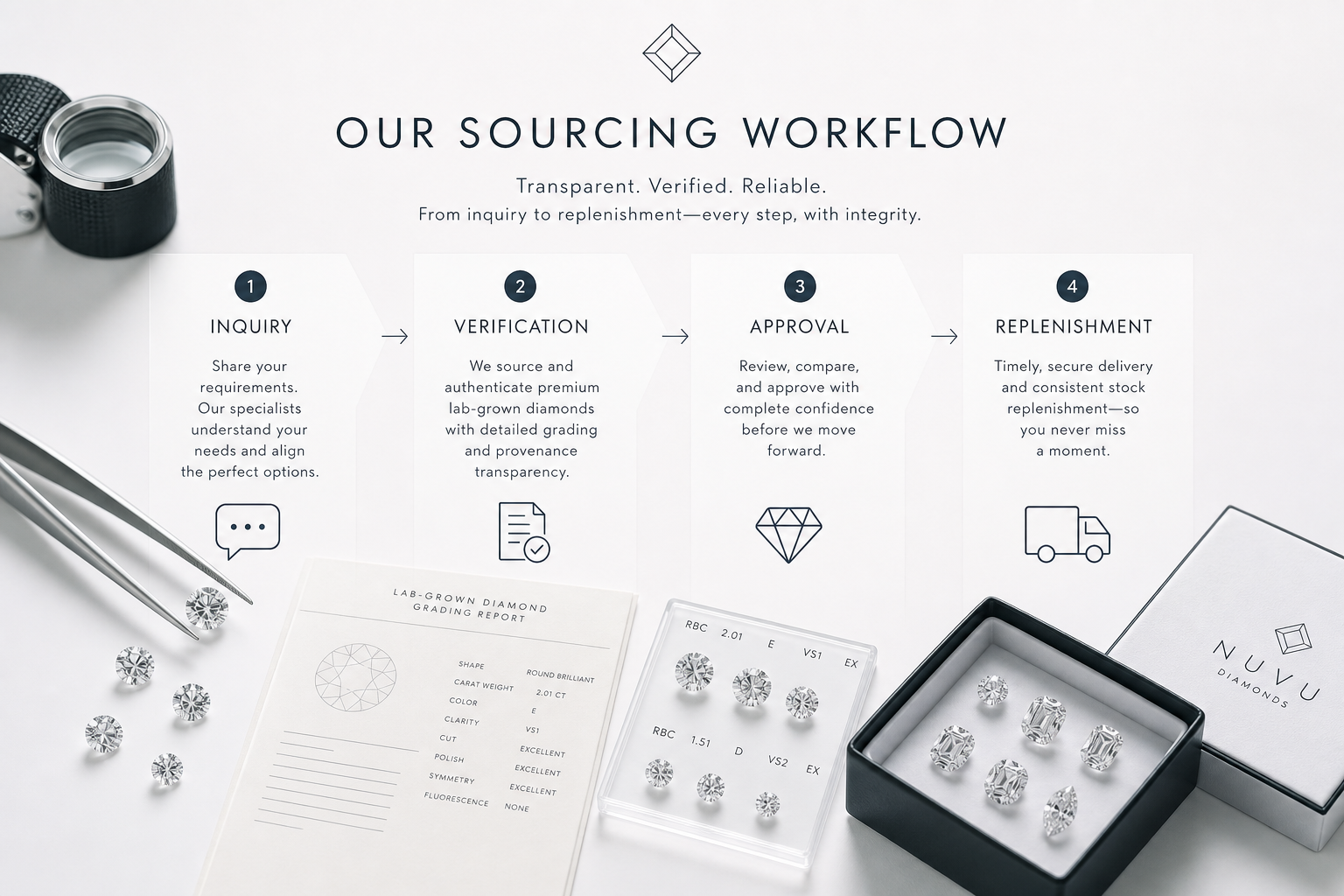
What to Check Before You Decide
- Order purpose: Decide whether the purchase is for a one-time customer request, a repeat product line, stock replenishment, or custom design production.
- Communication readiness: Confirm that the supplier can respond clearly on stone identity, availability, documentation, substitutions, and reorder expectations.
- Process control: Make sure inquiry, quote, approval, payment, and shipment steps are documented rather than handled through vague message threads.
- Replenishment risk: Ask whether similar stones can be sourced again later, especially if the stones are tied to a recurring setting or online listing.
Start with a clear target spec before you request quotes
A vague inquiry produces vague quotes. If a buyer asks for “nice oval lab diamonds” or “good price on 1 carat stones,” suppliers may respond with inventory that looks comparable at first but differs in size, color, clarity, cut quality, certification, or suitability for the intended product. Those differences may not matter for every order, but they matter a great deal when the stones need to fit a setting, match a product listing, or support repeat sales.
Before contacting suppliers, the buyer should separate fixed requirements from acceptable flexibility. This is especially important when sourcing loose lab-grown diamonds from China because the first quote often becomes the basis for the entire conversation. If the original request is unclear, the buyer may spend the rest of the process correcting assumptions that should have been defined at the start.
Define your non-negotiable specs first
The non-negotiable specs are the details that would make a stone unusable if they are wrong. For most trade buyers, these include shape, approximate millimeter size, carat range, color range, clarity range, and any cut or proportion requirements that affect the finished piece. If the diamond is intended for a specific mounting, millimeter dimensions often matter more than carat weight alone.
For example, a custom designer building a repeatable oval solitaire setting may need ovals that sit within a practical footprint, such as a defined length and width range, rather than simply “around 1.50 carats.” Two oval diamonds can share the same carat weight and still fit very differently because one is longer and narrower while another is shorter and wider. If the setting was built around the first profile, the second may create design or production problems.
The most common mistake is treating grade ranges as the whole specification. Color and clarity matter, but they do not tell the buyer whether the stone will fit the product, photograph consistently, or look balanced in a pair or group. For sourcing purposes, measurements and intended use should sit near the top of the requirement list.
For buyers, the practical point is not just what the grade range says, but which characteristics affect the finished jewelry. A higher clarity grade may be less useful than a better-fitting millimeter spread if the stone is going into a calibrated mounting, while a visually pleasing outline may matter more than a small difference in carat weight for a fancy-shape center stone.
Choose between calibrated sizes and free-size inventory
Calibrated sizes are useful when the stones must work inside repeatable jewelry designs. Stud earrings, tennis bracelets, station necklaces, halo rings, and standardized engagement ring settings often need stones that fall within tight size expectations. In these cases, the buyer is not only purchasing diamonds; the buyer is protecting production consistency.
Free-size inventory can work better when the buyer has more design flexibility or is selecting stones individually for custom projects. A one-of-a-kind ring may allow the setting to be built around the stone, so a slightly different millimeter spread may not be a problem. But for a retailer listing the same design online, inconsistent dimensions can lead to mounting issues, photography differences, and customer expectation problems.
As a practical example, a buyer sourcing round melee or accent stones may need a very controlled size band, while a buyer sourcing individual fancy-shape center stones may allow more variation if each stone is sold or designed around separately. The wrong choice is not calibrated or free-size by itself; the wrong choice is using free-size inventory for a product that requires interchangeability.
For custom design, trust comes from matching the stone to the setting, budget, and wearer’s daily use—not from choosing grades in isolation. A loose stone that looks attractive on a report may still be the wrong choice if the depth, outline, or millimeter spread requires a setting change the customer has not approved.
For custom jewelry, stone measurements and setting compatibility should be confirmed before finalizing a purchase. This includes the diamond’s length, width, depth, girdle profile, prong or bezel requirements, and whether the setting was designed for that exact stone or only for a general carat range.
Decide which specs can flex by product type
Not every spec deserves the same level of rigidity. A buyer should protect the details that affect fit, appearance, and customer promise, then allow flexibility where it does not damage the final product. This keeps the quote realistic and gives the supplier room to source better-matched goods without compromising the order.
For a bridal center stone, face-up appearance, shape outline, proportions, and certification may be more important than pushing clarity higher than the customer can appreciate without magnification. For a pair of earrings, visual matching may matter more than getting identical report grades. For small accent stones, consistent size and make may be more important than over-specifying color and clarity beyond the level the design requires.
A useful sourcing request might say: “Oval loose lab-grown diamonds, 1.40 to 1.60 carats, near-colorless range, eye-clean clarity, consistent length-to-width profile, intended for a repeatable solitaire setting.” That gives the supplier a clearer target than a loose budget request, while still leaving room to propose available stones. The better the opening spec, the easier it becomes to compare quotes on quality rather than guesswork.
Build an evidence file before the quote becomes an order
For trade buyers, the strongest specification is one that can be checked later. Before approving a quote, create a simple evidence file for the order: the original request, the supplier’s quoted stone list, report images or report references where applicable, videos, measurement confirmations, substitution notes, and final packing instructions. This does not need to be complicated, but it should be organized enough that another person on your team can understand what was approved.
This file is especially useful when several stones look similar on paper. If two oval diamonds share a similar carat range and grade range, the video label, millimeter measurements, and report reference help prevent accidental swapping during approval or packing. For online retailers, the same file can also support consistent product listings because the team can connect each loose stone to the correct SKU, image set, and customer-facing description.
Think of the evidence file as a practical buying control, not a legal formality. It helps you answer simple but important questions after the shipment arrives: Was this the stone we approved? Did the measurements match the quote? Was this substitution accepted as a one-time exception? Is this parcel suitable for the same product line as the previous batch? Those answers are much easier to confirm when the proof is gathered before payment and shipment.
Buyer Verification Checklist
- Shape: Confirm the exact shape and whether outline consistency matters for the product line.
- Millimeter size: Define the acceptable physical size range, especially for existing settings or repeat designs.
- Carat range: Use carat weight as a range, not the only size control.
- Color and clarity: Set a practical range based on how the stone will be sold and viewed.
- Cut and proportions: Identify any proportion preferences that affect face-up appearance or fit.
- Inventory type: Decide whether the order needs calibrated stones, matched parcels, or flexible individual stones.
- Flex points: Tell the supplier which specs can move and which cannot.
Use certificates as a filter, not a finish line
A lab-grown diamond grading report is useful because it creates a shared reference point. It can help document the stone’s identity, measurements, laboratory-grown origin disclosure, and grade descriptors. For buyers sourcing loose lab-grown diamonds from China, grading reports also make supplier comparisons more disciplined because they reduce the chance of relying only on verbal claims or informal inventory descriptions.
But a grading report should not be treated as the final buying decision. Reports do not show every visual detail that matters in retail, custom design, or matched inventory. They also do not remove the need to confirm that the quoted stone, the report number, the measurements, and the final shipped item all refer to the same diamond.
When a grading report is available, buyers should verify the report details through the issuing laboratory’s official report-check tool where available, then compare those details with the supplier’s media, invoice, parcel list, and received stone.
Which report fields matter most for sourcing
The first field to verify is the report number. It should match the stone being quoted and be usable for independent report lookup when available. If a supplier sends a report image without a clear report number or with details that cannot be checked, the buyer should treat the document as incomplete until clarified.
Measurements are just as important as the headline carat weight. Length, width, and depth help the buyer understand how the stone will face up and whether it may fit a setting or product requirement. For fancy shapes, this is especially important because two stones with similar carat weight can have different outlines, ratios, and apparent size. A report, as part of certification and QC checks, can document those measurements, but the buyer still needs to decide whether they fit the intended design.
Color and clarity grades help narrow a shortlist, but they should be interpreted in context. A clarity grade does not automatically describe whether an inclusion is visible in normal viewing, and a color grade does not tell the buyer how the stone will look in every lighting condition or metal color. Cut, polish, symmetry, and proportions can also influence how a stone performs visually, especially when two stones appear close on paper.
Growth method disclosure, such as HPHT or CVD when included on the report, should be treated as descriptive information rather than a simple quality ranking. Both methods can produce attractive lab-grown diamonds, and neither label alone proves beauty, durability, or value. If growth method matters for your assortment, customer education, or internal sourcing rules, make it part of the written specification and confirm that the report and invoice language are consistent.
When growth method or post-growth treatment is relevant, buyers should look for clear disclosure in the grading report or seller documentation. HPHT and CVD may describe laboratory diamond growth methods; they should not automatically be described as post-growth treatments unless the specific report or seller documentation supports that wording.
Practical limitation: A grading report helps document key characteristics, but it does not guarantee that a diamond will look bright, match another stone, fit a mounting, or support a sustainability claim. For trade buying, the reliable approach is to connect the report to the exact stone media, measurements, supplier parcel list, and final shipment records before approval.
Match the report to the commercial record and the physical stone
When a graded loose lab-grown diamond is quoted, the report should not stand alone as a loose attachment. Ask the supplier to connect the report reference to the quote line, video file, stone label, parcel list, and final invoice. This is the chain of evidence that helps prevent a correct report from being paired with the wrong diamond during a fast-moving sourcing conversation.
For single stones, the review can be straightforward: compare the report number, shape, carat weight, measurements, color, clarity, and any inscription or identifying reference shown in the supplier’s media. For parcels, the task is more detailed because many stones may share close grades. In that case, labels and tray positions matter. A parcel image that shows stone positions alongside corresponding report references can reduce confusion when the shipment is received and checked.
Buyers should also avoid over-reading a report. A report can help document what was examined and how the stone is described, but it does not replace inspection, setting-fit review, matching review, or supplier accountability. The better sourcing decision uses the report as one reliable data point inside a larger approval process.
Create a report-to-stone traceability chain
For graded loose stones, a useful traceability chain connects five points: the report reference, the supplier’s quoted line item, the visual media, the packing label, and the buyer’s receiving record. If any one of those points is missing, the buyer may still decide to proceed, but the risk should be understood before the order is treated as clean inventory.
For example, if a video shows a laser inscription or tray label, that reference should match the report number or internal stone ID listed on the quote. If the final invoice uses only a broad description, ask for a supplemental parcel list or label file that identifies each stone clearly. This is especially important for online stores and jewelers who assign stones to SKUs, customer jobs, or custom designs before the shipment arrives.
A grading report can narrow the comparison, but it should be read alongside the stone’s proportions, visual evidence, and intended jewelry use. The strongest buying decision is not based on the report alone; it is based on whether the report and the physical evidence point to the same stone and support the intended sale.
Request visual proof that actually helps you compare stones
Paper specs narrow the field, but they do not show whether a stone looks balanced, whether the outline is appealing, or whether two stones that appear similar on a report will work together in the same product line. When buying loose lab-grown diamonds from China, visual verification is one of the easiest places for a buyer to prevent avoidable sourcing mistakes.
The goal is not to collect beautiful marketing images. The goal is to receive media that helps you compare the exact stone being quoted against your requirements. A flattering photo taken at one angle can hide issues that become obvious in a ring, pendant, or matched layout. A useful video should make the comparison easier, not more vague.
What a useful diamond video should show
A useful diamond video should show the stone face-up, from the side, and through a full rotation. The face-up view helps you judge outline, spread, bow-tie visibility in elongated shapes, and how evenly the stone returns light. The side view helps confirm depth impression and girdle profile, which matters when a stone needs to fit an existing setting or repeatable mounting.
For sourcing decisions, a 360 video is usually more useful than a single hero image. Ask for the stone to be shown under steady lighting, without excessive filters, color correction, or distracting backgrounds. If every stone looks bright white and flawless in the supplier’s media, the presentation may be too polished to support real comparison.
Scale reference is also important. A loose oval or radiant may look attractive in isolation, but the visual impression changes once you see it next to a ruler, tweezers, a stone tray, or another diamond in the same size range. For custom designers and retailers, the practical question is not only “Does this stone look good?” but “Will this stone look right in the setting and beside the inventory I already sell?”
Measurements and proportion data to request
Ask the supplier to confirm measurements in millimeters, preferably to two decimal places where available, such as 8.12 x 6.05 x 3.78 mm. This matters more than many buyers expect because carat weight alone does not tell you how the stone will face up. Two stones with the same carat weight can have noticeably different length, width, depth, and apparent size.
For elongated shapes, length-to-width ratio should be checked before approval. A 1.40 ratio oval and a 1.50 ratio oval can both be attractive, but they may not suit the same bridal line or setting style. For rounds, the diameter range often matters more than tiny differences in carat weight. For step cuts, proportions and symmetry can affect the entire look of the stone, even when the basic grade appears acceptable.
If you are reviewing a parcel, request images or video sorted by size band rather than mixed together. For example, a group of 6.00 to 6.10 mm stones should not be casually mixed with 6.25 mm stones if they are intended for the same calibrated setting program. Small differences that look harmless in a quote sheet can become expensive when stones are being mounted, paired, or reordered.
When visual review should outweigh a paper-only quote
Visual review should carry more weight when the stone’s use depends on appearance or fit rather than simple grade matching. This includes elongated fancy shapes, matched pairs, center stones for custom rings, and stones intended for repeatable retail designs. In these cases, a quote that looks efficient on paper may still create problems if the outline, spread, or matching is off.
A paper-only quote is most risky when the buyer is trying to compare stones across multiple suppliers. One supplier may quote a lower price for the same stated color, clarity, and carat range, but the visual result may be weaker, the shape less consistent, or the measurements less suitable for the setting. The better quote is the one that supports the product you are building, not simply the one with the lowest number beside the grade.
At NUVU, we usually treat visual proof as part of the buying decision, not an optional extra. For loose stones, especially those sourced across time zones, a clear video and measurement confirmation can prevent the kind of mismatch that only becomes obvious once the stone is in hand.
How to Verify This Before Buying
- Request a video of the exact stone or exact parcel being quoted, not a sample from similar inventory.
- Ask for face-up, side-view, and rotating footage under steady lighting.
- Confirm measurements in millimeters and compare them against your setting or inventory requirements.
- For parcels, request stones arranged by size, shape, and intended match group.
- Be cautious if the supplier cannot connect the video, report number, and quote line clearly.
If the media does not help you distinguish one stone from another, it is not strong enough for a sourcing decision. Ask for clearer proof before you approve the order.

Calibrated sizes and matching: where inventory consistency is won or lost
For retailers, custom designers, and small wholesale buyers, a single beautiful loose diamond is often less useful than a group of stones that behave consistently across orders. Calibrated sizes and matching control whether your inventory can support repeatable designs, replacement needs, and predictable customer experiences.
This is where China sourcing should be judged carefully. A supplier may be able to offer attractive individual stones, but the more important question is whether they can help you maintain consistency across a product line. Close enough is not always interchangeable enough, especially when stones must fit existing settings or sit beside each other in pairs, side-stone layouts, or repeat-stock jewelry.
Why matched parcels matter more than a single great stone
A retailer building a bridal line around oval center stones may need a dozen loose lab-grown diamonds that look consistent across the showcase and fit the same general setting footprint. If one stone is 8.00 x 6.00 mm and another is 8.35 x 5.75 mm, both may fall near the same carat range, but they will not create the same visual impression. The difference can affect mounting fit, ring proportions, and customer expectations.
Matched parcels matter because they reduce the number of decisions your team has to remake later. If every reorder requires new setting adjustments, new photography, or new customer explanations, the sourcing channel is creating hidden labor. For a one-off custom project, that may be manageable. For a repeatable retail program, it becomes a margin and workflow problem.
The most common mistake is judging a parcel by its best stone. A more practical approach is to judge it by its weakest acceptable stone. If the least consistent stone in the parcel would create a problem in your setting or display, the batch is not as strong as the headline quote suggests.
How to compare batches instead of isolated stones
When comparing batches, ask the supplier to group stones by shape, millimeter range, ratio, color range, clarity range, and intended use. For example, if you need oval centers for a repeatable bridal setting, a practical request might specify 8.00 to 8.20 mm length, a controlled width range, and a similar length-to-width ratio rather than only asking for “around 1.50 carat ovals.”
For rounds, diameter consistency is often the key issue. For elongated shapes, outline and ratio can be just as important as millimeter size. For matched pairs, face-up similarity matters more than whether both stones have identical carat weight. A pair can be technically similar but visually uneven if one stone looks longer, wider, darker, or more angular than the other.
Ask for a layout image or video of the full batch arranged together. This reveals differences that individual videos may not show. A single radiant cut can look good alone, but when placed beside ten others, variations in corner shape, depth, and brightness become easier to judge. If the supplier cannot show the batch together, you have less evidence that the order will function as matched inventory.
In practical buying, this is where many comparisons become misleading. A supplier may describe stones as the same shape and size range, but matching also involves outline, face-up spread, table impression, brightness pattern, and how the stones look when placed side by side. Those details are difficult to judge from separate report images, so batch media is often more useful than another line of spreadsheet data.
What to do when inventory is close but not actually interchangeable
If stones are close but not interchangeable, separate them by use instead of forcing them into one category. A slightly deeper stone may work for a custom ring but not for a calibrated setting. A stone with a different ratio may be fine as a one-off center but unsuitable for a product line where customers compare multiple rings side by side.
This distinction matters most when you plan to reorder. If your first batch contains several borderline stones, your next order may be harder to match because the original standard was never clean. It is better to define a tighter acceptable range before the first purchase than to discover later that your inventory cannot be replenished consistently.
For calibrated programs, write down the accepted size window and visual standard after approval. For example, you might treat 6.45 to 6.55 mm rounds as one usable bucket for a specific setting, while keeping 6.35 mm or 6.65 mm stones separate. The exact tolerance depends on the design, but the principle is the same: a stone is only interchangeable if it works physically and visually in the same use case.
What This Means in a Real Purchase
If you are ordering twelve oval stones for a bridal line, do not approve the order based only on color, clarity, and total carat range. Ask to see the stones arranged together, confirm millimeter dimensions, check ratio consistency, and decide which stones belong in the same retail group. A lower-priced parcel that requires sorting, remounting, or customer explanation may cost more operationally than a tighter parcel with a higher unit price.
Price, MOQ, and lead time: how to judge the quote beyond the number
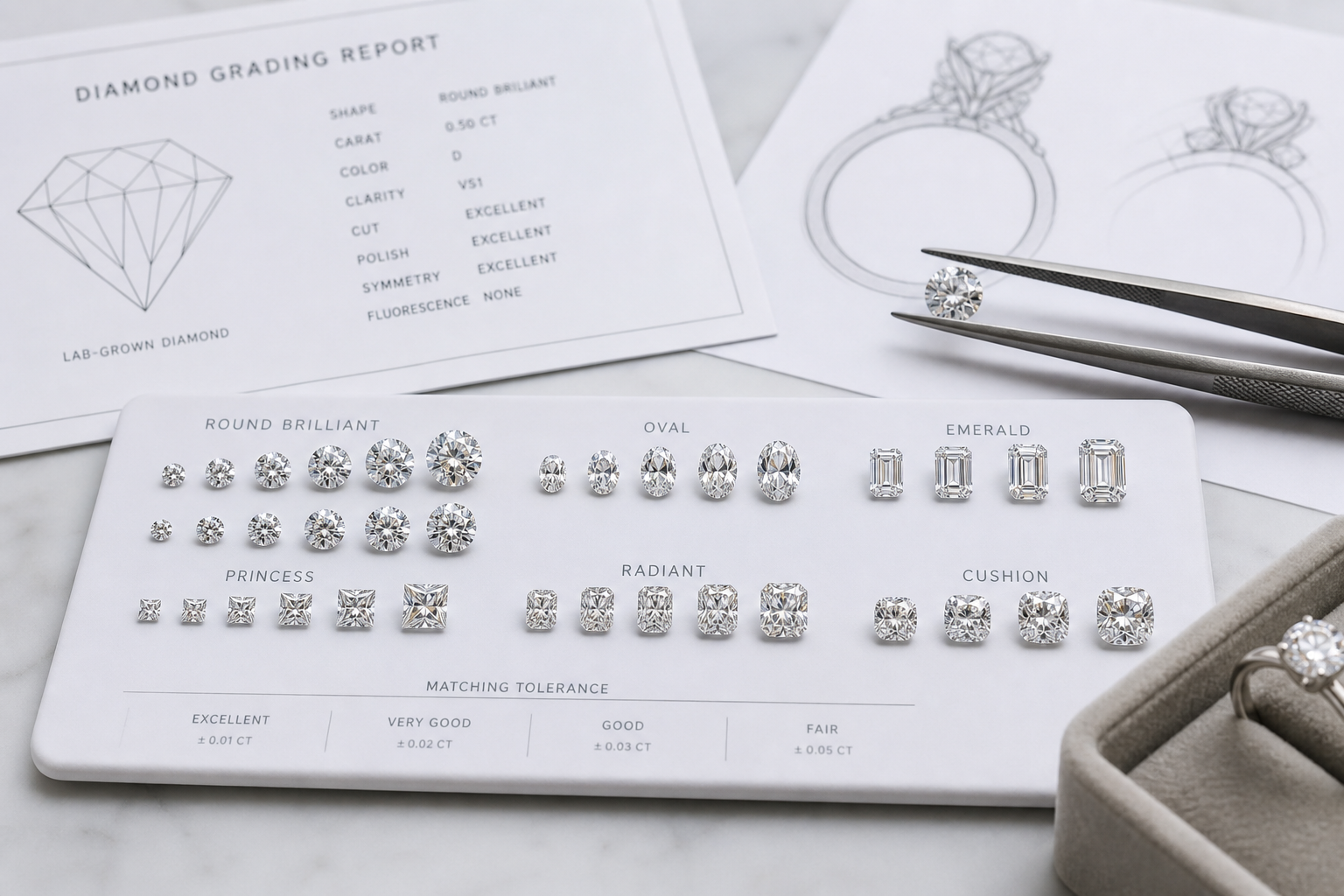
A wholesale quote for loose lab-grown diamonds from China should never be judged by unit price alone. Price matters, but it sits inside a larger sourcing equation that includes minimum order quantity, quote validity, substitution rules, lead time, and the supplier’s ability to support future orders. A low number can be useful, or it can be a warning that flexibility has been pushed out of the deal.
The better question is not “Which quote is cheapest?” It is “Which quote gives me the right stones, in the right quantity, with terms I can actually use?” That difference matters for retailers and jewelers who need reliable inventory rather than a one-time bargain.
Prices can vary because of cut precision, report type, seller channel, size, shape, availability, matching requirements, and documentation. Buyers should compare like-for-like specifications before treating one stone or parcel as a better value.
What usually changes price besides carat weight
Carat weight influences price, but it is not the only driver. Shape, size demand, color, clarity, cut quality, report type, millimeter spread, matching difficulty, and availability within a supplier’s current inventory can all affect the quote. A popular size or shape may carry different sourcing pressure than a less requested one, even when the basic specs appear similar.
Matching can also change the real cost. A parcel of stones that must stay within a tight millimeter range or ratio window may cost more than a looser mixed parcel because the supplier has to sort more carefully. For a buyer building repeatable jewelry, that added cost may be justified. For a buyer who can use free-size stones in one-off designs, strict matching may be less important.
Be cautious when two quotes look identical except for price. A lower quote may reflect looser grading tolerance, less precise matching, fewer media assets, shorter quote validity, or limited replacement options. None of those automatically makes the quote bad, but they change the risk. The mistake is treating all quotes as equal just because the headline specs look similar.
How MOQ affects flexibility and reordering
MOQ affects more than order size. It affects how quickly you can test a supplier, how much capital you tie up, and whether you can reorder only what you need. A one-piece quote may be useful for custom work, a five-piece quote may work for a small retail test, and a twenty-piece structure may only make sense if you already know the stones support a repeatable product line.
Lower unit cost often comes with a higher minimum. That can be efficient for established inventory, but it is risky when you are still testing shape demand, setting compatibility, or customer response. Buying too much too early can leave you with stones that are technically sellable but not aligned with your fastest-moving products.
Small buyers should pay close attention to whether the supplier can support partial reorders. If you sell three stones from a matched group, can you replenish three, or must you place a much larger order? If the answer is unclear, the original MOQ may look manageable while the reorder process becomes inconvenient.
How to plan for replacements and future orders
Lead time should be evaluated against your selling model. A longer lead time may be acceptable for planned inventory, private-label programs, or custom projects with clear customer timelines. It becomes a problem when you need quick replacements, last-minute swaps, or urgent stones for an existing client order.
Ask how long the quote is valid and whether the quoted stones are reserved, available on approval, or subject to substitution. A written quote-validity window matters because lab-grown diamond availability and pricing can change quickly. If a supplier quotes a parcel today but cannot confirm whether the same stones are available tomorrow, you need a process for rechecking before taking customer deposits or making product promises.
Replacement planning is especially important for matched or calibrated inventory. If one stone is damaged during setting or a customer requests a different size, the supplier’s ability to provide a near match may matter more than the original discount, especially when viewed through China lab-grown diamond supply chain expectations around batch documentation and replenishment. In practice, a slightly higher quote from a supplier who documents batches clearly can be more useful than a cheaper quote that leaves you rebuilding the order from scratch every time.
Separate quoted price from landed and usable cost
When comparing suppliers, keep the quoted unit price separate from the landed cost and the usable cost. The quoted unit price is only the number attached to the stone or parcel. The landed cost may also include shipping, insurance, duties, payment fees, local handling, inspection time, and any costs related to receiving or sorting the shipment. The usable cost goes one step further and asks how many stones in the order truly fit the intended product line after review.
This distinction is important because a cheaper parcel is not automatically cheaper if several stones need to be reclassified, discounted, remounted, or held for a slower-moving design. A tightly matched parcel with stronger documentation may cost more at the quote stage but create less work after arrival. For retailers and jewelers, the useful comparison is not only “What did I pay?” but “How cleanly can I sell, set, match, list, and reorder what I received?”
Before approving a lower quote, ask what is included and what is not. Confirm whether the price assumes exact stones, comparable replacements, report availability, labeled packing, video review, or after-sale clarification. If those elements are not included, the quote may still be valid, but it should be compared against other offers on that basis rather than treated as equal to a more complete sourcing package.
Compare supplier communication as part of the quote
For wholesale sourcing, the quote should be evaluated together with the way the supplier communicates. A clear supplier should be able to explain whether the price refers to exact stones, a current parcel, a comparable range, or a future sourcing target. If that distinction is unclear, the buyer may be comparing a firm offer from one supplier with a general estimate from another.
Ask for the same basic information from each supplier: stone or parcel identity, report status where applicable, measurement range, media availability, quote validity, substitution rules, packing method, and reorder expectations. This does not create a guarantee of performance, but it makes the comparison more traceable. It also helps reveal whether a lower quote is lower because the supplier is offering a different level of sorting, documentation, or matching control.
For NUVU, the goal in these discussions is to make diamond comparison easier to understand, especially when buyers are weighing report details, visual performance, setting fit, documentation, and budget together. The most useful sourcing conversation is one where the buyer can see what is fixed, what is flexible, and what still needs confirmation before approval.
Buyer Verification Checklist
- Ask whether the quote is for exact stones, similar stones, or a general spec range.
- Confirm MOQ by shape, size, grade, and parcel type rather than assuming one minimum applies to all orders.
- Request a written quote-validity window and clarify whether stones are reserved during review.
- Compare one-piece, small-batch, and larger-batch pricing only after checking how matching and documentation differ.
- Ask what happens if you need to reorder one stone, replace part of a parcel, or match a previous batch.
The better quote is the one that supports how your business actually buys and sells. If the terms make testing, reordering, or replacement difficult, the low unit price may not translate into better sourcing value.
Protect repeat orders with QC, documentation, and communication
Repeat orders do not fail only because a stone is poorly made. They often fail because one small change was approved casually, recorded vaguely, or remembered differently by each side weeks later. With loose lab-grown diamonds sourced from China, quality control is not a single inspection step at the end. It is the paper trail, the approval trail, and the communication trail working together before the parcel leaves the supplier.
This matters most when a buyer is building repeatable inventory: a bridal line, a set of online SKUs, a custom design program, or a small wholesale assortment. If the first order is approved by photo and the second order is based on memory, the buyer has no reliable baseline. The better approach is to treat every confirmed parcel as a reference point for the next one.
What to confirm on the final invoice and parcel list
Before shipment, the final invoice should match the approved order in more than total quantity and price. Confirm the shape, carat or millimeter range, color range, clarity range, report numbers where applicable, growth method if it matters to your buying criteria, and any matching or calibration requirements that were part of the original approval. If the order includes multiple stones, ask for a parcel list that identifies each stone clearly rather than relying on a broad description such as “oval lab diamonds, assorted.”
The parcel list becomes especially important when stones are similar but not interchangeable. A 1.50 ct oval and a 1.55 ct oval may sit differently in a setting if the length-to-width ratio or millimeter spread changes. For a retailer selling finished rings, that may create production friction. For an online store, it may create listing inconsistency. For a custom designer, it may mean the approved CAD or setting plan no longer fits as expected.
The most useful final confirmation ties the commercial record to the physical goods. A clean invoice tells you what you paid for. A clean parcel list tells you what is supposed to arrive. Labeled stone trays, report references, and final media help connect both to the actual shipment. If those records are loose, the buyer carries more risk after delivery because it becomes harder to identify whether a mismatch came from the quote, the packing stage, or the approval process.
Documentation is also where sourcing and sustainability claims should be handled carefully. Lab-grown diamonds can offer a different production path from mined diamonds, but that does not automatically prove a specific environmental or ethical claim. If your retail positioning depends on origin, production method, energy discussion, or supply-chain transparency, ask what can actually be documented and avoid turning broad marketing language into a customer promise.
Sustainability claims should be specific and documented. Broad green language is less useful than clear information about production, energy context, sourcing records, and seller transparency. If a supplier uses broad environmental language without supporting details, buyers should treat it as marketing language rather than verified sourcing evidence.
How to document substitutions and approvals
Substitutions are not automatically a problem. In loose diamond sourcing, they are sometimes necessary when a specific stone sells, a report is delayed, or a batch no longer matches the original availability. The risk is approving a replacement too quickly because it appears “close enough” on paper. Close enough may be acceptable for a one-off pendant stone. It may be unacceptable for a matched pair, a calibrated ring program, or a repeat SKU.
A practical substitution approval should record the original stone or spec, the proposed replacement, the reason for the change, and the exact difference between the two. If the replacement has a different millimeter measurement, ratio, color grade, clarity grade, report status, or visual appearance, that difference should be written out before approval. This prevents a later disagreement where one side remembers the change as minor and the other discovers it affected the finished product.
Consider a custom jeweler ordering a small group of oval stones for a recurring engagement ring design. The supplier offers a substitute that has the same carat weight and grade range but a slightly wider face-up shape. The buyer approves it quickly to avoid delay. On the next reorder, the supplier treats that wider oval as an accepted reference, and the jeweler receives stones that no longer fit the original setting proportions. The issue began with a substitution that was not documented as an exception.
For repeat orders, the key question is not only “Is this substitute acceptable today?” It is “Should this substitute become the new standard?” If the answer is no, label it clearly as a one-time approval. That small wording difference can prevent the exception from quietly becoming the baseline for future shipments.
Communication habits that reduce mistakes across time zones
Time zone differences make written communication more important, not less. A quick message may move an order forward, but it should not replace a clear confirmation when specs, substitutions, quantities, or shipment timing are involved. The safest communication habit is to restate the approved order in one concise message before the supplier prepares shipment.
A good confirmation message should include the final spec range, total quantity, approved substitutions, report requirements, labeling instructions, and any must-not-change details. If a buyer needs stones packed by size band, matched pair, SKU group, or customer order, that should be written before packing begins. Vague packing instructions are a common source of avoidable receiving problems.
Visual confirmation should also be organized. If photos or videos are shared across multiple chat threads, emails, and file links, it becomes easy to approve the wrong stone or lose track of which media belongs to which certificate. Ask the supplier to label images, videos, and parcel references in a way that matches the invoice or parcel list. The goal is not more communication; it is communication that can be checked later.
For wholesale conversations, our team treats documentation as part of quality control because a correct diamond sent with unclear records can still create problems for receiving, listing, setting, and reordering. The cleaner the communication before shipment, the fewer judgment calls the buyer has to make after the parcel arrives.
Use receiving inspection as a second verification step
Verification should not stop when the supplier ships the parcel. After arrival, inspect the goods against the same approval records used before shipment. Match the parcel list to the invoice, confirm stone counts, review labels, compare measurements where practical, and check that report references, media files, and physical stones still line up. This receiving step is where small packing or substitution issues can be caught before stones enter inventory or production.
For graded stones, avoid mixing stones into general stock before the report references and labels have been checked. For matched parcels, keep stones grouped by the supplier’s original layout until your team confirms which stones belong together. If a stone is intended for a customer order, SKU group, or calibrated setting, mark that use clearly before it is moved into a broader tray or inventory system.
If something does not match, document the difference immediately with photos, measurements, and a written description. A supplier can respond more effectively when the issue is specific: wrong measurement, missing report reference, unclear label, unexpected substitution, damaged packaging, or mismatch between video and received stone. Clear receiving records protect both sides and make the next order easier to manage.
How to Verify This Before Buying
- Ask whether the supplier can provide a final parcel list before shipment, not only a commercial invoice.
- Confirm that each stone or parcel group can be tied to report numbers, measurements, videos, or labeled tray images where applicable.
- Require written approval for any substitution, including what changed and whether it is a one-time exception or a new accepted standard.
- Restate packing instructions clearly if stones need to be grouped by SKU, size band, matched pair, customer order, or setting requirement.
- Keep one final written confirmation message that captures the approved order before goods leave the supplier.
A supplier who resists basic documentation may still be able to ship attractive stones, but that is not enough for repeat sourcing. If your business depends on replenishment, matching, or customer-specific orders, weak records are a real operational risk.
When China sourcing fits your business model—and when it doesn’t
Buying loose lab-grown diamonds from China works best when the sourcing model matches the way your business actually sells. It is not automatically the right route for every jeweler, retailer, online store, or small wholesale buyer. The channel can be useful when you have clear specs, repeatable demand, and enough process discipline to manage documentation and approvals. It can become frustrating when every order is urgent, tiny, or loosely defined.
The decision should not be based only on whether a quote looks attractive. A lower unit cost can lose its advantage if the order takes too much management time, creates setting mismatches, or leaves you without a clean path for replacement stones. For many buyers, the real question is whether China sourcing improves their supply control or simply adds another layer of coordination.
Best-fit scenarios for retailers, custom designers, and small wholesalers
China sourcing is often strongest for buyers who can define repeatable requirements. A retailer building a bridal assortment around popular shapes, a custom designer who regularly uses similar center-stone sizes, or a small wholesaler supplying calibrated loose stones may benefit from having a consistent sourcing conversation around batches, matching, and reorders.
This route also fits buyers who are comfortable approving stones through a combination of reports, measurements, visual media, and written confirmation. If your team already works with spec sheets, SKU groups, and customer-order documentation, the process can be manageable. The buyer does not need to be highly technical, but they do need to be specific.
Online sellers may also find value when they need a steady flow of loose stones for listings, especially if they can organize inventory by shape, grade range, size band, and report status. The advantage is not just access to stones. It is the ability to build a clearer replenishment process, provided the supplier can support consistent documentation and media review.
Warning signs that another sourcing route may be cleaner
China sourcing may be less suitable if you need one or two stones immediately, do not have time for back-and-forth verification, or want a supplier to make most selection decisions for you. In those cases, a domestic source, memo relationship, or more hands-on buying channel may be cleaner even if the unit price is higher.
Very small orders can also create friction. If the value of the order is low, the time spent comparing quotes, checking documents, reviewing media, confirming substitutions, and coordinating shipment may outweigh the savings. The smaller and more urgent the order, the more important convenience becomes.
Another warning sign is unclear internal demand. If you do not yet know which shapes, sizes, or grades your customers actually buy, ordering overseas inventory in advance can create dead stock. China sourcing tends to work better after you understand your sales pattern, not before. Testing demand locally or through smaller controlled orders may be the safer first move.
A simple decision framework for your next purchase
Start with the order type. If this is a one-off customer request with a tight deadline, prioritize speed, service, and low coordination risk. If this is a repeat SKU or a product line you expect to replenish, prioritize documentation, matching rules, and reorder reliability. If this is a custom design stone, prioritize physical fit, visual review, and clear substitution control before price.
Then look at your tolerance for process. Buyers who can prepare target specs, review videos, track approvals, and confirm parcel lists are better positioned to source directly or semi-directly from China. Buyers who need simplified purchasing may be better served by a domestic intermediary, even if the cost structure is different.
The final filter is consequence. If a mismatch would only require a simple listing change, the risk may be acceptable. If a mismatch would delay a customer ring, require a setting remake, or break a matched pair, the supplier’s documentation and communication standards should carry more weight than the lowest quote.
At NUVU, this is treated as a practical comparison rather than a single-source rule. The report helps narrow the field, the quote sets the commercial frame, and the final decision still depends on whether the stone or parcel makes sense visually, physically, operationally, and financially for the buyer’s actual use case.
When a grading report is provided, buyers should compare the report details with the issuing laboratory’s verification tools where available and with the supplier’s own quote, media, invoice, parcel list, and packing labels.
For trade buyers, this means report references should be treated as working documents, not decorative attachments. When a stone is supplied with a GIA, IGI, HRD Antwerp, or other grading report, the report number, measurements, shape, carat weight, color, clarity, laboratory-grown origin disclosure, and any inscription details should be checked against the supplier’s media, invoice, and parcel list before the stone is accepted into inventory.
This verification habit is especially important for retailers and jewelers who resell stones under their own customer-facing descriptions. A report-aware process helps prevent mismatched listings, incorrect SKU assignment, and avoidable disputes after a stone has already been photographed, mounted, or offered to a client.
Before purchase, buyers should confirm the seller’s documentation, return terms, resizing terms, and after-sales support in writing rather than assuming they apply automatically.
NUVU’s role in buyer education is to make comparison clearer, especially around grading reports, visual evidence, design fit, communication records, and documentation.
For wholesale and retailer orders, documentation support should be practical and traceable: clear report references where applicable, written specification confirmation, labeled packing, and a documented approval record before shipment. These details do not replace the buyer’s own inspection, but they give both sides a cleaner basis for receiving, listing, setting, and reordering loose lab-grown diamonds with confidence.
What This Means in a Real Purchase
A small retailer ordering twenty loose round stones for a repeatable stud earring program has a different sourcing profile than a jeweler trying to find one unusual elongated cushion for a rush engagement ring. The first buyer can define a size range, approve a parcel, document the batch, and plan reorders. China sourcing may fit well if the supplier can maintain consistency. The second buyer may be better served by a faster, more curated source with immediate availability and fewer coordination steps.
For your next order, choose the route that protects the sale you are actually trying to make. Use China sourcing when clear specs, repeat demand, and documentation discipline create an advantage. Use a closer or more hands-on channel when speed, tiny quantity, or customer-specific uncertainty matters more than sourcing efficiency.
Disclosure: This article is for general educational purposes only. Diamond grading, pricing, availability, specifications, and seller policies can change, and readers should verify important details through grading reports, official laboratory tools, seller documentation, or qualified professionals before making a purchase decision. Laboratory-grown diamonds should be clearly distinguished from natural diamonds, and environmental or sourcing claims should be supported by specific documentation.