
Buying lab-grown diamonds or finished jewelry from China, including China lab-grown diamond sourcing, often depends on one critical moment: the approval given before shipment leaves the supplier. A grading report is useful, but it does not prove that the correct stone, SKU, setting, certificate, packaging, and documents are all moving together in the parcel. Once goods cross borders, even small mismatches can become expensive delays, repairs, returns, or customer-service problems.
For the full framework, read China Lab-Grown Diamond Supply Chain Guide.
This article explains how to treat pre-shipment QC as a practical stop-or-go decision. It focuses on matching certificates to actual stones, reviewing traceable photos and videos, checking finished jewelry workmanship, confirming documents and packaging, and recording discrepancies before approval. The goal is to help buyers decide when a shipment is ready to release, when proof is not strong enough, and when a supplier must correct issues before dispatch.
| QC Area | What to Verify | When to Hold Shipment |
|---|---|---|
| Certificate matching | Report number, SKU, order line, shape, carat, measurements, color, clarity | Any mismatch, missing report, or unverified lab lookup |
| Stone identity | Laser inscription images or video linked to the correct stone | Unreadable inscription, unclear media, or possible substitution |
| Visual appearance | Face-up look, inclusions, bow-tie, windowing, symmetry, matched sets | Appearance differs from approved standard or set matching is weak |
| Finished jewelry | Prongs, pavé, alignment, clasp, size, engraving, stamps, polish, stone security | Loose stones, wrong size, poor setting, missing custom detail |
| Documents and packing | Invoice, packing list, certificates, SKU labels, protective packaging | Items cannot be traced from QC proof to shipment documents |
| Approval record | Discrepancy log, corrected proof, written final approval | Corrections are claimed but not re-documented |
Quick Questions Before You Read
Q: Is a diamond certificate enough to approve shipment?
No. It confirms recorded diamond details, but it does not prove the correct stone, jewelry item, label, or document is being shipped.
Q: What proof should buyers request before release?
Ask for traceable photos and videos tied to SKU, report number, order line, packing list, and invoice.
Q: Should every small document error stop shipment?
Not always. Minor formatting issues can be corrected quickly, but identity, quantity, certificate, workmanship, and custom-detail problems should pause release.
Q: Why keep a discrepancy log?
It records what changed, what proof was provided, and which supplier issues repeat across shipments.
Laboratory-grown diamonds should be clearly identified as laboratory-grown, and they should not be presented as mined diamonds. A shipment review should therefore check not only the report number and physical stone identity, but also whether invoices, packing lists, labels, product descriptions, and customer-facing records accurately disclose laboratory-grown origin where relevant.
A grading report helps document key characteristics, but it should not be treated as a guarantee of beauty, value, sourcing ethics, or shipment accuracy. Buyers should read the report alongside visual evidence, measurements, supplier documentation, and the intended jewelry use before approving release.
Start With a Pre-Shipment QC Mindset, Not Just a Certificate Check
China lab-grown diamond certification is an important part of shipment approval, but it should never be treated as the full quality control process. A grading report can help confirm recorded diamond characteristics, but it does not prove that the exact stone in the parcel is the one being shipped, that the correct ring was produced, or that the order is packed and documented correctly.
For B2B buyers sourcing loose diamonds or finished jewelry from China, the practical question is not only, “Does this diamond have a certificate?” The better question is, “Does every item being shipped match the approved order, the supporting documents, and the quality standard we agreed to before payment and dispatch?” That shift matters because most problems become slower, more expensive, and harder to prove once an international shipment has left the supplier.
Why pre-shipment approval matters more in cross-border sourcing
Cross-border sourcing can work well when the supplier is organized, responsive, and consistent. China has strong production and supply-chain capacity for lab-grown diamonds and jewelry, but capacity does not remove the buyer’s responsibility to control the approval gate. A shipment should not move simply because production is finished or the supplier says the goods are ready.
The risk is operational. If a certificate number is copied incorrectly, a stone is packed under the wrong SKU, a center diamond is set slightly off-center, or the final paperwork does not match the invoice, the buyer may not discover the issue until the goods arrive in the U.S. By then, the options are worse: return shipping, delayed customer delivery, extra photography, customer-service issues, or a repair process that could have been avoided with a tighter pre-shipment inspection.
The most reliable buyers treat pre-shipment QC as a stop-or-go decision. The supplier provides evidence, the buyer reviews it against the order, and shipment is approved only when the documentation and product evidence line up. This does not need to be adversarial. It simply creates a shared record before the goods leave the supplier’s control.
Certification is one checkpoint, not the whole QC process
A grading report is useful because it records key details such as report number, shape, carat weight, measurements, color, clarity, and sometimes growth-related information or inscription details. For certified loose stones, that report is the starting reference. It helps the buyer avoid relying only on a supplier’s description or file name.
The limitation is that a certificate describes a diamond, not a shipment. It does not confirm that the correct stone was packed in the parcel. It does not show whether finished jewelry has secure prongs, clean polishing, accurate engraving, or the right ring size. It also does not confirm that every SKU, quantity, label, and document is aligned. A buyer who stops at “certificate received” can still approve the wrong goods.
For buyers, the practical point is not just what the report says, but what the report does not evaluate. It may document a diamond’s graded characteristics, but it does not guarantee beauty, customer preference, setting compatibility, sourcing transparency, or commercial suitability for a specific order. Those questions require visual review, measurement comparison, supplier documentation, and a clear record of what the buyer actually approved.
This is where lab-grown diamond QC needs a broader workflow. Certification should be matched to the physical stone, the physical stone should be matched to the purchase order, and any finished jewelry should be reviewed as a completed product. If one of those links is weak, shipment should pause until the gap is explained or corrected.
Keep lab-grown, natural, and simulant language separate
Pre-shipment documents should use accurate product language. A laboratory-grown diamond is a diamond with laboratory origin; a natural diamond is formed by geological processes; and a diamond simulant is a non-diamond lookalike material. These categories should not be mixed in invoices, packing lists, SKU labels, product feeds, or sales descriptions.
This distinction is especially important when a buyer sources from several categories at once, such as lab-grown diamond rings, natural diamond accent jewelry, and moissanite or cubic zirconia samples. If the supplier uses vague wording such as “diamond style,” “synthetic stone,” or “created stone” without clear context, the buyer should ask for corrected descriptions before shipment. Clear language reduces receiving errors and helps prevent misleading product listings later.
When growth method or post-growth treatment is relevant, buyers should look for clear disclosure in the grading report or seller documentation. HPHT and CVD may refer to laboratory diamond growth methods, while some post-growth treatments may also need separate disclosure when applicable. Buyers should not assume treatment status unless it is documented for the specific stone.
Use an evidence hierarchy before you approve
A stronger QC process ranks proof by reliability. The most useful evidence usually comes from primary records and direct item media: the official grading report or report lookup, a readable inscription image when applicable, a current video of the exact stone, a finished-jewelry close-up, and a packing list that uses the same identifiers. Lower-value evidence includes file names, chat summaries, cropped screenshots, or a supplier’s general statement that “all is correct.” Those items can support communication, but they should not be the final basis for release.
Buyers should also separate evidence that proves identity from evidence that proves condition. A report number helps identify a diamond, but it does not show whether a ring was polished cleanly. A beauty video shows appearance, but it may not prove the certificate number unless the media is tied to the report, SKU, or packing list. Good pre-shipment QC uses several pieces of proof together instead of expecting one document to answer every question.
When proof is incomplete, avoid filling the gap with assumptions. If the report is present but the inscription image is unreadable, ask for a clearer image or a new video. If the ring looks good but the size is not shown, request size confirmation. If the invoice is correct but the parcel labels are unclear, hold shipment until labels are traceable. Evidence should reduce uncertainty before goods move, not create questions for the receiving team later.
A traceability mindset also means keeping the same identifiers active from quotation to final packing. If a stone is first discussed under a supplier stock number, then approved under a buyer SKU, then packed under a different internal label, the buyer should require a cross-reference that connects all three. The strongest QC trail lets someone who was not part of the original sales conversation still identify the stone, report, media, jewelry item, and parcel without guessing.
The difference between approving a stone and approving a shipment
Approving a stone means the buyer accepts the diamond’s identity and stated characteristics. Approving a shipment means the buyer accepts the complete package of goods, documents, labels, media, and order records. Those are different decisions, and confusing them is one of the easiest ways to create avoidable disputes.
A loose oval diamond may have the correct report and still be packed under the wrong customer SKU. A ring may contain the correct center stone and still fail because the prongs are uneven or the engraving is wrong. A parcel of matched accent stones may meet the quantity requirement but not the size range needed for the design. Shipment approval has to account for those practical details because the buyer is accepting the order as deliverable, not just the diamond as graded.
The strongest approval process separates identity, condition, order matching, and documentation. Each one should be checked before shipment, and each issue should be resolved in writing. If a supplier cannot provide clear evidence for a line item, that line item should be held back rather than included in a shipment that may become difficult to unwind later.
What This Means in a Real Purchase
For a U.S. retailer ordering a mixed shipment from a China-based supplier, the pre-shipment mindset prevents small errors from becoming expensive after arrival. The buyer may be approving certified loose diamonds, semi-mounts, finished engagement rings, and branded packaging in one order. A certificate PDF alone does not confirm that the correct loose stones are in the correct parcels, that the rings match the CAD notes, or that every item can be received and stocked without additional sorting.
The practical judgment is simple: do not approve shipment because the paperwork looks generally complete. Approve only when the exact goods being shipped are connected to the correct certificate, SKU, visual proof, and order record. That is the difference between buying from a supplier and controlling a supply process.
Match Every Diamond to Its Certificate Before Anything Ships
Before any loose diamond shipment is approved, every certified stone should be matched line by line to its grading report and purchase order. This is the core step in loose diamond QC because it confirms identity before the goods move. A certificate is only useful if the buyer can tie it to the exact stone being packed.
The common mistake is relying on supplier screenshots, folder names, or informal file labels. Those can help organize a review, but they are not proof. A file named “1.50ct E VS1 oval” may still be paired with the wrong PDF or the wrong stone video. Buyers should require a stone-by-stone matching sheet that connects each physical item to a report number, SKU, order line, and shipment line.
Build a stone-by-stone matching sheet
A good matching sheet should make each diamond traceable without forcing the buyer to search through messages and attachments. For certified loose stones, each row should include the buyer SKU or order reference, supplier stock number if used, report number, shape, carat weight, color grade, clarity grade, measurements, and any inscription status that applies.
This matters most when the order includes similar stones. Ten oval diamonds between 1.40 and 1.60 carats can look easy to manage in a chat thread, but they become much harder to verify if several have close color and clarity grades. Without line-item tracking, one swapped PDF or mislabeled parcel can create confusion at receiving, photography, inventory upload, or customer fulfillment.
For matched pairs, layouts, and multi-stone orders, the matching sheet should also show how the stones are grouped. Earrings, three-stone rings, tennis bracelets, and calibrated accent layouts depend on consistency, not only individual certificates. If the supplier treats each stone as an isolated item, the buyer may receive technically correct stones that still do not work together in the intended product.
Check report number, carat weight, shape, and measurements
The report number is the anchor, but it should not be reviewed alone. Buyers should compare the report number with the carat weight, shape, and measurements on the report, then check those details against the order record. If one field is wrong, the shipment line should be reviewed rather than waved through as a “typing issue.” Some errors are harmless clerical mistakes, but others signal that the wrong report or stone may be attached.
Measurements are especially useful because they help separate stones that otherwise look similar on paper. Two diamonds may both be listed as 1.50 carat F VS1 ovals, but their length, width, depth, and proportions can differ enough to affect setting fit or visual spread. For pre-shipment approval, the buyer does not need to re-grade the diamond; the goal is to make sure the recorded identity matches the stone being shipped.
If the supplier provides a packing list, it should use the same report numbers and SKU references as the buyer’s approval sheet. Any mismatch between the packing list, invoice, certificate PDFs, and QC sheet should be corrected before shipment. Small inconsistencies become larger problems when several people are involved in receiving, customs paperwork, inventory entry, and customer delivery.
Confirm color and clarity against the approved order
Color and clarity should be checked against what was actually approved, not against what seems acceptable in the moment. If the buyer ordered E to F color and VS clarity, a G color or SI clarity stone may still look attractive, but it is not the approved item unless the buyer accepts the substitution in writing. This is especially important for retailers whose product listings, customer quotes, or internal pricing depend on exact grade ranges.
The highest-risk substitutions are not always dramatic. A one-grade change in color or clarity may be easy to miss in a busy shipment review, but it can affect margin, listing accuracy, customer trust, or the ability to match stones later. Buyers should treat grade changes as commercial changes, not just gemological details.
At this stage, the grading report helps confirm the recorded grade, but it does not replace visual review. A diamond can match its certificate and still require separate evaluation for appearance, especially in fancy shapes where face-up look can vary widely. Certificate matching answers the identity question first; visual approval comes after the identity is clear.
Buyer Verification Checklist
- Require one line per certified diamond: Do not accept a bulk description for individually certified stones.
- Match the report number: The number should align across the certificate, QC sheet, packing list, and invoice where applicable.
- Compare basic identity fields: Shape, carat weight, color, clarity, and measurements should match the approved order record.
- Flag close-but-not-identical stones: Similar weight or grade is not enough if the report number or measurements do not match.
- Track matched groups together: Pairs, layouts, and calibrated sets should be reviewed as grouped items, not only as individual stones.
- Do not rely on file names alone: Supplier folder labels and screenshots are useful for organization, but they should not be the final proof of identity.
Verify the Report Number and Laser Inscription
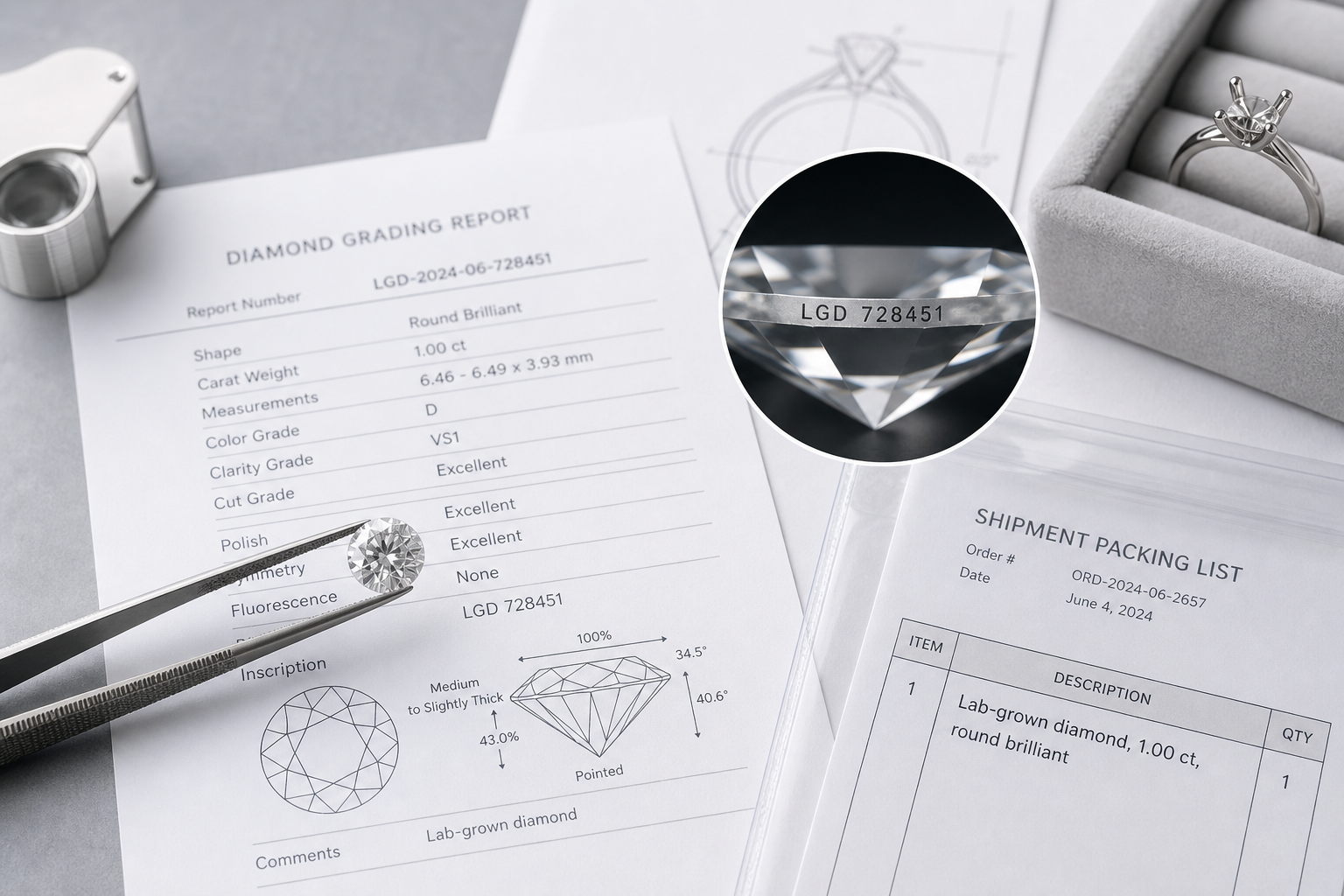
After each diamond is matched to its certificate, the next step is identity verification. The buyer should confirm that the report number is valid through the grading lab’s online lookup and, when the diamond is expected to carry a laser inscription, that the inscription on the stone matches the report and packing list.
This step is not about deciding whether IGI, GIA, or another recognized laboratory is better for every purchase. The practical question is narrower: does the document exist in the lab’s system, and is the physical stone connected to that document strongly enough to approve shipment?
Use the grading lab’s online report lookup
For certified lab-grown diamonds, buyers should use the grading lab’s official report lookup tool to confirm the report number and key details. The lookup result should match the PDF provided by the supplier and the information on the buyer’s QC sheet. If the report lookup shows different details, the shipment line should be held until the supplier explains and corrects the discrepancy.
A report number by itself is not enough. Numbers can be mistyped, copied into the wrong row, or attached to the wrong media file. The safer approach is to check the report number together with carat weight, shape, measurements, color, and clarity. If all fields align, the buyer has a stronger basis for approving that stone for shipment.
Different grading reports can present information in different formats, so buyers should focus on what can be verified rather than treating the logo alone as a complete approval. The useful review question is whether the report record, supplier file, inscription evidence, and shipment documents all point to the same stone. If those records do not line up, a recognized report still cannot solve the identity problem by itself.
Buyers should also be cautious with screenshots of report pages. A screenshot may be useful for quick communication, but China lab-grown diamond quotes should still be checked against the grading lab’s lookup page or the official report document. The standard should be simple: the supplier can send supporting files, but the buyer should verify the source record before goods leave.
When a grading report is available, buyers should verify the report details through the issuing laboratory’s official report-check tool where available, then compare those details with the stone media, inscription evidence, SKU, and packing documents.
Record the source of each verification step
For important stones, the buyer should record how verification was completed, not only that it was completed. A QC sheet can include simple fields such as “report checked,” “PDF matched,” “inscription image received,” “video matched to SKU,” and “packing list matched.” This creates a useful audit trail without turning the process into legal paperwork.
The distinction matters when several departments are involved. A sourcing manager may review the report, a merchandising team may review appearance, and a warehouse team may receive the parcel weeks later. If the record only says “approved,” the receiving team may not know which file, video, or certificate version was accepted. If the record identifies the exact evidence used for approval, the team can resolve questions faster and avoid reopening decisions that were already checked before shipment.
Request a clear laser inscription image when applicable
Many certified diamonds include a laser inscription on the girdle, but buyers should not assume this applies to every stone. The correct approach is to confirm whether the report and supplier records indicate that an inscription should be present. If it is expected, the buyer should request a clear image or video showing the inscription before shipment.
The image does not need to be studio-level marketing content, but it does need to be readable enough to support identity verification. A blurred girdle photo does not prove much. If the supplier cannot provide a clear inscription image, a short video showing the stone, report, and packaging reference together may help, but unresolved uncertainty should be treated as a review issue rather than ignored.
This matters most for high-value stones, similar inventory, and orders with several diamonds in close size and grade ranges. In those cases, the inscription is not a decorative detail. It is one of the simplest ways to connect the physical diamond to the report before international shipment.
Confirm the inscription matches the report and packing list
The inscription should match the report number exactly where an inscription is present and expected. The same number should also appear on the packing list or QC sheet for that line item. If the certificate shows one number, the inscription image shows another, and the packing list shows a third, the buyer should not approve shipment until the supplier identifies which item is correct.
Some issues are minor formatting differences. Others are shipment-stopping problems. A missing space or prefix may be less concerning if all other details line up and the grading lab record supports the number. A different report number, unreadable inscription, or unexplained mismatch should be treated as a hold condition because it affects stone identity.
The key judgment is that identity verification should happen before the supplier seals and dispatches the parcel. Once the goods are in transit, the buyer may still be able to prove a mismatch, but resolving it becomes slower and more expensive. A five-minute clarification before shipment is better than a cross-border dispute after delivery.
Certificate and Visual Review Check
- Look up the report number through the grading lab’s official system.
- Compare the lookup result with the certificate PDF and QC sheet.
- Confirm whether the stone is expected to have a laser inscription.
- Request a readable inscription image or video when applicable.
- Match the inscription number to the report number and packing list.
- Hold shipment for any unexplained mismatch, missing proof, or unreadable identity evidence on important stones.
Review Photos and Videos for the Actual Stones Being Shipped
Ask for media of the exact stones, not sample inventory
For loose diamond QC, the media must show the actual stones being shipped, not a similar stone, previous inventory, or a polished sample from the supplier’s catalog. A grading report confirms recorded characteristics, but it does not show the live appearance of the diamond in motion or whether the supplier has selected the exact stone tied to your order line.
Before approval, request a clear media set for each important stone: one face-up photo, one side-view photo, and one 360-degree diamond video under neutral lighting. For higher-value stones, elongated shapes, or stones intended as center diamonds, a single still image is not enough. Photos can hide contrast problems, while videos often reveal bow-tie strength, windowing, dark zones, or symmetry issues that would matter once the diamond is mounted.
Media review also has limits. Lighting, camera exposure, background color, and compression can make a diamond look better or worse than it may appear in person, so video should be used as decision evidence rather than treated as a perfect substitute for physical inspection. A careful buyer compares the media with the report, measurements, intended setting, and any previously approved sample standard before releasing the shipment.
The biggest mistake is accepting file names as proof. A video labeled with a report number is useful only if the stone can be reasonably tied back to the same report, packing list, and order line. If the supplier sends media in batches, ask them to identify each stone consistently by SKU, report number, or line item so the review does not turn into guesswork after the shipment arrives.
Check face-up appearance, symmetry, and visible inclusions
Video review should focus first on face-up appearance because that is how the customer will experience the diamond. A stone can have acceptable grades on paper and still look weak if it has obvious dark areas, uneven brightness, a strong bow-tie in an oval, pear, marquise, or radiant cut, or a face-up shape that looks noticeably off from the order expectation.
Visible inclusions deserve practical judgment. If the order is for eye-clean stones, the buyer should not approve a video where an inclusion is easy to spot in the normal face-up view, even if the clarity grade technically allows it. The same applies to color appearance. A small amount of warmth may be acceptable for some designs, but it becomes a problem when one stone in a group looks clearly warmer than the others or when the approved order called for a tighter color range.
Symmetry should be reviewed visually, not only as a report grade. Check whether the outline looks balanced, the table appears centered, and the facet pattern does not create distracting unevenness. This is especially important for fancy shapes, where two diamonds with similar report data can perform very differently in real viewing conditions.
Review pairs, layouts, and matched lots together
Pairs and matched layouts should be reviewed as a group, not only as individual stones. Two diamonds may each look acceptable alone but fail as a pair because one appears larger, warmer, darker, or more elongated than the other. This matters for earrings, side stones, three-stone rings, tennis bracelets, and any layout where visual consistency is part of the value.
For matched lots, ask for a group video showing the stones arranged in order with their corresponding line references. The goal is not to demand impossible uniformity; it is to catch obvious mismatches before they become your inventory problem. In melee or accent layouts, small differences may be acceptable, but uneven color, noticeably different spread, or inconsistent brightness can make the finished piece look cheaper than the order grade suggests.
If the supplier cannot provide clear media for the actual stones being shipped, treat that as a review issue, not a minor inconvenience. Remote buying depends on evidence. Without usable photos and videos, the buyer is approving paperwork rather than product condition.
What to Check Before You Decide
- Stone identity: Each image or video should connect to a SKU, report number, or order line, not a vague batch label.
- Face-up appearance: Look for brightness, dark zones, windowing, bow-tie effect, and whether the shape looks balanced.
- Visible inclusions: Judge whether inclusions are noticeable in a normal viewing position, not only under magnification.
- Color consistency: Compare stones intended for the same shipment, pair, or layout under the same lighting.
- Matched sets: Review pairs and groups together so differences in size impression, outline, and brightness are not missed.
Use Practical Tolerances for Measurements, Counts, and Order Matching
Set pass-or-review rules before the supplier packs the order
Pre-shipment quality control works best when the buyer defines what passes automatically and what needs review before the supplier packs the order. Without agreed rules, every small discrepancy becomes a negotiation, and the shipment may move forward before the buyer has clearly approved the details.
The strictest standard should apply to identity and quantity. Certified stones should match their reports and order lines without exception. Loose diamond counts should match the invoice and packing list exactly. A one-stone difference is not a tolerance issue; it is a shipment accuracy issue. For B2B buyers managing customer orders or retail inventory, that kind of mismatch can create delays, refunds, or internal reconciliation problems after delivery.
Other details need practical thresholds. Calibrated accent stones, matched layouts, and melee parcels may involve small measurement ranges, but those ranges should be approved before production or sourcing. A tolerance that works for a pendant may not work for a channel-set band or tightly engineered custom ring.
Use report data as the reference for certified loose stones
For certified loose stones, the grading report should be the measurement reference, not a photo estimate or a supplier’s casual description. Millimeter measurements, carat weight, shape, and report number should be checked against the report and the order sheet. If a buyer is comparing a video to a report, the video helps confirm appearance and identity support, but it cannot replace the recorded measurements on the grading document.
Carat weight should be reviewed carefully because two diamonds with the same nominal carat category can have different spread. A 1.50 ct stone that faces up smaller than expected may still be correctly graded, but it may not be right for a customer-facing order if the buyer approved a certain visual size. This is where measurement review has more value than carat weight alone.
Do not treat every small decimal difference as a problem. The key is whether the shipment matches the approved report, the buyer’s order criteria, and the intended use. A measurement that is acceptable for a loose diamond listing may be unacceptable for a ring mounting already built to tight proportions.
Define tolerances for calibrated stones and matched layouts
For calibrated stones and matched layouts, tolerances should reflect the design risk. A small size variation may be harmless in a loose parcel but visible in a matched pair of earrings or impossible to set cleanly in a pre-made mounting. Buyers should be more conservative when stones must fit existing jewelry, sit flush in a row, or match across left and right pieces.
As an operational example, a buyer might require calibrated accent stones to stay within ±0.05 mm for a precise setting, while allowing a wider range for a less size-sensitive layout. This should not be treated as a universal rule. The acceptable range depends on the design, setting style, stone size, and supplier agreement.
The most useful QC spreadsheet separates non-negotiable matches from design-dependent tolerances. Report number, quantity, and certificate identity should be exact. Measurement ranges for non-certified calibrated stones should be approved in advance. Matched layouts should be judged by both numbers and side-by-side visual review.
Pre-Shipment Parameter Block
- Certified stone report match: Required for every certified stone before shipment approval.
- Laser inscription check: Required for every stone that is expected to have an inscription tied to its report.
- Loose diamond count: Must match the invoice, packing list, and QC sheet exactly.
- Certified stone measurements: Check against the grading report, not against visual estimates from photos.
- Calibrated melee or accent stones: Define the acceptable millimeter range before production, such as ±0.05 mm when the setting requires tight fit.
- Matched pairs and layouts: Review size, color, shape outline, and brightness together before final approval.
- QC file references: Each photo, video, and document should use the SKU, report number, or order line so the buyer can trace every item.
Inspect Finished Jewelry Quality Before Shipment Approval
Check stone setting, alignment, and visible workmanship
Finished jewelry QC is different from loose diamond inspection because the buyer is no longer approving only the stone. The setting, proportions, finishing, and stone security all affect whether the product is ready to sell or deliver to a customer. A correct center diamond can still become a shipment problem if the prongs are uneven, the stone sits crooked, or the pavé work looks inconsistent.
For custom designs, the diamond should not be evaluated separately from the mounting. A stone with acceptable report details may still be a poor fit if its outline, depth, girdle position, or length-to-width impression does not work with the approved CAD or setting style. This is why pre-shipment review should connect the center stone, measurements, CAD notes, and final jewelry video instead of treating them as separate approvals.
For custom jewelry, stone measurements and setting compatibility should be confirmed before finalizing a purchase. This includes the center stone’s dimensions, depth, outline, prong position, head style, and whether the finished mounting matches the approved CAD or production notes.
For rings, start with stone alignment and setting symmetry. The center stone should sit straight in relation to the shank, prongs should appear even, and side stones should not look tilted or sunken. In pavé or halo designs, look for missing stones, uneven spacing, excess metal, rough bead work, and visible gaps. These issues are often easier to correct before shipment than after the piece has crossed borders.
For earrings, necklaces, and bracelets, the high-risk areas change. Earring posts should be straight and aligned. Clasps should open and close properly. Chains should match the ordered length. Tennis bracelets and line necklaces should be reviewed for stone consistency and flexibility, not just total carat weight. If the piece looks stiff, uneven, or poorly finished in video, it is worth holding approval until the supplier explains or corrects the issue.
Confirm metal type, ring size, engraving, and design details
Order conformance matters as much as visible polish. The buyer should confirm metal type, metal color, ring size, metal stamp, engraving text, and any design-specific details against the approved order, CAD, render, or production notes. A beautifully made ring in the wrong size or metal is still a failed shipment.
Engraving needs particular care because mistakes are usually personal, visible, and difficult to fix cleanly. Ask for a close-up image of the engraving before shipment if the order includes names, dates, initials, symbols, or custom wording. For private-label or retail buyers, also confirm that branding, stamps, or tags match the agreed specification and do not conflict with how the item will be sold.
Surface finishing should be reviewed in close-up. Look for scratches, dents, uneven polishing, rough solder areas, plating issues, and rhodium finish inconsistencies on white gold where applicable. Remote inspection cannot catch every tactile issue, but it can catch obvious defects that should not leave the workshop.
Review close-up videos of high-risk areas
Close-up video is more useful than a polished beauty photo because it shows how the jewelry behaves in movement. Ask the supplier to rotate the piece slowly under steady lighting, showing the top, side profile, gallery, underside, prongs, shank, clasp, posts, and any stone-set sections. The camera should be close enough to reveal workmanship but stable enough to judge alignment.
For center-stone rings, request a side-view video that shows stone height and how the diamond sits in the head. A stone that is technically secure may still sit too high, too low, or slightly off-center for the approved design. For pavé, halo, and three-stone rings, ask for angles that show whether smaller stones are level and whether the setting work looks consistent across the piece.
Written confirmation still matters. The supplier should confirm that stones have been checked for security, the ring size has been measured, the metal and stamp match the order, and the final piece has passed their internal inspection. This does not replace buyer review, but it creates a clear record if a shipment issue appears later.
Stone-to-Setting Fit Check
The most important question is whether the diamond fits the setting as approved, not simply whether both the diamond and the mounting exist. Check that the center stone is level, prongs contact the stone evenly, the girdle is not awkwardly exposed, and the basket or head supports the shape properly. This is especially important for ovals, pears, emerald cuts, radiants, and elongated cushions, where orientation and outline can change the look of the entire ring.
If the piece includes a certified center stone, confirm that the center stone shown in the finished jewelry media is the same stone approved earlier. The finished ring should connect back to the report number, SKU, or order line. A final jewelry video without identity reference is useful for workmanship, but weak as shipment proof.
For custom design, trust comes from matching the stone to the setting, budget, and wearer’s daily use, not from choosing grades in isolation. Before finalizing shipment approval, buyers should confirm that the center stone’s measurements, depth, outline, and orientation work with the finished mounting and any customer-specific notes.

Confirm Documents, Packaging, and Shipment Identification
Match the packing list to the approved QC sheet
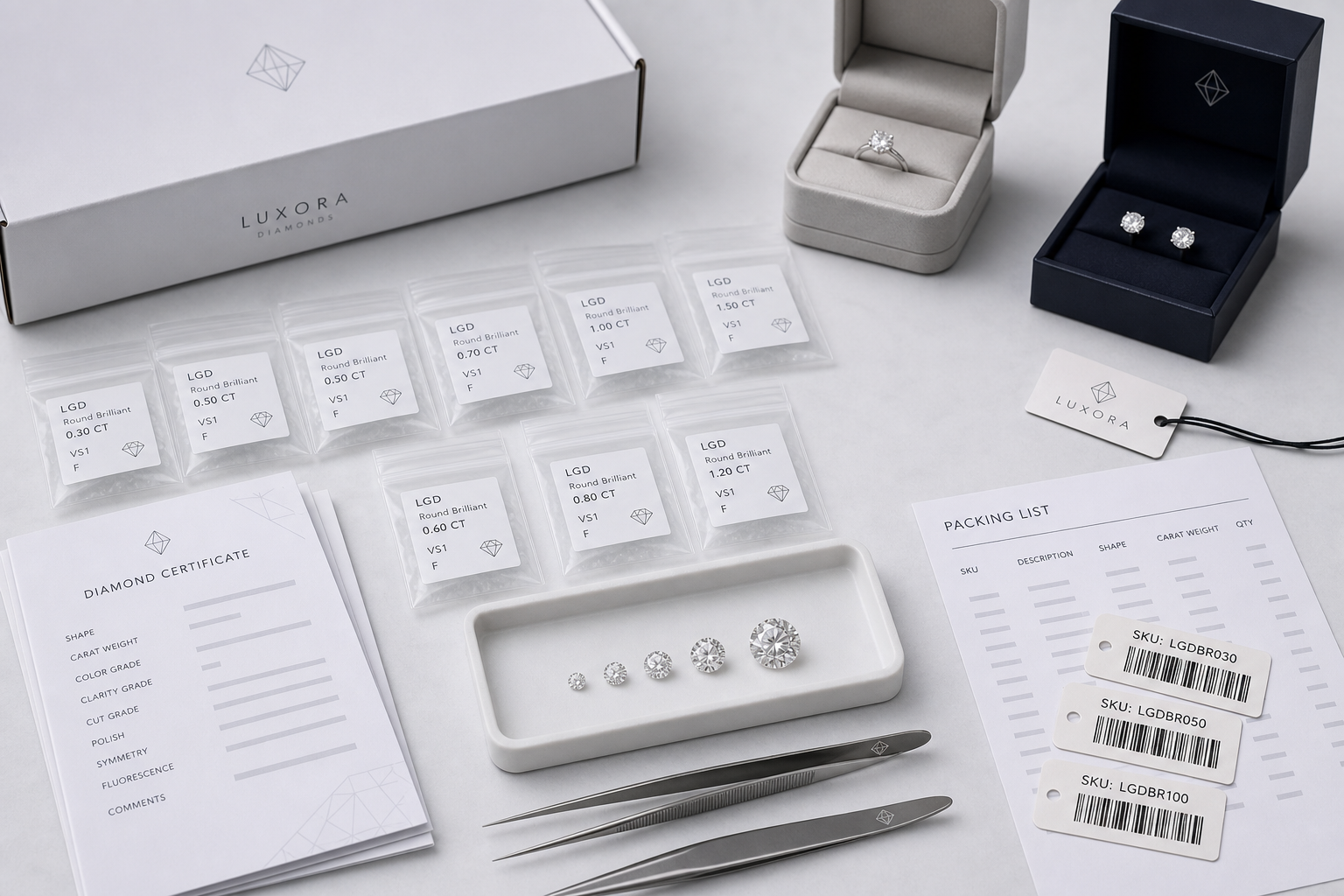
The packing list should not be treated as a shipping formality. It is the document that connects the approved QC sheet to the physical goods leaving the supplier. Before dispatch, every line should match the buyer-approved order records: SKU, report number where applicable, shape, carat weight, quantity, jewelry style, metal type, ring size, and any agreed engraving or customization details.
The highest-risk mistake is assuming that a correct invoice means the shipment is correct. An invoice may show the commercial value and general product description, while the packing list should identify what is actually inside each parcel. For loose lab-grown diamonds, this means stone-level identification. For finished jewelry, it means item-level identification, especially when multiple rings, pairs, or custom pieces look similar at a glance.
If the supplier uses internal stock codes, ask for those codes to be cross-referenced with your own SKU numbers or purchase order lines. A shipment that arrives with unfamiliar labels creates avoidable receiving problems, even if the goods are technically correct. The buyer should be able to open the parcel, compare the labels to the QC sheet, and know immediately which stone or jewelry piece is being checked.
Confirm certificates, invoices, and SKU identification
For certified loose diamonds, confirm whether original grading reports, printed copies, digital copies, or report numbers are included according to the purchase agreement. If original paper reports are expected, they should be accounted for before shipment, not chased afterward. If digital reports are being used, the supplier should provide organized files that match the packing list rather than a collection of screenshots with unclear file names.
The commercial invoice and packing list should describe the shipment consistently. Product descriptions should be specific enough to support internal receiving and inventory control: loose lab-grown diamonds, lab-grown diamond rings, metal type, stone quantity, and relevant SKU details. Buyers should consult their logistics or import professionals for any required customs wording, but the quality-control point is simple: vague or inconsistent descriptions make disputes and receiving checks harder.
Finished jewelry needs more than a generic item count. Each piece should carry a label or reference that connects it to the order line, QC photos, and final approval record. For example, a solitaire ring with a certified center stone should be traceable to the ring SKU and the center-stone report number. A pavé band or pair of earrings should be traceable to the design reference, metal specification, and quantity approved before shipment.
Avoid using broad marketing claims as shipment proof
Pre-shipment QC should stay focused on verifiable product facts. Claims such as “premium quality,” “eco-friendly,” “ethical,” “conflict-free,” or “factory checked” may be part of a supplier’s sales language, but in the context of the China lab-grown diamond supply chain, they do not replace item-level evidence. For shipment approval, the buyer still needs the report, actual-stone media, finished-jewelry inspection proof, labels, packing records, and corrected documentation where needed.
This is especially important for retailers that will resell the goods in a regulated consumer market. If a supplier provides sustainability, origin, or responsible-sourcing language, the buyer should ask what documentation supports that specific wording and whether it is appropriate for the buyer’s own product descriptions. Those claims should not be treated as proof that a specific stone, ring, or parcel has passed QC unless the supplier provides clear, item-relevant documentation.
Sustainability claims should be specific and documented. Broad green language is less useful than clear information about production context, energy references where available, disclosure language, and seller transparency. For pre-shipment QC, buyers should separate environmental or sourcing statements from the practical identity checks needed to release a particular parcel.
Review final packaging photos before dispatch
Packaging is part of quality control because it protects the condition and identity of the goods in transit. Loose diamonds should be individually secured, labeled, and separated in a way that prevents mix-ups. Finished jewelry should be protected from scratches, pressure, and movement, especially rings with raised settings, earrings with posts, necklaces with delicate chains, and pieces with pavé or small accent stones.
Ask for final packaging photos before the goods leave the supplier. The useful photos are not beauty shots; they should show labeled parcels, individual jewelry packaging, certificate placement where applicable, and the full shipment arranged against the packing list. If there are multiple parcels, each parcel should have a clear identifier that matches the packing list.
A common weak point is group packaging that looks efficient for the supplier but creates confusion for the buyer. If ten loose stones are placed in similar holders with unclear labels, receiving becomes slower and the risk of mismatching reports increases. If finished rings are packed without individual references, a custom-size or custom-engraved piece can be assigned to the wrong customer order after arrival.
Shipment Document Check
- Packing list: Must match the approved QC sheet by SKU, quantity, stone report number where applicable, jewelry style, metal type, and size.
- Commercial invoice: Should be consistent with the shipment description, quantities, and buyer order records.
- Certificates or report copies: Should match every certified stone included in the shipment, with originals included if agreed.
- SKU and parcel labels: Should be readable, consistent, and linked to the buyer’s purchase order or inventory system.
- Packaging photos: Should show individual item protection, parcel identification, and the complete shipment before dispatch.
Approve Shipment Only After Discrepancies Are Resolved in Writing
Separate minor documentation fixes from shipment-stopping issues
Not every discrepancy deserves the same response. A typo in a file name may be corrected quickly. A missing certificate copy, unclear inscription image, mismatched report number, loose prong, wrong ring size, or undocumented replacement stone should stop shipment until the supplier provides corrected proof. Treating every issue as equally serious slows the order; treating serious identity or workmanship issues as minor creates expensive problems after delivery.
The practical dividing line is whether the issue affects product identity, saleability, customer delivery, or receiving accuracy. If the buyer cannot confidently match the item to the approved order, the shipment should not move. If the issue only affects document formatting and the underlying product has already been verified, it may be handled as a documentation correction before final approval.
A shipment hold does not need to be adversarial. It should be specific: identify the affected SKU, report number, jewelry piece, or parcel, explain the discrepancy, and state what proof is required before release. Clear instructions reduce back-and-forth and make it easier for the supplier to correct the right item.
Request corrected proof after replacement, repair, or remake
If a supplier replaces a stone, repairs a setting, remakes a ring, or updates documents, the buyer should not approve shipment based only on a written assurance that the issue has been fixed. The corrected item needs new proof. That may include a revised packing list, updated certificate file, new inscription image, fresh stone video, close-up jewelry video, or final packaging photo.
This step matters because corrections can introduce new errors. A replacement diamond may solve one certificate mismatch but create a new carat weight or measurement mismatch. A repaired prong may look better from one angle but still sit unevenly from another. A remade ring may correct the setting but carry the wrong engraving or size. The buyer should review the corrected line item as if it were newly submitted for approval.
The supplier’s response should also be documented. For each issue, record whether the item was replaced, repaired, remade, relabeled, repacked, or corrected only in paperwork. This is especially useful for repeat B2B diamond sourcing because it shows whether problems are isolated or part of a pattern in communication, production, or final QC.
Keep a written approval trail for every shipment
Final approval should be written, dated, and tied to the latest approved files. Verbal approval or informal chat messages can create confusion if goods arrive with a discrepancy. A simple approval trail protects both sides by showing what was reviewed, what was corrected, and what the buyer accepted before dispatch.
A useful discrepancy log does not need to be complicated. It should include the issue, affected SKU or report number, supplier response, agreed correction, new proof provided, and final approval date. The most important field is not the issue description; it is the evidence that the corrected item was reviewed before shipment resumed.
Written approval also helps internal teams. The person receiving the shipment may not be the person who reviewed the videos or certificates. If the approval record is organized, the receiving team can compare the delivered goods against the same final documents instead of reconstructing the decision from scattered messages.
Pre-Shipment Approval Gate
- Approve: All documents, labels, media, packaging, and product details match the final QC record.
- Hold: Any issue affects stone identity, certificate matching, jewelry workmanship, item count, or customer-specific details.
- Correct: Supplier provides replacement, repair, remake, relabeling, repacking, or revised documents as agreed.
- Recheck: Buyer reviews corrected proof for the affected line items before release.
- Document: Final written approval references the corrected files and shipment version being released.
A Realistic Buyer Scenario: Approving a Mixed Diamond and Jewelry Order
The order: loose certified stones plus finished rings
A U.S. retailer in Texas places a mixed order with a China-based supplier: ten certified oval lab-grown diamonds for loose-stone inventory and six finished engagement rings for customer and showroom use. The loose stones are each listed with a report number, carat weight, color, clarity, and measurements. The rings include three solitaire settings, two halo designs, and one pavé band, each tied to a SKU and ring size.
Before shipment, the retailer asks for the final packing list, certificate files, loose-stone videos, close-up ring videos, and packaging photos. This is not extra paperwork for its own sake. A mixed shipment has more ways to go wrong than a single loose-stone parcel because the buyer must confirm both diamond identity and finished jewelry condition before international delivery.
The issue: one certificate mismatch and one setting concern
During review, the retailer finds that one oval diamond report number on the packing list does not match the certificate PDF provided in the file folder. The stone may still be correct, but the documentation is not clean enough to approve. In the same review, one ring video shows a slightly uneven prong on a solitaire setting. It is a small detail, but it affects how the ring will be received by a customer and may raise concern about stone security.
The buyer separates the issues instead of rejecting the full shipment immediately. The report mismatch is treated as a shipment-stopping identity issue for that loose stone. The prong concern is treated as a workmanship issue for that ring. The remaining stones and rings are not automatically blocked, but they are not released until the supplier confirms how the two affected line items will be handled.
The outcome: shipment approval after corrected proof
The supplier sends a corrected certificate file and updated packing list for the loose oval diamond, with the report number aligned across the certificate, QC sheet, and parcel label. For the ring, the supplier adjusts the prong and provides a new close-up video from multiple angles. The buyer updates the discrepancy log, records the corrected proof, and approves shipment only after the affected line items are rechecked.
The tradeoff is a short delay before dispatch, but the retailer avoids a much larger problem after arrival. If the shipment had gone out with the mismatch and prong issue unresolved, the buyer might have faced inventory confusion, customer delivery delays, or costly international return handling. In cross-border sourcing, a controlled hold before shipment is usually less expensive than trying to fix preventable errors after the goods are already in the United States.
Build a Repeatable QC Checklist for Future Orders
A one-time inspection can catch problems in a single shipment. A repeatable QC checklist helps prevent the same problems from appearing across future orders. For B2B lab-grown diamond sourcing, that distinction matters. The goal is not to make every approval process more complicated; it is to make the process consistent enough that your team, your supplier, and your records all point to the same standard.
The most useful checklist is not a long generic form. It should reflect the way you actually buy: certified loose stones, calibrated melee, finished rings, private-label jewelry, or mixed shipments. A buyer ordering loose certified diamonds needs a different review path than a buyer approving finished engagement rings, even if both orders come from the same China diamond supplier. Treating those orders as identical is how small mismatches get missed.
Create one checklist for loose diamonds and another for finished jewelry
Loose diamond QC should focus first on identity and order matching. The checklist should capture the order number, SKU, report number, shape, carat weight, measurements, color, clarity, inscription status, requested media, and final approval decision. If the stone has a grading report, the report data should be the reference point. If it is a matched layout or calibrated parcel, the checklist should document the agreed size range and matching standard instead of relying on a vague phrase like “same as sample.”
Finished jewelry needs a separate checklist because the risk changes once stones are set. A ring can contain the correct center diamond and still fail pre-shipment review because the prongs are uneven, the engraving is wrong, the ring size is off, or the pavé alignment does not match the approved design. For finished pieces, the checklist should include metal type, metal stamp, ring size or chain length, stone setting, engraving, polish, clasp or post function, CAD or design reference, packaging status, and close-up media of high-risk areas.
The judgment call is simple: do not force finished jewelry into a loose diamond checklist. Loose diamond QC confirms what the stone is. Jewelry QC confirms whether the product is ready to sell, wear, or present to a customer. Those are related checks, but they are not the same check.
Use consistent file names, SKU references, and approval records
File naming sounds administrative until something goes wrong. If your supplier sends ten videos named “oval1,” “oval2,” and “final video,” your team may not be able to prove which video belongs to which stone, order line, or certificate. A better system uses identifiers that remain clear after the shipment arrives, such as order number, SKU, report number, and product type.
For example, a loose diamond video might be named with the order number, stone SKU, and report number. A finished ring video might include the order number, ring SKU, center stone report number, and size. The exact format matters less than consistency. What matters most is that a buyer can open the file weeks later and know exactly what was approved.
Approval records should be equally clear. Each line should show whether the item was approved, held for correction, replaced, repaired, or still pending. If the supplier provides updated proof, save it next to the original issue record rather than replacing the old file. This protects the buyer from confusion and gives both sides a cleaner communication trail if a question appears after delivery.
Build an evidence pack for each completed shipment
After approval, save the final version of the QC sheet, report files, report-check notes, stone videos, jewelry videos, packaging photos, invoice, packing list, and discrepancy log in one shipment folder. The goal is not to keep unnecessary paperwork; it is to preserve the evidence that justified the release decision. If a receiving question, customer issue, or supplier dispute appears later, the buyer can review the exact files that were approved before dispatch.
A good evidence pack should be organized by order number and SKU rather than by message date. Chat histories are difficult to search and often mix unrelated topics. A structured folder makes it easier to confirm whether the delivered item matches the approved item, whether a replacement was accepted, and whether a defect was visible before shipment or appeared after transit.
For repeat sourcing, these records also help improve future supplier instructions. If several shipments show the same weak evidence, such as unreadable inscription images or inconsistent parcel labels, the buyer can update the supplier checklist instead of solving the same problem one order at a time.
Track supplier accuracy across multiple shipments
A repeatable lab-grown diamond QC checklist does more than approve one order. It gives buyers a way to measure supplier reliability over time. If one supplier repeatedly sends incomplete media, unclear inscription photos, missing certificate copies, or packaging labels that do not match the packing list, that pattern matters even if each issue is eventually fixed.
The most useful supplier scorecard is practical, not punitive. Track how often the first submission is complete, how often report numbers match without correction, how often jewelry QC videos reveal workmanship issues, and how quickly the supplier responds with corrected proof. A lower unit price becomes less attractive if every shipment requires repeated clarification before approval.
At NUVU, this type of review is treated as a practical comparison rather than a single-grade decision. The report helps narrow the field, but the shipment still needs to make sense visually, physically, and operationally: the correct stone, the right setting, the agreed documentation, and the buyer’s intended use should all align before release.
When a grading report is provided, buyers should compare the report details with the issuing laboratory’s verification tools where available. Report verification is one part of QC; it should be paired with item media, inscription evidence when applicable, and shipment documents before release.
Documentation-Based Support Builds Trust Before Goods Leave the Supplier
For buyers who source repeatedly, trust should come from a visible process rather than from general supplier confidence. A dependable partner should be able to explain which grading report was used, which media belongs to which SKU, what changed during correction, and which version of the packing list is final. This level of documentation is especially useful for wholesale buyers, custom jewelry retailers, and teams that need to hand orders from sourcing to receiving without losing context.
Certificate-aware selection also reduces avoidable disagreement. If a buyer is comparing several lab-grown diamond options, the useful conversation is not simply “which one is cheaper” or “which one looks good.” It should include report details, face-up appearance, measurements, setting compatibility, visible inclusions, and whether the final item can be documented clearly before shipment. When those factors are discussed early, pre-shipment approval becomes a confirmation step rather than a rushed problem-solving stage.
Prices can change with market conditions, report type, seller channel, and stone-specific details, so exact comparisons should be verified at the time of purchase. Buyers should compare like-for-like specifications, documentation, visual evidence, setting requirements, and supplier reliability before treating one option as a stronger commercial choice.
For custom and private-label jewelry orders, communication quality is part of QC. The supplier should be able to connect the approved CAD or design notes with the actual center stone, metal choice, ring size, engraving, and final workmanship media. If a buyer asks for clarification, the answer should point to evidence: a revised file, a new close-up video, a corrected packing list, or a specific report lookup. That kind of response gives the buyer a practical basis for approval without relying on sales language.
For wholesale buyers, documentation, consistency, and communication often matter as much as the headline specification. A parcel that is slightly cheaper but poorly labeled, weakly documented, or difficult to reconcile can create hidden labor costs for receiving, inventory upload, photography, and customer fulfillment. A more useful supplier conversation defines how line items will be named, how substitutions will be approved, how corrected files will be shared, and which records must be final before shipment.
This is especially important for private-label and wholesale buyers. Batch consistency affects customer experience. If one shipment is well documented and the next is disorganized, your internal team carries the cost through extra checking, delayed listing, slower fulfillment, or preventable customer questions. Over time, documentation accuracy becomes part of supplier quality, not just an office task.
Compliance Boundaries Buyers Should Keep in the QC File
Pre-shipment QC is also a good time to remove language that could create consumer-trust or advertising problems later. If the supplier’s documents use broad claims such as “perfect,” “guaranteed,” “eco-friendly,” “conflict-free,” or “investment grade,” the buyer should not copy those phrases into product listings unless the exact claim is supported by appropriate documentation and suitable for the market where the jewelry will be sold.
Environmental and sustainability claims should be specific, documented, and limited to what can be substantiated. Lab-grown diamonds offer a different sourcing path from mined diamonds, but that does not automatically prove a broad environmental claim for every stone, factory, supplier, or shipment. If sustainability language matters to the buyer’s brand, the supporting information should be reviewed separately from the diamond grading report.
Buyers should also avoid treating any grading report as proof of resale performance, investment value, ethical sourcing, or finished-jewelry workmanship. The report documents selected diamond characteristics according to the issuing laboratory’s system. It should be read alongside the buyer’s own QC evidence, the supplier’s documentation, visual media, order records, and any custom design requirements.
NUVU’s buyer-first approach is to make comparison clearer, especially around report details, visual evidence, setting fit, and documentation. That means a shipment should be approved because the evidence is organized and item-specific, not because a supplier uses broad assurances or because a certificate appears in the file.
Final Pre-Shipment QC Framework
A workable jewelry sourcing checklist should be short enough to use on every order and detailed enough to catch shipment-stopping issues before goods leave the supplier. The strongest framework usually includes these checkpoints:
- Order summary: order number, supplier name, buyer contact, product type, quantity, SKU list, and approved specifications.
- Certificate match: report number, stone identity, carat weight, shape, measurements, color, clarity, and order line for every certified stone.
- Inscription proof: confirmation for each stone expected to carry a laser inscription, with clear visual evidence where available.
- Media review: photos and videos of the actual stones or finished jewelry being shipped, labeled by SKU or report number.
- Jewelry QC: setting alignment, stone security confirmation, metal type, metal stamp, size, engraving, polish, and functional details.
- Packaging photos: item labels, parcel separation, jewelry protection, certificate placement, and packed-goods images before dispatch.
- Document review: packing list, invoice, certificate copies or originals where agreed, SKU references, quantities, and product descriptions.
- Discrepancy log: issue, affected SKU or report number, supplier response, correction required, updated proof, and resolution status.
- Final written approval: date, approved items, held items if any, and confirmation that the supplier may ship only the approved goods.
The most useful checklist is the one your team will actually use. It should make approval faster for clean orders and stricter for orders with mismatches. Once the format is stable, buyers can compare suppliers by accuracy, communication, and correction quality instead of judging each shipment in isolation.
Disclosure: This article is for general educational purposes only. Diamond grading, pricing, availability, specifications, and seller policies can change, and readers should verify important details through grading reports, official laboratory tools, seller documentation, or qualified professionals before making a purchase decision. Laboratory-grown diamonds should be clearly distinguished from natural diamonds, and environmental or sourcing claims should be supported by specific documentation.