
Importing lab-grown diamonds or jewelry from China is not only a shipping task. The shipment has to be described, valued, packed, insured, and cleared in a way that matches the real product and the real transaction, because poor supplier red flags often become visible when loose stones, finished jewelry, samples, or mixed parcels are labeled too broadly, when invoice details do not match packing records, or when buyers assume a courier declaration is enough for customs and insurance.
For the full framework, read China Lab-Grown Diamond Supply Chain Guide.
This article helps international buyers prepare the practical documents and decisions before dispatch: how to align invoices, packing lists, grading reports, HS code discussions, shipping terms, broker responsibilities, and insurance evidence. The goal is not to remove every possible customs question, but to reduce avoidable delays, unclear responsibility, under-covered shipments, and post-arrival inventory confusion.
Laboratory-grown diamonds should be clearly identified as laboratory-grown, and they should not be presented as mined diamonds. Lab-grown diamonds and natural diamonds are both diamonds, but they have different origins; diamond simulants are a separate category and should not be described as lab-grown diamonds unless they are actually laboratory-grown diamonds.
| Decision Point | What to Check Before Shipping | Common Risk to Avoid |
|---|---|---|
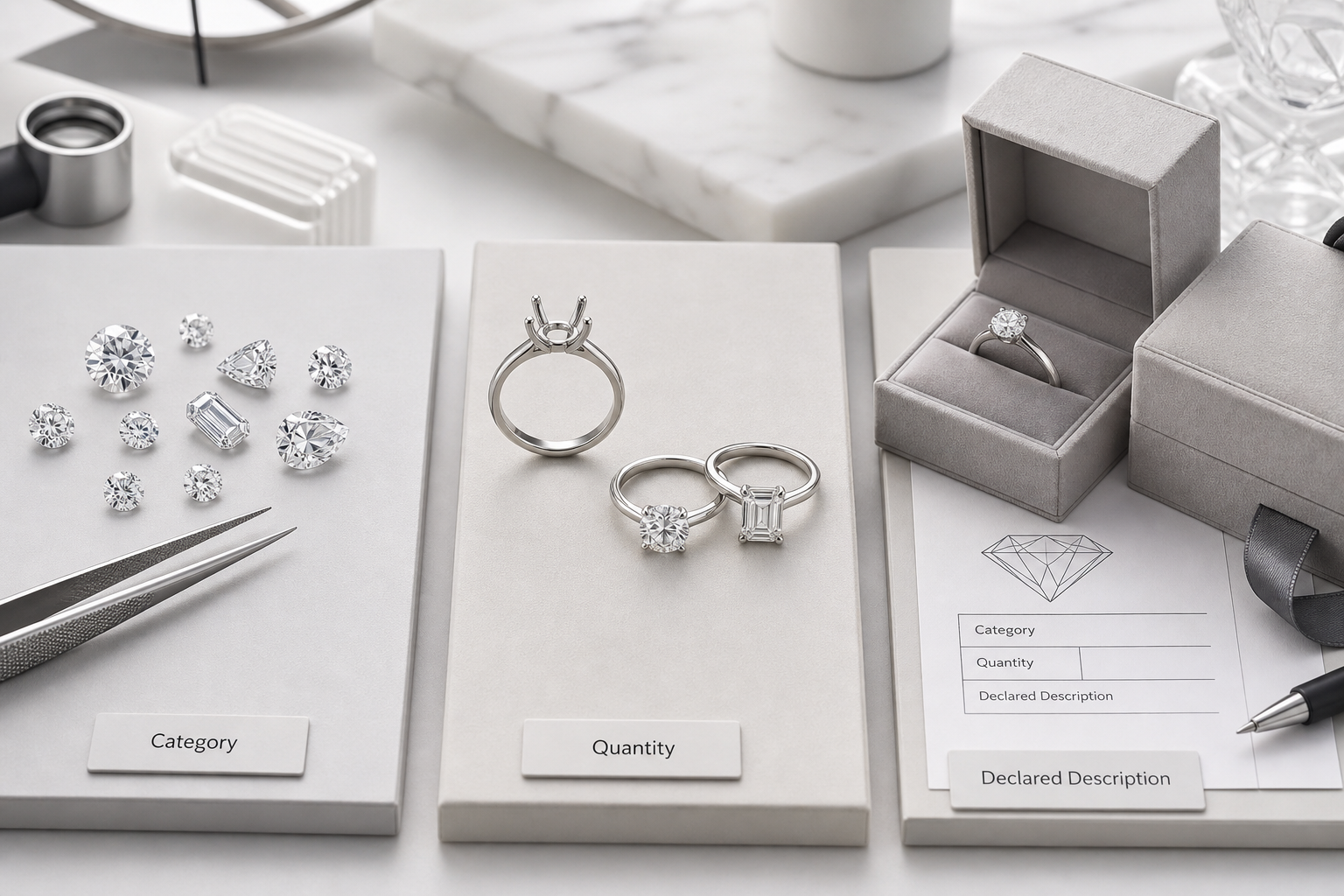
| Product category | Loose stones, jewelry, samples, semi-finished goods, or mixed shipment | Using vague labels like “diamonds” or “accessories” |
| Commercial invoice | Real buyer, seller, value, currency, quantity, origin, and export reason | Under-declared or inconsistent transaction value |
| Packing list | Parcel count, weights, SKUs, stone IDs, report numbers, and quantities | Invoice lines not matching physical contents |
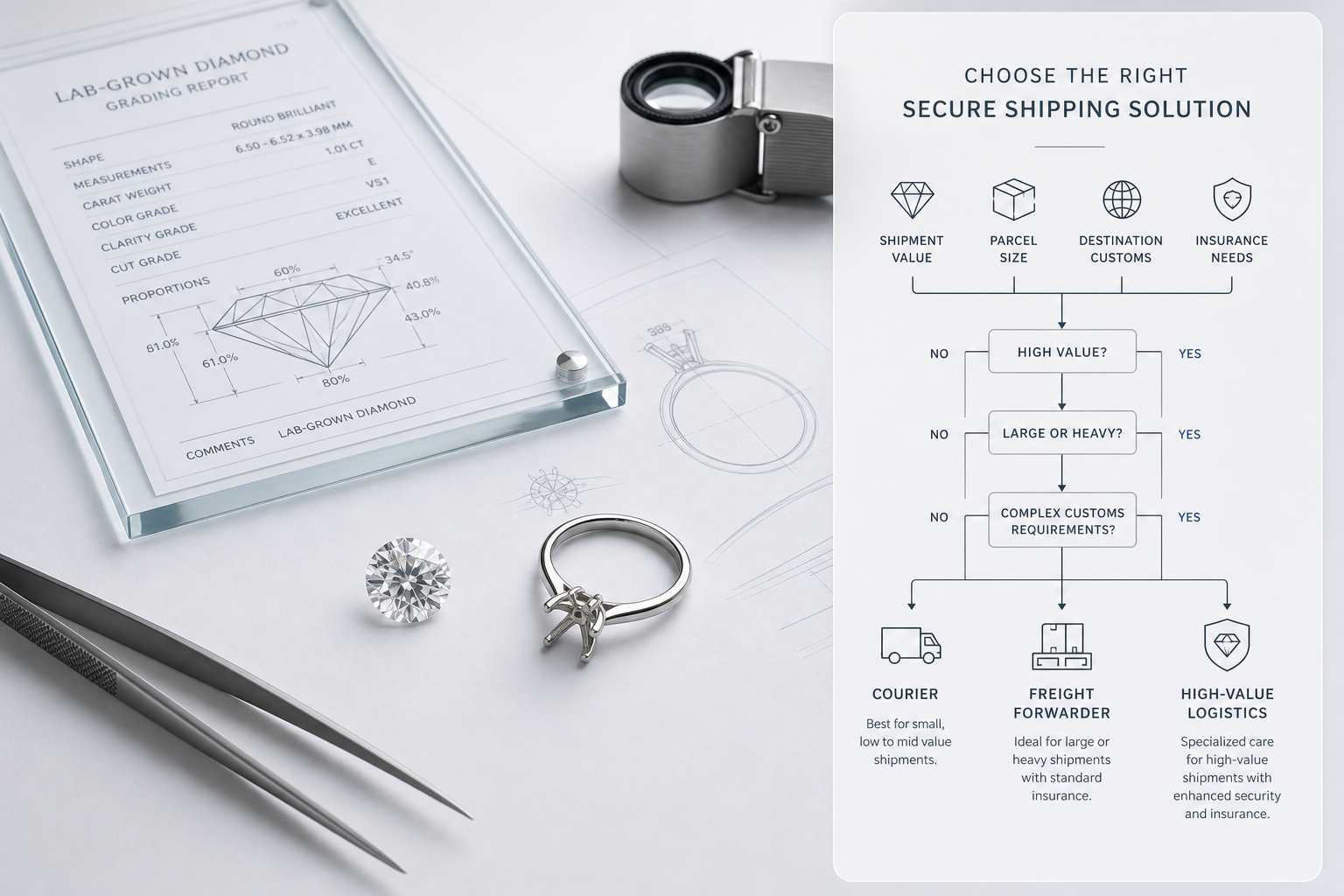
| Shipping method | Value, urgency, parcel count, insurance needs, and clearance complexity | Choosing express service for a shipment needing specialist handling |
| Customs responsibility | Importer of record, Incoterms, broker contact, duties, and response owner | No written agreement on who answers customs questions |
| Insurance coverage | Covered goods, route, value limits, partial loss, and required evidence | Assuming declared customs value equals insured value |
Quick Questions Before You Read
Q: Is a grading report enough for customs clearance?
No. Reports help identify stones, but customs still needs accurate invoice, packing, shipping, and classification documents.
Q: Can one HS code be reused for every lab-grown diamond shipment?
Not safely. Loose stones, finished jewelry, and mixed goods may require different classification review.
Q: Should declared value be lowered to reduce duties?
No. The declared value should reflect the real transaction and match payment and order records.
Q: Who should respond if customs places the parcel on hold?
Confirm this before dispatch: buyer, supplier, courier, broker, or freight forwarder should have a clear communication role.
Start by Confirming the Exact Product Category Before Export
Customs preparation begins before any invoice is drafted or courier pickup is booked. The first question is simple but easy to underestimate: what exactly is being shipped? A parcel containing loose lab-grown diamonds is not the same as a parcel containing finished rings, pendants, sample jewelry, or a mix of loose stones and mounted pieces.
This matters because product category affects how the shipment is described, how it may be classified, what supporting details may be requested, and how the buyer should prepare for import review. Treating every diamond-related shipment as “diamonds” can create avoidable confusion, especially when the goods are crossing borders from China into a market with its own customs classification rules.
For buyers, the practical point is that product category is not a marketing label chosen for convenience; it is a factual description that should match the physical goods. If a supplier, courier, and buyer use different words for the same shipment, customs may treat the file as unclear even when the order itself is legitimate.
Loose Lab-Grown Diamonds vs. Finished Jewelry
Loose lab-grown diamonds are individual stones that are not mounted into jewelry. They may be shipped with grading reports, parcel references, stone IDs, or item-level details such as shape, carat weight, color, clarity, and report number. From a customs perspective, the physical form of the product is important because the shipment is the stone itself, not a finished jewelry article.
Finished lab-grown diamond jewelry is different. A ring, necklace, bracelet, or pair of earrings may include lab-grown diamonds, but customs may review the item as jewelry based on its construction, metal content, and finished form. A 1.00 carat lab-grown diamond sold loose and a 1.00 carat lab-grown diamond mounted in a gold engagement ring should not be described or treated as the same product category.
The practical mistake to avoid is using a broad description that hides the real product form. If the goods are finished 14k gold lab-grown diamond rings, describing them only as “lab diamonds” may be incomplete. If the goods are loose stones, describing them as “jewelry accessories” may be too vague and may raise questions later.
Why Product Description Affects Customs Review
Customs officers and courier clearance teams rely on shipment descriptions to understand what is entering the destination country. The description should make the product form clear enough that the rest of the documents make sense. A strong description does not need to be overly technical, but it should not leave the reviewer guessing.
For loose stones, useful wording usually identifies them as lab-grown or synthetic diamonds, not natural diamonds, and includes relevant quantity or carat information where appropriate. For jewelry, the description should identify the finished product type, such as rings or pendants, and the material context when relevant. The point is not to over-explain; the point is to remove ambiguity.
This is especially important for HS code discussion. Loose synthetic or lab-grown diamonds are commonly discussed differently from mounted jewelry, and finished jewelry may fall under a different classification depending on the metal, design, and destination country’s rules. Buyers should not assume a code used for one prior shipment will automatically apply to a different product form.
Terminology Should Match the Goods and the Sales Records
For documentation purposes, the wording used for lab-grown diamonds should be clear and consistent. If the quotation, invoice, packing list, grading report, and product label use different terms, the buyer may have to explain that all records refer to the same goods. This is avoidable when the supplier and buyer agree on one description before the shipment is prepared.
Buyers should also avoid wording that could blur the distinction between laboratory-grown and natural diamonds. A customs broker or marketplace reviewer may not know the order history, so the documents should make the product identity clear on their face. If the goods are lab-grown, the invoice and supporting records should not describe them in a way that suggests natural origin.
When Mixed Shipments Need Extra Attention
Mixed shipments are where small errors become more likely. A single order might include loose lab-grown diamonds, sample rings, semi-mounted settings, and finished lab-grown diamond jewelry. If all items are placed under one generic description, the documents may not reflect what is actually inside the shipment.
The better approach is to separate product categories clearly before export. Loose stones should be distinguishable from finished jewelry. Sample goods should be described in a way that matches their actual use and value. If a shipment includes multiple product forms, the supplier, courier, or customs broker may need separate line descriptions rather than one combined label.
Mixed shipments are not automatically a problem, but they reduce the margin for vague paperwork. The more varied the contents, the more important it is that descriptions, quantities, item references, and shipment category details are organized before the goods leave China.
What to Check Before You Decide
Before confirming shipment, buyers should ask the supplier to identify the product category in plain language: loose lab-grown diamonds, finished lab-grown diamond jewelry, sample goods, semi-finished jewelry, or a mixed shipment. If there is any uncertainty, confirm the description with the courier or a customs broker before dispatch rather than trying to fix the classification after the parcel is already in transit.
The most useful pre-export check is whether the product description would still be clear to someone who has never seen the order. If the wording is too broad, too informal, or inconsistent with the actual goods, it should be corrected before the shipment is released.
Prepare a Commercial Invoice That Matches the Real Transaction
The commercial invoice is the central document customs will use to understand the transaction. It should show who sold the goods, who bought them, what the goods are, how much they are worth, and the basic terms under which they are being shipped. If this document is incomplete or unclear, even a legitimate shipment can be delayed for clarification.
For international buyers sourcing lab-grown diamonds or jewelry from China, the commercial invoice should not be treated as a formality. It is one of the main records that connects the order, payment, product description, and declared value. The safest invoice is the one that reflects the real transaction clearly and consistently.
Core Details Every Commercial Invoice Should Include
A complete commercial invoice should include the seller’s legal name and address, the buyer or consignee name and address, invoice number, invoice date, order number where available, and a clear product description. It should also show quantity, carat weight or piece count where relevant, unit price, total value, currency, country of origin, and shipping terms or Incoterms if agreed.
If an HS code is available and has been reviewed by the supplier, courier, or broker, it may also appear on the invoice. The reason for export should be clear as well, such as commercial sale, sample shipment, repair return, or other applicable purpose. These details help customs understand the shipment without needing to reconstruct the transaction from emails and payment records.
The most common invoice weakness is not missing every detail; it is having enough vague information that the shipment becomes harder to review. A line item that says “jewelry” or “accessories” gives less clarity than “lab-grown diamond ring in 14k gold,” assuming that description matches the actual goods.
How to Describe Lab-Grown Diamonds Clearly
Product descriptions should be specific enough to identify the goods without becoming overloaded. For loose lab-grown diamonds, the invoice may refer to loose lab-grown diamonds or synthetic diamonds and include quantity, total carat weight, or item-level details if the shipment requires them. For finished jewelry, the description should identify the jewelry type and material context, such as lab-grown diamond earrings or lab-grown diamond rings in a stated metal.
Avoid descriptions that make the shipment sound less specific than it is. “Jewelry accessories” is usually a poor description if the shipment contains finished lab-grown diamond jewelry. “Stone samples” may be unclear if the goods are commercial loose diamonds with individual values and grading reports. Vague language can look convenient in the moment, but it often creates more questions during clearance.
The description should also avoid implying the goods are natural diamonds if they are lab-grown. Lab-grown, laboratory-grown, synthetic, or man-made terminology may be used depending on supplier practice and documentation style, but the wording should be consistent across records. The key is that the invoice should not create a different product identity from the actual shipment.
Declared Value, Currency, and Transaction Consistency
The declared value should match the real commercial transaction. Buyers should not ask suppliers to understate invoice value to reduce duties or taxes. Besides the compliance risk, under-declaration can also create problems if the shipment is inspected, lost, damaged, insured, or compared against payment records.
Currency matters as well. If the order was quoted, paid, and invoiced in U.S. dollars, the invoice should reflect that clearly. If another currency is used, the buyer should make sure the amount aligns with the order confirmation and payment trail. A mismatch between paid amount and declared value is one of the easiest ways to invite follow-up questions.
Consistency is more important than making the invoice look simple. The invoice should align with the purchase order, payment proof, packing list, and shipment records. If a discount, sample value, replacement item, or partial shipment affects the declared value, the documents should make that context clear enough for review.
Prices can change with market conditions, report type, seller channel, and stone-specific details, so exact comparisons should be verified at the time of purchase. For export documents, the declared value should be based on the actual transaction record rather than a general market estimate, promotional comparison, or unsupported “replacement value.”
In practical buying, “sample” does not automatically mean “low value” or “no commercial value.” If a sample is a real lab-grown diamond or a finished jewelry piece that could be sold, its declared value should be supported by the transaction record or a clear valuation basis. If a replacement, warranty-related shipment, or promotional sample is involved, the reason should be documented rather than hidden behind an unrealistically low invoice line.
Build a Small Evidence File Behind the Invoice
For commercial buyers, the invoice is easier to defend when it is backed by a simple evidence file. This does not need to be complicated. Keep the purchase order, pro forma invoice, final commercial invoice, payment confirmation, buyer approval message, and any discount or sample explanation together. If customs or a broker asks how the value was calculated, the buyer can respond with records rather than relying on memory.
This evidence file is especially useful when the invoice includes partial shipments, replacement items, combined orders, or samples with special pricing. In those cases, the invoice may be accurate but not self-explanatory. A short written note from the supplier explaining the shipment purpose and value basis can reduce confusion if the broker asks for clarification after arrival.
Create a Traceable Link From Quotation to Invoice
For traceability, the commercial invoice should not appear as a disconnected document created only for customs. It should be possible to follow the order from quotation or purchase order to pro forma invoice, payment record, final invoice, packing list, and shipment tracking number. When these records use the same order reference, item reference, and buyer details, the shipment file becomes easier to explain if a broker, accountant, or receiving team reviews it later.
This traceable link is useful for both single-stone purchases and wholesale jewelry orders. A buyer who imports one loose lab-grown diamond may need to match the report number and invoice line. A buyer importing multiple finished rings may need to match SKU, metal type, stone details, ring size, and carton reference. In both cases, the goal is the same: each item should have a clear path through the paperwork.
Buyers should be cautious when suppliers issue revised invoices after payment, after packing, or after a shipment has already been booked. Revisions may be legitimate, but they should be saved with the reason for the change and checked against the packing list and airway bill. An unexplained invoice revision can weaken traceability even when the underlying order is correct.
Buyer Verification Checklist
- Confirm the seller and buyer or consignee details are correct and spelled consistently.
- Check that the product description matches the actual goods being shipped.
- Verify quantity, carat weight, piece count, unit price, total value, and currency.
- Make sure the invoice number, date, order reference, and reason for export are included.
- Review any HS code or country-of-origin statement with the supplier, courier, or broker if there is uncertainty.
- Compare the invoice against the order confirmation and payment record before dispatch.
Use the Packing List to Make the Shipment Easy to Inspect
The packing list serves a different purpose from the commercial invoice. The invoice explains the transaction; the packing list explains the physical shipment. It helps customs, couriers, warehouse teams, and the buyer understand what is inside each parcel and how the contents are organized.
A weak packing list does not always stop a shipment, but it can make inspection slower and more confusing. For lab-grown diamonds and jewelry, where items may be small, high-value, and linked to individual records, physical organization matters. The packing list should make it easy to compare the documents with the parcel contents without relying on guesswork.
What the Packing List Should Show
A useful packing list should include the number of packages, parcel or carton references, package dimensions where available, gross weight, net weight, item quantity, SKU or order number, and a clear description of the contents. For larger or multi-carton orders, it should show which items are in which package rather than presenting one undivided list.
For loose lab-grown diamonds, the packing list may include item references, parcel numbers, stone IDs, or report numbers where practical. For finished jewelry, it may include SKU, style number, metal type, piece count, and product category. The level of detail should be high enough that the buyer can verify the shipment against the order without opening a separate conversation about every item.
The best packing lists are not necessarily the longest ones. They are the ones that let a reviewer connect each physical package to the invoice and order record quickly. If the shipment has only one small parcel, the list can be simple. If it includes multiple SKUs, loose stones, or finished pieces, a one-line packing list is usually too thin.
How Packing Details Help Customs and Courier Handling
Packing details can reduce avoidable friction during customs review and courier handling. If the airway bill shows one parcel, the packing list should not suggest three. If the packing list shows a gross weight that looks inconsistent with the shipment type, the courier may ask for clarification. These issues are usually fixable, but they are easier to fix before dispatch.
Gross weight and net weight are not just logistics details. They help confirm whether the shipment record is physically plausible. Parcel count and dimensions help the courier process the shipment correctly. Item quantity helps the buyer and customs reviewer compare what was declared with what was packed.
A packing list does not prevent all inspections, and it should not be viewed as a shield against customs review. Its value is practical: it reduces confusion when someone needs to verify the shipment quickly and accurately.
Matching Item References, SKUs, and Report Numbers
When lab-grown diamonds are linked to grading reports, the packing list should use item references that can be matched to those records where practical. This may include IGI or GIA report numbers, internal SKU numbers, lot numbers, batch IDs, or order line references. The goal is not to turn the packing list into a grading report; it is to create a clean trail between the packed item and the buyer’s product records.
This becomes more important when shipments include multiple stones with similar specifications. Two round lab-grown diamonds may both be near 1.00 carat with similar color and clarity grades, but they are not interchangeable if the buyer ordered specific report numbers. Without item-level references, receiving and reconciliation become much harder.
For jewelry, product-level references are often more useful than stone-level details alone. A ring may include a center stone report number, a style number, metal type, ring size, and SKU. If the packing list only identifies the center stone, the buyer may still have to verify the finished product separately after arrival.
For custom jewelry, stone measurements and setting compatibility should be confirmed before finalizing a purchase. This is especially important when the same shipment includes a loose center stone and a separately made setting, because a grading report may document the diamond’s measurements while the packing list and product specification should confirm how that stone is intended to match the setting.
What This Means in a Real Shipment
For a small sample shipment, the packing list may show one parcel containing two loose lab-grown diamonds, with each stone tied to an item number and report number. For a jewelry order, it may follow wholesale order planning requirements by showing one carton containing ten finished lab-grown diamond rings, organized by SKU, ring size, and piece count. For a mixed shipment, it should separate loose stones from finished jewelry so the documents do not blur product categories.
The practical test is whether the buyer can receive the goods and confirm what arrived without depending on memory, chat screenshots, or informal supplier notes. If the packing list cannot support that basic receiving check, it should be revised before the shipment leaves China.
Discuss HS Codes Before the Shipment Leaves China
Why HS Codes Matter for Lab-Grown Diamond Shipments
An HS code is not just an administrative detail. It tells customs how the shipment is being classified, which can affect import tariff treatment, review priority, and the questions a broker or customs officer may ask. For lab-grown diamond shipments, confusion often starts when the product description is correct in plain English but too broad for customs classification.
The risk is not only using the “wrong” number. A bigger problem is inconsistency: one document describes the goods as synthetic diamonds, another as jewelry accessories, and the airway bill uses a shortened description that does not match either. Even if the goods are legitimate, that mismatch can trigger manual review because customs is trying to understand what is actually being imported.
Buyers should treat the HS code for lab-grown diamonds as something to confirm before dispatch, not something to solve after the parcel is already in transit. Once a shipment is held, correcting classification details can become slower because the courier, broker, supplier, and buyer may all need to provide matching explanations.
Loose Stones and Finished Jewelry May Not Use the Same Classification
Loose synthetic or lab-grown diamonds and mounted jewelry may be reviewed under different customs classifications because the physical form of the goods is different. That does not mean every shipment labeled “lab-grown diamond” automatically clears under the same code in every country. The final classification may depend on whether the stones are loose, worked, mounted, set into jewelry, or shipped as part of a mixed order.
Finished jewelry can be treated differently. A lab-grown diamond ring mounted in gold or platinum may be reviewed as a jewelry article depending on the material, construction, and destination country rules. This distinction matters because customs may classify the finished product by the jewelry article rather than by the loose stone inside it.
The practical takeaway is simple: do not reuse a loose lab-grown diamonds HS code for finished jewelry without checking. A shipment of loose stones, a shipment of gold rings set with lab-grown diamonds, and a shipment containing both may need different line descriptions and possibly different classification treatment. The product form usually matters more than the buyer’s internal product category.
Destination Rules Matter More Than Supplier Habit
A supplier may have shipped similar goods to another country without issue, but that does not prove the same classification, duty treatment, or document wording will work for the buyer’s market. Customs classification is applied by the destination authority, and a courier’s export-side habit should not be treated as a binding import decision.
For recurring orders, buyers should keep a record of the description and code previously accepted for the same product form and destination, but they should still review changes in material, mounting, shipment purpose, or mixed contents. A prior clearance can be useful background, but it should not replace checking the current shipment file.
Why Buyers Should Confirm Codes With a Broker or Courier
The supplier in China may be familiar with export documentation, but the buyer’s import country makes the final decision on customs classification. A code that works for export paperwork or a previous destination may not be the best match for a new market. This is especially relevant for international buyers who import for resale, because the same description can be reviewed differently based on product form and supporting documents.
A customs broker can help confirm whether the proposed synthetic diamonds HS code, loose lab-grown diamonds HS code, or jewelry HS code fits the actual shipment. Express couriers may also provide guidance, especially when they are handling customs clearance through their brokerage network. The strongest approach is to ask before shipping and keep the supplier’s invoice description aligned with the classification being used.
A common mistake is assuming the lowest-duty classification is automatically acceptable. Classification should start with the goods, not with the desired tariff outcome. If customs challenges the code, the buyer may face delays, document requests, adjustments, or additional charges, and the shipment can become harder to explain if the original description was vague.
At NUVU, this kind of classification discussion is treated as a documentation alignment issue rather than a one-number shortcut. The useful question is not only “which code was used last time,” but whether the code, invoice wording, packing list, and actual product form still point to the same goods for this specific shipment and destination.
How to Verify This Before Shipping
Before the shipment leaves China, ask the supplier what HS code they plan to show on the commercial invoice and export documents. Then compare that code against the product form: loose stones, finished jewelry, sample goods, or a mixed shipment. If the shipment includes both loose lab-grown diamonds and mounted jewelry, request separate invoice lines where appropriate rather than forcing everything into one broad description.
Send the proposed description and HS code to your customs broker or courier contact for review. The question should be specific: “Does this code match loose lab-grown diamonds?” or “Does this code match gold jewelry set with lab-grown diamonds?” A clear question usually gets a more useful answer than asking for a general tariff estimate.
Keep a record of the confirmed description, code, product category, and any broker guidance. If customs asks why a code was used, you want the invoice, packing list, airway bill description, and broker response to point in the same direction.
NUVU’s role in this type of export discussion is not to replace broker or customs advice, but to help keep product descriptions, item references, report details, and shipment documents aligned before dispatch.
Choose a Shipping Method Based on Value, Timing, and Clearance Needs
Express Courier for Samples and Smaller Orders
For many lab-grown diamond shipments from China, international courier services such as FedEx, DHL, and UPS are a practical option for samples, small commercial orders, and lower-volume jewelry shipments. They are usually easier to track than general freight, and their brokerage systems can handle many routine customs clearance questions.
Express courier does not mean “no customs risk.” It means the shipment moves through a structured courier network, often with built-in document review and broker communication. If the invoice description, HS code, declared value, or consignee details are unclear, the same courier shipment can still be delayed.
For planning, buyers should ask the supplier or courier for the current route estimate before promising delivery to their own customers. Transit time can vary by destination, service level, export pickup timing, customs review, weather, holidays, and broker response speed. Customs holds can add time if documents need correction or clarification.
Specialized Logistics for Higher-Value Shipments
Higher-value shipments deserve more careful handling than a standard parcel decision. If the declared value is substantial, buyers should review carrier value limits, jewelry or gemstone restrictions, and available insurance conditions before the goods leave the supplier. A fast courier service is not automatically the right choice if coverage is limited or the shipment exceeds the carrier’s comfort zone.
Specialized high-value logistics or armored logistics may be more appropriate for larger loose diamond orders, valuable finished jewelry, or shipments where loss exposure is unacceptable. These services can involve stricter handling procedures and more controlled routing, but they may also require more preparation, different paperwork, and longer coordination time.
The key judgment is whether speed or risk control matters more for that shipment. A small sample order may justify express courier speed. A high-value shipment that cannot be easily replaced should be reviewed for declared value limits, insurance terms, destination handling, and clearance support before dispatch.
Freight Forwarding for Bulk or Multi-Carton Orders
Freight forwarders can be useful when the shipment is larger, multi-carton, or part of a broader commercial import program. This is more common for bulk jewelry orders, packaging-inclusive shipments, trade inventory, or orders where warehouse receiving and carton-level organization matter. Air freight may make sense when the order is too large or operationally complex for a standard courier parcel.
The tradeoff is that freight forwarding usually requires more active coordination. The buyer may need to work more closely with a customs broker, confirm importer details, approve shipment documents, and manage delivery after arrival. For commercial buyers, that added control can be worthwhile, but it is not the simplest option for a small loose-stone sample.
Freight is often chosen for control and scalability, not just cost. If your order contains multiple SKUs, multiple cartons, or inventory intended for resale, the ability to organize documents and receiving records may matter as much as the delivery timeline.
Shipping Method Decision Check
Before choosing a method, compare the shipment’s value, parcel count, destination requirements, insurance needs, and urgency. A low-volume sample order with clean documents may fit an express courier. A high-value shipment may need specialized logistics. A bulk or multi-carton order may be better handled through a freight forwarder with broker coordination.
The mistake to avoid is choosing shipping based only on the lowest quoted freight cost. For lab-grown diamond shipping from China, the better question is whether the carrier can handle the declared product type, value level, documentation, insurance expectations, and customs clearance process for your destination.
Clarify Customs Responsibility Before the Order Is Shipped
Export Clearance Is Different From Import Clearance
A shipment can be properly exported from China and still require action from the buyer during import clearance. These are separate steps. The supplier may prepare export documents, book the courier, and provide a tracking number, but that does not always mean the buyer has no responsibility once the goods reach the destination country.
This distinction matters because many buyers treat international delivery like a domestic parcel. A courier tracking page may show smooth movement until the shipment reaches customs, then the broker may ask for clarification on product description, importer details, intended use, or declared value. If no one has agreed in advance who will respond, a simple question can turn into a delay.
For cross-border lab-grown diamond orders, the buyer should know who is handling export clearance, who is handling import clearance, and who is responsible for responding to broker or customs requests after arrival.
Who Acts as the Importer of Record?
The importer of record is generally the party responsible for importing the goods into the destination country and meeting import-related requirements. For a commercial buyer, this may be the retailer, wholesaler, online seller, or purchasing company receiving the goods. The exact role depends on the shipping terms, carrier arrangement, destination rules, and how the transaction is structured.
This should not be guessed from the tracking number. If the buyer is the importer of record, they may need to provide tax identification details, business information, broker authorization, product clarification, or other import records. If a third party or seller claims to handle import formalities, that responsibility should be confirmed in writing before shipment.
A practical scenario shows why this matters. A jewelry retailer orders loose lab-grown diamonds from Shenzhen and receives a tracking number, assuming delivery will work like a domestic package. Customs asks the courier’s broker to confirm whether the goods are loose synthetic diamonds, who the importer is, and what the declared value is based on. Because the commercial invoice, packing list, and consignee information were prepared correctly, the buyer only needs to confirm the broker’s request instead of rebuilding the shipment documents after the parcel is already delayed.
How Shipping Terms Affect Duty, Tax, and Broker Responsibility
Incoterms and shipping terms shape who arranges transportation, who carries certain risks, and who is expected to handle parts of the import process. They do not remove the need for accurate documents. They simply define responsibility more clearly when used correctly.
DAP often means the seller arranges delivery to the destination place, but the buyer is commonly responsible for import duties, taxes, and import clearance requirements. DDP may mean the seller takes on more import-side responsibility, including duties and taxes, but it must be confirmed carefully because it may not be available for every product, carrier, or destination. EXW and FCA can shift more logistics responsibility to the buyer, especially around pickup, export coordination, or carrier arrangements.
The wrong assumption can become expensive. A buyer who thinks “shipping included” also means “duties included” may be surprised by a courier invoice, broker request, or delivery hold. The phrase that matters is not only whether freight is included, but whether import duties, taxes, brokerage, and importer responsibility are included.
Keep a Written Communication Trail for Responsibility
Traceability is not only about item numbers and certificates. It also includes a clear record of who agreed to do what. Buyers should keep written confirmation of the shipping term, importer role, broker contact, duty and tax responsibility, insurance decision, and the person authorized to answer courier or customs questions. This record can be short, but it should be specific enough that the parties do not have to reinterpret the arrangement after a hold appears.
For wholesale or repeat import buyers, a simple shipment communication log can prevent repeated confusion. Record the date documents were approved, who approved the invoice and packing list, when the courier booking was confirmed, which broker contact was shared, and whether any corrections were made before dispatch. If a later dispute or clearance question arises, the buyer can review the sequence instead of relying on fragmented chat history.
What to Confirm in Writing
Before shipment, confirm the agreed shipping term, named destination, responsible importer, duty and tax responsibility, broker contact process, and who will respond if customs requests clarification. If the seller offers DDP, ask exactly what it covers and whether there are any exclusions for lab-grown diamonds, jewelry, gemstones, declared value, or your destination country.
If the buyer is responsible for import clearance, prepare the business details and broker contact before the parcel reaches customs. If the courier will act as broker, confirm what information they may need from you. The safest arrangement is one where the supplier, buyer, courier, and broker all work from the same description, invoice value, consignee details, and product classification before the shipment leaves China.
One of the simplest ways to reduce uncertainty is to create a shared shipment file before pickup is booked. This file should contain the final commercial invoice, packing list, airway bill draft or booking reference, agreed shipping term, certificate references, insurance confirmation where applicable, and the contact details for the person who will answer customs or broker questions. It gives the buyer and supplier one controlled version of the shipment record instead of relying on scattered chat messages or revised attachments.
For NUVU-related orders, this kind of file is also a useful communication tool between sales, production, logistics, and the buyer’s receiving team. The diamond selection record, finished jewelry specification, report number, SKU, and shipping document can be checked together before dispatch. That process does not guarantee that customs will never ask a question, but it makes any answer easier to support with consistent records.
Buyers who import repeatedly may want to keep a simple archive by shipment date, order number, tracking number, and destination. Over time, this archive becomes a practical reference for product descriptions that were accepted, broker feedback that was useful, insurance limits that applied, and receiving notes after arrival. It is not a substitute for current customs advice, but it helps the buyer avoid repeating the same documentation questions on every order.
Insure Higher-Value Shipments and Understand Coverage Limits
Declared Value Is Not Always Full Insurance
For higher-value lab-grown diamond shipments, insurance should be confirmed before the goods leave China, not after a tracking number is issued. The most common mistake is assuming that the declared value on the airway bill automatically means the shipment is fully insured. Declared value, courier liability, and actual insurance coverage are related, but they are not the same thing.
A shipment may show a full commercial value for customs purposes while still being subject to a carrier’s standard liability limit. That limit may be far below the invoice value, especially for loose diamonds, gemstones, jewelry, or other high-value goods. If the package is lost or damaged, the difference between “declared for customs” and “covered for loss” becomes a real financial risk.
The higher the shipment value, the less acceptable it is to rely on assumptions. If the value exceeds the courier’s standard liability or if the shipment contains multiple loose stones or finished jewelry pieces, ask the supplier or logistics provider to confirm whether high-value shipment insurance is available for that route, product type, and declared value.
Questions to Ask About Jewelry and Gemstone Coverage
Courier insurance often has exclusions or special conditions for jewelry, gemstones, precious metals, and high-value merchandise. Lab-grown diamonds may still fall into a restricted category even though they are not mined diamonds. The practical question is not whether the courier accepts the parcel; it is whether the shipment is actually covered if something goes wrong.
Before dispatch, buyers should ask direct questions: Are loose lab-grown diamonds covered? Are mounted lab-grown diamond rings or jewelry covered? Is there a maximum insured value per parcel? Does the carrier require special handling, approved packaging, sealed parcels, or a specific service level? Are partial losses covered if one item is missing from a multi-item shipment?
This is where shipping method and insurance decision overlap. A standard express courier may be suitable for lower-value samples, but a larger order may require a different arrangement if courier insurance does not cover the full value or excludes jewelry-related goods. Choosing the cheaper shipping option can be a poor decision if the coverage limit leaves most of the order exposed.
Chain of Custody and Photo Records Can Support Claims
For higher-value parcels, buyers should ask the supplier to keep clear packing photos or videos before handoff. Useful records can include item layout before sealing, close-up photos of report numbers or item labels where appropriate, exterior package photos, seal condition, weight confirmation, and the courier pickup receipt. These records do not guarantee a claim will be approved, but they can help show what was packed and handed over.
After arrival, the receiving team should inspect the parcel before mixing the goods with existing inventory. If packaging is damaged, opened, resealed, or inconsistent with the supplier’s records, document the condition immediately with photos and notify the courier, supplier, or insurer according to the claim procedure. Delayed reporting can make loss or damage harder to document.
Documents to Keep for a Potential Claim
Insurance is only useful if the buyer can support a claim with clear records. Keep the commercial invoice, packing list, airway bill, payment proof, order confirmation, item photos, certificate or grading report references, and any written insurance confirmation. These files should show the same buyer, seller, product description, quantity, declared value, and shipment reference.
For lab-grown diamond jewelry, item photos can be especially useful because the claim may need to distinguish between the stone, the setting, and the finished piece. For loose diamonds, report numbers, carat weights, shapes, and item references help connect the insured shipment to the actual goods. A generic description such as “jewelry goods” makes a claim harder to support than a documented item list tied to invoice lines and packing references.
The insured value should usually align with the invoice value unless there is a clear, documented reason for a difference. A mismatch between invoice value, declared value, and insured value can slow a claim or raise questions about what the shipment was worth at the time of export.
Insurance Review Before Dispatch
Before the shipment leaves China, confirm the insured value, covered product category, carrier or insurer name, coverage limit, claim documentation requirements, and any special handling instructions. If the supplier says the shipment is “insured,” ask what that means in writing. A useful confirmation should explain what is covered, up to what amount, and under what conditions.
For higher-value orders, do not treat insurance as an afterthought added to the shipping cost. Treat it as a risk-control decision tied to the invoice value, product type, and delivery route, because lab grown diamond supply chain variables can affect both coverage limits and documentation requirements. If full coverage is not available through the selected courier, the shipment method should be reviewed before dispatch rather than accepted by default.
Keep Certificates, Reports, and Product Records Aligned With the Shipment
How Grading Reports Support Product Identification
A lab-grown diamond certificate or grading report helps identify a stone, but it does not replace export or import documentation. Reports from laboratories such as IGI or GIA may show details such as report number, carat weight, shape, color, clarity, measurements, growth-related information, and sometimes laser inscription details. Those details are useful because they connect a specific stone to a specific order.
The practical value is item matching. If a buyer orders several loose lab-grown diamonds, each grading report should be easy to connect to the correct invoice line, packing reference, SKU, or lot number. Without that connection, the buyer may receive legitimate reports and legitimate stones but still face confusion during receiving, resale documentation, or customer fulfillment.
For finished jewelry, the recordkeeping is slightly different. A ring or pendant may include a stone-level grading report plus product-level details such as metal type, setting style, ring size, total piece count, and finished jewelry SKU. The stone report identifies the diamond; it does not fully describe the finished item being shipped.
A grading report helps document key characteristics, but it should not be treated as a guarantee of beauty, value, or sourcing ethics. Buyers should read the report alongside visual evidence, measurements, seller documentation, the intended jewelry use, and any destination-specific import requirements.
A grading report is strongest when used for identification and comparison, not as a substitute for buyer judgment. It can document reported characteristics, but it does not show how the stone will look in every lighting condition, how well it fits a specific setting, or whether the shipment value and classification have been prepared correctly.
Matching Report Numbers to Invoice or Packing References
Where practical, report numbers should appear in the supplier’s internal product records and be cross-referenced with invoice or packing list details. This does not mean every customs document must reproduce a full grading report, but the shipment file should allow the buyer, supplier, courier, or broker to trace each item without guessing.
For loose stones, the cleanest approach is usually a line-item structure that connects report number, carat weight, shape, and item reference. For example, a shipment with five loose diamonds should not rely only on a total carat weight if each stone has its own report. If one stone is questioned, inspected, or later matched to inventory, individual identification matters more than the shipment total.
For jewelry orders, the buyer should confirm whether the report number belongs to the center stone, side stones, or a separate loose diamond included in the same shipment. This distinction is easy to overlook, but it becomes important when receiving inventory or responding to a customer who expects the grading report to match the main diamond in the finished piece.
Build a Product Traceability Map for Receiving
A practical traceability map can be as simple as a spreadsheet that links each item reference to its report number, shape, carat weight, jewelry SKU, invoice line, packing location, and final tracking number. This is especially useful when the shipment includes multiple similar stones or repeated jewelry styles. The map does not replace the invoice or grading report; it helps the buyer connect them without relying on memory.
For wholesale buyers, this map can also support receiving and resale preparation. The receiving team can check whether the item in the parcel matches the approved order, while the sales or inventory team can later confirm which report belongs to which finished piece. If a customer or marketplace asks for supporting information, the buyer can provide consistent product records instead of rebuilding the trail after the goods have entered stock.
The traceability map should avoid overstating what the documents prove. It can show how a stone, report, SKU, invoice, and parcel reference connect. It should not be treated as proof of broad environmental claims, origin claims, or policy commitments unless those details are separately documented and supported.
Why Certificates Do Not Replace Customs Documents
Certificates and grading reports are identification records, not customs clearance documents. Customs still relies on the commercial invoice, packing list, airway bill, product description, declared value, country of origin, and classification details. A grading report can support what the item is, but it does not by itself establish duty treatment, import responsibility, or transaction value.
Buyers should also be careful not to overread what a certificate proves. A grading report may confirm diamond characteristics and lab-grown status, but it does not automatically prove export compliance, ethical superiority, full supply-chain origin, or that the shipment documents are correct. Treat it as one piece of the documentation set, not the document that solves every question.
This is especially important for commercial buyers who resell stones or finished jewelry. If the certificate details are accurate but the invoice description, packing reference, or SKU is vague, the buyer may still have to spend time rebuilding product records after delivery.
Certificate and Shipment Record Check
Before dispatch, compare the report number, carat weight, shape, color, clarity, measurements, and inscription details where available against the supplier’s item reference. Then confirm that the same item reference appears consistently in the invoice, packing list, and order record. The goal is not to overload customs documents with gemological detail; it is to make the shipment traceable from purchase order to delivered inventory.
For a commercial buyer, this alignment protects more than customs clearance. It supports receiving, inventory control, resale documentation, customer service, and claim handling if a shipment problem occurs.
When a grading report is available, buyers should verify the report details through the issuing laboratory’s official report-check tool where available and compare those details with the supplier’s item reference and shipment records.
Prevent Delays by Checking Document Consistency Across Every File
The Pre-Shipment Consistency Check
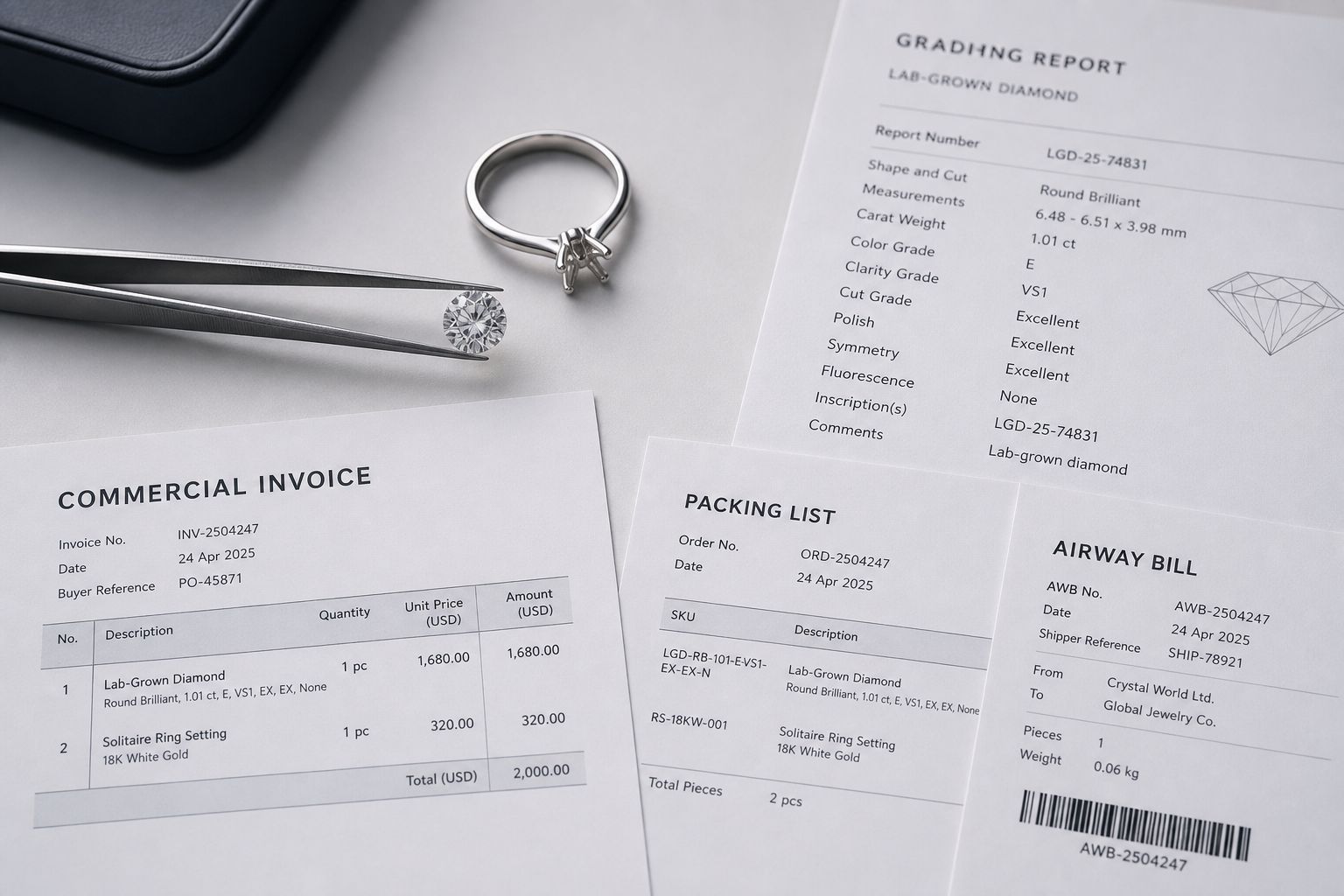
Most avoidable customs delays come from mismatched details rather than unusual products. A lab-grown diamond shipment can be legitimate, properly packed, and correctly purchased, yet still be delayed if the commercial invoice, packing list, airway bill, certificate records, order confirmation, and payment records do not tell the same story.
The pre-shipment check should focus on the fields that customs, couriers, and brokers are most likely to compare: buyer name, consignee address, seller name, product description, quantity, carat weight or piece count, HS code, declared value, currency, country of origin, parcel count, and shipment reference. If one file says “loose lab-grown diamonds” and another says “jewelry accessories,” the shipment invites questions that could have been avoided before dispatch.
This check matters most when several parties touch the order. A supplier may prepare the invoice, a logistics team may create the airway bill, a sales contact may issue the order confirmation, and a buyer’s accounting team may hold the payment record. If those files are not reviewed together, small errors can survive until the shipment reaches import clearance.
Common Mismatches That Cause Customs Questions
Quantity mismatch is one of the easiest problems to create. An invoice may list ten pieces, while the packing list shows nine items and one sample, or the airway bill may show one parcel while the packing list describes two packages. Even if the physical goods are correct, the documents give the reviewer a reason to pause.
Value mismatch is more serious. The commercial invoice, payment proof, insured value, and declared value should not contradict one another without explanation. Understated values can create compliance problems, while unexplained differences between documents can trigger requests for clarification. For commercial buyers, the better approach is to keep the transaction value clear and consistent from the start.
Product wording is another common weak point. Descriptions such as “accessories,” “samples,” or “fashion jewelry” may seem harmless, but they can be too vague for lab-grown diamond import documents. A clearer description should reflect the actual product form, such as loose lab-grown diamonds, lab-grown diamond rings, or lab-grown diamond jewelry, with material details where relevant.
Consignee details also deserve careful attention. The company name, recipient name, address, phone number, tax ID or importer number if required, and email contact should match the buyer’s import setup. A shipment addressed informally to an employee when the importer is a business can create avoidable broker questions.
How to Handle Corrections Before Dispatch
Corrections should be made before the shipment is handed to the courier whenever possible. Once the parcel is in transit, changing an invoice, consignee detail, or product description can become slower and less reliable. Some corrections may require revised documents, written explanation, or broker coordination after the shipment has already been flagged.
If an error is found, ask the supplier to revise the affected documents as a set rather than fixing only one file. Updating the invoice but leaving the packing list or airway bill unchanged may create a new mismatch. The better standard is simple: one correction should be reflected across every document that carries the same information.
Buyers should keep the final approved document set in one place before dispatch. That includes the invoice, packing list, airway bill draft or final copy, certificate or report references, order confirmation, payment proof, and any insurance confirmation. If customs or a broker asks a question later, the buyer can respond from the same document set rather than searching through separate email threads.
Final Document Match Review
Before approving shipment, review the file as if you were the customs broker seeing it for the first time. The buyer, seller, goods, value, quantity, origin, classification, parcel count, and shipment purpose should be understandable without extra explanation. If the documents require the supplier to “explain what they really mean,” they are not ready.
The strongest pre-shipment review is not complicated. It is disciplined. Consistent documents reduce manual questions, support insurance and claim records, and make the buyer look prepared when the shipment enters import clearance.
Plan for Import Questions Instead of Reacting After a Hold
A customs hold does not always mean something is wrong. For a lab-grown diamond import, it often means the courier, broker, or customs office needs clarification before the shipment can move forward. The problem is that many buyers only start organizing answers after the hold appears, which turns a routine broker request into a delay that could have been avoided.
The better approach is to prepare for import clearance before the shipment leaves China. If your shipment documentation is complete, consistent, and easy to access, most questions can be answered quickly without rewriting invoices, changing descriptions, or asking the supplier to recreate records under pressure.
Questions Customs or Brokers May Ask
Import questions usually focus on classification, value, product form, and the party responsible for the shipment. A broker may ask whether the goods are loose lab-grown diamonds, mounted jewelry, sample products, or finished pieces for resale. That distinction matters because a loose stone shipment is not reviewed the same way as a gold ring set with lab-grown diamonds.
You may also be asked what the product is made of. For jewelry, this can include the metal type, stone type, number of pieces, and whether the diamonds are natural or laboratory-grown. Vague answers such as “diamond goods” or “jewelry items” are rarely helpful. A better answer is specific enough to match the invoice, packing list, and item records without adding new wording that conflicts with the original export documents.
Value questions are also common. Customs or the broker may ask what the declared value is based on, whether the shipment is a commercial purchase, whether payment has been made, and whether the goods are for resale, sample review, repair, display, or personal use. The safest position is consistency: the declared value should align with the commercial invoice and the actual transaction, not a revised estimate created after the shipment is already under review.
Importer details can create delays if they are unclear. The broker may ask who is acting as the importer, whether the consignee has the correct tax or business identification details, and who should receive clearance notices. This is especially important for retailers, online sellers, and wholesale buyers that import under a business name but ship to a warehouse, office, or third-party receiving address.
Documents Buyers Should Keep Accessible
Buyers should keep the core shipment documentation available in one place before dispatch. This usually includes the commercial invoice, packing list, airway bill or tracking document, order confirmation, payment proof, and any grading reports or product records that identify the stones or finished jewelry. These documents do not all serve the same purpose, but together they help answer most broker requests without confusion.
For loose lab-grown diamonds, report numbers, carat weights, shapes, and item references should be easy to match against the invoice or packing list. For finished jewelry, the records should support the product description, quantity, metal type where relevant, and stone details if they are included in the order. A certificate may help identify a diamond, but it does not replace import paperwork or solve a mismatch in declared value, consignee information, or product classification.
Payment records are often overlooked until they are requested. If the declared value on the invoice differs from what appears on a wire transfer, card payment, platform order, or purchase agreement, the buyer may need to explain the difference. Discounts, sample pricing, partial payments, or combined orders should be documented clearly before shipping because they are harder to justify after a customs question appears.
Why Fast, Consistent Answers Matter
Speed matters, but consistency matters more. A quick reply that uses different product wording, a different value explanation, or a different importer name can create more questions than it solves. The best response is usually short, direct, and tied to the original shipment documentation.
If a broker asks whether the shipment contains loose stones or mounted jewelry, answer using the same category shown on the invoice. If customs asks what the declared value represents, refer to the transaction value shown on the commercial invoice and supported by the order record. If certificates are requested, provide them as supporting identification records rather than presenting them as customs documents.
The most avoidable mistake is allowing different people to answer separately without coordination. A purchasing manager, supplier, courier representative, and warehouse receiver may all have partial information. Before anyone replies to a broker request, the buyer should confirm which document is the controlling reference and make sure the answer does not contradict it.
Responsible Language for Sustainability and Origin Questions
Import documents for lab-grown diamonds should be factual rather than promotional. If a broker, marketplace, or customer asks about lab-grown status, the answer should point to the product description, grading report where available, and supplier records. Broad language about sustainability, ethics, or environmental benefit should not be added to shipping paperwork unless the buyer has specific documentation that supports the exact claim.
This matters because sustainability and origin statements can be interpreted differently by customs authorities, platforms, and customers. A precise statement such as laboratory-grown diamond, supported by a relevant report or product record, is more useful for traceability than broad green language. Responsible documentation focuses on what can be shown: product type, report details, invoice value, item reference, and shipment path.
Environmental and sustainability claims should be specific, documented, and limited to what can be substantiated. Lab-grown diamonds may appeal to buyers looking for an alternative to mined origin, but shipping paperwork, product pages, and customer-facing materials should avoid broad claims unless the seller can support them with relevant production, energy, sourcing, or supplier documentation.
Import Readiness Check
Can you explain whether the shipment contains loose lab-grown diamonds, finished jewelry, samples, or mixed goods?
Do the product description, quantity, declared value, currency, and consignee details match across the shipment documentation?
Do you know who is acting as the importer and who should respond to broker requests?
Are grading reports, item records, payment proof, and order confirmation accessible if customs asks for support?
Can your supplier respond quickly if the courier needs clarification before release?
A hold is easier to manage when the answers are already organized. For international buyers, the goal is not to predict every customs question, but to make sure the most likely questions can be answered without changing the story after the shipment is in transit.
FAQs About China Lab-Grown Diamond Export Documents and Shipping
What documents are usually needed to ship lab-grown diamonds from China?
Most shipments require a commercial invoice, packing list, and transport document such as an airway bill. Depending on the product and destination, the buyer may also need grading reports, order records, payment proof, or broker-requested information for import clearance. The exact requirements can vary by country, courier, product type, and shipment value.
Do loose lab-grown diamonds and jewelry use the same HS code?
Not necessarily. Loose lab-grown diamonds and finished jewelry may fall under different customs classifications because the product form is different. Mounted jewelry may also be affected by the metal type and how the destination country interprets the classification, so buyers should confirm the HS code with a customs broker or courier before shipping.
Who is responsible for import duties and taxes?
Responsibility depends on the shipping terms agreed with the supplier and the rules in the destination country. In many transactions, the buyer is responsible for import duties, taxes, and broker communication even if the supplier arranges export and international transport. Terms such as DAP, DDP, FCA, or EXW should be confirmed in writing before dispatch.
Should high-value lab-grown diamond shipments be insured?
High-value shipments should be reviewed for insurance before they leave China. Declared value is not always the same as full insurance coverage, and some couriers limit coverage for jewelry, gemstones, or high-value goods. Buyers should confirm coverage limits, exclusions, required documents, and claim procedures before approving shipment.
Can express couriers ship lab-grown diamonds internationally?
Express couriers can often handle eligible lab-grown diamond or jewelry shipments, but acceptance depends on the carrier, destination, declared value, product type, and customs requirements. Buyers should not assume that every courier service covers every diamond-related shipment. For higher-value or more sensitive orders, specialized logistics or broker-supported shipping may be more appropriate.
How can buyers make a lab-grown diamond shipment more traceable?
Use consistent item references across the quotation, invoice, packing list, grading report records, shipment booking, and receiving file. For each stone or jewelry piece, the buyer should be able to connect the report number or SKU to the invoice line, packing location, and tracking number without relying on informal messages.
Disclosure: This article is for general educational purposes only. Diamond grading, pricing, availability, specifications, customs requirements, shipping options, insurance coverage, and seller policies can change, and readers should verify important details through grading reports, official laboratory tools, seller documentation, customs brokers, carriers, insurers, or qualified professionals before making a purchase or import decision. Laboratory-grown diamonds should be clearly distinguished from natural diamonds, and environmental or sourcing claims should be supported by specific documentation.