
Buying lab-grown diamonds from China can offer access to competitive supply, but the real question is not whether a quote looks attractive. It is whether the supplier can prove that the stone exists, matches the grading details, and follows transparent lab grown diamond manufacturing standards from growth through cutting, remains available, and will be delivered under clear written terms. A low price becomes risky when the report number, measurements, media, inclusions, fees, or delivery promises do not line up.
For the full framework, read China Lab-Grown Diamond Supply Chain Guide.
This guide helps you separate normal sourcing differences from warning signs that can lead to mismatched stones, hidden costs, weak documentation, or difficult disputes. Before sending payment or placing a larger order, you should know how to compare quotes, verify stone-specific proof, test supplier communication, and decide when a small pilot order is safer than trusting a polished sample or a rushed offer.
| What to Check | Safer Signal | Red Flag |
|---|---|---|
| Price quote | Matches comparable stones with clear reason for any discount | Far below market with vague explanation |
| Stone proof | Unedited video and still image tied to the exact report | Stock photo, cropped media, or “ready” claim only |
| Grading details | Report number, measurements, shape, and inclusions align | Paperwork and visuals do not match |
| Payment timing | Requested after written verification is complete | Urgent payment pressure before proof |
| Order quality | Supplier explains sorting, matching, and batch checks | Good sample used to avoid batch-level details |
| Remedies | Refund, replacement, and dispute terms are written clearly | Terms are delayed, verbal, or unclear |
Quick Questions Before You Read
Q: Is a very low quote always a scam?
No. But it should be verified carefully because lower prices may reflect weaker cut, documentation gaps, stock issues, or hidden fees.
Q: Does a grading report prove the supplier has the diamond?
Not by itself. The report should match stone-specific photos or video, measurements, and written stock confirmation.
Q: Should I trust a supplier who sends one excellent sample?
Only after checking how they sort and confirm quality across the full order, not just the sample stone.
Q: When is it better to walk away?
Walk away when answers keep changing, proof is incomplete, fees are unclear, or clear terms appear only after payment is requested.
Compliance-aware sourcing baseline: Laboratory-grown diamonds should be clearly identified as laboratory-grown, and they should not be presented as mined diamonds. If a supplier uses loose wording such as “real diamond,” “natural look,” or “same as mined” without clearly stating laboratory-grown origin, ask them to restate the origin in writing and confirm that the grading report or sales documentation uses the same disclosure.
A diamond simulant is also different from a lab-grown diamond. Simulants may resemble diamonds visually, but they are not laboratory-grown diamonds. If a quote is unusually low or the description avoids standard diamond grading details, confirm whether the product is a laboratory-grown diamond, a natural diamond, or a simulant before comparing it with other offers.
How to spot a supplier risk pattern before you compare any quote
A buyer looking at loose lab-grown diamonds from China can get pulled in by the same pattern over and over: one quote is noticeably cheaper, the wording stays vague, and the supplier wants payment to move quickly. The mistake is treating that as a price problem first. It is usually a verification problem first. A supplier that cannot explain what they are offering in plain terms is already telling you something important, even if the number looks attractive.
The first quote should only tell you whether the conversation is worth continuing. It should not decide the deal. A serious wholesale diamond supplier can usually explain the stone, the grading report, the stock status, and the terms without making you guess. A weak supplier often leans on price before they have established trust. That is the pattern to watch for: unclear wording, rushed pressure, and missing proof showing up together. One of those may be fixable. Three or four at once usually means the risk is not accidental.
In sourcing or wholesale conversations, documentation, consistency, and communication often matter as much as the headline specification. A supplier who can keep the same details aligned from the first quote through the final invoice gives the buyer a clearer basis for comparison than a seller who offers only a lower number and broad reassurance.
Why the first quote is only the first filter
The first quote is useful because it reveals how the supplier thinks about the sale. If the response is organized, specific, and consistent, that is a good sign. If it is thin on detail, changes from message to message, or avoids basic questions, the quote is doing more than listing a price. It is showing you how much effort the supplier is willing to put into verification.
For a buyer, that matters more than many people expect. A low number can still be worth reviewing if the supplier can show the stone, confirm the report, and explain the terms. A slightly higher quote can still be the wrong choice if the seller cannot support it. The quote is just the entry point. The real test is whether the supplier can help you reduce uncertainty before money changes hands.
The difference between a sourcing partner and a one-off seller
A sourcing partner behaves like part of the buying process. They answer the same question the same way twice. They can distinguish between what is in stock, what is being sourced, and what is only available under certain conditions. They are able to discuss documentation, matching, and delivery in a way that helps you plan the order rather than guess through it.
A one-off seller often works in the opposite direction. The emphasis stays on closing fast, not on making the deal easier to verify. That does not automatically mean the supplier is dishonest, but it does mean the burden shifts to the buyer. If the seller cannot explain the product clearly before payment, they are unlikely to become more reliable after payment. For buyers comparing lab-grown diamonds from China, that difference is often the line between a manageable sourcing relationship and a problem that starts with the first deposit.
A real-world example of a buyer almost accepting the wrong supplier
A U.S. retailer comparing several offers for loose stones found one quote that was much lower than the others. The supplier said the stones were ready, but the product description stayed generic. When the buyer asked for the report number and exact stone media, the replies became slower and less specific. The payment request arrived before the documentation package was complete.
The buyer nearly moved forward because the pricing looked efficient on paper. What changed the decision was the pattern, not one single issue. The supplier could not keep the details aligned: the quote, the media, and the payment request were all moving ahead of verification. That is the kind of situation where a bad order begins. It does not usually start with a dramatic warning. It starts with small signs that the seller wants commitment before proof.
What to verify before you move to the next conversation
Before you continue, make sure the supplier can identify the exact stone, explain whether it is in stock, and provide matching documentation without hesitation. Ask for clear written confirmation of what is included in the quote and what is not. If the answers stay vague, the supplier is not ready for a serious order.
Evidence hierarchy matters at this stage. Treat each supplier claim as stronger only when it is backed by something traceable: a written quote is stronger than a chat summary, a stone-specific video is stronger than a catalog image, and a report that can be matched to measurements is stronger than a loose screenshot. This hierarchy helps buyers avoid giving equal weight to very different kinds of proof.

Pricing red flags that deserve extra scrutiny
Low lab-grown diamond pricing is not automatically a warning sign. It becomes a warning sign when the number is not backed by a believable explanation. A quote can be cheaper because of shape, size, quality range, inventory position, or packaging of the deal. It can also be cheaper because the supplier is leaving out something that matters. The buyer’s job is to tell the difference before assuming the quote is a good value.
The fastest way to judge pricing is to ask what the number actually includes. A clean quote is easier to evaluate than a bare headline price. If the supplier cannot explain the difference between this stone and a comparable one, the price is doing too much work on its own. That is where hidden risk starts.
Prices can change with market conditions, report type, seller channel, and stone-specific details, so exact comparisons should be verified at the time of purchase. Buyers should compare like-for-like specifications before treating one offer as a stronger value, especially when two quotes differ in report scope, visual proof, matching requirements, payment terms, or shipping responsibility.
Quotes that are far below comparable stones
When a quote sits well below other comparable options, the first question should not be whether the supplier made a miracle deal. It should be what is different. A lower number may reflect a real difference in size, cut, color range, or inventory urgency. It may also mean the stone is not truly comparable, even if it looks close at first glance.
The problem is that buyers often compare only the top-line number and miss the structure behind it. One supplier may be pricing an easier stone to place. Another may be pricing a stone with weaker appearance, looser documentation, or less reliable availability. The quote can look cheaper while the actual buying risk is higher.
Hidden charges for certification, matching, or export handling
Some suppliers keep the opening number low and add charges later for the parts that matter most. Grading report fees, matching work, export handling, or special sorting can appear after the buyer has already invested time in the conversation. That does not make every extra charge unfair, but it does make the quote incomplete.
A better supplier explains the total before you commit. If the price changes once you ask about documents or logistics, the quote was never a full quote. For sourcing teams, that matters because an apparently better deal can become more expensive once the missing pieces are added back in.
Why a lower number can hide weaker cut, documentation, or consistency
A lower price can also hide a weaker stone in ways that are easy to overlook early. A supplier may be offering a cut that performs less well in real light. The report may be less complete than expected. The order may also be built around stones that are not as closely matched, which becomes a problem when you need consistency across several pieces.
This is where value comparison becomes more important than price comparison. If a lower quote comes with weaker photos, unclear paperwork, or limited support after the sale, the savings may disappear in follow-up work, delays, or replacement risk. For many buyers, the real question is not whether the quote is low. It is whether the lower number is earned by efficiency or paid for somewhere else.
For buyers, the practical comparison should include both paper qualities and visual suitability. Two stones with similar carat weight, color, and clarity can still differ in face-up appearance, spread, proportions, and how lively they look in video. A low price may be reasonable when those tradeoffs are understood and accepted; it becomes risky when the supplier uses the grade line to avoid discussing appearance, measurements, or matching requirements.
A grading report can narrow the comparison, but it should be read alongside the stone’s proportions, visual evidence, and intended jewelry use. This is especially important when a buyer is comparing stones for custom work, because the best-priced stone on paper may not be the right fit for the setting, design proportions, or daily wear expectations.
What to compare line by line before you assume the quote is better
Compare the stone details, the document package, what is included in the price, and any extra charge tied to handling or verification. Then compare the supplier’s ability to explain those items without changing the story. A better quote is one you can understand fully, not one that only looks attractive before you ask questions.
Certificate and grading report problems that should stop the conversation
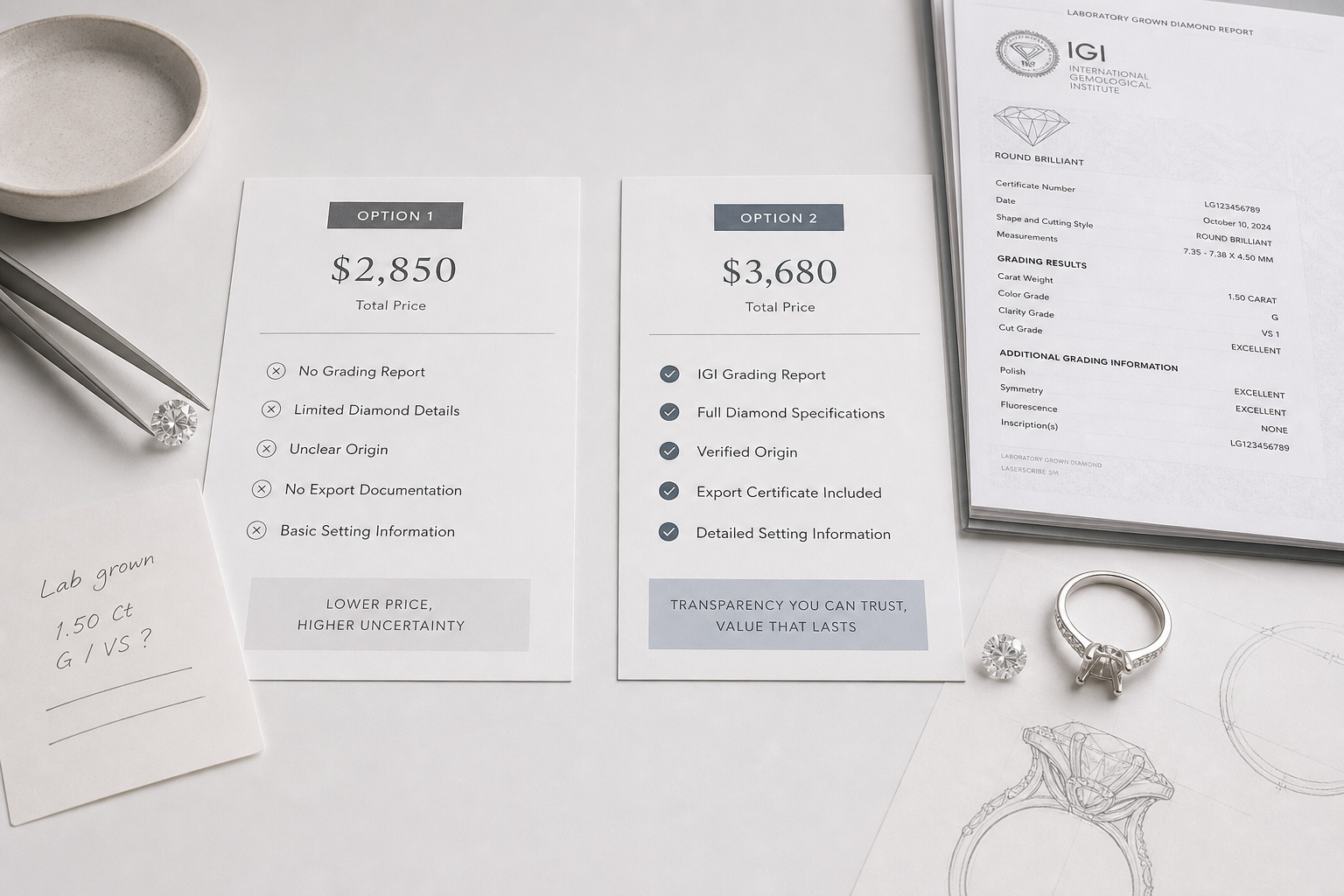
A grading report can help confirm what a stone claims to be, but it cannot carry the entire decision on its own. The report needs to match the stone being shown, and the details need to be complete enough to verify. If the paperwork is thin, inconsistent, or hard to connect to the actual stone, the conversation should pause until that gap is closed.
The most useful habit is to check the basics first. Look for the lab name, report number, and stone measurements, then confirm that those details align with the diamond in front of you. A report is only useful when it can be tied back to a specific stone without guesswork.
When a grading report is available, buyers should verify the report details through the issuing laboratory’s official report-check tool where available and compare those details with the stone’s visual evidence.
Missing lab name, report number, or stone measurements
If a report does not show the lab name, report number, or measurements, the buyer loses the ability to verify it properly. That is not a minor formatting issue. It means the document cannot do the basic job a grading report is supposed to do.
For a supplier, these omissions are especially concerning when they appear alongside pressure to act quickly. A complete report is not proof that the entire transaction is safe, but an incomplete report is a strong reason to stop and ask why the basics are missing. If the seller cannot produce the essentials, the rest of the conversation becomes much less reliable.
Report language that does not match the stone you were shown
Another warning sign is a report that sounds correct on paper but does not match the stone in the video or photo. The size may be off. The shape may be different. The description may refer to a stone that does not line up with what you were shown, especially when lab grown diamond export documents and shipping records are used to support the same claim. Once that happens, the buyer is no longer comparing one stone to one report. They are comparing a document to a claim.
That mismatch should be treated seriously. It may be a mistake, but it may also mean the media and the paperwork are not tied to the same item. For a sourcing decision, that is enough to pause the order until the supplier can reconnect the pieces clearly.
How to treat different labs without overclaiming one is always better
Buyers sometimes get pulled into lab debates that are broader than the actual risk in front of them. The more practical question is whether the report is credible, complete, and matched to the stone being offered. Different labs can serve different buyer needs, but no lab should be treated as a substitute for verification.
At NUVU, we treat the report as a starting point, not the whole answer. A document helps narrow the field, but it does not replace visual review, match checks, or supplier consistency. That is why the safer judgment is usually about fit and credibility, not brand names on paper.
A grading report also does not prove every commercial claim around the diamond. It may document characteristics such as identity, measurements, and grading details, but it does not automatically confirm current stock ownership, delivery reliability, sustainability claims, or after-sales responsibility. Those points should be verified through supplier documentation, written terms, and stone-specific evidence rather than inferred from the existence of a report.
How to read a report as evidence, not as a sales guarantee
Use the report to narrow the technical identity of the diamond, then use supplier evidence to prove the commercial reality of the order. These are separate checks. The report may help you understand what the stone is described as, while the supplier still has to prove that this specific stone is available, that the quoted price applies to it, and that the delivery and remedy terms are clear.
This distinction prevents a common sourcing error: treating a legitimate-looking report screenshot as proof that the transaction is safe. Even when the document appears complete, the buyer should still match it against the media, the measurements, the supplier’s written quote, and the final invoice. If those items do not tell the same story, the report should not be used to rush the order forward.
Origin and growth-method wording to check in supplier documents
For lab-grown diamonds, the documentation should clearly identify laboratory-grown origin when that information is relevant to the transaction. HPHT and CVD are commonly discussed as diamond growth methods, and they should not be confused with post-growth treatments unless the supplier documentation specifically says a treatment was applied.
When growth method or post-growth treatment is relevant, buyers should look for clear disclosure in the grading report or seller documentation. Do not assume treatment status from the method name alone, and do not accept vague phrases if the intended purchase depends on method, treatment disclosure, or matching across a batch.
Certificate and visual review check
Before moving ahead, confirm that the lab name, report number, shape, measurements, and visible stone details all point to the same item. Then compare the paper to the stone in the media without assuming the document alone proves availability or quality. If those two layers do not align cleanly, stop and ask for a corrected package.

Photos, videos, and inventory claims that do not prove the diamond exists
When a supplier shows you a clean photo and says the stone is “ready,” that is not proof of availability. In lab-grown diamond sourcing, weak media is one of the easiest ways to hide a problem, because a polished image can make a stone look real, current, and in stock even when it is borrowed from a catalog or attached to something else. The buyer mistake is assuming that a decent-looking photo is enough to move forward. It is not.
Media should be judged for traceability, not beauty alone. A helpful video shows the exact stone in a way that can be connected to the report and the written quote; a beautiful image that cannot be tied to one stone is still weak evidence. Buyers should also be cautious with overly edited clips, heavy filters, cropped frames, or files that avoid showing proportions and identifying details, because those choices can make comparison harder rather than easier.
Reused stock photos and generic listing images
Reused photos are a red flag when they are doing more than just showing shape or style. A stock image can help illustrate a cut or a general look, but it should never be treated as inventory proof. If the same image appears across multiple listings, or if the stone looks identical to dozens of other “available” stones, you are probably looking at a catalog image rather than the exact diamond being offered.
That matters because catalog-style images often hide the real variables a buyer needs to judge: the actual proportions, the specific hue, the real surface appearance, and whether the stone is genuinely on hand. A supplier can sound active and professional while offering nothing more than borrowed visuals. For a buyer, that is not a minor detail. It is the point where the order becomes speculative.
How to ask for a short unedited video tied to the exact stone
A better check is a short, unedited diamond video tied to the specific stone you are considering. A continuous 10 to 20 second clip is a practical baseline because it gives you enough time to see whether the stone is being shown consistently from different angles without obvious cuts or edits. If the supplier can only send a polished promotional clip, that is not the same thing.
The most useful package includes a video and at least one still image showing the exact stone with report details or measurements visible in the frame. That linkage matters more than production quality. A plain video shot on a phone is often more useful than a glossy clip, because it is easier to trust when it appears unfiltered and specific. If the supplier resists this request or keeps sending different stones, the inventory claim is not strong enough to trust.
Inventory claims that sound real but cannot be verified
Phrases like “we have many in stock,” “ready goods,” or “available now” are only useful if they can be connected to a verifiable stone. Otherwise, they are just sales language. A supplier may truly have access to inventory, but if they cannot identify which stone is yours, when it was last checked, or how it matches the media they sent, the claim is too loose to rely on.
The safer judgment is simple: availability should be tied to evidence, not confidence. If the seller cannot connect the photo, the video, and the description to one identifiable diamond, the buyer is still looking at a promise, not a confirmed stone.
File names, timestamps, and side-by-side proof can reduce confusion
Small documentation habits can make a sourcing file much easier to audit. Ask the supplier to label files with the same stone reference used in the quote, and keep the report screenshot, video, still image, and price line together in one thread or one shared folder. This does not prove the diamond is safe by itself, but it reduces the chance that media from one stone is accidentally or conveniently attached to another.
For batch orders, ask for a simple list that connects each stone reference to its report details, measurements, and intended use. When the supplier cannot keep file names, line items, and images organized before shipment, it is reasonable to worry that the same disorder may appear during packing, replacement, or dispute handling.
How to verify the stone you were shown
Ask for a stone-specific video, one still image with the report number or measurements visible, and a written confirmation that the media matches the exact diamond being offered. Then compare the shape, measurements, and any identifying details across every file. If the supplier cannot keep those details aligned, stop treating the listing as verified inventory.
Communication patterns that reveal weak operations
Slow replies are not automatically a warning sign. A supplier working across time zones can take hours to answer, and that alone does not mean the operation is weak. The real issue is whether the replies stay clear, consistent, and useful. Good communication is not about being warm or fast on one message. It is about whether the supplier can keep the details straight when the questions become specific.
Slow, inconsistent, or evasive replies
A delay becomes a problem when it comes with vagueness. If each reply sounds like a different person answered the same question, or if the supplier keeps circling around the point instead of addressing it directly, the operation may be poorly organized or the seller may not have real control over the inventory being discussed. That is a sourcing risk, even if the tone is friendly.
Evasive replies often show up in small ways. The supplier answers the easy part and ignores the part that would verify the stone. They give a broad reassurance instead of a direct file, a measurement, or a clear statement. Buyers sometimes excuse this because the conversation feels polite. Politeness does not make the supplier reliable.
Answers that never resolve the same question twice
One of the most useful warning signs is repetition without resolution. If you ask the same question in a different way and get a different answer, or if the answer changes every time the conversation shifts slightly, you are dealing with weak follow-through. In wholesale coordination, consistency matters more than a polished pitch.
This is where buyers should slow down. A supplier who cannot confirm a stone’s exact details twice in a row is not ready for a serious order. The problem is not only the answer itself. It is the fact that the answer does not hold up under basic checking. That usually means the operation is relying on improvisation instead of a controlled process.
Why good communication is about clarity, not friendliness
Friendly messages can be misleading. A supplier may sound helpful, respond quickly, and still leave you without the one thing you actually need: a clear, traceable answer. Clarity is the real test. Can they identify the stone, restate the details without changing them, and explain what happens next without drifting into vague reassurance?
At NUVU, we treat this as a simple buyer standard: if a supplier cannot communicate the facts cleanly, the rest of the conversation is not worth much. The goal is not to find the nicest seller. It is to find the one that can operate without confusion once money and production are involved.
What to verify in the next exchange
Ask one direct question that requires a specific answer, then check whether the supplier responds with the same stone details, the same measurements, and the same next step. If the reply becomes broader, softer, or noticeably different from the prior message, that inconsistency is the signal to pause.
Quality control gaps that show up in sample and repeat orders
A good sample can create false confidence. A supplier may send one attractive stone or a small matched set that looks fine, then struggle when the order becomes larger or more varied. That is usually where weak quality control shows itself. The issue is not whether the sample looked good. The issue is whether the supplier can keep the standard steady when the order needs sorting, matching, and final checking.
Quality control should also be judged against the intended use, not only against the loose stone description. Stones for matching earrings, a tennis bracelet, a halo design, or a custom engagement ring may need different levels of size, color, proportion, and visual consistency. For custom design, the stone cannot be evaluated separately from the setting: measurements, face-up spread, depth, girdle condition, and overall outline can affect how safely and attractively the stone can be mounted.
For custom design, trust comes from matching the stone to the setting, budget, and wearer’s daily use, not from choosing grades in isolation. A stone that looks efficient on a spreadsheet may still need a closer review if its depth, outline, or proportions create setting challenges or change the finished appearance of the piece.
For custom jewelry, stone measurements and setting compatibility should be confirmed before finalizing a purchase. This is especially important when the supplier is providing only loose-stone details while another workshop or jeweler will build the finished piece.
Inconsistent size, color, or cut between pieces
Variation is normal to a point, but large swings in size, color, or cut quality are a warning sign. If one piece looks noticeably different from the next, the supplier may not be sorting the lot carefully enough. For a buyer, that creates a downstream problem: the stones may no longer suit matching earrings, a multi-stone ring, or a uniform retail assortment.
The most important question is not whether every stone is identical. It is whether the differences are controlled and explainable. A reliable supplier can tell you what range they are working within and where the outliers were removed. If they cannot explain that plainly, the batch may be assembled loosely rather than managed with discipline.
Why sample approval is not enough if batch control is weak
Sample approval only proves that one stone, or a small group of stones, met expectations at one point in time. It does not prove that the rest of the order will match it. This is a common mistake in sourcing. Buyers see a good sample and assume the whole lot will behave the same way. If the supplier lacks batch control, that assumption can be expensive.
A better view is to treat the sample as a test, not a guarantee. What matters next is whether the supplier can reproduce the same standard across the actual order. If they cannot explain how the matching will hold together, the sample should not be used as proof of future performance.
What a real QC process should be able to describe plainly
A real QC process should be explainable without jargon. The supplier should be able to describe how stones are sorted, how matching is checked, and what gets reviewed before shipment. If they cannot explain those steps in simple terms, that is often because the steps are not being followed in a disciplined way.
The strongest test is practical: ask them to walk you through what happens from incoming stone to final confirmation. You do not need a technical lecture on the China lab grown diamond supply chain. You need a plain account of how they keep the order consistent. A supplier with a real process can usually explain it clearly because it is part of how they work every day.
Buyer verification checklist
Before you commit to a repeat order, confirm that the supplier can show how sample approval connects to the full batch, how they manage size and color matching, and how they identify stones before shipping. If their explanation is vague, changeable, or overly general, the QC risk is still too high for a serious order.
Payment, refund, and replacement terms that shift too much risk to the buyer
A supplier can look credible right up until the money conversation becomes one-sided. If the quote is attractive but the payment terms are rushed, the refund language is vague, and the replacement policy seems to protect everyone except the buyer, that is not a minor detail. It is usually the point where risk gets transferred before the order is fully verified.
For a U.S. buyer sourcing lab-grown diamonds from China, the question is not whether payment is required. It is whether the supplier asks for trust before they have earned it. A better supplier can explain the order clearly, document what is being sold, and state what happens if the stone does not match. A weak one often wants payment first and clarity later.
Pressure to pay before documentation is ready
Fast payment pressure is a warning sign when it arrives before basic verification. If the supplier has not provided the report, the stone-specific media, the exact measurements, and the written terms, there is no reason to treat urgency as a positive sign. In practice, urgency often means the buyer is being asked to commit before there is enough information to judge the order.
The problem is not only the timing. It is the imbalance. A supplier that insists on a deposit while still being vague about what is included is asking the buyer to carry the risk of missing details, unclear sourcing, or later disputes. That is a poor trade unless the rest of the file is already strong. If the documentation is incomplete, the safer move is to slow the conversation rather than reward pressure.
Payment structure should match the level of verification already completed. If the supplier asks for funds before confirming the exact stone, the final cost, the shipping responsibility, and the remedy path, the buyer is being asked to accept uncertainty that should have been resolved first. This does not mean every supplier with deposits is unsafe; it means the deposit should follow a clear, traceable order file rather than replace one.
Vague replacement language and refund exceptions
Refund and replacement language should be readable without guessing. If the supplier uses broad exceptions, undefined conditions, or phrases that sound flexible but are actually hard to enforce, the buyer should treat that as a real risk. The issue is not that every supplier offers the same policy. The issue is whether the remedy is specific enough to matter when something goes wrong.
A weak policy often sounds protective on the surface while leaving the buyer little practical recourse. It may imply that replacements are possible, but only under conditions that are never fully spelled out. It may mention refunds, but then carve out exceptions for items that were “approved” or “customized” without clearly defining what approval means. Once language gets that loose, the buyer is left depending on goodwill instead of terms.
The safer judgment is simple: if the supplier cannot explain the remedy in plain language, the buyer should assume the remedy may be difficult to use. A clear policy is not a guarantee, but it does show that the supplier has thought through the order enough to stand behind it.
How to judge whether the supplier stands behind the order
What matters most is not whether the supplier promises perfection. It is whether the supplier is willing to put the order details, the verification steps, and the remedy terms in writing before payment moves. A reliable supplier usually has no problem confirming what happens if the stone arrives with a mismatch, if the media does not match the report, or if an agreed specification is not met.
That written commitment is more important than a friendly conversation. Polite messaging can disappear the moment a dispute starts. Clear terms are harder to ignore. If a supplier is confident in the product and the process, the paperwork should reflect that confidence. If the paperwork is thin, the buyer is being asked to rely on trust that has not yet been earned.
For a sourcing team, this is one of the clearest thresholds for walking away. A supplier who hesitates to document the basics before collecting money is not just being inefficient. They are signaling that the order may be managed loosely, which usually becomes expensive later.
Build a written order file before the invoice is paid
Before payment, collect the quote, report details, stone-specific media, shipping responsibility, expected inspection window, and remedy language into one written order file. The purpose is not to make the process complicated; it is to make the agreement easy to review if the shipment later differs from what was promised.
If the supplier changes a detail after the file is created, ask for the change to be restated clearly in writing. Quiet substitutions, revised availability, or altered shipping terms should not be accepted through casual chat messages alone. A clean order file gives both sides a shared reference point and makes it harder for important details to disappear once payment has been made.
What to confirm in writing before paying
Before sending payment, the buyer should have a written record of the exact stone being sold, including the report number, measurements, and any agreed grading details. The supplier should also confirm which photos or videos belong to that stone, what is included in the quoted price, and what happens if the delivered item does not match the agreed specifications.
It is also worth confirming whether the refund or replacement path is tied to a clear inspection outcome and how disputes will be handled if the buyer finds a mismatch. If the supplier cannot state those points without hedging, the buyer should not treat the order as safe. A good rule is that money should follow clarity, not chase it.
Sourcing, sustainability, and responsibility claims that need documentation
China-linked supply chains can offer manufacturing depth and scale in some categories, but buyers still need to evaluate consistency, documentation, communication, and quality control. Do not assume that a China-based quote is automatically better, cheaper, weaker, or safer because of location alone. The relevant question is whether the supplier can document the specific goods and terms being offered.
Environmental and sustainability claims should be specific, documented, and limited to what can be substantiated. Lab-grown diamonds offer a different sourcing path from mined diamonds, but broad phrases such as “eco-friendly,” “green,” “carbon-neutral,” or “ethical” should not be accepted as proof unless the supplier provides clear supporting information about production practices, energy context, sourcing controls, or other relevant documentation.
Responsible sourcing language should also be checked against the transaction itself. A supplier may use polished branding or broad claims while still failing to provide stone-specific reports, clear origin disclosure, consistent media, or written remedy terms. For buyers, the most useful approach is to treat responsibility claims as one part of the file, not as a substitute for verification.
What a safer China supplier looks like after the red flags are removed
Once the weak signals are stripped out, a safer supplier is usually easy to recognize. The offer may not be the cheapest, but it is the one that can be checked. The documentation is consistent, the media is tied to the stone, the answers hold together, and the payment terms do not force the buyer to assume the worst. That combination matters more than any single selling point.
For lab-grown diamond sourcing, the goal is not to find a supplier who says everything perfectly. It is to find one whose process is strong enough that small problems can be corrected before they become order failures. A dependable supplier makes comparison easier because the facts are visible. A weak one makes comparison harder because every answer has to be chased.
A safer supplier also avoids turning broad sustainability or sourcing language into a shortcut for trust. Lab-grown diamonds can offer a different production path from mined diamonds, but responsible buying still depends on documentation, transparent communication, and the ability to verify what is actually being supplied. Claims about origin, production method, or responsible sourcing should be treated as checkable statements, not as automatic proof of lower risk.
Sustainability claims should be specific and documented. Broad green language is less useful than clear information about production, energy context, sourcing practices, and seller transparency, especially when buyers are comparing suppliers across different markets and production models.
The minimum verification package worth expecting
A supplier worth testing should be able to provide a basic package without delay or confusion. At minimum, that means a matching report, stone-specific photos or video, clear measurements, a direct description of the goods being offered, and written payment terms that explain what happens if the order does not match what was agreed. If those pieces are missing, the conversation is too early for a purchase decision.
The deeper point is that verification should line up across every part of the offer. The report, the media, the price, and the terms should all point to the same stone or batch. If one part looks strong but the others are vague, the supplier is not yet ready for a serious buyer. A reliable partner makes the order easy to trace, not hard to assemble.
How to test a supplier with a small first order
A pilot order is useful only if it is structured as a test, not a leap of faith. The first order should let the buyer check whether the supplier’s documentation, communication, fulfillment, and after-sales response actually match what was promised. If the small order already feels difficult to verify, a larger order will usually be worse, not better.
That is why the first order should be treated as evidence. Does the supplier send exactly what was agreed? Are the stones consistent with the approved media? Are questions answered directly after the order is placed, not only before? A good pilot order gives the buyer a realistic view of how the supplier operates when money is already in motion.
NUVU treats this stage as a practical filter, not a formality. In sourcing conversations, the stronger suppliers are the ones that stay organized after the first commitment, because that is when process quality becomes visible.
When to walk away and keep sourcing
Walking away is the right call when the supplier cannot satisfy the most basic checks without pressure, contradiction, or delay. If the paperwork is incomplete, the media cannot be tied to the stone, the answers keep changing, or the payment terms push too much risk onto the buyer, there is no advantage in trying to force the deal through. A low quote does not compensate for an unreliable process.
The clearest walk-away threshold is simple: if the supplier cannot make the order easy to verify before payment, they probably will not make it easy to resolve after payment. At that point, the safer choice is to keep sourcing rather than hoping the problems disappear later.
How to decide whether the supplier is worth a pilot order
A supplier is worth a pilot order when the file is coherent, the terms are understandable, and the supplier responds with specifics instead of reassurance alone. If the quote, report, media, and replacement terms all line up, the buyer has enough structure to test the relationship on a small scale. If they do not, the supplier is still in the screening stage, not the buying stage.
The right decision is often the quiet one: choose the supplier that makes verification easy, not the one that makes urgency feel important. That is usually the difference between a workable sourcing relationship and a problem that starts before the first payment clears.
For buyers who want a practical confidence check, the strongest signal is not a single impressive document or a persuasive salesperson. It is the way the supplier keeps the same stone identity intact across the quote, grading report, media files, invoice, inspection window, and remedy language. When every part of the file supports the same conclusion, the buyer can make a decision based on evidence rather than pressure.
It is also reasonable to ask how grading report verification is handled before and after selection. A supplier does not need to overstate what a grading report proves, but they should be comfortable helping the buyer match report details against official records where applicable. This is especially useful for buyers comparing GIA, IGI, or HRD Antwerp reports, because the report number, measurements, shape, and grading details should remain consistent from selection through final shipment.
When a grading report is provided, buyers should compare the report details with the issuing laboratory’s verification tools where available.
Independent checks should fit naturally into the buying process rather than appear only after a concern is raised. If a seller is confident in the documentation, they should not object to a buyer using official report-check tools, saving the verification result, and keeping it with the order file. This creates a cleaner record for both sides and helps prevent confusion if a stone is substituted, reserved by another buyer, or updated during sourcing.
If a GIA report is provided, the report details may be checked through GIA’s official report verification system where the report is eligible for lookup.
Disclosure: This article is for general educational purposes only. Diamond grading, pricing, availability, specifications, and seller policies can change, and readers should verify important details through grading reports, official laboratory tools, seller documentation, or qualified professionals before making a purchase decision. Laboratory-grown diamonds should be clearly distinguished from natural diamonds, and environmental or sourcing claims should be supported by specific documentation.