
MOQ is one of the most misunderstood parts of sourcing lab-grown diamonds from China because it can mean far more than a minimum piece count. A supplier may apply it to loose stones, jewelry styles, parcels, order value, existing stock, or new production, and this is where the broader China lab grown diamond ecosystem can influence how custom jewelry brands evaluate supplier flexibility. For buyers, the real question is not simply “How low can the MOQ be?” but whether the order size supports reliable specifications, documentation, matching, communication, and repeat supply.
For the full framework, read China Lab-Grown Diamond Supply Chain Guide.
This guide helps you judge when small orders are useful, when bulk orders make sense, and when flexible sourcing creates hidden risk. It also explains why loose diamonds often allow lower commitments than finished jewelry, how virtual inventory should be verified, and why repeat-order consistency matters more than a low first-order threshold.
Throughout this guide, “lab-grown diamond” means a laboratory-grown diamond with the same diamond material as a diamond, but with a laboratory-grown origin rather than a natural mined origin. Laboratory-grown diamonds should be clearly identified as laboratory-grown, and they should not be presented as mined diamonds. Diamond simulants, when they are discussed separately, are not the same as laboratory-grown diamonds.
| Sourcing Choice | Best Use | Main Check Before Ordering |
|---|---|---|
| Small loose diamond order | Testing supplier quality and process | Confirm specs, grading report where applicable, visuals, and availability |
| Virtual inventory | Expanding selection without holding stock | Verify hold time, media, substitution rules, and ownership |
| Finished jewelry MOQ | Producing repeatable designs or collections | Review setup, labor, stone fit, and remake consistency |
| Bulk diamond order | Matching sizes, parcels, or repeat assortments | Define tolerances, rejection terms, and documentation |
| Strict specification order | Meeting exact grading, shape, or calibration needs | Expect less flexibility and possibly higher MOQ |
| Repeat-order plan | Protecting product consistency over time | Agree on restock ranges, timing expectations, and visual standards |
Quick Questions Before You Read
Q: Is the lowest MOQ always the safest starting point?
No. A low MOQ is useful for testing, but it can also come with limited stock control, unclear specs, or weak repeat consistency.
Q: Why do loose diamonds usually have lower MOQs than finished jewelry?
Loose stones can often be sourced from existing inventory, while jewelry requires design setup, labor, stone fitting, and production planning.
Q: Can virtual inventory be treated as confirmed stock?
Not without verification. Availability, grading report details, images, hold time, and replacement rules should be checked before offering it to customers.
Q: When does a bulk order make sense?
Bulk buying is more suitable when demand is proven and the buyer has clear specifications, tolerance rules, documentation needs, and reorder plans.
What MOQ Really Means in China Lab-Grown Diamond Sourcing
China lab-grown diamond MOQ means the minimum order a supplier is willing to accept, but it is rarely just a simple count of stones. In real lab-grown diamond sourcing, MOQ can reflect how the supplier accesses inventory, how production is organized, how much customization is involved, and whether the transaction is worth the handling time for that supplier.
This is why asking “What is your MOQ?” too early can lead to a misleading answer. A wholesale diamond supplier may say there is no minimum for available loose stones, but require a minimum value for exported orders. Another supplier may accept one custom diamond order but require multiple pieces for a jewelry style, calibrated parcel, or private-label design. The number only makes sense once you know what the MOQ is attached to.
MOQ Is a Business Model Signal, Not Just a Quantity Rule
A minimum order quantity tells you something about the supplier’s business model. A supplier with deep loose stone inventory may be comfortable selling one diamond with a grading report because the stone is already cut, graded, photographed, and ready to ship. A factory focused on repeat jewelry production may set MOQ by style because its cost is tied to CAD work, mold preparation, setting labor, finishing, and packaging rather than the diamond alone.
The mistake is treating a lower MOQ as automatically better. A very flexible MOQ can be useful for testing, but it may also mean the supplier is sourcing stones case by case rather than holding consistent stock. A higher MOQ can feel restrictive, but it may indicate that the supplier is structuring production around matching, batch control, or repeatable output. The better question is not simply whether the MOQ is low, but whether the order size matches the supplier’s operating model.
Why MOQ Can Mean Stones, Styles, Parcels, or Order Value
MOQ can apply in several different ways, and buyers need to identify the unit before comparing quotes. For loose diamonds, it may apply by carat size, shape, color and clarity range, grading report type, or parcel category. A supplier might accept one 2.00 ct oval with a grading report but require a larger parcel for small calibrated rounds or melee because sorting, matching, and packing many small stones creates more handling work.
For finished jewelry, MOQ often shifts from stone count to style count. A supplier may set a minimum per ring design, bracelet model, pendant style, metal type, or setting variation. In some cases, MOQ is not expressed as pieces at all; it may be a total order value, a batch commitment, or a production slot. A “10-piece MOQ” for one jewelry style is very different from a “10-stone MOQ” across mixed loose diamonds, even if the number looks similar on paper.
This is where quote comparisons often go wrong. If one supplier’s MOQ refers to available loose diamonds and another supplier’s MOQ refers to custom-set finished jewelry, the two offers are not competing on the same basis. The second supplier may be absorbing design, casting, setting, and finishing work that the first supplier is not providing.
How Loose Diamonds and Finished Jewelry Create Different MOQ Logic
Loose lab-grown diamonds usually create more room for flexible sourcing because the transaction can be limited to selecting, verifying, and shipping the stone. If the diamond is already available with a grading report, video, measurements, and confirmed stock status, the supplier’s main cost is handling and coordination. This is why single-stone orders are more common in loose diamond sourcing than in full jewelry production.
Finished jewelry has a different MOQ logic. Even a simple solitaire ring can involve ring size, metal choice, setting style, stone fit, finishing standard, packaging, and quality checks. If the design is custom or private-label, the supplier may need to spread setup costs across multiple pieces. A low MOQ for finished jewelry is possible, but it often comes with higher per-piece cost, longer coordination, or less room for design changes.
The practical takeaway is clear: loose diamond MOQ is usually driven by inventory access and stone handling, while jewelry MOQ is usually driven by production setup and repeatability. If a buyer expects finished jewelry flexibility to behave like loose diamond flexibility, the sourcing conversation can become confusing quickly.
Evidence to Request Before Treating an MOQ as Reliable
A quoted MOQ becomes more useful when it is paired with proof that the supplier can actually fulfill the order under the stated conditions. For a loose diamond order, that proof may include a current stock confirmation, grading report details, measurements, live photos or videos, and a written note explaining whether the stone is owned stock, partner stock, or subject to reconfirmation. For jewelry, the proof should also cover the setting, metal, stone fit, finishing standard, packaging, and expected production route.
Buyers should separate three types of evidence: identity evidence, such as a report number or inscription detail; availability evidence, such as a current hold confirmation or stock status; and usability evidence, such as videos, measurements, CAD fit, or matching review. A supplier may provide one type but not the others. For example, a report number can help identify a stone, but it does not by itself prove the stone is still available, reserved for the buyer, or visually suitable for a specific design.
A grading report can document key characteristics, but it should be read alongside visual evidence, measurements, seller documentation, and the intended jewelry use. It should not be treated as a guarantee of beauty, value, availability, sourcing ethics, or suitability for every setting.
This evidence-first approach also makes MOQ negotiation cleaner. If a supplier can show that the selected stones are ready, documented, and within the agreed tolerance, a small MOQ may be reasonable. If the supplier must search across multiple sources, coordinate cutting, or build a matched batch, a higher MOQ or longer lead time may be understandable. The buyer’s goal is not to demand paperwork for its own sake; it is to make sure the minimum order reflects a real sourcing path rather than a vague promise.
Traceability Starts With Order Records, Not Marketing Language
For MOQ planning, traceability is less about broad claims and more about whether each sourcing decision can be followed through a clear record. A practical traceability record connects the quotation, approved specification, report reference where applicable, visual media, stone list, invoice description, and final packing details. If one of those elements changes, the change should be noted before the order moves forward.
This matters most when a small sample becomes a repeat program. Without a basic record, the buyer may not know whether a later batch differs because the specification changed, the supplier substituted from a different inventory pool, or the original approval was too vague. A simple written trail helps both sides distinguish normal acceptable variation from a sourcing problem that needs correction.
What to Clarify Before You Compare Supplier Quotes
Before comparing any MOQ, clarify exactly what the minimum applies to. Ask whether it is based on the number of stones, number of jewelry pieces, one specific style, one grade range, one parcel type, one grading report requirement, or a total order value. A supplier’s answer should be specific enough that you can understand what will happen if you change the shape, carat range, metal, setting, or documentation requirement.
It is also worth asking whether the MOQ is tied to available stock or new production. Available stock may allow a smaller first order, while new cutting, matching, or jewelry manufacturing may require a larger commitment. If the supplier cannot explain what drives the MOQ, treat that as a warning sign. A clear MOQ protects both sides; a vague MOQ often leads to substitutions, delays, or quote changes after the buyer has already planned around the order.
For buyers, the useful comparison is not only quantity versus price, but quantity versus control. A small order with confirmed report details, current media, clear measurements, and written substitution rules may be safer than a larger order described in broad terms. Likewise, a higher MOQ can be reasonable when it buys better matching, steadier documentation, or a more repeatable production process.
Why China’s Lab-Grown Diamond Supply Chain Can Support Different Order Sizes
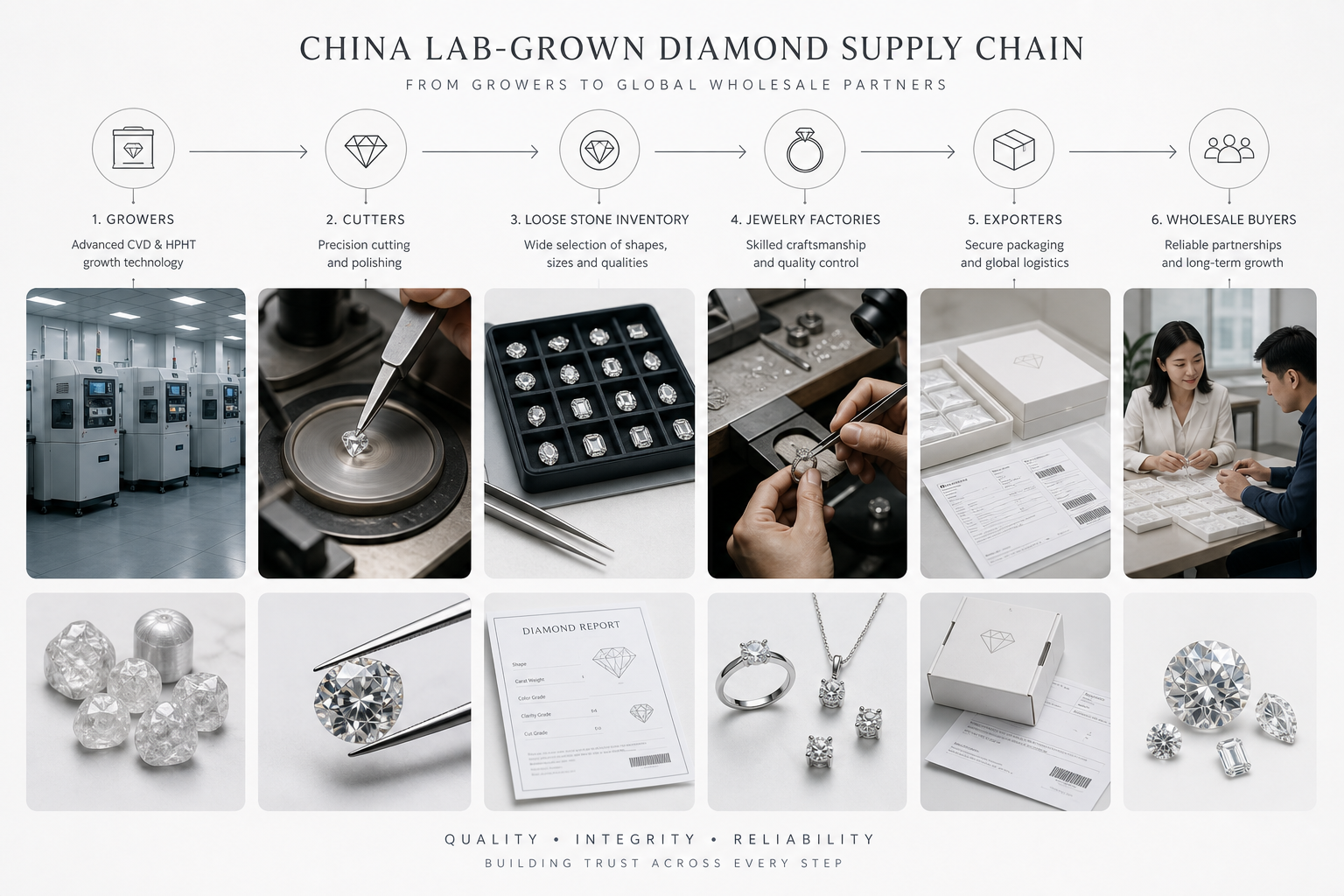
China’s lab-grown diamond supply chain can support different order sizes because it is not one single supplier type. It includes growers, cutters, polishers, loose stone traders, jewelry manufacturers, private-label factories, export companies, and suppliers that coordinate across several of these layers. This structure can create more sourcing options, but it does not mean every China-based supplier can handle every request well.
The real advantage is variety of capability. Some suppliers are built for individual loose diamond selection. Others are better suited to small batch lab-grown diamonds, repeat jewelry production, or bulk lab-grown diamond orders. Flexibility depends on where the supplier sits in the chain, what inventory it can access, and how tightly it controls quality and documentation.
From Growing and Cutting to Finished Jewelry Production
Lab-grown diamond sourcing starts before the finished stone appears on a supplier list. Rough material must be grown, assessed, cut, polished, graded when applicable, and then distributed into different channels. HPHT and CVD may describe laboratory diamond growth methods, not automatically post-growth treatments. When growth method or post-growth treatment is relevant, buyers should look for clear disclosure in the grading report or seller documentation.
China’s role across multiple stages matters because order size flexibility often comes from the ability to move between layers. A supplier connected to cutters and loose stone inventory may be able to source one specific emerald cut or a small run of matching ovals. A jewelry factory with access to calibrated goods may be better positioned for rings, earrings, tennis bracelets, or private-label collections. The stronger the connection between cutting, inventory, and jewelry manufacturing, the more order formats may be possible.
But integration should not be confused with guaranteed control. A supplier may have access to many stones without owning them. Another may own stock but have limited grades available. A factory may produce jewelry efficiently but rely on outside sources for specific center stones. The buyer’s risk is assuming that “China supply chain” automatically means full control from growth to finished jewelry.
How Inventory Networks Create More Order-Size Options
Inventory networks are one reason buyers may see flexible sourcing options from China-based suppliers. A supplier may combine owned stock, partner inventory, cutter relationships, and marketplace-style access to offer different order sizes. This can make it easier to quote a single loose stone, a sample batch, or a mixed order across several shapes and grades.
For buyers, the benefit is not just lower entry quantity. It is the ability to test a product idea before locking into a larger commitment. A retailer may request a few loose lab-grown diamonds with grading reports for photography and customer presentation. A designer may source several stones for prototypes. A growing brand may compare availability across a calibrated size range before planning a full collection.
The caution is that network access is not the same as stable inventory. Stones that appear available today may be sold tomorrow. Grade combinations may shift. Matching requirements may become harder once the first batch is gone. Flexible sourcing works best when the supplier confirms what is physically held, what is partner stock, and what must be sourced after the order is placed.
Where Flexibility Ends: Availability, Consistency, and Documentation
Flexibility has limits, and those limits matter most when the buyer needs consistency. A supplier may be able to find one 1.50 ct F VS1 oval quickly, but matching ten stones with similar measurements, ratios, visual appearance, and grading reports is a different task. The more exact the request, the more the order depends on stock depth, sorting discipline, and production timing.
Documentation can also narrow the available pool. If the buyer requires a specific grading laboratory, report numbers before payment, current videos, laser inscription verification, or matching reports across a batch, the MOQ may rise or the sourcing time may lengthen. These requirements are not excessive; they are often necessary for serious wholesale sourcing. They simply reduce the number of stones that qualify.
The practical judgment is to treat flexibility as a sourcing opportunity, not a substitute for verification. A broad supply chain can create more order-size options, but the buyer still needs confirmation of availability, specifications, visual quality, and documentation before relying on the quote.
Sourcing claims should also be kept separate from sustainability claims. A China-linked supply chain may offer scale, manufacturing depth, and flexible coordination, but that does not automatically prove lower environmental impact or better ethical performance. If sustainability, origin transparency, or production method matters to the buyer, those points should be discussed through documentation, production disclosure, and supplier communication rather than assumed from the word “lab-grown” alone.
Environmental and sustainability claims should be specific, documented, and limited to what can be substantiated. Lab-grown diamonds may appeal to buyers looking for an alternative to mined origin, but responsible sourcing, energy use, production practices, and origin transparency still need clear supporting information if those claims are used in sales or marketing.
Small Orders and Sample Batches: When Low MOQ Makes Sense
Low MOQ makes the most sense when the buyer is trying to reduce uncertainty, not when the buyer is simply trying to push every supplier into the smallest possible order. Small order lab-grown diamonds are useful for testing quality, communication, documentation, photography, and customer response before committing to a broader sourcing plan.
Ordering small batches of lab-grown diamonds from China can be a smart first step for a designer, retailer, or new private-label brand. The key is to treat the sample batch as a structured test, not a casual purchase. A small order should answer specific questions about the supplier’s accuracy, responsiveness, packaging, grading information, and ability to deliver what was actually quoted.
Best Uses for Small MOQ Orders
Small MOQ orders work well when the buyer is validating a product idea or supplier relationship. A jewelry designer planning a new solitaire ring collection, for example, might order three oval lab-grown diamonds in a narrow size and quality range before committing to twenty similar stones. That small test can reveal how the stones look in real settings, whether the proportions suit the design, and whether the supplier’s videos and grading details match the physical product.
Sample batches are also useful for photography and merchandising. An online seller may need real stones for product images, comparison content, or customer consultations before building a larger assortment. A retailer may want to see how customers respond to certain shapes or carat ranges before tying up cash in inventory. In these cases, a low MOQ lab-grown diamond supplier can help the buyer learn faster with less inventory exposure.
Useful small orders are narrow enough to provide evidence. Ordering one round, one oval, one emerald, and one pear across unrelated grades may show that the supplier can ship mixed goods, but it may not tell you much about repeat quality in a specific product category. A better sample order tests the range you actually plan to sell.
What Small Orders Can Reveal About a Supplier
A test order can reveal more than the diamond itself. It shows whether the supplier confirms report details clearly, provides current photos or videos, explains availability honestly, and communicates changes before shipping. For wholesale diamond sourcing, this behavior often matters as much as the first quote.
Small orders also expose how the supplier handles specifications. If you request ovals within a defined ratio range, matching color and clarity, and verified grading reports, the supplier’s response will show whether they understand the request or simply substitute whatever is available. A supplier that pushes vague “similar quality” language on a small order may become harder to manage on larger orders.
The most useful sign is consistency between the quote, the documentation, and the delivered product. If report numbers change without explanation, videos are outdated, measurements are incomplete, or the invoice uses broad descriptions instead of agreed specifications, the buyer should be cautious about scaling the relationship.
The Tradeoff: Lower Commitment, Less Repeat Consistency
The tradeoff with small orders is that they reduce upfront risk but may offer less control over repeat availability. A supplier can often source three attractive stones more easily than twenty matching stones. If the sample sells well, the next batch may not be identical unless the buyer has already discussed reorder expectations.
Small orders may also carry higher per-stone handling costs. The supplier still has to confirm stock, prepare documentation, coordinate payment, pack the order, and manage export steps. A buyer should not expect the same pricing or production attention on a tiny test order that might apply to a planned repeat program. Low commitment has value, but it rarely produces the strongest terms by itself.
The better approach is to use small orders to qualify the supplier and the product direction. If the first order is successful, the next conversation should move toward repeatable specifications, acceptable variation, and future order planning rather than simply asking for the lowest MOQ again.
Buyer Verification Checklist for a Sample Order
- Confirm the exact stone details: Ask for report number, shape, carat weight, measurements, color, clarity, cut information where applicable, and any laser inscription details before payment.
- Request current visual material: Photos and videos should reflect the actual stones being supplied, not generic examples from prior inventory.
- Define acceptable substitutions: If a stone becomes unavailable, the supplier should not replace it without approval, especially when ratio, measurements, or report type matter.
- Check how the order is described on the invoice: Broad wording can create confusion later. The invoice or order confirmation should match the specifications you approved.
- Evaluate communication as part of the test: Slow replies, unclear answers, or shifting details on a small order are warning signs for larger sourcing commitments.
Virtual Inventory and On-Demand Sourcing: Flexible but Not Risk-Free
How Virtual Inventory Differs from Owned Stock
Virtual inventory means the supplier is showing loose lab-grown diamonds that may be available through its own stock, partner stock, trading network, or a diamond sourcing platform, without requiring the retailer to buy and hold those stones upfront. This can be useful, but it is not the same as owned inventory sitting in a supplier’s physical control.
With owned stock, the supplier can usually confirm availability, provide updated media, and reserve the stone more directly. With virtual inventory, the supplier may need to verify whether the stone is still available, whether the report number matches the listing, and whether the stone can be held before another buyer takes it. The practical risk is not that virtual inventory is inherently weak; the risk is treating a listing as confirmed stock before it has been checked.
China lab-grown diamond virtual inventory for retailers can be especially useful because it gives access to broader shape, size, and grade combinations than a small retailer would normally hold. A store may be able to present multiple oval, emerald, radiant, or round options to a customer without tying up cash in every stone. The tradeoff is that the retailer must operate with tighter confirmation habits, because availability can change faster than a physical stock list suggests.
Why Retailers Use It to Expand Selection Without Heavy Inventory
Retailers and online sellers use virtual inventory because customer demand is rarely perfectly predictable. One buyer may want a 2.00 ct oval in F color and VS1 clarity, while the next may want a 1.50 ct emerald cut with a warmer color grade and a specific length-to-width ratio. Carrying every possible option is expensive and often inefficient, especially for businesses still learning which lab-grown diamond inventory turns quickly.
On-demand sourcing allows a retailer to respond to a customer request before committing to the purchase. This works best when the retailer has a clear process: identify the desired specification, request current availability, review report details, check videos or images, confirm measurements, and reserve the stone before presenting it as available. The strongest use case is not “show everything and hope it exists.” It is controlled expansion of selection within specifications the seller can verify quickly.
The common mistake is assuming virtual inventory removes inventory risk completely. It reduces upfront stock exposure, but it introduces timing risk, substitution risk, and communication risk. If a customer chooses a stone that disappears before confirmation, the retailer must either find a comparable replacement or reset expectations. That is why virtual inventory works better for sellers who can communicate clearly than for sellers who promise immediate access to every listed stone.
Availability, Substitution, and Hold-Time Risks
Real-time availability is one of the most important details in virtual sourcing, and it is also one of the easiest to misunderstand. A stone appearing in a feed or supplier list does not always mean it is still available for sale at that exact moment, and China diamond grading certificates can play a role in how quickly buyers confirm specifications with confidence. It may have been reserved, sold, repriced, or awaiting updated confirmation. For high-demand specifications, especially popular shapes and sizes, the gap between “listed” and “secured” matters.
Hold time should be confirmed in writing whenever the stone is being shown to a customer or assigned to a specific order. A short hold may be enough for an internal review, but it may not be enough if the end customer needs time to approve the report and video. If the supplier cannot define how long a stone can be held, the buyer should treat the listing as tentative rather than committed.
Substitution rules are just as important. A replacement stone is not automatically equivalent because the carat weight, color, and clarity look similar on paper. Measurements, cut proportions, fluorescence, growth method disclosure, grading laboratory, and visual appearance can all affect whether the substitute is acceptable. For a retailer selling loose lab-grown diamonds or made-to-order jewelry, the safer rule is simple: no substitution should happen without buyer approval when the stone has already been presented to a customer.
Certificate and Visual Review Check
Before relying on virtual inventory, buyers should request the report number, full measurements, current videos or images, and confirmation that the stone is physically available or can be secured. The grading report helps verify the grading information, but it does not show every visual factor a buyer may care about, such as bow-tie appearance in elongated shapes, windowing in step cuts, or how lively the stone looks in motion.
A strong review process checks the listing against the report and the report against the visual media. If the measurements do not match the listed size, if the video looks outdated, or if the supplier cannot confirm whether the stone is still available, the buyer should slow down rather than move forward on assumption. Virtual inventory is useful only when the verification process is faster than the risk it creates.
A grading report should be treated as documentation, not a complete buying decision. It can describe important characteristics such as carat weight, measurements, color, clarity, and sometimes growth method information, but it does not guarantee that two stones with similar grades will look the same. For fancy shapes especially, the buyer should compare the report with actual motion video and the intended setting before presenting the stone as suitable.
When a grading report is available, buyers should verify the report details through the issuing laboratory’s official report-check tool where available, then compare those details with the stone’s current visual media and order confirmation.
How to Keep Virtual Inventory Claims Defensible
Retailers using virtual inventory should be careful with customer-facing language. “Available to request” is safer than “in stock” when the stone has not been reserved or physically confirmed. “Comparable options may be sourced” is safer than promising a specific replacement before the supplier has checked the current market. The wording should match the level of control the seller actually has at that moment.
This matters because the buyer’s trust is often damaged less by a missing stone than by an overconfident promise. If the retailer clearly explains that a stone must be confirmed before final sale, the customer can make an informed decision. If the retailer presents unverified virtual inventory as guaranteed stock, any later substitution or delay feels like a failure of transparency. Good evidence practice is not only about grading reports; it is also about making sure sales language reflects availability reality.
Bulk Orders and Wholesale Allocations: When Higher MOQ Has Strategic Value
When Bulk MOQ Creates Better Matching and Planning
Higher MOQ is not always a disadvantage. For buyers with proven demand, bulk lab-grown diamond orders can create better planning, cleaner matching, and more predictable replenishment than buying one stone at a time. The key is whether the larger commitment supports an actual business need rather than simply satisfying a supplier’s preferred order size.
Bulk buying makes the most sense when consistency matters across multiple finished pieces. A retailer restocking a bestseller, a brand producing a private-label solitaire line, or a jewelry company planning tennis bracelets needs more than random availability. They need stones that fall within a controlled size, color, clarity, and measurement range. In those cases, a wholesale lab-grown diamond MOQ can function as a production tool, not just a purchasing barrier.
Directional order size should be discussed as a planning range rather than treated as a universal benchmark. A buyer testing a calibrated range may only need a small controlled sample, while a retailer planning a repeat assortment may need a broader allocation across several best-selling sizes. Melee-heavy jewelry, bracelet programs, or mass-market production can require much larger batches because matching and manufacturing efficiency become more important than individual stone selection.
Parcel Orders, Calibrated Sizes, and Matched Sets
Parcel buying is useful when the buyer needs a group of stones that work together rather than a single standout diamond. This is common for stud pairs, three-stone rings, eternity bands, tennis bracelets, halo designs, and jewelry lines that require repeated use of similar stones. The decision is less about finding one impressive report and more about whether the parcel will produce consistent finished jewelry.
Calibrated sizes create their own MOQ logic. If a factory is setting hundreds of stones into standardized jewelry, even small measurement variation can slow production or affect setting quality. A request for 3.0 mm round stones, matched color range, consistent clarity, and predictable make is very different from asking for “small round lab-grown diamonds.” The tighter the calibration, the more likely the supplier will require a larger allocation or more time to assemble the order.
Matched diamonds also raise the standard. A pair of 1.00 ct round stones for earrings should not only share similar grades; they should face up similarly, have compatible measurements, and look balanced next to each other. For larger matched sets or multiple pairs, a higher MOQ can give the supplier a wider pool to select from. Buying bulk lab-grown diamonds from China suppliers is strongest when the allocation is built around a defined matching goal, not just a low unit count.
Why Larger Orders Require Stronger Specification Control
The larger the order, the more expensive vague specifications become. A single imperfect match may be manageable in a sample order. Across a larger batch, unclear standards can create inconsistent finished products, customer complaints, or production delays. Bulk sourcing rewards precision, but it punishes assumptions.
Before accepting a diamond allocation, buyers should define the shape, carat or millimeter range, color and clarity range, cut expectations, grading report requirements, measurement tolerance, and acceptable variation. For jewelry production, setting requirements should be included as well. A stone that fits the grade range may still be unsuitable if the dimensions do not work with the setting or if the visual appearance is inconsistent across the batch.
The most common bulk-order mistake is focusing too much on price per stone and not enough on batch usability. A lower-cost parcel is not a better purchase if too many stones need to be rejected, rematched, or used in lower-priority designs. In wholesale sourcing, usable consistency often matters more than the headline MOQ.
Prices can change with market conditions, report type, seller channel, order size, shape, availability, and stone-specific details, so exact comparisons should be verified at the time of purchase. Buyers should compare like-for-like specifications before treating one allocation as a better value than another.
Bulk evaluation should also distinguish between “within grade range” and “usable together.” A parcel can meet the stated color and clarity range while still showing differences in make, face-up size, tint, or visual liveliness that matter in finished jewelry. In practical buying, the strongest allocation is the one where the rejection criteria, matching purpose, and setting requirements are clear before the buyer reviews the stones.
What to Confirm Before Accepting a Bulk Allocation
Before committing to a larger MOQ, confirm whether the supplier is offering owned stock, assembled stock, production-based allocation, or a mixed parcel sourced through a network. Each model can work, but each carries different timing and consistency risks. Owned stock may be easier to inspect quickly, while production-based orders may offer better control if the specifications are clear enough from the start.
Buyers should also ask how the stones will be documented, whether report numbers are available before payment or shipment, how rejected stones are handled, and what level of substitution is allowed. For calibrated or matched orders, written tolerances are essential. A clear specification sheet is more useful than a broad promise that the supplier will “match quality.”
Bulk MOQ has strategic value when it secures repeatable inventory, supports production planning, and reduces matching uncertainty. It becomes risky when the buyer accepts a large quantity before confirming how the allocation was selected, documented, and controlled.
Repeat Orders: The MOQ Model That Matters Most for Growing Brands
Why the First Order Should Test the Second Order
For a growing jewelry business, the first order should not be judged only by whether it arrives and looks acceptable. It should test whether the supplier can support the next order with similar specifications, documentation, communication, and timing. A sample or opening purchase has limited value if the supplier cannot repeat the result when the product starts selling.
Reorder consistency is where many sourcing problems become visible. A supplier may be able to find one attractive oval, one clean emerald cut, or one matched pair. The harder question is whether they can provide similar stones again after the original stock is gone. If a brand is building product pages, photography, pricing, and customer expectations around a specific look, large variation from one reorder to the next can weaken the entire assortment.
The practical test is to ask early how the supplier would restock the same specification. If the answer depends entirely on whatever happens to be available later, the buyer should treat the relationship as opportunistic sourcing rather than repeatable supply. Opportunistic sourcing can work for one-off custom pieces, but it is weaker for core products that need continuity.
How to Define Acceptable Variation Before Reordering
Acceptable variation should be written before the reorder is needed. A buyer may allow a color range of F to G, a clarity range of VS1 to VS2, or a carat range of 1.00 to 1.10 ct, but those ranges must match the product promise and customer expectation. If the original item was photographed with a bright, well-proportioned oval, a later stone with the same basic grades but a stronger bow-tie may not be a suitable replacement.
Grade substitutions also need clear boundaries. Moving from VS1 to VS2 may be acceptable in many commercial cases if the stone is eye-clean and visually similar. Moving from G to I color may be unacceptable for a collection marketed around a near-colorless appearance, especially in white metal. The decision should be based on how the customer will experience the final piece, not only on whether the substitute looks close in a spreadsheet.
At NUVU, wholesale conversations tend to focus on consistency and documentation because a low opening order does not help much if the second and third orders become unpredictable. For brands building repeat products, the real value is not just getting stones once; it is knowing what level of variation can be managed without changing the product identity.
Lead Time, Restocking, and Production Calendar Expectations
Repeat orders require planning around timing, especially when the buyer needs a narrow specification range or finished jewelry production. Sample confirmation, larger allocations, custom cutting requests, and jewelry production can vary widely depending on stock access, review requirements, complexity, and production calendars.
The mistake is waiting until inventory is almost gone before asking for a reorder. If a retailer sells through a best-selling engagement ring center stone size or a brand is restocking a bracelet program, late reordering can force weaker substitutions or rushed approval. A supplier may be able to help, but the buyer loses leverage over matching and documentation when timing becomes urgent.
Restocking plans should include minimum inventory triggers, expected review time, production or sourcing time, and acceptable fallback options. If a supplier can reserve production capacity or prioritize a repeat specification, that should be confirmed before the product becomes critical to the business. Repeat orders are strongest when they are planned as part of the sourcing relationship, not treated as a last-minute transaction.
What This Means in a Real Purchase
Consider a small brand that tests a 1.50 ct oval solitaire ring and sees strong customer interest. The first order proves the design can sell, but the reorder determines whether the brand can scale it responsibly. Before ordering more, the buyer should define the acceptable oval ratio, color and clarity range, grading report requirements, measurement tolerance, and visual standards for bow-tie control.
If the supplier can source similar stones within those boundaries, the brand can build a repeatable product with more confidence. If every reorder requires a completely new search with uncertain availability, the product may still work as a custom offering, but it is weaker as a stocked or advertised core item. That distinction matters because the right MOQ strategy changes once a product moves from testing to repeat demand.
How Designers, Retailers, and Mass-Market Brands Should Approach MOQ Differently
The right MOQ is not a status marker. A larger order does not automatically mean a more professional buyer, and a smaller order does not automatically mean weaker sourcing. The better question is whether the order size matches the buyer’s business model, product risk, cash flow, and ability to absorb variation.
A jewelry designer MOQ should usually look different from a retailer’s MOQ, and both should look different from the sourcing plan for mass-market jewelry production. Designers often need flexibility and careful stone selection. Retailers need enough breadth to sell without locking too much cash into slow-moving inventory. Larger private-label or mass-market brands need consistency across batches, documentation alignment, and production timing more than one-off flexibility.
Independent Designers: Prioritize Sampling and Custom Fit
Independent designers and small brands should treat MOQ as a way to protect the design process, not just as a purchasing hurdle. If the collection is still being developed, a low MOQ or sample-friendly supplier is usually more useful than a supplier offering better terms only on larger commitments.
For designer sourcing, the biggest risk is not always price. It is ordering too many stones before knowing how the shape, size, color range, and setting proportions work together in the finished piece. A designer building a new oval solitaire line, for example, may need to test a few stones across slightly different ratios before deciding which look fits the brand. Buying twenty similar stones before that decision is made can turn a sourcing shortcut into dead inventory.
Custom diamond order flexibility matters most when the design is stone-sensitive. East-west settings, bezel designs, toi et moi rings, low-profile settings, and pieces with tight measurement requirements often need more careful matching than a basic stock mounting. In those cases, a slightly higher per-stone cost on a smaller order may be more sensible than committing to a bulk parcel that does not fit the design cleanly.
For custom jewelry, stone measurements and setting compatibility should be confirmed before finalizing a purchase. This includes checking millimeter dimensions, depth, table, shape ratio where relevant, prong or bezel fit, metal choice, and any CAD or mounting constraints before production approval.
The mistake for designers is pushing for the lowest possible MOQ without asking whether the supplier can help maintain the same look later. A sample that cannot be repeated is useful for photography, but risky for a sellable collection. Small brand sourcing works best when the first order tests not only the product, but the supplier’s ability to support the next version of that product.
Retailers: Balance Selection Depth with Inventory Risk
Retail lab-grown diamond sourcing has a different problem: customers want options, but the retailer cannot hold every shape, size, and grade combination in physical inventory. A retailer’s MOQ strategy should balance sellable depth with capital discipline. Too little inventory can make the assortment feel thin; too much inventory can trap cash in stones that do not match local demand.
For retailers, the strongest MOQ model is often a mixed approach. Core bestsellers may justify owned stock, while less common sizes, shapes, or higher-carat options can be supported through supplier availability or confirmed sourcing. A retailer selling engagement rings, for instance, may keep popular 1.00 to 2.00 carat rounds and ovals in defined grade ranges, while sourcing elongated cushions, emerald cuts, or larger stones only when a customer request becomes serious.
The practical risk is substitution. If a supplier offers flexible MOQ but cannot clearly explain how replacement stones are selected, the retailer may end up with inconsistent visual quality even when the grading report details look similar. This is especially important for online sellers, where product photos, videos, and listed report details must match what the customer receives.
Retailers should not judge wholesale MOQ strategy only by how many stones must be purchased upfront. They should judge it by whether the supplier can support a reliable selling process: current availability, clear hold terms, matching documentation, acceptable substitution rules, and a realistic reorder path for proven products.
Mass-Market Brands: Control Batch Consistency and Production Capacity
Mass-market brands and private-label lab-grown diamond jewelry programs need less emphasis on one-off flexibility and more emphasis on repeatable execution. Once an item is proven, the sourcing problem becomes consistency across many units, not finding one attractive stone at a time.
For mass-market jewelry production, MOQ often connects directly to batch control. A tennis bracelet program, stud earring line, halo ring series, or pendant assortment may require stones that stay within a narrow size range, color clarity range, and measurement tolerance. If the batch is inconsistent, the finished jewelry can look uneven even if each individual diamond is technically acceptable.
Larger brands should also look beyond the stone MOQ and evaluate production coordination. A supplier may be able to source diamonds, but that does not mean they can coordinate grading reports, matching, setting production, packaging, labeling, and delivery timing at the same level for every order. In private-label programs, weak coordination can create problems downstream: mixed documentation, delayed assembly, inconsistent stone appearance, or products that cannot be replenished cleanly.
Higher MOQ can make sense when the buyer has proven demand, strict product standards, and the operational ability to manage inventory. It becomes a poor choice when the brand is still guessing about demand or when the specifications are not written clearly enough for batch production. Volume amplifies both good sourcing decisions and bad ones.
Order Model Fit by Business Type
Independent designers usually benefit from low-commitment sampling, custom stone review, and flexible sourcing until the design language is proven. Their priority should be fit, proportion, and product testing before scale.
Retailers usually need a controlled mix of owned inventory and flexible access. Their priority should be sellable range, current availability, substitution rules, and enough consistency to protect customer trust.
Mass-market and private-label buyers should use MOQ as a planning tool. Their priority should be batch consistency, production scheduling, documentation alignment, and the supplier’s ability to repeat the same product standard over time.
Specification Control: The Hidden Factor Behind MOQ Negotiation
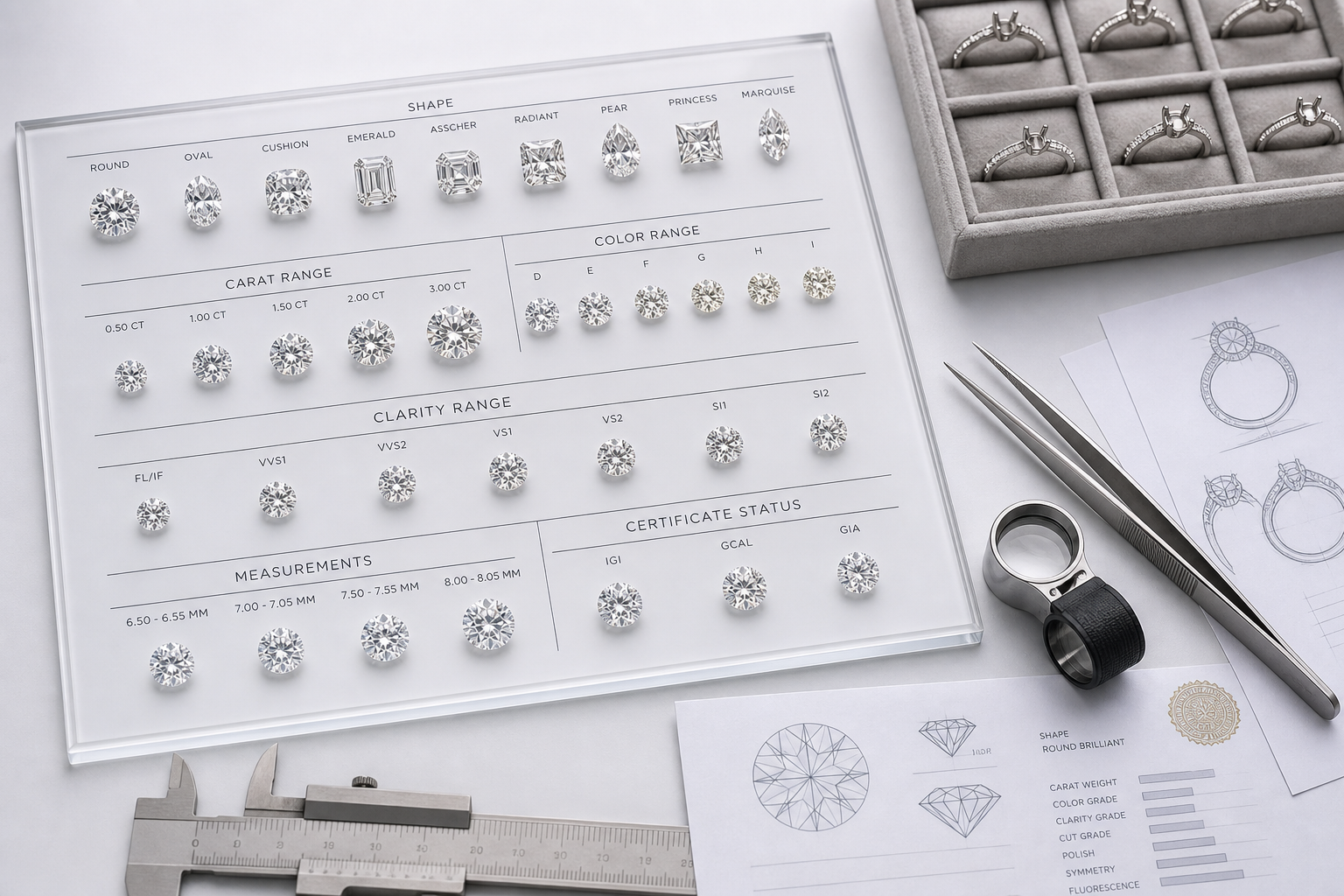
MOQ negotiation often changes once specifications become precise. A supplier may be flexible when the request is broad, but much less flexible when the buyer needs a specific shape, carat range, color clarity range, ratio, cut quality, grading report type, and matching standard. The tighter the lab-grown diamond specifications, the smaller the available pool becomes.
This is why lab-grown diamond MOQ by specification matters more than many buyers expect. A request for “near-one-carat oval lab-grown diamonds” leaves room for sourcing. A request for “1.00 to 1.10 ct oval diamonds, F to G color, VS1 to VS2 clarity, excellent cut or equivalent, 1.40 to 1.45 length-to-width ratio, with verified grading reports” is a different order. It may still be reasonable, but it requires more filtering, more confirmation, and often more time.
Tighter Specs Usually Reduce Flexibility
Flexibility comes from acceptable range. If a buyer can accept several carat weights, nearby color grades, or a wider measurement range, the supplier has more ways to fulfill the order. If the buyer wants exact parameters, the supplier may need to source across multiple inventory channels or wait for suitable production, which can raise MOQ or extend lead time.
The most important distinction is between commercial acceptability and technical precision. A customer-facing jewelry brand may not need every stone to be identical on paper, but it does need the finished pieces to look consistent. Sometimes a slightly wider grading range is acceptable if the stones match visually and fit the setting properly. Other times, especially with matched pairs or line production, a narrow specification is worth the higher sourcing effort.
The mistake is negotiating MOQ before defining what counts as acceptable. If the buyer and supplier use vague language such as “good quality,” “white color,” or “eye clean,” the order may look flexible at first but become difficult to dispute later. Written ranges protect both sides.
Shape, Size, Color, Clarity, and Report Requirements
Shape and size usually drive the first layer of availability. Round stones tend to be easier to source consistently than fancy shapes with strict proportion preferences. Ovals, emerald cuts, pears, and cushions may require extra review because two stones with similar grades can look very different in outline, faceting style, bow-tie visibility, or face-up size.
Carat range also affects MOQ. A request for 0.90 to 1.10 ct gives a supplier more flexibility than a request for only 1.00 to 1.02 ct. The narrower the range, the more likely the order depends on specific inventory rather than general supply. If the diamond must fit a pre-made setting, measurements may matter more than carat weight, especially for bezels, calibrated mountings, and multi-stone layouts.
Color and clarity should be chosen for the product’s use, not just for the highest-looking grade on paper. For many designs, an F to G color and VS range may provide strong commercial appeal without over-restricting supply, and real supplier evaluation should sit alongside these specification choices. Moving to only D color or only VVS clarity can sharply reduce options without producing a meaningful visual difference for every jewelry type. That tradeoff becomes more important as order size grows.
Grading report requirements add another layer. If every stone must come with a specific diamond grading report type, report number, matching inscription, or verified report details, the supplier has less room to substitute. That is not a bad thing when documentation consistency matters, but it should be understood before comparing supplier quotes.
Why Matching Requirements Can Raise MOQ
Matching is one of the most common reasons MOQ becomes higher than expected. A single loose diamond can be selected on its own merits. A pair, set, bracelet layout, or production batch must work as a group. That means the supplier is not simply finding acceptable stones; they are rejecting stones that may be fine individually but do not match the set.
Matched earrings need close size, color, shape, and visual balance. Tennis bracelets and eternity bands require even more consistency because small differences repeat across the entire piece. If a bracelet uses dozens of stones, a few mismatched diamonds can make the finished jewelry look uneven. In that situation, a higher MOQ may reflect the need to select from a larger pool, not just a supplier trying to increase order value.
For batch jewelry, buyers should define which tolerances matter most. Size and measurement consistency may be non-negotiable for a calibrated setting. Color variation may be more visible in white metal than yellow gold. Clarity may be less critical in small melee than in a center stone, as long as the diamonds are clean enough for the intended look. Treating every specification as equally strict can make the order unnecessarily difficult.
Stone-to-Setting Fit Check
Before confirming an order, the buyer should compare the diamond specifications against the actual setting requirements. Carat weight alone is not enough. Measurements, depth, table, outline, and shape ratio can determine whether a stone sits correctly, especially in bezels, low-profile rings, three-stone designs, and custom jewelry.
A practical fit check should confirm the accepted carat range, millimeter measurements, shape ratio where relevant, color clarity range, cut or make expectations, grading report requirements, and any visual factors the report does not fully show. At NUVU, this is where we usually encourage buyers to treat the grading report as a starting point, because the report can narrow the search but does not confirm how well a stone will work in every design.
The better the specification sheet, the cleaner the MOQ conversation becomes. A supplier can only quote accurately when they know whether the buyer wants general availability, tight matching, or production-level consistency.
For custom design, the stone cannot be evaluated separately from the setting. A diamond that looks strong as a loose stone may sit too high, expose too much pavilion, leave a visible gap in a bezel, or fail to align with side stones if the measurements are not compatible. This is why a practical MOQ discussion should include CAD or mounting requirements when the order is for finished jewelry, not just the diamond grades.
Questions to Ask a China Lab-Grown Diamond Supplier About MOQ
Good China lab-grown diamond supplier questions should reveal what the MOQ actually represents. Some MOQs are flexible because the supplier has access to available stock. Some are fixed because the order requires production planning, matching, or jewelry assembly. Others depend on whether the buyer is asking for loose stones, finished jewelry, custom designs, or repeatable private-label supply.
The goal is not to pressure every supplier into the lowest number. The goal is to understand whether the MOQ fits the sourcing model and whether the supplier can support the order after payment is agreed. In MOQ negotiation, unclear answers are usually more concerning than a higher minimum.
Questions That Reveal Whether the MOQ Is Flexible or Fixed
Start by asking what the MOQ applies to. Does it apply per stone, per style, per carat range, per shape, per grading report requirement, per jewelry design, or per total order value? A supplier may say “low MOQ,” but that phrase can mean very different things depending on whether the buyer is ordering one center stone with a grading report, a calibrated parcel, or a finished jewelry style.
Useful questions include: Is the MOQ lower for in-stock stones than for custom sourcing? Does the MOQ change by shape or carat size? Is there a different minimum for stones with grading reports, stones without individual grading reports, melee, matched pairs, or finished jewelry? Can a sample order be placed before a bulk order, and does the sample need to match the future production specification?
The answer should make commercial sense. If a supplier claims every order is fully flexible, every specification is available, and every quantity can be shipped immediately, the buyer should verify carefully. Real flexibility still has boundaries.
Questions About Stock Ownership and Availability
Stock ownership affects risk. A supplier selling owned inventory can usually confirm availability more directly. A supplier working through a network may offer wider selection, but the buyer needs stronger confirmation that the stone can actually be held and delivered.
Ask whether the stones are owned stock, partner stock, virtual inventory, or production-based sourcing. Ask how long a stone can be held after selection, whether report numbers are available before payment, and whether current photos or videos can be provided. For loose lab-grown diamonds, real-time availability matters because attractive stones can move quickly across multiple selling channels.
For finished jewelry, ask whether the diamonds and settings are sourced together or separately. A supplier may be able to confirm the diamond quickly but still need time to produce the setting, match side stones, or complete quality control. Order confirmation should include enough detail to prevent a loose-stone quote from being mistaken for a complete jewelry timeline.
Questions About Substitution, Reorders, and Documentation
Substitution rules should be discussed before they are needed. If a selected stone becomes unavailable, what counts as an acceptable replacement? Must the replacement match the same carat range, color clarity range, measurements, grading laboratory, shape ratio, and price level? Who approves the change before shipment?
For reorders, ask whether the supplier can repeat the same specifications later or only fulfill based on current market availability. This is especially important for retailers and private-label brands that need product continuity. A supplier may complete the first order well but struggle to maintain the same look across future batches if the specifications were never written clearly.
Documentation should also be confirmed in writing. For stones with grading reports, the buyer should request report numbers, report details, inscriptions where relevant, and matching photos or videos. For bulk or jewelry orders, the buyer may also need packing lists, stone breakdowns, style references, labeling requirements, and confirmation of any branding or private-label packaging details.
Documentation Packet to Request Before Scaling an Order
When a buyer moves from a sample order to a larger order, the documentation package should become more structured. A practical packet can include the approved specification sheet, stone list, report references where applicable, measurements, current visual media, substitution rules, packing format, production timeline, and quality-control checkpoints. For finished jewelry, it should also include style references, ring sizes or chain lengths, metal specifications, stone-setting method, surface finish, packaging, and labeling instructions.
This packet does not need to be complicated, but it should be consistent enough that both sides can refer back to it if a question arises. If a supplier changes a stone, adjusts a measurement range, or replaces a jewelry component, the change should be visible against the original approved packet. That makes the order easier to audit and reduces the chance that an informal chat message becomes the only record of an important sourcing decision.
For repeat buyers, keeping these packets over time also creates a useful sourcing history. The buyer can compare what was approved, what was delivered, what sold well, and what caused issues in setting or customer presentation. Over several orders, that evidence is more valuable than a one-time MOQ quote because it shows whether the supplier can maintain the same standard as the business grows.
Change Logs Make Traceability Practical
A change log is a simple but useful tool when sourcing from multiple inventory channels or moving from loose stones into finished jewelry. It should record the original approved specification, the reason for any change, the date of approval, the person who approved it, and the updated stone or jewelry details. This is especially important when report numbers, measurements, stone ratios, metal details, or packaging instructions are revised after the first quote.
For wholesale buyers, the value of a change log is not formality; it is accountability. If a stone was substituted, a parcel tolerance was widened, or a setting measurement was adjusted, the buyer can trace the decision instead of relying on memory across email, chat, and invoice records. NUVU’s buyer-first perspective is to make these comparisons easier to follow, particularly when report details, visual evidence, setting fit, and repeat-order expectations are being weighed together.
Buyer Verification Checklist
- Confirm what the MOQ applies to: stones, styles, parcels, total order value, custom production, or repeat orders.
- Ask whether the quoted stones are owned stock, partner stock, virtual inventory, or production-based sourcing.
- Request report numbers, current visuals, measurements, and written specifications before final confirmation.
- Define allowed substitutions by carat range, color clarity range, shape, measurements, report requirements, and price impact.
- Clarify whether sample orders can lead into repeat orders with similar specifications.
- Confirm expected production or sourcing timing as a planning range, not as an assumption.
- For finished jewelry, confirm setting details, stone matching standards, packaging, labeling, and final quality control steps.
A strong wholesale sourcing checklist does not need to be complicated, but it should force the supplier to be specific. The more reliable MOQ is not always the lowest one; it is the one tied to clear specifications, verified availability, and a sourcing process the buyer can repeat.
When grading reports are part of an order, buyers should compare the report details with the issuing laboratory’s verification tools where available and with the actual stone media supplied for the order.
For MOQ planning, this type of report-aware review is especially useful when a buyer is comparing small samples against larger allocations. Report numbers, grading laboratory names, measurements, and inscription details should be checked before a stone is treated as approved inventory, particularly when the same specification will later be repeated for customers or production.
If a GIA, IGI, HRD Antwerp, GCAL, or other laboratory report is provided, the report is a useful reference point, but it should be read alongside the stone’s measurements, visuals, availability status, and final order confirmation.
When buyers work with reports from recognized grading laboratories, the practical value is not only the document itself but the discipline around matching that document to the actual stone, current media, and final order confirmation. This creates a clearer record for both small custom purchases and wholesale programs.
Common MOQ Mistakes That Lead to Poor Sourcing Decisions
Choosing the Lowest MOQ Without Checking Supplier Fit
The most common lab-grown diamond MOQ mistake is treating the lowest minimum as the safest option. A low MOQ supplier may be useful for testing, but low commitment does not automatically mean low sourcing risk. If the supplier does not control the stones, cannot confirm current availability, or gives loose answers about grading reports and substitutions, the small order may only look safe on paper.
The better question is not “Who has the lowest MOQ?” but “What does this MOQ tell me about how the supplier operates?” A supplier offering one-piece orders from live inventory may be a good fit for a retailer testing demand. A supplier requiring a larger batch may be a better fit for calibrated sizes, matched stones, or repeatable jewelry production. The wrong fit creates friction even if the initial order is small.
Low MOQ becomes a warning sign when the supplier is flexible on quantity but vague on specifications. If shape, measurements, color range, clarity range, report type, and visual review are not clearly confirmed, the buyer is accepting uncertainty instead of flexibility.
Ordering Bulk Before Testing Quality and Communication
Bulk order risk usually starts before the invoice is paid. It starts when a buyer assumes that a favorable price or available parcel means the supplier is ready for a larger commitment. For wholesale lab-grown diamonds, quality consistency, response speed, documentation accuracy, packaging, and correction handling matter as much as the stones themselves.
A sample order is not only for judging the diamond. It is also a test of how the supplier communicates when details matter. Do they send the correct report numbers? Are videos current? Do the measurements match the report? Are substitutions disclosed before shipping? A supplier that is slow, unclear, or inconsistent on a small order is unlikely to become more reliable when the order is larger and more complex.
The smarter path is to use a small test order to evaluate both product and process before moving into bulk. For example, a retailer planning a larger oval lab-grown diamond assortment should first test a smaller group with the same target specifications. If the sample group already shows wide variation in bow-tie effect, ratio, or documentation quality, scaling the order will amplify the problem.
Ignoring Reorder Consistency and Substitution Rules
Many wholesale buying mistakes come from focusing only on the first shipment. A first order can look successful if the stones arrive on time and match the basic request. The real test is whether the same supplier can support similar goods again when the original stones are sold, discontinued, or unavailable.
Reorder consistency does not mean every diamond will be identical. It means the acceptable range is defined before the buyer needs inventory again. For a jewelry brand, that may include carat tolerance, color and clarity range, shape ratio, measurement spread, report type, and visual standards. Without those limits, a reorder can technically meet the supplier’s description while failing the buyer’s product standard.
Substitution rules should be written before they are needed. A replacement stone with the same carat weight and clarity grade may still be a poor substitute if its dimensions do not fit the setting, its color is outside the brand’s range, or its visual appearance differs from the original assortment. For finished jewelry and matched programs, substitutions are not a minor detail; they can change the product the customer receives.
Comparing MOQ Without Comparing Total Sourcing Risk
MOQ should never be compared in isolation. A supplier with a lower minimum may have higher handling fees, weaker documentation, limited matching ability, unstable inventory, or slower correction processes. A supplier with a higher MOQ may require more upfront commitment but offer better batch control, clearer specifications, and stronger reorder planning. The better choice depends on which risk matters most for the order.
Total sourcing risk includes more than the number of stones required. Buyers should account for report verification, video review, shipping coordination, setting compatibility, quality variation, payment exposure, timeline pressure, and the cost of replacing unsuitable goods. A low MOQ order that delays a collection launch or produces unsellable stones is more expensive than it first appears.
The practical judgment is simple: use MOQ as one signal, not the decision itself. A strong diamond supplier evaluation looks at quantity, specifications, documentation, communication, and repeatability together. If one of those pieces is weak, the minimum order quantity is not solving the sourcing problem; it is only making the first step feel easier.
How to Choose the Right MOQ Strategy for Your Order Size
If You Are Testing a New Product
If the product is unproven, start with the smallest order that gives you real information. Samples are useful when you need to test diamond appearance, setting fit, photography, customer response, or supplier communication before committing more capital. This is especially important for new shapes, new carat ranges, custom designs, or collections where the final demand is still uncertain.
The mistake is ordering too narrowly. One stone may confirm that a supplier can ship, but it may not show whether they can source a consistent range. A small but meaningful test might include several stones within the intended grade and measurement range, especially if the design depends on visual consistency. The goal is not to minimize the order at all costs; it is to buy enough evidence to make the next decision responsibly.
If You Need More Selection Without Heavy Inventory
Virtual inventory and flexible lab-grown diamond sourcing make sense when the business needs breadth without holding every stone in advance. Online retailers, appointment-based jewelers, and growing brands often use this model to show more carat sizes, shapes, and grades while keeping inventory exposure lower.
This strategy works best when the buyer has a disciplined confirmation process. Availability should be checked before presenting a stone as selectable, and report numbers, measurements, videos, and hold terms should be confirmed before customer commitment. Flexible sourcing fails when the buyer treats a listed stone as guaranteed stock without verifying whether it is still available and acceptable.
Use this model for range expansion, not for promises you cannot control. If the customer expects immediate fulfillment or exact repeat availability, owned stock or reserved allocation may be safer than relying only on network inventory.
If You Have Proven Demand and Need Consistency
Bulk orders make sense when the product has already proven itself. If a retailer repeatedly sells a specific size range, or a brand has steady demand for tennis bracelets, studs, solitaires, or calibrated jewelry styles, higher MOQ can support better planning. The benefit is not only potential unit efficiency; it is the ability to control matching, documentation, and production flow more deliberately.
This strategy requires tighter specifications than small-order sourcing. Before committing to bulk, define the acceptable carat range, measurements, color and clarity range, report requirements, matching tolerance, and substitution policy. A bulk order without written standards can create a larger version of the same uncertainty that small orders are meant to test.
Bulk buying is a poor fit when demand is speculative. If the buyer is guessing at shape preference, price point, or design direction, a large order can turn inventory into a constraint rather than an advantage.
If You Are Building a Long-Term Supplier Relationship
For a growing brand, repeat orders usually matter more than the first MOQ. A supplier relationship becomes valuable when it supports continuity: similar specifications, predictable communication, documentation discipline, and realistic planning around timing and availability. The better MOQ strategy should leave room for the second, third, and fourth order, not just make the first order easier to place.
This is where buyers should think beyond negotiation. A supplier who understands the brand’s acceptable range can help reduce friction over time, while a supplier who treats every order as a one-off may require the same verification work repeatedly. Long-term sourcing does not require blind loyalty, but it does require enough consistency to make restocking less unpredictable.
For China sourcing strategy, the strongest position is usually a staged one: validate first, expand carefully, then formalize repeat standards once demand is clear. That approach protects cash flow without ignoring the need for consistency.
Trust in a sourcing relationship is built through repeatable steps: clear specifications, written approvals, report-aware review, and communication before any substitution is made. Buyers should feel comfortable asking for supporting details, especially when a small order is intended to become a larger wholesale program.
Before purchase or production approval, buyers should confirm the seller’s documentation, return terms, resizing terms where relevant, and after-sales communication process in writing rather than assuming one standard policy applies to every order type.
Return terms, documentation scope, and grading report availability should be confirmed on the actual order because policies can vary by product type, customization level, and market. For custom jewelry, matched parcels, or private-label production, buyers should clarify what is returnable, what is made to order, and what documents will be delivered before approving production.
Final Evidence-Based MOQ Decision Check
Before choosing an MOQ path, buyers should ask one final question: “What evidence do I have that this order size fits the sourcing risk?” For a sample order, the evidence may be current media, report details, and a small but relevant test range. For virtual inventory, it may be hold confirmation, supplier disclosure, and clear customer-facing wording. For bulk orders, it should include written tolerances, rejection rules, matching standards, and a repeat-order plan.
If the evidence is thin, the order should usually stay smaller, more flexible, or more conditional. If the evidence is strong and demand is already proven, a higher MOQ can be a practical tool for consistency rather than an unnecessary burden. The most defensible MOQ strategy is the one that matches the buyer’s actual proof: proof of product-market fit, proof of supplier reliability, proof of documentation accuracy, and proof that the order can be repeated without changing the customer promise.
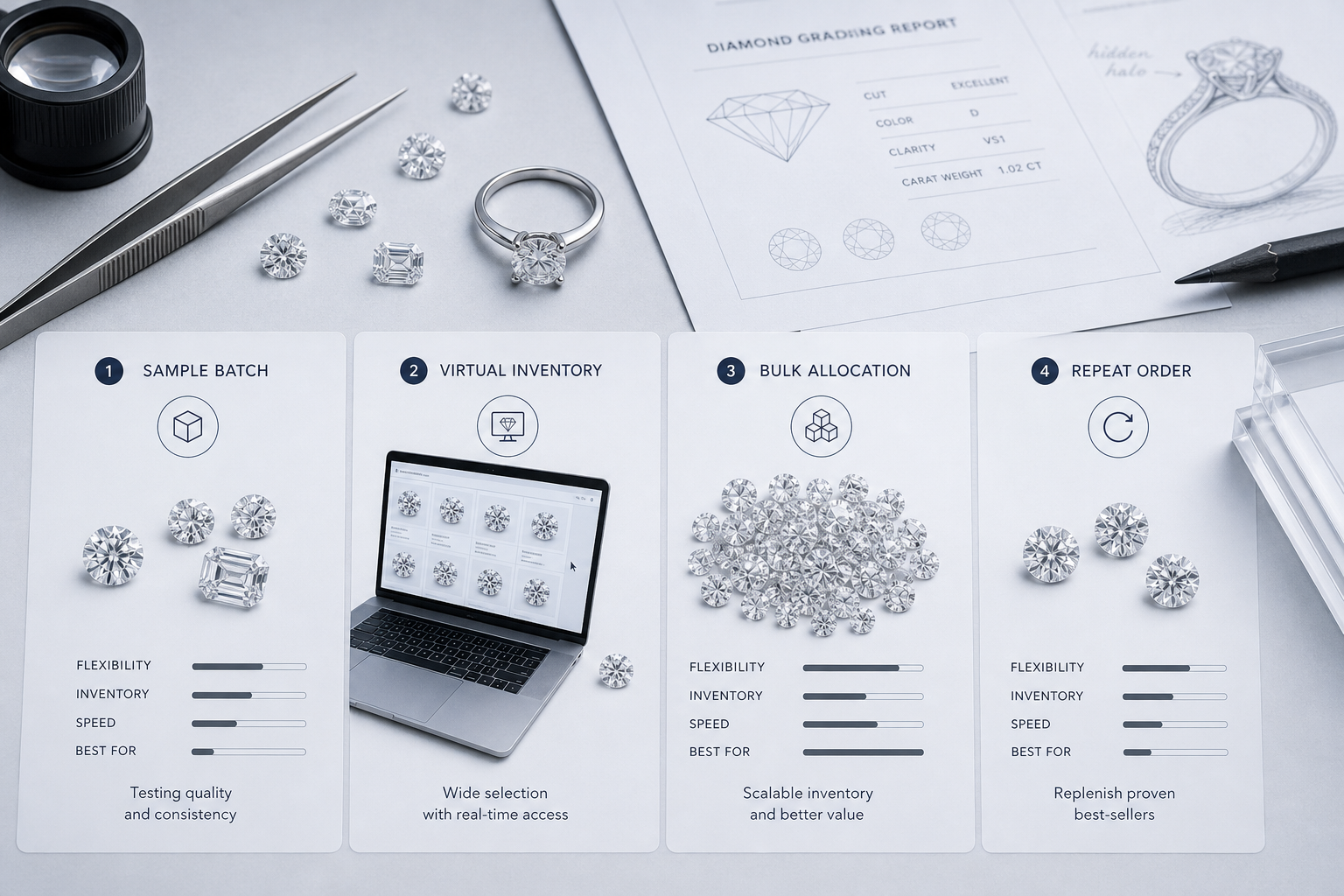
Simple MOQ Decision Framework
- Use samples when the design, supplier, grade range, or customer demand has not been proven yet.
- Use virtual inventory when you need broader selection but can verify availability, grading reports, videos, and hold terms before committing.
- Use bulk orders when demand is proven and consistency matters more than maximum flexibility.
- Use repeat-order planning when the business depends on restocking similar stones or jewelry styles over time.
A strong China lab-grown diamond MOQ strategy is not about forcing every supplier to accept the smallest possible order. It is about matching the order model to the business risk: small orders for learning, flexible sourcing for selection, bulk orders for proven demand, and repeat planning for growth.
Disclosure: This article is for general educational purposes only. Diamond grading, pricing, availability, specifications, and seller policies can change, and readers should verify important details through grading reports, official laboratory tools, seller documentation, or qualified professionals before making a purchase decision. Laboratory-grown diamonds should be clearly distinguished from natural diamonds, and environmental or sourcing claims should be supported by specific documentation.