
When lab-grown diamonds move through a fast supply chain in China, China lab-grown diamond MOQ planning sits alongside documentation review, because the real question is not whether a grading report exists, but whether the paper trail matches the stone in front of you. This article shows how grading reports, lab reputation, growth-method disclosure, and treatment notes help buyers separate usable documentation from false confidence, especially when parcels contain many similar stones or high-value items.
For the full framework, read China Lab-Grown Diamond Supply Chain Guide.
For wholesalers, retailers, and custom jewelry buyers, the practical decision is how much trust to place in a report before shipment, receiving, or resale. The guidance here helps you judge when a fast grading process supports inventory flow, when it needs extra verification, and which checks matter most: report numbers, measurements, laser inscriptions, and consistency across invoices, labels, and parcel records.
Laboratory-grown diamonds should be clearly identified as laboratory-grown, and they should not be presented as mined diamonds. A grading report can support that disclosure when the report states laboratory-grown origin, but buyers should still check that seller descriptions, invoices, listings, and customer-facing language use the same terminology.
| Checkpoint | What to Verify | Why It Matters |
|---|---|---|
| Report number | Matches lab database, PDF, label, and stone | Confirms the document belongs to that diamond |
| Stone identity | Carat, shape, measurements, color, clarity | Helps catch swaps and parcel mix-ups |
| Growth disclosure | CVD or HPHT clearly stated when available, with any relevant treatment notes | Supports accurate product description and consistency |
| Document alignment | Invoice, packing list, inventory ID, shipment label | Reduces mismatch risk before shipping |
| Laser inscription | Matches report, then cross-check measurements | Useful for similar stones, not proof of quality |
| Lab choice | Fits the intended market and downstream use | Not every report is equally useful for every retail setting |
Quick Questions Before You Read
Q: Does a faster grading process mean less reliable results?
Not necessarily, but speed only works if you still verify the stone against the report and shipment records.
Q: Can a grading report replace visual inspection?
No. It should support visual review and receiving checks, not replace them.
Q: Why does growth method disclosure matter?
It affects how buyers describe the stone, compare supply, and handle resale or matching decisions.
Q: When is extra verification most important?
Use it for high-value stones, matched pairs, similar parcels, finished jewelry, or any document mismatch.
Why Grading Is a Trust Checkpoint in China’s Lab-Grown Diamond Supply Chain
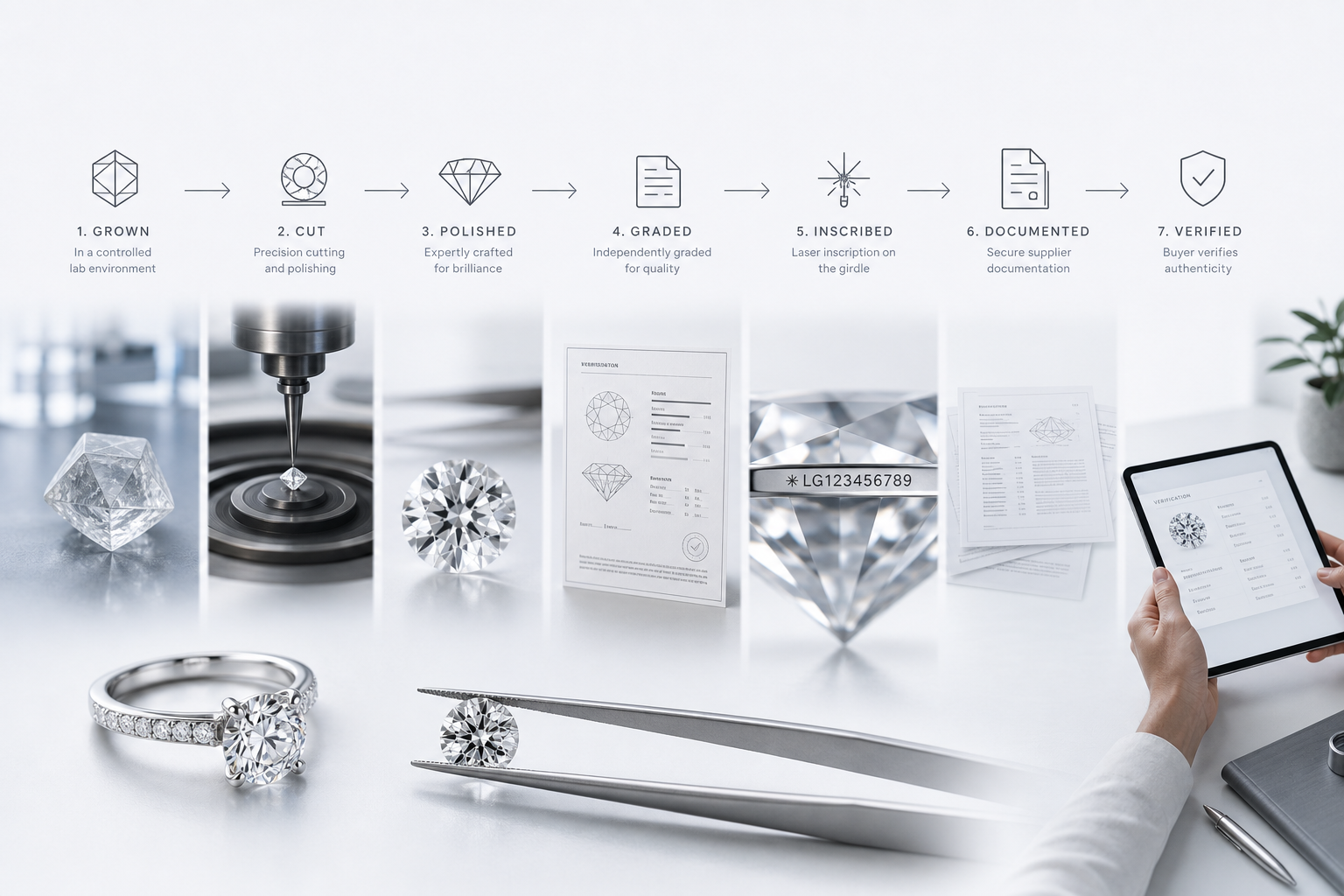
Lab-grown diamond grading in China matters because it is the point where production claims become buyer-facing evidence. Before grading, a stone may have internal notes from growth, cutting, sorting, or supplier inventory systems. After grading, the buyer has a diamond grading report that can be compared against the actual stone, the supplier’s invoice, and the intended use of the order.
For B2B diamond sourcing, this checkpoint is especially important because the buyer is often not selecting a single stone in person. A U.S.-market jewelry brand, wholesaler, or private-label buyer may be reviewing spreadsheets, videos, report files, and shipment documents from a China-based supplier. In that situation, confidence depends less on one verbal assurance and more on whether the documentation stays consistent from selection through delivery.
For buyers, the practical point is not that grading removes all risk. It changes the nature of the risk: instead of relying only on verbal descriptions, the buyer can test whether the report, stone media, supplier records, and shipment documents tell the same story. When those details disagree, the grading report should be treated as a prompt for review, not as a reason to ignore the mismatch.
Where grading fits after growth, cutting, and sorting
In the China lab-grown diamond supply chain, grading usually comes after the rough has been grown, cut, polished, and internally sorted. Internal sorting can help a supplier group stones by estimated size, color, clarity, shape, and commercial category, but it is not the same as independent grading documentation. A buyer should treat supplier pre-sorting as useful, not final.
The grading stage adds a more formal layer. It gives the stone a documented identity and creates a reference point for later review. This does not mean the grading report answers every quality question, but it does reduce ambiguity. Without that step, a buyer is relying heavily on supplier descriptions that may be accurate, but are harder to verify across multiple stones and repeated orders.
Why B2B buyers depend on documentation, not just supplier claims
Supplier claims can be helpful, especially when the supplier knows the buyer’s product standards. The risk is that claims alone do not travel well through a B2B transaction. A stone may pass through sales teams, QC teams, shipping teams, setters, and retail presentation teams before it reaches the final customer. Each handoff increases the need for clear documentation.
A diamond grading report gives everyone in that chain a shared reference. It helps prevent small differences from becoming expensive confusion: a 1.48 ct oval being treated as a 1.50 ct stone, a near-colorless grade being assumed rather than confirmed, or two similar stones being switched during packing. In wholesale and private-label orders, the most practical value of grading is not prestige; it is control.
The strongest buyer confidence comes when the supplier’s description, grading report, inventory record, and physical stone all point to the same diamond. If one part of that evidence does not line up, the problem may be minor, but it should be resolved before the stone moves into production or resale.
How grading connects the stone, the report, and the purchase decision
Grading connects three things that B2B buyers need to keep aligned: the physical diamond, the report data, and the commercial decision. The physical diamond determines what the buyer actually receives. The report records key characteristics. The purchase decision depends on whether the stone fits the buyer’s specification, price expectation, customer promise, and intended jewelry design.
This is where grading becomes more than an administrative step. A buyer may be willing to accept a certain clarity grade for earrings, but not for a center stone. A slight measurement difference may be acceptable for loose inventory, but not for a calibrated setting. A report may confirm the broad category of the diamond, while the buyer still needs video, measurements, and supplier communication to decide whether the stone belongs in a specific order.
At NUVU, we usually treat a grading report as a starting point for judgment rather than the whole decision. That approach matters in sourcing because a report can support trust, but it cannot repair poor document control, unclear matching, or weak communication after the sale.
Evidence Boundary: What the Report Can Support
A useful way to read any grading report is to separate documented facts from commercial interpretation. The report may document characteristics such as carat weight, measurements, color, clarity, and comments included by the grading lab. It does not, by itself, prove that the supplier’s full sales description is complete, that the stone is the right option for a particular design, or that every downstream marketing claim is safe to repeat.
This distinction protects both sides of a transaction. The supplier can point to the report for the characteristics it actually records, while the buyer can avoid stretching the report into claims about value, sustainability, resale demand, or customer preference that the document was not designed to prove. In a fast China-based sourcing workflow, that discipline keeps the report useful without turning it into false certainty.
Traceability Starts Before the Certificate
For traceability, the grading report should be treated as one important link in a longer chain, not the beginning and end of the record. A stronger file connects the supplier stock ID, rough or production batch reference where available, cutting or polishing notes if provided, grading report number, stone media, invoice line, and packing reference. Not every supplier will provide every upstream detail, but buyers should understand which parts of the chain are documented and which are based on supplier communication.
This matters because “traceable” should not mean simply “has a report.” A report can identify and describe a diamond at the grading stage, while traceability asks whether the buyer can follow that stone through selection, approval, shipment, receiving, and eventual setting or resale. If a buyer cannot connect the report number to a specific stone video, parcel label, and order line, the report may still be useful, but the traceability system is incomplete.
What This Means in a Real Purchase
In a real purchase, grading should help the buyer slow down at the right moment. Not every stone needs heavy investigation, but every stone should have a clean path from supplier description to report to shipment record. If the order is high value, time-sensitive, or made up of many similar stones, that path becomes more important than a fast quote or attractive unit price.
The practical rule is simple: accept speed only when the evidence remains aligned. If the grading report supports the supplier’s claim, the stone identity is controlled, and the documentation can be checked before shipment, efficient grading strengthens the transaction. If speed makes the paper trail harder to follow, it creates risk instead of confidence.
What a Lab-Grown Diamond Grading Report Should Confirm
A lab-grown diamond grading report should make the stone easier to evaluate, not simply make it easier to sell. For B2B buyers, the report is useful because it fixes key details in writing: identity, size, measurements, quality grades, and any relevant notes the grading lab includes. The most important question is not whether a report exists, but whether the report contains enough information to support the buyer’s intended use.
A diamond grading report is not a substitute for visual review, supplier accountability, or careful receiving checks. It is a decision tool. Buyers should use it to confirm that the diamond matches the order specification and to identify anything that needs further review before the stone enters inventory, production, or customer-facing presentation.
A grading report helps document key characteristics, but it should not be treated as a guarantee of beauty, value, or sourcing ethics. Those judgments depend on the physical stone, seller documentation, market context, product design, and the buyer’s own quality standards.
Report number, stone identity, and basic diamond data
The report number is the anchor point of the document. It allows the buyer, supplier, and downstream team to refer to the same diamond without relying only on file names, spreadsheet rows, or informal descriptions. If a report number is missing, unclear, cropped out of an image, or inconsistent across documents, the buyer should pause before accepting the stone into a controlled workflow.
Basic data should include the diamond’s shape, measurements, and carat weight. These fields are more than descriptive. They affect setting compatibility, parcel matching, price comparison, and whether the stone fits the buyer’s product plan. Measurements are especially important for fancy shapes because two diamonds with the same carat weight can face up very differently. A 1.50 ct oval that is too deep, too narrow, or visibly mismatched against the buyer’s layout may not serve the same purpose as another 1.50 ct oval on paper.
The 4Cs as documentation fields, not the whole quality story
Color grade, clarity grade, cut grade, polish, symmetry, and fluorescence help create a common language for comparison. For round diamonds, the cut grade can be a major screening point because it relates closely to light performance. For many fancy shapes, buyers need to pay closer attention to proportions, outline, bow-tie effect, and visual appearance because a single cut grade may not tell the full story or may not be presented in the same way across all reports.
The common mistake is treating the 4Cs as if they automatically rank stones from better to worse for every buyer. In practice, they narrow the field. A higher clarity grade may matter less if inclusions are not visible and the stone is being used in earrings. A color grade may matter more in a white gold solitaire than in a yellow gold design where the setting changes the visual impression. For B2B buyers, the grade should be judged against the product goal, not in isolation.
Polish and symmetry are also worth checking, but they should be weighted properly. Excellent polish does not rescue a stone with poor visual balance, and strong symmetry on paper does not guarantee a pleasing outline in every fancy shape. These fields help identify quality consistency, but the buyer still needs to look at the diamond as a physical product.
In practical buying, two diamonds with the same headline grades can still create different outcomes. One may have a more attractive face-up spread, a cleaner outline, or better compatibility with a planned setting; another may have a slightly stronger report profile but less pleasing visual performance. This is why buyers should compare the report with videos, measurements, and design requirements instead of assuming the highest listed grade is automatically the strongest commercial choice.
Growth method and treatment notes buyers should look for
A report may include growth method disclosure, such as CVD or HPHT, and may include comments related to post-growth treatment when the lab reports that information. Buyers should not assume every report format presents these details in the same way. The practical issue is consistency: if a buyer is building a product line, matched set, or repeatable wholesale assortment, inconsistent disclosure can create confusion later.
CVD and HPHT are both established methods for producing lab-grown diamonds, and one is not automatically the better choice for every order. The concern is whether the buyer knows what is being purchased and whether the supplier’s description matches the report notes. Treatment disclosure matters for the same reason. It helps the buyer understand the diamond’s documented history and avoid making claims that the paperwork does not support.
When growth method or post-growth treatment is relevant, buyers should look for clear disclosure in the grading report or seller documentation. If the report does not state a detail that matters to the buyer’s product language, the buyer should ask for clarification rather than assuming the answer from appearance, price, or supplier location.
Buyer Verification Checklist
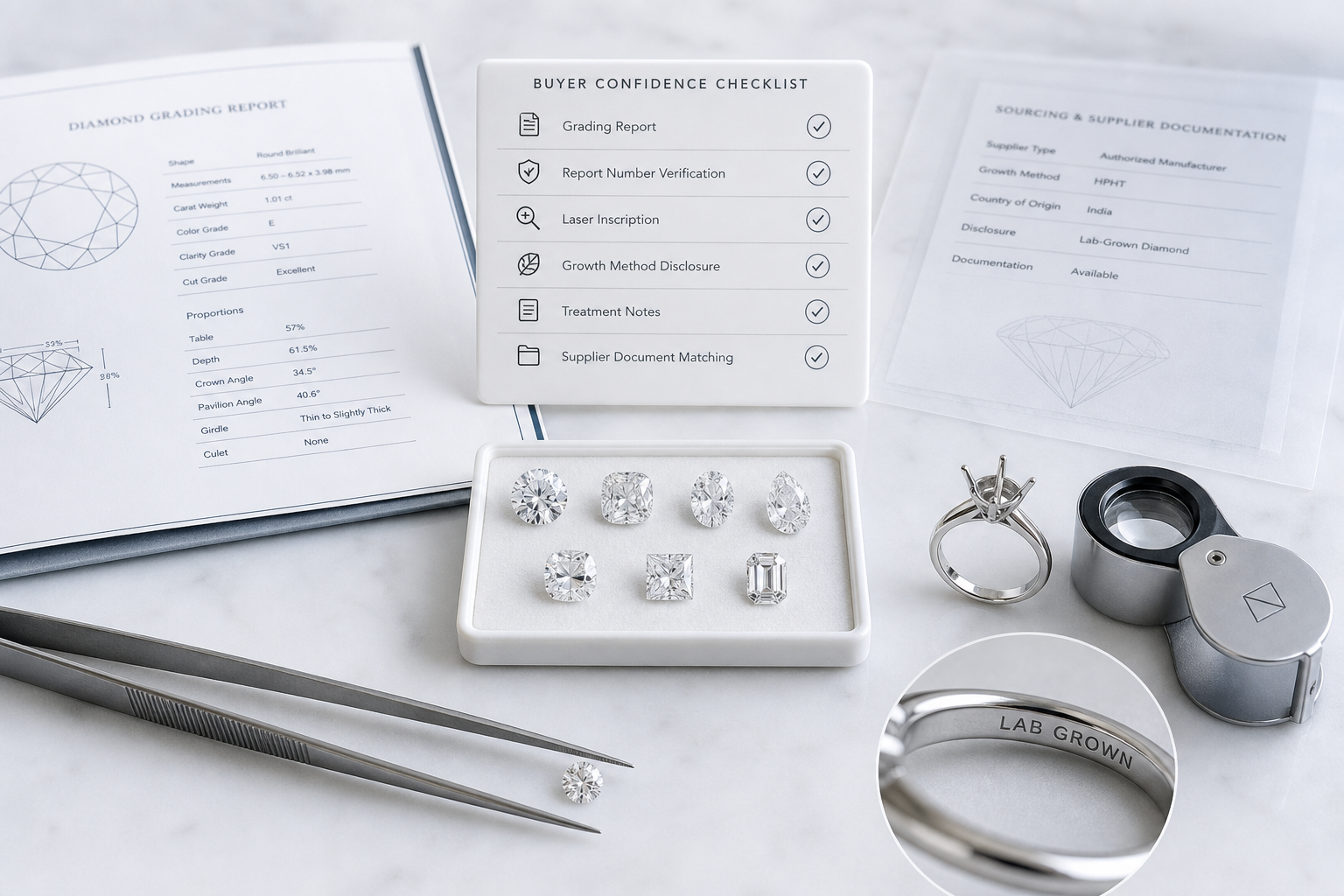
- Confirm the report number. It should be clear, complete, and consistent across the report file, supplier records, and order documents.
- Check shape, measurements, and carat weight. These fields affect fit, matching, and whether the stone works for the intended jewelry design.
- Review color and clarity in context. Do not pay for grades that do not improve the finished product, but do not accept grades that weaken the buyer’s customer promise.
- Look at cut-related fields carefully. Cut grade, polish, symmetry, and proportions should support the intended use, especially for center stones.
- Read fluorescence, growth method, and treatment comments. These notes help prevent disclosure gaps and inventory inconsistency.
- Pair the report with visual review. A report can confirm documented characteristics, but it cannot show every real-world appearance issue.
Speed in China-Based Grading: Useful Efficiency or Hidden Risk?
Fast lab-grown diamond grading can be a real advantage in China-based sourcing, but speed only helps when it preserves document accuracy. The China lab-grown diamond supply chain can move quickly because growth, cutting, sorting, grading submission, sales coordination, and export preparation may be located close together or handled through established supplier networks. That efficiency can shorten handoffs and help buyers respond to inventory needs faster.
The risk appears when speed becomes a substitute for control. A short grading turnaround is not a problem by itself. It becomes a problem if the buyer cannot confirm which stone was graded, whether the report data matches the order, or whether the final shipment follows the same documentation used during selection.
Buyers should also separate grading speed from overall transaction quality. A fast report, a low quote, or a quick export schedule may be useful, but none of these details proves that the stone is visually suitable, consistently documented, or appropriate for the intended retail promise. Speed is strongest when it supports a controlled workflow; it is weakest when it pressures the buyer to skip verification.
Why faster grading can happen in an integrated supply chain
China’s lab-grown diamond sector often benefits from concentrated production and trading networks. A supplier may be able to pre-sort stones quickly, submit them for grading in batches, receive report data, and coordinate shipment documents with fewer logistical delays than a more fragmented sourcing model. For wholesale diamond sourcing, that can reduce waiting time between selection and delivery planning.
Faster movement does not automatically mean weaker grading. In many cases, it reflects operational familiarity in diamond cutting and polishing: suppliers know how to prepare stones for submission, manage batches, and organize reports for buyers. The buyer’s job is to separate useful efficiency from rushed documentation. The difference is visible in the paper trail. Efficient suppliers keep report numbers, stone references, videos, packing lists, and invoices aligned even when timelines are tight.
When speed supports inventory planning and order fulfillment
Speed is most valuable when the buyer has a clear business need: replenishing popular loose diamond specifications, preparing a bridal collection, fulfilling a private-label order, or reserving stones for custom jewelry production. In those situations, a faster grading process can protect the buyer from missed selling windows or production delays.
The better use of speed is predictable planning, not last-minute pressure. If a buyer knows that certain sizes, shapes, and grades move consistently, fast grading can help maintain inventory without overcommitting capital too early. The tradeoff is that the buyer must still leave time for document review before shipment. A stone that arrives quickly but requires correction after receiving can create more delay than a slower order handled cleanly from the beginning.
When fast turnaround should trigger closer document review
Fast turnaround deserves closer review when the order includes many similar stones, high-value center stones, matched pairs, calibrated sizes, or tight production deadlines. These are the situations where a small mismatch can be expensive. If ten oval diamonds share similar carat weight, color, and clarity, a spreadsheet error or report mix-up may not be obvious until setting or final QC.
Buyers should also be cautious when documentation arrives as cropped screenshots, incomplete scans, or files that do not clearly show the report number and stone data. Speed should not reduce the buyer’s ability to compare the report against the order. If a supplier asks for quick payment or shipment approval before complete documents are available, the safer decision is to pause and request the missing evidence.
A rushed order should receive the same report-number and stone-matching checks as a normal order. If the supplier cannot support those checks, the issue is not the grading speed; it is the weakness of the control process around the grading.
Timing Benchmarks Buyers Can Use Carefully
Timelines vary by grading lab, submission volume, service level, stone quantity, and supplier workflow, so buyers should treat any estimate as directional rather than guaranteed. Internal pre-sorting, grading submission, report issue, inscription handling, and final document matching can each add time depending on how the stones are organized and which service path is used.
Laser inscription, report-number organization, and document matching should be completed before shipment approval, not cleaned up afterward. For B2B buyers, this is the practical line to hold: speed is acceptable when it shortens idle time, but not when it removes verification time. The supplier should be able to explain where the stones are in the process, when reports are expected, and how each report will be matched to the final shipment.
The strongest timing plan leaves room for review before money, production, or customer promises are locked in. If the order is routine and the documentation is complete, a faster process can be a sourcing advantage. If the order is high value, visually sensitive, or document-heavy, a few extra days of verification may be less costly than correcting a mismatch after the diamonds have entered inventory or production.
Report Numbers, Online Verification, and Document Control
How report number verification supports buyer confidence
A grading report number is one of the simplest tools a buyer has for checking whether the documentation is complete and consistent. When the grading lab provides an online grading report lookup, the buyer can compare the supplier’s report copy against the lab’s database entry. The useful question is not just “Does this report number exist?” It is “Does the report number show the same diamond data the supplier is using to sell this stone?”
For B2B buyers sourcing lab-grown diamonds from China, this matters because documents often move through several hands before the stone reaches inventory, production, or a retail customer. A supplier may share a PDF report, a spreadsheet, a packing list, and a pro forma invoice. If the report number, carat weight, shape, measurements, color grade, and clarity grade do not stay consistent across those documents, the issue should be resolved before shipment rather than after stones are received and mixed into stock.
Report number verification does not prove that the physical diamond in the parcel is the same diamond described on the report. It confirms the report’s data against an available source. That is valuable, but it is only one layer of diamond report verification. The next risk is document-to-stone matching, which requires disciplined handling of inventory IDs, report copies, and physical stones.
When a grading report is available, buyers should verify the report details through the issuing laboratory’s official report-check tool where available, then compare those details with the supplier’s documents and the stone’s physical identifiers.
Why screenshots and certificate images are not enough by themselves
A screenshot of a report can be useful for a quick preview, but it is a weak basis for a purchase decision. Cropped images may hide the lab name, report date, comments, QR code, or full measurement data. Blurry scans can make a report number hard to read. A report image that has been forwarded multiple times can also become separated from the stone it was meant to identify.
The safer standard is to request the full PDF report when available, along with a clear report number that can be checked through the grading lab’s verification system if that lab offers one. Printed reports can still be part of the transaction, especially for shipment and retail presentation, but the digital file should match the physical document and the supplier’s order paperwork. If a supplier can only provide cropped report images and cannot connect them to inventory IDs or stone videos, that is not just an inconvenience; it weakens document control.
Buyers should also avoid treating every verification system as identical. Some labs offer searchable online databases, some use QR codes, and some may have limited public lookup functionality. The practical standard is not that every report must be verified in the same way. The standard is that the supplier should be able to explain how report authenticity is checked for that report type and provide clean documentation that can be matched to the order.
How B2B buyers should match reports, packing lists, and inventory IDs
In wholesale and private-label sourcing, document control becomes more important as order size increases. One loose diamond with one report is fairly easy to track. A shipment of twenty similar stones, especially in repeated sizes and shapes, creates more room for mismatch. The buyer should expect a clear chain between the supplier’s stock ID, the diamond grading report number, the PDF report, the packing list, and the physical parcel label.
The most useful supplier spreadsheet is not the longest one; it is the one that makes matching easy. Each row should identify one stone and keep its report number, shape, carat weight, color, clarity, measurements, and supplier inventory ID aligned. If the packing list uses one naming system and the report files use another, the buyer may spend hours reconciling documents after delivery. That is a preventable operational risk.
This is where small inconsistencies deserve attention. A minor rounding difference in carat weight may have a reasonable explanation depending on document format, but a mismatched measurement, missing report number, or swapped inventory ID should pause the order. The cost of clarifying before shipment is usually lower than the cost of finding a mismatch after the stones have been assigned to production or offered to retail customers.
Document Control Standard for Repeat Orders
Repeat buying needs a slightly stricter documentation habit because errors can become harder to detect over time. If a buyer purchases the same shape, size range, and grade combination every month, the files may start to look interchangeable. A disciplined naming system should connect each report number to one supplier stock ID, one order line, one video or image set where available, and one final packing reference.
For recurring wholesale programs, buyers should also keep a record of how each supplier presents reports. Some suppliers may label files by report number, others by internal stock code, and others by customer purchase order line. None of these systems is automatically wrong, but inconsistency across shipments can make receiving harder. The safer approach is to define the preferred document format before a high-volume order begins, then ask the supplier to follow it consistently.
How to Verify This Before Buying
- Request the full PDF report, not only a screenshot or cropped report image.
- Use the grading lab’s online report lookup when available, and compare the database result with the supplier’s document.
- Check that the report number is consistent across the report, supplier spreadsheet, packing list, invoice, and parcel label.
- Confirm that the basic diamond data matches across documents, especially shape, carat weight, measurements, color, and clarity.
- Ask the supplier to clarify any missing, duplicated, or conflicting report numbers before shipment.
The strongest document file is one that can be understood by someone who was not part of the original negotiation. If a receiving team, setter, sales associate, or downstream buyer cannot connect the report to the correct inventory record, the documentation has not done its job.
Laser Inscription and Stone-to-Report Matching
What laser inscription does and does not prove
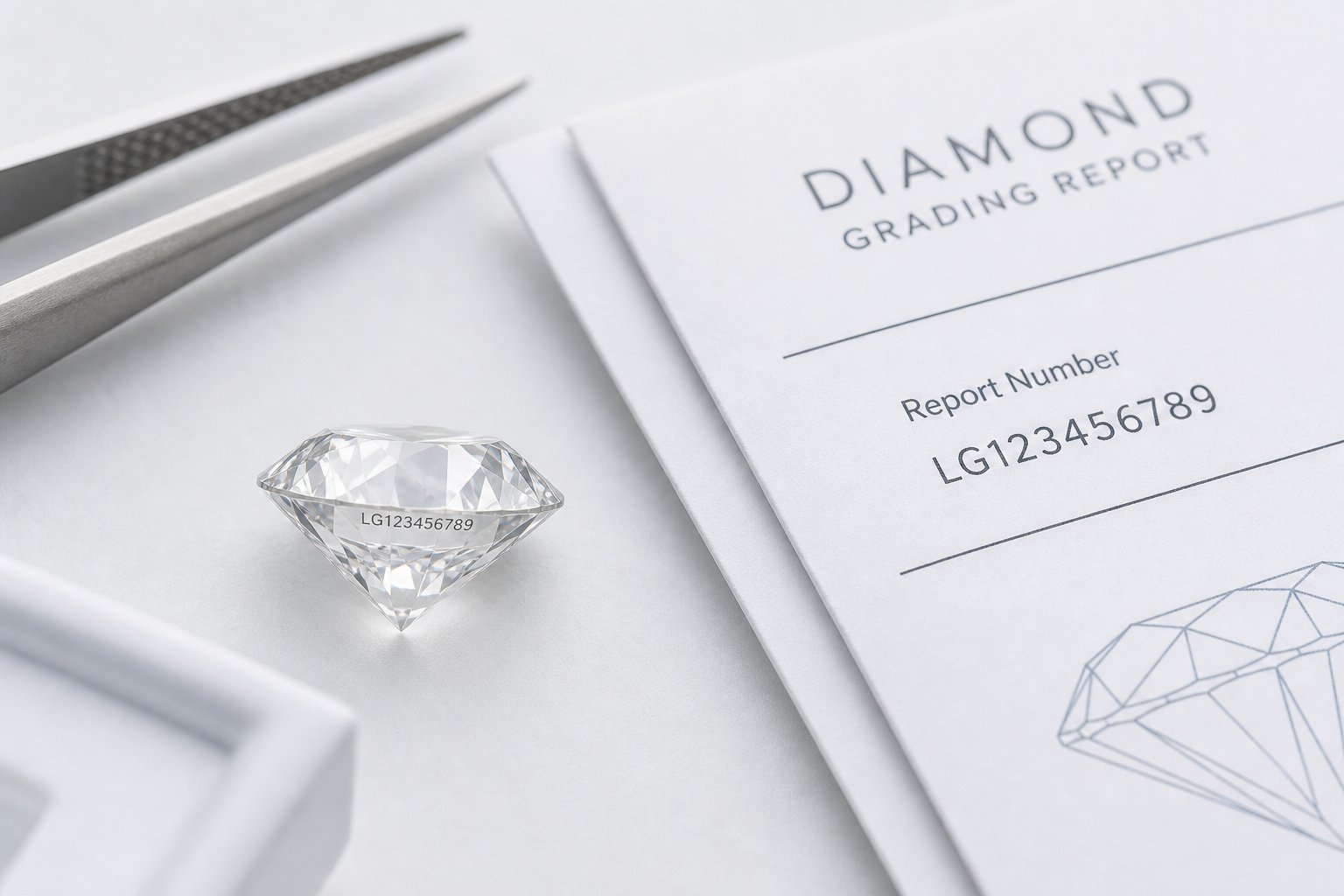
A laser inscription is usually placed on the diamond’s girdle, the narrow outer edge between the crown and pavilion. It commonly includes the grading report number, allowing the stone to be matched to the report under magnification. In B2B transactions, this can be especially useful because many lab-grown diamonds share similar specifications on paper.
Laser inscription is a matching tool, not a quality guarantee. It does not make the color grade more accurate, improve the cut, or prove that every supplier claim is correct. Its value is narrower and more practical: it helps connect a physical stone to a specific report number. That distinction matters because buyers can become overconfident when they hear that a stone is “inscribed.” The inscription supports identity control, but it does not replace measurement checks, visual review, or supplier accountability.
Not every buyer will personally read the girdle inscription, and in many transactions that is realistic. The supplier, grading lab, jeweler, or receiving team may be the one confirming it. What matters is that the buyer can request confirmation and that the report number inscription aligns with the report and order documentation.
Why inscription matters more when stones look similar
Laser inscription becomes more valuable when the risk of confusion increases. A single 3.00 ct emerald cut with distinct measurements is easier to track than a parcel of 1.50 ct oval diamonds with near-identical color and clarity grades. Matched pairs, melee layouts, bridal collections, and repeated private-label specifications all create situations where stones can look interchangeable at first glance.
The most common risk is not dramatic fraud; it is operational confusion. Two stones with the same shape, similar carat weight, and close color and clarity grades can be switched in a tray, mislabeled during packing, or assigned to the wrong production job. A diamond report number inscription gives the receiving team a way to restore order before the mistake affects setting, invoicing, or customer presentation.
For buyers sourcing from China-based suppliers, inscription is especially helpful when stones move quickly from grading to export packing. Speed is useful only if the handoff remains controlled. If several similar stones are moving through the same workflow, inscription confirmation is a sensible safeguard rather than an excessive request.
How buyers can confirm the stone matches the certificate
The practical process should be straightforward. Ask the supplier to confirm the laser inscription, compare the inscription number with the grading report number, and make sure that same number appears in the supplier’s spreadsheet or packing list. If the stone is high value or part of a closely matched group, request a short video or photo showing the stone label and report reference together. The goal is not to create a complicated inspection ritual; it is to reduce preventable mismatch risk.
Measurements should also be checked. If the report lists dimensions that do not align with the supplier’s listing or the stone video description, the buyer should ask for clarification before accepting the match. A report number is strong evidence only when the surrounding details agree. When the number matches but the measurements, shape description, or inventory label do not, the safest response is to pause and reconcile the documents.
For finished jewelry orders, the report should continue traveling with the correct stone through setting and shipment. A diamond can be properly verified at loose-stone approval and still become confusing later if the report is separated from the job envelope, setting order, or final packing documents.
Stone-to-Report Fit Check
- Confirm whether the stone has a laser inscription and whether it includes the diamond report number.
- Match the inscription number to the grading report number.
- Check that measurements, shape, and carat weight align with the report and supplier records.
- Use stone video, parcel labels, and inventory IDs to support report matching when stones are similar.
- Pause the order if the report number matches one document but not the packing list or inventory record.
Laser inscription is most effective when it works alongside disciplined documentation. Used alone, it is only a number on a girdle. Used with consistent records, it becomes a practical control point in lab-grown diamond verification.
Lab Reputation, Domestic Reports, and International Buyer Expectations
Why lab recognition matters differently by buyer type
Not every buyer needs the same type of grading report. A manufacturer sorting stones for internal production may use documentation differently from a U.S. retailer presenting graded lab-grown diamonds to an end customer. A wholesale buyer may care most about consistency across a parcel, while a consumer-facing brand may need a report format that customers recognize and can verify easily.
This is why diamond lab reputation should be evaluated by use case rather than by a simple ranking. A lab-grown diamond grading lab may be suitable for internal sorting, supplier quality control, or local-market documentation, but that does not automatically mean the report will carry the same confidence for U.S.-market retail presentation. For international buyers, recognition, report clarity, verification access, and grading consistency often matter more than the report’s availability alone.
The mistake is assuming that any report solves the trust problem. A report from a lab unfamiliar to the buyer’s market may still contain useful information, but it may require more explanation, extra verification, or a different retail strategy. If the report will be shown to consumers, insurers, retail partners, or marketplace platforms, buyer expectations should be considered before the order is finalized.
It is also important not to turn lab choice into a universal rule. Different reports can serve different buying priorities, and a familiar lab name does not automatically mean the diamond is the best visual or commercial fit. The more reliable question is whether the report documents the details that matter for this transaction, whether the buyer can verify those details, and whether the final customer or sales channel will understand the documentation without confusion.
Domestic documentation versus consumer-facing certificates
A China diamond report or domestic grading report can serve a legitimate purpose in the supply chain. It may help identify stones, support sorting, document basic characteristics, or move goods through wholesale channels. For some B2B transactions, that may be enough, especially when the buyer has its own quality control process and does not rely on the report for consumer presentation.
Consumer-facing reports usually carry a different burden. They need to be understandable to the final buyer, easy to verify where possible, and consistent with the way the jewelry will be described at retail. A domestic report that works for supplier-side documentation may create friction if a U.S. customer expects an international diamond grading report from a lab they recognize or can look up online.
The right question is not whether domestic documentation is “good” or “bad.” The better question is whether it fits the sale. If the stone is being used in internal production and will be rechecked before retail, a domestic report may be acceptable within a controlled workflow. If the report is meant to support a high-value consumer sale, international recognition and simple verification usually become more important.
What U.S.-market buyers usually need from a grading report
U.S.-market buyers generally need a grading report that supports both internal confidence and external explanation. That means the report should be clear, complete, and easy to connect to the physical stone. It should also use grading language that aligns with how the diamond will be sold, especially for shape, carat weight, color, clarity, cut information where applicable, fluorescence, measurements, and lab-grown origin disclosure.
For retailers, private-label brands, and custom jewelers, the most valuable report is not always the fastest or least expensive one. It is the one that reduces questions later. If a customer asks how the stone was graded, whether the report can be verified, or how the report connects to the diamond in the ring, the seller needs a confident answer. A report that saves a small amount upfront can become expensive if it creates hesitation at the point of sale.
In wholesale conversations, NUVU treats report acceptance as a fit question, not a blanket rule. The same documentation may be sufficient for one buying purpose and insufficient for another. A buyer building inventory for consumer-facing engagement rings should usually apply a stricter standard than a buyer evaluating stones for early-stage sample production.
If a grading report is provided, buyers should compare the report details with real supplier evaluation criteria and the issuing laboratory’s verification tools where available, then confirm that the report type fits the intended sales channel.
What to Check Before You Accept a Report
- Whether the grading lab is recognized enough for the buyer’s intended market and sales channel.
- Whether the report can be verified online, by QR code, or through another reliable lab process when available.
- Whether the report format is clear enough for internal teams, retail partners, or end customers to understand.
- Whether the report supports the buyer’s intended use: internal sorting, wholesale resale, finished jewelry, or consumer presentation.
- Whether additional QC is needed if the report is domestic, unfamiliar, incomplete, or difficult to verify.
A grading report should match the risk level of the transaction. Lower-risk internal use may justify simpler documentation. Higher-value, consumer-facing, or resale-sensitive purchases usually deserve reports with stronger recognition, clearer verification, and tighter document control.
Growth Method and Treatment Disclosure: What Buyers Should Look For
Why CVD and HPHT disclosure matters in B2B sourcing
Growth method disclosure matters because it gives buyers a clearer record of what they are purchasing, especially when stones move from China-based production and grading into wholesale inventory, private-label jewelry, or consumer-facing collections. A CVD lab-grown diamond and an HPHT lab-grown diamond can both be legitimate, attractive, and commercially useful, but buyers still need to know which production route is represented on the grading record when that information is available.
The practical issue is consistency, not whether one method is automatically better. A buyer building a line of solitaire rings, matched earrings, or repeatable SKU-based jewelry may want stones with similar growth history, visual character, and documentation language. If one batch contains a mixture of CVD and HPHT stones but the supplier presents them as interchangeable without clear disclosure, the problem is not the mix itself. The problem is that the buyer loses control over how the product is documented, described, and explained downstream.
For B2B sourcing, the higher-risk mistake is assuming that a clean report means all relevant production details have been disclosed in the same way across every stone. Grading reports vary. Some may state the growth method clearly. Some may include treatment-related comments. Others may provide less detail depending on the lab, report type, and service level. Buyers should not treat silence on a report as a complete answer.
How treatment notes affect transparency and product consistency
Treatment disclosure is one of the most important trust points in lab-grown diamond documentation. Some lab-grown diamonds may undergo post-growth treatment to improve color appearance or reach a more marketable grade. That does not automatically make the stone unacceptable, but it does affect how the buyer should evaluate documentation, matching, and product positioning.
The key question is whether the treatment status is disclosed consistently and accurately. A buyer can work with treated or untreated stones if the documentation supports that decision. The risk appears when a supplier description, spreadsheet, grading report, and sales claim do not line up. For example, if a stone is marketed as untreated but the lab-grown diamond report notes indicate post-growth treatment, the buyer should stop and resolve the discrepancy before accepting the shipment.
Treatment notes also matter for visual consistency. Two diamonds may share the same color and clarity grades but still behave differently in certain lighting if their growth history, strain patterns, or post-growth processing differ. This is especially relevant for larger stones, step cuts, elongated shapes, and matched layouts where small visual differences are easier to notice. The grade may be acceptable on paper, but the buyer still has to decide whether the stones work together in the final product.
Buyers should be careful with marketing language around origin, sustainability, and treatment status. A lab-grown diamond may offer a different sourcing path from a mined diamond, but broad ethical or environmental claims still need support from clear documentation and supplier transparency. In grading discussions, the safer approach is to describe only what the report and supplier records actually support, rather than extending the report into claims it was not designed to prove.
Disclosure Language Buyers Should Control
Before a buyer repeats supplier wording in a catalog, product page, marketplace listing, or sales script, the wording should be checked against the actual documents. Phrases such as “graded,” “lab-grown,” “CVD,” “HPHT,” “treated,” “untreated,” “sustainable,” or “responsibly sourced” do not all mean the same thing, and they are not all supported by the same type of evidence. A grading report may support some identity and grading statements, while a supplier policy, manufacturing record, or separate environmental documentation may be needed for broader sourcing or sustainability language.
For this reason, B2B buyers should build a short approved-language file for each order or collection. That file can state how the stones may be described, which report type supports the description, and which claims should not be made unless additional documentation is available. This is especially useful when sales teams, retail partners, and online listing teams are not the same people who reviewed the original reports.
Why disclosure standards should be consistent across an order
Consistency is more valuable than isolated detail when a buyer is sourcing multiple stones. A single well-documented diamond is useful, but a full order needs a repeatable disclosure standard: the same type of report data, the same supplier terminology, the same level of treatment disclosure, and the same handling of CVD or HPHT identification where available.
This becomes especially important for brands selling finished jewelry in the U.S. market. If a bridal collection includes stones with mixed report formats, unclear growth method disclosure, or inconsistent treatment comments, the sales team may struggle to answer reasonable customer questions. The issue may not be that the stones are poor quality. The issue is that weak documentation creates avoidable friction after the product reaches inventory.
Buyers should ask suppliers how growth method and treatment information will be represented before the order is finalized, not after stones are already cut, graded, packed, and assigned to jobs. The better approach is to define the documentation expectation at the start: which report types are acceptable, whether CVD or HPHT disclosure is required, how post-growth treatment notes will be handled, and what happens if a report conflicts with the supplier’s original description.
Sustainability and Origin Claims Need Separate Support
Growth method disclosure can support origin transparency, but it should not be used as a shortcut for broad sustainability claims. A report that identifies a diamond as lab-grown does not automatically document the energy source, production emissions, facility practices, or full environmental context. If a buyer wants to make environmental or responsible-sourcing statements, those claims should be specific, limited, and supported by documentation beyond the grading report where needed.
This distinction helps protect retail language from overreach. It is usually safer to say what is documented: that the stone is lab-grown, which growth method is disclosed if stated, which grading report accompanies it, and what treatment comments appear. Claims about sustainability, sourcing responsibility, or production impact should be checked separately and avoided when the buyer does not have substantiating records.
Environmental and sustainability claims should be specific, documented, and limited to what can be substantiated. A laboratory-grown origin is a material disclosure, but it is not the same thing as a complete environmental assessment.
Certificate and Visual Review Check
Check whether the report identifies the stone as CVD-grown or HPHT-grown, if the report format provides that information. Do not assume the growth method from price, supplier location, or appearance alone.
Review report notes for post-growth treatment language. If treatment disclosure affects how the stone will be sold or grouped, resolve that before shipment or setting.
Compare supplier descriptions against report comments. A mismatch between the supplier spreadsheet and the grading report is more important than a minor wording difference between labs.
Use visual review for batches and matched products. Similar grades do not guarantee that stones will look consistent together in a pair, layout, or collection.
When Buyers Should Request Additional Verification
Red flags that justify extra document or stone review
Additional diamond verification is not necessary for every transaction. For lower-value repeat orders with familiar suppliers, consistent reports, and clean document matching, normal review may be enough. Extra checks become worth the time when the cost of a mismatch is higher than the inconvenience of pausing the shipment.
The clearest red flags are report mismatch, missing report numbers, unclear scans, altered-looking documents, inconsistent measurements, or supplier spreadsheets that do not match the grading reports. Buyers should also slow down when stones have nearly identical specifications, because that is where accidental swaps are easiest. A batch of round brilliants with different carat weights may be simple to track. Twenty ovals between 1.48 and 1.52 carats with similar color and clarity grades require more disciplined control.
Order value matters too. A single inexpensive melee parcel may not justify the same verification process as a group of graded center stones for bridal rings. If the diamonds will be mounted into finished jewelry, especially consumer-facing engagement rings, the tolerance for documentation uncertainty should be much lower. Once a stone is set, correcting a report or identity issue becomes slower, more expensive, and harder to explain.
How to handle similar stones, matched pairs, and batch orders
Similar stones should be treated as a matching risk, not just an inventory convenience. In wholesale diamond QC, the challenge is often not whether the diamonds are real lab-grown stones. The challenge is whether each physical diamond is assigned to the correct report, report number, packing list line, and internal SKU.
Matched pairs deserve special attention because the buyer is not only verifying each diamond individually. The pair must work together in size, outline, color impression, clarity placement, and overall visual balance. A report can confirm that both stones fall within the requested specs, but it cannot guarantee that they will look like a well-matched pair in earrings or side-stone layouts. Buyers should ask for paired videos or side-by-side images when visual matching affects the final product.
For batch orders, the better workflow is to request organized documentation before shipment: report PDFs, a spreadsheet with report numbers and measurements, stone videos or images where relevant, and clear packing references that connect each stone to its report. If a supplier cannot keep these records aligned before export, the buyer should not expect the receiving process to become easier after the parcel arrives.
For custom design, the verification standard should also include physical fit. A report may confirm the diamond’s measurements, but the setting still needs to accommodate the stone’s outline, depth, girdle area, and orientation. This is especially important for elongated cushions, ovals, pears, emerald cuts, and calibrated side-stone layouts, where a small measurement difference can affect prong placement, visual balance, or production timing.
For custom jewelry, stone measurements and setting compatibility should be confirmed before finalizing a purchase. This check should happen before the stone is mounted, because a technically accurate report does not necessarily mean the diamond will fit a specific CAD, mounting, or design proportion.
Custom Jewelry Traceability After Setting
Traceability can weaken after a diamond is mounted if the workshop, setter, or shipping team separates the report from the job record. For custom jewelry, the buyer should keep the report number, setting order, CAD or design reference where available, stone measurements, and final jewelry description in the same project file. This is especially useful when a customer later asks which report belongs to the mounted center stone or when a retailer needs to confirm the stone before presentation.
For custom design, trust comes from matching the stone to the setting, budget, and wearer’s daily use, not from choosing grades in isolation. A high-grade diamond can still be the wrong choice if its depth, outline, or face-up dimensions do not suit the setting. Before finalizing the stone, buyers should confirm measurement compatibility, prong placement, visual balance, and whether the finished piece can be described accurately using the available report and project documents.
A realistic B2B scenario where verification prevents confusion
A U.S. jewelry brand orders twenty 1.50 ct oval lab-grown diamonds from a China-based supplier for a bridal collection. The supplier sends a spreadsheet, report PDFs, and videos. Most rows match cleanly, but two stones have similar carat weights and identical color and clarity grades. The report numbers appear correct, yet the measurement fields in the spreadsheet are reversed.
If the buyer approves shipment without checking, those two stones may be mounted into the wrong settings or assigned to the wrong customer-facing records. If the buyer pauses and asks the supplier to reconcile the videos, report numbers, measurements, and packing labels before export, the issue can be corrected with far less disruption. The value of verification in this scenario is not that it uncovers a dramatic problem; it prevents a small document error from becoming a production and customer-service issue.
The same logic applies to matched pairs. A pair may be commercially acceptable only when the two stones look balanced together. If report details are correct but videos show different length-to-width impressions or noticeably different bow-tie behavior, the buyer may still decide that the pair is not suitable for earrings. The report supports the review, but it does not replace the buyer’s visual and design judgment.
Price, Value, and Report-Based Buying Claims
Grading reports often influence price discussions, but buyers should be careful not to treat a report as a complete valuation tool. A report can document characteristics that affect comparison, such as carat weight, color, clarity, measurements, and comments. It does not determine the final market price by itself, and it does not establish resale value or investment potential.
Prices can change with market conditions, report type, seller channel, and stone-specific details, so exact comparisons should be verified at the time of purchase. For lab-grown diamonds, buyers should compare like-for-like specifications, including shape, size, cut quality, report type, visual media, treatment notes where relevant, and seller documentation. A lower quote may be useful, but it should not override document control or visual suitability.
When reviewing China-linked supply, buyers should also avoid broad assumptions about price or quality. China-linked supply chains can offer manufacturing depth and scale in some categories, but buyers still need to evaluate consistency, documentation, communication, and quality control. “Factory-direct,” “wholesale,” or “fast grading” should be treated as sourcing context, not as proof that a stone is the right commercial choice.
How to Use NUVU’s Buyer-First Lens Without Overreading the Paperwork
NUVU’s buyer-first approach is to make comparison clearer, especially around report details, visual evidence, setting fit, and documentation. In practice, that means asking what the report actually supports, what still needs to be checked visually, and which seller statements require separate documentation before they are repeated to a customer.
This lens is especially useful for lab-grown diamond sourcing because many stones may look similar in spreadsheets. A buyer should not rely on one signal alone, whether that signal is a familiar lab name, a fast turnaround, an attractive quote, or a laser inscription. Stronger confidence comes from several aligned signals: verified report details where available, consistent measurements, clean labeling, clear laboratory-grown origin disclosure, and visual media that supports the intended jewelry use.
NUVU does not need to turn every purchase into an overly complex process. The goal is proportional review. A routine reorder with clean documentation may need a simple checklist. A high-value center stone, custom setting, or consumer-facing bridal order deserves a more careful file, because any mismatch is harder to correct once the diamond has been sold, mounted, or assigned to a customer.
Practical Final Checklist for China Lab-Grown Diamond Grading
- Confirm laboratory-grown origin disclosure. The stone should be described as a laboratory-grown diamond, not as a natural or mined diamond.
- Verify the report number where available. Use the issuing lab’s report-check tool or other stated verification method when provided.
- Match the report to the stone. Check laser inscription, measurements, shape, carat weight, labels, and inventory IDs.
- Read growth method and treatment notes carefully. CVD and HPHT may refer to growth methods; post-growth treatment should be treated separately when disclosed.
- Control customer-facing language. Do not turn a grading report into unsupported claims about beauty, value, sustainability, or sourcing ethics.
- Check setting compatibility for custom jewelry. Measurements, outline, depth, and design fit matter before approval.
- Compare price only after matching specifications. A cheaper stone is not necessarily a better purchase if documents, visuals, or fit are weaker.
The most useful grading process is not simply the fastest one. It is the process that lets the buyer connect the laboratory-grown diamond, the report, the supplier’s records, and the intended jewelry use without confusion. When those elements stay aligned, China-based grading can support efficient sourcing and stronger buyer confidence. When they do not, the report should be the starting point for questions, not the end of the review.
Disclosure: This article is for general educational purposes only. Diamond grading, pricing, availability, specifications, and seller policies can change, and readers should verify important details through grading reports, official laboratory tools, seller documentation, or qualified professionals before making a purchase decision. Laboratory-grown diamonds should be clearly distinguished from natural diamonds, and environmental or sourcing claims should be supported by specific documentation.