
Buying wholesale lab-grown diamonds for a jewelry business comes down to one question: will these stones actually sell? Many jewelers load inventory based on specs that sound good on paper—high color, flawless clarity, rare carat weights—only to find those stones sitting in a safe for months. The lab grown diamond consistency guide details how uniform quality drives sales in bulk purchases. The real problem isn’t finding lab-grown diamonds. It’s matching your inventory to what your customers are actually asking for.
For the full framework, read Wholesale Lab-Grown Diamonds for Jewelers and Brands.
This article replaces generic buying advice with a practical framework for selecting shapes, qualities, and carat weights that move quickly in your retail setting. It also covers how to evaluate suppliers, read certificates for what matters, and time your purchases to avoid locking capital in slow-moving stock. Whether you stock to sell or build custom orders, the goal is the same: carry stones that turn over, not just ones that look good in a parcel.
For buyers, the practical point throughout this article is not simply what a certificate states, but how the stone performs visually, fits the intended design, and matches what your customers actually choose to buy.
| Inventory Decision | Move Fast | Proceed With Caution |
|---|---|---|
| Primary carat range | 1–1.5 carats for engagement rings | Larger stones (>2 ct) without confirmed retail demand |
| Color / clarity band | G–H color, VS1–VS2 clarity | D–E color or IF clarity unless custom-ordered |
| Stone shape mix | Match to your most-sold setting types | Trend-driven shapes without testing customer interest |
| Cut quality | Always prioritize excellent cut | Compromised proportions for a lower price |
| Supplier testing | Start with small orders; verify measurements & reports | Large volume orders before confirming consistency |
Quick Questions Before You Read
Q: Should I buy the highest color and clarity for wholesale?
Usually not. D–E color and IF clarity cost more but don’t sell faster. G–H with VS1–VS2 turns over fastest for most retail shops.
Q: Do I need to verify supplier lab reports myself?
Yes. Request video for stones over one carat and measure actual dimensions against the report. Small inconsistencies can signal bigger problems.
Q: What’s the biggest mistake when building lab-grown inventory?
Buying stones your customers haven’t asked for. Use actual request frequency, not aspirational grade lists, to decide your first stock order.
Q: How do I avoid getting stuck with slow-moving stones?
Test with sample pieces before bulk orders. Avoid carat weights where the price jumps sharply without a visible size increase. Those are dead zones.
Why Inventory Strategy Matters More Than Price Per Carat
The most common mistake jewelers make when transitioning to lab-grown diamond wholesale is treating it like natural diamond buying with smaller numbers. Natural diamond sourcing runs on scarcity: you buy what is available at a given price point, knowing every stone holds value independently. Lab-grown diamonds do not follow that logic. Supply is abundant, production is continuous, and price trajectories trend downward. That changes the math completely.
A jeweler buying lab-grown inventory at the lowest available price per carat can still end up with dead stock if the stones do not match what customers actually ask for. The real variable is not how cheaply you source, but how quickly the inventory converts to revenue. A stone sitting in a tray for six months costs you not only its purchase price, but the opportunity to use that capital on something that sells within weeks.
The Trap of Buying Inventory That Looks Good on Paper
Many jewelers default to the same size, shape, and color mixes they carried for natural diamonds. That instinct is understandable, but it ignores a fundamental difference in buyer behavior. Lab-grown diamond shoppers do not walk in asking for the same combination of grades and sizes. They ask for specific looks: a large center stone for a custom engagement ring, a matched pair for stud earrings, or a specific fancy shape that they saw on social media. The traditional hierarchy—round, D color, IF clarity, two carats—does not map directly onto what sells fastest.
If a jeweler orders a wholesale lot stocked with the color and clarity grades that moved well five years ago in natural diamonds, they may end up with stones that feel too expensive relative to their visual performance, or sizes that customers bypass for something larger at a similar price point. The inventory that looks correct on a grading report may be the inventory that sits longest in the case.
How Lab-Grown Consumer Behavior Changes Wholesale Buying
Lab-grown diamond buyers prioritize size and shape over the traditional rarity chain. A customer choosing between a 1.5-carat oval with G color and a 1-carat round with D color will almost always pick the larger stone at the same retail price. They are not looking for the highest grades on paper. They are looking for the best visible outcome for their budget.
This shifts the wholesale calculation. Instead of stocking premium color and clarity across every size band, the smarter approach is to concentrate budget on the shapes and carat weights that produce the most dramatic visual impact for the end buyer. Fancy shapes sell differently than rounds. Larger stones in medium color grades often outsell smaller stones in top grades. The inventory mix must reflect the actual tradeoffs your customers are making, not the tradeoffs natural diamond buyers used to make.
What to Check Before You Buy Wholesale
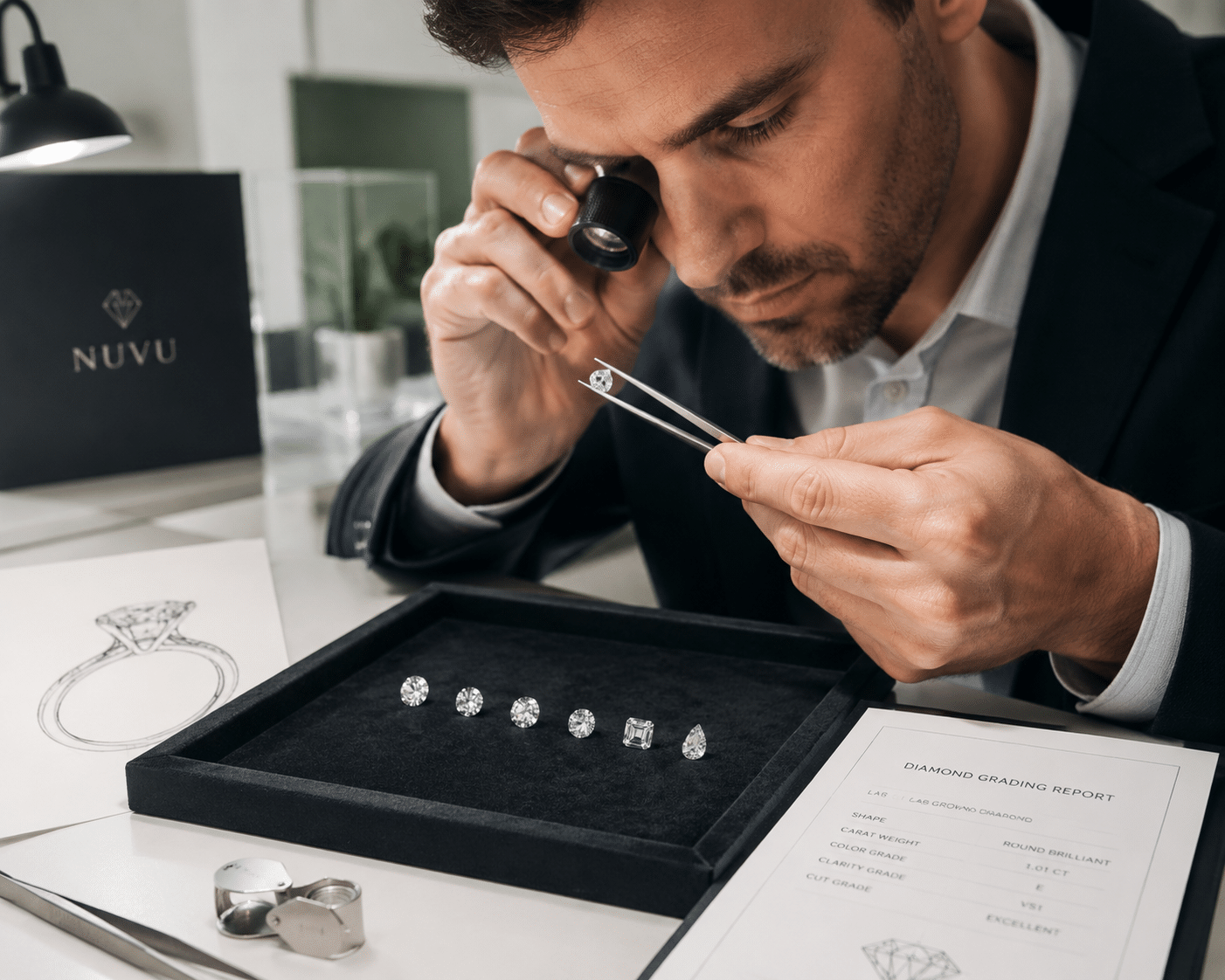
Before placing a wholesale order, review your own sales data from the last six months. Which shapes did customers request most frequently? What size range generated the most inquiries? What price band did your typical diamond buyer actually settle on, not just ask about? If a request came in for a stone you did not carry, write that down. Those are gaps in your inventory, not anomalies.
Cross-reference with customer upgrade patterns. A buyer who walks in wanting a 2-carat stone but walks out with a 1.5-carat stone is telling you where the real comfort zone sits. That price-to-size point is where you should concentrate wholesale spending, not on the aspirational grade that sounds better in a listing.
Adding Traceability to the Inventory Decision
Beyond matching inventory to customer demand, a growing number of jewelry buyers are asking questions about where their diamond came from and how it was produced. For lab-grown diamonds, traceability does not mean mining provenance, but it does mean being able to confirm the growth method—CVD or HPHT—and whether any post-growth treatment, such as HPHT color enhancement, was applied. These factors can influence not only the stone’s long-term stability in a setting, but also a buyer’s confidence in the product they are purchasing.
When you source wholesale lots, request documentation that specifies the growth and treatment history for each batch. A grading report from GIA, IGI, or GCAL will note whether a stone has been treated, but not all reports include the growth method. Supplementing the report with a supplier’s own production records, where available, creates a clearer chain of information. For a retail jeweler, being able to tell a customer “this stone is HPHT-grown with no post-growth treatment” is more specific and more trustworthy than a generic “lab-grown” label. In sourcing or wholesale conversations, documentation, consistency, and communication often matter as much as the headline specification.
NUVU’s approach to buyer education emphasizes that traceability is not about making broad claims—it is about being able to answer a customer’s direct question with a clear, documented answer. When a customer asks what process created their diamond, the jeweler who can point to specific documentation builds lasting trust.
Shape Mix: Which Cuts Actually Move in Wholesale Volume
Shape selection drives inventory velocity more than any other single factor in lab-grown diamond wholesale. A well-chosen shape mix turns over steadily. A poor mix creates dead stock that neither sells at retail nor exchanges easily between suppliers. Because lab-grown diamond production can pivot quickly, the market sees shape shifts faster than natural diamond channels ever did. Keeping your shape ratio aligned with current demand is not optional—it is the difference between a healthy inventory cycle and capital that never returns.
Round vs Fancy Shape Demand by Business Type
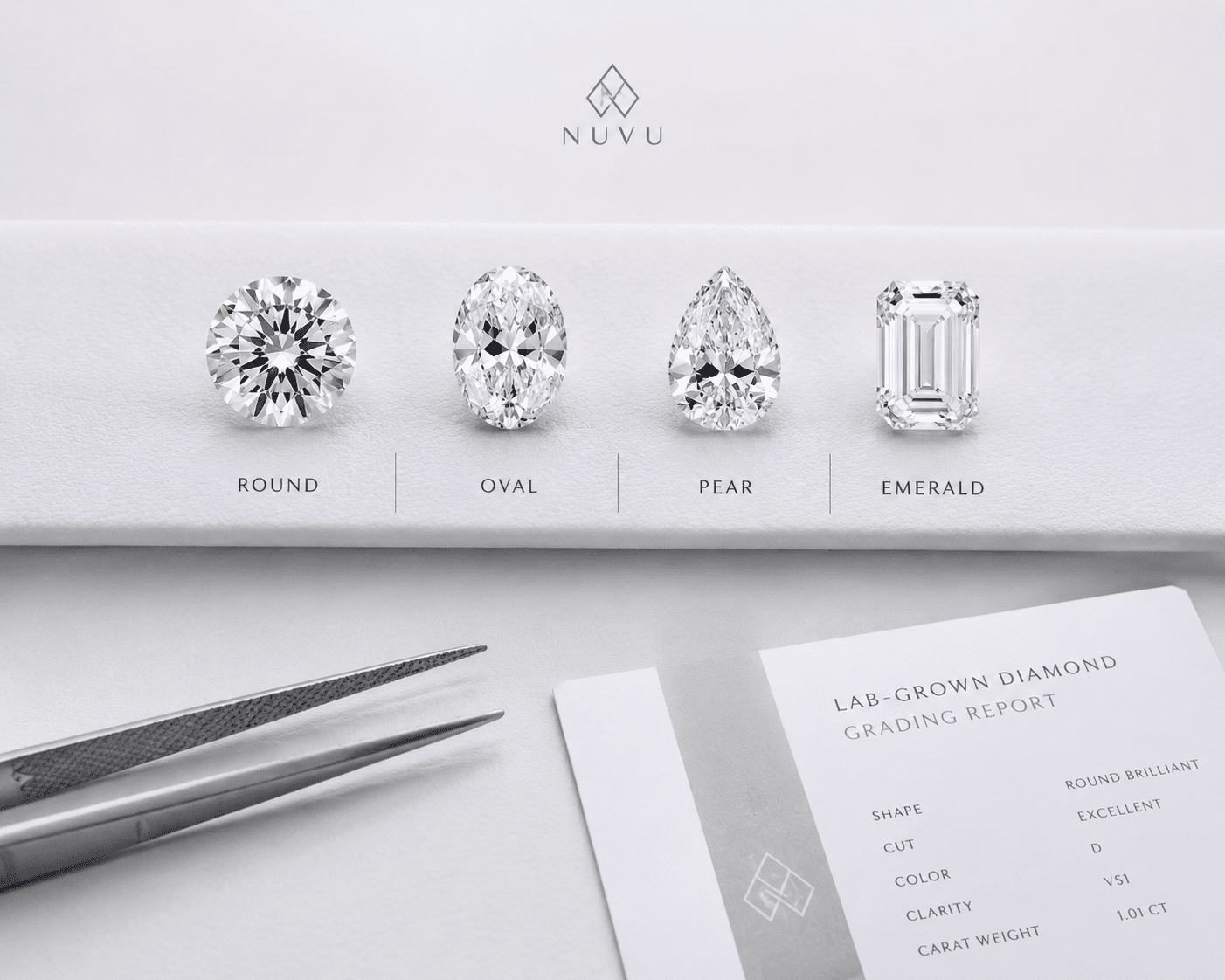
Round brilliant diamonds still dominate engagement ring center stones in most U.S. markets. That does not mean rounds should dominate every wholesale order. For jewelers who do significant fashion ring, earring, or anniversary band business, fancy shapes often carry higher retail margins and faster turnover. Ovals, pears, and emerald cuts have strong demand in custom solitaire settings and are frequently sought by buyers who want a less traditional look.
A jeweler specializing in engagement rings needs a strong round inventory with a select range of high-demand fancy shapes. A jeweler focused on fashion jewelry or earring sets may find that fancy shapes outsell rounds consistently, particularly in matched pairs where an elongated shape produces more visual impact per carat. The shape ratio should reflect what your actual selling floor looks like, not a generic industry average.
How to Match Shape Mix to Your Customer Base
A jeweler running a custom engagement ring business needs a different shape plan than one moving ready-made stud earrings or anniversary bands. For custom rings, the shape mix should match your most popular setting designs. If your portfolio leans heavily toward oval solitaires, you should stock more ovals than rounds in the 1-2 carat range, regardless of what general market data says about round diamond dominance.
For ready-made jewelry categories, the pattern is different. Stud earrings in round or princess cut move reliably. Three-stone rings and anniversary bands often use matched fancy shapes. The wholesale shape plan should follow the setting types and product categories you actually sell, not the categories you wish you sold. A shape you order that does not align with your existing mounting inventory will sit until you either find a specific custom request or discount it.
Stone-to-Setting Fit Check
Before buying wholesale loose diamonds in a shape you do not normally carry, confirm that your local or in-house setters can handle that shape for the mounting types you offer. Not every setting accommodates every shape. A deep pavilion on a certain cut may protrude below the setting. A shallow stone may require a custom seat that your setter does not routinely fabricate.
Ask your wholesale supplier for measurement ranges matching your standard setting inventory. If you stock settings designed for a 6-millimeter round, you need the exact length and width of the oval or pear you consider substituting. A stone that is 7 millimeters long but 5.5 millimeters wide may not seat properly in a setting designed for a 6-millimeter round. That mismatch turns a potential sale into a return.
Size and Carat Weight Bands That Sell vs Sit
Not every carat weight moves at the same speed. In both natural and lab-grown diamond retail, certain size bands generate consistent demand while others accumulate quietly in inventory. For wholesale buyers, identifying which bands turn over fastest in your specific market is more important than hitting a broad range of sizes. Carrying every weight from 0.25 to 3 carats sounds comprehensive, but it often means carrying dead weight in the middle.
The Dead Zone Between Retail Drivers
Certain carat weights fall into what experienced buyers, wholesale lab-grown diamond MOQ, call the dead zone: the point where the price jumps noticeably, but the visual size increase is barely perceptible. A 1.7-carat stone costs significantly more than a 1.5-carat stone, but most buyers cannot see the difference in a ring setting. The same applies around the 2.3 and 2.7 carat marks. These sizes get skipped by both natural and lab-grown buyers, because the extra cost does not produce a visible reward.
For wholesale orders, minimize these transitional weights unless a specific customer has already requested them. The capital is better spent on the sizes right below or above the dead zone. A 1.5-carat stone that looks close to 1.7 carats but costs notably less will sell faster every time. A 2-carat stone that lands clearly in the next visual bracket will command attention that a 2.2-carat stone in the dead zone will not.
Popular Size Ranges for Different Jewelry Categories
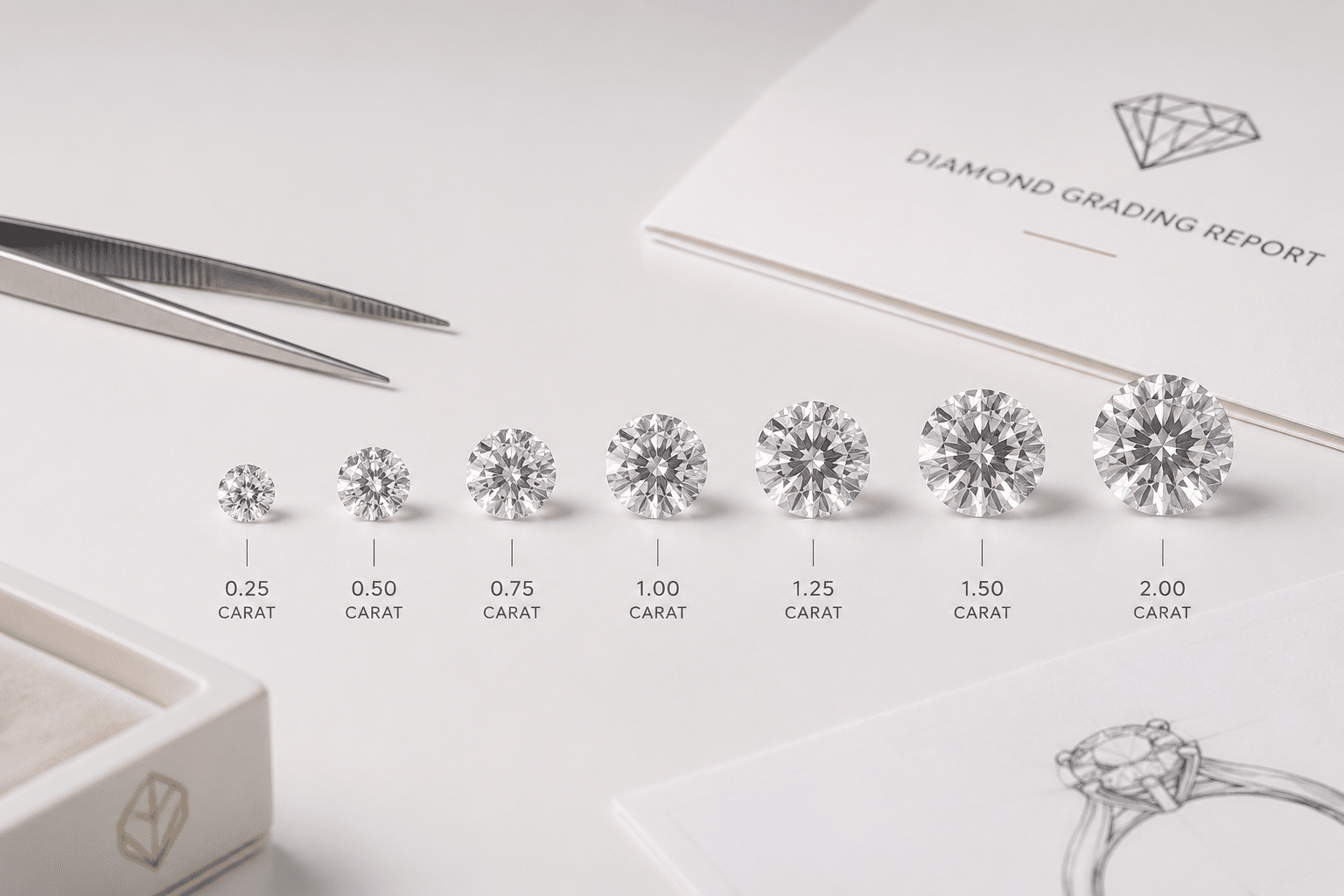
The 1 to 1.5 carat range dominates engagement ring center stones. That is where the bulk of retail demand sits and where wholesale orders should concentrate for most jewelers. Below that, 0.25 to 0.5 carat pairs sell fastest for stud earrings, particularly in rounds and princess cuts. At the higher end, 2 carat and above stones move slower but deliver stronger per-stone margins, especially in custom solitaire work where the buyer has already committed to a larger budget.
If your business does significant fashion jewelry or right-hand ring volume, the 0.75 to 1 carat range also deserves attention. That band serves a buyer who wants visual presence without engagement-ring-level pricing. For each weight range, check your actual customer request frequency before committing to wholesale volume. A size band that people ask about but do not buy should not be the basis of a large order.
Buyer Verification Checklist
For each size band you plan to stock, run three checks. First, review your own customer request frequency from the last year. How many people asked for a 1-carat stone versus a 1.5-carat stone? Second, look at your competitors’ visible inventory online and in-store. If every jeweler within twenty miles stocks the same size band, the price competition will be tighter and margins thinner. Third, confirm your supplier’s minimum order quantity for that weight range. Some suppliers push minimums that force you to overstock a size band you only need a few stones for.
A size band you cannot sell within 90 days is not inventory. It is capital locked in a drawer. If a band does not meet that test, skip it or order only the minimum for sample purposes until demand proves stronger.
Quality Band Architecture: Color, Clarity, and Cut for Resale
Not all quality grades sell equally well at retail, and the grades that look most impressive on paper are not always the ones that move fastest out of your case. The real question is which combination of color, clarity, and cut produces the best sell-through rate for a typical jewelry buyer—and which combinations create hesitation, confusion, or outright resistance.
The Sweet Spot for Lab-Grown Diamond Wholesale Quality
For most retail jewelers, the sweet spot falls at G-H color paired with VS1-VS2 clarity. This band hits the balance that matters most: the diamond looks white and clean to the naked eye, but the price stays within reach of a buyer who is already stretching their budget for a larger carat weight. G-H color shows no visible warmth unless placed directly next to a D or E stone, and VS1-VS2 inclusions are invisible without magnification. That combination removes the two most common customer objections—”it looks yellow” and “I can see something inside”—while keeping the wholesale acquisition cost low enough to preserve margin. A jeweler can price these stones competitively and still make a healthy retail markup. This is the band that turns over fastest across engagement rings, solitaires, and stud earrings alike.
When to Buy Higher or Lower Quality Bands
D-E color has a narrower but legitimate role. It sells predominantly in custom engagement rings where the buyer specifically prioritizes an icy white appearance and understands the premium required. If your business does custom solitaire work for buyers who request “the whitest possible diamond,” stocking a limited selection of D-E stones in popular carat weights makes sense. But buying deep into this band across sizes and shapes is a common capital mistake. D-E stones cost more at wholesale, require a higher retail price to maintain margin, and appeal to a smaller slice of buyers.
SI1-SI2 clarity has its own place. These stones can work well in stud earrings, side stones, and multi-stone settings where the design naturally distracts from inclusions. The lower wholesale cost allows attractive pricing for budget-conscious buyers. But never buy SI-grade stones sight unseen. Inclusions vary widely within the same grade, and a stone that looked clean in a grading report can show a distracting feather or crystal right in the table under normal light. For SI stones especially, visual review before purchase is not optional.
Cut quality is the one factor that should never be compromised at wholesale. A diamond with excellent color and clarity but poor cut will look dull and lifeless, and it will sit in inventory indefinitely. A well-cut stone with slightly lower color or clarity will still perform visually and will sell. The cut grade determines how light enters and exits the stone. That is not a negotiable variable for wholesale buyers who expect their inventory to move.
Certificate and Visual Review Check
When evaluating a wholesale lot, review multiple stones at the same grade band but from different production batches. Two stones with the same GIA or IGI report color and clarity can look noticeably different side by side. Color can shift within the same letter grade, and clarity characteristics vary in location and visibility. Check that the batch is consistent. For any stone over one carat, request a 360-degree video or real-time inspection before committing. Certification documents the grade. Batch consistency determines whether your customers see a uniform product or an unpredictable mix.
In practical buying, this is where many comparisons become misleading. A grading report helps narrow the shortlist, but it does not replace visual review for determining how the stone will perform in a setting and whether it meets your customers’ expectations for face-up appearance.
How Batch Documentation Supports Traceability
When buying across multiple lots, traceability becomes a practical tool for quality assurance, not just a marketing phrase. Keeping a record of which supplier batch each stone came from—with the growth method, post-growth treatment status, and grading report number—enables you to spot patterns that affect sell-through. If stones from one production batch consistently draw customer compliments on brightness while another batch generates questions about color, that information belongs in your purchasing history.
For a retail jeweler, this kind of batch tracking helps answer a simple question: which stones from which source sell best? Over time, the data reveals which suppliers and which production runs produce the most consistent results. For custom design, trust comes from matching the stone to the setting, budget, and wearer’s daily use—not from choosing grades in isolation. But that matching process is much easier when you have clear documentation about the stones you already sold successfully. A simple spreadsheet linked to your supplier order records can serve this function. It does not require a complex system, only consistent recording.
Understanding the Distinction: Lab-Grown vs Natural in Wholesale
Compliance-aware sourcing starts with a clear distinction. Laboratory-grown diamonds and natural diamonds have different origins, and this difference should be reflected in how inventory is labeled, presented, and communicated to customers. In wholesale transactions, a supplier who conflates or obscures the distinction between lab-grown and natural diamonds is a significant red flag. A grading report on a lab-grown stone should carry an explicit statement of its laboratory-grown origin, and the jeweler buying that inventory should pass the same clarity down to the retail floor.
Diamond simulants — such as cubic zirconia or moissanite — are not the same as lab-grown diamonds. Simulants are non-diamond materials that resemble diamonds but differ in composition, hardness, and optical properties. In wholesale diamond buying, the term “lab-grown diamond” should only refer to material that is chemically and structurally diamond, produced through controlled processes. Confusing these categories, either in supplier communications or customer-facing materials, can create compliance risk and erode buyer trust.
When stocking inventory, separating lab-grown and natural stones by clearly labeled bins, digital records, and distinct pricing tiers helps ensure that every stone reaches the right customer with the correct description. For a wholesale jeweler, this practice also simplifies compliance with advertising regulations, as it makes accurate disclosure easier to manage across multiple sales channels.
Price Architecture: Understanding Wholesale Pricing Layers
Wholesale lab-grown diamond pricing follows its own logic, and assuming that two stones with the same carat weight and grade should cost the same is a fast route to overpaying or underselling. Understanding what drives price beyond the basic parameters allows a jeweler to buy smarter and sell with more confidence.
What Determines Wholesale Price Beyond Carat and Grade
The same grade combination can carry meaningfully different wholesale prices depending on cut precision, measurement ratios, fluorescence, growth method, and supplier volume. A stone with ideal proportions in a desirable shape commands a premium even within the same color-clarity band. A well-cut 1.5 carat oval with a tight length-to-width ratio and strong optical performance will cost more per carat than a poorly proportioned oval at the same grade. That premium is worth paying because the stone will sell faster at retail and generate fewer customer concerns about brilliance and shape appearance.
Growth method matters too. CVD and HPHT stones can differ in cost depending on production efficiency, rough availability, and post-growth treatment requirements. Fluorescence, which is rarely a practical issue in lab-grown diamonds, can still influence price on certain supplier lists. Volume discounts apply as well—a jeweler ordering twenty stones at once will pay a different per-carat rate than one ordering two. The key is knowing which premium is justified by better sell-through and which is simply a supplier markup on a less available stone.
How to Compare Wholesale Suppliers on Price
Comparing price lists across suppliers requires more than matching carat weight and letter grades. Ask for the actual measurements—length, width, depth—and the proportions that determine visual performance: table percentage, crown angle, pavilion depth. Two stones listed as 1.00 carat G VS1 can have completely different face-up appearances if one is cut for maximum spread and the other is cut for weight retention. The well-cut stone costs more at wholesale but sells faster, with fewer returns, and at a higher retail margin. The cheaply cut stone costs less upfront but carries the risk of sitting unsold while customers ask why it looks smaller or less brilliant than expected.
When a supplier cannot or will not provide full measurement and proportion data for their wholesale lots, that signals either poor inventory management or a reluctance to disclose unfavorable specs. A serious wholesale partner provides the data because they know informed buyers return for repeat orders.
Price Claims and Market Comparisons
In the wholesale lab-grown diamond market, price comparisons are common but must be handled with care. Prices can vary because of cut precision, report type, seller channel, size, shape, availability, and documentation. A claim that a stone is “40% cheaper than retail” or “the best value in its class” depends on which baseline price is used, and those baselines often differ between suppliers and timeframes. Market conditions, report type, and stone-specific details can all shift the price picture, so exact comparisons should be verified at the time of purchase.
For a jeweler managing inventory, the more useful measure is sell-through rate and margin per stone, not the discount from a hypothetical list price. A stone that sells quickly at a reasonable margin is a better investment than one that offers a deep discount on paper but sits in inventory for months. When suppliers advertise their prices against competitors, treat those comparisons as starting points for your own evaluation, not as settled truths.
For wholesale buyers, consistency often matters as much as the headline price. The cheapest stone per carat is rarely the most profitable stone in the long run if it requires more time to sell or generates more customer objections.
What This Means in a Real Purchase
Do not accept two price lists that differ only by carat weight. For every stone in the lot, request full measurements and proportion data. The stone that costs slightly more but carries better proportions will typically deliver faster turnover, higher retail margin, and fewer customer objections. That makes it the cheaper stone in practice. The stone that looks like a bargain on paper but cuts poorly will cost you in holding time and price markdowns before it finally sells.
When a grading report is available, buyers should verify the report details through the issuing laboratory’s official report-check tool where available. For stones purchased from a wholesale lot, it is worth checking a sample against the lab’s verification system to confirm that the report number matches the stone’s inscribed identification, if laser inscription is present.
Customer-Facing Demand: Buying Inventory Your Customers Actually Want
The most common mistake in wholesale diamond buying is ordering inventory that looks ideal on a spreadsheet but does not match what customers actually walk in asking for. Aligning wholesale purchasing with real buyer demand requires looking at your own sales data, not market reports or supplier recommendations.
The Gap Between Wholesale Availability and Retail Demand
Wholesale suppliers have an incentive to push larger carat weights and higher color grades because those stones carry higher margins for them. But your customers may prefer slightly smaller stones with better cut, or a specific shape they saw on Pinterest, or a carat weight that fits a particular setting they found online. The supplier’s priority is moving their inventory. Your priority is moving yours. These two priorities align only when the stones in the supplier’s stock match the stones your customers are actually requesting. A 2.5 carat D VVS1 round may look impressive in a wholesale lot, but if your customers are asking for 1.2 carat G VS2 ovals, that expensive stone becomes a long-term holding cost.
How to Test Demand Before Committing to Bulk Wholesale Orders
Test demand before placing a significant order. Order sample stones in the target shape, size, and quality bands you are considering to evaluate B2B diamond supply options, then photograph them well and list them on your website or display them in a case with clear pricing. Track customer interest for two weeks. If a stone generates multiple inquiries during that window, that is a reliable signal to buy more in that band. If it generates none, that particular combination may not match your customer base, regardless of how well it looks on paper against wholesale price lists.
This approach is especially important when introducing a shape or size band you have not carried before. A wholesale lot of emerald-cut stones is a meaningful capital commitment. A single well-chosen sample emerald cut allows you to test whether your customers respond before you tie up cash in volume.
Understanding Customer Expectations for Lab-Grown Origin
When selling lab-grown diamonds at retail, customer expectations around origin should be managed clearly. Lab-grown diamonds should always be presented as laboratory-grown, not as mined diamonds. The distinction matters for trust, compliance, and long-term customer relationships. A buyer who expects a natural diamond but receives a lab-grown stone without clear disclosure will feel misled, regardless of the stone’s quality. Similarly, a buyer who specifically seeks a lab-grown diamond for its lower price or different sourcing path expects to see that choice honored in the product they receive.
For the jeweler, this means asking customers directly whether they are considering lab-grown or natural, and then matching them to inventory accordingly. It also means reviewing supplier labeling to confirm that lab-grown stones arrive with clear documentation and markings, so that every stone that goes into a display case or custom setting can be correctly described. When a customer’s question about origin is answered with specific documentation rather than a vague label, it reinforces the jeweler’s credibility and reduces the chance of a post-purchase dispute.
Buyer Verification Checklist
Before placing a bulk order, confirm demand through at least three separate touchpoints. Listen to what customers say in-store conversations. Review online inquiry patterns from your website or social media. Note what custom design requests are coming through. If you hear the same shape or size range mentioned across multiple channels, that is real demand. If customers have never mentioned the stones you are planning to buy wholesale, those stones will likely sit in your inventory until you discount them to move.
Understanding Grading Reports and Terminology for Lab-Grown Diamonds
Grading reports are a central part of wholesale lab-grown diamond buying, but not every report tells the buyer what they need to know for resale. The terminology used to describe lab-grown diamonds has become more standardized in recent years, partly due to guidance from regulators and major gemological laboratories. A clear understanding of what a report can and cannot document helps a jeweler avoid missteps in both purchasing and customer communication.
What a Grading Report Documents for Lab-Grown Diamonds
A grading report from a recognized lab documents the 4Cs — carat weight, color, clarity, and cut — along with measurements, proportions, and fluorescence. For lab-grown diamonds, the report should also clearly identify the stone as laboratory-grown. The Gemological Institute of America (GIA), for example, issues grading reports for lab-grown diamonds that include the same 4C assessment as its natural diamond reports, with the explicit statement that the stone is laboratory-grown.[1] The International Gemological Institute (IGI) follows a similar approach, providing detailed grading for lab-grown diamonds with clear identification of the growth method where possible.[2] A report that omits or obscures the lab-grown status is a red flag for a wholesale buyer.
How Terminology Affects Buyer Communication
The Federal Trade Commission (FTC) has provided guidance on how lab-grown diamonds should be described in advertising and sales. The FTC advises that terms such as “synthetic,” “laboratory-grown,” or “laboratory-created” should be used clearly to distinguish these stones from natural diamonds, and that terms implying they are natural or mined should be avoided.[3] For a jeweler selling wholesale lab-grown inventory to retail customers, accurate terminology is not just a compliance issue — it directly affects trust. A customer who discovers after purchase that a stone was described inconsistently is unlikely to return. Using the same clear language that appears on the grading report — consistently and across all customer-facing materials — reduces confusion and builds confidence in what the jeweler sells.
What the Report Does Not Prove
It is also important to understand what a grading report does not prove. A report documents the stone’s characteristics at the time of grading, but it does not guarantee that every stone in a wholesale lot will match identically. It does not prove that a stone is sustainable, eco-friendly, or ethically superior — those claims require separate substantiation beyond the scope of gemological grading.[3] And a report does not replace visual inspection for determining how a stone performs in a setting. For wholesale buyers, the grading report is a starting point for evaluation, not the final word on whether a stone will sell.
A grading report can narrow the comparison, but it should be read alongside the stone’s proportions, visual evidence, and intended jewelry use. For NUVU, the goal is to make diamond comparison easier to understand, especially when buyers are weighing report details, visual performance, setting fit, and budget together.
Supplier Evaluation: Separating Reliable Wholesale Partners from Inconsistency
The wholesale lab-grown diamond market has grown fast, and not every supplier in it has kept pace with quality control and documentation standards. A supplier who looks competitive on a price list may deliver stones that vary noticeably in color, clarity, or measurement from one batch to the next. For a jeweler, that inconsistency creates real cost — time spent reviewing returns, explaining discrepancies to customers, or reworking settings around stones that do not match their specifications. Evaluating a supplier before committing to volume is not just prudent; it directly affects how much of your inventory actually sells.
What to Verify Before Your First Wholesale Order
Before placing any order, request documentation on growth method — CVD or HPHT — and whether any post-growth treatment has been applied. A grading report from a recognized lab such as GIA, IGI, or GCAL is essential, but the report alone is not enough. Ask to see measurements for multiple stones listed under the same product description. If two stones with the same carat weight and grade show noticeably different dimensions or proportions, that supplier may be grouping inconsistently cut stones under the same category. For stones over one carat, request 360-degree video or real-time inspection access. A supplier who cannot provide this for standard wholesale items may be hiding visual variation that will hurt your sell-through rate.
How to Test Supplier Reliability with Small Orders
Start with a small order of three to five stones spread across different shape and size bands. This keeps your exposure low while giving you enough data to evaluate the supplier’s actual performance. Pay attention to packaging speed, communication accuracy, and whether the grading documentation matches the stone that arrives. Compare the actual stone against its report: does the color look consistent? Are there visible inclusions that were not noted? Are the measurements within a reasonable tolerance of what was listed? A supplier who passes these checks on a small order is worth scaling. A supplier who does not has saved you the cost of a much larger mistake.
How to Verify This Before Buying
Get the return policy and exchange terms in writing before you send any payment. Ask whether the supplier can match a specific color or shape within a defined measurement tolerance for future orders. A reliable supplier can answer these questions directly. A supplier who hesitates or offers vague answers is not ready for consistent wholesale business, and the cost of finding that out later will far exceed the time spent asking upfront.
Documentation as a Supplier Reliability Indicator
One of the simplest signals of supplier reliability is the completeness and consistency of their documentation. A supplier who provides batch-level records — including growth method, treatment history, grading report numbers, and measurement data for multiple stones in the same lot — demonstrates operational discipline. A supplier who can only provide a single report number for a large lot without any data on the range of measurements is harder to trust for repeat volume.
For wholesale buyers, documentation is not just a compliance checkbox; it is a practical tool for managing inventory risk. When a stone’s documentation is complete, you can trace it back to its production batch, confirm its grading through the lab’s verification tools, and pass that information to your customers with confidence. When documentation is missing or vague, the stone carries hidden risk that cannot be resolved after purchase. Sustainability claims should be specific and documented. Broad green language is less useful than clear information about production, energy, sourcing, and seller transparency.
Seasonal and Trend Timing for Wholesale Orders
Timing matters more in lab-grown diamond wholesale than many jewelers expect. The market has become liquid enough that the most desirable sizes and shapes can disappear from wholesale channels quickly during peak months, and lead times of two to four weeks mean a late order can miss an entire selling season. Aligning your purchasing calendar to real demand windows is one of the simplest ways to avoid holding inventory through a slow period.
When to Buy for Peak Selling Seasons
Engagement season peaks in the fourth quarter and runs through early spring, with holiday retail demand concentrated in October through December. Plan major wholesale orders six to eight weeks before your expected retail spike. If you need stones on hand for November engagement shoppers, your order should be placed by mid-September. For spring wedding season, order by early January. Suppliers who carry high-demand sizes and shapes — such as well-cut 1.5-carat ovals or matched pairs for studs — will allocate those stones to consistent buyers first. A late order in peak season often means accepting whatever is left, which is rarely the inventory you want.
How to Identify and Act on Trend Shifts
Shape trends in lab-grown diamonds shift faster than in natural diamonds because production can pivot into new cuts more quickly. A shape that is rising in popularity can become widely available within months, which means the window for capturing demand before oversupply narrows margins is shorter. Monitor your own customer requests, social media interest around bridal and fine jewelry, and bridal media coverage to see which fancy shapes are gaining traction. Oval and pear have led recent cycles, but emerald, elongated cushion, and radiant cuts have been moving up in custom engagement work. The risk is buying into a trend that has already peaked in wholesale channels, leaving you with stones that other jewelers are also trying to clear.
What to Check Before You Decide
Review your own sales data from the same period last year. If oval inquiries increased by 30 percent while round demand stayed flat, your wholesale budget should reflect that shift. Do not buy trend-driven shapes purely because they look promising in trade media. Validate the trend with your actual customer base before committing to volume.
Building Repeat Supplier Relationships That Improve Over Time
Consistent wholesale relationships produce advantages that one-off transactions cannot match. A supplier who sees regular volume from your business will prioritize your requests, offer better pricing on repeat orders, and often allocate desirable stones before listing them broadly. These benefits do not arrive immediately — they develop as the supplier learns your preferences and trusts your buying patterns. But a jeweler who treats every order as a spot transaction misses the opportunity to build a sourcing channel that becomes more reliable and more cost-effective with time.
What Repeat Buyers Receive That One-Time Buyers Do Not
Suppliers reserve their best pricing for buyers they expect to see again. Repeat buyers also gain priority access to stones in high demand, such as well-proportioned 1.5-carat ovals or D-color rounds with ideal cut grades. Beyond pricing and allocation, a supplier who knows your business can match production runs to your specifications — requesting specific rough-to-polish cuts for custom work or identifying stones that fall within your preferred measurement tolerance before they even hit the general inventory list. These advantages reduce the time you spend searching for stones and increase the consistency of what lands in your inventory.
How to Structure a Long-Term Wholesale Agreement
Put the terms of your relationship in writing. Negotiate volume pricing tiers, return and exchange conditions, minimum order quantities, and communication expectations. A written agreement prevents misunderstandings when demand spikes or when a specific order does not meet expectations. The goal is not to lock yourself into rigid commitments but to make sourcing predictable enough that you can focus on selling rather than constantly renegotiating terms.
How Traceability Deepens Supplier Trust Over Time
As a relationship matures, traceability becomes a two-way advantage. When a supplier knows you keep detailed batch records — tracking which stones sold quickly and which were returned — they can adjust their allocations to send you more of what moves. Over several orders, your supplier can learn to identify which production runs match your preferred measurement tolerances and quality consistency, offering you first choice on those batches before they are listed to the broader wholesale market.
For the jeweler, maintaining a simple log of batch numbers, report numbers, and sell-through dates pays off in future buying decisions. When you approach a supplier and say, “The last two orders of 1.5-carat ovals from lot B sold within three weeks, but the stones from lot C took four months to move,” you have data that a one-time buyer cannot provide. That data builds a more useful relationship for both sides, based on actual selling performance rather than promises or price alone.
Buyer Verification Checklist
After your first order, evaluate the supplier on three questions. Did the stones match their grading reports? Did the supplier communicate honestly about availability and lead time? Were measurements and proportions accurate to what was listed? Use these answers to decide whether to scale the relationship or begin evaluating alternatives. A supplier who delivers consistency on these three points is worth investing in. One who does not will cost you more in frustration and dead stock than any price advantage could offset.
Disclosure: This article is for general educational purposes only. Diamond grading, pricing, availability, specifications, and seller policies can change, and readers should verify important details through grading reports, official laboratory tools, seller documentation, or qualified professionals before making a purchase decision. Laboratory-grown diamonds should be clearly distinguished from natural diamonds, and environmental or sourcing claims should be supported by specific documentation.
[1] GIA, “GIA Lab-Grown Diamond Grading Report,” Gemological Institute of America, accessed 2024.
[2] IGI, “IGI Laboratory-Grown Diamond Grading Report,” International Gemological Institute, accessed 2024.
[3] Federal Trade Commission, “Guides for the Jewelry, Precious Metals, and Pewter Industries,” 16 CFR Part 23, FTC, accessed 2024.