
Most wholesale lab-grown diamond suppliers offer a single approach, but the needs of an independent jeweler and a large brand are fundamentally different, and using the wrong supplier structure—wholesale lab grown diamond red flags—whether that means high minimums for a small shop or unreliable batch consistency for a chain—creates hidden costs that erode margins and complicate operations. This article clarifies why fit matters more than the lowest listed price per carat.
For the full framework, read Wholesale Lab-Grown Diamonds for Jewelers and Brands.
It will help you evaluate whether your current or potential supplier’s pricing model, inventory access, quality verification, and relationship structure actually match how your business buys and sells diamonds. The goal is to avoid common mismatches that lead to inventory risk, specification drift, or lost client trust.
| Buyer Profile | Key Supply Requirement | Hidden Risk If Mismatched |
|---|---|---|
| Independent Jeweler | Low minimums; single-stone selection | Inventory carrying cost on unwanted stock |
| Large Brand | Batch consistency; volume commitments | Specification drift across order batches |
| Independent Jeweler | Per-stone transparent pricing | Reduced margin on each individual sale |
| Large Brand | Contractual price stability; forecasting support | Cost unpredictability and supply gaps |
| Independent Jeweler | Pre-purchase visual verification (video, 360°) | Stones that pass grade but fail client look-test |
| Large Brand | Batch-level certification; dimensional tolerance checks | Returns or reputational issues from off-spec goods |
Quick Questions Before You Read
Q: Can one wholesaler serve both a small jeweler and a big brand well?
Rarely. The operational structure, inventory approach, and pricing terms that suit one profile usually create friction for the other. The article explains how to check fit before committing.
Q: Is a lower per-carat price always the better deal?
No. A lower price can hide costs from minimum order sizes, inconsistent selection, or poor specification control that eat into your actual margin. Value depends on total cost for your order type.
Q: If a diamond has a grading report, do I still need to see it in person?
For independent jewelers, yes. A report confirms specs, but it does not capture how a stone appears to a client. Visual verification is often essential for selling single stones.
Q: What is the most important step before switching wholesalers?
Test with a pilot order. Analyze the real per-stone cost at your typical order size and assess how the supplier handles communication and exceptions—not just their quoted price.
Wholesale Lab-Grown Diamonds for Independent Jewelers vs Large Brands: Why Supply Needs Are Not the Same
The wholesale lab-grown diamond market has grown quickly, but the models used to serve it have not adapted at the same pace. Many suppliers still apply a single set of terms—one pricing ladder, one minimum order threshold, one communication channel—to every buyer who walks through the door. That works only if all buyers operate the same way. They do not.
A custom jeweler who sells one engagement ring at a time and a national brand that moves thousands of stones per quarter face entirely different constraints. When the wrong sourcing structure is applied to either buyer, the result is predictable: one pays hidden premiums or gets treated as a low-priority account, and the other wastes time on terms designed for a much smaller operation. The solution is not a better universal model. It is recognizing that the universal model itself is the problem.
The Fallacy of a Universal Wholesale Model
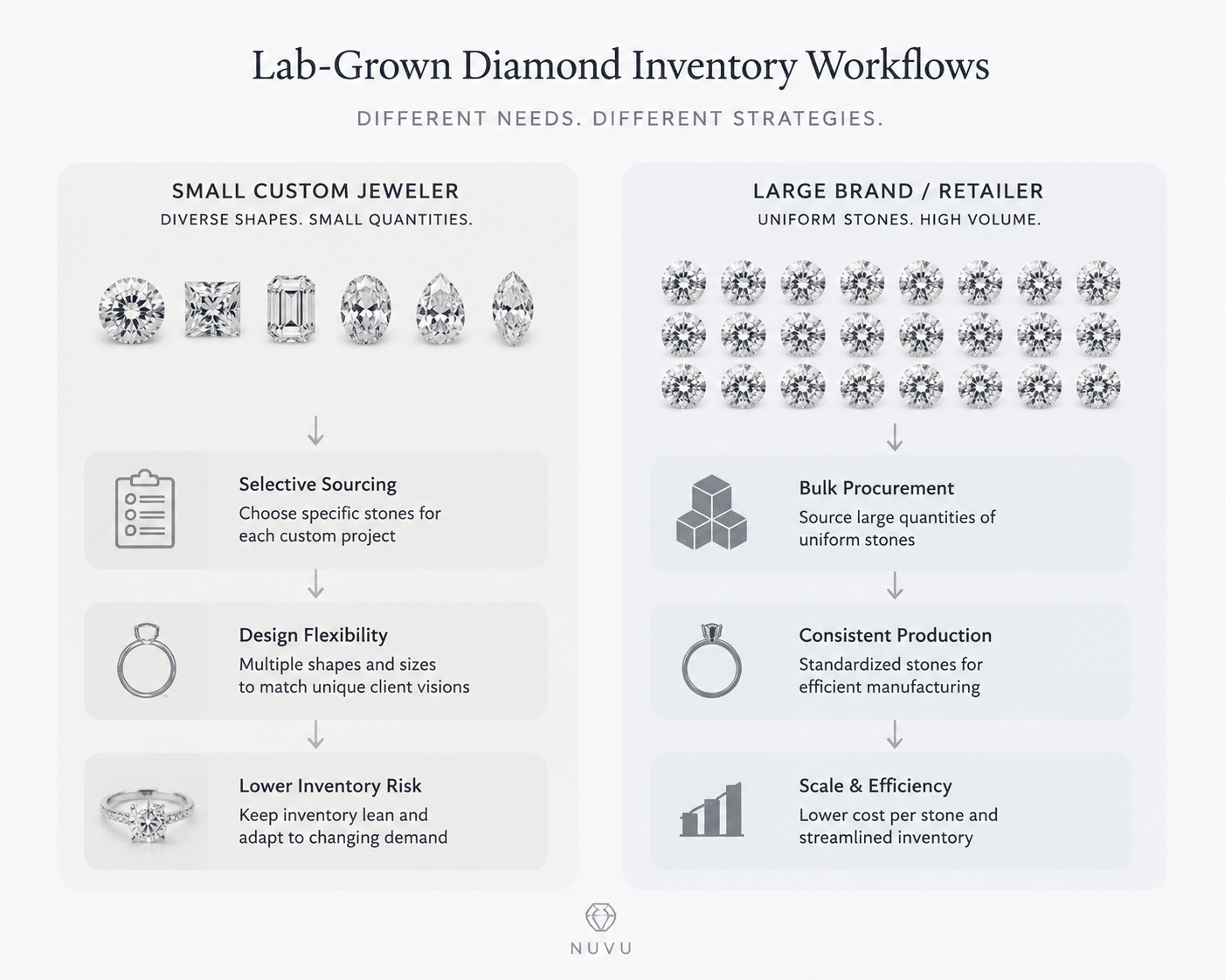
Most wholesale suppliers build their pricing and terms around a single buyer profile. Typically, that profile is the large-volume account. Tiered discounts reward big batch orders. Minimum order quantities block small pick-and-choose purchasing. Customer support is routed by account size, not order complexity.
This creates a double failure. The independent jeweler ordering 20 stones per month gets deprioritized, charged higher per-stone rates for small batches, and pushed toward inventory they do not want. The enterprise buyer ordering 2,000 stones per batch gets terms that look favorable on paper but lack the contractual guarantees, batch consistency documentation, and escalation paths their procurement process requires. A model built for one profile cannot serve both.
Defining the Buyer Segments
Buyers in the lab-grown diamond wholesale market fall into four distinct operational profiles, each with different constraints and priorities.
Independent jewelers and custom studios operate on low volume and high variety. They need fast turnaround and the ability to select one stone at a time across a wide range of shapes and sizes. Their revenue comes from individual projects, not repeat batches.
Online-native sellers are data-driven and often operate with virtual inventory or dropship models. They need catalog integration, reliable availability data, and return logistics that match direct-to-consumer expectations.
Regional multi-store retailers occupy a middle ground. They need predictable replenishment of core SKUs—round brilliants in standard sizes and grades—alongside access to a smaller number of premium or special-order stones for higher-ticket sales.
National and multi-brand enterprises require volume commitments, tight specification tolerances, and quality control documentation at the batch level. Their primary risk is inventory that does not match product specifications, not a lack of exotic shapes.
A wholesale supplier cannot serve all four profiles well with identical terms. The buyer who knows which profile they fit is already ahead of the buyer who only compares list prices.
Segment Alignment Check
Before evaluating any wholesale partner, take five minutes to align your business with one of these four profiles. Write down your average monthly stone count. Note the typical spread of shapes and sizes you sell. Record your required turnaround time from order to delivery. Then compare those numbers against the supplier’s standard terms.
A custom studio should not accept a supplier whose minimum order is 100 stones at 0.30ct each. An enterprise buyer should not work with a supplier who cannot guarantee batch consistency across multiple replenishment cycles. Filter suppliers by these operational criteria first, not by the lowest listed price per carat. A low price on the wrong terms is not a deal—it is a hidden cost.
Why Independent Jewelers Need a Different Pricing Logic
Independent jewelers and custom studios do not make money on volume. They make money on per-stone margin across a wide assortment. A single custom engagement ring might use an oval F VS1 at 1.50ct, followed the next week by a princess E SI1 at 1.20ct. Each stone must carry enough margin to cover design time, client consultation, setting costs, and overhead.
A wholesaler who offers tiered volume discounts but charges a premium for single-stone selection or memo inventory is applying a large-brand pricing logic to a small-shop reality. The independent jeweler does not benefit from saving 3% on a 50-stone order of identical goods. They benefit from a wholesale model that lets them buy one stone at a time at a fair price, with the ability to return or exchange stones that do not pass client inspection. Without that flexibility, the “wholesale price” is an illusion—the small buyer simply absorbs costs that the pricing structure does not show.
Why Large Brands Prioritize Consistency Over Variety
Large jewelry brands build product lines around fixed SKUs. A single collection may require round brilliants at EF/VS1, 0.50ct ± 0.02ct, graded by GIA or IGI, delivered in batches of 500 stones per quarter. The brand’s risk is not running out of interesting shapes. It is receiving a batch where color or clarity drifts outside the acceptable range, forcing a production pause or a costly return.
For enterprise buyers, the wholesale model must prioritize batch consistency, quality control documentation, and contractual compliance over assortment breadth. A supplier who can deliver 5,000 round brilliants at a tight spec every time is more valuable than one who has 10,000 stones across 50 shapes but cannot guarantee that the next batch of round brilliants will match the previous one. The financial consequence of a rejected batch is large enough that the lowest per-carat price is rarely the deciding factor.
Clarifying Key Terminology: Lab-Grown vs. Natural Diamond Disclosure
Before examining order scale and pricing models, it is worth clarifying the terminology that underpins the entire category. The Federal Trade Commission (FTC) has provided guidance on how lab-grown diamonds should be described in advertising and commerce, emphasizing the importance of clear disclosure that distinguishes laboratory-created stones from mined diamonds.[1] The FTC notes that terms like “laboratory-grown,” “laboratory-created,” and “manufacturer-created” are appropriate, provided the language is not misleading and clearly communicates the product’s origin.[1]
This guidance is especially relevant for wholesale buyers who sell to end consumers. An independent jeweler listing a diamond online must ensure their product descriptions use clear terminology. A large brand managing a national catalog must apply consistent disclosure language across every SKU. Misleading descriptions, even if unintentional, carry legal and reputational risk under FTC advertising standards.[1] For both buyer segments, working with a wholesaler who documents the origin of each stone and uses correct disclosure language in accompanying material reduces compliance exposure and strengthens end-consumer trust.
The Practical Role of Supplier Documentation in Disclosure Compliance
Documentation from the wholesale supplier plays a direct role in how accurately a buyer can disclose product origin to their own customers. When a supplier provides clear origin records—whether through invoice language, packing lists, or grading report notes—the buyer has a verifiable basis for their own disclosures. When such documentation is vague or absent, the buyer is left to make assumptions that may not hold up under scrutiny.
For independent jewelers, this matters at the point of sale. A client who asks “Where does this diamond come from?” deserves an answer that is specific rather than generic. A supplier who cannot document the growth method or provide a consistent terminology reference on the invoice creates a gap that the jeweler must fill with guesswork. For large brands, the same issue scales: a national catalog with hundreds of SKUs requires uniform disclosure across every product page. If the supplier’s documentation is inconsistent, the brand’s compliance exposure grows with each listing.
Buyers in both segments should request written confirmation of the terminology the supplier uses for lab-grown origin and ask whether that language appears on invoices, grading reports, and product tags. A supplier who has a standard disclosure practice is more reliable than one who answers the question differently each time it is asked.
Order Scale and Minimum Quantity Requirements: Matching Supplier Terms to Business Flow
Minimum order quantities are one of the most common points of friction in wholesale diamond buying. A supplier’s MOQ structure reveals who they are built to serve. When that structure does not match the buyer’s actual order flow, the buyer pays a penalty—sometimes in cash, sometimes in lost opportunity, sometimes in both.
MOQ Structures That Fit Independent Jewelry Operations
Independent jewelers and custom studios typically need one to five stones per order, and those stones often span multiple shapes and sizes. A supplier who requires a 50-stone minimum per order is not serving this buyer. The jeweler either walks away or accepts inventory they did not need, tying up capital that could go toward other product categories and increasing exposure to price drops in a market where per-carat prices can shift noticeably within a year.
Suppliers who offer memo access, virtual inventory, or no minimum assortment quantity are structurally better fits for this segment. These models let the jeweler select individual stones as client orders come in, rather than guessing what future clients will want. The supplier absorbs the inventory risk; the jeweler pays only for what sells.
Volume Commitments and Replenishment Contracts for Multi-Store and Enterprise Buyers
Regional and national brands need predictability. They forecast inventory three to six months out and require pricing that stays fixed within that window. A supplier who changes terms based on spot market volatility or who cannot commit to per-batch pricing creates unacceptable risk for a brand with established retail prices and planned margins.
Enterprise buyers benefit from contracts that guarantee specification adherence, priority allocation during market shortages, and documented quality control at the batch level. The wholesale relationship is not transactional. It is a supply agreement. Suppliers who, custom sourcing for wholesale lab-grown diamonds, treat it as one-off purchasing create friction that compounds with every order cycle.
Quantity Commitment Verification
Before signing any wholesale agreement, confirm in writing how the MOQ applies. Does it apply per order, per month, or per SKU? Some suppliers advertise “no MOQ” but then enforce a minimum line item of 20 stones per shape-size combination. For a small buyer needing one oval and one princess, that effectively blocks access to a diverse assortment.
For large buyers, confirm the supplier’s capacity to hold committed inventory for 90 days without price adjustment. Get this in writing before the first order. A verbal agreement on pricing stability is not a contract, and the cost of a mid-cycle price change can erase the margin on an entire batch.
The Penalty of Misaligned Minimums
The cost of misaligned minimums is not abstract. A small jeweler who accepts a 100-stone MOQ faces 12 to 18 months of inventory holding costs, price erosion risk, and reduced cash flow for other product categories. The “wholesale price” they received becomes a net loss once carrying costs are factored in.
A large brand who accepts a flexible no-MOQ supplier faces a different penalty: inconsistent grading, unreliable availability, and no contractual recourse when specifications drift between orders. The time spent inspecting and rejecting non-conforming stones, the production delays, and the customer-facing fallout from inconsistent product quality can cost far more than the savings from a flexible purchasing model.
Assortment Needs and Inventory Strategy: Breadth vs. Depth in Lab-Grown Diamond Buying
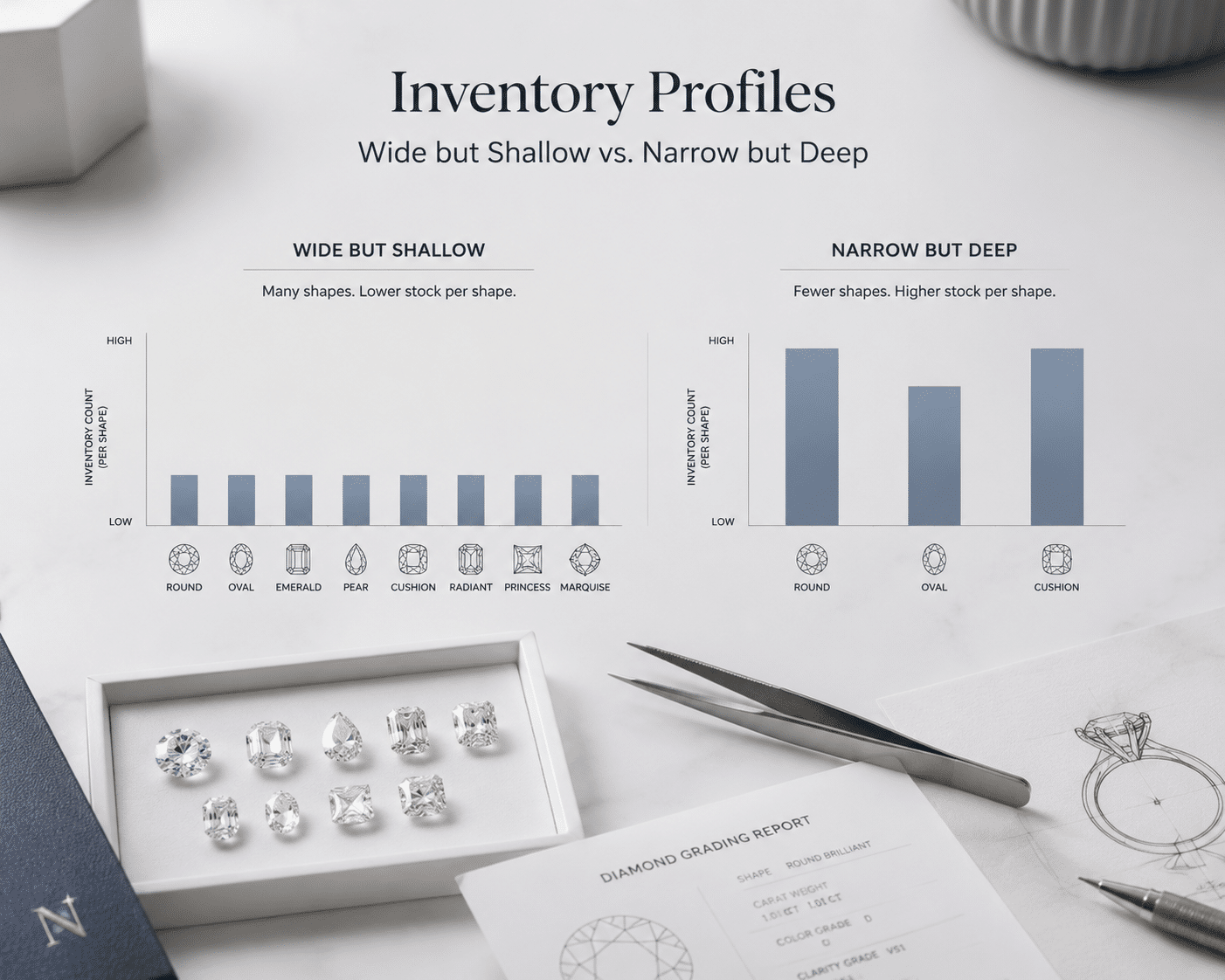
Assortment strategy is where the divergence between buyer segments becomes most visible. Independent jewelers and large brands do not just want different quantities. They want fundamentally different inventory structures.
Why Independent Jewelers Require Broad Assortment Access
Custom engagement ring and fine jewelry projects rarely follow a template. One client requests an oval F VS1 at 1.50ct. The next asks for a princess E SI1 at 1.20ct. The third wants a radiant D VVS2 at 2.00ct. The independent jeweler’s competitive advantage is the ability to fulfill these specific requests quickly, without keeping a large inventory in-house.
That requires a wholesale supplier with depth across shapes, carat weights, and grades, and the ability to select individual stones rather than pre-assembled lots. A supplier who only stocks high-volume shapes and sizes forces the jeweler to turn away clients or spend excessive time sourcing elsewhere. For this segment, assortment breadth is not a luxury. It is the business.
Why Large Brands Prefer Depth Over Breadth
Large brands typically build collections around three to five core shapes and two to three standard quality tiers. A bridal collection might require only round brilliants and ovals at EF/VS, in 0.50ct, 0.75ct, and 1.00ct sizes. A fashion line might only use princess cuts at a single carat weight.
For these buyers, total supplier inventory size matters less than depth in their specific SKU set. A wholesaler with 5,000 round brilliants at EF/VVS but only 50 ovals at the same grade may be a poor fit for a brand whose collection depends on ovals. Deep inventory across the buyer’s target specifications is the critical variable. Wide but shallow inventory is noise.
Assortment Fit Check for Your Business
Map your last 20 sales. List the combination of shape, carat, color, and clarity for each. Independent jewelers who see 15 different combinations in those 20 sales need a broad-assortment supplier. Brands whose last 20 sales include 15 or more round brilliants at the same specification need a deep-inventory supplier for that spec.
Use this mapping to evaluate whether a wholesaler’s listed inventory actually matches your real demand pattern. A supplier with impressive total inventory may have nothing in the combination your clients actually buy. The goal is not to find the largest catalog. It is to find the supplier whose catalog overlaps most closely with your sales history.
How Inventory Documentation Supports Traceability Across Buyer Segments
Inventory documentation is not only about availability—it also affects how traceable a stone’s origin and characteristics remain as it moves through the supply chain. A supplier who maintains an internal stone-level inventory record with matching grading report numbers, growth method notes, and measurement data provides a foundation that the buyer can build upon. That documentation allows a jeweler to trace a specific stone’s path back through the supplier’s system if a question arises about its specifications or documentation.
For independent jewelers, this traceability matters most when a client asks for proof of origin or asks detailed questions about the stone’s growth process. For large brands, traceability is a procurement requirement: internal audit processes may demand the ability to match each finished product to its source documentation. A supplier who cannot provide stone-level inventory records creates a traceability gap that the buyer must either accept or fill through separate verification efforts.
Buyers should ask potential wholesale partners how they track individual stones through their system, whether that tracking links to grading report numbers, and how long those records are retained. The answer reveals how seriously the supplier takes documentation continuity—a factor that affects both buyer trust and operational efficiency.
Understanding the Growth Methods: HPHT and CVD in Lab-Grown Diamonds
For buyers evaluating wholesale lab-grown diamonds, understanding the difference between HPHT (high pressure, high temperature) and CVD (chemical vapor deposition) growth methods can inform purchasing decisions. GIA explains that both methods produce diamonds that are chemically and optically identical to mined diamonds, but they differ in their growth processes and sometimes in the types of impurities or growth structures they may contain.[2] HPHT diamonds are created by subjecting a carbon source to high pressure and high temperature, mimicking the natural process, while CVD diamonds are grown in a vacuum chamber using carbon-rich gas that deposits atoms layer by layer onto a seed crystal.[2]
For the wholesale buyer, the practical relevance of growth method is not about quality—both HPHT and CVD can produce stones across a range of color and clarity grades. The distinction can matter for grading report documentation, as some reports may note the growth method. It can also inform how certain diamonds react to specific detection equipment or how they may present under magnification. A knowledgeable wholesaler should be transparent about the growth method for each stone when asked, and should be able to explain how it relates to the stone’s documented characteristics. For both independent jewelers and large brands, asking about growth method as part of routine supply evaluation is a mark of due diligence, not a niche technical concern.
Margin Pressure and Pricing Models: How Revenue Structure Drives Wholesale Choice
A wholesale price that looks good on paper can still destroy profitability if the pricing logic does not match how a buyer actually earns revenue. The difference between project-based and volume-based margins is not just accounting detail. It determines which supplier terms create real value and which ones quietly erode the bottom line.
How Project-Based Pricing Benefits Independent Jewelers
Independent jewelers and custom studios sell one stone at a time. Their revenue comes from individual client projects, not bulk shipments. A 2x or 3x retail markup on a single stone must cover the sales conversation, design consultation, setting labor, and overhead for that specific transaction. Per-stone profitability matters far more than total order volume.
A wholesaler who offers a 15% discount on orders of 50 stones but charges full retail on single-stone selections is not actually offering a better price to the small jeweler. The advertised discount is locked behind a volume requirement that forces the jeweler to carry speculative inventory. The real per-stone cost at the typical order size of 3–5 stones may be higher than a supplier who publishes transparent single-stone pricing. The key number is not the best price on the pricing sheet. It is the actual cost per stone at the order size the jeweler normally places.
How Volume-Based Pricing Serves Enterprise Buyers
Large brands operate on per-item margins multiplied by thousands of units. Their wholesale model must deliver consistent, repeatable pricing so retail price points and category profitability can be forecast. A brand running 200 SKUs across 50 retail locations cannot adjust retail prices every time the spot market for rough shifts by a few percent. They need pricing stability over a defined contract period, even if the per-stone cost is slightly higher than the spot market on peak days.
The most challenging pricing model for a large brand is one that appears flexible but introduces hidden variability. A supplier who quotes per-stone pricing that varies between orders makes margin planning unreliable. The brand may receive a favorable rate on one batch and a different rate on the next, with no contractual mechanism to lock terms.
Pricing Model Verification
Ask any wholesale supplier for a written pricing schedule that includes per-stone pricing by specification, volume discounts by order size, frequency discounts, and any price lock or price protection guarantees. An independent jeweler should calculate total cost per stone at their typical order size, not at the advertised best price that requires 100+ stones. A large brand should verify pricing consistency across at least three sample purchase orders to test for hidden variability.
Hidden Costs in Misaligned Pricing Models
Small buyers accepting volume-based pricing absorb several hidden costs. Higher per-stone prices on small batches are only the most visible. Restocking fees for returned stones, shipping charges waived only for large orders, and payment terms that penalize lower volume all add up quickly. A 20-stone order that triggers a restocking fee and full shipping may end up costing more per stone than buying from a supplier with slightly higher base pricing but no minimum requirements.
Large buyers accepting flexible per-stone pricing face a different set of hidden costs. Price variations between orders can make retail margin planning less predictable. A brand that cannot predict cost for a core SKU set cannot confidently set promotion calendars or allocate inventory across channels. The supplier who offers a predictable contract price, even a few points above the occasional spot low, often delivers better long-term margin stability.
Flexibility Requirements: Turnaround Time, Memo, Returns, and Custom Requests
The kind of flexibility a buyer needs depends on how they sell, not just what they buy. A one-day turnaround is essential for one business model and irrelevant for another. Understanding which flexibility features actually matter, and which are just nice to have, is how buyers avoid overpaying for terms they will never use.
Speed and Flexibility as an Independent Jeweler’s Non-Negotiable
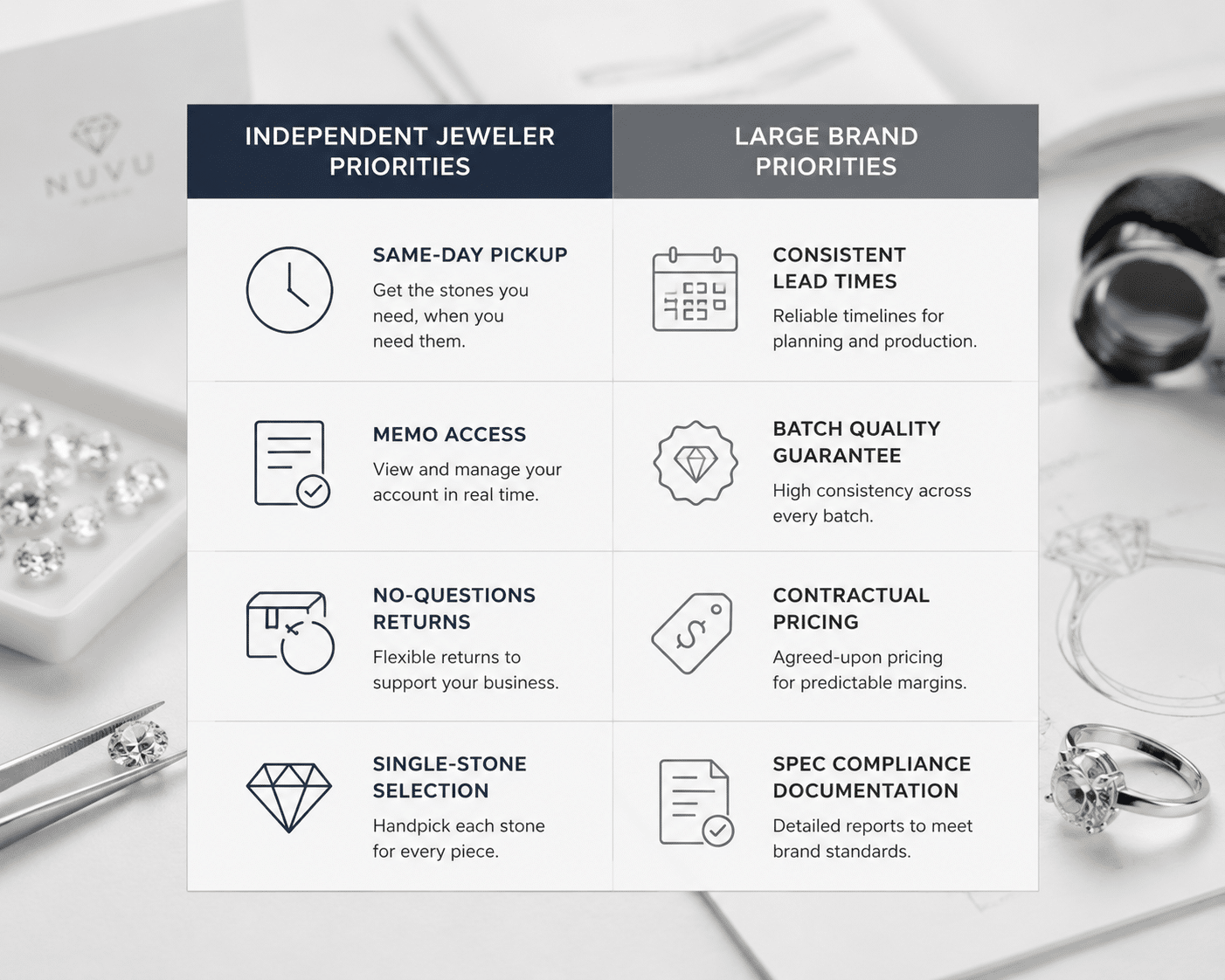
Custom jewelry projects often have tight deadlines tied to proposal presentations, engagement dates, or anniversaries. An independent jeweler who cannot get the right stone in hand within 24–48 hours risks losing the client to a competitor or delaying the entire project. Same-day stone availability, fast shipping, easy memo or approval-to-set processes, and flexible return policies for stones that fail client inspection are not optional. They are the operational backbone of the business.
A wholesaler with 5–7 day processing times and no return window creates unacceptable client risk. The jeweler either carries extra speculative inventory to compensate for slow fulfillment, or turns away rush projects that would have been profitable. The cost of lost client trust is far higher than a slightly lower per-stone price from a slow supplier.
Reliability and Standardization as Large Brand Requirements
Large brands do not need rapid turnaround on individual stones. Their production cycles are planned weeks or months in advance. What they need is reliable lead times on batch orders and consistent quality across the entire batch. A supplier who ships a 500-stone order two days early is not especially valuable. One who ships exactly on schedule, with every stone within the agreed specification range, is indispensable.
Flexibility for a large brand means the ability to adjust color or clarity parameters within a predefined tolerance window for a reorder, not the ability to source a single fancy-shaped stone for a custom setting. A supplier who can shift a batch from G color to F color while maintaining the same pricing structure is more valuable than one offering overnight shipping but inconsistent grading.
Flexibility Expectations Alignment
Write down the three most common operational exceptions your business encounters: a rushed custom engagement ring, a client who changes their mind on stone shape after seeing the setting, a large order where three stones fail visual inspection. Then evaluate whether your wholesale supplier’s policies support or block these scenarios. An independent jeweler should explicitly confirm memo terms, return windows, and substitution policies before the first order. A large brand should verify batch rejection protocols and replacement timelines.
Relationship Expectations: Sales Support, Communication, and Long-Term Partnership
A wholesale relationship that works for one buyer type can feel neglectful or invasive to another. The structure of support, communication cadence, and partnership terms must match the buyer’s operational reality, not the supplier’s default account management tiers.
What Independent and Small-Studio Jewelers Need from a Wholesale Relationship
Independent jewelers and custom studios benefit from a dedicated sales contact who understands custom projects, can source specific stones, and communicates proactively on availability and lead times. A single-stone inquiry for a 1.40 carat pear shape, F color, VS1 clarity is not a minor order. It is the core of their business. They need a partner who treats 1–5 stone orders with the same responsiveness as large accounts, not a tiered support system that routes small inquiries to junior representatives.
The most valuable wholesaler for a small jeweler is one who picks up the phone, knows the inventory without checking a system for ten minutes, and can offer alternatives when the exact stone is not available. A relationship with a large account manager who takes 24 hours to reply to an email is a relationship that will eventually fail.
What Enterprise Buyers Require from a Wholesale Partnership
Large brands need a defined account management structure with regular business reviews, inventory forecasting support, quality control documentation, and escalation paths for specification disputes. Their relationship is contractual, not personal. They need transparency around production capacity, grading consistency, and supply chain bottlenecks that could affect future orders.
A large brand’s procurement team does not need a responsive salesperson who can find a single stone by end of day. They need an account manager who can provide a 90-day inventory forecast, confirm capacity for a 2,000-stone reorder, and document the batch-level QC process according to B2B diamond supply evaluation. The relationship quality is measured by how well the supplier handles exceptions: a rejected batch, a mis-graded shipment, or a last-minute order increase.
Relationship Fit Assessment
Before committing to a wholesale partnership, request a trial period or pilot order. An independent jeweler should evaluate response time to email or phone inquiries for a single-stone request, not a bulk quote. A large brand should request a sample batch and verify that the documentation, communication, and problem resolution process meets internal procurement standards. The relationship quality will become visible during the first exception, not the first successfully completed standard order.
Quality Control, Grading Consistency, and Documentation: Different Verification Standards for Different Buyers
A grading report is not a guarantee of visual consistency. Two stones graded EF/VS1 can look noticeably different side by side, and that variation creates different levels of risk depending on who is buying.
How Independent Jewelers Should Verify Stone Quality
Independent jewelers cannot rely solely on a grading report to confirm a stone’s appearance. Color and clarity grades allow for a range of inclusions and tint that may be acceptable on paper but visible in a finished setting. The practical risk is receiving a stone that passes the grade but fails the client’s visual expectation.
The solution is pre-purchase visual verification. Before committing, access high-resolution video, 360-degree imagery, and exact measurement data for the specific stone. Grading reports tell you the category. Visual media tells you how the stone actually looks. Once the stone arrives, inspect it immediately under natural and point-light conditions. Reject any stone that does not match the visual representation you were shown. A supplier who cannot or will not provide individual stone images before purchase is asking you to accept risk that belongs to them, not to you.
How Large Brands Should Structure Quality Assurance
Large brands face a different QC challenge. Their risk is not a single stone looking wrong; it is an entire batch falling outside specification tolerances after it has been allocated to a product line. For a brand producing 200 rings from a single SKU, even a 5% rejection rate creates a costly production gap.
Batch-level quality assurance requires more than individual grading reports. The supplier should provide lot-level certification that the entire shipment meets agreed parameters for color range, clarity floor, carat weight tolerance, and dimensions. Dimensional tolerance checking matters especially for brands using shared settings or standardized mounting heads. The procurement contract should include a clear remedy for batches where more than 2-3% of stones fall outside the agreed spec: replacement at the supplier’s cost, a price adjustment, or return rights. If the remedy is vague or unstated, the brand absorbs the cost of inconsistency.
QC Protocol Check for Your Buyer Type
An independent jeweler should request sample images of 3-5 stones in their target quality range before committing to a bulk order. Compare the stones’ visual appearance side by side with their grading reports. Look for variance in face-up brightness, inclusion visibility, and color tone that the report did not capture.
A large brand should request a pilot batch of 20-30 stones and independently verify grading consistency before scaling up production. Have the stones regraded or at least cross-checked by a second party. Compare measurement data to the supplier’s documentation line by line.
In both cases, ask the supplier for their internal QA process documentation. How many stones are checked per batch? By whom, and with what instruments? If the answer is vague, undocumented, or handled solely by the grading lab without internal review, consider it a red flag. A supplier who does not verify their own inventory cannot be relied upon to deliver consistent quality.
Documentation Continuity: The Link Between Supplier Records and Buyer Traceability
Quality control is only as reliable as the documentation that accompanies it through each transaction stage. A supplier who stamps a batch as “passed QA” without keeping individual stone records creates a documentation gap that reappears later when a specific stone needs to be traced. For buyers who sell to end consumers, this gap can be costly: a client returning a stone with a documentation discrepancy has no easy way to verify whether the error originated at the lab, the supplier, or the jeweler’s own inspection.
Independent jewelers should request that the supplier provide a stone-level record for each diamond purchased, including the grading report number, growth method, and key measurements, all linked to the supplier’s internal tracking system. For large brands, the request should go further: the supplier should demonstrate how batch-level QC documentation connects to individual stone records, so that any stone flagged in a quality review can be traced back to its source documentation within the supplier’s system.
A supplier who treats documentation as an afterthought rather than a structural requirement will create traceability friction for every buyer who depends on clear records to sell with confidence. Buyers should consider documentation continuity a core evaluation criterion, not a nice-to-have feature.
Grading Reports and Their Practical Limitations
A grading report from a recognized laboratory documents key characteristics at the time of examination, but it does not capture every variable a buyer or end consumer might consider. Color and clarity grades represent ranges, not exact points, and two stones with identical grades can differ in face-up appearance, brightness, or inclusion placement. The report is a useful reference, but it should not be treated as a complete description or a guarantee of how a stone will appear under all lighting conditions or in a finished setting.
For independent jewelers, this means the grading report is one input among several in the buying decision. Visual inspection, measurement verification, and comparison with the specific setting design are all necessary steps before finalizing a stone for a client project. For large brands, the report provides a documented baseline, but batch-level consistency checks and dimensional verification remain essential to ensure that stones in a production run meet the required tolerances. A grading report documents characteristics; it does not replace the buyer’s own quality assessment process.
The Role of Independent Report Verification
Grading reports issued by laboratories such as GIA, IGI, and GCAL serve as a foundational reference for diamond quality documentation. GIA provides public-facing resources that explain how their grading reports are structured, what each section documents, and how consumers can verify the information on a report through online report check tools.[3] This independent verification layer is important for both buyer segments. An independent jeweler can use report-check tools to confirm that the stone they receive matches the documented characteristics before presenting it to a client. A large brand can use batch-level verification as part of its internal procurement audit process.
Relying on the report number alone is not sufficient. GIA’s own guidance emphasizes that the report documents the characteristics of the diamond at the time of grading, and that buyers should examine the stone directly alongside the report to ensure it meets their expectations.[3] For wholesale buyers, this means that even with a reputable grading report, the stone should be inspected, measured, and compared to the documented data. A wholesaler who encourages independent report verification and provides clear documentation for each stone demonstrates operational transparency that benefits both small jewelers and enterprise procurement teams.
When a grading report is available, buyers should verify the report details through the issuing laboratory’s official report-check tools where available, and compare those details with the stone’s visual evidence and measurements. A grading report helps document key characteristics, but it should not be treated as a guarantee of beauty, value, or sourcing ethics.
Mapping Your Buying Profile to the Right Wholesale Model
The earlier sections each addressed one dimension of wholesale fit. This section pulls them together into a decision framework that works for any buyer type.
Self-Assessment: Diagnose Your Buying Profile
Start with four questions about your actual business behavior.
First, what is your average monthly stone count and typical order composition? Do you order 5 stones in 4 shapes, or 200 stones in 1 shape? This determines whether you need assortment breadth or depth.
Second, what is your margin structure? Do you need per-stone profitability on low volume, or are you scaling margins through volume discounts? A jeweler with high margin sensitivity and low volume should prioritize memo access and broad inventory. A brand with lower per-unit margin and high volume should prioritize batch consistency and contractual pricing.
Third, what is your operational flexibility requirement? Is speed the constraint, or is specification reliability the constraint? Custom studios need fast turnaround and easy returns. Enterprise brands need predictable lead times and spec adherence.
Fourth, what kind of relationship depth do you need? A responsive contact who handles small orders without friction, or a structured account management system with forecasting and escalation procedures?
Your answers define your profile. That profile determines which wholesale model will serve you and which will create hidden costs.
Supplier Evaluation Criteria by Buyer Segment
For independent jewelers, the evaluation focuses on access and flexibility. Evaluate the supplier on MOQ flexibility, return policy, per-stone pricing transparency without volume penalties, and the ability to select individual stones rather than pre-assembled lots.
For custom studios, the critical criteria are memo terms, image quality and availability for single stones, and turnaround time on special requests. A studio that regularly sources unusual shapes or non-standard carat weights should confirm that the supplier’s inventory actually covers those specifications.
For e-commerce sellers, the technical infrastructure matters most. Evaluate API or catalog integration capabilities, dropship support and branding options, and return logistics for customer-initiated returns. An online seller’s operating model depends on automated inventory visibility, not phone calls.
For enterprise brands, the evaluation criteria shift to structural reliability. Evaluate contractual terms for pricing locks and allocation guarantees, batch consistency documentation and QA protocols, and capacity guarantees for committed volume. A brand scaling production cannot afford a supplier who runs out of inventory mid-cycle.
Before You Sign a Wholesale Agreement
Run through this final checklist on any supplier you are seriously considering.
Does the supplier’s MOQ match your actual order size, not your aspirational order size? Does their inventory depth match your most common SKUs, or does their total stone count look large while your specific needs are shallow? Do their pricing terms actually work at your volume level, or do the best prices require a quantity you will never reach? Do they offer the flexibility your business model requires—returns, memo, speed—or do they assume every buyer can plan three months ahead? Do they have the documentation and QC protocols your buyer type demands, or do they hand you a grading report and call it done?
If the answer to any of these is no, keep looking. The right wholesale model for your business exists, but you will not find it by accepting a universal template. The best wholesale partner is not the one with the lowest headline price. It is the one whose structure, inventory, and policies actually match how your business works.
[1] Federal Trade Commission, “FTC Jewelry Guides: Frequently Asked Questions,” Federal Trade Commission, 2018, https://www.ftc.gov/business-guidance/resources/jewelry-guides-frequently-asked-questions.
[2] GIA, “Laboratory-Grown Diamonds: HPHT and CVD,” Gemological Institute of America, https://www.gia.edu/lab-grown-diamond.
[3] GIA, “How to Read a GIA Diamond Grading Report,” Gemological Institute of America, https://www.gia.edu/gia-about/how-to-read-gia-diamond-grading-report.
Disclosure: This article is for general educational purposes only. Diamond grading, pricing, availability, specifications, and seller policies can change, and readers should verify important details through grading reports, official laboratory tools, seller documentation, or qualified professionals before making a purchase decision. Laboratory-grown diamonds should be clearly distinguished from natural diamonds, and environmental or sourcing claims should be supported by specific documentation. A grading report helps document key characteristics, but it should not be treated as a guarantee of beauty, value, or sourcing ethics. Prices can change with market conditions, report type, seller channel, and stone-specific details, so exact comparisons should be verified at the time of purchase.