
Buying a certified loose lab-grown diamond is not just about choosing the report with the strongest grades. IGI, GIA, and GCAL reports can all provide useful information, and buyers comparing loose lab-grown diamonds for a custom engagement ring should treat each grading report as only a starting point. The real task is confirming that the report matches the exact stone being sold, then judging whether the diamond’s proportions, appearance, and details suit the jewelry you plan to make.
For the full framework, read Loose Lab-Grown Diamonds Buying Guide.
This article helps you avoid common mistakes such as relying only on color and clarity, ignoring measurements, or assuming a lab name alone proves value. You’ll learn how to check report numbers, inscriptions, images, videos, and seller confirmations so you can compare certified stones with more confidence before buying or starting a custom design.
Terminology note: In jewelry listings, the word “certificate” is often used casually, but buyers should think in terms of a grading report or laboratory report. A grading report can document key characteristics, but it should not be treated as a guarantee of beauty, value, or sourcing ethics. Laboratory-grown diamonds should also be clearly identified as laboratory-grown, and they should not be presented as mined diamonds.
| What to Check | Why It Matters | Buyer Action |
|---|---|---|
| Report number | Confirms the report is traceable | Look it up on the lab’s official site where available |
| Measurements | Affects visible size, setting fit, and shape balance | Match report, listing, and design needs |
| Laser inscription | Helps link the physical stone to the report | Ask the seller to confirm it when available |
| Photos or 360-degree video | Shows visual traits grades may not reveal | Review brightness, silhouette, and inclusions |
| Cut, polish, symmetry | Influences performance more than paper grades alone | Compare proportions and visual appearance together |
| Seller confirmation | Reduces uncertainty before payment or custom work | Get availability and stone match in writing |
Quick Questions Before You Read
Q: Is an IGI, GIA, or GCAL report enough to buy confidently?
No. It is important, but you still need to verify the report, inspect visuals, and confirm the stone matches the listing.
Q: Which lab report is best for lab-grown diamonds?
IGI, GIA, and GCAL can all be useful. The better choice depends on report legitimacy, stone details, visuals, and seller transparency.
Q: Do higher color and clarity grades always mean a better diamond?
Not always. Poor proportions, weak visual performance, or the wrong fit for the setting can reduce the appeal of a higher-graded stone.
Q: Do small accent diamonds need individual reports?
Usually not. Individual grading reports are most important for loose center stones and higher-value diamonds used in engagement rings or custom jewelry.
Start With the Real Question: What Does a Lab-Grown Diamond Certificate Actually Do?
A lab-grown diamond certificate is an independent grading report that helps identify a loose diamond and compare it against other stones. For buyers looking at certified loose lab-grown diamonds, the certificate is one of the most useful safeguards because it ties the stone to specific grading details rather than relying only on a seller’s description.
The key point is that a certificate is not the same thing as a buying decision. It confirms important facts, but it does not show everything that affects beauty, fit, or confidence. A strong loose lab diamond certification process should help you narrow the field, verify the diamond’s identity, and spot mismatches before money changes hands. It should not be treated as a substitute for actual images, video, clear seller communication, or basic judgment.
What a Certificate Confirms
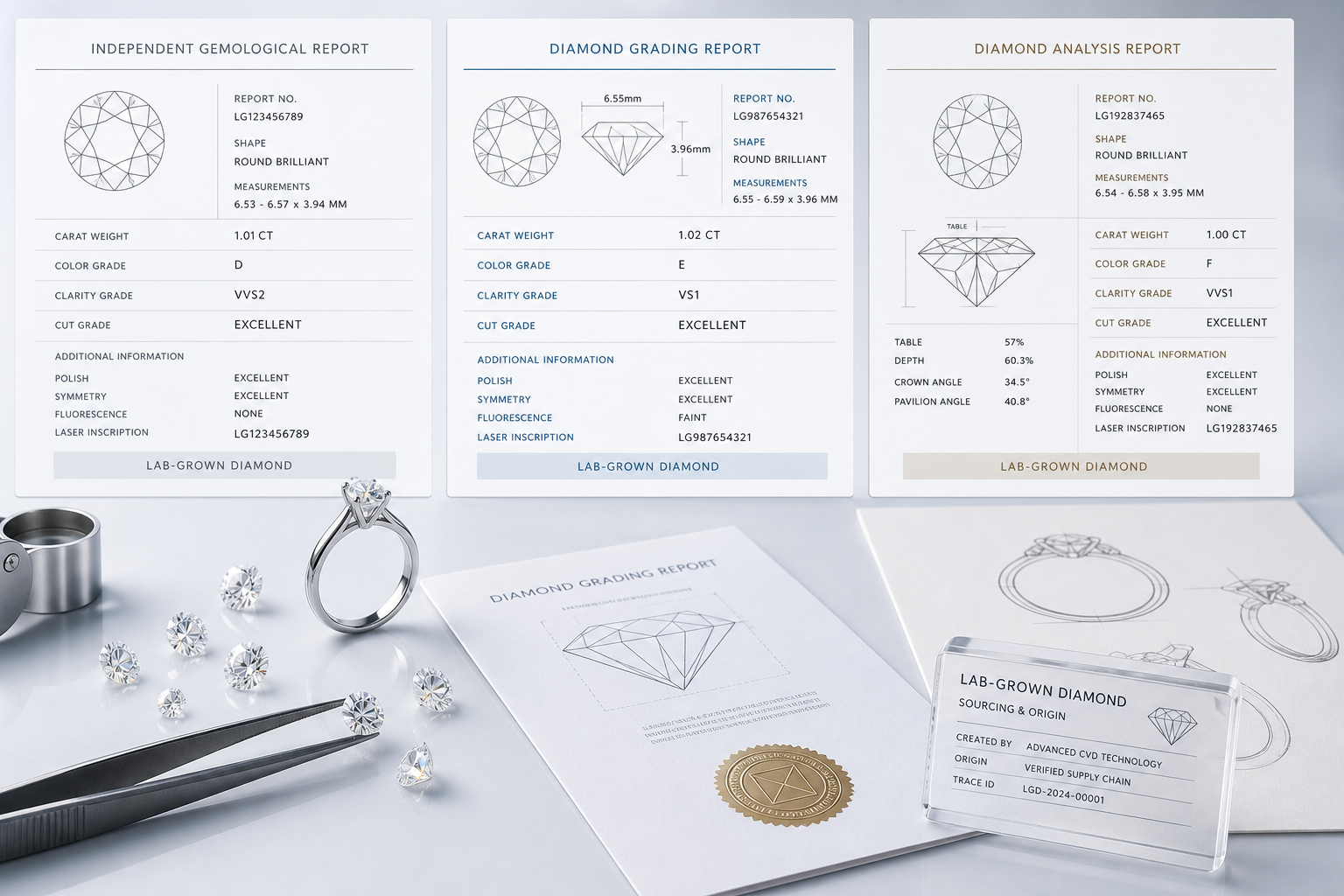
A typical grading report identifies the diamond as laboratory-grown and lists the details buyers need for comparison: shape, carat weight, measurements, color grade, clarity grade, cut information where applicable, polish, symmetry, fluorescence, laser inscription details, report number, and any relevant comments. These are not decorative details. They are the data points that let you compare one stone against another without guessing.
For example, two diamonds may both be listed as 1.50 carats, but their measurements can make them look different once set. One may face up larger, while another may carry more weight in depth. A report helps expose that difference. The same applies to clarity and color. The certificate gives you a common language for comparison, but the practical value comes from reading the details together rather than focusing on one grade in isolation.
The report number is especially important for diamond verification. It should match the seller listing and, where applicable, the laser inscription on the diamond’s girdle. If a seller cannot provide a verifiable report number for a meaningful loose diamond purchase, that is a reason to slow down. A certified loose lab diamond for an engagement ring should be traceable to a specific report, not described with vague language such as “certificate available” without proof.
When growth method or post-growth treatment is relevant, buyers should look for clear disclosure in the grading report or seller documentation. HPHT and CVD may refer to laboratory-grown diamond growth methods, while any post-growth treatment should be documented only when it actually applies to the specific stone.
When a grading report is available, buyers should verify the report details through the issuing laboratory’s official report-check tool where available, then compare those details with the seller listing and actual-stone media.
Evidence Boundaries: What the Report Should and Should Not Be Used to Support
When reading a lab-grown diamond report, it helps to separate identity evidence from quality judgment. A report can support claims about the diamond’s recorded characteristics, such as carat weight, measurements, color, clarity, and whether the stone is identified as laboratory-grown. It should not be stretched into proof that the diamond is the best value, the most beautiful option, or suitable for every setting. Those conclusions require a broader review of the stone, visuals, design requirements, and seller communication.
This distinction also protects buyers from misleading shortcuts. If a listing says a diamond is “certified,” the next question is not only which lab issued the report, but what exact claim the report supports. Does it identify the stone? Does the report number match? Do the measurements align with the listing? Is the inscription listed and confirmable? Evidence is strongest when each document, image, and seller statement supports the same specific diamond.
What a Certificate Does Not Fully Prove
A certificate does not fully prove that the diamond looks lively, balanced, or flattering in the setting you have in mind. It does not show whether an oval has a distracting bow-tie, whether an emerald cut has obvious windowing, or whether a cushion has a facet pattern you personally like. Those visual traits can matter more in daily wear than a small difference in color or clarity grade.
A diamond report also does not prove that the seller’s photos or videos show the exact stone being sold. That is why actual-stone imagery matters. If the report looks complete but the listing uses generic media, cropped certificate images, or inconsistent measurements, the certificate alone is not enough to create confidence.
For buyers, the practical point is to separate documented facts from buying judgments. A grading report can document the diamond’s recorded characteristics, but it does not automatically prove visual beauty, long-term satisfaction, sourcing ethics, or suitability for a specific ring design. Those judgments require the report to be checked against the actual stone, the intended setting, and the seller’s written answers.
Seller transparency is part of the purchase, too. A report can confirm lab diamond grading details, but it cannot confirm whether the seller will answer questions clearly, verify the inscription, explain setting compatibility, or provide written confirmation that the listed diamond matches the report. This is where buyers make costly mistakes: they treat a legitimate document as proof that the entire buying process is equally reliable.
Why Loose Diamond Buyers Depend on Reports More Than Finished Jewelry Buyers
Loose diamond buyers rely heavily on reports because they are choosing the stone before it becomes part of a ring, pendant, or other piece of jewelry. There is no finished design to soften the decision. The diamond must be evaluated on its own merits, including its dimensions, grading details, and suitability for the intended setting.
This matters most when you plan to buy certified loose lab-grown diamonds for an engagement ring or custom jewelry project. A stone may look attractive on paper but be too deep for a low-profile setting, too elongated for a certain halo design, or visually weaker than another diamond with similar grades. The certificate gives you the baseline, but the design goal decides which details deserve the most attention.
At NUVU, we treat the grading report as a starting point rather than the final answer because a loose diamond still has to work visually and physically in the final piece. That distinction is especially important for buyers comparing several stones with similar grades.
What to Check Before You Decide
- Match the report number to the seller listing. The number on the lab-grown diamond certificate should match the diamond being offered, not just a sample document or similar stone.
- Confirm the diamond is described as laboratory-grown. The report should clearly identify the stone as lab-grown so there is no confusion about origin.
- Compare measurements against the listing. Length, width, depth, and carat weight should align with the seller’s product details.
- Look for actual-stone photos or 360-degree video. A report helps verify the diamond, but visual evidence helps you judge appearance, proportions, and eye appeal.
IGI, GIA, and GCAL: How the Major Lab-Grown Diamond Reports Differ
IGI, GIA, and GCAL are among the grading names buyers often encounter when comparing certified lab diamonds. Each can provide useful documentation, but they do not all play the same role in the market or present information in the same way. The better question is not which name wins in every case. The better question is which report gives you enough verified information for the specific diamond you are considering.
A serious lab diamond report comparison should look at the report itself, the seller’s listing, and the stone’s visual evidence together. A familiar grading lab can support confidence, but the report still needs to be verified, matched to the diamond, and interpreted in context.
IGI Reports: Common in the Lab-Grown Diamond Market
An IGI lab-grown diamond certificate is widely encountered in the loose lab diamond market. For many buyers, this availability is useful because it creates a larger pool of stones to compare across shape, carat, color, clarity, measurements, and cut information where provided.
The practical advantage is comparison efficiency. If you are reviewing several IGI certified loose lab diamond options, you can often compare similar report fields across multiple stones without changing grading formats every time. That does not mean every IGI-graded diamond is automatically a better buy. It means the report can make shortlisting easier when the seller provides complete data, actual imagery, and verification access.
Buyers should still avoid using the certificate as a shortcut. A diamond with strong IGI grades can still have proportions or visual traits that make it less appealing than another stone with slightly different paper grades. The report narrows the search; it does not finish it.
GIA Reports: Strong Recognition and Conservative Buyer Familiarity
A GIA lab-grown diamond report carries strong name recognition, especially for buyers who have already researched natural diamonds. Many consumers know GIA as a major grading name, so seeing a GIA report can reduce uncertainty for buyers who want a familiar reference point.
That recognition can be valuable, but it should not become an automatic requirement for every lab-grown diamond purchase. A GIA certified lab-grown diamond may appeal to a buyer who prioritizes brand familiarity or wants documentation from a lab they already know. Another buyer may find better availability or a more suitable stone with a different reputable report.
The practical mistake is paying attention to the lab name while ignoring the diamond itself. If the report is verifiable but the listing lacks actual video, has unclear measurements, or does not confirm the inscription, the purchase still needs more review.
GCAL Reports: Performance-Focused Documentation
A GCAL lab-grown diamond certificate is often associated with more performance-oriented documentation where that information is included on the specific report. Buyers who care about light behavior, optical detail, or added documentation may find GCAL reports useful, especially when the report provides more than basic grading fields.
The important phrase is “where included.” Buyers should review the actual GCAL report rather than assuming every report contains the same level of detail or the same format. A GCAL certified lab-grown diamond may offer helpful information, but the value depends on what the document shows for that particular stone.
This is a good example of why report reading matters more than report name recognition alone. If the report provides performance-related data, use it. If the visual evidence does not support the paper impression, keep comparing.
How to Compare Reports Without Turning It Into a Brand Contest
IGI, GIA, and GCAL reports should be evaluated by how well they help you make a specific decision. IGI may be useful when broad market availability matters. GIA may feel more reassuring to buyers who value familiar grading names. GCAL may appeal to buyers who want additional performance-oriented information when available. None of those advantages eliminates the need to verify the report and inspect the diamond visually.
The strongest comparison starts with the same core fields: carat weight, measurements, color, clarity, cut grade for round diamonds when listed, polish, symmetry, fluorescence, report date, laser inscription, and comments. Then the buyer should ask a more practical question: does the actual stone look like a good candidate for the setting, budget, and wear style?
For wholesale or multi-stone buying, the same logic becomes even more important. Consistency across reports, measurements, media quality, and seller communication may matter as much as the price of any one stone. A batch of loose lab-grown diamonds should not be judged only by average grades; buyers also need to check whether the documentation is organized, the stones can be matched to their reports, and the visual quality is consistent enough for the intended jewelry program.
In sourcing or wholesale conversations, documentation, consistency, and communication often matter as much as the headline specification. Buyers should ask how stones are identified, how report numbers are shared, how substitutions are handled if inventory changes, and what information will be provided before committing to a group of stones.
This approach prevents a common error. Buyers sometimes turn the report into a brand contest and miss the more relevant issue: whether the certificate, listing, photos, video, and seller answers all point to the same diamond with no unexplained gaps.
Certificate and Visual Review Check
- Compare the same fields wherever possible. Carat weight, measurements, color, clarity, cut information, polish, symmetry, report date, inscription, and comments should be reviewed across reports.
- Check the report format carefully. Different labs may organize information differently, so do not assume a missing field means the same thing in every report type.
- Use visual evidence as the tie-breaker. Actual photos or 360-degree video can reveal proportion, contrast, and shape personality that the certificate cannot fully show.
- Do not ignore seller transparency. A reputable report is much more useful when the seller clearly confirms that the document belongs to the exact stone being offered.
Which Certificate Matters Most When Buying a Loose Lab-Grown Diamond?
The more useful certificate for lab-grown diamonds depends on what you are trying to protect against. If you want easier comparison shopping, availability may matter most. If you want a grading name that feels familiar, recognition may matter most. If you want more performance-oriented documentation, report detail may matter most. For any serious certified loose lab diamond purchase, the important requirement is a verifiable report from a reputable grading lab that matches the actual stone.
So if the question is, “Which lab diamond certificate should I choose?” the practical answer is: choose the certificate that gives you clear, verifiable information for the diamond you actually want to buy. A strong certified loose lab-grown diamond candidate is not simply the one with the most recognizable report. It is the one where the report, inscription, measurements, imagery, proportions, and seller confirmation all line up.
If You Want Broad Market Availability
IGI-certified lab-grown diamonds are commonly available, especially in the loose stone market. That can make it easier to compare several diamonds with similar carat weight, shape, color, and clarity without being limited to a very small selection.
This is most useful for buyers who want to see a range of options before deciding. If you are comparing multiple oval, round, cushion, or radiant lab-grown diamonds, broad availability gives you more room to reject stones with weaker videos, awkward proportions, or less appealing measurements. Availability is not the same as superiority, but it can improve your odds of finding a well-matched stone.
If You Want Maximum Name Recognition
GIA may matter most to buyers who feel more comfortable with a grading name they already know. This is common among shoppers who first learned about diamond grading through natural diamond research and want a familiar reference point when moving into lab-grown options.
That comfort has value, especially for a buyer making a meaningful purchase for the first time. Still, GIA recognition should be treated as a trust preference, not a universal rule. A GIA report does not remove the need to check the report number, review the actual stone, and confirm that the diamond’s measurements work for the intended setting.
If You Want More Performance-Oriented Detail
GCAL may appeal to buyers who want more information about performance characteristics, provided that the specific report includes those details. This can be useful for shoppers who care about light behavior and want more than a basic grade summary.
The right way to use this information is to read the actual report carefully, not assume that the lab name alone tells the whole story. If performance-related documentation is present, compare it with the diamond’s video and proportions. A detailed report is valuable only when it helps confirm what the eye is likely to see.
If You Want the Strongest Buying Decision
The strongest buying decision combines a verifiable lab-grown diamond grading report with a matching inscription where available, clear actual-stone images or video, sensible proportions, and a seller willing to answer specific questions. If any one of those pieces is missing, the risk increases.
For round diamonds, the certificate may give more standardized cut information. For fancy shapes, visual review often becomes more important because grades alone do not fully capture bow-tie, windowing, outline, or facet pattern. A buyer who understands this will make a better decision than one who simply chooses the highest color and clarity combination on the page.
Report verification should come before emotional commitment. If the certificate cannot be verified, the listing details do not match, or the seller avoids direct answers, the more careful move is to keep looking. A beautiful diamond is not a good purchase if the documentation does not clearly support the stone being sold.
What This Means in a Real Purchase
Consider Maya, who is choosing between two 1.50 ct oval lab-grown diamonds for an engagement ring. Both stones have similar color and clarity grades. The first has a familiar report, but the listing shows only limited images and a low-quality video. The second has a detailed, verifiable report, clear 360-degree video, measurements that suit the setting better, and seller confirmation that the inscription matches the report number.
The familiar report on the first diamond is useful, but it does not solve the biggest uncertainty: how the stone actually looks and whether it fits the ring design well. The second diamond gives Maya more decision-ready evidence. In that situation, the better choice may be the stone with the stronger total file, not simply the report name that feels most familiar.
Certification starts the comparison. The final decision should come from the way the report, visual evidence, proportions, and seller transparency work together.
How to Verify a Lab-Grown Diamond Report Before You Buy
Before you buy, treat the grading report as something to verify, not just something to view. A certificate image on a product page is useful only if the report number, diamond details, and seller listing all point to the same stone, especially when a loose diamond price guide is being used to judge whether the listed quality matches the asking price. This step matters most with loose diamonds because you are choosing the diamond before it is mounted, and there is less room to hide behind a finished design.
The goal is simple: confirm the diamond identity. If the lab diamond report number cannot be checked, the listing details do not match the report, or the seller will not confirm the connection between the stone and the document, that is a reason to slow down. A reputable report should make comparison easier, not create more questions.
Use the Report Number Lookup
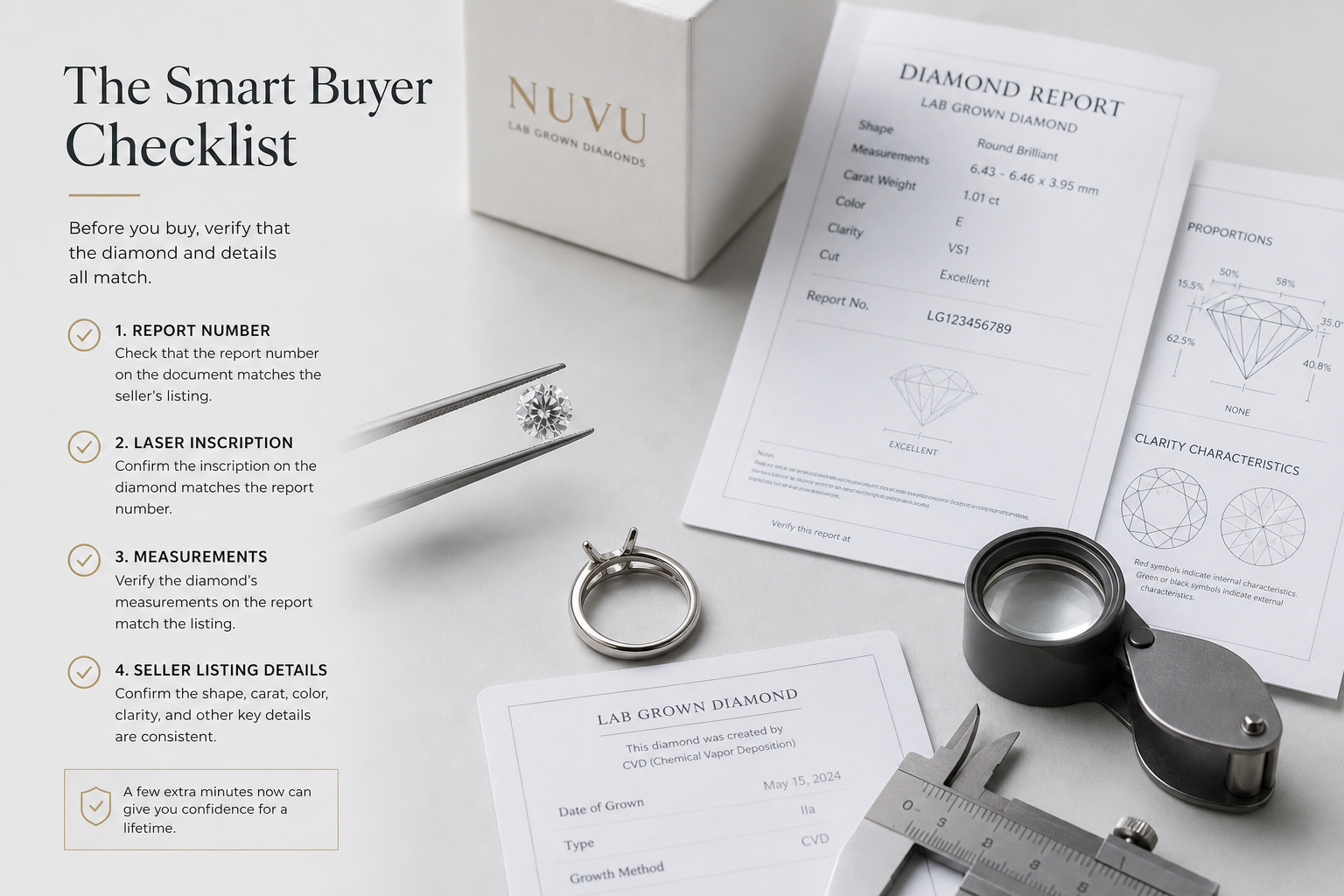
Start with the grading lab’s official online report lookup when available. Enter the report number or certificate number exactly as shown on the document, then compare the result against the seller’s listing. The lab name, report number, shape, carat weight, color, clarity, and measurements should align.
This is one of the fastest ways to verify a lab-grown diamond certificate because it checks the document against the lab’s own report database. It does not prove the seller’s service quality or the diamond’s beauty, but it does confirm whether the report itself appears to exist and whether the basic data matches what you are being shown.
A report lookup also has a limitation: it verifies the record, not necessarily the seller’s possession of the exact stone at that moment. That is why the next checks still matter. Ask for confirmation that the stone is available, that the report number belongs to the listed diamond, and that any laser inscription can be matched when applicable. This is especially important when inventory moves quickly or when a stone will be reserved for custom work.
If a seller provides only a cropped report image without a visible report number, ask for the full report details before moving forward. A serious loose diamond purchase should not depend on a certificate screenshot that cannot be independently checked.
Keep a Verification Trail Before You Pay
For a meaningful loose diamond purchase, the strongest evidence is not one screenshot. It is a consistent trail: the full report number, the lab lookup result, the seller listing, actual-stone media, inscription confirmation where available, and written confirmation from the seller. Keeping those details together makes it easier to resolve questions if the listing changes, inventory moves, or the stone is later sent into custom setting work.
This verification trail does not need to be complicated. Save the report PDF or full report image, note the report number, keep a copy of the product listing, and ask any important questions through the seller’s official email, chat, or order system. If the diamond is being used in a custom ring, include the confirmed measurements in the design discussion so the stone-to-setting fit is documented before production begins.
Match the Report to the Seller Listing
Once the report is verified, compare it line by line with the seller listing. The shape, carat weight, measurements, color grade, clarity grade, report date, and inscription details should match. Small formatting differences are normal, but the underlying diamond data should not conflict.
Measurements deserve close attention because they are harder to fake casually and more useful than many buyers realize. For example, a listing may describe two stones as 2.00 carats, but the report measurements show whether one faces up wider, deeper, longer, or narrower. If the listed measurements differ from the report, ask for clarification before assuming it is a harmless typo.
Also check that the report identifies the stone as laboratory-grown. This may sound obvious, but it is a basic identity check. A lab-grown diamond report should clearly distinguish the stone from a natural diamond and should not leave the origin unclear.
Check the Laser Inscription When Available
Many certified loose diamonds have a microscopic laser inscription on the girdle that matches the report number. The girdle is the thin outer edge of the diamond, and the inscription is not visible to the naked eye in normal wear. Most buyers will not inspect it themselves without magnification, but they can ask the seller to confirm it.
A matching laser inscription is useful because it connects the physical diamond to the grading report. It is not a substitute for a full visual review, but it reduces the risk of confusing one stone with another, especially when several diamonds have similar carat weight, color, clarity, and shape.
If the report lists an inscription and the seller cannot confirm it, that is worth questioning. There may be a practical explanation, but for a certified loose lab diamond, the seller should be able to explain how the report, inscription, and actual stone are being matched.
A laser inscription should be treated as a linking tool, not as the whole verification process. The inscription can help connect the physical stone to the report, but buyers should still compare the report number, measurements, actual-stone media, and written seller confirmation. If any part of that chain conflicts, the conflict should be resolved before the diamond is paid for or assigned to a custom setting.
Watch for Listing-Report Mismatches
The most common risk is not always a fake document. More often, the problem is a mismatch between a real report and the stone being presented. A slightly different carat weight, inconsistent measurements, missing report number, or report image that looks cropped can all indicate that the listing needs closer review.
Be especially cautious if the certificate is shown but there is no clear verification path. A seller should not ask you to rely only on a report image when the grading lab offers a way to confirm the record. The same applies if the seller avoids direct answers about whether the report belongs to the exact diamond being sold.
Another warning sign is inconsistent media. If the report describes an oval diamond but the video appears to show a different outline, or if the measurements suggest a long, slender shape while the image looks short and wide, pause before buying. Visual evidence and report data should support each other.
Buyer Verification Checklist
- Confirm the grading lab name and full report number.
- Use the official report lookup when available.
- Check that the report identifies the diamond as laboratory-grown.
- Match the shape, carat weight, measurements, color, and clarity to the seller listing.
- Review cut grade where applicable, especially for round brilliant diamonds.
- Compare polish, symmetry, fluorescence, and report comments.
- Check whether the report lists a laser inscription.
- Ask the seller to confirm the inscription when available.
- Review actual-stone photos and video, not only sample imagery.
- Get written confirmation that the listed stone matches the report before purchase.
If any of these checks creates uncertainty, do not treat it as a minor detail. The more careful buying path is to resolve the mismatch before payment, setting work, or custom design decisions begin.
Report Details That Actually Affect Diamond Comparison
A grading report contains many fields, but not every field carries the same weight in a buying decision. The most useful diamond certificate fields are the ones that help you compare real stones more accurately: carat weight, measurements, color grade, clarity grade, cut information, polish, symmetry, fluorescence, and comments. The mistake is treating all grades as equally important without considering shape, setting, and how the diamond will actually be worn.
Good lab-grown diamond grading details should narrow your options, not make the decision for you. A report can tell you what the diamond is on paper, but the buyer still needs to interpret which details affect appearance, fit, and value in the intended jewelry piece.
Price differences between certified lab-grown diamonds may reflect several factors at once: report type, carat weight, measurements, cut quality, color, clarity, shape demand, growth characteristics, seller service, availability, and how well the stone fits the intended design. A lower price is not automatically a warning sign, and a higher price is not automatically proof of a better diamond. The useful question is whether the documentation, visuals, and practical performance justify the tradeoff for your purchase.
Prices can change with market conditions, report type, seller channel, availability, and stone-specific details, so exact comparisons should be verified at the time of purchase. If two stones appear dramatically different in price, compare like-for-like specifications first: same shape, similar measurements, comparable report detail, similar visual evidence, and similar setting suitability.
Carat Weight and Measurements Are Not the Same Thing
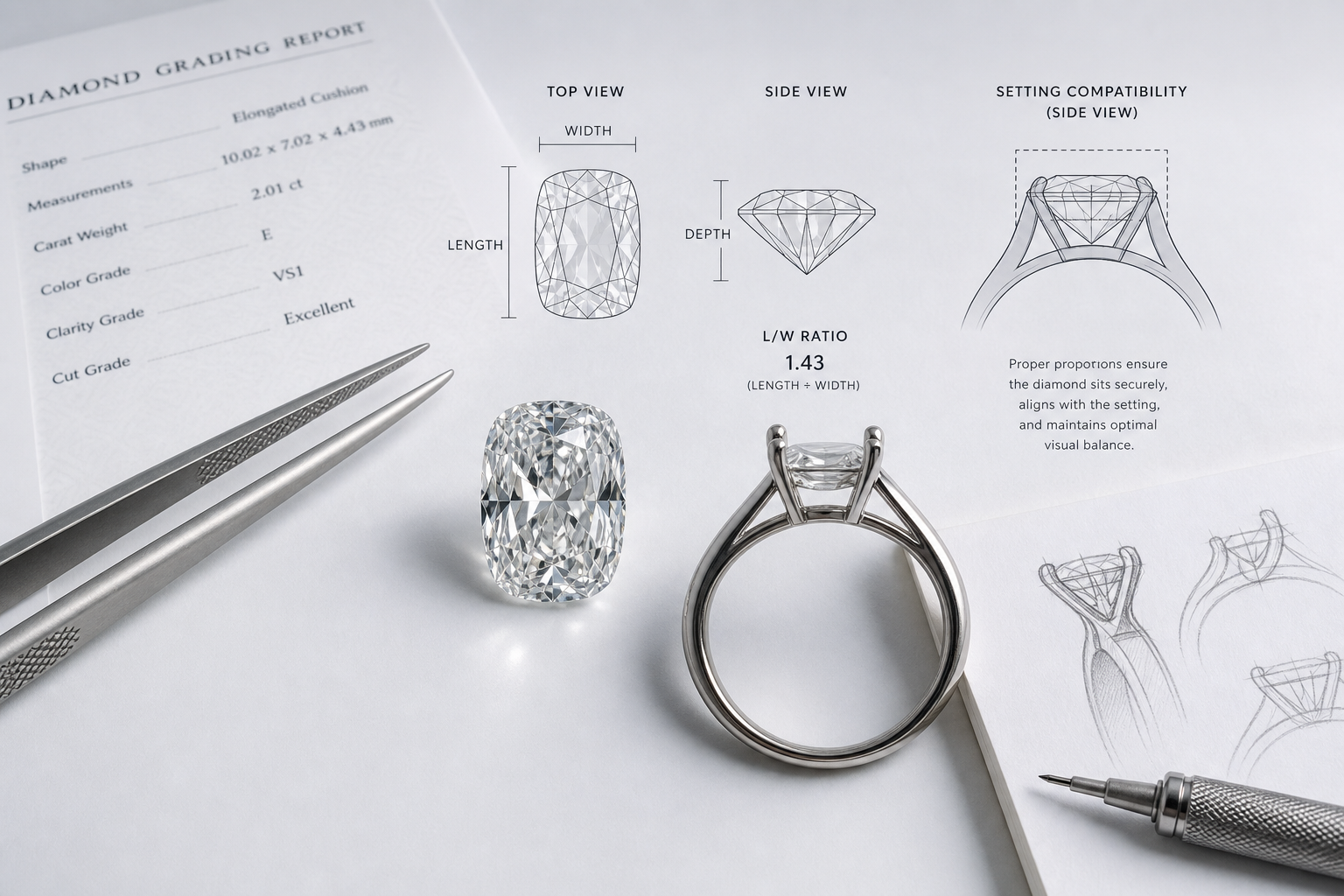
Carat weight tells you how much the diamond weighs. Measurements tell you how large it may look and whether it will fit a specific setting. Two diamonds can both weigh 1.50 carats and still face up differently because one carries more weight in depth while the other spreads more across the top.
This matters when you compare certified lab-grown diamonds for rings in particular. A diamond that is deep may look smaller from above than another stone with the same carat weight. A diamond that is unusually shallow may look large for its weight but may have weaker light return or durability concerns depending on the shape and proportions.
For loose diamond buyers, measurements are not a technical afterthought. They affect visual size, setting compatibility, finger coverage, and the balance of the final design. If two stones have similar grades but one has better face-up dimensions for the intended setting, that stone may be the stronger practical choice.
Color and Clarity Need Shape-Specific Interpretation
Color and clarity do not show the same way in every diamond shape. Step cuts such as emerald and Asscher diamonds have broad, open facets that can make inclusions and body color easier to notice. Brilliant cuts, including round, oval, pear, cushion, and radiant styles, often break up light in a way that can make some clarity characteristics less obvious.
This is where buyers often overspend. A very high clarity grade may look reassuring on a report, but it may not create a visible benefit once the diamond is set and viewed at normal distance. On the other hand, a lower clarity grade can be a poor choice if a dark inclusion sits near the center of an emerald cut or another open-facet shape.
The better approach is not to chase the highest grade automatically. Match the grade to the shape. For many brilliant-cut diamonds, an eye-clean stone can be a better value than paying more for clarity that cannot be seen. For step cuts, clarity deserves more caution because the diamond gives imperfections fewer places to hide.
Cut Grade Is Most Standardized for Round Diamonds
Cut grade is especially useful for round brilliant diamonds because the category has more standardized grading and more predictable proportion benchmarks. When comparing round stones, the cut grade can help eliminate weak options quickly, especially when combined with table percentage, depth percentage, polish, symmetry, and video.
Fancy shapes are different. Oval, pear, marquise, cushion, radiant, emerald, and Asscher diamonds often require more visual review because many reports do not evaluate cut with the same level of standardized simplicity used for rounds. A fancy shape can have strong paper grades and still show a heavy bow-tie, windowing, uneven facet pattern, or a shape outline that does not suit the setting.
For round diamonds, cut information can be a primary filter. For fancy shapes, it should be treated as a starting point, with measurements and video carrying more of the decision.
Polish, Symmetry, Fluorescence, and Comments
Polish describes the finish of the diamond’s surfaces. Symmetry describes how well the facets align. For most buyers, excellent or very good polish and symmetry are strong practical targets. Lower grades are not automatically disqualifying, but they should raise the question of whether the diamond’s appearance or value justifies the compromise.
Fluorescence is less common as a major buying issue in many lab-grown diamond comparisons, but it should still be read rather than ignored. If fluorescence is listed, consider whether it could affect appearance in certain lighting. It is not automatically bad, but strong effects should be evaluated with actual imagery when possible.
Comments can be more important than they look. Depending on the report format, they may mention growth method, post-growth treatment, inscription details, or clarity characteristics that are not fully captured by the headline grade. A buyer who skips the comments may miss a detail that explains why two diamonds with similar grades are priced or presented differently.
Specific Parameters to Include
For round brilliant lab-grown diamonds, proportion screening can help buyers eliminate obvious poor fits before deeper review. Some buyers and jewelers use table percentage, depth percentage, crown and pavilion information when available, polish, symmetry, and video together as practical filters. These numbers should be treated as comparison tools rather than as a universal guarantee of beauty.
The warning is important: numbers are screening tools, not final proof. A round diamond with attractive proportions can still look dull if the overall cut execution and light behavior are weak. A stone just outside a preferred range is not automatically bad, but it deserves closer visual review rather than blind acceptance or rejection.
For fancy shapes, compare the length-to-width ratio and actual video before relying too heavily on report grades. A longer oval will look very different from a shorter oval even if the carat weight, color, and clarity are similar. In a real purchase, the shape outline and face-up appearance often matter more than a small difference in clarity grade.
Why Visual Judgment Still Matters After Certification
A certificate can narrow the field, but it cannot show how a diamond feels to the eye. Certified lab-grown diamond buying still requires visual review because diamonds with the same report grades can look noticeably different in brightness, contrast, shape personality, and overall presence.
This is especially true with loose diamonds. Before the stone is set, you have the chance to evaluate it on its own. Skipping that step can lead to a technically certified diamond that meets the paperwork but disappoints in the finished ring or jewelry piece.
A Certificate Cannot Show Personality
Two diamonds with the same carat weight, color, and clarity can have completely different visual character. One may look crisp and lively, while another may look flat or uneven because of its proportions, facet pattern, or contrast distribution. The report tells you the graded characteristics; it does not fully show how the diamond returns light.
This is why visual judgment matters most after the basic report checks are complete. Once you know the diamond is properly documented, the next question is whether it actually looks good. A higher paper grade is not always the better buy if the stone with slightly lower grades has stronger face-up appeal.
At NUVU, we treat the grading report as a starting point rather than the whole decision because the buyer is not wearing a certificate. The final piece depends on how the diamond looks, fits, and performs in the intended design.
Photos and 360-Degree Video Help Confirm Eye Appeal
Actual-stone photos and 360-degree video are more useful than generic sample media. They help confirm outline, facet pattern, contrast, visible inclusions, and whether the stone looks consistent with the report details. If you are trying to buy a lab-grown diamond with certificate and video, the video should show the specific diamond, not merely represent the shape category.
Video is evidence, not perfection. Lighting, camera angle, background, and magnification can all affect how a diamond appears online. A diamond may look more dramatic under one lighting setup and softer under another. The best use of video is to look for patterns: Does the stone return light evenly? Is there a distracting dark area? Does the shape look balanced? Do inclusions appear in normal viewing?
For online buying, a certified loose diamond with images gives the buyer a stronger basis for judgment than a certificate alone. If a seller provides a report but no meaningful imagery, you are being asked to make a visual purchase with limited visual evidence.
Fancy Shapes Need Extra Visual Review
Fancy shapes are where lab diamond visual review becomes especially important. Oval, pear, and marquise diamonds can show a bow-tie effect, which appears as a dark band across the center. A slight bow-tie can be normal, but a heavy one can dominate the diamond and make it look less lively.
Emerald cuts need a different kind of caution. Their broad step facets can show windowing, where the center looks glassy or see-through instead of reflective. Radiant and cushion cuts may have uneven facet patterning, with some stones looking crisp and others appearing crushed, busy, or inconsistent.
These issues are not always obvious from the main grades on a report. A fancy shape with strong color and clarity can still be the wrong choice if the outline is awkward, the facet pattern is distracting, or the face-up look does not suit the setting.
Eye-Clean Does Not Always Mean Flawless
Eye-clean means inclusions are not easily visible under normal viewing conditions. It does not mean the diamond is flawless, and it does not always match the clarity grade in a simple way. Location, size, color, and contrast of inclusions all matter.
A lower clarity grade may still be a smart purchase if the inclusions are small, light-colored, near the edge, or hidden by the facet pattern. A higher clarity grade may still deserve review if an inclusion is positioned in a noticeable area or reflected through the stone.
The practical takeaway is to avoid paying for clarity beyond what the eye can use, but do not ignore clarity placement. For engagement rings and daily-wear jewelry, the strongest choice is usually not the highest clarity grade available; it is the diamond that looks clean in real viewing and fits the budget without sacrificing cut, proportions, or setting compatibility.
Photo and Video Review Check
- Review face-up video to judge brightness, contrast, outline, and visible inclusions.
- Look for side-view imagery when available, especially if depth or setting height matters.
- Check close-up still images for clarity features and facet pattern.
- Confirm the video shape matches the report shape and listed measurements.
- Compare the visible outline with the length-to-width ratio on the report.
- For reports with an inclusion plot, check whether visible marks appear in the expected area.
- Use imagery to confirm eye appeal, not to override obvious report or listing inconsistencies.
The strongest buying decision combines certificate verification with visual evidence. If the report looks right but the diamond looks weak, keep comparing. If the video looks appealing but the document cannot be verified, that risk is not worth ignoring.
Grading Consistency, Lab Differences, and How to Stay Practical
Questions about lab-grown diamond grading consistency usually come from a reasonable concern: if IGI, GIA, and GCAL do not present information in exactly the same way, how should a buyer compare stones fairly? The practical answer is to treat each independent lab report as a strong reference point, not as a perfectly interchangeable language. Reports are meant to reduce uncertainty, but they still require careful report interpretation.
The mistake is turning IGI vs GIA vs GCAL into a simple ranking exercise. A report from a reputable diamond grading lab matters, but the better buying decision comes from comparing the report, the actual diamond, and the seller’s disclosure together. If those three do not agree, the certificate alone should not carry the purchase.
Why Different Reports May Not Feel Identical
Different labs may use different report layouts, terminology, levels of detail, and presentation styles. One lab diamond report may make the growth method or inscription easy to spot, while another may place more emphasis on core grading details such as color grading, clarity grading, measurements, polish, and symmetry. This can make two legitimate reports feel uneven even when both are useful.
Buyers often interpret a more detailed-looking report as automatically better, but detail only helps if it answers the right question. A dense report does not replace clean imagery, and a familiar report name does not guarantee the diamond is the better visual choice. The useful question is not only “which lab-grown diamond grading lab is best?” but “does this report give me enough verified information to compare this specific stone with confidence?”
Do Not Compare Reports Like They Are Perfect Substitutes
If two diamonds are graded by different labs, avoid assuming that every grade translates one-for-one across reports. A color grade or clarity grade gives you a comparison point, but the actual appearance still depends on the diamond’s proportions, facet pattern, inclusion placement, and how the stone performs in video or in person. This matters most when two options are close on paper.
A cleaner comparison is usually possible when the diamonds are graded by the same lab, because the report format and grading standards are easier to read side by side. When you compare IGI, GIA, and GCAL lab diamonds across different listings, a loose lab diamond buying guide can help you give more weight to facts that can be checked directly: report number, measurements, inscription, actual-stone media, and seller confirmation. If a seller asks you to rely only on a cropped certificate image or a broad claim about the lab, that is not enough.
When a Higher Grade Is Not Automatically a Better Buy
A diamond with slightly stronger paper grades is not automatically the better stone. A higher clarity grade can still look less appealing if the cut is weak, the proportions create a dull center, or the video shows poor light return. A higher color grade may also be less meaningful in a setting where the difference is difficult to see, especially if the tradeoff is a less attractive shape outline or weaker measurements.
This is where buyers can overspend without improving the final jewelry. For example, choosing a higher-graded oval with a distracting bow-tie or stretched outline may be a worse decision than choosing a slightly lower-graded oval with better balance and cleaner face-up appeal. The report helps you screen the options, but it should not override what the diamond actually looks like.
When Paying More for a Certain Report May Make Sense
Some buyers are more comfortable paying for a diamond with a report from a lab name they already recognize. That can be reasonable, especially for someone who wants documentation that feels familiar, easy to discuss with a jeweler, or simpler to retain for personal records. Buyer confidence has value, even when it is not the same thing as visual superiority.
Paying more for a certain report may also make sense when the documentation is clearer, easier to verify, or better aligned with the buyer’s risk tolerance. It becomes harder to justify when the only advantage is the name on the document while the competing stone has stronger imagery, better proportions, matching verification, and a more transparent seller. A report should support confidence, not distract from weak evidence.
How to Verify This Before Buying
For the cleanest comparison, start by comparing diamonds graded by the same lab whenever possible. This reduces the chance of over-reading small differences between report formats and makes it easier to compare carat weight, measurements, color, clarity, polish, symmetry, and comments in a consistent way.
If you are comparing across labs, slow the decision down. Confirm that each report can be verified through the lab’s official lookup process, then check whether the seller listing matches the report exactly. Focus on actual measurements, diamond imagery, inscription details where available, and any written seller disclosure. If one diamond has a verifiable report and clear media while another has stronger-looking grades but weak documentation, the better practical choice is usually the stone with fewer unanswered questions.
Common Mistakes Buyers Make With Certified Loose Lab-Grown Diamonds
Certified loose lab-grown diamond mistakes usually happen when buyers treat documentation as protection against every possible problem. A certificate lowers uncertainty, but it does not remove the need to check the stone, the listing, the setting plan, and the seller’s claims. Most avoidable problems come from trusting one part of the purchase while ignoring the rest.
Buying certified lab diamonds is easiest when the buyer keeps the decision practical. The goal is not to collect the highest possible grades. The goal is to choose a verified stone that looks right, fits the intended jewelry, and has no unexplained gap between the report and the listing.
Mistake 1: Treating the Certificate as the Whole Decision
A certificate can confirm key grading information, but it cannot tell you whether the diamond is the right choice for your ring, pendant, or custom design. Buyers get into trouble when they see a reputable lab name and stop asking questions. That can lead to buying a stone with acceptable paper grades but weak visual appeal, awkward proportions, or poor fit for the final piece.
The consequence is usually not that the diamond is “bad.” It is that the buyer paid for specifications that did not solve the actual design problem. A certified stone can still face up smaller than expected, show a distracting pattern, or sit poorly in a setting if the measurements and shape are not reviewed before purchase.
Mistake 2: Ignoring Measurements and Setting Fit
Loose diamonds have to work physically with the jewelry they are going into. A 1.50 carat diamond is not just a weight; it has a length, width, depth, shape outline, and girdle profile that affect how it will sit in a setting. Two stones with the same carat weight can require different setting adjustments because their proportions are different.
This becomes especially important for custom rings, east-west settings, bezels, halos, three-stone designs, and pairs of earrings. A diamond that looks attractive on its own may be too deep for the desired setting height, too wide for a planned halo, or poorly matched as part of a pair. Setting compatibility should be checked before payment, not after the stone is already committed to the design.
For custom design, trust comes from matching the stone to the setting, budget, and wearer’s daily use, not from choosing grades in isolation. Before finalizing a loose stone, buyers should confirm the design’s measurement tolerances, setting style, and any shape-specific concerns such as depth, corners, girdle thickness, or length-to-width ratio.
Mistake 3: Chasing the Highest Color and Clarity Grades
Higher color and clarity grades can matter, but they are not always the best use of budget. Many buyers overpay for differences that will not be obvious in the finished piece, especially once the diamond is set and viewed under normal lighting. The mistake is assuming that the highest grade automatically creates the most beautiful result.
Diminishing returns are real. A well-cut diamond with practical color and eye-clean clarity can be a stronger choice than a higher-graded stone with weaker proportions or less appealing video. Clarity is especially easy to overbuy if inclusions are not visible face-up. Color can also be over-prioritized in designs where metal color, diamond shape, and lighting affect what the eye actually notices.
Mistake 4: Forgetting to Confirm Seller Claims in Writing
Verbal or casual claims are not enough when buying a certified loose diamond. Before committing, buyers should confirm the report match, laser inscription where available, stone availability, setting compatibility, and relevant purchase policies through the seller’s official communication channel. This is especially important if the diamond will be used in a custom engagement ring, where changes become harder once design work begins.
A transparent seller should be willing to answer specific questions without making the process feel vague. If the listing says the stone is certified, the seller should be able to confirm which report belongs to the actual diamond. If the stone is being set, the seller should be able to discuss whether the measurements and shape work with the intended design. Refusal, delay, or unclear answers are warning signs.
Mistake 5: Treating Marketing Claims as Report Evidence
Another common mistake is assuming that a grading report supports every claim on a product page. The report may document identity and grading information, but it does not automatically substantiate claims about sustainability, resale expectations, rarity, ethics, or long-term value. Those claims require their own evidence, and buyers should be cautious when broad marketing language is presented next to a certificate as though the certificate proves all of it.
A practical way to avoid this mistake is to ask, “Where is this specific claim documented?” If the claim is about the diamond’s carat weight or clarity, the grading report may answer it. If the claim is about environmental impact, production energy, origin controls, or seller policies, the answer should come from separate seller documentation or clearly stated policies. Keeping those evidence categories separate makes the purchase more transparent.
Stone-to-Setting Fit Check
Before finalizing a loose stone for a custom ring or jewelry project, confirm the length, width, depth, shape, and length-to-width ratio. For some designs, girdle information also matters because it can affect how securely the stone can be set. A prong setting may tolerate certain shapes more easily than a bezel, while a halo or three-stone design may require tighter dimensional planning.
For a custom engagement ring, our team usually looks at the diamond and setting together rather than treating the stone as a separate purchase. The strongest certificate will not fix a poor physical fit. If the setting has already been chosen, the diamond should be selected to support that design, not forced into it after the fact.
How Certification Fits Into a Confident Loose Diamond Buying Process
A lab diamond certificate guide is most useful when it becomes part of a buying process, not a separate document buyers glance at after falling in love with a stone. Certification should help narrow the field, remove unverifiable options, and make comparisons more disciplined. It should not be used to justify skipping visual review or setting checks.
The most confident way to buy certified loose lab-grown diamonds is to move in order: define the use case, filter by reliable documentation and basic specs, review the actual diamond, then confirm the stone before payment or setting work. Skipping that sequence is where most avoidable mistakes begin.
Step 1: Set the Use Case Before Comparing Reports
Start with the jewelry the diamond is meant to become. A solitaire engagement ring may place more pressure on face-up beauty and cut quality because the center stone stands alone. A halo setting may make outline and measurements more important because the center stone has to align cleanly with the surrounding design. A three-stone ring requires proportion harmony between the center and side stones.
Pendants and earrings can change the priorities again. A pendant may not need the same clarity threshold as an engagement ring viewed closely every day. Earrings require matching more than isolated perfection, so measurements, shape consistency, and visual pairing can matter more than pushing one stone to a higher grade. The certificate helps, but the use case decides which details deserve the most attention.
Step 2: Shortlist by Report and Basic Specs
Once the use case is clear, shortlist stones with reputable certification and specs that match the project. Filter by shape, carat range, color, clarity, measurements, and budget, but avoid treating those filters as the final decision. They are there to remove poor fits, not to identify the winner on their own.
A practical certified loose lab diamond buying process should eliminate stones with missing, unverifiable, or mismatched reports early. After that, compare only the options that have enough information to support a real decision. A diamond with strong grades but no clear verification path is not a strong candidate; it is an unanswered question.
Step 3: Review Visual Evidence and Proportions
After the shortlist is built, connect the report data to what the diamond actually looks like. Check photos and 360-degree video against the report’s shape, measurements, and grading details. Look for face-up appeal, even facet patterning, balanced outline, and any visible issues that the report may not fully communicate.
Proportions deserve special attention because they affect both beauty and fit. A stone can meet the basic grading criteria and still look shallow, deep, narrow, bulky, or visually uneven. For fancy shapes, this step often matters more than small differences in color or clarity. If the video makes one diamond look more balanced and lively, that evidence should carry weight.
Step 4: Confirm the Stone Before Payment or Setting Work
Before paying for the diamond or beginning custom setting work, confirm that the report number matches the listed stone, the laser inscription is present where available, the stone is available, and the measurements work for the intended design. This is also the time to ask any policy questions through the seller’s official communication channel.
For buyers choosing a certified lab-grown diamond for a custom ring, this final confirmation is not a formality. It protects against report mismatch, unavailable inventory, setting complications, and assumptions that were never put in writing. A clean purchase should leave no major uncertainty about which diamond is being purchased and how it will be used.
Practical Decision Framework
Use a simple order of elimination. First, remove any diamond with an unverifiable report. Next, remove listings where the report details do not match the seller’s information. Then compare visual appearance, proportions, and setting fit. Only after those checks should value and personal preference decide between the strongest options.
NUVU’s certified loose lab-grown diamond selection can be approached this way: use the certificate to build confidence, then use imagery, measurements, and design context to make the final call. If the stone is intended for a custom engagement ring or another specific piece, ask about setting compatibility before choosing the diamond, not after.
Documentation and Buyer Assurance
Once a diamond has passed report verification, the most helpful next step is to keep the record trail together. Save the report, the listing, the video, and the seller’s written confirmation so the stone can be identified later if it is being set into custom jewelry or compared with another option.
When a grading report is provided, buyers should compare the report details with the issuing laboratory’s verification tools where available and keep the seller’s written confirmation with their purchase records.
Before final payment, buyers should also confirm the seller’s documentation practices, return terms, resizing terms, and any after-sales support in writing, especially when the diamond will be used in a custom ring or other made-to-order setting.
FAQ: Certified Loose Lab-Grown Diamonds
Do Lab-Grown Diamonds Need Certificates?
For most serious loose diamond purchases, yes. A lab-grown diamond certificate gives you a documented basis for comparing the stone’s identity, carat weight, measurements, color, clarity, cut information where applicable, and other grading details. Without that grading report, you are relying much more heavily on the seller’s description, which makes comparison harder and increases the risk of overpaying for unclear specifications.
The need is strongest when you are choosing a center stone for an engagement ring, custom ring, pendant, or any purchase where the diamond itself carries meaningful value. Very small accent stones are not always individually certified, but a loose lab diamond intended as the main stone should usually come with a verifiable report.
Is IGI, GIA, or GCAL Best for Lab-Grown Diamonds?
There is no single best answer for every buyer. IGI, GIA, and GCAL lab diamonds can all be useful when the report is legitimate, verifiable, and matched to the actual stone being sold. The better question is what kind of confidence you need from the report.
IGI is common in the loose lab-grown diamond market, which can make comparison shopping easier. GIA may appeal to buyers who value broad name recognition. GCAL may interest buyers who want more performance-oriented documentation where that information is included. The mistake is treating the lab name as the whole decision. Report verification, laser inscription, actual-stone imagery, measurements, and seller transparency still matter.
Can a Certificate Prove a Diamond Is Beautiful?
No. A certificate can confirm graded characteristics, but it cannot fully prove beauty. Two certified diamonds with similar color, clarity, and carat weight can look noticeably different because of proportions, facet pattern, contrast, and light behavior.
This is where many buyers put too much trust in paper grades. A higher clarity grade does not automatically make a stone more attractive, and a strong color grade will not rescue a diamond with weak visual performance. Use the certificate to narrow the field, then use photos, video, and setting fit to decide whether the diamond actually works for the piece you want to make.
Should I Buy a Loose Lab-Grown Diamond Without a Report?
Most buyers should be cautious. A loose lab-grown diamond without a grading report is harder to compare, harder to verify, and harder to evaluate against other certified loose lab-grown diamonds. It may still be a real lab-grown diamond, but the buyer has less independent documentation to rely on.
The exception is usually small accent stones, where individual reports may not be practical or expected. For a center stone, especially one being chosen for an engagement ring or custom design, a verifiable certificate is a basic safeguard rather than an optional extra.
Quick FAQ Takeaway
A certificate does not make a diamond automatically worth buying, but the absence of one should raise the level of caution. The strongest purchase combines a reputable grading report, report verification, matching stone details, clear imagery, and a seller who can confirm exactly what you are buying.
Next Steps: Compare, Verify, and Choose With Confidence
Where to Go Next
If you are still narrowing your options, it helps to move from certification into the related decisions that affect the final purchase. A loose lab-grown diamond buying guide can help you understand the overall selection process, while a 4Cs guide can clarify how color, clarity, cut, and carat should be weighed in real buying situations.
Shape-specific guidance is also useful because diamond shapes do not hide color, inclusions, or proportion issues in the same way. A custom engagement ring guide can help you connect the stone to the setting, and a lab-grown diamond value or pricing guide can help you judge whether a certified stone is priced sensibly for its specifications and appearance.
A Practical Next Step Before Buying
Before you choose a certified loose lab diamond for a custom ring or finished jewelry piece, compare more than the headline grades. Verify the report number, confirm the diamond is identified as laboratory-grown, check the measurements against the listing, and review actual-stone photos or video. If the stone will be set into a specific ring design, ask about compatibility before payment or setting work begins.
At NUVU, this is the kind of comparison we encourage buyers to make: start with the certificate, but do not stop there. A transparent buying process should make it easy to understand which diamond is being offered, how it was graded, and whether it fits the intended design.
How This Guide Fits With Other Buying Decisions
This guide focuses on certification, report comparison, and verification. Pricing, sustainability, the 4Cs, shape selection, and custom design all matter, but they should not blur the central point: a lab-grown diamond certificate is most useful when it helps you confirm identity and compare stones accurately.
The most common mistake is trying to make one document answer every question. A grading report can tell you what the lab recorded. It cannot fully tell you whether the diamond is the best visual choice, the best value, or the best fit for a specific setting. Those judgments require the report, the imagery, the measurements, and the design goal to line up.
Sustainability and sourcing claims should be handled with the same verification mindset. Lab-grown diamonds can offer a different production path from mined diamonds, but broad claims should still be supported by clear seller information, production context where available, and transparent documentation. A certificate identifies and grades the diamond; it should not be treated as proof of environmental impact, ethical superiority, or responsible sourcing by itself.
Evidence Questions to Ask About Non-Grading Claims
Before relying on any non-grading claim, ask what kind of evidence would actually support it. A report can help with identity and grading; it is not the right document for proving broad environmental, ethical, pricing, or investment claims. If a seller makes a claim outside the report’s scope, the buyer should look for separate documentation, clear policy language, or a careful explanation of what is and is not being promised.
This is especially important when comparing lab-grown diamonds across sellers. One seller may use careful, limited language, while another may use sweeping claims that sound reassuring but are not tied to specific documentation. The more specific the claim, the more specific the evidence should be. A confident purchase is built on claims that can be checked, not claims that simply sound attractive.
What You Should Know Before You Buy
By this point, the buying standard should be clear. IGI, GIA, and GCAL reports can all support a confident purchase when they are verifiable and matched to the actual stone. The report should help you compare the diamond’s specifications, but it should also lead you to better questions: Does the stone look good in video? Do the measurements make sense? Is the inscription confirmed? Will the shape and depth work with the intended setting?
A buyer who checks those details is less likely to be distracted by a single impressive grade or a familiar lab name. The better decision is usually the diamond with strong documentation, clean visual evidence, practical proportions, and no unexplained mismatch between the report and the listing.
Final Buyer Confidence Checklist
- Reputable grading report: Choose a loose lab diamond with a report from a recognized grading lab such as IGI, GIA, or GCAL.
- Verified report number: Use the lab’s report verification process when available, and make sure the number matches the seller listing.
- Lab-grown identification: Confirm the report clearly identifies the diamond as laboratory-grown.
- Matching inscription where available: Ask the seller to confirm that the laser inscription matches the report number if the stone has one.
- Actual-stone images or video: Do not rely only on sample photos or certificate data. Review the diamond itself whenever possible.
- Practical proportions: Check measurements, depth, spread, and shape-specific visual issues before judging value.
- Setting fit: Confirm that the diamond’s length, width, depth, shape, and girdle information work for the intended ring or jewelry design.
- Seller confirmation: Get confirmation that the listed stone, certificate, inscription, and availability all match before committing.
- No unexplained mismatch: Pause if the carat weight, measurements, report number, image, or description does not line up cleanly.
Disclosure: This article is for general educational purposes only. Diamond grading, pricing, availability, specifications, and seller policies can change, and readers should verify important details through grading reports, official laboratory tools, seller documentation, or qualified professionals before making a purchase decision. Laboratory-grown diamonds should be clearly distinguished from natural diamonds, and environmental or sourcing claims should be supported by specific documentation.