
Choosing between IGI, GIA, and GCAL reports can be confusing because a grading document can feel like a final verdict on a lab-grown diamond. In reality, the report is a verification tool: understanding lab-grown diamond laser inscription helps confirm identity, origin, carat weight, measurements, color, clarity, and other recorded details. It does not automatically prove that a diamond has the best sparkle, shape appeal, transparency, or value for its price.
For the full framework, read Lab-Grown Diamond Certification Guide.
This matters most when buying online, comparing similar stones, choosing a fancy shape, or selecting a center stone for an engagement ring or custom design. The practical question is not which lab name is universally “best,” but what each report helps you confirm and what you still need to judge with images, video, proportions, inscription checks, and price context. This guide helps you use the certificate as one part of a smarter buying decision.
For buyers, the most reliable approach is to separate facts from judgments. The report records important facts about the diamond, while the buying decision still requires judgment about appearance, setting compatibility, seller transparency, and whether the price reflects the complete evidence rather than the lab logo alone.
| Buyer Need | Report Use | What Still Needs Review |
|---|---|---|
| Compare many online listings | IGI is widely available for lab-grown inventory | Match report details to videos and pricing |
| Prioritize familiar recognition | GIA has broad name awareness | Do not assume appearance is better from the logo alone |
| Study performance details | GCAL may include deeper light-performance documentation | Confirm the data matches real visual appeal |
| Buy a fancy shape | Certificate confirms measurements and grades | Check bow-tie, windowing, shape balance, and face-up look |
| Verify a specific stone | Use the lab’s official report lookup | Confirm inscription, carat weight, shape, and dimensions match |
| Choose a major center stone | Documentation supports confidence | Review proportions, setting fit, transparency, and value |
Quick Questions Before You Read
Q: Is one grading lab always better for lab-grown diamonds?
No. IGI, GIA, and GCAL serve different buyer needs, so the better choice depends on what you need to verify.
Q: Does a certificate prove the diamond will look beautiful?
No. It confirms recorded facts, but beauty still depends on cut behavior, light return, shape, clarity visibility, and personal preference.
Q: What is the first thing to check on a report?
Verify the report number through the issuing lab’s official lookup tool, then match the details to the seller’s listing.
Q: When does stronger documentation matter most?
It matters most for larger center stones, online purchases, fancy shapes, custom settings, and higher-value decisions.
Why the Grading Lab Matters for Lab-Grown Diamond Buyers
A common buying problem looks like this: two 2.00 ct oval lab-grown diamonds appear almost identical online. Both are listed with the same color and clarity grades. Both look bright in the main photo. One has an IGI report, another has a GIA report, and a third option in the same range may carry a GCAL certificate. The useful question is not simply “Which lab is best?” The better question is: “Which report gives me enough reliable information to feel confident about this specific diamond?”
In the IGI vs GIA vs GCAL lab-grown diamonds conversation, the grading lab matters because the report shapes how buyers compare stones, verify identity, and interpret the seller’s claims. A lab-grown diamond grading report can confirm key facts such as lab-grown origin, carat weight, color, clarity, measurements, shape, and sometimes laser inscription details. Those facts do not make the diamond beautiful by themselves, but they reduce uncertainty. Without that documentation, the buyer has to rely much more heavily on the seller’s description.
The report is a confidence tool, not a beauty guarantee
A diamond certificate is most useful as a confidence tool. It gives the buyer a third-party record of what the stone is supposed to be. That matters most when the diamond is being purchased online, used as an engagement ring center stone, or compared against several similar-looking options.
The mistake is treating the report as if it can answer every question. It cannot. A report can list the diamond’s color and clarity grades, but it will not always show whether an oval has a distracting bow-tie, whether an emerald cut looks lively enough, or whether a radiant cut has the kind of crushed-ice appearance the buyer actually likes. It can document measurements, but it does not show how the stone will look on a specific hand or in a specific setting.
At NUVU, we usually treat the grading report as the starting point, not the final answer. It helps narrow the field, but the actual decision still depends on visual evidence, proportions, setting fit, and whether the diamond supports the buyer’s purpose.
Evidence note: what a grading report can substantiate
A grading report is strongest when it is used for narrow, verifiable claims. It can support statements such as the stone’s reported shape, carat weight, measurements, color grade, clarity grade, lab-grown origin, and any inscription information listed by the issuing laboratory. It should not be stretched to support claims it does not directly prove, such as “best sparkle,” “best value,” “most ethical,” or “perfect for every setting.”
This distinction protects the buyer. When a seller makes a claim that goes beyond the report, ask what evidence supports that extra claim. A report may show that the diamond is lab-grown, but that alone does not prove a broad sustainability claim. A report may show a clarity grade, but that alone does not prove the diamond is visually clean from every angle. The safest buying process keeps each piece of evidence in its proper role.
When a grading report is available, buyers should verify the report details through the issuing laboratory’s official report-check tool where available, then compare those details with the seller’s listing and visual evidence.
Why the same diamond specs can feel different with different documentation
Two diamonds can share the same headline specs and still feel very different once the documentation is reviewed. One report may present a clean, easy-to-verify record with a report number, measurements, grading details, and inscription information. Another may provide fewer supporting details or use wording that leaves the buyer with more follow-up questions. The grades may look similar, but the level of buyer confidence is not the same.
This matters because buyers rarely compare diamonds in a vacuum. They are comparing listings, prices, videos, seller descriptions, and reports at the same time. If one diamond has stronger documentation and the other relies mostly on a short listing description, the better-documented stone may be easier to evaluate even if the lab name alone does not make it better.
Market perception can also play a role. Some grading labs are more familiar to certain buyers, jewelers, or resale conversations than others. That familiarity may make a report easier to understand and communicate, but it should not be confused with a guarantee of higher beauty, higher durability, or better value.
The buyer question: “What does this report help me verify?”
The most practical way to judge a report is to ask what it helps you verify. At minimum, a certified lab-grown diamond report should help confirm that the stone is lab-grown, that the carat weight and measurements match the listing, and that the stated color and clarity are supported by independent grading. If there is a laser inscription, the report should also help connect the physical diamond to the document.
The report becomes less useful when the buyer expects it to do work it was not designed to do. It may confirm that a stone is graded VS1, but it does not always tell you whether the inclusion placement matters visually. It may confirm the diamond is an oval, but it will not fully evaluate face-up shape appeal. For buyers comparing lab reports, the practical priority is not collecting the most impressive-looking document; it is making sure the document answers the questions that carry the most risk for that purchase.
What to Check Before You Decide
Before giving too much weight to any lab name, confirm that the report number can be verified, the shape and measurements match the listing, the carat weight is consistent, and the color and clarity grades are clearly stated. If a laser inscription is listed, ask whether it matches the report number and whether the seller can confirm it under magnification.
The strongest early signal is alignment. The report, the seller’s listing, the diamond images, and the video should all describe the same stone without awkward gaps. If the documentation looks strong but the visual evidence is weak, keep evaluating. If the visuals look appealing but the report details are incomplete or hard to verify, ask for clarification before treating the diamond as a safe comparison.
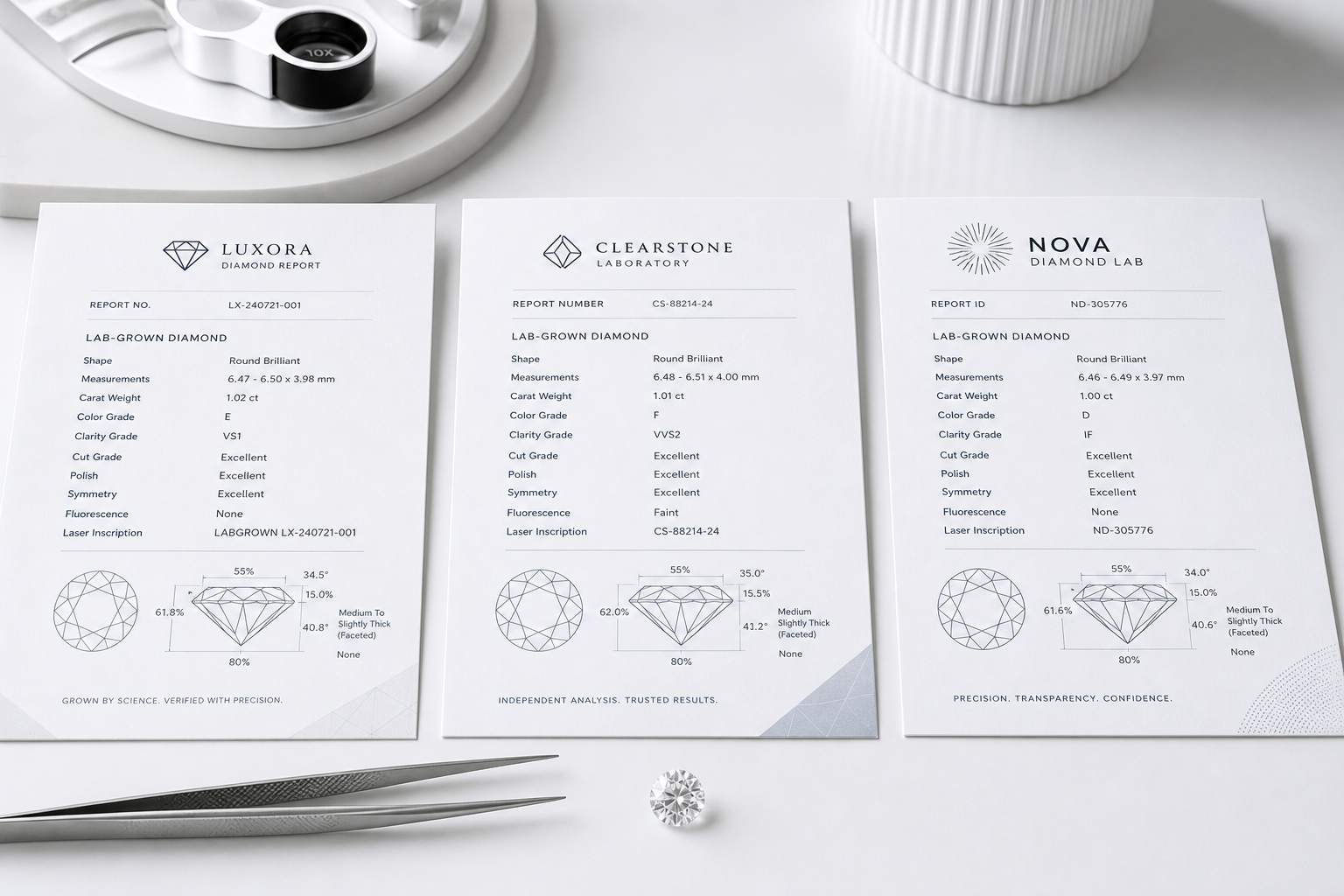
How IGI, GIA, and GCAL Are Commonly Used in Lab-Grown Diamond Buying
IGI, GIA, and GCAL each appear in lab-grown diamond buying for different reasons. None of them should be reduced to a simple “good” or “bad” label. A buyer is usually better served by understanding where each report is commonly encountered and what kind of confidence it tends to support.
IGI: common availability across lab-grown diamond listings
An IGI lab-grown diamond report is commonly seen across online lab-grown diamond inventories. Buyers comparing loose stones, especially in popular sizes and shapes, will often encounter IGI documentation because many lab-grown diamonds in the retail market are listed with IGI grading.
The practical advantage is comparability. If a buyer is reviewing several diamonds with similar shapes, carat weights, color grades, and clarity grades, IGI reports can make it easier to compare options within a large inventory. That does not mean every IGI-graded diamond is a strong buy. It means the buyer will often have more choices to compare, which can be useful when the goal is to balance size, appearance, and documentation.
The risk is assuming availability equals quality. A common report type can help with search and comparison, but it does not replace checking proportions, images, video, and whether the listed stone actually fits the intended design.
GIA: broad name recognition and institutional familiarity
A GIA lab-grown diamond report may appeal to buyers who place value on broad institutional recognition. GIA is familiar to many U.S. consumers and jewelers because of its role in diamond grading and diamond education. For buyers who feel more comfortable with a name they have heard before, that familiarity can reduce hesitation.
This recognition can be useful in conversations with jewelers, family members, or anyone helping evaluate the purchase. A familiar grading lab may make the documentation easier to understand and discuss. Still, name recognition should not be treated as a shortcut around reviewing the stone. A GIA report can support confidence, but it does not automatically make one diamond more visually appealing than another diamond with a different respected report.
The better use of GIA documentation is as part of a complete review: confirm the report, compare the listed details, evaluate the diamond’s appearance, and judge whether the asking price makes sense against similarly documented stones.
GCAL: documentation depth and performance-oriented report options
A GCAL lab-grown diamond certificate is often discussed by buyers who care about documentation depth, especially when the report includes performance-oriented information. Certain GCAL report formats may provide more cut-performance context for qualifying diamonds than a basic identity-focused document.
This can be valuable for buyers who want more than basic identity and grading information. For example, someone choosing a high-visibility center stone may care about whether the documentation gives more support around cut and optical performance. That added detail may be especially attractive when the buyer is comparing fewer stones but wants more evidence behind the final choice.
The limitation is that deeper documentation is not automatically necessary for every purchase. A smaller accent diamond, a lower-stakes jewelry piece, or a stone with excellent visual evidence may not require the same level of report depth as a larger engagement ring center stone. GCAL can be a strong fit for buyers who value more supporting information, but the certificate still needs to be read alongside the actual diamond.
Why common use does not automatically mean better or worse
A report’s popularity in the market does not prove that it is the better report for every buyer. IGI may be easier to find across broad lab-grown inventory. GIA may feel more familiar to buyers who already associate the name with diamond grading. GCAL may stand out when performance documentation is part of the decision. Those are different strengths, not a universal ranking.
The practical mistake is choosing by habit. A buyer who wants the widest selection may naturally see more IGI reports. A buyer who wants a familiar institutional name may lean toward GIA when available. A buyer focused on cut-performance documentation may pay closer attention to GCAL. The right report depends on what the buyer needs the documentation to do.
What the Report Actually Says: Format, Language, and Detail Level
The value of a lab-grown diamond report depends on more than the logo at the top. The format, wording, and level of detail affect how useful the report is during a real buying decision. A clear report helps the buyer verify the diamond’s identity, compare it against other stones, and identify where visual review is still needed.
Basic identity fields: report number, shape, measurements, and carat weight
The first details to check are the identity fields. The report number should match the listing and be searchable through the grading lab’s official verification system. The shape should match the stone being shown, and the measurements should make sense for the listed carat weight.
Measurements are more important than many first-time buyers realize. Two diamonds with the same carat weight can face up differently if one carries more weight in depth and the other spreads more across the top. For a 2.00 ct oval, for example, length, width, and depth can affect whether the diamond looks elegant and balanced or heavy and undersized for its weight. Carat tells you weight; measurements tell you more about visible presence.
This is where buyers should slow down. If the report lists dimensions that do not match the seller’s listing, or if the diamond looks visually smaller or oddly shaped compared with similar stones, the issue deserves clarification before moving forward.
Quality fields: color, clarity, cut, polish, symmetry, and fluorescence
Quality fields help buyers compare the diamond’s graded characteristics, but not every grade carries the same practical weight in every shape. Color and clarity matter, but their importance changes depending on cut style, size, setting metal, and how visible inclusions are in the specific stone.
For round brilliant diamonds, reports often provide more standardized cut-related information. Buyers may compare cut grade where available, table percentage, depth percentage, crown angle, pavilion angle, polish, symmetry, and fluorescence. These numbers are useful screening tools because round brilliants have more established proportion relationships, but they should not be treated as a guarantee that every diamond with attractive numbers will look equally lively.
For fancy shapes, the report can be more limited as a beauty predictor. An oval, pear, marquise, radiant, cushion, or emerald cut may have strong color and clarity grades while still showing visual issues that the report does not fully capture. Polish and symmetry still matter, but they are not the same as light performance, face-up balance, or pattern appeal.
Fluorescence is another field that can be overinterpreted. Its practical effect depends on the individual diamond and viewing conditions, so it should be checked in context rather than treated as automatically good or bad. If fluorescence is listed and the stone also appears hazy, oily, or unusually muted in video, ask for clearer visual evidence before assuming the grade tells the whole story.
Lab-grown disclosures: growth method, treatment language, and origin wording
Lab-grown diamond reports may include wording related to lab-grown origin, growth method, and post-growth treatment disclosure when listed. These details help distinguish the stone from a natural diamond and clarify the type of documentation being provided.
Buyers should read this language carefully but avoid overreacting to terms they do not understand. The most important point is that the report clearly identifies the diamond as lab-grown and that the seller’s description matches that disclosure. If treatment language appears, it should not be ignored, but it should be interpreted in context rather than treated as an automatic rejection.
The warning sign is not the presence of technical language; it is vague selling language that avoids matching the report. If a listing describes a stone in broad promotional terms but does not clearly connect those claims to the certificate, the buyer should ask for the report number and verify the details directly.
Growth-method language, such as HPHT or CVD when disclosed, can help buyers understand how the diamond was produced, but it does not by itself determine beauty or value. A CVD-grown diamond can still need review for transparency, strain-like appearance, or post-growth treatment wording, while an HPHT-grown diamond still needs the same checks for cut, color, clarity, measurements, and visual performance. The practical point is to use the disclosure as context, not as a shortcut around evaluating the stone.
Disclosure language and marketing claims should match
For lab-grown diamonds, clear disclosure is part of buyer protection. The report, product title, product description, invoice language, and sales conversation should all describe the stone consistently as lab-grown. If one document says “lab-grown,” another says “diamond” without context, and the sales copy relies on vague phrases, the buyer should ask the seller to clarify the exact nature of the stone before purchase.
The same caution applies to environmental or ethical claims. A seller may describe lab-grown diamonds as a different sourcing path from mined diamonds, but broad claims such as “eco-friendly,” “carbon-neutral,” or “sustainable” should be supported by specific documentation rather than assumed from the growth method alone. In a careful buying decision, the certificate helps establish identity; separate evidence is needed for broader sourcing or environmental statements.
Sustainability language is most useful when it is specific. Buyers can ask what the claim is based on, whether it relates to production energy, facility practices, packaging, sourcing records, or another defined factor. A grading report can identify a diamond as lab-grown, but it should not be treated as proof of every environmental or sourcing claim attached to the listing.
Why fancy shapes need more than report data
Fancy shapes require more visual judgment than a report can provide. For ovals, pears, and marquises, bow-tie visibility can make or break the diamond’s appeal, demonstrating diamond certificate limitations. For emerald cuts, the openness of the step-cut pattern can make inclusions or body color more noticeable. For radiants and cushions, the buyer may prefer a different facet pattern or light return style even when the grades look similar.
Length-to-width ratio is a practical example. An oval with a more elongated ratio may look elegant in a solitaire setting, while a shorter oval may feel softer and more balanced in a halo or three-stone design. The report can give the measurements needed to calculate the ratio, but it cannot tell the buyer which outline looks best for the intended ring.
This is why image and video review becomes essential. A certificate can help confirm what the diamond is. It cannot fully show how the diamond behaves when it moves.
Certificate and Visual Review Check
Use the report to confirm the facts first: report number, shape, carat weight, measurements, color, clarity, polish, symmetry, fluorescence, and inscription information when available. Then use visual evidence to judge what the report cannot fully answer, especially brightness, contrast, bow-tie effect, transparency, face-up shape, and overall appeal.
The strongest purchase is not always the diamond with the longest report or the most familiar lab name. It is the diamond where the certificate, listing details, visuals, and intended setting all support the same conclusion.
Laser Inscription and Report Verification: The Buyer’s First Safety Check
How report-number lookup works
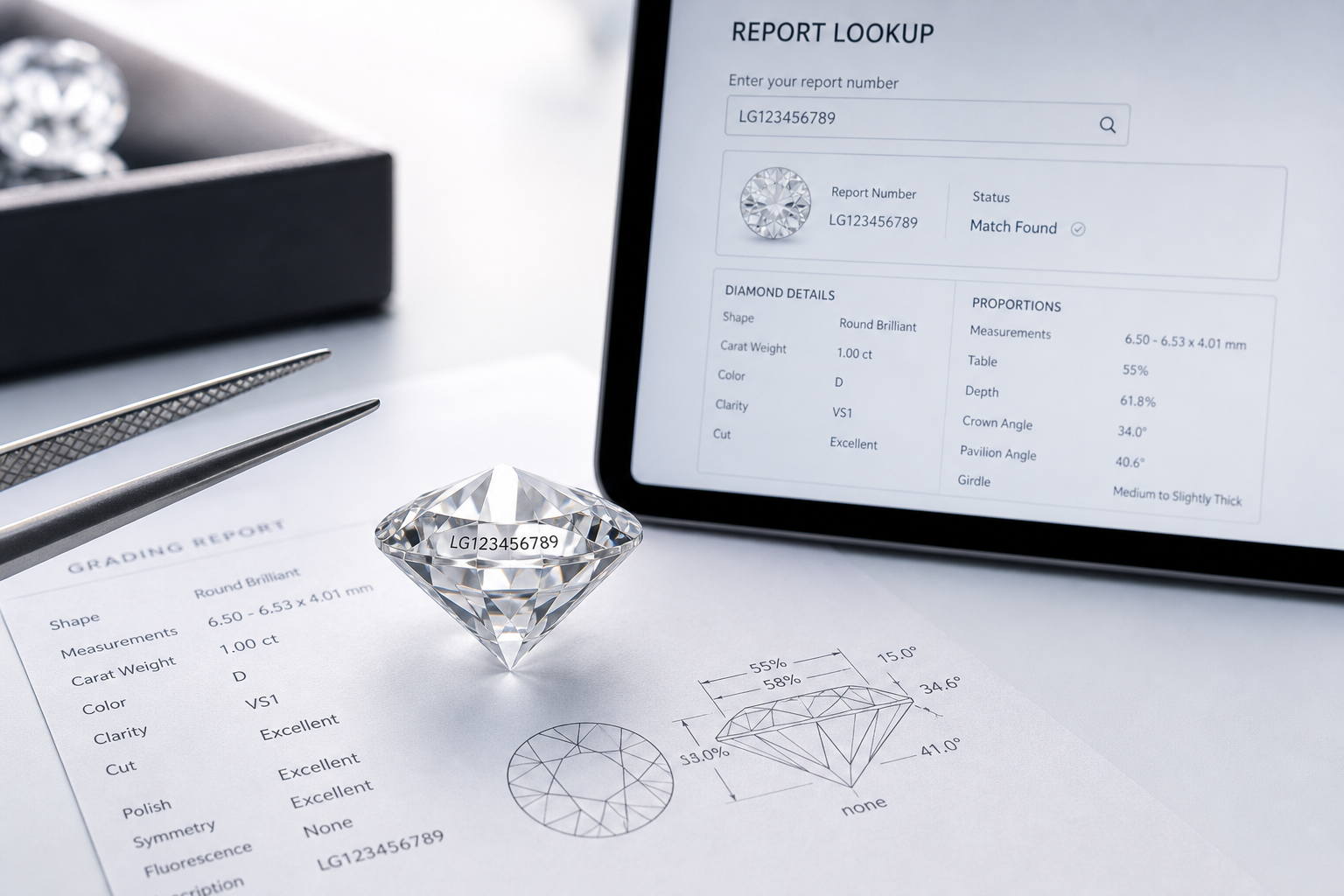
The first safety check is simple: verify the diamond report number with the grading lab that issued it. IGI, GIA, and GCAL each provide an official report lookup tool where buyers can enter the certificate or report number and confirm that the record exists.
This lookup should not be treated as a quality verdict. It is an identity check. The goal is to confirm that the report number, carat weight, shape, measurements, color, clarity, and other listed details match the diamond being offered. If the seller’s listing says the stone is a 2.00 ct oval with a specific color and clarity grade, the report lookup should support those same facts without unexplained differences.
A small mismatch in wording may not always be a problem, especially if a seller abbreviates a grade or description. A mismatch in carat weight, shape, measurements, report number, or lab name is different. Those are core identity fields, and they should be clarified before a buyer moves forward.
What laser inscription can and cannot prove
A lab-grown diamond laser inscription is usually placed on the girdle, the thin outer edge of the diamond. It often includes the grading lab initials and report number, allowing the physical stone to be matched to the grading report. For buyers shopping online, this is one of the most useful ways to connect the diamond in the listing with the document being shown.
The inscription is microscopic. Most buyers will not see it with the naked eye, and even in person it may require magnification and the right viewing angle. Online, the seller may provide a magnified image, video confirmation, or written confirmation that the inscription matches the report number.
The laser inscription helps confirm identity, but it does not prove that the diamond is beautiful, well-cut, or the right choice for a ring. A stone can have a matching inscription and still show weak light return, an obvious bow-tie in an oval, or proportions that make it face up smaller than expected. Treat the inscription as a strong identity tool, not as a shortcut around visual review.
Matching the report to the seller’s listing
After the report lookup and inscription check, compare the report against the seller’s listing line by line. The most important items are the report number, lab name, shape, carat weight, measurements, color grade, clarity grade, and any inscription information. If the listing includes a 360-degree video or magnified images, the diamond shown should correspond to the same stone, not a generic example.
This step matters because online diamond listings can look very similar. Two stones may both be described as 1.80 ct, F color, VS1 clarity, and excellent polish, but their measurements, proportions, and visual behavior may differ. Report matching prevents a buyer from relying on the right certificate for the wrong stone.
If the seller cannot confirm whether the inscription matches the report, that does not automatically mean the diamond is unacceptable. Some situations may require extra clarification, especially with older reports or certain inventory systems. Still, for a significant center stone, a buyer should not have to guess. Clear documentation and consistent listing details are basic conditions for confidence.
When the evidence does not line up
If the report lookup works but the seller’s listing shows different measurements, a different shape description, or a different grade, pause the comparison until the discrepancy is explained. A reliable seller should be able to identify whether the issue is a listing typo, a data-feed mismatch, an outdated document, or the wrong report attached to the wrong stone.
Do not solve a documentation mismatch by choosing the interpretation that makes the diamond look like a better deal. If the report says one thing and the sales page says another, use the issuing lab’s record and the seller’s written clarification as the basis for the decision. For a meaningful center-stone purchase, uncertainty around identity is a stronger concern than small differences in price or grade preference.
Buyer Verification Checklist
- Enter the report number on the grading lab’s official lookup page, not a third-party page.
- Confirm that the lab name, report number, shape, carat weight, and measurements match the seller’s listing.
- Check whether the diamond has a laser inscription and whether it matches the report number.
- Ask for magnified images, 360-degree video, or seller confirmation when inscription visibility is not shown.
- Do not use report verification as a substitute for reviewing the diamond’s actual appearance.
The practical rule is straightforward: verify the document first, then judge the diamond. If the report, inscription, and listing do not line up cleanly, resolve that issue before comparing beauty, price, or setting options.
Consistency, Strictness, and the Problem With Simple Lab Rankings
Why buyers ask whether one lab is “stricter”
Many buyers comparing IGI vs GIA grading consistency are really asking a practical question: can they trust that the grade means what it appears to mean? This is reasonable. A one-grade difference in color or clarity can affect how a diamond is positioned, compared, and priced, especially when two stones look similar in an online listing.
The problem is that “which lab is stricter?” is too blunt to answer every buying situation. Grading involves standards, human evaluation, report format, lighting conditions, diamond type, and the specific characteristics of the stone. A broad reputation may be useful context, but it should not replace a careful comparison of the actual report and diamond.
Claims such as “GIA is always stricter” or “IGI always grades softer” are not careful enough for a real purchase. They may reflect market perceptions, individual experiences, or comparisons from specific stones, but they are not a reliable substitute for checking the diamond in front of you.
Where small grading differences can affect confidence
Small grading differences matter most near decision thresholds. If a diamond is listed as F color instead of G, or VS1 clarity instead of VS2, the difference may influence how buyers compare it against similar stones. The practical question is not whether one grade is emotionally better, but whether the grade difference is visible, relevant to the setting, and reflected fairly in the price.
Color sensitivity depends on shape, size, metal color, and personal preference. A near-colorless grade may look very clean in a yellow gold setting, while the same grade may be more noticeable in a larger step-cut diamond set in platinum. Clarity works the same way. A VS2 can be a smart choice if it is eye-clean, while a higher clarity grade may be less meaningful if the inclusions were never visible to begin with.
GCAL vs IGI lab-grown diamonds introduces another layer because the comparison may involve report scope, not just grading strictness. Some GCAL reports may provide additional information about cut performance. That can be valuable for buyers who care about documentation depth, but it does not automatically make every GCAL-graded stone superior to every IGI-graded stone.
Why the actual diamond still matters more than the rumor
The strongest decision usually comes from combining the report with visual evidence. A buyer comparing two 1.50 ct round lab-grown diamonds, both listed as F VS1, may see one with a lower price and an IGI report, and another with a GIA report plus stronger seller-provided video. The better choice is not decided by the lab name alone.
The buyer should ask whether the cut data, report verification, laser inscription, visual performance, and price difference support the purchase. If the IGI stone has excellent proportions, clean video, a verified inscription, and a meaningful price advantage, it may be the better buy. If the GIA stone has stronger documentation, better video, and visibly better light return, the higher price may be easier to justify.
This is where simple rankings fail. A grading lab’s reputation can increase comfort, but it cannot rescue a diamond with weak visuals or poor fit for the intended design. At NUVU, we usually treat the grading report as a starting point, not the final answer, because the report narrows the comparison but does not show every real-world viewing condition.
What This Means in a Real Purchase
Use grading strictness claims as context, not as a rule. If two diamonds are close in size, shape, and stated grade, the next step is to compare verification, visual evidence, proportions, and price alignment. A familiar lab name may justify more confidence, but it should not justify ignoring the stone itself.
The clearest warning sign is not a particular lab logo. It is a decision based on reputation without checking whether the report, inscription, listing, and visual evidence all support the same diamond. That is where buyers are most likely to overpay or choose a stone that looked better on paper than it does in a ring.
Market Recognition: How Each Lab Affects Buyer Confidence
Name recognition and why it influences comfort
Lab-grown diamond certificate recognition matters because buyers are not only evaluating the stone; they are also evaluating how easy the documentation is to understand and trust. A recognized grading lab gives the buyer a shared language with sellers, appraisers, designers, and comparison tools.
For many U.S. consumers, GIA carries broad name recognition because of its role in diamond education and grading. That familiarity can make buyers more comfortable, especially if they are new to lab-grown diamonds or making a high-stakes center-stone purchase. The value of that recognition is psychological and practical: it helps buyers feel that the report comes from a widely known source.
Recognition does not mean the diamond is automatically more beautiful, more durable, or a better value. It simply means the report may be easier for many buyers to understand, discuss, and compare. That distinction matters because confidence should come from both the document and the diamond, not from the lab name alone.
Availability and comparability in online lab-grown diamond listings
IGI is often visible in online lab-grown diamond inventories, which makes it useful for comparison shopping. A buyer browsing dozens of loose stones may see many IGI reports with familiar fields, similar formatting, and enough detail to compare carat weight, measurements, color, clarity, and other basics across multiple listings.
This availability can be a real advantage. If a buyer wants a specific combination, such as a 2.00 ct elongated cushion in a tight color and clarity range, a market with many IGI-graded options may provide more practical choice. More choice does not automatically mean better quality, but it can help buyers avoid settling for a poorly matched stone simply because documentation options are limited.
The risk is treating common availability as proof of superiority. A widely available report type is helpful for search and comparison, but the buyer still needs to confirm the report number, inspect visual media, and make sure the measurements and appearance fit the intended piece.
When documentation depth may matter more than brand familiarity
GCAL may appeal to buyers who value deeper documentation, especially when a report includes performance-oriented information that supports the cut conversation. This can be particularly useful for buyers who are less comfortable judging light return from video alone or who want additional documentation around a high-value center stone.
In some purchases, report depth may matter more than broad name familiarity. A buyer choosing a round brilliant for an engagement ring may place extra weight on cut-performance documentation if the stone qualifies for it. A buyer choosing a fancy shape, however, may still need strong video and image review because no report format can fully show bow-tie strength, facet pattern appeal, or how the stone looks on the hand.
The better question is not which lab-grown diamond certificate is most recognized in isolation. It is whether the recognition, report detail, and seller-provided evidence give enough confidence for this specific purchase. A familiar lab can make communication easier, a common lab can make comparison easier, and a deeper report can make certain performance questions easier to evaluate.
For wholesale buyers or designers sourcing several stones for a collection, recognition also has a consistency function. A report format that is easy to verify and communicate can reduce confusion across multiple stones, but it still needs to be supported by matched measurements, comparable visual standards, and clear documentation from the supplier. Consistency in paperwork is helpful; consistency in the actual diamonds is what protects the final jewelry outcome.
In sourcing or wholesale conversations, the most useful trust signals are usually operational rather than promotional. Buyers should clarify how stones are matched, which report details are provided, how substitutions are communicated, and what evidence will accompany each stone or parcel before committing to a selection. Clear expectations reduce misunderstandings more effectively than relying on a lab logo alone.
What Buyers Should Compare Beyond the Lab Logo
A grading lab name can help you filter options, but it should not make the decision for you. Two certified lab-grown diamonds can carry similar grades and still look noticeably different once you compare their measurements, proportions, video, and fit for the intended setting. The stronger buying decision comes from reading the report as evidence, then checking whether the diamond itself supports what the paperwork suggests.
Report details: confirm the facts first
Start with the basics before comparing beauty or value. The report number should match the grading lab’s online record, and the seller’s listing should match the report for shape, carat weight, measurements, color, clarity, and any listed cut-related information. If the listing says one thing and the report says another, treat that as a reason to pause, not as a harmless clerical issue.
This is the first step in how to compare lab-grown diamond certificates properly: confirm identity before interpreting quality. A report that cannot be verified, a missing report number, or inconsistent measurements weakens buyer confidence even if the diamond appears attractive in photos. The certificate is not useful if it cannot be tied clearly to the exact stone being offered.
Cut data deserves special attention where available. For round brilliant diamonds, cut grade, polish, symmetry, table percentage, depth percentage, and angle information can help screen for stronger candidates. For fancy shapes, the report may provide fewer performance clues, so measurements and visual evidence become more important than the lab logo alone.
Visual evidence: photos and video still matter
A strong report plus weak visuals is not an ideal combination. High-resolution photos and 360 video help reveal things a grading report may not fully communicate, including light return, contrast pattern, bow-tie appearance, transparency, and whether the diamond looks lively or flat. This matters most when buying online, where the report is only one part of the evidence.
For oval, pear, marquise, and radiant cuts, watch for a dark bow-tie that dominates the center of the stone. Some contrast is normal, but a heavy, distracting bow-tie can make a diamond look less bright in real wear. For emerald and asscher cuts, clarity and transparency become more visible because the step-cut faceting does not hide inclusions as easily as brilliant-style faceting.
Haziness is another issue buyers often miss if they only compare grades. A diamond can have an attractive color and clarity grade while still showing a sleepy or strained look in video. If the stone looks dull in multiple lighting angles, the report should not override what the eye is seeing.
Measurements: why spread and proportions affect appearance
Carat weight tells you how much the diamond weighs, not how large it will look from the top. A 2.00 ct stone can face up smaller or larger depending on its depth and outline. This is why measurements often matter more than buyers expect, especially when comparing diamonds with the same carat weight.
Visual spread should be judged against shape and proportion. A diamond that is too deep may carry weight below the surface, making it look smaller than expected. A diamond that is too shallow may look wide but lose brightness or show awkward light leakage. The better option is not always the stone with the biggest face-up dimensions; it is the one where spread, brilliance, and outline work together.
Length-to-width ratio also changes the character of fancy shapes. An oval with a longer ratio can look elegant and slender, while a shorter oval may feel softer and fuller. Neither is automatically better, but the ratio should match the buyer’s taste and the setting style. A report gives the numbers; images and design context show whether those numbers make sense.
Setting compatibility: especially important for center stones
A certified lab-grown diamond may be excellent on paper and still be the wrong fit for a specific ring design. Center stones need to work with prong placement, basket structure, side stones, band width, and the wearer’s daily use. This is especially true for elongated shapes, step cuts, and larger stones where millimeter differences can affect balance.
For custom rings, measurements are not a minor detail. A stone with a wide table, unusually deep profile, or very elongated outline may require design adjustments. If the setting is already chosen, the diamond must fit the design. If the diamond is chosen first, the setting should be built around its actual dimensions rather than a generic carat weight.
At NUVU, we treat the grading report as the starting point for this kind of decision, not the final answer. The better question is not only whether the diamond is certified, but whether its dimensions, appearance, and documentation all support the way it will be worn.
For custom design, trust comes from matching the stone to the setting, budget, and wearer’s daily use, not from choosing grades in isolation. Before finalizing a loose stone, buyers should confirm the exact measurements, prong or bezel compatibility, height profile, side-stone relationship, and whether the chosen shape supports the intended ring style.
Stone-to-Setting Fit Check
Confirm the report number and make sure the listing matches the certificate details.
Compare measurements, not just carat weight, especially for center stones.
Review photos or 360 video for bow-tie, haziness, poor light return, or awkward outline.
Check whether the color and clarity make sense for the shape and setting style.
For custom designs, make sure the stone’s exact proportions can be accommodated before committing.
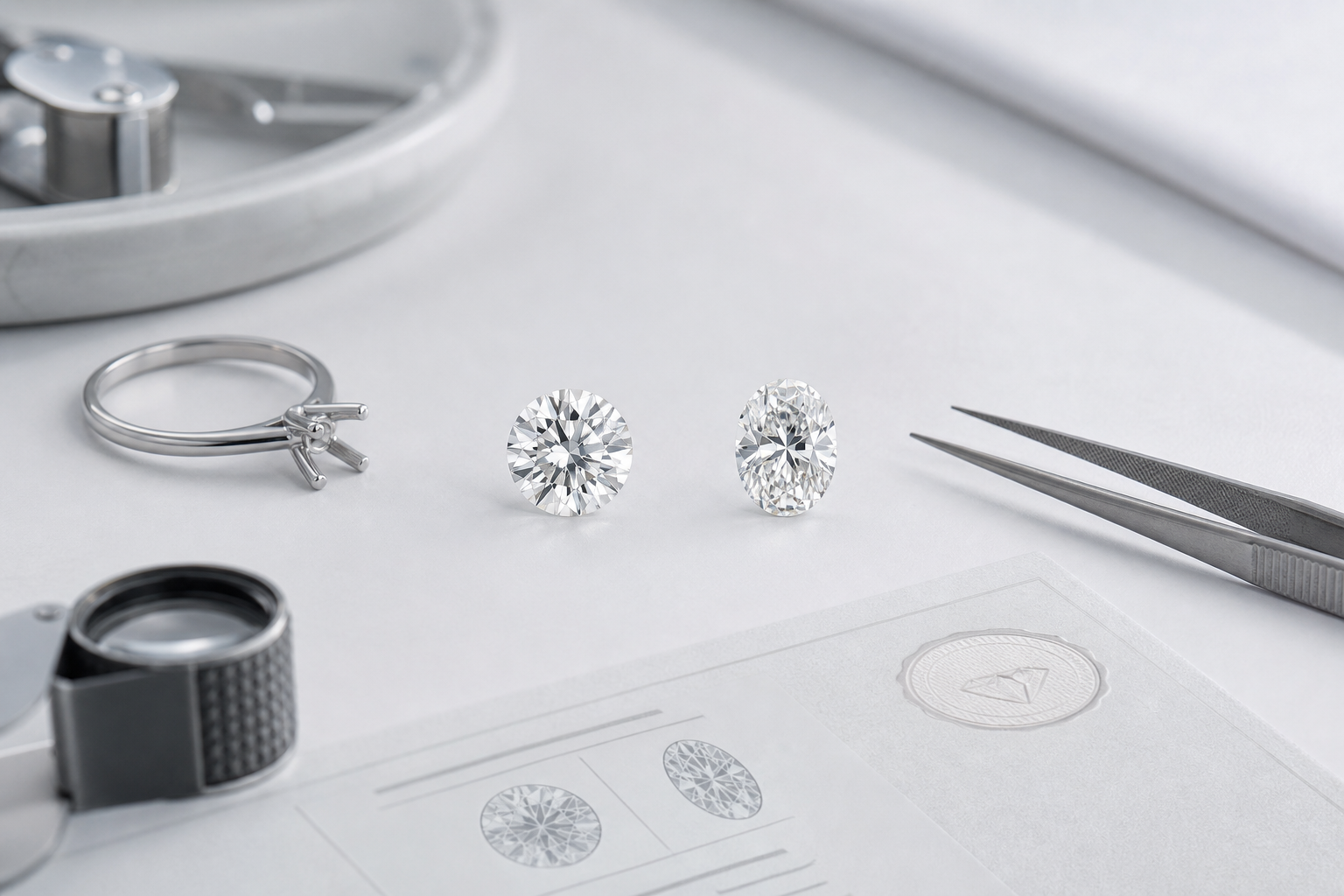
Which Report Fits Which Buying Scenario?
The most useful way to compare IGI, GIA, and GCAL is not to ask which one is best in every case. A better question is which report gives enough confidence for the diamond, purchase channel, and purpose. A casual pendant stone, a 2.00 ct engagement ring center diamond, and a custom oval ring do not need to be evaluated with the same level of documentation.
If you want the widest lab-grown diamond selection
Buyers who want the broadest range of lab-grown diamond options will often encounter IGI reports. IGI is widely seen across online lab-grown inventories, which can make it easier to compare many stones by shape, carat, color, clarity, measurements, and listed cut information where available.
This can be useful when you are narrowing a large search. If you want to compare multiple 1.50 ct to 2.50 ct ovals, cushions, or rounds across similar grades, commonly available documentation helps create a workable starting point. The mistake is assuming availability alone settles the decision. An IGI report can support a strong purchase, but it still needs to be matched with verification, visual media, and sensible proportions.
If you want the most familiar grading name
Some buyers feel more comfortable with GIA documentation because the name is widely recognized in diamond education and grading. For a buyer who is nervous about online purchasing or wants a report from a lab many jewelers and consumers already know, a GIA lab-grown diamond report may provide added comfort when available.
The tradeoff is that familiarity should not be treated as a substitute for the diamond’s actual appearance. A GIA report can make communication and comparison easier, but it does not guarantee that the stone is the better visual choice against another well-documented option. If the competing stone has clearer video, stronger measurements, and a verified report, the better decision may not be the one with the more familiar logo.
If you want deeper performance documentation
GCAL may be especially relevant for buyers who care about more detailed performance-oriented documentation, particularly when a stone has report features that address cut and optical behavior more directly. For buyers comparing high-importance center stones, that additional layer of information can be useful because the report may speak to more than basic identity and grade categories.
This does not mean every buyer needs GCAL, or that every GCAL-reported stone is automatically the right choice. The value of deeper documentation depends on the stone and the decision. If you are comparing two round brilliant diamonds and one has stronger performance documentation along with excellent visual evidence, that may carry real weight. If the report depth is strong but the stone’s video looks dull or the shape does not suit the setting, the documentation should not override the practical fit.
If you are choosing a diamond for a custom engagement ring
For a custom engagement ring, the report should support the design decision rather than sit apart from it. Measurements, shape outline, length-to-width ratio, depth, and visual character can all affect how the ring is built and how the diamond looks once set. This is why custom buyers should prioritize verified documentation, clear visuals, and stone-to-setting compatibility regardless of whether the report is IGI, GIA, or GCAL.
A high-value center stone deserves more careful comparison than a small accent diamond. For most significant center-stone purchases, independent grading provides useful protection and comparability. Uncertified stones are not automatically unacceptable in every jewelry context, but for an engagement ring center diamond, relying only on a seller’s description leaves too much room for uncertainty.
How to Match the Report to the Purchase
Choose broad availability when you need many comparable options and can evaluate visuals carefully.
Prioritize familiar institutional recognition if that helps you feel more confident in the purchase.
Consider deeper performance documentation when cut behavior and optical evidence are central to the decision.
For custom rings, give extra weight to exact measurements, shape outline, and how the stone will sit in the design.
For higher-value center stones, do not rely on the lab logo alone; require verification, images, video, and a coherent match between the report and the diamond.
When a report is provided, buyers should use the issuing laboratory’s official lookup tools where available and compare the verified details with the exact stone, listing, inscription information, and visual media before deciding.
Buyer Assurance: What Good Documentation Should Feel Like in Practice
A buyer should not have to decode conflicting paperwork or rely on vague promises. In a well-supported purchase, the report number, product listing, diamond video, measurements, and sales conversation should all point to the same stone. If a seller is careful about documentation, they should also be willing to explain what the report proves, what it does not prove, and where visual judgment still matters.
For NUVU buyers comparing IGI, GIA, and GCAL reports, the most useful support is usually practical rather than promotional: checking whether the certificate is readable, confirming whether the report details match the stone, comparing similar documented options, and discussing how the diamond will work in the intended setting. This kind of process gives buyers more confidence because it is based on traceable details, not on pressure to choose a particular lab name.
Documentation is also part of after-purchase clarity. A buyer should know which certificate accompanies the diamond, how to access the issuing lab’s report lookup when available, and what information should be kept with the jewelry record for insurance, appraisal, resizing, future servicing, or resale conversations. Keeping the certificate, invoice, and any design notes together helps protect the long-term record of the piece.
When Stronger Documentation Matters Most
Stronger documentation matters most when the cost of being wrong is higher. That does not always mean the most expensive diamond on the page. It usually means the diamond is visually important, difficult to judge from basic grades, being purchased online, or being used in a setting where exact proportions affect the final result.
Larger center stones and higher-stakes purchases
For center stones around 1.50 ct and above, many buyers benefit from more complete documentation, verified report details, and strong visual media. This is not a hard rule, but it is a practical threshold where small differences become more visible and the purchase usually carries more emotional and financial weight.
A larger diamond gives the eye more surface area to notice issues. A slight tint, visible inclusion, awkward facet pattern, or weak light return may stand out more than it would in a smaller stone. If the diamond is going into an engagement ring, stronger documentation is less about chasing a prestigious certificate and more about reducing uncertainty before the stone becomes the focus of daily wear.
Fancy shapes with more visual variables
Fancy shapes often need more scrutiny than round brilliants because their appearance is less fully captured by standardized report data. Ovals, pears, marquises, radiants, and emerald cuts can vary widely in brightness, symmetry impression, bow-tie strength, and face-up shape even when the grades look similar.
This is where relying on color and clarity alone becomes risky. An oval with a desirable color and clarity grade may still have a distracting center bow-tie. An emerald cut may look clean on paper but reveal visible inclusions or reduced transparency because of its open facets. A radiant may have the right size and grade combination but look crushed or uneven in video. Stronger documentation helps, but it should be paired with visual review rather than used as a replacement for it.
Online purchases where the report is only one part of verification
Online diamond buying puts more weight on documentation because the buyer is often making a decision without seeing the stone in person. In that situation, the report, seller listing, magnified images, and 360 video need to tell the same story. If one part of the evidence conflicts with another, the safer move is to ask for clarification or compare another stone.
A report lookup can confirm that the certificate exists and that the main details match the diamond record. It does not prove that the stone has strong light performance, that the video is representative of normal wear, or that the diamond will look right in the chosen setting. Stronger documentation is most valuable when it works together with transparent visual evidence.
Custom settings that depend on exact measurements
Custom settings make measurements more important than many buyers expect. A stone’s length, width, depth, and outline can influence prong placement, basket height, side-stone proportions, and the overall balance of the ring. A diamond that looks attractive as a loose stone may still require design adjustments if its proportions are unusual.
This matters especially for elongated center stones and rings with side stones, halos, bezels, or low-profile designs. The designer needs the actual measurements, not just the carat weight, to judge fit. For small accent stones, full individual reports may be less common or less practical; for a main center diamond, stronger documentation and precise measurements are usually worth prioritizing.
Common Mistakes Buyers Make With IGI, GIA, and GCAL Reports
Mistake 1: treating the lab logo as the whole decision
A grading lab name can influence confidence, but it should not carry the entire purchase. One of the most common lab-grown diamond certificate mistakes is assuming that an IGI, GIA, or GCAL report automatically settles the question of quality. It does not. The report identifies and describes the diamond; it does not show every visual behavior the buyer will notice once the stone is set and worn.
This matters most when two diamonds look similar on paper. A buyer may prefer the report from a more familiar lab, but if the other stone has stronger visual evidence, better proportions for its shape, and a verified inscription, the better choice may not be the one with the more recognizable logo. The lab logo should narrow the field, not end the comparison.
Mistake 2: ignoring report verification
A diamond grading report is only useful if it actually matches the diamond being sold. Buyers should confirm the report number through the grading lab’s official lookup tool and compare the returned details against the seller’s listing. Shape, carat weight, measurements, color, clarity, and report date should line up. If the diamond has a laser inscription, the inscription number should match the report number or the identifying information stated on the report.
The mistake is not just forgetting to verify the report; it is treating a PDF or listing image as enough. Report verification is a basic safety step, especially for online purchases. It does not prove the diamond is beautiful, but it helps confirm that the buyer is evaluating the right stone instead of relying on copied or mismatched documentation.
Mistake 3: comparing grades without comparing visuals
Color and clarity grades are useful, but they do not behave the same way across every shape, size, or setting. A VS1 clarity grade may be more than enough in many diamonds, while certain inclusions, growth features, or transparency concerns can still make a specific stone less attractive in real images. A color grade that looks safe in one shape may show more warmth in an elongated diamond, especially in a white metal setting.
Cut-related differences are even easier to underestimate. A certificate can list measurements, proportions, polish, symmetry, and sometimes cut or performance-related information, but it cannot fully replace video or high-quality imagery. Ovals, pears, marquises, radiants, and emerald cuts need particular visual review because bow-tie effect, windowing, dark zones, or uneven light return may not be obvious from the grade alone.
Price comparisons can also become misleading when buyers match only carat, color, and clarity. A lower-priced diamond may be a good value, but only if the report quality, measurements, shape, cut data, visual performance, and verification all support the discount. A cheap comparison is not useful if the stones are not truly comparable.
In practical buying, the most useful comparison is a like-for-like comparison: similar shape, similar measurements, similar report confidence, similar visual quality, and similar setting suitability. If one stone is cheaper because it faces up smaller, has weaker video, carries less complete documentation, or does not suit the intended design, the price difference may reflect a real tradeoff rather than a bargain.
Mistake 4: assuming every purchase needs the same level of documentation
Not every diamond purchase carries the same documentation burden. A larger engagement ring center stone deserves more careful review than a small accent stone, because the center diamond drives the appearance, budget, and long-term confidence of the piece. For a significant center stone, independent grading, report lookup, inscription confirmation, measurements, and visual media are not excessive; they are part of a reasonable buying process.
For smaller side stones or pavé diamonds, individual full reports may be less common and less practical. In that case, matching, consistency, and seller transparency may matter more than having a separate certificate for every tiny stone. The mistake is applying the same rule to every purchase instead of matching the documentation level to the role of the diamond.
Mistake 5: treating marketing language as evidence
Another common mistake is accepting promotional language as if it carries the same weight as a grading report. Phrases such as “premium,” “ideal-looking,” “sustainable,” “investment quality,” or “hand-selected” may express the seller’s positioning, but they do not replace verifiable report data, matched visuals, or clear seller documentation. If a claim affects the price or the buyer’s confidence, it should be supported by something more specific than attractive wording.
This is especially important when comparing lab-grown diamonds across different sellers. One seller may use conservative descriptions, while another may use more emotional language for a similar stone. The buyer should translate every listing back into evidence: What does the report verify? What do the images show? What does the video reveal? What does the seller confirm in writing? Claims that cannot be tied to evidence should have less influence on the decision.
Final Buyer Check Before Relying on a Report
- Verify the report number through the grading lab’s official lookup tool, not only through the seller’s listing.
- Confirm the diamond identity by checking shape, carat weight, measurements, and laser inscription details where available.
- Compare visual evidence, especially for fancy shapes where appearance can vary widely within the same grade range.
- Review measurements and proportions instead of assuming carat weight alone tells you how large or balanced the diamond will look.
- Match documentation to the purchase; a high-value center stone deserves more scrutiny than a small accent diamond.
The Practical Bottom Line: Choose the Report That Fits the Diamond and the Decision
There is no single best lab for every buyer
The most useful way to approach IGI vs GIA vs GCAL lab-grown diamonds is not to ask which certificate is universally best. A better question is which report gives enough confidence for the diamond, the buying channel, and the intended use. IGI is commonly seen across lab-grown diamond inventories and can make broad comparison easier. GIA carries strong name recognition and institutional familiarity. GCAL may be especially relevant when the buyer values deeper performance-oriented documentation for qualifying stones.
Those strengths matter in different situations. A buyer browsing a wide online selection may naturally encounter many IGI-graded stones. A buyer who wants the comfort of a widely recognized grading name may lean toward GIA when comparable options are available. A buyer focused on cut-performance evidence may give more weight to GCAL documentation. None of these choices is automatically right without checking the actual diamond.
Use the report to support the decision, not replace it
A diamond certificate should help confirm facts: identity, origin, measurements, carat weight, color, clarity, and other listed grading details. It should also make the stone easier to compare against similar documented options. What it should not do is replace judgment about appearance, setting fit, or whether the price makes sense for the full package.
The strongest buying decisions usually combine report verification with visual review. If a diamond has a respected report but weak imagery, unclear measurements, or a questionable listing, the certificate alone should not carry the purchase. If a diamond has common documentation but strong visuals, verified identity, suitable proportions, and a setting-friendly shape, it may be a more practical choice than a stone chosen only for the lab name.
The strongest choice is the one with aligned documentation, visuals, and purpose
The right report is the one that matches the risk and importance of the purchase. For a larger center stone, stronger documentation and careful verification are worth prioritizing. For a custom engagement ring, measurements and proportions matter because the diamond has to work physically with the design. For online buying, report lookup, inscription confirmation, and video review help reduce uncertainty before the stone is set.
IGI, GIA, and GCAL can all play useful roles in lab-grown diamond buying. The buyer’s job is to understand what each report helps verify, where the report has limits, and whether the diamond itself supports the decision. A good certificate creates confidence, but the better purchase is the one where the documentation, visuals, proportions, and intended setting all point in the same direction.