
When you buy a lab-grown diamond, a grading report confirms the 4Cs of that single stone. But if you are sourcing diamonds repeatedly—whether for a retail showcase or a wholesale inventory—the lab grown diamond certificate tells you almost nothing about the next order. Will the next batch match? Was the rough sourced ethically and consistently? Can you prove it to your own customers? The article below breaks down the critical difference between a certificate and true supply chain transparency. It will help you evaluate whether a supplier can deliver the consistency, traceability, and accountability that repeat buying demands, rather than just a piece of paper for a single stone.
For the full framework, read Lab-Grown Diamond Traceability, Certification, and Transparency Guide.
| Buying Scenario | What You Get from a Grading Report | What Documented Transparency Adds |
|---|---|---|
| One-time retail purchase | 4Cs confirmation for that specific stone | Origin and growth record for personal assurance |
| Repeat B2B orders from same supplier | No guarantee of batch-to-batch consistency | Batch IDs and documented grading tolerances |
| Verifying ethical sourcing claims | No chain-of-custody or production record | Rough batch logs and cutting audit trail |
| Resolving a quality dispute | Limited to the stone’s final grade | Batch records shift evidence burden to supplier |
| Choosing a long-term partner | A transaction, not a relationship | Consistent pass rates and replicable quality specs |
Quick Questions Before You Read
Q: My supplier provides a grading report. Is that enough for ongoing orders?
No. A grading report confirms a single stone. For repeat consistency, you need documented batch IDs, grading tolerance policies, and inspection pass rates to prove the supplier can replicate quality.
Q: What documents should a transparent supply chain provide beyond the certificate?
Rough batch logs, cutting records (to prevent swapping or undisclosed treatment), and a chain-of-custody record. These layers create an audit trail that a simple 4Cs report cannot.
Q: Doesn’t a certificate prove ethical origin for lab-grown diamonds?
It proves the 4Cs, not the full production history. True traceability requires batch numbers and growth records that verify how and where the diamond was created from rough to finished stone.
Q: If I buy in bulk, can I just trust a new supplier after one good order?
Not without documented procedures. A good first order means little if there are no batch IDs or consistency policies. Documented transparency shifts the risk of variation back to the supplier, protecting your repeat orders.
Understanding Supply Chain Transparency in Lab-Grown Diamonds: A Dual-Perspective Guide
Most articles about lab-grown diamond transparency treat the topic as one thing. It is not. What a retail buyer needs to feel confident about a single diamond is very different from what a jeweler or brand needs to trust a supplier across multiple orders. Confusing the two leads to misplaced expectations: a consumer might think a single certificate proves everything, while a B2B buyer might rely on surface-level documentation that masks serious gaps in consistency. Understanding why transparency means different things at different buying levels prevents both mistakes.
Why Consumer-Facing Transparency Is Only Half the Picture
For the retail buyer, transparency has a clear meaning: a personally identifiable grading report from a recognized lab such as IGI or GIA. That certificate proves a specific stone’s 4Cs, confirms it is lab-grown, and links it to a unique serial number or laser inscription. The consumer’s question is simple: “Is this exact diamond what I am paying for?” A single report answers that question. But that same report tells a B2B buyer very little about whether the next stone from the same source will match, whether the supplier can maintain quality across repeated orders, or whether the stone’s production history is verifiable beyond the grading stage.
What to Verify Before You Buy as an End Consumer
The first step is checking the report number against the issuing lab’s online database. Every major lab provides free verification. Second, review 360-degree video or high-resolution images to look for clarity characteristics and windowing—a condition where the stone lacks depth and allows the setting beneath it to show through. Third, confirm that the stone’s actual measurements match the setting you plan to use. A well-graded diamond can still fail visually if its proportions do not fit the prongs or bezel properly.
What Retail Consumers Actually Need to Confirm—And What They Don’t
A consumer’s transparency needs are narrow and self-contained. You need to confirm that the diamond in your hand matches the report, that it looks good under natural and indoor lighting, and that it fits the ring setting. You do not need batch documentation, production logs, or third-party audits of the growth facility. You do not need evidence that the supplier can replicate a similar stone for a matching pair or a future order. Your confidence rests on a single transaction, and when that transaction is complete, your risk is resolved.
Why the B2B Transparency Requirement Is Fundamentally Different
A jeweler or brand buying twenty diamonds in a single order has a fundamentally different question: “Do all these stones meet a consistent standard?” A single certificate per stone confirms each diamond’s individual grades, but it does not guarantee that the batch has uniform cut proportions, consistent color across the range, or similar visual behavior. The B2B buyer needs documented traceability that can survive the retail sale downstream. When an end consumer asks “Where did this stone come from?” the jeweler needs an answer that is verifiable, not just a photocopy of a certificate.
The Core Difference Between a Certificate and True Documentary Traceability
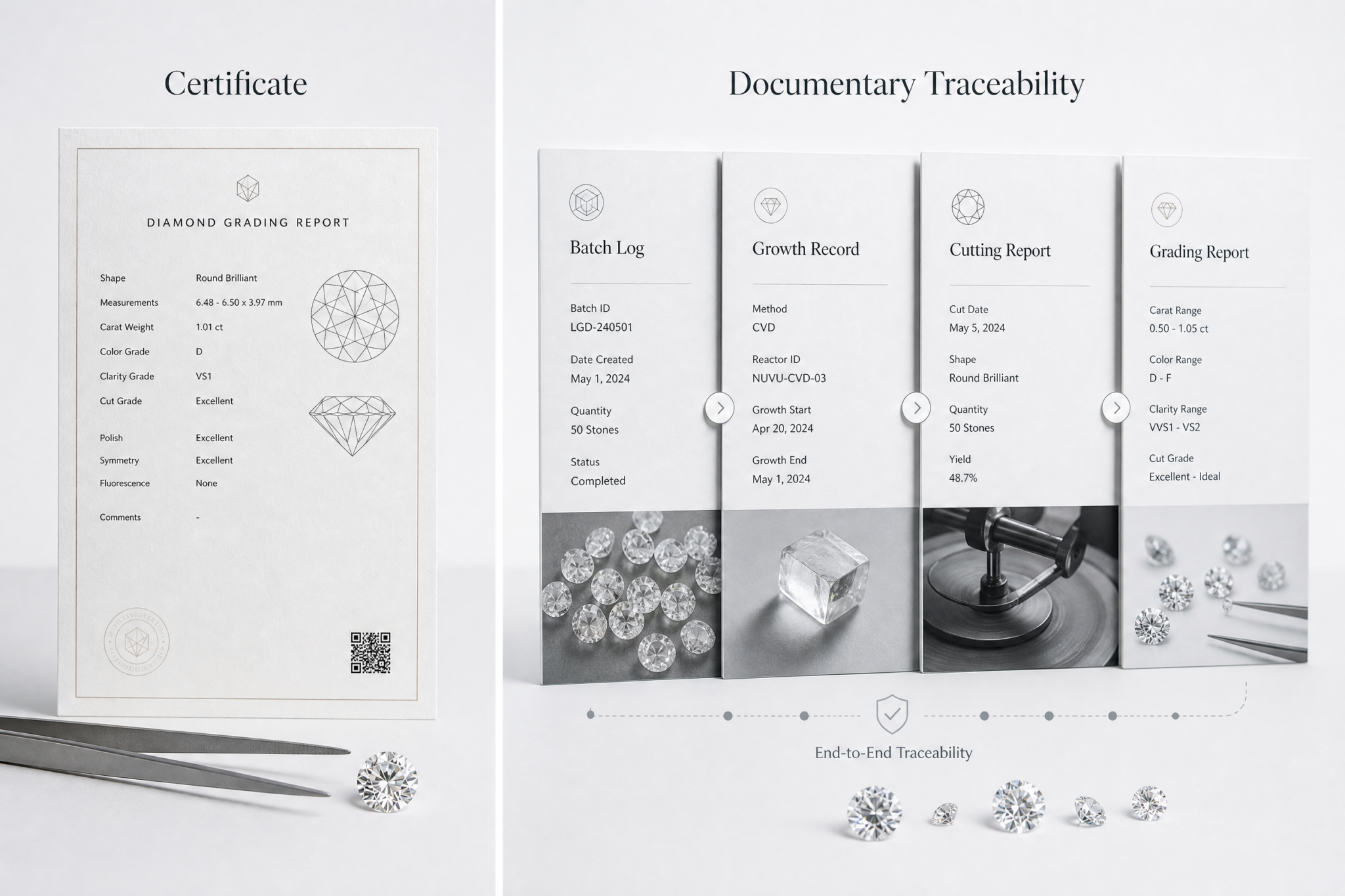
A grading report is often presented as proof of transparency. It is not the same thing as traceability. The difference matters most to B2B buyers, who need to know not just what a stone is, but whether they can trust the system that produced it.
What a Single Grading Report Confirms
A standard grading report from IGI, GIA, or GCAL confirms cut, color, clarity, carat weight, fluorescence, and symmetry and polish grades for one stone. That is the full extent of what it proves. It does not confirm which factory grew the diamond, whether its production was energy-monitored, whether it came from a repeatable batch, or whether any post-growth treatment has been applied unless the report explicitly notes it. A certificate is a snapshot of a finished diamond, not a record of how it arrived there.
What Documentary Traceability Adds for the B2B Buyer
Real traceability extends far beyond the grading report. It includes production batch numbers, the growth method used—CVD or HPHT—records of the rough stone’s origin, cutting facility documentation, and a chain-of-custody report that links each stage. For a B2B buyer, this documentation serves a practical purpose: it allows you to re-order the same quality of stone and trust that it matches previous batches. Without batch-level data, every order is essentially a gamble on whether the supplier can repeat their own work.
Why “Traceability” Is Not a Single Document
A single QR code on a package does not equal traceability. The code is only as useful as the data behind it. If that data is incomplete, unverifiable, or stops at the grading lab, it is marketing, not transparency. A real traceability system requires a linked, auditable chain that follows the diamond from rough material through growth, cutting, grading, and final sale. Each link must be documented and independently verifiable. Anything less leaves a gap that can undermine trust, especially for B2B buyers whose reputation depends on what they pass along to their own customers.
Supplier Accountability: The Metric That B2B Buyers Can’t Afford to Ignore
Transparency without accountability is just documentation. The difference between a one-time retail transaction and a long-term B2B relationship is whether the supplier stands behind what their documents claim.
Accountability in a One-Time Retail Purchase
For a retail buyer, accountability is governed by return policies, warranty terms, and the retailer’s reputation. If the diamond does not meet expectations, you return it. The risk is limited to a single purchase, and it is resolved once the piece is in hand and performs as expected. The retailer’s long-term reliability is irrelevant because you are not coming back to place a second order.
Accountability in Repeat B2B Sourcing
B2B accountability is measured differently. A supplier must demonstrate consistent grading tolerance across multiple orders—for example, committing that all stones will fall within a defined range of stated color and clarity across the batch. When a shipment fails inspection, the supplier must respond with corrective action, not excuses. The relevant metrics are order history, inspection pass rates, and communication speed when something goes wrong. A supplier who cannot document their own consistency is a supplier who cannot be relied upon for repeat sourcing.
How to Verify Supplier Accountability Before a Repeat Order
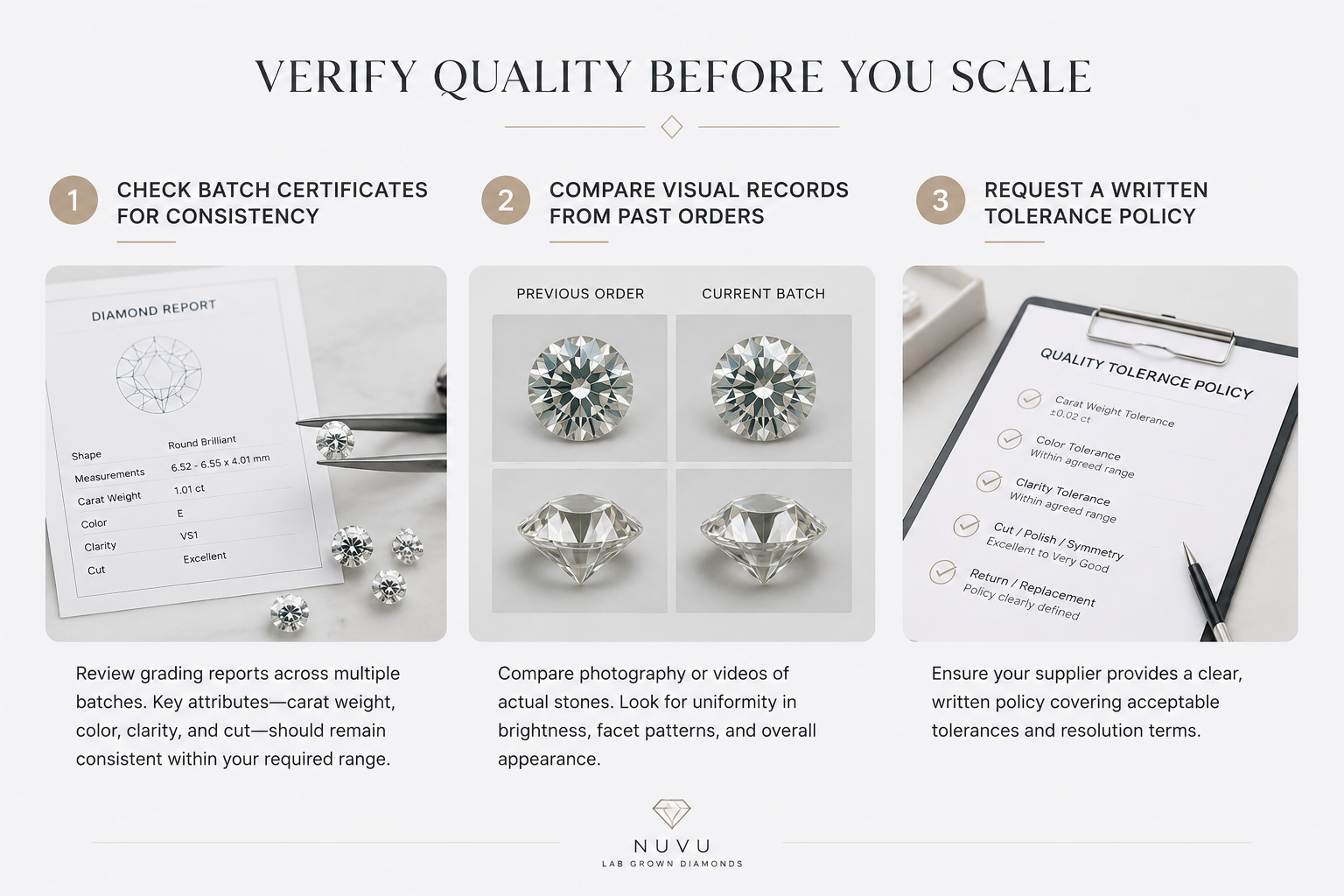
Three checks are useful. First, review the grading consistency across multiple certificates from previous batches. Look for whether stones labeled the same grade actually cluster within a narrow range or drift near the lower boundary. Second, request photos or videos of stones from past orders to compare visual consistency—grading reports cannot capture how a diamond actually appears under light. Third, ask for a written statement of the supplier’s tolerance policy for color, clarity, and cut within a batch. A supplier who refuses to put that policy in writing is a supplier who does not want to be held to it.
Documentation Flow: From Rough Feedstock to Finished Jewelry
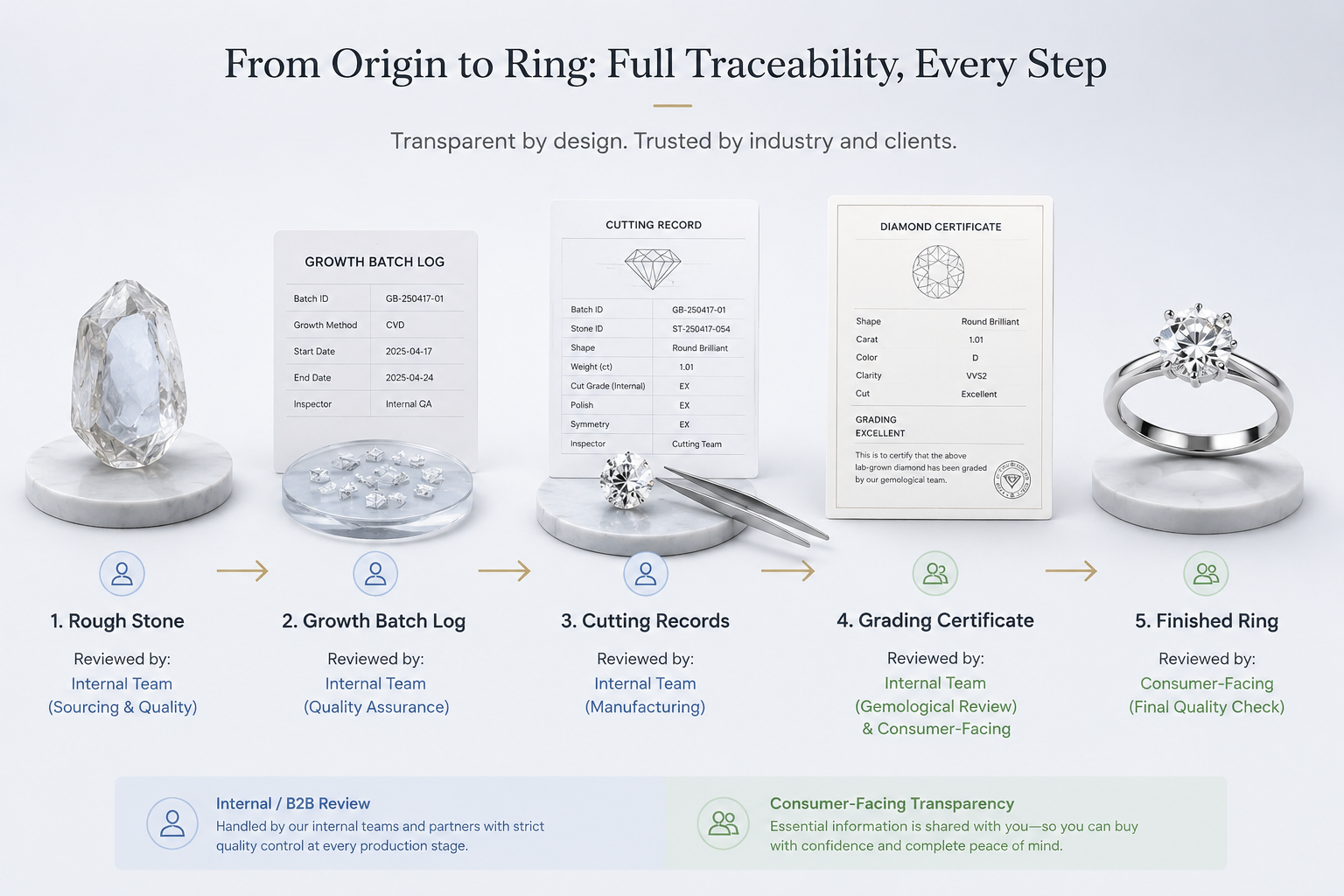
A single grading report is not a supply chain. Real traceability runs from the rough diamond’s origin through every production step to the finished piece, and the documents generated at each stage serve different audiences. Understanding which documents exist, and who actually needs to see them, is the difference between marketing transparency and operational transparency.
Rough Diamond Documentation (Producer Level)
The first document in a verifiable chain is the rough stone log. This record includes the growth batch ID, the production method (CVD or HPHT), the date range of the growth run, and which specific growth chamber produced the material. For the producer, this log is the baseline for quality control. For a B2B buyer, it is the reference that confirms supply stability and repeatability. If a jeweler orders a second batch of stones and wants them to match the first, the rough documentation is what makes that possible.
These records are almost never shared with consumers, and they do not need to be. A retail buyer does not benefit from knowing which growth chamber produced their stone. But a B2B buyer who skips this documentation layer is trusting the supplier’s memory rather than their records.
Cutting and Polishing Documentation (Manufacturing Level)
Once the rough stone is cut, the manufacturing stage generates a second layer of records. This includes the pre-polish weight, the final finished weight, and proportion measurements such as table size, crown angle, pavilion depth, and total depth.
This data serves a specific protective purpose. It confirms that the stone was not secretly treated, recut, or swapped during the polishing process. A documented weight loss from rough to finished that falls outside the expected range is a red flag. So is a finished stone whose proportions do not match the recorded cutting plan. For the wholesale buyer, this documentation layer is the audit trail that proves the stone you ordered is the stone you received.
Grading and Certification (Verification Level)
The grading report is where the chain meets the consumer. An independent lab such as IGI, GIA, or GCAL examines the polished stone and issues a report confirming cut, color, clarity, carat weight, fluorescence, and symmetry or polish grades. This is the only document in the chain that is designed to be consumer-facing, and it is also the most limited.
A grading report does not confirm the rough origin, the growth method, or the cutting facility. It verifies what the finished stone is right now, not where it came from. For a retail buyer, that is usually sufficient. For a B2B buyer, it is one link in a longer chain, not the whole story.
Understanding the Terminology of Lab-Grown Diamond Identification
A recurring point of confusion in the supply chain concerns the language used to describe lab-grown diamonds. The Gemological Institute of America (GIA) has published specific guidance on how these diamonds should be identified and described, especially in reports and advertising. According to GIA, a lab-grown diamond should be clearly distinguished from a natural diamond, using terminology such as “laboratory-grown,” “laboratory-created,” or “[manufacturer name]-created,” rather than terms that might imply natural origin.[1] This distinction is not just a matter of marketing language; it affects how the stone is documented at every level of the supply chain. For a B2B buyer, ensuring that a supplier always uses clear, GIA-recommended terminology in their documentation and communication helps prevent downstream confusion and potential compliance issues when selling to consumers who may have questions about the diamond’s origin.
Jewelry Integration and Final Sale (Retail Level)
When a loose stone is set into a finished ring, a final chain-of-custody document should connect the stone to the setting. This document links the loose stone’s grading report to the metal type, such as conflict-free gold or platinum, and to the craftsmanship record for the finished piece.
At this stage, the relevant audience shifts back to the consumer. A retail buyer who receives a chain-of-custody document along with their finished ring has more than just confidence in the stone, they have a verifiable record that the entire piece was produced under documented conditions. For jewelers sourcing finished pieces, this document is also a sales tool, because an end customer who asks about origin can be answered with paperwork rather than general assurances.
How Transparent Sourcing Supports Long-Term B2B Cooperation
Open documentation is not just a signal of good faith. It is operational infrastructure that makes long-term sourcing relationships more predictable, less risky, and easier to maintain. For the B2B buyer, the value of a supplier with auditable records becomes most visible not on the first order, but on the third.
Consistency Across Repeat Orders
A supplier who records growth batch IDs and cutting parameters can reproduce a previous batch’s visual profile with reliability. Brightness, fire, and scintillation are not random, they are functions of cut proportions and material quality, and those variables can be controlled when they are documented.
For jewelers who need matching pairs, wedding sets, or replacement stones years later, this consistency is the difference between a reliable supply and a gamble. A supplier without batch records is effectively starting from scratch every time. A supplier with records can say, “Here is the batch that matches your 2023 order, same growth run, same cutting parameters.” That capability is worth more than a marginal price difference.
Faster Problem Resolution
When a stone fails inspection, the cost of the failure depends on how quickly the root cause can be identified. A supplier with batch logs and cutting records can trace the problem to a specific growth chamber, cutting run, or polishing step within hours. A supplier without documentation has no trail, which means the buyer absorbs the loss, reorders, and hopes the next batch is better.
In practice, this shifts risk from the supplier to the buyer. A documented supplier who can isolate and correct a defect is demonstrating accountability. A non-documented supplier who cannot explain why a stone failed is demonstrating that the buyer is on their own.
The Role of Growth Methods in Supply Chain Documentation
Understanding the two primary methods for producing lab-grown diamonds—High Pressure High Temperature (HPHT) and Chemical Vapor Deposition (CVD)—is essential for evaluating supply chain documentation. GIA explains that HPHT diamonds are created by exposing a carbon source to high pressure and high temperature, while CVD diamonds are grown from a carbon-rich gas in a vacuum chamber.[2] Each method produces diamonds with distinct characteristics, and a traceable supply chain should document which method was used for each batch. This information is critical for B2B buyers because different growth methods can lead to different types of inclusions or post-growth treatment needs, which may affect how the stone performs or how it appears under certain lighting conditions. A supplier that can provide this level of detail is demonstrating an understanding of the technical nuances of their product, which is a strong indicator of operational sophistication.
Brand Trust and Consumer Communication
Consumer skepticism about lab-grown diamond origin claims is rising, and a growing number of retail buyers are asking for documentation, not just reassurance. Understanding the lab grown diamond supply chain becomes essential, as a jeweler who can produce batch IDs, growth records, and a chain-of-custody document when asked gains a competitive advantage over one who can only say “trust us.”
This is not about satisfying every customer’s curiosity. It is about having the answer ready when a skeptical buyer asks. For independent jewelers and small brands, the ability to provide documentation that a larger online retailer cannot match is a real differentiator.
What Long-Term Buyers Must Confirm in Their Supplier Contracts
Before committing to a repeat sourcing relationship, confirm three things in writing. First, that the supplier will provide batch IDs for every order, allowing you to reference and reorder specific production runs. Second, that the grading tolerance ranges are stated, for example, that all stones in a batch will fall within half a grade of the stated color and clarity. Third, that there is a clear process for replacing out-of-tolerance stones, including who pays for return shipping and how quickly replacements ship. These terms separate a reliable partner from a transactional vendor.
Beyond these three contractual points, a B2B buyer should also consider how the supplier handles documentation for visually similar but differently graded stones. Two diamonds with the same color and clarity grade may still display different brightness or fire depending on slight proportion differences that the report does not fully capture. A supplier who offers to pre-select stones based on visual criteria—such as light performance images or side-by-side video comparisons—adds a layer of practical quality control that a grading report alone cannot provide. For jewelers assembling multiple pieces for a single client or collection, this kind of pre-selection service can prevent mismatched stones from reaching the showcase.
Practical Verification Steps for Buyers at Every Level
Whether you are a retail buyer purchasing a single stone or a B2B buyer evaluating a supplier’s long-term reliability, there are concrete steps you can take to verify the transparency claims made about a diamond. These steps do not require access to proprietary databases or industry connections—they rely on publicly available tools and straightforward questions. The goal is to move from passive trust to active verification, ensuring that the documentation you receive matches the reality of the stone in hand or in the order.
Verifying a Single Grading Report
For the retail buyer, the most direct verification step is to check the grading report number against the issuing laboratory’s online report check tool. GIA, IGI, and GCAL all maintain searchable databases where the report number and the stone’s details can be confirmed. This step ensures that the report has not been fabricated or altered. After verification, compare the report’s measurements and clarity plot with the actual stone, ideally through high-resolution images or a 360-degree video. If the stone’s inclusions or proportions do not match the report, it is worth raising the discrepancy with the seller before purchase. A grading report is only as useful as its accuracy, and a mismatch between document and stone is a clear warning sign.
Verifying Batch-Level Documentation for B2B Orders
For the B2B buyer, verification extends beyond a single report. When a supplier provides batch IDs or production logs, the buyer should confirm that the IDs are internally consistent across multiple documents. For example, the batch ID on the rough stone log should match the batch ID on the cutting record and the grading report for stones from that run. Any break in the ID chain is a gap that weakens the traceability claim. Additionally, a B2B buyer can request a sample from a past batch to compare visually with the current order. If the supplier has maintained proper records, they should be able to produce a reference stone from a previous batch with documented proportions and color grade. This comparison provides practical evidence of consistency that no single document can offer.
Cross-Referencing Supplier Claims with Independent Sources
When a supplier makes a specific claim about their production process—such as the use of a particular growth method or facility location—a B2B buyer can cross-reference this information with independent sources. For instance, if a supplier claims to use exclusively CVD-grown diamonds, the buyer can ask for documentation that shows the growth chamber specifications and the date range of the run. While not every buyer will have the technical expertise to evaluate these records in depth, the act of requesting and receiving them tests the supplier’s willingness to be transparent. A supplier who cannot or will not provide this level of detail is unlikely to be operating with the internal controls that a long-term partnership requires.
When a grading report is provided, buyers should verify the report details through the issuing laboratory’s official report-check tools where available. For batch-level documentation, confirming internal consistency across rough logs, cutting records, and final grading reports is the most practical verification step available.
Differentiation: How NUVU’s Supply Chain Supports Both Retail and B2B Transparency Standards
Most diamond content is written for one audience or the other. Consumer-facing guides focus on certificates and online verification, while B2B content talks about batch logs and supplier accountability. The two perspectives rarely meet. NUVU’s supply chain structure, built on direct factory access, allows the brand to serve both audiences without compromising either standard.
For the Retail Buyer: Simple, Verified Confidence
For the consumer buying a single engagement ring or loose stone, NUVU provides full grading reports from recognized labs, 360-degree video for visual inspection, and detailed measurements that allow the buyer to confirm fit before purchase. The retail transparency standard is straightforward: a verified report, clear imagery, and enough information to feel secure in the decision. No batch documentation is required, and no buyer should need to ask for it.
For the B2B Buyer: Batch Documentation and Supplier Accountability
For the jeweler or brand sourcing multiple stones, NUVU’s factory-direct sourcing and established supply-chain records make it possible to request production documentation that goes beyond what a standard retailer can provide. This includes batch logs, cutting consistency reports, and the documentation trail from rough feedstock through to the finished stone. The B2B buyer who needs repeatability, matching, or verifiable origin data can get it without switching suppliers.
Why This Dual-Capability Matters
A supply chain that can support both retail simplicity and B2B depth is rare because most operators optimize for one side. A consumer-focused retailer lacks the factory relationship to produce batch documentation. A wholesale manufacturer lacks the presentation quality and buyer education tools a consumer expects. NUVU’s direct access to production means the same supply chain can deliver a verified certificate for a single stone and a batch log for a wholesale order, without forcing either buyer to compromise on transparency.
For B2B buyers evaluating whether a supplier’s documentation meets real-world needs, one useful test is to request a sample batch log alongside a regular order. A supplier who can provide a clear, structured record linking rough material to finished stones is demonstrating operational maturity. A supplier who hesitates, provides generic information, or treats the request as unusual is likely not operating with verifiable internal controls. At NUVU, this distinction is treated as a baseline for serious wholesale relationships, not an extra service reserved for the largest accounts.
Why Post-Growth Treatment Disclosure Matters in Documentation
Another area where documentation depth matters is post-growth treatment. Some lab-grown diamonds may undergo color or clarity enhancement after the initial growth process. For example, HPHT can be used as both a growth method and a post-growth treatment to modify color, and CVD-grown stones may sometimes receive HPHT treatment to improve color grade. A transparent supply chain documents whether any such treatment occurred and at what stage. For a B2B buyer, this distinction is not a technical footnote—it directly affects grading consistency, stability expectations, and how the stone should be described to an end customer. A supplier who documents treatment status clearly in their batch records and grading reports is providing a level of detail that protects the buyer from downstream disclosure obligations.
Ultimately, the strongest signal of supply chain integrity is a supplier’s willingness to have their processes and documentation scrutinized. The Federal Trade Commission (FTC) has provided guidance on advertising and labeling for lab-grown diamonds, emphasizing that claims about origin must be clear and not misleading.[3] For a B2B buyer, this translates into a practical requirement: the supplier’s documentation should be specific enough to support any claims the jeweler or brand makes to their own customers. A general statement of “lab-grown” is insufficient if the buyer’s marketing materials need to reference energy use, production facility location, or growth method. By maintaining a supply chain that aligns with the highest standards of terminology and disclosure, NUVU ensures that its partners can meet the expectations of regulators and consumers alike without needing to retrofit their documentation later.
[1] Gemological Institute of America, “Lab-Grown Diamonds: How They Are Identified and Described,” GIA, accessed 2025. Lab-Grown Diamond Identification.
[2] Gemological Institute of America, “HPHT and CVD Diamond Growth: How Lab-Grown Diamonds Are Made,” GIA, accessed 2025. How Lab-Grown Diamonds Are Made.
[3] Federal Trade Commission, “Guides for the Jewelry, Precious Metals, and Pewter Industries,” FTC, 16 CFR Part 23, updated 2018. Jewelry Guides.
Disclosure: This article is for general educational purposes only. Diamond grading, pricing, availability, specifications, and seller policies can change, and readers should verify important details through grading reports, official laboratory tools, seller documentation, or qualified professionals before making a purchase decision. Laboratory-grown diamonds should be clearly distinguished from natural diamonds, and environmental or sourcing claims should be supported by specific documentation. For custom jewelry, stone measurements and setting compatibility should be confirmed before finalizing a purchase.