
Buying a lab-grown diamond should start with proof that the certificate belongs to the exact stone being sold. A report number alone is not enough if it only appears in a screenshot, a cropped image, or a listing that does not match the lab’s official record. This article shows how to check the certificate against the grading lab’s database using lab grown diamond certificate verification, confirm the details that matter, and spot the mismatches that should make you slow down before paying.
For the full framework, read Lab-Grown Diamond Certification Guide.
That matters because a valid report can confirm identity and grading, but it does not tell you everything about beauty, value, or whether the diamond suits your setting and budget. By comparing the certificate, inscription, listing, photos, and invoice, you can decide whether the stone is properly documented, transparently described, and worth further consideration—or whether it needs more proof first.
A useful way to read any diamond report is to separate verification from selection. Verification asks whether the paperwork belongs to the stone. Selection asks whether that stone is the right visual, practical, and financial choice for the piece of jewelry you want to make or buy.
Laboratory-grown diamonds should be clearly identified as laboratory-grown, and they should not be presented as mined diamonds. A lab-grown diamond and a natural diamond are both diamonds, but they have different origins. Diamond simulants are a separate category and should not be confused with laboratory-grown diamonds.
| Check Point | What Should Match | If It Does Not Match |
|---|---|---|
| Report number | Live entry on the lab’s official site | Pause; do not rely on screenshots |
| Stone identity | Lab name, carat, shape, color, clarity | Ask for written clarification |
| Measurements | Exact dimensions on report and listing | Verify the stone is the same one |
| Lab-grown disclosure | Clearly labeled as lab-grown, with growth method if shown | Request a corrected certificate or listing |
| Inscription | Laser inscription matches the report number | Use magnification and re-check the stone |
| Media and invoice | Photos, video, and sales documents tie to the same report | Do not proceed until everything aligns |
Quick Questions Before You Read
Q: Can I trust a certificate screenshot from the seller?
No. Verify the report number directly on the grading lab’s official database.
Q: Does a lab-grown growth method tell me quality?
Not by itself. It is a transparency detail, not a measure of quality.
Q: What if the certificate and listing differ slightly?
Ask for written clarification and updated proof before buying.
Q: Does a valid report guarantee the diamond is a good choice?
No. It confirms the stone’s identity and grading details, not its visual appeal or setting fit.
Start With the Report Number Before You Trust the Certificate
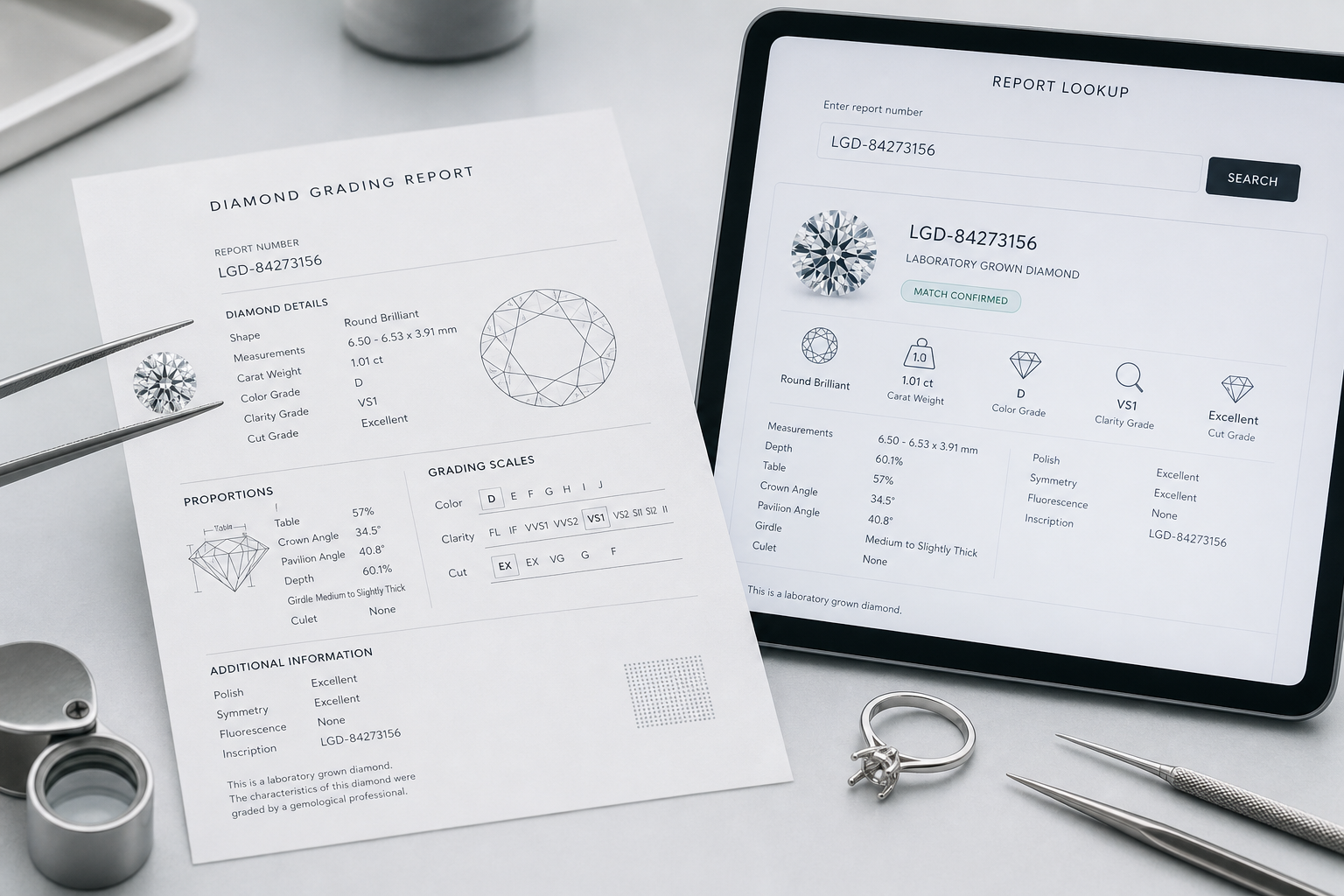
If you want to verify lab-grown diamond certificate details quickly, start with the report number, not the marketing copy. A grading report number is the link between the PDF in front of you and the lab’s own record, and that is the first check worth making before you trust a seller’s listing or a polished product page.
This matters because a certificate can look official even when the buyer is only seeing a screenshot, a cropped PDF, or a reused file from another stone. The report number is what lets you test whether the document is real and whether the stone being offered is actually tied to a live record in the grading lab’s database.
Where to Find the Report Number on a Lab-Grown Diamond Certificate
The report number is usually printed near the top of the certificate or in a clearly labeled section of the grading report. On a PDF, it may appear alongside the lab name, the stone’s basic specifications, or a barcode. On a printed copy, it should be easy to read without guessing. If the number is blurry, partially hidden, or cropped out, that is already a warning sign that the document needs closer review.
For a buyer, the practical rule is simple: do not rely on someone else’s claim that “the report is on file.” Find the number yourself and confirm that it can be entered into the lab’s official lookup tool. If the seller only provides an image and not the full report, ask for the complete document before moving forward.
How to Use the Grading Lab’s Official Lookup Tool
Most reputable grading labs provide a report number lookup on their own website. The process is usually straightforward. Go to the lab’s official site, enter the report number exactly as shown, and review the record that appears. IGI and GIA are common examples of grading labs that buyers may encounter, but the key point is not the brand of the lab. The key point is that the lookup should happen on the lab’s own website, not through a third-party screenshot or a seller’s copy of the result.
If a direct lookup is available, use that instead of trusting a forwarded image. Screenshots can be altered, outdated, or disconnected from the actual report number. A direct search is the cleaner test because it shows you what the lab currently recognizes for that report number.
A successful search should return a record that clearly corresponds to the report number on the certificate. If the lab site cannot find the number at all, that does not automatically prove fraud, but it does mean the buyer should stop and ask for clarification before continuing.
Use the official lab website directly rather than a search result ad, shortened link, or seller-provided redirect. This is a small step, but it reduces the chance of checking a copied page or an outdated image instead of the lab’s live record.
Do a Link-Safety Check Before You Enter the Report Number
Before typing a report number into any lookup page, make sure you are on the grading lab’s own website rather than a copied page, marketplace mirror, paid ad, shortened link, or seller-controlled landing page. The safest habit is to navigate to the lab site independently, then find the report check tool from the lab’s menu or search function. This keeps the verification step separate from the seller’s presentation and makes the result easier to trust.
If the seller provides a “click here to verify” link, treat it as convenient but not final. Open a separate browser tab, search for the lab by name, and compare the domain and page layout before entering the number. This is not about assuming bad faith; it is about keeping your strongest evidence independent. A certificate check is most useful when the buyer controls the route to the source.
What a Successful Report Lookup Should Confirm
A valid lookup should do more than simply return a page. It should confirm that the report number exists and that the basic information matches the certificate you were given. At a minimum, the lab record should align with the lab name, the report number, and the stone’s core identifying details. If those basics do not line up, the document is not yet trustworthy enough to use as the basis for a purchase.
The best habit here is to compare the lookup result against the full report, not just the listing headline. A seller may describe a stone as “certified,” but the official record is what matters. If the online result is missing, incomplete, or different from the PDF, the buyer should treat that as an unresolved issue rather than a minor formatting problem.
A grading report can document key characteristics, but it should not be treated as a guarantee of beauty, value, or sourcing ethics. It is one document in the buying process, and it should be read alongside visual evidence, measurements, seller documentation, and the intended jewelry use.
When a grading report is available, verify the report details through the issuing laboratory’s official lookup tool where available, and compare the live record with the certificate, listing, and inscription rather than relying on screenshots alone.
Buyer Verification Checklist
- Find the report number on the certificate or PDF.
- Enter that number on the grading lab’s official website.
- Confirm that the lab record appears and is tied to the same report number.
- Check that the lab name on the document matches the lookup result.
- Do not rely on screenshots if a direct lookup is available.
- Pause if the report number cannot be found or does not return a clear record.
Make Sure the Online Lab Record Matches the Certificate You Received
Once the report number is found, the next step is to compare the lab’s online record with the certificate in front of you. This is where many buyers stop too early. A report number match is necessary, but it is not enough if the details on the lab record and the details on the certificate or listing do not align.
The lab’s online record is the reference point. If the seller’s description is looser, more flattering, or slightly different, the lab record should still be the version that guides your decision. A certificate is only useful when the stone, the report, and the listing are all describing the same diamond.
The Details That Should Match Line by Line
Start with the basics that should not drift. The shape should match exactly. A round should not be presented as an oval, and an emerald cut should not be loosely described as a “step-cut style” if the report says otherwise. Carat weight should match the formal report exactly. Color and clarity should also match the grading report rather than a seller’s softened wording.
Measurements matter as well. The dimensions on the lab record should be very close to what appears on the certificate and in the listing, allowing only normal rounding in the seller’s presentation. A small display difference in a product page may be harmless, but a meaningful shift in measurements deserves a pause. The same is true for report date and any growth method disclosure if the lab includes it.
If the report includes an inscription number, that should also align with the certificate. The point is not to expect every field to be worded identically across every platform. The point is to confirm that the same stone is being described consistently across the lab record, the certificate PDF, and the seller’s listing.
Why Small Listing Differences Can Still Matter
Buyers sometimes dismiss small differences as harmless because they look minor on paper. That is a mistake. A listing that says 1.50 ct when the certificate says 1.47 ct may not be the same problem as a mismatched report number, but it still tells you the seller may be rounding aggressively or using outdated copy. When a purchase depends on precise grading details, casual wording can hide a real mismatch.
The same caution applies to color and clarity. A seller may present the stone in flattering terms such as “bright,” “clean,” or “near colorless,” but those phrases are not substitutes for the lab’s actual grade. If the listing rephrases the report in a way that sounds better than the lab’s wording, trust the report, not the marketing language.
For buyers comparing several stones, these small differences become even more important. A slight shift in carat or a changed measurement may affect how the diamond looks in a setting, especially in shapes where proportions matter. The lab record is the anchor because it prevents the buyer from making a decision based on polished but imprecise copy.
In practical buying, the most important question is not whether a difference can be explained in theory, but whether it is explained clearly for this exact stone. A seller who understands the documentation should be able to identify whether the difference is rounding, a listing error, updated media, or a sign that the wrong report has been attached.
Build a Side-by-Side Match Log
For a higher-value purchase, it helps to create a simple side-by-side match log before you decide. Put the certificate, lab lookup result, product listing, seller email, inscription image, and invoice into one comparison. You do not need technical software; a short table or note is enough. The goal is to make hidden discrepancies visible before they become post-purchase problems.
| Field | Certificate | Lab Lookup | Listing or Invoice | Status |
|---|---|---|---|---|
| Report number | Exact number shown | Exact number returned | Same number referenced | Match or investigate |
| Diamond type | Lab-grown wording shown | Lab-grown wording shown if available | Seller describes as lab-grown | Match or clarify |
| Carat and shape | Formal report values | Same basic values | No unexplained changes | Match or investigate |
| Measurements | Millimeter dimensions | Same or consistent with report | Same, allowing normal display rounding | Match or investigate |
| Inscription | Report number or inscription field | Consistent if shown | Photo or written confirmation | Match or request proof |
This kind of log is especially useful when several diamonds look similar on a product grid. It prevents one stone’s video, another stone’s certificate, and a third stone’s invoice language from being accidentally treated as one complete record. If every row matches, you have a clearer basis for continuing. If one row remains unresolved, the seller should address it before you rely on the certificate.
Certificate Date, Lab Name, and Report Format Checks
Before you decide, check whether the certificate looks current and whether the lab format is consistent with the issuing lab’s normal presentation. The lab name should be clear and correctly spelled. The report should have a format that looks complete, not pieced together from cropped images or text fragments. If the document appears too generic, too blurry, or unusually edited, stop and ask for the full version.
The report date can also help you judge whether you are looking at an older record that no longer matches the item being sold. A report does not become useless simply because it is older, but the buyer should know whether the stone has been re-listed from older stock or whether the paperwork is being reused in a way that creates confusion.
At this stage, the main judgment is straightforward: if the report number exists and the lab record matches the certificate cleanly, you have a credible starting point. If the record is missing, inconsistent, or vague, the document set is not strong enough yet to support a confident purchase.
What to Check Before You Decide
- The lab record appears when the report number is searched on the official website.
- The lab name on the certificate matches the lab record.
- The shape matches exactly.
- The carat weight matches the report exactly.
- The color and clarity grades match the formal lab record.
- The measurements are very close across the certificate, listing, and online record.
- The report date and any listed growth method make sense across the documents.
- The seller’s wording does not improve or soften the lab’s actual grades.
Check the Laser Inscription When One Is Provided
A laser inscription gives the buyer another way to connect the physical diamond to the grading report. Many diamonds with grading reports have the report number laser-inscribed on the girdle, which is the outer edge of the stone. When it is present and readable, it can help confirm that the diamond in hand is the same one described in the report.
This check is useful, but it has limits. A buyer does not usually need special equipment at home, and not every seller will provide a clear close-up by default. What matters is whether the seller can show the inscription clearly enough to compare it with the report number and whether the supporting information is consistent.
What a Laser Inscription Is and Where It Appears
The inscription is usually tiny and placed along the girdle of the diamond. It may contain the report number, or part of it, depending on the lab and the stone. Because the engraving is so small, it may not be visible in a normal product photo. That is why a direct request for magnified imaging is reasonable when the seller says the stone is inscribed.
Buyers should think of the inscription as an identity check, not as a beauty check. It does not tell you whether the stone is well cut or whether it will look right in a setting. It simply helps connect the physical diamond to the paperwork.
How to Compare the Inscription With the Report Number
If the seller provides an inscription image, compare the characters carefully against the report number on the certificate. The best case is a clear, magnified image that shows enough detail to read the inscription without guessing. If the image is too soft, cropped, or obscured by reflections, ask for another view or ask the seller to confirm the inscription in writing.
If the diamond is already at a jeweler or available for in-person review, a jeweler can often confirm the inscription under magnification. That is a practical step when the buyer wants more certainty before committing. The important point is that the inscription should reinforce the report number, not create a new layer of ambiguity.
Remember that an inscription is strongest when it is part of a complete match. In the context of lab grown diamond supply chain transparency, the inscription should support the report lookup, the certificate details, the seller’s media, and the invoice; it should not be used to excuse other unresolved discrepancies.
What It Means If the Inscription Is Missing or Hard to See
Missing or unreadable inscription information does not automatically mean something is wrong, but it does mean the buyer needs more documentation. Some stones may not have an inscription, and others may be difficult to photograph clearly because of size, setting, or image quality. The correct response is not panic; it is to ask for a better explanation.
If the seller claims the stone is inscribed but cannot provide a usable image, that is a problem worth taking seriously. The buyer should ask whether the diamond can be viewed under magnification, whether the inscription can be confirmed by a jeweler, or whether updated documentation is available. If none of that is possible, the stone should not be treated as fully verified.
How to Verify This Before Buying
- Ask whether the diamond has a laser inscription before you place the order.
- Request a magnified image if the seller says the stone is inscribed.
- Compare the inscription characters with the report number.
- Use jeweler confirmation if the image is not clear enough.
- Do not assume missing inscription information proves fraud.
- Do treat unexplained or unverified inscription claims as a reason to pause.
Match the Certificate to the Actual Diamond, Not Just the Listing
A certificate can be real and still not match the stone being offered. That is the gap buyers need to close before they pay. The report tells you what the diamond should be; the listing, photos, and video tell you what the seller says they are selling. Those two things need to line up cleanly.
Compare Carat Weight, Shape, and Measurements
Start with the basics that should match without explanation. Carat weight should match the certificate value in formal documentation, not a loosely rounded version of it. If the report says 1.50 ct, the listing should not quietly shift to 1.51 ct unless the seller is clearly showing a separate stone or explaining a rounding difference in a way that makes sense. Shape should match exactly. A round should not become an oval in the product page language, and a pear should not be described as a teardrop in a way that makes the stone sound different from the report.
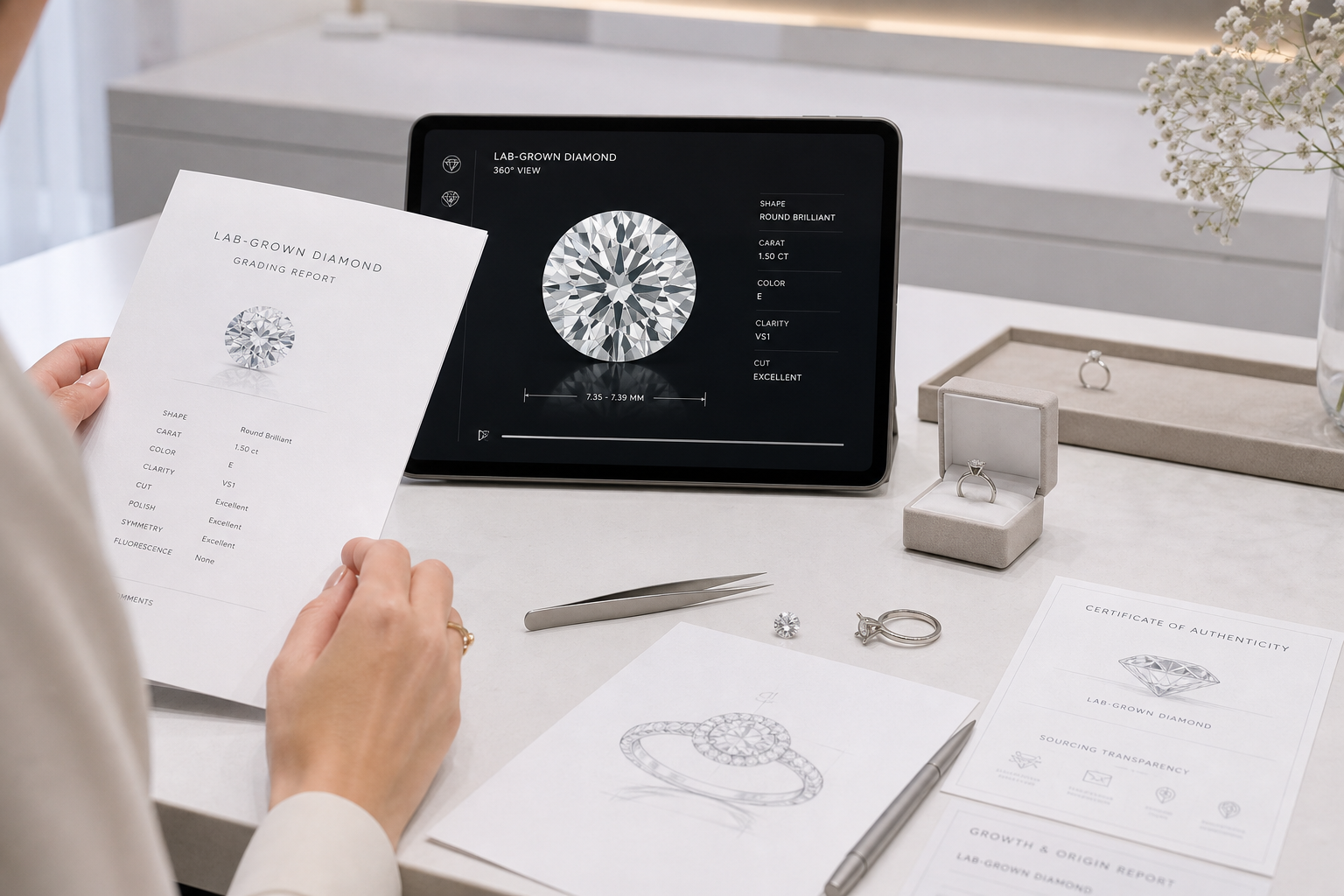
Measurements matter just as much because they help confirm that the stone shown in media is the same one described in the certificate. The millimeter figures on the report should match closely, with only normal display rounding in the listing. If the certificate shows 7.30 x 5.20 x 3.35 mm and the listing presents noticeably different proportions, that is not a small detail. For elongated shapes like oval, pear, marquise, radiant, and emerald cuts, the length-to-width ratio can be calculated from the certificate measurements and used as an extra check on whether the seller’s video is showing the same stone.
Color and clarity should also match the grading report, not a seller’s upgraded wording. If the certificate says VS2, the listing should not casually call it “eye-clean” and leave it at that. Eye-clean may be true, but it is not a substitute for the actual grade. The better practice is to treat the certificate as the reference point and the listing as a description that should agree with it.
Use Photos and 360-Degree Video to Confirm the Same Stone
Photos and 360-degree video are useful only if they help you connect the paperwork to the exact diamond being sold. A still image can be flattering while hiding proportion differences, and a polished video can look convincing even when the media is not clearly tied to the report number. The question is not whether the stone looks attractive on screen. The question is whether the stone shown is the one described on the certificate.
Look for visible cues that support the match: report number if shown, dimensions that align with the certificate, and a shape that agrees with the grading report. If the seller provides a 360-degree video but no inscription image and the measurements in the listing drift from the report, you do not yet have enough to treat the stone as verified. A good visual review should support the certificate, not replace it.
For loose diamond verification, this is where many buyers should slow down. The media may show a beautiful stone, but beauty alone does not solve a mismatch. If the listing says one set of measurements and the video suggests a different outline or ratio, ask for updated media tied directly to the report number before you move forward.
For custom design, the stone cannot be evaluated separately from the setting. Measurements, outline, depth, and shape consistency can affect how securely the diamond fits, how it sits on the finger, and whether the finished piece has the intended balance. For NUVU, the comparison stays centered on the report, the visual evidence, and the setting fit together rather than any one detail in isolation.
A Realistic Example of a Certificate Mismatch
Maya is comparing a 1.50 ct oval lab-grown diamond online. The PDF certificate looks legitimate, but the listing says 1.51 ct, the 360-degree video shows a slightly different measurement ratio than the report, and there is no inscription image. The seller says the difference is minor and asks her not to worry about it. That is the point where Maya should pause, not proceed.
Her next step is simple: compare the report in the grading lab’s database, ask for an inscription confirmation, and request updated media that clearly ties the stone to the report number. If the seller can explain the 1.51 ct listing as a display rounding issue and the video, measurements, and report all match once corrected, the concern may be resolved. If they cannot reconcile the differences, the safest move is to stop treating it as a confirmed match.
The lesson is straightforward. A certificate that looks valid is not enough if the stone being offered cannot be matched back to it with confidence. When the numbers, shape, and media do not agree, the burden is on the seller to close the gap.
Certificate and Visual Review Check
- Carat weight matches the certificate exactly in formal documentation
- Shape matches the report without rewording or substitution
- Measurements align with the certificate, allowing only normal rounding in the listing
- Color and clarity match the grading report, not seller language
- Length-to-width ratio makes sense for elongated shapes when calculated from the report
- Photos or 360-degree video appear tied to the same stone, not just a similar one
Read Lab-Grown-Specific Details Carefully
Lab-grown certificates sometimes include details that do not appear on every report for every stone, and those details are worth reading closely. The most important point is not to overinterpret technical language. It is to notice whether the report clearly identifies the diamond as laboratory-grown and whether any additional disclosures help you understand what you are buying.
Confirm the Report Clearly Identifies the Diamond as Lab-Grown
A proper lab-grown diamond grading report should not leave the diamond’s origin vague. The document should clearly identify the stone as laboratory-grown, lab-grown, or equivalent wording used by the grading lab. If that identification is missing or hard to find, the report deserves a closer look before you rely on it. A buyer should not have to guess whether a stone is natural or laboratory-grown from the seller’s marketing language alone.
This is especially important when the listing is polished and the report is presented as a PDF attachment without much explanation. A legitimate certificate should make the diamond’s type clear enough that the buyer does not have to infer it from context.
Look for Growth Method or Treatment Disclosures When Available
Some lab-grown diamond grading reports include growth method information such as CVD or HPHT. Some also note post-growth treatment when the lab includes that detail in the report format. Not every lab presents the same fields in the same way, so the absence of one detail is not automatically a problem. The key is whether the report format is complete and readable, and whether any disclosed information matches what the seller has told you.
These details are best treated as transparency signals. They help you understand the diamond more fully, but they do not by themselves tell you whether the stone will look better or be a smarter buy than another stone with different lab-grown-specific wording. If the seller highlights a growth method, the buyer should ask whether that language is supported by the actual report rather than by a generic product description.
When growth method or post-growth treatment is relevant, buyers should look for clear disclosure in the grading report or seller documentation. HPHT and CVD may describe growth methods for laboratory-grown diamonds; they should not be treated as automatic quality rankings or assumed to be treatments unless the report or documentation specifically says so.
The same caution applies to broad sourcing or sustainability language. A lab-grown origin can be part of a buyer’s values-based decision, but claims about energy use, production practices, or sourcing responsibility should be supported by clear documentation rather than assumed from the word “lab-grown” alone.
Do Not Treat Technical Terms as Automatic Quality Rankings
CVD and HPHT are not quality grades. They are production methods, and they should not be treated as shorthand for “better” or “worse” without considering the rest of the report and the actual stone. A diamond can have a strong certificate and still be a poor match for your priorities if the proportions, color, clarity, or visual character do not suit the way you plan to wear it.
This is where buyers often get distracted. A technical term can sound important because it is specific, but specificity is not the same as superiority. Use the details to improve transparency, not to make a shortcut judgment about value.
Separate Origin Disclosure From Environmental or Ethical Claims
When you verify a certificate, keep the lab-grown origin claim separate from any broader environmental or ethical claim made in the listing. A report may help confirm that the diamond is laboratory-grown, but that is not the same thing as proving a seller’s claims about energy source, production footprint, labor practices, or carbon impact. Those claims require their own documentation, and they should be stated specifically rather than treated as automatic benefits of the category.
If values-based purchasing is important to you, ask the seller what evidence supports the exact claim being made. “Lab-grown” is an origin disclosure. “Low-impact,” “carbon-neutral,” “sustainably made,” or similar language is a separate claim that should be backed by clear, relevant documentation. In certificate verification, this distinction keeps the report from being used to prove more than it actually documents.
What This Means in a Real Purchase
If a seller offers two lab-grown diamonds with similar grades but different growth-method disclosures, the right question is not which method sounds more advanced. The better question is which stone has the clearer report, the cleaner documentation trail, and the better match to the design or budget you actually have in mind. For a buyer who wants a straightforward decision, that is the more useful way to read the certificate.
Check Whether the Seller’s Documentation Supports the Certificate
A grading report should not stand alone if the rest of the paperwork tells a different story. Seller documentation matters because it shows whether the report number, diamond specifications, invoice, listing, and any supporting media all point to the same stone. If those documents are cleanly aligned, the purchase is easier to trust. If they are not, the buyer has to do more work before relying on the offer.
Compare the Listing, Certificate, and Invoice
Start by placing the certificate PDF next to the product listing and the invoice or receipt if one has already been issued. The report number should match. The carat weight, shape, and major grading details should match. The item description should not quietly drift from the lab record into more flattering language that changes the meaning of the stone. A listing can be written more smoothly than a certificate, but it should not rewrite the facts.
It also helps to compare any seller-provided media against the same set of details. If the invoice, listing, and certificate all describe a 1.50 ct oval with the same measurement range, that is a good sign. If one of those documents says 1.50 ct, another says 1.51 ct, and the video appears to show a different shape ratio, the documentation is not yet supporting the claim cleanly.
Ask for Written Confirmation When Details Are Unclear
When something does not line up, ask for a direct written explanation instead of relying on a quick chat response. Written confirmation forces the seller to be specific about what is being sold and reduces the chance of confusion later. If the seller says a number is rounded, the explanation should state which number is rounded and why. If the media is for a similar stone rather than the exact stone, that should be made clear in writing.
For buyers comparing lab-grown diamonds with grading reports online, this step is often the difference between a smooth purchase and a risky one. A clear seller will usually be able to confirm the report number, the exact item, and the media tied to it without hesitation. If the answer remains vague, the documentation is not doing its job.
For wholesale or multi-stone buying, the same principle becomes even more important. Consistency across certificates, parcel descriptions, invoices, and communication helps prevent mix-ups when several stones have similar weights, shapes, and grades. The lowest headline price is less useful if the documentation trail is not organized enough to confirm what is actually being supplied.
Before purchase, buyers should confirm documentation, return terms, resizing policies, and after-sales support directly with the seller. A certificate verification article can help you know what to ask, but seller policies should come from the seller’s current written terms rather than from assumptions based on the presence of a grading report.
Ask the Seller to Tie Each File to the Report Number
A useful request is simple: ask the seller to identify which report number belongs to each video, photo set, invoice line, and loose stone. This is especially helpful when a seller is showing you several options at once. Instead of accepting a folder of attractive media, ask for each file or message to be labeled with the same report number shown on the certificate.
This extra step reduces accidental substitutions. Two oval lab-grown diamonds may have similar carat weights and grades, but their measurements, ratios, inclusions, and visual character can differ. If the seller can tie each asset to the report number cleanly, the documentation becomes more useful. If the seller cannot, you may be comparing mixed information without realizing it.
Why Screenshots Alone Are Not Enough
Screenshots can be useful as a quick reference, but they are not a substitute for the underlying report, the live listing, or seller-issued paperwork. A screenshot can be cropped, outdated, or taken from a different stone with a similar description. It may look convincing while hiding the very details you need to verify.
That is why a buyer should treat screenshots as supporting material, not proof. The more important question is whether the certificate PDF, the lab’s record, the invoice, and the media all tell the same story. If they do, the purchase is on firmer ground. If they do not, the safest choice is to pause until the seller resolves the mismatch.
Buyer Verification Checklist
- Report number matches across the certificate, listing, and invoice
- Carat weight, shape, and measurements align across all documents
- Seller description does not exaggerate or rename the grading report details
- Media appears tied to the same stone, not a similar one
- Written clarification is provided when any detail needs explanation
- Screenshots are treated as support, not as the final proof
Request a Complete Documentation Pack Before You Commit
One of the most useful traceability habits is to ask for a complete documentation pack instead of relying on a single PDF. A strong paper trail usually includes the full grading report, the live lookup result if available, a clear image of the laser inscription when one is present, the current listing or product page, and the invoice or order summary. When these items are grouped together, it becomes much easier to see whether the same report number follows the same stone across every file.
This approach is especially helpful when the seller is showing multiple stones with similar grades. A clean file structure reduces the chance of a report being reused on a different diamond or of media being attached to the wrong listing. If the seller cannot keep the files separated and labeled, that is not just a clerical issue; it affects whether the diamond can be traced back to the report with confidence.
What a Useful Documentation Pack Should Include
- The full grading report, not only a cropped image of the headline section
- The report number entered or checked on the lab’s official site when that tool is available
- A clear inscription image or written confirmation if the stone is inscribed
- The current listing with the same report number and specifications
- The invoice, receipt, or order summary showing the same stone details
- Any written clarification about rounding, media, or revised item descriptions
When the seller can provide these items without hesitation, the buyer has a much clearer view of the stone’s traceability. When the seller can only provide fragments, the gap between the certificate and the actual diamond becomes harder to close. At that point, it is reasonable to slow down rather than assume the missing details are harmless.
How to Keep the Record Organized
Save the report, listing screenshots, message thread, and invoice in one folder with the report number in the file name. If the purchase is for a gift, a future setting, or a comparison between several stones, this makes it easier to revisit the same record later. Organization is not just for bookkeeping. It helps prove that the buyer asked the right questions before paying.
For buyers working with a retailer or designer, it also helps to ask which document is considered the source of truth if any detail changes. That question is practical, not confrontational. It simply prevents a situation where one file says one thing and another file quietly says something else.
In NUVU’s buyer education approach, the strongest documentation is the kind that lets you trace one report number through the lab record, the media, and the final sales paperwork without guessing which file belongs to which stone.
Watch for Red Flags in Unclear or Incomplete Certificate Information
Report Number Problems
A report number that cannot be found in the grading lab’s database is one of the clearest diamond certificate red flags. It does not automatically prove fraud, but it does mean you should stop treating the document as reliable until the issue is explained. A real report should be traceable through the lab’s official lookup tool, not just through a seller’s screenshot or copied PDF.
Pay close attention if the report number on the listing does not match the number on the certificate file, or if the seller gives you multiple versions of the same document with different numbers. Misspellings in the lab name are another warning sign, especially when the report is presented as if it came from a well-known grading lab. A small typo can be harmless, but repeated confusion around the lab identity usually means the paperwork has not been handled carefully.
The practical standard is simple: if the report number is unclear, inconsistent, or absent from the lab database, the buyer should pause. Understanding the lab grown diamond supply chain provides essential context for verifying authenticity and tracing certification origins. That is especially true when the seller cannot produce the original report, only an image with partial details.
Specification Mismatches
Another common warning sign is a mismatch between the certificate and the seller’s listing. A report number may be real, but if the carat weight, shape, measurements, or grading details do not line up, the buyer is no longer looking at clean documentation. That kind of mismatch needs an explanation before you move forward.
Carat weight should not drift in formal documentation. Minor rounding in a listing can happen, but a meaningful difference between the report and the advertised stone should not be brushed off. Shape should match exactly, not loosely. An oval should not be described like a radiant, and a pear should not be presented as if the difference is trivial. Measurements also matter because they help confirm that the stone being offered is the same one described in the report.
Color and clarity deserve the same discipline. If a seller quietly upgrades the language, such as making a G color sound comparable to a much higher grade, that is a documentation problem even if the underlying report is real. A certificate is only useful if the seller is presenting it honestly and consistently.
When buyers ask what are red flags when verifying a lab-grown diamond certificate, this is one of the biggest: the document may exist, but the stone being sold is not being described with enough precision to trust the match.
Not every mismatch has the same seriousness, but every mismatch should be resolved before purchase. A typo in a product description, a rounded display weight, and a wrong report number are different problems; what they have in common is that the buyer needs a clear answer before relying on the listing.
Blurry, Cropped, or Incomplete Documents
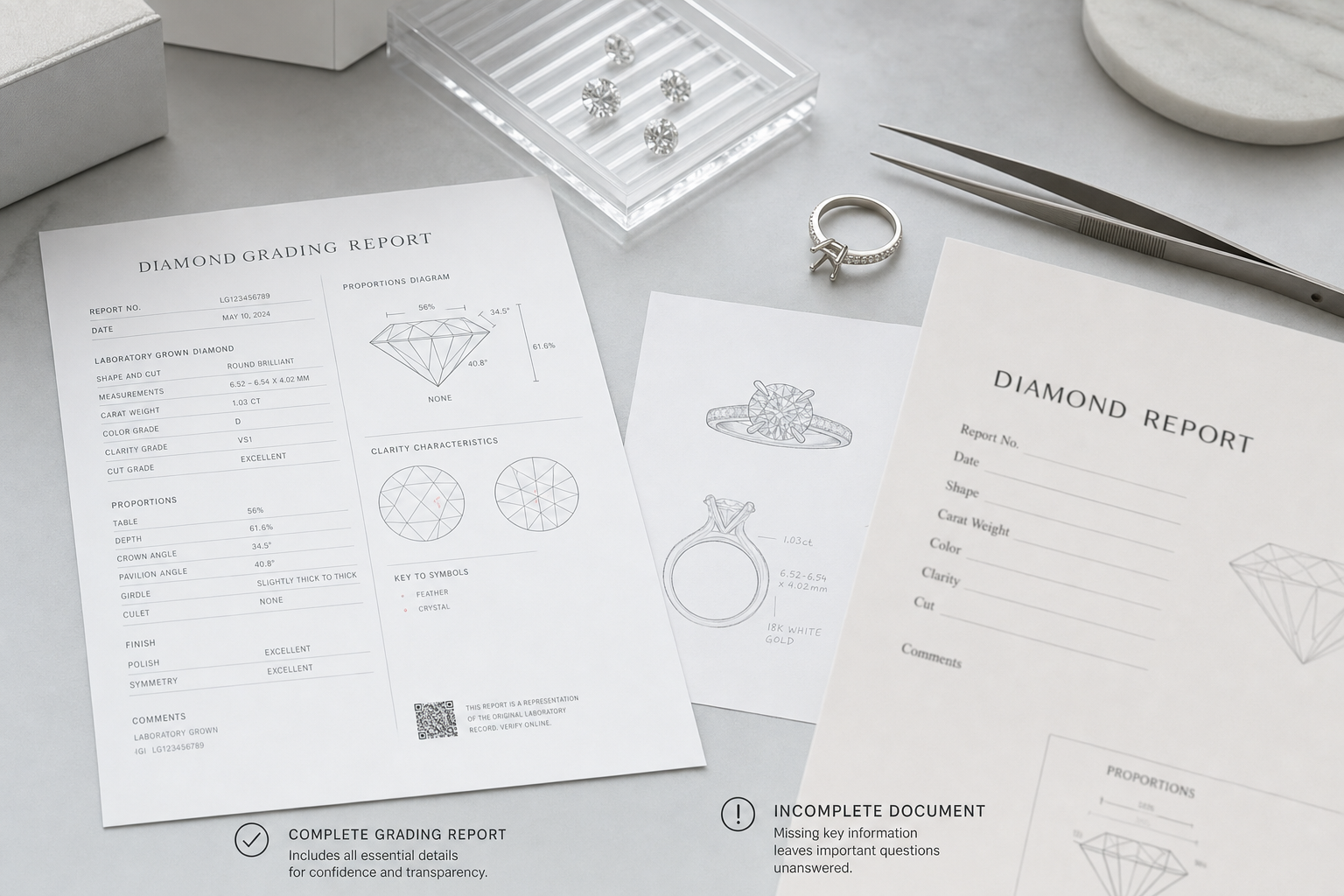
Unclear documentation is not a small issue. A certificate image that is blurry, cropped, or missing key fields makes it harder to verify the stone and easier for errors to hide. If the report number, lab name, measurements, or grading details cannot be read clearly, the document is not doing its job.
A cropped PDF or screenshot can be especially misleading because it may show only the flattering parts of the report. A buyer should be cautious when the seller offers a partial image instead of the full certificate, or when the file hides the very details that matter most for verification. If the inscription is claimed but no matching photo or clear confirmation is provided, that is another reason to ask for more.
Incomplete documentation is not the same as a fake diamond certificate, but it does create the same practical problem: you cannot verify what you cannot see. A clean purchase depends on readable paperwork, not selective presentation.
Seller Explanations That Do Not Resolve the Issue
Sometimes the seller notices the mismatch and offers an explanation. That is not a problem by itself. The issue is whether the explanation actually resolves the conflict. If the answer is vague, contradictory, or keeps changing, the buyer should treat that as a warning sign rather than reassurance.
“The lab must have updated something” is not enough unless the seller can show a fresh lookup result or corrected report. “The video is of the same stone” is not enough if the measurements, report number, or inscription do not line up. “Trust us” is not documentation. A seller who cannot provide basic evidence, or who avoids direct questions about the certificate, is not helping you verify the diamond.
If the mismatch remains unresolved, the right response is to pause. A buyer should not move forward simply because the price is attractive or the stone looks appealing in a video. The paperwork has to support the stone, not compete with it.
When to Pause Before Moving Forward
Pause any time the report number cannot be confirmed, the certificate and listing disagree on core details, or the seller cannot provide a readable copy of the full report. Pause if the lab name is unclear, the inscription cannot be verified when claimed, or the documentation feels assembled from fragments rather than a complete record. At that point, the issue is not cosmetic. It is verification itself.
Understand What a Certificate Can and Cannot Prove
What a Verified Report Helps Confirm
A verified lab-grown diamond certificate is useful because it confirms identity and records the lab’s grading opinion on the stone. It can tell you that the diamond is identified as lab-grown, give you the reported carat weight, shape, measurements, color, clarity, and other details the lab chose to include. That makes it a valuable reference point, especially when you are comparing stones online.
What it does not do is settle every buying question. A verified report gives structure to the decision, but it does not replace judgment. A diamond can have a valid report and still be less suitable than another stone with similar paperwork, depending on how it actually looks and how it fits the setting you want.
What Still Requires Visual Review
Certificate verification does not tell you how the diamond performs in real light. It does not show sparkle, symmetry as your eye sees it, face-up presence, or whether the proportions suit your taste. It also does not tell you whether the diamond will look right in a specific ring design, especially if the setting depends on a certain shape, depth, or outline.
That is why visual review still matters. Photos, 360-degree video, and proportion details help you judge whether the stone is actually appealing, not just correctly documented. For many buyers, that step matters as much as the report itself, because a technically accurate stone can still be the wrong choice visually.
Cut quality is another area where the report helps, but does not close the case. A grading report can provide useful information, yet it is not the same thing as seeing how the diamond handles light. If the goal is to make a confident purchase, the report should be treated as one part of a broader review, not the final answer.
Two diamonds with similar certificate grades can still look different because shape, facet pattern, proportions, inclusions, and viewing conditions affect the face-up impression. That does not make the report less useful; it means the report should guide the shortlist while visual evidence helps decide which stone actually suits the buyer’s priorities.
Why Certificate Verification Is Only One Part of Diamond Evaluation
The right way to think about a lab-grown diamond certificate is as a verification tool, not a guarantee of satisfaction. It helps confirm that the stone is what the seller says it is, and that the reported characteristics come from an outside grading lab. It does not prove that the stone is beautiful, fairly priced, or the best match for your budget and design goals.
That distinction matters because buyers can overvalue paperwork and undervalue the actual stone. A clean grading report is important, but diamond value still depends on the combination of specs, visual performance, and intended use. At NUVU, we usually treat the report as the starting point, then look at how the diamond appears in context before making a final judgment.
What to Check After the Certificate Matches
Once the report is confirmed, review the images or video, check the proportions, and think about setting compatibility. If the diamond is going into a ring, the shape and measurements should make sense for the design. If you are choosing between two similar stones, the better choice is often the one that looks more balanced and fits the intended setting more naturally, not the one with the more impressive paper description.
Check Setting Compatibility Before You Finalize the Stone
Traceability does not stop at the certificate. If the stone will be mounted in a ring or other jewelry piece, the report should be checked alongside the practical dimensions needed for the setting. A diamond can be fully documented and still be awkward for the design if the measurements, depth, or shape are not compatible with the head, halo, bezel, or prong layout you plan to use.
This is especially important for custom work. A buyer may focus on carat weight because it is easy to compare, but the setting usually cares more about millimeter dimensions, outline, and how the stone sits face up. A narrow oval and a wider oval with the same carat weight can behave differently in a mounting. The same report number that verifies identity can also help the jeweler confirm whether the stone is physically appropriate for the intended setting.
Ask for Fit Questions in Writing Before the Stone Is Finalized
If the diamond is being used for custom design, ask the seller or jeweler to confirm the following before you commit: the stone’s exact measurements, whether those dimensions suit the setting style, whether the chosen head or basket is sized for the actual outline, and whether any accents or side stones are being matched to the same documentation. This is not about getting a promise of perfect results. It is about avoiding a mismatch that could have been prevented by checking the numbers early.
A report can support this process, but it does not replace it. The best traceability comes from connecting the certificate to the design plan itself, so the stone being purchased is not only the right one on paper but also the right one for the final jewelry piece.
For custom jewelry, stone measurements and setting compatibility should be confirmed before finalizing a purchase. This is especially relevant for elongated shapes, halos, bezels, three-stone rings, and any design where small dimensional differences can affect the finished proportions.
For buyers comparing stones for a ring, NUVU’s buyer-first perspective is to check the report, the visual evidence, and the setting dimensions together before choosing the stone that moves forward.
Keep Sustainability and Origin Claims Narrow and Documented
Lab-grown origin is a factual disclosure, but broader sustainability language is a separate claim. A certificate may help establish that a diamond is laboratory-grown, yet it does not automatically prove how the stone was produced, what energy source was used, or how a seller defines environmental responsibility. Those are different questions, and they should not be collapsed into one label.
For that reason, buyers should read sustainability language carefully. Terms like “eco-friendly,” “carbon-neutral,” “sustainable,” or “ethical” should not be treated as proof just because the diamond is lab-grown. If a seller uses those words, ask what documentation supports the exact claim being made. Specific records are more useful than broad adjectives because they let you judge the claim on its own terms.
How to Ask Better Questions About Responsible Claims
- What exact claim is being made?
- What document or statement supports that claim?
- Does the evidence describe this stone, this production batch, or only the category in general?
- Is the language specific enough to compare against another seller’s claim?
This kind of questioning keeps the buyer focused on traceable information rather than marketing language. In practice, that makes the certificate more useful because it remains a document about the diamond itself, not a substitute for broader sourcing or production claims.
Sustainability claims should be specific and documented. Broad green language is less useful than clear information about production, energy context, and seller transparency.
If the seller cannot support the claim with clear documentation, the safest approach is to separate the origin of the diamond from the broader claim. That does not make the stone better or worse; it simply keeps the decision honest about what the paperwork can actually prove.
Verify Price Claims Separately From Certificate Claims
A certificate can help you compare specifications, but it does not prove that a diamond is the lowest-priced option, the strongest value, or a better financial choice than another stone. Price depends on many variables beyond the report fields, including cut precision, shape demand, seller channel, availability, visual character, setting needs, and how complete the documentation is.
Prices can change with market conditions, report type, seller channel, and stone-specific details, so exact comparisons should be verified at the time of purchase. If a seller uses strong price language, compare like-for-like details rather than relying on a headline claim. Two lab-grown diamonds with the same carat, color, and clarity may still differ in proportions, appearance, inscription evidence, return terms, and documentation quality.
How to Compare Price Without Overreading the Report
- Compare diamonds with the same origin disclosure: laboratory-grown with laboratory-grown, natural with natural.
- Match report type, shape, carat weight, color, clarity, measurements, and visual evidence as closely as possible.
- Check whether the price is for a loose stone, a finished piece, or a custom design package.
- Confirm whether taxes, setting costs, resizing, shipping, or after-sales terms are included or separate.
- Avoid treating a grading report as a resale or investment document.
This keeps price comparison practical. The goal is not to find a universal “best value” from the certificate alone, but to decide whether the documented stone, visual evidence, seller terms, and intended design make sense together.
All diamonds discussed in this article with grading reports should be reviewed against the issuing laboratory’s own record when that lookup tool is available. The most reliable approach is not to assume the certificate is enough on its own, but to compare the report number, stone details, inscription, and seller paperwork until the same diamond is being described in every file.
If a GIA report is provided, buyers can compare the report number and available details using GIA’s official report-check tool. For other labs, the same method applies: use the lab’s own verification page rather than a forwarded screenshot or copied image. The point is to confirm the source of the information, not to rely on a polished presentation of it.
Use a Final Certificate Verification Checklist Before You Buy
The 9-Step Certificate Verification Sequence
A practical lab-grown diamond certificate checklist keeps the process simple. Start with the report number, then search the official grading lab database. Confirm that the lab record matches the certificate you received. Compare the certificate data with the seller listing, including carat weight, shape, color, clarity, and measurements. If a laser inscription is provided, make sure it aligns with the report number. Review photos or 360-degree video to confirm that the visual presentation matches the paperwork. Check lab-grown-specific details, including whether the report clearly identifies the stone as laboratory-grown and whether any growth-method language is disclosed. Compare the invoice or written documentation to the same details. If any major point still does not reconcile, pause before buying.
What to Do If One Step Does Not Match
One mismatch does not always mean you should walk away immediately, but it does mean you need a better explanation. Ask for the full report, a clearer image, a fresh database lookup, or updated media that shows the same stone more clearly. If the seller cannot resolve the discrepancy, do not assume it will become clearer after purchase. Verification works best before money changes hands.
If multiple details are off, the safest judgment is to stop. A certificate that is partly right is not enough if the key identifiers cannot be matched cleanly. The goal is not to make the paperwork look acceptable. The goal is to confirm that the document, listing, and diamond all point to the same stone.
It is also reasonable to compare the seller’s response to the size of the issue. A corrected typo should come with a corrected listing or written note. A report-number mismatch should come with stronger proof, not a casual reassurance. The more central the detail is to identity, the more direct the evidence should be.
How to Keep a Record of Your Verification
Save the certificate PDF, the lab lookup result, screenshots of the listing, the invoice, and any written confirmation from the seller in one folder. If there is a mismatch later, having the record in one place makes it much easier to trace what was promised and what was verified. This is especially useful for online purchases, where the listing can change after you place an order.
A buyer does not need a complicated system. A few clear files and a dated note about what matched is often enough. What matters is being able to show, at a glance, that the report number, specifications, and seller documentation were reviewed before the purchase.
Final Buyer Verification Checklist
Confirm the report number in the lab database. Match the certificate to the seller listing. Check the inscription if one is provided. Review photos or video. Verify the lab-grown identification and any disclosed growth details. Compare the invoice or written confirmation. Stop if the documentation remains unclear, inconsistent, or incomplete.
Disclosure: This article is for general educational purposes only. Diamond grading, pricing, availability, specifications, and seller policies can change, and readers should verify important details through grading reports, official laboratory tools, seller documentation, or qualified professionals before making a purchase decision. Laboratory-grown diamonds should be clearly distinguished from natural diamonds, and environmental or sourcing claims should be supported by specific documentation.