
Building a custom lab-grown diamond jewelry line is not just a matter of choosing beautiful stones and sending them to production. The finished piece depends on how well each laboratory-grown diamond’s measurements, proportions, shape, depth, and consistency match the CAD design, setting method, comfort requirements, and future restock needs. When sourcing, design, sampling, and quality control are handled separately, lab-grown diamond supplier red flags such as inconsistent tolerances or weak documentation can make small mismatches become costly revisions, uneven batches, weak settings, or delayed launches.
For the full framework, read China Lab-Grown Diamond Supply Chain Guide.
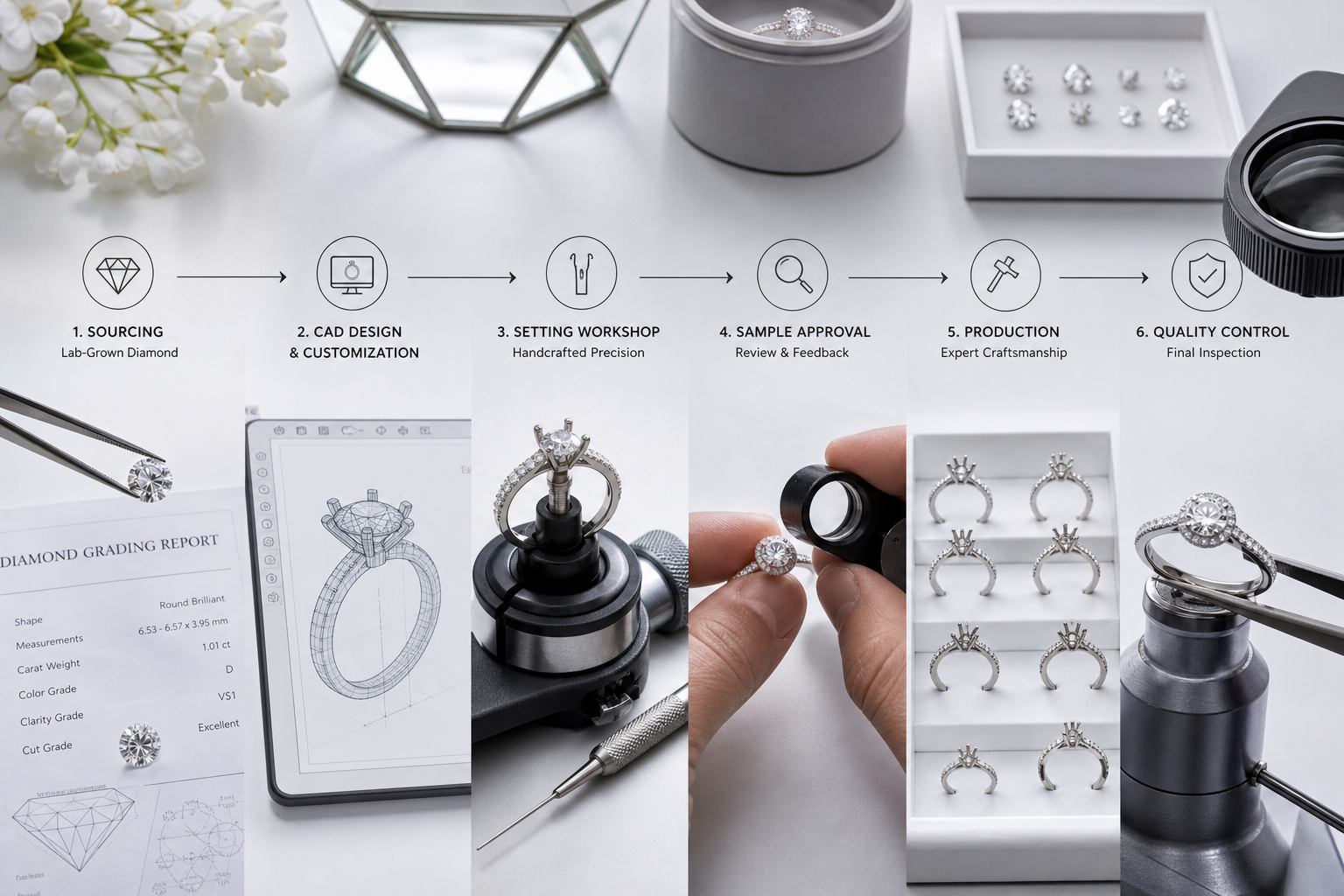
This article explains how China’s connected lab-grown diamond ecosystem can support custom jewelry brands when the process is managed as one coordinated development chain. It helps buyers judge whether a supplier can move beyond loose-stone availability and provide practical alignment between stone selection, CAD adjustment, sampling, production tolerances, and repeatable finished jewelry.
For buyers, the practical point is not that one country, supplier type, or production model automatically solves every problem. The useful question is whether the supplier can document stone specifications, communicate design constraints clearly, adjust CAD around real measurements, and keep the approved sample repeatable when the order moves into production.
| Decision Point | What to Verify | Risk if Ignored |
|---|---|---|
| Stone selection | Measurements, depth, ratio, laboratory-grown origin disclosure, and batch consistency | Same carat weight, different finished look or unclear product description |
| CAD development | Design built around actual stones, not generic sizes | Poor seating, weak prongs, or awkward height |
| Fancy shapes and matched sets | Symmetry, alignment, pair matching, and profile control | Uneven earrings, tilted halos, or inconsistent pendants |
| Sampling | Comfort, balance, finishing, and stone security | A good render fails as a wearable product |
| Scaling production | Locked tolerances, finishes, setting details, and revisions | Approved sample cannot be repeated reliably |
| Supplier structure | Coordination between sourcing, CAD, setting, documentation, and QC | More delays, revisions, inconsistent batches, and unclear customer-facing claims |
Quick Questions Before You Read
Q: Is carat weight enough when choosing diamonds for custom jewelry?
No. Measurements, proportions, depth, and shape consistency often matter more for fit and repeatability.
Q: Does a CAD render prove the jewelry is ready for production?
No. A render shows the design direction, but a physical sample reveals comfort, balance, setting strength, and finishing issues.
Q: Why does supplier coordination matter for private-label jewelry?
Coordinated sourcing, CAD, sampling, and QC reduce mismatches and make approved designs easier to reproduce.
Q: What should brands check before scaling a design?
They should lock stone specifications, setting details, tolerances, finishes, and documented CAD revisions.
Q: Should lab-grown diamonds be described differently from natural diamonds?
Yes. Laboratory-grown diamonds should be clearly identified as laboratory-grown, and they should not be presented as mined diamonds or confused with diamond simulants.
Why Custom Lab-Grown Diamond Jewelry Needs More Than Loose Stone Supply
Loose diamonds are only the starting point
Buying one loose oval lab-grown diamond is a very different task from producing 100 oval solitaire rings with consistent proportions, prong placement, metal finish, ring sizing, packaging, and repeatable presentation. The first purchase is mainly about choosing a stone. The second is about building a product that can be made, checked, reordered, and delivered with the same design language each time.
This is where custom jewelry brands often underestimate the role of coordination. Loose lab-grown diamonds may be available in the right shape, color, clarity, and price range, but that does not automatically mean they are ready for a private-label jewelry line. The stone still has to work with the intended setting, the metal structure, the visual proportions, and the production process behind the finished piece.
For a brand developing rings, pendants, earrings, or bridal collections, stone sourcing is not an isolated decision. A diamond that looks attractive as a loose stone can create problems later if its measurements do not suit the setting, if the depth affects the basket height, or if future batches cannot be matched closely enough for repeat orders. The practical question is not only “Can we source the stone?” but “Can this stone support the jewelry product we are trying to build?”
Custom jewelry depends on stone-to-setting coordination
Custom lab-grown diamond jewelry production in China, or anywhere else, depends on the fit between the diamond and the jewelry structure. The center stone must sit securely and at the right visual height. Side stones or melee must align cleanly. Prongs, bezels, halos, and baskets need enough metal for durability without making the design look heavy. These details are small on paper, but they determine whether the finished jewelry feels refined or improvised.
The most important issue is not always the diamond’s carat weight. Two 1.50 carat ovals can have different length-to-width ratios, depths, girdle profiles, and face-up sizes. One may suit a low-profile solitaire, while another may require a taller basket or a modified prong layout. If the setting was designed around a generic stone size rather than the actual diamond measurements, the workshop may have to compensate during production. That is where uneven prongs, awkward seating, or inconsistent proportions can appear.
For private-label jewelry, this matters even more because the brand is not only approving one finished item. It is creating a style that may need to be repeated across sizes, metals, center-stone ranges, or future restocks. A ring that works once through manual adjustment may not be reliable as a repeatable product. The better approach is to align stone specifications, CAD design, setting expectations, and production tolerances before the first batch moves forward.
Why disconnected suppliers create more revision risk
Disconnected sourcing can look efficient at first. A brand buys loose lab-grown diamonds from one supplier, sends CAD files to another vendor, uses a separate setting workshop, and asks a final factory to assemble or finish the jewelry. Each step may be capable on its own, but the risk increases when no one is responsible for how the pieces fit together.
The most common failure point is not dramatic. It is usually a series of small mismatches: a stone parcel that varies slightly more than expected, a CAD file that was not updated for actual measurements, a setting workshop that interprets prong height differently, or a production team that finishes the sample well but cannot keep the same standard across a batch. None of these issues proves that a supplier is poor. They show that custom jewelry production needs one coordinated workflow, not just multiple vendors completing separate tasks.
For custom jewelry brands, the cost of this fragmentation is often paid in revisions. Samples need to be remade, production files need to be corrected, stones need to be swapped, and launch timelines become harder to manage. A lower loose-stone price does not help much if the finished jewelry requires repeated correction before it can be sold confidently.
What This Means in a Real Purchase
A brand developing a private-label oval solitaire ring should not evaluate the project by loose diamond availability alone. The better purchase decision is to confirm whether the stone range, setting design, CAD adjustment, sample expectations, and batch production process can be managed together. If those steps are not connected, the brand may save money at the sourcing stage and lose it later through revisions, delays, or inconsistent finished jewelry.
The China lab-grown diamond ecosystem can be useful for custom jewelry brands because many of these steps can be coordinated within connected production environments. The value is not simply that loose lab-grown diamonds can be sourced. The value is that stone selection, setting compatibility, product development, and production coordination can be aligned before small issues become expensive production problems.
Prices can change with market conditions, report type, seller channel, and stone-specific details, so exact comparisons should be verified at the time of purchase. A sourcing offer should therefore be reviewed together with measurements, report details where available, production requirements, communication quality, and the level of documentation attached to the project.
How China’s Lab-Grown Diamond Ecosystem Connects Stones, Settings, and Production
What the ecosystem actually includes
A lab-grown diamond ecosystem is not just a group of loose diamond sellers. In practical jewelry production, it may include stone suppliers, CAD jewelry design teams, casting workshops, setting workshops, polishing teams, sample makers, plating or finishing specialists, packaging providers, and final inspection staff. In many China jewelry manufacturing clusters, these capabilities operate close enough to support a connected workflow when the project is properly managed.
That does not mean every supplier controls every step in-house. Some companies focus on loose lab-grown diamond sourcing. Some specialize in finished jewelry manufacturing. Others act more like development partners, coordinating stone selection, CAD adjustment, sample production, setting, polishing, and QC through a network of workshops. For a custom jewelry brand, this distinction matters because the project risk depends less on how many services appear on a supplier list and more on who is responsible for coordination between them.
The strongest ecosystem advantage appears when each step can respond to the others. If the chosen center stones are slightly deeper than the original design assumed, the CAD team can adjust the basket. If a halo needs tighter visual spacing, stone matching and setting review can happen before batch production. If polishing changes the look of a delicate prong style, that feedback can be folded back into the production file rather than treated as a one-off correction.
In practical buying, this is where broad supplier descriptions should be tested with specific questions. A buyer can ask who checks the diamond measurements against the CAD file, who approves the revised seat or prong structure, how sample comments are recorded, and what happens if the next stone batch falls outside the approved tolerance. Clear answers do not guarantee a flawless project, but they show whether the supplier understands custom jewelry as a connected development process rather than a series of separate transactions.
Compliance Boundaries for Supplier Claims
China-linked supply chains can offer manufacturing depth and scale in some categories, but buyers still need to evaluate consistency, documentation, communication, and quality control. A supplier’s location, factory access, or network size should not be treated as automatic proof of lower risk, lower price, or stronger finished jewelry. The practical evidence is the project record: stone specifications, CAD versions, sample approvals, inspection criteria, and clear communication about what is and is not included.
When growth method or post-growth treatment is relevant, buyers should look for clear disclosure in the grading report or seller documentation. HPHT and CVD may refer to laboratory-grown diamond growth methods; they should not automatically be described as treatments unless the specific stone documentation supports that statement. If any enhancement, treatment, or post-growth process is material to the product description, the brand should confirm how it will be disclosed before the jewelry is sold.
A grading report helps document key characteristics, but it should not be treated as a guarantee of beauty, value, or sourcing ethics. A report can be useful for confirming reported measurements, color, clarity, cut information where provided, and laboratory-grown origin, but it should be read alongside videos, physical measurements, setting requirements, seller documentation, and the intended jewelry use.
Documentation That Makes the Ecosystem Verifiable
A connected production environment becomes more useful when the supplier can show how decisions are recorded. For a custom jewelry brand, the key evidence is not a long claim about capability; it is a practical trail of stone specifications, CAD revisions, sample comments, production notes, and inspection criteria. These records help the buyer see whether the approved design is controlled or simply remembered informally by the people who handled the first sample.
Useful development documentation may include a stone specification sheet, measurement photos or videos, CAD screenshots with version dates, sample approval images, setting notes, finish references, and packaging instructions. None of these documents needs to be complicated, but when small reorders and bulk orders share one workflow, a lab grown diamond MOQ guide can support the same written discipline; each one reduces ambiguity. If a future reorder uses a different stone parcel or a different bench team, the written standard gives both sides a reference for what must stay consistent.
Traceability in custom jewelry is usually built from several small records rather than one single document. For example, a project file might connect the selected stone parcel, any available grading reports, CAD version number, sample approval images, metal specification, setting notes, and final inspection checklist. When those records are linked to the same style code or purchase order, the brand can more easily understand which materials and production decisions created the approved sample.
This kind of traceability is especially useful when a design is reordered months later. The buyer can compare the new stone measurements with the earlier approved range, check whether the CAD file has changed, and confirm whether the workshop is using the same setting and finishing references. It does not remove the need for inspection, but it gives the buyer and supplier a shared factual record instead of relying on memory or vague descriptions.
Why proximity can improve communication between steps
Proximity does not automatically guarantee quality, but it can reduce the friction between decisions. When stone selection, CAD review, casting, setting, polishing, and inspection are handled within a connected production environment, small questions can be resolved earlier. A measurement issue can be checked before casting. A setting concern can be reviewed before stones are secured. A finishing detail can be corrected before the sample becomes the standard for a full order.
This matters because custom jewelry production is full of dependencies. A pendant bail affects how the piece hangs. A ring basket affects comfort and height. A pair of earrings depends on stone matching, angle, weight, and balance. If these details are passed between distant or disconnected vendors without clear technical feedback, the brand may not see the problem until a sample arrives.
The practical benefit of a coordinated China lab-grown diamond ecosystem is faster problem recognition, not a promise that every project will be simple. Custom jewelry still requires clear specifications, sample approval, and inspection. The difference is that a connected workflow gives the brand a better chance of catching design and production issues while they are still easy to fix.
The difference between a stone supplier and a jewelry development partner
A loose diamond vendor helps the brand access stones. That can be valuable, especially when the buyer needs specific shapes, sizes, grading reports, or price ranges. But a stone supplier is not always equipped to judge whether those diamonds will work across a custom jewelry collection. The supplier may be able to provide an attractive oval, emerald cut, or melee parcel without managing the setting design that follows.
A finished jewelry factory can produce rings, pendants, bracelets, or earrings, but it may not always offer strong upstream stone matching or development support. If the factory receives stones and a CAD file without enough technical alignment, it may build what was requested rather than challenge whether the design is production-ready. That can be acceptable for simple repeat items, but it is risky for new private-label styles.
A jewelry development partner sits between these roles. The partner does not simply sell stones or produce a finished item; it helps connect the decisions that affect the final product. For custom brands, this is usually the more useful model when launching a new collection because early coordination can prevent problems that are difficult to correct once production begins.
Trust Signals to Look for in a Development Partner
After a buyer has identified the supplier model that fits the project, the next step is to check whether the supplier’s process creates verifiable confidence. In custom lab-grown diamond jewelry, trust usually comes from repeatable documentation rather than broad claims. A reliable partner should be able to explain how diamond reports are checked, how stone measurements are captured, how CAD revisions are named and archived, and how the approved sample is translated into production instructions.
For center stones with grading reports, buyers should ask whether the report number, measurements, and basic grading information are checked against the stone being proposed. For melee, the trust signal may be a clear parcel standard rather than individual reports. The important point is that the supplier should not rely only on verbal descriptions such as “good quality” or “same as sample.” The documentation should be specific enough for the brand to verify what is being purchased and to use the same standard when reordering.
When a grading report is available, buyers should verify the report details through the issuing laboratory’s official report-check tool where available and compare those details with the stone’s measurements, visuals, and intended setting use.
Loose Diamond Sourcing for Custom Jewelry Collections
Center stones, melee, and matching requirements
Loose diamond sourcing changes when the buyer is developing a jewelry collection instead of choosing one stone for one piece. A single center stone can be selected for its individual beauty, but a collection needs stones that support consistency. The brand may need multiple center stones in a defined size range, matched pairs for earrings, calibrated melee for halos or pavé bands, and replacement availability for future orders.
Center stones usually carry the most visual weight, so shape, face-up size, color, clarity, and grading report availability can matter to the customer experience. Melee diamonds are different. They may not be individually graded, but they must be consistent enough in diameter, color appearance, and cut quality to avoid a patchy or uneven look. In a halo ring, for example, poorly matched melee can make a well-cut center stone look less refined because the surrounding frame draws the eye to inconsistency.
Calibrated stones are especially important for repeatable designs. A collection may require clearly specified melee dimensions depending on the setting style. Those dimensions are not decorative; they affect seat size, metal spacing, stone security, and the way light moves across the finished piece. If a design is built around one melee size and future parcels drift noticeably, the same CAD file may not produce the same visual result.
Why measurements matter as much as carat weight
Carat weight is often overemphasized in sourcing conversations because it is easy to compare. For custom jewelry production, measurements can be more important. A 1.00 carat round may be fairly predictable, but fancy shapes such as ovals, cushions, pears, emerald cuts, and radiants can vary significantly in length, width, depth, and outline even when the carat weight is the same.
This affects both appearance and fit. A 2.00 carat elongated oval may give a longer finger coverage than a shorter oval of the same weight, but it may also require different prong placement and a longer basket. An emerald cut with a deeper profile may sit higher than expected. A pear shape with a sharper tip needs careful protection in the setting. These are not only design preferences; they influence durability, comfort, and repeatability.
For repeatable settings, center stone measurement tolerance should be agreed in a practical range that suits the setting style and how tightly the design is built. A forgiving solitaire can accept more variation than a bezel, halo, or three-stone design. The mistake is assuming that matching carat weight alone will keep the jewelry consistent. It will not if the stones face up differently or sit differently in the setting.
Batch consistency for repeatable jewelry styles
Batch consistency is one of the main differences between sourcing for a collection and sourcing for a one-time custom piece. A brand may approve a beautiful sample using one set of stones, but the real test is whether the next batch can reproduce the same look. If future stones are warmer, smaller in face-up spread, deeper in profile, or less consistently matched, the collection can drift away from the approved sample.
This is especially important for private-label jewelry where the brand’s reputation depends on predictable product presentation. Customers may not know the technical reason a halo looks uneven or a pair of earrings feels mismatched, but they will notice that one piece looks cleaner than another. The brand should treat stone consistency as part of product development, not as a minor purchasing detail.
Grading reports can help for center stones, especially when the brand wants documented color, clarity, measurements, and laboratory-grown origin information. But a grading report does not solve every collection-level issue. It does not guarantee that multiple stones will look identical side by side, and it does not replace the need to compare actual measurements, proportions, and visual matching before production.
A grading report is best used as a documented starting point rather than a final quality decision. It can confirm the reported characteristics of an individual stone, but it may not show how that stone looks beside another diamond in the same pair, how it performs in the intended setting, or whether its outline suits the brand’s design language. For collection sourcing, buyers should compare the report with videos, photos, measurements, and, where possible, sample-setting feedback before treating a stone as production-ready.
Evidence to Request With Stone Parcels
When a supplier proposes stones for a custom collection, the buyer should ask for evidence that matches the actual production decision. For center stones, that may include grading reports where applicable, clear measurements, videos, and confirmation that the stones fall within the approved size and ratio range. For melee or smaller side stones, the evidence may be more practical: parcel specifications, size sorting, color appearance standards, and photos that show whether the stones will look consistent when set together.
This distinction matters because not every stone in a jewelry product needs the same kind of documentation. A center stone that will be promoted individually may require more formal documentation than calibrated melee used in a pavé shank. The brand’s goal is not to collect paperwork for its own sake; it is to make sure the documentation supports the way the finished product will be described, sold, reordered, and inspected.
For traceability, the evidence should also be tied to the exact parcel or stones intended for the project. A general sample video or a previous batch reference may help explain a standard, but it is less useful than current measurements, current parcel photos, and clear identification of which stones are assigned to which style. If a brand is developing several similar rings at once, separating the documentation by style code, stone size range, and setting type can prevent confusion during sampling and reorder conversations.
Stone Specification Check Before Production
Before approving production, a brand should confirm the stone requirements in a way the workshop can actually use. For center stones, that means shape, size range, minimum and maximum measurements, color and clarity range, grading report expectations where relevant, laboratory-grown origin disclosure, and any required length-to-width preference for fancy shapes. For melee, it means calibrated diameter, acceptable tolerance, color appearance, quantity, and whether the stones need to match a center stone or a broader collection standard.
The most useful check is whether the stones support the specific jewelry design, not whether they look good in isolation. If a design requires tight halo spacing, matched earrings, or a bezel that hugs the stone closely, the sourcing standard should be stricter. If the design is more open and forgiving, the brand may have more flexibility. This is where good sourcing decisions reduce later production friction instead of simply filling a stone order.
CAD Adjustment and Setting Compatibility
Why CAD files must follow real stone dimensions
CAD jewelry design is where a custom concept becomes a manufacturable product, but the file only works if it reflects the actual stones being used. A 1.50 carat oval, for example, is not a fixed physical object. One stone may be longer and narrower, another may be shorter and deeper, and both can carry the same carat weight on a grading report. If the CAD file is built around carat weight alone, the finished setting may look unbalanced or fail to hold the diamond correctly.
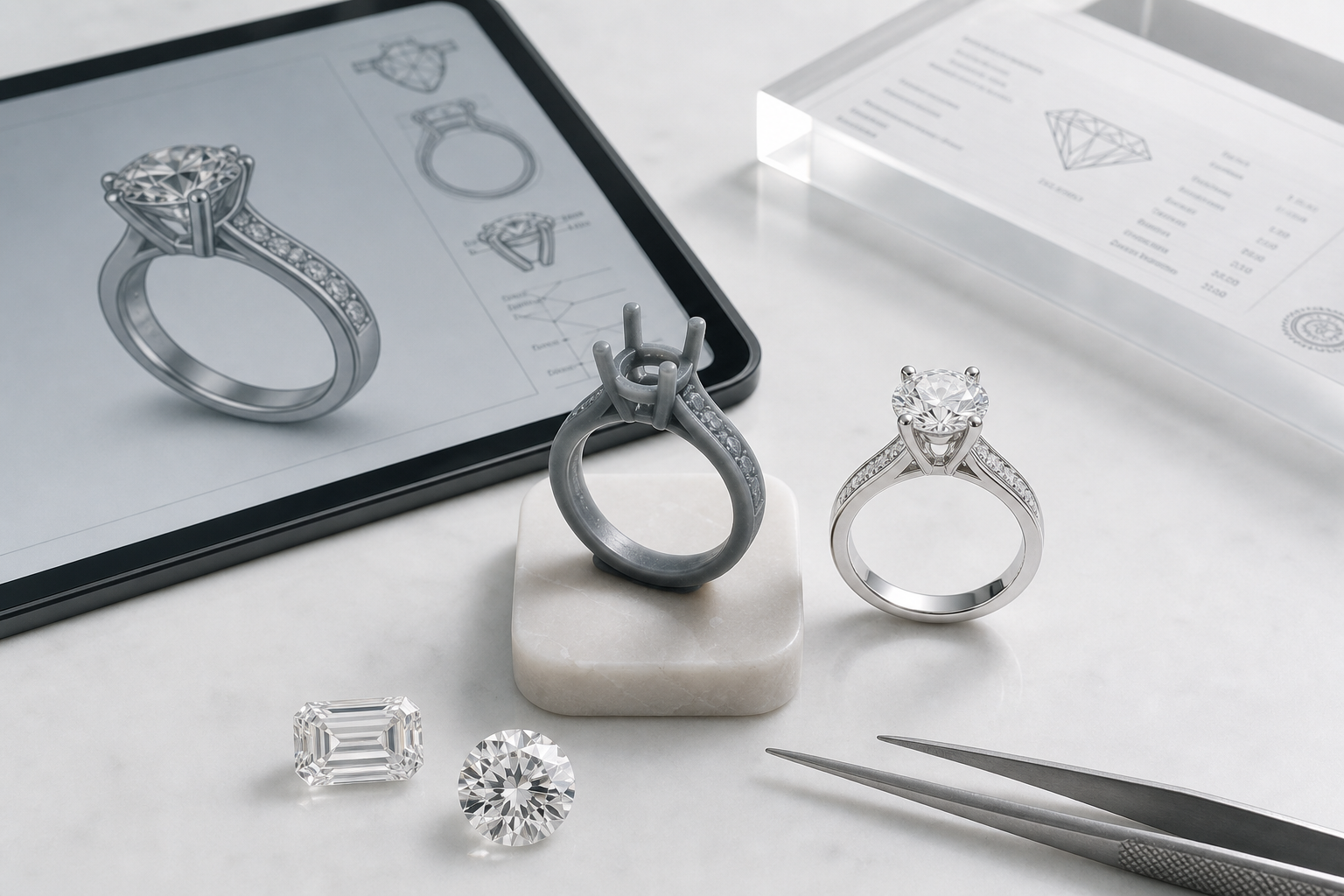
For custom lab-grown diamond jewelry, the most useful CAD adjustment starts with measurements: length, width, depth, girdle profile, corner shape, and how the stone sits visually from the top and side. These details affect basket height, seat placement, prong angle, bezel thickness, halo spacing, and the way the piece wears on the body. A file that looks attractive in a render can still be wrong if the stone sits too high, tilts in the seat, or leaves prongs stretched into weak positions.
This is where stone-to-setting compatibility becomes a real production issue rather than a design preference. A brand developing repeatable styles should not approve a CAD file only because the rendering looks close to the reference image. The better test is whether the file can accommodate the selected diamond specifications without forcing the workshop to improvise at the bench.
How shape affects setting design
Diamond shape changes the setting more than many first-time product developers expect. Round stones are generally easier to standardize because their symmetry supports more predictable prong placement and calibrated settings. Fancy shapes need more attention. Elongated ovals, pears, marquise cuts, emerald cuts, radiant cuts, and cushion cuts each create different pressure points, visual proportions, and alignment risks.
An elongated oval in a prong setting may need a basket that supports length without making the ring look top-heavy. If the prongs are placed too close to the narrow ends, the stone can appear pinched; if they sit too far apart, the outline may lose definition. Emerald cuts bring a different problem. Their straight edges and open facets make symmetry more obvious, so even a small misalignment between the stone, prongs, and shank can make the piece look less refined.
Halo settings raise the stakes because the center stone and surrounding melee must work together visually and physically. A halo built around a generic oval outline may leave uneven gaps when the actual center stone is slightly wider or has softer shoulders. Eternity bands create another kind of challenge: the CAD must account for stone size, finger size, shared prong spacing, and comfort. A design that works in one ring size may not translate cleanly to every size without adjustment.
The practical judgment is simple: use standard CAD libraries carefully, with the same verification discipline applied in lab grown diamond supplier evaluation when assumptions affect output. They can speed up development, but they should not replace stone-specific adjustment for designs where outline, seating height, or repeated stone spacing affects the final look.
Common fit issues in rings, pendants, and earrings
In rings, the most common CAD-related problems involve height, comfort, and stone security. A setting that is too high may look dramatic in a render but feel unstable during daily wear. A low basket may be more wearable but can limit wedding band compatibility or reduce light entry depending on the design. Prong thickness also needs balance. Very delicate prongs can make a product photo look refined, but if they are too thin for the stone size and metal choice, the setting may not be practical for repeat production.
Pendants have different fit concerns. The stone needs to sit straight when worn, not only when photographed flat. Bail placement, weight distribution, and chain movement affect whether the pendant flips, tilts, or faces forward. A pear or oval pendant can look correct in CAD and still hang awkwardly if the attachment point is not considered as part of the setting design.
Earrings add the issue of pair matching. Studs, drops, and halo earrings must account for left-right balance, stone depth, setting height, and how the piece sits on the ear. Two stones with similar face-up size but noticeably different depths can create uneven profile heights. For private-label jewelry, that inconsistency can become a customer-facing quality problem even when each individual diamond is technically acceptable.
For custom jewelry brands, the goal of CAD adjustment is not to make every design heavier or more conservative. It is to decide where precision matters most. Visible alignment, secure seating, comfortable wear, and repeatable production should take priority over small design flourishes that create manufacturing risk.
Stone-to-Setting Fit Check
Before a CAD file moves forward, the brand should confirm that the file was adjusted around the actual stone measurements or a clearly defined stone tolerance range. This matters most for fancy-shaped center stones, halo designs, eternity bands, matched earring pairs, and any style intended for repeat orders.
A useful fit check should answer four practical questions: Does the stone sit at the intended height? Do the prongs, bezel, or seat contact the stone correctly? Does the design still look balanced from the top and side? Can the same style be produced again if the next batch of stones varies slightly within the approved range?
If the answer depends on the setter “making it work later,” the CAD file is not ready enough for reliable production. Bench skill matters, but it should refine the design, not rescue a file that was never properly matched to the diamond.
For custom jewelry, stone measurements and setting compatibility should be confirmed before finalizing a purchase. For brands comparing suppliers, this is also a useful place to separate preference from risk. A higher or lower setting profile may be a design choice, but an unsupported seat, stretched prong position, or mismatch between the stone outline and CAD structure is a production risk. At NUVU, this kind of comparison is treated as a practical selection question: the report and CAD file narrow the field, but the stone still needs to make sense visually, physically, and commercially within the intended jewelry design.
Sample Production: Where Design Assumptions Become Physical Jewelry
Why a CAD render is not the same as a finished sample
A CAD render can show proportion, stone placement, and overall design direction, but it does not prove how the jewelry will feel or perform as a physical piece. Renderings tend to make surfaces look cleaner, prongs look more even, and proportions look more controlled than they may appear after casting, setting, polishing, and finishing. For custom jewelry development, the sample is the first serious test of whether the design works beyond the screen.
Sample production may involve a resin sample, a silver sample, or a production sample in the intended metal, depending on the brand’s budget, risk level, and product category. Resin can help evaluate scale and shape, but it cannot fully show metal weight, stone seating, polishing behavior, or wearability. A silver sample can reveal more about physical structure, though it still may not behave exactly like the final gold or platinum piece. A production sample is more expensive, but it gives the clearest view before a style is approved for repeat manufacturing.
The mistake is treating the first attractive render as approval for production. A rendering may satisfy the design brief while still hiding problems with comfort, height, stone exposure, or finishing access. For a private-label jewelry line, those hidden problems become more expensive once multiplied across a batch.
What brands should review on the first sample
The first sample should be reviewed as a product, not just as a design object. The brand should look at visual proportion, stone alignment, prong placement, metal thickness, surface finishing, comfort, and how the piece behaves when worn. A ring should be checked on the finger from the top, side, and angle views. A pendant should be checked while hanging. Earrings should be checked as a pair, not only as individual pieces.
A small bridal brand developing a 1.5 carat oval halo ring might approve a CAD render because the halo looks balanced and the center stone appears elegant. Once the first sample arrives, the brand may discover that the halo sits too high and catches on fabric. In that case, the right correction is not simply to polish the sample better. The basket may need to be lowered, prong height adjusted, and halo stone spacing tightened before the production file is approved.
This is the non-obvious value of sampling: it reveals which problems are cosmetic and which are structural. A minor surface finish issue may be corrected during production control. A proportion issue, comfort issue, or stone seating issue usually belongs back in the development file. Brands that separate those categories make better approval decisions.
How sample feedback changes the production file
Good sample feedback should become a controlled update to the production file, not a loose comment passed between teams. If the sample shows that prongs are too high, the CAD file should be revised. If the ring feels too bulky, the shank or gallery may need adjustment. If a pendant flips forward or backward, the bail position and weight distribution may need to change. These revisions should be documented before the next sample or production run begins.
The most valuable feedback is specific. “Make it more elegant” is too vague for a workshop to apply consistently. “Lower the basket slightly,” “reduce the visual thickness of the halo edge,” “adjust the prong angle around the oval shoulders,” or “increase clearance under the gallery for band pairing” gives the development team something usable. For private-label sample approval, vague feedback creates interpretation risk, especially when the same style will later be produced in multiple sizes, metals, or stone specifications.
Sample approval should also define what is now locked. If the brand approves the stone size range, setting height, prong style, metal finish, engraving placement, and packaging-related details, those choices become the reference point for production. If those details remain informal, the next batch may follow a slightly different interpretation of the same design.
Before scaling from sample to batch, buyers should also confirm what evidence will be used for approval: final CAD version, stone specification sheet, sample photos or video, finishing notes, metal and plating details, and any packaging or engraving requirements. This does not need to be complicated, but it should be written clearly enough that both sides can compare the finished production pieces against the same agreed reference.
For custom lab-grown diamond jewelry, the sample is not just a preview. It is the bridge between design intent and repeatable manufacturing, and the brands that treat it seriously usually avoid the most expensive revisions later.
Private-Label Development Needs Clear Product Claims
Custom jewelry development is not only a technical production task. It also affects how the brand describes the finished collection to customers. If a piece uses lab-grown diamonds, the product page, packaging, invoice, and sales training should use consistent wording so that buyers understand what they are purchasing. Clear terminology protects the customer experience and reduces confusion between the stone type, the grading report, the setting metal, and the brand’s own design claims.
Brands should be especially careful with broad claims such as “eco-friendly,” “sustainable,” “conflict-free,” or “carbon neutral” unless they have specific documentation that supports the exact claim being made. Lab-grown origin is a sourcing distinction, but it should not be treated as automatic proof of every environmental or ethical benefit. A more defensible approach is to describe what can be verified: the stones used, the report or documentation available, the metal specification, the production finish, and any supplier-provided evidence that the brand has actually reviewed.
Sustainability claims should be specific and documented. Broad green language is less useful than clear information about production context, energy claims where substantiated, material specifications, and seller transparency. If a private-label brand wants to make environmental or responsible-sourcing statements, those statements should be limited to what the brand can support with records and should be reviewed separately from the basic fact that the diamond is lab-grown.
This is another reason a coordinated supply chain matters. When loose diamond sourcing, CAD development, setting, sample approval, and final QC are connected, the brand can build a cleaner product file for each style. That file can support customer-facing descriptions, wholesale line sheets, reorder instructions, and after-sales service discussions. Without it, the brand may still receive attractive jewelry, but it may struggle to explain or reproduce the product with the same confidence.
How Private-Label Brands Can Word Product Descriptions Carefully
A compliant product description should separate what the stone is, what the report documents, what the setting is made from, and what the brand is promising as part of its own policies. For example, “laboratory-grown diamond center stone with an available grading report” is clearer than wording that suggests the stone is natural, mined, or broadly “certified” in a way that proves beauty or value. If a grading report is mentioned, the description should identify the issuing laboratory where accurate and avoid implying that the report confirms environmental impact, ethical sourcing, future resale value, or customer satisfaction.
| Product Claim Area | Lower-Risk Wording Approach | What to Avoid Without Support |
|---|---|---|
| Diamond origin | Clearly state “laboratory-grown diamond” or “lab-grown diamond.” | Language that implies a lab-grown diamond is a mined diamond. |
| Grading reports | Describe report details and encourage report verification where available. | Claims that a report guarantees beauty, value, sourcing ethics, or sustainability. |
| Environmental claims | Limit statements to documented production, sourcing, or energy information. | Broad unsupported claims such as “eco-friendly,” “green,” or “zero-impact.” |
| Price or value | Compare like-for-like specifications and verify current quotes. | Unsupported claims such as “lowest price,” “best value,” or guaranteed savings. |
| Custom design | Confirm measurements, CAD revisions, setting fit, and approval records. | Promises that every design will work without sampling or adjustment. |
Customer-Facing Assurance Should Match the Production File
For private-label brands, trust continues after production because the final customer will often rely on the brand’s description, grading report references, and after-sales communication. A well-prepared product file allows the brand to answer practical questions without exaggeration: what type of diamond is used, whether a grading report is available for the center stone, what metal specification is used, what finish was approved, and what care or resizing limits may apply to the setting.
This is especially important for bridal and higher-value custom jewelry, where buyers may compare several similar designs before deciding. Clear documentation does not need to make the product sound more luxurious than it is. Instead, it helps the customer understand the piece accurately and gives the brand a reliable basis for service, reorder, repair, or replacement discussions later.
If a GIA, IGI, GCAL, or other laboratory grading report is provided, buyers should use the issuing laboratory’s available report-check tools and confirm that the report details match the stone being described.
Final Buyer Takeaway
China’s lab-grown diamond ecosystem can support custom jewelry brands most effectively when it is used as a connected development system rather than a loose collection of vendors. The real advantage is not simply access to stones or manufacturing capacity. It is the ability to align stone measurements, CAD files, setting methods, sample feedback, inspection standards, and repeat-order requirements before the design becomes a scaled product.
For buyers, the strongest supplier conversations are specific. Ask how stones are measured and matched, how CAD files are adjusted, how sample changes are documented, how production tolerances are locked, and how the approved style will be repeated in future orders. A supplier that can answer those questions clearly is more likely to function as a jewelry development partner, not just a source for loose lab-grown diamonds or finished pieces.
Before committing to a custom or private-label program, buyers should also confirm the communication record they will receive: stone specifications, report references where applicable, CAD versions, sample approval notes, production standards, and any changes made after approval. These documents are not a substitute for choosing a capable supplier, but they make the project easier to audit, repeat, and explain to future customers or wholesale accounts.
NUVU’s buyer-first approach is to make comparison clearer, especially around report details, visual evidence, setting fit, and documentation. The useful outcome is not a generic promise that one supplier model is right for every brand, but a clearer decision process: verify the laboratory-grown origin, compare actual measurements, review the CAD against the stones, approve a physical sample, and keep the documentation connected to the style being produced.
Disclosure: This article is for general educational purposes only. Diamond grading, pricing, availability, specifications, and seller policies can change, and readers should verify important details through grading reports, official laboratory tools, seller documentation, or qualified professionals before making a purchase decision. Laboratory-grown diamonds should be clearly distinguished from natural diamonds, and environmental or sourcing claims should be supported by specific documentation.