
A first successful order from a lab-grown diamond supplier in China can be encouraging, but it does not prove that the supplier is ready for long-term dependence. Real reliability shows up across repeat orders, changing stock conditions, and the speed expectations set by China lab-grown diamond supply chain models, while still accounting for different specifications, documentation needs, quality issues, and delivery pressure. For buyers, the main challenge is turning a good first transaction into a sourcing system that can be repeated, checked, and improved.
For the full framework, read China Lab-Grown Diamond Supply Chain Guide.
This article helps you judge whether a supplier relationship is becoming stronger or simply relying on luck, memory, and informal communication. It looks at how to define specifications, set realistic tolerances, record quality decisions, review pricing, verify documents, and evaluate performance over several orders. The goal is to help you decide when to scale a partnership, when to tighten controls, and when to reduce dependency before small sourcing problems become expensive patterns.
Throughout this guide, “lab-grown diamond” refers to a laboratory-grown diamond, not a natural or mined diamond and not a diamond simulant. Laboratory-grown diamonds should be clearly identified as laboratory-grown, and they should not be presented as mined diamonds. When growth method, origin disclosure, or post-growth treatment is relevant, buyers should look for clear disclosure in the grading report or seller documentation.
| Partnership Area | What to Verify | Risk if Ignored |
|---|---|---|
| Supplier role | Loose stones, cutting, jewelry making, or sourcing coordination | Unclear accountability when problems appear |
| Quality standards | Carat, color, clarity, reports, measurements, proportions, visual traits | “Same as last time” leads to inconsistent reorders |
| QC feedback | Marked photos, videos, report references, accepted and rejected examples | Repeated disputes without useful correction |
| Documentation | Reports, invoices, packing lists, QC notes, written confirmations | Stones or jewelry cannot be confidently traced |
| Performance review | Three to five orders scored for accuracy, timing, response, resolution | One good shipment hides recurring weaknesses |
Quick Questions Before You Read
Q: Is one good lab-grown diamond order enough to trust a supplier?
No. It is a useful starting point, but repeat performance under different order conditions matters more.
Q: Should every reorder match the previous stones exactly?
Usually not. Long-term sourcing works better with agreed quality ranges and clear tolerances.
Q: Do certificates remove the need for visual QC?
No. Grading reports support verification, but photos, videos, measurements, and face-up review still matter.
Q: When should a buyer reconsider supplier dependency?
When the same quality, documentation, timing, or communication problems continue after clear written feedback.
Why One Successful Lab-Grown Diamond Order Is Not Enough
A strong first order from a China lab-grown diamond supplier is a useful signal, but it is not proof of a stable sourcing partnership. It shows that the supplier could meet one request, at one moment, under one set of conditions. Long-term diamond sourcing asks a harder question: can both sides repeat the result when the order changes, the timeline tightens, the market moves, or the same product needs to be reordered three months later?
This distinction matters because first orders often receive extra attention. A supplier may select stones carefully, respond quickly, and treat the shipment as a test of future business. That does not mean the performance is artificial, but it does mean the buyer has not yet tested the supplier’s normal operating rhythm. Repeat order consistency is where supplier reliability becomes easier to judge.
In practical buying, the first order should be treated as a controlled observation rather than a final verdict. A clean invoice, matching report numbers, and attractive videos are positive signals, but they do not yet show how the supplier handles substitutions, mixed availability, rejected stones, or repeat specifications. The more useful question is what evidence can be carried into the next order: written standards, accepted examples, rejected examples, and a clear record of why the first shipment was approved.
The difference between a good shipment and a reliable supply system
A good shipment is an outcome. A reliable supply system is the process that makes that outcome repeatable. For wholesale lab-grown diamonds, the process matters as much as the stones themselves because the buyer is not only purchasing inventory; they are building a product standard their own customers will expect to see again.
A dependable sourcing partnership requires more than attractive stones and a fair invoice. It depends on clear requests, shared definitions, consistent checking, written confirmations, and a practical way to handle problems. If those pieces are missing, a successful shipment may create false confidence. The first order can look clean because the request was simple, the supplier had suitable stock on hand, or one salesperson managed the details closely. The next order may expose whether the company behind that salesperson can actually support repeat business.
The real test is not whether a lab-grown diamond supplier in China can deliver a nice parcel once. The better question is whether the supplier and buyer have built a repeatable sourcing system that can survive normal business friction without confusion.
Why repeat orders reveal more than sample orders
Repeat orders reveal the details that a sample order hides. A sample order may confirm basic capability: the supplier can source the requested shape, provide grading reports, arrange shipment, and communicate in a way that works for the buyer. A second or third order tests whether those same results can be reproduced without starting from zero each time.
For example, a U.S. jewelry brand may receive a strong first shipment of 1.50 ct E VS1 oval lab-grown diamonds. The stones look bright, the grading reports match the request, and the shipment arrives within the expected window. Encouraged by the result, the buyer places a larger reorder for the same oval program. This time, the stones are still technically close, but the measurements vary more than expected, some reports are from a different lab than originally discussed, the face-up appearance is less consistent, and replies take longer because the supplier is balancing other orders.
That situation does not automatically mean the supplier is unreliable. It may mean the buyer never converted the first order into a clear reorder standard. “Same as last time” is not a sourcing system. It depends on memory, interpretation, and goodwill. In a long-term lab-grown diamond supply partnership in China, the buyer and supplier need enough structure that a reorder can be quoted, selected, checked, and shipped without everyone guessing what “same” means.
Common risks that appear after the first successful order
The most common risks after a successful first order are rarely dramatic at the beginning. They tend to appear as small differences that become expensive when repeated: slightly different proportions, slower response times, inconsistent report types, unclear replacement rules, shifting availability, or stones that meet the broad grade request but do not match the buyer’s visual standard.
For buyers selling finished jewelry, these differences can affect product photography, customer expectations, setting compatibility, and margin planning. A center stone that is technically 1.50 ct may still face up smaller than the previous batch. An oval that fits the requested color and clarity range may show a stronger bow-tie than the approved sample. A melee parcel may be acceptable on paper but look warmer beside the previous production run. These are not abstract quality issues; they affect how consistent the buyer’s own product line feels to the end customer.
Communication is another risk. During a first order, a supplier may respond quickly because the order is being closely watched. Over time, if there is no agreed communication rhythm, updates can become scattered across messages, order details can be buried in chat history, and small changes may not be confirmed clearly. The partnership then depends too heavily on individual attention instead of a repeatable business process.
What This Means in a Real Purchase
A buyer should treat the first successful order as the beginning of evaluation, not the end of it. The practical next step is not to assume the supplier has passed every test. It is to ask what made the order successful and whether those conditions can be repeated.
If the first shipment worked because the supplier had ideal stock available, the buyer should be cautious about scaling too quickly. If it worked because the specifications were unusually flexible, the buyer should define which details are truly required before placing a larger reorder. If it worked because one contact managed every detail manually, the buyer should find out whether the same accuracy holds when order volume increases.
The strongest long-term sourcing relationships are built when both sides understand that a good shipment is evidence, not a guarantee. It gives the buyer a reason to continue, but the partnership becomes reliable only when repeat orders are managed through clearer standards, better communication, and a shared definition of what acceptable supply looks like.
Evidence Standard for Long-Term Supplier Decisions
Before increasing order volume, separate encouraging signals from usable evidence. Encouraging signals include friendly communication, attractive presentation, and a smooth first transaction. Usable evidence includes repeatable documents, matching stone references, clear approval notes, shipment records, and a supplier response that shows the same instructions can be followed more than once.
A practical rule is to avoid scaling based only on impressions. If a supplier claims they can support a repeat program, ask what process will support that claim: how stones will be selected, how report details will be checked, how substitutes will be approved, how QC media will be stored, and who confirms final shipment contents. The stronger the evidence trail, the easier it becomes to distinguish a capable long-term partner from a supplier who performed well only under first-order conditions.
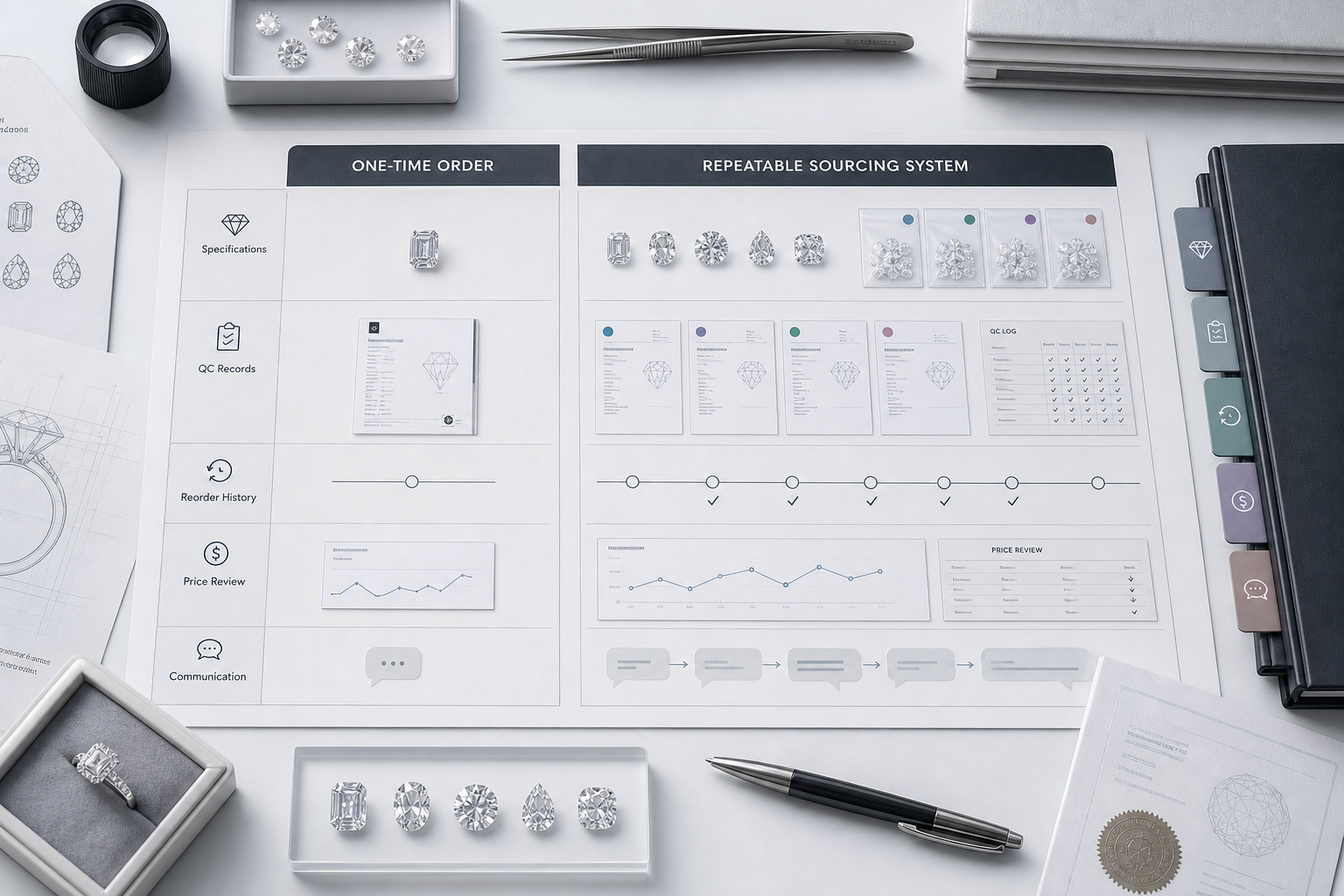
Define the Supplier Role Before You Build the Partnership
Not every China-based lab-grown diamond partner is built to solve the same problem. Some companies are strongest as loose diamond suppliers. Some focus on cutting or recutting. Some operate as jewelry factories. Others function as mixed sourcing partners that coordinate stones, settings, packaging, and private-label production through different channels. A long-term partnership becomes harder to manage when the buyer treats all of these roles as interchangeable.
Role clarity prevents mismatched expectations. A lab-grown diamond wholesale supplier may be excellent at locating stones with grading reports in commercial quantities but less suited to managing custom jewelry manufacturing. A jewelry manufacturing partner may understand CAD, casting, setting, and finishing, but may not always be the strongest source for every loose center stone. A China lab-grown diamond manufacturer may offer production depth in some categories, while a sourcing partner may offer flexibility across categories. The better choice depends on what the buyer needs to repeat.
Loose diamond supplier, cutter, jewelry factory, or sourcing partner
A loose diamond supplier is usually the right partner when the main requirement is access to stones that meet defined size, shape, grade, report, and visual standards. This role is especially relevant for online diamond sellers, wholesalers, and jewelers building inventory around lab-grown diamonds with grading reports. The buyer’s main concern is stone consistency, report accuracy, media quality, and availability.
A cutter or cutting-connected partner becomes more relevant when the buyer cares about make, proportion control, calibrated dimensions, or custom cutting requirements. This is different from simply buying available goods. The buyer may need stronger agreement on measurements, shape ratios, table and depth preferences, matching requirements, and acceptable variation after cutting.
A jewelry factory is a different type of partner. For custom jewelry manufacturing, engagement ring programs, private-label jewelry, or finished fine jewelry, the diamond is only one part of the finished product. Metal quality, CAD interpretation, setting work, polishing, prong alignment, stone security, engraving, packaging, and production communication all become part of the relationship. A factory that produces good rings may still need a separate stone-selection process if the buyer has strict center-stone standards.
A sourcing partner sits between these categories. This type of partner may help coordinate loose lab-grown diamonds, melee, settings, finished pieces, and documentation. The advantage is convenience and broader coordination. The risk is less direct control if the sourcing partner does not clearly identify which parts of the order they produce, which parts they source, and how quality is checked across each step.
Why role clarity changes your quality control process
The quality control process should match the supplier’s actual role. A buyer sourcing 2 ct center stones with grading reports should focus heavily on report verification, videos, proportions, measurements, and visual review. A buyer ordering calibrated melee should pay more attention to face-up consistency, color matching, size tolerance, and how the parcel performs in finished jewelry. A buyer producing private-label rings should inspect not only the stones, but also the setting, finish, alignment, and packaging accuracy.
This is where many sourcing relationships become strained. The buyer may complain about “quality,” while the supplier believes the goods meet the stated request. The real issue is often that the buyer expected one type of quality control from a partner playing a different role. A loose diamond supplier may not automatically check finished-ring details. A jewelry factory may not apply the same loose-stone comparison standards a diamond-focused buyer expects unless those standards are written into the order process.
For long-term cooperation, the priority is identifying the failure points that belong to that supplier’s role. If the partner supplies loose stones, the key risk may be inconsistent proportions or report mix. If the partner manufactures jewelry, the key risk may be production interpretation or finishing quality. If the partner coordinates multiple steps, the key risk may be handoff errors between stone sourcing and jewelry production.
For custom design, the stone cannot be evaluated separately from the setting. A diamond with attractive grading details may still create problems if its measurements, depth, girdle profile, or outline do not work with the approved CAD, prong style, halo layout, or matching side stones. Before assigning responsibility, clarify who checks setting compatibility: the loose stone supplier, the jewelry factory, or the buyer’s own production team.
When one partner is enough and when multiple partners reduce risk
One partner can be enough when the order type is narrow, repeatable, and well matched to the supplier’s strengths. A buyer who regularly purchases a defined range of loose lab-grown diamonds may benefit from concentrating volume with one reliable wholesale supplier, because the supplier learns the buyer’s preferences and can build a clearer reorder history. The same can apply to a consistent private-label jewelry program if the factory understands the design standards and production expectations.
Multiple partners become useful when the buyer’s needs are too broad for one supplier to handle equally well. A brand may use one partner for center stones with grading reports, another for calibrated melee, and a separate jewelry manufacturing partner for finished settings. This adds management work, but it can reduce dependency and prevent one weak category from affecting the entire supply program.
The mistake is assuming that fewer suppliers always means better control. A single partner can simplify communication, but only if that partner is genuinely capable in the categories being assigned to them. If not, the buyer may gain convenience while losing quality visibility. The better decision is to match supplier structure to the product strategy: simple programs can often stay concentrated; mixed programs usually need either a capable coordinating partner or a controlled multi-supplier model.
Supplier Role Fit Check
Before treating a China-based supplier as a long-term partner, define the role in plain business terms. Is the partner responsible for loose diamond sourcing, cutting support, finished jewelry manufacturing, private-label production, or full sourcing coordination? Then identify what success looks like for that role.
For loose stones, success may mean accurate grading alignment, consistent visual selection, reliable media, and clean report handling. For custom jewelry, success may mean CAD accuracy, stone-setting quality, finish consistency, and clear production updates. For a sourcing partner, success may mean transparent coordination, organized documentation, and the ability to explain which standards apply at each step.
If the role is unclear, every later conversation becomes harder. Quality control becomes vague, pricing comparisons become unfair, and accountability becomes difficult to assign. A stable partnership starts when both sides know exactly what job the supplier is being asked to perform.
When a grading report is provided, buyers should verify the report details through the issuing laboratory’s official report-check tool where available and compare those details with the stone, media, invoice reference, and shipment record.
For a buyer evaluating long-term cooperation, this kind of document-aware process is not a decorative extra. It is part of how trust becomes operational. When report numbers, stone videos, invoice references, and QC notes can be connected to the same shipment, the buyer is less dependent on verbal assurance and better able to confirm what was actually selected, approved, and shipped.
If a GIA, IGI, HRD Antwerp, GCAL, or other laboratory report is provided, verification should be matched to the actual laboratory named on the document. Each grading organization uses its own report format and verification process, so buyers should confirm report details through the appropriate official channel rather than relying only on a screenshot or supplier message. This habit keeps the partnership grounded in records that both sides can review.
Scaling orders without shared specification standards is one of the fastest ways to turn a promising supplier relationship into a frustrating one. Vague requests may work for a small test shipment, but they do not hold up when the buyer needs repeatable supply. “Good quality oval diamonds,” “nice VS stones,” or “same as last time” leave too much room for interpretation.
Written lab-grown diamond specifications protect both sides. The buyer gets a clearer basis for approval and rejection. The supplier gets a request that can be quoted, sourced, checked, and repeated without guessing. In a long-term sourcing relationship, the goal is not to make every stone identical. It is to define the approved quality range clearly enough that both sides know what belongs inside or outside the program.
Turn vague buying preferences into written diamond standards
A buying preference becomes useful only when it can be translated into standards. If a buyer says they want “high-quality round diamonds,” the supplier still has to interpret carat weight, color, clarity, cut grade, report type, fluorescence, table range, depth range, and whether the buyer values face-up size or stricter proportions more. Without written standards, two suppliers can quote the same request and deliver very different products.
The most important specifications are the ones that affect the buyer’s actual selling model. An online loose diamond seller may need stricter report consistency and video review because customers compare stones side by side. A jeweler producing a repeat ring style may care more about measurements and setting fit. A wholesale buyer purchasing melee may prioritize batch consistency over individual report-level details.
This is why specification discipline should come before larger orders. It reduces unnecessary disputes because both sides can compare the delivered goods against the same written standard. It also prevents a common sourcing mistake: approving a first order based on personal judgment, then expecting the supplier to recreate that judgment later without a documented reference.
Set acceptable ranges for carat, color, clarity, shape, and measurements
Long-term cooperation works better when specifications use acceptable ranges rather than single fixed targets. A request for exactly 1.50 ct stones may sound precise, but it can make sourcing slower or more expensive without improving the buyer’s real outcome. A range such as 1.45–1.59 ct may be more practical if the finished product can support that spread and the face-up appearance remains consistent.
For a repeat order of 1.50 ct oval lab-grown diamonds, an illustrative standard might read: 1.45–1.59 ct, D–F color, VS1–VS2 clarity, oval shape ratio between 1.35 and 1.45, agreed report type such as IGI or another approved laboratory report, no strong visible bow-tie in supplied video, and measurements within a visual-size tolerance accepted by the buyer. These numbers are not universal rules. They are examples of how a buyer can turn a general product need into a standard that can be checked.
The key is to separate must-have requirements from preferences. Report type, shape, carat range, and minimum clarity may be firm requirements for one program. A narrower color range or more specific ratio may be preferred but negotiable if availability changes. Treating every detail as equally important creates delays and weakens communication because the supplier cannot tell which tradeoffs are acceptable.
Define visual standards that grading reports do not fully capture
Grading reports are useful, but they do not show everything that matters in a buying decision. Fancy shapes in particular require visual review because two stones with similar grades can look very different face up. Bow-tie strength in ovals, crushed-ice appearance in cushions, windowing in elongated shapes, and uneven light return are not fully explained by color, clarity, and carat weight.
Visual standards should be documented with the same seriousness as grading standards. If a buyer dislikes short, wide ovals, the acceptable ratio should be written down. If a buyer rejects strong bow-ties, reference videos or approved examples should be saved. If melee needs to match a previous batch, the supplier should know whether the priority is color consistency, brightness, diameter tolerance, or all three.
The most common mistake is relying on report grades to carry the full quality decision. Grading reports narrow the field, but they do not replace buyer-specific judgment. A stone can meet the written grade request and still be wrong for the program if the measurements, face-up outline, or visual performance do not match the intended product.
A grading report should also be read as a description of documented characteristics, not as a promise that the diamond is the best commercial choice. It may confirm details such as weight, measurements, color, clarity, and report identity, but it does not automatically prove beauty, customer appeal, setting fit, sourcing ethics, or resale value. For a long-term supply program, the report is strongest when it is paired with comparable media, physical measurements, and a clear explanation of why the stone fits the buyer’s product standard.
For NUVU, the buyer-first approach is to make diamond comparison easier to understand, especially when buyers are weighing report details, visual performance, setting fit, and budget together. In a sourcing partnership, that means the report should help organize the decision, not replace the decision. The more clearly a buyer can explain why a stone fits a product program, the easier it is for a supplier to repeat that standard responsibly.
Specification Evidence File
Once specifications are written, create a small evidence file for each recurring program. This file should include the approved written range, sample videos or images, any supplier comments about availability, and examples of stones that were accepted or rejected; for overseas programs, China supplier red flags can also help teams decide which supplier comments need closer verification. The purpose is not to make the process bureaucratic. It is to give the supplier a practical reference that reduces interpretation during the next quotation or selection round.
This evidence file should be updated only when the buyer’s standard actually changes. If every minor preference becomes a new rule, the file becomes difficult to use. A stronger approach is to record meaningful decisions: a ratio range that consistently works, a visual trait that repeatedly causes rejection, a report type that must be confirmed before shipment, or a measurement tolerance required by an existing setting design.
Specification Range Example for Repeat Orders
A practical repeat-order standard should be specific enough to guide sourcing but not so narrow that it blocks supply unnecessarily. For example, a buyer building an oval center-stone program might define the request as follows: 1.45–1.59 ct oval lab-grown diamonds, D–F color, VS1–VS2 clarity, agreed grading report type, ratio 1.35–1.45, no obvious dark bow-tie in normal video review, no visual inclusions in face-up inspection, and measurements suitable for the approved setting range.
The buyer should also identify what can change with approval. If E color is unavailable but D and F are available, that may be acceptable. If the ratio drops to 1.30, the stone may no longer fit the brand’s preferred oval look. If the report type changes, the buyer may need to approve that before shipment rather than discovering it during receiving.
Shared specifications are not paperwork for its own sake. They are the operating language of a long-term supply relationship. Once both sides know the approved range, future orders become easier to quote, easier to inspect, and easier to improve.
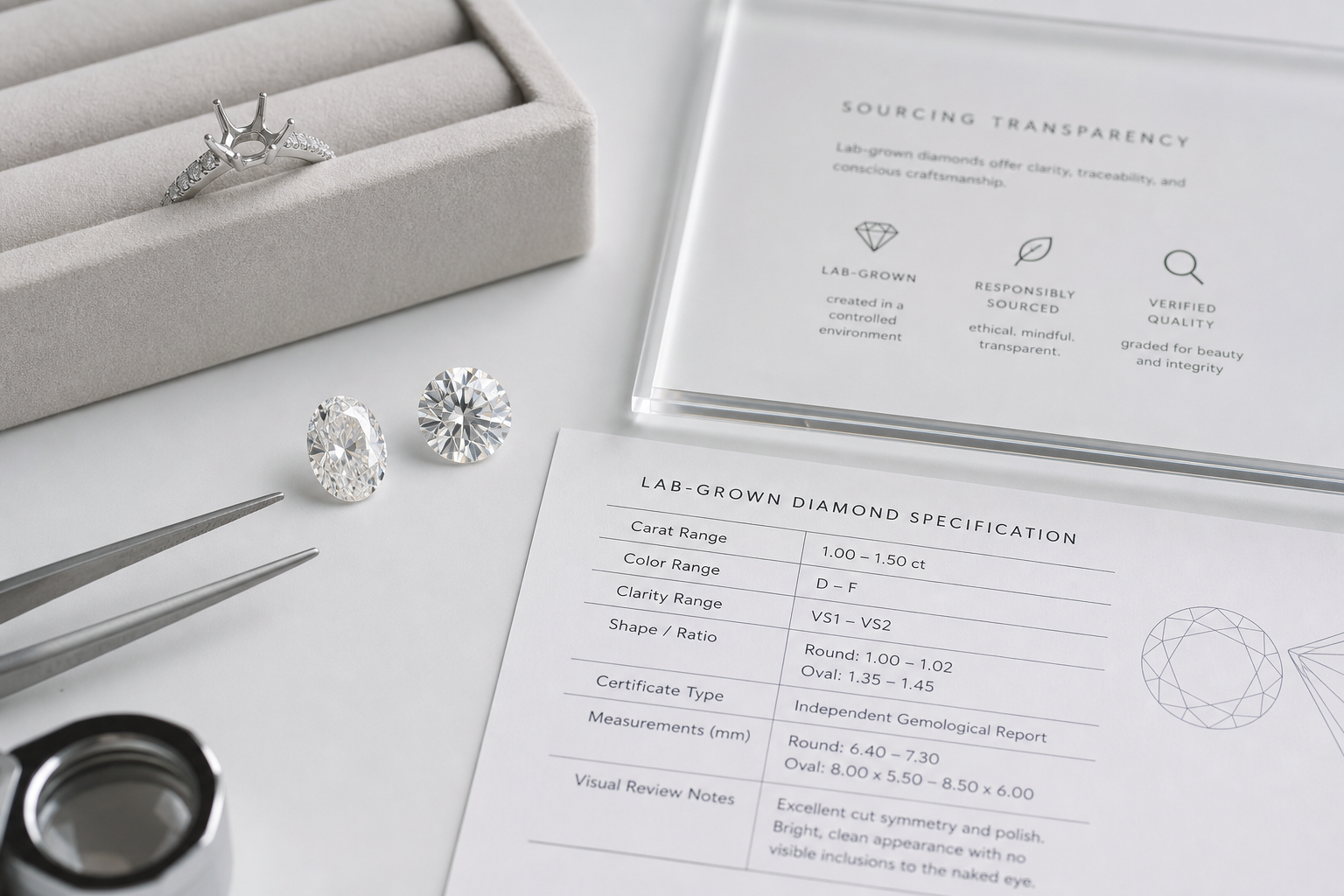
Build an Approved Quality Range Instead of Chasing Perfect Matches
A long-term sourcing program works best when both sides agree on a controlled quality range, not when the buyer expects every lab-grown diamond to match a previous stone exactly. This matters because diamonds are physical products with visible variation, especially in fancy shapes, matched pairs, melee, and repeat custom jewelry programs. The practical goal is not sameness. It is commercial consistency inside limits that both buyer and supplier understand.
An approved quality range protects the buyer from unpredictable variation, but it also protects the supplier from impossible instructions. If the request is too loose, the next shipment may drift away from the look your customers expect. If the request is too narrow, sourcing becomes slower, pricing becomes less stable, and the supplier may struggle to fill repeat orders without constant exceptions. Good diamond quality tolerance sits between those two problems.
Why acceptable tolerance matters in real sourcing
In real sourcing, the question is rarely whether two stones are technically identical. The better question is whether the difference matters in the final product. A 1.48 ct oval and a 1.52 ct oval may both work in the same program if the face-up size, ratio, color, clarity, and visual performance remain within the approved range. A technically larger stone can still be the worse choice if it faces up small, has a heavier bow-tie, or does not match the visual style of previous orders.
This is where many buyers overcorrect. After one disappointing batch, they tighten every requirement at once. That may reduce variation, but it can also create longer lead times and fewer available stones. A better approach is to identify which variation actually caused the problem. If customers noticed warmer color, tighten the color range. If the issue was short-looking ovals, tighten the ratio. If the problem was inconsistent sparkle in videos, strengthen the visual review standard instead of narrowing every grading category.
Acceptable tolerance should be tied to the selling context. For a wholesale diamond program, consistency may mean repeatable grading ranges and predictable report types. For private-label jewelry, it may mean that finished pieces look uniform across a product line. For custom jewelry, it may mean matching the design intent rather than forcing a stone to copy a previous order exactly.
How quality range differs for center stones, melee, and matched pairs
Center stones usually need tighter individual review because the customer sees one diamond as the focus of the purchase. For center stones with grading reports, report details, measurements, videos, shape ratio, and visual issues such as bow-tie, windowing, or unusual make can carry real buying consequences. A buyer ordering 2 ct radiant or oval lab-grown diamonds should not rely only on color and clarity. Two stones with the same grade can look meaningfully different once set.
Melee diamond quality works differently. For small stones used in pavé, halos, bands, or tennis bracelets, the main concern is often consistent face-up appearance across the finished piece. Individual report details are usually less important than batch consistency, color harmony, size calibration, brightness, and clean setting performance. A melee batch that is technically acceptable stone by stone can still fail commercially if half the stones look warmer or duller under the same lighting.
Matched diamond pairs require a different level of control. Earrings, side stones, two-stone rings, and symmetrical designs depend on visual balance. Carat weight alone is not enough. The stones should be close in face-up size, outline, ratio, color, clarity impression, and light behavior. A pair can look mismatched even when both stones fall within the same written grade range. For matched diamond pairs, the approved quality range should include pair-level judgment, not just individual stone acceptance.
Fancy shape diamonds need special attention because their appearance changes more dramatically from stone to stone than many round diamonds. Ovals, emerald cuts, pears, cushions, radiants, and marquise cuts can vary in outline, length-to-width ratio, corner shape, facet pattern, and light distribution. A long-term sourcing partner may understand the requested grade, but still need reference videos or approved samples to repeat the preferred look.
When tighter standards improve consistency and when they create delays
Tighter standards are useful when the variation affects the customer-facing product. If your brand sells a specific oval look, ratio control matters. If your jewelry line depends on bright white melee, color consistency matters. If your program uses center stones with grading reports, report type and verification process matter. Narrowing the standard is worth it when it protects the product experience or reduces remakes and customer dissatisfaction.
Tighter standards become a problem when they are used to chase theoretical perfection. Requiring an unusually narrow carat range, one specific ratio, only one report type, a limited clarity range, and highly selective visual approval may be reasonable for a high-value center stone program, but inefficient for routine replenishment. The more filters added, the smaller the available supply becomes. That can increase sourcing difficulty, slow reorders, and create price pressure even if the general market is stable.
The smarter question is which standards should be fixed and which can be flexible. For example, a buyer may keep shape ratio and visual bow-tie control tight for oval center stones, while allowing a broader carat range if the face-up measurements stay consistent. For melee, the buyer may keep color and calibration tight while accepting a practical clarity range because tiny inclusions may not affect the finished look. This kind of hierarchy makes lab-grown diamond consistency easier to maintain without making every order harder than necessary.
Quality Tolerance Check Before Reordering
- Identify the product type: center stone, melee, matched pair, finished jewelry, or custom design program.
- Decide what the customer will actually notice: face-up size, color harmony, outline, sparkle, matching, or report details.
- Separate fixed requirements from flexible ranges: do not make every specification equally strict unless the product truly requires it.
- Review previous accepted stones: use videos, photos, measurements, and QC notes to define the acceptable look.
- Flag repeated variation: if the same issue appears across multiple batches, update the approved quality range before the next order.
Keep Reorder Records That Make Future Orders Easier
Long-term sourcing depends on a memory system, not personal memory. A supplier may remember the general product, and a buyer may remember that the previous shipment was “good,” but that is not enough to repeat an order accurately three months later. Reorder records give both sides a shared reference point when staff changes, pricing moves, report availability shifts, or the product line expands.
The most useful records are not complicated. They simply capture what was requested, what was offered, what was accepted, what was rejected, and what should change next time. Without that record, every reorder becomes a partial restart. The buyer asks for “the same as last time,” the supplier interprets it from memory, and small differences start to accumulate.
What to record after every lab-grown diamond order
After each order, keep a clear file that connects the commercial order to the actual stones or finished goods received. At minimum, this should include the order date, supplier contact, quotation version, final confirmed specifications, stone quantities, report numbers where applicable, videos or images reviewed before approval, accepted stones, rejected stones, QC feedback, final invoice, packing list, shipping documents, and reorder notes.
For wholesale diamond inventory control, SKU mapping is especially important. If a 1.50 ct oval program, a 2.00 ct radiant program, and a melee jewelry line all sit under the same supplier relationship, vague file names will create confusion later. Each product group should have its own reorder trail so future purchasing decisions can be based on the actual supplier order history, not scattered messages across email, spreadsheets, and chat apps.
The biggest mistake is only saving invoices. An invoice proves what was billed, but it rarely explains why specific stones were chosen or what issues appeared during QC. A complete diamond reorder record should preserve the buying judgment behind the transaction, not just the transaction itself.
How report numbers, videos, and QC notes support reorders
Report number tracking helps prevent confusion when comparing previous and current inventory. It also allows the buyer to verify report details again if questions arise later. For lab-grown diamonds with grading reports, report numbers are useful anchors, but they should be paired with the videos, images, and measurements used during approval. The report may confirm grade information, while the visual file shows why the stone was considered acceptable for the program.
Videos and images are especially valuable for fancy shapes because they preserve visual preferences that a grading report does not fully describe. If the previous oval batch had a preferred length-to-width ratio and mild bow-tie appearance, saving only the report numbers will not help the supplier repeat the look. If the buyer keeps the original videos and marks which stones were approved, the next sourcing request becomes much clearer.
QC notes turn inspection experience into future instruction. A note such as “accepted, but ratio near lower limit” is more useful than a simple approval. A note such as “rejected because color appeared warmer than prior melee batch under same lighting” gives the supplier a specific correction path. Over time, these notes become one of the strongest forms of lab-grown diamond sourcing documentation because they show how the buyer defines acceptable quality in practice.
Why rejected stones are as useful to track as accepted stones
Rejected stones often teach the supplier more than approved stones. An accepted stone shows what worked. A rejected stone shows where the boundary is. If the buyer does not track rejected options, the same type of unsuitable stone may be offered again because the supplier has no durable record of the issue.
This matters most when the rejection is not obvious from the report. A stone may have the right carat weight, color, clarity, and report type, yet still fail because the shape outline is too bulky, the bow-tie is too strong, the pair does not match, or the face-up size is disappointing. Those are exactly the details that should be captured in reorder notes.
Rejected goods also help distinguish a supplier problem from an unclear buying standard. If the same rejection pattern repeats, the buyer may need to rewrite the sourcing instruction. If the supplier repeatedly offers stones outside a clearly documented range, the issue is execution. Without records, both sides end up debating impressions instead of reviewing evidence.
Reorder File Checklist
- Order basics: order date, buyer SKU, supplier name, supplier contact, and quotation version.
- Confirmed specifications: shape, carat range, color, clarity, measurements, ratio, report type, and any visual requirements.
- Stone-level records: report numbers, videos, images, measurement details, and approval status.
- QC outcome: accepted stones, rejected stones, reason for rejection, inspection notes, and supplier response.
- Commercial documents: final invoice, packing list, payment reference, shipping documents, and delivery confirmation.
- Next-order notes: what to repeat, what to avoid, what range to tighten, and what can remain flexible.
Use Price Review Cycles Without Turning Every Order Into a Renegotiation
Stable sourcing partnerships still need price review. Lab-grown diamond pricing can move because of supply conditions, shape availability, size category, grading reports, demand, production cost, and selling channel. A long-term buyer should expect pricing to be reviewed, but not argued from scratch on every order. Constant renegotiation drains trust and makes planning harder for both sides.
The goal is not to lock a supplier into yesterday’s market or accept every price change without question. The goal is to create a disciplined way to review repeat order pricing with enough context to judge whether a change is reasonable. In a healthy China diamond supplier pricing discussion, quality, documentation, availability, and consistency are part of the conversation, not just the unit price.
Prices can change with market conditions, report type, seller channel, and stone-specific details, so exact comparisons should be verified at the time of purchase. Buyers should compare like-for-like specifications before treating one quote as a better value than another.
Why stable partnerships still need price review
A stable partnership does not mean static pricing. Some lab-grown diamond categories move faster than others. Popular sizes, certain fancy shapes, specific report combinations, and high-demand qualities may shift more often than routine custom jewelry components. If a buyer expects old pricing to apply indefinitely, the supplier may respond by lowering quality, limiting availability, or avoiding difficult orders.
At the same time, a supplier should not use every reorder as an opportunity to reset the relationship. If pricing changes without explanation, the buyer cannot plan inventory, quote customers confidently, or compare supplier performance over time. The more repeatable the program, the more important it becomes to agree on when and how lab-grown diamond price review should happen.
For wholesale diamond pricing, the most practical standard is transparency. If a price changes, the buyer should know whether the change is tied to market movement, stricter specifications, report requirements, limited availability, faster delivery expectations, or a different stone mix. A lower quote is not automatically better if it quietly relaxes the approved quality range.
How to compare price changes without ignoring quality differences
Price comparisons are only useful when the goods are comparable. A quote for 1.50 ct D-F VS oval lab-grown diamonds with tight ratio control and report consistency should not be compared directly with a broader mixed lot that includes more visual variation. The second quote may look cheaper, but it may create more QC rejections, slower selling inventory, or customer dissatisfaction.
When reviewing repeat order pricing, compare the full package: grade range, shape difficulty, measurements, visual standards, report type, matching requirements, delivery expectation, documentation quality, and past rejection rate. A supplier with a slightly higher price but fewer QC failures may be more cost-effective than a lower-priced option that requires repeated sorting and replacement.
This is where many buyers make the wrong tradeoff. They push aggressively for a lower unit price, then absorb the hidden cost through extra inspection time, inconsistent product photography, delayed fulfillment, or uneven customer experience. Sourcing cost management should include the cost of problems, not only the cost of the stone.
Set review timing by order frequency, not emotion
Price review should be scheduled around buying activity. A high-volume loose diamond program may need monthly review or review after a defined order volume because the market and inventory mix can change quickly. A slower private-label jewelry program may work better with quarterly review or review at the start of each new production cycle. A custom-order business may review pricing by project type rather than on a fixed calendar.
The wrong time to review price is during a dispute or under urgent delivery pressure. In those moments, both sides are reacting to stress rather than evaluating data. Planned review cycles make the conversation more professional: what has changed, which categories moved, where the supplier remains competitive, and whether the approved quality range still matches the buyer’s commercial goals.
A useful rhythm is to separate routine reorder confirmation from broader price review. The reorder conversation should confirm availability, specifications, lead expectations, and current quote. The review conversation should look at trends across multiple orders. If every order becomes a negotiation, the partnership never develops the stability that long-term diamond sourcing requires.
Price Review Questions to Ask Internally First
- Are we comparing the same quality range? Check shape, carat range, color, clarity, report type, measurements, and visual standards before judging the price.
- Did our requirements become stricter? Tighter matching, faster delivery, narrower ratios, or specific reports can justify different pricing.
- What is the actual rejection rate? A low quote loses value if more stones fail QC or require replacement.
- How often do we reorder this category? Frequent programs may need more regular review than occasional custom projects.
- Is the price change explained clearly? A reasonable increase should come with enough context to evaluate it.
- Are we optimizing for unit price or total sourcing reliability? The cheapest repeat order is not always the lowest-risk order.
Create a QC Feedback Loop That Suppliers Can Actually Use
A quality issue only becomes useful when the supplier can understand it, verify it, and change behavior on the next order. In long-term lab-grown diamond sourcing, vague complaints such as “quality was not good” or “stones looked different” rarely lead to better outcomes. They create defensiveness, delay, and repeated mistakes because the supplier does not know which part of the diamond inspection process failed.
Effective diamond QC feedback should connect the issue to an agreed acceptance criterion. If a stone falls outside the approved range, say exactly how. If the grading report is acceptable but the visual appearance does not fit the program, explain what was visible in video, photo, or inspection. The goal is not to win an argument after one shipment. The goal is to make the next shipment easier to approve.
Separate preference issues from true quality problems
Not every disappointment is a supplier quality failure. Some issues are true defects or mismatches against agreed standards. Others are preference differences that were not clearly defined before the order. Treating both the same way weakens the feedback loop because the supplier cannot tell whether the problem is production control, sourcing selection, or unclear buyer expectations.
A true quality problem might be a stone with a grading report shipped with the wrong report number, melee that is visibly warmer than the approved batch under the same lighting, or a ring setting with uneven prongs shown clearly in a macro photo. These are issues the supplier should be able to investigate and correct. A preference issue might be an oval diamond that technically meets the agreed ratio but looks too short for your brand’s visual style. That still matters, but it should be framed as a sourcing refinement rather than a defect claim.
This distinction is especially important in China jewelry QC and wholesale diamond quality issues because suppliers often manage multiple buyers with different standards. One buyer may accept a stronger bow-tie in an oval if the price is right, while another may reject it for brand consistency. The supplier can only apply your standard reliably if the feedback explains whether the issue violates the agreement or updates the preference for future selection.
Use photos, videos, and written notes to reduce ambiguity
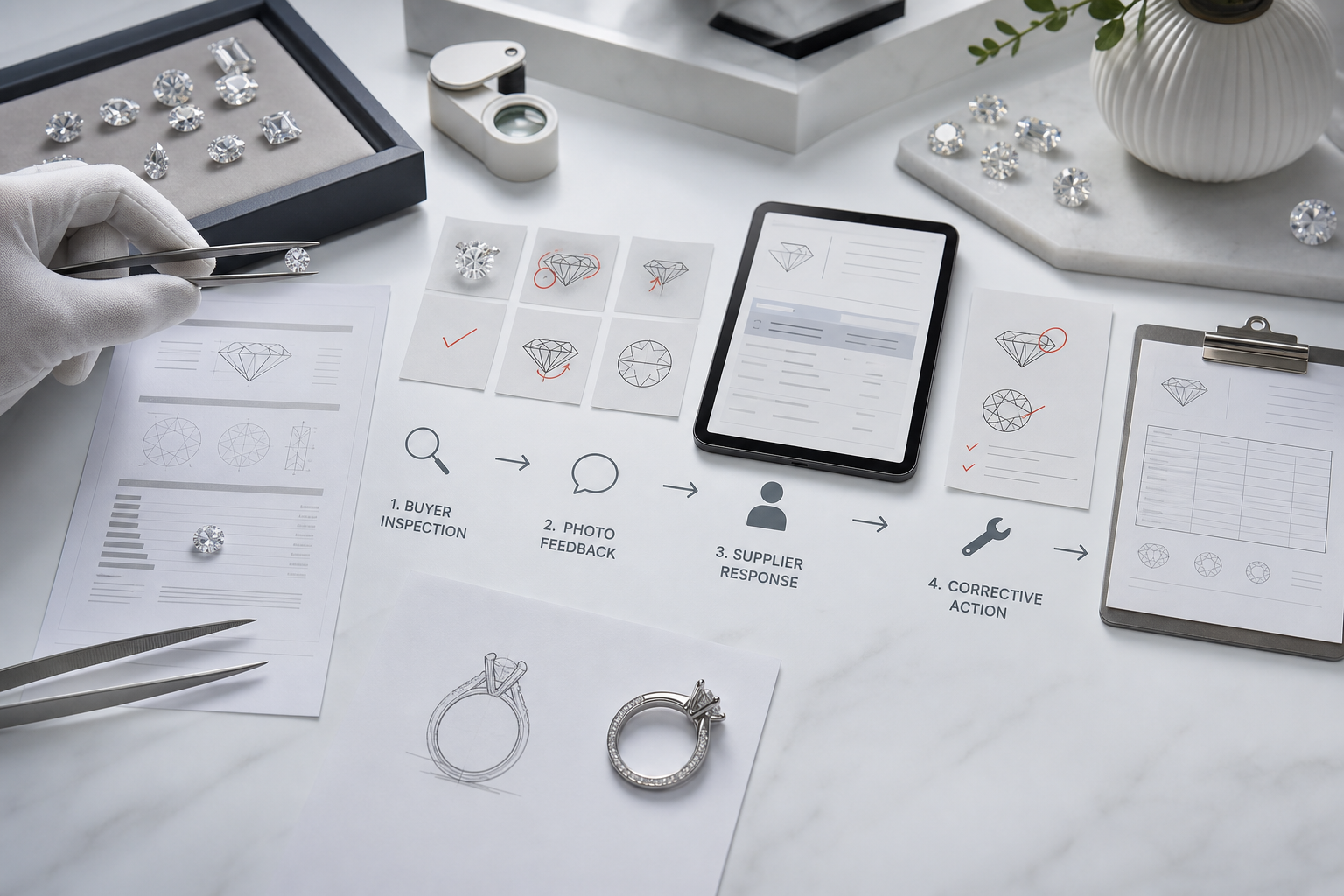
Photos and videos are not just evidence for disputes. Used properly, they are training material for future orders. A marked image showing uneven prongs, a side-by-side video comparing an approved oval to a rejected oval, or a screenshot highlighting a visible bow-tie is far more useful than a long message describing the issue in general terms.
Strong supplier quality feedback usually includes the stone ID or report reference, the original requirement, the inspection result, and the buyer’s decision. For example: “Stone accepted, but ratio too short for our oval program. Please prioritize a more elongated face-up look on future 1.50 ct ovals.” Or: “Rejected because visible bow-tie was stronger than approved reference video under similar lighting.” These comments give the supplier a clear correction point without forcing them to guess what went wrong.
For jewelry manufacturing, the same logic applies. “Ring setting prongs were uneven in macro photo” is more actionable when paired with an image marked at the exact prong position. “Melee color appeared warmer than previous batch under same lighting” becomes stronger if the buyer includes a comparison photo and notes the lighting condition. The more visual the issue, the less useful text-only feedback becomes.
Turn QC problems into updated sourcing instructions
The most common mistake after a QC dispute is treating the replacement or credit as the end of the issue. That solves the immediate shipment, but it does not improve the sourcing system. If the same problem could happen again, the feedback should be converted into an updated instruction for future orders.
For example, if a batch of fancy shapes technically meets grade requirements but fails visually because several stones face up too deep or too short, the next instruction should not simply say “better make.” It should define what the supplier should screen more carefully, such as face-up spread, ratio, bow-tie strength, or video review before shipment. If melee color variation caused problems in finished jewelry, the updated instruction may require batch comparison under consistent lighting before setting.
Corrective action does not need to be complicated, but it must be specific. A useful supplier feedback loop answers three questions: what failed, how it was verified, and what should change next time. Without that last step, QC becomes a recurring complaint process instead of a sourcing improvement system.
QC Feedback Format That Prevents Repeated Mistakes
A practical QC feedback format should be short enough to use consistently but detailed enough to prevent confusion. The strongest format usually includes the order number, stone or SKU reference, inspection finding, supporting photo or video, accept or reject decision, and updated instruction for future sourcing.
- Reference: Order number, SKU, report number, or production item.
- Issue: The specific QC concern, not a general quality complaint.
- Evidence: Photo, video, marked image, report reference, or comparison to an approved sample.
- Decision: Accepted, rejected, accepted with note, replacement requested, or future adjustment only.
- Corrective instruction: What the supplier should screen, avoid, confirm, or change on the next order.
This format keeps the conversation focused on correction rather than blame. It also protects both sides: the buyer has a clear record of the inspection notes, and the supplier has a usable instruction set for avoiding the same issue in the next shipment.
Standardize Documentation Habits for Transparency and Accountability
Documentation is what keeps a long-term sourcing relationship from depending on memory, chat history, or assumptions. In repeat lab-grown diamond sourcing, the right documents help both sides confirm what was ordered, what was shipped, what was inspected, and what should be repeated. They do not eliminate the need for judgment, but they reduce avoidable disputes.
The mistake is treating paperwork as a formality after the order is finished. For a serious lab-grown diamond wholesale partnership, diamond documentation should be part of the operating system. It supports report verification, invoice matching, packing accuracy, QC review, and reorder planning. When records are incomplete, even a good supplier relationship can become difficult to manage once order volume increases.
Which documents matter most in repeat lab-grown diamond sourcing
The most useful documents are the ones that connect the commercial order to the physical stones or jewelry received. For lab-grown diamonds with grading reports, that usually includes grading reports or report numbers, stone images or videos, order confirmations, invoices, packing lists, and any QC summary provided before shipment. For finished jewelry, production orders, setting details, stone allocation records, and final inspection photos may matter just as much as the center stone report.
A buyer should be able to open the order file later and answer basic questions without asking the supplier to reconstruct the history. Which stones were approved? Which report numbers were shipped? Were any substitutions made? Did the final invoice match the confirmed quotation? Were QC notes attached to the shipment? These questions become especially important when reordering, resolving disputes, or comparing supplier performance across several orders.
China diamond supplier documents may vary by supplier type and order complexity, so the goal is not to demand unnecessary paperwork for every small purchase. The practical standard is simpler: collect enough documentation to verify the order, inspect the goods, support accounting, and make the next order more accurate.
Build a traceability map for every repeat program
Traceability in a long-term lab-grown diamond partnership does not need to mean a complicated compliance system. At a practical buying level, it means the buyer can connect each stone or jewelry item to the order request, supplier quotation, approval media, grading report where applicable, invoice line, packing list, QC result, and receiving record. If those links are easy to follow, later questions can be answered with evidence instead of memory.
A useful traceability map starts with one consistent identifier. For a center stone with a grading report, that identifier may be the laboratory report number combined with the buyer’s SKU. For melee or finished jewelry, it may be a batch number, production item number, or internal product code. The exact format matters less than consistency. The same identifier should appear in the quotation, approval notes, QC file, invoice, packing list, and reorder record whenever possible.
Traceability also has limits. A grading report can support the characteristics described on that report, but it does not automatically document every sourcing, environmental, production, or handling claim that may appear later in marketing language, especially during lab grown diamond supplier evaluation. If a buyer needs to make customer-facing statements beyond the report details, those statements should be supported by separate supplier documentation or narrowed to what can actually be substantiated.
Traceability Record Chain
- Request record: buyer SKU, target specification, quantity, acceptable ranges, and intended product use.
- Supplier offer: quoted options, report numbers where applicable, photos, videos, measurements, and any proposed substitutions.
- Approval record: accepted stones or items, rejected options, buyer notes, and written approval of exceptions.
- Commercial record: invoice, packing list, payment reference, and shipment-related documents.
- Receiving record: buyer-side inspection result, matched report or SKU references, QC photos, and reorder notes.
This chain helps both sides locate the source of a mismatch. If the issue appears in the supplier offer, the request may have been interpreted incorrectly. If the offer was correct but the packing list differs, the issue may be shipment control. If documents match but the buyer’s inspection fails, the issue may be visual standards, setting compatibility, or QC interpretation. A traceability map turns these questions into a review process rather than a dispute based on scattered messages.
Why grading reports help but do not replace visual review
Lab-grown diamond grading reports are useful because they give an independent grading reference for details such as carat weight, color, clarity, measurements, and sometimes growth-related information. Report-number verification can also help confirm that the document corresponds to the stone being discussed. For higher-value center stones, this is a basic accountability step.
But a grading report does not show everything a buyer needs to judge. It does not fully capture bow-tie appearance in fancy shapes, face-up personality, matching quality, setting compatibility, or how a stone looks in the lighting conditions used for online selling. A diamond can be accurately graded and still be a weak fit for a specific jewelry program.
That is why report verification should sit beside visual review, not replace it. Stone videos, supplier photos, comparison images, and buyer-side inspection notes add context the report cannot provide. Documentation supports sourcing transparency, but it does not prove every claim about origin, sustainability, ethics, or visual quality beyond the limits of the documents themselves.
Sustainability and sourcing claims should be handled with the same discipline. Lab-grown diamonds can offer a different sourcing path from mined diamonds, but that does not automatically verify energy use, production practices, labor conditions, or broader environmental impact. If these claims matter to the buyer’s brand or customers, ask what documents, production disclosures, or supplier explanations are available, and avoid treating general marketing language as proof.
Claim Support and Disclosure Log
If the buyer plans to use supplier information in product pages, sales presentations, or customer-facing education, create a separate claim support log. This should record each claim the brand intends to make, the exact supplier document or explanation that supports it, and any limits on how the claim should be worded. For example, a report number may support the characteristics listed on that report, but it should not be used as proof of broader environmental or ethical claims unless separate documentation supports those claims.
This log is especially useful when multiple departments touch the same product. A sourcing team may understand that “lab-grown” describes the diamond’s origin category, while a marketing team may be tempted to expand that into broader claims about sustainability or responsible sourcing. Keeping a claim support log helps the business maintain careful language and prevents supplier paperwork from being used beyond what it actually proves.
Compliance Boundary for Supplier Claims
Long-term supplier documents should be separated into two categories: documents that describe the diamond or jewelry item, and documents that support broader business or sourcing statements. A grading report may document characteristics such as measurements, weight, color, clarity, and laboratory-grown origin where stated, but it should not be treated as proof of customer appeal, future value, environmental impact, or the supplier’s broader business practices.
If a supplier uses broad terms such as responsible, sustainable, green, conflict-free, factory-direct, or guaranteed quality, ask what the statement specifically means and what documentation supports it. If the support is not clear, keep customer-facing language narrower. A safer approach is to say that laboratory-grown diamonds provide an alternative origin path from mined diamonds, while any environmental, sourcing, or production claims should be specific, documented, and limited to what can be substantiated.
How written confirmations prevent later disputes
Many sourcing disputes begin with a change that was discussed informally but never confirmed clearly. A supplier may believe the buyer approved a substitute report type, a slightly different size range, or a production timing adjustment. The buyer may remember the conversation differently. Written confirmations prevent small changes from becoming expensive disagreements.
Important details should be confirmed in writing before the supplier proceeds, especially specifications, price, quantity, report type, production timeline, shipment contents, substitutions, and any exception to the usual standard. This does not need to be overly formal. A clean written confirmation in the main communication channel is often enough if it is specific and easy to find later.
The highest-risk moments are usually not the original order placement. They are mid-order changes: replacing an unavailable stone, approving an alternate measurement, adjusting ring details, splitting a shipment, or accepting a different documentation package. These decisions should never rely only on a voice call or scattered messages.
Certificate and Visual Review Check
Before accepting a repeat shipment, check that the documentation and the physical goods tell the same story. Confirm report numbers where applicable, match reports to stone videos or labels, compare invoices against the approved quotation, and review packing lists against the actual shipment. If a stone was approved based on video, keep that video in the order file with the report number or SKU reference.
The practical warning sign is inconsistency. One missing image may not be serious. Repeated mismatches between report numbers, invoices, stone labels, and shipment contents are a supplier management issue, even if the stones themselves look acceptable. In long-term sourcing, documentation accuracy is part of reliability.
Documentation supports verification, but it should not be stretched beyond what it proves. Buyers should match each claim to a specific record, laboratory report, supplier confirmation, or inspection note before using it in sourcing decisions or customer-facing language.
Set a Communication Rhythm That Supports Long-Term Cooperation
A long-term supplier relationship cannot depend on scattered messages sent only when something is urgent. Reliable diamond sourcing communication needs a rhythm: when updates happen, what gets confirmed, which channel is used, and how problems are escalated. The point is not constant messaging. The point is predictable communication that helps both sides work with fewer surprises.
This matters even more when working across U.S. and China time zones. A delayed answer may be normal overnight, but unclear responsibility is not. If quotation confirmation, production updates, inspection feedback, and shipment timing all happen in one unstructured thread, important details can be missed. A simple sourcing workflow reduces that risk without turning the relationship into a heavy corporate process.
Move from scattered messages to repeatable communication routines
The right supplier communication rhythm depends on order volume and complexity. A buyer placing occasional loose stone orders does not need the same routine as a private-label jewelry brand managing active production. What matters is that both sides know when to communicate and what kind of information belongs in each update.
For an active wholesale order communication routine, weekly order-status updates may be enough for normal production, with faster confirmation for urgent specification changes when feasible. A monthly price and availability summary can help buyers plan categories that move quickly. A quarterly review can be used to discuss quality patterns, documentation issues, rejected items, and upcoming sourcing needs.
More communication is not always better. Too many unscheduled messages can slow a supplier down and create confusion if decisions are spread across different channels. The stronger approach is to separate routine updates from urgent issues and make sure both sides know which messages require action.
Confirm specifications, timing, and changes in writing
Every meaningful order decision should have a written record. This includes the approved quotation, diamond or jewelry specifications, report requirements, production timeline, shipment plan, and any change made after the order begins. Written confirmation is especially important when a supplier proposes an alternative because the original stone, size, or component is unavailable.
A strong confirmation is specific enough to prevent interpretation. “Approved” is weak if the thread contains several options. “Approved for 10 pieces, 1.45–1.59 ct oval, D–F, VS1–VS2, IGI report, ratio 1.35–1.45, shipment after final video approval” is much harder to misunderstand. The detail may feel repetitive, but it protects both buyer and supplier when orders become frequent.
For production updates, ask for information that helps you make decisions, not just reassurance. “In production” is less useful than “casting completed, stone setting scheduled, QC photos expected Friday.” Good China supplier communication turns status updates into operational visibility.
Wholesale buyers should also confirm communication expectations before committing to a larger program. That includes who sends quotations, who confirms substitutions, who stores approval media, who checks report or SKU references, and how changes are summarized before shipment. Clear communication roles reduce the risk that a correct decision is made verbally but lost before the final order record is prepared.
Use review meetings to improve the system, not just solve problems
Review meetings are most useful when they focus on patterns rather than isolated frustrations. If a supplier missed one response window, that may not matter. If response delays repeatedly happen during substitution approvals or QC disputes, the process needs adjustment. The meeting should identify where the workflow breaks, not simply revisit every mistake.
Useful review topics include order accuracy, repeated QC issues, documentation completeness, response quality, timeline reliability, and upcoming product needs. For a China-based lab-grown diamond supplier or jewelry manufacturing partner, these conversations are also where buyers can explain changes in their sales program before the supplier has to react under pressure.
A mature communication system gives both sides room to improve. The buyer becomes clearer and more predictable. The supplier becomes better at anticipating standards, timing, and documentation expectations. If review meetings only happen after a serious dispute, the relationship is already operating too late.
Communication Cadence Example
For a buyer with active monthly sourcing, a practical cadence might include weekly order-status updates, written confirmation for every specification change, same-day acknowledgment for urgent issues when feasible, monthly price and availability reviews, and quarterly performance discussions. Smaller buyers may use a lighter version, while high-volume private-label programs may need more structured production tracking.
The key is to match the cadence to the risk level of the work. Loose stone sourcing with grading reports may need fast availability checks and clear report references. Custom jewelry manufacturing may need milestone updates, CAD or sample approvals, production photos, and final QC confirmation. A communication rhythm works when it supports the actual sourcing model rather than copying a generic supplier management template.
Measure Supplier Performance Across Orders, Not Impressions
A supplier can feel reliable in conversation and still produce inconsistent results over time. Friendly replies, fast quoting, and a strong first shipment matter, but they are not enough to judge diamond sourcing reliability. A long-term partner should be measured by what happens across repeated orders: how accurately they follow specifications, how often quality issues repeat, how complete their documentation is, and how quickly they resolve problems without creating new ones.
This is where a simple lab-grown diamond supplier scorecard becomes useful. It does not need to be complicated, and it should not turn the relationship into a formal audit every week. The point is to replace vague impressions with supplier quality metrics that show whether the partnership is getting easier, harder, or simply staying unpredictable.
Track accuracy, consistency, documentation, and response quality
The most important performance measure is order accuracy. For a loose diamond program, that may mean the percentage of stones that arrive within the approved specification range for carat, color, clarity, shape ratio, measurements, report type, and visual appearance. If 18 out of 20 stones match the agreed range, the issue is very different from a shipment where only 12 out of 20 are commercially usable.
Defect rate should be tracked separately from preference differences. A stone that is slightly less elongated than your preferred oval ratio may be a tolerance issue. A stone with a visible bow-tie that was specifically excluded in the approved standard is a repeatable QC failure. For finished jewelry, uneven prongs, inconsistent polishing, incorrect ring size, loose stones, or mismatched melee should be grouped by issue type so the supplier can see what needs correction.
Documentation completeness is often underestimated until a buyer needs to reconcile inventory, verify report numbers, or handle a customer question. Track how often invoices, packing lists, grading report numbers, stone videos, QC summaries, and written confirmations arrive correctly. One missing video may be a minor inconvenience. Repeated report-number errors are a warning sign because they create downstream risk for inventory control and customer trust.
Response quality matters more than response speed alone. A supplier who replies quickly but does not answer the actual question can slow down the entire wholesale sourcing management process. Useful response metrics include average reply time for order changes, how often revised quotes are confirmed in writing, whether urgent specification changes are acknowledged clearly, and whether issue-resolution steps are documented instead of handled through scattered messages.
Look for patterns across three to five orders
One shipment is rarely enough to judge a China-based lab-grown diamond partner. A single order may be affected by inventory availability, a rushed timeline, a holiday period, or a misunderstanding that is easy to correct. Three to five orders usually reveal more meaningful patterns: whether the supplier learns from QC feedback, whether the same issue appears again, and whether reorder consistency improves or declines as the relationship becomes routine.
A practical supplier performance evaluation should focus on trends, not perfection. Even strong suppliers will occasionally have unavailable stones, delayed documents, or items that need review. The question is whether the issue is isolated and handled well, or whether it becomes a recurring operating cost for the buyer. If every shipment requires extra inspection time, replacement requests, and repeated clarification, the low headline price may not be saving money.
For example, a supplier may deliver most shipments within agreed timing but show a rising number of documentation errors. Another may be slightly slower but consistently sends accurate reports, videos, and matching details. The better partner depends on the buyer’s business model. A fast-moving online diamond seller may prioritize availability and response speed, while a private-label jewelry brand may place more weight on matching consistency and production accuracy.
Know when to improve the partnership and when to reduce dependency
Not every performance problem means the supplier should be replaced. Some issues point to unclear buyer instructions, overly narrow tolerances, rushed approval timelines, or missing written confirmations. If a supplier’s error rate improves after clearer specifications and QC feedback, the partnership is worth developing. A supplier who adapts is often more valuable than one who performs well once but does not improve when conditions change.
The warning sign is repeated failure in the same category after the issue has been clearly documented. If three consecutive orders show the same mismatched melee color, the same incomplete report tracking, or the same late notice about unavailable stones, the buyer should reduce dependency or assign that supplier a narrower role. Long-term sourcing does not require blind loyalty. It requires knowing which partner can be trusted for which type of order.
A balanced approach is usually stronger than an all-or-nothing decision. A supplier may remain suitable for standard center stones with grading reports but not for matched pairs. Another may be reliable for loose lab-grown diamonds but weak for finished jewelry production. Performance tracking helps buyers assign work based on proven capability instead of general confidence.
When reviewing performance, keep the evaluation tied to the buyer’s actual risk. A supplier that is acceptable for flexible inventory buys may not be acceptable for a documented bridal program where report consistency, stone media, and setting fit must be highly organized. Conversely, a slower supplier may still be valuable if they communicate clearly, document substitutions, and deliver consistent goods for categories where speed is less important than predictability.
Evidence-Based Performance Review
A performance review should use the records already created during sourcing, not a supplier’s general reputation or a buyer’s memory of the relationship. Bring the last several order files into the review and compare what was requested, what was confirmed, what was delivered, and what required correction. This keeps the discussion practical and reduces the chance that one frustrating order or one excellent shipment dominates the evaluation.
When the evidence is mixed, assign the supplier more precisely rather than judging them as simply good or bad. A partner may have strong loose-stone sourcing records, weak custom-setting records, and acceptable communication records. That evidence can support a narrower but still valuable role. Long-term partnership quality is not only about whether the supplier can be trusted; it is also about knowing exactly where that trust is justified.
Simple Supplier Scorecard Categories
- Specification accuracy: Percentage of stones or jewelry pieces that match the approved quality range without revision.
- QC rejection rate: Number of rejected items per shipment, separated by issue type rather than grouped as one general problem.
- On-time delivery: Percentage of shipments or production milestones completed within the agreed timeline.
- Documentation completeness: Frequency of correct grading reports, report numbers, invoices, packing lists, videos, and confirmations.
- Response quality: Speed, clarity, and usefulness of replies when specifications change or problems appear.
- Issue resolution: How quickly the supplier acknowledges problems, proposes corrective action, and prevents the same issue from repeating.
- Reorder consistency: How closely repeat orders match approved samples, past batches, or written reorder standards.
Turn the Relationship Into a Repeatable Sourcing System
A long-term lab-grown diamond supply partnership in China is not built by finding one good shipment and hoping the next one looks the same. It is built by turning each part of the relationship into a repeatable sourcing system. The buyer defines the supplier’s role, writes usable specifications, agrees on an approved quality range, keeps reorder records, reviews pricing on a schedule, sends actionable QC feedback, verifies documents, communicates consistently, and measures performance across orders.
This system does not remove every sourcing risk. It does make problems easier to identify, discuss, and correct. In a China diamond supply chain where buyers may be working across time zones, languages, report types, production roles, and changing market conditions, structure is what keeps the relationship from depending on memory, goodwill, or one strong contact person.
The repeatable partnership model
The partnership model should follow a clear operating sequence. First, define what the supplier is responsible for: loose stones, cutting, melee, finished jewelry, private-label production, or mixed sourcing. Then convert buying preferences into written specifications that can be quoted, checked, and repeated. After that, agree on tolerances so the supplier understands what is acceptable, what needs approval, and what should be rejected before shipment.
Once orders begin, every shipment should create records for the next one. Report numbers, videos, accepted stones, rejected stones, QC notes, invoice versions, and communication history all become part of the buyer’s supplier management system. Price reviews should happen at planned intervals rather than through emotional renegotiation on every order. QC feedback should be specific enough for the supplier to act on, not just broad complaints about quality.
The strongest wholesale diamond sourcing process is not the one with the most paperwork. It is the one where each document, message, and review point helps prevent a future mistake. If a record does not help the buyer reorder, verify, compare, or correct something, it is probably administrative clutter rather than useful control.
How each order should improve the next one
Each order should leave the buyer and supplier with a clearer understanding of what works. Accepted stones show the usable quality range. Rejected stones show the boundary. Delays reveal where timing assumptions were too loose. Documentation errors show where confirmation habits need to improve. Price differences show whether the buyer is comparing equivalent goods or mixing quality levels without realizing it.
The most common mistake is treating each shipment as a separate transaction. That forces the buyer to solve the same problems repeatedly. A better approach is to update the sourcing instructions after each meaningful issue. If an oval program keeps receiving stones with ratios that look too short, the approved range should be tightened. If melee color varies too much between batches, the matching instruction should become more specific. If report tracking causes confusion, the reorder file should require report numbers before final confirmation.
A mature long-term lab-grown diamond partnership becomes easier over time because the supplier has fewer gaps to guess around. The buyer also becomes easier to serve because expectations are clearer, feedback is more useful, and order history is organized enough to guide future decisions.
What a mature sourcing relationship should feel like
A mature sourcing relationship should feel steady, not effortless. There will still be unavailable stones, price movement, production questions, QC discussions, and occasional delays. The difference is that none of these issues should reset the entire relationship. Both sides should know how to confirm details, review alternatives, document decisions, and resolve problems without starting from zero.
The clearest sign of progress is lower ambiguity. The buyer no longer sends vague requests like “similar quality as before” and hopes the supplier remembers. The supplier no longer quotes options without knowing which tradeoffs matter most. Reorders become more accurate because the approved range, past examples, and QC history are available for reference.
The relationship is ready to scale only when consistency is proven across routine conditions, not just special attention. If the system depends on one person manually watching every detail, it is still fragile. If the process can survive repeat orders, minor staff changes, product variation, and normal market movement, it is closer to a true long-term sourcing partnership.
Final Evidence Review Before Scaling
Before increasing volume or giving one supplier a larger share of the program, run a final evidence review. Confirm that the relationship has produced more than good conversations and attractive offers. The buyer should be able to point to order files, approved standards, QC outcomes, substitution records, document checks, and supplier corrections that show the process is becoming more controlled over time.
If the evidence is incomplete, scale in stages rather than all at once. Increase one category first, tighten documentation habits, or assign the supplier a limited product role while continuing to test consistency. A cautious scale-up is not a sign of distrust; it is a practical way to make sure the partnership is supported by repeatable proof rather than optimism.
Long-Term Partnership Readiness Check
- Supplier role is defined: The buyer knows whether the partner is responsible for loose stones, production, sourcing, finished jewelry, or a specific combination.
- Specifications are written: Key standards for size, grade, measurements, grading reports, visual review, and tolerance are documented before scaling orders.
- Approved quality range is clear: Both sides understand what is acceptable, what requires approval, and what should be rejected.
- Reorder records are maintained: Past orders can be reviewed by report number, video, QC note, invoice, and supplier confirmation.
- Price reviews are scheduled: Pricing is discussed with context and timing rather than renegotiated unpredictably on every order.
- QC feedback leads to corrections: Problems are documented in a way the supplier can use to prevent repeat mistakes.
- Documents are verified: Reports, invoices, packing lists, and written confirmations support accountability without replacing visual inspection.
- Communication has a rhythm: Order updates, changes, issue escalation, and review points follow a predictable routine.
- Performance is measured over time: Decisions are based on accuracy, consistency, documentation, delivery, and issue resolution across multiple orders.
Long-term cooperation works best when both sides can see the same system. The buyer gains better control over quality, timing, and risk. The supplier gets clearer instructions and fewer avoidable disputes. That is the difference between placing repeat orders and building a sourcing partnership that can actually hold up over time.
Disclosure: This article is for general educational purposes only. Diamond grading, pricing, availability, specifications, and seller policies can change, and readers should verify important details through grading reports, official laboratory tools, seller documentation, or qualified professionals before making a purchase decision. Laboratory-grown diamonds should be clearly distinguished from natural diamonds, and environmental or sourcing claims should be supported by specific documentation.