
When sourcing lab-grown diamonds from China, the choice between HPHT and CVD can look simple on a supplier quote, but the growth method alone does not tell you whether a stone is better, safer to buy, or correctly priced. In a China lab-grown diamond supplier verification workflow, a diamond may move through growers, cutters, traders, exporters, and brokers before it reaches a buyer, so labels need to be checked against grading reports, inscriptions, exact-stone images, videos, measurements, and written treatment disclosures.
For the full framework, read China Lab-Grown Diamond Supply Chain Guide.
This article helps buyers judge HPHT and CVD stones with more discipline. Instead of assuming one method is superior, it shows how to connect method, price, appearance, documentation, and intended jewelry use. That matters whether you are selecting a solitaire center stone, building a matched production line, or comparing quotes from multiple China-based suppliers.
Because no single label proves the whole sourcing story, buyers should separate documented facts from supplier interpretation. “HPHT,” “CVD,” “certified,” “excellent,” and “good price” are starting points for review, not conclusions. A more defensible sourcing file should show what the diamond is, how it was represented, which document supports the representation, and whether the exact stone or lot delivered matches the approved details.
Laboratory-grown diamonds should be clearly identified as laboratory-grown, and they should not be presented as mined diamonds. HPHT and CVD describe laboratory diamond growth methods; they do not make a lab-grown diamond a natural diamond, and they should not be confused with diamond simulants, which are non-diamond lookalikes.
| Buying Situation | What to Verify | Common Mistake to Avoid |
|---|---|---|
| Single solitaire stone | Exact report, inscription, video, cut, tone, treatment disclosure | Choosing by HPHT or CVD label alone |
| Matched jewelry set | Consistent measurements, color, tone, proportions, reports | Saving slightly while accepting uneven stones |
| Very low supplier quote | Reason for discount, report status, treatment, availability | Assuming low price means better value |
| Higher-priced offer | Added verification, matching quality, service, replacement terms | Paying more without clear evidence |
| Private-label or repeat orders | Written specs, substitute rules, batch consistency, documentation trail | Relying on verbal supplier assurances |
Quick Questions Before You Read
Q: Is HPHT automatically better than CVD?
No. HPHT and CVD describe growth methods, not finished quality. Cut, appearance, reports, treatment disclosure, and consistency matter more.
Q: Does a grading report guarantee the stone is suitable?
Not by itself. The report should match the exact stone, and buyers should still review visuals, measurements, inscription details, and any treatment notes.
Q: Should I avoid unusually cheap lab-grown diamonds from China?
Not automatically, but a low quote should have a clear explanation, such as availability, specs, documentation level, or visible characteristics.
Q: When does growth method matter most?
It matters most for center stones, matched sets, private-label supply, and customers who ask technical questions about origin and treatment.
HPHT and CVD in China’s Lab-Grown Diamond Supply Chain
Why Growth Method Shows Up in Supplier Conversations
Buyers sourcing China lab-grown diamonds will often see inventory described as HPHT or CVD before they see the full details that actually decide value. The growth method appears in supplier lists, WhatsApp / WeChat messages, stone spreadsheets, grading reports, and loose lab-grown diamond offers because it is one of the easiest technical labels to attach to a stone. The mistake is treating that label as a shortcut for quality.
HPHT vs CVD lab-grown diamonds is a useful distinction, but it is not a ranking system. HPHT and CVD describe how the diamond crystal was grown, not whether the finished diamond is attractive, well cut, properly documented, or suitable for a specific jewelry program. A buyer who filters only by method may reject strong stones or accept weak ones for the wrong reason.
In practical lab-grown diamond sourcing, growth method should prompt better questions. It can help a buyer know what to check next: how the stone looks, whether the report language is clear, whether the supplier can explain the inventory consistently, and whether the finished diamond fits the intended use. Method matters most when it connects to verification, not when it is used as a sales slogan.
How HPHT and CVD Fit Into China’s Production and Export Network
China’s lab-grown diamond supply chain is not one single type of seller. It can include growers producing rough material, cutters and polishers turning rough into finished stones, jewelry manufacturers setting diamonds into finished pieces, trading companies consolidating inventory, brokers matching orders, and exporters handling international buyer communication. A U.S. buyer may be speaking with a company that has direct production access, or with a supplier several steps removed from the original grower.
This structure is not automatically a problem, but it changes how buyers should evaluate claims. If a supplier says a stone is HPHT or CVD, the next issue is whether that statement is supported by the grading report, the supplier’s internal documentation, and consistent answers across the order. The farther the seller is from the original production source, the more important it becomes to verify the details instead of relying on a spreadsheet label.
HPHT diamonds and CVD diamonds can both move through the same downstream channels after growth. Rough may be cut in one facility, graded through a laboratory, listed by another company, and sold by an exporter to a jewelry brand or retailer. Because of that, “China supplier” does not automatically tell you who grew the diamond, who selected it, or how carefully it was sorted before offer.
In practical sourcing, a supplier’s position in the chain affects the type of evidence a buyer should request. A direct manufacturer may be able to discuss production categories and rough-to-polish planning, while a trading company may be stronger at locating inventory across many sources. Neither model is automatically better; the useful question is whether the supplier can connect each claim to a report, exact-stone media, written specification, and consistent delivery process.
China-linked supply chains can offer manufacturing depth and scale in some categories, but buyers still need to evaluate consistency, documentation, communication, and quality control. A location label should not be treated as proof of lower price, better quality, faster availability, or stronger supply access without supporting evidence from the specific supplier and order.
Why Method Alone Is Not a Quality Grade
Both HPHT and CVD methods can produce gem-quality lab-grown diamonds suitable for commercial jewelry. The buyer’s decision should not start with the assumption that one method is always safer, cleaner, brighter, or more valuable. The finished stone matters more than the production label when the goal is a sellable, well-documented diamond.
The stronger sourcing question is not simply, “Is this HPHT or CVD?” It is, “Does the method match the report language, the visual appearance, the price, and the supplier’s explanation?” A diamond with a desirable growth method label can still be a poor buy if the cut is weak, the appearance is off, the documentation is unclear, or the supplier cannot confirm whether the exact stone in the video is the one being offered.
For buyers comparing HPHT vs CVD diamonds from China, the stronger approach is to treat growth method as an early sorting clue. It belongs beside report details, visual review, stone measurements, consistency across lots, and supplier transparency. Used that way, the method helps structure the sourcing conversation without replacing the buyer’s judgment.
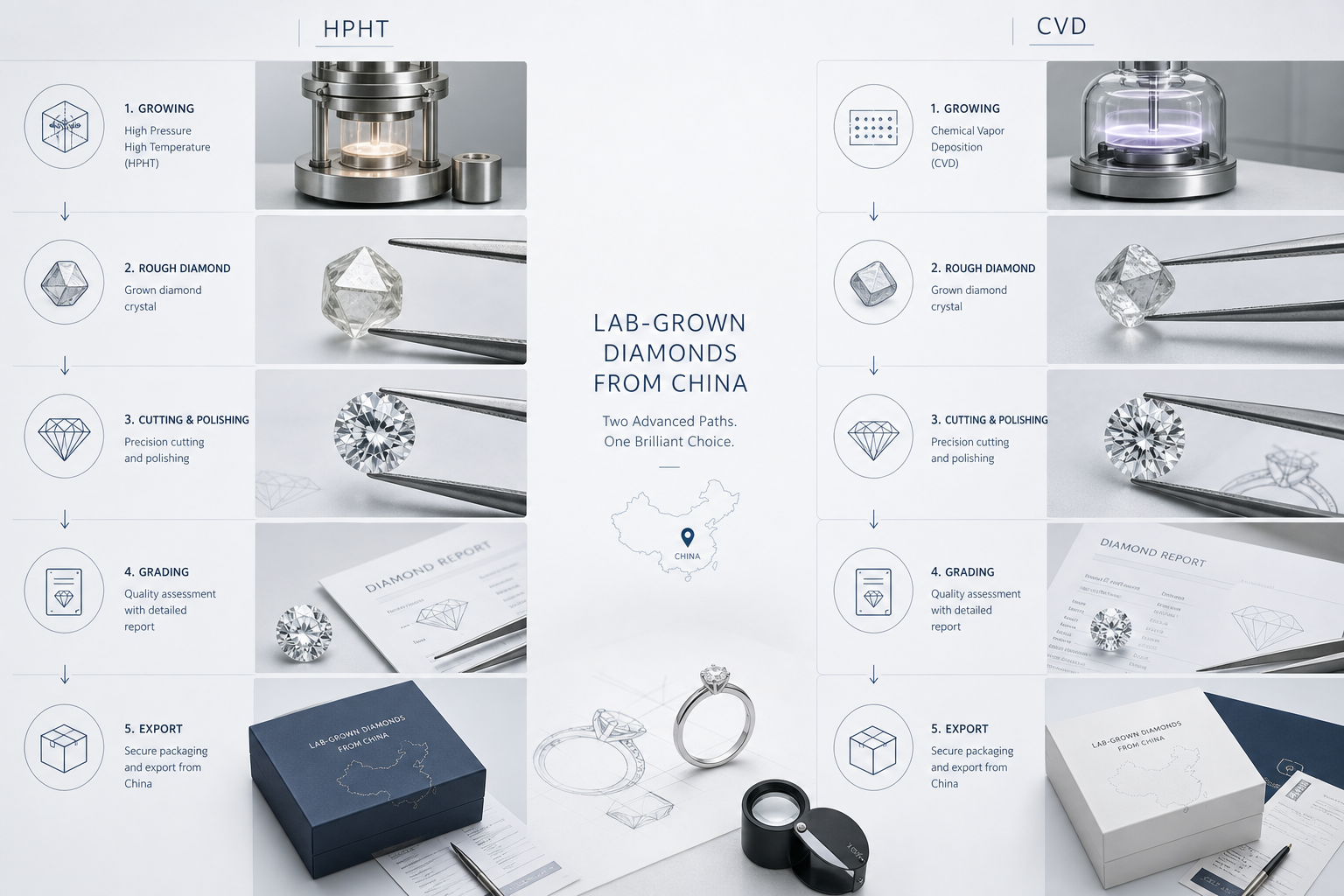
What HPHT and CVD Actually Mean for Buyers
HPHT: High Pressure, High Temperature Growth
HPHT stands for high pressure, high temperature. In simple terms, the process grows diamond crystal under conditions designed to simulate the pressure and heat associated with natural diamond formation. For buyers, the technical detail matters less than the practical result: HPHT is a growth method that can produce polished lab-grown diamonds across commercially relevant sizes and qualities.
HPHT lab-grown diamonds are sometimes discussed as if the method itself guarantees a certain look. That is too simple. Production conditions, rough selection, cutting decisions, and later grading all influence the finished stone. An HPHT label may be relevant when reviewing color behavior, report comments, or supplier sorting, but it does not tell you enough to approve a purchase by itself.
CVD: Chemical Vapor Deposition Growth
CVD stands for chemical vapor deposition. This process grows diamond crystal in a controlled chamber using carbon-containing gas. Instead of forming under high-pressure conditions, the diamond builds layer by layer on a seed plate. The method is widely used for gem-quality diamond production and is common in sourcing conversations around loose lab-grown diamonds.
CVD lab-grown diamonds can offer strong buying options, but buyers should be careful with broad claims. Some CVD stones may require closer review for visual tone or treatment history, while others present well and are fully suitable for fine jewelry. The point is not to avoid CVD or favor it automatically; the point is to know that the method name does not replace visual and document-based evaluation.
Evidence Buyers Should Request for Method Claims
When a supplier identifies a diamond as HPHT or CVD, the buyer should ask what evidence supports that statement for the specific stone or lot. For a documented center stone, that evidence may be the grading report, inscription match, report lookup result where available, and exact-stone video. For a parcel or melee lot, the evidence may be a written lot specification, supplier sorting statement, sample images, and agreed tolerance ranges.
The level of evidence should match the risk of the purchase. A high-visibility engagement ring center stone deserves more exact-stone documentation than a small accent parcel. A private-label collection that will be reordered should have clearer written specifications than a one-time sample purchase. Evidence is not about making sourcing slower; it is about making the buyer’s decision repeatable and easier to defend later.
Buyers should also distinguish between evidence and reassurance. A supplier saying “trust us” or “same as certificate” may be friendly, but it does not replace a document, photo, video, report match, or written specification. The most useful supplier is one who can show how each claim was checked rather than simply repeating that the diamond is good quality.
From Growth Method to Finished Diamond
A diamond does not go from growth chamber to buyer as a finished product. The rough crystal must be planned, cut, polished, inspected, and often submitted for grading. Each step can affect the final value more than the growth method alone. A well-grown diamond can lose appeal through poor cutting, while a carefully cut stone from either method can perform better than a buyer might expect from the label.
This matters in China lab-grown diamond sourcing because buyers are often comparing finished inventory, not raw production output. By the time a stone appears in a supplier’s stock list, its commercial value depends on its report details, measurements, cut precision, face-up appearance, and how confidently the supplier can match the offer to the exact stone. The method is part of the file, not the whole file.
For buyers, the practical point is not just what the report says, but how the stone performs visually and fits the intended design. A round solitaire, an elongated oval, an emerald-cut center, and a pavé accent lot expose different characteristics, so the same HPHT or CVD label may matter differently depending on shape, size, setting style, and customer expectations.
What Buyers Should Not Assume from the Method Name
Buyers should not assume HPHT means better, CVD means treated, HPHT means colorless, or CVD means lower quality. Those shortcuts lead to weak sourcing decisions. Growth method may influence what deserves closer review, but it does not settle the decision before the diamond is inspected as a finished stone.
The most useful assumption is a cautious one: if a supplier highlights the method strongly, ask why it matters for that specific offer. The answer should connect to the stone’s documentation, appearance, availability, or intended jewelry use. If the explanation stays vague, the method label is being used more as a selling point than as useful sourcing information.
Common Misunderstandings About HPHT vs CVD Sourcing
Misunderstanding 1: One Method Is Always Better
The most common mistake in HPHT vs CVD sourcing is trying to crown one method as the better method in every situation. That may feel efficient, but it does not reflect how finished diamonds are evaluated. A buyer is not purchasing a growth method in isolation; they are purchasing a specific polished diamond or a specific group of diamonds for a defined commercial purpose.
HPHT may be a strong fit in one sourcing case, while CVD may be the better fit in another. The recommendation changes with the diamond’s appearance, grading report, size, shape, consistency, and customer expectations. If a supplier says one method is always superior, the buyer should treat that as a warning sign. Real sourcing decisions usually require more context than that.
Misunderstanding 2: Lower Price Means Better Sourcing Value
A lower price can be useful, but it is not the same as better value. In lab-grown diamond sourcing, a cheaper offer may reflect legitimate inventory efficiency, but it may also reflect weaker selection, less desirable visual character, unclear documentation, mixed sourcing, or reduced support from the supplier. The risk is especially high when two offers look similar on paper but the supplier cannot explain why the price difference exists.
Value is the relationship between cost, documentation, appearance, consistency, and fit for the buyer’s use. A low-priced HPHT or CVD diamond that creates customer questions, matching problems, or documentation gaps can become more expensive in practice than a slightly higher-priced stone with cleaner verification. The headline price should start the investigation, not end it.
Misunderstanding 3: Growth Method Tells You Everything About Appearance
Growth method can sometimes help buyers know what to examine, but it does not fully predict how a diamond will look. Two diamonds from the same method can differ in color impression, transparency, cut precision, and overall face-up appeal. Two diamonds from different methods can also look very similar once cut, polished, and graded.
This is where many buying mistakes happen. A buyer sees the same carat weight, same shape, and similar grades, then assumes the method label explains the entire difference. In reality, the appearance may be driven by cutting quality, proportions, color tone, lighting conditions in the video, or post-growth treatment history. The method gives context, but the actual stone still has to be reviewed.
Misunderstanding 4: A Supplier Label Replaces a Grading Report
A supplier label is not the same as independent documentation. Inventory sheets often move quickly, and descriptions may be shortened for convenience. “HPHT,” “CVD,” “certified,” or “excellent quality” are not enough to confirm what a buyer is receiving. The stronger standard is to match supplier claims against the grading report, the report number, and exact-stone visuals.
This does not mean every supplier label is unreliable. It means the label should be treated as a claim until verified. For stones with grading reports, the buyer should expect the report details and supplier description to align. For non-reported or small-lot purchases, the buyer should be even more careful about written disclosure, because the supplier’s sorting and communication become the main source of information.
What This Looks Like in a Real Sourcing Decision
Consider a U.S. jewelry brand comparing two 2.00 ct round brilliant offers from China-based suppliers. One supplier offers an HPHT diamond with a competitive price and a report that clearly identifies the stone as laboratory-grown. Another offers a CVD diamond with a similar carat weight and attractive grade range, but the video shows a slightly different color impression and the treatment wording is unclear in the supplier’s description.
The weaker decision would be choosing the HPHT diamond automatically because the label feels safer, or choosing the CVD diamond automatically because the listed grades appear attractive. The better decision is to slow down and compare what can actually be verified: the report language, the exact-stone video, the face-up appearance under consistent lighting, the measurements, and the supplier’s explanation of treatment and availability.
In that scenario, either stone could be the better buy. The HPHT offer may be stronger if the documentation, appearance, and price align. The CVD offer may still be excellent if the report and supplier clarify the treatment question and the visual appearance fits the brand’s standards. The deciding factor is not the method alone; it is whether the method sits inside a coherent, verifiable sourcing story.
Color Tone, Treatment, and Visual Appearance
Why Two Diamonds with the Same Color Grade Can Look Different
A lab-grown diamond color grade is useful, but it does not tell the whole visual story. Two diamonds can both be graded G color and still face up differently because the grade measures body color within a controlled grading environment, not every undertone a buyer may notice in real jewelry lighting.
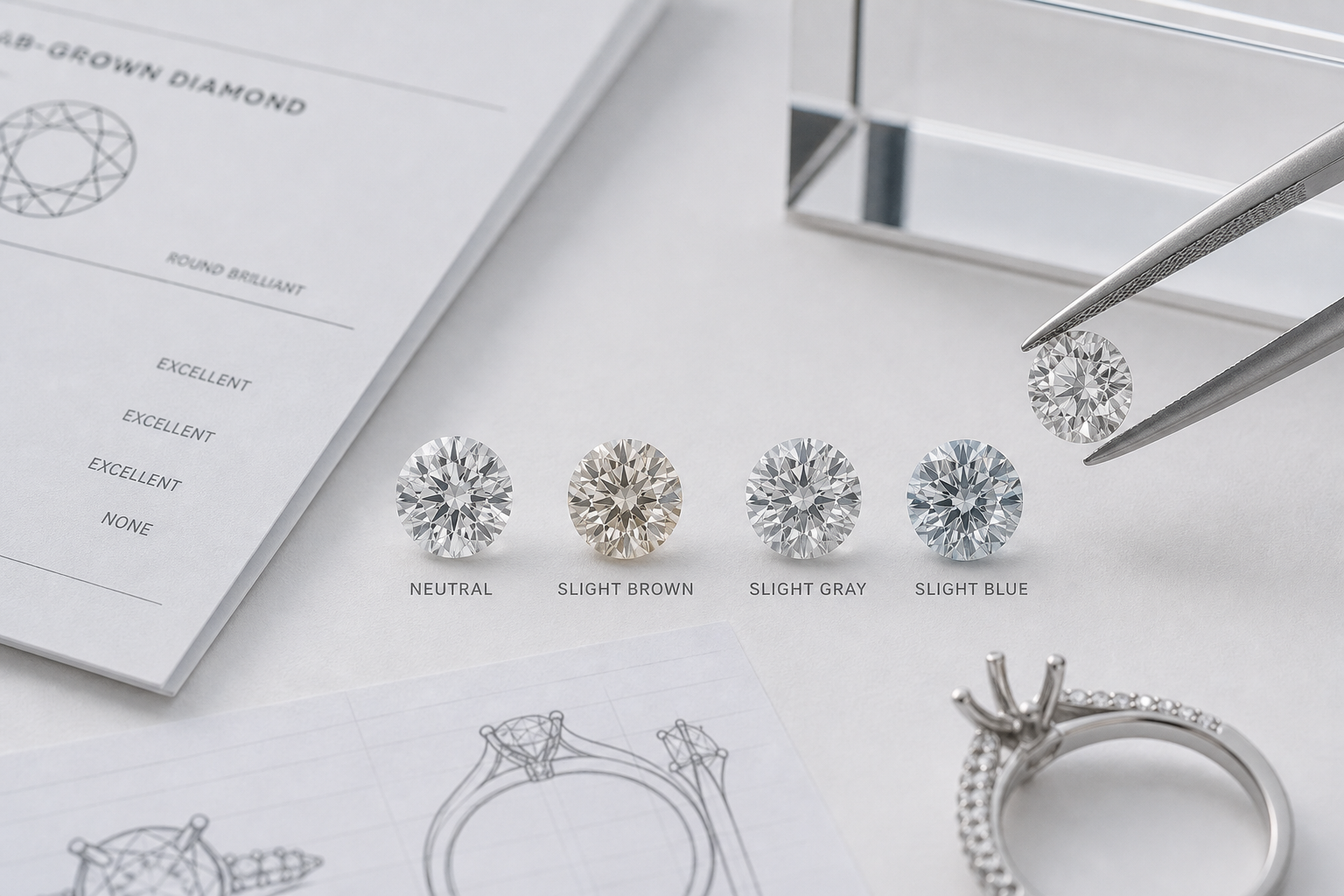
This matters in HPHT vs CVD sourcing because growth method can be connected to different visual tendencies, although it should never be treated as a guaranteed outcome. Some CVD diamonds may show a slight brown or gray tone depending on growth conditions and any later treatment. Some HPHT diamonds may show a faint blue nuance, often discussed in relation to boron, though this is not universal and should not be assumed from the method name alone.
For sourcing, the practical mistake is choosing only by the letter grade. A stone with a technically strong color grade can still look less suitable for a bright white solitaire if it carries a visible gray cast. Another stone with the same grade may look more balanced in a yellow gold setting where tiny warmth is less noticeable. The report narrows the comparison, but image and video review decide whether the diamond fits the intended jewelry use.
How Post-Growth Treatment Enters the Conversation
Post-growth treatment is part of many lab-grown diamond conversations because it can affect color appearance after the crystal has been grown. In practical terms, treatment is not automatically a problem. The issue is whether it is properly disclosed, reflected in the grading report or supplier documentation where relevant, and priced in a way that matches the finished stone.
A treated diamond can still be attractive, durable for normal jewelry use, and commercially suitable. The sourcing risk appears when the treatment history is vague, omitted, or described with loose supplier language that does not match the grading report. Buyers should be especially careful when a supplier presents a diamond as “better color” without explaining whether the improvement came from growth conditions, post-growth treatment, or selection after cutting.
For a U.S. jewelry brand, the disclosure question also affects customer communication. If end customers ask whether a diamond is HPHT or CVD, or whether it has been treated, the retailer needs an answer grounded in lab grown diamond manufacturing details that align with the report and invoice language. A low-cost stone becomes less useful if the seller cannot confidently explain what is being sold.
When growth method or post-growth treatment is relevant, buyers should look for clear disclosure in the grading report or seller documentation. HPHT and CVD should be described as growth methods unless the discussion specifically concerns a separate post-growth process.
Color Tone Signals Buyers Should Review Carefully
The most useful visual review is not simply asking whether the diamond is “white.” Buyers should look for the specific type of tone that might affect the final jewelry piece. Brown tint may make a diamond appear warmer or slightly muted. Gray tone can reduce the crisp, bright appearance some buyers expect from colorless or near-colorless stones. A faint blue nuance may look acceptable in some contexts but less natural to customers who expect a neutral white appearance.
These signals become more important in larger stones because color tone is easier to notice across a bigger face-up area. They also matter in matched jewelry. A pair of earrings can look uneven if one stone is neutral and the other leans gray, even if both reports show similar grades. In pavé or melee layouts, small tone differences may be less obvious individually but more visible when stones are set side by side in rows.
Lighting discipline is critical. A supplier video taken under cool lighting can make a diamond look whiter than it appears under warmer indoor light. A white background can hide certain undertones, while a hand video may reveal warmth or grayness more clearly. Buyers should request consistent lighting, neutral backgrounds, and side-by-side comparisons when choosing between HPHT diamond color and CVD diamond color options.
Report and Visual Review Check
Before treating color as settled, compare three things together: the color grade on the report, the exact-stone image or video, and the supplier’s statement about growth method and post-growth treatment. If one of those three does not align with the others, slow down before committing.
A practical red flag is not the existence of treatment by itself. The stronger warning sign is unclear language. If the report, product listing, and sales message describe the same diamond differently, the buyer should ask for clarification in writing. For lab-grown diamond color evaluation, consistency of documentation is part of quality control, not an administrative detail.
How Grading Reports May Disclose HPHT, CVD, and Treatment
Where Growth Method May Appear on a Report
A lab-grown diamond grading report can identify the diamond as laboratory-grown and may include language about the growth method, such as HPHT or CVD. The exact placement and wording depend on the grading lab, the report type, and the version of the report. Buyers should not assume every report presents HPHT CVD disclosure in the same way.
On some reports, growth method may appear in a comments section, a dedicated identification area, or in wording connected to laboratory-grown origin. Some reports may also include an inscription reference that connects the physical stone to the report number. The buyer’s job is not to memorize every report format, but to check whether the report language supports the supplier’s claim.
This is especially important when sourcing from a multi-layer supply chain. A China-based exporter may be selling stones grown, cut, graded, or aggregated through different channels. The grading report helps anchor the specific stone being offered, but only if the report number, inscription, and product listing all point to the same diamond.
How Treatment Language Should Be Read
Treatment language should be read carefully, not emotionally. A comment about post-growth treatment does not automatically make a diamond unsuitable. It does, however, change how the stone should be evaluated, compared, and explained to the final customer.
Some grading reports may include treatment-related comments, while others may use different wording depending on the lab’s standards and report format. Buyers should avoid overinterpreting a single phrase without understanding the context. If a report mentions treatment, the next question is whether the price, color appearance, and supplier explanation make sense together.
The bigger risk is vague supplier language that avoids the issue. Phrases like “no problem,” “normal quality,” or “same as natural” do not answer whether a CVD diamond or HPHT diamond has treatment history relevant to the transaction. A reliable supplier should be able to point back to the report or provide a clear written answer without turning the conversation into a sales pitch.
Why Report Verification Matters Before Sourcing
Before sourcing a stone with a grading report, buyers should verify the report number through the issuing lab’s database when that option is available. This applies whether the document is an IGI report, GIA report, or another laboratory-grown diamond report. Verification helps confirm that the report exists and that the key details match the offered stone.
Report verification is not just about preventing obvious document issues. It also helps catch mismatches between listings and reports. A supplier may send a stock video, a similar report, or an outdated file by mistake. In a single-stone purchase, that can lead to disappointment. In wholesale lab-grown diamond sourcing, repeated mismatches can disrupt customer orders, production planning, and inventory records.
At NUVU, this is why we treat the grading report as a starting point rather than the whole decision. The report establishes a documented baseline, but the buyer still needs exact-stone visuals, consistent supplier answers, and a clear link between the report and the diamond being purchased.
Reading Report Evidence Without Overclaiming
A grading report should be treated as evidence for the specific details it records, not as proof of every statement a supplier may make. If the report identifies the stone as laboratory-grown, records measurements, lists grading results, or includes comments, those details can help structure the buyer’s review. But the report does not automatically verify a supplier’s production story, future availability, pricing logic, customer service quality, or broader business claims.
This distinction matters when buyers compare multiple China-based offers. A supplier may use the existence of a report to imply that everything else about the offer is settled. A more careful buyer separates the report-backed facts from the supplier’s additional claims. If the supplier says the stone is part of a matched batch, immediately available, untreated, method-specific, or selected for a private-label program, those statements should be confirmed separately in writing.
Report evidence is most useful when paired with exact-stone evidence. A report can help identify what the diamond is, while photos, videos, measurements, inscription checks, and supplier confirmations help show that the diamond being offered is the same one being discussed. This paired approach reduces the risk of approving a diamond based on a document while receiving a stone that has not been properly matched to that document.
What a Report Does Not Prove
A grading report does not prove everything a buyer may want to know. It does not guarantee that the diamond was grown in a specific factory, that the supplier is the original grower, or that the sourcing relationship will be reliable. It also does not prove broader ethical, environmental, or business claims unless those claims are supported by separate documentation.
A grading report is strongest when used for identity, origin category, measurements, grading information, and applicable comments. It is weaker when buyers try to use it as a full supplier-vetting tool. A report can tell you important things about the diamond; it cannot tell you whether a supplier communicates clearly, ships consistently, or maintains stable batch quality.
The most common mistake is treating a grading report as permission to stop looking. A well-documented diamond can still have a visual tone that does not fit the intended product. A report can confirm a color grade while the video reveals a look that your customer base may not prefer.
A grading report also does not prove beauty or value in a universal sense. It records specific characteristics according to the report format, but buyers still need to judge cut appearance, face-up size, brightness pattern, tone, setting compatibility, and whether the price reflects the total evidence. This distinction is important because two stones with similar reports can create very different customer reactions once mounted.
A grading report helps document key characteristics, but it should not be treated as a guarantee of beauty, value, or sourcing ethics. Buyers should read it alongside visual evidence, measurements, seller documentation, and the intended jewelry use.
Buyer Verification Checklist
- Confirm the report number through the issuing lab’s online database when available, and make sure the carat weight, measurements, color, clarity, and shape match the supplier’s listing.
- Check whether the report identifies lab-grown origin and whether it includes HPHT or CVD growth method language.
- Review treatment comments carefully and ask the supplier to explain any wording that is unclear or not reflected in the sales description.
- Match the report to the exact stone by checking inscription details, exact-stone images, and video rather than relying on generic inventory photos.
- Keep written supplier answers for growth method, treatment, and report identity, especially when buying for resale or private-label inventory.
Availability, Size, Shape, and Batch Consistency
Why Single-Stone Buying and Batch Sourcing Are Different
For a single loose diamond, HPHT vs CVD evaluation often comes down to the individual stone: report, appearance, price, and fit for the setting. For batch sourcing, the question changes. A retailer or jewelry brand may need repeatable color, measurements, shape availability, and documentation across many stones, and that can matter more than whether one sample looks strong on its own.
This is where wholesale lab-grown diamonds require a different mindset. A supplier may be able to offer one excellent 1.50 ct round brilliant, but that does not prove they can supply ten similar stones for a matching collection. Batch consistency is usually where weak sourcing systems show up: mixed tones, slightly different measurements, unclear report status, or lots that combine stones from different production paths without enough disclosure.
For commercial sourcing, the better question is not “Is HPHT or CVD better?” It is “Can this supplier deliver the same look, documentation level, and physical fit across the quantity I need?” A strong single stone is useful; a predictable supply category is more valuable for repeatable jewelry production.
How Method Can Affect Shape and Size Availability
HPHT availability and CVD availability can differ by size, shape, and supplier specialization. Some suppliers may have stronger access to certain HPHT diamonds, while others may be deeper in CVD diamond sourcing. This does not mean one method is universally easier to buy. It means buyers should ask what the supplier can consistently provide, not just what appears in one inventory list.
Shape matters because cutting plans depend on rough material. Rounds may be broadly available, but elongated shapes, matched fancy shapes, larger stones, or tight calibrated sizes may require more careful sourcing. A supplier who is strong in loose lab-grown diamonds China inventory for standard rounds may not be equally strong in matching ovals, emerald cuts, or princess cuts for production jewelry.
Size also changes the sourcing risk. In smaller goods, especially melee, buyers may be dealing with parcel-level ranges rather than individual reports. In larger stones with grading reports, the report and exact-stone review carry more weight. The growth method can be relevant, but the practical concern is whether the supplier can maintain the color range, measurement range, and documentation standard needed for the order.
Matched Pairs, Calibrated Stones, and Jewelry Production Needs
Matched pairs expose inconsistencies quickly. Two diamonds with similar carat weight and grades can still look mismatched if one carries a different undertone, has a noticeably different diameter, or reflects light differently because of cut proportions. For earrings, side stones, or three-stone rings, buyers should request side-by-side images under the same lighting rather than reviewing each stone separately.
Calibrated stones add another layer. A diamond can be attractive and still fail the production requirement if its measurements do not fit the setting. This is especially relevant for jewelry brands ordering pre-designed mounts, pavé layouts, halos, tennis bracelets, or repeatable private-label pieces. In these cases, measurement tolerance can be more important than a small difference in method.
Melee and small accent stones should be treated as a lot-control issue. Buyers need clarity on size range, color range, clarity range, and whether the parcel is mixed-method or method-specific. Mixed-method lots are not automatically bad, but they require tighter visual review because the final jewelry piece should not show uneven tone once stones are set together.
For custom design, the stone cannot be evaluated separately from the setting. Prong style, halo spacing, basket depth, band width, and side-stone layout can all change which measurements and visual traits matter most. A diamond that looks appealing in a loose-stone video may still need a different depth, outline, or face-up spread to sit correctly in the intended mount.
For custom jewelry, stone measurements and setting compatibility should be confirmed before finalizing a purchase. This is especially important for elongated shapes, shallow or deep stones, hidden halos, bezel settings, and designs where small measurement differences can affect durability or appearance.
Practical Batch Review Parameters
- Review 3 to 5 stones when possible from the same claimed batch, supply category, or parcel type before assuming consistency across a larger order.
- Confirm report numbers for stones with grading reports and check that each report matches the exact stone being offered.
- Compare measurements against the setting requirement rather than relying only on carat weight, especially for calibrated layouts and matched designs.
- Request side-by-side images or video for pairs, matched sets, and color-sensitive orders under the same lighting conditions.
- Clarify lot ranges for melee, including size range, color range, clarity range, and whether the lot is HPHT, CVD, or mixed-method.
- Ask whether replacement stones are expected to match the original batch if production requires replenishment later, because one good parcel does not ensure future consistency.
These parameters are practical sourcing checks, not universal rules. The tighter the jewelry design and the more visible the stones are side by side, the less room there is for variation in tone, measurement, and documentation.
Price Differences Between HPHT and CVD: What They May Signal
Why Similar Report Grades Can Still Have Different Prices
HPHT vs CVD price differences are not always about one method being better than the other. Two diamonds can share the same carat weight, shape, color grade, clarity grade, and grading lab, yet still be priced differently because the report does not capture every commercial factor behind the stone. Cut precision, visual tone, report type, supplier channel, inventory age, and whether the diamond is available at that moment can all affect the final offer.
This matters especially in China lab-grown diamond pricing, where a buyer may be comparing offers from growers, cutters, trading companies, jewelry manufacturers, or export-focused suppliers. A lower quote may come from a supplier with efficient access to inventory, but it may also reflect looser selection standards, older stock, mixed lots, or weaker documentation. A higher quote may include tighter matching, better support, stronger report consistency, or simply a wider margin from a supplier further down the chain.
The practical mistake is treating the lab-grown diamond price as a verdict. Price should start a question, not end the evaluation. If an HPHT and a CVD diamond look similar on paper but are priced differently, the buyer should ask what is driving the gap: appearance, treatment disclosure, report cost, cut quality, supply availability, or supplier service level.
Prices can change with market conditions, report type, seller channel, and stone-specific details, so exact comparisons should be verified at the time of purchase. Buyers should compare like-for-like specifications before treating one stone as a better value.
When a Lower Price Deserves a Closer Look
A lower price can be legitimate. It may reflect production efficiency, a larger available batch, a supplier clearing inventory, or a diamond type that is easier to source at that moment. For wholesale buyers, private-label brands, or jewelry manufacturers working with repeated styles, those efficiencies can matter. There is nothing automatically wrong with a lower HPHT or CVD offer if the documentation, visuals, and measurements support it.
The warning sign is a low price paired with vague answers. If the supplier cannot clearly state the growth method, cannot provide verifiable report numbers for stones with grading reports, avoids treatment questions, or sends videos that may not show the exact diamond, the discount may not be worth the risk. The problem is not that the stone is HPHT or CVD; the problem is that the buyer cannot confirm what is being purchased.
Lower pricing also deserves extra review when the diamond has a less desirable color tone, weaker cut precision, or unclear lot composition. A diamond with a good color grade on a report may still show a brown, gray, or blue nuance that affects how it performs in jewelry. For a solitaire ring, that may be a customer-facing issue. For small accent stones, it may matter less unless the lot needs to match across repeated production.
When Paying More May or May Not Be Justified
Paying more is justified when the added cost solves a real sourcing problem. That may include stronger documentation, exact-stone imaging, tighter visual selection, reliable matching, better cut consistency, or clearer disclosure around post-growth treatment. For engagement ring centers, matched pairs, and private-label inventory, a slightly higher quote can be reasonable if it reduces avoidable customer confusion.
Paying more is not justified simply because a supplier labels one diamond as HPHT or CVD and presents the method as inherently superior. Method can influence what needs to be checked, but it does not automatically make one offer more valuable. A well-documented CVD diamond with strong visual appearance may be a better buy than a poorly documented HPHT stone, and the reverse can also be true.
The better question is whether the premium changes the outcome for the intended use. If a diamond is going into a high-visibility solitaire, visual neutrality and report clarity carry more weight. If the order is for small melee in a pavé design, batch consistency and color range may matter more than the method label on any single stone. Value depends on the relationship between price, proof, appearance, and application.
How to Document Price Assumptions Without Overstating Market Claims
Buyers should be careful when turning supplier quotes into broad market conclusions. One quote does not prove that HPHT is generally cheaper, CVD is generally more expensive, or one method has a permanent price advantage. Prices can vary with report type, stone availability, cut quality, size, shape, supplier channel, order quantity, and how much verification or matching support is included.
A more reliable internal record should explain why a specific offer was accepted or rejected. For example, a buyer can record that one stone was selected because its report matched the supplier description, the video showed a more neutral face-up appearance, and the supplier confirmed treatment language in writing. This kind of evidence is more useful than a general note saying one method was “better value.”
For repeat sourcing, keep comparable quotes in the same format: method, shape, carat, measurements, report details, treatment disclosure, images received, supplier position in the chain, availability, and service terms. Over time, this helps a buyer understand supplier behavior without pretending to have a complete market pricing database.
Questions to Ask When Two Offers Look Too Different
- Why is this HPHT or CVD diamond priced differently from a similar stone with the same report grades?
- Is the price difference related to cut quality, color tone, report type, treatment history, inventory availability, or batch size?
- Are the images and videos showing the exact stone or a representative sample?
- Can the report number be verified through the issuing grading lab?
- Is the stone already available, or does it need to be specially sourced after payment or order confirmation?
- For multiple stones, are the diamonds from a consistent supply category, or are they mixed across methods, batches, or suppliers?
- What support or process applies if the delivered stone does not match the quoted details, measurements, or visual expectations?
If a supplier can answer these questions clearly, a price difference becomes easier to interpret within China lab-grown diamond supply chain due diligence. If the answers stay general, the buyer is not comparing HPHT vs CVD in a meaningful way; they are comparing a documented offer against an uncertain one.
When Growth Method Actually Matters in Sourcing
When Method Matters More
Growth method matters most when it changes what the buyer must explain, verify, or control. For solitaire diamonds with grading reports, especially engagement ring centers, HPHT vs CVD sourcing can affect customer questions about production method, treatment, and visual tone. In that situation, the buyer needs documentation that matches the selling story and a stone that performs well beyond the report grades.
Method also matters more when consistency is part of the product promise. Matched earrings, three-stone rings, tennis bracelets, and private-label collections often require stones that look coherent together. A mixed supply of HPHT and CVD diamonds is not automatically a problem, but it becomes one if the color tone, transparency of disclosure, or measurement consistency varies across the set.
For jewelry brands selling to informed customers, growth method can also affect trust. Some buyers will ask whether a diamond is HPHT or CVD, whether treatment was used, and what the report says. A retailer or brand does not need to turn every sale into a technical lecture, but it should be able to answer method-related questions without guessing.
When Method Matters Less
Growth method matters less when the finished diamond is well documented, visually strong, appropriately priced, and suitable for the intended jewelry. If a CVD diamond has a reliable report, a clean appearance, clear treatment disclosure where relevant, and the right proportions for the setting, rejecting it only because it is CVD may remove a good option for no practical reason. The same applies to HPHT diamonds.
Method is also less important for buyers whose main constraint is a specific design requirement rather than a method preference. A calibrated stone that fits the setting, matches the requested color range, and arrives with consistent documentation may be more useful than a method-specific stone that creates production delays or matching problems.
The common overemphasis is treating HPHT and CVD as two fixed quality tiers. They are better understood as production backgrounds that shape the questions a buyer should ask. Once the diamond is polished, graded, inspected, and matched to its use case, the final decision should be based on evidence rather than the method name alone.
How End Customer Expectations Affect the Decision
Customer expectations can make method more important even when the stone itself is attractive. If a U.S. retailer serves buyers who ask detailed questions about lab-grown origin, the sales team needs consistent language across product pages, reports, and supplier documentation. A diamond that is difficult to explain can create more friction than a comparable stone with clearer disclosure.
For private-label inventory, consistency of wording can matter as much as consistency of stones. If some reports identify CVD, others identify HPHT, and some supplier files use unclear treatment language, the brand may struggle to present the collection cleanly. That does not mean the inventory is unsuitable, but it does mean the buyer must decide whether mixed disclosure language fits the brand’s customer experience.
At NUVU, this is the kind of comparison we treat as a transparency issue rather than a method preference. The better sourcing path is usually the one that lets the buyer explain the diamond clearly, verify the documentation, and match the stone to the jewelry without relying on shortcuts.
Method-Based Decision Framework
- Choose based on method when the customer or product positioning requires it. This may apply to brands that clearly market method-specific inventory or serve buyers who ask technical questions.
- Choose based on visual and report evidence when both methods meet the use case. A strong diamond should not be dismissed because of its growth method if the documentation and appearance support the offer.
- Prioritize consistency for production jewelry. In earrings, bracelets, pavé, and repeated styles, matching across stones often matters more than the method label.
- Treat unclear treatment disclosure as a decision risk. Treatment is not automatically negative, but vague or missing explanation can weaken buyer confidence.
- Let the intended use decide the standard. A solitaire center stone, a matched pair, a melee lot, and a private-label collection do not require the same level of method sensitivity.
How to Ask China Suppliers the Right HPHT and CVD Questions
Questions About Growth Method and Treatment
The most useful supplier questions are specific enough to produce useful answers but not so aggressive that the conversation becomes adversarial. Buyers sourcing lab-grown diamonds from China should ask directly whether each stone or lot is HPHT, CVD, or mixed-method, and whether any post-growth treatment is disclosed by the grading report or supplier records. A clear supplier should be able to answer without treating the question as unusual.
For stones with grading reports, the question should be tied to the individual diamond, not just the inventory category. “Is this exact report number HPHT or CVD?” is stronger than “Do you sell HPHT?” For lots, the buyer should ask whether all stones in the lot share the same method or whether the lot is selected by size, color, and clarity without separating production method.
Treatment questions should be asked neutrally. A useful phrasing is: “Does the report or your internal documentation disclose any post-growth treatment for this stone or lot?” This keeps the focus on transparency rather than implying that treatment makes the diamond unacceptable. The real sourcing risk is not treatment by itself; it is treatment that is undisclosed, inconsistently described, or not reflected in price and customer-facing documentation.
Questions About Reports, Images, and Exact-Stone Matching
For diamonds with grading reports, report verification should be handled before the buyer commits to a sourcing path. Ask for the grading lab, report number, report image or PDF, and confirmation that the laser inscription matches the document when applicable. If the issuing lab provides online verification, the buyer should check that the report details match the supplier’s quote.
Images and videos need the same discipline. A polished video is not enough if it shows a representative stone rather than the exact diamond being offered. Ask whether the media is exact-stone, whether it was taken under consistent lighting, and whether additional side-by-side images are available when comparing two offers. This is especially useful when an HPHT and CVD diamond have similar grades but different price or tone.
For non-reported or smaller stones, exact-stone documentation may not be realistic for every piece, but the buyer still needs lot-level clarity. The supplier should be able to state the promised size range, color range, clarity range, method policy, and whether the lot is sorted for visual consistency. If those details are left open, the buyer is accepting more variation than the quote may suggest.
Questions About Batch Consistency and Jewelry Use
China lab-grown diamond suppliers may be able to provide a wide range of loose stones, but jewelry production depends on repeatability, not just availability. A buyer ordering stones for matched earrings, calibrated settings, pavé bands, or a private-label line should ask how the supplier controls size, measurements, color range, and visual matching across the order.
The intended jewelry should be part of the conversation. A stone that looks acceptable as an individual listing may not work in a pair if the tone is slightly different from its match. A melee lot may be commercially useful even if it includes mixed method stones, but only if the final appearance is consistent enough for the setting. The supplier should understand whether the buyer is sourcing for one center stone, a matched set, or repeat production.
Measurement questions are often more important than buyers expect. For calibrated jewelry, small differences in diameter, depth, or outline can affect setting fit. A supplier who can discuss tolerances, matching, and replacement options is usually more useful than one who only repeats carat weight and color grade.
Questions That Reveal Vague or Incomplete Disclosure
Vague answers often sound confident at first. Phrases such as “best quality,” “same as certificate,” “no problem,” or “all good color” do not answer the sourcing question. A transparent supplier does not need perfect English or excessive technical detail, but the answer should connect the claim to a report, image, measurement, lot description, or written specification.
Buyers should be cautious when a supplier refuses to clarify whether a stone is HPHT or CVD, avoids report verification, provides inconsistent media, or changes the description after questions are asked. One unclear answer does not automatically mean the supplier is unreliable, but repeated vagueness should change the buyer’s risk assessment.
The strongest supplier conversations leave a written trail. Before placing an order, confirm the growth method, treatment disclosure, report details, visual media, measurements, and lot specifications in writing. This protects both sides and reduces the chance that a sourcing decision becomes a dispute over what was promised.
Supplier Question Checklist Before Committing to a Sourcing Path
- Is this exact diamond HPHT or CVD, and where is that shown in the documentation?
- If this is a lot, are the stones method-specific or mixed-method?
- Does the report or supplier documentation disclose post-growth treatment?
- Which grading report is available, and can the report number be verified online?
- Are the images and videos of the exact stone being offered?
- For comparisons, can the supplier provide side-by-side videos under the same lighting?
- What color, clarity, and measurement ranges are agreed for the lot?
- For matched pairs or calibrated settings, what tolerance is used for size and measurements?
- If the delivered stones do not match the written specifications, what process will be used to review the issue?
- Can all key claims be confirmed in writing before payment or production begins?
A supplier who answers these questions clearly gives the buyer something more valuable than a method label: a sourcing decision that can be checked, compared, and defended.
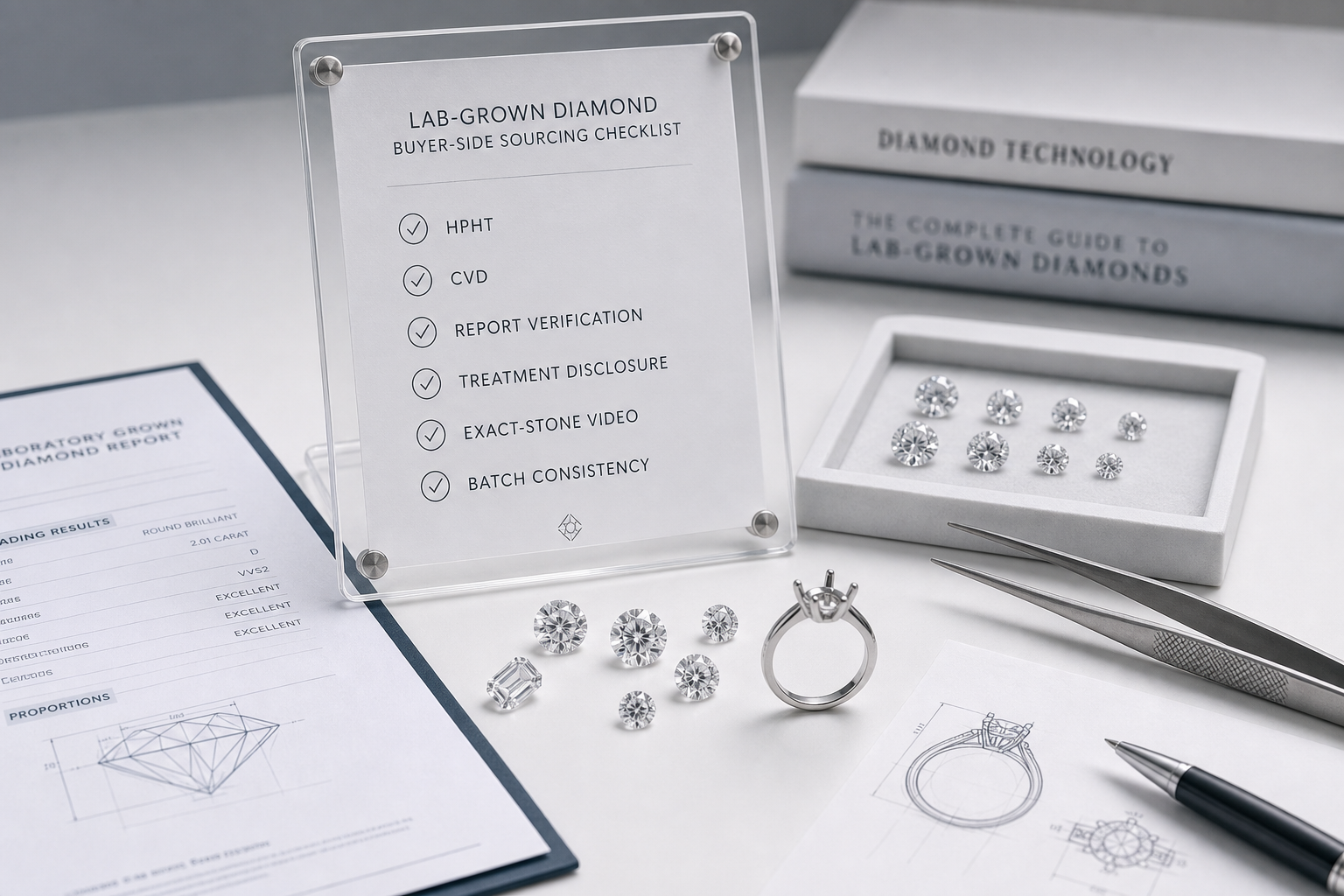
A Practical Evaluation Flow for HPHT vs CVD Buying Decisions
Step 1: Start with the Intended Jewelry or Inventory Use
The first question is not whether HPHT or CVD is better. The first question is what the diamond has to do in the finished product. A single center stone with a grading report for an engagement ring, a matched pair for earrings, a calibrated group for a tennis bracelet, and a mixed lot for inventory all create different sourcing risks.
For a solitaire, the buyer can usually spend more time evaluating one stone closely: report details, exact-stone video, color tone, cut quality, and price alignment. For production jewelry, consistency becomes more important. A group of stones that looks acceptable individually can still fail if the measurements, color range, or tone variation are too wide for the setting or product line.
This is where HPHT vs CVD sourcing should be treated as a filter, not a verdict. If a brand needs consistent disclosure language across a private-label collection, method may matter more. If the buyer is choosing one visually strong, well-documented stone, method may matter less than the actual appearance and report language.
Step 2: Match Report Details with Visual Evidence
Once the intended use is clear, compare the supplier’s description against the grading report and the exact-stone visuals. The growth method, report number, lab-grown identification, treatment comments, measurements, and inscription details should line up with what the supplier is offering. If the listing says one thing and the report wording suggests another, pause before negotiating price.
Visual evidence should be tied to the exact diamond whenever possible, not a sample stone or generic inventory video. For higher-value loose lab-grown diamonds, request images or video under stable lighting and compare them with the report grade. A diamond with a strong grade on paper can still show a color nuance, haziness, or cut personality that makes it less suitable for the intended design.
A practical HPHT vs CVD buying guide should never stop at the grading report. The report narrows the evaluation, but it does not show every viewing condition, every angle, or how the stone will look once mounted. At NUVU, this is why we treat documentation and visual review as paired steps rather than separate checks.
Step 3: Compare Price Against Disclosure and Consistency
Price should make sense in relation to what is known. If two China-based supplier offers look similar by carat weight, color, clarity, and shape, but one is priced noticeably lower, the buyer should look for the reason before assuming it is the better sourcing opportunity. The difference may be legitimate, but it may also reflect weaker documentation, less desirable tone, uncertain treatment disclosure, older inventory, looser batch sorting, or limited supplier support.
Paying more is not automatically safer either. A higher quote should correspond to something concrete: stronger report support, cleaner exact-stone visuals, tighter matching, more predictable availability, clearer treatment disclosure, or better suitability for the product. If the higher price is supported only by broad claims such as “better quality” or “premium CVD” without evidence, it deserves the same scrutiny as a suspiciously low price.
For multiple-stone sourcing, consistency can be more valuable than a small unit-price advantage. A lower price loses much of its appeal if the buyer later has to reject stones, remake settings, separate mixed tones, or explain inconsistent documentation to retail customers. In China lab-grown diamond evaluation, the better offer is the one that balances price, proof, appearance, and repeatability.
Step 4: Keep Written Records of Supplier Claims
Supplier communication should be documented before the order is confirmed. Written answers help prevent misunderstandings about whether the diamonds are HPHT or CVD, whether treatment has been disclosed, whether images show the exact stones, whether report numbers are verifiable, and whether a lot is method-specific or mixed.
This does not require aggressive questioning. It requires clear, practical confirmation. A buyer can simply ask the supplier to confirm the growth method, report details, treatment language, exact-stone matching, measurement range, color and clarity range, and whether substitutes will be approved before shipment. If the supplier’s answers are vague before the sale, they are unlikely to become more precise after a problem appears.
For wholesale, private-label, or recurring sourcing, keep records by order, stone group, report number, and supplier statement. This creates a reference point if future shipments differ from the approved sample or if internal teams need to explain product details consistently. A sourcing checklist is only useful if the answers are preserved, not just discussed in a chat thread and forgotten.
Step 5: Build a Simple Evidence File Before Approval
Before approving a stone or lot, buyers should assemble a compact evidence file rather than relying on scattered messages. For a loose diamond with a grading report, that file can include the supplier quote, grading report image or PDF, report verification result where available, exact-stone video, inscription confirmation, treatment answer, measurements, and final written approval. For a parcel, it can include lot specifications, sample images, agreed ranges, method policy, and review procedures if delivered goods do not match the written specification.
This evidence file does not need to be complicated. Its purpose is to preserve the reason for the buying decision. If a customer later asks why a stone was described as HPHT or CVD, or if a production team needs to reorder matching goods, the buyer can refer back to the same information used at the time of purchase.
A clear evidence file also helps avoid unsupported claims in customer-facing language. If the buyer has documentation only for lab-grown origin, growth method, report details, and treatment disclosure, the selling language should stay within those boundaries. Broader claims about environmental impact, ethical superiority, factory origin, or market value should not be made unless the buyer has separate, specific documentation to support them.
Compliance Boundaries for Buyer-Facing Product Language
How to Describe Lab-Grown Diamonds Clearly
When lab-grown diamonds are listed online, quoted to retail partners, or described to end customers, the laboratory-grown origin should be clear and consistent. A product page should not rely on vague wording such as “diamond” alone when the context could lead a buyer to believe the stone is natural or mined. Clear terms such as “laboratory-grown diamond” or “lab-grown diamond” help reduce confusion while still accurately describing the product.
Simulants should also be kept separate in language and inventory records. Moissanite, cubic zirconia, and other lookalike stones are not laboratory-grown diamonds. If a supplier or product file mixes those categories, the buyer should correct the terminology before using the material in customer-facing listings or sales conversations.
How to Handle Sustainability and Sourcing Claims
Lab-grown diamonds may appeal to buyers looking for an alternative to mined origin, but environmental and sustainability claims should be specific, documented, and limited to what can be substantiated. Broad claims such as “eco-friendly,” “conflict-free,” “green,” or “fully ethical” can create trust and compliance risk if the seller cannot support the exact statement with relevant documentation.
A safer product description focuses on verifiable facts: laboratory-grown origin, grading report details, growth method where documented, stone measurements, and visual evidence. If a seller wants to make claims about energy use, production practices, responsible sourcing, or carbon impact, those claims should be supported by current, specific documentation from the relevant supplier or producer rather than assumed from the lab-grown category.
For buyers working with HPHT or CVD stones that have grading reports, a dependable trust signal is not a supplier’s enthusiasm but a report-aware process. That means checking the lab name, report number, report details, inscription information when available, and the supplier’s exact-stone media before treating the offer as ready for purchase.
GIA, IGI, and HRD Antwerp reports can help buyers create a more consistent comparison file, but they should still be read for what they actually state. A grading report can support identity, grading details, lab-grown origin, and applicable comments; it should not be stretched into proof of unrelated claims about factory source, market superiority, environmental impact, or future supply consistency.
NUVU’s role in HPHT and CVD selection is to help buyers connect the stone to the intended jewelry, the report language, and the practical sourcing record. That support is especially useful when comparing similar-looking offers, selecting a center stone for a custom setting, or building a repeatable assortment where documentation and visual consistency need to stay aligned over time.
Before purchase, buyers should confirm documentation, payment terms, return or exchange terms, resizing policies, shipping expectations, and after-sales support directly with the seller. Those business terms can vary by seller, order type, and jurisdiction, and they should not be assumed from the presence of a grading report or supplier quote.
The Short Version: Method Matters, but Verification Matters More
HPHT and CVD matter when they affect appearance, treatment disclosure, documentation, availability, consistency, or customer-facing explanation. They matter less when the finished diamond is well documented, visually suitable, appropriately priced, and aligned with the intended jewelry use.
The strongest buyer decision framework is simple: define the use, confirm the method, verify the report, review the exact diamond, compare appearance against the grade, ask about treatment, judge price against evidence, check consistency if buying multiples, and keep written supplier answers. If any one step is missing, the method name should not be used as a shortcut.
For buyers sourcing lab-grown diamonds from China, the safer approach is not to choose HPHT or CVD by reputation alone. The better approach is to make every claim verifiable, every price difference explainable, and every selected stone appropriate for the product it is meant to become.
Disclosure: This article is for general educational purposes only. Diamond grading, pricing, availability, specifications, and seller policies can change, and readers should verify important details through grading reports, official laboratory tools, seller documentation, or qualified professionals before making a purchase decision. Laboratory-grown diamonds should be clearly distinguished from natural diamonds, and environmental or sourcing claims should be supported by specific documentation.