
Lab-grown diamonds from China dominate global production volume, yet buyers often struggle to separate meaningful quality indicators from assumptions about origin. The reality is more nuanced than common perceptions suggest: production location tells you far less about a diamond’s value than its growth method, HPHT vs CVD diamond myths, cut quality, and certification; understanding how HPHT and CVD methods differ, why sorting processes shape what’s actually available, and how to verify supplier claims can prevent costly mistakes.
For the full framework, read China Lab-Grown Diamond Supply Chain Guide.
This article helps you evaluate Chinese lab-grown diamonds on their actual merits rather than geographic stereotypes. You’ll learn to read grading reports more effectively, ask the right questions of suppliers, and recognize when pricing or claims deserve scrutiny. Whether you’re comparing stones, assessing a supplier’s transparency, or deciding between growth methods, the goal is to give you a clearer framework for judgment.
| Common Assumption | What Actually Matters | How to Verify |
|---|---|---|
| Chinese diamonds are lower quality | Quality depends on production standards, cutting, and certification—not origin | Check grading report from GIA, IGI, or GCAL; evaluate specs individually |
| Origin can be verified on reports | Grading reports confirm growth method, not country of production | Request growth method documentation; accept that origin typically cannot be proven |
| Lower price means better value | Pricing reflects cut precision, fluorescence, lab reputation, and market conditions | Compare equivalent specs across sellers; scrutinize unusually low prices |
| HPHT or CVD is inherently superior | Each method produces different characteristics suited to different priorities | Match growth method characteristics to your visual and budget preferences |
| All suppliers offer similar transparency | Communication quality and QC standards vary significantly across supplier types | Ask specific questions; request high-res images and videos before purchasing |
| Cutting location determines quality | Measurable proportions and light performance data matter, not where cutting occurred | Review cut grades, proportions, and ideal scope images when available |
Quick Questions Before You Read
Q: Can I tell if a diamond was grown in China from its grading report?
No. Grading reports confirm the growth method (HPHT or CVD) and quality characteristics, but they do not verify country of origin. Production location is generally not traceable through standard documentation.
Q: Should I prefer one growth method over the other?
Neither HPHT nor CVD is inherently better. Each produces diamonds with different characteristics that may suit specific priorities—such as size goals, color preferences, or budget constraints. The article explains how to match method to your needs.
Q: Are Chinese lab-grown diamonds automatically cheaper?
No. Pricing reflects quality factors, certification, and market conditions—not production location. A well-cut, certified diamond costs similarly regardless of where it was grown.
Q: What should I ask a supplier before purchasing?
Ask about growth method, certification laboratory, cut quality, any treatments, return policies, and request high-resolution images. Suppliers who avoid specific questions or cannot provide documentation are a red flag.
What This Article Explains About China’s Lab-Grown Diamond Supply Chain
This article is not a procurement manual. It will not tell you where to buy, which supplier to choose, or how to import diamonds. What it will do is help you understand how one major production hub actually operates — and how that reality shapes what you see, what you pay, and what you should verify.
China has become the world’s largest producer of lab-grown diamonds by volume. That fact alone does not tell you whether a diamond is good, bad, fairly priced, or right for your needs. What matters is understanding how production methods, sorting decisions, cutting quality, certification pathways, and supplier networks influence the stones that actually reach the market.
This article focuses specifically on how supply-chain dynamics affect buyer options. It is not about comparing countries or arguing that one origin is superior to another. The goal is practical: to give you enough context to ask better questions, recognize when something does not add up, and verify claims with more confidence.
Throughout this discussion, it is important to remember that laboratory-grown diamonds should be clearly identified as laboratory-grown, and they should not be presented as mined diamonds. Both laboratory-grown and natural diamonds have their place in the market, but they have different origins, different market dynamics, and different value considerations. Buyers should understand these distinctions before making purchasing decisions.
Who This Information Helps
Engaged couples researching lab-grown diamonds will find this useful for understanding why certain specifications are more available than others, and why pricing can vary even when grades look identical on paper. Jewelry buyers comparing options across sellers will gain context for evaluating claims and asking verification questions. Small brands evaluating sourcing decisions will find a framework for understanding what supply-chain transparency actually looks like in practice. Procurement professionals seeking supply-chain context will find a grounded explanation of how production realities translate into market availability.
What This Article Will Not Cover
This article does not recommend specific vendors or suppliers. It does not provide wholesale import procedures, legal guidance, or tax advice. It does not issue sustainability certifications or make ethical claims about production practices. Those topics require separate, specialized treatment. What you will find here is factual context about how lab-grown diamonds move from production to market, and what that means for buyers who want to make informed decisions.
What to Clarify Before Reading Further
This article assumes you already understand the basic difference between lab-grown and natural diamonds, and between HPHT and CVD growth methods. If those concepts are unfamiliar, start with foundational education on diamond formation and growth technologies before diving into supply-chain specifics. The information here builds on that baseline knowledge.
China’s Role in Global Lab-Grown Diamond Production
China produces more lab-grown diamonds by volume than any other country. That does not mean every lab-grown diamond comes from China, nor does it mean that China-produced diamonds are uniformly better or worse than stones from elsewhere. Production scale matters because it affects availability, pricing dynamics, and the range of options that buyers encounter in the market.
Understanding China’s role requires looking past headlines about market share. The relevant questions are practical: What production methods dominate? How does that affect what buyers see? What should buyers verify rather than assume?
Production Scale and Capacity
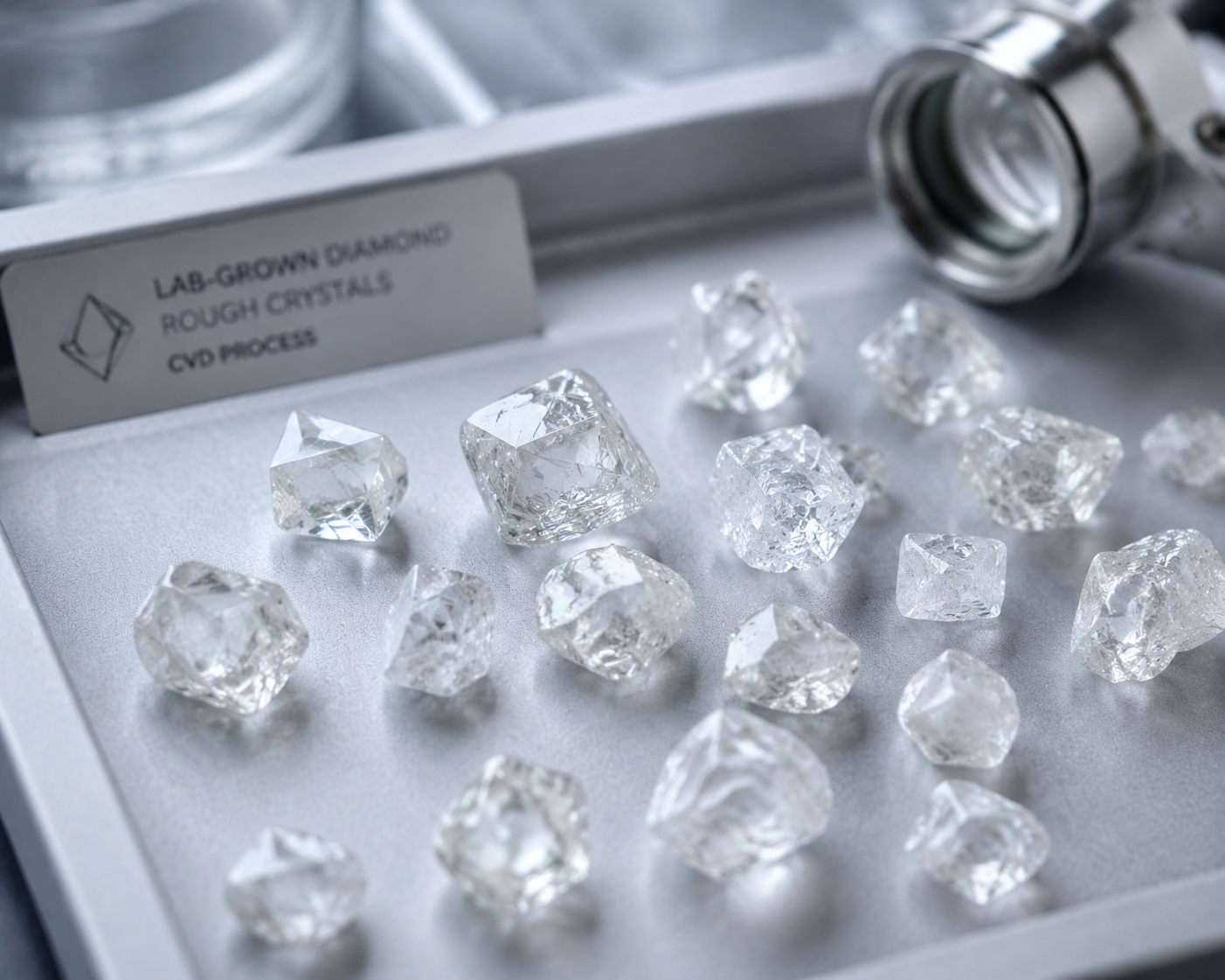
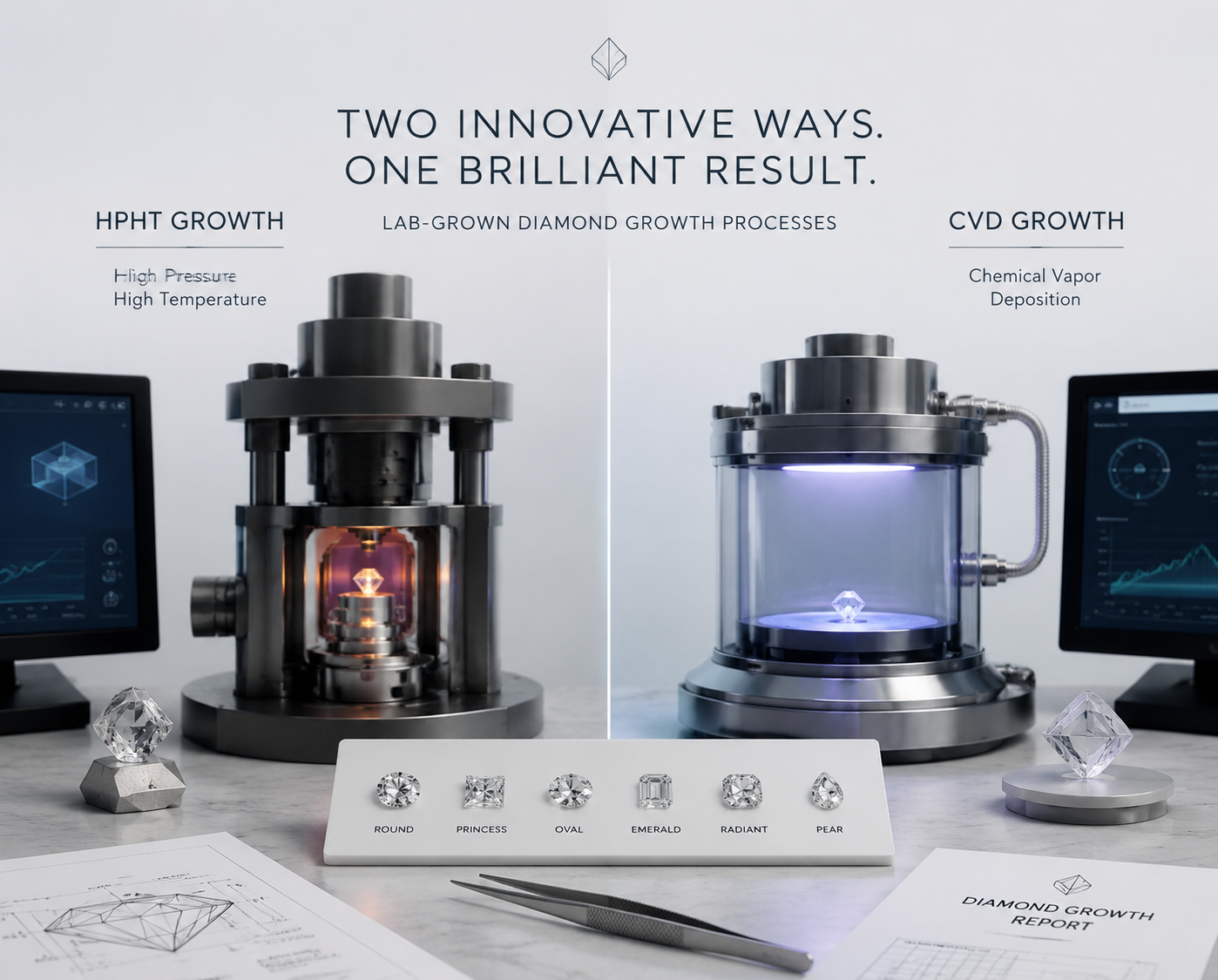
China’s lab-grown diamond production is concentrated in regions with specialized infrastructure, particularly in Henan province. Both HPHT (High Pressure High Temperature) and CVD (Chemical Vapor Deposition) methods operate at significant scale. HPHT production has a longer industrial history in China, originally developed for industrial diamond applications before expanding into gem-quality production. CVD capacity has grown rapidly over the past decade, with new facilities coming online to meet rising demand.
Exact production figures vary by source and year, and industry reporting is not always consistent. Buyers should treat specific numbers with caution unless verified by current, reputable industry reports. What is clear is that China’s production volume influences global supply — when production capacity shifts, availability and pricing for certain specifications can shift as well.
For buyers, the key takeaway is that production scale creates market availability, but it does not guarantee quality or value. A large supply of lab-grown diamonds means more options, but it also means more variation in sorting standards, cutting quality, and documentation practices.
HPHT vs. CVD Specialization in China
HPHT production in China has established capacity for larger stones and specific color ranges. The method’s longer history means more mature production processes and more facilities with deep expertise in HPHT growth. CVD production has expanded quickly, offering different growth characteristics and size possibilities. Some facilities specialize in one method; others operate both, allowing them to serve different market segments.
The distinction matters because HPHT and CVD diamonds can have different visual and grading profiles. HPHT-grown diamonds may show certain metallic inclusions or color tendencies related to the growth process. CVD-grown diamonds may exhibit different strain patterns or growth textures visible under magnification. These are not defects — they are characteristics of the growth method.[1]
Buyers should not assume that one method is inherently superior. The question is which characteristics fit the buyer’s priorities, and whether the seller can provide clear documentation about which method was used and what to expect visually.
Understanding the technical differences between HPHT and CVD production helps buyers interpret what they see on grading reports and under magnification. GIA notes that HPHT-grown diamonds often contain metallic inclusions from the metal catalyst used during growth, while CVD-grown diamonds may show different internal features related to the gas-deposition process.[1] These characteristics can help gemologists identify the growth method, but they do not indicate quality — they are simply fingerprints of the production process.
When growth method or post-growth treatment is relevant, buyers should look for clear disclosure in the grading report or seller documentation. Some laboratory-grown diamonds undergo post-growth treatments to improve color or clarity, and these treatments should be disclosed where applicable. A grading report from a reputable laboratory will typically note if treatments are detected, but buyers should also ask sellers directly about any enhancements.
How Production Method Affects Buyer Options
HPHT and CVD are not interchangeable labels. Each method produces diamonds with slightly different characteristics, and those differences show up in grading reports, visual appearance, and sometimes pricing. A buyer who understands the distinction can make more informed comparisons. A buyer who ignores it may be surprised by what they receive.
For example, HPHT-grown diamonds in certain size ranges may be more readily available from China-based production, while CVD-grown diamonds in other size or color ranges may be more common. Availability affects pricing and lead times. If you are seeking a specific combination of size, color, clarity, and growth method, understanding which production method dominates that segment helps set realistic expectations.
What to Ask About Growth Method
When considering a laboratory-grown diamond, ask the seller to confirm whether it is HPHT or CVD grown. Check if the grading report states the growth method — most major grading laboratories now include this information. Understand that both methods produce genuine lab-grown diamonds, but their characteristics and market availability may differ. Neither method is automatically “better” — the relevant question is which characteristics align with what you want, and whether the seller can document what they are selling.
How Sorting and Grading Practices Shape Market Availability
Not every diamond produced enters the jewelry market. Between production and retail, stones pass through sorting and grading processes that determine what becomes available to buyers. Understanding this stage of the supply chain explains why certain specifications are common while others require more searching — and why pricing does not always follow straightforward logic.
Production Output vs. Market-Ready Stones
Lab-grown diamond production does not uniformly yield gem-quality material. Stones are sorted by size, color, clarity, and growth quality. Lower-quality material may be diverted to industrial uses — cutting tools, thermal conductors, or other technical applications — rather than polished for jewelry. Sorting thresholds vary by producer and by market demand.
This matters for buyers because it means that what you see available is not a random sample of all production. It is a filtered selection. If certain color-clarity combinations seem scarce, it may reflect sorting decisions rather than production capability. Conversely, if certain grades seem abundant, it may indicate that production is optimized for those specifications.
Sorting also affects pricing. Stones that require more sorting effort, or that fall into rarer categories after sorting, may carry higher premiums even if production costs are similar. The price you pay reflects not just what it costs to grow the diamond, but what it costs to sort, select, and prepare it for the jewelry market.
Color and Clarity Distribution
Lab-grown diamond production does not yield equal numbers of stones across all color and clarity grades. HPHT and CVD each have typical color and clarity ranges based on how the growth process affects the crystal. Sorting determines which stones are polished for jewelry and which are redirected to other uses.
Buyers may notice that certain combinations — for example, larger carat weights with high color grades — are more common or more scarce than others. This reflects sorting and production realities, not just pricing strategy. A buyer seeking a specific combination should understand that availability may be limited by what production actually yields, not just by what sellers choose to stock.
At NUVU, we encourage buyers to compare available stones across multiple sellers before concluding that a specific combination is impossible to find. Production output varies, and different suppliers may have access to different inventory pools. But understanding that sorting shapes availability helps set realistic expectations.
How Large Stones Enter the Market
Larger lab-grown diamonds — generally 2 carats and above — require longer growth cycles and carry higher production risk. A larger crystal takes more time to grow, and the longer the growth cycle, the more opportunity for inclusions, color variations, or growth interruptions. Not all facilities produce large stones at scale.
Availability of larger sizes depends on specialized production capacity and sorting decisions. Some producers focus on smaller, faster-turnaround production. Others specialize in larger stones but may have longer lead times and higher production costs. Buyers seeking larger lab-grown diamonds should understand that supply is not infinite, immediate availability is not guaranteed for all specifications, and lead times may apply for custom orders or rare combinations.
Prices can change with market conditions, report type, seller channel, and stone-specific details, so exact comparisons should be verified at the time of purchase. A larger stone that seems attractively priced today may reflect current supply conditions that could shift. Conversely, a premium price does not automatically indicate superior quality — it may reflect scarcity, certification choices, or seller positioning.
How to Interpret Availability Claims
If a seller claims “immediate availability” of rare specifications — such as large carat weights with exceptional color and clarity grades — ask to see the actual stone, the grading report, and video confirmation. Verify that the stone matches the claimed specifications. Understand that unusually rare combinations may require verification of whether the stone is genuinely available for purchase or merely listed as searchable inventory that may have already been sold or reserved.
Availability claims are not always current. Some inventory databases show stones that are no longer available. Some sellers list theoretical availability based on production capability rather than actual stock. Verification is not excessive caution — it is standard practice when significant money is involved.
Cutting and Polishing: Where Value Is Added
A lab-grown diamond’s journey from rough stone to market-ready gem involves a critical transformation stage: cutting and polishing. This is where production output becomes a finished product, and where the difference between an average stone and an exceptional one often becomes visible. Understanding where and how cutting happens in the supply chain helps buyers evaluate what they are actually purchasing—beyond origin narratives.
Where Cutting Happens in the Supply Chain
Lab-grown diamonds may be cut in China, India, or other locations depending on the supplier’s operations. Some producers integrate cutting facilities directly into their manufacturing sites, allowing them to control the entire process from growth to finished stone. Others sell rough material to independent cutting operations, which may specialize in specific shapes or sizes.
Geographic assumptions about cutting quality are unreliable. A diamond cut in China can meet the highest standards—or it can be poorly executed. The same applies to India, Thailand, or any other cutting center. What matters is the cutting standard applied, not the location where the work was done. Buyers who assume that certain countries automatically produce better cuts are making judgments based on outdated generalizations rather than actual stone quality.
The practical question for buyers is not where the cutting occurred, but whether the cutter had the skill and incentive to maximize the stone’s potential. A producer that integrates cutting into its own facility may have more control over quality consistency. An independent cutting operation may specialize in certain shapes or cutting styles. Neither model guarantees quality—the results depend on standards, expertise, and quality control processes.
For buyers, this distinction has real implications. A stone with excellent proportions and measurable light performance data will typically outperform a stone with mediocre proportions, regardless of where either was cut. The cutting center’s reputation tells you nothing; the stone’s measurements tell you something useful. Focus on the data that actually predicts visual performance rather than geographic assumptions that do not.
Cut Quality and Visual Performance
Cut quality is the single most important factor in how a diamond performs visually. A well-cut lab-grown diamond will show brilliance, fire, and scintillation that a poorly cut stone lacks—regardless of where either stone was grown or cut. The physical and optical properties of lab-grown diamonds are identical to natural diamonds, so the same principles of light performance apply.
For round brilliant cuts, grading reports from major laboratories provide a cut grade that summarizes proportions, symmetry, and polish. This grade offers a useful starting point, but it does not capture everything. Two diamonds with the same “Excellent” cut grade can look different in person due to subtle variations in proportions, facet angles, and light return patterns.
Fancy shapes—oval, cushion, pear, emerald, radiant, and others—do not receive standardized cut grades from most laboratories. This makes proportion analysis and visual inspection even more important. A cushion cut with poor depth or a pear shape with thick shoulders will underperform visually, even if the color and clarity grades are strong. Buyers cannot rely on a single grade to assess fancy shapes; they need to look at the actual stone.
The supply chain reality is that cutting quality varies across all production sources. Some facilities consistently produce excellent cuts. Others prioritize yield—retaining more carat weight from the rough—at the expense of light performance. This tradeoff between weight retention and optical performance is common across the industry, not specific to any single country or supplier.
In practical buying situations, this tradeoff often becomes visible in the proportions data. A stone that weighs more but has a deep pavilion or thick girdle may have sacrificed light performance for carat weight. The price per carat might look attractive, but the visual result may disappoint. Understanding this dynamic helps buyers recognize when a “good deal” on paper may not deliver the visual impact they expect.
How to Evaluate Cut Without Geographic Bias
The most productive approach is to evaluate each stone on its measurable attributes rather than assumptions about origin, including HPHT vs CVD methods. For round brilliants, check the proportions report: table percentage, depth percentage, crown angle, pavilion angle, and girdle thickness. These numbers tell you more about how the stone will perform than any claim about where it was cut.
For fancy shapes, request length-to-width ratio and review visual performance through available media. A 360-degree video shows how the stone moves light as it rotates. High-resolution images taken under controlled lighting reveal facet pattern, bow-tie effect in elongated shapes, and overall brightness. If a seller cannot or will not provide this level of visual documentation, that absence is itself information about their transparency standards.
Light performance data—such as ASET (Angular Spectrum Evaluation Tool) images or Ideal Scope images—provides additional insight, though not all sellers offer this level of detail. When available, these tools show where light enters, reflects, and exits the diamond, revealing potential leakage or darkness that standard images may not display.
The supply chain question that matters is not “where was this cut?” but “was this cut well?” A diamond that was grown in China, cut in India, and certified in the United States can be exceptional—or problematic. The evaluation must focus on the stone itself, not the path it traveled.
What to Verify About Cut Quality
Request the full proportions report, not just the summary cut grade. For round brilliants, compare the stone’s measurements against established ideal ranges: table percentage typically between 54-57 percent, depth percentage between 61-62.5 percent, crown angle between 34-35 degrees, pavilion angle between 40.6-41 degrees, and girdle thickness in the thin-to-medium range. These are guidelines, not absolute rules, but significant deviations warrant closer inspection.
For fancy shapes, ask specifically about length-to-width ratio and how it affects the stone’s appearance. An oval that is too long may look thin and dark; one that is too short may appear roundish and lose the elegant shape buyers expect. Each fancy shape has proportion ranges that tend to produce the most appealing visual results.
Review all available visual media before making a decision. If the stone looks dark, lifeless, or uneven in professional images and video, it is unlikely to improve in person. Do not assume that a strong color or clarity grade compensates for weak cut quality—cut drives visual impact more than any other factor.
Certification Flow and Documentation Realities
Grading reports from independent laboratories provide a standardized assessment of a lab-grown diamond’s characteristics. For buyers navigating the supply chain, understanding how diamonds reach these laboratories—and what the reports actually confirm—helps separate useful documentation from marketing claims.
Common Certification Pathways
Lab-grown diamonds produced in China may be submitted to GIA (Gemological Institute of America), IGI (International Gemological Institute), GCAL (Gem Certification and Assurance Lab), or other grading laboratories. Certification typically occurs after cutting and before the stone enters retail distribution. Some producers have established relationships with specific laboratories and submit most of their production through those channels. Others use multiple services depending on buyer preferences or market requirements.
The choice of laboratory affects what information appears on the report and how that information is presented. GIA reports for lab-grown diamonds clearly identify the stone as laboratory-grown and typically include the growth method when it can be determined.[2] IGI reports also identify laboratory-grown status and growth method. GCAL offers additional services such as light performance grading and diamond imaging. Each laboratory has its own standards, report formats, and pricing structures.
From a supply-chain perspective, certification provides an independent checkpoint between production and sale. The grading laboratory has no financial stake in the specific stone’s sale price, which creates separation between the producer’s interests and the reported grades. However, the report is only as useful as the information it contains—and it does not contain everything buyers might want to know.
What Grading Reports Confirm and What They Do Not
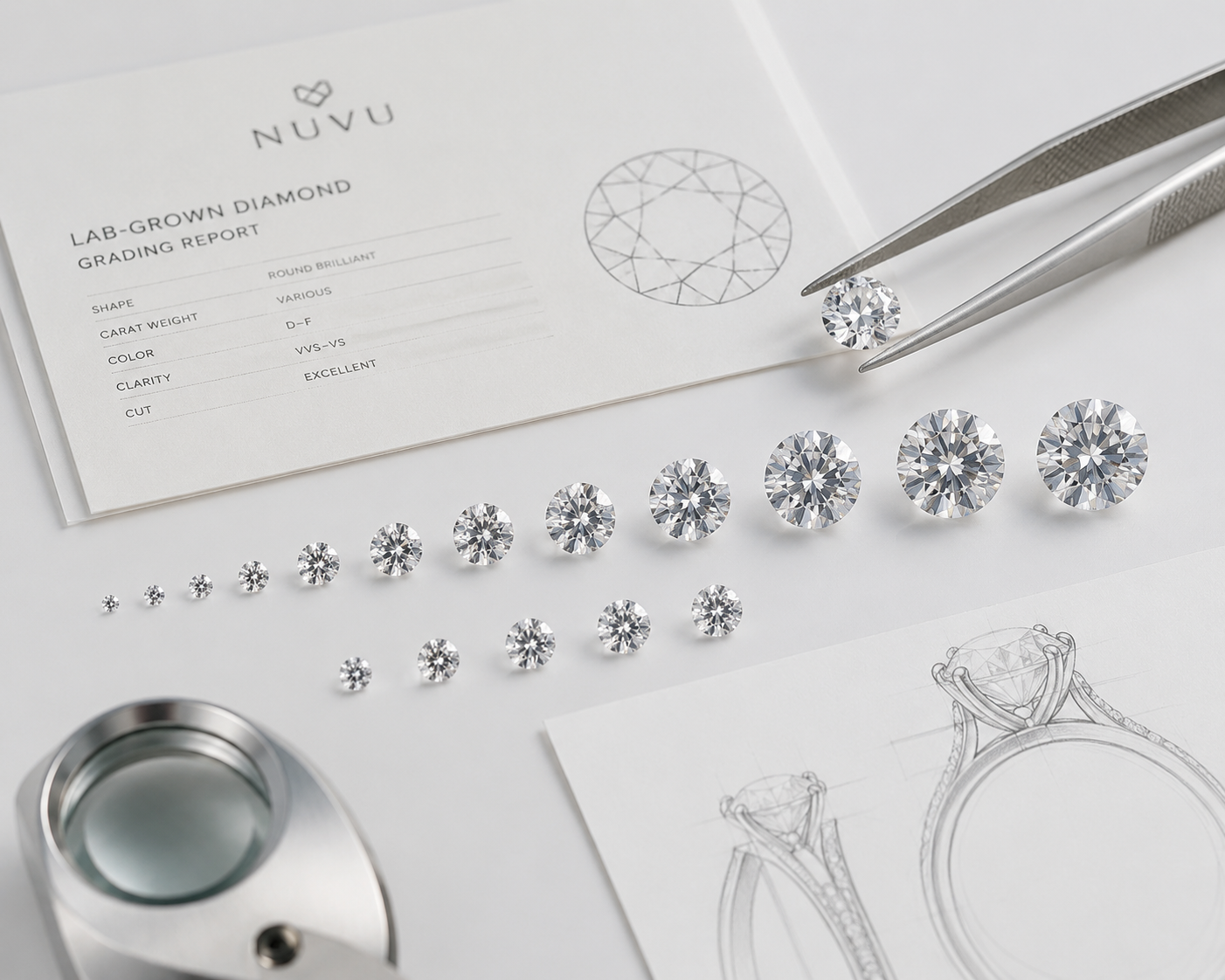
A grading report confirms specific, measurable characteristics: carat weight, color grade, clarity grade, cut grade for round brilliants, measurements (length, width, depth), polish and symmetry assessments, fluorescence intensity, and in most cases, whether the stone is HPHT or CVD grown. The report also includes a unique identification number, which may be laser-inscribed on the diamond’s girdle.[2]
What the report does not confirm is equally important. Reports do not verify the country where the diamond was grown, the specific production facility, or the workers’ conditions. They do not validate ethical or sustainability claims unless those claims are specifically documented through separate certification programs—and even then, the scope of such programs varies widely. The report also does not guarantee how beautiful the stone will look in person. Two diamonds with identical grades can appear different due to cut nuances, fluorescence effects, or how their specific inclusions interact with light.
A grading report can document key characteristics, but it should be read alongside visual evidence, measurements, seller documentation, and the intended jewelry use. The report provides a technical baseline; it does not replace the buyer’s own assessment of whether the stone meets their expectations.
For buyers concerned about supply-chain transparency, this creates a gap. The report confirms the stone’s identity and quality characteristics, but it does not trace the stone’s journey from growth facility to market. If origin transparency is important, buyers must seek that information from sellers directly—and evaluate how credible and verifiable those claims are.
For buyers, the practical point is not just what the report says, but how the stone performs visually and fits the intended design. A grading report helps narrow the shortlist, but it does not replace visual review. The report tells you the stone meets certain specifications; it does not tell you whether you will find it beautiful or whether it will work well in the setting you have in mind.
Understanding the Limits of Report Verification
A grading report provides valuable documentation, but it represents a single point of assessment under controlled laboratory conditions. The report captures the stone’s characteristics at the time of grading, but it cannot account for how those characteristics will appear in different lighting environments, settings, or wearing conditions. Buyers should understand that a report is a verification tool, not a complete picture of the stone’s visual behavior.
Report verification through the issuing laboratory’s online database adds an important layer of confidence. Most major grading laboratories—GIA, IGI, and GCAL—provide online tools that allow buyers to look up report details using the report number. This verification step confirms that the report document matches the laboratory’s records. However, this process verifies the report’s authenticity, not the stone’s visual appeal or suitability for a specific piece of jewelry.
When a grading report is available, buyers should verify the report details through the issuing laboratory’s official report-check tool where available. This confirms that the report document matches the laboratory’s records, though it does not replace visual inspection of the actual stone.
The gap between report data and visual reality is particularly relevant for fancy shapes, which do not receive standardized cut grades. A cushion cut or oval may have excellent color and clarity grades on paper, but perform poorly due to proportion choices that the report does not evaluate. Buyers relying solely on report data for fancy shapes may be disappointed when the stone arrives. Visual documentation—images, video, and ideally light performance analysis—fills this gap.
For buyers sourcing stones remotely, this reality underscores the importance of requesting comprehensive visual evidence. A grading report confirms what the stone is; visual evidence shows how it looks. Both are necessary for informed decision-making, especially when the buyer cannot inspect the stone in person before purchase.
How to Read Reports for Supply-Chain Awareness
Start by confirming that the report clearly identifies the stone as laboratory-grown. Reports from reputable laboratories will state “laboratory-grown” or “lab-grown” prominently, distinguishing the stone from natural diamonds. If this identification is missing or unclear, request clarification from the seller.
Check whether the report states the growth method—HPHT or CVD. Most modern reports include this information, though older reports or reports from some laboratories may not specify. Understanding the growth method can help buyers interpret certain characteristics. For example, HPHT-grown diamonds may occasionally show metallic inclusions from the growth process, while CVD-grown diamonds may show different internal features. Neither method is inherently superior, but each has characteristics that informed buyers may want to understand.
Verify that the report number matches any laser inscription on the diamond’s girdle. Most lab-grown diamonds carry a laser inscription linking the physical stone to its report. This inscription is typically visible under magnification and provides a way to confirm that the stone you receive is the stone described in the documentation.
Use the report as a starting point for evaluation, not a complete answer. The grades provide a standardized framework, but they do not replace visual inspection. A VS2 clarity grade tells you the stone has minor inclusions visible under 10x magnification, but it does not tell you whether those inclusions are dark crystals in a visible location or white feathers tucked near the girdle. The report describes; the buyer—or a trusted advisor—must interpret.
How to Cross-Check Report and Stone
Match the report number to the laser inscription on the diamond’s girdle. This is the most basic verification step, yet many buyers skip it. If you cannot view the stone in person, ask the seller for a high-resolution image of the inscription under magnification. A reputable seller should be able to provide this.
Confirm that the stated carat weight and measurements match what you observe. The report lists the stone’s dimensions in millimeters. If a stone is listed as 6.5mm in diameter but measures differently in images or video, ask for clarification. Significant discrepancies between reported and observed dimensions are a red flag.
Compare the stated color and clarity grades to the stone’s visual appearance in images and video. A D-color diamond should show no discernible yellow or brown tint. An IF (internally flawless) or VVS-grade diamond should show no visible inclusions in face-up view under normal magnification. If a stone’s visual appearance seems inconsistent with its stated grades, request additional documentation or consider an independent evaluation.
Report verification is not an advanced precaution reserved for high-value purchases. It is a basic step that any buyer can and should take. The few minutes required to cross-check report and stone can prevent significant problems later.
Pricing Dynamics: Beyond “China Equals Cheaper”
The assumption that lab-grown diamonds from China are automatically cheaper than stones from other sources oversimplifies how pricing actually works. Production location is one factor among many, and it rarely determines price in isolation. Understanding what drives pricing helps buyers evaluate whether a specific stone represents fair value—regardless of where it was grown.
Factors That Influence Lab-Grown Diamond Pricing
Price is determined by a combination of factors: carat weight, color grade, clarity grade, cut quality, shape, certification status and laboratory, seller margin, and current market conditions. A well-cut, IGI-certified, VS-clarity, F-color lab-grown diamond from China will typically cost more than a poorly cut, uncertified, SI-clarity, H-color stone from any source. The quality attributes drive price more than geography does.
Supply-chain efficiency can influence pricing, but the relationship is not linear. A producer with integrated operations—growing, cutting, and certifying in a streamlined process—may offer competitive pricing due to reduced intermediate costs. However, that efficiency does not automatically translate to the lowest price for every stone. The producer may choose to invest in better sorting, stricter quality control, or stronger documentation, all of which add cost but also add value.
Certification itself affects price. A lab-grown diamond with a GIA or IGI report commands a premium over an uncertified stone or one with minimal documentation. The certification cost is real, and the independent verification provides buyer protection. Stones without certification may be priced lower, but they also carry higher risk—the buyer has no independent assessment of quality claims.
Market conditions play a role that has nothing to do with origin. Lab-grown diamond prices have declined over time as production capacity has expanded. This trend affects all production sources. A stone priced today may cost less than an equivalent stone priced two years ago, regardless of where either was produced. Buyers comparing prices should consider timing as well as specifications.
China-linked supply chains can offer manufacturing depth and scale in some categories, but buyers still need to evaluate consistency, documentation, communication, and quality control. The presence of large-scale production does not automatically translate to better value for any individual purchase. Each stone must be evaluated on its own merits.
Why Similar Specifications Can Have Different Prices
Two diamonds with identical carat weight, color grade, and clarity grade can have meaningfully different prices. Cut quality is often the hidden differentiator. A diamond with excellent proportions, symmetry, and polish will outperform and often cost more than a diamond with the same color and clarity but mediocre cut. The price difference reflects real quality variation that the basic 4Cs do not fully capture.
Fluorescence affects price. A diamond with strong blue fluorescence may be priced lower than an equivalent diamond with no fluorescence, even though fluorescence is not inherently negative. Some buyers prefer fluorescent stones; others avoid them. The market prices fluorescence as a factor, and that pricing varies depending on the stone’s other characteristics.
Certification laboratory matters. A diamond graded by GIA may be priced differently than an equivalent diamond graded by IGI, even if the actual quality is similar. This reflects market perception of laboratory strictness and brand recognition, not necessarily differences in the stones themselves. Buyers should be aware that the same stone graded by different laboratories might receive slightly different grades—and different prices.
Seller overhead and positioning also influence price. A brand with significant marketing expenses, retail locations, and service offerings will price stones higher than a lean online operation with minimal overhead. This is not necessarily a negative—the higher price may fund services, guarantees, or customer support that buyers value. But it means that comparing prices across different seller types requires accounting for what is included in the purchase beyond the stone itself.
In many buying situations, this price variation reflects real differences in what buyers receive. A lower price from a seller with minimal overhead may mean less pre-purchase support, limited return options, or less detailed documentation. A higher price from a full-service seller may include consultation, better visual documentation, and clearer recourse if something goes wrong. The question is not just “what does this stone cost?” but “what does this purchase include?”
How to Evaluate Price Without Origin Assumptions
The most productive approach is to compare stones with similar specifications across multiple sellers, focusing on quality attributes rather than origin claims. Start by defining your target specifications: carat range, color, clarity, shape, and certification preference. Then search for stones that match those specifications across several sources.
Check whether the stones you are comparing have equivalent cut quality, proportions, and visual performance. A lower price may reflect weaker cut quality, not better value. A higher price may reflect superior proportions, stronger documentation, or better visual characteristics. Ask each seller to explain significant price differences within your comparison set. The explanation should reference specific, verifiable attributes—not vague claims about quality or origin.
Be cautious of prices that seem unusually low relative to the market. A stone priced significantly below comparable alternatives may have undisclosed issues: weaker cut than the grade suggests, inclusions that are more visible than the clarity grade implies, fluorescence that affects appearance, or missing documentation. Low price is not automatically a red flag, but it is a reason for additional verification, not automatic acceptance.
Origin claims themselves should be treated skeptically unless accompanied by verifiable documentation. A seller claiming “direct from China” or “factory prices” should be able to explain what that means in practical terms: how their supply chain operates, what documentation they provide, and how their prices compare to equivalent stones from other sources. The claim alone is not evidence of value.
Prices can vary because of cut precision, report type, seller channel, size, shape, availability, and documentation. Buyers should compare like-for-like specifications before treating one stone as a better value. A lower price for different specifications is not a valid comparison.
What to Check Before Accepting a Price as Fair
Compare at least three stones with similar specifications from different sellers. Ensure that all stones in your comparison have equivalent certification, cut quality, and visual documentation. If one stone lacks certification or has significantly weaker visual performance, it is not a valid comparison point.
Ask each seller to explain any price difference that exceeds roughly 10-15 percent for equivalent specifications. The explanation should reference specific, verifiable factors: cut quality differences, certification laboratory, fluorescence, proportions, or included services. Vague explanations or an inability to explain price differences are warning signs.
Before purchase, buyers should confirm documentation, return terms, resizing policies, and after-sales support directly with the seller. Do not assume that policies are standard or that services are included unless they are clearly stated in writing.
Treat unusually low prices as a trigger for additional questions, not as evidence of a great deal. Ask for additional images, verification of report and stone match, and explanation of why the price is significantly below market. If the seller cannot or will not provide this information, the risk may outweigh the savings.
Supplier Networks and Communication Realities
The lab-grown diamond supply chain is not a single, uniform system. It is a network of different supplier types, each with distinct capabilities, limitations, and communication practices. Understanding where a seller sits in this network affects what buyers can access, how quickly orders can be fulfilled, and what level of service to expect.
Types of Suppliers in the Supply Chain
Suppliers generally fall into several categories. Producers manufacture the rough diamonds and may sell directly or through intermediaries. Some producers are integrated operations that control growth, cutting, and sales; others sell rough to independent cutting facilities. Wholesalers and aggregators buy from multiple producers, offering broader inventory but less direct control over production. Cutting operations focus on polishing and may work with rough from various sources. Retail-facing brands source from producers, wholesalers, or cutting operations and sell directly to end buyers.
Supplier type shapes what buyers experience. A producer may offer deeper customization and shorter lead times, particularly for HPHT vs CVD lab-grown diamonds, but often has limited inventory breadth for other specifications. An aggregator may have wider selection but less control over individual stone quality. An intermediary may add markup without adding transparency. The question is not which type is “best” but which type fits the buyer’s priorities: access, customization, speed, or breadth.
Communication and Responsiveness
Communication quality varies significantly across the supply chain. Language differences, time zones, and business culture all affect responsiveness. Some suppliers provide detailed technical data, high-resolution images, and prompt answers to specification questions. Others offer minimal information and slow responses. This is not a geography issue — it is a supplier capability issue.
Buyers should treat communication quality as a signal. A supplier that cannot provide clear answers, detailed images, or timely responses is unlikely to improve after a sale is complete. For custom orders or specific specifications, communication quality matters as much as price. If a supplier is difficult to work with during inquiry, the actual transaction is unlikely to be smoother.
Minimum Order Quantities and Lead Times
Wholesale and custom orders often involve minimum order quantities or extended lead times. Production scheduling affects when specific specifications are available. A stone that is listed as searchable inventory may not actually be in stock; it may be available to order with a production lead time. Buyers seeking larger sizes, rare color-clarity combinations, or custom cuts should clarify lead times before assuming immediate availability.
Lead times also depend on where the supplier sits in the chain. A producer may need to grow and cut a stone to order. An aggregator may need to source from multiple producers. A retail brand may have stock on hand. Clarity on lead times prevents unrealistic expectations and allows buyers to plan accordingly.
For wholesale buyers and brands sourcing inventory, consistency often matters as much as headline price. A supplier that delivers consistent quality, reliable documentation, and responsive communication across multiple orders provides value that a slightly lower-priced but inconsistent supplier cannot match. Evaluating suppliers should include not just price and specs, but reliability across the full relationship.
Documentation Standards Across Supplier Types
Different supplier types operate with different documentation standards. A producer selling directly may provide detailed growth records, production batch information, and full certification trails. An aggregator may consolidate stones from multiple sources, making detailed origin documentation more difficult to provide. A retail brand may add proprietary documentation or quality guarantees, but these vary significantly from one brand to another.
For buyers seeking traceability, understanding these documentation differences is essential. A supplier’s ability to provide specific documentation often reflects their position in the supply chain and their internal systems. Producers with integrated operations typically have the most detailed records. Aggregators may have broader inventory but less granular documentation. Retail brands may offer polished presentation but rely on upstream suppliers for underlying data.
In sourcing or wholesale conversations, documentation, consistency, and communication often matter as much as the headline specification. Buyers should clarify what documentation is available before committing, and evaluate whether the supplier’s transparency level meets their needs.
Documentation requests also serve as a test of supplier responsiveness. A supplier that readily provides detailed information demonstrates operational competence and transparency. A supplier that struggles to answer basic questions about origin, certification, or quality control may have gaps in their systems—or may be reselling stones they do not fully understand. Either situation warrants caution.
For custom orders, documentation becomes even more important. A buyer commissioning a specific size, shape, or specification should expect clear communication about production timelines, quality expectations, and what happens if the finished stone does not meet specifications. Documentation at each stage of a custom order protects both parties and reduces the risk of misunderstandings.
What to Confirm Before Engaging a Supplier
Before committing to a supplier, buyers should confirm several points directly. Ask whether the supplier is a producer, wholesaler, or intermediary. Clarify minimum order requirements, lead times, and payment terms. Request sample images, videos, and documentation for the specific stone being considered — not generic stock photos. Confirm return policies, dispute resolution processes, and any guarantees in writing.
These questions are not confrontational. They are standard business practice. A supplier that avoids answering or provides vague responses is signaling how the relationship will likely proceed. Transparency at the inquiry stage usually indicates transparency throughout the transaction.
Quality Control and Consistency Challenges
Quality control in the lab-grown diamond supply chain is not uniform. Different producers and suppliers apply different standards, and inconsistent QC can result in stones that do not match their stated specifications. Understanding what QC means in practice helps buyers verify claims rather than assume uniform quality.
What Quality Control Means in Practice
Quality control includes sorting by color and clarity, checking for growth defects, verifying cut proportions, and ensuring documentation accuracy. Some producers have rigorous internal QC processes; others rely on external grading laboratories to catch issues. The grading report provides an independent check, but it does not replace the producer’s or supplier’s responsibility to sort and verify before submission.
QC standards vary. A supplier with strong QC will catch stones that do not meet specifications before they reach buyers. A supplier with weak QC may pass along inconsistencies, relying on buyers to notice. This is why verification matters regardless of the grading report. The report confirms what was submitted; it does not guarantee what was not submitted.
Common Consistency Issues
Issues that can arise include stones that do not match report grades, inclusions that are not visible in standard images but affect appearance, color differences under different lighting conditions, and proportions that deviate from stated measurements. These issues are not unique to any single country or supplier. They exist across the global lab-grown diamond supply chain.
The risk is not that every stone has problems. The risk is that buyers assume grading reports and seller claims are always accurate. Most are. But verification is the only way to know. A stone that looks correct on paper may have issues that only become visible through high-resolution images, video, or in-person inspection.
How Buyers Can Protect Themselves
Protection starts with information. Request high-resolution images, 360-degree video, and full measurement data. Compare visual appearance to stated grades. If a stone is labeled VS clarity but the video shows visible inclusions, ask for clarification. If color seems different under daylight versus jewelry store lighting, ask why. Work with sellers who provide transparent information and clear return policies.
At NUVU, we treat visual verification as essential, not optional. A grading report is a starting point, but it does not show how a stone will look in real-world conditions. Video, images, and proportion data fill that gap. Buyers should expect sellers to provide this level of transparency before purchase.
Red Flags in Quality Claims
Certain warning signs deserve extra scrutiny. Be cautious if a seller cannot provide high-resolution images or video. Be cautious if report numbers do not match laser inscriptions. Be cautious if grades seem inconsistent with visual appearance — a D-color stone should not appear yellow, and a VS-clarity stone should not show obvious inclusions in video. Be cautious if the seller avoids questions about treatments, enhancements, or origin claims.
Verification is not distrust. It is standard practice. A seller who welcomes questions and provides documentation is demonstrating reliability. A seller who treats verification as an inconvenience is demonstrating the opposite.
Environmental and Sourcing Considerations
Buyers often ask about the environmental and ethical implications of lab-grown diamonds compared to natural diamonds. These are legitimate questions, but they deserve careful answers rather than broad claims. The reality is that environmental and sourcing claims require specific substantiation, and buyers should approach such claims with appropriate scrutiny.
Understanding Environmental Claims
Lab-grown diamonds are sometimes marketed as environmentally superior to mined diamonds, but broad claims of being “eco-friendly,” “sustainable,” or “carbon-neutral” require specific evidence. The environmental impact of lab-grown diamond production depends on factors such as energy sources, production efficiency, facility practices, and supply chain logistics. Without documented information about these factors, general environmental claims are difficult to evaluate.
Buyers who prioritize environmental considerations should ask sellers for specific information: What energy sources power the production facilities? Does the producer publish environmental impact data? Are there third-party certifications or audits that verify environmental claims? A seller who can provide documented answers to these questions offers more than a seller who makes general claims without support.
Environmental and sustainability claims should be specific, documented, and limited to what can be substantiated. A claim that a specific producer uses renewable energy for a documented percentage of production is more meaningful than a vague claim that lab-grown diamonds are “green.” Buyers should expect the same level of specificity for environmental claims that they would for quality claims.
Sourcing Transparency and Ethical Considerations
Lab-grown diamonds offer a different sourcing path from natural diamonds, but this does not automatically mean they are “ethical” or “conflict-free” in any verified sense. Those terms carry specific meanings in the natural diamond supply chain, where certification systems like the Kimberley Process address conflict concerns. Lab-grown diamonds do not present the same conflict risks, but they still have supply chains involving production facilities, workers, and communities.
Lab-grown diamonds may appeal to buyers looking for an alternative to mined origin, but ethical and sourcing claims still need clear documentation. A buyer who wants assurance about labor practices, worker safety, or community impact should ask the seller for specific information about the production facilities involved. Some producers may be able to provide this information; others may not have visibility into their own upstream supply chains.
The appropriate stance for buyers is to ask specific questions and expect specific answers. If a seller claims ethical production, ask what that means in practice. If a seller claims responsible sourcing, ask for documentation. If a seller cannot answer these questions, that absence of information is itself useful—it tells the buyer that the claim may not be substantiated.
Treatment Disclosure and Documentation
Some laboratory-grown diamonds undergo post-growth treatments to improve color or clarity. These treatments are legitimate practices within the industry, but they should be disclosed to buyers. A grading report from a reputable laboratory will typically note if color or clarity treatments are detected during examination.
Buyers should ask sellers directly whether a laboratory-grown diamond has been treated or enhanced in any way, and whether that treatment is documented on the grading report. Treatments do not make a diamond inferior, but they are material information that affects value and should be disclosed transparently.
When growth method or post-growth treatment is relevant, buyers should look for clear disclosure in the grading report or seller documentation. Transparency about treatments is a sign of a seller who values customer trust. Evasiveness about treatments is a warning sign.
What This Means for Buyers and Brands
Supply-chain awareness does not simplify into a rule like “buy from this source” or “avoid that source.” It translates into better questions, clearer verification, and more informed decisions. China’s role as a major production hub shapes what is available, at what specifications, and at what price points. But the buyer’s responsibility — to verify, compare, and confirm — remains the same regardless of origin.
How Supply-Chain Knowledge Improves Buying Decisions
Understanding that China is a major production hub helps buyers contextualize availability and pricing. Certain specifications may be more readily available because of production capacity. Certain price points may reflect supply-chain efficiency rather than quality compromise. But supply-chain knowledge also highlights what remains unknown: the specific production facility, the exact QC process, the full documentation trail. This is why verification questions matter more than origin assumptions.
A buyer who asks the right questions — about growth method, certification, cut quality, visual verification, and return policies — is protected regardless of where the diamond was produced. A buyer who relies on origin as a proxy for quality is making an assumption, not a verified decision.
Questions Buyers Should Ask Any Seller
Certain questions apply to every transaction, regardless of supplier type or origin. Ask about growth method: is the diamond HPHT or CVD, and does the grading report confirm this? Ask about certification: which laboratory graded the stone, and does the report number match the inscription? Ask about cut quality: what are the proportions, symmetry, and polish grades? Ask about visual verification: can the seller provide high-resolution images and 360-degree video? Ask about treatments: has the stone been treated or enhanced in any way? Ask about policies: what are the return and dispute resolution terms?
These questions are not specific to China-sourced diamonds. They apply to any lab-grown diamond purchase. Supply-chain awareness simply reinforces why these questions matter.
How Brands Can Communicate Supply-Chain Transparency
Brands that source from China — or any production region — can build trust by explaining their sourcing practices, verification steps, and quality standards. Transparency about supply-chain realities, including limitations, is more credible than vague ethical claims. Buyers increasingly expect brands to know where their diamonds come from, what verification processes are in place, and how quality is assured.
For brands, this means being specific. Instead of claiming “ethical sourcing” without detail, explain what verification steps are taken. Instead of claiming “high quality” without evidence, describe the QC process. Instead of claiming “transparent pricing” without context, explain how pricing reflects quality, certification, and market conditions. Specificity builds trust. Vagueness invites skepticism.
At NUVU, this kind of transparency is treated as a practical matter, not a marketing claim. Buyers can verify what they are purchasing through documentation, visual evidence, and clear communication. The goal is not to claim perfection, but to provide enough information that buyers can make informed decisions based on actual evidence rather than assumptions.
Final Verification Before Purchase
Before finalizing any lab-grown diamond purchase, buyers should confirm five elements. First, certification and report verification: ensure the grading report matches the stone and the report number matches the inscription. Second, visual review: examine high-resolution images and 360-degree video to confirm the stone matches its stated grades. Third, specification match: verify that carat weight, measurements, color, clarity, and cut align with what was represented. Fourth, return and dispute resolution policies: confirm the terms in writing before purchase, not after. Fifth, written confirmation of all claims: ensure any representations about growth method, treatments, or origin are documented.
Supply-chain awareness is valuable only if it leads to verification action. Knowing that China is a major production hub, that HPHT and CVD methods have different characteristics, that sorting and cutting affect availability, and that pricing reflects multiple factors — all of this knowledge should translate into better questions and more confident decisions. The goal is not to simplify the supply chain into a single narrative. The goal is to understand it well enough to navigate it effectively.
Frequently Asked Questions
Are lab-grown diamonds from China lower quality than diamonds from other countries?
No. Quality depends on production standards, sorting, cutting, and certification — not geographic origin. Well-produced lab-grown diamonds from China meet the same physical and optical standards as lab-grown diamonds from any other location. Buyers should evaluate each stone on its specifications and documentation, not on assumptions about origin.
How can I verify where a lab-grown diamond was produced?
In most cases, you cannot definitively verify production location from a grading report. Reports confirm growth method (HPHT or CVD) and laboratory-grown status, but they do not typically list the production facility or country. If origin transparency is important to you, ask the seller for documentation about their sourcing practices.
Does “China-produced” mean the diamond is cheaper?
Not necessarily. Production location is one factor among many that influence price. A high-quality, well-cut, certified lab-grown diamond from China may be priced competitively, but it is not automatically the cheapest option. Pricing reflects quality, certification, seller margin, and market conditions — not just geography.
What is the difference between HPHT and CVD lab-grown diamonds from China?
Both methods are used at scale in China. HPHT production has a longer history and may be more common for certain sizes and colors. CVD production has expanded rapidly and offers different growth characteristics. Neither method is inherently superior. Buyers should understand the characteristics of each method and verify which method was used for a specific stone.
Should I ask for a grading report for a lab-grown diamond from China?
Yes. A grading report from a reputable laboratory (such as GIA, IGI, or GCAL) provides independent verification of carat, color, clarity, cut, measurements, and growth method. This applies to lab-grown diamonds from any source. Reports are a standard verification tool, not an optional extra.
Are lab-grown diamonds more environmentally friendly than natural diamonds?
Lab-grown diamonds offer a different production path from natural diamonds, but environmental claims should be specific and supported by documentation such as production practices, energy use, and seller transparency. Broad claims of being “eco-friendly” or “sustainable” without specific evidence should be treated with scrutiny. Buyers who prioritize environmental considerations should ask for documented information about energy sources, production practices, and any third-party certifications.
How can I tell if a diamond is laboratory-grown or natural?
Laboratory-grown diamonds should be clearly identified as laboratory-grown on grading reports from reputable laboratories. Most laboratory-grown diamonds also have a laser inscription on the girdle indicating their laboratory-grown origin. If you are uncertain whether a diamond is laboratory-grown or natural, ask the seller for documentation and verify the report through the issuing laboratory’s official database.
[1] GIA, “Lab-Grown Diamonds,” Gemological Institute of America, accessed 2025.
[2] GIA, “Understanding GIA Laboratory-Grown Diamond Reports,” Gemological Institute of America, accessed 2025.
Disclosure: This article is for general educational purposes only. Diamond grading, pricing, availability, specifications, and seller policies can change, and readers should verify important details through grading reports, official laboratory tools, seller documentation, or qualified professionals before making a purchase decision. Laboratory-grown diamonds should be clearly distinguished from natural diamonds, and environmental or sourcing claims should be supported by specific documentation.
Last updated: January 2025