
When shopping for a lab-grown diamond engagement ring, you will inevitably see stones labeled HPHT or CVD, China HPHT CVD supply chains, and sellers may push one method as superior. This article addresses the central question: does the growth method actually affect how your ring looks, performs, or holds up over time? The short answer is no, but the reasons matter. Understanding why HPHT and CVD produce indistinguishable results once a diamond is set helps you avoid paying a premium for irrelevant distinctions and keeps your focus where it belongs—on cut quality, documented grades, and visual appeal.
For the full framework, read Lab-Grown Diamond Engagement Rings Guide.
Below, we break down the real factors that separate a great stone from a mediocre one, clarify what grading reports actually tell you, and help you decide when growth method matters (rarely) and when it is simply marketing noise.
| What You Are Evaluating | Common Assumption | What Actually Matters |
|---|---|---|
| Visual appearance after setting | HPHT or CVD changes brilliance | Cut quality and proportions determine all visual performance |
| Durability for daily wear | One method produces a harder stone | Both rank 10 on Mohs; setting quality and shape affect durability |
| Price differences between stones | Growth method drives cost | Carat, cut, color, clarity, and seller pricing set the price |
| Type IIa status on CVD diamonds | Guarantees a visibly better stone | No visible superiority; treat as informational, not a value factor |
| Growth method on grading report | Indicates quality tier | Confirms production origin only; does not predict performance |
| Seller promoting one method as best | Must be a real advantage | Demand verifiable evidence of tangible benefits before accepting the claim |
Quick Questions Before You Read
Q: Can a jeweler tell whether my set diamond is HPHT or CVD by looking at it?
No. Once cut and polished, both methods produce visually identical diamonds. The growth method can only be confirmed through specialized lab testing.
Q: Should I pay more for a diamond because it was grown using a specific method?
No. Price differences should reflect the 4Cs (cut, color, clarity, carat) and seller pricing, not the production technology. There is no performance-based reason to pay a premium for one method.
Q: Does CVD’s Type IIa purity mean it will look better than HPHT?
No. Type IIa indicates fewer nitrogen impurities at the chemical level, but this does not translate to any visible difference in brilliance, fire, or overall appearance.
Q: What should I prioritize instead of growth method when choosing a stone?
Cut quality first—it directly controls brilliance and visual performance. Then verify certification from a reputable lab, and evaluate the stone’s actual appearance in person or through detailed imagery.
Does Growth Method Change How Your Ring Looks?
For most engagement ring buyers, this is the question that actually matters. You are not shopping for a manufacturing process. You are shopping for a ring that will look beautiful on your partner’s hand for decades. The short answer: once a diamond is cut, polished, graded, and set, the growth method leaves no visible trace that you or anyone else could detect. What you see is determined by cut quality, proportions, color, and the stone’s inherent optical properties—not whether it formed under high pressure or in a plasma chamber.
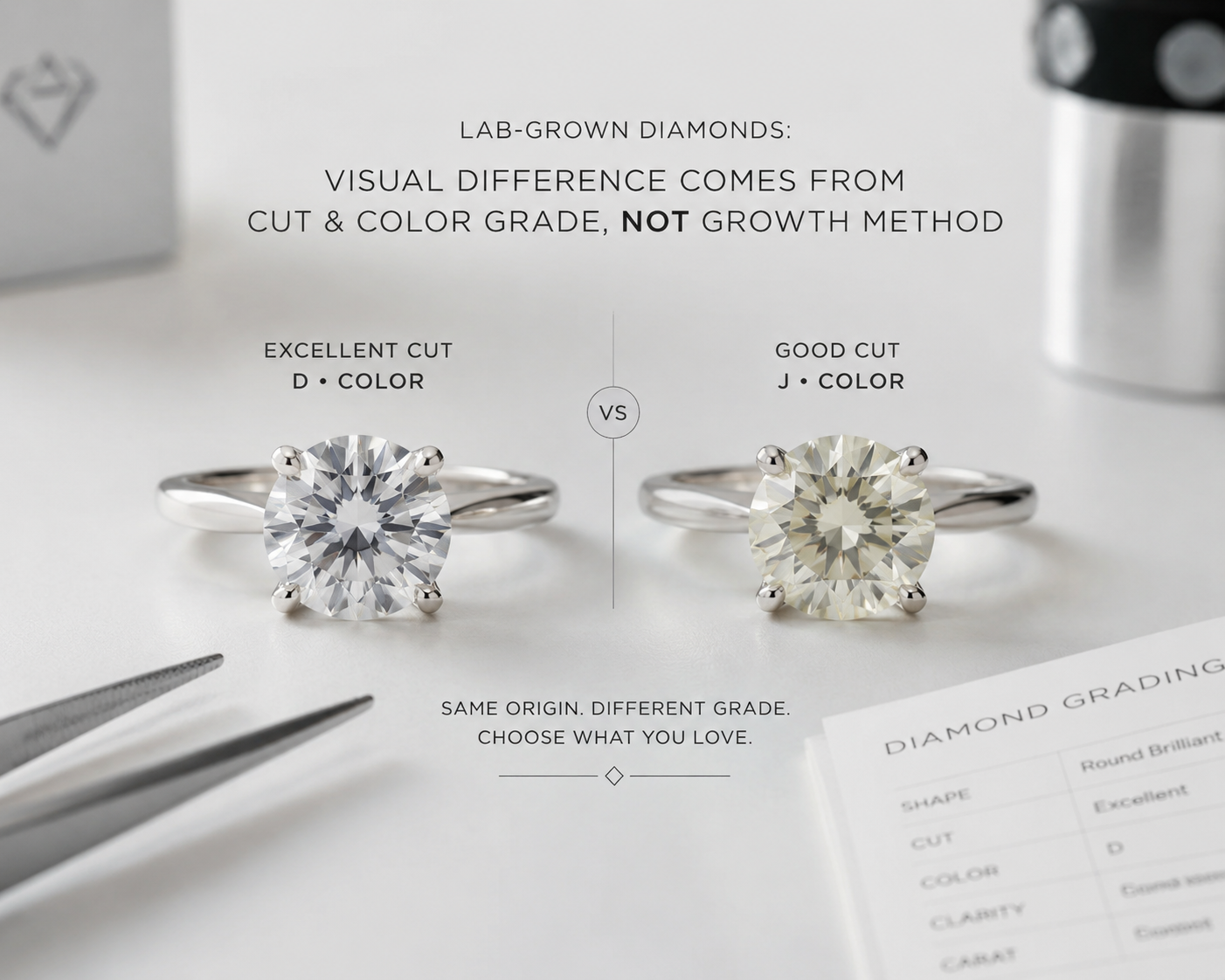
This does not mean all lab-grown diamonds look the same. It means the differences you can actually see come from factors that show up on the grading report and in the stone’s face-up appearance, not from the production method itself.
Laboratory-grown diamonds should be clearly identified as laboratory-grown, and they should not be presented as mined diamonds. Both HPHT and CVD produce genuine diamond material with the same chemical composition and crystal structure as natural diamonds, but the origin is different. Grading reports from reputable laboratories will clearly disclose whether a diamond is laboratory-grown and which growth method was used. This transparency helps buyers understand what they are purchasing, but it does not indicate any difference in how the finished stone performs in an engagement ring.
What Determines a Diamond’s Visual Performance
Brilliance, fire, and scintillation—the three components of a diamond’s visual performance—are the result of cut craftsmanship, not growth technology. A well-cut CVD diamond and a well-cut HPHT diamond of identical shape, proportions, and color grade will look indistinguishable to the naked eye. Light performance comes down to geometry: how the facets are angled, how precisely they are aligned, and how well the stone has been polished. None of this is determined by how the crystal was grown.
This is worth stating directly: the growth environment does not create a “signature” look. There is no HPHT sparkle pattern or CVD tint. The optical properties of a diamond are defined by its crystal structure, and that structure is the same regardless of which growth method produced it. What creates visible differences between stones is how well the cutter executed the design, not what equipment the grower used.
Why No One Can “See” the Growth Method in a Set Ring
Once a diamond is mounted in an engagement ring, there is no visual characteristic that reveals its origin. No tint, no internal pattern, no way of reflecting light that would tell a wearer—or anyone looking at the ring—whether the stone was HPHT or CVD. The only way to know is through documentation or advanced laboratory testing. Neither of these has any relevance to wearing and enjoying the ring in daily life.
This should come as a relief to buyers who feel pressured to pick the “right” growth method. If you choose a well-cut, high-quality stone from either method, you are not sacrificing visible beauty. The growth method is a production detail, recorded on the certificate, not a factor that changes how the ring looks on the finger.
GIA notes that lab-grown diamonds are chemically and optically the same as natural diamonds, and that specialized equipment is required to distinguish them.[1] This same principle applies to distinguishing between HPHT and CVD stones: the differences exist at the production and atomic level, not in the face-up appearance that an engagement ring wearer would ever observe.
When Appearance Differences Do Exist (and Why Growth Method Isn’t the Cause)
Buyers sometimes see diamonds that look different from each other and assume the difference must relate to how they were grown. Some stones appear slightly warmer; others face up whiter. Some seem brighter; others look a bit flat. These differences are real, but they trace back to the specific stone’s color grade, fluorescence, and cut quality—not to HPHT or CVD as categories.
A lower-color CVD diamond and a lower-color HPHT diamond will both show warmth. A high-color, well-cut stone from either method will appear bright and white. A poorly cut diamond from either method will look dull. The growth method does not override these factors. If you are comparing two stones and one looks better, the reason will be found in the cut grade, color, proportions, or fluorescence—not in the growth method line on the report.
In practical buying, this is where many comparisons become misleading. Two stones with identical grades on paper can still look different face-up because of subtle proportion variations that the report summarizes but does not fully capture. This is why reviewing actual stone media—photos, videos, or in-person viewing—matters more than parsing the growth method line.
When a grading report is available, buyers should verify the report details through the issuing laboratory’s official report-check tool where available. This confirms that the document matches the laboratory’s records and that the stone’s reported characteristics are accurately documented. Report verification is a straightforward step that takes only a few minutes and adds a layer of confidence that the paperwork aligns with the issuing lab’s database.
What to Prioritize When Comparing Stones Visually
When you are evaluating diamonds for an engagement ring, focus on what you can actually see and verify. Look at the stone’s face-up appearance under different lighting conditions. Ask for 360-degree video or multiple still photos showing the diamond from various angles. Check the certificate for cut grade and proportions. Compare stones of similar grade to each other, regardless of whether they are HPHT or CVD.
The growth method should be treated as a documentation detail, not a visual filter. If a stone looks beautiful and has strong grades, it is a strong candidate. The growth method line on the report is not the reason it looks that way.
Where HPHT and CVD Actually Differ (Before Cutting)
Understanding what HPHT and CVD mean can help demystify the terminology you will see on grading reports. But it is important to frame this knowledge correctly: these are manufacturing distinctions that matter to producers, not decision criteria that should guide your engagement ring purchase.
How HPHT and CVD Work: A Brief Manufacturing Distinction
HPHT stands for High Pressure High Temperature. This method mimics the natural environment in which diamonds form deep within the earth. A carbon source is subjected to extreme pressure and heat in the presence of metal catalysts, causing diamond crystals to grow. CVD, or Chemical Vapor Deposition, takes a different approach: it builds diamond layer by layer inside a plasma chamber, where carbon-rich gas breaks down and deposits onto a substrate.
Both methods produce genuine diamond material with the same chemical composition and crystal structure as natural diamonds.[2] The processes differ in approach, not in the quality of the outcome. A well-executed growth from either method can yield a diamond that achieves excellent grades across the 4Cs.
It is important to understand that HPHT and CVD are growth methods, not treatments. When discussing how a lab-grown diamond was created, these terms describe the production process. If post-growth treatments are applied to modify color or other characteristics, those treatments should be disclosed separately on the grading report. The presence of a growth method notation on a certificate does not indicate treatment—it simply documents how the diamond was created.
Why These Differences Matter to Producers, Not Wearers
Manufacturers choose between HPHT and CVD based on production efficiency, target stone sizes, desired color outcomes, equipment availability, and cost structures. These are supply-chain considerations. For the person wearing the ring, the relevant outcomes—the stone’s cut, color, clarity, carat weight, measurements, and fluorescence—are already captured in the grading report. The “how it was made” question has already been answered by the “what it is” results.
This is why spending significant time weighing HPHT versus CVD is usually a misallocation of effort for an engagement ring buyer. The factors that will affect your daily experience of the ring are visible and documented. The production method is background information.
How Grading Reports Document Growth Method (and When to Care)
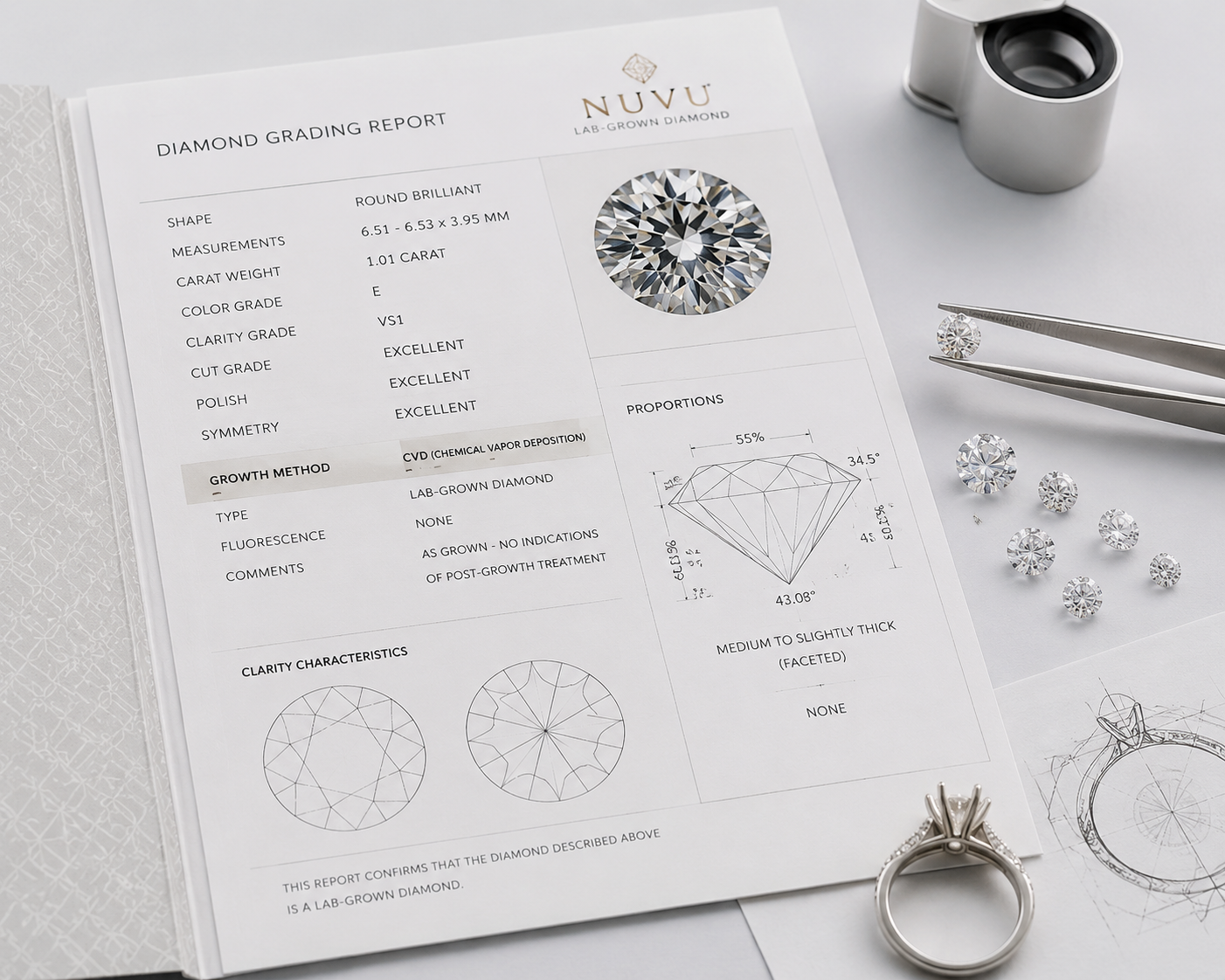
Major grading laboratories such as IGI and GIA note the growth method on their reports. This is useful for transparency and record-keeping. It allows buyers to verify that the stone they receive matches what was described, and it provides documentation for insurance or resale purposes. If you have a strong personal preference for one method or want to confirm consistency with a seller’s claim, the report is where you check.
However, the growth method line does not predict performance, durability, or appearance. It is not a quality grade. It does not override the 4Cs or provide additional insight into how the stone will look in a ring.
A grading report helps narrow the shortlist, but it does not replace visual review. The report documents what the stone measures and how it was graded under controlled conditions. How it performs in your chosen setting, under the lighting you actually live in, still depends on cut execution and proportions—details that the report summarizes but cannot fully convey.
The grading report serves as an independent, third-party assessment of the stone’s characteristics. Its value lies in standardization: a GIA or IGI report means the diamond was evaluated against consistent criteria by graders who follow established protocols. This allows meaningful comparison across stones and sellers. However, a report is a snapshot under controlled lab conditions. It cannot show you how the diamond will look in your kitchen, your office, or your evening restaurant—environments where engagement rings are actually worn. For that, visual review remains essential.
A grading report helps document key characteristics, but it should not be treated as a guarantee of beauty, value, or sourcing ethics. The report tells you what the stone measures and how it was graded. It does not tell you whether the stone will appeal to your personal taste, whether it will look right in your chosen setting, or whether the price is fair compared to other options. Those judgments require comparing stones visually, reviewing seller documentation, and evaluating the total purchase context.
When to Check the Growth Method on Your Certificate
There is one practical situation where the growth method line matters: verification. If a seller specifically told you the stone is “HPHT” or “CVD” as part of their pitch, check the report to confirm it matches. This is basic due diligence. If the seller emphasized one method over the other but cannot provide documentation, or if the report contradicts their claim, that is a transparency issue worth addressing.
Otherwise, treat the growth method as informational. It does not deserve the same weight as cut grade, color, clarity, or carat weight in your decision process.
Cut Quality: The Real Driver of Engagement Ring Beauty
If there is one factor that deserves your attention when choosing a lab-grown diamond for an engagement ring, it is cut quality. Cut is the single most important variable affecting how brilliant, lively, and visually impressive a diamond appears. And unlike growth method, cut quality has no connection to whether the stone was grown via HPHT or CVD.
Why Cut Grade Outweighs Growth Method for Visual Impact
Cut determines how effectively a diamond returns light to the eye. A poorly cut stone will look dull and lifeless regardless of how it was grown. A beautifully cut stone will look brilliant and dynamic regardless of whether it came from an HPHT press or a CVD reactor. Cut is the “C” that directly governs aesthetics for engagement rings, and it should be your primary filter when comparing stones.
This is not a subtle distinction. The difference between an Excellent cut and a Good cut is immediately visible to most observers. The difference between HPHT and CVD, as explained in HPHT and CVD processing, is not visible at all once the stone is set. When you allocate your attention and your budget, prioritize cut. A higher cut grade will do more for your ring’s appearance than any choice about growth method.
Shape-Specific Cut Considerations for Engagement Rings
The importance of cut evaluation varies by shape. Round brilliant diamonds have standardized cut grades from major labs, making it relatively straightforward to identify top-performing stones. Fancy shapes—oval, cushion, emerald, pear, radiant, marquise, princess—do not have universally standardized cut grades. This requires more buyer judgment.
For engagement rings, proportions matter significantly. Table percentage, depth percentage, length-to-width ratio, polish, and symmetry all affect how the stone performs. These factors interact with your choice of setting style: a shallow cushion may look different in a halo than a deeper stone; an elongated oval may suit some ring designs better than a rounder proportion. These are the decisions that affect how your ring looks on the hand. Growth method does not enter this equation.
For custom design, the stone cannot be evaluated separately from the setting. A diamond with slightly deep proportions may perform well in a low-profile bezel but look bulky in a solitaire prong setting. These interactions between cut, shape, and mounting are where the real visual outcome is decided—and they have nothing to do with whether the rough was grown by HPHT or CVD.
For custom jewelry, stone measurements and setting compatibility should be confirmed before finalizing a purchase. A stone that looks beautiful on its own may not work well with a specific setting design. The diameter, depth, and girdle thickness all affect how the stone sits in the mounting. Working with a jeweler who can verify these measurements against your chosen setting helps avoid surprises when the ring is completed.
How to Evaluate Cut When Growth Method Isn’t the Question
For round brilliants, rely on the cut grade from a reputable laboratory. Prioritize Excellent or Very Good cut grades. These designations reflect real performance differences that you will see in daily wear. For fancy shapes, go beyond the certificate. Review the proportions, look at actual photos or videos of the stone, and pay attention to length-to-width ratio and overall symmetry.
Ask the seller for light performance images if available—ASET maps, IdealScope images, or 360-degree videos that show how the stone handles light. These tools reveal far more about how your ring will look than any information about growth method. At NUVU, we encourage buyers to compare stones visually and by cut metrics, not by production origin, because that is what actually drives satisfaction.
Buyer Verification Checklist for Cut Quality
- Confirm the cut grade on the report. For rounds, this is straightforward. For fancy shapes, check polish and symmetry grades.
- Review proportions for the specific shape. Table and depth percentages, length-to-width ratio, and girdle thickness all matter.
- Request photos or video showing the stone face-up and tilted. Look for even brightness, attractive sparkle pattern, and absence of obvious dark areas.
- Compare multiple stones of similar grade before deciding. Even within the same grade category, individual stones can look different.
- Ask about light performance images if available. These provide additional insight into how the stone handles light.
Notice what is not on this list: growth method. It does not belong there because it does not influence visual assessment. Cut quality is what you should verify. Growth method is what you note on the paperwork and then ignore.
Setting Style, Durability, and Long-Term Wear
For engagement ring buyers, durability questions are practical and immediate. This ring will be worn daily, exposed to bumps, scraped against surfaces, and subjected to temperature changes. A natural concern is whether the diamond’s origin—HPHT versus CVD—affects how it holds up over time. The short answer: it does not. Both methods produce genuine diamond material with identical physical properties. What actually affects longevity is the quality of the setting work, the choice of metal, the diamond’s shape, and how well the ring is maintained.
Are HPHT and CVD Diamonds Equally Durable for Daily Wear?
Yes. HPHT and CVD diamonds are not “different types” of diamond in any way that affects hardness or durability. Both are chemically and physically diamond—carbon atoms arranged in the same crystal structure. Both rank 10 on the Mohs hardness scale, meaning both resist scratching from any material except another diamond. Both withstand the same range of temperatures, both resist the same chemicals, and both respond to impact in the same way.
Engagement rings face real-world wear: knocks against doorframes, contact with hard surfaces, exposure to soaps, lotions, and cleaning products. None of these factors interact with growth method. A diamond grown under high pressure in an HPHT press and a diamond grown layer by layer in a CVD reactor will perform identically in these conditions. If either stone chips, scratches, or suffers damage, the cause will be physical trauma that would have affected any diamond—not a weakness traceable to how it was grown.
Durability is a material property, not a manufacturing variable. The growth process ends before the diamond is cut and polished. Once the rough stone enters the cutting pipeline, its origin becomes a historical fact, not an active influence on how it wears in a ring.
How Setting Choice Protects Your Diamond (Regardless of Growth Method)
Setting style has a far greater impact on diamond safety than growth method ever could. The way a stone is held in the ring determines how vulnerable it is to chipping, loosening, or loss. These are design and craftsmanship decisions—entirely independent of whether the diamond is HPHT or CVD.
A bezel setting, which surrounds the diamond’s girdle with a continuous metal rim, offers the most edge protection. This is a strong choice for active wearers or for diamond shapes with pointed corners, such as princess or marquise cuts, which are more susceptible to corner chips. A prong setting, which lifts the diamond and exposes more of its surface, maximizes light return and visual impact but leaves the girdle and corners more exposed. A halo setting adds a ring of smaller diamonds around the center stone, which can provide some buffer against direct impacts. A three-stone setting distributes visual weight across multiple stones but requires secure prong or bezel work for each diamond.
The vulnerability of any diamond depends on its shape and how securely it is set. A princess-cut diamond with thin, pointed corners is more chip-prone than a round brilliant with a continuous girdle—regardless of growth method. A bezel-set stone is better protected than a prong-set stone—regardless of growth method. These are the factors that actually influence how a ring wears over time.
When a jeweler recommends a setting style, the recommendation should be based on the diamond’s shape, the wearer’s lifestyle, and aesthetic preferences—not on whether the stone was grown via HPHT or CVD. No competent jeweler adjusts setting recommendations based on growth method because there is no need.
What Long-Term Ownership Actually Depends On
Engagement rings are often described as “forever” pieces, and many are passed down through generations. Whether a ring lasts decades or shows premature wear depends on factors that have nothing to do with the diamond’s growth origin.
The first is the quality of the setting work. A well-executed setting holds the diamond securely, with prongs or bezels shaped correctly and metal thickness appropriate for the stone size. Poor workmanship—thin prongs, uneven tension, incomplete seating—creates risk regardless of the diamond inside. The second is the choice of metal. Platinum is denser and more durable than gold, though it develops a patina over time. Gold alloys vary in hardness depending on karat and composition. These choices affect how the ring itself wears, which indirectly affects the diamond’s security.
The third factor is maintenance. Prongs wear down over time, especially in rings worn daily. Bezel edges can thin. Regular inspections—ideally once a year—catch these issues before they lead to stone loss. Insurance coverage matters for catastrophic loss or damage. None of these factors connect to growth method.
A well-made ring with a securely set, well-cut diamond will last for generations. The growth method recorded on the grading report will remain a historical detail, not a factor in how the ring performs on the finger.
What to Ask Your Jeweler About Setting and Longevity
The right questions yield actionable information. Focus on craftsmanship, materials, and maintenance:
- How is the stone secured? Ask about prong count, prong thickness, and whether the setting style is appropriate for the diamond shape.
- What metal is recommended for this style? Understand the tradeoffs between platinum, white gold, yellow gold, and rose gold in terms of durability, maintenance, and cost.
- What maintenance does this ring require? Clarify how often prongs should be checked, whether the ring needs rhodium plating (for white gold), and what signs of wear to watch for.
- Is the workmanship guaranteed? Understand the jeweler’s policy on repairs, resizing, and setting issues that may arise after purchase.
- What happens if a stone loosens or chips? Know whether the jeweler offers service, what insurance covers, and how claims would be handled.
Asking about growth method in this context would not yield useful information. The jeweler can confirm what the certificate states, but that confirmation does not change any practical aspect of how the ring should be worn, maintained, or protected.
Before purchase, buyers should confirm the seller’s documentation, return policy, resizing terms, and after-sales support in writing. These practical details affect the ownership experience far more than the growth method listed on the grading report.
Price, Value, and the Growth Method Question
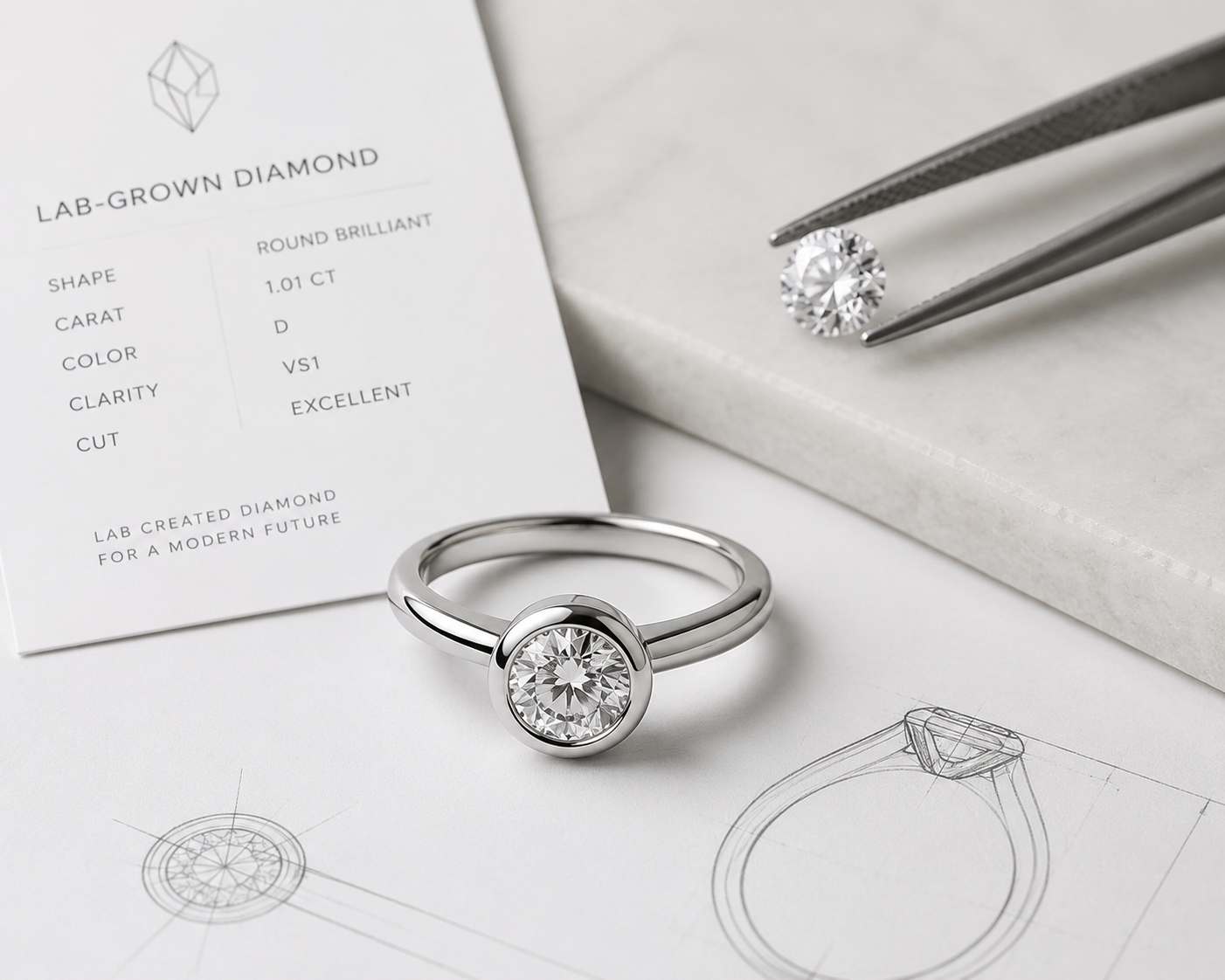
Price is where many buyers expect growth method to matter. The assumption is logical: if two production methods exist, one might be more expensive to produce, more scarce, or higher quality—and that difference should show up in the price tag. In practice, the relationship between growth method and price is far weaker than most buyers assume. Pricing for lab-grown diamonds is driven by factors that affect the finished stone’s market appeal, not the technology used to grow it.
Do HPHT or CVD Diamonds Cost More?
There is no consistent “HPHT premium” or “CVD discount.” Price differences between stones of comparable grade are far more likely to reflect carat weight, cut quality, color, clarity, shape, and the seller’s pricing strategy than growth method.
A buyer comparing two 1.5-carat round brilliants with Excellent cut, F color, and VS1 clarity—one HPHT, one CVD—will typically find that any price difference reflects the seller’s inventory positioning, certification lab, or promotional pricing, not a systematic premium for one growth method. The same applies across shapes and sizes. A 2-carat oval with strong proportions and a clean certificate will be priced based on those attributes and current market supply, not on whether it emerged from an HPHT press or a CVD reactor.
Market supply does fluctuate. If a particular size or color grade becomes more abundant from one production method, prices in that segment may shift slightly. But this is a supply-chain effect, not a quality distinction. The buyer comparing individual stones should focus on the stone’s attributes and price relative to comparable options—not on growth method as a proxy for value.
Prices can change with market conditions, report type, seller channel, and stone-specific details, so exact comparisons should be verified at the time of purchase. A price observed today may not reflect current availability or market shifts. Buyers should compare like-for-like specifications—carat, cut, color, clarity, shape, and certification—before determining whether one stone represents better value than another.
Where Real Value Differences Come From
Value in a lab-grown diamond engagement ring comes from factors that directly affect the buyer’s experience: the stone’s visual appeal, the setting’s suitability for the wearer, the fairness of the price relative to market comparisons, and the reliability of the seller.
A diamond with strong cut quality and appealing proportions will look better than a diamond with weak cut, even if both share the same certificate grades on paper. A setting that matches the wearer’s lifestyle—secure enough for daily wear, comfortable on the hand, appropriate for the diamond shape—adds practical value that a lower price cannot compensate for. A fair price is one that aligns with what comparable stones sell for across reputable sellers, not one that is simply the lowest number available. And a seller who provides clear documentation, responsive service, and reliable policies delivers value that a discount seller may not.
None of these factors depend on growth method. A buyer who filters search results by HPHT or CVD may inadvertently exclude stones that offer better visual performance or better value simply because the filter prioritizes a production detail over what actually matters.
When Growth Method Might Influence Price (and Why It’s Rarely the Reason)
Edge cases exist. Certain color grades or large carat weights may be more commonly produced by one method, and supply conditions in those segments can affect pricing. For example, if the market sees a surge of CVD production in a specific size range, prices in that range may soften relative to HPHT stones in the same category—not because CVD stones are inferior, but because supply increased.
Similarly, some buyers may encounter sellers who market one growth method as “premium” and price those stones higher. This is a marketing decision, not a reflection of inherent quality. If a seller cannot point to a documented difference in cut, color, clarity, or visual performance that justifies the price gap, the premium is not based on factors that affect how the ring looks or wears.
The practical guidance is simple: compare stones on their merits. If two stones have identical grades and similar visual appeal, the lower-priced option represents better value—regardless of growth method. If a seller claims one method commands a premium, ask what tangible benefit that premium buys. If the answer is vague or relies on technical claims that do not translate to visible or measurable differences, the premium is marketing, not value.
How to Compare Value Across Stones Without Filtering by Growth Method
The most effective value comparison ignores growth method entirely and focuses on attributes that affect the finished ring:
- Compare stones of similar grade across multiple sellers. Look at diamonds with comparable carat weight, cut, color, clarity, and shape. Note the price range and where each stone falls within it.
- Check that certificates come from reputable labs. IGI and GIA are the most common for lab-grown diamonds. A certificate from a recognized lab provides a baseline for comparison.
- Evaluate total cost, including setting and customization. The diamond price is one component. A seller with a higher diamond price may offer better value if the setting quality, customization options, or service policies are stronger.
- Prioritize visual appeal over production details. Request photos, videos, or 360-degree views. A stone that looks better face-up is worth more than a stone with identical grades that looks dull or unbalanced.
- Treat growth method as informational, not evaluative. The growth method line on the certificate confirms origin. It does not predict performance, durability, or value.
A lower price for a CVD stone or an HPHT stone does not indicate better or worse value on its own. Value is the relationship between what you pay and what you receive. What you receive is a diamond with specific visual characteristics, set in a specific ring, purchased from a specific seller. Growth method is one line on a document—not a factor in that equation.
For wholesale buyers, consistency often matters as much as the headline price. A supplier whose stones grade reliably and whose documentation is complete reduces the risk of surprises at the bench. This kind of consistency depends on the grower’s process control and the cutter’s standards, not on whether the method is HPHT or CVD. Buyers sourcing multiple stones for inventory or custom orders should evaluate suppliers on documentation quality and grading predictability, not on growth method alone.
Clarifying Persistent Myths About HPHT and CVD
Buyers researching lab-grown diamonds often encounter conflicting claims about HPHT and CVD. Some sources present one method as superior. Others introduce technical terminology that sounds important but does not translate to practical differences. These myths can create unnecessary anxiety or lead buyers to filter their choices based on irrelevant criteria. Clearing up the most common misconceptions helps focus the decision on what actually matters.
Myth: One Method Produces “Better” Diamonds
This is the most persistent and misleading claim. Neither HPHT nor CVD produces inherently “better” diamonds. Both methods produce genuine diamond material capable of achieving the full range of color, clarity, and cut grades. Both can yield exceptional stones. Both can yield stones with visible inclusions or lower color grades. The method does not determine quality; the individual stone’s characteristics do.
A well-cut, high-color, clean HPHT diamond and a well-cut, high-color, clean CVD diamond will look identical to the eye and identical under standard magnification. A poorly cut, low-color, included HPHT diamond and, HPHT vs CVD methods, a poorly cut, low-color, included CVD diamond will both look inferior—again, for reasons unrelated to how they were grown.
The grading report documents the stone’s quality. The growth method line is a production detail, not a quality indicator. If a seller claims one method is universally better, the claim should be met with skepticism. Ask what specific, documented quality difference justifies that position. If the answer cannot point to cut, color, clarity, or visual performance, the claim is marketing, not substance.
Myth: CVD Diamonds Are Always “Type IIa” and Therefore Superior
This myth combines a partial truth with a misleading conclusion. CVD diamonds are typically Type IIa, a classification that refers to crystal purity—specifically, the absence of nitrogen impurities in the crystal lattice. Type IIa diamonds, whether natural or lab-grown, are chemically very pure. This sounds impressive and is sometimes presented as a quality advantage.
For engagement ring buyers, Type IIa status does not translate to visible superiority. The color grade on the certificate already captures what matters: how white or colorless the stone appears. A Type IIa diamond with a G color grade and a non-Type IIa diamond with a G color grade will both appear similarly white to the eye. The technical purity classification does not override the practical color grade.
Moreover, many HPHT diamonds also achieve exceptional optical properties and high color grades. The idea that CVD holds an inherent advantage because of Type IIa status is a technical truth that does not matter for the buyer looking at a finished, graded, mounted diamond. The certificate’s color and clarity grades are what the buyer should evaluate—not the crystallographic classification that underlies them.
It is also worth noting that Type IIa classification is not exclusive to CVD diamonds. Some HPHT-grown diamonds also achieve Type IIa status, and some of the world’s most famous natural diamonds—including the Cullinan and Koh-i-Noor—are Type IIa. The classification speaks to chemical purity, but it does not predict how a specific diamond will perform visually or guarantee a higher grade on any of the 4Cs.
Myth: Growth Method Affects Resale or Trade-In Value
Lab-grown diamonds have different resale dynamics than natural diamonds, and buyers should understand this before purchase. However, the growth method is not a factor in those dynamics. What affects future trade-in or resale potential is the overall market for lab-grown diamonds, the stone’s quality, the documentation available, and the specific jeweler’s policies—not whether the stone is HPHT or CVD.
Some jewelers offer trade-in programs for lab-grown diamonds. These programs typically evaluate the stone based on current market prices for comparable lab-grown diamonds, the condition of the stone and setting, and whether the buyer is upgrading to a larger purchase. The growth method recorded on the certificate does not enter the calculation.
Buyers should approach lab-grown diamond purchases with realistic expectations about resale. Lab-grown diamonds are produced at scale, and prices have declined over time as production capacity has expanded. This trend affects all lab-grown diamonds, regardless of growth method. If a buyer purchases a lab-grown diamond engagement ring, the primary value should be in wearing and enjoying it—not in expecting it to function as a financial investment. The growth method is irrelevant to this reality.
Questions to Ask If a Seller Emphasizes One Growth Method Over Another
A seller who pushes one growth method as superior deserves scrutiny. The following questions help separate genuine guidance from marketing:
- Why are you highlighting growth method? Ask directly what advantage the seller is claiming and whether that advantage is documented on the grading report.
- Are the stones being compared identical in cut, color, clarity, and carat weight? If a seller is comparing an HPHT stone to a CVD stone with different grades, the comparison is meaningless. The growth method is not the variable that explains any price or appearance difference.
- What tangible quality difference does the growth method create? If the answer references visible characteristics, check the certificate. If the answer references technical claims that do not appear on the report or affect face-up appearance, the claim is not actionable.
- Is the price difference justified by documented quality? If one stone costs more and the seller attributes the premium to growth method, ask whether the higher price reflects cut, color, clarity, certification, or inventory positioning—factors that actually affect value.
If a seller cannot point to a documented, measurable distinction that affects the stone’s appearance, durability, or certification, the growth method emphasis is likely a marketing angle. Buyers can safely treat it as such and refocus on what the certificate and visual inspection actually reveal.
When Growth Method Might Genuinely Matter to You
For most engagement ring buyers, growth method is a secondary detail—worth knowing, but not worth prioritizing over cut, appearance, or certification. However, some buyers have personal reasons to care about whether their diamond was grown via HPHT or CVD. Those reasons are valid, but they belong in a different category than performance or durability.
Personal Preference and Informed Choice
Some buyers simply feel more comfortable with one growth method over the other. This might come from research, from conversations with trusted sources, or from a sense that one process aligns better with their values or expectations. There is nothing wrong with this kind of preference. It resembles choosing one brand over another for reasons that have little to do with objective performance—comfort, familiarity, or personal meaning.
What matters is understanding the nature of that preference. If a buyer chooses HPHT because they like the idea of a process that mimics natural diamond formation, or CVD because they prefer a newer technology approach, that is a personal choice. It does not mean the stone will look better, last longer, or perform differently. The preference is about the story behind the diamond, not the diamond itself.
Buyers should feel free to act on personal preference, but they should also recognize when that preference is being treated as a quality factor. If a seller suggests that one method is objectively superior, the buyer should ask for specific, verifiable differences. If none exist beyond preference, the choice remains personal—not a determinant of value.
Transparency and Supply-Chain Documentation
Some buyers value growth method information as part of a broader interest in transparency. Knowing whether a diamond was grown via HPHT or CVD can feel like one more piece of the puzzle—similar to wanting to know the country where the stone was cut, the grading lab that issued the report, or the seller’s sourcing practices.
This kind of transparency is worth pursuing. A seller who provides clear, consistent documentation about growth method, certification, and origin is demonstrating a commitment to openness that benefits the buyer. At NUVU, we treat growth method as part of the standard information we provide because we believe buyers should have access to complete documentation, not because the method changes the stone’s performance.
However, transparency about growth method does not translate to visible or functional differences. A buyer who knows their diamond is CVD rather than HPHT has more information, but that information does not alter how the ring looks on the finger, how it wears over time, or how it is perceived by others. Transparency is valuable for trust and record-keeping, not for predicting beauty or durability.
Environmental and sustainability claims around lab-grown diamonds should be specific, documented, and limited to what can be substantiated. Neither HPHT nor CVD is automatically the more sustainable choice—energy consumption, production practices, and facility standards vary by manufacturer, not by method category. Buyers who prioritize environmental considerations should ask sellers for specific sourcing information rather than relying on growth method as a proxy for sustainability.
For buyers who want to understand the full picture, asking a seller about their documentation practices can be revealing. A transparent seller should be able to provide the grading report, confirm the growth method, and answer questions about the stone’s characteristics without hesitation. If a seller cannot or will not provide basic documentation, that lack of transparency is a separate concern from the growth method itself—and may be more relevant to the buying decision than whether the stone is HPHT or CVD.
When You’re Told “This Is an HPHT/CVD Stone” as a Selling Point
Sellers sometimes emphasize growth method in their marketing. A listing might highlight that a diamond is “CVD-grown” or “HPHT-created” as if this distinction carries inherent value. In most cases, this is simply informational framing—a way to differentiate inventory in a crowded market.
Buyers should treat growth-method marketing with healthy skepticism. If a seller presents growth method as a primary reason to choose one stone over another, ask what tangible benefit it provides. Does the HPHT or CVD label correlate with better cut? Higher clarity? Superior light performance? A more attractive price? If the answer is vague—phrases like “it’s just better” or “this method is more advanced”—the growth method is being used as a marketing angle, not a meaningful differentiator.
The real question is whether the stone itself meets the buyer’s standards. A well-cut, fairly priced, properly certified diamond from either growth method is a strong candidate. A stone that is marketed primarily on its growth method, without clear advantages in cut, appearance, or value, may be deflecting attention from more important factors.
How to Confirm Growth Method Matches Seller Claims
If a seller claims a diamond is HPHT or CVD, the grading report is the verification document. Major labs like IGI and GIA list the growth method on the certificate.[3] If the report matches the seller’s claim, the information is consistent. If the seller emphasizes growth method but cannot provide documentation, or if the documentation does not match the claim, that is a transparency issue—separate from the growth method itself.
For buyers who care about growth method as a personal preference or documentation detail, this verification step takes only a moment. For buyers who are indifferent to growth method, the same check still serves as a useful test of seller accuracy. A seller who misrepresents growth method may be careless or misleading in other areas as well.
Conclusion: What Actually Matters for Your Engagement Ring Decision
After examining growth method from multiple angles—appearance, cut, durability, price, and transparency—the conclusion is straightforward. HPHT and CVD are different ways to create the same material. Once a lab-grown diamond is cut, certified, and set into an engagement ring, the growth method does not determine how the ring looks, performs, or wears. The factors that matter are the ones buyers can see, verify, and evaluate directly.
The Decision Framework: Cut First, Documentation Second, Growth Method Optional
For engagement ring buyers, the priority order is clear. Cut quality and visual performance come first. A diamond that is cut well will return light beautifully regardless of how it was grown. Certification from a reputable lab comes second. The grading report confirms the stone’s grades, proportions, and characteristics, giving the buyer a reliable basis for comparison. Setting choice comes third. The ring should suit the wearer’s style, protect the stone appropriately, and be built to last.
Price fairness matters, but it should be evaluated against comparable stones—not based on growth method. A lower price for a CVD stone is not automatically a better value if the cut is inferior. A higher price for an HPHT stone is not automatically justified by the method alone. Compare stones on their documented merits, not on assumptions about production origin.
Growth method belongs in the optional category. It is worth knowing for completeness, and it matters to some buyers as a personal preference or transparency point. But it should not drive the decision. A beautiful, well-cut, properly certified diamond from either method is a strong choice. A poorly cut or overpriced diamond is a weak choice, regardless of how it was grown.
Why Most Engagement Ring Buyers Can Safely Ignore the HPHT vs CVD Debate
The HPHT versus CVD conversation has been amplified by marketing, online forums, and seller differentiation strategies. For buyers in the middle of an engagement ring search, this debate can feel like one more thing to worry about—another technical distinction that might make or break the decision.
In reality, the debate is largely irrelevant to the outcome that matters. Once the ring is on the finger, no one will be able to tell how the diamond was grown. The stone will sparkle because of its cut, not its origin. It will withstand daily wear because it is diamond, not because of the reactor or press that created it. It will be insured, maintained, and enjoyed based on its documented characteristics and the quality of the setting—not the production method listed on a certificate.
Buyers who spend hours researching HPHT versus CVD are often looking for a clear answer that does not exist. There is no winner. There is no hidden quality gap. There is only the individual stone in front of them, with its specific cut, color, clarity, carat weight, and price. Those are the factors that determine whether the ring is a good choice. Growth method is background information—useful for transparency, but not decisive for the purchase.
Your Next Steps: Choosing with Confidence
The best way to move forward is to focus on what you can see and verify. Compare stones based on visual performance. Look at face-up appearance under different lighting conditions. Request 360-degree video or multiple high-quality photos. Check the certificate for cut grade, proportions, and fluorescence. For fancy shapes, review length-to-width ratio and polish ratings. Ask the seller for light performance images if available—tools like ASET or IdealScope can reveal how effectively a diamond returns light.
Choose a setting that protects the stone and suits the wearer’s lifestyle. A bezel setting offers more edge protection for active wearers. A prong setting showcases more of the diamond but requires occasional maintenance. Consider metal durability, ring size, and daily wear patterns. The setting is the foundation for long-term satisfaction, and it has nothing to do with growth method.
Work with a seller who provides clear documentation, responsive communication, and transparent information. At NUVU, we provide full certification, 360-degree viewing, and complete growth method documentation for every stone—not because the method determines quality, but because buyers deserve to know what they are purchasing. A seller who is forthcoming with information is easier to trust, and trust matters far more than production technology.
When the decision comes down to two stones of similar cut, color, clarity, and price, and one is HPHT while the other is CVD, choose the one that looks better to you. Choose the one that fits your budget and your design vision. Choose the one that comes from a seller you trust. The growth method line on the report will still be there, but it will not be the reason you love the ring.
[1] GIA, “Lab-Grown Diamonds,” Gemological Institute of America, accessed 2025.
[2] GIA, “How Lab-Grown Diamonds Are Made: HPHT and CVD,” Gemological Institute of America, accessed 2025.
[3] IGI, “Laboratory Grown Diamond Reports,” International Gemological Institute, accessed 2025.
Disclosure: This article is for general educational purposes only. Diamond grading, pricing, availability, specifications, and seller policies can change, and readers should verify important details through grading reports, official laboratory tools, seller documentation, or qualified professionals before making a purchase decision. Laboratory-grown diamonds should be clearly distinguished from natural diamonds, and environmental or sourcing claims should be supported by specific documentation.