
Lower China-linked lab-grown diamond quotes can look simple at first, but the real question is what sits behind the price. A lower number may come from factory access, scale, faster turnover, or fewer middle layers. It may also mean the quote leaves out grading reports, screening, shipping, matching work, after-sale help, or buyer protection. Understanding the supply chain matters because two stones with similar carat, color, and clarity can still differ in proportions, appearance, documentation, availability, and final landed cost.
For the full framework, read China Lab-Grown Diamond Supply Chain Guide.
This article helps you judge whether China-linked sourcing fits your buying situation. It explains when direct or supplier-led purchasing can improve cost control, selection, customization, or repeat inventory, and when a local retailer may be safer or easier. The practical goal is not to chase the cheapest offer, but to compare complete, verifiable quotes that match your timeline, quality expectations, and risk tolerance.
For buyers, the practical point is not just whether the number is low, but whether the stone, the report, and the seller’s process all line up well enough to trust the value being offered.
| Buying Factor | What to Check | Why It Changes Value |
|---|---|---|
| Headline price | Reports, shipping, duties, service, return terms | A low quote may exclude major costs or protections |
| Stone comparison | Measurements, proportions, photos or video, report number | Similar grades can look and price differently |
| Shape choice | Round precision, oval spread, emerald clarity visibility | Each shape needs different screening standards |
| Custom or matched orders | Pairing, batch consistency, exact specs, lead time | Tighter filtering usually increases cost |
| Sourcing route | Factory, supplier, wholesaler, or local retailer | Each layer adds different convenience, risk control, and service |
| Most suitable offer | At least three aligned quotes with full details | The clearest, most complete offer is often the better value |
Quick Questions Before You Read
Q: Are China-linked lab-grown diamonds cheaper because they are lower quality?
Not necessarily. Price can reflect supply-chain efficiency, but quality still depends on the exact stone, screening, report, and seller support.
Q: Is a grading report enough to compare two diamonds?
No. A report confirms key specs, but photos, video, measurements, proportions, and visual performance still matter.
Q: When does China-linked sourcing make the most sense?
It often suits buyers who want loose stones, custom specs, matched pairs, repeat supply, or more control over selection and margin.
Q: When is a local retailer the better choice?
A local retailer may be better for urgent timelines, finished rings, simple service, easy returns, and one clear point of contact.
How to read lab-grown, natural, and simulant wording in supplier quotes
Lab-grown diamonds and natural diamonds have different origins, so quotes should identify the stone clearly rather than using diamond language that blurs the source. A laboratory-grown diamond should be described as laboratory-grown or laboratory-created when that is the product being sold. It should not be presented as a mined diamond, and a diamond simulant such as cubic zirconia or moissanite should not be described as a lab-grown diamond.
That distinction matters in China-linked sourcing because some offers focus on price first and product description second. Buyers should confirm whether they are comparing a lab-grown diamond, a natural diamond, or a non-diamond lookalike, because the three categories do not belong in the same price or quality comparison. If the seller’s wording is vague, ask for a plain-language restatement before treating the quote as final.
A practical habit is to check whether the report or seller note identifies the origin category, the stone type, and any growth method or treatment disclosure that is relevant to the item. When growth method or post-growth treatment is relevant, buyers should look for clear disclosure in the grading report or seller documentation.
Why China-linked lab-grown diamond pricing should be read as a supply-chain question
The short answer is that China lab-grown diamond pricing is usually lower or higher because of the route a stone takes to market, not because “China” is a complete explanation on its own. A diamond that leaves a factory, passes through fewer intermediaries, and arrives with simpler packaging or less handholding will often quote differently from the same apparent stone sold through a full retail channel. The real pricing question is not just where it came from, but who handled it, what was added, and what the buyer is actually paying for.
That is why two quotes can look misleadingly similar at first glance. One may reflect closer access to production and a leaner distribution path. Another may include added screening, holding costs, branded presentation, service time, or a seller’s margin for taking on more risk. If the buyer only compares the headline number, the cheaper offer can look like better value even when it may simply be a thinner, less supported transaction.
For practical buying, the most useful distinction is between a lower price that comes from efficiency and a lower price that comes from missing support. A quote can be lean without being risky, but it should still state clearly what is included and what is not. If documentation, photos, or service steps are absent, the buyer should treat that absence as part of the cost comparison rather than as a minor detail.
The real question behind “why is it cheaper?”
When buyers ask why something is cheaper, they are usually asking whether the lower price reflects genuine efficiency or a hidden compromise. In this market, both are possible. China-linked sourcing can reduce cost because the supply chain may be shorter and more integrated, but a low quote can also mean the seller is giving up services, documentation, selection time, or consistency checks that another quote includes.
That is the useful mental model: price is not just attached to the stone. It is attached to the path the stone took. If a seller is closer to production, holds inventory differently, or moves volume faster, the price can change without any obvious difference in the stone itself. If a seller is farther from production and adds more service layers, the quote usually rises for reasons that are not always visible in the listing.
Why country labels do not explain the full quote
Country labels can be informative, but they are too blunt to explain value. A stone described as China-linked may have been produced, sorted, finished, traded, and resold through several hands before it reaches the buyer. Each hand can add cost for storage, selection, administration, presentation, and risk. By the time the stone is offered to a U.S. buyer, the final number may say more about the seller’s business model than the country where the stone first entered the chain.
For that reason, China lab-grown diamond pricing should be judged through a sourcing lens. Ask what the quote includes, how direct the route is, and whether the lower price is backed by clear documentation and a buyer-ready presentation. If those pieces are thin, the number may be cheap for a reason that matters.
What to Check Before You Decide
Before comparing offers, identify the basics that make two quotes truly comparable: who is selling, whether the stone is already in hand or still being sourced, what documents are included, and whether the price reflects a loose stone, a finished piece, or a reserved inventory item. A lower number is only meaningful if the path to that number is transparent enough for you to trust it.
Traceability starts with a simple chain of facts: the exact stone, the report or grading reference if available, the current visual evidence, and the seller’s explanation of how the stone is being supplied. This does not require a dramatic story about origin; it requires the information to stay consistent from the first quote to the final confirmation.
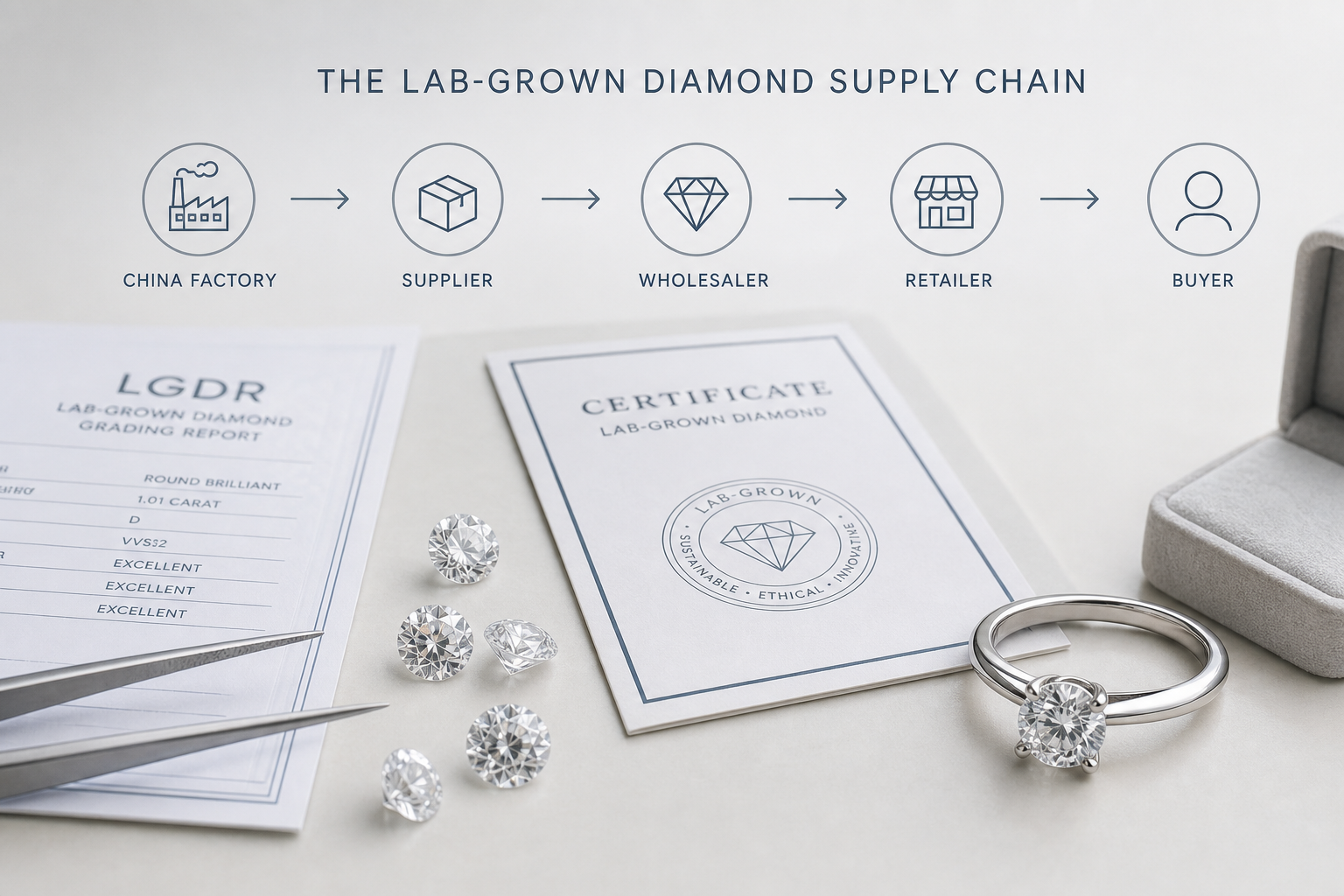
How China’s manufacturing base changes baseline cost and availability
China’s manufacturing base can affect China lab-grown diamond cost because scale changes the economics of production and movement. A larger, more specialized production environment can support deeper inventory, faster replenishment, and more stable access to common sizes and shapes. That does not make every stone cheaper by default, but it can lower the baseline cost before the diamond ever reaches a retailer or custom jeweler.
The important distinction is that lower baseline cost usually comes from structure, not from a simple quality shortcut. When growth, cutting, polishing, and inventory handling are concentrated in a stronger production ecosystem, some expenses are reduced by efficiency. The buyer benefits most when that efficiency shows up as a better quote without losing control over selection and documentation.
One limitation worth keeping in mind is that availability is not the same as suitability. A supplier may have many stones in stock, but not every stone will be a good match for the buyer’s shape, spread, visual preference, or setting plan. Read “available” as a sourcing advantage, not as proof that every stone in that pool is worth buying.
Scale, specialization, and integrated production
Scale matters because it changes what can be produced and held in inventory. In a more integrated environment, growers, cutters, and finishers can operate with tighter coordination, which helps reduce delays and repeated handling. Specialization also matters: when each stage is handled by teams focused on one part of the process, the work can become more efficient and more predictable.
That predictability is part of the value. It can improve availability for buyers who need multiple stones, consistent sizing, or repeated replenishment. For a jeweler or custom brand, that often matters more than chasing the lowest one-off quote. A stone that is easy to source again has practical value beyond its headline number.
Rough production, cutting, and finishing as linked cost stages
Lab-grown diamonds are not priced as one clean event. They move through stages, and each stage affects the final number. Rough production establishes the base material, cutting converts it into a sellable shape, and finishing determines how ready it is for market. If those stages are efficiently linked, the seller may be able to offer a more competitive price because less time and overhead are being added between production and sale.
That is one reason a 1.00 ct stone, a 1.50 ct stone, and a 2.00 ct stone do not always move in a straight line. The larger size may not simply be “50 percent more” or “twice as much” in market terms. Availability, yield, and how much select rough is needed can change the price behavior in non-linear ways. Buyers who assume size increases should follow a clean formula often misread the quote.
In practice, the useful question is not whether a bigger stone is always proportionally more expensive. It is whether the production structure makes that size easy to supply at the quality level you need. When supply is deeper, the buyer may see better availability and fewer delays, which can matter as much as the price itself.
Why faster access can lower some costs but not all risk
Faster access can reduce some costs because stones spend less time in transit, less time sitting in multiple inventories, and less time being resold between parties. That can be a real advantage for buyers who need flexibility or a faster turn on custom work. But speed alone does not prove value. A fast quote can still be poorly documented, loosely screened, or difficult to verify.
The most useful reading of China lab-grown diamond cost is therefore structural, not emotional. Lower baseline cost may signal efficiency, but the buyer still needs to know whether the stone is well described, easy to compare, and actually available on the terms promised. Efficiency is useful only when it survives the trip from factory to final buyer.
Buyer Verification Checklist
Check whether the stone is already allocated or still being sourced, whether the size and shape are common enough to support reliable replenishment, and whether the quote seems to reflect direct access or a layered handoff. If the price looks unusually low, the first question should be what part of the normal production path has been removed, not just whether the number sounds attractive.
Also ask whether any documentation travels with the stone at each stage of the sale. In practical buying, a lower production cost is more credible when it is paired with clear stone identification, current media, and a seller who can explain the route without changing the story from one message to the next.
Who adds margin along the path from factory to retail
Factory pricing, wholesale pricing, and retail pricing are often treated as if they describe the same thing. They do not. Each layer in the chain usually adds something different, and the added cost is not always waste. Sometimes it pays for inventory risk, screening time, customer support, shipping coordination, or the confidence a buyer gets from dealing with a known seller rather than a raw source.
The same apparent stone can therefore move through very different price structures depending on who owns it and how long they hold it. A direct factory quote may look lower because it has fewer services attached. A retail quote may look higher because it includes overhead, presentation, and a stronger buyer experience. The right question is not which number is lowest, but what each number is actually buying.
Factory-level pricing and what it usually includes
Factory-level pricing is closest to production and usually reflects the leanest version of the stone’s cost. It may include little more than the diamond itself, basic handling, and the factory’s own margin. That can make it attractive for experienced buyers who know exactly what they want and are prepared to manage more of the selection and verification process themselves.
For less experienced buyers, factory pricing can be harder to evaluate because the quote may not include the support that makes a purchase feel straightforward. The lower number is real, but so is the fact that more of the burden shifts to the buyer. If you do not know how to compare stones line by line, the cheapest factory quote can become the most expensive mistake.
Supplier and wholesaler markups, service, and inventory risk
Once a stone leaves the factory level, supplier and wholesaler pricing usually adds inventory risk, screening time, communication, and the cost of holding stock. A wholesaler may spend real money tying up capital in diamonds that may not sell immediately. That risk gets built into the quote. The added margin is not simply padding; it often covers the fact that the seller is prepared to make the stone available when the buyer needs it.
For a jeweler or sourcing buyer, this is where pricing becomes more nuanced. A slightly higher quote from a strong wholesaler may be better value if it includes accurate descriptions, responsive communication, and dependable delivery. A lower direct quote can be less useful if it creates delays, mismatches, or unclear expectations. In sourcing, the cheapest line item is not always the cheapest outcome.
In wholesale conversations, documentation, consistency, and communication often matter as much as the headline specification. Buyers should ask how stones are identified, how substitutions are approved, and how matching standards are recorded before treating a quote as comparable to another supplier’s offer.
Retail pricing, branding, and the cost of presentation
Retail pricing adds the most visible markups because it carries the most visible costs. Packaging, merchandising, storefront overhead, sales support, branding, and after-sale service all become part of the final number. That means retail price is not just a stone price; it is a finished customer experience price. Some buyers value that. Others do not need it and should not pay for it.
This is where the gap between apparent value and actual value can widen. A buyer who wants a finished ring, clear guidance, and a simple transaction may accept the higher number because the added service solves real problems. A buyer comparing loose stones for custom work may see little reason to pay for that same presentation. The right channel depends on whether you want convenience, control, or a balance of both.
What This Means in a Real Purchase
Imagine a jeweler comparing a direct factory quote to a retail quote for the same apparent specs: same carat, same shape, same reported color and clarity. The factory price may be lower because it excludes the service layer, but the retail quote may include handholding, screening, and a smoother buying process. If the jeweler needs volume and can verify stones efficiently, the factory route may make sense. If the priority is speed, consistency, and less back-and-forth, the retail route may be the safer business decision.
That is the core lesson behind China lab-grown diamond pricing: price follows structure, whether evaluating loose stone sourcing or lab grown diamond engagement ring cost across setting, metal, and design variables. Once you see who is adding margin, and why, the quote becomes much easier to judge for real value rather than just for cheapness.
Which stone and order variables still move price the most
Even in China-linked sourcing, the price is still shaped by the stone itself and by how specific the order is. Two diamonds can look close on paper and still land at very different quotes because the first is easy to source, match, and finish, while the second requires tighter selection, better proportions, or more rejection during screening. That is why the useful question is not just “what carat is it?” but “how easy is this exact stone, in this exact spec, to deliver well?”
Carat is usually the first pricing lever, but it is not the only one that matters. A 1.00 ct stone is often easier to source cleanly than a 1.50 ct or 2.00 ct stone with the same color and clarity target, and the jump is not linear. As size increases, the pool of stones that meet the same visual standard gets smaller, which can raise the quote even before you factor in cut quality or shape. A buyer comparing similar-looking stones should treat carat as the starting point, not the full answer.
Grading factors still matter because the certificate does not describe everything a buyer sees. Color and clarity ranges may look identical, yet one stone can face up brighter, open, or more balanced because its proportions are better. In practice, a slightly more generous color or clarity grade can sometimes be the smarter value if the visual result is stronger. The opposite is also true: an attractive grade on paper does not help if the stone is poorly proportioned or dull in appearance.
Measurements matter as much as carat weight in real buying decisions. Two stones with the same weight can spread differently across the finger, and that affects both appearance and value. If one stone holds more face-up size because of its shape and depth, while another hides weight in a deeper body, they are not equivalent even if the report makes them seem close. Buyers who ignore measurements often overpay for a stone that is technically the same size but less impressive in use.
Shape changes pricing in a more practical way than many first-time buyers expect. Round stones tend to be the most tightly sorted because demand is high and the cutting standard is less forgiving. Oval stones can sometimes offer a better face-up look for the weight, which is why they are often judged as value-forward rather than simply cheaper. Emerald cuts sit in a different category because step-cut behavior makes clarity, transparency, and precision more visible, so selection quality can matter more than headline grade. Shape is not just style; it changes how hard the stone is to source well.
For a concrete comparison, a well-cut 1.00 ct round, 1.50 ct oval, and 2.00 ct emerald are not just three sizes. The round often carries the strictest selection pressure, the oval may offer more visible size for the weight, and the emerald may demand cleaner internal appearance because its open facets reveal more. If all three are presented at similar prices, the buyer should ask which one required the most screening and which one is strongest in actual face-up performance. That is where value becomes visible.
Carat and grading factors
The biggest pricing moves usually come from the combination of carat, color, clarity, and how narrow the selection target is. A broad request like “near-colorless, eye-clean, around one carat” gives the supplier room to source efficiently. A narrow request like “exactly 1.50 ct, high color, higher clarity, strong spread, and specific measurements” reduces the number of acceptable stones and can push the quote up. The tighter the search, the more you pay for filtering.
This is why similar certificates can still produce different offers. One stone may be selected because it meets the basic grade, while another is selected because it also has better symmetry, stronger spread, or a cleaner look in normal viewing conditions. At that point, the quote is reflecting the selection standard, not just the report.
Shape and cut behavior
Cut behavior is where many buyers misread value. A stone can have a good-size certificate and still look underwhelming if the proportions are off, the table is too large for the design goal, or the depth hides too much weight. That matters especially in China-linked sourcing, where buyers sometimes compare quotes as if all stones with the same basic report are equal. They are not.
Rounds usually sit at the top of the comparison because the market expects more precision. Ovals can be appealing when the buyer wants more visible surface area without stepping up carat too aggressively. Emerald cuts behave differently because the shape rewards careful visual screening rather than just a strong grade line. If the cut style is not matched to the buyer’s goal, the lower quote may simply reflect a less desirable stone.
Batch matching and custom specifications
Price also changes when the order is not for one isolated stone but for a matched set or a custom build. Matching a pair for earrings, building a three-stone ring, or sourcing stones for repeat inventory adds a different layer of work. The supplier is no longer only finding a single acceptable diamond; they are coordinating consistency across size, tone, shape, and look. That extra sorting effort usually shows up in the quote.
Custom specifications can increase cost even when the grade range stays the same. A buyer may want a particular length-to-width ratio, a tighter visual match, or a set of stones that all read the same under inspection. Those requirements reduce substitution flexibility, which means more rejection and more time spent sourcing. For a casual shopper, that might feel like a small detail. For a jeweler or custom designer, it is often the difference between a workable order and a difficult one.
For custom design, trust comes from matching the stone to the setting, budget, and wearer’s daily use—not from choosing grades in isolation. A stone with attractive paper specifications can still be the wrong choice if the measurements do not fit the mounting, the shape does not suit the design, or the visual character does not match the wearer’s preference.
How to Verify This Before Buying
Before accepting a quote, ask for the exact measurements, not just the carat weight. Confirm whether the price assumes a single stone, a matched pair, or a batch with consistent appearance. Review the photo or video against the stated shape and cut style, and ask whether the supplier screened for spread, symmetry, and any visible issues that would affect how the stone looks once set. At NUVU, we usually treat this step as the point where a quote becomes real or stays theoretical.
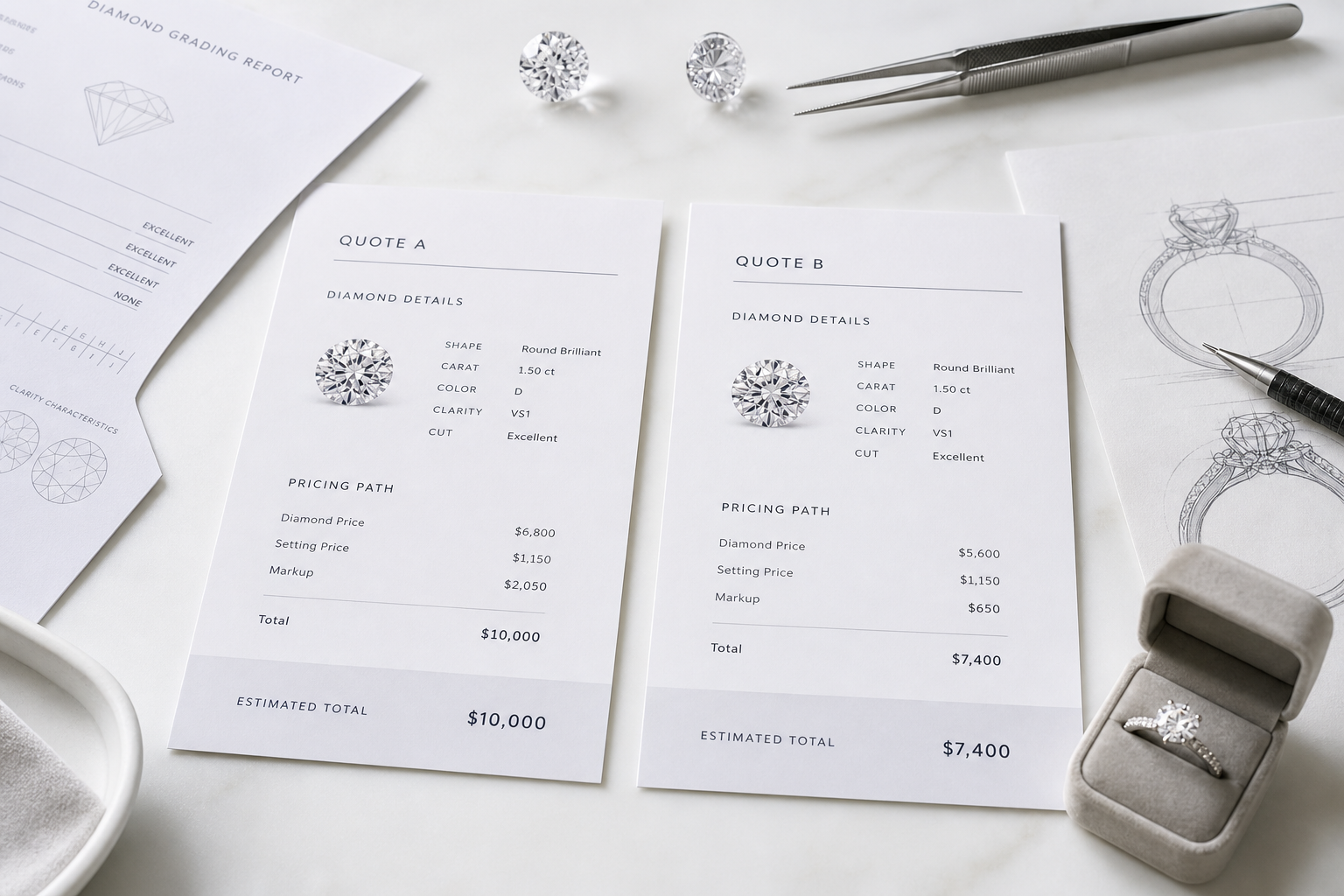
What certification and grading reports can actually prove
Lab-grown diamond certification is useful, but it has a specific job. A grading report helps verify that the stone presented to you matches the identity and characteristics listed on the document. It is a control point, not a guarantee of overall buying quality. The best buyers use it to reduce uncertainty, then still check the stone itself.
Which details a report helps verify
A report can confirm core identifying information such as carat weight, measurements, shape, and the stated grade range for color and clarity. It may also include details like polish, symmetry, and the growth method if the issuing lab records them. For a buyer, the main value is alignment: does the stone in front of you match the stone described on paper?
That alignment matters because it helps rule out simple mismatches. If the measurements, report number, and listed characteristics do not line up, the buyer should slow down immediately. A report is most useful when it creates a clear paper trail between the stone, the seller, and the exact item being discussed.
When a grading report is available, buyers should verify the report details through the issuing laboratory’s official report-check tool where available.
Where reports stop and visual review begins
A grading report does not tell you how the stone will look in every setting or every light. It cannot fully capture brightness, face-up appeal, or whether the proportions suit the intended design. Two stones with the same report grade can still perform differently once viewed side by side, which is why visual review remains necessary.
This is also where buyers sometimes overtrust the document. A report may say the right things without answering the more important question: is this the right stone for the actual ring, budget, or inventory purpose? The report narrows the field. It does not finish the decision.
For lab-grown stones specifically, buyers should also remember that a report does not automatically explain how the diamond was produced, handled, or priced. Those questions belong to the seller and the documentation package, not just the grade. If a quote leans heavily on the report but is vague about the actual stone, the buyer should ask for more than paper alone.
Why lab reputation and report consistency still need context
Not every report style gives the same level of clarity, and not every issuing lab presents information in exactly the same way. That does not mean one report is automatically better in every case. It does mean the buyer should read the document in context, not as a standalone proof of value. Consistency across report details, photos, and the seller’s description is what matters most.
At NUVU, we treat the report as a starting point, not the whole answer. The better question is whether the document, the stone, and the seller’s description all tell the same story. When they do, the buyer can move with more confidence. When they do not, the discount may be hiding a problem rather than creating real value.
Certificate and Visual Review Check
Before buying, confirm that the report number matches the stone being shown, the measurements are consistent with the listed carat weight, and the visible appearance fits the quality you expect from the grade. If the documentation is clear but the stone looks off in photos or video, trust the mismatch and ask for more information before proceeding.
What a grading report can support, and what it cannot prove
A grading report helps document key characteristics, but it should not be treated as a guarantee of beauty, value, or sourcing ethics. It can verify that a seller is discussing a specific stone with a specific set of measurements and grade details, but it does not tell the buyer whether the diamond suits a particular setting, whether the price is favorable, or whether any environmental claim has been substantiated.
That is why report-aware buying works best when the report is read together with current photos, video, dimensions, and the seller’s explanation of how the stone was selected. A report is valuable because it narrows uncertainty. It is not a substitute for judging the stone’s visual performance or the completeness of the offer.
For buyers comparing China-linked options, this distinction is important because a lower quote sometimes relies on the report to do more work than it should. If the stone looks different from the media, if the dimensions do not fit the design, or if the origin and handling story is unclear, the document alone should not be used to resolve the mismatch.
Quality control is one of the least visible reasons two otherwise similar quotes can diverge. A lower price may reflect a simpler process, but a stronger price can also reflect more time spent checking the stone, comparing options, and confirming details before shipment. For buyers sourcing from China-linked channels, that screening step is often where real value is created or lost.
What quality control looks like before a stone ships
Basic QC should confirm that the stone being shipped matches the report, the measurements, and the agreed visual standard. It should also catch issues that may not show up in a headline grade, such as finish problems, obvious symmetry concerns, or visible flaws that make the stone less suitable than expected. A supplier that checks these details is doing real work; a supplier that skips them is shifting the risk to the buyer.
The important point is not that every low-priced supplier is careless. It is that the buyer should know what was actually checked. If the stone was only pulled from inventory without review, the quote may look attractive but carry more uncertainty than it first appears.
Screening for matching, consistency, and batch-level variation
Screening matters most when the order is more than one stone. A single diamond can be acceptable on its own, yet look inconsistent next to another stone from the same batch. Matching across size, shape, tone, and face-up look takes more attention than many buyers assume, and that attention has a cost.
Batch variation is especially relevant for custom and wholesale orders. If a buyer needs several stones that will sit together in one piece of jewelry or be used across repeat production, the supplier has to filter harder to keep the group consistent. That kind of sorting can increase price, but it can also prevent expensive rework later.
Communication details that prevent avoidable mistakes
Clear communication is part of the value, not just customer service. Buyers should expect written confirmation of the exact stone, the measurements, the report details, and any special selection requests. Photos or video should show the actual stone, not a generic sample that only resembles the order. If a supplier is vague at this stage, the buyer is usually the one absorbing the risk.
Specific answers matter more than broad reassurance. If the buyer asks whether the stone is eye-clean, matched to a pair, or suitable for a particular setting, the response should address that exact question. The more precise the order, the more precise the confirmation should be. That is one of the simplest ways to tell whether a quote is genuinely well-supported.
Buyer Verification Checklist
- Confirm the exact measurements, not only the carat weight.
- Check that the report number and stone details match the item being offered.
- Ask for current photos or video of the actual stone.
- Request written confirmation of any matching or batch requirements.
- Verify whether the stone was screened for visible issues before shipment.
- Ask what was checked if the quote is lower than comparable offers.
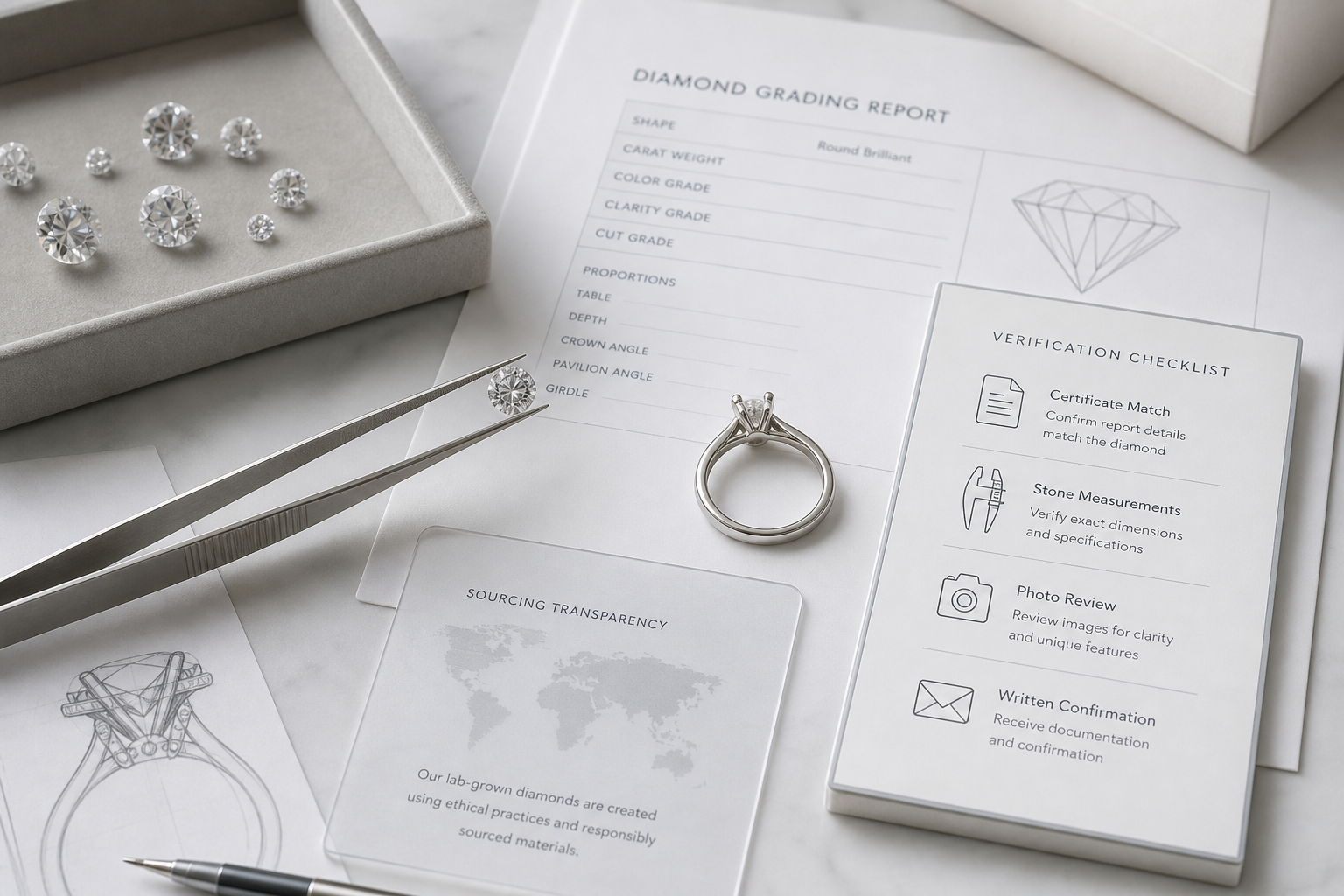
When China-linked sourcing is the right fit—and when it is not
China-linked sourcing makes sense when the buyer cares about flexibility, price structure, and selection control more than convenience. It is often a strong fit for custom projects, loose-stone buying, and inventory purchasing where the buyer can wait, compare options, and manage a more involved process. It is a weaker fit when the buyer wants a finished piece quickly, prefers a simple storefront experience, or does not want to manage back-and-forth on specs, timing, and delivery.
The key judgment is this: direct sourcing is only useful if the buyer can actually use the advantages it creates. A lower quote means little if the order is urgent, the desired stone is highly specific, or the buyer does not have the patience to verify details before committing. The right path depends less on the country name and more on the buyer’s goal, timeline, and tolerance for process.
It also depends on how much of the decision the buyer wants to control. Some shoppers want to choose the exact stone and oversee the details. Others prefer to pay for convenience and let the retailer handle the coordination. Neither approach is inherently better, but the sourcing route should match the amount of oversight the buyer is prepared to give.
Good fit for direct sourcing, custom work, or inventory buying
Direct sourcing works best when the buyer already knows what they are trying to build or stock. A custom engagement ring client with a fixed budget but flexible timing may benefit because they can put more of the budget into the stone and setting instead of retail overhead. A jeweler or boutique buyer may also prefer this route because it can open access to broader selection, better matching for multiple stones, or more control over inventory strategy.
This is also where China lab-grown diamond sourcing can make practical sense for buyers who do not need a finished retail package. If the job is to secure a specific carat, shape, or size range for a design or inventory plan, direct sourcing can be more efficient than paying for presentation-heavy retail markup. The advantage is not just lower headline cost. It is the ability to work closer to the source and shape the order around the actual need.
For wholesalers, direct sourcing is often about consistency and replenishment rather than one-off savings. A supplier relationship matters more when the buyer needs repeatable supply, matching sets, or a predictable pipeline. In those cases, the sourcing model itself becomes part of the value.
Situations where a local retailer path may be simpler
A local retailer path is usually the better choice when simplicity matters more than sourcing control. If the buyer needs a finished ring for a proposal date, wants one point of contact, or does not want to manage stone selection, mounting, and shipping separately, retail is easier to execute. The premium often buys convenience, faster handoff, and fewer moving parts.
Retail is also better for buyers who want to see fewer options, not more. Some people do not want to compare stones across several quotes or decide which measurements are close enough. They want a finished product they can review in person or from a single trusted source. In that scenario, a higher price may still be the better value because it reduces friction and decision fatigue.
For many consumers, that tradeoff is reasonable. The mistake is assuming direct sourcing is automatically smarter because it is cheaper on paper. If the buyer has to spend extra time, manage more risk, or solve more problems, the savings can shrink quickly.
Tradeoffs for consumers, jewelers, and wholesalers
Consumers usually care most about ease, confidence, and timing. For them, direct sourcing is only worth considering if they are comfortable comparing options and waiting through a longer process. A shopper buying a simple engagement ring may not benefit much from a sourcing-heavy route unless the budget is tight or the design is highly specific.
Jewelers and custom designers tend to see the most upside, but they also take on more responsibility. They need to evaluate whether the source can support consistency, responsiveness, and reliable follow-through. A good-looking quote is not enough if communication is slow or the supplier cannot hold to the agreed specs. For this group, sourcing is a business decision, not just a purchase decision.
Wholesalers face a different calculation. They are less focused on one stone and more focused on repeatability, availability, and margin control. Direct sourcing can help if it improves replenishment and keeps pricing stable, but it can also create headaches if the supply chain is inconsistent or the order requires too much manual correction. The real question is whether the model supports the buyer’s turnover, not whether it simply comes in cheapest.
What This Means in a Real Purchase
A couple designing a custom ring with a six-week window, a fixed budget, and a willingness to review loose stones may be a strong candidate for China-linked sourcing. The same couple, if they need the ring in ten days and do not want to manage separate stone and setting decisions, is usually better served by a simpler retail route. The right answer changes with the buyer’s constraints.
The same logic applies to trade buyers. A jeweler building inventory may choose direct sourcing to improve margin and selection depth, while a consumer buying a single finished ring may decide that the convenience premium is worth paying. Neither choice is wrong by default. The wrong choice is using the wrong sourcing model for the job.
Trust signals that should sit behind a China-linked diamond quote
After a buyer has decided that China-linked sourcing is a reasonable fit, the next step is to look for practical assurances rather than broad promises. A trustworthy quote should make it easy to identify the exact diamond, understand which grading document applies, and confirm that the stone shown in media is the stone being discussed. These checks are especially important when the price advantage comes from a leaner supply chain, because the buyer needs documentation and communication to replace the reassurance normally provided by a retail storefront.
For a loose stone, the strongest trust signal is consistency across the report, the measurements, the visual material, and the seller’s written description. For a finished jewelry order, the same logic extends to the setting: metal type, ring size, stone security, production timeline, and any resizing or service terms should be stated before payment. This does not need to feel complicated, but it should be recorded clearly enough that both sides are working from the same expectations.
When a grading report is provided, buyers should compare the report details with the issuing laboratory’s verification tools where available and make sure the report, stone media, and seller description refer to the same item.
Buyers should also ask how the seller handles cases where a selected diamond becomes unavailable, where a report detail needs clarification, or where a custom specification cannot be matched exactly. The answer matters because real sourcing is not always perfectly linear. A reliable supplier should be able to explain substitution standards, approval steps, and timing changes before they become a problem. Clear process is a form of protection, especially for custom and wholesale orders.
At NUVU, this kind of communication is treated as part of the buying process rather than an afterthought. The goal is to help the buyer understand what is confirmed, what still needs approval, and which details may affect the final price or schedule. That approach is more useful than simply labeling a quote as cheap or premium, because it gives the buyer a clear basis for deciding whether the offer is suitable.
Before purchase, buyers should confirm the seller’s documentation, return policy, resizing terms, and after-sales support in writing. Those terms are separate from the stone’s grade, but they can affect whether the overall transaction fits the buyer’s needs.
How traceability works in a practical sourcing conversation
Traceability in this context does not mean every stage of the supply chain is automatically visible to the final buyer. It means the seller can connect the quote to a specific stone or order batch and can explain what is known, what is documented, and what still depends on supplier confirmation. The more customized or wholesale-oriented the order is, the more important this written trail becomes.
A practical traceability record may include the stone description, report reference if available, measurements, current visual material, matching notes, and any agreed substitution rules. For a finished jewelry project, it should also connect the selected stone to the setting specifications so that the buyer is not approving a diamond in isolation from the final piece.
NUVU’s buyer-first approach is to make diamond comparison easier to understand, especially when buyers are weighing report details, visual performance, setting fit, and budget together. The purpose is not to replace laboratory grading or seller documentation, but to help buyers see where the available evidence supports the quote and where more clarification is still needed.
How to compare offers on value instead of headline price
Comparing offers well means treating them as complete packages, not just numbers on paper. Two quotes can look similar at first glance and still deliver very different value once you account for measurements, documentation, photos or video, timing, and final landed cost. The buyer should judge the whole offer, not the cheapest line item.
The best way to compare lab-grown diamond offers is to build a like-for-like check. If one quote is cheaper because the shape is different, the measurements are slightly smaller, the report is missing, or delivery takes longer, it is not the same offer. Headline price only matters after the rest of the terms are aligned.
In practical buying, the most common mistake is to compare the stone price but forget the delivery cost, any setting work, and the time spent resolving unclear details. A quote that looks strong at first can become less attractive once those pieces are added back in.
A fair comparison framework for similar stones
Start with the stone itself. Carat, shape, cut, color, clarity, and measurements need to line up closely before a price difference means much. A 1.50 ct round and a 1.50 ct oval are not interchangeable just because the weight is the same. Nor are two stones with the same grade automatically equal if one presents better visually or matches a setting more cleanly.
A practical rule is to compare at least 3 quotes and make sure 5 to 7 variables are aligned before deciding one is a better value. Those variables should include the stone’s size, shape, grading details, report, visual material, delivery timing, and total landed cost. If those details are not close, the cheaper quote may simply be the less complete one.
It also helps to look at what the buyer is actually paying for beyond the stone. One offer may include stronger photos, clearer communication, and tighter shipping terms, while another only looks cheaper because fewer services are included. If the buyer has to fill in the missing pieces elsewhere, the real cost moves up.
Questions to ask about documentation, QC, and timelines
Ask what is included in writing before comparing price. If the quote does not clearly state the report details, stone measurements, image or video availability, and expected delivery window, the buyer is not comparing a complete offer. Missing details create risk, and risk has a cost even when it is not shown on the invoice.
Timing deserves the same attention as price. A lower quote that arrives too late for the project is not a better value. Lead time should be treated as part of the quote, not as a separate inconvenience. If the buyer needs a stone for custom setting or a scheduled event, delivery reliability can matter more than a modest price gap.
Questions should stay direct: What exactly is included? Are the measurements confirmed? Is the visual material for the same stone being sold? What is the final delivered cost? If a supplier cannot answer these clearly, the quote is not ready to compare.
Simple comparison check: if two offers differ on more than one of these points, they are not truly equal: stone specs, report, photos or video, shipping terms, and delivery timing. The less transparent offer should not be treated as the better deal just because it is cheaper.
The final filter: price, transparency, and buying confidence
The strongest offer is usually the one that gives the buyer the clearest path from quote to delivery. Price matters, but it should not outrank transparency when the buyer is making a meaningful purchase. A quote that is a little higher but easier to verify can be better value than a slightly cheaper one that leaves room for mistakes.
This is especially true in China-linked diamond quotes, where the buyer may be dealing with different levels of service, access, and responsiveness. If the source is clear, the documentation is aligned, and the delivery terms are realistic, a lower price can be a real advantage. If any of those pieces are weak, the quote deserves skepticism.
For custom buyers and trade buyers, confidence is part of value. The right offer is the one that fits the project, the timeline, and the buyer’s ability to manage the process without surprises. Cheap is only useful when it is also clear, complete, and deliverable.
How to Compare Before You Decide
Use the same standard on every quote: match the stone details, verify what is documented, check the visual material, and calculate the final delivered cost. If one offer still looks better after that, it is probably the better value. If it only looks better before the details are lined up, it is not a fair comparison.
The buyer who compares carefully usually ends up with the better result, even if the lowest number was not the winner. That is the point of value-focused buying: not to chase the cheapest quote, but to choose the offer that is most likely to deliver the right stone with the least friction.
What a defensible China-linked quote should include
A quote is easier to trust when it tells the whole story in one place. At a minimum, the buyer should be able to see the stone’s key details, the documents attached to it, what the seller has actually screened, and what happens after the order is placed. If any of those elements are vague, the buyer is not comparing a complete offer.
For China-linked sourcing, that completeness matters even more because the supply chain can be faster and less visible at the same time. A low number with incomplete information is not the same as a well-supported low number. The first is just a price; the second is a decision the buyer can evaluate.
A useful standard is to ask whether the seller can explain the quote without changing the answer from one message to the next. If the story changes, the stone may still be fine, but the transaction is not yet ready to trust. Consistency is part of value.
Minimum items to request in writing
Before paying, ask for the exact stone description, the current report or grading reference if one exists, confirmation of the shape and measurements, and any current photo or video of the item being sold. If the order involves matching or custom work, ask how the seller decided the stone was suitable for that purpose. If the order is for a finished piece, ask what is included in the setting and what is not.
It also helps to ask for a final delivered price rather than only a base stone price. Shipping, duties, setting work, and any handling fees can change the final amount in ways that matter more than a small difference in the headline quote. Buyers often think they are comparing two stones when they are really comparing two very different transaction structures.
A strong quote does not have to be the longest one. It only has to be complete enough that the buyer can compare it with confidence. That is the real test of transparency.
How to verify price at the time of purchase
Prices can change with market conditions, report type, seller channel, and stone-specific details, so exact comparisons should be verified at the time of purchase. A quote that looked competitive last week may not stay competitive once the stone is reserved, rechecked, or paired with a setting and shipping plan.
For a fair comparison, ask for the full landed cost in the same currency and with the same assumptions for shipping, duties, setting work, and any additional service fees. A headline stone price is useful only if it survives that fuller accounting. This is especially true in China-linked sourcing, where the first number may not include the same support or logistics that a retailer quote does.
If the seller cannot hold the quote or cannot explain what happens when the stone is no longer available, the buyer should treat the number as provisional rather than final. That caution is not a problem; it is normal sourcing discipline.
How to handle sustainability and origin claims carefully
Lab-grown diamonds are often discussed alongside sustainability, but buyers should treat those claims carefully. “Lab-grown” describes how the diamond was made, not automatically how low-impact or responsible the full supply chain is. If a seller makes environmental or ethical claims, those claims should be specific, limited, and easy to understand.
The same caution applies to origin language. A stone may be produced in one place, cut in another, sold through several intermediaries, and packaged under yet another business name. For the buyer, the useful question is not whether the story sounds clean, but whether the seller can explain the path in a way that matches the documentation.
When a quote leans heavily on broad ideas like “green,” “clean,” or “responsible,” ask what those words mean in practice. If the answer is vague, treat the claim as marketing rather than as evidence. In this market, careful wording is often more reliable than big promises.
Sustainability claims should be specific and documented. Broad green language is less useful than clear information about production, energy, sourcing, and seller transparency.
What buyers should ask instead of assuming
Ask what the seller can document, what the seller can explain clearly, and what the seller is not claiming. If an origin or sustainability statement is important to the purchase, the buyer should want specifics, not slogans. That may include production notes, chain-of-custody explanations, or a plain-language description of what the seller knows and does not know.
For practical buying, the safest approach is to separate product quality from story quality. A stone can be attractive, well priced, and well suited to the project without carrying a grand sustainability claim. Conversely, a polished sustainability pitch does not make up for weak documentation or poor screening.
That is why transparency matters so much in China-linked sourcing. It helps the buyer decide what is actually being purchased, what is simply implied, and what still needs proof before the order moves forward.
Disclosure: This article is for general educational purposes only. Diamond grading, pricing, availability, specifications, and seller policies can change, and readers should verify important details through grading reports, official laboratory tools, seller documentation, or qualified professionals before making a purchase decision. Laboratory-grown diamonds should be clearly distinguished from natural diamonds, and environmental or sourcing claims should be supported by specific documentation.