
The cost of a lab-grown diamond engagement ring is not determined by carat size alone. In the same cost logic reflected by China lab grown diamond pricing, the finished price reflects the center stone, setting style, metal, accent stones, craftsmanship, finishing, and any custom work needed to make the ring wear well. Two rings with similar-looking diamonds can land at very different prices if one uses platinum, pavé, a hidden halo, a custom basket, or more complex fabrication.
For the full framework, read Lab-Grown Diamond Engagement Rings Guide.
This guide helps you judge a ring as a complete purchase rather than a loose diamond plus an afterthought setting. You’ll see where upgrades can improve appearance, durability, or personal fit, and where they may add cost without much visible benefit. The goal is to compare quotes more carefully, balance the 4Cs with design choices, and decide whether your budget is better spent on a larger center stone, a more detailed setting, a premium metal, or custom design.
Laboratory-grown diamonds should be clearly identified as laboratory-grown, and they should not be presented as mined diamonds. Lab-grown diamonds and natural diamonds are both diamonds, but they have different origins, and that origin should be clear in the product listing, grading report, invoice, or seller documentation. Diamond simulants are a separate category and should not be confused with laboratory-grown diamonds.
Prices can change with market conditions, report type, seller channel, availability, stone-specific details, and setting complexity. For that reason, a useful comparison should be based on like-for-like specifications rather than a single headline price. The most reliable quote is the one that explains what is included, what may change, and which details the buyer should verify before approving the final ring.
| Cost Choice | What Changes the Price | Best Buyer Check |
|---|---|---|
| Center diamond | Cut, shape, proportions, color, clarity, carat weight | Compare visual performance, not grades alone |
| Setting style | Solitaire, halo, pavé, three-stone, vintage details | Ask what labor and accent stones are included |
| Metal | 14k gold, 18k gold, platinum weight and maintenance | Balance color preference, durability, and budget |
| Custom design | CAD work, revisions, sourcing, fabrication complexity | Confirm revision scope and possible change fees upfront |
| Quote comparison | Diamond, setting build, finishing, resizing, support | Compare complete ring details, not total price only |
Quick Questions Before You Read
Q: Should most of my budget go toward the center diamond?
Often yes for a simple solitaire, but decorative or custom rings may justify more spending on the setting and craftsmanship.
Q: Is platinum always worth the higher cost?
Not always. Platinum offers weight, natural whiteness, and low maintenance, while 14k gold often gives strong durability at a lower price.
Q: Can a lower quote still be a good deal?
Yes, but only if the diamond, metal, construction, accent stones, finishing, and service terms are truly comparable.
Q: Do higher diamond grades always look better once set?
No. Some upgrades are hard to see in a finished ring, so appearance, proportions, and setting style should guide the decision.
What actually makes up the total cost of a lab-grown diamond engagement ring?
The cost of a lab-grown diamond engagement ring is not the same thing as the cost of the loose center stone. The center diamond is usually the largest single line item, but the finished ring price also includes the setting, metal, side stones, fabrication, finishing, and any design work needed to make the ring wearable and secure.
This is where many quote comparisons go wrong. A shopper may see two rings with similar-looking center diamonds and assume the lower total price is automatically the better value. Sometimes it is. Other times, the lower quote reflects a simpler setting, lighter metal, fewer accent stones, less finishing detail, or less service included before and after production. The finished ring has to be evaluated as a complete object, not as a diamond with a band attached.
For buyers, the practical point is not just what the report or product title says, but how the stone, setting, metal, and construction work together in the finished ring. A quote that looks attractive on one line can become less clear if it does not explain what is included, what is standard, and what would cost extra.
Center stone price versus finished ring price
The loose diamond price answers one question: what does the center stone cost by itself? The finished ring price answers a broader and more useful question: what does it cost to turn that stone into the exact ring someone will wear every day?
For a simple solitaire, the center diamond may take up most of the budget. In a more detailed ring, the balance can shift. A halo, pavé band, three-stone layout, custom basket, or platinum build can move a meaningful share of the total cost away from the center diamond and into the setting. This does not mean the ring is overpriced. It means the money is being spent in a different part of the design.
A practical way to think about a lab-grown engagement ring price is to separate the quote into layers. The diamond gives the ring its main visual presence. The setting determines how that diamond is held, framed, and worn. The metal affects durability, weight, color, and cost. Side stones and accent details add both materials and labor. Workmanship determines whether the ring feels refined, balanced, and secure rather than simply assembled.
The main cost layers: stone, setting, metal, side stones, and workmanship
A useful engagement ring budget should account for five cost layers: the center stone, the setting style, the metal, any side stones or accent diamonds, and the workmanship required to bring the design together. These layers do not carry equal weight in every ring.
In a clean solitaire, the stone may be the main driver, while the setting and metal stay relatively controlled. In a decorative ring, the setting can become a major part of the finished ring cost because it requires more construction, more stone setting, and more finishing detail. In a custom ring, design time and revisions may also become part of the equation, even if the final ring looks visually simple.
The most common mistake is to set a budget around the center diamond first and treat the rest as an afterthought. That can work for very simple designs, but it creates problems when the buyer wants a specific metal, a hidden halo, pavé, side stones, or delicate proportions that require more careful fabrication. A better approach is to decide on the total ring budget first, then allocate money across the parts that matter most for the design.
For example, a buyer with a fixed total budget may get a more satisfying finished result by choosing a slightly smaller or more practical center stone and allowing enough room for a well-made setting. Pushing too much of the budget into carat size can leave the ring feeling unfinished, too light for the design, or visually mismatched. Strong value is rarely about choosing the largest diamond and the cheapest setting without checking how the complete ring is built.
What to Check Before You Decide
- Ask whether the quote is for the loose diamond only or the completed ring. This prevents a low stone price from being mistaken for the full cost.
- Separate the quote into diamond, setting, metal, accent stones, and labor. If those layers are not clear, it is harder to compare value.
- Check whether the design requires extra workmanship. Pavé, halos, custom baskets, and delicate prongs can add cost even when the ring looks understated.
- Do not judge value by carat size alone. A larger center stone paired with a weak setting can be a worse purchase than a slightly smaller diamond in a better-built ring.
How the center diamond changes the final number
The center diamond still has the strongest influence on many lab-grown engagement ring budgets, especially in solitaire and minimal settings. But its price is not determined by carat weight alone. The final number reflects how size, cut quality, shape, color, clarity, grading details, and visual performance interact in a real stone.
This matters because two lab-grown diamonds can look similar in a product grid but land at different prices for valid reasons. One may have stronger proportions, a more desirable shape, a higher color grade, better clarity, or a grading report that supports more confidence. Another may be priced lower because the tradeoff is less obvious at first glance, such as weaker light return, visible tint, strain, or a clarity feature in an important viewing area.
A grading report is useful because it records important characteristics, but it does not prove that a diamond will be the better-looking choice for a specific ring. Reports should be compared with images, video, measurements, and the intended setting. This is especially important for fancy shapes, where outline, bow-tie effect, windowing, and face-up spread can influence the finished look more than the basic grade combination suggests.
Carat, cut, color, clarity, and shape: which factors move price most
Carat weight is usually the easiest price driver to notice because shoppers compare size quickly. Moving from one carat range to another can change the lab-grown diamond price sharply, even if the visual difference on the hand is more modest than the number suggests. A 2.00-carat stone often carries a psychological premium over a 1.80 or 1.90-carat stone, even when the face-up difference is not dramatic.
Cut quality deserves more weight than many buyers give it. A well-cut diamond can look brighter, more balanced, and sometimes visually larger than a heavier stone with weaker proportions. Paying for carat while compromising heavily on cut is usually a poor tradeoff because size is visible only if the stone also performs well. This is especially important in round brilliants, but it also matters in ovals, emerald cuts, cushions, radiants, and elongated shapes where proportion and light pattern can vary widely.
Shape also changes pricing. Round diamonds often price differently from fancy shapes because of demand, cutting yield, and market preference. Fancy shapes such as oval, pear, emerald, cushion, and radiant cuts can offer strong visual size for the money, but they also introduce shape-specific risks. An oval may show a bow-tie effect. An emerald cut may reveal clarity characteristics more easily. A radiant or cushion may vary greatly in spread and brightness. The lower price is only useful if the stone still looks good in the chosen design.
Color and clarity affect cost, but they should be judged with restraint. Many buyers overspend chasing grades they cannot appreciate once the diamond is set. For most ring designs, the practical question is not “What is the highest grade I can afford?” but “At what point does the difference stop being visible or meaningful?” A near-colorless diamond may be a better value than a higher color grade if it faces up white in the chosen metal. Similarly, an eye-clean clarity grade can be more sensible than paying extra for a cleaner report that does not improve the appearance of the ring.
Why two similar lab-grown diamonds can still cost differently
Two diamonds with the same carat, color, and clarity grades can still price differently because the headline grades do not describe everything. Proportions, polish, symmetry, table size, depth, fluorescence, growth characteristics, and the location of inclusions can all affect value. In fancy shapes, the outline and length-to-width ratio can be just as important as the basic grade combination.
A lower-priced stone is not automatically a warning sign, but it should prompt a closer look. Sometimes it is simply a good match for the buyer’s priorities. Other times, the lower cost reflects a visual compromise: a dark center, uneven faceting, a strong bow tie, a watery appearance, or an inclusion that sits where the eye naturally lands. These issues may not be obvious from the grade line alone.
The opposite mistake is assuming a more expensive diamond must be better. A higher-priced stone may have a premium grade combination, but that does not always translate into a better finished ring. If the difference is invisible once set, the extra money may be better used toward a stronger setting, better craftsmanship, or a design detail the wearer will actually notice.
At NUVU, the practical view is that the grading report helps narrow the options, but it should not replace visual review. For a center diamond, the right question is not only whether the specs look strong, but whether the stone performs well enough for the ring design and budget.
Certificate and Visual Review Check
- Compare stones with similar specs, not just similar prices. A cheaper diamond may be smaller, lower in cut quality, weaker in visual performance, or simply a better value.
- Review images or video when available. This is especially important for oval, pear, emerald, radiant, and cushion cuts.
- Do not overpay for invisible upgrades. Higher color or clarity grades are only worth the premium if they improve the appearance or confidence of the final ring.
- Make sure the stone fits the design. A diamond that looks good loose may not be ideal for a specific setting style, prong layout, or ring proportion.
When a grading report is available, buyers should verify the report details through the issuing laboratory’s official report-check tool where available and compare those details with the stone’s measurements, images, and setting plan.
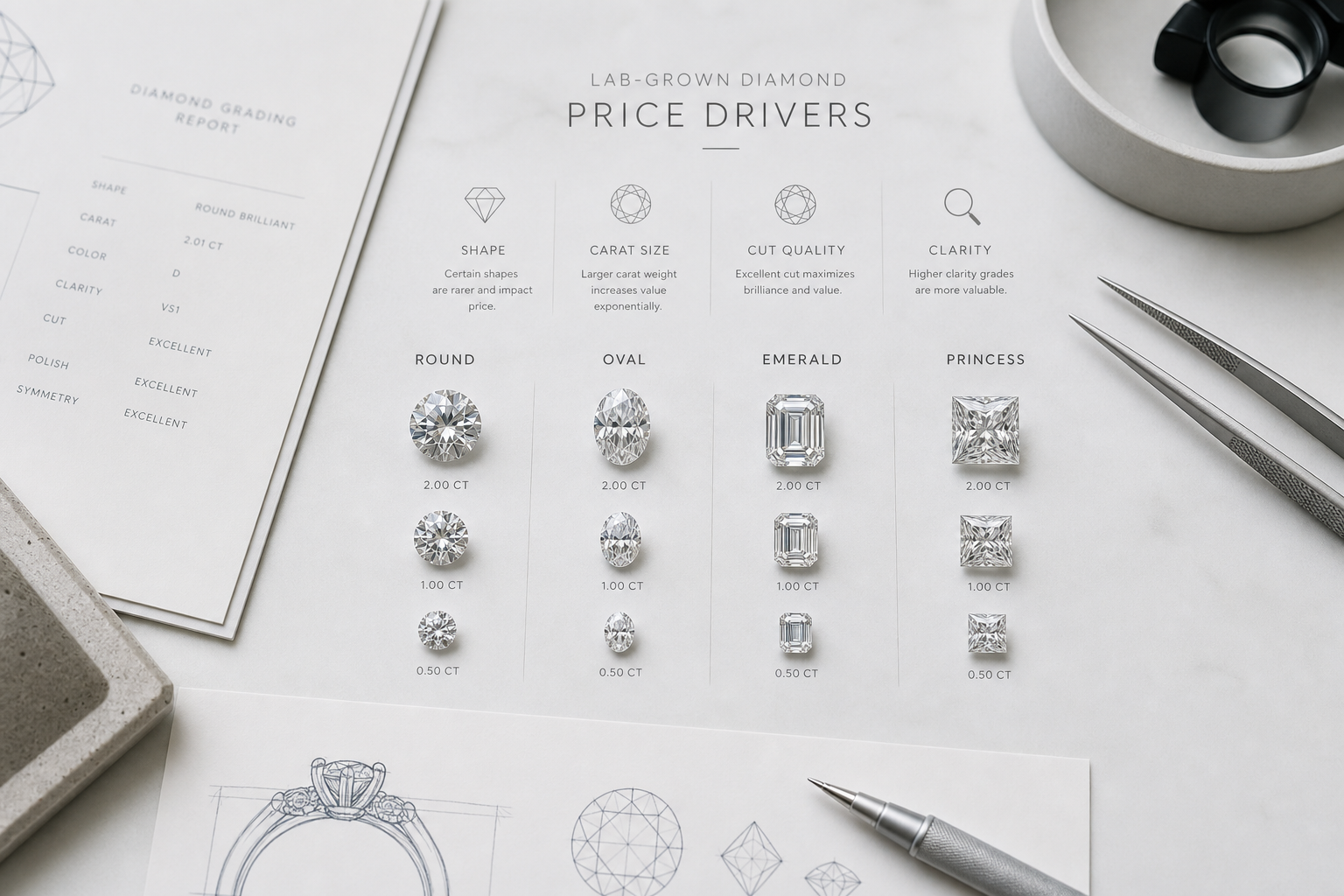
What a grading report and product listing should confirm
Before you compare ring prices too closely, make sure the listing and report are describing the same stone in the same way. A useful product page should identify the shape, carat weight, color, clarity, and key measurements clearly enough that the buyer can tell what is being sold. If the report and listing do not align, the quote is harder to trust because the price may be tied to assumptions that are not fully visible.
For lab-grown diamonds, the most helpful documentation is the kind that makes the stone easy to trace within the purchase process. That means the buyer should be able to match the center stone to the report, inspect the stated measurements, and understand whether the quote reflects the exact finished item or a placeholder stone that may later be replaced. A solid ring quote should reduce uncertainty, not add it.
It also helps to separate what a report documents from what it does not. A grading report can support comparison, but it does not guarantee that the stone will look best in every setting, nor does it replace visual review, especially for fancy shapes. Two stones can share similar paper specs and still produce a different visual result once they are set, angled, and viewed in normal light.
What a report can document and what it cannot decide for you
A grading report can document key characteristics such as carat weight, measurements, color, clarity, and cut information where applicable. For laboratory-grown diamonds, the report or accompanying seller documentation should also clearly disclose laboratory-grown origin. When growth method or post-growth treatment is relevant, buyers should look for clear disclosure in the grading report or seller documentation rather than assuming details that are not stated.
A grading report helps document key characteristics, but it should not be treated as a guarantee of beauty, value, or sourcing ethics. It also does not guarantee that a diamond will suit every setting, hand proportion, or design preference. A report is strongest when it is used with images, video, measurements, and a clear setting plan, especially when the finished ring includes fancy shapes, low profiles, side stones, or custom prong work.
Report terminology should be read carefully. “Laboratory-grown diamond” identifies origin; it does not mean the stone is a diamond simulant. Likewise, a lab name on a report should not be used as a shortcut for assuming a ring is automatically the right choice. Certificate-aware buying means reading the details, checking whether they match the stone being quoted, and confirming how the ring will be built around that stone.
Questions that improve the reliability of a quote
If you want the ring quote to be easier to compare, ask questions that force the seller to define the product more precisely, using cheap lab grown diamond pricing as a reference point for judging whether a lower figure reflects real value or missing specifications. This is especially useful when the ring is made to order, when the setting includes multiple elements, or when the diamond choice can still change during production.
- Is the center stone exactly the one shown in the listing or video?
- Does the quote include the complete ring or only the mounting?
- Are the metal type, accent stones, and setting style fully identified?
- Are there any design approvals, revisions, or size adjustments that could change the price later?
- Will the finished ring match the listed specifications, or can some details vary slightly during production?
These questions do not make the ring more expensive by themselves. They make the price easier to evaluate. The clearer the product definition, the easier it is to tell whether one quote is truly better or just less complete.
What traceability can and cannot prove
For a lab-grown diamond ring, traceability should be treated as a documentation trail rather than a blanket promise. A report, listing, or invoice can help connect the stone to a specific sale, but it does not by itself tell the buyer everything about the manufacturing process, the seller’s internal sourcing standards, or future service outcomes. That is why clarity matters: buyers should know which details are documented, which are visual, and which are simply claimed.
When documentation is available, the most useful checks are practical: does the report number match the stone, do the measurements align with the product listing, and do the images or video show the same shape and proportions described in the quote? If a seller cannot clearly explain those links, the ring is harder to compare even if the price looks attractive.
For NUVU, the buyer-first approach is to make the comparison clearer: what the report shows, what the visuals reveal, and whether the stone fits the intended piece.
Why setting style can change the price more than buyers expect
The setting is often treated as the decorative part of the ring, but it is also a major cost driver. Setting style affects how much metal is used, how many stones must be set, how much precision the design requires, and how long the ring takes to finish. A ring with the same center diamond can land at very different total prices depending on the architecture around it.
This is where a finished ring quote can surprise buyers. A simple-looking design may still require careful fabrication, custom proportions, hidden details, or delicate prong work. A more visibly decorative design may justify a higher price because it includes more accent diamonds, more setting points, and more finishing time. The visual style is only part of the story; the construction behind it matters just as much.
For custom design, the stone cannot be evaluated separately from the setting. A low-profile design, flush-fit wedding band, elongated diamond, or delicate pavé band can change which center stone dimensions make sense. In practical buying, this is where many comparisons become misleading: two diamonds may share similar grades, but one may sit better, look more balanced, or require less modification in the chosen ring.
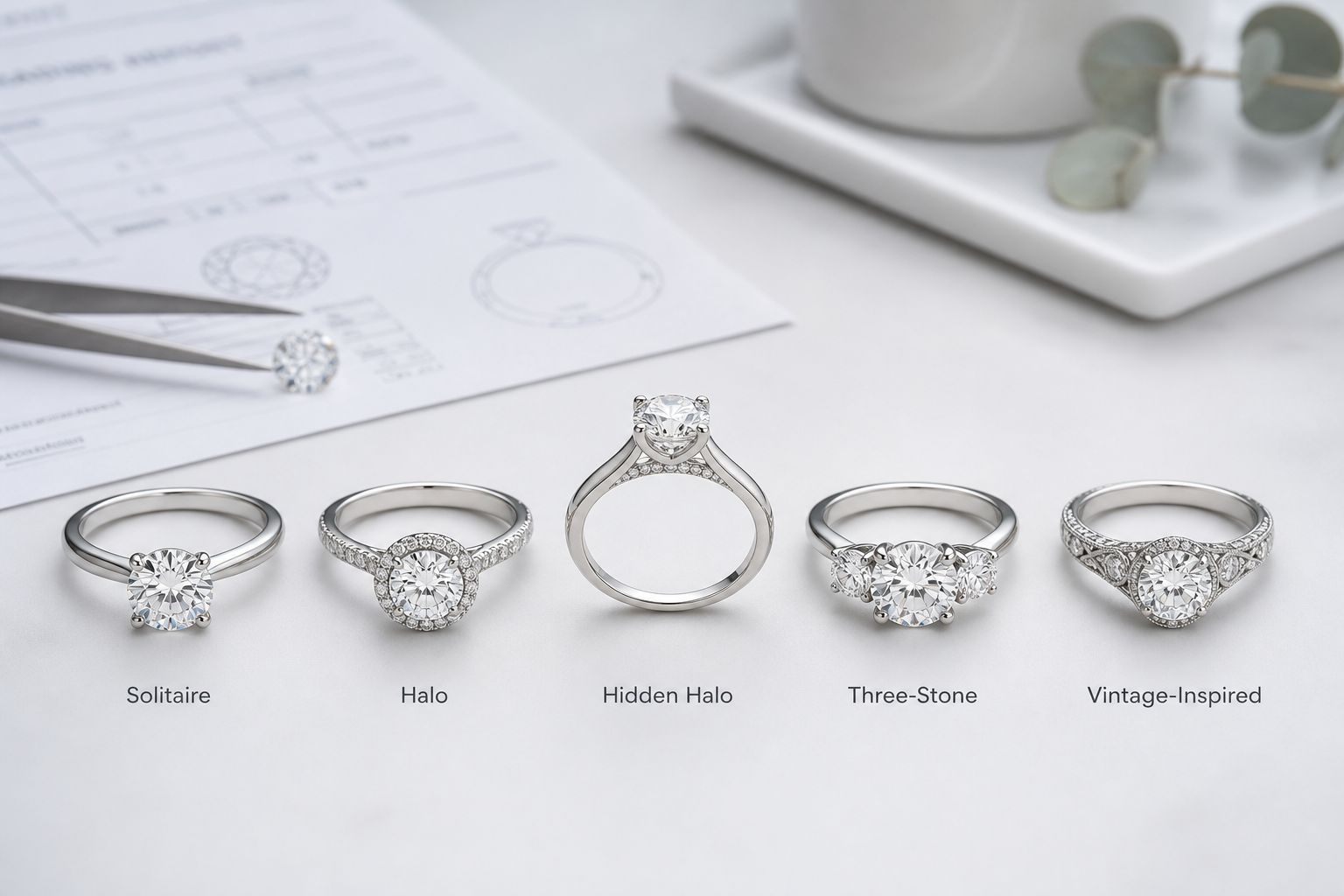
A solitaire is usually the most cost-controlled setting style because it uses fewer components and keeps the focus on one center stone. That does not mean every solitaire is inexpensive. A well-proportioned solitaire with refined prongs, a secure basket, and a comfortable band can cost more than a basic stock setting. Still, if the goal is to put the largest share of the budget into the center diamond, a solitaire is often the cleanest path.
A halo setting increases visual spread by surrounding the center diamond with smaller stones. This can create a larger face-up look, but it also adds material and labor. The tradeoff is straightforward: more visual presence for the money, but more complexity in maintenance, stone matching, and craftsmanship. A halo may not be the right choice if the buyer wants the simplest long-term care or a very minimal appearance.
A hidden halo is more subtle from the top view, but it is not cost-free. Because the detail sits beneath or around the center stone basket, it can require precise setting work in a tight area. Buyers sometimes assume hidden details should be inexpensive because they are not immediately visible. In practice, a hidden halo can add meaningful labor without changing the ring’s top-down appearance as much as a full halo.
A three-stone ring changes the budget because the side stones are no longer minor accents. They need to be properly matched in size, shape, color, and overall appearance. The setting also has to balance all three stones so the ring does not look crowded, tilted, or heavy. This style can be excellent for someone who wants more total diamond presence across the finger, but it is rarely the lowest-cost route if the side stones are substantial.
Vintage-inspired settings can vary widely. Some are relatively simple designs with milgrain or engraving. Others involve intricate galleries, filigree, pavé, or hand-finished details. The risk with vintage styling is underestimating labor. A ring can look delicate and romantic while being technically demanding to build well.
Which setting features usually add the most labor and materials
The features that tend to raise engagement ring setting cost are the ones that add either more stones, more precision, or more time at the bench. Pavé bands, halos, hidden halos, split shanks, detailed galleries, cathedral shoulders, custom baskets, and fine milgrain all add complexity. None of these details are automatically a bad value, but they should be chosen intentionally rather than added because they sound small.
Stone setting is one of the most underestimated parts of the price. Each accent diamond has to be matched, placed, secured, and finished cleanly. A row of tiny stones may look minor compared with the center diamond, but the labor behind that row is real. If the setting is very delicate, the workmanship matters even more because small mistakes can affect durability and daily wear.
The strongest value usually comes from choosing one or two design features that support the center diamond instead of stacking every detail into one ring. A hidden halo plus pavé plus a custom basket plus vintage engraving may be beautiful, but it shifts more of the budget into complexity. For a buyer with a firm ceiling, simplifying the setting can protect the center stone budget and reduce maintenance concerns.
Stone-to-Setting Fit Check
- Match the setting to the stone’s shape and proportions. An elongated oval, emerald cut, or pear shape may need a different basket or prong layout than a round stone.
- Decide whether the setting should add size, detail, or simplicity. A halo adds spread, pavé adds sparkle, and a solitaire keeps the focus on the center diamond.
- Be cautious with very delicate designs. Thin bands and tiny prongs can look elegant, but they may require more careful wear and better craftsmanship.
- Ask what parts of the setting are standard and what parts are modified. Custom proportions, special baskets, and detailed finishing can change the final ring price even before the metal choice is considered.
Platinum, 14k gold, and 18k gold: what metal choice adds to the budget
Metal choice affects the ring in three practical ways: upfront price, long-term wear, and how the color supports the diamond. It is not just a line item on the quote. The same center diamond can feel like a different purchase when it is set in platinum instead of 14k gold, especially if the setting is wide, detailed, or built with heavier prongs.
In comparable designs, platinum often costs more than a similar 14k gold setting, though the gap can shrink or widen depending on ring weight, construction, metal market conditions, and finishing requirements. A delicate setting may show a smaller difference. A heavier design with a thick band, larger basket, or more metal around the center stone can make the premium more noticeable. This is why comparing “platinum versus gold” without looking at the actual setting build can be misleading.
How metal weight, color, and durability affect price
Platinum is denser than gold, so a platinum ring usually uses more metal by weight than the same design in gold. That weight contributes to the higher platinum engagement ring cost, but it also changes how the ring feels on the hand. Some buyers like the substantial feel; others prefer the lighter feel of gold, especially for daily wear.
Gold pricing depends on karat. A 14k gold engagement ring contains less pure gold than an 18k gold ring, which generally makes 14k the more budget-friendly option. It is also slightly harder in many everyday jewelry alloys, which can make it a practical choice for someone who wants durability without paying for platinum. 18k gold has a richer metal content and often a softer, warmer look, but it can cost more and may show wear differently over time.
Color also matters. White gold is typically rhodium plated to create a bright white finish, which can make it visually close to platinum when new. The tradeoff is maintenance: rhodium plating can wear over time, especially on rings worn daily, and may need refreshing. Platinum is naturally white-gray and does not need rhodium plating, but it develops a patina rather than staying mirror-bright. Neither is automatically better. The right choice depends on whether the wearer values lower initial cost, lower plating maintenance, or the feel of a heavier metal.
Platinum is usually worth considering when the ring has a larger center diamond, a design that relies on strong prongs, or a wearer who prefers a naturally white metal with less concern about replating. It can also make sense for heirloom-style expectations, where the buyer is comfortable paying more for metal density and long-term wear characteristics.
Gold is often the better value when the buyer wants to keep more of the budget in the center diamond or setting design. For many lab-grown engagement rings, 14k gold gives a strong balance of cost, durability, and appearance. It is especially practical when the design is already carrying extra cost through pavé, side stones, or custom details. Paying for platinum in that situation may be worthwhile, but it should be an intentional choice rather than an automatic upgrade.
18k gold sits between these priorities. It can be a good choice for buyers who want a richer yellow or rose gold tone, or who prefer the idea of higher gold content. It is less compelling if the main goal is simply to control the finished ring price. In that case, 14k gold usually delivers more visible value per dollar, because the difference in appearance may be subtle once the diamond and design are the focus.
Metal and Wearability Check
- Choose platinum if a naturally white metal, heavier feel, and long-term prong security matter more than the lowest upfront price.
- Choose 14k gold if you want a practical balance of durability, appearance, and budget control.
- Choose 18k gold if richer gold content or a warmer metal tone is part of the design goal, and the price increase fits the budget.
- Be careful with white gold comparisons because a lower initial quote may not reflect future rhodium maintenance.
Small details can make a ring look more refined, but they are not small from a pricing standpoint. Accent stones, pavé rows, hidden halos, milgrain, and detailed basket work all add material, setting time, quality control, and finishing work. A buyer may see “just a few tiny diamonds,” while the jeweler sees matching, drilling, seating, tightening, polishing, and inspection.
As a directional guide, decorative setting elements can add a meaningful premium versus a plain solitaire, depending on the number of stones, the metal, and how much handwork is involved. The difference is more likely to be noticeable when the design includes multiple pavé surfaces, a hidden halo, a split shank, or intricate finishing that must be executed cleanly under magnification.
It is worth separating appearance from durability when evaluating these details. A thin pavé band or delicate hidden halo may photograph beautifully, but the buyer should also consider how much metal supports the stones, how exposed the detail is during daily wear, and whether the design suits the wearer’s lifestyle. More sparkle is not automatically better if it comes with maintenance expectations the wearer does not want.
Small accent stones and why they are not small on the invoice
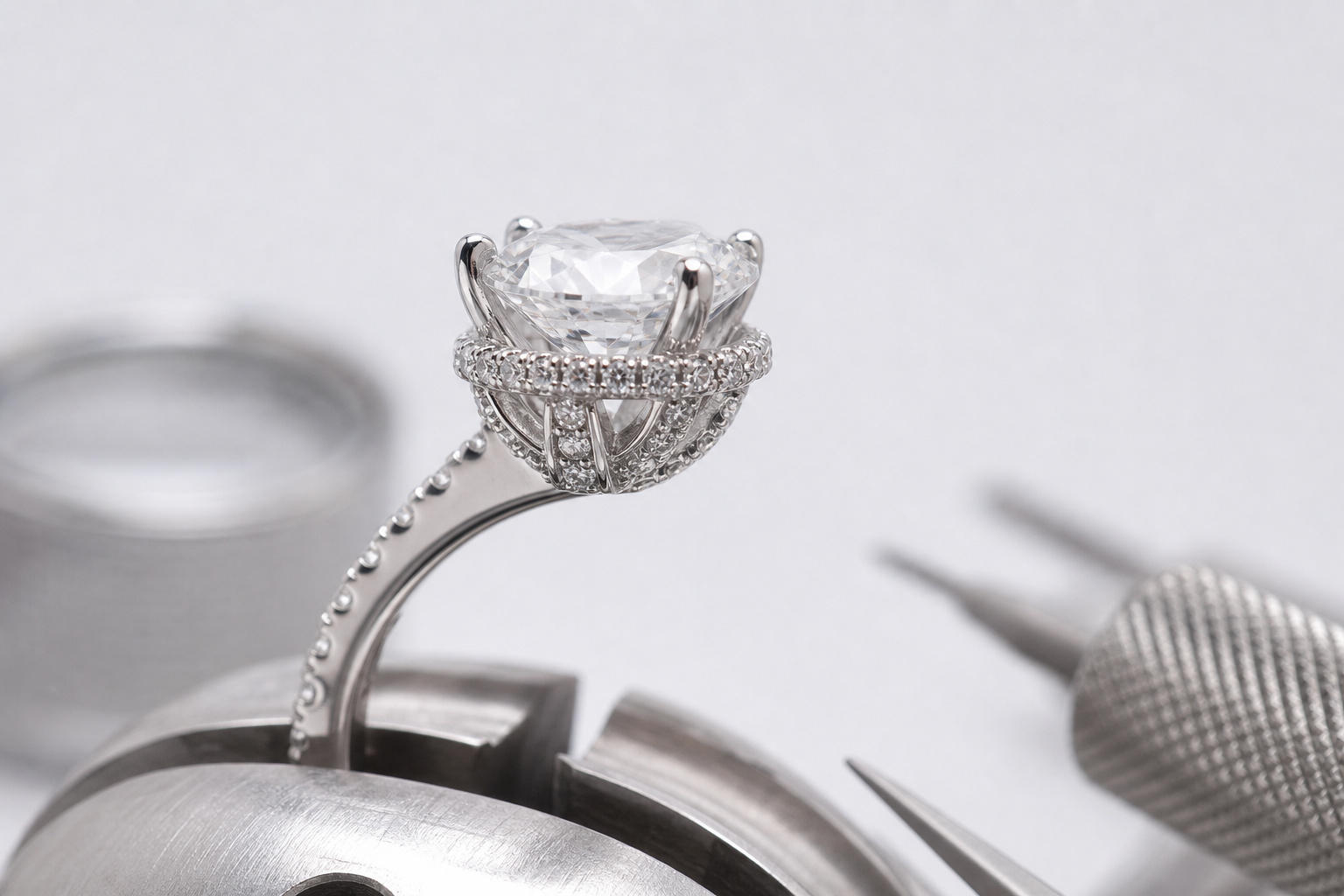
Accent diamonds usually cost far less individually than the center stone, but the invoice is not only charging for the stones. The real cost is often in the labor required to place them securely and evenly. A row of pavé must look consistent from every angle, and each tiny stone needs a secure seat. If the work is rushed or too lightly built, the ring may look delicate at first but become more vulnerable to loose stones over time.
This is where buyers often misread value. A lower pavé engagement ring cost may come from fewer accent diamonds, lighter metal, simpler finishing, or less precise setting work. None of those tradeoffs is automatically unacceptable, but they should be visible in the quote. If two rings look similar in photos but one is much cheaper, the difference may be hidden in construction rather than the design concept.
Side stones create a different kind of cost. Larger side diamonds need to be matched for size, shape, color, and overall appearance. In a three-stone or side-stone engagement ring, poor matching is more noticeable than many buyers expect because the stones are viewed together. Paying for better matching can be more worthwhile than pushing the center diamond slightly higher in clarity, especially when the side stones frame the center stone directly.
Pavé, milgrain, basket work, and hand finishing
Pavé adds cost because it multiplies the number of setting points. A single pavé row is usually more budget-friendly than pavé on the band, bridge, and basket. Split shanks add more surface area and often more stones. Hidden halos add visual detail from the side, but they also require extra precision because the stones sit close to the center setting and must not interfere with the structure.
Milgrain and vintage-style details are easy to underestimate. They may not add large material cost, but they add finishing time and require clean execution. Poorly done milgrain can make a ring look busy or uneven rather than refined. The same applies to basket work under the center stone: it may not be visible from the top, but it affects the ring’s profile, durability, and overall craftsmanship.
The practical judgment is simple: pay for detail when it improves the ring from the angles the wearer will actually notice, and be cautious when decorative work adds fragility without adding much visible value. A hidden halo can be beautiful if the wearer likes side-view detail. It is less valuable if the priority is a clean top-down look and easy long-term maintenance.
Buyer Verification Checklist
- Ask how many accent stones are included and whether their total carat weight is listed clearly.
- Check where pavé appears: band only, basket, bridge, hidden halo, or multiple surfaces.
- Look for construction clarity, especially whether the ring uses enough metal around small stones to support daily wear.
- Compare finishing quality, not just the presence of details such as milgrain or engraving.
- Be cautious with very low quotes on highly detailed designs, because the savings may come from lighter construction or reduced finishing time.
When custom design changes the budget
Custom design does not always mean dramatically more expensive, but it does change how the ring is priced. A custom lab-grown diamond ring may cost more when the design requires extra development, special stone matching, unusual proportions, or nonstandard fabrication. In simpler made-to-order cases, the main difference may be process rather than a major price jump.
The key distinction is whether the ring is being adapted from an existing design or built as a more bespoke engagement ring. Adjusting prong style, band width, metal color, or center stone size is usually less cost-intensive than creating a new ring architecture from scratch. The more the design moves away from standard construction, the more likely custom engagement ring cost will reflect additional design and production time.
For custom jewelry, stone measurements and setting compatibility should be confirmed before finalizing a purchase. This is especially important for elongated shapes, low-profile rings, flush-fit wedding band plans, unusual prong layouts, and designs with side stones close to the center setting. A diamond can have appealing grades and still require a different basket, prong position, or band proportion to work safely in the final piece.
CAD revisions, sourcing, and setting fabrication
A typical custom process includes consultation, design direction, a CAD model, review, revisions, production, and final setting. CAD design is useful because it lets the buyer see proportions before the ring is made, but every revision can add time. One or two focused revisions are normal. Repeated changes to the band shape, basket height, stone layout, or side profile can push the project beyond the original estimate.
Stone sourcing can also affect the budget. If the design needs matched side stones, a specific elongated shape, a very low-profile center setting, or accent diamonds within a narrow color range, the sourcing work becomes more specific. The added cost is not only the stones themselves; it is the time spent finding components that fit the design rather than forcing the design to accept whatever is easiest to source.
Fabrication matters most when the ring has unusual geometry. A standard solitaire adapted to fit a chosen lab-grown diamond is usually straightforward. A low-set oval with a hidden halo, custom prongs, a curved wedding band fit, and matching side stones is a different project. The risk is not just a higher quote. The greater risk is approving a design that looks good in isolation but does not wear comfortably or protect the stones well.
Timeline, approval steps, and where change orders can increase cost
Many custom or made-to-order rings take several weeks, though timelines can run longer when revisions, special sourcing, or complex production are involved, especially when lab grown diamond pricing factors are still being evaluated alongside design specifications. A longer timeline is not automatically a problem. What matters is whether the approval steps are clear before production begins. The buyer should know when the design is still flexible and when changes become expensive.
Change orders usually increase cost when they happen after CAD approval or production start. Changing a center stone size may require a new setting. Changing side stone dimensions can affect the basket or band. Switching from gold to platinum can change both material cost and production requirements. These are not cosmetic edits at that stage; they can alter the structure of the ring.
At NUVU, this is treated as a practical design-fit question rather than a single-grade decision. A stone with strong specifications on paper can still be the wrong physical fit for a specific design, especially with elongated shapes, low-profile settings, and rings meant to sit flush with a wedding band.
What records to ask for in custom or made-to-order rings
For made-to-order pieces, the best traceability usually comes from keeping the design record intact from start to finish. Buyers should ask for the final CAD approval, the confirmed metal type, the agreed center stone identification, and a written summary of any special features such as prongs, hidden halos, or matching side stones. Those records make it easier to compare the finished ring with what was approved, especially if a change is made during production.
It is also sensible to confirm how the finished ring will be described on the final invoice or order summary. If a custom piece changes from the original concept, the buyer should be able to see what was altered and when. That does not eliminate every risk, but it does make the purchase easier to audit and easier to discuss if the finished ring needs adjustment.
In custom design, the most useful documentation is the version history: final stone choice, final CAD, final metal, and any approved changes before production.
What This Means in a Real Purchase
Custom work is most worthwhile when the buyer has a clear design reason for it: a specific profile, a meaningful detail, an unusual stone shape, a matching wedding band requirement, or a setting that is not available as a standard option. It is less worthwhile when the goal is only to make a common design feel more exclusive. In that case, a well-made standard or semi-custom setting may deliver better value.
Before approving a custom quote, look for three things: what is included in the design process, how many revisions are covered, and what changes would create additional charges. A strong custom process should make the decision clearer, not more open-ended. The better result is not necessarily the most complicated ring; it is the design that uses the budget where the wearer will actually see, feel, and rely on it every day.
How to budget a finished ring by total spend, not loose stone price
The most useful engagement ring budget starts with the finished ring price, not the loose diamond price. If you spend the entire budget on the center stone first, the setting can become an afterthought, and that is where buyers often get boxed into compromises they did not plan for: a thinner setting, a different metal, fewer accent stones, or a simpler design than they actually wanted.
A better approach is to decide what the complete ring should cost, then divide that number across the parts that create the final piece. For a simple solitaire or minimal setting, the center diamond may reasonably take the largest share of the total budget, with the setting, metal, and basic labor taking most of the rest. For a more detailed ring with pavé, a halo, a three-stone layout, platinum, or custom work, the center diamond may take a smaller share because more of the budget is being used to build the ring around it.
This does not mean a decorative ring is a worse value. It means the value is distributed differently. A buyer who wants the largest possible center diamond for the budget should usually keep the setting simple. A buyer who cares more about a detailed profile, extra sparkle from the band, or a design that feels more personal should expect less of the total spend to sit in the center stone alone.
Example budget splits for lower, mid, and higher total budgets
For a lower total budget, the strongest strategy is usually restraint. A clean 14k gold solitaire or simple low-detail setting keeps more money available for the center diamond while avoiding unnecessary labor costs. In this type of lab-grown ring budget, putting a larger share of the spend toward the diamond often makes sense, because extra setting complexity can quickly reduce the size or quality of the main stone.
For a mid-range budget, there is more room to balance the diamond and the design. A buyer might still prioritize the center stone, but add a hidden halo, pavé band, upgraded prongs, or a more refined basket. In this range, the setting and metal may take a more noticeable share of the total ring spending, especially if the design uses platinum or includes multiple small accent stones. The key is to decide which detail will actually be noticed and appreciated, rather than paying for every possible upgrade at once.
For a higher total budget, the preferred allocation depends heavily on the design goal. If the goal is visual size, the extra spend may still belong in the center diamond. If the goal is a more intricate or custom piece, it is normal for a larger share to go into setting architecture, stone matching, CAD work, hand finishing, and fabrication. At this level, the mistake is assuming the strongest budget split is always the one with the most expensive diamond. A beautifully proportioned ring can justify spending more on the build when the setting is central to the look.
As a practical guide, simpler rings often work well when the center stone remains the main cost layer and the setting is kept clean. More decorative or custom rings may shift noticeably more into setting complexity and labor. If that shift feels uncomfortable, the design may be competing with the diamond for too much of the same budget.
A budget split is a planning tool, not a rule. The better test is whether each extra dollar changes something visible, wearable, or confidence-building. Paying more for a slightly higher clarity grade may not matter if the stone is already eye-clean, while paying more for better prong work or a sturdier band may matter every day. The better allocation depends on the wearer’s priorities, the ring design, and which tradeoffs are acceptable.
A realistic scenario: the same diamond, two different ring totals
Imagine two buyers choose the same lab-grown center diamond. The first places it in a 14k gold solitaire with a clean basket and standard prongs. The finished ring price stays close to the diamond-driven budget because the setting is simple, the metal use is controlled, and the labor is straightforward.
The second buyer uses that same diamond in a platinum halo with pavé along the band, custom claw prongs, and a more detailed gallery. The center stone has not changed, but the finished ring price can rise meaningfully because the quote now includes more metal, more accent stones, more setting labor, more finishing time, and more design coordination. This is why two rings with the same main diamond can feel similar in headline specifications but land at very different final totals.
The right choice depends on what the buyer wants the ring to do. If the priority is a larger-looking center stone at the cleanest price, the solitaire is usually the better value. If the priority is a more ornate ring with sparkle from multiple angles, the higher setting spend may be justified. What matters is recognizing that the second ring is not simply “more expensive”; it is buying a different kind of result.
How to keep price comparisons specific
Prices can change with market conditions, report type, seller channel, and stone-specific details, so exact comparisons should be verified at the time of purchase. A quote that looked competitive earlier may no longer reflect the same availability, metal cost, diamond selection, or production scope later. This is why buyers should compare current quotes rather than relying on older price examples or general rules.
When reviewing a finished ring price, ask whether the amount is tied to a specific center stone and a specific setting plan. If the quote is based on an example diamond, a placeholder carat range, or a design that has not been fully specified, the final price may change once measurements, metal, accent stones, or customization details are confirmed. The more exact the quote, the easier it is to judge whether the ring fits the budget.
It is also useful to separate affordability from value. A lower total price can be appropriate when the design is simpler and the specifications still meet the buyer’s needs. A higher price can be appropriate when it reflects more labor, more metal, better-matched accent stones, or custom work the buyer truly wants. Neither conclusion should be automatic; both depend on what the quote actually includes.
Budget Allocation Check
Before committing to a ring, ask whether the budget matches the design priority. If the center diamond is the main feature, the setting should support it without consuming too much of the total spend. If the setting is a major part of the design, the budget should leave enough room for proper construction instead of forcing the jeweler to make the ring look detailed while cutting corners on weight, finishing, or stone setting.
A useful test is to compare what you would change first if the quote came in too high. If you would reduce decorative details before changing the center diamond, your budget priority is the stone. If you would keep the setting design intact and choose a slightly different diamond, your priority is the complete look. That decision should be made early, not after you have already fallen in love with a design that stretches the budget in the wrong place.
Comparing engagement ring quotes is only useful when the quotes are built on the same assumptions. A lower total price is not automatically a better deal, and a higher price is not automatically a sign of better quality. The real question is whether each quote includes the same center stone specifications, setting construction, metal type, side stone details, labor expectations, and included services.
The biggest mistake is comparing only the final number. One quote may include a heavier platinum setting, matched pavé stones, custom prong work, CAD revisions, and final finishing. Another may use lighter metal, simpler construction, fewer details, or a more basic setting while still looking similar in a small product photo. Those two quotes are not offering the same ring, even if the center diamond appears comparable.
What should be included in a complete quote
A complete quote should clearly identify the center diamond, including carat weight, shape, color, clarity, cut information where applicable, grading report details, and any visual review notes that affect selection. If the diamond is not specified clearly, the quote is too vague to compare. A ring price built around an undefined or interchangeable stone can shift later, especially if the final diamond has different proportions, availability, or grading characteristics.
The quote should also describe the setting in enough detail to judge construction, not just style. “Halo ring” or “pavé band” is not specific enough. The buyer should know the metal, approximate design approach, side stone count or total accent weight where relevant, prong style, band details, and whether any part of the ring is custom, modified, or made to order. If a quote gives a beautiful design name but avoids construction details, it may be difficult to understand what the price actually includes.
Services and process details matter as well. Design revisions, CAD renderings, stone matching, resizing terms, appraisal documents, shipping, production timing, and post-purchase service can all affect the real value of a quote. Not every quote needs to include every service, but anything that affects the buying experience or final ownership cost should be visible before the buyer makes a decision.
Where a low price can hide tradeoffs in quality or service
A lower quote often has a reason behind it. Sometimes the reason is efficient sourcing or a simpler design, which can be perfectly fine. Other times, the savings come from lighter metal, fewer accent stones, less precise finishing, reduced customization, or limited support after purchase. The risk is not the low price itself; the risk is not knowing what was removed to reach it.
Metal weight is one of the easiest places for a ring to look similar online but feel different in person. A lighter setting may reduce cost, but it can also affect durability, balance, and long-term wear. This matters most for rings with thin bands, pavé, raised heads, large center stones, or delicate galleries. A setting that is too light for the design can create future problems that were not obvious at checkout.
Finishing is another area where price differences can hide. Clean prongs, even pavé, smooth edges, secure stone setting, and a well-proportioned basket take time. A ring with small workmanship issues may still photograph well, but the difference becomes more noticeable during daily wear. If a quote is much lower than others for a detailed design, ask what level of hand finishing, inspection, and adjustment is included.
There is also a service tradeoff. A quote that excludes design revisions, stone review, sizing support, or clear documentation may look attractive at first but require more effort from the buyer later. For a straightforward solitaire, that may be acceptable. For a custom or highly detailed ring, limited communication and unclear approvals can become expensive in a different way: delays, redesigns, or a finished piece that does not match the expectation.
Seller policies and promises to verify before purchase
Some buying details are not visible in the ring itself but still affect the total purchase decision. Before purchase, buyers should confirm documentation, return terms, resizing policies, warranty or repair coverage, shipping arrangements, production timing, and after-sales support directly with the seller. These should be checked in writing rather than assumed from general product language or a sales conversation.
Be careful with phrases such as “guaranteed quality,” “lowest price,” “risk-free,” or “certified value” unless the seller provides clear policy language and the claim can be verified. A grading report can document diamond characteristics, but it does not replace a seller’s actual policies, and it does not prove future resale value or long-term service terms. For a large or custom purchase, the buyer should know which commitments are documented and which are simply general descriptions.
NUVU’s buyer-first approach is to make comparison clearer, especially around report details, visual evidence, setting fit, and documentation. That does not mean a buyer should rely on brand language alone. The stronger purchase process is the one where the buyer can see the stone details, understand the setting build, confirm the terms, and approve the final design with enough information to compare alternatives fairly.
Quote Comparison Checklist
When comparing quotes, keep the review focused on what changes the finished ring price and the finished ring quality. The goal is not to choose the cheapest option. The goal is to understand whether the lower or higher price reflects a meaningful difference.
- Center diamond: Confirm the exact stone, grading report, carat weight, shape, color, clarity, proportions, and visual appearance.
- Setting construction: Compare the actual design details, not just the setting category or product name.
- Metal: Check whether the quote uses 14k gold, 18k gold, or platinum, and whether the design appears appropriately built for the center stone.
- Accent stones: Review the number, size, quality, and placement of side stones, pavé, halos, or hidden details.
- Labor and finishing: Ask what is custom, what is standard, and how much hand finishing or adjustment is included.
- Process and services: Clarify CAD approvals, revisions, timelines, documentation, resizing terms, shipping, and after-purchase support.
If two quotes differ by a small amount, choose the one with clearer specifications and better alignment with the design you actually want. If they differ by a large amount, do not assume one seller is simply cheaper or more expensive. Break the quote apart. The answer is usually in the construction, metal, labor, stone details, or service terms, and that is where the real value comparison begins.
Disclosure: This article is for general educational purposes only. Diamond grading, pricing, availability, specifications, and seller policies can change, and readers should verify important details through grading reports, official laboratory tools, seller documentation, or qualified professionals before making a purchase decision. Laboratory-grown diamonds should be clearly distinguished from natural diamonds, and environmental or sourcing claims should be supported by specific documentation.