
Buying lab-grown diamonds or finished jewelry from a Chinese supplier can be efficient, but the real risk is not simply whether the company exists. The harder question, especially in China lab-grown diamond cutting and polishing programs, is whether the supplier can repeat the same quality, documentation, communication, packing, and problem-solving standards when an order moves from sample size to wholesale volume.
For the full framework, read China Lab-Grown Diamond Supply Chain Guide.
This article helps you verify a supplier before committing larger funds. It explains how to check business identity, match certificates to actual stones, confirm stock and specifications, test communication, review QC steps, and identify red flags before they become costly disputes. The goal is to help you decide when a supplier is ready for a sample order, when more proof is needed, and when it is safer to walk away.
For evidence-based due diligence, separate three kinds of proof: company proof, product proof, and transaction proof. Company proof helps confirm who you are dealing with. Product proof helps confirm whether the stones or jewelry being offered are specific and traceable. Transaction proof helps confirm what was agreed, paid for, prepared, shipped, and received. A supplier can pass one category and still fail another, so the safest approach is to build a complete verification file before scaling an order.
| Verification Area | What to Check | Decision Signal |
|---|---|---|
| Business identity | Registered name, invoice name, payment beneficiary, address | All details should match or be clearly explained |
| Product proof | Report numbers, measurements, photos, videos, live availability | Evidence should link to specific stones, not generic stock |
| Certificates | Verify reports directly with the issuing lab | Grades help, but do not prove supplier reliability |
| Sample order | Test the exact product type, packing, documents, and timeline | Use repeatability before scaling volume |
| Written terms | Specs, substitutions, shipping terms, payment details, issue handling | Vague terms increase substitution and dispute risk |
| Red flags | Bank changes, recycled images, pressure to pay, evasive answers | Pause until the supplier provides clear proof |
Compliance-aware sourcing starts with precise language. A laboratory-grown diamond should be identified as laboratory-grown and should not be presented as a natural or mined diamond. Diamond simulants, such as non-diamond lookalikes, should also be kept separate from lab-grown diamonds in supplier descriptions, invoices, and customer-facing materials.
Environmental, sustainability, and sourcing claims should be treated as claims that require support, not as automatic benefits. A China-linked supply chain, a laboratory-grown origin, or a factory-direct sales channel may be relevant to a buyer’s decision, but none of those details alone proves lower impact, ethical sourcing, or better value.
A grading report can document key characteristics, but it should not be treated as a guarantee of beauty, value, sourcing ethics, supplier reliability, or future resale performance. Buyers should compare report details with visual evidence, measurements, written supplier documentation, and the intended jewelry use.
Quick Questions Before You Read
Q: Is a business license enough to trust a supplier?
No. It confirms identity, but not consistency, stock control, grading accuracy, or after-sales support.
Q: Does a diamond certificate guarantee I will receive the right stone?
No. You still need to match the report number, measurements, images, invoice, and shipment records.
Q: Should I place a large order after one good quote?
No. Start with a representative sample order that tests the same product and process you plan to scale.
Q: When should I stop negotiations?
Stop or pause when payment details, product identity, documentation, or written confirmations become inconsistent.
Start With the Real Question: Can This Supplier Support Repeat Wholesale Orders?
Before placing a wholesale order with a Chinese lab-grown diamond supplier, the most useful question is not simply whether the company is “real.” The better question is whether the supplier can repeat the same result over time: similar quality, accurate documentation, clear communication, reliable packing, and predictable handling when something changes.
A low quote can attract attention, especially in overseas sourcing, but it does not prove that the supplier can support wholesale volume, custom jewelry work, or repeat orders. Supplier verification should be treated as a layered process. Business identity, product evidence, grading reports, sample order performance, communication habits, order records, QC steps, and after-sales behavior all matter because each one reveals a different kind of risk.
Why a Low Quote Is Not Enough for Wholesale Sourcing
Wholesale buyers are not only buying a diamond. They are relying on a supply channel. A supplier may offer attractive pricing on 2-carat ovals, emerald cuts, or matched melee, but price alone says little about whether the stones are actually available, whether the report numbers match, whether substitutions will be disclosed, or whether the same quality range can be sourced again next month.
The mistake is treating the first quote as proof of capability. In practice, the lowest offer can become expensive if the stones are not held, if the final goods do not match the agreed specifications, or if delays leave a retailer unable to fulfill customer orders. For wholesale due diligence, the headline price should come after the supplier has shown that their information is traceable and their process can be tested.
Price differences can reflect many factors at once: stone availability, grading report type, cut make, measurements, shape demand, production timing, payment terms, service level, and whether the supplier is quoting goods already in hand or goods that still need to be sourced. A lower number is not automatically unsafe, and a higher number is not automatically better. The practical buyer question is whether the quote is supported by verifiable stone details, realistic timing, and written terms that make the comparison fair.
How to Compare Price Without Relying on Unsupported Savings Claims
When comparing China-based suppliers, avoid reducing the decision to broad claims such as “cheapest,” “factory-direct,” or “best value.” Those phrases can be misleading unless the supplier can show exactly what is included in the comparison. A quote for a loose laboratory-grown diamond with one report type, one cut make, and one shipment arrangement is not directly comparable to a finished custom ring with CAD work, setting labor, packaging, and different documentation.
Prices can change with market conditions, report type, seller channel, and stone-specific details, so exact comparisons should be verified at the time of purchase. For wholesale due diligence, compare like-for-like details: shape, carat range, color, clarity, measurements, report availability, visual make, quantity, payment terms, production status, shipping responsibility, and any documentation included in the order record.
A supplier does not need to be the lowest-priced option to be commercially useful. In many sourcing situations, a slightly higher quote with clearer stone identity, stronger written terms, and more reliable QC evidence may reduce the buyer’s operational risk. The safer comparison is not “Which supplier is cheapest?” but “Which supplier gives enough verifiable evidence for this order type, quantity, and intended resale or jewelry use?”
The Difference Between Buying One Stone and Building a Repeat Supply Channel
A one-time consumer purchase can tolerate a narrower kind of verification. If the diamond, report, and delivery are correct, the transaction may be complete. Wholesale sourcing is different. A retailer, private-label brand, or online seller needs repeatability: the ability to obtain comparable stones, consistent jewelry finishing, matching documentation, and steady communication across multiple orders.
This is where many first-time buyers underestimate the risk. One acceptable shipment does not automatically prove that the supplier can handle a 30-stone order, a custom ring program, or ongoing matched inventory. A supplier that works well for occasional loose-stone sourcing may not be the right fit for custom jewelry production. A China diamond manufacturer may have strong production capability but weaker export communication. A trading company may be useful if it is transparent about its role and controls sourcing carefully. The issue is not the label; the issue is whether the supplier’s claimed capability matches the order you actually plan to place.
The Core Evidence You Need Before a Larger Order
A serious verification process should connect what the supplier says with evidence you can check. You need proof that the business identity is consistent, that the products being offered are specific rather than generic catalog items, that certificate details can be verified where applicable, and that the order record clearly states what will be supplied.
Communication is part of the evidence, not a side issue. If a supplier cannot confirm stone availability, certificate numbers, measurements, timelines, payment beneficiary details, or custom jewelry requirements in writing before payment, that weakness will usually become more serious once production or shipping begins. For wholesale buyers, unclear answers are not just inconvenient; they create inventory, cash flow, and customer-service risk.
A useful way to strengthen your review is to save every claim in a verification folder: business documents, screenshots of the quoted stones, report lookup results, videos, invoices, payment instructions, CAD approvals, QC photos, packing images, tracking records, and after-sales messages. This does not make the supplier risk-free, but it gives you a factual record if availability changes, if a substitution is proposed, or if a received item does not match the agreed order.
In sourcing or wholesale conversations, documentation, consistency, and communication often matter as much as the headline specification because they determine whether the buyer can reconstruct the transaction from evidence rather than assumptions.
What This Means in a Real Purchase
Consider a U.S. jewelry startup that finds a lab-grown diamond wholesale supplier offering competitive pricing on 2-carat oval diamonds. Before committing to 30 stones, the buyer should not rely only on a product sheet and a friendly sales message. A stronger first step is to request a structured sample order: specific stones in the target range, stone-specific photos and videos, report numbers where available, a clear invoice, confirmed payment details, and written shipping communication.
If the videos, report information, invoice details, and delivery updates all align, the buyer has stronger evidence than a quote alone. If the supplier becomes vague, changes payment details without explanation, cannot confirm which stones are available, or avoids written documentation, the better decision is to slow down before scaling up.
Verify the Supplier’s Business Identity Before Discussing Price
China diamond supplier verification should begin with identity, not negotiation. A supplier’s price has limited value if the buyer cannot confirm who is issuing the invoice, who is receiving payment, and whether the business details match across documents and communication channels.
A business license or company registration document is useful, but it is not a guarantee of reliability by itself. The practical goal is consistency. The registered company name, invoice name, payment beneficiary, address, email domain, packaging details, and any company information shared during the inquiry should point to the same business relationship. Inconsistency does not always prove fraud, but it is a reason to pause and ask for clarification before sending money.
Match the Company Name Across Documents, Invoices, and Payment Details
Start by asking for the supplier’s registered company name, business license or registration information where appropriate, physical address, and the company name that will appear on the proforma invoice. Then compare those details with the payment beneficiary and the communication channel you are using.
The most important check is whether the money is being sent to an account that logically matches the supplier relationship. A last-minute request to pay a different company, an unrelated personal account, or a beneficiary that has not appeared in previous documents should be treated as a serious warning sign. There may be legitimate explanations in some business structures, but the supplier should be able to document the relationship clearly before payment.
Identity checks should also be viewed as a limitation, not a full approval. A matching license, invoice, and bank beneficiary can reduce payment confusion, but they do not prove product quality, grading accuracy, or production consistency. Treat identity verification as the first gate: if it fails, stop; if it passes, continue into product-specific and order-specific verification.
Understand Whether You Are Working With a Manufacturer, Trader, or Hybrid Supplier
A trading company is not automatically a problem, and a manufacturer is not automatically the better choice. Many overseas jewelry buyers work successfully with suppliers who source from multiple producers, especially when they need flexible inventory or mixed specifications. The risk comes from misrepresentation.
If a supplier claims to be a China diamond manufacturer, ask what they actually control. Do they grow rough, cut and polish stones, hold finished lab-grown diamond inventory, produce jewelry in-house, coordinate with partner factories, or operate as a sourcing and export company? Each model can work, but each has different implications for availability, pricing stability, custom jewelry timelines, and accountability when an issue appears.
The strongest suppliers are clear about their role. If a company says it manufactures everything but cannot provide consistent address details, production-related documentation, or product-specific evidence, the claim should not carry much weight. Accuracy matters more than the most impressive label.
Check for Address, Registration, and Export Experience Consistency
For overseas sourcing, the supplier should be able to provide basic business identity details without treating the request as unusual. Ask for the registered address, operating address if different, export experience evidence where available, and company information that matches the invoice and packaging.
Address differences are not automatically suspicious. A company may have a registered office, showroom, warehouse, and production partner in different locations. What matters is whether the supplier explains those differences clearly and consistently. If every document shows a different business name or address with no explanation, the buyer has no reliable chain of accountability.
Export experience is also worth checking, especially for wholesale lab-grown diamonds or custom jewelry orders. A supplier familiar with international buyers should understand commercial invoices, packing details, certificate handling, shipping communication, and written order confirmation. Lack of export experience is not always disqualifying, but it raises the amount of guidance and documentation the buyer will need to manage.
Buyer Verification Checklist
- Request the registered company name and business license or registration details where appropriate.
- Confirm the company name on the invoice matches the supplier relationship.
- Check whether the payment beneficiary is consistent with the documented company or clearly explained.
- Compare the address across the business license, invoice, email signature, website, packaging, and shipping documents.
- Ask whether the supplier is a manufacturer, trader, sourcing office, jewelry producer, or hybrid supplier.
- Request a clear explanation for any mismatch before paying.
The practical rule is simple: do not let pricing discussions outrun identity checks. If the business relationship is unclear at the beginning, it will be harder to resolve disputes after payment.
Ask for Product Evidence That Proves Actual Inventory or Production Capability
Product evidence is where supplier verification moves from “this company exists” to “this company can supply what I need.” A polished catalog can show taste and product range, but it does not prove current lab-grown diamond inventory, direct access to specific stones, or the ability to produce consistent custom jewelry.
For wholesale lab-grown diamonds, the buyer should ask for evidence tied to specific goods. For custom jewelry, the buyer should look for proof of comparable work, not just lifestyle images or generic renderings. The goal is to separate real product control from broad sourcing claims.
Request Stone-Specific Photos, Videos, Measurements, and Availability Confirmation
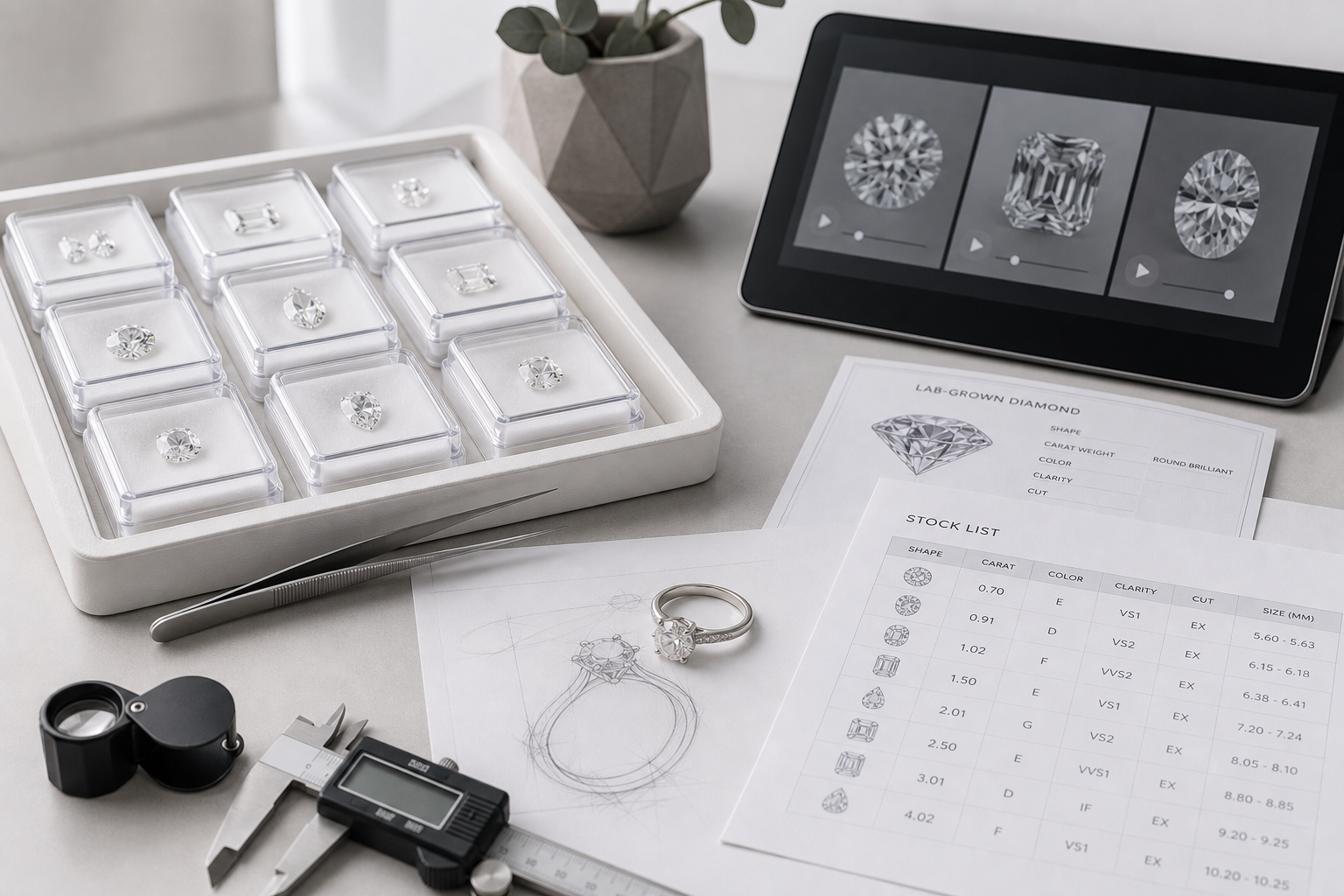
For loose diamonds, ask for a current stock list with report numbers where applicable, exact carat weight, shape, color, clarity, cut information if available, measurements, and written availability confirmation. A useful supplier should be able to connect each offered stone to a specific set of details, not only a broad description such as “2 ct oval F VS.”
For an initial evaluation, request 3 to 5 comparable stones in your target category. If your future order will focus on 1.50 to 2.00 carat oval lab-grown diamonds, do not evaluate the supplier using only a small round stone that is easier to source. Ask for at least one clear photo and one short video per stone, exact measurements, report numbers if certified, and a written statement of whether the stones are available now or subject to confirmation.
Videos are useful, but they should not be treated as complete proof of ownership. They help you check whether the supplier can provide stone-specific media and whether the appearance roughly matches the listed details. They do not, by themselves, prove long-term availability, exclusive control, or future pricing stability.
For Custom Jewelry, Ask for Comparable Finished Work Instead of Generic Catalog Images
If you are evaluating a custom jewelry supplier in China, generic product images are not enough. Ask for 2 to 3 examples of finished projects similar to what you plan to order. For example, if you need hidden-halo oval engagement rings, ask for previous oval ring examples, CAD images, finished-piece photos, metal details, prong style, and any available production notes from similar work.
The closer the examples are to your intended project, the more useful they become. A supplier may have beautiful tennis bracelet photos but still be the wrong fit for delicate custom bridal settings. A strong custom jewelry supplier should be able to show process evidence: CAD development, stone setting examples, finishing quality, and the ability to translate specifications into a finished piece.
For custom work, the most common mistake is judging only the final glamour image. Buyers should look at construction details instead: prong alignment, stone seating, ring proportions, metal finish, engraving clarity, and whether the finished item resembles the approved design. These details reveal production discipline more clearly than catalog styling.
For custom design, the stone should not be evaluated separately from the setting. A diamond with attractive grades may still be a poor fit if its measurements do not suit the CAD, if the depth affects setting height, or if the shape ratio changes the look of the finished ring. Before approving production, compare the stone dimensions, setting style, prong layout, and wearer-facing requirements together rather than treating the loose diamond and jewelry design as two separate decisions.
For custom design, trust comes from matching the stone to the setting, budget, and wearer’s daily use, not from choosing grades in isolation or approving a design from a single polished image.
Confirm Origin, Growth Method, and Treatment Language When It Matters
Supplier product evidence should make the diamond origin clear. Laboratory-grown diamonds and natural diamonds have different origins, and a wholesale buyer should not rely on ambiguous terms such as “real diamond” without a clear laboratory-grown or natural disclosure. Laboratory-grown diamonds should be clearly identified as laboratory-grown, and they should not be presented as mined diamonds.
If a supplier references HPHT or CVD, confirm whether the term is being used to describe the diamond growth method or a post-growth treatment. In lab-grown diamond sourcing, HPHT and CVD are commonly discussed as production methods, while treatment language should be used only when a relevant post-growth process is being disclosed. When growth method or post-growth treatment is relevant, buyers should look for clear disclosure in the grading report or seller documentation.
For wholesale and private-label buyers, origin and treatment wording also affects downstream customer communication. The invoice, product sheet, website listing, and sales description should not blur lab-grown diamonds with natural diamonds or confuse diamonds with simulants. Clear wording protects the buyer’s inventory records and helps avoid customer-trust problems later.
Use Comparable SKUs to Test Consistency Across Multiple Items
Wholesale sourcing depends on consistency across multiple items, not one impressive example. Ask the supplier to present comparable SKUs within the same target range so you can see whether their inventory is coherent. If one stone is much deeper, warmer, or differently proportioned than the others, that may not be wrong, but it changes how useful the batch is for repeat selling or matched customer offerings.
Some suppliers list stones they do not directly control. This is common in many diamond markets and is not automatically fraudulent. The issue is whether the supplier is transparent about availability. If stones are pulled from shared networks, they may sell before payment, pricing may change, and delivery timing may be less predictable. For wholesale buyers, that affects planning even when the supplier is acting honestly.
A better supplier will explain whether goods are in hand, reserved, aligned with HPHT and CVD production schedules, sourced from partner inventory, or produced after order confirmation. Each model can work, but the buyer should know which one applies before treating the quote as firm.
What to Check Before You Decide
- Ask for 3 to 5 comparable stones in the exact category you plan to buy.
- Request stone-specific photos and short videos, not only catalog images.
- Confirm measurements, carat weight, color, clarity, shape, and report numbers where applicable.
- Ask whether each stone is in stock, reserved, partner-sourced, or subject to availability.
- For custom jewelry, request 2 to 3 examples of similar finished projects, not unrelated luxury images.
- Check whether the supplier’s product evidence supports the order type you actually plan to place.
Product evidence does not eliminate every sourcing risk, but it quickly reveals whether the supplier can discuss real goods in a specific, traceable way. If the supplier cannot connect images, measurements, availability, and documentation to the products being offered, a larger order should wait.
Check How the Supplier Handles Diamond Certificates and Report Verification
A lab-grown diamond certificate, more accurately called a grading report, is one of the easiest documents to request and one of the easiest to misunderstand. It can confirm that a specific diamond was graded by a recognized laboratory, but it does not prove that the supplier is reliable, that the stone is still available, or that the diamond will look attractive in the final jewelry piece.
For wholesale buying, the real test is not whether a supplier can send a report image. The test is whether the report number, stone details, stock list, video, invoice, and final shipment all point to the same item without gaps or substitutions.
Verify Report Numbers Directly With the Issuing Lab
Do not rely only on a screenshot, PDF, or photo of a grading report sent by the supplier. Use the report number to check the record directly on the issuing lab’s website, such as IGI report verification or GIA report verification where applicable. The online record should match the basic details provided by the supplier, including shape, carat weight, measurements, color, clarity, and any cut information shown for that stone. GIA and IGI both provide online report lookup tools that allow buyers to compare a report number with the details recorded by the issuing laboratory.[1][2]
When a grading report is available, buyers should verify the report details through the issuing laboratory’s official report-check tool where available and compare those details with the supplier’s quote, visual evidence, and invoice.
This step matters because a report image can be outdated, copied from a sold stone, or attached to the wrong stock item by mistake. That does not always mean fraud, but it does mean the buyer should slow down until the supplier can explain the mismatch clearly. A serious wholesale supplier should expect buyers to verify certificate numbers before payment, especially for certified lab-grown diamonds above smaller melee sizes.
Report availability can also vary by product type. Larger center stones are more likely to come with individual grading reports. Small accent stones, melee, and some production batches may not have individual certificates, which makes batch documentation, sorting standards, and pre-shipment QC more important. The absence of an individual report is not automatically a problem for small stones, but the supplier should be clear about what documentation is included before the order is placed.
When you perform an official report lookup, save the result with the date of your check and the supplier’s matching quote or invoice. This creates a narrow but useful evidence trail: it shows what the lab record displayed at the time you reviewed the stone, and it helps you compare the same report number against the shipment record later. It does not prove ownership or reserve status, but it makes accidental or undisclosed substitutions easier to spot.
Match the Report Details to the Stone Being Offered
After confirming that the report number is valid, compare the report details against the supplier’s stock list and stone-specific evidence. The carat weight should match exactly or within the normal way the supplier has listed it. The measurements should align with the stone shown in the video or photo. The shape, color, clarity, and any listed cut grade or polish and symmetry details should be consistent across the report, quotation, and invoice.
For stones with laser inscriptions, ask whether the inscription can be shown in a close-up video or inspection photo if practical. Not every video will capture it clearly, and not every order requires this level of evidence, but it is useful when the stone is high value or when multiple similar diamonds are being compared. If the supplier provides five oval diamonds with similar carat and color grades, the measurements and report numbers become the practical way to keep each stone separate.
The common mistake is treating the certificate as proof that the exact diamond being shipped is the one the buyer selected. It is only one link in the chain. The report should match the supplier’s current availability confirmation, the stone video, the written quote, the invoice, and the pre-shipment record. If one of those documents describes the diamond generically, such as “2 ct oval lab diamond” without a report number or measurements, the order is still exposed to substitution risk.
Understand What a Certificate Does Not Prove
A grading report does not prove that the supplier owns the stone, controls the inventory, or can reserve it until payment. It also does not prove that the supplier can handle repeat orders, custom jewelry production, matching requests, or delivery timelines. Those questions belong to supplier performance, not diamond grading.
A certificate also does not guarantee visual appeal. Two lab-grown diamonds with the same carat, color, clarity, and report type can look different because of proportions, faceting, bow-tie visibility in elongated shapes, windowing, light return, or how the stone appears under real lighting. This is especially important for ovals, pears, emerald cuts, radiants, and other shapes where appearance can vary noticeably even within similar grades.
A grading report can narrow the comparison, but it should be read alongside the stone’s proportions, visual evidence, and intended jewelry use. This is especially important when the stone will be set into a custom piece, where measurements, face-up spread, depth, and shape ratio can affect both appearance and setting compatibility.
At NUVU, we treat a grading report as a starting point rather than the whole decision. For wholesale sourcing, the report helps confirm identity and basic grading data, but it should be paired with stone-specific video, written order details, and a supplier process that makes substitutions visible before money or inventory planning is committed.
Keep Lab Report Claims Within Their Actual Scope
When a supplier says a diamond is “certified,” ask what that means in the specific order. In many buying conversations, the word refers to a grading report issued by a gemological laboratory, not a broad guarantee from the seller. The report may document characteristics such as carat weight, measurements, color, clarity, polish, symmetry, fluorescence, inscription, and laboratory-grown origin where applicable, but the exact fields depend on the report type and issuing lab.
A grading report should not be used as proof that the supplier’s business is reliable, that the price is the lowest available, that the diamond is environmentally preferable, or that the finished jewelry will meet a buyer’s expectations. Those claims require separate evidence. Report verification confirms that the report record can be checked through the lab’s system where available; it does not prove the supplier’s ownership, reservation status, shipment contents, or after-sales process.
For wholesale buyers, the safest approach is certificate-aware buying rather than certificate-only buying. Use the report to anchor the stone identity, then compare it with the supplier’s current availability confirmation, live product evidence, invoice details, QC media, and packing record. If any part of that chain is missing, request clarification before treating the order as ready for payment or shipment.
Certificate and Visual Review Check
- Verify every report number directly on the issuing lab’s website before payment.
- Match carat weight, shape, measurements, color, clarity, and cut details against the supplier’s quote and stock list.
- Ask whether the stone has a laser inscription and whether it can be shown or confirmed when relevant.
- Compare the report with actual product evidence, including photos, videos, and availability confirmation.
- Do not accept a generic invoice when the order is for specific certified stones; report numbers should appear in the order record where applicable.
- For uncertified melee or small stones, request clear batch specifications, sorting standards, and QC expectations instead of assuming individual reports will be provided.
Use a Sample Order to Test the Supplier Before Scaling Up
A sample order should not be treated as a small purchase made only to test price. It is a controlled test of whether the supplier can follow instructions, document the order, prepare the correct goods, communicate changes, package properly, and ship with traceable records. For a lab-grown diamond wholesale order, that evidence is more valuable than a supplier’s catalog or sales promise.
The sample does not need to be large, but it should be representative. If the future plan is to source 1.50 to 2.00 ct oval lab-grown diamonds, testing one small round stone tells you very little about whether the supplier can provide the shape, size range, and consistency you actually need. If the future order involves custom rings, the sample should test the custom process, not just a loose stone shipment.
Choose a Sample That Matches Your Real Future Order
A useful sample order mirrors the buyer’s intended sourcing category. A retailer planning to build inventory around certified center stones should request a small group of stones in the target range, not the cheapest available item. A private-label brand planning custom jewelry should test a simple but relevant project from specification to CAD, production, QC photos, and shipment.
For loose diamonds, a useful first sample may include one to three stones that match the planned future category in shape, carat range, color and clarity target, and certification expectation. For a more meaningful comparison, ask the supplier to present three to five comparable options before selecting the sample. This shows whether they can source within a defined brief instead of pushing unrelated stock.
For custom jewelry, avoid testing with a design that has no connection to your real product line. If your business plans to sell oval solitaire rings, a generic pendant sample will not reveal much about ring sizing, stone setting, prong work, CAD interpretation, or final fit. A simple ring design in the intended metal type is usually a better test than an elaborate showpiece that the supplier may not need to reproduce consistently.
Document the Agreed Specs Before Payment
Before paying for a sample order, confirm the exact details in writing. For a loose diamond, this should include shape, carat weight, color, clarity, measurements, certificate number when applicable, price, availability status, and what will be included in the shipment. For custom jewelry, include metal type, metal color, ring size, stone details, CAD approval process, engraving if any, finish, production timeline, and whether pre-shipment photos or videos will be provided.
A supplier who is unwilling to write down basic order details is not ready for a larger wholesale relationship. The issue is not formality for its own sake; it is dispute prevention. If the received stone differs from the selected stone, or if a ring arrives in the wrong size, the written record becomes the only reliable reference for resolving the problem.
Timelines should also be stated before payment. For evaluation purposes, routine replies within 24 to 48 business hours are a reasonable benchmark for many overseas sourcing conversations, though not a universal promise. Sample preparation timing, CAD timing, production sequence, and shipment tracking expectations should be clear enough that the buyer is not forced to chase basic updates after payment is sent.
Evaluate the Sample Beyond the Product Itself
A sample can look acceptable and still reveal supplier risk. The product matters, but so does the process around it. Track whether the supplier answers technical questions clearly, sends the promised videos or documents, confirms changes before acting, provides shipment tracking once dispatched, and packages the goods in a way that protects the product and matches the paperwork.
For loose stones, compare the received diamond against the agreed report number, measurements, visual evidence, and invoice details. For jewelry, compare the finished piece against the CAD, approved specifications, ring size, stone placement, prong work, engraving, and finish. If something is wrong, pay close attention to how the supplier handles the issue. A clear explanation and practical correction process is very different from vague excuses or pressure to accept a mismatch.
A successful sample order does not guarantee that every future order will be smooth. It does, however, replace guesswork with evidence. If the supplier struggles on a small, clearly documented order, scaling up usually increases the risk rather than fixing it.
Sample Order Scorecard
- Product match: The received stone or jewelry matches the written specifications, report details, and approved images.
- Documentation accuracy: Invoice, certificate information, shipment details, and product descriptions are consistent.
- Communication quality: Questions receive specific answers, and routine updates are not avoided after payment.
- Timeline control: Preparation, CAD, production, or shipping timing follows what was stated or is updated with a clear reason.
- Packaging condition: The item arrives protected, identifiable, and aligned with the documents provided.
- Issue handling: Any problem is addressed with evidence and a practical response, not blame-shifting or silence.
If the sample performs well on the product but poorly on documentation or communication, do not treat it as a full pass. For wholesale sourcing, repeatability depends on the process as much as the item.
Evaluate Communication Quality Before It Becomes a Production Problem
Supplier communication is not a soft factor in overseas sourcing. It is an early warning system. If a wholesale diamond supplier cannot confirm basic details before payment, the risk becomes larger when stones are reserved, custom jewelry enters production, or customer deadlines depend on accurate timing.
Good communication does not simply mean fast replies. A supplier can respond quickly and still avoid the question. What matters is whether the answer is specific, consistent, and documented well enough that the buyer can make a decision without guessing.
Ask Questions That Require Specific Answers
Vague questions invite vague answers. Instead of asking whether a stone is “good quality,” ask whether the exact report number is available, whether the stone can be reserved after payment, and what happens if it sells before payment is completed. Instead of asking whether custom rings are possible, ask what CAD revision process applies, when production starts, and how finished-piece QC photos are shared before shipment.
Useful questions force the supplier to reveal how they manage inventory, documentation, and production. For example: Can you confirm these exact stones are available today? Are the report numbers attached to this quote? Are the photos and videos for these specific stones? What is the estimated preparation time before shipment? If one stone is no longer available, will you provide replacement options before substituting?
For custom jewelry, the questions should become even more precise. Ask how ring size is confirmed, whether CAD approval is required before production, how metal type and stone setting details are recorded, and what visual evidence will be provided before dispatch. A supplier who can answer these questions clearly is easier to evaluate than one who only says, “Don’t worry, we can do it.”
Look for Written Confirmation, Not Just Verbal Agreement
Written confirmation protects both sides. It turns a conversation into an order record and reduces the chance that a salesperson, production team, or shipping contact interprets the details differently. For a wholesale buyer, this is especially important because one misunderstood specification can affect multiple stones or an entire jewelry batch.
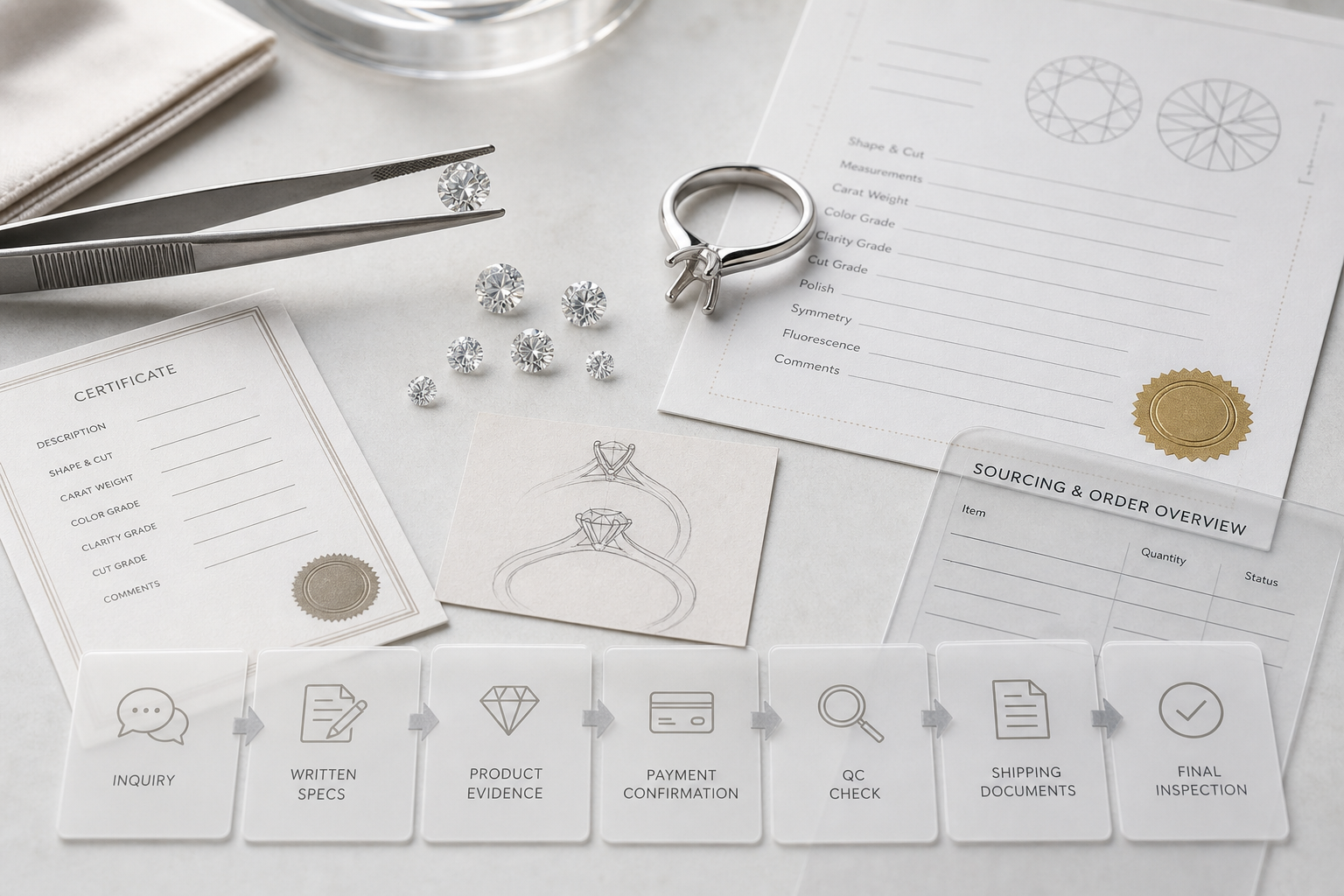
The strongest communication pattern is simple: the supplier confirms the item, specs, price, timeline, payment details, and shipment expectations in writing before money is sent. If the order changes, the change is also written down. This matters more than the platform used. Email, invoice, or a formal order sheet can all work if the details are complete and traceable.
Pay close attention when a supplier gives key information only by voice message or refuses to put important details into the invoice or written order record. Verbal reassurance may feel convenient in the moment, but it becomes weak evidence if there is a dispute over report numbers, stone substitutions, CAD approval, ring size, or delivery timing.
Watch for Pressure, Vagueness, and Unexplained Changes
Pressure is a warning sign when it replaces verification. Limited availability is common in diamond sourcing because stones can sell, but a supplier should still be able to provide clear product evidence, report details, and payment documentation before asking for quick action. “Pay now or lose it” is not a reason to skip basic checks.
Vagueness is another practical risk. If the supplier avoids direct answers about whether the stones are in hand, whether certificates are available, whether the invoice will list report numbers, or whether QC photos are provided before shipment, assume the risk has not been resolved. The safest response is not to argue; it is to ask for written clarification and pause if the answer does not improve.
Unexplained changes deserve extra caution. A sudden switch in company name, contact person, payment beneficiary, stock availability, certificate number, or quoted specs should trigger re-verification before proceeding. Some changes have legitimate reasons, but a reliable supplier will explain them clearly and update the documentation accordingly.
Questions Worth Asking Before You Pay
- Can you confirm these exact stones are available now, not just similar options?
- Are the report numbers attached to this quote, and can I verify them with the issuing lab?
- Are the photos and videos for the exact stones being offered?
- What happens if one selected stone sells before payment is completed?
- For custom jewelry, when is CAD provided, and how many revision rounds are included before production?
- Will the final invoice list the specific stone details, certificate numbers where applicable, metal type, ring size, and agreed timeline?
- How will QC photos or videos be shared before shipment?
- Who is the payment beneficiary, and does it match the company relationship shown on the invoice?
Reliable suppliers do not need to be pushed into clarity. They may not answer every question instantly, but they should be able to provide specific, consistent responses before the buyer takes on payment or production risk.
Review Order Records, Invoices, and Commercial Terms Carefully
A supplier invoice is not just a payment request. For a wholesale diamond order, it is the document that defines what the buyer believes they are purchasing and what the supplier has agreed to provide. If the invoice only says “lab-grown diamond” or “diamond ring,” it is too vague for a serious sourcing transaction.
Clear documentation matters most when something changes. A stone may sell before payment is completed, a custom jewelry detail may be misunderstood, or a production timeline may shift. Without a detailed written order record, the dispute becomes a memory contest instead of a document-based conversation.
Make Sure the Invoice Describes the Exact Product, Not a Generic Category
A useful supplier invoice should identify the exact goods being ordered. For loose diamonds, that means more than shape and carat weight. The document should include the stone specifications agreed before payment, such as shape, carat, color, clarity, cut details where applicable, measurements, certificate or report numbers if available, quantity, unit price, and total price.
For a custom jewelry order, the invoice should go further. It should list the metal type, metal color, ring size if relevant, center stone details, side stone or melee specifications, CAD approval status, engraving details, finish style, and any agreed packaging. If the order involves a gold or platinum piece, a metal weight estimate can also help clarify expectations, even if the final weight may vary slightly after production.
The most common mistake is accepting a proforma invoice that describes the category but not the item. “2 ct oval lab diamond” may sound specific, but it does not identify the actual stone. “18K gold ring with lab diamond” does not confirm ring size, setting style, stone specs, or whether the CAD shown in messages is the approved production version. For wholesale sourcing, vague wording creates room for substitutions that may be technically similar but commercially unacceptable.
Confirm Payment Details and Beneficiary Consistency
Before sending funds, compare the payment beneficiary with the supplier relationship you have already verified. The company name on the invoice, the name used in prior business documents, and the receiving account should make sense together. A mismatch does not automatically prove fraud, but it should never be ignored.
Last-minute payment account changes are especially serious. If a supplier suddenly asks you to pay a different company, a personal account, or an unrelated beneficiary, pause and re-confirm through a known contact channel. Do not rely only on a message inside one platform if the payment instruction changes after the order is agreed.
This is not about assuming every account difference is dishonest. Some suppliers operate through trading entities, group companies, or export partners. The issue is whether the explanation is clear, documented, and consistent with the business identity you are relying on. If the supplier cannot explain who is being paid and why, the order is not ready for payment.
Record What Happens if Stones, Timing, or Specs Change
A wholesale diamond order should state what happens if the originally quoted stone is no longer available, the production schedule changes, or a jewelry detail needs revision. These terms do not need to be complicated, but they should be written before payment rather than negotiated after a problem appears.
For loose stones, ask the supplier to confirm whether substitutions are allowed and, if so, under what conditions. A replacement stone should not be chosen only because it has the same carat range. Shape, measurements, color, clarity, certificate status, and visual match may all affect whether the substitution is acceptable for your customer or inventory plan.
For custom jewelry, confirm when production begins, whether CAD approval is required before casting or setting, and how changes are handled after approval. A design correction before production is very different from a correction after the piece has been made. If this is not documented, buyers often discover too late that “small change” means different things to each side.
Document Details That Reduce Disputes
- Supplier company name, buyer name, invoice date, and order reference number.
- Exact item descriptions, including SKU details where used.
- For loose diamonds: shape, carat, color, clarity, measurements, certificate numbers, and quantity.
- For jewelry: metal type, metal color, ring size, stone layout, CAD approval status, engraving, finish, and packaging.
- Unit price, total price, deposit or balance schedule, and currency.
- Stated preparation or production timeline, with any conditions that may affect timing.
- Shipping terms, shipment responsibility, and required shipping documents.
- Whether QC photos or videos will be provided before shipment.
- What happens if a stone, specification, or timeline changes before fulfillment.
The stronger the documentation, the less room there is for confusion. A good supplier should not resist putting normal order details in writing, because clear records protect both sides of the transaction.
Confirm the Supplier’s QC Process Before Shipment
Quality control should not be treated as a vague promise. Before shipment, a buyer should know what the supplier will check, what evidence will be shared, and what level of review is possible before the goods leave China. This is especially important because fixing a loose diamond mismatch or custom jewelry defect after international delivery is slower, more expensive, and harder to document.
QC photos and videos do not replace a full independent inspection, and they cannot reveal every issue. For lab grown diamond supplier evaluation, their value is practical: they help catch obvious mismatches, wrong items, poor setting work, missing engravings, incorrect ring sizes, or packaging problems before the order is shipped.
For Loose Diamonds, Check Report Match, Measurements, and Visual Consistency
For loose diamonds, pre-shipment QC should begin with identity matching. The report number, carat weight, measurements, shape, and main grading details should match the stone being shipped. If the diamond has a laser inscription, ask whether the supplier can provide a clear image or video showing it when practical.
Visual review also matters. A stone can match a report and still be a poor fit for your intended order if the appearance is not what you expected. Ask for short, clear videos under neutral lighting, not only heavily filtered clips or beauty shots. For elongated shapes such as oval, radiant, emerald, pear, or marquise, video is especially useful because proportions, bow-tie appearance, windowing, and overall face-up look can affect buyer acceptance.
If your order includes several stones in the same category, do not review each one in isolation. A group of F color VS1 stones may still look inconsistent if the shapes, ratios, or face-up sizes vary too much. For wholesale inventory, consistency often matters as much as individual grading because your customers will compare stones side by side.
For Custom Jewelry, Review CAD Approval and Finished-Piece Photos
For custom jewelry, the QC process should connect the approved CAD to the finished piece. Ask for final photos that show the top view, side profile, setting height, prongs, basket, gallery, shank, engraving if included, and any areas where stones are set. A single glamour photo is not enough to evaluate production accuracy.
Prong and setting details deserve close attention because they are common failure points. Uneven prongs, tilted stones, weak-looking settings, or rough finishing may not be visible in a front-facing photo. If the piece includes pavé, hidden halo work, side stones, or a complex basket, ask for close-up images before shipping.
Ring size should be confirmed before production and again before shipment when possible. For U.S. buyers, the exact U.S. size should be written clearly, including half or quarter sizes if used. Size misunderstandings are avoidable, but only if the order record and QC review use the same sizing standard.
For Matched Sets, Define Matching Criteria Before Production
Matched pairs and layouts need defined standards before the supplier starts selecting stones. “Matched” can mean different things depending on the order. For earrings, face-up size and visual balance may matter more than identical carat weight. For a tennis bracelet or eternity band, consistent diameter, color range, and overall appearance may be more important than one grade on paper.
Set the matching criteria in writing. For example, you may ask for stones within a narrow agreed range for carat, color, clarity, measurements, and shape ratio, depending on the product. The exact tolerance should fit the item being made rather than follow a universal rule. A pair of 2.00 ct oval earrings requires stricter visual matching than small accent stones set far apart in a ring.
The risk is not only receiving “bad” stones. The more common issue is receiving stones that are individually acceptable but visually uneven as a group. That kind of mismatch is easier to prevent before setting than to correct after shipment.
Pre-Shipment Review Checklist
- Confirm the exact stones or jewelry pieces being shipped match the invoice and order record.
- For certified loose diamonds, compare report numbers, carat weight, measurements, shape, and grading details.
- Request clear videos of loose stones under neutral lighting, especially for fancy shapes.
- For matched pairs or sets, review stones together rather than only one by one.
- For custom jewelry, compare finished-piece photos against the approved CAD and written specifications.
- Check prongs, stone alignment, metal color, finish, engraving, and ring size where applicable.
- Ask for packaging photos when presentation, labeling, or retail readiness matters.
- Confirm that any promised certificates, reports, invoices, or shipping documents are included before dispatch.
The best time to catch an obvious QC issue is before the parcel leaves the supplier. Once the order is in transit, even a simple correction becomes a cross-border problem.
Assess After-Sales Support and Repeat Order Reliability
For wholesale and repeat sourcing, the transaction does not end when the supplier ships the goods. The real test is how the supplier handles missing details, unclear documents, damaged packaging, incorrect items, delayed production, or questions from a buyer who plans to order again.
A low quote loses value quickly if the supplier disappears after shipment or treats every issue as the buyer’s problem. After-sales support does not need to be generous to be useful, but it does need to be clear. Buyers should know what the supplier will and will not do before money is sent.
Ask How Problems Are Handled Before There Is a Problem
Ask direct questions about common order issues before placing the order. What happens if a certificate is missing from the shipment? What if the wrong stone is sent? What if a custom ring arrives with a production defect? What if packaging is damaged, or a stone substitution was made without written approval?
The answer matters less if it sounds reassuring and more if it is specific. “Don’t worry, we will solve it” is not a policy. A useful answer explains the steps: what evidence the buyer should provide, how the supplier reviews the issue, what remedies may be considered, and which situations are excluded.
Buyers should not assume returns, replacements, resizing, repairs, warranty coverage, or compensation terms unless those expectations are confirmed in writing. This is especially important for custom jewelry, because custom-made goods often involve different correction limits than loose stones or stock items.
Check Whether the Supplier Keeps Order Records for Repeat Work
Repeat sourcing depends on memory only until the first staff change, system change, or busy production period. A reliable supplier should be able to reference previous orders, stone specifications, CAD files, ring sizes, metal details, engraving notes, and QC records when future orders are placed.
This is particularly important for private-label jewelry, recurring engagement ring styles, matched layouts, and inventory programs built around consistent specifications. If the supplier cannot retrieve the details of your first order, the second order may look similar in the conversation but different in execution.
For lab-grown diamond supplier reliability, repeatability is often more valuable than a one-time discount. A supplier who can preserve records, explain availability changes, and source comparable specs again is more useful for a wholesale buyer than one who can only quote whatever is cheapest that day.
Confirm Expectations for Replacements, Corrections, and Missing Documents
Before scaling up, ask the supplier to define how they handle replacement requests, production corrections, missing certificates, incorrect inscriptions, damaged packaging, or jewelry defects. The goal is not to demand a perfect answer to every possible problem. The goal is to see whether the supplier has a real process or only reacts case by case.
For loose diamonds, clarify whether replacement stones must match the original report range, measurements, and visual expectations. For custom jewelry, clarify whether corrections are possible after CAD approval, after production, or after delivery. These stages matter because the cost and responsibility can change depending on when the issue is identified.
Missing documents deserve separate attention. If certificates, grading reports, commercial invoices, packing lists, or agreed QC images are important to your resale or internal records, confirm that they will be provided and identify them in the order record. A document that is “available later” may not help if your customer, marketplace, or internal receiving process needs it immediately.
What to Get in Writing
- How the supplier handles wrong items, missing documents, damaged packaging, and obvious quality discrepancies.
- What evidence the buyer must provide if an issue is reported after delivery.
- Whether replacements, corrections, resizing, repairs, or compensation are possible, and under what conditions.
- Whether custom jewelry revisions are handled differently before CAD approval, after approval, and after production.
- Whether the supplier keeps CAD files, stone specifications, QC photos, and order notes for future repeat orders.
- How the supplier communicates restock options or comparable alternatives when the same stone specifications are no longer available.
After-sales clarity is not a bonus feature for repeat sourcing. It is part of supplier verification because problems are easier to manage when expectations were written before the order became urgent.
Red Flags That Should Slow Down or Stop a Wholesale Order
Not every concern means a supplier is unsafe, and not every unusual detail means a wholesale order should be canceled. The real question is whether the supplier can explain the issue clearly, document the correction, and keep the order traceable. A serious red flag is not just a problem; it is a problem the supplier cannot or will not clarify.
For overseas buyers, the biggest wholesale sourcing risk usually appears before production begins. If the supplier’s identity, product evidence, certificate handling, payment details, or after-sales terms become harder to verify as the order gets larger, pause before sending more money. A small unresolved inconsistency can become expensive once it is tied to 20, 50, or 100 stones.
Identity and Payment Red Flags
The strongest stop signs involve inconsistent identity or payment instructions. If the company name on the invoice does not match the business name used in communication, the payment beneficiary belongs to an unrelated individual, or the supplier changes bank details at the last minute without a clear written explanation, do not treat it as a small administrative issue. Re-verify the business relationship before proceeding.
A trading company is not automatically a problem. Many legitimate suppliers operate as traders, wholesalers, or hybrid sourcing partners. The red flag is misrepresentation. If a supplier claims to be a factory but cannot explain where production happens, refuses to provide basic company details, or gives different business names across email, invoices, payment accounts, and packaging, the risk is not the business model itself; it is the lack of traceability.
Pressure tactics should also slow the order down. Claims that a price is available only if payment is sent immediately, or that documentation can be provided “after payment,” are poor conditions for a first wholesale order. Competitive inventory can move quickly, but a reliable supplier should still be able to confirm what is being sold, who is receiving payment, and what happens if availability changes.
Product and Certificate Red Flags
Product red flags often show up as a gap between what is advertised and what is actually proven. Stock photos, polished catalog pages, and broad claims of “large inventory” do not confirm control over specific stones. If the supplier cannot provide stone-specific images, short videos, measurements, report numbers where applicable, or current availability confirmation, the order is not ready for wholesale scaling.
Certificate issues deserve special attention. A report number that does not verify on the issuing lab’s website, report details that do not match the offered stone, or repeated excuses for why certificates cannot be checked should be treated as serious warning signs. A grading report is not a full guarantee of supplier reliability, but if the report itself cannot be verified, the buyer has lost one of the basic anchors for the transaction.
Quality mismatch is another practical warning sign. If the quoted goods are described as matched but the videos show obvious differences in shape, size impression, color tone, or make, ask for clarification before paying. In wholesale lab-grown diamonds, small differences can matter when stones are being used for pairs, layouts, repeated SKUs, or custom jewelry programs. A supplier who dismisses visible mismatches as “normal” without reference to the agreed specs may not be suitable for repeat sourcing.
Communication and After-Sales Red Flags
Vague communication becomes more dangerous as the order becomes more complex. Answers such as “don’t worry,” “same as picture,” or “we will arrange good quality” are not enough for a wholesale order. The buyer needs written confirmation of specs, timelines, QC evidence, shipping details, and issue-handling expectations. If the supplier avoids specifics before payment, the same pattern often continues when a problem needs to be resolved.
Refusal to provide written terms is a major warning sign. This includes refusal to confirm what happens if a stone sells before payment clears, if a certificate is missing, if a custom piece does not match the approved CAD, or if shipment contents differ from the invoice. After-sales support does not need to be unusually generous, but it does need to be defined. Undefined expectations are where disputes usually begin.
A limited sample option can also reveal supplier fit. If the buyer is planning repeat orders in a defined category and the supplier refuses any relevant sample order, offers only unrelated items, or insists on a large wholesale commitment before proving basic fulfillment performance, the risk is too high for a first transaction. The issue is not that every supplier must support every small request; it is that a buyer should not be asked to scale before the supplier has been tested in the actual product category.
When to Pause Instead of Proceeding
Pause the order when a concern affects traceability, product identity, payment safety, or dispute resolution. These are not cosmetic issues. They determine whether the buyer can prove what was ordered, what was paid for, what was shipped, and what was promised if something goes wrong.
Some issues only require clarification. A supplier using a trading model, quoting a longer timeline, or offering uncertified small stones may still be workable if the role, timeline, documentation, and QC process are clear. Stop signs are different: unverifiable report numbers, unrelated payment accounts, refusal to document specs, sudden account changes, recycled product images presented as current inventory, and pressure to pay before basic evidence is provided.
If the supplier answers concerns with clear documents and consistent explanations, the buyer may continue cautiously. If the answers become more evasive as the order becomes more specific, the safer decision is to reduce the order to a controlled sample or walk away before the risk becomes difficult to recover.
First-Time Buyer Verification Checklist Before Placing a Wholesale Order
A first wholesale order should not depend on trust built through messaging alone. Use this supplier verification checklist to decide whether a Chinese lab-grown diamond supplier is ready for a sample order, a limited wholesale order, or no order at all. The goal is not to eliminate every possible risk; it is to avoid sending money before the supplier has proven the basics that matter for repeat sourcing.
Business Identity Checks
- Confirm the supplier’s registered company name, business address, and primary contact details.
- Match the company name across the invoice, email signature, payment beneficiary, business documents, and any commercial paperwork.
- Clarify whether the supplier is a manufacturer, trader, wholesaler, or hybrid sourcing partner.
- Ask for evidence of export experience if the order involves international shipping, wholesale documentation, or repeat supply.
- Treat unexplained payment account changes, unrelated personal payment requests, or inconsistent business names as reasons to pause.
Product and Certificate Checks
- Request 3 to 5 comparable product examples in the exact category you plan to buy, not unrelated sample stones or catalog images.
- For loose diamonds, ask for stone-specific photos, short videos, measurements, grading details, and written availability confirmation.
- For custom jewelry, request examples of comparable finished work, including CAD references, setting details, metal information, and finished-piece images.
- Verify every certificate or grading report number directly through the issuing lab’s official lookup tool.
- Match the report details to the offered stone, including carat weight, shape, measurements, color, clarity, and inscription information where applicable.
- Be cautious if the supplier cannot show evidence for the exact goods being offered or repeatedly substitutes items without clear explanation.
Sample Order and QC Checks
- Place a sample order that reflects your future buying needs. If you plan to source 1.50 to 2.00 ct ovals, do not test the supplier only with a small round stone.
- Confirm all agreed specs in writing before payment, including stone details, jewelry details, certificate numbers, quantity, unit price, timeline, and shipping expectations.
- Evaluate the sample order for accuracy, communication, packaging, document consistency, and issue handling, not just whether the item arrives.
- Require pre-shipment photos or videos for the exact goods being sent.
- For loose diamonds, review report match, measurements, shape, and visual consistency before shipment.
- For jewelry, check CAD approval, finished-piece photos, stone placement, prongs, ring size, engraving, finish quality, and packaging evidence.
Communication, Documentation, and After-Sales Checks
- Ask direct questions that require specific answers, such as availability, certificate handling, substitution rules, CAD revision process, QC photos, and shipping documentation.
- Keep all important confirmations in writing rather than relying on verbal agreement or informal chat summaries.
- Review the invoice carefully. It should describe the exact product, not just a broad category such as “lab-grown diamond” or “gold ring.”
- Confirm payment schedule, preparation or production timeline, shipping terms, and what happens if stones, timing, or specs change.
- Ask how the supplier handles wrong items, missing certificates, damaged packaging, jewelry defects, resizing needs, replacements, corrections, or unavailable repeat specs.
- Do not assume returns, replacements, compensation, warranty coverage, or corrections unless they are confirmed before the order.
Marketing and Resale Documentation Checks for Wholesale Buyers
If the goods will be resold, the verification file should support not only the purchase but also the buyer’s own customer-facing descriptions. Product listings, invoices, hang tags, and sales scripts should clearly identify laboratory-grown diamonds as laboratory-grown. They should avoid implying mined origin, guaranteed resale value, universal superiority, or unsupported environmental benefits.
Before publishing product descriptions, compare the supplier’s wording against the grading report and order record. If the supplier uses broad claims such as “eco-friendly,” “conflict-free,” “investment,” “certified ethical,” or “guaranteed lowest price,” ask for specific documentation before repeating those claims. If the documentation is not available, use narrower language that describes what can be verified: laboratory-grown origin, report details, measurements, metal type, design specifications, and seller-provided records.
For private-label or marketplace sellers, this step is especially important because supplier language can become the buyer’s advertising claim once it appears on a product page. A careful buyer should keep descriptions factual, specific, and consistent with the documents held in the order file.
For buyers comparing several suppliers, it can help to score each one using the same evidence categories rather than relying on the most persuasive sales conversation. A supplier with a slightly higher quote but clearer report matching, better written order records, and more consistent QC communication may be lower risk for repeat sourcing than a cheaper supplier whose proof is incomplete. The decision should balance price with traceability, product fit, documentation, and the cost of resolving problems across borders.
Before sending a deposit, do one final evidence audit: can you identify the supplier, the payment receiver, the exact goods, the grading reports where applicable, the agreed substitutions policy, the QC process, and the expected shipment documents from written records alone? If the answer depends on memory, chat reassurance, or assumptions, the order is not documented strongly enough for wholesale scaling.
Simple Decision Framework for First-Time Buyers
Proceed cautiously if the supplier’s identity is consistent, product evidence is specific, certificates verify correctly, written specs are clear, the sample order performs well, and pre-shipment QC evidence matches the order. Even then, the next order should scale gradually rather than jump straight into a large commitment.
Request more proof if the supplier appears legitimate but the evidence is incomplete. This is appropriate when the business identity is clear, but inventory proof, QC photos, certificate matching, or after-sales terms need more detail before payment.
Place only a limited sample order if the supplier communicates well but has not yet proven fulfillment performance in your target product category. A controlled test order is the right middle ground when the opportunity looks promising but repeat reliability has not been demonstrated.
Stop if report numbers do not verify, payment details are inconsistent, company names do not match, the supplier refuses written specs, product evidence is generic, or pressure increases when you ask for documentation. Those issues affect the buyer’s ability to trace the transaction and resolve problems later, which makes them unacceptable for a first wholesale commitment.
Build Trust Through Verification, Not Assumptions
For overseas buyers, the most useful supplier relationship is one where trust is earned through repeated, checkable steps. A supplier does not need to overpromise to be useful; they need to provide clear product information, accurate grading references where applicable, realistic production timelines, and written confirmation when specifications change. This is especially important for lab-grown diamond wholesale sourcing because the commercial value of a shipment depends on both the stones and the supporting documentation.
When comparing suppliers, use certificate-aware selection as one part of the decision rather than the only filter. GIA, IGI, HRD Antwerp, and other recognized grading reports can help confirm diamond identity and grading data, but wholesale reliability also depends on whether the supplier can match those records to the exact items quoted, packed, shipped, and invoiced. A supplier who welcomes reasonable verification is usually easier to work with than one who treats documentation requests as a lack of trust.
For custom jewelry and repeat sourcing, the same principle applies beyond loose diamonds. CAD records, metal specifications, ring sizes, stone layouts, QC photos, and shipment paperwork should form a continuous trail from inquiry to delivery. If a supplier can keep that trail organized on a sample order, the buyer has better grounds for a cautious second order. If the trail breaks repeatedly, scaling the order usually increases the risk rather than solving it.
NUVU’s buyer-first approach is to make comparison clearer, especially around report details, visual evidence, setting fit, and documentation. That means treating supplier claims as items to verify, not as promises to repeat automatically. The more specific the evidence is, the easier it becomes to decide whether a supplier is suitable for a sample, a limited wholesale order, custom jewelry production, or long-term repeat sourcing.
When a grading report is provided, buyers should compare the report details with the issuing laboratory’s verification tools where available.
If a GIA report is provided, the report details can usually be checked through GIA’s official report verification system.
[1] Gemological Institute of America, “GIA Report Check,” GIA, access context.
[2] International Gemological Institute, “Verify Your Report,” IGI, access context.
Disclosure: This article is for general educational purposes only. Diamond grading, pricing, availability, specifications, and seller policies can change, and readers should verify important details through grading reports, official laboratory tools, seller documentation, or qualified professionals before making a purchase decision. Laboratory-grown diamonds should be clearly distinguished from natural diamonds, and environmental or sourcing claims should be supported by specific documentation.