
Choosing a lab-grown diamond by carat alone can lead to a ring that costs more without looking noticeably better. Carat measures weight, not visible size, so two diamonds with the same listed weight can appear quite different once the best 4C priority is considered alongside shape, depth, proportions, and setting factors. A deeper stone may face up smaller, while an elongated shape may give more finger coverage without needing a higher carat number.
For the full framework, read Lab-Grown Diamond 4Cs Guide.
This guide helps you judge when going bigger is worth it and when a smaller, better-proportioned diamond may be the smarter choice. You will learn how to compare millimeter measurements, shape, face-up spread, cut quality, grading report details, and visual evidence such as images and video. The goal is to choose the diamond that looks balanced, bright, and right on the hand rather than simply chasing a milestone weight.
Laboratory-grown diamonds should be clearly identified as laboratory-grown, and they should not be presented as mined diamonds. Lab-grown diamonds and natural diamonds can share diamond material properties, but they have different origins, and that origin should be clear in listings, grading reports, and seller documentation.
| Buying Question | What to Check | Why It Matters |
|---|---|---|
| Does higher carat mean bigger look? | Millimeter dimensions and face-up spread | Weight can be hidden in depth |
| Which shapes look larger? | Oval, pear, marquise, emerald proportions | Elongated shapes can add finger coverage |
| Is a round number worth paying for? | Compare nearby weights, such as just below and at a milestone | Milestones can raise cost more than appearance |
| Can a shallow stone be a good deal? | Depth, table, images, and video | Too shallow may reduce sparkle |
| Will the size suit daily wear? | Ring size, setting height, lifestyle | Comfort and balance affect long-term satisfaction |
Quick Questions Before You Read
Q: Is a 2 carat lab-grown diamond too large?
Not automatically. It depends on the wearer’s hand, diamond shape, setting style, and daily comfort needs.
Q: Should I choose the highest carat I can afford?
Not always. A slightly smaller diamond with better proportions, brightness, or setting quality may look better overall.
Q: What matters more than carat for visible size?
Millimeter measurements, shape, depth, and face-up spread give a clearer idea of how large the diamond will appear.
Q: Are stones just below carat milestones worth considering?
Yes, if the cut and proportions are strong. They can look very similar while leaving more budget for the finished ring.
Carat Weight Measures Weight, Not Visible Diamond Size
Carat is one of the easiest diamond terms to misunderstand. In a lab-grown diamond carat guide, this is the first correction that matters: carat tells you how much the stone weighs, not how large it will look from the top. That is why diamond carat size and carat weight vs size are not the same decision.
One carat equals 0.20 grams. That number is useful as a reference point, but it does not tell you how much of the diamond you will actually see on a ring. A stone can weigh one carat and still look different from another one-carat diamond because the weight is not always distributed the same way.
Two diamonds with the same carat can look noticeably different because the weight may be carried across width, length, and depth in different proportions. A deeper stone can hide more of its weight below the surface, which often makes it appear smaller face-up. A better-spread diamond can look larger from above because more of its weight contributes to the visible outline. The mistake is assuming that a shallower stone is automatically better. If a diamond is cut too shallow, it can lose brightness and look flat instead of lively.
A grading report is useful here because it records the carat weight and measurements in a consistent format, but it should not be treated as the whole judgment. The report can help you identify the stone, compare key characteristics, and narrow a shortlist; it does not prove that the diamond will look bright, balanced, or flattering in a particular ring. For buyers, the practical point is not just what the report says, but how the stone performs visually and fits the intended design.
A grading report helps document key characteristics, but it should not be treated as a guarantee of beauty, value, or sourcing ethics. It is one part of the evidence, not a replacement for visual review, measurement comparison, setting evaluation, and clear seller communication.
When using a grading report as evidence, match the report details to the actual listing rather than treating the word “certified” as a complete answer. The stone’s shape, carat weight, measurements, color, clarity, and any inscription or report number should align with the seller’s product details. If any detail is missing or inconsistent, pause the comparison until the seller can clarify it. This protects the buyer from making a carat decision based on incomplete documentation.
When a grading report is available, buyers should verify the report details through the issuing laboratory’s official report-check tool where available and compare those details with the stone’s measurements, images, and listing information.
Lab-grown diamonds make larger carat weights more accessible in many buying situations, but that does not mean the biggest number is the smartest choice. Bigger carat weight can still affect the cut you can afford, the setting that will fit properly, how the ring feels on the hand, and how much of the total budget goes to the center stone alone. For many buyers, the real question is not “How big can I go?” but “What size gives me the best balance of appearance, quality, and wearability?”
What One Carat Actually Means
One carat is a weight measure, equal to 0.20 grams. That is the cleanest way to think about it. It is a stone’s mass, not its top-view footprint. A buyer can easily overpay for a higher carat number if the visible size barely changes.
Why Two Diamonds With the Same Carat Can Look Different
The same carat weight can be distributed differently within the diamond. One stone may be wider and shallower, while another may be narrower and deeper. That difference changes what the eye sees. A diamond with more depth may feel heavier on paper but look less substantial on the hand. A diamond with better face-up spread may look larger even when the carat weight is identical.
The important point is balance. More face-up size is not worth much if the proportions hurt sparkle or create a dull center. Buyers should treat visible size and beauty as linked, not competing.
Why Lab-Grown Buyers Still Need Carat Discipline
Because lab-grown diamonds often offer more size for the budget, it is easy to get pulled toward the highest carat number available. That is where discipline matters. A larger diamond is only a better choice when it still works in the setting, fits the wearer’s lifestyle, and delivers a visible improvement that justifies the tradeoff.
A NUVU-style selection process treats carat as one part of the decision, not the headline. A stronger stone is not simply the largest one in budget; it is the one that looks right, wears well, and fits the overall design.
What to Check Before You Decide
Ask for the diamond’s millimeter dimensions, not just its carat weight. For round diamonds, compare the average diameter. For elongated shapes, compare the length and width directly. The key question is whether the carat increase actually creates a visible size difference, or only a higher number on the grading report.
| Carat Weight | Approx. Visible Clue | What It Can Mean in Practice |
|---|---|---|
| Same carat, different depth | One stone may face up smaller | Weight is hidden below the surface |
| Same carat, better spread | One stone may look larger | More of the weight shows from above |
| Higher carat, weak proportions | May not look dramatically bigger | The added weight may not improve appearance enough |
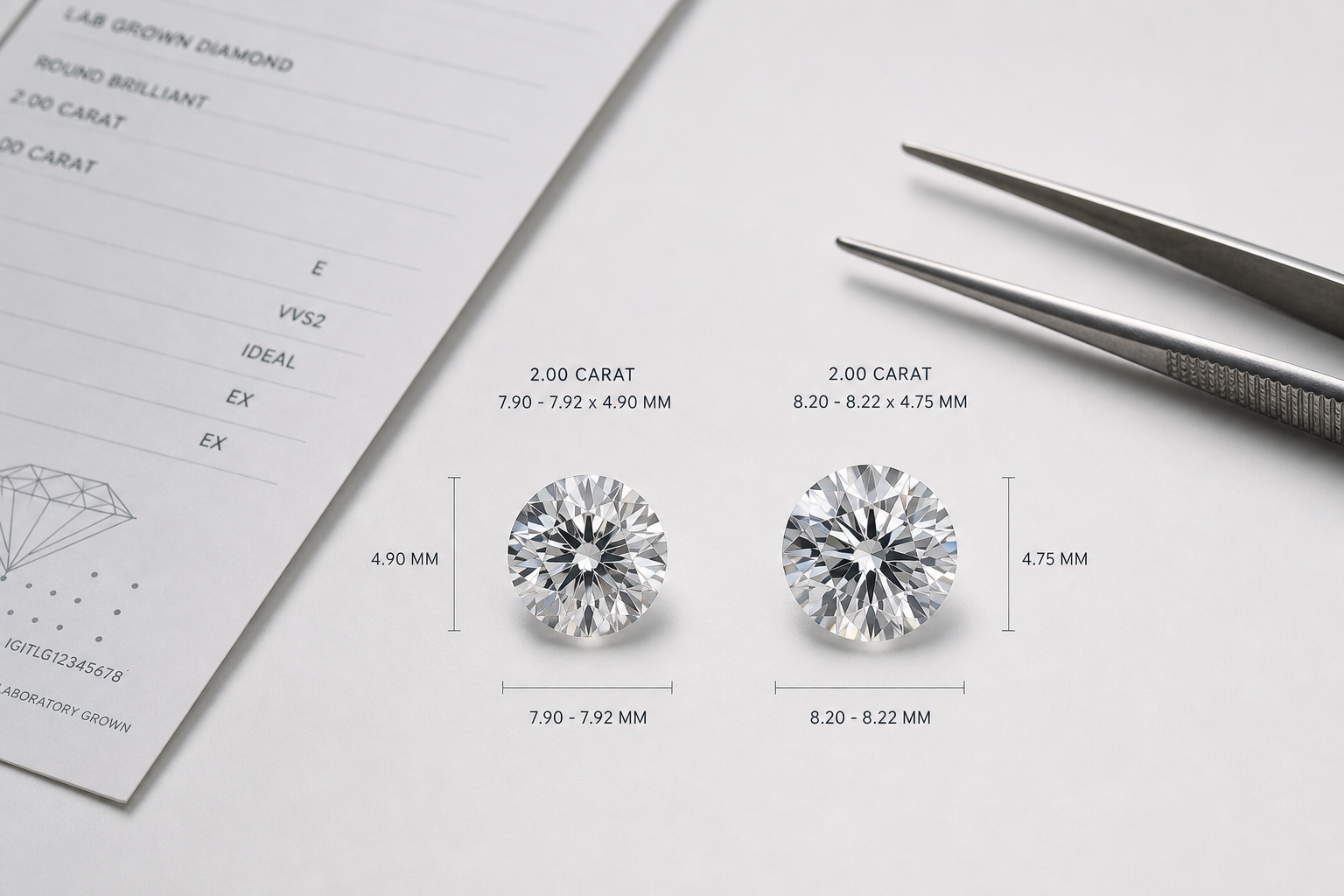
Millimeter Measurements Are the Best Starting Point for Real Size Comparison
If you want to compare diamond size honestly, start with millimeters. Carat can help you narrow the search, but diamond measurements tell you what the stone actually covers. That is why diamond millimeter size matters more than a label when you are evaluating how the diamond will look in real life. This is the clearest carat vs millimeter size distinction buyers need to make.
Most grading reports list three measurements: length, width, and depth. Length and width determine the visible top-view footprint. Depth explains where the weight sits. Depth is not a negative by itself. It only becomes a problem when it is carrying too much weight below the surface without giving you a better-looking stone in return.
For round diamonds, average diameter is the number most buyers should watch first. A well-cut round stone should balance diameter with brightness, fire, and overall liveliness. A round diamond that looks wide but performs poorly will not be a good deal just because the measurement is large. For fancy shapes, length-to-width ratio matters more than a single diameter number because it changes the silhouette. A 2.00 carat oval can feel elegant and elongated or shorter and broader depending on the proportions.
In practical buying, this is where many comparisons become misleading: two listings may share the same carat weight and even similar grades, but the millimeter spread and videos tell a different story. When possible, compare the report measurements against real images, 360-degree video, and the setting plan. This helps separate a stone that is genuinely efficient from one that only looks attractive in a table of specifications.
A useful evidence habit is to compare at least two forms of proof before deciding that a diamond “looks big for its carat.” The first is documentary proof, such as the report measurements. The second is visual proof, such as a real image, video, or hand-rendered setting mockup. Measurements help you understand footprint, while visual media helps you judge outline, brightness, and whether the proportions look pleasing in motion.
The practical habit is simple: compare the dimensions before you get attached to the carat weight. Two diamonds can both be 2.00 carats and still give a different visual result on the finger. If the measurements are not meaningful to the eye, the heavier stone is not automatically the better buy.
Length, Width, and Depth: The Three Numbers Buyers Should Read
Diamond reports usually list measurements in millimeters, and those are the numbers that help you judge size honestly. Length and width shape the visible outline. Depth tells you how much of the diamond’s weight is hidden below the top view. A deeper stone can look smaller than expected, while a well-proportioned stone may present more size without feeling bloated.
Why Diameter Matters Most for Round Diamonds
With round diamonds, average diameter is usually the fastest way to compare visible size. It gives you a practical sense of how much surface area the stone presents. Still, diameter should not be read alone. A round diamond should also look bright and balanced. If the proportions are off, a slightly smaller stone with stronger performance can be the better choice.
Why Length-to-Width Matters for Fancy Shapes
Oval, emerald, radiant, pear, marquise, and cushion cuts all depend heavily on shape proportions. Length-to-width ratio changes how the stone reads on the hand. A more elongated oval may look slimmer and longer, while a wider one may appear fuller across the finger. That difference affects hand coverage, style, and the overall feel of the ring.
Measurement Comparison Example
| Diamond | Carat Weight | Millimeter Size | Likely Visual Effect |
|---|---|---|---|
| Option A | 2.00 ct | 10.0 x 7.0 mm | Looks longer and more elongated on the finger |
| Option B | 2.00 ct | 9.4 x 7.3 mm | Looks broader and slightly shorter in outline |
A buyer comparing these two 2.00 carat oval lab-grown diamonds is not choosing between right and wrong. The better option depends on the look they want. One may create more length on the finger, while the other may create a fuller shape. The more important question is which one gives the desired hand coverage and works best with the setting style.
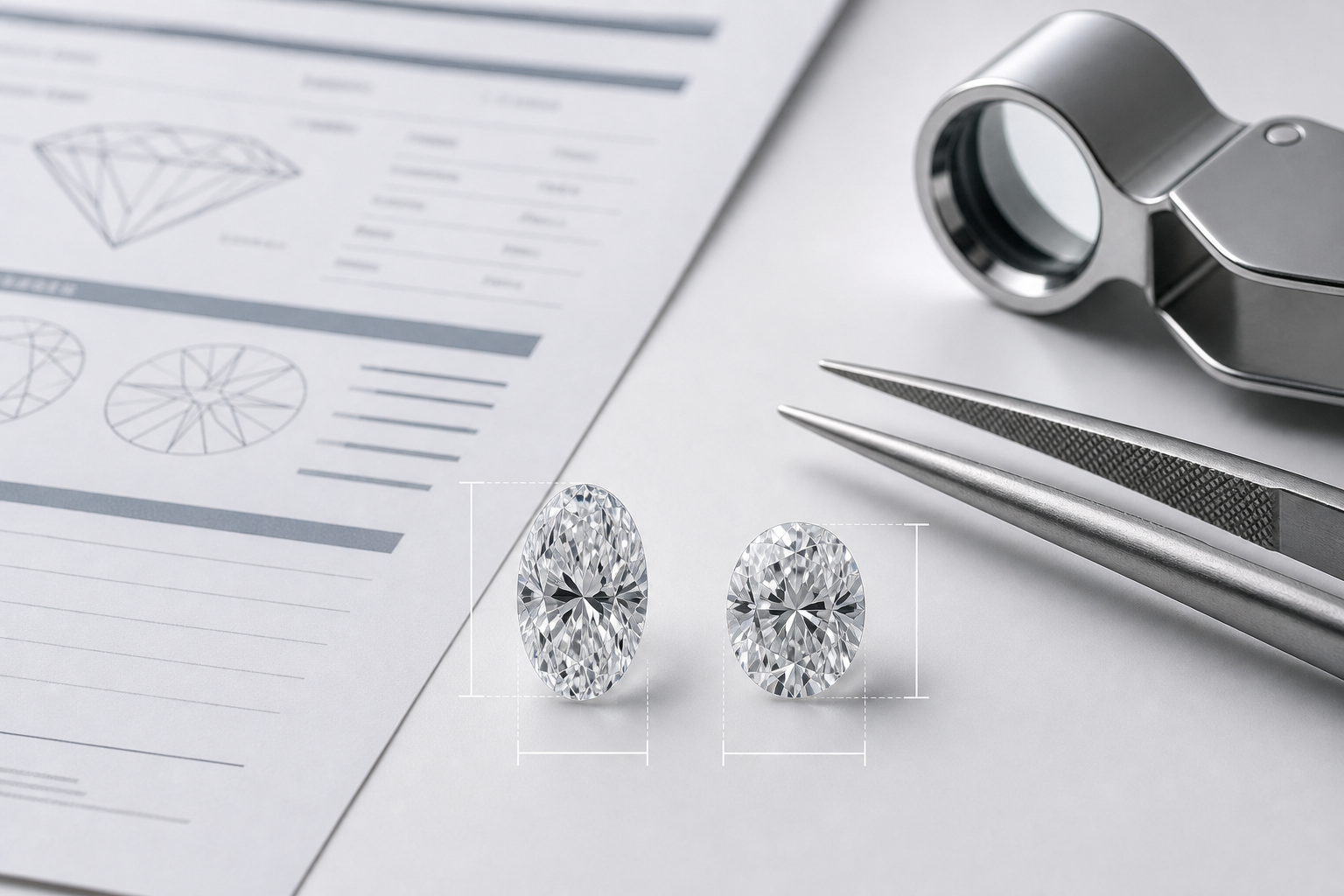
Face-Up Spread Explains Why Some Diamonds Look Larger Than Their Carat Weight
Face-up spread is the bridge between carat weight and visible size. It describes how large a diamond appears when viewed from above relative to how much it weighs. This is why some stones look bigger than their carat weight suggests, while others look smaller even when the number on the report is the same. If you are shopping for a face-up size diamond, spread is one of the most useful ideas to understand.
A diamond with efficient spread can give you strong visible size for its weight. That is a real advantage. But spread should never be chased at any cost. If a diamond looks large only because it is cut too shallow or proportioned poorly, the result can be weak brightness, windowing, or a flat center. A stone that looks larger but performs worse is usually not the better value.
This is where photos and video matter. Measurements alone do not show how a stone handles light. They do not reveal bow-tie effect, contrast problems, or a center that looks dull in motion. That is why a diamond that looks bigger than carat on paper should still be reviewed visually before you commit.
For buyers, the best habit is to treat spread as a filter, not a final answer. A diamond should look generous from above and still look alive.
What Face-Up Spread Means
Face-up spread is the visual footprint you see when looking directly at the stone. It is especially important in rings because that is the view most people will notice. A stone with strong spread can look more substantial without needing a dramatic jump in carat weight.
Good Spread Versus Overly Shallow Spread
There is a real tradeoff here. Good spread makes a diamond feel efficient and visually satisfying. Too much spread created the wrong way can make the diamond lose depth, contrast, and sparkle. The goal is not maximum footprint. The goal is a diamond that looks balanced and bright.
Why Spread Should Be Judged With Images and Video
Numbers can tell you the size of the stone, but they cannot tell you how the stone behaves. Photos and 360-degree video reveal whether the diamond actually looks lively. They also help you spot issues that measurements alone cannot explain. If the stone looks larger but lifeless, the larger face-up size is not delivering real value.
Certificate and Visual Review Check
Before choosing a diamond because it faces up large, confirm the measurements, depth percentage, table percentage when available, cut grade where applicable, and real images or video. For fancy shapes, pay attention to bow-tie visibility, outline symmetry, and whether the center looks active rather than flat. The better-looking diamond is the one that earns its size, not just claims it on paper.
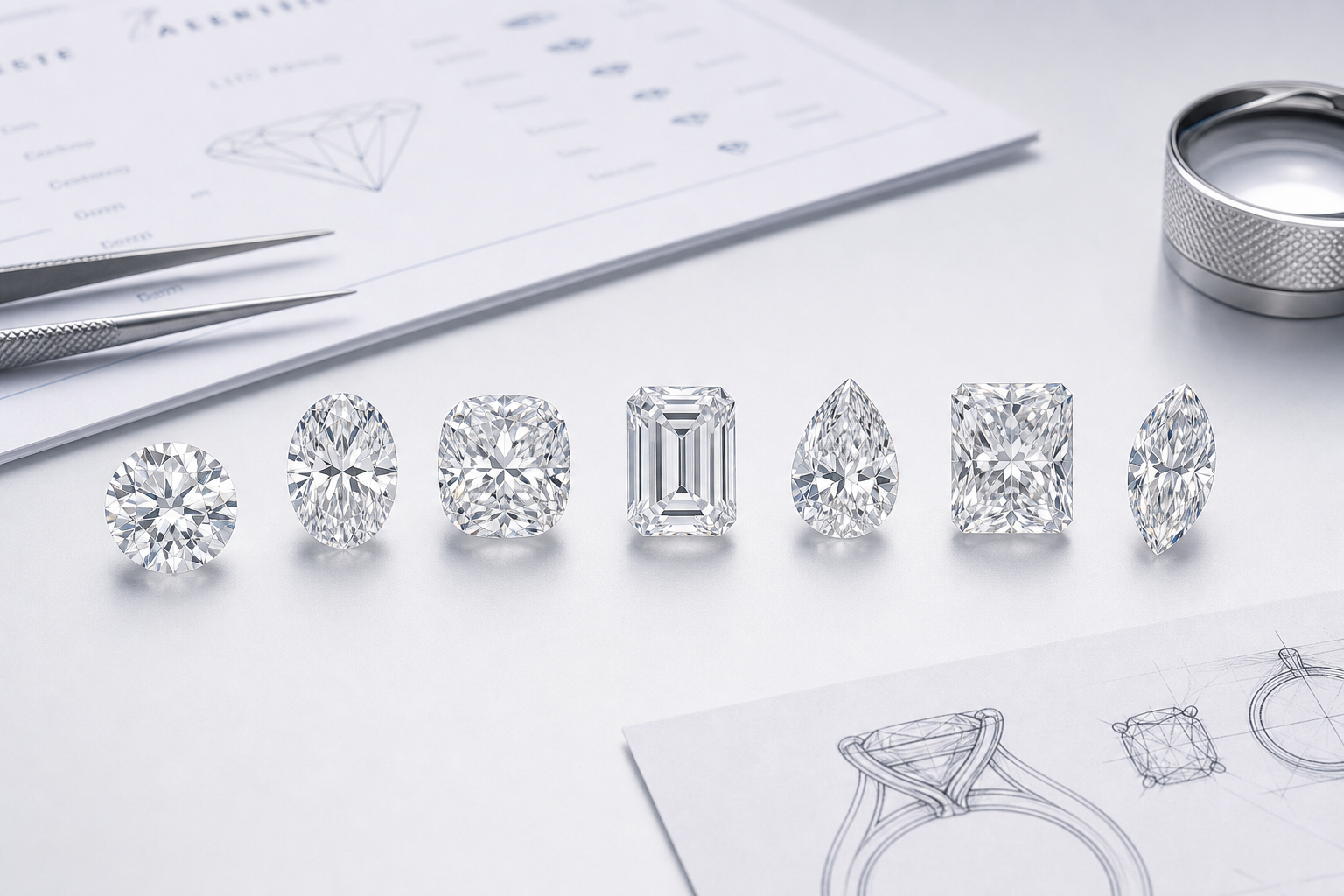
Diamond Shape Changes How Carat Weight Appears on the Finger
Shape is one of the biggest reasons two diamonds with the same carat weight can look noticeably different in real life. Carat tells you how much the stone weighs, but shape determines how that weight is distributed across the top view. That is why a buyer comparing diamond shape carat size should look past the number and ask what the stone will actually cover on the finger.
For most shoppers, this is where the decision gets more practical. A diamond size on finger is not just about how heavy the stone is on paper. It is about silhouette, length, width, and how the shape interacts with the hand and the setting. Some shapes spread the weight outward and look more generous face-up. Others hold more weight in the body of the stone and appear smaller than expected.
For custom design, the stone cannot be evaluated separately from the setting. A pear, marquise, or emerald cut may need different prong placement, corner protection, or profile height than a round stone of similar carat weight. At NUVU, this kind of comparison is treated as a practical design question: the report narrows the field, but the final diamond still needs to make sense visually, physically, and financially in the finished ring.
For custom design, trust comes from matching the stone to the setting, budget, and wearer’s daily use, not from choosing grades in isolation. Before finalizing a center stone, it is worth confirming the exact millimeter size, corner or point protection, band width, prong style, and setting height so that the finished ring supports the diamond rather than simply holding it.
For custom jewelry, stone measurements and setting compatibility should be confirmed before finalizing a purchase. This is especially important when a buyer chooses a larger lab-grown diamond, because a small difference in length, width, depth, girdle shape, or corner structure can change how the stone must be secured.
Round Diamonds: Balanced, Classic, and Easy to Compare
Round diamonds are usually the easiest shape to compare because cut grading and diameter measurements are more standardized. That makes them useful for buyers who want a cleaner apples-to-apples decision. A well-cut round may not always look as large as an elongated shape of the same carat weight, but it often gives a dependable balance of brilliance and proportion.
The main advantage of round diamonds is predictability. If you are trying to avoid surprises, a round stone gives you a clearer sense of what the carat is likely to produce visually, and an eye-clean diamond clarity benchmark can help keep that visual assessment focused on value rather than overpaying. The tradeoff is that some buyers find they have to go a little higher in carat weight to get the same finger coverage they would see in an oval, pear, or marquise.
Oval, Pear, Marquise, and Emerald Shapes: More Length, More Finger Coverage
Elongated shapes often create more vertical coverage on the finger, which can make them look larger than round diamonds of similar carat weight. That is why an oval diamond size often feels more impressive than the number alone suggests. The extra length changes the visual footprint, especially when the stone is viewed on the hand rather than under a loupe or in a report.
That visual advantage comes with a condition: elongated shapes need closer review. Symmetry matters more than many buyers realize, and so does the bow-tie effect in ovals, pears, and marquise cuts. A shape can look larger and still be less appealing if the center looks dark, uneven, or awkwardly proportioned. Length-to-width ratio also changes the personality of the stone. A slightly wider oval may feel softer and more compact, while a slimmer one can look longer and more elegant.
Cushion and Radiant Cuts: Carat Can Hide in Depth
Cushion and radiant cuts can vary a lot in how they carry carat weight. Some look spread out and open, while others appear compact because more of the weight sits deeper in the stone. That means a higher carat cushion or radiant will not always look dramatically larger than a lower-carat stone in the same family of shapes.
For buyers, the mistake is assuming that all cushions and radiants behave the same way visually. They do not. Two stones can have similar carat weight and very different face-up impressions. This is why dimensions matter more than the headline number when the goal is visible size. If you want stronger coverage, compare the actual measurements, not just the grading report carat line.
Shape Selection Check
If your goal is maximum visible size, compare round, oval, pear, marquise, radiant, cushion, and emerald options in the same carat range using millimeter dimensions. The shape that looks largest is not always the one with the heaviest carat weight. It is the one that gives you the strongest balance of spread, proportion, and the kind of coverage you want on the hand.
If your goal is a specific style or balanced sparkle, do not choose shape based on size alone. A round may be the better choice if you want classic brightness. An oval may be better if you want more length on the finger. A cushion may work well if you want softness and a fuller outline. The right answer depends on what visual effect matters most to you.
Cut Depth Can Make a Diamond Look Smaller or Less Lively
Cut depth affects both appearance and performance, and it is one of the easiest places for a buyer to misread value. A diamond’s depth can hold weight below the surface, which makes the stone look smaller from above even when the carat weight is the same. That is why diamond cut depth should always be read as part of the broader visual picture, not as a standalone number that guarantees size or beauty.
This matters most when shopping online. A diamond can look appealing in the listing because the carat number is strong, but a deeper stone may not give you the face-up size you expected. On the other hand, a well-proportioned diamond can offer a better balance of spread and visual life, even if the carat weight is slightly lower.
How Depth Holds Carat Weight Below the Surface
A deeper diamond can carry more of its weight in the pavilion, which is the lower part of the stone. That extra depth does not help with top-view size. It may even reduce the visual footprint compared with another stone of the same carat weight that spreads more efficiently across the top. This is one of the main reasons the highest carat option is not always the most convincing choice.
For buyers comparing stones online, depth helps explain why one diamond looks smaller despite the same weight. It is a useful screening tool, especially when two stones are close in price and carat but do not look similar in photos or video. The better question is not simply which one weighs more, but which one gives you the stronger face-up result.
Why Shallow Is Not Automatically Better
It is tempting to think that a shallower stone must be better because it can look larger. That is a mistake. Too much shallowness can create light leakage, weak contrast, or a flat, glassy appearance. The stone may seem generous in diameter but feel less alive once it is viewed in motion or under different lighting.
The right judgment is directional, not absolute. A stone should not be rejected just because it is deeper, and it should not be chosen just because it spreads wider. The question is whether the proportions support a lively appearance. If the face-up size gains are being purchased at the expense of sparkle and contrast, the tradeoff is usually not worth it.
Useful Proportion Ranges to Treat as Starting Points
For round brilliant diamonds, many buyers use depth around 59 percent to 63 percent and table around 54 percent to 58 percent as a starting review range. Those numbers can help narrow the field, but they should not be treated as a final verdict. Cut grade, angles, images, and video still matter. For fancy shapes, the range of acceptable proportions is broader and less standardized, so measurement review becomes even more important.
The practical value of these numbers is not that they guarantee beauty. It is that they help you avoid obvious problems early. If a stone falls far outside a reasonable range, it deserves a closer look. If the proportions sit in a healthy range, you still need to check the visual evidence before deciding.
At NUVU, we usually treat proportions as a filter, not the full answer. A report can narrow the options, but it cannot show how the stone will actually look in different lighting or in a finished setting.
What This Means in a Real Purchase
If two lab-grown diamonds have the same carat weight but one has a noticeably smaller face-up measurement, check whether extra weight is hidden in depth. That is often the reason the stone looks less impressive than its number suggests. If the larger-looking stone appears dull or watery in video, the visual gain may not be worth the compromise.
The better choice is usually the one that gives you the strongest combination of spread and liveliness. A diamond that looks slightly smaller but performs better can be the smarter purchase, especially if the goal is a ring that looks balanced and remains attractive in everyday wear.
Finger Coverage Depends on Carat, Shape, Ring Size, and Setting Style
Carat weight does not exist in a vacuum once the diamond is set. The same stone can look modest on one hand and bold on another because finger coverage depends on more than weight alone. Shape, ring size, and setting style all influence how much of the finger the diamond visually occupies, which is why diamond finger coverage is often the more useful way to think about size.
This is where engagement ring carat size becomes personal. A diamond that feels substantial on one wearer may feel restrained on another. If the goal is to make a good buying decision, the real question is not whether a carat number sounds large. It is whether the diamond size on hand creates the look the wearer actually wants.
Why Ring Size Changes Visual Impact
A 1.50 carat diamond can look more prominent on a size 4 finger than on a size 8 finger. The same stone covers more of the visible surface on a smaller hand, so it appears larger even though the carat weight has not changed. That is why hand proportion should matter more than social pressure or generic size expectations.
Buyers often compare themselves to other ring images without accounting for finger size. That leads to bad assumptions. A diamond that looks bold in one photo may look more restrained on a different hand. The smarter approach is to think in terms of proportion, not prestige.
How Settings Can Increase or Reduce the Appearance of Size
Setting style can make a diamond feel more or less substantial than its actual measurements. A slim band can make the center stone look larger because there is less metal competing with it visually. A halo can add width and amplify the presence of the center stone. A hidden halo can create a little more presence without changing the top outline as much. A bezel can make the stone feel more integrated and sometimes slightly smaller in appearance because more of the edge is framed.
Prong style also matters. Delicate prongs tend to keep the focus on the diamond, while heavier-looking settings can reduce contrast and make the stone feel visually busier. The setting is not just a support structure. It changes the impression of size, sometimes in ways that are more noticeable than a small carat upgrade.
Comfort and Lifestyle Matter More as Carat Increases
Larger diamonds often sit higher, catch more easily, or feel less practical for active daily wear. That does not mean large stones are a bad choice. It means the buyer should match the stone to the way the ring will actually be worn. A person with a hands-on job, frequent travel, or a very active routine may value a lower-profile design more than maximum presence.
As carat weight rises, comfort becomes a real design issue. A bold diamond can be beautiful, but if it feels awkward or fragile in daily use, the visual gain may not translate into satisfaction. The stronger choice is the one that looks right and lives well.
Stone-to-Setting Fit Check
Before committing to a larger carat weight, confirm the stone’s exact measurements with the intended setting. Ask whether the setting must be modified, whether the stone will sit high or low, and whether the design protects the corners or points on shapes like pear, princess, marquise, and emerald. A stone that is technically attractive can still be the wrong physical fit if the setting was not built for it.
Maya wears a size 5 ring and is comparing a 2.00 carat round with a 1.70 carat oval. The oval gives her more length on the finger and allows for a lower-profile setting, while the round gives a brighter classic look. Neither choice is wrong. The better option depends on whether she values elongated coverage or traditional brilliance more.
Carat Milestones Can Create Price Jumps Without Equal Visual Gains
Carat milestones are easy to remember, which is exactly why they can be misleading. A shopper sees 1.00, 1.50, 2.00, 3.00, or 4.00 carats and assumes the jump is automatically worth it. In practice, the visible difference is often smaller than the change in diamond carat price suggests, especially if the shape, depth, and measurements are not working in your favor.
Prices can change with market conditions, report type, seller channel, and stone-specific details, so exact comparisons should be verified at the time of purchase. A carat milestone should be treated as a comparison point, not as proof that one diamond is a better purchase than another.
For lab-grown diamond value, the better question is not “What is the biggest number I can afford?” It is “What size increase will I actually see, and what am I giving up to get it?” That is the right frame for anyone trying to choose a suitable carat size for engagement ring shopping without overpaying for a number that looks more impressive on paper than on the hand.
Why Round Numbers Feel More Important Than They Are
Round carat numbers feel decisive. They are tidy, easy to compare, and heavily repeated in shopping conversations, so buyers naturally attach meaning to them. A 2.00 carat diamond sounds like a major step up from a 1.90 carat diamond, even when the face-up difference is modest.
That psychology creates pressure to “reach” a milestone instead of judging the stone in front of you. A small increase in carat can cause a noticeable jump in cost, but not always a matching jump in visible size. In a lab-grown diamond buying guide, this is one of the most common traps: treating the milestone as the goal instead of treating visual impact as the goal.
The smarter approach is to compare the actual view, not the label. A well-cut stone just below a milestone can look cleaner, better balanced, and more convincing than a heavier diamond that carries extra weight in ways the eye does not reward.
Why Slightly Under a Milestone Can Be Smart
Diamonds just under a popular milestone often offer nearly the same look with less weight carried through the stone. That can be a strong value move, especially when the measurements are strong and the cut is doing its job. A 1.90 carat diamond, for example, may face up so close to a 2.00 carat stone that the difference is hard to notice once it is set, worn, and viewed from a normal distance.
This is where people who compare lab-grown diamonds carefully tend to make better decisions than people who chase the neatest carat number. If two stones have similar spread, similar shape, and similar visual performance, the one below the milestone may leave room in the budget for a better setting, higher finish quality, or a more comfortable ring design.
The important caution is not to assume “just under” is automatically the best value. If the stone looks smaller because of poor proportions or an awkward shape, then the milestone avoidance is not helping you. The real win comes when the lower-carat option still delivers the look you want without paying extra for a round-number premium.
Price differences can also reflect more than carat weight. Color, clarity, cut quality, shape demand, report details, availability, and supplier consistency may all affect the final comparison. A lower price is not automatically a better value, and a higher price is not automatically proof of a better-looking stone. The useful question is whether the added cost is tied to a visible or practical improvement you actually care about.
Total Ring Budget Matters More Than Stone Weight Alone
Carat weight is only one part of the ring purchase. The center stone matters, but so does the setting, the metal, any side stones, the labor involved in custom work, resizing needs, and any appraisal or insurance-related steps you may want to handle afterward. If you spend too aggressively on the stone itself, the rest of the ring can start to feel compromised.
That is why a large headline number is not always the most useful way to allocate money. A larger diamond with a weaker setting can create a worse final result than a slightly smaller stone with better proportions and a design that fits the wearer. In practical terms, the stronger purchase is the one that improves the finished ring, not just the center stone’s report.
For buyers focused on lab-grown diamond value, this broader view matters even more. Because lab-grown options can make larger sizes more accessible, it is easy to let the carat number absorb too much attention. The better habit is to judge the whole ring as a finished object.
Value Comparison Check
Before deciding, compare three options side by side: one at the milestone you had in mind, one slightly below it, and one with a different shape that creates similar visual coverage. Do not decide on carat alone. Judge the stones by their measurements, visual performance, grading report, and whether they actually fit the setting you want.
If the milestone stone is only marginally larger but meaningfully more expensive, the upgrade may not be worth it. If the smaller option looks nearly identical once set, the smarter choice is usually the one that preserves budget for the parts of the ring that affect wear, fit, and overall finish.
The point is simple: compare visual gain against cost increase, not carat number against carat number.
How to Treat Evidence When Comparing Lab-Grown Diamond Carat Options
A strong carat decision should be supported by the same kinds of information across every stone you compare. If one diamond has a full report, exact measurements, and clear video while another has only a carat weight and a stock image, the comparison is uneven. The better-documented stone is usually easier to judge, even if it is not the highest carat option.
Be especially careful with broad claims that go beyond the report. A seller may describe a diamond as lab-grown, beautifully cut, responsibly sourced, excellent value, or visually larger than expected, but each claim depends on different evidence. The grading report can help document gemological details, while videos, setting mockups, seller policies, and written disclosures help answer separate practical questions. Do not let one piece of documentation carry more proof than it actually provides.
Sustainability and ethics language should also be read carefully. Lab-grown origin is a different production path from mined origin, but it does not automatically prove a specific environmental footprint, energy source, labor practice, or carbon claim. If those issues matter to you, ask for specific documentation rather than relying on generalized marketing language.
Environmental and sustainability claims should be specific, documented, and limited to what can be substantiated. Broad green language is less useful than clear information about production method, energy context, supply chain disclosures, and seller transparency, while a diamond 4Cs guide can help distinguish quality factors from marketing claims before pricing is compared. A careful buyer should separate what is confirmed by the grading report from what requires additional documentation or written explanation.
A practical evidence standard is simple: the bigger the claim, the clearer the support should be. “This stone weighs 2.00 carats” should match the report. “This stone faces up larger than a typical option” should be checked through measurements and visual review. “This is the best value” should be tested against comparable stones, not accepted as a slogan.
Traceability Questions Buyers Should Ask Before Choosing by Carat
Traceability in a lab-grown diamond purchase is not just about having a report number. It is about being able to connect the stone being offered with the documents, measurements, visuals, and design plan used to make the buying decision. A diamond can have a legitimate grading report and still be a poor fit if the listing details are incomplete, the video does not match the proportions you expected, or the setting has not been checked against the stone’s exact measurements.
For a more traceable comparison, keep a simple record of the stones you are considering: report number, carat weight, measurements, shape, color, clarity, depth, table where relevant, price at the time of comparison, and the visual media reviewed. This helps prevent confusion when several stones are close in carat weight. It also makes the final decision easier to explain: you are not choosing only the heavier diamond, but the option whose documentation, appearance, and setting fit line up most clearly.
For NUVU, the practical goal is to make diamond comparison easier to understand, especially when buyers are weighing report details, visual performance, setting fit, and budget together. A transparent process does not require dramatic promises; it requires clear identification, consistent comparison criteria, and enough information for the buyer to see why one carat option is more suitable than another.
When Bigger Actually Is Better and When It Is Not
This article is not an argument against a bigger lab-grown diamond. Bigger can be exactly the right choice when the rest of the stone and ring support it. The mistake is assuming that larger automatically means better. A large lab-grown diamond engagement ring only works if the proportions, setting, and wearer’s preferences all line up.
Bigger Can Be Better When the Measurements, Cut, and Setting Work Together
A larger stone makes sense when the visible size increase is real, the cut still looks lively, and the setting is built to support the shape without making the ring feel awkward. If the diamond has strong light return, pleasing proportions, and the look the wearer actually wants, then the added carat weight is doing useful work.
In those cases, bigger is not vanity. It is a legitimate design decision. If someone wants a bolder presence on the hand and the stone still performs well, there is nothing irrational about choosing the larger option. The mistake is not wanting size; the mistake is paying for size that does not improve the ring in a meaningful way.
Bigger May Not Be Better When Size Comes With Poor Proportions
A diamond can be larger and still feel less satisfying. Excess depth can hide weight below the surface. Awkward dimensions can make the stone look shorter, narrower, or less elegant than expected. A bulky setting can also make the whole ring feel heavy without improving the look from above.
In those situations, the larger stone is not delivering its value. A slightly smaller diamond with better balance often looks cleaner and more intentional. That is especially true when the buyer cares about sparkle, daily comfort, and a ring that feels visually refined rather than simply large.
A useful carat guide is not asking you to reject size. It is asking you to reject wasted size.
Bigger Is Personal, Not Universal
Some buyers want a restrained look. Others want a strong center stone that reads immediately on the hand. Both preferences are valid. Carat choice should be treated as a design and value decision, not a ranking system where the larger number wins by default.
A buyer choosing a classic, understated ring may be happiest with a smaller stone that fits the hand and feels balanced in daily wear. Another buyer may prefer the visual presence of a larger center stone and be willing to trade elsewhere to get it. The right answer depends on the wearer, the setting, and the total result.
That is the practical lesson: bigger is better only when it makes the finished ring better.
Decision Filter Before Upgrading Carat
Before moving up in carat weight, ask four questions.
- Does it look meaningfully larger in millimeters?
- Does the cut still look lively?
- Does it fit the setting and lifestyle?
- Does the added cost improve the final ring enough to matter?
If the answer to any of those is weak, the upgrade deserves a closer look. A larger diamond that fails one of those tests may be less satisfying than a stone that is slightly smaller but better balanced.
That is the standard that keeps the purchase grounded. Better-proportioned is better.
A Practical Carat Selection Framework for Lab-Grown Diamond Buyers
If you are trying to figure out how to choose diamond carat size without getting distracted by milestone thinking, start with the finished look you want. The right process is straightforward: decide the visual goal, compare measurements, review the stone properly, and then decide what tradeoff you are willing to make. That is the real lab-grown diamond buying guide at the carat stage.
Step 1: Start With Desired Finger Coverage, Not a Prestige Number
Begin by deciding how you want the ring to look on the hand. Do you want subtle coverage, a balanced everyday look, a more prominent center, or something bold? That answer matters more than whether the grading report says 1.00, 1.50, or 2.00 carats.
Once you know the look you want, compare shapes and measurements that create that result. This keeps the decision anchored in appearance instead of in a number that feels important only because it is familiar.
Step 2: Compare Millimeter Dimensions Within the Same Budget
Do not search only for one exact carat weight. Build a shortlist across nearby sizes and related shapes. Comparing nearby carat options often reveals that the visual difference is smaller than the budget difference. That is where a buyer starts to see real diamond value instead of just headline weight.
Millimeter dimensions are what make the stone look large or small in practice. A smart shortlist should include stones that may sit on different sides of a milestone but still create a similar face-up presence. The better choice is the one that delivers the look you want without paying for unnecessary weight.
Step 3: Review Cut, Certificate, Images, and Setting Fit Together
This is where buyers often go wrong. A grading report by itself does not tell the full story, and a spreadsheet comparison can hide important visual differences. You need the report, the measurements, the photos or video, and the intended setting to all make sense together.
If the stone looks good on paper but weak in motion, it is not a good candidate. If the setting forces the diamond into a poor position, the ring will not feel right no matter how strong the carat number looks. The best comparison is visual and practical, not just numeric.
When reviewing documentation, make sure the report details match the diamond being offered, including carat weight, measurements, shape, and report number. If a seller makes broader claims about origin, production method, sustainability, or sourcing, those claims should be supported by clear documentation rather than treated as automatic benefits of being lab-grown. A certificate helps identify and describe the stone; it does not, by itself, prove beauty, ethics, environmental impact, or long-term value.
Step 4: Decide What Tradeoff You Are Comfortable Making
Every carat choice involves a tradeoff. You may choose larger size over a higher color grade. You may prefer a longer shape over the crisp symmetry of a round stone. You may step below a milestone to improve the setting, or keep the stone modest so the ring feels more comfortable day to day.
There is no universal answer because the tradeoff is personal. Some buyers care most about bold coverage. Others care more about balance, sparkle, or daily wear. The right choice is the one that matches your priorities instead of trying to satisfy every criterion at once.
Buyer Verification Checklist
Before you buy, confirm the following in writing or in the product details:
- carat weight
- exact measurements
- laboratory-grown origin disclosure
- shape
- length-to-width ratio for fancy shapes
- depth percentage
- table percentage when relevant
- grading report number
- visual media
- setting compatibility
- seller policies
At NUVU, we usually treat that checklist as the point where a good-looking stone becomes a workable purchase. The carat number matters, but only after the rest of the picture makes sense.
The right way to compare lab-grown diamonds is to ask what size increase you are really getting and whether that increase improves the finished ring enough to justify the cost. If it does, go bigger with confidence. If it does not, the smarter choice is usually the stone that gives you the better overall result.
When a grading report is provided, buyers should treat it as a traceable reference point and compare its details with the issuing laboratory’s report-check tools where available.
For buyers comparing carat options, this means the report should be treated as a practical identification document rather than a decorative extra. A report from established laboratories such as GIA, IGI, or HRD Antwerp can give you a consistent way to review carat weight, measurements, color, clarity, and other identifying details before you compare visual size.
When a diamond is shortlisted for a ring, it is reasonable to ask that the report number, inscription where available, and product details all match. This is especially helpful when two stones are close in price or carat weight, because small measurement differences can change the final appearance more than the headline size suggests.
If a GIA report is provided, the report details can usually be checked through GIA’s official report verification system.
Independent report checking is most useful when you want another layer of confidence before moving from comparison to purchase. It does not replace judging the diamond’s images, video, proportions, or setting fit, but it can help confirm that the documented details correspond to the stone being discussed.
For a balanced carat decision, combine documentation review with practical review: check the report, compare millimeter dimensions, ask how the stone will sit in the setting, and make sure the final ring design supports the size you choose. That process creates confidence without relying on carat weight alone.
Compliance-Aware Buying Notes for Carat Comparisons
When comparing lab-grown diamond carat options, separate gemological facts from marketing descriptions. Carat weight, measurements, color, clarity, and grading report details are documentable characteristics. Descriptions such as “exceptional value,” “responsibly sourced,” or “larger-looking” require additional context, visual evidence, or documentation before they should influence a purchase decision.
If HPHT or CVD is mentioned in a listing, read the wording carefully. For laboratory-grown diamonds, HPHT and CVD commonly refer to growth methods; HPHT may also be discussed as a post-growth treatment in some contexts, but that should not be assumed unless the grading report or seller documentation clearly says so. When growth method or post-growth treatment is relevant, buyers should look for clear disclosure in the grading report or seller documentation.
Do not confuse lab-grown diamonds with diamond simulants. A laboratory-grown diamond is diamond material created in a controlled growth environment, while simulants are lookalike materials that are not diamonds. If a listing uses unclear language, the buyer should ask whether the stone is a laboratory-grown diamond, a natural diamond, or a diamond simulant before comparing carat size or price.
Finally, confirm policy-related details directly with the seller instead of assuming them from the diamond description. Return terms, resizing options, shipping timing, after-sales support, and documentation delivery can vary by seller and purchase type. Those terms matter to the overall buying decision, but they should be verified separately from the stone’s carat weight or grading report.
FAQ: Lab-Grown Diamond Carat Size Questions
These quick answers cover the most common carat-size questions buyers still have after comparing lab-grown diamonds by measurements, shape, and face-up appearance.
Does Carat Mean the Same Thing as Size?
No. Carat measures weight, not visible size. A diamond’s face-up appearance depends on its millimeter dimensions, shape, depth, and cut. Two stones can weigh the same and still look different on the hand, which is why carat alone is not enough for a good comparison.
What Diamond Shape Looks the Biggest for Its Carat Weight?
Elongated shapes such as oval, pear, marquise, and emerald cuts often create more finger coverage for the weight. That does not make them automatically better. The stronger choice is the shape that gives you the right balance of spread, proportions, and visual style. A larger-looking shape with weak performance is still a poor buy.
Is a 2 Carat Lab-Grown Diamond Too Big?
Not necessarily. A 2 carat stone can look bold on one hand and completely balanced on another. Ring size, shape, setting height, and daily wear all matter. A 2 carat oval may feel very different from a 2 carat round or cushion, so the real question is whether the size fits the wearer and the design.
Should I Buy Slightly Under My Target Carat Weight?
Often, yes. A well-proportioned diamond just under a popular milestone can look very close to the next step up, while leaving more room in the budget for better cut quality, a better setting, or a more suitable shape. Carat milestones can be useful reference points, but they should not control the decision by themselves.
If you are still deciding, compare diamonds by carat weight, millimeter dimensions, shape, and visual media together. That approach gives you a clearer answer than carat alone and usually leads to a better final choice.
Disclosure: This article is for general educational purposes only. Diamond grading, pricing, availability, specifications, and seller policies can change, and readers should verify important details through grading reports, official laboratory tools, seller documentation, or qualified professionals before making a purchase decision. Laboratory-grown diamonds should be clearly distinguished from natural diamonds, and environmental or sourcing claims should be supported by specific documentation.