
A loose lab-grown diamond certificate is useful, but only if you know what it can and cannot tell you. The report confirms identity, measurements, grades, growth method, and notes, yet it does not show how the stone looks in person, how its outline compares with common lab-grown diamond shapes, or whether it suits a specific ring design. That makes the first buying decision less about the grade on the page and more about whether the paperwork, visuals, and dimensions all point to the same diamond.
For the full framework, read Loose Lab-Grown Diamonds Buying Guide.
This article helps you verify that match, then judge which details actually matter for the stone you are considering. You will learn how to read carat weight alongside size, interpret color and clarity in context, spot limits in cut grading, and pay attention to comments, inscriptions, and video so you can avoid paying for a certificate that looks better than the diamond itself.
| What to Check | What to Confirm | Decision Cue |
|---|---|---|
| Report identity | Report number, inscription, listing, and lab record match | Any mismatch means pause |
| Carat vs. measurements | Dimensions fit the face-up size you expect | Weight alone can mislead |
| Color and clarity | Grades make a visible difference for that shape and setting | Judge appearance, not just the label |
| Cut and shape | Round performance or fancy-shape form, bow-tie, and windowing | Video matters most for fancy cuts |
| Comments and plots | Clouds, graining, hidden inclusions, or treatment notes | Read the fine print before buying |
| Polish, symmetry, fluorescence | Secondary quality clues, not automatic deal-breakers | Use them as context, not the final verdict |
Quick Questions Before You Read
Q: Does a certificate guarantee the diamond will look beautiful?
No. It verifies details, but sparkle and face-up performance still need visual review.
Q: Why do measurements matter if the carat weight is already listed?
Two stones with the same weight can look different in size and spread.
Q: Are fancy shapes judged the same way as round diamonds?
No. Fancy shapes need extra attention to form, bow-tie, and windowing.
Q: What should I do if the report and listing do not match?
Stop and ask for written clarification before moving forward.
Start With What a Lab-Grown Diamond Certificate Can and Cannot Tell You
A lab-grown diamond certificate is best understood as a verification document, not a final buying decision. A loose lab diamond grading report records the characteristics observed by a grading laboratory for one specific stone, including its identity details and quality grades. It helps you confirm what you are looking at, compare similar diamonds more accurately, and avoid relying only on a seller’s product title or marketing description.
The mistake many buyers make is treating the certificate as if it answers every important question. It does not. A diamond grading report can tell you the recorded carat weight, color, clarity, measurements, and other grading information, but it cannot fully show whether the diamond looks lively in motion, whether the proportions create the kind of face-up presence you want, or whether the stone is the right physical match for a ring setting.
If you are wondering what does a lab-grown diamond certificate show, the answer is: it shows documented diamond characteristics. If you are trying to learn how to read a diamond grading report before buying, the more useful question is what the report confirms, what it leaves open, and what you still need to check before committing.
For buyers, the practical point is not just whether a report looks “high grade,” but whether the documented facts support the intended use of the stone. A report can help you reject mismatched or poorly documented options quickly, but the final shortlist should still be judged by visual evidence, measurements, setting fit, and clear seller communication.
What the Certificate Confirms
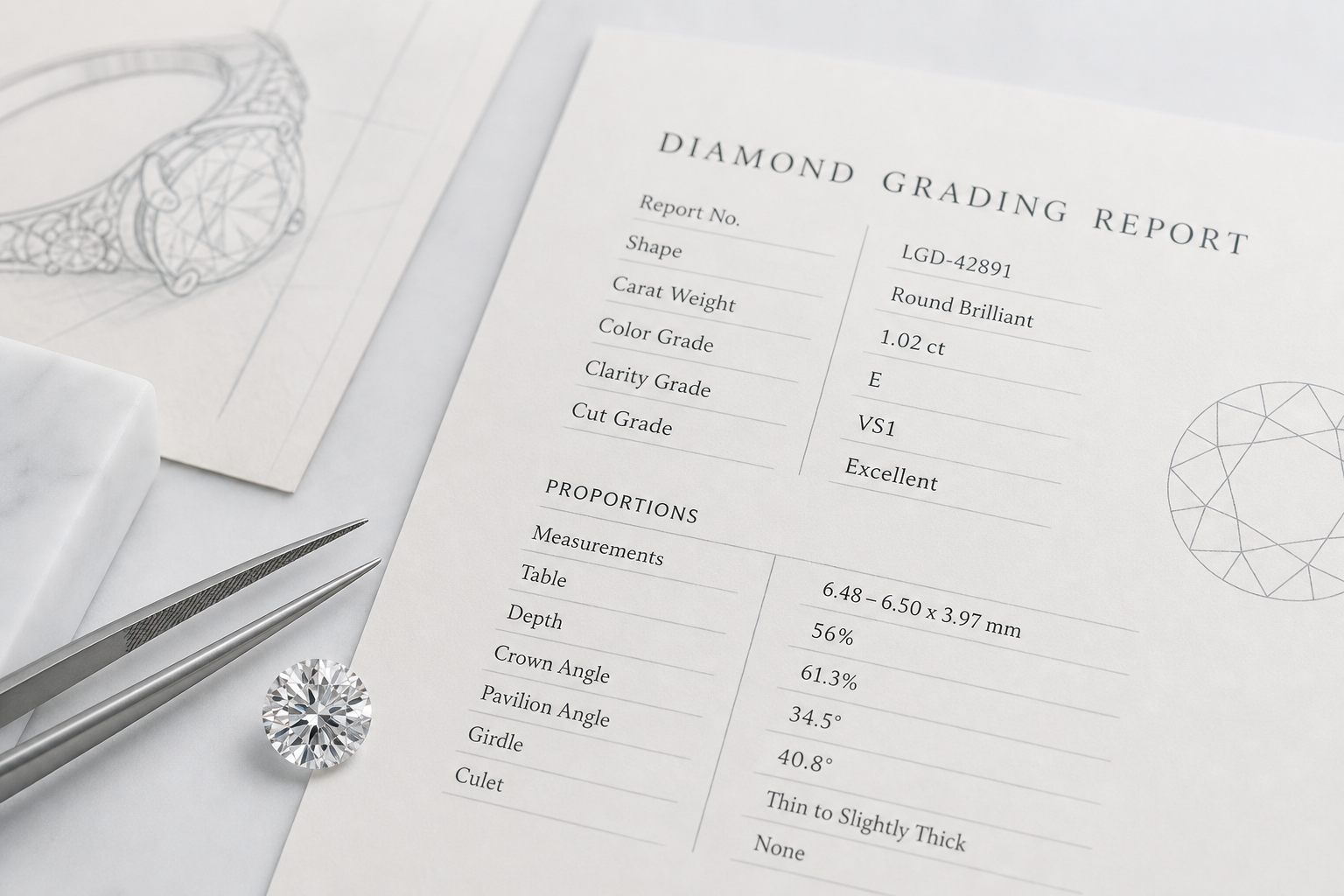
A typical lab-grown diamond certificate confirms the basic identity and grading profile of the stone. This usually includes the report number, shape, carat weight, color grade, clarity grade, measurements, cut-related grades, polish, symmetry, fluorescence, growth method, and inscription information when applicable. Some reports also disclose treatments or post-growth processes if those details are part of the lab’s reporting format.
These details matter because they create a common reference point. Instead of comparing two loose diamonds based on vague descriptions such as “near colorless” or “high clarity,” you can compare the actual grading information on each report. That is especially helpful online, where two diamonds may appear similar in a listing but differ in measurements, proportions, or disclosure details.
The certificate also helps protect against one of the most basic buying errors: evaluating the wrong stone. The report number, measurements, and inscription details should connect the document to the exact diamond being sold. If those identity markers are unclear, the quality grades are not yet useful because you have not confirmed that the report belongs to the diamond in the listing.
What the Certificate Does Not Fully Prove
A certificate does not prove that a diamond is the most beautiful option, the best value, or the strongest choice for your ring. It records grades and measurements; it does not judge your priorities. A diamond with higher color or clarity can still be less appealing than another stone if the cut, proportions, or visual pattern are weaker.
It also does not fully predict sparkle. Cut-related information is important, especially for round brilliant diamonds, but the report cannot replace photos, 360-degree video, proportion review, or a real discussion with the seller. For fancy shapes such as oval, radiant, emerald, pear, and marquise, visual issues like bow-tie effect, windowing, outline balance, and facet pattern often need to be judged beyond the certificate.
The certificate also does not confirm whether the diamond is the right choice for a specific setting. A stone may look strong on paper but be too deep, too wide, too elongated, or physically unsuitable for the mounting you want. This is why a transparent buying process should treat the report as the starting point, not the whole answer.
Keep Laboratory-Grown and Natural Diamonds Distinct
Laboratory-grown diamonds should be clearly identified as laboratory-grown, and they should not be presented as mined diamonds. When you compare options, make sure the report, listing, and product description use the same origin language so the comparison stays accurate.
It is also important not to confuse a laboratory-grown diamond with a diamond simulant. Simulants may look similar in a listing, but they are not the same material and should not be described with the same grading language. If the wording is unclear, ask the seller to state whether the stone is laboratory-grown, natural, or a simulant before you compare grades.
This distinction matters because the certificate documents the stone being graded; it does not make different materials interchangeable. Clear origin disclosure is part of responsible buying, especially when a listing uses broad marketing language.
A Practical Way to Read the Report in Order
If the report feels dense, read it in a fixed sequence instead of jumping around. Start with identity, then move to shape and measurements, then the main grades, and finally the notes and comments. That order keeps you from overvaluing a single field before you know whether the rest of the document matches the stone.
A simple reading routine can help: first confirm the report number and inscription, then check whether the measurements make sense for the carat weight, and only after that review color, clarity, cut, polish, symmetry, and fluorescence. If the report includes comments or a plot, treat those as context that may change how you view the headline grade.
This method is especially useful when comparing multiple diamonds online. It keeps you from being swayed by the first impressive-looking number and helps you compare stones in a way that is more consistent and less emotional.
Common Misreads Buyers Should Avoid
One of the most common mistakes is assuming that a higher carat weight always means a larger-looking diamond. Another is assuming that a stronger color or clarity grade always produces a better visual result. Both assumptions can lead you away from the stone that actually looks best for the intended ring.
Buyers also sometimes treat a clean-looking report as proof that no further review is needed. In practice, the report is only one layer of evaluation. If the video shows a dark center, weak symmetry, or an awkward outline, the report has done its job by documenting the stone, but it has not made the buying decision for you.
When in doubt, slow the process down. A careful read of the report takes less time than correcting a mismatched or disappointing purchase later.
Why Loose Diamonds Require More Careful Report Reading
Loose diamonds require more careful report reading because the stone has not yet been committed to a finished design. Once a diamond is mounted, the setting can influence how large it appears, how color is perceived, and how protected the stone feels on the hand. Before that happens, the certificate is one of the few structured tools you have for judging whether the stone is a practical fit.
Measurements matter more than many first-time buyers expect. A diamond’s carat weight tells you how much it weighs, but the measurement line shows how that weight is distributed. A deeper stone may carry weight below the surface and appear smaller from the top. A shallower or wider stone may show more spread but could raise other visual or setting concerns if the proportions are not balanced.
For a loose diamond, shape, depth, table, length-to-width relationship, and face-up size all affect the buying decision. These are not minor technical details. They can determine whether the diamond looks proportionate in a solitaire, whether it suits a halo or three-stone design, and whether a jeweler can set it safely without modifying the design.
What to Check Before You Decide
Before you compare grades, confirm that the report belongs to the exact diamond being offered. Match the report number, carat weight, shape, measurements, and inscription details against the seller’s listing. If the listing shows a certificate image but the specifications do not line up, pause the purchase and ask for clarification in writing.
Small mismatches should not be ignored. A different measurement, missing inscription detail, or inconsistent carat weight may be a simple listing error, but it can also mean the certificate image is not tied to the exact stone you are buying. Until that is resolved, the report cannot do its job as a decision tool.
Verify the Diamond’s Identity Before Interpreting the Grades
The first step in reading any lab-grown diamond certificate is not color, clarity, or carat. It is identity. Before you decide whether the grades are good enough, you need to confirm that the certificate, the seller listing, and the actual loose diamond all refer to the same stone.
This matters because online diamond listings often look highly standardized. Multiple stones can share the same shape, carat range, color grade, and clarity grade, especially in lab-grown inventory. The diamond certificate number and lab-grown diamond report number are the anchors that keep the evaluation tied to one specific diamond instead of a similar-looking option.
In practical buying, this is where many comparisons become misleading. A buyer may spend time debating whether one clarity grade is slightly better than another, while the more important question has not yet been answered: does the report actually belong to the stone being offered, and can the seller connect the report, inscription, imagery, and inventory record without ambiguity?
Report Number and Online Verification
Many grading laboratories allow buyers to enter a report number into an online database to view or verify the grading record. This kind of grading report lookup can help confirm that the document is legitimate and that the basic report details match what the seller is showing.
Online verification should still be used carefully. Not every report format, lab, or seller presentation works exactly the same way, and a verified report number only confirms the record associated with that report. You still need to compare the online record against the seller’s listing, including shape, carat weight, measurements, color, clarity, and any inscription information.
The most useful habit is to check the diamond report number before buying, then compare every major detail across the report, online record, and product page. If one source says the diamond is a 1.52 ct oval and another shows a 1.50 ct oval with different measurements, do not assume the difference is harmless.
When a grading report is available, buyers should verify the report details through the issuing laboratory’s official report-check tool where available, then compare those details with the seller’s listing, photos, video, and inscription information.
How to Treat Report Verification Responsibly
Report verification is a cross-check, not a replacement for judgment. A lab lookup can help you confirm that a report number corresponds to a grading record, but it does not automatically prove that the stone in a product video, the stone in inventory, and the stone that will be set into a ring are all the same diamond. That link still depends on matching report details, inscription confirmation, and clear seller communication.
A practical verification process should create a simple chain of traceability: the report number appears on the certificate, the same number appears in the seller’s listing, the measurements and grades match across both sources, and the seller can confirm the inscription or identity of the physical stone. If one link in that chain is missing, the buyer should ask for clarification before comparing price or beauty.
For NUVU, the buyer-first approach is to make this comparison easier to understand: what the report shows, what the visuals reveal, and whether the stone fits the intended piece. The goal is not to treat the certificate as a sales shortcut, but to use it as one part of a clear decision record.
Laser Inscription on the Girdle
Many loose lab-grown diamonds have a microscopic laser inscription on the girdle, which is the outer edge of the diamond. This inscription often corresponds to the report number and may also include wording that identifies the stone as laboratory-grown, depending on the grading lab and report type.
Most buyers will not be able to inspect a laser inscription themselves without magnification. That is normal. What matters is whether the seller can confirm the inscription and, when appropriate, provide supporting documentation, magnified imagery, or a clear statement that the inscription matches the report.
A laser inscription is useful because it strengthens the connection between the document and the physical diamond. It should not be treated as a beauty marker or a quality upgrade. Its main value is identity confirmation, which comes before any judgment about whether the stone is attractive or well priced.
Listing Details That Should Match the Report
The seller listing should match the certificate on the details that identify and describe the stone. Shape, carat weight, measurements, color grade, clarity grade, and report date are all worth checking. The report number should also be visible or clearly provided, especially before payment.
Measurements deserve special attention because they are harder to fake casually and easier to compare precisely. If a listing describes a diamond as a 2.00 ct round but the report measurements are meaningfully different from what the listing shows, that is a reason to ask questions. The same applies if the listing uses a broad title while the certificate shows a different shape variation or proportion profile.
The report date can also be useful context. An older report is not automatically a problem, but if the seller cannot explain current availability, inscription confirmation, or whether the exact stone is still in stock, the buyer has less confidence that the listing reflects the diamond being shipped.
Buyer Verification Checklist
- Confirm the report number shown on the certificate and, where available, verify it through the grading lab’s online database.
- Ask whether the laser inscription matches the report number and whether the seller can confirm it before shipment.
- Compare the listing against the report for shape, carat weight, measurements, color grade, clarity grade, and report date.
- Ask whether the diamond being shipped is the exact stone shown in the listing, photos, video, and certificate.
- If the diamond is intended for a custom ring, confirm that the stone measurements have been reviewed for the planned setting.
Read Carat Weight and Measurements Together, Not Separately
Diamond carat weight and diamond measurements answer different questions. Carat tells you weight. Measurements tell you physical size, spread, and whether the stone’s proportions make sense for the design you have in mind. Reading one without the other is one of the easiest ways to overestimate what a diamond will look like in person.
This is especially important with loose lab-grown diamonds because buyers often compare stones by carat first. A 1.50 ct diamond may sound like a fixed size, but it is not. Two diamonds with the same carat weight can have noticeably different face-up size if one carries more weight in depth or has a different outline.
Why Carat Weight Is Not the Same as Visual Size
Carat is a unit of weight, not diameter. A 1.50 ct round diamond that is cut deeper may look slightly smaller from the top than another 1.50 ct round diamond with a broader, more balanced spread. The deeper stone is not automatically worse, but if you are paying for size and presence, you need to know where the weight is going.
This is where lab diamond carat vs size becomes a practical buying issue. A buyer comparing two similar reports may assume the higher carat weight is the better choice. In reality, a slightly smaller carat weight with better face-up spread and stronger visual balance may be more satisfying than a heavier stone that hides weight below the girdle.
For engagement rings, this distinction matters because the diamond is viewed mostly from above, especially when the loose lab grown diamond choice is made before the finished jewelry design. A stone that looks smaller than expected can disappoint even if the certificate grade is accurate. A stone that spreads too wide or has awkward proportions can also create setting challenges, especially in designs with tight tolerances.
How to Read the Measurement Line
The measurement line is usually shown in millimeters as length × width × depth. For a round diamond, the first two numbers represent diameter measurements, followed by depth. For example, a round diamond might show measurements close to 7.30 × 7.32 × 4.50 mm, which gives you a sense of both face-up size and depth.
For fancy shapes, the length-to-width relationship becomes more visually important. An oval, emerald, pear, radiant, or marquise diamond is not judged only by total size, but also by how the outline feels. A long, narrow oval can look elegant to one buyer and too slim to another. A shorter oval may feel softer and more substantial, but it may not create the elongated look the buyer wants.
The measurement line also helps you compare loose diamond measurements before buying. If two diamonds have the same carat weight but one has a smaller face-up footprint, check the depth percentage and overall proportions before assuming the stones are equal. A report that looks stronger at first glance can become less appealing once the measurements are read carefully.
Useful Parameter Ranges to Mention Carefully
For many round brilliant diamonds, buyers often see table percentages around 54% to 58% and depth around 60% to 62.5% in well-balanced stones. These ranges are not guarantees of beauty, but they are useful reference points. A stone outside those ranges is not automatically a bad choice, but it deserves closer review through video, images, and proportion details.
For elongated and fancy shapes, length-to-width ratio often affects the buying decision more than a single table or depth number. Many buyers prefer ovals around 1.30 to 1.45, emerald cuts around 1.30 to 1.50, and pears around 1.45 to 1.75, depending on style preference. These are taste-sensitive ranges, not strict rules, but they help you identify whether a stone will look classic, elongated, compact, or unusually narrow.
The key is to use numbers as filters, not verdicts. A certificate can flag stones that deserve closer attention, but it cannot show whether an oval has a distracting bow-tie, whether an emerald cut has appealing step patterning, or whether a pear shape looks balanced from tip to shoulder. Measurements help you ask better questions before the visual review.
Stone-to-Setting Fit Check
Before buying a loose diamond, confirm that the millimeter measurements work for the intended ring setting. A setting built for a 7.4 mm round stone may not safely fit a 7.9 mm round stone, even if both diamonds are close in carat weight. The same issue can appear with elongated shapes if the length, width, or shoulder profile conflicts with the mounting.
For custom design, this check should happen before the diamond is treated as final. A beautiful stone on paper can still be the wrong physical fit for a specific ring. If you already have a setting design in mind, ask the seller or jeweler to review the measurements against that design before you purchase the loose diamond.
Custom design trust comes from matching the stone to the setting, budget, and wearer’s daily use, not from choosing grades in isolation. A low-profile ring may need a different depth profile than a raised solitaire, and a halo or three-stone layout may require closer attention to outline, millimeter spread, and side-stone matching. Before finalizing a loose diamond, make sure the design discussion uses the exact measurements from the report rather than a general carat category.
Interpret Color and Clarity Without Overpaying for Invisible Differences
The diamond color grade and diamond clarity grade are two of the easiest fields to overvalue on a certificate. They look precise, and they are useful, but they do not always translate into a visible difference once the diamond is viewed in normal lighting or set in a ring. A higher grade can be worth paying for when it solves a real visibility concern. It is less useful when it only improves the report on paper.
The practical question is not simply “what color grade is good for a lab diamond” or “what clarity grade should I choose for a loose lab diamond.” The better question is whether the grade supports the look you want in that specific shape, size, and setting. A certificate can narrow the field, but it should not push you into paying for differences your eye will not notice.
A useful way to think about color and clarity is to separate preference from necessity. Some buyers genuinely prefer the assurance of a higher grade, and that can be a valid choice if the budget allows. But it is different from saying the higher grade is required. In many purchases, the stronger decision is to choose the combination of color, clarity, cut, size, and setting compatibility that produces the best visible result rather than the cleanest-looking certificate.
Color Grade: What the Letter Actually Means
Most diamond grading reports list color on a scale that starts at D and moves downward through the alphabet. In common grading language, D, E, and F are considered colorless. A D color diamond sits at the top of that scale, but that does not mean every buyer needs D color to get a bright white appearance.
Near-colorless grades can still look very white to many buyers, especially in brilliant-cut shapes and in settings where the metal does not emphasize body color. A round brilliant lab-grown diamond in a white gold or platinum setting may reveal color differently than an oval, emerald, or pear shape of the same grade. Larger stones can also show subtle warmth more easily because there is simply more diamond to look through.
The common mistake is treating color as a trophy grade instead of a visual decision. If you are choosing a loose diamond for a minimalist solitaire, a very high color grade may matter more because the stone is exposed and becomes the entire design. If the diamond will be surrounded by side stones, warm yellow gold, or a more detailed setting, a near-colorless grade may deliver the look you want without forcing the budget toward a difference that is barely visible.
Clarity Grade: Why the Plot and Comments Matter
A diamond clarity grade summarizes the presence of inclusions and blemishes, but it does not tell the whole story by itself. Two diamonds with the same clarity grade can look different if one has a small inclusion near the edge and the other has a darker mark under the table. Location, contrast, size, and type of inclusion often matter more in real viewing than the grade label alone.
VS clarity is often a comfortable range for buyers who want a clean appearance without chasing flawless grades, but it is still not a blind guarantee. Some VS diamonds may have inclusions that are easy to spot in magnified video, while some lower-clarity diamonds may appear eye-clean in normal wear. The certificate should be used to understand what the grader recorded, then the images or video should confirm whether those features matter visually.
Pay attention to clarity characteristics, comments, and any plot if the report includes one. Words such as clouds, crystals, needles, pinpoints, feathers, or internal graining are not automatically alarming, but they should direct your visual review. A small feather near the girdle may be less noticeable than a dark crystal in the center. A comment about clouds may be harmless in one stone and worth questioning in another if the video shows a hazy or dull appearance.
Shape-Specific Visibility Differences
Shape changes how color and clarity appear. Step cuts such as emerald and asscher diamonds have broad, open facets that act more like windows into the stone. They can make inclusions easier to see and may reveal color more readily than a round brilliant, cushion brilliant, or radiant cut with more splintered light return.
This does not mean step cuts require perfect grades. It means the same certificate grade carries a different level of risk depending on the shape. For an emerald cut, a centrally located inclusion deserves closer inspection than it might in a brilliant cut. For elongated shapes such as oval, pear, and marquise, color concentration near the tips or ends can also be more noticeable than the report grade alone suggests.
Certificate and Visual Review Check
Use the certificate to narrow your options, then inspect magnified photos or a 360-degree video before deciding. If the clarity grade looks acceptable on paper but the main inclusion sits under the table, ask whether it is visible in normal viewing conditions, not just under magnification. If the color grade is near-colorless, compare the video against the setting metal and diamond shape you plan to use. The certificate gives you the vocabulary; the visual evidence tells you whether the grade works for the actual stone.
Use Cut, Polish, and Symmetry Grades to Predict Craftsmanship, Not Automatically Beauty
The diamond cut grade, polish and symmetry fields on a grading report are important because they describe aspects of craftsmanship. They help you understand how carefully the diamond was finished and, in some cases, how well it may return light. The mistake is assuming these grades automatically prove that a diamond will be beautiful in person.
Cut-related grades should be read alongside proportions, measurements, shape, and video. A diamond can have strong grades and still show a pattern you do not like. Another stone can look visually balanced even if one minor finish grade is not the absolute top category. For loose lab-grown diamonds, the best use of these fields is to identify which stones deserve closer visual review and which ones raise avoidable concerns.
Cut Grade: Most Useful for Round Brilliant Diamonds
Many grading reports provide an overall diamond cut grade for round brilliant diamonds. This is one of the more useful report fields because round brilliants are cut to a more standardized performance model than most fancy shapes. If you are comparing two round lab-grown diamonds with similar carat, color, and clarity, cut grade and proportions should carry more weight than a small difference in color or clarity that you cannot see.
An excellent cut grade is a strong starting point, but it is not the full decision. Table size, depth, crown angle, pavilion angle, and overall visual pattern can still affect brightness and contrast. A buyer who stops at “Excellent” may miss meaningful differences between two stones that look similar on paper.
Fancy shapes are different. Oval, emerald, radiant, cushion, pear, marquise, and asscher diamonds may not receive the same kind of overall cut grade, depending on the lab and report format. That makes video and measurements more important. For these shapes, you are not only checking technical finish; you are judging whether the outline, facet pattern, length-to-width ratio, and light behavior suit the design you want.
Polish: Surface Finish and Minor Manufacturing Quality
Polish describes the quality of the diamond’s surface finish after cutting. A higher polish grade generally means fewer or less noticeable surface-level manufacturing marks. On a certificate, Excellent and Very Good polish are commonly acceptable for many buyers, especially when the diamond looks bright and clean in video.
The practical risk is overreacting to polish while ignoring more visible issues. A minor difference between Excellent and Very Good polish is often less important than poor proportions, a distracting bow-tie, or a stone that looks dark in the center. Polish matters, but it is usually a supporting factor rather than the main reason to choose or reject a diamond.
Symmetry: Facet Alignment and Visual Balance
The symmetry grade describes how well the diamond’s facets and structural elements align. In round diamonds, symmetry supports consistent light return and patterning. In fancy shapes, it can also relate to how evenly the design is executed, but the report grade may not fully capture what your eye notices first.
For a fancy shape, visual symmetry includes the outline. An oval may have one shoulder that looks slightly fuller than the other. A pear may have an uneven point or unbalanced wings. An emerald cut may have a pleasing certificate grade but still show a facet pattern that feels uneven or a window that makes the center look flat. These issues are not always fully explained by the symmetry grade.
What This Means in a Real Purchase
If you are comparing two round lab-grown diamonds with the same carat, color, and clarity, give serious attention to cut grade, proportions, and video. A slightly better clarity grade is not a useful upgrade if the better-cut stone looks brighter and more balanced. For round diamonds, cut quality often has a stronger visible impact than small paper differences in color or clarity.
For fancy shapes, do not rely on polish and symmetry alone. Check the outline, bow-tie effect, windowing, and facet pattern visually. A certificate can tell you that the diamond was finished to a certain standard, but it cannot tell you whether the elongated shape looks elegant, whether the center goes dark, or whether the step-cut pattern has the clean, glassy look you want.
Check Fluorescence, Growth Method, and Treatment Disclosures With Nuance
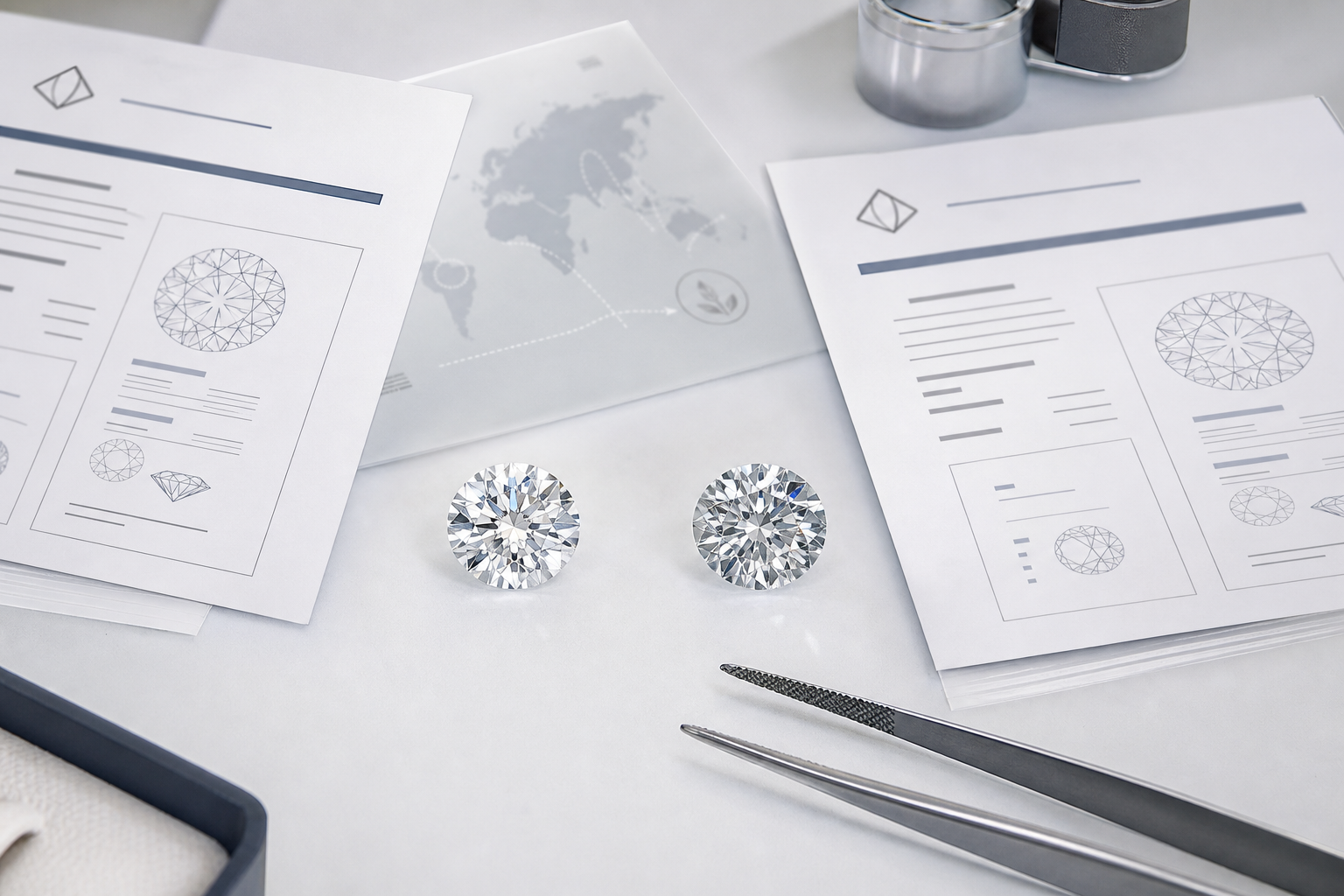
Fluorescence, growth method, and treatment disclosures are easy to skip because they sit outside the familiar 4Cs. They should not be treated as automatic deal-breakers, but they should be read carefully. These fields help you understand the diamond more completely and can explain why two lab-created diamond listings with similar headline grades may deserve different levels of scrutiny.
The right approach is balanced. Do not panic over a notation you do not understand, and do not ignore it either. A lab-grown diamond certificate is most useful when every field is accounted for before purchase, especially if the stone is being selected online.
Fluorescence: Usually a Context Field, Not a Panic Signal
Diamond fluorescence describes how a diamond reacts under ultraviolet light. On a grading report, it may be listed as None, Faint, Medium, Strong, or a similar scale depending on the lab. In many real buying situations, fluorescence has little visible effect, especially under everyday indoor lighting.
The field becomes more relevant when fluorescence is strong or when the diamond already looks hazy, oily, or less crisp in video. Fluorescence itself is not always the cause of those issues, and it is not automatically bad. The safer judgment is to use the fluorescence grade as a prompt for visual confirmation. If the report says Strong fluorescence and the listing video looks slightly cloudy, ask the seller to comment on transparency and appearance in normal lighting.
Growth Method: CVD and HPHT on the Report
A lab-grown diamond certificate may identify the stone as laboratory-grown and may list the lab-grown diamond growth method, commonly CVD or HPHT, depending on the grading lab and report format. Buyers often ask about CVD vs HPHT on a diamond certificate because the terms sound technical and can feel like a hidden quality ranking.
The growth method alone should not be treated as a simple winner-or-loser category. A well-cut CVD diamond can be a better purchase than a poorly cut HPHT diamond, and the reverse can also be true. What matters in practice is the finished stone: its grading information, transparency, color appearance, clarity characteristics, cut quality, measurements, and visual performance.
Some buyers may prefer to know the method for documentation or transparency reasons. That is reasonable. The mistake is using CVD or HPHT as a shortcut for quality without reviewing the actual diamond. The certificate tells you how the stone is categorized; it does not replace evaluation of how the stone looks.
Treatment or Post-Growth Disclosure
Some lab-grown diamond reports may include post-growth treatment disclosures or notes related to treatment status. This does not need to create alarm, but it should never be ignored. The key issue is transparency: you should understand what the report says and whether the seller’s listing describes the same information clearly.
If you see unfamiliar wording, ask for a plain-English explanation before buying. The seller should be able to explain what the notation means without making it sound either meaningless or frightening. A vague answer is a warning sign, not because every treatment disclosure is bad, but because unclear documentation weakens your ability to compare stones responsibly.
Sustainability or sourcing language should be treated the same way: as something to verify through clear documentation rather than accept as a slogan. Lab-grown diamonds can offer a different production path from mined diamonds, but the certificate itself usually documents gemological characteristics, not a complete environmental or ethical profile. If those issues matter to your purchase, ask what information the seller can actually provide and distinguish documented facts from broad marketing claims.
Use Sustainability and Sourcing Claims Carefully
Environmental and sourcing claims should be specific, documented, and limited to what can be substantiated. A grading report usually documents gemological characteristics rather than proving low-impact production, responsible sourcing, or a particular ethical pathway.
If a seller describes a diamond as sustainable, eco-friendly, ethical, or conflict-free, ask what the claim refers to and what documentation supports it. Buyers comparing lab-grown and natural diamonds should separate origin, production method, and seller claims instead of treating one term as proof of all three.
When those claims matter to your decision, look for clear product documentation and treat broad marketing language as a starting point for verification, not as a conclusion.
When to Pause on a Disclosure Field
It is worth slowing down if the report has a notation you cannot match to the listing, if a disclosure seems unusually vague, or if the seller avoids explaining it directly. The issue is not that every unusual note is negative. The issue is that unclear disclosure makes it harder to compare stones fairly and to understand what you are buying.
A report should reduce uncertainty, not add to it. If the seller cannot explain the growth method, a treatment note, or a fluorescence grade in a straightforward way, ask for the full report image and a second look at the video before proceeding.
How to Verify This Before Buying
Before purchasing, review the full report image rather than relying only on a product summary. Check the fluorescence grade, growth method if listed, and any treatment or post-growth notation. If a listing omits the report image or crops out the relevant disclosure fields, request the full report before moving forward.
Ask the seller to explain any fluorescence, growth method, or treatment language that is unclear. If the response does not match the certificate, or if the seller cannot confirm what the report says, pause the purchase. These fields may not determine whether the diamond is right for you, but they should be understood before you commit.
Use Comments, Clarity Plots, and Inscription Notes to Catch Important Details
The smaller text on a grading report is easy to skip, but it can change how confidently you evaluate a loose diamond. Diamond certificate comments, clarity plots, and inscription notes often explain details that do not fit neatly into the main color, clarity, or cut fields. They may not make a diamond better or worse by themselves, but they can tell you where to look more carefully before buying.
This is especially important online, where the report may be the most formal document attached to the stone. A buyer who reads only the headline grades may miss a comment about clouds, pinpoints, internal graining, or an inscription detail that helps confirm the diamond’s identity.
Comments That Deserve a Second Look
Diamond certificate comments are short, but they are not throwaway text. They may mention clarity characteristics, additional observations, or grading notes that help explain how the lab reached its conclusion. A comment such as “additional clouds are not shown” does not automatically mean the diamond is hazy or unattractive, but it does mean you should not stop at the clarity grade alone.
The practical question is whether the comment points to something that could affect normal viewing. Clouds, pinpoints, needles, or internal graining may be irrelevant in one diamond and more noticeable in another, depending on their density, location, and how the stone handles light. A VS-grade diamond with a poorly placed feature under the table may deserve more scrutiny than a lower-grade stone with a small inclusion near the edge that disappears in normal wear.
If you do not understand what a comment means, ask the seller for a plain-English explanation and use a loose lab diamond buying guide when you compare that answer against magnified images or video. The mistake is not buying a diamond with comments; the mistake is treating unfamiliar wording as either harmless or alarming without checking how it affects the actual stone.
Clarity Plot Versus No Plot
Some grading reports include a clarity plot, while others use comments or a more abbreviated format. A clarity plot maps certain inclusions and blemishes, usually with symbols showing where the features appear. It can help you understand whether a visible characteristic sits near the table, along the edge, or in a less noticeable area.
A missing clarity plot is not automatically a warning sign. Some report formats, especially shorter or digital-first reports, may rely on written comments instead. What matters is whether the available report details give you enough information to evaluate the diamond alongside photos and video. If the report has no plot and the listing has no clear magnified imagery, the buyer is being asked to make a decision with too little visual evidence.
Use the plot as a guide, not a verdict. Plots do not always show every tiny feature, and they do not tell you how distracting an inclusion will be in real life. A plotted inclusion that looks concerning on paper may be hard to see without magnification, while a broad cloud mentioned in comments may affect transparency more than its short description suggests.
Inscription Notes and Brand or Report Markings
Diamond laser inscription details help connect the physical diamond to the grading report. Many loose lab-grown diamonds have a microscopic inscription on the girdle that matches the report number. Depending on the grading lab and report type, the inscription may also identify the stone as laboratory-grown.
Most buyers will not be able to read the inscription without proper magnification, but the seller should be able to confirm it. If the certificate lists a diamond laser inscription, the report number on the listing, the report image, and the seller’s confirmation should all point to the same stone. This matters more than many shoppers realize: before judging whether a diamond is a good value, you first need confidence that the document actually belongs to the diamond being offered.
Inscription notes may also include brand or report markings, depending on how the diamond was submitted and documented. These markings are useful for identification, but they should not be confused with proof of beauty, performance, or fair pricing. They confirm identity better than they confirm desirability.
Buyer Verification Checklist
- Read every comment line before purchase, including short notes that appear below the main grades.
- If a comment mentions clouds, pinpoints, internal graining, or additional characteristics not shown, request a plain-English explanation.
- Check whether the report includes a clarity plot, written comments, or both, and make sure the listing provides enough visual evidence to support the format.
- Confirm that the inscription note matches the report number and the seller’s listing details.
- If the wording is unclear, ask for visual confirmation through magnified images, video, or seller documentation before committing.
Compare the Certificate Against Photos, Video, and the Seller Listing
A diamond certificate review should narrow your options, not replace your eyes. The report tells you what the lab recorded; it does not fully show brightness, contrast, bow-tie effect, windowing, or how balanced the stone looks as it moves. For loose lab-grown diamond buying, the safest approach is to compare the certificate with photos, video, and the seller listing before treating any diamond as a serious contender.
The common mistake is asking, “Should I buy a diamond based on certificate only?” In practical terms, no. A grading report is essential, but a loose diamond is still a visual object. Two stones with the same carat, color, clarity, and even similar measurements can look noticeably different once you see their facet pattern and light return.
What Video Can Reveal That the Certificate Cannot
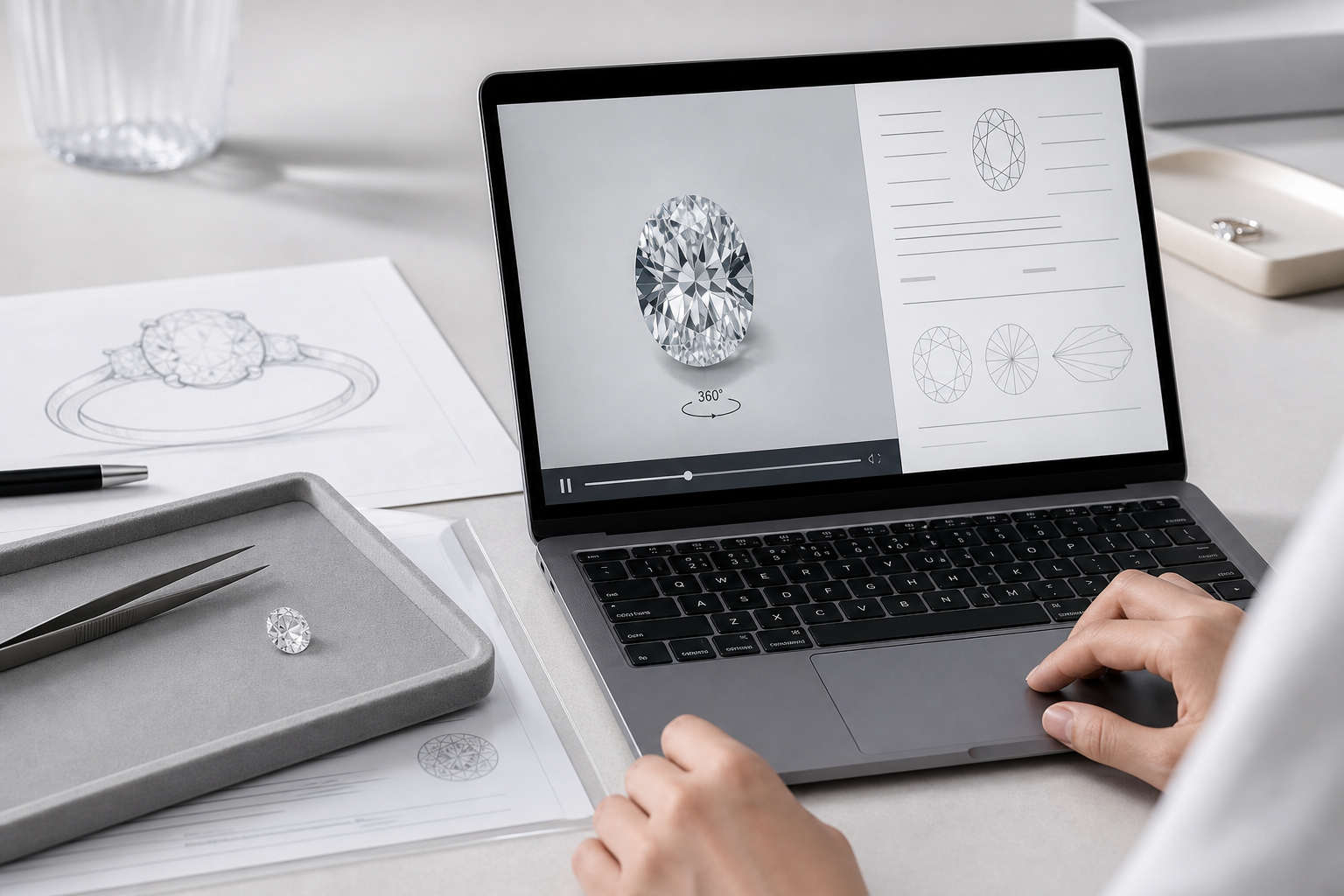
A 360-degree video can show how the diamond behaves when it moves. This is where you may notice dark areas, uneven brightness, a strong bow-tie effect in elongated shapes, or windowing in step cuts such as emerald and asscher diamonds. These issues are not always obvious from the certificate because the report records grades and measurements, not the full visual experience.
For oval, pear, marquise, and radiant shapes, video is especially useful because outline and light pattern matter as much as the numbers. A certificate may tell you the length-to-width ratio, but it will not tell you whether the stone looks elegant, overly narrow, bottom-heavy, or visually unbalanced. If the video shows a large dark band across the center of an oval, a better paper grade may not make that stone the better purchase.
What Photos Can and Cannot Prove
Diamond photos can help you examine inclusions, outline, color impression, and general appearance. Magnified images are useful when checking whether a clarity characteristic sits in a distracting location, especially under the table. They can also reveal whether a fancy shape has an uneven outline or a shape profile that does not match your preference.
Photos have limits. Lighting, magnification, background color, and editing can all affect how a diamond appears. A highly magnified image may make a tiny inclusion look worse than it will in daily wear, while flattering lighting may hide weak brightness or dark zones. If multiple images are available, compare them instead of relying on the most attractive one.
Seller Listing Consistency
The seller listing should match the certificate in every core detail: title, report number, shape, carat weight, measurements, color, clarity, and any linked stone video. If the listing says 1.70 ct but the certificate shows 1.67 ct, or if the measurements differ from the report image, pause before buying. Some mismatches may be simple listing errors, but they still need to be resolved in writing.
Also compare the certificate image against the product specifications rather than assuming the uploaded document belongs to the listed stone. In online shopping, a correct certificate attached to the wrong listing is a real risk. The more expensive or time-sensitive the purchase, the less tolerance you should have for unexplained inconsistencies.
Scenario Grounding: A Practical Buyer Example
Emily is comparing two 1.70 ct oval lab-grown diamonds with the same color and clarity grades. On paper, one diamond looks slightly stronger because its listed grades and proportions appear a little more favorable. But when she compares the diamond certificate and video, she notices that the higher-paper-grade stone has a stronger bow-tie across the center and a narrower outline than she wants for her ring.
The second diamond has nearly identical certificate information but looks more balanced in motion. Its outline feels softer, the center appears brighter, and the bow-tie is less distracting. Emily chooses the second stone because the certificate helped her narrow the search, but the video showed which diamond better matched the look she actually wanted.
Understand How Certificates Affect Value Without Treating Them as Price Guarantees
A certificate affects lab-grown diamond value because it gives buyers a shared basis for comparison. It records the diamond’s graded characteristics, making it easier to compare one loose stone against another. But diamond certificate value should not be confused with a price guarantee. The report helps explain what is being offered; it does not decide what the diamond should cost in every selling environment.
This distinction matters because buyers often compare two certificates and assume the better-looking report must be the better purchase. Sometimes it is. Sometimes the more valuable diamond is the one with slightly less impressive grades but better visual performance, better measurements for the intended setting, or more complete seller documentation.
At NUVU, this kind of comparison is best treated as a practical selection question rather than a single-grade decision. The report narrows the field, but the final decision still depends on whether the stone makes sense visually, physically, and financially for the buyer’s ring plan or inventory need.
A reliable comparison process should also separate what the lab has independently graded from what the seller is helping you interpret. The grading report gives the formal reference point; the seller’s role is to help you understand whether that report aligns with the diamond’s video, measurements, setting plan, and budget. When those pieces are presented clearly and consistently, the buyer has a stronger basis for saying yes or no without relying on pressure or vague claims.
When a grading report is provided, buyers should compare the report details with the issuing laboratory’s verification tools where available and confirm any seller-stated policies, services, or documentation expectations in writing before purchase.
Why Similar Certificates Can Still Have Different Prices
Two lab-grown diamonds with similar grading reports can have different prices for valid reasons. Cut precision, visual performance, measurement spread, inventory source, seller channel, documentation quality, setting services, and market timing can all affect the final price. A diamond that faces up larger, looks brighter, or fits a specific ring design more cleanly may carry a different value than one with the same headline grades.
Seller model also matters. Some sellers price only the loose diamond, while others may include design consultation, setting coordination, documentation support, or more hands-on comparison help. Those services do not change the grading report, but they can change the total buying experience and total ring cost. The mistake is comparing price without comparing what is included and how clearly the stone has been documented.
When a Higher Grade May Not Improve the Real Purchase
A higher color or clarity grade is not always the smartest use of budget. If a diamond already appears white in the intended setting and clean to the naked eye, paying more for a grade the wearer cannot see may not improve the real purchase. This is especially true when the upgrade takes money away from cut quality, preferred size, or a better-fitting setting.
The certificate should help you identify meaningful differences, not chase perfect-looking paper. A D color or very high clarity grade can be worthwhile for buyers who are sensitive to those details, choosing a larger stone, or selecting a shape that shows color and inclusions more easily. But for many buyers, the better decision is the diamond that looks bright, balanced, and clean in normal viewing conditions rather than the one with the highest possible grade in every box.
When a Lower Price Should Prompt More Questions
A lower price is not automatically suspicious. Lab-grown diamond pricing can vary widely based on supply, seller channel, inventory model, and market conditions. But a price that seems unusually low should slow the decision down, not speed it up.
Before assuming it is the best deal, check the report match, measurements, visual performance, fluorescence, growth method, treatment disclosures, seller transparency, and setting compatibility. A lower price becomes less attractive if the stone has a distracting bow-tie, shallow visual spread, unclear disclosure language, mismatched listing details, or proportions that do not work for the intended ring. The most expensive mistake is not overpaying slightly; it is buying the wrong diamond because the discount made the decision feel urgent.
What to Confirm in Writing
- The exact report number and grading lab shown on the certificate.
- Confirmation that the diamond being shipped is the exact stone shown in the listing, images, and video.
- Shape, carat weight, color, clarity, measurements, fluorescence, growth method, and any treatment disclosures.
- Whether the millimeter measurements work for the intended setting, especially for custom or semi-mount designs.
- Any seller-provided policies or services that affect the total purchase, such as setting coordination, documentation support, or post-purchase options.
For buyers comparing several loose stones at once, written confirmation is not just a formality. It creates a record of which diamond was discussed, which report was reviewed, and which measurements were considered for the intended setting. That record is especially useful when a stone is being reserved, shipped to a jeweler, or coordinated with a custom design timeline.
Documentation should feel straightforward rather than intimidating. A seller who can calmly confirm the report number, inscription, lab record, visual assets, and setting fit is giving you practical confidence, not asking you to take a leap of faith. If the answer to a simple documentation question becomes vague, rushed, or inconsistent, treat that as a reason to slow down and re-check the file before payment.
Read Price and Resale Claims as Context, Not Guarantees
Prices for loose lab-grown diamonds can vary with report type, shape, size, cut precision, seller channel, and availability. Similar certificate grades do not always lead to the same price because the visible appearance, measurements, and documentation can differ.
For that reason, phrases such as best value, great deal, or resale language should be treated carefully unless the seller gives a current, specific basis for the claim. A lower price is not automatically better if the stone shows weaker visual performance, unclear disclosure, or dimensions that do not fit the intended setting.
When comparing options, line up like-for-like stones and verify the details at the time of purchase rather than relying on a static listing or general market language.
Build a Pre-Purchase Certificate Review Checklist
A good lab-grown diamond certificate checklist should follow a fixed order. Do not start by debating whether a color grade is high enough or whether a clarity grade is a good value. Start by proving that the loose diamond certificate belongs to the exact stone being sold. If the identity is wrong, every other grade becomes irrelevant.
Once the identity is confirmed, move from hard facts to judgment calls. Report number, inscription, shape, carat weight, and diamond measurements are verification points. Color, clarity, cut, polish, symmetry, fluorescence, growth method, comments, and visual review are decision points. Mixing those two categories is where many buyers make mistakes: they treat a strong grade as proof of the whole diamond, or they spend time analyzing a report that may not match the stone in the listing.
Step 1: Confirm Identity
Begin with certificate verification. Check the report number on the grading report, then compare it with the seller’s listing and, when available, the grading lab’s online lookup. The shape, carat weight, and measurements should match across all sources. Small formatting differences can happen, but a different measurement, shape, or carat weight is not something to ignore.
The inscription matters because it helps tie the physical diamond to the report. Many loose lab-grown diamonds have a microscopic laser inscription on the girdle that corresponds to the report number or identifies the stone as laboratory-grown. Most buyers will not inspect this themselves without magnification, so ask the seller to confirm the inscription and state whether the diamond being shipped is the exact stone shown in the listing.
Step 2: Review the Main Quality Grades
After identity is confirmed, review the 4Cs and related quality grades together. Carat, color, clarity, cut, polish, symmetry, and fluorescence should not be treated as separate trophies. A higher color grade may not improve the purchase much if the stone already appears white in the intended setting. A strong clarity grade may still need closer review if an inclusion sits in a visible location. A high carat weight can be less appealing if the stone carries weight in depth rather than face-up size.
Cut-related information deserves extra attention because it influences how the diamond handles light. For round brilliant diamonds, the cut grade is one of the most useful fields on the report. For fancy shapes, the certificate may give polish and symmetry but not a complete visual judgment, so the report should push you toward closer photo and video review rather than serve as the final answer.
Step 3: Check Measurements and Visual Evidence
Read the diamond measurements before deciding whether the carat weight works. The millimeter size tells you how the stone will face up and whether it can fit the intended ring design. This is especially important for custom settings, halos, three-stone rings, and low-profile designs, where a small difference in length, width, or depth can affect the structure of the ring.
Photos and video should confirm what the grading report cannot fully show. Look for brightness, dark areas, outline balance, bow-tie effect in elongated shapes, windowing in step cuts, and whether the stone’s proportions match the look you want. If a diamond looks unbalanced on video, a clean certificate does not fix that. The better decision is to choose the stone that works on paper and in motion.
Step 4: Ask the Seller the Right Final Questions
Before buying, ask direct questions that can be answered in writing. Confirm the report number, laser inscription, actual stone availability, and whether the diamond in the listing is the diamond that will be shipped. If the diamond is intended for a ring, ask whether the measurements have been reviewed for that setting rather than assuming a similar carat weight will fit.
Also ask about any treatment disclosure, fluorescence notation, or certificate comment you do not understand. A transparent seller should be able to explain the report in plain English without pushing you to ignore the details. At NUVU, this is how we usually encourage buyers to treat certificate review: not as a formality, but as a final check that the stone, the documentation, and the intended design all line up.
When a loose diamond is part of a custom design, the final questions should include both gemological and production details. Ask whether the jeweler has reviewed the stone’s exact millimeter dimensions, whether the setting will be made or adjusted for that specific stone, and whether any side stones will be matched with the center diamond’s color, shape, and visual style in mind. These checks keep the certificate connected to the finished piece rather than treating the diamond as an isolated purchase.
Step 5: Keep a Clear Decision Record
Before payment, save or request the key information that supports your decision: the full grading report image, the report number, the seller’s listed specifications, the stone video or image reference, and any written clarification about inscription, disclosure wording, or setting compatibility. This does not need to be complicated; it simply keeps the decision traceable if you need to revisit what was reviewed.
A clear decision record is especially helpful when more than one person is involved, such as a buyer, partner, jeweler, or custom design consultant. It prevents confusion between similar stones and helps everyone refer to the same report, measurements, and design requirements. The more similar the options are on paper, the more useful this record becomes.
Final Buyer Checklist
- Confirm that the report number on the certificate matches the seller listing.
- Use the grading lab’s report lookup when available.
- Match the shape, carat weight, and diamond measurements across the report and listing.
- Ask the seller to confirm the laser inscription and exact stone identity.
- Review carat, color, clarity, cut, polish, symmetry, and fluorescence together.
- Check the growth method and any treatment or post-growth disclosure.
- Read all comments, clarity notes, and inscription details before purchase.
- Compare the certificate against photos, 360-degree video, and the listed specifications.
- Look for visual issues the report may not fully capture, such as bow-tie, windowing, dark areas, or outline imbalance.
- Confirm that the stone’s measurements work for the intended setting or custom ring design.
- Get written clarification for any mismatch, missing detail, or unfamiliar report wording.
If you are comparing documented loose lab-grown diamonds, use the certificate to narrow the field, then use measurements, visual evidence, and seller confirmation to make the decision. A strong report is valuable, but the safest purchase is the one where the paperwork, the stone, and the design goal all support the same conclusion.
NUVU’s role in buyer education is to make comparison clearer, especially around grading reports, visual evidence, design fit, and documentation. Buyers should still verify report details through the issuing laboratory where available and confirm seller-specific policies or services directly before purchase.
FAQ: Reading a Loose Lab-Grown Diamond Certificate
Is a lab-grown diamond certificate the same as an appraisal?
No. A lab-grown diamond certificate, often called a grading report, describes the diamond’s characteristics, such as carat weight, color, clarity, measurements, cut-related grades, fluorescence, growth method, and inscription details. An appraisal usually estimates value for insurance or documentation purposes. The grading report helps identify and evaluate the diamond; the appraisal is a separate value-related document.
Can I buy a loose lab-grown diamond based only on the certificate?
You should not buy based on the certificate alone. The certificate is essential, but it does not fully show brightness, sparkle, outline balance, bow-tie effect, windowing, or how the stone will look in a specific setting. Before purchasing, compare the grading report with photos, video, measurements, seller details, and setting compatibility.
Which part of the certificate matters most?
Identity verification comes first. Confirm the report number, inscription, shape, carat weight, and measurements before interpreting quality grades. After that, review cut-related information, color, clarity, fluorescence, growth method, comments, and inscription notes. The biggest mistake is judging a diamond’s quality before confirming that the report belongs to the exact loose stone being sold.
Does the certificate prove a lab-grown diamond is beautiful?
No. A certificate supports evaluation, but it does not fully prove beauty, sparkle, or visual balance. Two diamonds can have very similar reports and still look different in video or in a ring. The report should help you avoid poor matches and narrow your options, but visual review should carry real weight in the final decision.
What should I do if the seller listing does not match the certificate?
Pause the purchase and ask for written clarification. A mismatch in report number, carat weight, shape, measurements, color, clarity, or inscription details should be resolved before you buy. If the seller cannot clearly explain the difference or confirm the exact stone identity, do not proceed with that diamond.
Disclosure: This article is for general educational purposes only. Diamond grading, pricing, availability, specifications, and seller policies can change, and readers should verify important details through grading reports, official laboratory tools, seller documentation, or qualified professionals before making a purchase decision. Laboratory-grown diamonds should be clearly distinguished from natural diamonds, and environmental or sourcing claims should be supported by specific documentation.