
Choosing a loose lab-grown diamond is not just about picking the biggest stone or the lowest price. Shape changes how large a diamond looks, how much sparkle you notice, and how clearly inclusions show, so a lab-grown diamond cut quality perspective can help explain why proportions, symmetry, and light return matter before deciding whether the stone will work well in a ring setting. A 1-carat round, for example, can look very different from a 1-carat oval or marquise once measurements, depth, and overall form are taken into account.
For the full framework, read Loose Lab-Grown Diamonds Buying Guide.
This guide helps you judge shapes the way a careful buyer would: by comparing face-up size, proportions, bow-tie risk, clarity visibility, and setting fit together. It gives you a practical way to decide whether round is the safest choice, whether an elongated fancy shape offers better visual spread, or whether a step cut, radiant, or cushion better matches your style and budget.
| Shape or Check | What to Compare | Buying Takeaway |
|---|---|---|
| Round | Brilliance, cut consistency, setting ease | Safest all-around choice for many buyers |
| Oval, pear, marquise | Length-to-width ratio, bow-tie, finger coverage | Can look larger, but needs visual review |
| Emerald, asscher | Clarity, symmetry, step-cut pattern | Shows inclusions more easily |
| Radiant, cushion | Overall form, depth, sparkle pattern | Varies widely from stone to stone |
| Measurements | Length, width, depth, face-up size | More useful than carat alone |
| Setting fit | Point protection, support, ring style | Affects durability and final cost |
Quick Questions Before You Read
Q: Is carat weight enough to tell how big a diamond will look?
No. Shape, measurements, and depth can make the same carat weight look larger or smaller.
Q: Which shapes need the closest visual review?
Oval, pear, marquise, and radiant shapes, because bow-tie effect and symmetry can vary a lot.
Q: Do emerald and asscher cuts need different clarity standards?
Usually yes. Their open step cuts can make inclusions easier to notice.
Q: Should I pick the setting after choosing the shape?
Usually. Some shapes need more protection or support, especially at the corners or pointed ends.
Start With the Real Decision: What Diamond Shape Changes in a Loose Lab-Grown Diamond
Choosing between loose lab-grown diamond shapes is not just a matter of picking the outline you like best. Shape changes how large the diamond looks from the top, how it reflects light, how visible inclusions may be, how efficiently it uses budget, and how easily it fits the ring or jewelry design you have in mind.
Two lab-grown diamonds with the same carat weight can look surprisingly different once viewed face-up. A 2.00 carat round diamond may feel compact and bright, while a 2.00 carat oval or pear may cover more length on the finger. An emerald cut may look quieter but more architectural. A cushion may look soft and romantic, but depending on its depth, it may face up smaller than expected. The carat number is only part of the decision; the shape determines how that weight is distributed and how the finished piece reads in real life.
Lab-grown diamonds often give buyers more room to consider a larger carat weight or a higher color and clarity grade than they initially expected. That does not mean every larger stone is the better choice. If the shape works against the design, hides weight in depth, shows an obvious bow-tie, or demands a setting that does not fit your lifestyle, the value on paper may not translate into a better-looking diamond.
Evidence note for buyers: A lab-grown diamond should be described clearly as laboratory-grown, not as a natural diamond with vague wording. GIA explains that laboratory-grown diamonds are produced by technological processes rather than formed geologically, and FTC jewelry guidance is relevant because advertising should avoid confusing or misleading origin descriptions. In practical shopping, this means the shape decision should sit alongside clear disclosure, report details, and seller transparency.
Laboratory-grown diamonds should be clearly identified as laboratory-grown, and they should not be presented as mined diamonds. Lab-grown diamonds and natural diamonds can share the same basic diamond material, but their origins are different, and that origin should be clear in product descriptions, grading reports where applicable, and seller communication.
It is also useful to separate lab-grown diamonds from diamond simulants. A diamond simulant is a lookalike material rather than a laboratory-grown diamond. If a buyer is comparing loose lab-grown diamonds, the listing and documentation should clearly indicate that the stone is a laboratory-grown diamond, not a simulant and not a natural diamond.
Shape Versus Cut: Why Buyers Should Not Confuse the Two
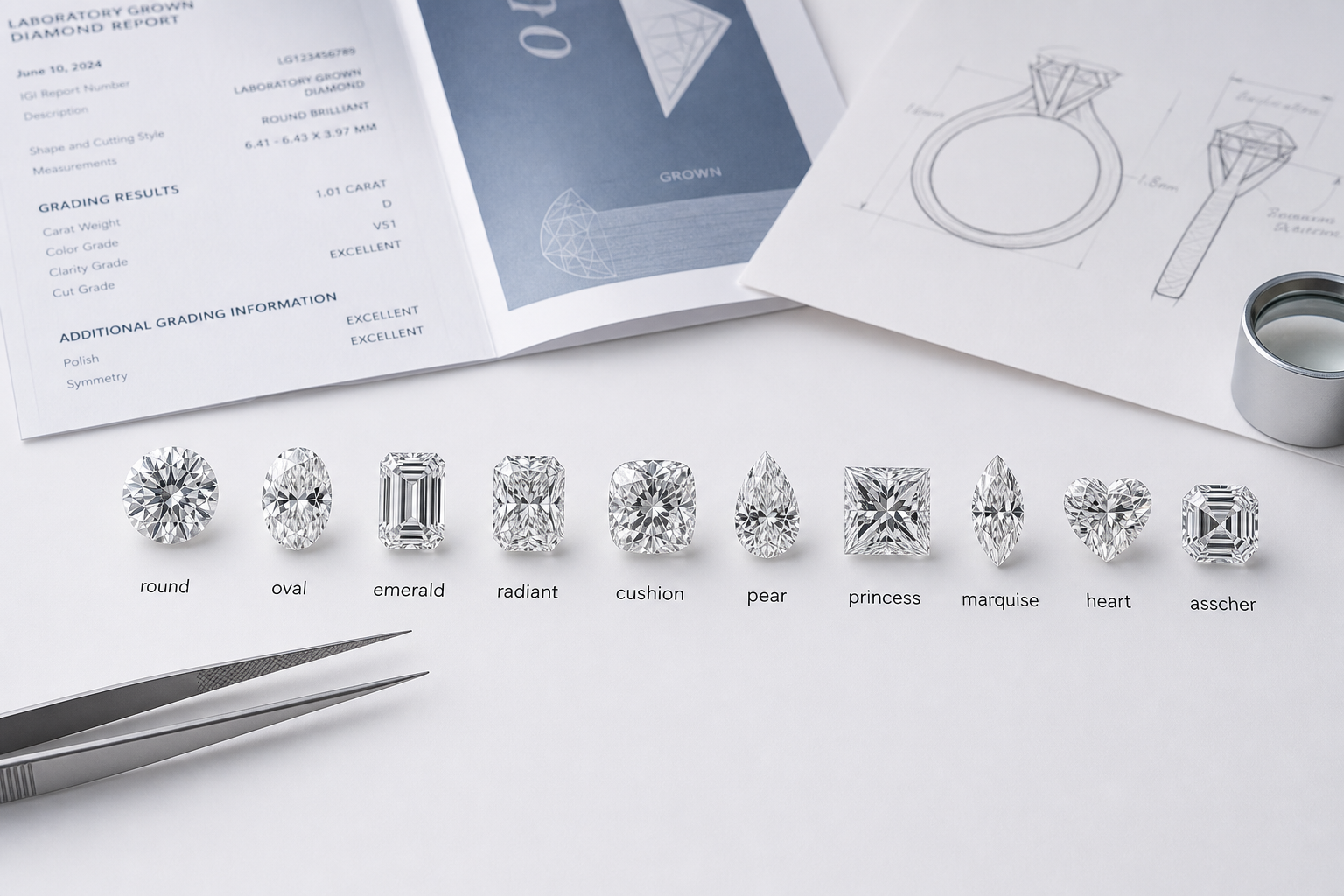
Shape is the diamond’s outline: round, oval, emerald, cushion, radiant, pear, princess, marquise, heart, or asscher. Cut quality is different. It refers to how well the diamond’s proportions, symmetry, and facet arrangement handle light.
This distinction matters because buyers often say they want a “good cut” when they really mean they like a certain shape. A round brilliant diamond is both a shape and a cutting style, and rounds are often easier to compare because many grading reports include a cut grade. Fancy shapes, including oval, radiant, cushion, pear, emerald, and marquise, require more visual review because the report will not fully tell you whether the outline is balanced, the sparkle is attractive, or the center looks dark.
For a cautious buyer, round is usually the safest route for predictable brilliance. For a buyer choosing a fancy shape, the decision needs more judgment: proportions, images, video, and setting fit matter more than the shape name alone.
For buyers, the practical point is that a grading report and a product title describe different parts of the decision. The report can document measurable characteristics, while the stone’s actual videos, proportions, and intended setting show whether those characteristics work together visually. This is especially important for fancy shapes, where two stones with similar grades can feel quite different once viewed in motion.
The Five Buying Factors Shape Influences Most
Visual size is often the first surprise. Some shapes spread their weight across more length and width, while others carry more depth below the girdle. This is why an elongated oval, pear, or marquise can look larger than a round diamond with the same carat weight.
Sparkle style changes by faceting pattern. Round brilliants tend to give the most familiar bright sparkle. Radiants can look lively and energetic. Cushions vary widely, from broader flashes to a crushed-ice effect. Emerald and asscher cuts trade constant glitter for cleaner lines and broad flashes.
Price efficiency depends on demand, cutting yield, and visual spread. Fancy shapes can sometimes offer more face-up presence for the budget, but a lower price is not automatically better value. Poor proportions, weak light return, or an unattractive outline can erase the advantage.
Clarity tolerance is not equal across shapes. Brilliant-style shapes can hide small inclusions better because their facet patterns create more movement. Step cuts like emerald and asscher are more transparent, so inclusions and body color can be easier to notice.
Setting compatibility affects the final ring more than many buyers expect. Round, oval, radiant, cushion, and emerald shapes are broadly versatile. Pear, marquise, princess, and heart shapes can be beautiful but need more attention to points, corners, orientation, and protection.
This lab-grown diamond shape guide compares each shape through those practical filters: how it looks, how it performs, how it uses budget, and how it works in the finished piece.
Quick Orientation: Safe, Bold, Elongated, and Architectural Shapes
Round is the classic bright choice. It is the least risky option for buyers who want familiar sparkle, simple setting compatibility, and a timeless engagement ring look. It may not always look largest for the carat weight, but it is often the easiest shape to buy with confidence.
Oval and pear are strong choices for buyers who want a softer elongated look with more finger coverage. They can be flattering and visually efficient, but they need careful review for bow-tie visibility, symmetry, and overall outline balance.
Emerald and asscher cuts are better for buyers who prefer structure over glitter. They look clean, architectural, and deliberate. The tradeoff is that they usually require more careful clarity review because their open facets do not disguise inclusions as easily.
Radiant and cushion cuts sit in the flexible middle. Radiants can feel bright, modern, and angular, while cushions can look soft, relaxed, or antique-inspired depending on their outline and facet pattern. These are good candidates for buyers who want personality without moving into a highly unusual shape.
Princess and heart shapes are more style-specific. A princess cut suits a crisp modern square look, but its corners need protection. A heart shape only works well when the buyer truly wants that symbolism and the stone is large enough for the outline to read clearly.
Marquise is the most dramatic of the common elongated shapes and often one of the most size-efficient face-up. It can look striking, but it is not a neutral choice. It needs strong symmetry, a secure setting, and a wearer who wants the shape to be noticed.
What to Check Before You Decide
Before choosing a loose diamond shape online, check the actual millimeter measurements rather than relying on carat weight alone. Length, width, and depth tell you much more about how the diamond will appear from the top.
For fancy shapes, images and 360-degree video are not optional extras. They help reveal whether the outline looks balanced, whether an oval or marquise has a heavy bow-tie, whether a cushion looks too deep, whether a radiant has the sparkle style you expect, and whether corners or tips will fit the intended setting safely.
The best lab-grown diamond shape for an engagement ring is the one that fits the wearer’s eye, the design, and the practical use of the finished piece. Shape is where those decisions start to become visible.
Compare Visual Size: Which Lab-Grown Diamond Shapes Look Largest for Their Carat Weight
Some diamond shapes look bigger because they show more surface area from the top. This is called face-up size or spread, and it is one of the most important practical differences between loose lab diamond shapes. If your goal is the best lab-grown diamond shape for a bigger look, you should compare length and width before you compare carat weight.
Elongated diamond shapes usually create more visible coverage across the finger. Marquise, oval, pear, and some elongated radiant or cushion cuts can appear larger than round, asscher, or deeper cushion cuts at the same carat weight. The warning is that spread only helps if the stone still has attractive proportions and good visual performance. A wide or long diamond that looks dark, flat, or awkward is not a better buy.
Why Carat Weight Does Not Equal Visual Size
Carat measures weight, not surface area. A diamond can carry weight in its depth, meaning more of the material sits below the girdle where you do not see it face-up. That stone may weigh more but look smaller from the top than a better-spread stone with the same carat weight. Buyers who shop only by carat often pay for weight they cannot visually appreciate.
Elongated shapes can be efficient because they distribute more of their presence across length and width. That extra length can make the diamond look larger on the hand, especially in solitaire settings where the center stone outline is fully visible.
Approximate Face-Up Measurement Benchmarks for 1.00 Carat Lab-Grown Diamonds
These approximate benchmarks can help you understand what is normal, but they should not be treated as fixed rules or grading standards. Actual millimeter measurements vary by depth, proportions, cutting style, and length-to-width ratio, so the report-listed measurements and real imagery should control the final comparison.
- Round: often near the mid-6 mm range in diameter.
- Oval: commonly appears longer than a round of the same carat weight, with the exact look depending on length-to-width ratio.
- Pear: usually gives a directional, elongated look, with both width and tip shape affecting perceived size.
- Emerald: tends to show length and clean rectangular lines, but depth and step-cut proportions can change face-up presence.
- Radiant: can be square or rectangular, so measurements must be read with the intended style in mind.
- Cushion: can face up compact or generous depending on depth, outline, and whether it is square or elongated.
- Marquise: often creates one of the strongest length impressions because of its pointed elongated outline.
The useful lesson is not that one measurement guarantees a better diamond. The useful lesson is that two 1.00 carat diamonds can occupy very different visual space. If a stone’s face-up measurements are noticeably small for its shape and carat weight, look carefully at its depth and proportions before assuming it is a bargain.
Face-up spread should be judged with light performance, not separately from it. A shallow-looking stone may appear large in millimeters but lose life in the center, while a deeper stone may sacrifice some spread but look more balanced. In practical buying, the strongest candidate is usually the one that combines acceptable spread, attractive brightness, and a shape outline that will still look intentional after setting.
Prices can change with market conditions, report type, seller channel, and stone-specific details, so exact comparisons should be verified at the time of purchase. A shape that appears more budget-efficient in one listing may not be the better choice if the stone has weaker proportions, limited documentation, or a setting requirement that increases the total project cost.
Shapes That Usually Look Larger: Oval, Pear, Marquise, and Some Radiants
Oval, pear, and marquise cuts tend to look larger because they create more vertical coverage. On the hand, length is highly visible, and that extra reach can make the center stone feel more substantial without necessarily increasing carat weight.
Marquise usually delivers the most dramatic length. It can be an excellent choice for buyers who want maximum face-up impact, but it is also the least subtle of the size-efficient shapes. If the points are too sharp, the symmetry is off, or the bow-tie is obvious, the diamond can look more problematic than impressive.
Oval and pear shapes are often easier to wear for buyers who want a larger look without as much drama. Ovals feel soft and balanced in many engagement ring designs. Pears add more direction and personality, but the tip needs protection and the orientation should be considered before choosing the setting.
Radiants can also look large when the spread is favorable, especially rectangular radiants. The risk is depth. A radiant that carries too much weight underneath may lose the visual-size advantage that made it appealing in the first place.
Shapes That May Look Smaller but Offer Other Advantages
Round diamonds do not usually win on face-up size per carat, but they often win on brightness and predictability. For buyers who care more about classic sparkle than maximum finger coverage, a well-cut round can still be the stronger choice.
Cushion cuts can face up smaller, especially when they are deep or have a very pillowy outline. That does not make them poor choices. A cushion may be worth choosing for its softer shape, warmer visual character, and compatibility with many ring styles. The mistake is choosing a cushion for size efficiency without checking its measurements.
Asscher cuts may also look smaller for their carat weight because of their depth and step-cut structure. Their appeal is not spread; it is geometry, symmetry, and a distinctive hall-of-mirrors effect. Buyers who want a large-looking diamond for the budget may find asscher less efficient, while buyers who want a precise vintage-inspired square may consider that tradeoff acceptable.
Some princess cuts can also feel more compact from the top. Their sharp square outline gives a modern look, but corner protection and setting choice become part of the value equation.
Measurement Check Before Buying
Compare length, width, and depth percentage across stones with the same carat weight. If one diamond costs less but faces up smaller, the apparent savings may not help you once the stone is set.
For elongated shapes, also check the length-to-width ratio. A ratio that is too short can make an oval, pear, radiant, or cushion look stubby; a ratio that is too extreme can make the stone look narrow or increase visible bow-tie risk. The strongest purchase is usually not the highest carat number, but the stone whose measurements, proportions, and visual appearance support the look you actually want.
Compare Sparkle Style: Brilliant, Crushed Ice, Step-Cut, and Mixed Facet Looks
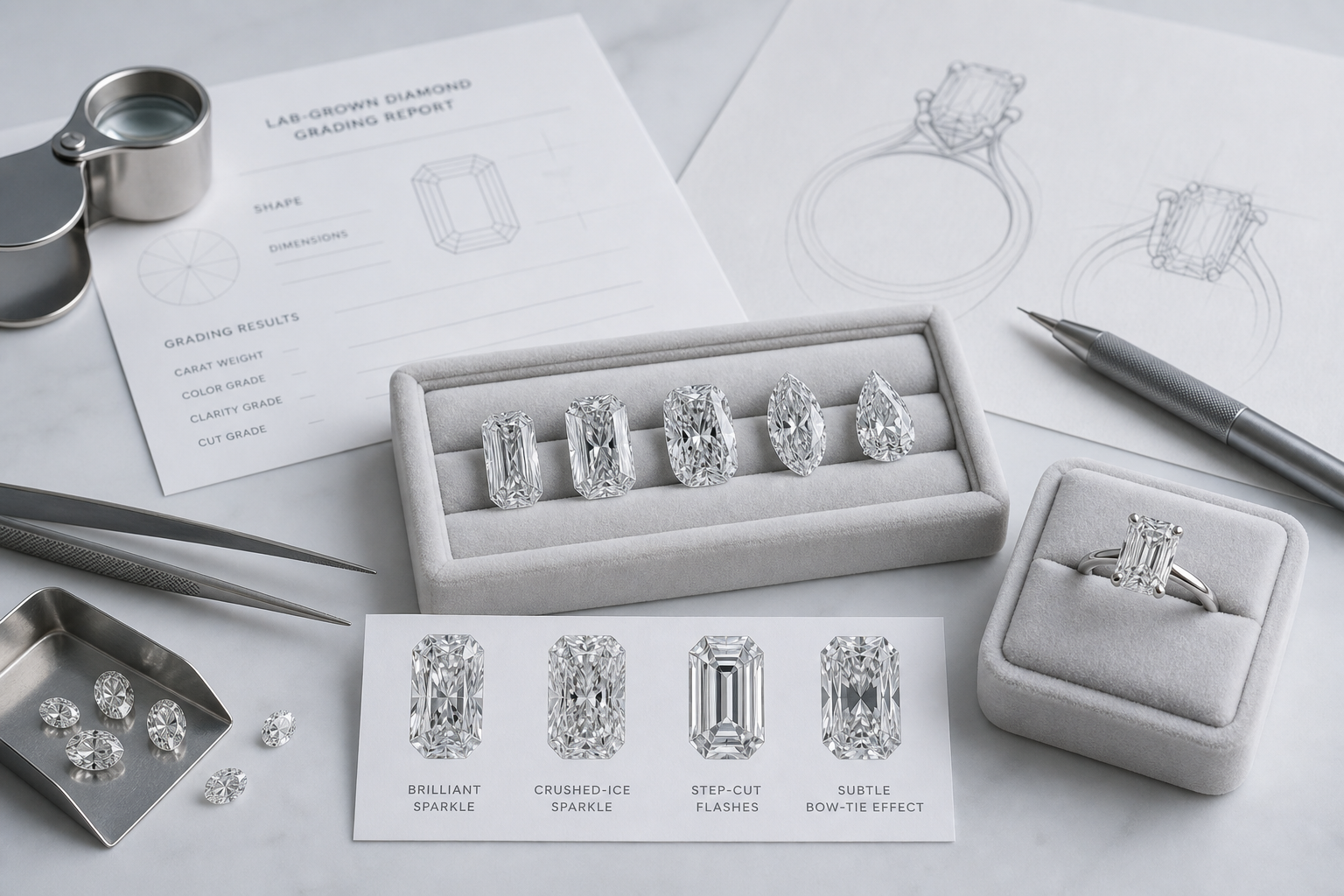
Sparkle is not one single effect. Diamond sparkle by shape depends on facet pattern, proportions, symmetry, and how the stone handles light as it moves. Some shapes create sharp brightness and quick scintillation. Others show broader flashes. Some have a crushed-ice look with many small reflections. Step cuts look cleaner and calmer rather than glittery.
This matters because two buyers can both ask for “sparkle” and mean different things. One may want the classic brightness of a round brilliant. Another may prefer the high-energy look of a radiant. Another may choose emerald because it does not sparkle constantly. The best diamond shape for sparkle depends on the type of light return you enjoy, not just the amount.
Round Brilliant: The Safest Choice for Classic Sparkle
A well-cut round brilliant is usually the safest choice for classic lab-grown diamond sparkle. Its facet arrangement is designed to return light in a balanced, familiar way, with a mix of brightness, fire, and scintillation.
Round diamonds are also easier for cautious buyers to compare because cut grading is more standardized than it is for fancy shapes. A report still does not replace seeing the stone, but a round brilliant gives less shape-related uncertainty than an oval, cushion, radiant, or pear.
If a buyer wants a bright diamond and does not want to spend time sorting through bow-ties, outline variations, or unusual facet patterns, round is the practical first choice. The tradeoff is that it may not provide the largest face-up look for the same budget.
Oval, Pear, and Marquise: Bright Sparkle With Bow-Tie Risk
Oval, pear, and marquise diamonds can be very bright because they use brilliant-style faceting. They also tend to create more length on the finger, which makes them attractive for buyers who want sparkle and visual size together.
The main risk is the bow-tie effect. A bow-tie is a darker area across the center of an elongated diamond, caused by the way light interacts with the facet pattern and viewing angle. Some bow-tie is common in elongated brilliant shapes, and a subtle one does not automatically make the diamond a bad choice.
The problem is a bow-tie that dominates the center in normal viewing. If the middle of an oval, pear, or marquise looks dark in most lighting or pulls attention away from the rest of the stone, the diamond may feel less lively even if the report looks strong. Video review is especially important here because still photos can understate or exaggerate the issue.
Radiant and Cushion: Lively Sparkle With More Personality Variation
Radiant cuts often appeal to buyers who want an angular outline with strong brilliance. They can look energetic and modern, especially in rectangular forms. A well-chosen radiant can be a good middle ground between the clean geometry of an emerald cut and the livelier sparkle of a brilliant-style diamond.
Cushion cuts are less predictable. Some show broader, chunkier flashes. Others have a crushed-ice look, with many smaller reflections across the stone. Neither style is automatically better, but they create different personalities. A buyer who loves bold flashes may be disappointed by a crushed-ice cushion, while a buyer who wants constant texture may find a chunky cushion too quiet.
The mistake is assuming all cushions or all radiants look alike. These shapes need visual comparison. If possible, compare at least two or three stones of the same shape and similar carat weight so you can see whether you prefer crisp flashes, softer sparkle, or a more splintered crushed-ice effect.
Emerald and Asscher: Broad Flashes Instead of Constant Sparkle
Emerald and asscher cuts are step cuts. Instead of many small brilliant facets, they use long, clean facets that create broad flashes and a mirror-like effect. Their appeal is transparency, symmetry, and structure.
These shapes are not the right choice for buyers who want maximum glitter. They are better for buyers who like a quieter, more architectural diamond and are willing to prioritize clarity, symmetry, and clean facet reflection. In return, they can look refined in a way brilliant cuts do not.
The non-obvious tradeoff is that step cuts reveal more. Inclusions, windowing, uneven faceting, and color can be more noticeable because there is less sparkle to distract the eye. For emerald and asscher cuts, a beautiful shape on paper still needs careful visual review.
Report and Visual Review Check
A grading report can confirm the diamond’s shape, carat weight, measurements, color, clarity, polish, symmetry, and other specifications. It cannot fully show sparkle style. It will not tell you whether a cushion has the personality you like, whether an oval’s bow-tie is acceptable, or whether an emerald cut has the clean visual rhythm you expect.
A grading report can narrow the comparison, but it should be read alongside the stone’s proportions, visual evidence, and intended jewelry use. This is especially important for fancy shapes because a report may show similar color, clarity, and measurements for two stones that look noticeably different in motion.
A grading report helps document key characteristics, but it should not be treated as a guarantee of beauty, value, or sourcing ethics. When growth method or post-growth treatment is relevant, buyers should look for clear disclosure in the grading report or seller documentation rather than assuming those details from shape, price, or appearance alone.
When a grading report is available, buyers should verify the report details through the issuing laboratory’s official report-check tool where available and compare those details with the stone’s listed media and measurements.
Review real photos or 360-degree video before choosing a fancy shape. Better yet, compare more than one stone in the same shape. The strongest decision is not simply round versus oval sparkle or radiant versus cushion sparkle; it is whether the individual diamond’s light performance matches the look you want to wear every day.
Compare Price Efficiency: Which Shapes Usually Stretch a Lab-Grown Diamond Budget Further
Lab-grown diamond shape price is not driven by one simple rule. Shape affects how much usable material is retained during cutting, how strongly buyers demand that shape, how strict the cutting expectations are, and how much visual presence the finished stone delivers for its carat weight. A good diamond shape value comparison looks at all of those factors together, not just the lowest listed price.
For many buyers, the best value lab-grown diamond shape is not the cheapest option. It is the shape that gives the right balance of appearance, measurements, sparkle, and setting fit for the total budget. A stone that looks large, performs well, and fits the intended design is usually a stronger buy than a lower-priced stone with compromised proportions or a distracting visual issue.
Price differences can also reflect factors that are not obvious in a simple product grid, including loose lab grown diamond certificate report details, growth method disclosure, inventory availability, matching difficulty, and how consistently stones can be supplied for a project. None of these factors automatically makes one stone better than another, but they are worth checking when two diamonds appear similar at first glance. At NUVU, this kind of comparison is treated as a practical selection question: the report narrows the field, but the final choice still needs to make sense visually, physically, and financially.
When growth method appears in a listing or report, treat it as identification information rather than a shortcut for beauty or value. Laboratory-grown diamonds are commonly associated with controlled growth processes such as HPHT or CVD, but the growth method alone does not tell you whether a specific oval, radiant, or emerald cut has the proportions, transparency, and visual performance you want.
Why Round Diamonds Often Cost More Than Fancy Shapes
Round brilliant diamonds are often priced at a premium compared with many fancy shapes of similar carat weight, color, clarity, and grading report type. Part of that comes from demand: round is the most established engagement ring shape and remains a safer choice for buyers who want classic brilliance. Strong demand can support stronger pricing.
Cutting expectations also matter. Round diamonds are usually judged against more standardized performance expectations, and buyers often compare cut grades more closely in this shape than they do with fancy shapes. Producing a well-proportioned round can also involve more cutting loss from the original crystal than some other shapes, which affects yield. That does not make round a poor value. It means the buyer is often paying for predictability, broad appeal, and a sparkle style that is easier to compare on paper than most fancy shapes.
Where Fancy Shapes Can Create Strong Value
Fancy shapes can stretch a budget when they give more face-up presence, stronger design personality, or a look that would cost more in a round diamond of similar visual impact. Oval, pear, and marquise diamonds often feel efficient because their elongated outlines create more coverage across the finger. For buyers who want a larger-looking center stone without moving up substantially in carat weight, these shapes can be practical options.
Radiant and cushion cuts can also offer strong diamond shape value, but they require more judgment. A rectangular radiant may give a bold, bright look with good spread, while a cushion can deliver a softer outline that works well in both modern and vintage-inspired settings. The risk is assuming the shape name is enough. Two cushions of the same carat weight can look very different if one is deep with a smaller face-up size and the other has more balanced proportions.
An affordable loose lab diamond shape is only useful if the savings translate into something the buyer can see or use. If a lower-priced oval looks visibly larger and has a pleasant sparkle pattern, that may be a strong budget move. If it is cheap because the bow-tie is heavy or the outline looks uneven, the price advantage is not doing real work.
When a Lower-Priced Shape Is Not Actually a Better Buy
The most common mistake is treating price per carat as the main measure of value. A diamond can be less expensive because it carries weight in depth instead of width, has a less desirable outline, shows a strong bow-tie, or has light performance that looks flat in normal viewing. Those issues are not minor if they affect the exact things the buyer wanted from the shape.
Overly deep stones are a frequent value trap. A 2.00 carat diamond that faces up closer to a smaller stone may look attractive in a price filter but underdeliver on the hand. Poor symmetry can also weaken value, especially in shapes where the outline is part of the appeal, such as oval, pear, marquise, heart, emerald, and asscher. If the shoulders, points, corners, or table alignment look off, the diamond can feel less refined even with strong grades on the report.
Clarity placement matters more in some shapes than others. Step cuts such as emerald and asscher can make inclusions easier to notice because their facets are open and mirror-like. A lower-priced emerald cut with a visible inclusion under the table may be a weaker buy than a slightly more expensive one with cleaner visual presentation. In brilliant shapes, small inclusions may be easier to hide, but a dark crystal or feather in a prominent area can still affect the stone’s appeal.
Budget Allocation: Shape, Setting, and Total Project Cost
A loose diamond is only one part of the final purchase if the stone is going into an engagement ring or custom jewelry piece. Shape can influence the setting cost, the level of protection needed, and whether a standard mounting will work. A round or oval solitaire may be straightforward, while a pear, marquise, heart, or princess cut may require more specific prong placement or protective detailing.
Setting complexity can change the real budget decision. A shape that costs less as a loose stone may need a more customized setting, especially if the buyer wants a bezel, halo, three-stone design, or low-profile mounting. Side stones must also be proportioned carefully around elongated centers, and that can affect the total project cost. The smarter comparison is not loose diamond price alone, but diamond plus setting plus design feasibility.
For custom work, this is where a transparent process matters. The stone should be evaluated not only for carat weight and price, but for whether its measurements, outline, and depth make sense for the ring being built around it.
What This Means in a Real Purchase
A buyer comparing a 2.00 carat round and a 2.00 carat oval may find that the oval appears larger on the hand and costs less in some listings. On paper, the oval may look like the better value. In practice, that depends on whether the oval has balanced proportions, appealing brightness, and a bow-tie that does not dominate the center.
If the oval looks stretched in a flattering way, has good visual life, and fits the intended setting safely, it may be the stronger budget choice. If it has an awkward outline, a dark center, or depth that reduces its face-up advantage, the apparent value disappears. The better decision is to compare actual millimeter measurements, video, and setting fit rather than choosing the lowest price per carat.
Choose by Setting Compatibility: How Shape Affects Ring Design and Jewelry Fit
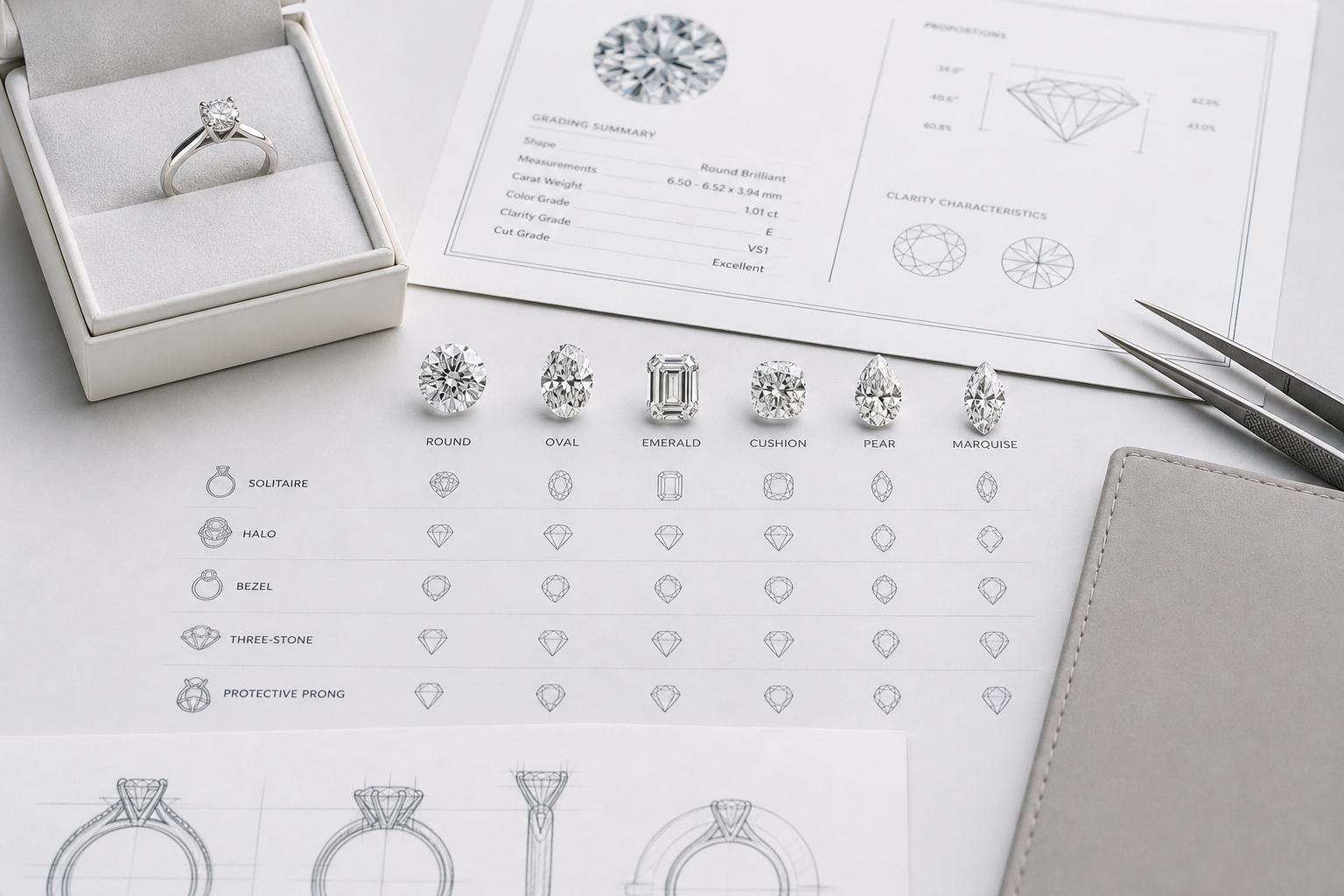
Loose diamond setting compatibility is one of the most practical reasons to choose shape carefully. A diamond can look attractive as a loose stone and still be the wrong physical fit for the ring design a buyer has in mind. Shape affects prong placement, band proportions, side-stone balance, halo shape, bezel feasibility, and how secure the finished piece feels during daily wear.
The best diamond shape for an engagement ring depends on both the center stone and the setting. A shape with a dramatic outline may need more protection. A long stone may need a band that visually supports its length. A square stone may need cleaner alignment and sharper symmetry because the setting will frame it more obviously. The earlier those details are considered, the fewer compromises appear later.
For custom design, trust comes from matching the stone to the setting, budget, and wearer’s daily use, not from choosing grades in isolation. Before finalizing a stone, confirm that the measurements, depth, girdle description, corner style, and orientation are compatible with the intended mounting.
For custom jewelry, stone measurements and setting compatibility should be confirmed before finalizing a purchase. This includes not only length and width, but also depth, girdle condition, prong access, stone orientation, and whether the final design can protect any points or corners without hiding the intended shape.
Best Shapes for Classic Solitaire Settings
Round, oval, emerald, radiant, cushion, and pear diamonds all work well in classic solitaire settings, but they create different demands. A solitaire leaves the center stone exposed visually, so outline, symmetry, and proportions matter more than they might in a heavily detailed setting. There is less design distraction, which means the stone’s shape has to carry the look.
Round diamonds are the easiest fit for most solitaire designs because they are symmetrical, widely supported by standard settings, and visually balanced on many hand shapes. Oval diamonds also work especially well in solitaires because their length adds finger coverage without requiring a complex design. Emerald, radiant, and cushion cuts can look clean and substantial in solitaires, but their corners and proportions need to match the setting style. A pear can be elegant in a solitaire, but its orientation and tip protection should be planned before the stone is purchased.
Shapes That Need More Protective Setting Attention
Pear, marquise, princess, and heart shapes deserve closer setting review because they have points, tips, or corners that can be more exposed. The diamond itself is hard, but the vulnerable area is often the edge or point where impact, snagging, or poor prong placement can create risk. This does not mean these shapes are impractical. It means the setting has to do more work.
V-prongs are commonly used to protect pointed tips on pear and marquise diamonds. Princess cuts often need secure corner protection because their sharp corners are part of the shape’s appeal and also one of its more sensitive areas. Heart shapes need careful prong placement so the cleft and lobes remain visually clear while the point is still protected. A bezel or partial bezel can add protection, but it may also change the visual outline, so buyers should decide whether security or an airier look matters more.
Shapes That Pair Well With Three-Stone and Side-Stone Designs
Emerald, oval, round, radiant, and cushion diamonds often work beautifully in three-stone and side-stone designs because their shapes can be balanced with tapered baguettes, trapezoids, pears, rounds, or smaller matched side stones. The center stone still leads the design, but the supporting stones need to echo its proportions rather than compete with them.
Side-stone proportions are especially important with elongated center stones. An oval with side stones that are too wide can lose its graceful length. An emerald cut with poorly matched side stones can look visually interrupted instead of architectural. Radiant and cushion centers offer more flexibility, but the corner style and length-to-width ratio should guide the side-stone choice. A three-stone ring is less forgiving than it looks because imbalance is easy to see from the top view.
How Shape Affects Band Width and Finger Coverage
Elongated shapes such as oval, pear, marquise, elongated radiant, and elongated cushion create more vertical finger coverage. This can make the center stone feel larger and more flattering, especially for buyers who want presence without an overly wide look. The tradeoff is that longer stones can feel more directional, so the band width and setting height need to support the stone rather than make it feel perched on top of the finger.
Round and square shapes feel more centered. They often pair well with delicate bands, wider bands, pavé bands, and classic solitaires because their visual weight is more evenly distributed. Emerald cuts sit between these categories: they can feel elongated and elegant, but their straight lines make band alignment more noticeable. Buyers with smaller fingers or very narrow bands should be careful with extreme length, while buyers who prefer a substantial look may want enough band width to keep the ring from feeling top-heavy.
Stone-to-Setting Fit Check
Before purchasing a loose lab-grown diamond for a custom ring, confirm the stone’s length, width, depth, girdle description, corner style, and whether the chosen setting can safely hold that shape. For pointed shapes, ask how the tip or corners will be protected. For elongated shapes, check whether the design supports the stone’s length without raising the profile more than the wearer wants.
For buyers planning a custom ring, the strongest process is to choose the diamond shape and setting direction together. At NUVU, this kind of decision is usually treated as a fit question, not just a style question: the right stone should look good loose, sit securely in the design, and make sense for how the ring will be worn.
Shape-by-Shape Buyer Guide: Strengths, Tradeoffs, and Best-Fit Use Cases
A useful diamond shape comparison should make the tradeoffs clear. Round oval emerald radiant cushion lab-grown diamonds are often compared by appearance first, but the better question is how each shape behaves in a real purchase. Some shapes are safer for sparkle. Some give more size impression. Some require cleaner clarity. Some need more setting planning.
If you are asking which lab-grown diamond shape should I choose, start with the visual effect you want most, then check the tradeoff that comes with it. The best loose lab diamond shape by style is the one whose weakness you can accept, not just the one whose strength looks attractive in a product photo.
Round, Oval, and Pear: Classic Brightness Versus Elongated Presence
A round brilliant is the safest choice for buyers who want classic sparkle, easy setting compatibility, and a timeless engagement ring look. It is also the most straightforward shape to compare because cut quality is more standardized than it is for fancy shapes. The tradeoff is value efficiency: round diamonds often cost more than many fancy shapes and may not look as large face-up as elongated stones of the same carat weight.
An oval diamond is often the better fit for buyers who want a larger-looking stone with a softer outline. It gives more finger coverage than a round and usually feels elegant without being too unconventional. The main risk is the bow-tie effect and uneven symmetry. A good oval should look lively through the center, with shoulders that feel balanced rather than lumpy, flat, or overly narrow.
A pear shape works best for buyers who want an elongated diamond with more personality than an oval. It can look graceful, dramatic, or vintage depending on the setting orientation and proportions. The point must be protected, and the shape needs careful symmetry review because one uneven shoulder can make the whole stone look off. Pears are strong choices for distinctive rings, but they are less forgiving than ovals in both setting and outline.
Emerald, Asscher, and Radiant: Clean Lines Versus High-Energy Sparkle
An emerald cut is best for buyers who prefer structure over glitter. Its step-cut facets create broad flashes and a clear, architectural look rather than constant scintillation. The benefit is refinement; the cost is that clarity, symmetry, and windowing become harder to ignore. Buyers choosing emerald cuts should be willing to prioritize a clean-looking table and balanced length-to-width ratio over simply maximizing carat weight.
An asscher cut has a more compact, vintage geometric feel. It suits buyers who like symmetry, depth, and a square step-cut appearance. The main tradeoff is face-up size: asschers often look smaller for their carat weight because of their depth and facet structure. They are not the best choice for buyers whose first priority is maximum spread, but they can be compelling for someone who wants a more distinctive, old-world look.
A radiant cut is a good middle ground for buyers who like an angular outline but still want strong brilliance. It can feel more modern than cushion and more energetic than emerald or asscher. The caution is variation. Some radiants have attractive, even sparkle, while others look overly crushed, dark in the center, or too deep for their carat weight. A radiant should be selected by video and measurements, not by shape name alone.
Cushion and Princess: Soft Romance Versus Modern Geometry
A cushion cut is best for buyers who want a soft square or rectangular outline with a less formal feel than round or emerald. It can work in solitaires, halos, vintage-inspired rings, and modern low-profile designs. The challenge is that cushions vary widely: some have broad, chunky flashes, while others have a crushed-ice look. Neither is automatically better, but buyers should know which look they prefer before comparing prices.
Cushions can also carry weight differently. A deep cushion may look smaller than expected, while a better-spread cushion may feel more generous on the hand. This is why cushion value depends heavily on measurements, depth, and visual performance. It is not a shape to buy from carat weight and clarity grade alone.
A princess cut suits buyers who like crisp square geometry and a modern style. It can be visually sharp and efficient in the right setting, especially for someone who wants a square diamond without the step-cut look of an asscher. The concern is corner vulnerability. Princess cuts need secure setting design, and buyers should avoid settings that leave the corners feeling exposed or visually unsupported.
Marquise and Heart: High-Impact Shapes for Specific Style Preferences
A marquise is one of the strongest shapes for dramatic length and finger coverage. It can make a diamond look larger than its carat weight suggests, which makes it appealing for buyers who want presence and a distinctive silhouette. The tradeoff is that marquise diamonds are visually demanding. Symmetry, point alignment, bow-tie visibility, and length-to-width ratio all matter. A poorly balanced marquise can look dated or distorted quickly.
A heart shape is best for buyers who specifically want symbolism to lead the design. It is not the most versatile shape, and it should not be chosen just because it appears affordable in a listing. Heart diamonds need enough size for the cleft, lobes, and point to read clearly. In very small sizes or poorly balanced outlines, the shape can look more like a rounded triangle than a heart.
For both marquise and heart shapes, confidence matters. These are not neutral choices. They work best when the buyer wants the shape itself to be a central part of the jewelry’s identity, not just a variation on a classic diamond.
Buyer Verification Checklist
For any fancy shape, compare outline symmetry, length-to-width ratio, actual millimeter measurements, photos or 360-degree video, clarity placement, and the setting plan. A grading report can confirm important specifications, but it cannot show whether an oval’s bow-tie is distracting, whether a cushion’s sparkle style matches your taste, or whether a pear’s shoulders look balanced.
Do not choose a fancy shape by report details alone. Use the report to narrow the options, then let visual performance, proportions, and setting compatibility decide which stone is worth the budget.
Use Length-to-Width Ratio to Control the Shape’s Personality
Diamond length to width ratio is one of the simplest ways to understand lab-grown diamond proportions before you compare two stones side by side. It tells you whether a shape will read as square, softly elongated, narrow, dramatic, or compact. This matters because two diamonds with the same shape name can look noticeably different once set in a ring.
Ratio is not a quality grade by itself. A longer oval is not automatically better than a shorter oval, and a rectangular radiant is not automatically more valuable than a square one. The useful part is control. If you know the ratio, you can avoid choosing a stone that looks too stubby for an elongated design or too narrow for the setting you had in mind.
How to Calculate Length-to-Width Ratio
To calculate length-to-width ratio, divide the diamond’s length by its width. If an oval measures 8.0 x 6.0 mm, the ratio is about 1.33. If a pear measures 10.0 x 6.0 mm, the ratio is about 1.67.
The first number is usually the longer measurement, and the second is the shorter measurement. For square shapes, the ratio stays close to 1.00. For elongated shapes, the ratio rises as the stone becomes longer and narrower. A small difference can be visible: an oval at 1.30 may look softly rounded, while an oval at 1.45 may look more slender and elongated.
Useful Length-to-Width Ratio Ranges by Shape
These ranges are practical orientation points, not strict rules. Personal taste, setting style, and the stone’s actual outline still matter. A diamond can fall within a common range and still look awkward if the shoulders, corners, or facet pattern are poorly balanced.
- Oval: about 1.30 to 1.45 for a balanced elongated look.
- Pear: about 1.45 to 1.75, with 1.50 to 1.65 often feeling balanced.
- Emerald: about 1.30 to 1.50 for classic rectangular elegance.
- Radiant: about 1.00 to 1.05 for square styles; about 1.20 to 1.35 for rectangular styles.
- Cushion: about 1.00 to 1.10 for a square cushion; about 1.15 to 1.30 for an elongated cushion.
- Marquise: about 1.75 to 2.25, depending on how dramatic the buyer wants the shape.
- Asscher: usually close to 1.00 because it is intended to look square.
- Princess: usually close to 1.00 for a balanced square look.
- Heart: usually close to 1.00, but outline symmetry matters more than the ratio alone.
The most common mistake is treating these numbers as a substitute for looking at the diamond. Ratio helps narrow the search, but the best proportions for loose lab diamond selection still depend on how the stone appears in real images or video.
When to Choose a More Elongated Ratio
A more elongated ratio can be the better choice when the buyer wants more vertical finger coverage, a slimmer visual line, or a center stone that feels larger across the hand. Oval, pear, marquise, elongated radiant, and elongated cushion shapes benefit most from this effect.
This is especially useful when the setting is simple, such as a solitaire or delicate hidden-halo design, because the center stone carries most of the visual weight. A slightly longer ratio can make the ring feel more substantial without automatically increasing carat weight. The tradeoff is that elongated stones need more careful visual review; the longer the outline becomes, the more obvious symmetry issues, uneven shoulders, or a dark bow-tie can appear.
When to Avoid Extreme Ratios
Extreme ratios can look stylish in the right design, but they are less forgiving. An overly narrow oval, pear, or marquise may show a stronger bow-tie, feel less balanced, or create a center stone that is harder to pair with side stones. Very long shapes can also need more precise setting work because the stone’s ends become more visually exposed.
Short ratios have their own risk. An oval that is too short can look closer to a rounded cushion. A pear that is too short may lose its graceful taper. A rectangular emerald or radiant that is too compact may not deliver the clean length many buyers expect from that shape. If the shape’s personality depends on elongation, choosing too low a ratio can make the diamond feel visually compromised even if the carat weight looks appealing.
How to Verify This Before Buying
Use the listed millimeter measurements to calculate the ratio, then compare that number with the diamond’s actual image or 360-degree video. The ratio should support what your eye sees, not override it.
For elongated shapes, check whether the shoulders look even, whether the ends feel too sharp or too rounded, and whether the center has distracting darkness. For square or near-square shapes, confirm that the outline looks intentional and balanced. A good ratio narrows the field, but the final decision still depends on outline, corners, facet pattern, and how the stone will sit in the intended setting.
Match Shape to Lifestyle: Everyday Wear, Durability, and Maintenance
The best diamond shape for everyday wear is not simply the hardest shape. Diamond itself is very hard, but daily wear problems usually come from exposed points, high settings, weak prong protection, and how often the ring catches on clothing, bags, gloves, or equipment. Shape affects those risks because some outlines are naturally smoother, while others have tips or corners that need more thoughtful setting support.
A durable diamond shape for an engagement ring is usually one that works well with a secure setting and the wearer’s habits. Someone who works at a desk may be comfortable with a taller setting and a more dramatic shape. Someone who uses their hands all day may be better served by a lower-profile setting, rounded outline, or stronger protection around vulnerable points.
Lowest-Maintenance Shapes for Daily Wear
Round, oval, cushion, radiant, and emerald cuts are generally versatile choices for daily wear when properly set. Round diamonds are especially easy to accommodate because their outline has no corners or tips. Ovals give a similar smooth-edge advantage while adding length. Cushions and radiants can also work well, though their corners should still be held securely.
Emerald cuts can be practical from a shape standpoint because their clipped corners are less sharp than princess corners, but the setting still matters. A secure four-prong, bezel, or well-built custom setting can make a major difference. For daily wear, prong quality and setting height often matter as much as the shape itself.
Shapes That Need More Careful Protection
Pear, marquise, princess, and heart shapes need more attention because they include pointed corners, tips, or sharper edges. These shapes are not fragile in a casual sense, but exposed points can be more vulnerable if the setting is poorly designed or if the ring takes repeated knocks.
For pear and marquise diamonds, the tip should usually be protected with a V-prong or another secure design choice. Princess cuts need strong corner protection because the corners are part of the visual appeal but also the area most likely to be exposed. Heart shapes need both protection and symmetry; if the setting covers too much of the outline, the heart shape can become less recognizable.
How Setting Height Changes Everyday Comfort
A high-profile setting can make almost any shape feel less practical, especially for elongated or pointed stones. The higher the diamond sits above the finger, the more likely it is to snag, twist, or take impact during everyday movement. This is one reason a practical engagement ring diamond shape cannot be judged apart from the ring design.
A lower-profile setting can improve comfort, but it must still allow enough structure to hold the stone safely. Bezel settings, semi-bezels, secure prongs, and thoughtfully designed baskets can help reduce exposure. The best lab-grown diamond shape for daily wear is often the one that gives the desired look without forcing a setting that feels too tall, delicate, or vulnerable for the wearer’s routine.
Cleaning and Visual Maintenance by Shape
Some shapes require more visual maintenance than others. Step cuts such as emerald and asscher have open, mirror-like facets that make smudges, dirt, and inclusions easier to notice. They can look exceptionally clean and refined when maintained, but they are less forgiving if the wearer expects the diamond to hide every fingerprint or speck of dust.
Brilliant-style shapes such as round, oval, pear, radiant, and many cushions tend to disguise small visual interruptions better because their facet patterns create more sparkle and movement. This does not mean they stay cleaner, only that they may look more forgiving between cleanings. If a buyer wants a low-maintenance appearance, a brilliant shape may be easier to live with than a step cut.
Daily Wear Fit Check
Before choosing a shape for an everyday ring, think about work, hobbies, hand use, and tolerance for maintenance. If the ring will be worn daily, ask how exposed the stone’s points or corners will be, how high the stone will sit, and whether the setting can be adjusted for a lower or more protective profile.
The practical test is simple: if the design depends on delicate prongs, exposed tips, and a tall setting, it may not match an active lifestyle. The better choice is not always the safest-looking shape; it is the shape and setting combination that can survive normal wear without turning the ring into something the wearer feels nervous using.
Choose by Buyer Scenario: Practical Recommendations for Different Priorities
The best lab-grown diamond shape depends on what the buyer is trying to optimize. Some buyers want the brightest possible stone. Others want a larger visual size for the budget, a cleaner architectural look, or a distinctive custom setting. A good choice starts by ranking those priorities instead of trying to make one shape win every category.
If you are trying to choose a loose lab-grown diamond, the most useful question is not “Which shape is best?” It is “Which tradeoff am I most comfortable making?” A round may give the safest sparkle. An oval may give more size impression. An emerald may look more refined but less glittery. A marquise may create dramatic coverage but demand more careful setting and symmetry review.
If You Want Maximum Sparkle
Choose round first if your priority is classic brilliance with the least shape-related uncertainty. A well-cut round brilliant is the safest recommendation for buyers who want bright, familiar sparkle and broad setting compatibility. It is also easier to compare because round diamonds typically have more standardized cut information than fancy shapes.
Radiant, oval, pear, and some cushion cuts can also be very lively, but they require more visual inspection. For these shapes, the grading report does not tell the whole story. A radiant may look crisp and bright, or it may look busy and uneven. An oval or pear may sparkle beautifully, but a strong bow-tie can distract from the center. If maximum sparkle is the goal, do not buy a fancy shape without reviewing real imagery or video.
If You Want the Largest Look for Budget
Oval, pear, marquise, and some elongated radiant or cushion cuts are usually stronger options when visual size matters most. These shapes spread more length across the finger, so a loose lab diamond buying guide can help buyers compare face-up presence with clarity and proportion details, which can make the diamond appear larger than its carat weight alone suggests. Marquise often gives the most dramatic length, while oval and pear tend to feel easier to wear for many buyers.
The warning is that spread only helps if the stone still looks balanced and performs well. A low price on a deep radiant, a narrow pear with a distracting bow-tie, or a marquise with poor symmetry is not the best loose lab-grown diamond shape for your budget; it is a compromise that may become obvious every time the ring is worn. Compare millimeter measurements and video before treating carat weight as the main value signal.
If You Want a Clean, Elegant, Less Glittery Look
Emerald and asscher cuts are the strongest choices for buyers who prefer structure, transparency, and broad flashes over constant sparkle. They work well in refined solitaire designs, three-stone rings, and settings where clean geometry is part of the style. These shapes are especially appealing when the buyer wants the diamond to feel calm rather than flashy.
The tradeoff is that step cuts are less forgiving. They can show inclusions, body color, and fingerprints more clearly than brilliant cuts. If you choose emerald or asscher, prioritize clarity placement, symmetry, and the face-up appearance. The right buyer will see this as elegance; the wrong buyer may feel the stone is not sparkly enough.
If You Want a Distinctive Custom Ring
Pear, marquise, elongated cushion, radiant, heart, and emerald cuts can all work beautifully in custom settings, but the design should begin with the stone’s physical measurements. Length, width, depth, corner style, and orientation affect the prong layout, side-stone proportions, band width, and overall balance of the ring.
For a custom engagement ring, the best diamond shape is the one that supports the design rather than fighting it. A pear may need tip protection. A marquise may need careful symmetry and a setting that does not exaggerate its length. A heart shape may need enough size for the outline to read clearly. At NUVU, this is where stone selection and design planning are best treated as one decision, not two separate purchases.
Real Buyer Scenario: Choosing Between Oval and Emerald
Maya wants a 2.00 carat loose lab-grown diamond for a yellow gold solitaire. She likes the larger look of an oval, but she also likes the clean lines of an emerald cut. Both can work in a solitaire, but they solve different problems.
The oval gives Maya more finger coverage and a brighter, more active sparkle style. If she chooses oval, she should compare length-to-width ratio, bow-tie visibility, and outline symmetry before committing. A well-balanced oval could give her the size impression she wants without making the design feel too formal.
The emerald cut gives her a more refined, architectural look. It will not sparkle like an oval, and that is not a flaw if she prefers broad flashes and clean transparency. Her priority should shift toward clarity, symmetry, and whether she likes the quieter visual effect in everyday lighting.
Her decision should come down to what she wants to notice first when she looks at the ring. If she wants brightness and size impression, the oval is the better direction. If she wants structure and elegance, the emerald cut is the stronger fit.
Common Mistakes to Avoid When Comparing Loose Lab-Grown Diamond Shapes
Most loose lab-grown diamond buying mistakes happen when a buyer treats shape as a label instead of a set of visual and design consequences. A stone can have the right carat weight, color, and clarity on paper and still be the wrong choice if it faces up small, shows a distracting bow-tie effect, has awkward symmetry, or cannot be set safely in the ring design the buyer wants.
The goal is not to find a flawless shape. Every shape has tradeoffs. The safer approach is to know which diamond shape mistakes are most likely to affect appearance, value, and setting fit before committing to a loose stone.
Mistake 1: Choosing by Carat Weight Without Checking Measurements
Carat weight tells you how much the diamond weighs, not how large it will look from the top. A deeper stone may carry more weight below the girdle, which can make it appear smaller than another diamond with the same carat weight. This matters most when comparing shapes such as cushion, radiant, emerald, asscher, and princess, where depth and proportion can vary significantly.
The better action is to compare length, width, depth, and the face-up appearance together. If two 2.00 carat diamonds have noticeably different millimeter measurements, the one with better visible spread may look more substantial on the hand. Do not assume the heavier-looking listing is the stronger value until you know where the weight is sitting.
Mistake 2: Assuming All Fancy Shapes of the Same Name Look Similar
Fancy shapes are less standardized than round brilliants. One cushion may look soft and square with chunky flashes, while another may look elongated with a crushed-ice pattern. One oval may look balanced and bright, while another may look narrow, dark through the center, or uneven in the shoulders. Radiants, pears, and cushions are especially easy to misjudge from a name alone.
The better action is to compare video, photos, proportions, and measurements before deciding. If you are comparing loose stones online, look at at least two or three diamonds in the same shape so your eye can recognize the difference between a strong outline and one that only looks acceptable in a static listing image.
Mistake 3: Ignoring Bow-Tie, Symmetry, and Outline Balance
Elongated brilliant shapes such as oval, pear, marquise, and some radiant cuts can show a bow-tie effect, which appears as a darker area across the center of the stone. A slight bow-tie is common and not automatically a dealbreaker. The warning sign is a dark center that dominates the diamond in normal viewing, making the stone look less lively even if the grading report looks strong.
Symmetry and outline balance matter just as much. A pear with uneven shoulders, a marquise with misaligned points, or an oval with a lopsided outline can feel off once set, especially in a solitaire where the center stone has nowhere to hide. The better action is to avoid stones where the dark center, uneven outline, or poor balance is obvious in video. A small savings is rarely worth a shape flaw you will notice every time you look at the ring.
Mistake 4: Buying a Loose Stone Before Confirming the Setting Plan
A loose diamond should not be chosen in isolation if it is intended for an engagement ring or custom jewelry project. Not every setting works equally well for every shape. Pears and marquise cuts need tip protection. Princess cuts have corners that require secure placement. Hearts need enough size and symmetry for the outline to read clearly. Elongated stones may also change the balance of a ring depending on band width, prong layout, and setting height.
The better action is to confirm setting compatibility before purchase, especially for pointed, unusually elongated, or style-specific shapes. If the ring design is already fixed, the diamond’s length, width, depth, corner style, and girdle description need to work with that design. For custom work, the stone and setting should be evaluated together rather than forcing a setting to accommodate a poorly matched diamond.
Mistake 5: Treating “Certified” as Proof of Every Claim
A grading report is important, but it has limits. It can help document identification and grading information, yet it should not be read as proof that a diamond is the best visual choice, the best price, the most sustainable option, or the right fit for a specific ring. Those decisions require additional checks: real imagery, comparison against similar stones, setting feasibility, and clear seller documentation for any claims beyond the report.
This matters most when product pages use broad language. If a listing says “eco,” “sustainable,” “ethical,” or “responsible,” ask what specific documentation supports that wording. FTC guidance is especially relevant because environmental marketing claims should be clear, specific, and substantiated rather than broad or vague. For a buyer, careful wording is not just legal caution; it is a practical way to separate documented facts from marketing language.
Sustainability claims should be specific and documented. Broad green language is less useful than clear information about production context, energy use where available, origin disclosure, and seller transparency. A lab-grown diamond may support certain buyer priorities, but responsible comparison still depends on the evidence behind each claim.
Environmental and sustainability claims should be specific, documented, and limited to what can be substantiated. A laboratory-grown origin is a different sourcing path from mined origin, but it does not by itself prove carbon impact, energy source, labor practices, or overall environmental performance. If those factors matter to the buyer, the relevant documentation should be reviewed separately from the grading report.
Pre-Purchase Confirmation Checklist
Before committing, confirm the grading report number, shape, carat weight, measurements, color, clarity, and cut-related details such as polish and symmetry. For fancy shapes, also review available images or 360-degree video, depth percentage, length-to-width ratio, outline balance, clarity visibility, and any bow-tie effect.
If the diamond will be used in a ring, confirm the setting fit in writing when possible. Ask whether the setting can safely hold the stone’s shape, whether points or corners will be protected, and whether the final profile suits daily wear. Buyers should also confirm the seller’s return, resizing, documentation, and after-sales terms before purchase rather than assuming they apply automatically.
Final Decision Framework: How to Choose the Right Loose Lab-Grown Diamond Shape
To choose a loose lab-grown diamond shape well, start with the outcome you care about most. The best lab-grown diamond shape is not the same for every buyer because shape affects sparkle preference, visual size, setting design, and how the stone feels in real wear. A buyer who wants classic brilliance should not be using the same decision logic as someone who wants an architectural emerald cut or a dramatic marquise.
The Simple Shape Selection Formula
Choose sparkle priority first. If you want the safest classic sparkle, round should be the first comparison point. If you like brightness but want a more distinctive outline, look at oval, radiant, pear, or certain cushion cuts with strong visual performance.
Then choose your visual size preference. If finger coverage matters, compare elongated shapes by actual measurements rather than carat weight alone. Oval, pear, marquise, elongated radiant, and elongated cushion can create more presence, but only if the proportions and light performance support the look.
Next, check setting compatibility. A diamond that looks beautiful loose can become a poor choice if the setting leaves vulnerable points exposed, makes the stone sit too high, or does not visually balance the shape. This is especially important when choosing a loose lab-grown diamond shape for an engagement ring or custom design.
After that, verify measurements, proportions, and video. The grading report helps narrow your options, but it cannot fully show sparkle style, bow-tie visibility, outline balance, or how the stone reacts in motion. Finally, compare report details and total project cost, including the setting, prongs, side stones, metal choice, and any custom work.
Fast Shape Recommendations by Priority
For maximum classic sparkle, choose round. It is the safest option for many buyers who want familiar brilliance, broad setting compatibility, and fewer shape-related surprises.
For a larger look with a soft outline, choose oval. It offers strong finger coverage and a graceful shape, but the right stone should be checked carefully for bow-tie and symmetry.
For an elegant, architectural look, choose emerald. It works best for buyers who prefer clean lines, transparency, and broad flashes over constant glitter. Clarity and symmetry deserve extra attention.
For a bright, angular style, choose radiant. It can deliver lively sparkle with a more geometric outline, but depth and facet pattern should be reviewed closely because not all radiants face up or sparkle the same way.
For a soft and versatile shape, choose cushion. It suits buyers who want a less formal alternative to round or emerald, but cushion cuts vary widely, so video comparison is especially useful.
For a distinctive elongated look, choose pear or marquise. Pear feels elegant and directional; marquise gives the most dramatic length. Both need careful symmetry review and secure setting protection.
For a modern square look, choose princess or asscher. Princess is sharper and more brilliant; asscher is more structured and vintage in feel. Princess needs corner protection, while asscher usually requires more comfort with a smaller face-up impression and a step-cut look.
For a symbolic and style-specific choice, choose heart. It is best for buyers who actively want the heart shape, not for someone looking for the most flexible or universally adaptable option.
When to Browse Loose Stones Versus Start With a Setting
If the center stone is the priority, begin by browsing loose lab-grown diamonds by shape, measurements, report details, and visual appearance. This makes sense when the buyer wants to compare sparkle, size impression, and value before choosing the ring design around the diamond.
If the ring design is highly specific, start with the setting direction first. A low-profile bezel, delicate side-stone ring, east-west layout, or unusual custom design may limit which shapes and proportions will fit well. In those cases, the right custom lab-grown diamond ring shape is the one that supports the design physically and visually, not just the one that looks best loose.
Compare Your Preferred Shapes With NUVU
NUVU helps buyers compare loose lab-grown diamonds in a way that connects the stone to the final piece. Instead of looking only at carat weight or a grading report, compare shape, measurements, proportions, visual appearance, and setting plans together.
If you are ready to buy a loose lab-grown diamond for an engagement ring or custom jewelry project, use the shape decision as a filter, not a shortcut. Narrow the shape group first, then compare real stones side by side before moving into the setting or custom design conversation.
Documentation and Verification Support Before Purchase
A confident loose lab-grown diamond purchase should leave a clear paper trail. Before finalizing a stone, match the listed shape, carat weight, measurements, color, clarity, polish, symmetry, and report number against the grading document. This is especially useful when comparing fancy shapes, because the report helps confirm identity while photos and video help confirm whether the stone’s outline and sparkle style suit your taste.
For NUVU buyers, the most helpful conversation usually combines three checks: report-aware selection, visual review, and setting feasibility. The report helps establish the diamond’s documented characteristics; the visual review shows whether bow-tie, depth, or facet pattern is acceptable; and the setting review confirms that the chosen shape can be held securely and comfortably in the final piece.
If you are comparing several similar stones, ask for the differences to be explained in practical terms rather than only by grade. For example, one oval may have better finger coverage, another may have a softer bow-tie, and another may fit a lower-profile setting more easily. Clear communication around those tradeoffs is often more valuable than simply choosing the highest grade in a product grid.
Documentation does not need to be complicated, but it should be consistent. The stone listing, grading report, measurements, images, video, and setting discussion should all point to the same diamond and the same design plan. If any detail conflicts, resolve it before committing rather than assuming it is a harmless formatting issue.
NUVU’s buyer-first approach is to make comparison clearer: what the report shows, what the visuals reveal, and whether the stone fits the intended piece. A grading report supports identification and comparison, but it should not be treated as a substitute for visual review or setting-fit confirmation.
Final Buyer Check
The right shape should pass three tests: it looks right to your eye, it fits the intended setting safely, and its measurements and visual performance support the price. If one of those three fails, keep comparing. A better-matched stone will usually serve you longer than a diamond chosen only because the carat weight or listing price looked attractive.
FAQ: Loose Lab-Grown Diamond Shapes
These answers cover the most common questions buyers ask after comparing loose lab-grown diamond shapes. The right answer depends on the buyer’s priorities, so treat each recommendation as a starting point rather than a universal rule.
Which loose lab-grown diamond shape is best overall?
Round is the safest overall choice for classic sparkle, easy setting compatibility, and a timeless look. It is not automatically the best choice for every buyer, though. Oval may be better for a larger-looking stone, emerald may be better for a clean architectural style, and radiant or cushion may be better for buyers who want a distinctive balance of shape and brilliance.
Which diamond shape looks the biggest for its carat weight?
Marquise, oval, pear, and some elongated radiant or cushion cuts often look larger because they create more length and finger coverage. The mistake is assuming shape alone guarantees size. Always verify actual millimeter measurements, depth, and video, because an overly deep stone can lose much of its face-up advantage.
Which lab-grown diamond shape sparkles the most?
A well-cut round brilliant is usually the strongest choice for classic sparkle. Radiant, oval, pear, and some cushion cuts can also be very lively, but fancy shapes need more visual review because the grading report does not fully show sparkle style, bow-tie effect, or facet personality.
Which diamond shape is best for an engagement ring?
Round, oval, cushion, radiant, and emerald are versatile engagement ring choices because they work well across many settings. Pear, marquise, princess, and heart can also work beautifully, but they need more attention to prong placement, tip or corner protection, and overall setting fit.
Are emerald cut lab-grown diamonds a good choice?
Yes, if you prefer clean lines, broad flashes, and a more understated look than brilliant-cut shapes. Emerald cuts are less forgiving, though. Because of their open step-cut facets, clarity characteristics, body color, and symmetry can be more visible, so they should be reviewed carefully before purchase.
Should I choose the diamond shape before the setting?
Often, yes, especially if the center stone is the main priority. Choosing the shape first helps you compare visual size, sparkle, and proportions more clearly. If you already have a specific custom setting in mind, plan the shape and setting together so the diamond’s measurements, outline, and protection needs fit the design from the start.
Continue Your Lab-Grown Diamond Research
Diamond shape is only one part of choosing a loose lab-grown diamond. Once you have narrowed your preferred shape group, the next step is to compare real stones, review their measurements and grading reports, and make sure the diamond fits the setting or jewelry design you have in mind.
Compare Loose Lab-Grown Diamonds
If you are ready to evaluate actual stones, start by comparing loose lab-grown diamonds by shape, carat weight, measurements, color, clarity, report details, and available imagery. This is where the tradeoffs become practical. A shape that looks ideal in theory may feel too deep, too narrow, too wide, or visually unbalanced once you compare real options side by side.
The most useful comparison is not the lowest price or the highest carat weight. It is the stone that gives you the right balance of face-up size, visual performance, proportions, and setting fit for the way the diamond will actually be worn.
Review the 4Cs Only Where They Affect Shape
Carat, color, clarity, and cut still matter, but they should be interpreted through the shape you are considering. GIA describes the 4Cs as color, clarity, cut, and carat weight, which is useful as a common grading framework, but the way those grades matter can change by shape. Emerald and asscher cuts usually require closer clarity review because their open facets show more. Round brilliant diamonds are often easier to compare by cut quality. Elongated shapes need more attention to measurements, symmetry, and bow-tie visibility.
A full 4Cs guide is useful when you want to understand each grade in detail. For choosing shape, the better question is narrower: which grades actually affect the appearance and value of this specific shape?
Use Grading Reports as a Starting Point
A grading report helps confirm the diamond’s basic specifications, including shape, carat weight, measurements, color, clarity, polish, symmetry, and other identifying details. It is essential for comparison, but it does not replace visual judgment.
For fancy shapes especially, the report will not fully show outline balance, sparkle personality, bow-tie strength, or how the diamond looks in motion. Buyers should use report details to narrow the field, then rely on images, video, measurements, and setting compatibility to make the final call.
Before relying on any report, check that the report details match the listed stone: shape, carat weight, measurements, inscription information if provided, and the seller’s media. A report supports comparison, but it does not guarantee beauty, value retention, sustainability claims, or that the stone is the best fit for a particular setting. If environmental or sourcing language is part of the purchase decision, ask what documentation is available rather than relying on broad claims.
Connect Shape to the Setting Before You Commit
If the diamond is for an engagement ring or custom lab-grown diamond ring, the setting should not be treated as an afterthought. A pear, marquise, princess, or heart shape may need more protective prong placement. An elongated oval or radiant may require careful alignment with the band. An emerald cut may look especially refined in a simple solitaire, but its proportions still need to work with the ring’s width and profile.
Buyers who care most about the center stone can begin by browsing loose stones. Buyers with a very specific custom engagement ring design should confirm the setting direction early so the diamond’s shape, size, and depth do not create design problems later.
Explore Shape-Specific Guides When You Need More Detail
Once you have narrowed the decision to one or two shapes, a deeper shape guide can help with the details this comparison only touches briefly. Oval, emerald, radiant, cushion, pear, marquise, princess, asscher, and heart-shaped diamonds each have their own proportion ranges, common visual issues, and setting considerations.
This broader shape guide is meant to help you narrow the field. Shape-specific guidance is more useful once you are deciding between individual stones within the same shape.
Reader Value Check
After comparing shapes, you should be able to identify which shape group fits your priorities, understand the main tradeoffs, know which measurements and visuals to verify, and decide whether to browse loose lab-grown diamonds first or begin with the setting design. If any of those steps still feels unclear, the safest next move is to compare real stones within two or three preferred shapes rather than trying to choose from every option at once.
[1] GIA, “Laboratory-Grown Diamonds,” Gemological Institute of America, accessed 2026.
[2] Federal Trade Commission, “Guides for the Jewelry, Precious Metals, and Pewter Industries,” Federal Trade Commission, 16 CFR Part 23, current guidance.
[3] GIA, “The 4Cs of Diamond Quality,” Gemological Institute of America, accessed 2026.
[4] GIA, “GIA Report Check,” Gemological Institute of America, accessed 2026.
Disclosure: This article is for general educational purposes only. Diamond grading, pricing, availability, specifications, and seller policies can change, and readers should verify important details through grading reports, official laboratory tools, seller documentation, or qualified professionals before making a purchase decision. Laboratory-grown diamonds should be clearly distinguished from natural diamonds, and environmental or sourcing claims should be supported by specific documentation.