
Two lab-grown diamonds can look identical on paper and still carry very different carbon footprints. The difference usually comes down to where the stone was grown, what kind of electricity powered the process, how HPHT vs CVD sustainability is evaluated alongside facility efficiency, and how much of the full supply chain is included in the claim. That makes the “lab-grown” label useful, but not enough on its own if you are trying to judge climate impact honestly.
For the full framework, read Are Lab-Grown Diamonds More Sustainable?.
This article helps you sort meaningful documentation from vague sustainability language. It shows which details actually change the footprint, how to read energy and emissions claims without overtrusting a grading report, and when carbon should matter alongside cut, shape, price, and setting fit. The goal is simple: help you compare stones and seller claims with more confidence before you buy.
| What to Check | Why It Matters | Common Mistake |
|---|---|---|
| Growth facility energy source | Electricity mix drives most emissions | Assuming “lab-grown” means low-carbon |
| Claim boundary | Shows whether growth only or full lifecycle is covered | Comparing growth-only data to cradle-to-gate claims |
| HPHT or CVD method | Method affects energy use, but not by itself the full footprint | Treating the growth method as the main carbon answer |
| Renewable proof type | Direct power, PPAs, RECs, and offsets are not equal | Reading every “renewable” claim as the same thing |
| Facility- or batch-level records | Gives stronger evidence than broad brand language | Accepting vague “eco-friendly” claims without data |
| Cutting, polishing, and transport | These stages can add emissions beyond the growth process | Ignoring post-growth processing in the total footprint |
Quick Questions Before You Read
Q: Does HPHT or CVD automatically mean a lower carbon footprint?
No. The electricity source, efficiency, and production boundary matter more than the growth method alone.
Q: Is a grading report enough to verify environmental claims?
No. Grading reports cover gem quality, not emissions or energy use.
Q: What does “carbon-neutral” usually mean here?
It often means emissions were offset after production, not that the diamond was made with low-carbon power.
Q: Should carbon footprint matter more than cut or price?
Only when the stones are otherwise similar; visual quality and budget still need to fit your purchase.
Why Two Lab-Grown Diamonds Can Have Very Different Carbon Footprints
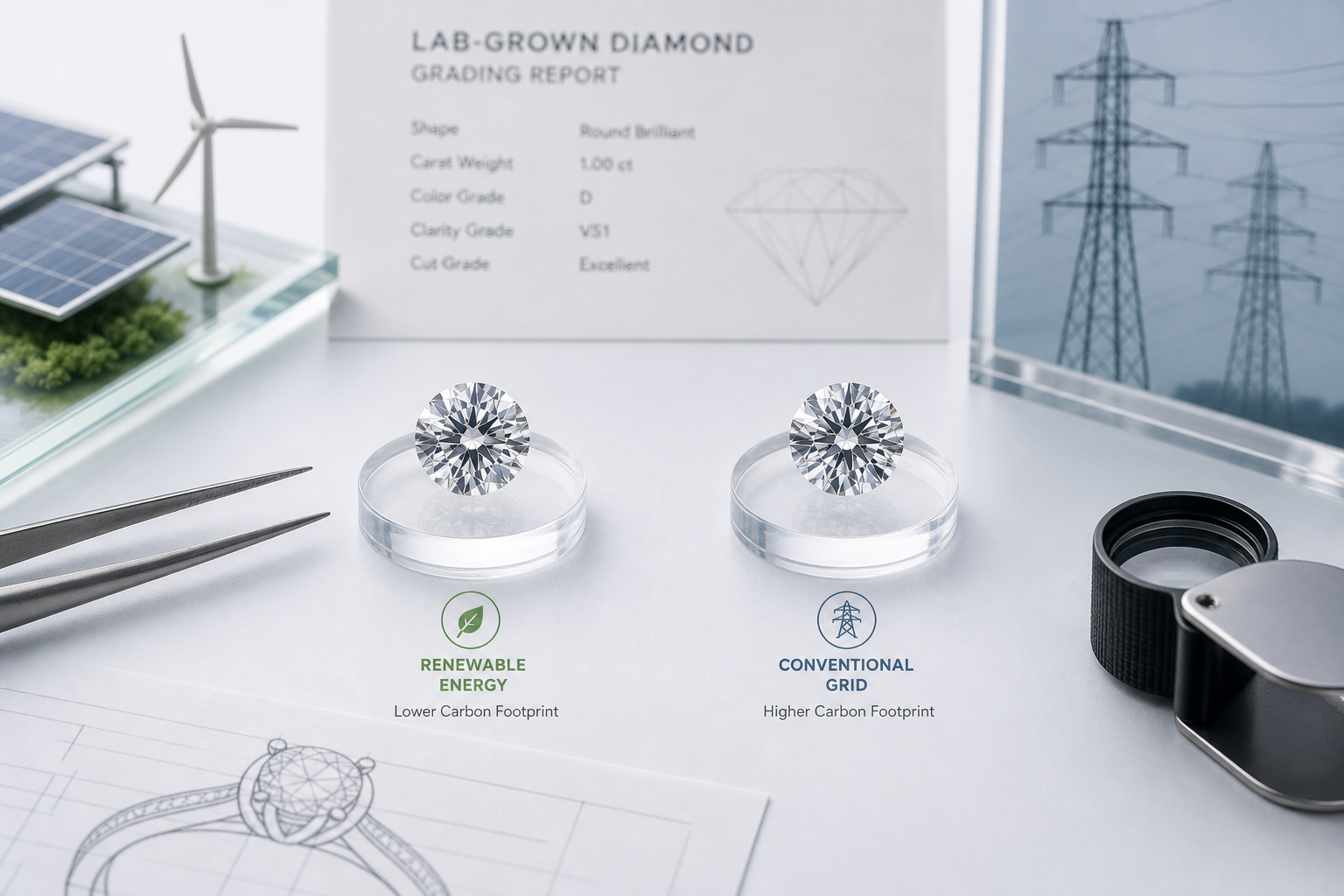
The lab-grown diamond carbon footprint is not determined by the words “lab-grown” alone. Two diamonds can have the same carat weight, color, clarity, cut grade, and origin disclosure on a grading report, yet carry very different emissions profiles because they were produced under different conditions.
The biggest difference often comes from electricity. A diamond grown in a facility powered by a coal-heavy grid is not the same carbon story as a diamond grown with verified lower-carbon electricity. The stones may look identical under magnification, but the energy behind them can be very different.
The Short Answer: The Label Does Not Tell You the Energy Story
“Lab-grown” describes how the diamond originated. It does not tell you how much electricity was used, where that electricity came from, how efficient the factory was, or whether the seller can document any environmental claim. That distinction matters because the carbon footprint of lab-grown diamonds is shaped by production choices, not just product category.
This is where the common question “are lab-grown diamonds low carbon?” needs a careful answer. They can be lower-carbon than some alternatives when production is efficient and electricity comes from lower-emission sources. But they are not automatically low-carbon simply because they were made above ground. A lab-grown diamond produced with high-emission electricity and weak documentation should not be treated the same as one supported by facility-level energy data and verified renewable electricity.
Renewable energy lab-grown diamonds can offer a stronger environmental case, but only when the claim is specific. A broad phrase like “eco-friendly” tells a buyer very little. A claim tied to a named facility, a defined production period, and a clear electricity source tells much more.
For buyers, the practical point is not to turn every purchase into a technical audit, but to avoid giving equal weight to unequal evidence. A grading report can confirm that the stone is laboratory-grown and describe its gem characteristics, while energy or emissions documentation must come from a separate source. Treat those as two different files in the same buying decision.
Evidence Standard: What Counts as Support for a Carbon Claim?
A stronger carbon claim should be supported by documents that match the claim being made. If the claim is about the diamond growth stage, the support should describe the growth facility, electricity source, production period, and calculation boundary. If the claim is about the finished jewelry piece, the support should explain whether cutting, polishing, setting, packaging, and transport are included. A document about general company values does not prove the footprint of a specific diamond.
It also helps to separate three different types of evidence. A grading report supports gem identity and quality. Energy or utility documentation supports electricity-source claims. Carbon-accounting documentation supports emissions calculations, but only within the stated boundary. When these documents are mixed together, buyers may assume a claim is more complete than it really is. The safer habit is to ask, “Which exact statement does this document prove?”
A practical traceability check is to follow the claim backward from the finished diamond to the source of the evidence. If a product page says the stone is linked to lower-carbon production, the supporting information should identify whether that statement applies to the individual stone, a production batch, a facility, or a brand-wide average. The closer the documentation sits to the actual stone being compared, the more useful it becomes for decision-making.
The Main Variables Behind the Footprint
Four factors usually control the carbon story. The first is the energy source for lab-grown diamonds, because electricity with a higher emissions intensity creates more carbon for the same amount of power used. The second is production location, since local and regional grids can vary widely in how electricity is generated.
The third factor is factory efficiency. A facility that produces more usable diamond material from the same amount of electricity can lower energy per finished carat, while poor yield, rework, or rejected material can push the effective footprint higher. The fourth factor is disclosure quality. Without clear documentation, a buyer may be comparing marketing language rather than measurable performance.
The practical hierarchy is simple: electricity source matters first, efficiency comes close behind, and disclosure determines how much confidence you should place in the claim. A polished sustainability phrase is less useful than a specific answer about how and where the diamond was produced.
A Practical Buyer Scenario to Ground the Issue
Imagine Maya is comparing two 1.50 carat F VS1 lab-grown diamonds for an engagement ring. Both have similar prices. Both have grading reports. Both look bright in the product images, and neither has an obvious visual advantage.
The first seller describes its stone as an “eco-friendly lab diamond” but provides no production location, no energy information, and no explanation of whether the claim refers to the growth stage, the brand’s general operations, or carbon offsets. The second seller provides the growth region, explains the facility’s electricity mix, and shares emissions documentation or a clear summary of how the claim was calculated.
Maya may still choose based on beauty, proportions, price, and setting fit. But if carbon transparency is part of her decision, the second diamond gives her more to evaluate. The key advantage is not that it automatically has the lowest footprint. The advantage is that the claim can be checked. The first option asks her to trust a label; the second gives her information she can compare.
What This Means Before You Start Comparing Diamonds
Before comparing stones, the better question is not only “Is it lab-grown?” A more useful set of questions is: How was it powered? Where was it produced? What documentation supports the carbon or renewable energy claim?
This does not mean every buyer needs a full carbon accounting report for every diamond. It does mean vague environmental language should carry less weight than specific production details. If two diamonds are otherwise similar, the one with clearer energy and emissions disclosure gives you a stronger basis for judgment.
Why Diamond Growth Requires So Much Electricity
Lab-grown diamond energy use is significant because diamond growth depends on controlled industrial environments, not simple assembly. Whether the diamond is made through HPHT or CVD, the process requires equipment that can maintain extreme conditions with stability over time. That stability is what turns electricity demand into a central part of the carbon footprint calculation.
Many buyers hear “lab-grown” and imagine a clean, compact process with minimal impact. The reality is more industrial. The process may avoid mining, but it still requires power for heat, pressure, plasma, vacuum systems, cooling, monitoring, and long production cycles. The footprint depends on how much electricity is used and how carbon-intensive that electricity is.
HPHT: Pressure, Heat, and Power Demand
HPHT stands for high pressure, high temperature. The method grows diamond material by recreating conditions under which carbon can crystallize into diamond. From a carbon-footprint perspective, the important point is not the machinery name; it is the amount of power required to sustain pressure, heat, and process control long enough to produce usable material.
HPHT diamond energy demand can vary by equipment design, growth cycle, facility efficiency, and yield. A newer or better-managed facility may use energy more effectively than one with older equipment or inconsistent output. This is why it is risky to say HPHT is always higher-carbon or always lower-carbon. The method matters, but the facility and electricity source often matter more.
CVD: Plasma, Vacuum Systems, and Long Growth Cycles
CVD stands for chemical vapor deposition. Instead of recreating pressure deep inside the earth, CVD grows diamond layer by layer in a chamber using carbon-containing gases, controlled pressure, plasma, cooling systems, and continuous monitoring. The process can produce high-quality material, but it still depends on steady electricity over extended growth periods.
CVD diamond energy use is affected by chamber design, run duration, growth rate, interruptions, and usable output. A long growth cycle that produces material requiring additional correction or rejection can raise the effective electricity per saleable carat. The practical question is not whether CVD sounds more modern; it is whether the facility can control the process efficiently and document the electricity behind it.
Growth Is Only One Part of the Energy Picture
Diamond growth is usually the most important energy focus in this discussion, but it is not the only step that can contribute to emissions. Cutting, polishing, grading, transport, and jewelry manufacturing may also add to the total footprint, depending on where each stage happens and what boundary the seller is using in its claim.
This boundary issue matters because a “production” claim may refer only to growth, while a broader footprint claim may include more downstream steps. Neither is automatically wrong, but the buyer needs to know what is being counted. A low-carbon claim that covers only the growth stage should not be read as a full life-cycle claim unless the seller states that clearly.
Useful Parameters to Include Without Overclaiming
The most useful numbers are not generic industry averages. They are production-specific data points that explain the diamond’s actual energy profile. If a seller provides carbon information, look for electricity used per rough carat or polished carat, the production run or reporting period, the facility energy source, and the grid emissions factor used in the calculation.
A grid emissions factor means the amount of greenhouse gas emissions associated with a unit of electricity. In plain terms, it tells you how carbon-intensive the power is. The same diamond growth electricity can lead to very different emissions depending on whether the facility is drawing from a higher-carbon grid, a lower-carbon grid, or verified renewable power.
Be cautious with universal kWh-per-carat claims unless they are dated, sourced, and tied to a defined production method and boundary. A number without context can mislead as easily as a slogan. What matters in practice is whether the data reflects the actual facility, time period, production output, and electricity source behind the diamond being sold.
Why the Electricity Source Matters More Than the Diamond Label
The strongest carbon lesson is also the simplest: the energy source for lab-grown diamonds can matter more than the label itself. If diamond growth requires a substantial amount of electricity, then the emissions intensity of that electricity becomes the main driver of the footprint.
Electricity is not one uniform input. Power from a coal-heavy grid, a natural-gas-heavy grid, nuclear, hydro, solar, wind, or a mixed regional grid can produce very different carbon results. A diamond does not reveal that difference by appearance, grading report, or price alone.
Same Electricity Use, Different Carbon Outcome
Consider a simplified example. If two factories each use the same amount of electricity to produce a carat of usable diamond material, their emissions can still differ sharply if one facility operates on higher-carbon electricity and the other uses lower-carbon electricity. The machines may be doing the same work, but the carbon attached to each unit of power is different.
For illustration, if one electricity source emitted several times more carbon per kilowatt-hour than another, the same production energy could create several times more emissions. Exact figures require current grid data and a clear calculation boundary, but the principle is not complicated: electricity use tells you how much power was needed; the grid emissions factor tells you how carbon-heavy that power was.
This is why “low carbon lab-grown diamonds” should be treated as a documentation claim, not a category claim. A seller needs to show what makes the production lower-carbon. Without that, the phrase is only a conclusion without evidence.
Grid Mix: Why Production Location Changes the Footprint
Production location matters because the electricity mix for diamond production varies by region. Some grids rely more heavily on coal or gas. Others include more hydro, nuclear, wind, solar, or other lower-carbon sources. Even within one country, regional grids can differ, and the mix can shift by season or time period.
A country name alone is not enough. A diamond grown in one region of a country may have a different electricity profile from a diamond grown elsewhere in the same country. A facility may also use contracted power, renewable certificates, or other electricity arrangements that are not visible from the “made in” label.
The common mistake is treating geography as a shortcut for carbon performance. It is more accurate to treat location as the starting point for better questions. Where was the diamond grown? What grid or energy source powered that facility? What reporting period does the claim cover?
Renewable Power, Nuclear, Hydro, and Mixed Grids
Lower-carbon electricity can come from several sources. Solar and wind are important, but they are not the only possibilities. Hydro and nuclear power can also reduce grid emissions, and some mixed grids may be materially lower-carbon than others depending on how the electricity is generated.
Renewable electricity diamonds should still be evaluated carefully. A factory physically powered by on-site renewable energy or a direct renewable power arrangement is a different claim from a seller purchasing certificates or offsets after using standard grid electricity. These tools may have a role, but they do not all prove the same thing.
The strongest claims connect the electricity source to the actual production stage. The weakest claims use broad brand language that does not explain whether the diamond growth itself was powered by lower-carbon energy.
Buyer Verification Checklist
Ask what facility or region the diamond was grown in, not only where the seller is based.
Ask whether the growth facility used standard grid electricity, directly supplied renewable electricity, renewable certificates, a power purchase agreement, or offsets.
Ask whether the energy data is facility-specific, batch-level, product-level, or only a brand-wide estimate.
Ask what production stage the carbon claim covers: growth only, growth and cutting, or a broader life-cycle boundary.
Ask for the reporting period, because electricity mixes and procurement arrangements can change over time.
If a seller can answer these questions clearly, the claim deserves more attention. If the answer stays at the level of “lab-grown is sustainable,” the buyer has very little basis for comparing carbon impact.
HPHT vs CVD: Does the Growth Method Determine the Carbon Footprint?
The HPHT vs CVD carbon footprint question is common, but the method name alone is not enough to tell you which diamond has lower emissions. HPHT and CVD are different lab diamond production methods, and both can require significant electricity. What matters more in practice is how efficiently the facility operates, how much usable diamond material is produced, how long the equipment runs, and what electricity source powers the process.
A buyer can easily overvalue the growth method because it sounds technical and specific. In carbon terms, however, “HPHT” or “CVD” is only the beginning of the story. A well-managed facility using lower-carbon electricity may have a stronger footprint profile than a less efficient facility using the same method on a higher-emissions grid. The more useful question is not which method sounds cleaner, but which claim is better documented.
Why Method Comparisons Can Be Misleading
HPHT growth uses high pressure and high temperature to create diamond-forming conditions. CVD growth uses a controlled chamber where carbon builds layer by layer, typically with plasma, gases, vacuum systems, and cooling. These technical differences matter, but they do not create a universal ranking where one method is always lower-carbon.
HPHT lab-grown diamond emissions can vary depending on press design, growth cycle stability, heat control, yield, and power source. CVD lab-grown diamond emissions can vary for similar reasons, including chamber efficiency, run duration, gas handling, cooling requirements, and how much saleable material comes out of each cycle. A newer, tightly controlled CVD operation may perform very differently from an older or less efficient one. The same is true for HPHT.
This is where buyers should be careful with simple “HPHT is greener” or “CVD is greener” claims. A method comparison without facility-level energy data is usually too thin to support a low-carbon conclusion. If a seller cannot explain where the diamond was grown, what electricity source was used, and whether the carbon claim is tied to actual production data, the method name should not carry much weight.
Yield, Rework, and Energy per Usable Carat
Carbon footprint is usually more meaningful when viewed as energy per usable carat, not just energy used by a machine. If a growth run consumes a fixed amount of electricity but produces a higher share of usable diamond material, the energy burden per saleable carat can be lower. If the output has more rejected material, requires heavy correction, or loses more weight during cutting, the effective footprint per finished diamond can rise.
This is a less obvious part of diamond growth efficiency. Two factories may use the same growth method and a similar amount of electricity per run, but if one consistently produces better usable yield, its carbon per polished stone may be lower. Yield is not only a production-cost issue; it affects the environmental math behind each finished diamond.
Rework can also matter. A diamond that needs additional processing, correction, or recutting may carry more energy use than the basic growth step suggests. That does not automatically make the diamond a poor choice, but it does mean that a serious carbon claim should account for more than the first successful growth cycle.
Post-Growth Treatment and Processing Considerations
Some lab-grown diamonds may go through additional post-growth treatment or processing to improve appearance or prepare the material for cutting. Treatment is not automatically negative, and it should not be treated as a red flag by itself. The issue is whether the extra steps are included when a seller makes a low-carbon or reduced-emissions claim.
For carbon evaluation, every meaningful process step has a boundary question attached to it, making sustainability claim verification especially dependent on scope clarity. Does the reported footprint include growth only, or does it also include treatment, cutting, polishing, grading, and shipping? A claim based only on the growth stage may still be useful, but it should not be presented as the full footprint of the finished diamond unless the supporting documentation says so.
What to Ask Instead of “Is HPHT or CVD Better?”
A sharper question is: what method was used, and what data supports the carbon claim attached to it? If the answer stops at “HPHT” or “CVD,” the information is incomplete. The buyer still needs to know the production region, the diamond factory energy source, whether the energy data is facility-specific, and whether the claim applies to this stone, this production batch, or the seller’s overall brand average.
For a practical purchase decision, prioritize documented energy source and production efficiency over the method label. HPHT and CVD can both produce beautiful diamonds, and either can be associated with stronger or weaker emissions performance depending on how the facility runs. The strongest claim is not the one with the most technical wording; it is the one that connects the specific diamond to verifiable production information.
Production Location and Grid Mix: Why Geography Matters
Lab-grown diamond production location matters because electricity is not the same everywhere. A factory’s carbon footprint is shaped by the local grid mix, the availability of lower-carbon power, the efficiency of the facility, and the way the diamond moves through later stages such as cutting, grading, and jewelry assembly. Geography is not a moral shortcut; it is an energy and documentation question.
The phrase “grid mix lab-grown diamonds” refers to the electricity sources feeding the area where production happens. A grid may rely heavily on coal, natural gas, hydro, nuclear, wind, solar, or a changing blend of several sources. Since diamond growth requires sustained power, the emissions intensity of that electricity can change the footprint even when the growth method is the same.
Why “Made In” Is Not Enough
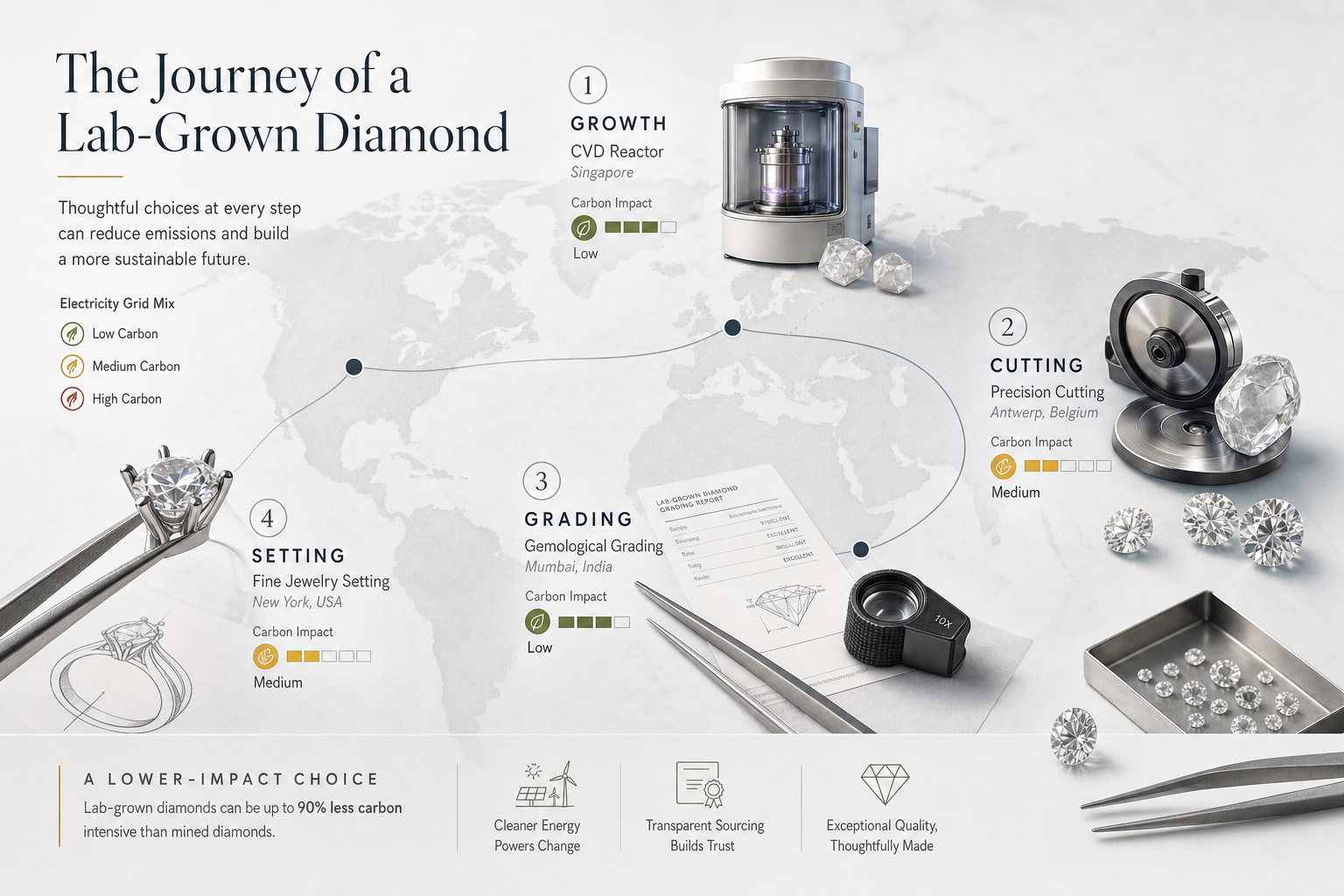
A country label can be useful, but it rarely answers the carbon question by itself. “Made in” may refer to where the diamond was grown, where it was cut, where it was mounted in jewelry, or where the seller is based. Those are not interchangeable stages. A diamond could be grown in one region, cut and polished in another, graded elsewhere, and finally set into a ring for a U.S. buyer.
This is why broad assumptions about country of origin can mislead buyers. A China lab-grown diamond carbon footprint, for example, cannot be judged from the country name alone. China includes different regions, industrial systems, grid mixes, and renewable procurement options. The same caution applies to any other production region. Location matters, but only when the claim specifies which stage happened there and what energy source was involved.
The most useful location claim is specific enough to connect to a production stage. “Grown in a facility using documented lower-carbon electricity” gives a buyer more to evaluate than “responsibly made” or “internationally sourced.” If a seller uses geography as part of an environmental claim, the burden is to explain the boundary.
In practical buying, this is also where supply-chain wording can become slippery. “Sourced from,” “made in,” “cut in,” and “set in” may all describe real parts of the journey, but they do not prove the same thing. If carbon impact is part of the decision, ask which location is connected to the highest-energy step: the diamond growth itself.
Regional Electricity Can Change the Same Production Process
The same HPHT or CVD process can produce different emissions profiles depending on local electricity. If two facilities use similar equipment and similar electricity per carat, the one connected to a higher-emissions grid will usually carry a higher production footprint than one using a lower-carbon grid or verified lower-carbon power. The production method may be identical, but the emissions result is not.
This is where current grid-emissions data becomes important. A grid emissions factor is typically expressed as emissions per unit of electricity, and it changes by region, reporting year, and sometimes season. If a seller provides a numerical footprint, buyers should look for the reporting period and the source of the emissions factor rather than treating the number as timeless.
Regional infrastructure also affects what factories can realistically document. Some facilities may have direct renewable contracts, on-site generation, or clearer utility data. Others may rely on standard grid power with less granular reporting. That does not automatically make one seller unreliable, but it changes the confidence level behind any low-carbon claim.
Supply Chain Boundaries: Growth, Cutting, Setting, and Shipping
Carbon claims become easier to compare when buyers understand the boundary. “Production-only” data may refer mainly to the diamond growth stage. “Cradle-to-gate” data usually covers more steps up to the point where the product leaves the producer, though the exact boundary should still be stated. A broader life-cycle view may include cutting, polishing, transport, jewelry manufacturing, packaging, and other downstream steps.
Cutting and polishing can introduce another geography layer. India lab-grown diamond cutting and polishing is relevant in many supply chains because India is a major center for diamond manufacturing, but the carbon effect depends on the specific process, electricity source, transport assumptions, and whether that stage is included in the claim. Naming the country does not answer those questions on its own.
The risk for buyers is comparing two claims that use different boundaries. One seller may report growth-stage emissions only, while another includes growth, cutting, and setting. The second number may look higher simply because it includes more of the real process. A lower number is not automatically better if it leaves out major stages.
Documentation to Request When Location Is Part of the Claim
When a seller uses location to support a carbon or sustainability claim, ask what the location refers to. Was the diamond grown there, cut there, polished there, graded there, assembled into jewelry there, or simply sold by a company headquartered there? Those answers change what the claim can prove.
Useful documentation should identify the production stage, facility or region, reporting period, electricity source, and emissions boundary. If the claim depends on a diamond factory energy source, the documentation should say whether the facility used standard grid electricity, renewable-backed electricity, direct renewable power, or another arrangement. Without that detail, location becomes a label rather than evidence.
Factory Efficiency: The Overlooked Factor Behind Energy per Carat
Even if two factories use the same electricity source, their carbon footprints can differ because they may not turn electricity into usable diamonds with the same efficiency. Lab-grown diamond factory efficiency depends on equipment condition, process control, chamber utilization, cooling systems, batch consistency, and yield. These factors determine how much energy is required for each finished stone, not just how much electricity the facility uses overall.
This is one of the reasons carbon claims should not stop at renewable energy or production location. A facility powered by cleaner electricity can still waste energy if yields are poor or equipment runs inefficiently. A facility with better diamond production efficiency may reduce energy per finished carat by producing more usable material from the same growth cycle.
Why Energy per Carat Is More Useful Than General Sustainability Language
“Green,” “clean,” and “eco-conscious” are weak terms unless they are tied to measurable production data. Energy per carat lab diamond metrics are more useful because they connect electricity use to actual output. The key is not only how much power a factory consumed, but how many rough or polished carats resulted from that power.
Buyers should pay attention to whether the figure refers to rough carat or polished carat. Rough output is not the same as the finished diamond in a ring. Cutting and polishing remove material, and not every grown crystal becomes a saleable stone. A claim based on electricity per rough carat may look stronger than one based on electricity per polished carat because it measures an earlier stage with less loss included.
The most decision-useful metric is tied to the product being compared. If two diamonds are visually similar and priced similarly, a seller who can explain energy per usable carat, production stage, and calculation boundary gives the buyer a better basis for judgment than a seller relying on broad environmental language.
Yield Rate, Equipment Age, and Process Control
Yield rate matters because carbon is allocated across the diamonds that can actually be used. If a growth run produces more rejected or low-utility material, the energy spent on that run is spread across fewer saleable stones. The footprint per finished carat rises even if the machine consumed the same amount of electricity.
Equipment age and maintenance can also affect energy use. Older or poorly controlled systems may require more power, longer run times, more cooling, or more process correction. Newer equipment is not automatically lower-carbon, but stable equipment and disciplined process control usually make it easier to reduce waste and improve consistency.
Chamber utilization is another overlooked factor. If equipment is underused, interrupted, or producing inconsistent batches, total factory electricity can be less efficiently converted into finished diamonds. In practical terms, factory efficiency is not just about having advanced machinery; it is about keeping the process stable enough that fewer growth cycles are wasted.
Batch Data vs Brand-Wide Averages
Brand-wide averages can provide a general view, but they may not describe the specific diamond in front of the buyer. A company may source from multiple facilities, production regions, or suppliers with different electricity sources and efficiency levels. If a brand average blends those sources together, it can smooth out the differences that matter for an individual stone.
Batch-level carbon data is usually more useful because it narrows the claim to a defined group of diamonds produced under known conditions. Facility-level data can also be valuable, especially when it identifies the energy source, reporting period, and production boundary. Product-level data is the most specific, but buyers should understand that not every seller will have it available.
The right judgment is not that broad data is worthless. It is that the confidence level changes. A batch-level or facility-level disclosure deserves more weight than a vague brand claim because it is closer to the actual production conditions behind the diamond being sold.
Practical Metrics Worth Asking For
When a seller makes a carbon or efficiency claim, ask for metrics that connect energy use to output and define the boundary clearly. Useful data points include electricity use per rough carat, electricity use per polished carat, growth facility location, reporting period, share of renewable electricity, and whether the data has been reviewed by a third party.
It is also worth asking whether offsets are included in the reported figure. Offsets may be part of a company’s climate approach, but they should be separated from actual lab diamond manufacturing emissions. A lower reported footprint based partly on offsets is not the same as a lower production footprint from efficient operations and lower-carbon electricity.
The practical takeaway is simple: efficiency affects carbon per finished stone. If a seller can explain usable yield, facility energy source, and the period covered by the data, the claim is much stronger than a general promise that the diamond was made in a modern lab.
Renewable Energy Claims: What They Can Prove and What They Cannot
Renewable energy lab-grown diamonds can be a meaningful step toward lower emissions, but the claim only becomes useful when it explains how the electricity was sourced and what part of production it covers. A diamond described as “made with renewable energy” may involve direct renewable power at the growth facility, a power purchase agreement, renewable energy certificates, or carbon offsets. Those are not interchangeable.
The strongest claims connect the electricity source to the actual diamond growth stage. Weaker claims may describe company-wide goals, broad diamond sustainability claims, or marketing language that does not tell you whether the specific stone was grown using lower-carbon electricity. The difference matters because the carbon footprint is driven heavily by the energy used during growth, not by the label printed on a product page.
Sustainability claims should be specific and documented. Broad green language is less useful than clear information about production location, electricity source, reporting period, energy procurement, and the calculation boundary behind the statement. A careful seller should be able to explain what is known, what is estimated, and what is not covered by the claim.
Direct Renewable Power vs Renewable Certificates
A factory physically powered by on-site solar, wind, hydro, or a dedicated renewable electricity contract is different from a company buying certificates to match its electricity use after the fact. Direct renewable power is closer to the production process. It can support a stronger low-carbon claim if the facility, time period, and electricity share are clearly documented.
Renewable energy certificates, often called RECs in the U.S., represent the environmental attribute of renewable electricity generation. They can help companies support renewable energy markets, but they do not automatically prove that the electrons powering a diamond growth reactor came from renewable sources at the time of production. In plain terms, “renewable energy certificates diamonds” may indicate a market-based claim, not necessarily a physically renewable-powered factory.
This does not make certificates useless. It means the buyer should treat them as a specific type of evidence, not as a complete answer. A claim based on 100% certificate matching is less direct than a claim showing that the growth facility was supplied by verified low-carbon electricity during the reporting period. The practical risk is assuming both claims mean the same thing when they do not.
Carbon Offsets Are Not the Same as Low-Carbon Production
Carbon neutral lab-grown diamonds require especially careful wording. A company may use offsets to compensate for emissions that occurred during production, but that does not mean the diamond itself was produced with low-carbon electricity. Offsets address emissions after they are calculated; they do not reduce the electricity demand of the growth process or change the grid mix used by the facility.
Offsets can be part of a broader climate strategy, particularly when some emissions are difficult to avoid. The problem comes when “carbon neutral” is presented as if it means the same thing as low-carbon production. A diamond grown on a fossil-heavy grid and offset afterward has a different emissions story from a diamond grown in a facility using documented lower-carbon electricity.
The better question is not whether offsets are good or bad in the abstract. The better question is what role they play in the claim. If offsets are being used to cover most of the footprint, the buyer should know that. If they are used only for residual emissions after lower-carbon electricity is already in place, that is a stronger position.
What a Strong Renewable Claim Should Include
A strong renewable energy claim should be specific enough that a buyer can understand what is being claimed without decoding marketing language. It should identify the growth facility or region, the energy source, the reporting period, and the share of electricity covered. It should also explain whether the claim is based on direct renewable electricity, a power purchase agreement, renewable energy certificates, offsets, or a combination of those tools.
The strongest low-carbon diamond claims also state the boundary of the calculation. Does the claim cover only the diamond growth stage, or does it include cutting, polishing, grading, transport, and jewelry manufacturing? A narrow claim is not necessarily misleading, but it becomes misleading if it is presented as if it covers the entire finished ring.
Third-party review adds confidence, but it is not a magic stamp. A reviewed claim is only as useful as the scope being reviewed. If the review covers company-wide electricity purchases but not product-level or batch-level production, it should not be treated as proof that one specific diamond has a verified low carbon footprint.
How to Read Environmental Language Without Overextending It
Environmental language should be read narrowly. “Made with renewable energy” should prompt the question, “Which facility, which period, and which share of electricity?” “Carbon neutral” should prompt the question, “Which emissions were counted, and what role did offsets play?” “Responsibly produced” should prompt the question, “Responsible in what specific way, and what document supports that statement?”
This narrow reading protects both the buyer and the seller. It allows a meaningful claim to stand on its actual evidence without turning it into something broader. A seller may have a legitimate facility-level renewable electricity claim, for example, but that does not automatically prove a full life-cycle footprint for the finished ring. Careful wording keeps the comparison fair.
How to Verify a Renewable Energy Claim Before Buying
- Is the claim facility-specific or company-wide? A facility-specific claim is more useful because it is closer to where the diamond was actually grown.
- Does it cover the diamond growth stage? Some claims may apply to offices, retail operations, or general business activity rather than production electricity.
- Is it based on direct power, RECs, PPAs, or offsets? Direct renewable power and well-documented power purchase agreements usually provide stronger evidence than broad offset language alone.
- What reporting period does it cover? Current, dated information is more useful than an undated claim that may refer to past operations.
- Is the claim annual, batch-level, or product-level? Product-level or batch-level information gives more confidence than a broad annual average.
- Has a third party reviewed the data? Independent review can improve trust, especially when the scope and calculation method are clearly stated.
The practical takeaway is simple: renewable claims can matter, but their strength depends on how closely they connect to the actual production of the diamond being sold. A buyer does not need to become a carbon accountant, but they should know whether the claim is tied to real production energy or to a broader environmental accounting tool.
Carbon Data Disclosure: What Buyers Should Look For
Good lab-grown diamond carbon data should make a claim easier to evaluate, not harder. The most useful disclosures tell you what was measured, where the diamond was produced, what electricity source was used, which production stages were included, and whether the data was reviewed by an independent party. Vague environmental language may sound reassuring, but it does not help a buyer compare one diamond or seller against another.
Diamond carbon footprint disclosure is strongest when it is tied to a clear boundary. A production-only estimate is different from a broader life-cycle estimate. A growth-stage figure is different from a finished-jewelry footprint. None of these boundaries is automatically wrong, but the seller should state the boundary clearly so the buyer does not mistake a partial claim for a complete one.
Useful Disclosure Is Specific, Not Decorative
Specific disclosure includes practical details: production stage, facility or region, electricity source, reporting period, calculation method, and whether the figure was independently reviewed. This does not need to read like a technical report for the average shopper, but it should provide enough information to understand what the claim actually covers.
Decorative disclosure does the opposite. Phrases such as “eco-conscious,” “sustainably made,” or “clean diamond” may signal intention, but they do not reveal energy source, emissions factor, factory efficiency, or offset treatment. These phrases are weakest when they stand alone. A seller making a serious carbon claim should be able to explain the basis of that claim in concrete terms.
Traceable lab-grown diamonds can support transparency, but traceability by itself does not prove a low carbon footprint. Knowing where a diamond was grown is valuable only if it leads to better information about the facility, electricity mix, production boundary, and documentation. Location is the beginning of the question, not the answer.
Product-Level, Batch-Level, and Brand-Level Claims
Product-level data is the most specific because it is tied to the individual diamond being considered. If available, it can give the buyer the highest confidence that the claim applies to the actual stone rather than to a general production average. This level of disclosure is not yet standard across the market, so its absence does not automatically mean a seller is hiding something.
Batch-level data can still be useful. If a group of diamonds was produced in the same facility during the same reporting period with the same energy assumptions, batch-level disclosure may provide a reasonable basis for comparison. It is not as precise as product-level data, but it is far stronger than a broad environmental statement with no production details.
Brand-level averages are the least precise. They can help show a company’s overall direction, but they may not describe the specific diamond being purchased. A brand could source diamonds from multiple facilities, regions, or production partners, each with a different electricity profile. The risk is treating a company-wide average as if it applies equally to every stone in inventory.
What Certificates and Grading Reports Usually Do Not Tell You
A diamond grading report usually documents gemological characteristics: carat weight, color, clarity, measurements, growth origin, and sometimes cut-related information depending on the diamond shape and report type. It helps confirm what the diamond is as a gemstone. It usually does not function as a diamond emissions report.
This distinction matters because buyers often give grading reports more authority than they are designed to carry. A grading report can help confirm that a diamond is lab-grown and describe its quality characteristics, but it generally does not tell you the electricity source, growth facility emissions, renewable energy treatment, or carbon calculation boundary.
A verified carbon footprint diamond claim requires separate documentation. The grading report may be one piece of the buying decision, but carbon disclosure has to come from energy data, production information, emissions accounting, or a reviewed footprint statement. Confusing these two forms of documentation can lead buyers to trust a carbon claim that has not actually been substantiated.
It is also worth matching every document to the same stone or batch. The report number, measurements, carat weight, and any seller-provided inventory details should line up logically with the diamond being considered. When carbon information is batch-level rather than product-level, the seller should be able to explain how the diamond belongs to that batch and where the data stops.
When a grading report is available, buyers should verify the report details through the issuing laboratory’s official report-check tool where available, then treat any carbon or renewable-energy claim as a separate documentation question.
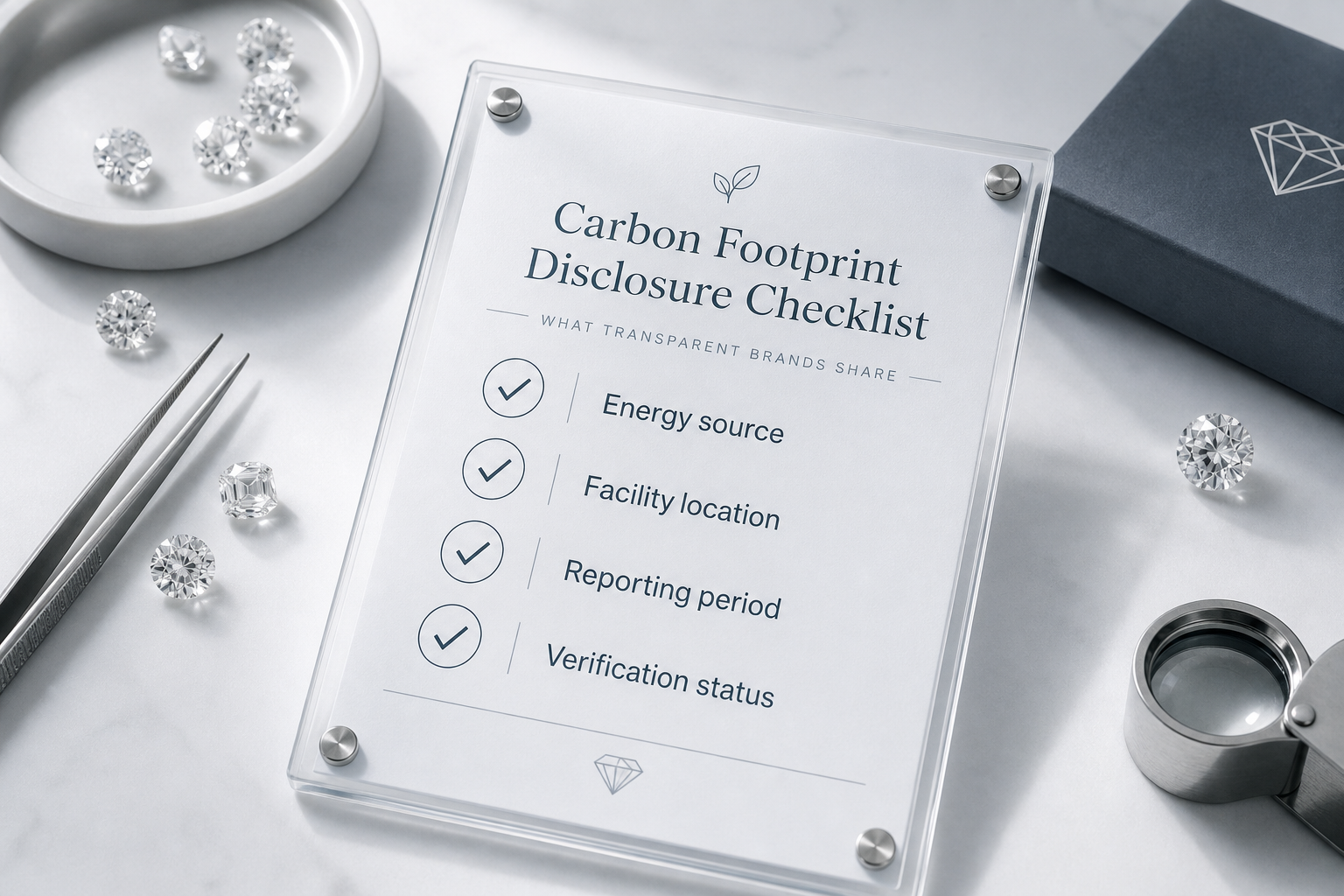
Carbon Footprint Data Checklist
- Diamond growth method: HPHT or CVD, if disclosed, because method can affect the production profile but does not determine the footprint alone.
- Growth location: Facility or region, not just seller headquarters or jewelry assembly location.
- Facility energy source: Grid electricity, direct renewable power, hydro, nuclear, mixed grid, certificates, or another documented source.
- Electricity use per carat, if available: Ideally stated per usable rough carat or polished carat, with enough context to understand the boundary.
- Emissions factor used: The carbon intensity applied to the electricity calculation, preferably tied to a current and relevant grid or power source.
- Scope or boundary: Whether the claim covers growth only, production through polishing, delivery to seller, or the finished jewelry piece.
- Renewable energy treatment: Whether renewable power is direct, contracted, certificate-based, or blended into a broader grid claim.
- Offset treatment: Whether offsets are included, what emissions they cover, and whether the footprint is reduced or compensated after production.
- Reporting year: Current data is more useful than undated information.
- Third-party review status: Whether the data or calculation method has been reviewed, audited, or independently assessed.
Buyers should not expect every seller to provide a complete carbon file for every diamond. The realistic standard is progression: the more specific, current, and production-linked the disclosure is, the stronger the claim. A seller who clearly explains the limits of available data is usually more credible than one making absolute claims with no supporting detail.
How to Keep Carbon Claims Traceable Across the Buying File
A useful buying file keeps each claim attached to the document that supports it. The grading report should match the diamond’s identity and measurements. The carbon disclosure should match the production stage, batch, or facility being discussed. The renewable-energy statement should explain whether the evidence relates to the growth facility, the seller’s broader operations, or an accounting instrument such as certificates or offsets.
This traceability habit reduces confusion when several documents are involved. If the seller provides a grading report, a supplier statement, an energy summary, and a product page claim, do not assume they all prove the same thing. Read them together, but ask which document supports which statement and whether the dates, locations, and boundaries line up.
How to Compare Low-Carbon Lab-Grown Diamond Claims Without Getting Misled
To compare lab-grown diamond carbon footprint claims, start by separating language from evidence. A low-carbon lab-grown diamond claim should not be judged by how polished the product page sounds. It should be judged by whether the seller explains the production stage, energy source, location, calculation boundary, and documentation behind the claim.
This is where many buyers get misled. “Eco-friendly lab-grown diamonds” may sound clear, but the phrase can mean very different things across sellers, especially when lab-grown diamond sustainability is discussed without specific evidence. One company may be referring to renewable electricity at the growth facility. Another may be referring to offsets, recycled packaging, or a general belief that lab-grown diamonds are more sustainable than mined diamonds. Those are different claims with different levels of carbon relevance.
The Three-Level Claim Test
A practical way to evaluate sustainable lab-grown diamond claims is to sort them into three levels. This does not require exact emissions numbers for every stone; it simply helps you decide how much confidence the claim deserves.
- Level 1: Vague claim. Phrases such as “eco-friendly,” “green,” “clean,” or “sustainable” with no production detail belong here. These claims may be harmless as branding language, but they should not influence a carbon-focused buying decision by themselves.
- Level 2: Specific but unaudited claim. A seller may name a production location, mention renewable energy use, or describe a lower-carbon process, but provide no calculation method, reporting period, or third-party review. This is more useful than Level 1, but still limited.
- Level 3: Documented claim. The claim identifies the facility or region, energy source, calculation boundary, reporting period, renewable or offset treatment, and whether the data was reviewed. This is the level that can reasonably support a stronger low-carbon claim.
The mistake is treating all three levels as equal. If two diamonds are similar in price, grading, and appearance, a Level 3 claim is a meaningful differentiator. If a seller only provides Level 1 language, the buyer should not pay a premium for a carbon benefit that has not been explained.
Warning Signs in Carbon Footprint Marketing
The biggest warning sign is an absolute claim without a boundary. Statements such as “zero impact,” “100% sustainable,” or “carbon neutral” should be supported by clear documentation. Without that, the buyer has no way to know whether the claim refers to growth, polishing, shipping, the whole company, or only offset purchases.
Other warning signs include no production location, no energy source, no distinction between renewable electricity and offsets, no reporting period, and no explanation of whether cutting and polishing are included. A claim that avoids all operational detail is usually not strong enough to guide a serious carbon comparison.
Another common issue is using the word “lab-grown” as if it automatically answers the carbon question. It does not. The lab-grown label tells you origin. It does not tell you whether the diamond was produced on a coal-heavy grid, a lower-carbon grid, direct renewable electricity, or a facility using certificates to match consumption.
When Imperfect Information Is Still Useful
Not every seller will have product-level carbon data, and not every buyer will be able to obtain a full emissions report for a single diamond. That does not make the search pointless. Partial information can still improve the decision if it is specific and honestly framed.
A seller who can explain the growth region, the type of energy claim being made, what stage the claim covers, and where the data stops may be more trustworthy than a seller using broad green language with no detail. Imperfect but clear information is often more useful than a confident claim with no visible basis.
The practical judgment is to compare transparency, not perfection. If one seller says only “sustainable lab diamond” and another says the renewable claim is facility-level, annual, certificate-backed, and limited to the growth stage, the second seller gives you more to evaluate. Even with limitations, that is a better decision position.
Evidence Matching: Make Sure the Proof Follows the Stone
When a seller provides supporting material, check whether the evidence follows the same diamond, the same batch, or only the same brand. A product-level document should connect logically to the stone’s listed carat weight, measurements, report information, or inventory record. A batch-level document should explain how the diamond belongs to that batch. A brand-level statement should be treated as broad context, not proof that every diamond in the catalog has the same footprint.
This evidence matching step is especially important when several suppliers, cutters, or production regions are involved. A retailer may sell diamonds from more than one producer, and those producers may use different growth methods, facilities, and electricity sources. If a carbon claim is attached to the whole collection, ask whether it applies to all stones equally or only to certain lines, batches, or production partners.
A Simple Buyer Comparison Table to Include
| Claim Made | What It Might Mean | What to Ask Next | Confidence Level |
|---|---|---|---|
| “Eco-friendly lab-grown diamond” | A broad marketing phrase with no clear carbon boundary. | What makes it eco-friendly? Is there energy or emissions documentation? | Low |
| “Made with renewable energy” | Could mean direct renewable power, certificates, a PPA, or a company-wide claim. | Does the claim cover the growth facility? Is it direct power, RECs, or a PPA? | Medium if specific, low if unsupported |
| “Carbon neutral lab-grown diamond” | May involve offsets after production rather than low-carbon electricity during production. | What emissions were calculated? What offsets were used? Was the data reviewed? | Medium only with documentation |
| “Grown in a lower-carbon facility” | Potentially meaningful if tied to actual facility energy data. | Which facility or region? What electricity source and reporting year? | Medium to high depending on evidence |
| “Verified low-carbon diamond” | Could be strong if verification covers the relevant production stage and calculation boundary. | Who reviewed it? Does the review apply to this diamond, batch, or brand average? | High if current, specific, and independently reviewed |
If you are deciding what to ask before buying a lab-grown diamond, focus on the evidence closest to the stone itself. Ask where it was grown, what electricity source supported production, whether the claim is based on direct energy use or offsets, and what documentation backs it up. The goal is not to find perfect language; it is to avoid letting vague language make the decision for you.
Where Carbon Footprint Fits in the Bigger Diamond Buying Decision
Carbon footprint should influence the way you compare diamonds, but it should not replace the rest of the buying decision. A well-documented lower-carbon claim is valuable only if the diamond also makes sense visually, structurally, and financially. If a stone has weak cut quality, poor light performance, awkward proportions, or questionable suitability for the setting, carbon documentation alone does not make it the better purchase.
This matters most for engagement ring shoppers because the diamond is not being evaluated in isolation. It has to look right in the chosen setting, fit the wearer’s daily life, and stay within a realistic budget. For lab diamond engagement ring sustainability, the stronger decision is not simply choosing the diamond with the greenest wording. It is choosing a stone that combines beauty, credible documentation, and practical suitability.
Carbon Matters, But It Is Not the Only Quality Signal
A lower-carbon claim does not tell you whether a diamond is well cut, whether it faces up beautifully, or whether its measurements work for the ring design. Those questions still require a grading report, actual imagery or video, proportion review, and setting compatibility check. Carbon transparency and gem quality are related to the same purchase, but they answer different questions.
The grading report helps confirm core gemological details such as carat weight, color, clarity, measurements, and growth origin. Videos and images help reveal how the diamond actually performs visually. The setting determines whether the stone’s shape, size, depth, and proportions will sit securely and look balanced. Carbon data belongs beside these factors, not above all of them.
The mistake is treating any single signal as decisive. A strong grading report does not prove low emissions. A renewable energy claim does not prove strong visual performance. A low price does not prove value. When buying a lab-grown diamond, the safest approach is to compare the stone as a whole rather than letting one attractive claim carry the entire decision.
For custom design, the stone cannot be evaluated separately from the setting. A diamond with excellent documentation may still be the wrong choice if its depth, length-to-width appearance, girdle profile, or overall measurements do not suit the intended prongs, bezel, halo, or low-profile design. Carbon transparency is most useful after the diamond has already cleared the basic jewelry-fit questions.
How to Balance Beauty, Budget, and Carbon Transparency
If two lab-grown diamonds are visually similar, similarly graded, and close in price, stronger carbon documentation can be a meaningful differentiator. In that situation, the better-documented diamond gives the buyer more confidence because the sustainability-related claim is supported by specifics rather than broad language.
The recommendation changes when the better-documented diamond comes with real compromises. If it has weaker cut performance, visible inclusions, an undesirable color appearance, poor proportions, or a shape that does not suit the intended setting, the carbon claim should not automatically win. A responsible purchase still has to work as jewelry.
Budget also needs a clear boundary. Paying a modest premium for better transparency may make sense if the diamond remains strong visually and fits the design. Paying a large premium for a vague low-carbon claim is harder to justify. The documentation should become more specific as the claim becomes more important to the price or the buying decision.
For buyers who care about ethical lab-grown diamond buying, the practical standard should be evidence, not perfection. A seller who clearly explains what is known, what is not known, and which production stage the claim covers is usually more useful than one relying on polished environmental language without supporting detail.
The Most Logical Next Step for Buyers
The next step is to compare carbon-related information alongside the same materials you would already review before purchase: the grading report, diamond images, videos, measurements, price, and setting requirements. Carbon questions should be part of the buying file, not a separate emotional decision made after the fact.
Ask the seller for documentation that explains where the diamond was grown, what electricity source was used, whether renewable claims are direct or certificate-based, and which production stages are included. If the seller cannot provide product-level data, ask whether facility-level or batch-level information is available. Imperfect disclosure can still be useful if its limits are explained clearly.
At NUVU, transparent diamond buying means treating environmental claims with the same care as grading claims: useful when specific, weak when vague, and most valuable when they help the buyer compare real options. For loose diamonds or a custom lab-grown diamond ring, that means looking at the stone, the setting, the budget, and the documentation together.
For NUVU, the practical role of traceability is to make the comparison clearer rather than louder. A buyer should be able to separate what the grading report shows, what the visual evidence reveals, what the setting requires, and what the carbon documentation can reasonably support. That disciplined separation helps prevent one strong-looking claim from carrying more weight than it should.
Before purchase, buyers should confirm the seller’s documentation, return policy, resizing terms, and after-sales support in writing. These business terms are separate from grading reports and separate from any carbon-footprint or renewable-energy claim.
Final Buyer Checklist
- Confirm the grading report. Make sure the report matches the diamond being considered and review carat weight, color, clarity, measurements, and growth origin.
- Review actual diamond imagery or video. Do not rely on grades alone; visual performance still determines whether the diamond looks good in real life.
- Ask where the diamond was grown. Production location matters because the local electricity mix can affect the carbon footprint.
- Ask what electricity source was used. Grid power, direct renewable electricity, renewable certificates, and offsets are not the same thing.
- Ask whether renewable claims are direct, certificate-based, or offset-based. This distinction changes how much confidence the claim should carry.
- Ask what production stage the carbon claim covers. Growth-only data is different from data that also includes cutting, polishing, setting, or shipping.
- Get important claims in writing before purchase. Clear written documentation is more useful than general language on a product page.
The most responsible carbon question is not simply whether the diamond is lab-grown. It is whether the seller can explain how it was produced, what powered that production, and what documentation supports the claim.
Frequently Asked Questions
Do lab-grown diamonds have a carbon footprint?
Yes. Lab-grown diamonds require electricity for growth and additional energy for processing, cutting, polishing, grading, transport, and jewelry production. The size of the footprint depends on how much energy was used, the electricity source, the efficiency of the facility, and which stages are included in the calculation.
Are lab-grown diamonds always lower carbon than mined diamonds?
Not automatically. Some lab-grown diamonds may have a lower carbon footprint than some mined diamonds, but the comparison depends on the production method, electricity source, mining assumptions, transportation, and life-cycle boundary used. A lab-grown label alone is not enough to prove a lower-carbon result.
Does a grading report include carbon footprint data?
Usually, no. A grading report generally focuses on gemological characteristics such as carat weight, color, clarity, measurements, cut-related information, and whether the diamond is laboratory-grown. Carbon footprint data usually requires separate disclosure from the seller, producer, or a third-party emissions report.
Can a diamond be carbon neutral if it was made with fossil-fuel electricity?
A company may make a carbon-neutral claim by using offsets, renewable energy certificates, or other accounting tools, but that is not the same as saying the diamond was produced with low-carbon electricity. The strongest claims explain whether emissions were reduced during production or compensated after the fact.
Are lab-grown diamonds sustainable?
They can be part of a more transparent jewelry choice, but “sustainable” is too broad to trust without specifics. For carbon impact, the better question is how the diamond was powered, where it was produced, how efficient the facility was, and whether the seller can document the claim.
Which lab-grown diamond is lowest carbon?
The lowest-carbon option is usually the one with documented low electricity emissions, efficient production, clear facility or batch-level data, and transparent boundaries. Without that documentation, it is not possible to identify the lowest-carbon diamond based only on method, country, price, or grading report.
Continue Your Lab-Grown Diamond Research
Carbon footprint is one part of a larger buying process. Once you understand how energy source and disclosure affect the claim, the next step is to connect that knowledge with diamond quality, certification, visual review, and setting fit. This is where lab-grown diamond education becomes most useful: it helps you ask better questions before you compare products.
Recommended Next Reads
If you are still narrowing your options, a lab-grown diamond buying guide can help you evaluate cut, color, clarity, carat weight, shape, and price together. If you are unsure what a report does and does not prove, a lab-grown diamond certification or grading report guide is the right next step.
For buyers comparing production methods, an HPHT vs CVD guide can explain the manufacturing differences without reducing the decision to a simple “better or worse” answer. If you are ready to compare actual stones, a loose lab-grown diamonds collection or selection guide can help connect the technical details to real buying choices.
For engagement ring shoppers, a custom engagement ring design guide can be especially useful because the right diamond depends on more than grades. Shape, measurements, setting style, metal choice, and daily wear all affect whether the finished ring works as intended.
How to Use This Information Before You Buy
Use carbon transparency as a comparison tool, not a shortcut. Start with diamonds that meet your visual, grading, budget, and design requirements. Then compare the strength of their carbon-related claims. A diamond with credible documentation has an advantage when the other buying factors are also strong.
If you are comparing options through NUVU, approach the process with grading details, visual review, and sourcing questions in mind. For a custom lab-grown diamond ring, the most useful conversation is not only about finding a beautiful stone, but about aligning the diamond, setting, budget, and documentation preferences in a way that makes sense for the purchase.
The Point to Keep in Focus
This article is not a broad argument about sustainability, a mined-versus-lab-grown debate, or a technical manufacturing manual. Its core point is narrower and more practical: the carbon footprint of a lab-grown diamond depends heavily on electricity source, production efficiency, production location, renewable energy claims, and disclosure quality.
The strongest buying decision comes from asking specific questions. What powered the diamond growth? Where did it happen? How efficient was the production? What part of the process does the claim cover? Is the information documented? Those questions do more for transparent diamond buying than any single label on its own.
Additional Buyer Checks for Side-by-Side Comparisons
When shoppers compare a laboratory-grown diamond with a natural diamond, the two stones should be evaluated as different origin categories rather than interchangeable products. Laboratory-grown diamonds should be clearly identified as laboratory-grown, and they should not be presented as mined diamonds. A natural diamond has a different supply chain, different disclosure questions, and different documentation expectations. A diamond simulant is a separate category again, and it should not be treated as either a laboratory-grown diamond or a natural diamond.
That distinction sounds basic, but it matters because some product pages use broad language that can blur categories. If a seller shows a stone next to a natural diamond or a simulant, the buyer should check whether the description is referring to origin, appearance, or comparison context. A laboratory-grown diamond can be a real diamond with a lab-grown origin, while a simulant is not a diamond at all. Keeping those categories separate prevents a lot of confusion later in the buying process.
For carbon-focused buyers, this same category clarity helps avoid false comparisons. A natural diamond may carry very different sourcing and environmental questions from a lab-grown diamond. That does not make one category automatically better for every buyer. It does mean the documentation should be read on its own terms. When origin changes, the relevant questions change too.
What a Grading Report Can and Cannot Do
A grading report helps document key characteristics, but it should not be treated as a guarantee of beauty, value, or sourcing ethics. It can help identify whether a diamond is laboratory-grown or natural, describe the stone’s measurable characteristics, and provide a common language for comparison. It usually cannot tell you whether the stone will look best in a specific setting, whether it matches your design goals, or whether a seller’s environmental claim is strong enough to support a premium.
This is why many careful buyers read the report together with actual images, video, measurements, and seller documentation. A grading report is one input. It is not the whole buying answer. If the stone is being purchased for an engagement ring or other custom piece, the buyer still needs to see how the diamond performs visually and how it fits the intended design.
It also helps to keep report claims and seller claims separate. If a seller says a diamond is responsibly produced, the grading report does not automatically verify that statement. If a seller says a diamond was made with renewable electricity, the report usually does not prove that either. In practical terms, the report documents the stone; the seller documentation should support the environmental or sourcing claim.
Why Visual Review Still Matters
Even when the report details look strong, the diamond still needs to be judged as a piece of jewelry. Lighting, proportion, face-up appearance, symmetry, and setting compatibility can all affect whether the stone is a good fit for the buyer’s intended use. A lab-grown diamond can have excellent documented characteristics and still be a poor match for the ring style, finger size, or design preference.
Visual review matters because the report cannot show every real-world detail. It may not reveal how the stone looks under different lighting, how it pairs with a side-stone design, or whether its shape and depth create the appearance the buyer wants. That is especially important for custom work, where measurements and mounting choices have to line up before finalizing the purchase.
Prices can change with market conditions, report type, seller channel, and stone-specific details, so exact comparisons should be verified at the time of purchase. A stone that looks like a good value on paper may not be the better buy if the visual evidence or the setting requirements do not line up. Buyers generally get the most reliable comparison when they look at the stone, the report, the price, and the setting together.
Questions That Improve a Buyer’s Shortlist
Once the basic category and documentation questions are answered, it helps to narrow the shortlist with practical questions. Which stone has the clearest report details? Which seller can explain the origin and energy claim without changing the subject? Which diamond has the best fit for the intended mounting or ring style? Which option has enough documentation to support the claim being made about it?
These are not abstract questions. They are the same questions that prevent an otherwise attractive purchase from becoming a disappointing one. Buyers often focus first on size or price, but in many shopping situations the details around report quality, visual performance, and seller transparency do more to protect the final decision.
When comparing a laboratory-grown diamond to a natural diamond, or comparing two laboratory-grown stones with different carbon claims, the buyer should resist the urge to collapse all the information into one label. The label matters, but it is only one part of the file. Documentation, performance, and fit still need to stand on their own.
Custom Design and Setting Checks
For custom jewelry, stone measurements and setting compatibility should be confirmed before finalizing a purchase. This applies whether the stone is laboratory-grown or natural. A diamond can look excellent in a report and still create problems if the depth, length-to-width ratio, or girdle profile does not suit the intended mount. Custom design works best when the stone choice and the setting design are evaluated together rather than in isolation.
That is especially true for designs that use halos, side stones, bezels, low-profile settings, or tight prong layouts. A buyer may care most about transparency or carbon documentation, but the design still has to function as jewelry. If the stone is too deep for the setting, or if the shape does not distribute light the way the buyer expects, even a well-documented diamond may not be the right choice.
A good custom process usually starts with the diamond’s measurable dimensions, then checks how those dimensions interact with the intended setting. If the seller or designer can confirm compatibility in writing, that is more useful than assuming the ring will work because the carat weight seems appropriate. Size alone does not predict fit.
A Practical Comparison Workflow for Buyers
A simple workflow can make all of these decisions easier. First, confirm the diamond category: laboratory-grown, natural, or simulant. Second, review the grading report and make sure it matches the stone being discussed. Third, compare the actual visual evidence. Fourth, evaluate any carbon, renewable energy, or sourcing claim against the documentation. Fifth, check whether the stone fits the intended setting and design.
That sequence keeps the process organized. It also prevents one attractive claim from masking a different problem. A seller may have strong energy documentation but weak visual media. Another may have a beautiful stone but a vague environmental claim. A third may have a clean report but a setting mismatch. The best decision usually comes from balancing all five steps rather than overvaluing just one of them.
For many buyers, this workflow also improves communication with the seller. Instead of asking only “Is it good?” or “Is it sustainable?” the buyer can ask more useful questions: What is the origin? What does the report show? What does the visual review show? What documentation supports the environmental claim? Will the stone work in the setting I want? Those questions are more likely to lead to a clear answer.
Document-by-Document Summary for Buyer Confidence
| Document or Claim | What It Can Usually Tell You | What It Does Not Prove on Its Own |
|---|---|---|
| Grading report | Gem characteristics, measurements, and origin category when included | Beauty, value, ethics, carbon footprint, or setting fit |
| Seller sustainability statement | How the seller describes its environmental approach | Specific emissions performance unless supported by data |
| Energy or utility disclosure | The source or mix of electricity behind the production stage | Overall product sustainability if downstream stages are excluded |
| Third-party review | Added confidence that a claim was examined within a stated scope | That every aspect of the product or brand has been fully verified |
| Images and videos | How the diamond looks in real conditions and lighting | Carbon impact, ethical sourcing, or complete specification accuracy |
| Setting plan or CAD review | Whether the stone is likely to fit the intended design | Long-term performance or the full environmental profile |
Viewed this way, the buying process becomes more manageable. Each document has a role, but none of them should be asked to prove more than it can reasonably support. That is especially important when a seller uses broad language about sustainability or quality, because broad language is often where misunderstandings begin.
If a buyer wants to reduce risk, the safest habit is to ask for specific documentation early and compare stones only after the same questions have been answered for each one. That makes it easier to see whether the difference between two options is actually in the diamond itself, in the documentation, or in the seller’s way of presenting the information.
Questions to Ask Before Finalizing the Purchase
- Is this stone laboratory-grown, natural, or a diamond simulant?
- What does the grading report document, and what does it not document?
- Which part of the production chain does the carbon or renewable claim cover?
- Is the environmental claim based on direct energy use, certificates, offsets, or a broader company statement?
- Do the photos, videos, and measurements match the report and the intended setting?
- For custom work, has the seller confirmed stone-to-setting compatibility in writing?
- Are the dates, regions, and reporting boundaries current enough to be meaningful?
Those questions are useful because they do not assume a particular conclusion. They simply help the buyer test whether the claim is specific enough to trust and whether the diamond itself fits the purpose of the purchase.
Disclosure: This article is for general educational purposes only. Diamond grading, pricing, availability, specifications, and seller policies can change, and readers should verify important details through grading reports, official laboratory tools, seller documentation, or qualified professionals before making a purchase decision. Laboratory-grown diamonds should be clearly distinguished from natural diamonds, and environmental or sourcing claims should be supported by specific documentation.