
For buyers, the practical point is not just whether a lab-grown diamond has a certificate, but what the certificate is being used to prove. Understanding the differences in IGI vs GIA vs GCAL helps clarify how each laboratory approaches diamond grading. A report can document important facts, yet the final choice still depends on visual performance, measurement fit, seller communication, and the buyer’s own priorities.
For the full framework, read Lab-Grown Diamond Certification Guide.
What a Lab-Grown Diamond Certificate Is Actually Designed to Do
A lab-grown diamond certificate is designed to document a diamond, not decide whether you should buy it. Its main purpose is to record identifying details, measurements, lab-grown origin, and grading information in a standardized format so the stone can be compared more clearly against other stones.
That distinction matters because many buyers treat a clean grading report as if it were a complete approval stamp. It is not. A report can help you confirm what the diamond is. It cannot, by itself, tell you whether the diamond is the right choice for your ring, your budget, or your expectations for appearance.
A helpful way to read any certificate is to separate documented facts from buying conclusions. Documented facts are items the report is built to record, such as measurements, carat weight, color grade, clarity grade, report identification, and lab-grown origin description. Buying conclusions are judgments such as beauty, value, suitability, trust, and long-term satisfaction. The first group belongs on the report. The second group needs visual review, comparison, and seller accountability.
Laboratory-grown diamonds should be clearly identified as laboratory-grown, and they should not be presented as mined diamonds. A lab-grown diamond and a natural diamond are both diamonds, but they have different origins. A grading report or seller listing should make that origin clear so the buyer is not left to infer whether the stone is laboratory-grown or natural.
The report as a record, not a recommendation
A diamond report is closer to a technical record than a shopping recommendation. It gives you a shared reference point: the stone’s shape, carat weight, color grade, clarity grade, measurements, and other documented characteristics. Without that record, comparison becomes much harder because every seller could describe similar stones in slightly different language.
The strongest use of a grading document is to narrow the field. If you are comparing several lab-grown diamonds, the certificate helps you remove stones that do not match your basic requirements. For example, if you want a specific carat range, color range, or clarity level, the report gives you a more reliable starting point than product photos or marketing descriptions alone.
Where buyers get into trouble is treating those recorded details as a verdict. A certificate does not say, “This diamond is beautiful,” “This diamond is the best value,” or “This is the stone you should choose.” It simply records characteristics that need to be interpreted in the context of appearance, price, setting style, and personal preference.
Why buyers often overread certification language
Certification language can sound more conclusive than it really is. Words like “graded,” “certified,” and “laboratory report” create a sense of authority, and that authority is useful. But it can also lead shoppers to assume that a diamond with strong grades is automatically a strong buy.
Consider a shopper comparing loose stones online. One diamond has a report showing an appealing carat weight, a high color grade, and a clarity grade that looks more than adequate. On paper, it feels safe. But the certificate has not answered whether the stone faces up attractively, whether the proportions work well for its shape, or whether the price makes sense compared with similar options.
The most common mistake is not trusting the certificate too much in general. It is trusting it for the wrong job. Use it to confirm recorded information. Do not use it as a substitute for judgment.
Where the certificate fits in the buying process
The certificate should come early in the buying process, but it should not be the final step. A practical sequence is to use the report first to verify the basics, then use visual evidence and seller information to decide whether the stone still holds up as a real purchase candidate.
For a buyer choosing a diamond for an engagement ring or custom design, this order is especially important. The report can help confirm that the stone meets the requested specifications, but it cannot tell whether the diamond suits the setting, the wearer’s style, or the way the finished piece will be used. A stone can be technically acceptable and still be a weak match for a specific design goal.
At NUVU, we treat the grading report as a starting point, not the whole decision, because purchase decisions are clearer when documentation, visual review, and practical fit are considered together.
For custom design, trust comes from matching the stone to the setting, budget, and wearer’s daily use—not from choosing grades in isolation. Before a stone is finalized for a ring or other jewelry piece, the buyer should confirm that the millimeter dimensions, shape outline, depth, prong placement, and visual style work with the intended design.
For custom jewelry, stone measurements and setting compatibility should be confirmed before finalizing a purchase. This is especially important for elongated shapes, step cuts, halos, bezels, side-stone layouts, and low-profile settings, where a small difference in depth, length-to-width impression, or girdle outline can affect the finished design.
What to Check Before You Decide
Before giving too much weight to a lab-grown diamond certificate, ask what role the document is playing in your decision. If it is helping you confirm identity, origin description, measurements, and grading information, it is doing its job. If you are using it to assume beauty, value, ethics, or seller reliability, you are asking it to prove more than it was built to prove.
The safer approach is to let the report qualify the stone, not close the decision. A certificate can move a diamond onto your shortlist. It should not be the only reason it stays there.
What the Certificate Can Confirm With Confidence
A lab-grown diamond certificate can confirm several important facts with a high degree of usefulness for buyers. These facts are not everything, but they do matter. They help you identify the stone, understand its basic specifications, and compare it against other diamonds without relying only on sales descriptions.
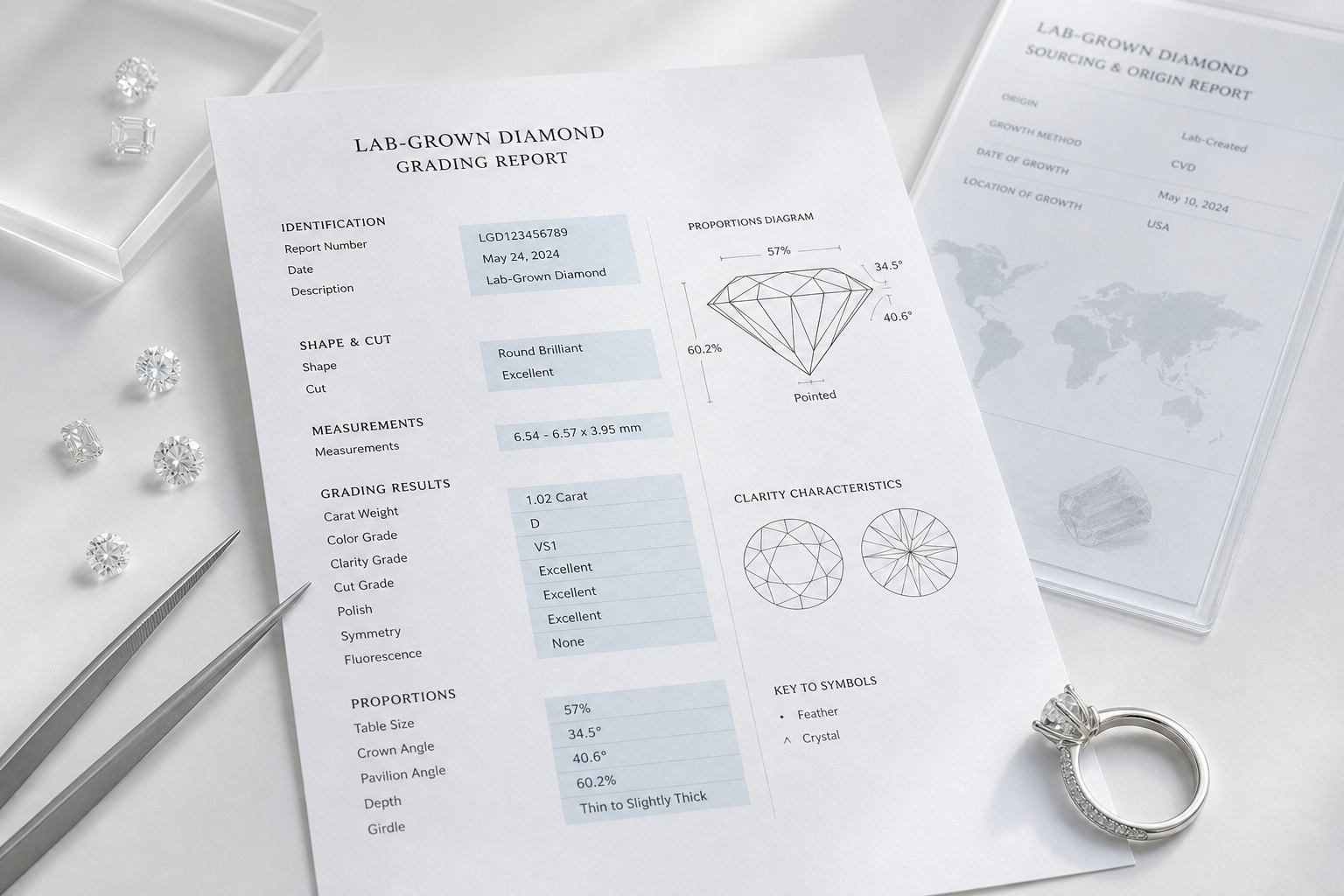
The most useful parts of a diamond grading report are the details that make the stone traceable and comparable. These include identity markers, physical measurements, lab-grown origin description, and graded characteristics such as color, clarity, carat weight, and, where applicable, cut-related information. The report gives structure to the comparison, even though it does not complete the comparison for you.
Traceability in this context should be understood carefully. A report number, inscription reference, measurements, and grading data can help connect a specific diamond to a specific document. They do not necessarily create a complete chain of custody from production through every commercial handoff. Buyers should treat the report as a strong identity tool, while asking separate questions when they need more information about sourcing, handling, seller documentation, or multi-stone matching.
When a report describes a diamond as lab-grown, it is documenting origin category rather than making a broader ethical or environmental judgment. Some reports or seller materials may also mention production-related terms such as HPHT or CVD, but those terms should be understood as growth-method context, not automatic proof that one stone is more beautiful, more responsible, or better value than another. The practical use is to keep the description clear and consistent across the report, listing, and seller explanation.
If growth method appears on a document or listing, read it as a descriptive detail rather than a ranking system. HPHT and CVD may help explain how a lab-grown diamond was produced, but a buyer should still evaluate the actual stone through its report, measurements, video, and seller explanation. The method alone should not be used to assume better appearance, better pricing, or stronger sourcing claims unless the seller provides specific evidence for that separate claim.
When growth method or post-growth treatment is relevant, buyers should look for clear disclosure in the grading report or seller documentation. HPHT and CVD may refer to diamond growth methods for laboratory-grown diamonds, while any post-growth treatment or enhancement should be described separately when applicable rather than assumed from the growth-method label alone.
Identity and measurement details the report can verify
The first job of the report is identification. It typically records the diamond’s shape, carat weight, measurements, and report number. These details help distinguish one stone from another, which matters more than many shoppers realize. Two diamonds may both be described as “2 carat oval lab-grown diamonds,” but their measurements, proportions, and grading details can be meaningfully different.
Measurements are especially useful because carat weight alone can be misleading. Carat tells you weight, not visual spread. A diamond with the same carat weight may appear larger or smaller depending on how that weight is distributed. The report’s millimeter measurements help you see whether a stone’s physical size supports the look you expect.
This is one place where the certificate can prevent a real buying mistake. If a diamond’s carat weight looks attractive but its measurements suggest it may face up smaller than expected, the report gives you a reason to pause before assuming the stone is a better deal.
Graded characteristics that help buyers compare stones
The report also records the graded characteristics most buyers use to narrow their options: color, clarity, carat weight, and cut information where the shape and reporting format support it. These grades are valuable because they create a common comparison language. Without them, buyers are left with vague claims like “bright,” “clean,” or “high quality,” which are not enough for a serious purchase.
Not every grade carries the same practical weight in every buying situation. Clarity, for example, matters most when inclusions are visible or affect transparency. A high clarity grade may be reassuring, but paying more for clarity that cannot be seen in normal wear may not improve the finished jewelry. Color works the same way: a higher grade may be desirable, but the setting metal, diamond shape, and buyer sensitivity to warmth can change how much that grade matters.
Cut-related information deserves particular attention because it often has more influence on appearance than buyers expect. Even then, the report should be treated as a guide rather than a full visual answer. A documented cut grade or proportion set can help flag a stronger candidate, but it does not replace seeing how the stone handles light.
How the stone is matched to the document
A report number is one of the simplest but most important details on a lab-grown diamond certificate. It allows the diamond to be matched to its grading document. In many cases, the stone may also have a microscopic laser inscription on the girdle that corresponds to the report number, making it easier to verify that the diamond being sold is the diamond described.
This matching step is not glamorous, but it is practical. If you are buying a loose stone, especially online, the report number and any inscription details help reduce confusion between similar diamonds. This matters in inventory environments where many stones may share similar carat weights, shapes, and grades.
The report does not eliminate every possible concern, but it does give you a concrete way to verify that the conversation is about a specific diamond rather than a general product category.
When a grading report is available, buyers should verify the report details through the issuing laboratory’s official report-check tool where available, then compare those details with the seller’s listing, images, video, and any inscription information.
Buyer Verification Checklist
- Confirm the report number: Make sure the number on the grading report matches the seller’s listing and any available inscription information.
- Check the shape and carat weight: These should match the stone being offered, not just the general product description.
- Review the measurements: Look at the millimeter dimensions, not only carat weight, because spread affects how large the diamond appears.
- Compare the main grades: Color, clarity, and cut-related information help narrow choices, but they should not be treated as the whole decision.
- Look for consistency: If the listing, report, and seller description do not line up cleanly, ask for clarification before moving forward.
What the Certificate Does Not Prove
Understanding what a lab-grown diamond certificate does not prove is just as important as understanding what it can confirm. The report is useful because it documents specific characteristics. It becomes risky only when a buyer treats that documentation as proof of beauty, value, ethical production, sustainability, or seller reliability.
A certificate can support a smarter decision, but it cannot make the decision for you. The most expensive mistakes often happen when a shopper sees a strong report and stops asking the next set of questions.
A grading report helps document key characteristics, but it should not be treated as a guarantee of beauty, value, or sourcing ethics. This boundary is not a weakness of the report; it is the reason buyers need to combine report data with visual evidence, seller documentation, and purchase-specific questions.
Why a report cannot judge beauty or light performance
A diamond’s appearance is not fully captured by the grades printed on a report. Beauty depends on how the stone looks face up, how it handles light, how its shape appears in real proportions, and whether any visual characteristics bother the person wearing it. A report can describe inputs. It cannot fully show the result.
This is especially relevant with fancy shapes such as oval, pear, emerald, radiant, cushion, and marquise diamonds. Two stones can have similar color, clarity, and carat weight but look noticeably different because of shape outline, facet pattern, contrast, bow-tie effect, or face-up spread. The report may help you understand why the stones are comparable on paper, but it does not prove they are equally appealing in person or on video.
The practical judgment is simple: if beauty is the reason you are buying the diamond, the certificate cannot be your only evidence. Understanding verifying a lab grown diamond certificate is essential, as a report may tell you the stone is worth reviewing. It does not prove the stone will be visually satisfying.
Why it does not tell you whether the price is fair
A grading report does not certify value. It does not say whether the price is competitive, whether the stone is a good deal, or whether another diamond with slightly different specifications would be a smarter use of the same budget.
Price depends on market conditions, seller margin, shape demand, carat range, cut quality, availability, and how the stone compares with alternatives. A certificate gives you the language to compare, but it does not perform the comparison. A diamond with higher grades can still be a poor value if the premium does not create a visible or practical benefit.
This is where buyers often overpay for numbers that do not change the final experience. For example, moving from an eye-clean clarity grade to a much higher clarity grade may look impressive on the report, but it may not improve the appearance of the finished ring. The better value may be the stone with slightly less impressive paperwork but stronger visual performance or a better balance of size, color, and cut.
Prices can vary because of cut precision, report type, seller channel, size, shape, availability, and documentation. Buyers should compare like-for-like specifications before treating one stone as a better value, and exact comparisons should be verified at the time of purchase.
Why it cannot prove ethical production or seller reliability
A certificate may identify a diamond as lab-grown, but that does not automatically prove every ethical, environmental, or sourcing claim attached to it. Lab-grown origin is a specific description of how the diamond was created. It is not a complete audit of energy use, labor practices, factory conditions, supply-chain handling, or seller behavior.
This does not mean lab-grown diamonds should be viewed with suspicion. It means broad claims require separate support. If a seller makes strong statements about sustainability, ethical superiority, or responsible sourcing, the certificate alone is not enough evidence. Those claims need clear documentation, careful wording, and a seller willing to explain what is actually known.
A useful way to handle sustainability language is to separate what is documented from what is implied. “Lab-grown” tells you the diamond was created in a controlled production environment rather than mined from the earth, but it does not automatically describe the energy source, manufacturing practices, transport path, or business standards behind that stone. If these issues matter to the buyer, they should be discussed as documentation questions rather than assumed from the certificate alone.
When environmental or responsible-sourcing language appears beside a certified diamond, ask whether the claim is specific enough to be checked. “Lab-grown” is a product description. “Lower-impact,” “sustainable,” “carbon-neutral,” or “responsibly produced” are broader claims that should be supported by separate documentation, not inferred from the grading report. This distinction protects buyers from confusing a verified origin category with an unverified marketing conclusion.
Sustainability claims should be specific and documented. Broad green language is less useful than clear information about production context, energy use, sourcing records, and seller transparency. If a buyer cares about these factors, the certificate can start the conversation, but it should not be treated as the evidence for every environmental or responsibility claim.
Environmental and sustainability claims should be specific, documented, and limited to what can be substantiated. A lab-grown origin description may be relevant to a buyer’s sourcing preference, but it should not be expanded into claims about carbon impact, labor conditions, or overall environmental performance without separate support.
Seller reliability is also separate from certification. A grading report can describe the stone, but it cannot prove that the seller communicates clearly, represents inventory accurately, handles questions responsibly, or provides the right support for your purchase. A trustworthy diamond decision depends on both the document and the people presenting it.
What This Means in a Real Purchase
In a real purchase, the certificate should reduce uncertainty, not replace evaluation. It can help you confirm that a diamond matches its listed specifications, but it should not be used as proof that the stone is beautiful, fairly priced, responsibly produced in every respect, or sold by a reliable source.
The better habit is to separate the questions. Use the report to ask, “What is this diamond?” Use visual review to ask, “Do I like how it looks?” Use comparison to ask, “Is the price justified?” Use seller communication and documentation to ask, “Can I trust the process?” A strong buying decision needs all of those answers, not just a certificate with attractive grades.
Why Visual Review Still Matters Even When the Report Looks Strong
The gap between grades and actual appearance
A strong lab-grown diamond certificate can narrow the field, but it cannot show how the diamond behaves in real life. Grades are useful because they organize measurable information. Appearance is different. It depends on how the stone returns light, how evenly it looks bright across the face, how its shape carries weight, and whether its proportions make it look balanced once viewed from above.
This is where many buyers over-trust the report. A diamond can have appealing color and clarity grades and still look flat, watery, dark in the center, or visually smaller than expected for its carat weight. That does not mean the certificate is wrong. It means the certificate was never designed to replace visual review.
The most important practical distinction is this: the report helps you decide whether a stone deserves attention, while photos and video help you decide whether it deserves serious consideration. Skipping that second step is one of the easiest ways to buy a diamond that looks better on paper than it does in a ring.
What photos and 360-degree video can reveal
Clear photos and 360-degree video can show issues that a grading report may not make obvious. You can see whether the diamond has lively light return or large dull zones, whether reflections look balanced, and whether the face-up outline feels attractive. For fancy shapes, visual review is even more important because shape behavior varies widely even among stones with similar grades.
An oval may show a noticeable bow-tie effect across the center. A pear may look too narrow or bottom-heavy. An emerald cut may reveal more visible inclusions than its clarity grade suggests because of its open, step-cut pattern. A cushion may carry weight in the depth and appear smaller from the top than another cushion of the same carat weight. These are not minor technicalities if the diamond will be worn every day.
Video is especially useful because it shows movement. A still photo can make a diamond look bright under one lighting setup, while a rotating video can reveal whether that brightness holds across different angles. The warning sign is not a diamond that has contrast; all diamonds show contrast. The concern is uneven performance that stays dark, dull, or distracting as the stone moves.
Why the same report can still produce two different-looking stones
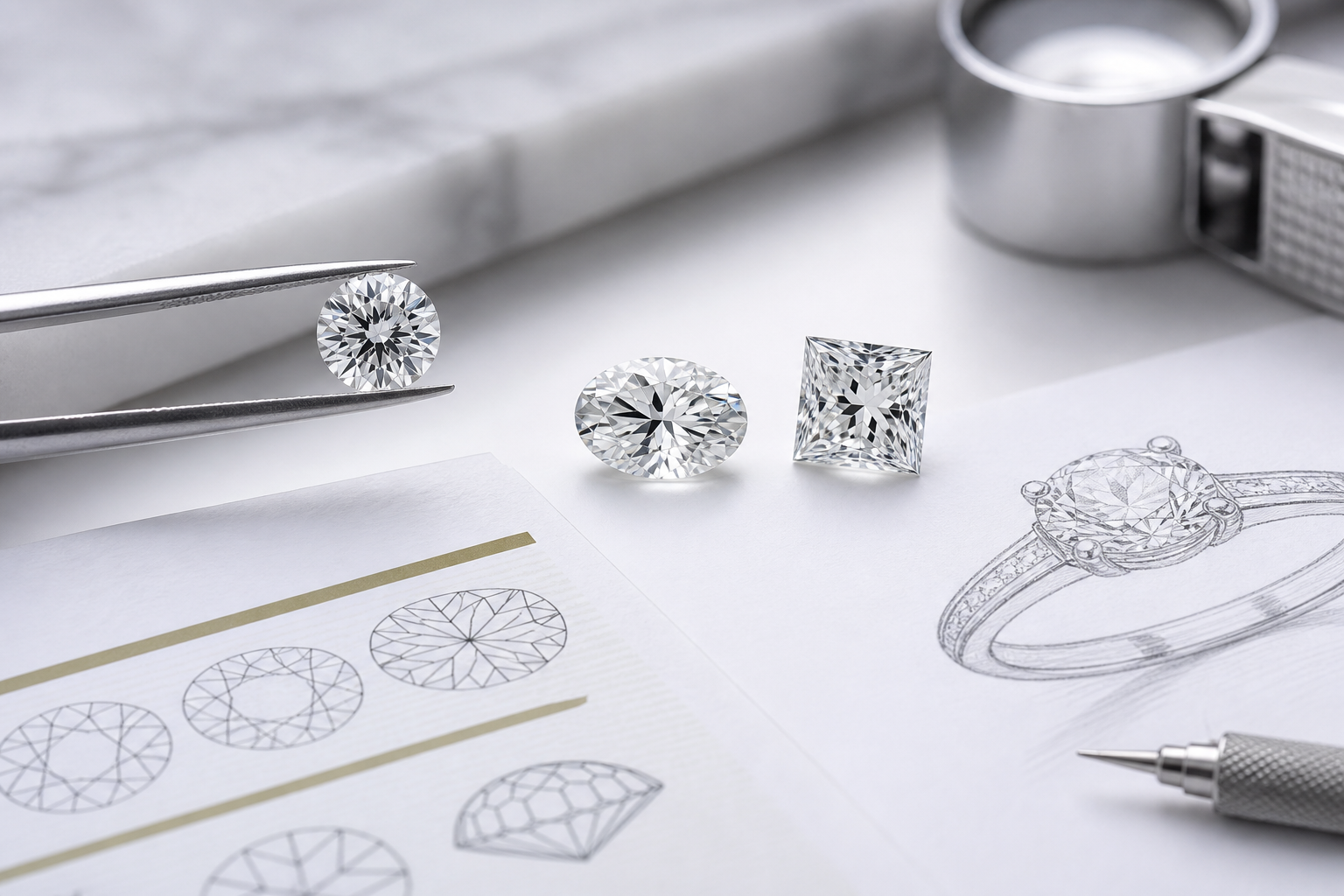
Consider two 2.00 carat lab-grown oval diamonds with similar color, clarity, and grading reports. On paper, both may look like safe choices. In video, one may have a balanced outline, clean brightness through the center, and a pleasing spread. The other may show a stronger bow-tie, a narrower shape, or a deeper build that makes it face up smaller. The certificate did not fail; it simply did not answer the visual question.
This matters most when the price difference is small. If two diamonds cost nearly the same and have similar report grades, the better value is often the one with stronger face-up appearance, not the one with a slightly better-looking line on the certificate. A small grade advantage can be less meaningful than a more attractive shape, better light behavior, or a cleaner visual presence in the actual setting.
At NUVU, we usually treat visual review as the step that turns report data into a real buying decision. The certificate can qualify a stone, but the eye still has to approve how that specific diamond looks.
How to Verify This Before Buying
Before committing, compare the lab-grown diamond certificate against the actual images and video. Start with the report to confirm the basics, then look at the diamond face-up. Ask whether the stone looks bright across the center, whether the outline is attractive, whether the shape appears balanced, and whether anything visually distracting keeps drawing your attention.
For round diamonds, focus on brightness, contrast, and overall symmetry of appearance. For fancy shapes, pay closer attention to outline, length-to-width impression, center darkness, and how the diamond carries its carat weight. If a stone looks weak in video but strong on paper, do not let the certificate talk you into ignoring what you can see.
How to Read the Report Fields That Matter Most
The fields to look at first
When learning how to read a lab-grown diamond report, start with the fields that affect identity and comparison before getting lost in smaller details. The report number, shape, carat weight, measurements, color, clarity, cut information where applicable, polish, symmetry, and proportions are usually the most useful starting points. These fields help confirm what the diamond is and whether it belongs in your shortlist.
Measurements deserve more attention than many buyers give them. Carat weight tells you weight, not visible size. A 1.50 carat diamond that measures well across the top may look larger than another 1.50 carat diamond that carries more weight in its depth. Reports often list measurements to hundredths of a millimeter, such as 7.42 x 7.39 x 4.55 mm. You do not need to obsess over every hundredth, but you should notice whether the stone’s spread makes sense for its shape and carat weight.
For round brilliant diamonds, cut grade is often one of the most decision-relevant fields because it connects more directly to light performance than color or clarity alone. For fancy shapes, the report may not give the same type of cut grade, so measurements, proportions, symmetry, and visual evidence become more important. Treat the report as a prioritization tool, not a complete scoring system.
How to interpret measurements and proportion data without overfitting
Proportion data can help you spot diamonds that deserve closer review, but it should not be used like a rigid formula. Table percentage, depth percentage, length-to-width ratio, and girdle information all add context. The mistake is assuming that one number automatically makes a diamond beautiful or unacceptable.
Depth is a good example. A diamond that is too deep may face up smaller than expected because more weight sits below the visible surface. A diamond that is too shallow may have weaker light return or a less pleasing appearance. The better question is not whether a number is “perfect,” but whether the measurements, video, and intended setting all support the same conclusion.
Length-to-width ratio also needs context. A buyer choosing an oval engagement ring may prefer a longer, slimmer look, while another may want a softer, fuller outline. The report can show the ratio, but it cannot decide which visual style fits the design. If the numbers look acceptable but the shape feels awkward in video, trust the visual evidence rather than forcing the diamond into your shortlist.
What missing, vague, or incomplete details can signal
A lab-grown diamond certificate should give enough information to identify and compare the stone with confidence. If the documentation is missing key details, uses vague descriptions, or does not clearly connect the stone to the report, slow down. Incomplete information does not automatically mean the diamond is poor, but it does raise the amount of verification required before buying.
Be especially cautious when the report details are presented only as marketing claims instead of as a readable grading document. A listing that says “certified,” “excellent quality,” or “top grade” without showing the actual report number, measurements, and grading information gives you less to evaluate. The risk is not just overpaying; it is choosing a diamond without enough evidence to compare it fairly against other options.
Some fields are more important than others depending on the purchase. For a loose stone intended for a custom ring, exact measurements can affect setting fit. For a diamond selected mainly for visual size, face-up spread matters. For a step-cut shape, clarity may need closer review than it would for a brilliant-cut shape because inclusions can be easier to see. The report is most useful when you read it according to the decision you are actually making.
Certificate and Visual Review Check
Read the report in this order: confirm the diamond’s identity, check measurements and carat weight together, review color and clarity in relation to the shape, look at cut or proportion data where available, then compare those details against photos or video. If the report and the visual evidence support each other, the stone is easier to evaluate. If they conflict, the conflict deserves attention before the purchase moves forward.
The strongest buying decisions usually come from alignment. The certificate, measurements, proportions, and visual appearance should tell a consistent story. If one part of that story feels weak, unclear, or unsupported, the better move is to ask for more information rather than assume the report has answered everything.
Why Seller Transparency Is a Separate Question
What the seller should explain beyond the grading report
A lab-grown diamond certificate and seller transparency are related, but they are not the same thing. The grading report documents the diamond. The seller is responsible for explaining the purchase clearly enough that you know what you are considering, what is included, and what is not being claimed. A clean certificate does not automatically prove the seller is careful, accurate, or complete in their communication.
A transparent seller should be able to connect the report to the listed diamond, provide clear visuals, explain any important tradeoffs, and avoid stretching the certificate beyond what it proves. If a diamond has strong grades but a visible feature that may affect appearance, that should not be hidden behind generic language. If the stone is being recommended for a specific ring design, the seller should be able to explain why its measurements, shape, and appearance make sense for that use.
The most useful seller explanations are specific. “This diamond has a balanced oval outline with moderate center contrast in video” is more useful than “beautiful certified diamond.” Specific language gives you something to verify. Vague praise asks you to trust the seller without giving you much to test.
Why documentation quality and communication matter
Documentation quality matters because online diamond buying depends on matching several pieces of evidence: the certificate, the listing, the images, the video, and the seller’s written explanation. If those pieces do not line up, the certificate alone cannot fix the uncertainty. A report number may confirm identity, but it does not explain why one stone is a better fit for your budget, design, or visual preference.
Good communication also helps separate normal tradeoffs from warning signs. Nearly every diamond involves some compromise, whether in size, color, clarity, proportions, or price. A reliable seller should help you understand the compromise instead of pretending it does not exist. A lower price, for example, may be reasonable if the buyer accepts a warmer color or a less ideal spread. It becomes a problem when the tradeoff is not disclosed clearly enough for the buyer to judge it.
This is especially important for custom work. A diamond may be attractive as a loose stone but less suitable for a particular setting if the dimensions, shape, or proportions create fit or design issues. Seller transparency should help connect the diamond to the intended use, not just repeat what is already printed on the report.
For wholesale or multi-stone buying, transparency also includes consistency. A single certificate can identify one diamond, but a larger order may require clear matching across reports, listings, videos, parcel descriptions, and production timelines. In practical buying, consistency often matters as much as the headline price because mismatched documentation or unclear communication can create problems later in setting, inventory planning, or customer presentation.
In sourcing or wholesale conversations, documentation, consistency, and communication often matter as much as the headline specification. Buyers should ask how stones are matched across reports and listings, what information will be shared before approval, and how substitutions or specification changes would be communicated if they arise. This kind of clarity is separate from the grading report, but it makes the report more useful.
China-linked supply chains can offer manufacturing depth and scale in some categories, but buyers still need to evaluate consistency, documentation, communication, and quality control. A country of origin, seller location, or factory-linked description should not be treated as proof of lower price, higher quality, stronger reliability, or reduced purchase risk without specific, verifiable information.
Which claims deserve extra caution
Be careful with claims that sound broader than the certificate can support. A grading report does not prove that a diamond is the best value, ethically superior, environmentally impact-free, investment-grade, or visually exceptional. Those are separate claims that require separate evidence, and some of them may still involve judgment rather than certainty.
Words such as “perfect,” “flawless-looking,” “sustainable,” “conflict-free,” or “best price” should be treated as prompts for clarification, not as conclusions. Some claims may be reasonable when explained carefully. Others are too broad to rely on without supporting details. The practical rule is simple: the bigger the claim, the more specific the evidence should be.
A certificate can support a seller’s description only within its actual scope. If the seller uses the report as proof of things the report does not measure, that is a communication problem. It does not automatically mean the diamond is bad, but it does mean the buyer should slow down and ask sharper questions before committing.
What to Ask in Writing
Ask the seller to confirm the report number, provide the certificate or report copy, and explain how the diamond shown in photos or video matches that document. If the stone is being considered for a ring, ask whether the measurements and shape are suitable for the intended setting. If a claim is made about value, sourcing, or production standards, ask what documentation or explanation supports that claim beyond the grading report.
It can also help to ask the seller to separate confirmed facts from professional opinion. For example, “The report lists this carat weight and these measurements” is different from “We think this stone faces up well for the design.” Both statements can be useful, but they are different kinds of information. Clear sellers should be comfortable explaining which parts are documented by the report and which parts are based on visual assessment or practical recommendation.
The goal is not to interrogate the seller. It is to make sure the buying decision rests on evidence rather than assumptions. A seller who can answer clearly, specifically, and consistently makes the certificate more useful. A seller who leans on the certificate while avoiding reasonable questions leaves too much of the decision unsupported.
How to Combine Certificate, Video, and Seller Explanation Into One Decision
A lab-grown diamond certificate should begin the decision, not end it. The strongest buying process uses three sources together: the report for documented facts, the diamond video for real appearance, and the seller explanation for context that the report cannot provide. If one of those three pieces conflicts with the others, slow down before treating the stone as a safe choice.
A simple three-step review workflow
Start with the certificate. Use it to confirm that the stone belongs in your shortlist based on the basics that matter for your purchase: shape, carat weight, measurements, color, clarity, cut information when available, and report identification. This is a screening step. A clean report can tell you that a diamond is worth considering, but it cannot tell you that it is the best-looking option in your budget.
Next, review the visual evidence. A clear diamond video should show how the stone faces up, how evenly it returns light, whether the shape looks balanced, and whether any inclusions, tint, windowing, bow-tie effect, or dark areas are noticeable in normal viewing. This step often changes the ranking. A diamond with slightly less impressive paper grades can sometimes look better than one with stronger numbers if the proportions and light behavior are more appealing.
Then test the seller explanation against the certificate and video. The explanation should make sense in relation to what you can see and what the report documents. If the seller says a stone is “exceptionally bright,” the video should support that claim. If the seller recommends it for a custom ring, the measurements and shape should work for the intended setting. At NUVU, we treat this combination as a practical check: the document narrows the field, the video shows the stone, and the explanation should connect both to the buyer’s actual use.
If a GIA, IGI, GCAL, or other grading report is provided, buyers should use the issuing laboratory’s official report verification system where available. This step helps confirm the report details, but it should still be paired with visual review, setting-fit checks, and clear seller communication.
NUVU’s role in buyer education is to make comparison clearer, especially around grading reports, visual evidence, design fit, and documentation. A report can reduce uncertainty about what the diamond is, while photos, video, and direct communication help answer whether that specific stone fits the design, budget, and visual expectations of the purchase.
How to compare two stones with similar reports
Imagine two oval lab-grown diamonds with similar carat weight, color, clarity, and certification details. On paper, they may seem nearly interchangeable. In video, one may show a more balanced outline, better edge-to-edge brightness, and a less distracting bow-tie effect. The other may have the same attractive grades but look stretched, uneven, or darker through the center. In that situation, the better diamond is not automatically the one with the cleaner-looking certificate. It is the one where the report, video, and practical explanation point in the same direction.
This is where many buyers make the wrong tradeoff. They overpay for a small paper advantage while ignoring visible performance. A one-grade difference in clarity may not matter if both stones are eye-clean, but a noticeable difference in face-up appearance will matter every time the ring is worn. The certificate helps you avoid unsuitable stones; the video helps you avoid disappointing stones.
Seller explanation also matters when two options look close. A useful explanation should clarify why one stone is better suited to the design, budget, or viewing preference. For example, one stone may have dimensions that make it look larger in a solitaire setting, while another may be easier to pair with side stones because of its outline and proportions. If the explanation only repeats the grades without addressing visible differences, it is not adding much decision value.

When the report should stop the process and trigger more questions
A certificate should raise questions when the documented details do not line up with the way the diamond is being presented. If the report is missing important information, if the report number is hard to verify, if the listed measurements seem unusual for the claimed size, or if the video is unavailable or too unclear to judge, the stone should not move straight to purchase consideration.
The same caution applies when the seller’s language goes beyond what the documentation can support. A grading report does not prove that a diamond is the “best value,” “ethically superior,” or “perfect for every setting.” Those claims require separate evidence or a more specific explanation. A confident seller should be able to explain the recommendation without asking you to treat the certificate as a complete verdict.
A mismatch is the biggest warning sign. If the certificate suggests a strong candidate but the video looks weak, trust the visual concern enough to investigate further. If the video looks appealing but the documentation is vague, ask for clarification before committing. A good buying decision is built when the evidence supports itself from more than one angle.
Buyer Verification Checklist
- Use the lab-grown diamond certificate to confirm the stone belongs in your shortlist, not to approve the purchase by itself.
- Review the diamond video for face-up appearance, light behavior, shape balance, and any visible issues that grades may not reveal.
- Ask whether the seller explanation connects clearly to the report, video, intended setting, and budget.
- Be cautious if the seller relies on broad claims instead of specific, document-backed reasoning.
- Pause the decision if the certificate, video, and explanation do not support the same conclusion.
A Practical Decision Framework: When the Certificate Is Enough, and When It Is Not
A lab-grown diamond certificate is enough when you are narrowing options. It is not enough when you are making the final commitment on a stone that will be set, worn, and judged by appearance in real life. The practical question is not whether the certificate matters. It does. The question is what level of decision you are asking it to support.
When the certificate may be enough for a first-pass shortlist
For early comparison, the certificate can do a lot of useful work. If you are filtering loose stones by shape, carat range, color, clarity, cut grade where applicable, and measurements, the report is often enough to remove poor-fit options and create a serious shortlist. At this stage, you do not need to solve every visual or value question. You need to decide which stones deserve more attention.
This is especially helpful when shopping online. A buyer comparing ten round brilliant stones or six elongated cushions can use certification details to avoid wasting time on diamonds that fall outside the design goal or budget. If the intended ring needs a specific size range, the measurements may matter more than a tiny difference in carat weight. If the diamond will be set in yellow gold, a slightly warmer color grade may be more acceptable than it would be in a bright white metal setting.
The mistake is treating the shortlist as the final answer. A certificate can help you identify candidates, but it should not make one stone the automatic winner unless the purchase is very low-risk, the visual evidence is clear, and the seller’s supporting information is consistent.
When you should slow down and verify more before committing
Slow down when the diamond is expensive relative to your budget, when the shape is more sensitive to proportion differences, or when the stone is being chosen for an important custom piece. These are situations where small mismatches become more costly. A certificate may show attractive grades, but the wrong face-up outline, weak light return, or poor fit for the setting can make the final piece feel less successful.
Elongated shapes deserve particular care because the report rarely tells the whole visual story. Ovals, pears, marquise cuts, radiants, and elongated cushions can vary noticeably in bow-tie visibility, length-to-width feel, and brightness pattern even when their grades look similar. In those cases, the certificate is useful for screening, but video and seller explanation carry more weight before purchase.
Extra scrutiny is also appropriate when claims are broad or unsupported. If a diamond is described as an exceptional value, ask what makes it so beyond the certificate. If it is recommended for a custom design, ask how its measurements and shape support that design. If a seller cannot connect the recommendation to visible and documented details, the safest move is to keep comparing.
How this applies to loose stones, custom design, and simple online buying
For loose lab-grown diamonds, the certificate is a strong starting point because it helps confirm identity and compare core characteristics. The final decision should still depend on whether the stone looks good in available media and whether its measurements make sense for the intended use. A loose stone with strong grades but poor visual behavior is not a better buy simply because the report looks cleaner.
For custom design, the certificate becomes one part of a larger fit question. The right diamond must work with the setting style, prong layout, metal choice, and daily-wear expectations. A stone can be attractive on its own and still be a weaker choice for a specific design if the outline, depth, or proportions create practical issues. In custom work, compatibility often matters as much as headline grades.
For simple online buying, the threshold depends on risk. If the stone is modestly priced, clearly documented, supported by strong video, and easy to compare against alternatives, the certificate may be enough to move confidently into final review. If the purchase is high-value, visually sensitive, or tied to an engagement ring, the smarter decision is to require all three pieces: report, video, and a clear seller explanation.
What This Means in a Real Purchase
Use the certificate to decide whether a diamond deserves consideration. Use video to decide whether it deserves serious interest. Use the seller explanation to decide whether the recommendation holds up for your budget, design, and expectations. If all three support the same choice, you have a stronger basis for buying. If one piece is weak or missing, the certificate alone should not carry the decision.
Before purchase, buyers should also confirm the seller’s documentation, return terms, resizing terms, and after-sales support in writing. These are separate from the grading report, but they affect the practical risk of the transaction and should not be assumed from the word “certified.”
Certificate Boundary Questions to Ask Before You Buy
Before relying on any lab-grown diamond certificate, it helps to ask boundary questions rather than only grade questions. Start with: “What exactly does this report document?” Then ask: “What important parts of this purchase are outside the report?” This mindset keeps the certificate useful without allowing it to become a shortcut for claims it was not designed to prove.
A practical boundary check can be simple. If the question is about identity, origin category, measurements, carat weight, color, clarity, or report details, the grading report may provide useful evidence. If the question is about beauty, value, long-term satisfaction, environmental impact, sourcing standards, seller reliability, custom fit, or purchase terms, the answer should come from additional documentation, visual review, comparison, and direct seller communication.
| Buyer Question | What the Report Can Help With | What Still Needs Separate Review |
|---|---|---|
| Is this diamond laboratory-grown? | The report may document laboratory-grown origin when clearly stated. | The seller listing and invoice should also describe the stone accurately as laboratory-grown, not natural. |
| Will it look beautiful in the ring? | The report can provide measurements, grades, and proportion clues. | Photos, video, setting design, and personal visual preference still matter. |
| Is the price justified? | The report gives comparison data for like-for-like review. | Market context, seller channel, visual performance, availability, and purchase terms should be checked separately. |
| Are sustainability claims supported? | The report may identify lab-grown origin. | Environmental, energy, sourcing, or responsibility claims require separate documentation. |
| Will it fit a custom setting? | The report gives millimeter dimensions and shape details. | Prong layout, depth, girdle outline, CAD design, and jeweler confirmation should be reviewed before final approval. |
The goal is not to make buying more complicated than necessary. It is to put each piece of evidence in the right place. A certificate is valuable when it answers the questions it is built to answer. The buying decision becomes stronger when the remaining questions are handled with the right type of evidence instead of being folded into the word “certified.”
Disclosure: This article is for general educational purposes only. Diamond grading, pricing, availability, specifications, and seller policies can change, and readers should verify important details through grading reports, official laboratory tools, seller documentation, or qualified professionals before making a purchase decision. Laboratory-grown diamonds should be clearly distinguished from natural diamonds, and environmental or sourcing claims should be supported by specific documentation.