
A lab-grown diamond certificate is meant to be your proof of value, but not every document is trustworthy. Missing report numbers, unfamiliar lab names, vague sustainability claims, and restrictive return policies all shift risk onto you as the buyer. Understanding why transparency matters becomes essential when evaluating certification documents, as the real question isn’t whether to buy a certified diamond — it’s whether you can read the fine print well enough to spot problems before you pay. This article walks through the documentation red flags that matter most, from certificate discrepancies to seller policies that limit your recourse after purchase.
For the full framework, read Lab-Grown Diamond Traceability, Certification, and Transparency Guide.
| Red Flag | What to Watch For | Why It Matters |
|---|---|---|
| Unsearchable report number | Number is missing, blurred, or doesn’t appear in the lab’s online database | You cannot independently verify the stone’s specs or origin |
| Unfamiliar lab name | Grading report from a lab without an established online verification portal | No reliable way to confirm the diamond’s characteristics exist |
| Mismatched weight and diameter | Dimensions don’t align with standard weight expectations for that shape | May indicate poor cut proportions or a misgraded stone |
| Post-growth treatment disclosure | Certificate mentions HPHT enhancement or other color/clarity modifications | Treated stones often have different performance and may not align with buyer expectations for as-grown material |
| Restrictive return policy | Return window under 5 days, restocking fee of 10–20%, or no dispute process | Limits your ability to challenge a diamond that doesn’t match expectations |
| Pressed wire transfer payment | Seller insists on wire transfer and avoids credit card options | Removes chargeback protections that safeguard your purchase |
| Unverifiable sustainability claim | Claims like “eco-friendly” or “carbon-neutral” without third-party certification | Marketing without evidence provides no real basis for comparison |
Quick Questions Before You Read
Q: Can I verify a lab-grown diamond certificate before I buy?
Yes. Most reputable labs (IGI, GIA, GCAL) offer an online database where you can check the report number[1]. If the number is missing or doesn’t return any results, that is a clear red flag.
Q: Is a lower price always a warning sign?
Not always, but a far-below-market price often means hidden tradeoffs — a poor cut, a missing certificate, or a seller cutting costs on transparency. Always verify the stone’s specs first.
Q: Do I lose buyer protection if I use a wire transfer?
Yes. Wire transfers bypass the chargeback protection that credit cards offer. If the diamond doesn’t match its certificate, you have much less leverage to dispute the charge.
Q: What should I check before agreeing to a custom design?
Confirm in writing that you can inspect the loose stone before it is set. Once set, many sellers will not accept returns of the diamond alone, so visible flaws or mismatches become much harder to address.
Why Documentation Red Flags Matter More Than Buyers Realize
You find a lab-grown diamond at a price that looks too good to ignore. The listing includes a certificate photo, but the report number is cropped out. The lab name sounds vaguely familiar but turns out to be nothing you can search for online. You pause. Does it matter?
It does. With lab-grown diamonds, documentation is the primary tool a buyer has to verify what they are actually getting. Unlike natural diamonds with decades of established resale markets and auction records, lab-grown stones depend almost entirely on their grading report for quality and value confirmation. A flawed or suspicious document does not just mean paperwork you can ignore — it often hides a stone with inconsistent measurements, a grade that cannot be confirmed, or a seller who is unwilling to back up their claims after you pay.
What Bad Documentation Can Hide
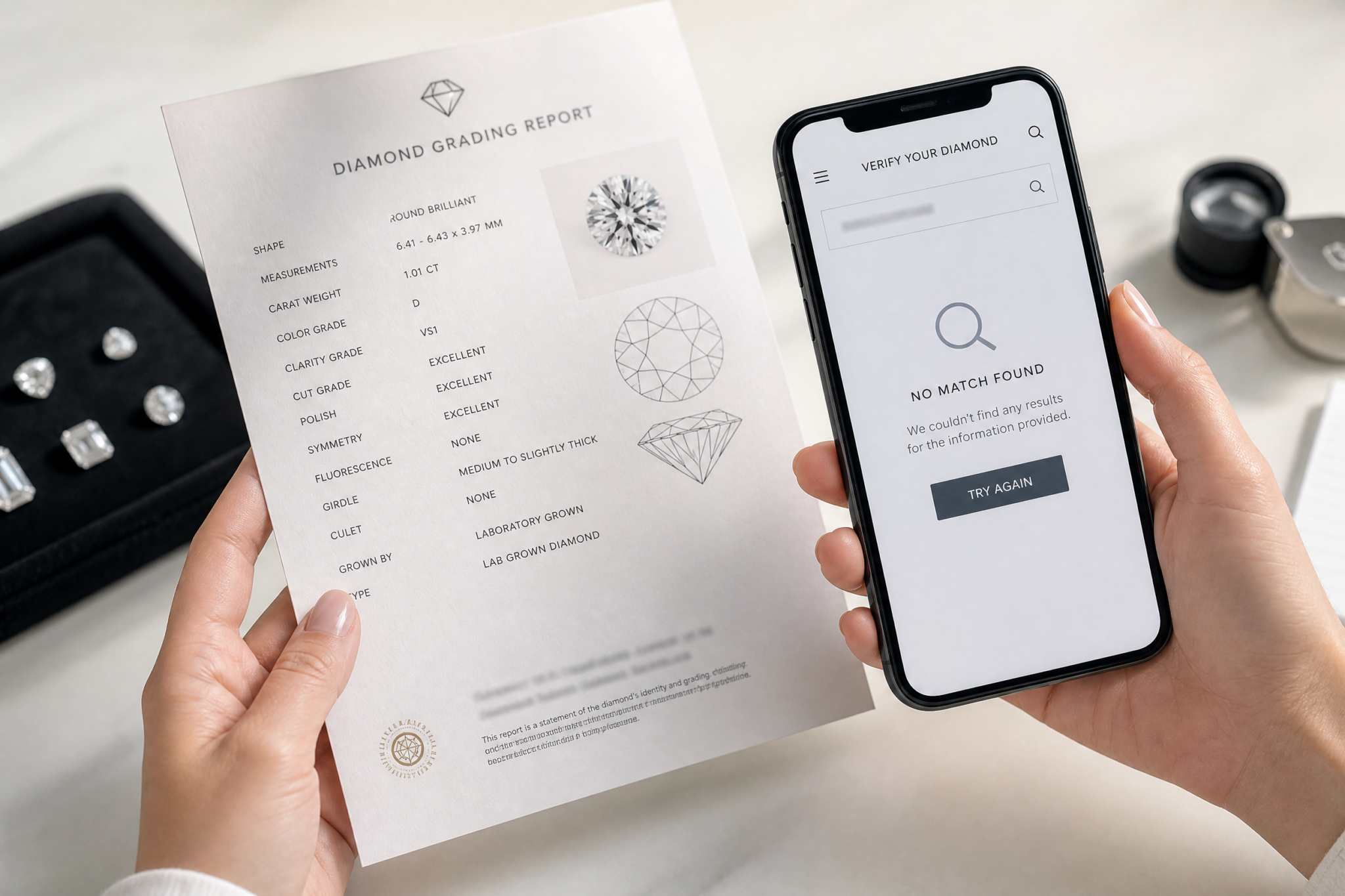
When a certificate has errors, omissions, or unverifiable details, the buyer loses the easiest point of leverage they have. Without a verifiable report number, you cannot independently confirm the color, clarity, or cut grade the seller assigned to that stone. You also cannot check whether the measurements and proportions match the physical diamond. A good document protects both sides of the transaction. A bad document protects only the seller’s version of the story.
Why Lab-Grown Diamonds Are Especially Vulnerable to Weak Paperwork
The lab-grown diamond market has grown quickly, and the range of grading reports has expanded along with it. There are reputable labs with well-known standards, but there are also smaller or newer labs whose grading conventions are less consistent. Buyers who are not familiar with the landscape can end up trusting a document that looks official but carries little weight in verification terms. A certificate from an unrecognized source, or one with no public database, leaves the buyer dependent on the seller’s word.
The Practical Limits of What a Certificate Can Tell You
Even a legitimate certificate from a well-known lab does not tell the full story of a diamond’s suitability for a specific piece of jewelry. A grading report records color, clarity, cut, and carat weight, but it does not measure optical performance, the visual effect of fluorescence, or how the stone interacts with different lighting conditions in a setting. Two diamonds with identical grades on the same report may perform noticeably differently in person, especially in side-by-side comparisons under natural or directional light. For custom design, the fit between the stone’s proportions and the intended setting is equally important. A standard report will not indicate whether the pavilion angle or crown height aligns optimally with a particular mounting style. This is why a grading report is best treated as a starting point, not a complete description. Buyers who rely solely on the certificate without considering the stone’s visual evidence or intended use may end up with a diamond that meets its stated grade but fails to satisfy in the context of the finished piece.
How a Single Red Flag Changes Your Buyer Protection
A single missing detail — a cropped report number, a missing laser inscription, a lab name that does not appear in any publicly accessible registry — shifts the burden of proof onto you. Instead of being able to verify the diamond with a few clicks, you are left asking the seller to explain what is missing. A straightforward seller with a legitimate stone has no reason to make that process difficult. The moment you notice something off about the paperwork, you are already in the position of needing to prove the stone is what it claims to be, rather than simply confirming it.
For the buyer, the practical distinction is between a document that enables verification and one that merely asserts a grade. A certificate is only useful if it can be cross-checked independently. The moment verification is blocked — by a missing number, a non-responsive database, or a seller who hesitates — the document stops being a buyer’s tool and becomes a seller’s shield. This is not about distrusting every seller, but about recognizing that the certificate’s primary function is to allow comparison, and that function is lost the moment the report number cannot be confirmed.
Certificate-Related Red Flags: What Does Not Line Up
The certificate is the single most important document you will see before buying a lab-grown diamond. It is also the place where red flags appear most often. Some are obvious. Others require looking at the details.
Missing or Unverifiable Report Numbers
Every legitimate grading report from a recognized lab includes a unique report number. That number is how you look up the diamond in the lab’s online database, confirm the grades assigned, and check that the measurements match. When a seller shows a certificate with the report number cropped, blurred, or blacked out, treat it as a serious warning. There is no legitimate reason to withhold that number. The buyer needs it to confirm that the diamond in hand matches the diamond described. Without it, you are buying based on trust alone.
Unfamiliar Grading Lab Names and Generic Logo Designs
A small number of labs dominate the lab-grown diamond grading space, and their names are widely known. When a certificate comes from a lab you have never heard of, or one with a name that sounds like a generic variation of a known institution, look closer. Some certificates carry logos that resemble established labs but are not affiliated. Others come from laboratories with no public database, no published grading standards, and no third-party oversight. That does not mean every unfamiliar lab is illegitimate, but it does mean you cannot verify the report independently. In a market where verification is the main safety net, an unverifiable certificate is a weak foundation.
Inconsistent Measurements or Weight-to-Diameter Mismatches
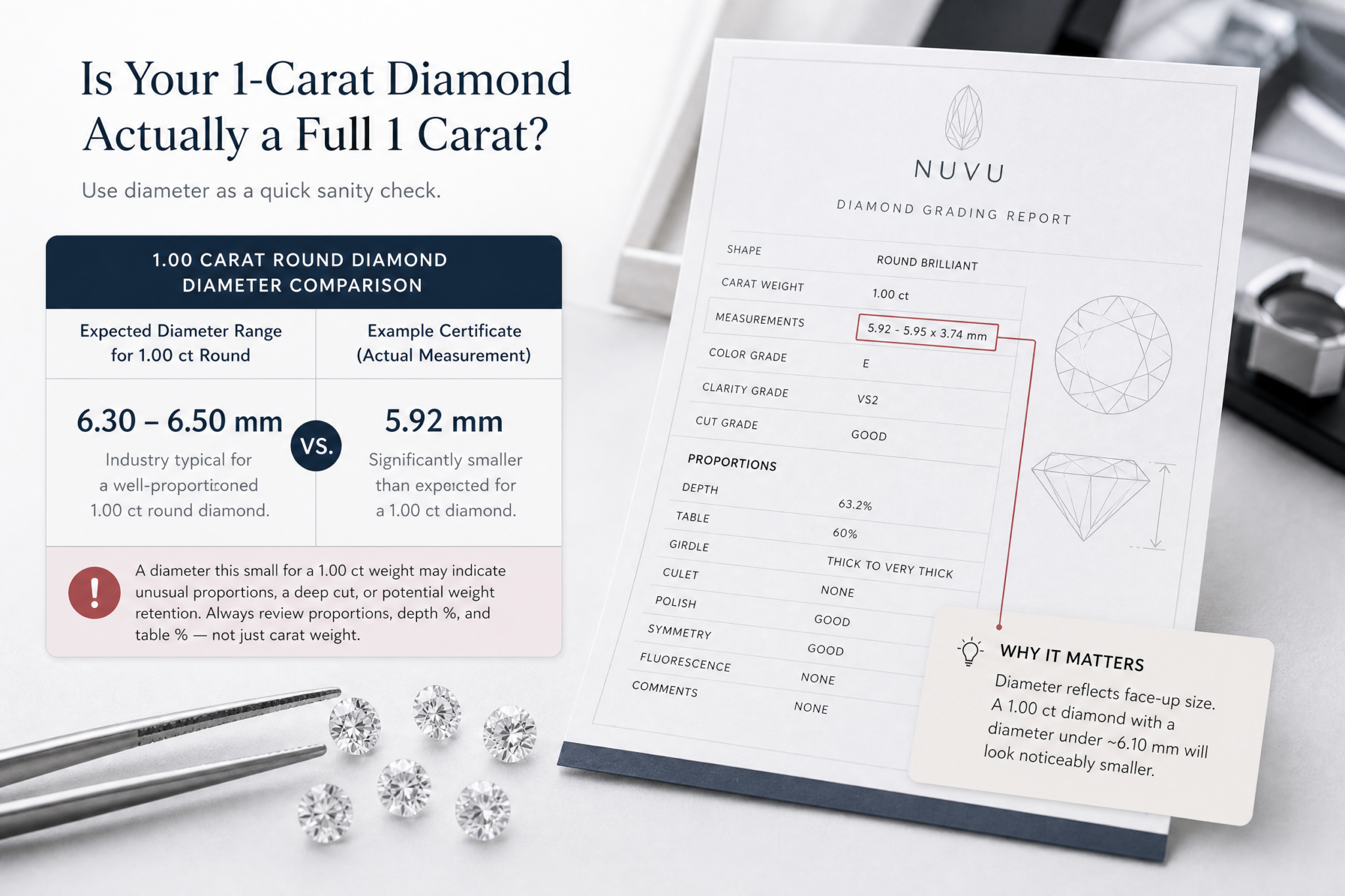
Grading reports include physical measurements for a reason. For a round brilliant diamond, the diameter should fall within a predictable range for its carat weight. A 1-carat round brilliant typically measures around 6.3 to 6.5 millimeters in diameter[2]. If the certificate shows a 1-carat diamond with a 5.8-millimeter diameter, either the weight is wrong, the measurement is wrong, or the stone is cut much deeper than normal, which affects how it performs visually. These mismatches are not common in reputable labs, so when you see one, it is worth asking why. The same goes for off-square ratios in fancy shapes or unusually thick girdle measurements that do not match the total depth percentage.
References to Treatment, Enhancement, or Synthetic Grading
Lab-grown diamonds are grown as complete crystals. They should not require post-growth treatments like fracture filling, HPHT color enhancement after growth, or coating to achieve their color[3]. If the certificate mentions any form of treatment or enhancement, pause. Some lower-quality lab-grown diamonds do undergo post-growth processing, and a reputable lab will note that on the report. A treated or enhanced lab-grown diamond is not the same as an as-grown diamond in terms of stability, visual consistency, or long-term value. References to “synthetic diamond” rather than “laboratory-grown diamond” are also worth noting. The U.S. Federal Trade Commission (FTC) has issued guidance on the use of terminology for laboratory-grown diamonds, advising marketers to use clear and non-deceptive language to differentiate them from natural diamonds[4]. Legitimate labs use standard terminology. Outdated or nonstandard wording sometimes signals a less rigorous grading process.
Grading Report Currency and Date Relevance
Another detail that deserves attention is the issue date of the grading report. A grading report issued years before the current sale may refer to a stone that has been through multiple transactions, inspected under different conditions, or stored in varied environments. While the documented characteristics — carat weight, color, clarity — do not change over time, the buyer’s ability to verify the stone’s current condition can be affected by the age of the report. Some labs offer updates or re-inspection services, but these are not automatic. When a certificate is several years old, asking whether the stone has been re-inspected or whether the seller can confirm that the diamond matches the original report is a reasonable step. An old certificate is not necessarily a red flag, but it adds an extra layer of uncertainty that the buyer should be aware of before relying on the document as a current representation of the stone.
What to Check Before Accepting a Certificate
Before you move forward with a purchase, the certificate should meet a few basic conditions. The report number must be visible and searchable online. The lab name should match a known, accessible grading organization. The measurements and weight should be internally consistent. The grading language should be standard and free of treatment references. The report date should be recent enough to serve as a current reference. Any deviation from these basics should be treated as a reason to ask for clarification, not as a minor detail you can ignore.
When a grading report is available, buyers should verify the report details through the issuing laboratory’s official report-check tool where available. A cross-check between the online record and the seller’s description is the most straightforward way to confirm that the documented specs match the stone being offered.
Seller Communication Red Flags: What They Avoid Saying
A seller’s willingness to share information directly tells you as much about the stone as the document itself. When evaluating diamond quality and value, understanding transparency questions to ask before buying a lab grown diamond can reveal whether communication patterns suggest the seller knows something they are not saying, or that the diamond would not hold up to independent review. These behaviors are worth treating as real caution signals, not just minor inconveniences.
Seller Refuses to Provide the Full Certificate Before Payment
If a seller sends only a screenshot of a certificate with the report number cropped out, or says they will provide the full document after you pay, consider that a warning. Without the report number, you cannot independently verify the stone online. The seller’s refusal to share it early suggests they may be sending a different stone than what arrives, or that the certificate belongs to a diamond with different specifications. A legitimate seller has no reason to withhold a report number. If they will not provide it upfront, the question is not whether the stone is real, but whether the stone you are paying for matches the paper.
Stock Photos or Renderings Instead of Real Diamond Images
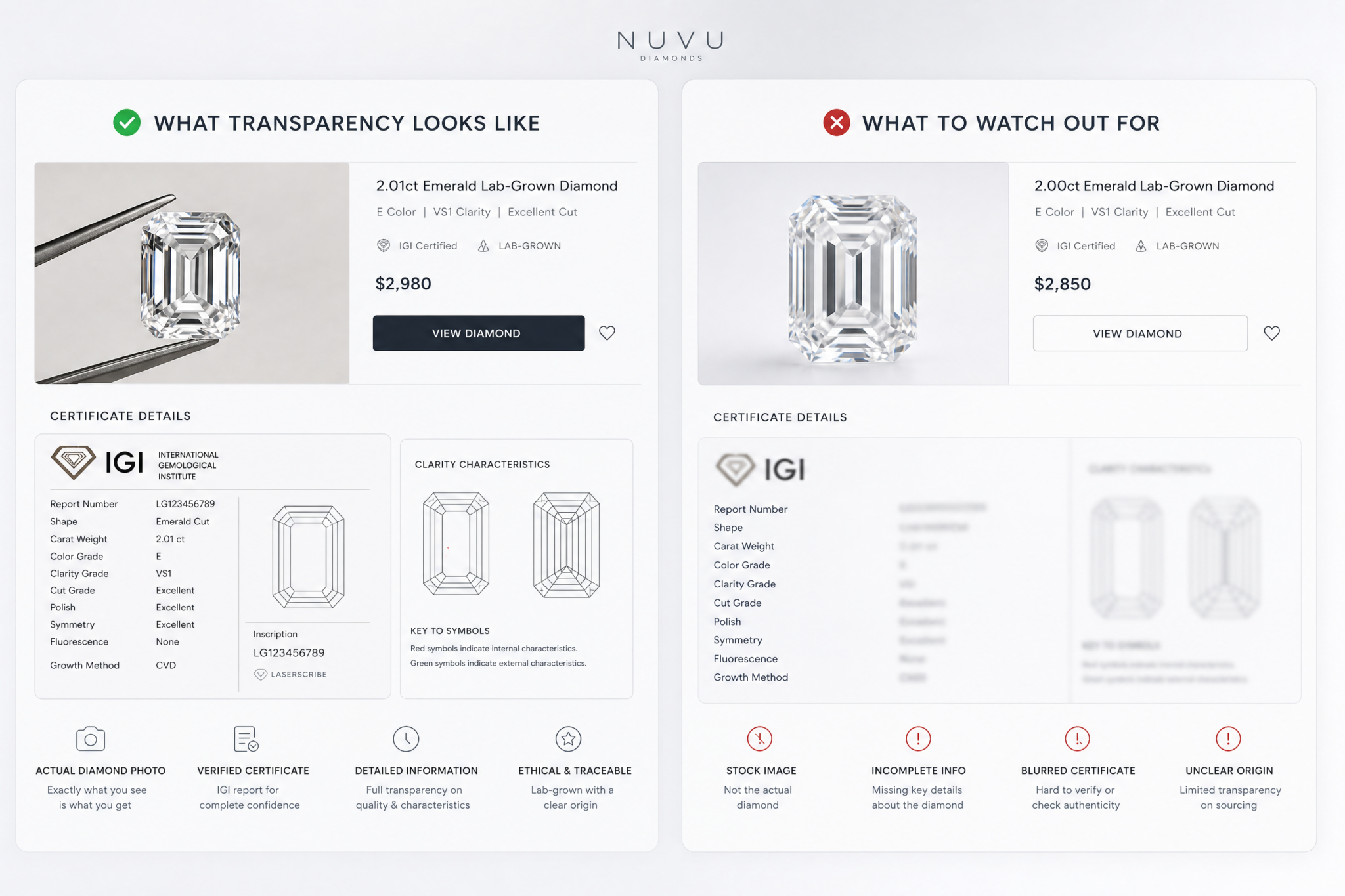
A listing that uses only generic stock photos, computer renderings, or the same image across multiple diamonds is hiding what the actual stone looks like. Two diamonds with identical grades on paper can look noticeably different side by side. One may have better optical performance, a warmer tint, or visible inclusions in a way the grade does not fully capture. A seller who cannot or will not show the actual diamond should make you ask why. Real images or short video footage taken under normal lighting are now standard for reputable online sellers. Anything less means you are buying blind.
Vague Supplier Descriptions and Unverifiable “Factory Direct” Claims
Many sellers describe their source as a “top manufacturer,” “leading facility,” or “direct from the lab.” These phrases sound reassuring but contain no actionable information. A seller who cannot name the specific facility, the growth method (HPHT or CVD), or the region where the diamond was produced is relying on generic positioning rather than real traceability. In practice, a named, known grading lab on the certificate is more meaningful than any vague “factory direct” claim. If the seller cannot tell you where the stone came from, the claim of a streamlined supply chain loses its value.
Price Comparisons That Use Misleading Reference Points
Some listings compare lab-grown diamond prices to natural diamond retail prices using dramatic language, such as “80% less than mined diamonds,” without specifying the comparison point. The reference may be a premium natural stone sold at full retail markup, which makes the lab-grown price look unusually favorable. The real question is not whether lab-grown costs less than natural, but whether the price is reasonable for that specific stone. A buyer who sees only a dramatic percentage comparison learns nothing about the stone’s actual value. Prices can change with market conditions, report type, seller channel, and stone-specific details, so exact comparisons should be verified at the time of purchase.
Buyer Verification Checklist for Online Listings
Before committing to a purchase, cross-check a few specific details. Confirm the listing shows the actual certificate with a visible report number, not just a partial screenshot. Look for real images or short video clips captured under normal lighting, not studio renderings. Ask directly for the facility name or origin, and see whether the seller gives a clear answer or a vague one. Compare the price to similar stones from sellers who share certificates freely. A seller who answers directly and provides documentation without resistance is almost always a safer choice than one who hedges or delays.
Documentation Consistency Across Communication Channels
One practical check that buyers sometimes overlook is whether the same documentation appears consistently across different platforms or conversations. A seller who provides one set of report details via email but lists slightly different measurements on a product page or an invoice may be operating with loose internal record-keeping, or worse, with multiple versions of a stone’s identity. This kind of inconsistency can be subtle — a diameter listed as 6.44 mm on the certificate but as 6.4 mm on the invoice, or a clarity grade written differently on a sales receipt. While rounding is common and sometimes acceptable for carat weight or millimeter measurements, mismatched data points between the certificate, the listing, and the seller’s own written communication should prompt a direct request for clarification. If the seller cannot explain the discrepancy or dismisses it as unimportant, the lack of internal consistency becomes a red flag in its own right.
Sustainability and Origin Claim Red Flags: Vague or Overstated Promises
Lab-grown diamonds do offer a different environmental and ethical profile than mined diamonds, but not every claim made about them is backed by real data. Some sellers use sustainability language the same way they use generic supplier descriptions, as a marketing shortcut. A buyer who wants to consider these factors needs to distinguish between real documentation and convenient phrasing. Environmental and sustainability claims should be specific, documented, and limited to what can be substantiated.
Sustainability Claims Without Third-Party Verification
A statement like “eco-friendly lab-grown diamond” tells you nothing specific. Does the seller mean the diamond was grown using renewable energy, or simply that lab-grown avoids mining? Without a third-party certification or a clear summary of the energy source, the statement is too broad to evaluate. The FTC has cautioned that environmental benefit claims should be supported by competent and reliable evidence[5]. A seller who offers only a general environmental claim without supporting detail may not have the data to back it up.
The distinction between a broad claim and a specific one is particularly important in the lab-grown diamond space. A seller who says “our diamonds are carbon neutral” without citing a recognized offset program or a life-cycle assessment is making an assertion that cannot be independently verified. In contrast, a seller who names the production facility, describes the energy mix, and points to a third-party audit provides a claim that can be evaluated. A buyer who sees only the first type of claim should treat it as marketing language, not as factual documentation.
Vague Traceability Statements That Do Not Name a Facility
Traceability means knowing where a diamond was grown and how it moved through the supply chain. A seller who describes a stone as “ethically sourced” or “responsibly produced” but cannot name the facility or region is making a claim that cannot be checked. Real traceability requires at minimum a named production facility or a verified supply chain document. Generic language about responsible sourcing may look reassuring but does not provide the kind of detail a buyer would need to evaluate the claim independently.
Energy Source and Carbon Offset Claims Without Supporting Data
Some sellers claim their diamonds are “carbon neutral” or “grown with 100% renewable energy.” These are specific claims that require specific evidence. Carbon neutrality involves either a verified low-energy process, purchased offsets, or both. Without a methodology or a certification from a recognized carbon accounting standard, the claim is unverifiable. That does not necessarily mean the claim is false, but a buyer who takes such statements at face value may be relying on marketing rather than substance.
“Ethically Sourced” as a Standalone Marketing Term
The phrase “ethically sourced” is common across both lab-grown and natural diamond marketing, but it has no single legal definition. It can mean different things depending on the seller. In some cases it refers to labor practices, in others to environmental impact, and in others to conflict-free sourcing. A seller who uses the term without explanation may simply be using industry-standard phrasing. A buyer who wants real clarity should ask what standard or certification the seller is referencing. A willingness to cite a specific third-party program is more useful than a vague label.
For buyers evaluating these claims, the most reliable starting point is to treat the grading report as the primary document, and any sustainability statement as secondary. A well-documented diamond from a recognized lab provides a verifiable foundation for the purchase. A sustainability claim, however well-intentioned, cannot substitute for a missing certificate or an unverifiable report number. The practical question is not whether a seller makes a green promise, but whether the diamond’s core specifications are independently confirmed first.
How the Documentation Layer Affects Trust in Origin Claims
In sourcing and wholesale conversations, the consistency of documentation across multiple touchpoints — from the initial certificate to the seller’s invoices and shipping manifests — often matters as much as the headline specification. When a seller makes an origin claim about a lab-grown diamond, the grading report provides the first layer of traceability by recording the diamond’s measurable characteristics. But origin claims extend beyond the certificate. A seller who can describe the production facility, the growth method, and the chain of custody offers a level of transparency that a seller relying on generic assurance language cannot match. For buyers who care about where their diamond came from and how it moved through the supply chain, the real test is whether the seller can produce documentation that moves beyond vague marketing terms and into specific, verifiable details about the stone’s history. Documentation consistency — across the certificate, the invoice, and the seller’s own statements — is the practical foundation for trust in any origin-related claim.
How to Verify a Sustainability Claim Before It Influences a Purchase
If a sustainability claim matters to your decision, ask for the supporting material before you buy. Request the facility name and check whether it publishes any energy or environmental data. Ask whether the seller has third-party documentation for carbon offsets or renewable energy usage. If the seller responds with detailed information and specific references, the claim has more weight. If the response is vague or refers back to the general benefits of lab-grown diamonds, the claim should not influence your decision. Lab-grown diamonds do not need inflated environmental marketing to be a good choice, and honest claims are almost always more specific than vague ones.
Sustainability claims should be specific and documented. Broad green language is less useful than clear information about production, energy sourcing, and seller transparency. Buyers should look for substantiation and treat general environmental statements with the same scrutiny they would apply to any other marketing claim.
Pricing and Value Flags: When the Deal Seems Too Good to Be Documented
A low price is one of the main reasons buyers choose lab-grown diamonds, and it is often completely legitimate. But when the price falls well below the normal range for a stone with similar specifications, it often correlates with weaker documentation, limited verification, or a larger tradeoff the seller is not explaining.
Price Far Below Market Average Without a Clear Reason
If a 2-carat round diamond with decent color and clarity is listed at a price that looks out of line with every comparable stone from other sellers, something is being left out. The stone might have weak fluorescence, poor optical performance, or a visible tint that does not show in the grade. It might come from a lesser-known grading lab or have no certificate at all. The seller may not be hiding anything intentionally, but the absence of an explanation for the low price means you are expected to guess what the tradeoff is. A fair price does not have to be expensive, but it should be explainable. If the seller cannot or will not explain why the stone is priced far below others, the buyer cannot evaluate whether the discount comes from a real savings or a hidden compromise.
“Investment Grade” Claims Applied to Lab-Grown Diamonds
Some sellers describe lab-grown diamonds as “investment grade” or suggest they hold long-term resale value. This is misleading. Lab-grown diamonds, like most consumer goods, depreciate after purchase. They do not have a resale market comparable to natural diamonds, and their value is driven by current demand for jewelry, not scarcity or long-term appreciation. A seller who frames a lab-grown diamond as an investment is either uninformed or hoping the buyer does not realize how resale works. The real value of a lab-grown diamond is what it brings to a piece of jewelry, not what someone else will pay for it later.
No Certificate at a Price Point That Should Include One
A loose lab-grown diamond at a significant price point should come with a grading report from a recognized lab. When a diamond is listed without one, especially at a low price, the buyer loses the ability to verify basic specifications like color, clarity, and measurements. Without a certificate, you are relying entirely on the seller’s description, which may not be independently checked. A missing certificate does not automatically mean the stone is poor quality, but it removes the layer of third-party verification that makes comparison buying possible. For a buyer comparing multiple options, a stone without a certificate is very difficult to evaluate against others that have one.
The Connection Between Price and Documentation Depth
Another relationship worth understanding is how the depth of documentation often correlates with price positioning. A diamond sold with a full GIA or IGI report, real images, and a transparent return policy will almost always carry a higher price than a similar-looking stone sold with a truncated certificate and no buyer protection. That price difference is not arbitrary — it reflects the cost of documentation, verification, and risk-bearing by the seller. When a buyer chooses the lowest-priced option without examining the documentation quality, they are effectively subsidizing the savings by accepting less verifiable information about the stone. The practical implication is that price comparison should include documentation quality as a variable. The cheapest diamond in a search result may represent the best deal on paper, but only if the documentation allows the same level of verification as the more expensive options. When it does not, the low price is not a saving — it is a different category of purchase with a different risk profile.
What This Means Before You Compare Prices
Price comparison only works when you are comparing stones with equivalent documentation. A diamond from a well-known grading lab with a verifiable report and clear seller policies is a known quantity. A diamond with no certificate, from an unfamiliar source, at a dramatically lower price is not the same kind of product. Comparing them directly is like comparing a sealed product with a used one. The cheaper option may still work for certain uses, but the buyer should understand that the lower price is not a deal, it is a tradeoff. The real question is whether that tradeoff is acceptable for how the diamond will be used.
Policy and After-Sale Red Flags: What Happens After You Pay
A diamond can check every box on paper and still become a problem if the seller’s policies make it nearly impossible to return or dispute what you received. These red flags live outside the certificate, but they matter just as much. A seller who is confident in their product will give you time to inspect it. A seller who limits your options after payment is often banking on you giving up.
Short Return Windows or Restocking Fees on Certified Stones
A standard return window for a certified loose diamond should give you enough time to have the stone independently verified. Those navigating the lab grown diamond supply chain should also consider how sourcing impacts quality assessment. If the policy allows only three to five days, that is not enough time to confirm the grading report matches the physical diamond, especially if you need to ship it to a third-party appraiser. Some sellers offset short windows with restocking fees of 10 to 20 percent, which means returning a diamond becomes an expensive decision even if you catch a problem. The combination of a tight window and a restocking fee should raise caution. It is one thing to have a policy that discourages frivolous returns. It is another to make correction feel financially punishing.
No Clear Process for Disputing Certificate Accuracy
If the grading report does not match the stone you receive, the seller should have a defined path for handling that discrepancy. Some sellers have no written process at all, leaving you to negotiate after the fact. Others require you to pay for a second certification out of pocket before they will even review your claim. When a seller cannot explain in writing how they handle certificate errors, you are trusting them to do the right thing without a guarantee. A clear process does not mean the seller will agree with your claim, but it means they have thought about the scenario and set terms in advance. Without that, every dispute starts from zero, with you as the one pushing uphill.
Payment Terms That Bypass Buyer Protection
The payment method a seller insists on can tell you as much as any document. Sellers who request wire transfers, direct bank deposits, or nonrefundable deposits before providing a full certificate are asking you to skip the safety net that credit cards and escrow services offer. Wire transfers are essentially irreversible. Once the money leaves your account, recovering it requires legal action or a bank dispute process that rarely favors the sender. A seller who demands this payment method and refuses to provide a verifiable certificate before payment is creating a situation where you have no leverage. Legitimate sellers accept payment methods that offer buyer protection because they expect the transaction to go smoothly. Sellers who avoid those methods are often betting that you will not push back.
Stone-to-Setting Fit Check: Policy Considerations Before Custom Design
Custom jewelry adds another layer of policy risk. If you order a setting and a loose diamond from the same seller, the return policy usually applies to the combined piece. That means discovering an issue with the stone after it is set requires returning the entire ring, not just the diamond. Some sellers will not accept a return on a set stone at all. Before committing to a custom project, confirm how the return policy applies to the stone separately from the setting. The best scenario is one where you can inspect and approve the loose diamond before it is mounted. If the seller does not offer that option, you are approving the stone sight-unseen for a design that cannot be undone without cost. For custom jewelry, stone measurements and setting compatibility should be confirmed before finalizing a purchase.
The Role of Policy Documentation in Building Transactional Trust
For wholesale buyers or those purchasing in larger quantities, policy documentation takes on an additional dimension. A clear, written agreement covering how stones are matched to their certificates, how measurement variances are handled, and how communication is managed during production becomes the operational foundation of the transaction. In wholesale contexts, the seller’s willingness to document these terms in advance is itself a trust signal. A seller who provides a detailed order specification, references the grading report numbers explicitly, and defines how the buyer can verify the stones upon delivery is treating the transaction with the seriousness it deserves. A seller who relies on verbal assurances or vague email confirmations is creating room for misunderstandings that may not surface until after payment. The documentation that surrounds the sale — not just the grading report — is what supports trust across the entire transaction cycle.
What to Do Before Paying a Deposit or Placing an Order
Spotting red flags matters less without a plan for what to do next. The steps below are straightforward verification checks that take very little time but significantly reduce your exposure to the patterns described in this article.
Request the Full Certificate and Verify the Report Number
Ask for the complete grading report, not a screenshot or a cropped image. Once you have the report number, go to the grading lab’s website and enter it into their verification tool. A legitimate report will return the same details the seller showed you. A missing or non-matching result means the document cannot be trusted, and neither can the listing.
Ask for Real Images or Video of the Actual Stone
Renderings and stock photos tell you nothing about the specific diamond you are buying. Request video of the loose stone under natural and directional light. A seller who cannot or will not provide this is asking you to judge the diamond by its paperwork alone, which is not enough to evaluate its visual performance.
Confirm Return and Exchange Policy in Writing
Return policies can change depending on whether you order a loose stone, a set ring, or a custom piece. Get the exact terms in writing before you pay. Specifically, confirm the return window, whether restocking fees apply, and whether the policy covers certificate disputes.
Use a Payment Method That Allows a Dispute
Credit cards provide the strongest buyer protection for individual purchases. If the diamond does not match the description and the seller will not correct it, your card issuer can initiate a chargeback. Wire transfers and direct bank deposits do not offer this safety net. Do not pay for a significant purchase using a method that leaves you no recourse.
Review Documentation Across All Stages of the Transaction
One of the most effective verification habits is to treat documentation as a thread that runs through the entire purchase — from the initial listing to the final shipment. This means cross-checking the grading report number against the seller’s invoice, the shipping manifest, and any packaging documentation. If the same diamond is described differently at any stage, the discrepancy is a signal worth investigating. For loose stones, it is also worth asking the seller whether the diamond has a laser inscription that matches the certificate number, and if so, whether they can provide a photo or confirmation of that inscription. A matching inscription is a straightforward physical link between the stone and its paperwork. When that link is absent, unverified, or the seller cannot confirm it, the buyer has one less tool to confirm that the stone in hand is the stone that was graded. These cross-checks may seem detailed, but they are the kind of practical verification steps that separate a well-documented purchase from one built on trust alone.
Evaluate the Seller’s Willingness to Answer Direct Questions
The way a seller responds to straightforward questions before payment is a reliable indicator of how they will handle problems after payment. Ask for the certificate number to verify online. Ask for real video of the stone. Ask for the return policy in writing. If the seller is evasive, slow, or unwilling to provide what you have asked for, that pattern is unlikely to improve after you pay.
What This Means Before You Decide on a Supplier
Lab-grown diamonds vary in quality, and so do the sellers who offer them. The goal is not to avoid every seller with a minor policy quirk. It is to recognize when a pattern of weak documentation, unverifiable claims, restrictive policies, or poor communication suggests the seller is not set up to support the buyer after the sale. A seller who answers directly, documents clearly, and offers reasonable return terms is treating the transaction as the start of a relationship. A seller who hides information, limits protection, and avoids questions is treating it as a one-way transaction where you carry the risk. That distinction is worth more than any individual price or grade on a certificate.
What a Transparent Process Looks Like From the Buyer’s Perspective
When a seller is transparent about their documentation, it shows in the details. The certificate number is visible and searchable from the first inquiry. The images of the stone are specific and current. The return and dispute policies are written clearly and shared before payment. The seller answers questions about the stone’s origin, its measurements relative to the setting, and the verification process without hesitation. For the buyer, this level of transparency makes the comparison process straightforward: each stone can be evaluated against the same set of verifiable facts, and the seller’s confidence in their own documentation builds confidence in the transaction. The presence of this kind of clarity does not guarantee a perfect diamond, but it does guarantee that the buyer can make an informed decision based on reliable information. That alone is worth more than any discount offered by a seller whose documentation is murky.
Transparency in Documentation as a Buyer’s Tool
Throughout this article, the common thread is that documentation serves the buyer only when it can be independently verified. A certificate is not a guarantee — it is a record that allows comparison and confirmation. A grading report helps document key characteristics, but it should not be treated as a guarantee of beauty, value, or sourcing ethics. The red flags described here — missing numbers, unfamiliar labs, inconsistent measurements, vague claims, restrictive policies — all share the same effect: they make independent verification harder. A buyer who recognizes these patterns and knows how to respond has a clear advantage in a market where documentation quality varies widely. The most practical skill is not spotting every single red flag, but knowing which ones matter, what questions to ask, and when to walk away.
For custom design, trust comes from matching the stone to the setting, budget, and wearer’s daily use — not from choosing grades in isolation. A grading report provides part of the information needed for this match, but it should be read alongside the stone’s visual evidence, its proportions, and the practical demands of the intended jewelry piece.
When a grading report is provided, buyers should compare the report details with the issuing laboratory’s verification tools where available. Independent verification of a stone’s certificate is a standard buyer practice, not an optional step.
Before purchase, buyers should confirm the seller’s documentation, return policy, resizing terms, and after-sales support in writing. These written terms form the practical framework within which any post-purchase concerns can be addressed.
Disclosure: This article is for general educational purposes only. Diamond grading, pricing, availability, specifications, and seller policies can change, and readers should verify important details through grading reports, official laboratory tools, seller documentation, or qualified professionals before making a purchase decision. Laboratory-grown diamonds should be clearly distinguished from natural diamonds, and environmental or sourcing claims should be supported by specific documentation.
[1] GIA, “Verify a Report,” Gemological Institute of America, accessed 2025. https://www.gia.edu/report-check
[2] GIA, “Diamond Cut: The Basics,” 4Cs of Diamond Quality, Gemological Institute of America. https://4cs.gia.edu/en-us/diamond-cut/
[3] GIA, “HPHT and CVD Diamond Growth Processes,” GIA.edu, accessed 2025. https://www.gia.edu/gia-news-research-hpht-cvd-diamond-growth
[4] Federal Trade Commission, “Guides for the Jewelry, Precious Metals, and Pewter Industries,” 16 CFR Part 23, FTC, 2018 revision. https://www.ftc.gov/sites/default/files/attachments/press-releases/ftc-approves-revisions-jewelry-guides/jewelryguides.pdf
[5] Federal Trade Commission, “Environmental Benefit Claims: Green Guides,” 16 CFR Part 260, FTC. https://www.ftc.gov/enforcement/rules/rulemaking-regulatory-reform-proceedings/green-guides