
Buying a lab-grown diamond online removes the chance to inspect the stone in person, which creates a real information gap between what you see on screen and what arrives at your door. Without physical verification, you are relying entirely on the seller’s honesty and documentation to judge color, clarity, cut, and overall visual performance. Recognizing lab grown diamond documentation red flags helps you close that gap by identifying the specific, verifiable details a transparent seller must provide—from grading report numbers and growth method disclosures to actual 360-degree videos and fair return policies. The framework below gives you a practical checklist to separate trustworthy sellers from those using vague marketing to hide overgraded stones or hidden flaws.
For the full framework, read Lab-Grown Diamond Traceability, Certification, and Transparency Guide.
| Transparency Signal | What to Look For | Red Flag to Avoid |
|---|---|---|
| Grading report | Report number from IGI, GIA, or GCAL; verify on lab’s website | Seller withholds report number until after purchase |
| Diamond imagery | 360-degree video and high-mag images of the actual stone | Stock photos or generic clips without certificate match |
| Growth method | HPHT or CVD stated; mention of any post-growth treatment | Vague claims about production without specifics |
| Return policy | Minimum 30 days from delivery; no restocking fee; insured return | Policy counts from shipment date or charges hidden fees |
| Laser inscription | Inscription matches the grading report number exactly | No inscription or seller cannot confirm it |
| Millimeter measurements | Exact dimensions provided for setting compatibility check | Round carat-weight given without precise measurements |
Quick Questions Before You Read
Q: Can I trust a lab-grown diamond that has no visible inclusions in the online video?
Not without a grading report. A 360-degree video under controlled lighting is helpful, but inclusions can be hidden by lighting or resolution. Always verify the clarity grade on an independently issued report.
Q: Is there a real difference between HPHT and CVD diamonds for the buyer?
Yes, though both are real diamonds. HPHT stones often have higher color grades but may show magnetic inclusions. CVD stones can have strain patterns under magnification. Know which method you are buying and whether it has been treated post-growth.
Q: If a seller offers a 30-day return policy, is it safe to buy on that alone?
Not entirely. Check whether the 30 days start from delivery or shipment, whether shipping is insured for full value, and if restocking fees apply. A policy that starts from shipment can cut your review time to under three weeks.
Q: Should I buy the diamond and setting together or separately?
Buy the loose diamond first. This lets you verify the stone’s quality, exact measurements, and visual performance on your own before committing to a setting that may not fit perfectly. Most reputable sellers will hold the stone while you select a setting.
Why Transparency Questions Matter More for Online Diamond Buying
Online diamond buying gives you better prices and a wider selection than most local jewelry stores. But it also removes the one thing that has traditionally protected buyers: the ability to hold the stone in your hand and see it with your own eyes before paying. When you buy online, every piece of information you rely on comes from the seller. That means the difference between a confident purchase and an expensive regret comes down to what you ask before you click checkout.
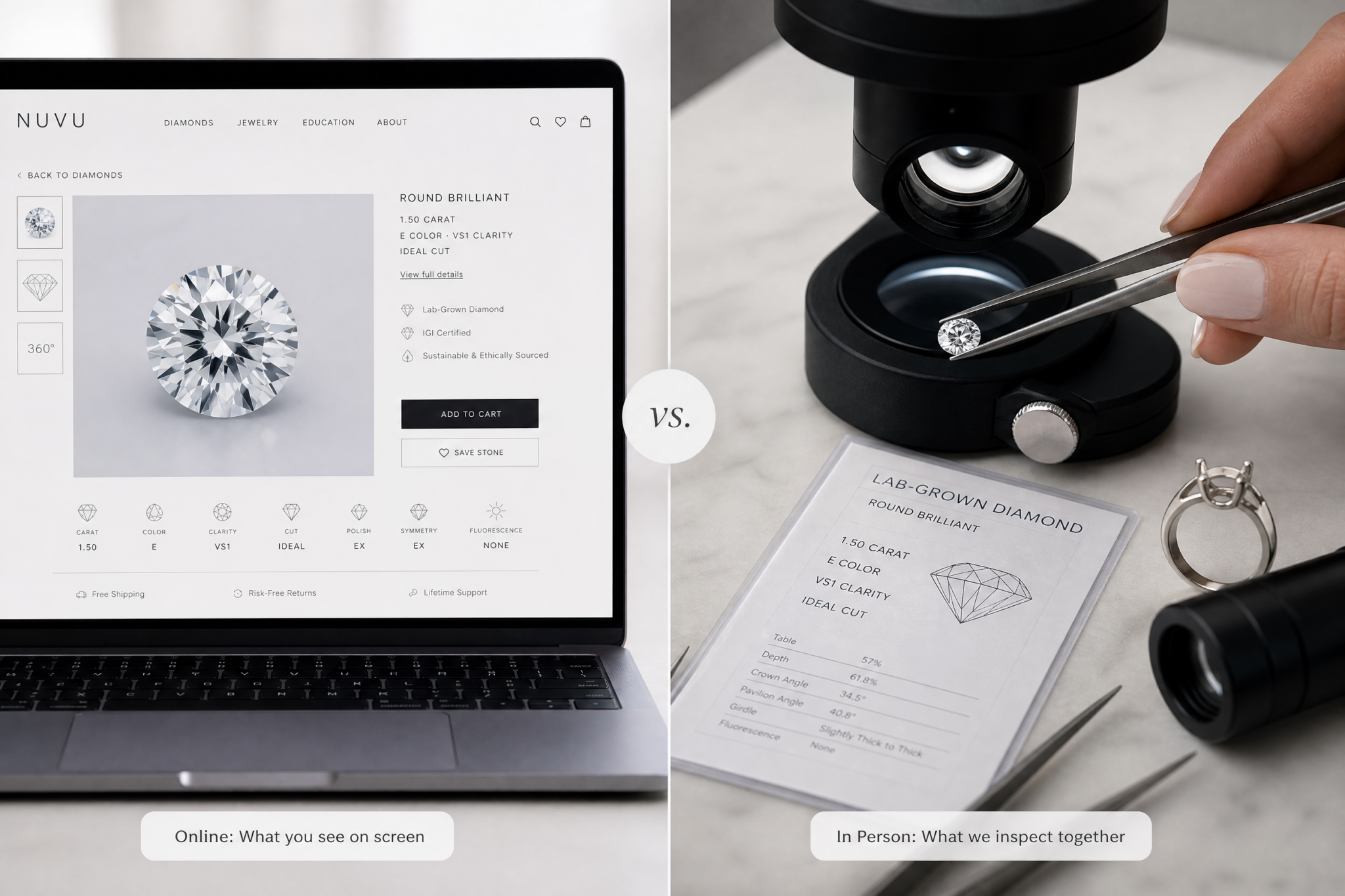
This article gives you a specific question framework organized by category, with what to look for in the answers. Use it as your pre-purchase checklist.
The Information Gap Between In-Store and Online Buying
In a physical store, you can examine a diamond under natural light, compare several stones side by side, and ask questions with the stone in hand. You see inclusions, not just a clarity grade. You see how the diamond performs in different angles, not just a single product photo. Online, you rely entirely on what the seller chooses to show and disclose. That gap creates real risks: overgraded colors that look fine on paper but appear dull in person, hidden inclusions that only show at certain angles, cut proportions that pass the report but underperform visually, and stones that simply do not match the expectations set by the listing. Questions are how you close that gap.
What Real Transparency Looks Like in Practice
Real transparency is specific, documented, and verifiable. It means the seller provides the grading report number before purchase so you can look it up yourself. It means they share a 360-degree video of the actual diamond or high-magnification images that show real surface details, not just a glossy product shot. It means they disclose the growth method — HPHT or CVD — and whether any post-growth treatment was applied. It means the return policy is stated in clear calendar days, not vague phrases like “we want you to be happy.” Vague claims about “ethical sourcing” or “quality guaranteed” without supporting documentation are not transparency. They are marketing language designed to stop you from asking more questions.
What a Good Seller’s Response Pattern Tells You
A reliable online seller responds with specific numbers, document references, and policy details. They do not deflect. They do not say “we can discuss that after you order.” When you ask for the report number, they provide it. When you ask about the growth method, they tell you. When you ask about return policy, they state the exact number of days and any conditions. A less reliable seller responds with general reassurance, tells you not to worry, or asks you to proceed and sort out details later. The pattern of responsiveness itself is a signal. A seller who answers clearly and specifically is treating the purchase as a transparent transaction. A seller who avoids specifics is managing your expectations for a reason.
For the buyer, it is useful to remember that a responsive seller is demonstrating a pattern of transparency, not just making a one-time promise. The way they handle your pre-purchase questions often predicts how they will handle any post-purchase issues.
Questions About the Diamond Itself — Stone Identity and Visual Confirmation
Before you hand over money, you need to confirm that the diamond in the listing is the diamond you will actually receive. The only reliable way to do that is through documentation and visuals that tie the stone to a specific identity.
The Role of Official Grading Reports in Buyer Verification
The primary document for establishing a diamond’s identity is its grading report. Official organizations such as the Gemological Institute of America (GIA) and the International Gemological Institute (IGI) issue reports for lab-grown diamonds that document the 4Cs — carat weight, color, clarity, and cut grade — along with the growth method and any notable characteristics. GIA explains that its laboratory-grown diamond reports include the same 4Cs used for natural diamonds, providing an objective assessment of quality. The report number serves as the stone’s unique identifier, linking the physical diamond to its documented specifications. A buyer who can verify this number on the issuer’s website gains a layer of protection against misrepresentation, because the report provides an independent snapshot of the stone’s characteristics before it entered the seller’s inventory.
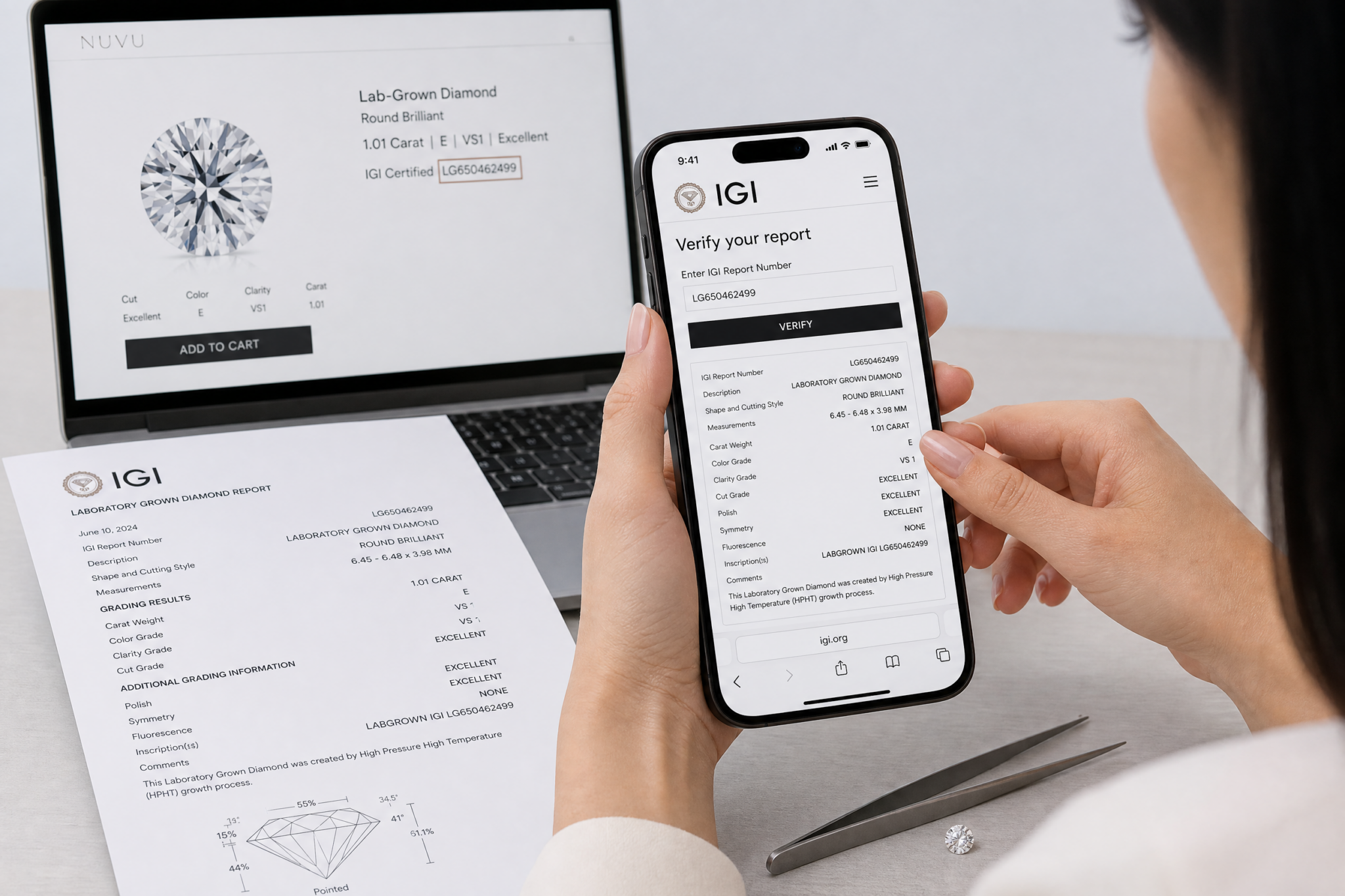
This is the single most important question you can ask. A reputable seller should provide the grading report number — typically from IGI, GIA, or GCAL — before any payment is made. With that number, you can go directly to the lab’s website, pull up the full report, and verify that the carat weight, color, clarity, and cut grade match what the seller listed. You can also check for any laser inscription details and treatment notations. If a seller refuses to share the report number until after purchase, that is not a policy worth respecting. It prevents you from independently verifying the stone and effectively locks you into the sale before you have the facts.
Do You Provide a 360-Degree Video or High-Magnification Images?
A single photo does not tell you enough. A 360-degree video lets you see how the diamond performs under movement — how light travels through the crown, where the dark zones fall, and whether the stone shows balanced brightness across all angles. High-magnification images at 10x to 20x reveal surface clarity, facet alignment, and any visible inclusions that might not be obvious from a standard photo. You should also ask whether the video is of the actual diamond you are buying or a stock representation. Some sellers use a “representative” video of a stone with similar specs. If that is clearly labeled, it is acceptable, but the better practice is to request visuals of your specific stone before committing.
Understanding How HPHT and CVD Growth Methods Are Documented
The two primary methods for producing lab-grown diamonds — High Pressure High Temperature (HPHT) and Chemical Vapor Deposition (CVD) — both create diamonds with the same crystal structure and optical properties as natural diamonds. GIA explains that HPHT replicates the high-temperature, high-pressure conditions under which natural diamonds form, while CVD uses a gas mixture in a vacuum chamber to deposit diamond material layer by layer. Each method can produce diamonds of different quality ranges, and some stones may undergo post-growth treatment to improve color. The grading report typically notes the growth method under “Comments” or “Origin” and will indicate if treatment was applied. When a seller discloses these details, it allows the buyer to better understand what the report says about the stone’s manufacturing history, which is a standard expectation for responsible advertising in the jewelry trade.
What Growth Method Was Used — HPHT or CVD?
HPHT (High Pressure High Temperature) and CVD (Chemical Vapor Deposition) produce different growth characteristics that matter beyond the production process. CVD stones sometimes require post-growth treatment to improve color, and that treatment should be disclosed. HPHT stones can retain trace metal inclusions from the growth chamber, which may cause magnetic interference in certain settings — a relevant consideration if you plan to wear the diamond in a ring that will be near medical devices or metal-detecting security systems. Neither method is inherently better or worse for a buyer, but the method affects long-term appearance and care. If a seller cannot or will not state the growth method, treat it as a red flag. They may not be tracking important details about their own inventory.
Is the Diamond Treated or Enhanced in Any Way?
Most lab-grown diamonds do not require post-growth treatment beyond standard annealing. But some lower-color CVD stones undergo HPHT color enhancement to raise their grade. This treatment must be disclosed on the grading report, typically in the comments section. You should ask explicitly and then verify the report yourself. A seller who is upfront about treatment is signaling that they handle their documentation carefully. A seller who hesitates or offers vague language may be hoping you do not read the fine print.
What to Check Before You Decide
Verify the grading report number on the lab’s official website before you pay. Confirm that all 4Cs match the listing. Ask whether any images or videos are of the actual stone you are buying. Confirm the growth method and whether any post-growth treatment was applied. For CVD stones specifically, ask about color consistency and whether HPHT enhancement was used.
Why Traceability of the Stone’s Origin and Chain of Custody Matters
In addition to confirming the grading report and growth method, buyers should also consider the broader traceability of the diamond. Understanding the distinction between traceability vs certification provides important context, as traceability refers to the documented path of the stone from its growth in a laboratory through to the point of sale. While lab-grown diamonds do not carry the same sourcing concerns as mined diamonds, a seller who can describe their supply chain — from the manufacturer to the grading laboratory to their own inventory — demonstrates a higher level of operational diligence. Ask whether the seller sources directly from accredited growers or through intermediaries. A direct relationship with a known producer often translates into better documentation and fewer opportunities for information loss. For the buyer, a seller who provides clarity on how the stone entered their inventory is also more likely to maintain accurate records on its specifications, treatment history, and grading timeline.
A seller’s willingness to discuss their upstream sourcing and chain of custody is a practical proxy for how well they maintain records on the stone itself. If a seller cannot describe where the diamond came from or how it reached them, it is reasonable to question the accuracy of the other details they provide.
Questions About Certification and Report Matching
A grading report is your primary document for verifying what you are buying. But reports have limits, and not every report is equally useful. You need to confirm that the report matches the stone and understand what the report actually proves — and what it does not.
Which Lab Certified This Diamond, and Does Your Guarantee Cover Report Accuracy?
The most common labs for lab-grown diamonds are IGI, GIA, GCAL, and HRD. Each lab applies slightly different grading standards, and buyers should know which one graded their stone. You should also ask whether the seller stands behind the report. Some sellers offer a secondary verification if the stone was graded by a less recognized lab. Before you rely on any report, check whether the lab has a verification page for lab-grown diamond reports — both GIA and IGI do. If the lab does not offer online verification for the report type you are shown, your ability to independently confirm the stone’s specs is limited.
Does the Diamond Have a Laser Inscription, and Can You Confirm It Matches the Report?
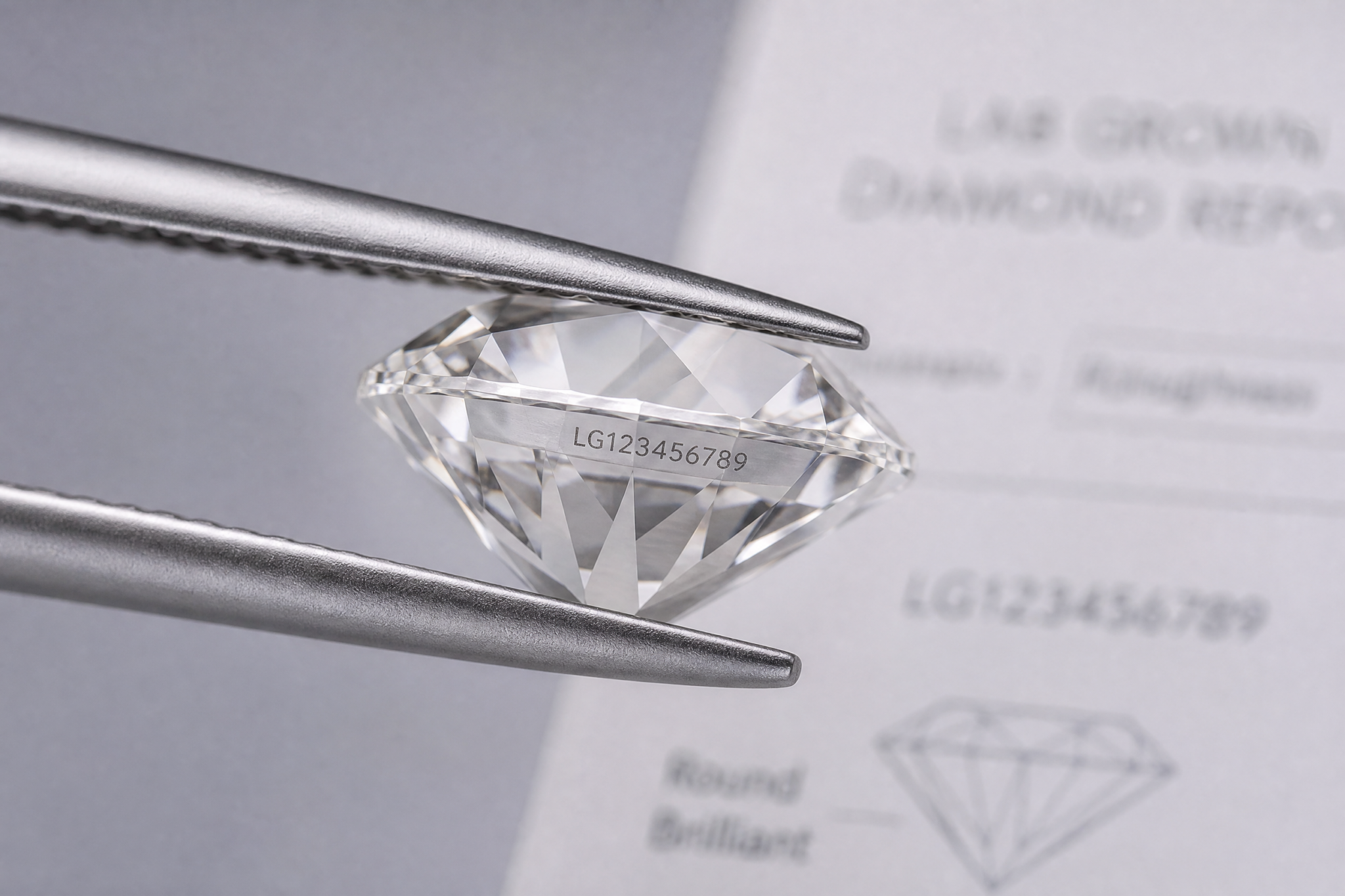
Most certified lab-grown diamonds have a laser-inscribed girdle showing the report number. This inscription is your physical link between the stone and the paperwork. Ask the seller whether they can confirm the inscription matches the report number before shipping. Some sellers will provide a photograph of the inscribed girdle under magnification, which gives you direct visual proof. If the stone has no inscription, ask how the stone will be identified later. This becomes especially important if you plan to set the diamond into a ring, because once the stone is mounted, the girdle becomes inaccessible and visual identification becomes difficult.
What Is the Report Date — and Why Does It Matter?
A grading report dated within the past 12 months is typical for newly released lab-grown diamonds. An older report date may indicate a stone that has been sitting in inventory for some time. While this does not affect the diamond’s physical quality, it is worth asking whether the seller has re-evaluated the stone since the original report. Grading standards have evolved at some labs, and a stone graded under older criteria may not receive the same grade if evaluated today. This is not always a problem, but it is a detail worth knowing before you buy.
Certificate and Visual Review Check
Confirm the report number and verify it on the lab’s website before purchase. Ask for a photo of the laser inscription showing the report number matches. Confirm whether the report was issued before or after any post-growth treatment. If the stone will be set, ask whether the inscription is on the girdle or elsewhere — and whether it will remain visible after mounting.
Keep in mind that a grading report documents specific characteristics under controlled conditions, but it does not capture every visual impression a buyer will see in person. The report is a starting point for evaluation, not a complete substitute for your own inspection under varied lighting.
When a grading report is available, buyers should verify the report details through the issuing laboratory’s official report-check tool where available. This step ensures that the document you are shown matches the lab’s own record for that specific stone, independent of what the seller has stated.
Questions About Setting, Custom Work, and Stone Compatibility
A diamond that looks beautiful in a video can turn into a problem when it does not fit the setting you chose. Carat weight alone tells you nothing about physical compatibility. You need the exact measurements and a clear understanding of how the stone and setting work together.
What Are the Exact Measurements — Not Just Carat Weight?
Carat weight is a measure of mass, not size. Two diamonds of the same carat weight can have different diameters and depths depending on how they were cut. You need the exact dimensions in millimeters: length, width, and depth. For a 1-carat round brilliant, the diameter should be approximately 6.3 to 6.5 mm. A 1-carat princess cut may measure 5.0 to 5.5 mm square. Compare these measurements against the setting’s prong spacing or bezel specifications. A stone that is too large will not seat properly. A stone that is too small may sit loosely or require custom modifications that add cost.
Do You Offer Setting Compatibility Checks Before I Commit?
Some sellers will verify whether a loose diamond fits a specific setting before you commit to both purchases. This check typically involves comparing the stone’s dimensions against the setting’s head size, assessing prong placement, and confirming that the stone’s depth and pavilion angle do not interfere with the setting structure. Ask whether this check is included in the purchase process or whether it requires a separate custom design consultation. A seller who offers this service is saving you from an expensive post-purchase surprise.
What Is the Process for Custom Design or Setting a Loose Stone?
If you plan to set the diamond into a custom ring, necklace, or earrings, ask about the timeline and communication process before you commit. Key questions include: How many design revisions are included in the quoted price? Do you receive CAD renderings before the piece is cast? What is the typical lead time from CAD approval to finished jewelry? Is the stone insured while it is in the workshop? The answers to these questions tell you how structured the process is and whether you will have control over the final result.
Can You Confirm the Stone Will Be Safe for the Setting I Want?
Not every diamond shape works well in every setting style. Princess cuts and marquise cuts have pointed corners that are vulnerable to chipping if the setting does not protect them properly. Step cuts like emerald and asscher show inclusions more readily, so clarity becomes more important. Ask the seller whether your chosen shape, carat weight, and setting type are compatible. A reliable seller will flag potential issues before you proceed, not after you discover them yourself.
Stone-to-Setting Fit Check
Request exact millimeter measurements, not just carat weight. Ask whether the seller will verify stone-to-setting compatibility before you pay. For custom work, confirm the number of CAD revisions included and the typical turnaround. If you are setting a fragile shape like a princess, marquise, or pear, ask about protective setting options such as bezel or cathedral mounts.
Documentation and Communication for Custom Design Fit
For custom design, trust comes from matching the stone to the setting, budget, and wearer’s daily use—not from choosing grades in isolation. When discussing a custom piece with a seller, ask them to confirm in writing the stone’s exact measurements against the head size of the proposed setting. Ask whether the setting will be cast around the stone or hand-fabricated to fit it. A seller who provides detailed written confirmation of this fit, including any clearance or depth allowances, is giving you traceable documentation that protects you if the piece does not assemble as planned. This written record is as important as the grading report itself for custom work, because it establishes the seller’s own specifications for the finished product.
Questions About Shipping, Insurance, Return Policy, and After-Sales Support
The transaction does not end when you click pay. How the seller handles delivery, returns, and long-term support tells you as much about their operation as the diamond listing itself. These questions separate sellers who stand behind their product from those who make it difficult to walk away.
How Is the Diamond Packaged and Shipped, and Is It Insured?
A reputable seller ships lab-grown diamonds through fully insured carriers such as FedEx or UPS, often using specialized logistics with chain-of-custody tracking. The stone should arrive in a tamper-evident container accompanied by the original grading report and any supporting documentation. Confirm that the shipment is insured for the full purchase value, not a nominal amount that would leave you undercompensated if the package is lost or damaged. Many sellers require a signature at delivery, which protects you from porch theft. If the seller offers uninsured standard shipping or cannot explain their packaging process, that is a warning sign.
What Is Your Return Policy — Exactly How Many Days Do I Have, and What Conditions Apply?
Return policies for lab-grown diamonds vary significantly. A reasonable policy offers at least 30 days from delivery, with the stone returned in its original condition and packaging. Do not assume the window starts when the package arrives — some sellers count from the date of shipment, which can cut your inspection time by several days. Ask specifically whether return shipping is covered, whether a restocking fee applies, and what condition requirements are enforced. Some sellers charge 10–15 percent restocking fees, which can turn a normal return into an expensive mistake. For custom designs, the return policy is often different or nonexistent, so ask before you approve any custom work.
What Happens If the Diamond Looks Different in Person Than in Photos or Video?
Lighting, camera settings, and screen calibration can alter how a diamond appears online. A stone that looked warm and bright on your monitor may appear cooler or darker under natural light. This is not necessarily a grading error — it is a limitation of digital representation. Ask the seller how they handle color or clarity discrepancies that fall within the grading report but still differ from your expectations. A transparent seller will acknowledge this possibility and clarify whether their return policy covers visual dissatisfaction, not just certificate errors. If the seller insists that their imagery is always accurate and offers no recourse for differences in appearance, proceed with caution.
What After-Sales Support Do You Offer — Resizing, Repairs, Future Trade-Ins?
Post-purchase support is rarely highlighted in product descriptions, yet it adds significant long-term value. Ask whether the seller offers one free resizing within a certain period, what the warranty covers on the setting, and whether there is a trade-in or upgrade program for lab-grown diamonds. Some sellers provide lifetime cleaning, inspection, or rhodium plating for white gold settings. These services indicate that the seller expects a long relationship with their customers, not just a one-time transaction. If the seller cannot describe any after-sales support beyond the return window, factor that into your comparison.
What This Means in a Real Purchase
Confirm the return window in calendar days and ask whether it starts at shipment or delivery. Ask about restocking fees, return shipping costs, and the condition required for acceptance. Inquire specifically whether the return policy covers visual dissatisfaction or only grading errors. Ask about resizing, warranty coverage, and trade-in programs before you buy, because these terms are much easier to negotiate upfront than after delivery.
Red Flags to Watch For — What Answers Should Make You Hesitate
Not all responses are equally reliable. Some answers signal a seller who is cutting corners, hiding information, or simply not taking the transaction seriously. Recognizing these patterns early saves you time and potential frustration.
This is the most common and most serious red flag in online diamond buying. A legitimate seller has no reason to hide the grading report before payment, since transparency throughout the lab grown diamond supply chain depends on verifiable documentation at every stage. Withholding it prevents you from verifying the stone independently and effectively locks you into the transaction before you have the information needed to evaluate it. Treat this as a non-negotiable requirement. If a seller refuses to provide the report number upfront, move on.
“We Use Only the Best-Graded Stones” Without Specifics
Generic quality claims without report numbers, measurements, or visual evidence are meaningless in a purchase of this value. Phrases like “top quality,” “eye-clean,” or “excellent cut” without corresponding grading report data are subjective descriptions, not verifiable facts. A transparent seller lets the documentation speak. If the seller cannot translate their quality claims into specific numbers and certificate details, they are relying on language that cannot be verified after purchase.
“All Our Stones Are Conflict-Free” in a Lab-Grown Context
Lab-grown diamonds are inherently conflict-free by production method. A seller who emphasizes “conflict-free” as a distinguishing claim for lab-grown stones is either using irrelevant marketing language or trying to distract from other areas where transparency is lacking. This phrasing is common on sites that sell both natural and lab-grown diamonds without clear separation. Instead of accepting this as a meaningful answer, ask about growth method, treatment history, and grading lab — the areas that actually matter for your purchase.
“We Can’t Tell You the Growth Method Because We Don’t Track It”
This response suggests the seller does not maintain documented traceability on their inventory, which is a significant concern for lab-grown diamonds. Knowing the growth method matters for long-term care and setting compatibility. HPHT stones can contain trace magnetic inclusions from the metal flux, which may interfere with certain jewelry settings and should be noted for future service work. CVD stones may have undergone post-growth color enhancement, which affects long-term stability. If the seller cannot state the method, ask specifically why they do not track it — and consider what else they also may not track.
It is also worth noting that a seller who does not track growth method may also lack detailed records on other specifications, such as exact proportions or treatment history. A pattern of missing data points is itself a meaningful signal about the seller’s operational diligence.
Buyer Verification Checklist
If a seller refuses to share the grading report before purchase, walk away. If quality claims are made without supporting documentation, request specifics in writing. If the seller uses “conflict-free” as a differentiator for lab-grown, redirect the conversation toward growth method and treatment disclosure. If the seller cannot state the growth method, ask why that information is not tracked and what other specifications may also be undocumented.
How Classification and Terminology Standards Affect Your Purchase
The language used to describe lab-grown diamonds in online listings is not just a marketing choice — it is shaped by official guidelines that establish how these products should be presented to buyers. The Federal Trade Commission (FTC) has issued guidance on jewelry advertising that covers terminology for lab-grown diamonds, specifically noting that terms like “cultured” or “eco-friendly” for lab-grown diamonds may create confusion about the nature of the product. The FTC’s guidance is rooted in consumer protection, aiming to ensure that advertising does not mislead buyers about whether a diamond is mined or laboratory-created. For online buyers, this means a seller who uses precise, straightforward language — stating “laboratory-grown,” “HPHT,” or “CVD” — is more likely to be following sound advertising practices. A seller who relies on vague terms such as “eco-conscious” or “sustainable” without connecting them to a specific growth method or production standard may be making claims that are difficult to substantiate. Asking directly about growth method and treatment disclosure, rather than accepting broad characterizations, gives you a clearer picture of the stone’s manufacture.
Sustainability Claims: What to Look For and What to Question
As lab-grown diamonds become more widely marketed, sustainability claims have become a common differentiator for sellers. However, not all claims are equally substantiated. Buyers should distinguish between specific, documented environmental information and broad, unverifiable assertions. A seller who states the energy source used in their production, such as “grown using 100% renewable energy,” provides a verifiable claim that can be checked against their own documentation. A seller who simply labels a stone “eco-friendly” or “sustainable” without specifying what that means offers little that a buyer can independently confirm. Sustainability claims should be specific and documented. Broad green language is less useful than clear information about production, energy, sourcing, and seller transparency. For the buyer, the most practical approach is to ask for specifics: What energy source is used? Is there any third-party verification of the claim? What does “sustainable” mean in the context of this specific stone? If the seller cannot answer these questions with concrete details, the claim is not providing useful information for your decision.
How to Organize Your Questions Before Contacting a Seller
Having the right questions is only half the work. How you organize and track them determines whether you make a confident decision or get lost in a stack of email threads. A structured approach turns a scattered inquiry process into a clear comparison.
One Email, Five Categories — What to Send in Your First Inquiry
Rather than sending questions one at a time across multiple messages, consolidate everything into a single structured inquiry covering five categories: stone confirmation (report number, video of the actual stone), certification (grading lab, laser inscription, treatment status), measurements (exact dimensions in millimeters, not just carat weight), policies (return window, restocking fee, insurance coverage), and after-sales support (warranty, resizing, trade-in options). A single organized email signals to the seller that you are an informed buyer who expects clear, complete answers. Sellers who respond promptly and specifically to a well-structured inquiry are generally more reliable than those who answer selectively or ask you to call instead.
What to Track in a Seller Comparison Spreadsheet
If you are comparing multiple stones or sellers, do not rely on memory. Create a simple spreadsheet with columns for seller name, stone SKU, grading report number, growth method, video availability, millimeter measurements, return window in days, restocking fee percentage, whether resizing is included, and your overall assessment of response quality. This turns subjective impressions — “this seller seemed nice” — into comparable data. The spreadsheet also reveals patterns. A seller who cannot answer half your questions within 24 hours is very different from one who provides complete answers within the same day.
When to Walk Away and When to Commit
The decision framework is straightforward. Commit when the seller has answered all your questions clearly, specifically, and in writing. The answers should include verifiable information such as report numbers, measurements, and policy timelines. Walk away if the seller deflects, withholds information until after payment, offers vague reassurances without documentation, or cannot provide growth method or treatment disclosure. The presence of clear, documented answers matters more than getting the lowest price. A diamond bought at a slight premium from a transparent seller is almost always a better purchase than one bought at a discount from a seller who avoids questions.
Frequently Asked Questions About Buying Lab-Grown Diamonds Online
Even with a clear question list in hand, practical concerns still come up once you start the process. Here are the most common follow-up questions online buyers ask — and the answers that help you move forward with confidence.
Can I Trust a Diamond Video From an Online Seller?
You can trust videos that show the actual diamond under controlled, consistent lighting — ideally a 360-degree view that lets you see brightness, fire, and scintillation from every angle. What warrants caution is low-resolution footage, videos shot in direct sunlight (which makes every stone look brilliant), or clips that are clearly generic and reused across multiple listings. A straightforward fix: ask the seller to confirm in writing that the video is of your specific stone, not a representative sample. If they hesitate or dodge, that is itself an answer.
What If the Diamond Looks Different in Person Than the Video Showed?
This is exactly why the return policy matters more than the video quality. A seller with a fair return window — typically 30 days from delivery with no restocking fee — gives you the room to inspect the stone under natural light, compare it against expectations, and make a final decision without pressure. Plan to examine the diamond within the first few days after delivery. If the stone does not meet what the video or images suggested, initiate the return promptly. A seller who stands behind their product will not penalize you for exercising that option.
Should I Buy a Loose Diamond Before Choosing a Setting?
Yes, for two practical reasons. First, the diamond is the highest-value component of any jewelry piece. You want to confirm that the stone itself meets your standards — color, clarity, cut performance, and overall appearance — before committing to a setting that cannot be returned as easily. Second, having the stone’s exact millimeter measurements allows the jeweler to build the setting around the diamond, ensuring a precise fit for the prongs, basket, or bezel. Buying the setting first and then trying to find a stone that fits is a much more constrained process.
Do I Need to Get the Diamond Appraised After Purchase?
For insurance purposes, yes. Even though the diamond comes with a grading report from a recognized lab, most insurance companies require an independent appraisal within 30 to 60 days of purchase to establish a replacement value. The appraisal should document the stone’s exact measurements, report number, 4Cs, growth method, and estimated replacement cost. Some sellers offer appraisal services or can recommend independent appraisers. This step is not about questioning the certificate — it is about protecting your coverage if the stone is ever lost, stolen, or damaged.
When working with an appraiser, it helps to provide them with the original grading report and any documentation from the seller about the growth method. This creates a clear chain of information and helps the appraiser produce a more accurate insurance valuation.
How Can I Ensure the Seller’s Documentation Matches the Stone I Receive?
The most reliable way to ensure a match is to verify the laser inscription on the girdle against the grading report number as soon as you receive the diamond. A 10x loupe is sufficient to read the inscription on most lab-grown diamonds. If you do not own a loupe, many jewelers or appraisers can verify this for you at minimal cost. Compare the inscribed number directly with the report number from the grading document. If they match, the stone’s identity is confirmed. If they do not match, or if the stone has no inscription when the report states one should be present, contact the seller immediately and do not accept the stone. This physical verification step is the most direct way to close the traceability loop between documentation and the physical product.
[1] GIA, “How to Buy a Lab-Grown Diamond,” Gemological Institute of America, accessed through knowledge base. Information on report content for laboratory-grown diamonds, including the 4Cs, growth method documentation, and post-growth treatment notations.
[2] Federal Trade Commission, “Guides for the Jewelry, Precious Metals, and Pewter Industries: Advertising and Marketing,” FTC, 2024 update. Guidance on terminology for laboratory-grown diamonds, including disclosure expectations and cautions about vague claims such as “cultured” or “eco-friendly.”
[3] GIA, “HPHT and CVD Diamond Growth Processes,” Gemological Institute of America, accessed through knowledge base. Explanation of the two primary methods for producing laboratory-grown diamonds and their respective characteristics.
Disclosure: This article is for general educational purposes only. Diamond grading, pricing, availability, specifications, and seller policies can change, and readers should verify important details through grading reports, official laboratory tools, seller documentation, or qualified professionals before making a purchase decision. Laboratory-grown diamonds should be clearly distinguished from natural diamonds, and environmental or sourcing claims should be supported by specific documentation. A grading report helps document key characteristics, but it should not be treated as a guarantee of beauty, value, or sourcing ethics.