
When shopping for a lab-grown diamond, two terms often get used interchangeably: certification and traceability. But they are not the same thing, and confusing them can lead to assumptions about a stone’s origin that simply aren’t supported by the paperwork you’re holding. A grading certificate tells you about a diamond’s quality, but it almost never tells you where it came from. Traceability, on the other hand, documents the chain of custody from the growth lab to your finger—but not all traceability systems are created equal. This article clarifies the difference between these two documents, addresses essential transparency questions to consider, and gives you a practical framework for deciding which level of documentation matters most for your purchase.
For the full framework, read Lab-Grown Diamond Traceability, Certification, and Transparency Guide.
| Document Type | What It Confirms | What It Does Not Confirm |
|---|---|---|
| Grading Certificate (IGI, GIA, etc.) | 4Cs quality (carat, cut, color, clarity) and verifies the diamond is laboratory-grown | Growth method (CVD vs. HPHT), specific manufacturing facility, or supply chain path |
| Basic Traceability Record | Facility of origin and general growth method (internal batch records) | Detailed energy sources, full chain-of-custody, or independent third-party verification |
| Digital Passport | Unique inscribed code linking to online batch data including growth parameters | Immutability of records if stored on a centralized server susceptible to alteration |
| Blockchain Traceability | Immutable, timestamped records throughout the supply chain | Guaranteed accuracy of data entered at each step; honesty of input is still required |
| Certification + No Traceability | Trustworthy quality assessment at a lower cost | Any assurance of origin, manufacturing ethics, or supply chain transparency |
| Full Traceability + Certification | Maximum confidence in both quality and documented origin | Lower price point; typically commands a premium for the added verification |
Quick Questions Before You Read
Q: Does a grading report like IGI or GIA automatically include traceability information?
No. Standard grading reports for lab-grown diamonds verify the 4Cs and confirm the diamond is laboratory-grown, but they do not document the specific growth facility, batch, or supply chain path.
Q: Is a diamond with full traceability always a better choice than one with just a certificate?
Not necessarily. If visual quality and price are your top priorities, a well-graded stone with limited origin data can offer better value. Full traceability is most important if supply chain transparency is a key concern for you.
Q: Can I trust a lab-grown diamond’s “origin” claim if it only has a certificate and no separate traceability document?
You can trust that the diamond is lab-grown as certified, but you have no verified record of which specific laboratory grew it or how it moved through the supply chain. The certificate alone does not prove origin.
Q: Does blockchain traceability guarantee the diamond’s entire history is accurate?
Blockchain makes records immutable once entered, but it still relies on honest data input at each step. It prevents tampering, not misinformation.
Lab-Grown Diamond Traceability vs Certification: What Is the Difference?
Two terms get tangled in nearly every lab-grown diamond conversation: certification and traceability. Most buyers assume they mean the same thing. They do not. And confusing them can lead to a purchase that feels complete on paper but leaves a real question unanswered: where did this stone actually come from?
Certification answers one question: what are the measurable qualities of this diamond? Traceability answers a different one: where was this diamond produced, and how did it move through the supply chain? One is about grading. The other is about origin and documentation. A diamond can have an excellent grading report and an entirely unknown production history. Understanding the difference is the first step toward buying with real confidence.
The Distinction Rooted in Industry Practice
This separation between grading and origin documentation is not a subtle technicality — it is embedded in how major gemological laboratories define their services. The Gemological Institute of America (GIA) makes this clear in its educational materials: a grading report identifies the 4Cs and confirms whether a diamond is laboratory-grown, but it does not track the stone’s production facility or manufacturing batch.[1] Similarly, the International Gemological Institute (IGI) issues grading reports that describe quality characteristics and disclose the lab-grown nature of a stone, without extending to supply chain documentation.[2] A buyer who looks at an IGI or GIA report for traceability information is looking at the wrong document entirely. The report accomplishes exactly what it is designed to do — nothing more, and crucially, nothing less.
The Federal Trade Commission (FTC) in its Jewelry Guides further reinforces this boundary. The FTC requires that lab-grown diamonds be clearly disclosed as such in advertising and labeling, to prevent consumer confusion with natural diamonds.[3] But disclosure of origin type — “laboratory-grown” versus “natural” — is not the same as traceability. Knowing that a diamond is laboratory-grown does not tell a buyer which facility grew it, what growth method was used, or how it traveled through the supply chain. The FTC’s guidance addresses truthful advertising and misrepresentation; it does not mandate, nor does it create, a system of batch-level origin documentation. This distinction is precisely why certification and traceability remain separate concepts in practice.
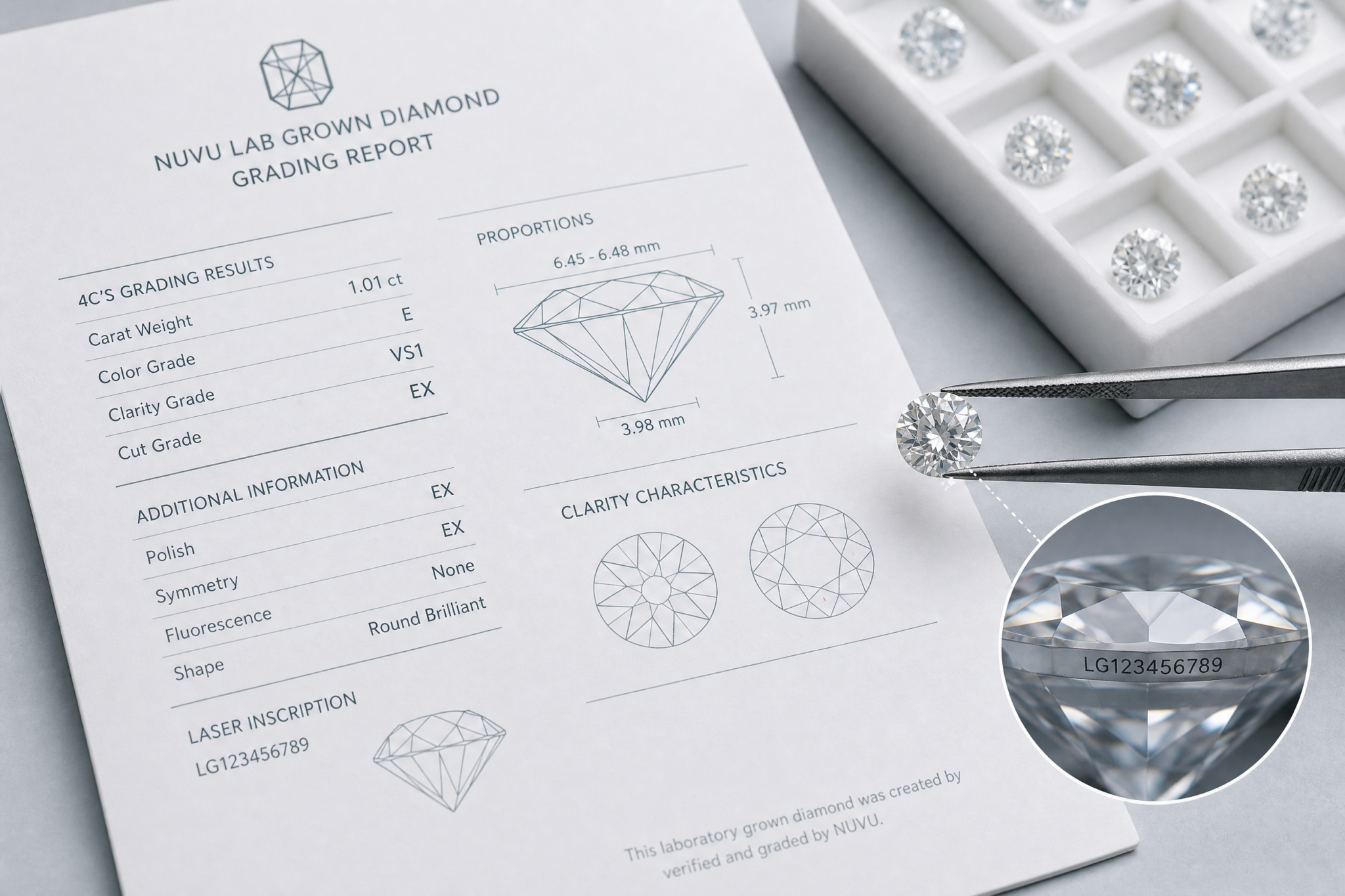
When a grading report is available, buyers should verify the report details through the issuing laboratory’s official report-check tool where available. This step confirms that the document has not been altered, but it does not supply any origin information. A verified grading report is a reliable quality assessment, not a record of production history.
What a Diamond Grading Report Actually Confirms
A grading report from a major laboratory like IGI, GIA, or GCAL serves a specific, limited purpose. It identifies the diamond’s 4Cs — carat weight, color, clarity, and cut — and confirms that the stone is laboratory-grown. That is what it does. What it does not do is often more important.
The report does not track the diamond’s manufacturing batch. It does not record which growth method was used, whether HPHT or CVD. It does not identify the cutting factory or the original growth facility. It does not document any chain-of-custody events after the grading was completed. The grading report is a snapshot of the stone’s characteristics at one moment in time, not a log of its journey through the supply chain.
Many buyers treat a grading report as a complete identity document. It is not. It is a quality assessment and an identification confirmation. Those are valuable functions, but they do not extend backward into the stone’s production history or forward into its handling after grading.
Buyer Verification Checklist
Before purchasing, ask to see the full grading report, not just a summary or a screenshot. Visit the issuing lab’s website and verify the report number against their database. Confirm that the report explicitly states “Laboratory-Grown” or “Lab-Grown” — some older reports or identification cards may not include this language. And most importantly, understand that this report does not prove where or how the diamond was produced. A valid grading report is a necessary starting point, but it is not a complete answer.
What Traceability Actually Means in the Lab-Grown Diamond Context
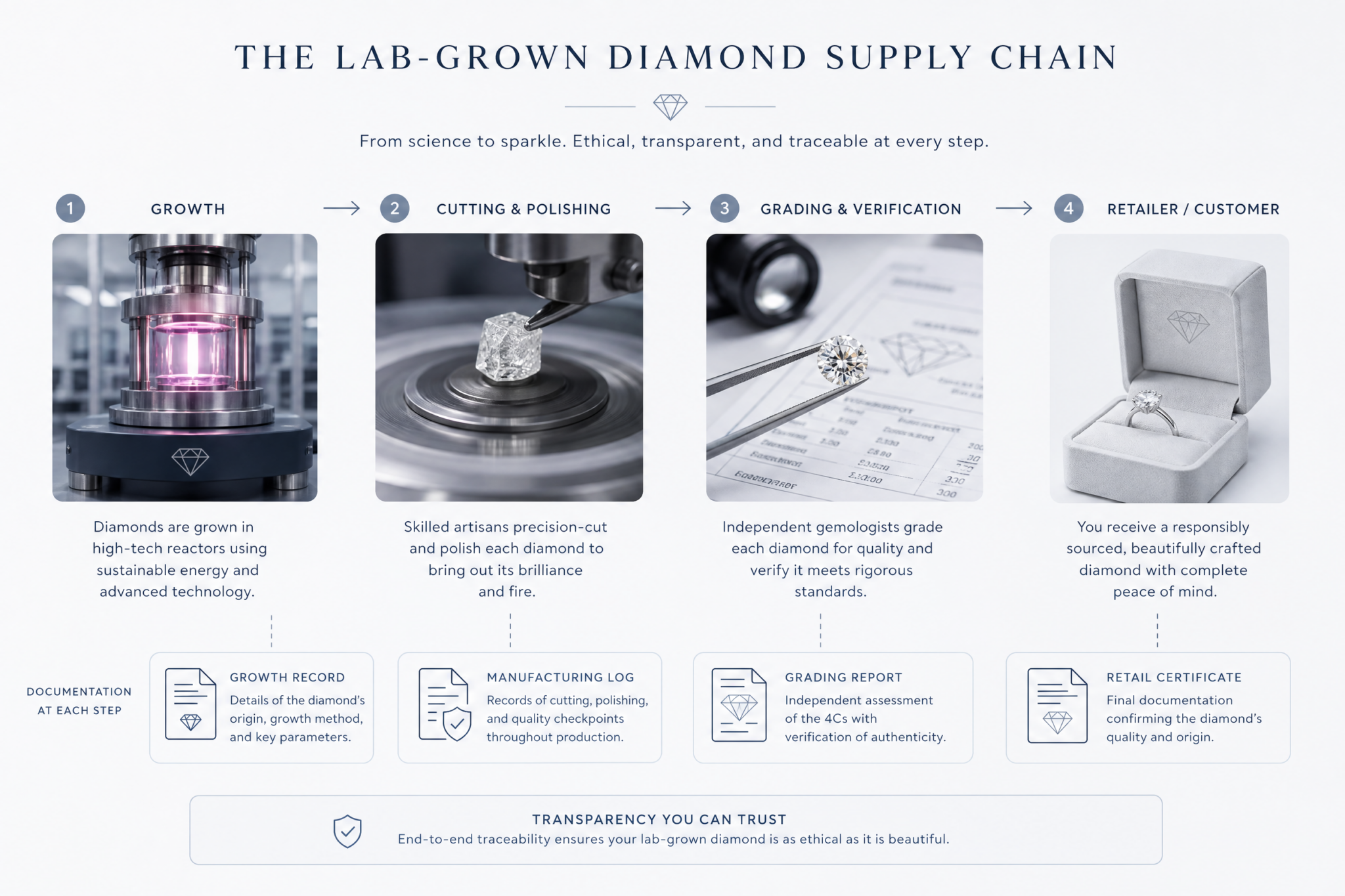
Traceability refers to a documented chain of custody that tracks a diamond from its creation point through every step that follows. This means the growth reactor or facility, the cutting and polishing stage, the grading event, and the final jewelry assembly all leave a verifiable record. It requires a system of digital records, batch IDs, and sometimes blockchain entries or secure QR codes that link each step to a specific source.
The goal is straightforward: a buyer should be able to ask “where was this diamond grown?” and receive a documented answer, not a marketing statement. For a diamond to be truly traceable, there must be a record that connects that specific stone to a specific manufacturing batch and a specific production facility. Anything less is partial traceability, which may still be useful but should be understood clearly.
Traceability is not a single document. It is a documentation system. Some suppliers use digital passports that combine grading data with production records. Others rely on internal batch tracking and supplier questionnaires. The form matters less than the substance. What matters is whether the information exists and whether the buyer can access it.
How to Verify This Before Buying
Ask the seller directly: “Can you show me a record of where this diamond was grown and how it moved through the supply chain?” A seller who can provide a production certificate, a digital passport with batch information, or a secure online record linked to a laser-inscribed code is offering real traceability. A seller who responds by pointing to the grading report alone is not. A truly traceable diamond will have documentation beyond what the grading lab provides. If the only answer is a certificate number, the traceability is incomplete.
The Role of Documentation in Responsible Sourcing
For buyers who are concerned about the production conditions of their diamond, traceability documentation is the primary tool for making informed decisions. A lab grown diamond report confirms the stone’s quality, but it does not reflect how the diamond was grown, what type of energy was used in the facility, or whether the manufacturer followed consistent batch controls. These are questions that only traceability records can address.
It is important to recognize that even the most detailed traceability system has a limitation: the accuracy of the record depends on honest input at each step. A digital passport or blockchain log can show the chain of custody, but it cannot independently verify the conditions inside the growth reactor or the energy source without additional third-party validation. Buyers should approach traceability claims with the same scrutiny they apply to certification — asking for specific documentation rather than accepting general statements. For NUVU, the goal is to make diamond comparison easier to understand, especially when buyers are weighing report details, visual performance, setting fit, and budget together. Traceability adds a layer of information, but it is not a substitute for a careful evaluation of the stone itself.
Where Certification and Traceability Overlap — and Where They Diverge
Both certification and traceability increase buyer confidence, but they serve different purposes. Certification answers the question: what are the quality characteristics of this stone? Traceability answers: where did this stone come from and how was it handled? A buyer who understands both can make a more informed decision. A buyer who conflates them is at risk of assuming transparency that does not exist.
The Overlap: Both Build Buyer Confidence
A buyer who has both a verified grading report and a clear traceability record possesses the highest level of information confidence available in the lab-grown diamond market. The combination allows a buyer to know a stone’s quality, its authenticity, and its origin path. Some forward-looking labs and brands are beginning to offer combined digital passports that include both grading data and production chain records. This integrated approach is still uncommon, but it represents the direction the market is moving. For now, most buyers must seek out these two types of documentation separately.
Where They Do Not Overlap: Origin vs. Quality
The divergence between certification and traceability matters more than their overlap. A standard certification report, even from a top-tier lab like GIA or IGI, does not describe the growth method, the specific reactor type, or the facility location. A diamond with an excellent grading report can have completely opaque origins. Conversely, a stone could have detailed traceability records and a mediocre grading report. One does not guarantee the other.
Documented Boundaries on Terminology and Disclosure
Industry guidance from authoritative sources further clarifies why certification and traceability remain separate functions. The GIA, for example, maintains a detailed educational resource on terminology for laboratory-grown diamonds, noting that terms like “HPHT” and “CVD” refer to specific growth processes — information that is not recorded on a standard grading report.[4] A buyer who wants to know which method was used will not find it on a typical certificate. Meanwhile, the FTC’s Jewelry Guides advise against unsubstantiated environmental or ethical claims in jewelry advertising, reinforcing that any origin-related claim should be specific and documented.[3] This guidance applies directly to traceability claims: a seller who states a stone comes from a specific facility or uses a particular energy source should be able to back that up with verifiable records, not just a grading report.
This distinction is not academic. It has real consequences for a buyer. A diamond that appears identical to another on paper — same cut grade, same color, same clarity — may have been grown in a facility with inconsistent quality control, using an energy source the buyer would prefer to avoid, or mixed into a batch of visually mismatched stones. None of those factors show up on a grading report. Only traceability documentation can reveal them.
Certificate and Visual Review Check
When comparing two lab-grown diamonds with similar 4Cs, use traceability documentation as a tiebreaker. The stone with clearer origin records offers more transparency about its manufacturing history. This is a concrete advantage for a buyer who values supply chain visibility. If both stones have comparable grades and similar prices, the one with documented traceability is the safer choice.
The Impact of Documentation Gaps on Buyer Confidence
When certification and traceability are not both available, the gap in documentation can affect buyer confidence in different ways. A buyer who only has a grading report is relying entirely on the lab’s reputation for quality assessment, with no independent verification of the stone’s production path. This is a reasonable position for many purchases, but it leaves certain questions unanswered. On the other hand, a buyer who only has traceability records but no grading report is relying on the grower’s or supplier’s internal data, without an independent third-party quality check. Neither scenario is ideal, but understanding the specific gap helps the buyer decide which missing piece matters more for their specific needs. In sourcing or wholesale conversations, documentation, consistency, and communication often matter as much as the headline specification.
The Practical Limits of a Grading Report as a Traceability Tool
The most common mistake buyers make is treating a grading report as a complete record. A diamond can have a flawless report and an entirely unknown production history. The grading lab does not investigate where the stone came from. It evaluates the stone in front of it and produces a report based on that evaluation. Everything before and after is outside the report’s scope.
What a Report Cannot Tell You: Growth Facility, Energy Source, and Batch Consistency
The grading process does not test for or record the energy source used during crystal growth. Whether the facility used grid electricity, renewable energy, or a mix is simply not part of the grading evaluation. The report also does not identify the specific CVD reactor model or HPHT press type used to grow the stone. And it does not indicate whether the stone was part of a batch with consistent visual properties.
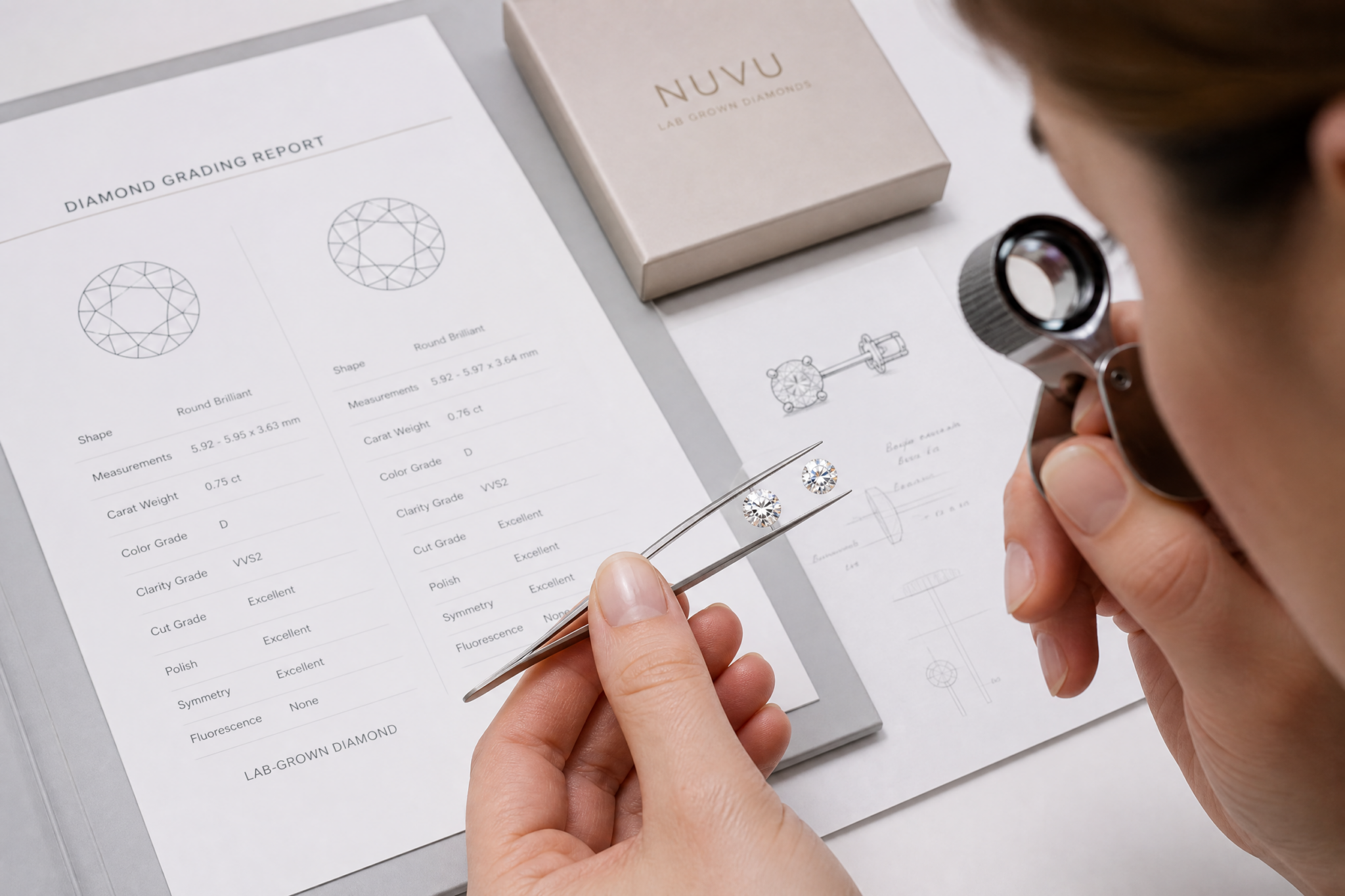
Batch consistency is especially relevant for buyers ordering multiple stones for a single jewelry piece. A pair of earrings or a three-stone ring requires diamonds that match each other in color, clarity, and overall appearance. A grading report confirms that each individual stone meets a certain standard, but it does not confirm that two stones from separate batches will look identical when set side by side. That is a traceability issue, not a certification issue.
Why Some Grading Reports Are Mistaken for Traceability Proof
Many sellers market a stone as “IGI certified” or “GIA certified” and imply that this document alone confirms a full supply chain. This is a framing problem, not a factual one. The report is a quality and identification document. It is not a chain-of-custody record. The confusion arises because certification is the most visible documentation a buyer sees, and it is natural to assume that a document from a trusted lab covers more than it actually does.
This does not mean sellers are being deceptive. Many are simply repeating a common industry shorthand. But the buyer who relies on that shorthand without asking further questions is assuming traceability that may not exist. A grading report and a traceability record are separate documents that serve separate functions. The sooner a buyer treats them as such, the clearer the decision becomes.
Stone-to-Setting Fit Check
If you are purchasing a stone to be set in a custom ring, ask about batch consistency. If the jeweler is sourcing multiple small stones for a pave or halo setting, they should be able to confirm that the diamonds come from the same production batch. This is a traceability question, not a certification question. A grading report for each individual stone does not guarantee visual uniformity. A traceability record that links all stones to the same batch provides that assurance. The difference may seem small, but it can determine whether a finished piece looks cohesive or mismatched.
How Traceability Systems Work in Practice
Every buyer wants the idea of traceability. Fewer know what it actually looks like when they encounter it. The difference between a marketing claim and a real traceability system is whether you can see the documentation, verify the link, and follow the chain from the growth chamber to the finished stone.
The most common implementation is a digital passport. Some suppliers, particularly in China and other major production hubs, now laser-inscribe a unique code onto the diamond’s girdle. That code links to a secure online record that may include the growth batch ID, the cutting facility, quality control checkpoints, and in some cases the type of energy used during production. The most practical delivery method is a QR code printed on the grading report or on a separate certificate. You scan it. You see the record. That is traceability in a usable form.
A smaller but growing number of companies use blockchain-based platforms to log each transfer of a diamond. The theoretical advantage is immutability — entries are timestamped and cannot be altered retroactively. In practice, the system is only as reliable as the person entering the data at each step. A blockchain record of a false origin is still a false origin. The technology strengthens the chain, but it does not verify the first link.
For many commercial lab-grown diamonds, traceability does not involve any advanced technology at all. It is handled through internal batch records, purchase orders, and supplier questionnaires. This method is less glamorous than blockchain, but it can be equally valid if the buyer has direct access to the records and the supplier is transparent about their sourcing. The real test is not whether the system sounds modern. It is whether the documentation exists and can be shared.
It is also worth noting that traceability and certification address different kinds of risk. Certification addresses the risk of misrepresentation — that the stone’s quality or identity is not as claimed. Traceability addresses the risk of unknown origin — that the stone’s production history is a blank space. A buyer who only checks certification is protected from the first risk but not the second. Understanding which risk matters more to you is the core of the decision.
What to Check Before You Decide
Ask the seller what specific traceability method they use. Is there a digital passport? Is a laser-inscribed code present on the stone? Can they provide a written statement about the country of origin and the type of production facility? A seller who cannot answer these questions clearly likely has limited traceability, regardless of how polished their marketing sounds.
How Buyers Should Ask Better Questions Before Purchasing
The difference between a well-informed buyer and a casual one is not how much they read about diamonds. It is whether they know what to ask. The following questions are designed to separate genuine transparency from surface-level claims. They force the seller to go beyond the grading report.
Questions That Test for True Traceability
Start with the most direct question: “Can you tell me the specific country and facility where this diamond was grown?” A seller with real traceability should be able to answer this without hesitation. For buyers seeking to understand the broader lab grown diamond supply chain, follow up with: “Is there a batch number or production record that links this specific stone to a certain manufacturing run?” And: “Do you have a document from the grower or cutter that verifies the chain of custody before the stone was graded?” These questions are not aggressive. They are standard for any buyer who understands that a grading report alone is not a supply chain record.
Questions That Test for Certification Quality
Traceability and certification are separate, so you need separate questions for each. For certification, ask: “Which lab issued the grading report, and is the report number verifiable on their website?” Confirm the report explicitly states the diamond is laboratory-grown with no post-growth treatment. Then ask: “Are the measurements and proportions shown on the report consistent with a high-quality cut?” This distinguishes a buyer who understands grading from one who simply checks for a piece of paper.
Questions to Avoid (They Won’t Help You Differentiate)
Some common buyer questions do not actually narrow down your options. “Is this diamond real?” is unhelpful because all lab-grown diamonds are real diamonds. “Is it good quality?” is too vague to produce a useful answer. “Is it traceable?” is a good starting point, but it must be followed by the specific questions listed above. A yes without documentation is not traceability.
Another question that can mislead is “Is this diamond certified?” It sounds definitive, but it conflates two separate things. If the seller says yes and points to a grading report, you have confirmed certification but not traceability. If the seller says yes and points to a production record, you may have traceability but no independent quality assessment. The buyer’s task is to ask two separate questions and evaluate the answers separately. That is the only way to know what you are actually getting.
Buyer Verification Checklist
Before you commit to a purchase, write down your questions. Keep the grading report and the traceability documentation separate in your evaluation. If a seller says “it’s all in the certificate,” you now know that answer is incomplete. Verify both independently. A stone can pass every certification check and still have an entirely opaque production history.
Why This Distinction Matters for Your Final Diamond Choice
The choice between a certified-only stone and a traceable-certified stone is a real tradeoff. It is not a marketing distinction designed to upsell you. The two options serve different priorities, and the right choice depends entirely on what matters most to you.
The Value of a Fully Traceable Diamond
A stone with documented origin, batch records, and a verifiable production history provides maximum buyer confidence. It allows you to make value judgments about the manufacturing process, not just the final appearance. If you care about energy sourcing, production conditions, or the specific facility where the diamond was grown, a fully traceable stone is the only option that gives you real information.
How the FTC Guidance Shapes the Boundaries of What Can Be Claimed
The FTC’s Jewelry Guides carry practical implications for how traceability claims can be presented to buyers. The guidance advises that environmental or origin claims should be substantiated and not misleading.[3] For a lab-grown diamond with documented traceability, this means the seller should be able to produce specific evidence — not general statements — for any claim about the production facility, energy sources, or manufacturing conditions. A grading report alone does not meet this standard. A buyer who encounters marketing language about “sustainable sourcing” or “responsible production” should ask for the documentation that supports it. If the seller cannot produce batch-level records, the claim is not backed by traceability; it is backed by marketing phrasing only.
This guidance is especially relevant because the FTC has taken action in the past against companies making unsubstantiated claims about diamond origin and environmental benefits.[3] While the guidance does not mandate traceability systems for every lab-grown diamond, it establishes a clear expectation: claims about origin, production, or environmental impact must be truthful and supported. For the buyer, this reinforces the practical difference between a grading report (which documents quality) and traceability documentation (which documents origin). The two are not interchangeable.
When Traceability Claims Should Raise a Question
Sustainability claims should be specific and documented. Broad green language is less useful than clear information about production, energy, sourcing, and seller transparency. A buyer who sees a traceability or sustainability claim should ask: what specific documentation supports this? If the seller offers a general statement about eco-friendly production but cannot point to a batch record, energy source documentation, or a third-party audit, the claim should be treated with caution. This does not mean the diamond is inferior — it simply means the buyer should not assume the claim is verified without evidence. For NUVU, the goal is to make diamond comparison easier to understand, especially when buyers are weighing report details, visual evidence, design fit, and budget together. A transparent claim with supporting documentation is far more useful than a general promise.
The Practical Reality: Most Lab-Grown Diamonds Are Not Fully Traceable
The majority of commercially available lab-grown diamonds have excellent grading reports but limited traceability. The supply chain frequently blends stones from multiple growers and cutters before they reach a retailer. This does not make the stone inferior. It simply means you are relying on the grading report and the seller’s reputation rather than a complete origin record. For many buyers, that is entirely acceptable.
How to Match Your Choice to Your Priorities
If maximum transparency is your primary value, seek out brands that invest in digital passports and verified production chains. Be prepared to pay for that documentation effort. If your priority is the best visual quality for a specific budget, a well-graded stone with only basic origin documentation can still be an excellent purchase. The key is knowing the difference and choosing intentionally, not assuming that one option is universally better.
It is also useful to recognize that traceability adds the most value when the buyer intends to ask specific questions about production. If your goal is simply to own a beautiful diamond with verified quality, a strong grading report may be all you need. But if you want to know how it was made, where it was grown, and how it arrived at the retailer, traceability is not optional — it is the only way to get those answers. The choice is not about which document is better. It is about which questions you need answered.
What to Check Before You Decide
Align your final decision with your actual priorities. If traceability is a must, do not settle for a seller who only offers a grading report. If visual quality and price are paramount, a strong grading report from a reputable lab may be sufficient. Understand the tradeoff, make a clear choice, and move forward with confidence.
Custom Design and Setting Fit Considerations
For custom design, trust comes from matching the stone to the setting, budget, and wearer’s daily use—not from choosing grades in isolation. When traceability is a concern for a custom piece, the buyer should ensure that any multiple stones come from the same batch to guarantee visual consistency. A grading report for each stone is necessary but not sufficient for this purpose. Buyers should ask the jeweler for traceability documentation that links all stones to a single production batch, and confirm the measurements and proportions are compatible with the intended setting. A stone that looks excellent on paper but does not fit the setting or match its companion stones will compromise the final result, regardless of its certificate.
When a grading report is provided, buyers should compare the report details with the issuing laboratory’s verification tools where available. This step confirms the document’s authenticity, but it does not supply origin information. A verified report is a reliable quality assessment, not a record of production history. For any claim about traceability or origin, buyers should seek separate, specific documentation beyond the grading report.
If a GIA or IGI report is provided, the report details can usually be checked through the lab’s official report verification system. This free step allows any buyer to confirm that the report they are reviewing has not been altered or fabricated, providing an additional layer of trust before making a purchase decision. However, this verification applies only to the grading data, not to any traceability claim.
[1] GIA, “Laboratory-Grown Diamond Identification,” Gemological Institute of America, https://www.gia.edu/laboratory-grown-diamond-identification. Accessed 2025. (Explains that GIA grading reports for lab-grown diamonds confirm the 4Cs and disclose laboratory growth, but do not track production facility or batch).
[2] IGI, “Lab Grown Diamond Reports,” International Gemological Institute, https://www.igiworldwide.com/en/lab-grown-diamond-reports. Accessed 2025. (Describes that IGI reports cover quality characteristics and identify the diamond as laboratory-grown, without extending to supply chain documentation).
[3] Federal Trade Commission, “Guides for the Jewelry, Precious Metals, and Pewter Industries,” 16 CFR Part 23, https://www.ftc.gov/legal-library/browse/rules/guides-jewelry-precious-metals-pewter-industries. Accessed 2025. (Provides guidance on disclosure of laboratory-grown diamonds, advertising substantiation, and environmental claims).
[4] GIA, “HPHT-Grown and CVD-Grown Diamonds,” Gemological Institute of America, https://www.gia.edu/education-resources/laboratory-grown-diamond. Accessed 2025. (Explains that HPHT and CVD are specific growth processes, distinct from the grading parameters recorded on a standard report).
Disclosure: This article is for general educational purposes only. Diamond grading, pricing, availability, specifications, and seller policies can change, and readers should verify important details through grading reports, official laboratory tools, seller documentation, or qualified professionals before making a purchase decision. Laboratory-grown diamonds should be clearly distinguished from natural diamonds, and environmental or sourcing claims should be supported by specific documentation.