- Shop
Diamonds & Jewelry
Loose Lab Diamonds Yellow Lab Diamonds Pink Lab Diamonds Blue Lab Diamonds Engagement Rings Fine Jewelry Shop All Loose lab-grown diamonds10 shapes · IGI, GIA or NGTC reports
- Wholesale
- Custom Design
- Education
- About
1 Carat Lab-Grown Diamond Price Guide: Why the Same Size Can Cost Very Different Prices
- What moves a 1 carat price
- Cut is often the biggest driver at 1 carat
- Color and clarity at 1 carat
- Shape changes price and face-up size
- 0.90 ct vs 1.00 ct
- The report and treatment
- 1 carat checklist
- 1 carat by shape: typical measurements
- What 1 carat costs in October 2026
- 1 carat lab-grown vs natural
- 1 carat in different jewelry
- GIA Premium and Standard at 1 carat
- 1 carat questions
- Compare 1 carat stones by measurements
Two stones are both listed as “1.00 ct round”. One is E VVS2 with a Very Good cut and measures 6.25 mm across. The other is G VS2 with an Excellent cut and measures 6.45 mm. The first looks better on paper and usually costs more. The second faces up larger and brighter, and in a ring the color and clarity gap is very hard to see.
A 1 carat lab-grown diamond can cost several times more than another 1 carat stone because carat only measures weight. Cut quality, color, clarity, shape, measurements, the grading report and whether the stone is as-grown or treated all move the price. For most buyers, an excellent cut, G to H color and eye-clean VS clarity gives the best balance. A 0.90 to 0.99 carat stone can look almost identical for noticeably less.
What moves a 1 carat price
Cut is often the biggest driver at 1 carat
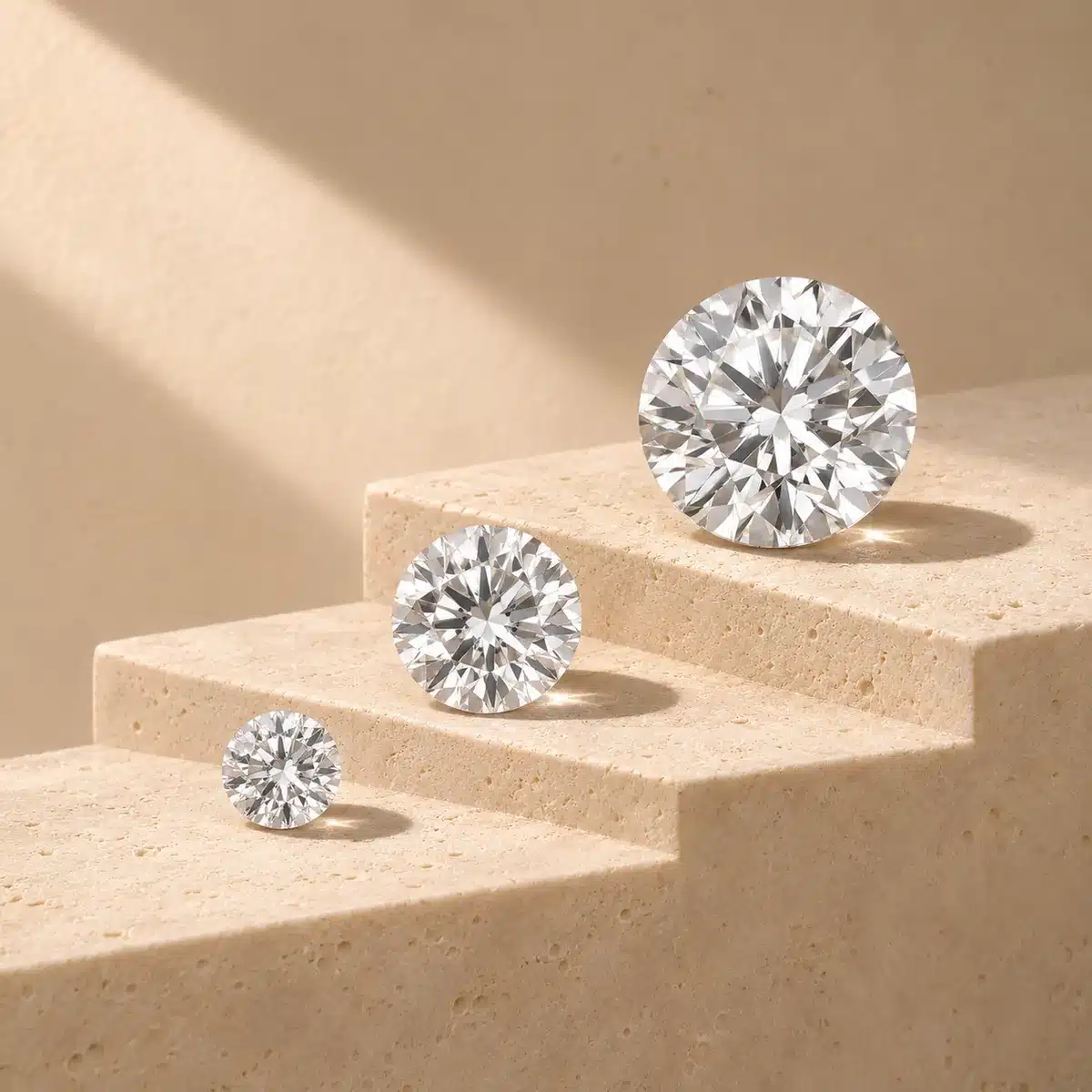
Cut decides how big and bright a 1 carat stone looks. For rounds, look for Excellent cut and a diameter around 6.4 to 6.5 mm. A deep stone can measure 6.2 mm and look like a 0.90 carat.
Color and clarity at 1 carat
At 1 carat, G to H color looks white in most settings, and D to F is worth paying for mainly in platinum or white gold if you want an icy look. VS1 to VS2 is usually eye-clean; SI stones can be eye-clean too, but check each one. VVS adds cost with little visible difference.
Shape changes price and face-up size
A 1 carat oval or pear usually costs less per carat than a round and looks larger face-up, because the weight is spread over a longer outline. Check the length-to-width ratio and bow-tie in video. See shape price comparison.
0.90 ct vs 1.00 ct
GIA names 1.00 ct as one of the “magic sizes” where prices step up. A 0.90 to 0.99 carat stone with excellent cut is only a fraction of a millimeter smaller and can cost noticeably less. If the round number does not matter to you, it is one of the easiest ways to save.
The report and treatment
An IGI or GIA report makes the stone comparable. GIA charges $15 per carat for its lab-grown assessment, small next to the price of a 1 ct stone. Treatment status can change the price at the same grades, and about 80% of the CVD stones GIA received since 2020 had been treated after growth. If you want as-grown, check the report comment: on IGI reports, “As Grown – No indication of post-growth treatment”.
1 carat checklist
1 carat by shape: typical measurements
Swipe the table to see more →
| Shape | Approx. face-up size at 1.00 ct |
|---|---|
| Round | 6.4–6.5 mm |
| Oval | 7.7 × 5.7 mm |
| Emerald | 7.0 × 5.0 mm |
| Cushion (square) | 5.6 × 5.6 mm |
| Pear | 8.5 × 5.5 mm |
| Radiant (elongated) | 6.8 × 5.2 mm |
Elongated shapes look larger for the same weight. Deep stones face up smaller.
What 1 carat costs in October 2026
StoneAlgo’s index of online asking prices for loose stones (colors D–K, clarity FL–SI2), read on 29 October 2026:
Swipe the table to see more →
| Lab-grown, 1 ct | Natural, 1 ct | |
|---|---|---|
| Average asking price | $516 | $3,864 |
| Range | $249 to $1,317 | $816 to $9,960 |
| Round | $517 | $4,670 |
| Oval | $522 | $3,852 |
| Change over 6 months | About −17% | About +4% |
The spread inside the lab-grown range is the point of this guide: the same weight runs from about $250 to over $1,300 depending on cut, color, clarity, shape and report. Wholesale prices are lower again. Analyst Edahn Golan’s data, reported by JCK, put the fall in 1 ct round wholesale prices at 15% in the first quarter of 2026 alone.
1 carat lab-grown vs natural
For the same specifications, a 1 carat lab-grown diamond costs a fraction of a natural one, roughly an eighth to a tenth for a round in the figures above. That is why many buyers choose a larger size or higher grade in lab-grown. Resale value for lab-grown is limited, so buy for the look and the price today.
1 carat in different jewelry
- Engagement ring solitaire: cut and measurements first.
- Studs (two 0.50 ct for 1.00 ct TCW): pair matching matters more than top grades.
- Pendant: eye-clean is enough; cut decides presence.
GIA Premium and Standard at 1 carat
On GIA lab-grown reports since October 2025, a 1 carat round is either Premium (D color, VVS or better, Excellent cut, polish and symmetry) or Standard (E–J, VS or better, Very Good cut, polish and symmetry). Standard covers a wide range, so compare stones within it on video and price. IGI reports give full grades.
1 carat questions
How much does a 1 carat lab-grown diamond cost?
Prices vary widely by quality and seller. Wholesale prices fell 26% across 2025, though 1 ct rounds rose 1% in the second quarter of 2026. Compare current quotes for equivalent cut, color, clarity and report.
What is the best value 1 carat lab-grown diamond?
Usually an excellent cut, G to H, VS clarity stone with a verified report.
Does a 1 carat oval cost less than a round?
Often yes, per carat, and it looks larger face-up.
Is 1.00 ct TCW in earrings the same as a 1 carat stone?
No. TCW is the total of both stones, usually two stones of about 0.50 ct each.
Compare 1 carat stones by measurements
Send your preferred shape, quality range and the diameter or measurements you want, and we will reply with options. NUVU can arrange IGI, GIA or NGTC reports and send the report number and a video of each option on request. Send your requirements or WhatsApp / WeChat +86 191 1840 3930.
Sources
- GIA: Updated laboratory-grown diamond services (Aug 2025)
- GIA 4Cs: Ways to save money on a diamond
- GIA Gems & Gemology: Update on laboratory-grown diamonds (2024)
- JCK: Lab-grown diamond prices show signs of stabilizing (Jul 2026)
- GIA: Diamond quality factors
- StoneAlgo: 1 carat lab-grown diamond prices (read 29 Oct 2026)
- StoneAlgo: 1 carat natural diamond prices (read 29 Oct 2026)
- JCK: Rising demand for lab-grown diamonds collides with falling value (Apr 2026)

11+ years supporting global clients with lab-grown diamond product consultation and market analysis.
About NUVU. NUVU is the international brand of New Perspective Superhard Materials Co., Ltd. in Zhecheng, Henan, China. We grow HPHT lab-grown diamonds in-house and cut, polish and match stones in our own workshop.
Related Guides
Lab-Grown Diamond Price Guide: What Affects Cost
What sets lab-grown diamond prices: carat thresholds, shape, cut, color and clarity, reports, treatment…
Read more →Price2 Carat and 3 Carat Lab-Grown Diamond Price
What 2 carat and 3 carat lab-grown diamonds cost in 2026, how size and shape change the price, typical…
Read more →NUVULoose Lab-Grown Diamonds | Certified Stones
Loose lab-grown diamonds in 10 shapes with IGI, GIA or NGTC reports.
Read more →