
Cut quality is one of the biggest reasons two lab-grown diamonds with similar carat, color, and clarity—factors often compared in a diamond color clarity guide—can look—and cost—very different. A better cut can make a stone appear brighter, livelier, and sometimes even larger face-up, while a weaker cut can hide weight in the wrong places or leave the diamond looking dull despite impressive specs on paper.
For the full framework, read Lab-Grown Diamond Price Guide.
This article helps you judge when paying more for cut is worthwhile and when another upgrade may matter more. You’ll learn how to compare cut against carat, color, and clarity; why round diamonds are easier to screen than fancy shapes; and what to verify beyond the grading report, including proportions, measurements, photos, video, bow-tie effect, and setting fit.
Laboratory-grown diamonds should be clearly identified as laboratory-grown, and they should not be presented as mined diamonds. Lab-grown diamonds and natural diamonds are both diamonds, but they have different origins. Diamond simulants, such as non-diamond lookalikes, are a separate category and should not be confused with laboratory-grown diamonds.
| Buying Situation | What to Check | Practical Move |
|---|---|---|
| Round brilliant center stone | Cut grade, table, depth, crown, pavilion, symmetry | Use proportions as a screen, then confirm by video |
| Fancy shape diamond | Bow-tie, shape profile, dark zones, watery center | Prioritize visual review over report details alone |
| Choosing between size and sparkle | Face-up spread, brightness, hidden depth | Pick the better-cut stone if the larger one looks dull |
| Considering higher color or clarity | Whether the stone already looks white and eye-clean | Upgrade cut first if light performance is weak |
| Comparing similar prices | Measurements, polish, symmetry, real images | Choose the diamond with stronger visible performance |
Quick Questions Before You Read
Q: Is a higher-priced lab-grown diamond always better cut?
No. Price can reflect size, color, clarity, brand, report type, or availability, so cut still needs to be verified separately.
Q: Should cut matter more than carat weight?
Often, yes for a center stone. A slightly smaller diamond with stronger light return can look more impressive than a larger dull one.
Q: Can a grading report tell me everything about cut quality?
Not everything. Reports help, but photos, video, proportions, and face-up appearance are important checks.
Q: Are fancy shapes harder to judge than round diamonds?
Yes. Fancy shapes need closer visual review because bow-ties, uneven brightness, and shape profile issues may not show clearly in grades.
Why Cut Quality Can Change the Price of a Lab-Grown Diamond
Cut Affects What You Actually See, Not Just What the Report Says
Yes, lab-grown diamond cut quality can change the price of a diamond because cut changes how the stone looks in real life. The material is still lab-grown diamond, but the way that material is shaped determines how much light comes back to your eye. A diamond with stronger light performance can look brighter, sharper, and more expensive-looking than another diamond with the same carat weight, color, and clarity on paper.
This is where many buyers misread diamond cut and price. Cut is not just a line on a grading report. It affects the visual impression of the stone every time it is worn. A diamond with weak proportions may leak light, show dull areas, or look flat under normal lighting. A better-cut stone can look more alive even if its color or clarity grade is not the highest available.
The report matters, but it does not replace judgment. An Excellent or Ideal cut grade is a useful filter, especially for round brilliant diamonds, but it should not be treated as an automatic guarantee of beauty. Proportions, symmetry, polish, and actual visual review still matter because two diamonds with the same broad cut grade can perform differently.
When a grading report is available, buyers should verify the report details through the issuing laboratory’s official report-check tool where available, then compare those details with the stone’s measurements, images, video, and intended jewelry use.
For buyers, the practical point is not just what the report says, but how the stone performs visually and fits the intended design. A grading report documents important characteristics, but it cannot fully show light behavior in everyday environments, how the diamond looks on the hand, or whether the proportions make sense for the setting. That is why cut should be evaluated as both a documented feature and a visual result.
It also helps to separate three different ideas that are often blended together in online listings: the diamond’s identity, the diamond’s grading information, and the diamond’s beauty. Identity confirms that the stone is a lab-grown diamond rather than a natural diamond or a simulant. Grading information describes characteristics such as carat weight, color, clarity, measurements, and cut-related details. Beauty is the buyer-facing result of how those characteristics work together in real lighting. A strong purchase decision uses all three, but it does not treat any single line on a report as a substitute for the finished visual impression.
A grading report helps document key characteristics, but it should not be treated as a guarantee of beauty, value, or sourcing ethics. If a listing uses report language to imply broader claims, buyers should separate what the laboratory actually assessed from what the seller is saying about appearance, price, origin, or responsible sourcing.
Why Two Similar Lab-Grown Diamonds Can Have Different Prices
Two lab-grown diamonds can share the same carat, color, and clarity grades and still deserve different prices. The difference often comes down to cut precision and visual performance. If one stone is planned and cut to return light more efficiently, it may command a higher price because it offers a stronger face-up appearance.
This matters most when buyers compare diamonds online. A 2.00 carat F VS1 lab-grown diamond may look stronger on paper than a 1.90 carat G VS2 diamond, but the better buy is not always the one with the bigger or cleaner specifications. If the 1.90 carat stone has better proportions, stronger brightness, and more balanced contrast, it may look more impressive in daily wear.
The mistake is assuming that a lower lab-grown diamond price always means better value. Sometimes it does. Other times, the lower price reflects a visual compromise that becomes obvious once the diamond is viewed in motion or compared beside a better-cut option.
Traceability also matters in a practical, buyer-facing way. A diamond listing should make it possible to connect the stone being discussed with its report, measurements, media, and design plan. If a buyer cannot tell whether a video belongs to the exact stone, whether the measurements match the report, or whether a quoted price refers to the same diamond being reviewed, the comparison becomes less reliable. Clear documentation does not make a diamond beautiful by itself, but it makes the evaluation easier to check.
Brightness, Fire, and Contrast: The Visual Reasons Cut Matters
Cut controls how light enters the diamond, reflects inside it, and returns to the viewer. When the proportions work well together, the diamond shows strong brightness, meaning more white light returns through the top of the stone. This is the first thing most people notice, even if they do not know the technical language behind it.
Fire is the colored light you see when a diamond breaks light into flashes of rainbow color. Scintillation is the sparkle pattern created as the diamond, the light, or the wearer moves. Contrast gives the stone its pattern and depth, preventing it from looking glassy or washed out. A diamond that lacks contrast can seem bright in one photo but flat in person.
The practical point is simple: cut affects the traits people actually associate with a beautiful diamond. Color and clarity are important, but once they are within a visually acceptable range, better light performance can have a stronger impact than a small upgrade on the grading report.
What This Means in a Real Purchase
If you are choosing between two similar lab-grown diamonds, do not treat cut as a minor detail after carat, color, and clarity. Start by asking which stone will look brighter, more balanced, and more lively in the setting you plan to use. A well-cut diamond can make your budget work harder because more of the value is visible.
The practical approach is not to pay blindly for the highest label. Use the cut grade to narrow your options, then compare proportions, measurements, photos, and video. A higher price for cut is easier to justify when the diamond shows a clear visual advantage, not just a better-sounding grade.
Why Cut Is Often More Important Than Buyers Expect
Why Carat, Color, and Clarity Usually Get More Attention
Carat, color, and clarity tend to get more attention because they are easier to filter and compare. A buyer can quickly sort for 2.00 carats, F color, and VS1 clarity, then assume the strongest option will be near the top of that list. Cut requires more interpretation, which is why it is often underestimated.
This creates a common problem in lab-grown diamond shopping. Because lab-grown diamonds make higher carat weights and higher grades more accessible than many buyers expect, it becomes tempting to chase the biggest or cleanest stone within budget. But a diamond does not look impressive because of its paperwork alone. It looks impressive when its proportions support strong visual performance.
For buyers focused on lab diamond value, cut should not be treated as the leftover category. It is often the factor that determines whether the diamond looks crisp and intentional or simply large.
How Strong Cut Can Make a Diamond Look Larger and Cleaner
A strong cut can improve face-up appearance in ways buyers do not always expect. Better brightness can make the outline of the diamond look more defined, which helps the stone feel larger from the top. Balanced contrast can also make the diamond look cleaner because the eye is drawn to light movement rather than small internal features.
This does not mean cut erases poor clarity or changes the actual color grade. It means visual performance can reduce the importance of minor differences that are hard to see without magnification. If a VS2 diamond is already eye-clean, moving to VVS2 may add less visible value than choosing the better-cut stone.
The same logic applies to color in many real settings. A well-cut G color diamond may look bright and white once set, while a poorly performing F color diamond may appear less lively. The better-looking stone is not always the one with the technically higher grade.
For custom design, the stone cannot be evaluated separately from the setting. Prong style, basket height, metal color, halo proportions, and whether the design is open or protective can all change how color, spread, and brightness are perceived. A cut choice that looks strong as a loose stone should still be checked against the final ring design so the diamond does not sit too deep, appear visually crowded, or lose the light performance that justified the premium.
For custom jewelry, stone measurements and setting compatibility should be confirmed before finalizing a purchase. Before selecting a stone, buyers should confirm the exact measurements, depth, girdle description, corner or point protection for fancy shapes, and whether the setting can physically support the diamond’s proportions. This is especially important when a diamond has an attractive face-up spread but a shallow or deep profile that may affect durability, prong coverage, or how high the stone sits.
A Realistic Comparison: Bigger Specs vs Better Light Performance
Imagine Emily is comparing two round lab-grown diamonds for an engagement ring. The first is a 2.00 carat F VS1 with average light return. The second is a 1.85 carat G VS2 with stronger proportions, better brightness, and a more balanced pattern. On a spreadsheet, the first diamond looks like the obvious winner. In person, the second may look more energetic and refined.
The reason is not that carat, color, and clarity do not matter. They do. The issue is priority. Once a diamond reaches a size, color, and clarity range the buyer is comfortable with, cut can become the upgrade that changes the entire impression of the stone. A slightly smaller diamond with stronger sparkle often feels more valuable than a larger one that looks sleepy.
This is one of the least obvious parts of buying a lab-grown diamond online. Better specifications do not always create a better visual result. The stronger choice is the diamond whose grades and appearance work together.
Buyer Verification Checklist
- Compare video, not just reports. A grading report narrows the field, but movement reveals brightness, contrast, and dull areas more clearly.
- Check whether the diamond looks bright across the whole face. A stone that is bright only around the edges or center may have a cut issue.
- Do not overpay for invisible clarity before cut is strong. If inclusions are not visible to the eye, a clarity upgrade may add less practical value.
- Watch for a larger stone that looks flat. Extra carat weight is less useful if the diamond lacks life from normal viewing angles.
The goal is not to choose the smallest diamond with the highest cut description. The goal is to avoid sacrificing the part of the diamond that people notice first.
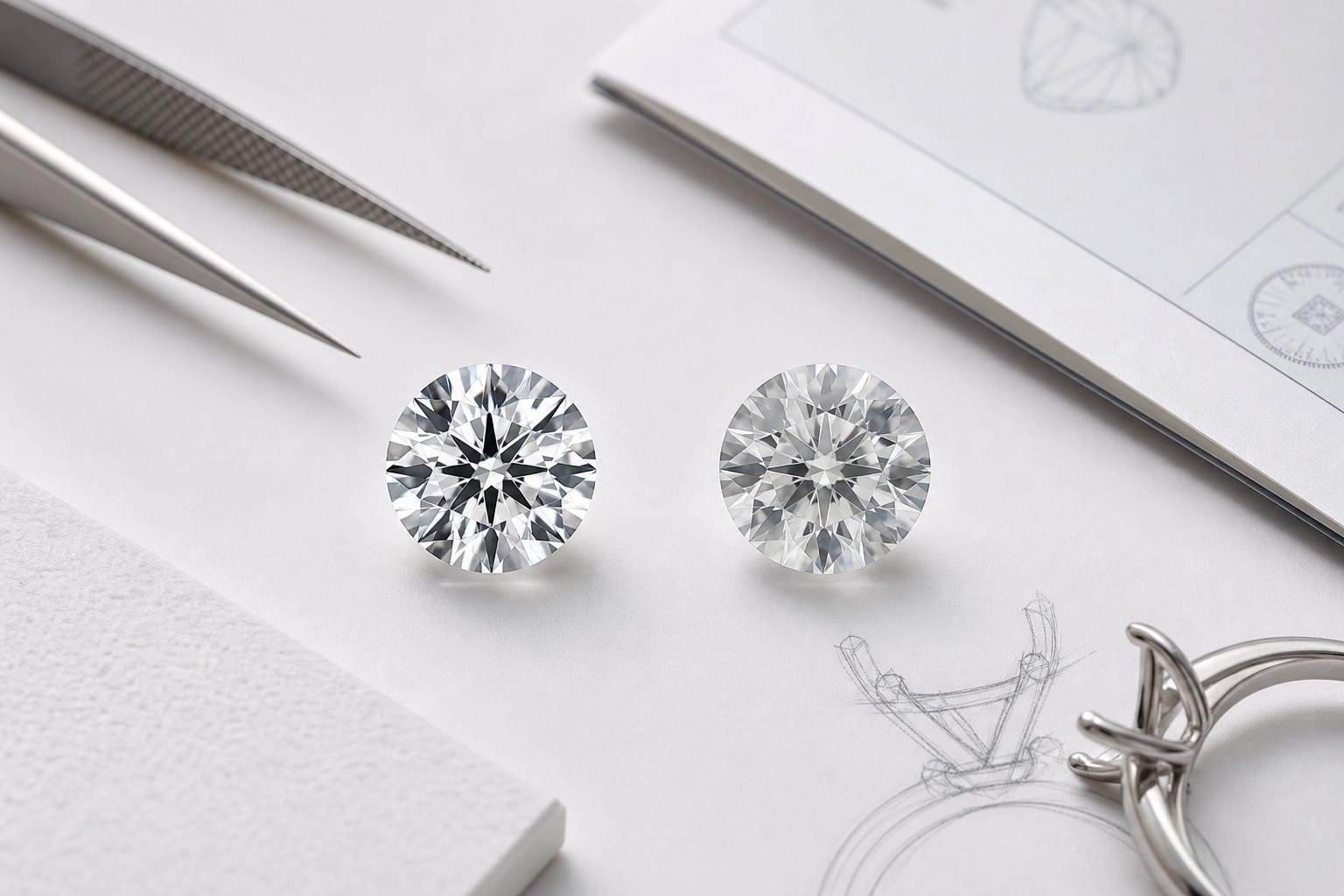
How Cut Quality Affects Lab-Grown Diamond Pricing
Why Better Cut Can Carry a Price Premium
Better cut can carry a price premium because it usually requires more careful planning and execution. A cutter may need to make tradeoffs in weight retention to achieve better proportions, symmetry, and light return. That means a better-cut diamond may not always be the heaviest possible stone from the available rough, but it may be the more desirable finished diamond.
This is especially relevant in lab-grown diamond pricing because many buyers assume the value story is mostly about lower cost compared with natural diamonds. In reality, there are still quality differences within lab-grown diamonds. An ideal cut lab-grown diamond can be priced higher than a weaker-cut option because the final result is more visually appealing and often easier to compare confidently.
The premium is not always dramatic, and it should not be accepted without comparison. But if the added cost produces stronger brightness, cleaner patterning, and better face-up balance, it may be a more meaningful upgrade than paying for a grade difference the eye will not notice.
Price can also reflect factors outside cut, including shape demand, availability, report details, matching requirements, and how narrowly the buyer has filtered the search. Some reports may identify growth method, such as HPHT or CVD, but that information alone does not prove that one diamond will look better than another. It is more useful to treat growth and documentation details as part of the verification process while still judging the finished stone by proportions, appearance, and suitability for the jewelry design.
When growth method or post-growth treatment is relevant, buyers should look for clear disclosure in the grading report or seller documentation. HPHT and CVD may refer to laboratory diamond growth methods, and any separate post-growth treatment should be considered only when it is specifically disclosed for the individual stone.
A careful price comparison should also avoid treating “lab-grown” as one uniform quality category. Two lab-grown diamonds may share the same broad origin description while differing in post-growth treatment disclosure, visual transparency, strain appearance, make, report format, and available media. Those details do not automatically make one stone better than another, but they can affect how confidently a buyer can compare options. When the cut premium is real, it should show up as a clearer visual result and cleaner supporting documentation, not only as a higher listed price.
When a Lower Price Signals a Cut Tradeoff
A lower price is not automatically a warning sign. Some diamonds are priced well because of market conditions, inventory movement, or a sensible balance of grades. The concern is when the lower price is attached to cut-related compromises that reduce the diamond’s appearance.
Common tradeoffs include excessive depth that hides carat weight where you cannot see it, shallow proportions that cause light leakage, or weak patterning that makes the diamond look uneven. In these cases, the buyer may think they are getting more diamond for the money, when they are really getting more weight and less visual impact.
A practical way to judge this is to ask what the lower price is costing you. If the lower-priced diamond gives up a small clarity upgrade that was not visible anyway, that may be reasonable. If it gives up brightness and balance, the savings may show every time the ring is worn.
Why Higher Price Does Not Automatically Mean Better Cut
A higher price does not automatically mean better cut, especially when a diamond shape price comparison shows that price can also be influenced by carat weight, color, clarity, brand positioning, report details, shape, and market availability. A diamond may cost more because it has a higher clarity grade or a more desirable color grade, even if its light performance is not the strongest option in the group.
This is why buyers should not assume the most expensive diamond in a filtered search is the best-looking one. A D color VVS diamond with average cut can be less visually compelling than a G color VS diamond with stronger proportions. The higher-priced stone may be rarer on paper, but rarity is not the same as beauty from across a table.
The better question is not “Which diamond has the highest price?” but “Which diamond gives me the most visible improvement for the money?” For many buyers, that question moves cut higher on the priority list.
Price Comparison Boundaries Buyers Should Use
Prices can change with market conditions, report type, seller channel, and stone-specific details, so exact comparisons should be verified at the time of purchase. A quoted price is most useful when it is attached to a specific diamond, report, measurement set, visual media, and setting plan. Without that context, a cheaper or more expensive listing may not be a fair comparison.
Buyers should also be cautious with broad claims such as “lowest price,” “factory-direct value,” or “investment-grade” unless those claims are supported with clear, current, and relevant documentation. For a cut-quality decision, the safer question is whether the price difference is supported by visible performance, comparable specifications, and transparent documentation for the individual stone.
How to Compare Price Fairly
To compare price fairly, look at diamonds that are close in carat weight, shape, color, and clarity, then examine how cut separates them. If one diamond is meaningfully brighter and better proportioned while the rest of the grades are similar, a higher price may be justified. If the visual difference is minor or unclear, the premium deserves more scrutiny.
Do not compare a better-cut 1.80 carat diamond against a weaker-cut 2.20 carat diamond and judge only by price per carat. That comparison hides the real decision. A fair comparison keeps the visible size range close enough that you can evaluate whether better cut, not just smaller weight, is creating the value.
For a purchase that will be worn daily, cut is one of the few upgrades that can be seen repeatedly without magnification. That makes it worth evaluating before spending more on color or clarity grades that may look identical once the diamond is set.
Cut vs Color vs Clarity: Which Upgrade Gives the Most Visible Value?
Most lab-grown diamond buyers are not choosing between “good” and “bad” specs. They are choosing where the next dollar should go. That is where cut vs color vs clarity becomes a practical value question, not a grading exercise.
Color and clarity matter, but their visual impact often drops once the diamond reaches a clean, attractive range. Cut is different. A stronger cut can improve brightness, contrast, and face-up presence every time the diamond moves. If the goal is the most noticeable improvement in real life, cut is often the upgrade that changes the stone the most.
When Better Cut Beats Higher Color
Higher color grades can be worth paying for in certain designs, but they are easy to overvalue if the diamond is already facing up white. For many round brilliant lab-grown diamonds, a well-cut G or H color stone can look bright, lively, and white in a white gold, yellow gold, or platinum setting. A D, E, or F color stone with weaker light performance may technically have a higher color grade, but it can still look flat because it is not returning light efficiently.
This is one of the most common buying mistakes: treating color as the main sign of beauty. Color is a body-color grade. Cut is the engine that determines how much brightness and contrast the eye sees. If a diamond is well cut, its light return can make a near-colorless stone appear crisp and attractive. If the cut is weak, even a high-color stone can lack life.
The better upgrade depends on the setting and the viewer’s sensitivity. If the diamond is going into a very open platinum solitaire and the buyer is highly color-sensitive, moving higher in color may make sense. But if the stone already appears white in normal viewing conditions, paying for better cut will often create more visible value than moving from G to F or from F to E.
When Better Cut Beats Higher Clarity
Clarity upgrades are often even easier to overbuy. Once a diamond is eye-clean, meaning inclusions are not readily visible without magnification in normal viewing, moving higher in clarity may not improve how the stone looks on the hand. A VS2 lab-grown diamond that is clean to the eye can be a stronger visual purchase than a VVS stone with average cut performance.
The key is not the clarity label alone. Location, type, contrast, and visibility of inclusions matter. Some VS2 stones are very clean in real-world viewing. Some SI1 stones may also be acceptable, but this requires more caution because visibility varies more, grading consistency can differ, and inclusions may be more noticeable in larger diamonds or step-cut shapes. A higher clarity grade is useful when it removes a visible distraction. It is less useful when the diamond was already clean to the naked eye.
If the choice is between better cut and higher clarity, cut should usually come first after the stone reaches a trustworthy eye-clean range. A flawless-looking grading report does not help much if the diamond lacks brightness or has uneven contrast. The buyer sees light performance before they see microscopic clarity differences.
When Color or Clarity Still Deserves Priority
Cut should not be treated as the only factor that matters. Color becomes more important in larger stones, elongated shapes, step cuts, and very open settings where body color can be easier to notice. Emerald cuts and asscher cuts, for example, do not hide color the same way a well-cut round brilliant can. If the design uses bright white metal and a minimalist setting, a lower color grade may stand out more than expected.
Clarity also deserves priority when the diamond shape makes inclusions easier to see. Step cuts have broad, open facets that act more like windows than sparkle-heavy facet patterns. In those shapes, a clarity grade that would be acceptable in a round brilliant may feel distracting. Larger diamonds also make inclusions easier to spot because there is simply more visible surface area.
The judgment is not “always choose cut over color and clarity.” The better rule is to bring color and clarity to a visually safe level first, then spend the next upgrade on cut. Paying for D color or VVS clarity before securing strong light performance often puts money into qualities that may look impressive on paper but less meaningful in daily wear.
What to Check Before You Decide
Before paying more for any upgrade, compare the diamonds as complete stones rather than isolated grades. Start by asking whether the color difference is visible in the intended setting and whether the clarity difference is visible without magnification. If the answer is no, the cut difference is more likely to affect the final appearance.
A practical order of priority is simple: secure strong cut quality, make sure the diamond faces up white enough for the design, then confirm it is eye-clean. After that, higher color and clarity become preference upgrades rather than automatic value upgrades. That distinction matters because strong lab-grown diamond value is rarely the stone with the highest grades across every category. It is the stone where the visible qualities line up with the price.
The Cut Quality Numbers Buyers Should Actually Check
Cut grades are useful, but they should not be treated as the whole answer. A lab-grown diamond cut grade gives a quick screening point, especially for round brilliant diamonds, but the proportions explain much more about why one stone looks bright and another looks dull.
The goal is not to memorize gemology charts. The goal is to avoid obvious proportion problems before spending money. A few numbers can help buyers filter out diamonds that are too deep, too shallow, or poorly balanced, but those numbers still need to be checked against photos, video, and the overall look of the stone.
Useful Round Brilliant Cut Ranges to Know
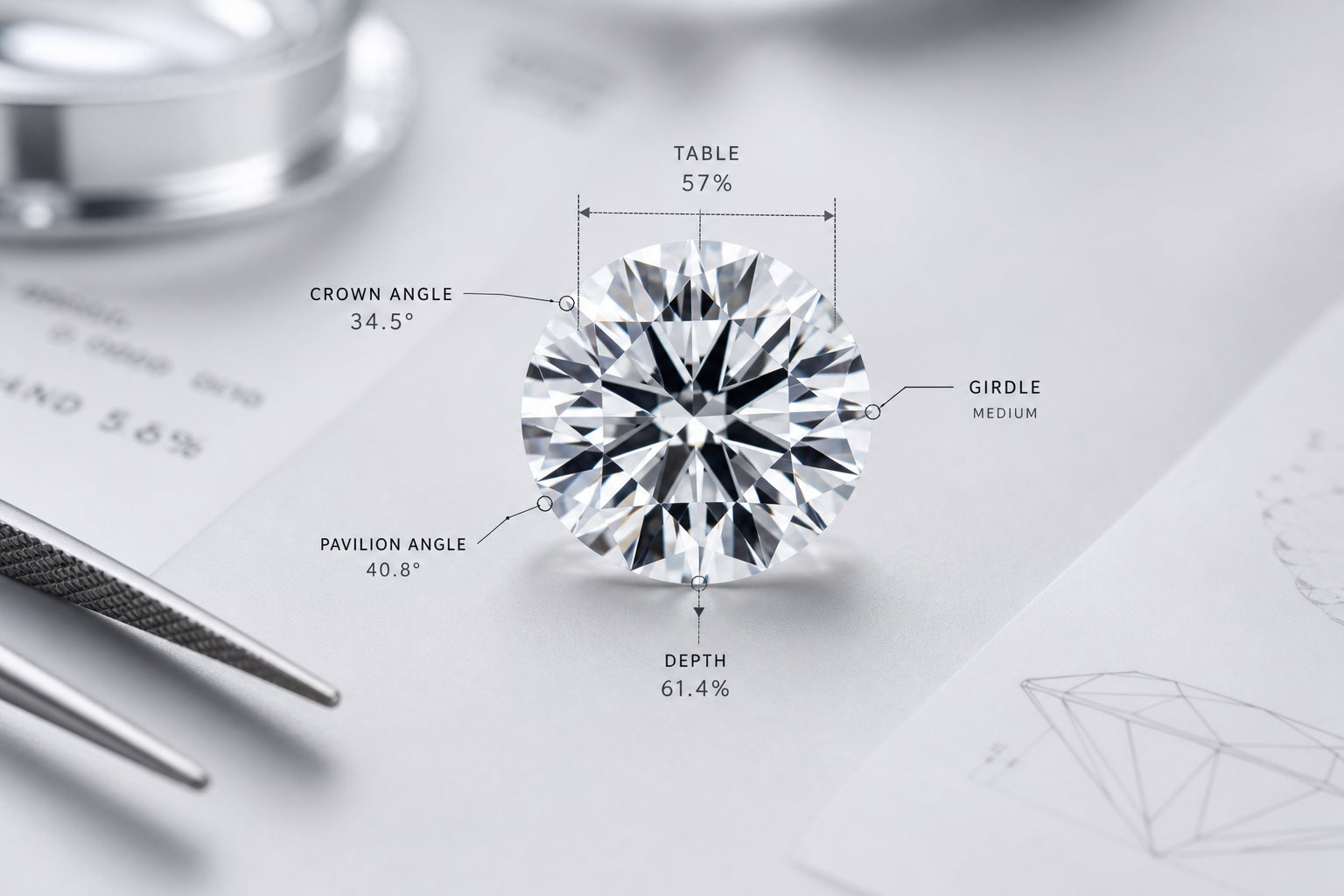
Round brilliant diamonds are the easiest shape to screen with cut numbers because their light performance is more standardized than fancy shapes. For buyers comparing ideal cut lab-grown diamond options online, the following ranges can be useful starting points:
- Table percentage: about 54% to 58%
- Depth percentage: about 60% to 62.5%
- Crown angle: about 34° to 35.5°
- Pavilion angle: about 40.6° to 41.0°
- Girdle: thin to slightly thick, or medium to slightly thick
- Polish and symmetry: Excellent or Very Good, with Excellent preferred when prices are close
These are screening ranges, not magic guarantees. A diamond outside one range is not automatically poor, and a diamond inside all of them is not automatically beautiful. The practical value is that these numbers help eliminate stones with obvious cut risks before the buyer spends time comparing less visible upgrades.
These proportion ranges should be treated as buyer-friendly screening guidance rather than universal standards. Different laboratories, sellers, and cut-analysis tools may describe cut performance in different ways, and a diamond’s actual look can still depend on how the angles work together. If a seller presents a proportion range as a rule, the useful follow-up is to ask for the stone’s report, measurements, and comparable visual media so the claim can be checked against the individual diamond.
Why Proportion Combinations Matter More Than One Number
The most common mistake is judging one number in isolation. A table percentage may look fine, but if the depth is excessive, the diamond may carry weight in the body rather than across the visible face. A pavilion angle may seem close to ideal, but paired with the wrong crown angle, it can reduce light return or create an unbalanced contrast pattern.
Cut works as a system. The crown, pavilion, table, depth, girdle, and symmetry all interact. A round diamond with a slightly larger table can still look attractive if the rest of the proportions support strong brightness. A diamond with an appealing depth percentage can still disappoint if the angles do not work together.
This is why stronger cut decisions combine numbers with visual review. The numbers help narrow the field. The images and video help confirm whether the diamond actually looks bright, balanced, and lively. Buyers who rely only on the report can miss problems that are visible once the stone moves.
Why Fancy Shapes Need More Than a Cut Grade
Fancy shapes require more judgment because cut grading is less standardized across shapes. Ovals, pears, cushions, radiants, emerald cuts, and marquise diamonds can vary widely in facet pattern, outline, face-up size, and light behavior. A simple cut grade, when available, may not tell the full story.
For fancy shapes, measurements and visual appearance matter more. An oval may have a flattering outline but a heavy bow-tie. A cushion may look either soft and romantic or crushed and uneven, depending on facet style. An emerald cut may have elegant step patterns, but it will also reveal inclusions and color more easily than a brilliant-cut shape.
The main risk with fancy shapes is buying from numbers that look acceptable while ignoring the face-up personality of the stone. Two cushions with similar carat weight and color can look completely different because one has better spread, cleaner contrast, and more organized light return. This is where video becomes essential, not optional.
Certificate and Visual Review Check
Use the grading report to confirm the basics: measurements, depth, table, polish, symmetry, and any available cut information. For round brilliant diamonds, compare the proportions against practical screening ranges and avoid assuming that “Excellent” alone settles the decision. For fancy shapes, pay closer attention to outline, length-to-width ratio, dark zones, bow-tie strength, and whether the diamond looks balanced as it moves.
The strongest buying process uses both documentation and visual proof. A grading report can narrow the search, but it cannot show how the diamond performs in every lighting environment. If a better-cut stone costs more, the higher price should be supported by better proportions and a visibly stronger appearance, not just a nicer label.
It is also worth separating report facts from broader marketing claims. A grading report can document diamond characteristics, but it should not be treated as proof of sustainability, resale value, or ethical superiority. If those issues matter to the buyer, they should be discussed through clear seller documentation and sourcing transparency rather than assumed from the fact that the diamond is lab-grown.
Environmental and sustainability claims should be specific, documented, and limited to what can be substantiated. Broad green language is less useful than clear information about production context, energy considerations where disclosed, sourcing transparency, and the seller’s ability to explain what is known and what is not known. For a cut-quality decision, those claims should not replace the basic checks: the report, the stone’s visible performance, and the fit of the diamond in the intended jewelry.
Why a Cheap Lab-Grown Diamond Can Still Be Poor Value
A lower price is not automatically a warning sign. Lab-grown diamonds exist across a wide price range, and buyers can find strong value without choosing the most expensive stone. The problem is when a cheap lab-grown diamond looks like a bargain only because the tradeoff is hard to see on the first comparison screen.
Weak cut is one of the easiest tradeoffs to overlook. A diamond can have the desired carat weight, a high color grade, and clean clarity while still looking less bright, less balanced, or smaller than expected. That kind of lower price can cost the buyer more in appearance than it saves in price.
Low Price vs Good Value: The Difference Matters
Good value means strong appearance for the money. Low price means the number is smaller. Those are not the same thing. A lower-priced diamond can be the right choice if the cut, proportions, and visual performance are still solid. It becomes poor value when the savings come from a weakness the buyer will notice every time the diamond is worn.
This is especially important online, where comparison tools make it easy to sort by price and choose the least expensive stone with similar listed specs. The issue is that the listing may not make visual performance obvious. A diamond can sit next to another with the same carat, color, and clarity while having weaker light return, less attractive contrast, or a deeper build that reduces face-up size.
The smarter question is not “Which diamond is cheapest?” It is “Which diamond gives a strong appearance at this price?” If a slightly higher-priced stone looks brighter, faces up better, and has cleaner proportions, it may be the better value even if its color or clarity grade is not as high.
How Weak Cut Can Hide Carat Weight Where You Cannot See It
Carat weight measures weight, not visible size. A poorly proportioned diamond can hold too much weight in its depth, making it look smaller from the top than another diamond with the same carat weight. This is one reason some stones appear attractive on paper but underwhelming in person.
Excessive depth is a common example. The buyer pays for weight, but part of that weight sits below the girdle where it does not improve face-up presence. A shallower diamond can create a different problem: it may look spread out, but light may leak instead of returning cleanly to the eye. Neither issue is solved by a better color grade.
This is where cut quality has a direct effect on lab-grown diamond value. A 2.00 carat stone with weak proportions can appear less impressive than a slightly smaller diamond with stronger spread, brightness, and contrast. If the larger stone looks dull or undersized, the “deal” may not be a deal at all.
Visual Problems That Make a Diamond Feel Less Valuable
Poor cut often shows up as a feeling before the buyer knows the technical reason. The diamond may look sleepy, glassy, dark in the center, watery around the edges, or uneven as it moves. These are visual problems that reduce perceived value even if the report looks respectable.
Light leakage is one of the biggest issues. Instead of returning light back to the viewer, the diamond lets too much light escape through the bottom or sides. The result can be a stone that looks dim in normal lighting. Poor symmetry can also affect the pattern, making the diamond feel less crisp or less organized. In fancy shapes, uneven brightness or a heavy bow-tie can pull attention away from the overall beauty of the stone.
These problems matter because diamonds are judged in motion and in changing light, not only under magnification or studio lighting. A weakly cut stone may look acceptable in a still photo but lose energy in a short video or on the hand. That is why a low price should be tested against visual performance, not accepted as value by default.
Warning Signs in Photos, Videos, and Measurements
Watch for diamonds that look dark through the center, have inconsistent brightness from end to end, show large lifeless areas, or appear flat when rotated. In videos, the diamond should have active light movement rather than a single bright flash followed by dullness. For elongated shapes, look for bow-tie effects that dominate the stone instead of adding normal contrast.
Measurements can also reveal hidden tradeoffs. If a diamond has a high carat weight but smaller-than-expected face-up dimensions, a lab grown diamond price guide may help explain why it may be carrying weight in depth. If the table or depth looks far outside common ranges for the shape, the lower price may be connected to a cut compromise. A budget-friendly diamond can still be a smart purchase, but only if the savings do not come from the part of the diamond that controls how it looks.
How Shape Changes the Cut-and-Price Conversation
Why Round Diamonds Are Easier to Screen by Cut Grade
Shape changes how cut quality should be judged. A round brilliant lab-grown diamond is the easiest case because cut grading is more standardized and the relationship between proportions, light return, and face-up performance is easier to compare. If two round diamonds have similar carat weight, color, clarity, and grading report details, the one with stronger cut quality is usually easier to justify at a higher price because the visual difference is more predictable.
This does not mean every round diamond with a high cut grade is automatically the better buy. Cut grade is a useful filter, not a final decision. A round stone can still have proportion combinations that create less attractive contrast, a smaller-looking spread, or weaker brightness than expected. But compared with most fancy shapes, round diamonds give buyers a clearer starting point: if the cut grade, measurements, symmetry, polish, and video all support each other, the price premium is easier to evaluate.
Why Fancy Shapes Require More Visual Review
Fancy lab-grown diamond shapes are more dependent on visual judgment because cut grades are often less standardized or less descriptive. Ovals, pears, emerald cuts, cushions, radiants, and marquise diamonds can look very different even when their reports appear similar. The issue is not only whether the stone is “well cut” in a broad sense, but whether the shape looks balanced, bright, and attractive for its intended setting.
This is where buyers can overtrust the report. A fancy shape may have strong color and clarity grades but still show a distracting bow-tie, uneven brightness, a watery center, thick edges, or an outline that feels awkward once set. In those cases, paying more for the paper specs does not necessarily create better lab diamond value. For fancy shapes, video and measurements often matter more than a simple grade label because they show how the diamond actually handles light across its full shape.
At NUVU, this kind of comparison is treated as a practical selection question rather than a single-grade decision. The report helps narrow the field, but the final choice still needs to make sense visually, physically, and financially. For fancy shapes in particular, a balanced outline and compatible setting plan can be just as important as a higher grade that does not improve the finished look.
Shape-Specific Cut Issues That Can Affect Value
Ovals and pears are good examples of why diamond shape and cut quality cannot be separated. A mild bow-tie effect can be normal, but a dark, heavy bow-tie across the center can make the diamond look less lively, especially in direct viewing. A buyer choosing an oval for spread and elegance should not focus only on carat weight; a slightly smaller oval with better brightness and a cleaner outline can look more expensive than a larger one with a dull center.
Emerald cuts require a different kind of judgment. They do not rely on the same glittery brilliance as round brilliants or radiants. Their value comes from clean step patterns, broad flashes, symmetry, and transparency. Because the facets are larger and more open, clarity characteristics and growth-related visual issues can be easier to see. A higher-color emerald cut with uneven steps or a glassy, lifeless appearance may be less appealing than a more balanced stone with slightly lower specs.
Cushion and radiant cuts vary widely because facet style changes the way they face up. Some cushions have a chunky, antique-inspired pattern, while others have a crushed-ice look. Radiants can be bright and energetic, but some show uneven sparkle or hidden weight in depth. The mistake is assuming one shape name tells you enough. With these cuts, the right price depends heavily on whether the diamond’s actual face-up appearance matches what the buyer wants.
Stone-to-Setting Fit Check
Cut quality also affects how well a diamond works in a specific ring. A shape that looks attractive loose may feel too long, too shallow, too deep, or visually unbalanced once placed in a setting. Elongated shapes need special attention because length-to-width ratio affects finger coverage, prong placement, and the overall look of the ring. Step cuts often benefit from settings that protect corners and frame the geometry cleanly, while brilliant fancy shapes need enough open exposure to show their light performance.
Before paying more for a fancy shape, check more than the grade. Look at the outline, face-up size, depth, symmetry, center brightness, and how the stone will sit in the setting. For engagement rings, this is often the difference between a diamond that looks impressive only in a listing and one that looks right on the hand.
How to Decide When Better Cut Is Worth Paying For
Prioritize Cut When Appearance Matters Most
Better cut is worth paying for when the diamond is meant to be the visual center of the piece. This is especially true for a round brilliant engagement ring diamond, where brightness, contrast, and sparkle are the first things most people notice. If the stone will be worn every day and viewed in many lighting conditions, cut should usually come before small upgrades in color or clarity that may not be visible without close inspection.
The clearest case for a cut-first strategy is when you are comparing diamonds in the same general size range. If one stone is slightly smaller or one grade lower in color but has visibly stronger light performance, it may be the better value. A diamond that returns light well often looks more alive, more balanced, and sometimes even larger than a higher-spec stone with weaker proportions.
Compromise Carefully When Chasing More Carat Weight
Carat weight is tempting because it is easy to compare, but it can be a poor upgrade if the extra weight is hidden in depth or comes with weaker light return. A larger lab-grown diamond that looks flat, dark in the center, or smaller face-up than expected can feel disappointing even if the grading report looks impressive. More size only helps if the stone still looks bright and well-proportioned.
A moderate cut compromise may be acceptable if the diamond is not the main visual focus, if the setting reduces how much of the stone is seen, or if the buyer strongly prefers size and has reviewed the stone carefully. The compromise becomes risky when the diamond is a center stone, the visual performance is clearly weaker, or the larger size depends on proportions that reduce spread and brilliance. In that situation, the buyer is not really getting more diamond where it matters most.
Use Color and Clarity Upgrades After Cut Is Solid
Color and clarity still matter, but they should usually be treated as secondary upgrades once cut quality is strong. If a diamond is already in a color range that appears white in the chosen metal and setting, paying more for a higher color grade may create less visible improvement than improving cut. The same logic applies to clarity: once a stone is visually clean to the naked eye, moving to a much higher clarity grade often changes the report more than the appearance.
The recommendation changes when the setting or shape makes color or clarity more noticeable. Emerald cuts, asschers, and some elongated shapes can reveal inclusions or body color more readily than round brilliants. Larger stones also make visual issues easier to detect. In those cases, color and clarity deserve more attention, but not at the expense of a diamond that lacks life.
A Simple Cut-First Decision Framework
If the diamond is round and will be the center stone, prioritize cut strongly. If the diamond is a fancy shape, prioritize visual review, balanced proportions, and face-up appearance rather than relying on grade language alone. If clarity is already eye-clean, do not spend heavily on invisible clarity before confirming cut. If the setting softens color, such as yellow gold or certain vintage-inspired designs, a color upgrade may be less urgent than stronger light performance.
For buyers trying to maximize size, the practical rule is simple: do not sacrifice cut so far that the larger diamond looks dull. A smaller, brighter stone often makes the better impression because people notice light performance before they notice a grading detail. A strong value lab-grown diamond is not the one with the biggest number in a filter; it is the one where size, cut, color, clarity, and setting work together without one weak point pulling the whole look down.
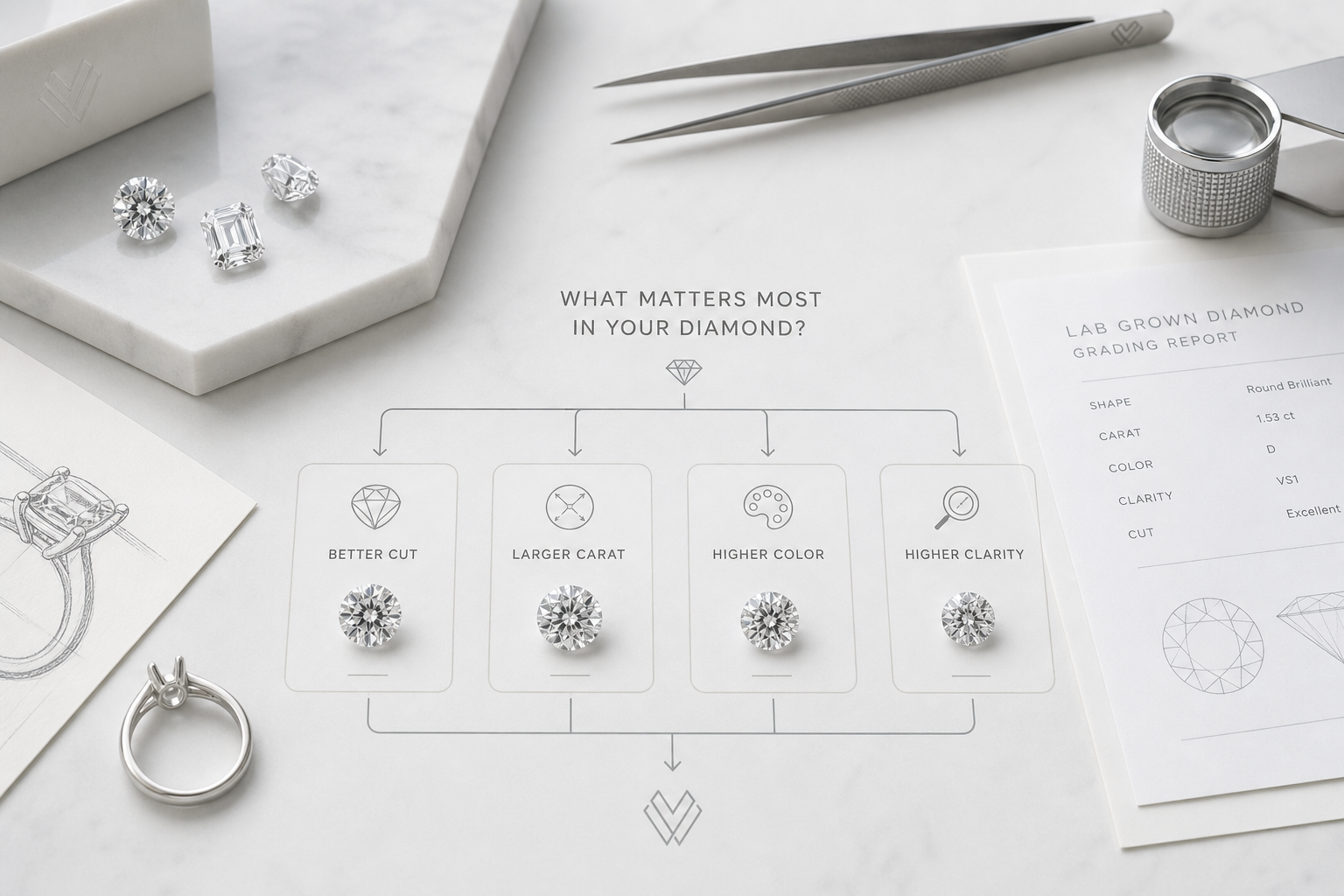
What to Review Before Paying More for a Better-Cut Lab-Grown Diamond
Start With the Grading Report, But Do Not Stop There
A lab-grown diamond grading report is the right starting point because it gives you the basic facts: carat weight, measurements, color, clarity, cut grade where applicable, polish, symmetry, and proportions. For round brilliant diamonds, the cut grade and proportion data can quickly eliminate stones that are unlikely to perform well. For fancy shapes, the report is still useful, but it rarely tells the full story of visual balance.
The mistake is treating the report as proof of beauty. A grading report can help document what the diamond is, but it does not show how the stone looks in motion, how evenly it returns light, or whether a shape has distracting dark zones. At NUVU, the report is treated as a starting point for comparison, not the final answer, because stronger buying decisions combine documentation with visual review.
A report should also be matched to the exact stone under consideration. Buyers should compare the report number, carat weight, measurements, shape, color, clarity, and inscription information when provided, then check whether the photos and videos appear to correspond to that same diamond. This step is not about assuming a problem; it is about making the comparison traceable so that the price, the report, and the visual evidence all point to the same stone.
Use Photos and 360-Degree Video to Confirm Light Performance
Photos and 360-degree video help reveal what the numbers cannot. Look for brightness across the whole stone, not just a flash in one angle. A good diamond should show a balanced pattern of light and contrast, with no persistent dead center, washed-out areas, or distracting darkness that stays visible as the stone rotates. For fancy shapes, this review is even more important because bow-ties, uneven facet patterns, and watery areas may not appear clearly on the report.
Be cautious with overly flattering lighting. Some videos make almost any diamond look bright because of strong studio reflections. The more useful comparison is between stones shown in similar conditions. If one diamond consistently looks livelier, cleaner in pattern, and better balanced than another with stronger paper specs, that visual difference may justify paying more for cut quality.
Compare Similar Stones Side by Side Before Judging Price
Price only makes sense when the comparison is fair. Compare diamonds with similar carat weight, shape, color range, clarity range, report type, and measurements before deciding whether a better-cut stone is overpriced. If one diamond costs less because it is noticeably deeper, faces up smaller, or shows weaker light return, the lower price may reflect a real compromise rather than a bargain.
Side-by-side comparison also helps prevent overspending. A more expensive diamond is not automatically better cut, and a higher grade does not always produce a visible improvement. If two stones look equally bright and balanced in video and have comparable proportions, the more expensive option needs a clear reason to justify the difference. Paying more makes sense when the improvement is visible, not merely when the listing sounds stronger.
For wholesale or repeat purchasing, consistency becomes part of the value calculation. A single attractive stone may be enough for one engagement ring, but matched pairs, multi-stone jewelry, or inventory planning require repeatable documentation, comparable measurements, and clear communication about visual standards. In those situations, a slightly higher cut standard can reduce mismatch risk and make the finished jewelry look more intentional.
In sourcing or wholesale conversations, documentation, consistency, and communication often matter as much as the headline specification. Buyers should ask how stones are matched, what report details will be shared, how visual standards are described, and how differences in spread, color appearance, and cut style will be communicated before a commitment is made. This is especially important for earrings, three-stone rings, tennis jewelry, and private-label assortments where small mismatches can be more noticeable than a single grade difference.
Documentation Boundaries Buyers Should Keep in Mind
A grading report is useful because it records the characteristics assessed by the laboratory, but it should not be read as a full value guarantee, a resale promise, or a complete design recommendation. The same report information can support several different buying decisions depending on the setting, wearer preferences, and visual comparison group. That is why a report should be checked together with the seller’s imagery, setting plan, and any additional disclosure the buyer considers important.
Buyers should also be cautious with broad marketing statements around lab-grown diamonds. A seller may discuss growth method, origin category, or sourcing approach, but those statements are different from cut performance and should not be used to justify a cut premium unless they directly affect the stone being compared. For this article’s purpose, the stronger question is narrower and easier to verify: does the better-cut diamond visibly outperform the alternative enough to justify the extra spend?
For NUVU, the goal is to make diamond comparison easier to understand, especially when buyers are weighing report details, visual performance, setting fit, and budget together. That perspective keeps the focus on evidence a buyer can review: the report information, the stone’s measurements, comparable media, and whether the final jewelry plan supports the diamond rather than working against it.
Seller Claims Worth Verifying Before Purchase
Before purchase, buyers should confirm documentation, return terms, resizing policies, and after-sales support directly with the seller. These terms can vary by seller, product type, custom work, and location, so they should not be assumed from general marketing language or from the existence of a grading report.
If a seller describes a diamond as responsibly sourced, environmentally preferable, specially selected, or priced below comparable options, the useful next step is to ask what documentation supports that claim for the specific stone or jewelry piece. Clear answers do not have to be complicated, but they should be specific enough for the buyer to understand what is being promised and what is simply being recommended.
Final Buyer Verification Checklist
Confirm the grading report details, including measurements, cut grade where applicable, polish, symmetry, and relevant proportions.
Use the issuing laboratory’s report-check tool when available, and make sure the visible listing details match the report being referenced.
Check face-up size, not only carat weight. A heavier diamond with poor spread may look smaller than expected.
Review photos and 360-degree video for brightness, contrast, pattern, and any persistent dark or watery areas.
For fancy shapes, look closely for bow-tie strength, outline balance, length-to-width ratio, corner symmetry, and setting compatibility.
Compare at least two or three similar stones before deciding whether the cut premium is justified.
Ask how the diamond will fit the intended setting, especially if the design is custom, low-profile, elongated, halo-based, or uses delicate prongs.
Avoid paying for invisible upgrades in color or clarity until cut quality and visual performance are already strong.
Before purchase, buyers should confirm the seller’s documentation, report details, setting compatibility, return policy, resizing terms, and after-sales support in writing rather than relying on broad assurances.
These checks are most useful when they support, rather than replace, careful comparison. A buyer should still review the report number, measurements, videos, setting plan, and seller terms before committing to a stone. The purpose of documentation is to make the decision easier to verify: the diamond should match its report, the visual media should match the buyer’s expectations, and the final jewelry should make sense for the wearer’s priorities.
The strongest purchase is not the diamond with the most impressive single grade. It is the diamond whose report, proportions, video, and intended setting all support the same conclusion: the stone looks as good as its price suggests.
Compliance-Aware Takeaways for Cut-Focused Buying
Cut quality can be worth paying for, but the premium should be visible and verifiable. A buyer should be able to connect the higher price to stronger light performance, better proportions, cleaner patterning, useful documentation, and a setting plan that supports the diamond’s appearance. If those pieces are missing, the cut premium deserves closer review.
Lab-grown diamonds should be compared as individual stones, not as a single uniform category. Origin disclosure, growth method where documented, grading report details, visual media, and seller communication all help buyers make a more informed decision. None of those elements alone guarantees beauty, value, sustainability, or long-term resale performance.
NUVU’s buyer-first approach is to make comparison clearer, especially around report details, visual evidence, setting fit, and documentation. The practical goal is not to chase the highest grade in every category, but to choose a laboratory-grown diamond whose visible performance and supporting information make sense for the design, budget, and wearer.
Disclosure: This article is for general educational purposes only. Diamond grading, pricing, availability, specifications, and seller policies can change, and readers should verify important details through grading reports, official laboratory tools, seller documentation, or qualified professionals before making a purchase decision. Laboratory-grown diamonds should be clearly distinguished from natural diamonds, and environmental or sourcing claims should be supported by specific documentation.