
Lab-grown diamonds can offer real advantages, but sustainability language around them is often too broad to be useful on its own, especially when evaluating sustainable engagement rings across diamond origin, metal sourcing, and setting choices. Claims such as “eco-friendly,” “ethical,” “carbon-neutral,” or “guilt-free” may sound reassuring, yet they only matter if a brand explains what the claim covers, how it was measured, and what evidence supports it. A diamond’s lab-grown origin does not automatically prove renewable energy use, recycled metals, low emissions, fair labor practices, or full supply-chain transparency.
For the full framework, read Are Lab-Grown Diamonds More Sustainable?.
Laboratory-grown diamonds should be clearly identified as laboratory-grown, and they should not be presented as mined diamonds. Lab-grown diamonds and natural diamonds have different origins, and any grading report or seller description should make that origin clear.
This article helps buyers slow down and separate documented claims from vague reassurance. It shows how to question environmental and ethical language without assuming every claim is false, and how to judge whether a statement applies to the diamond, the setting, shipping, packaging, offsets, or company operations. The practical goal is clearer decision-making: knowing which claims are specific enough to trust, which need follow-up questions, and which should not distract from diamond quality, certification, design fit, and budget.
| Marketing Claim | What to Check | Buyer Risk |
|---|---|---|
| “Eco-friendly” | Specific impact, component, and proof | Too vague to compare options |
| “Carbon-neutral” | Scope, dates, offsets, and verification | May rely mainly on offsets |
| “Conflict-free” | Whether it covers more than conflict financing | May not address labor or energy |
| “Recycled metal” | Which metal, percentage, and documentation | Setting claim may not apply to diamond |
| “Zero impact” | Methodology, exclusions, and independent support | Absolute claim needs very strong evidence |
Quick Questions Before You Read
Q: Are lab-grown diamonds automatically sustainable?
No. Their origin matters, but energy use, materials, shipping, offsets, and supplier practices still need evidence.
Q: Is “carbon-neutral” the same as having no emissions?
No. It usually means emissions were calculated and balanced through reductions, offsets, or both.
Q: Should I reject every brand using broad sustainability language?
Not necessarily. Broad claims should lead to follow-up questions, not automatic trust or automatic dismissal.
Q: What is the safest way to compare claims?
Look for clear scope, current documentation, named programs, third-party checks, and honest limits.
Start Here: What Greenwashing Looks Like in Lab-Grown Diamond Marketing
Greenwashing in lab-grown diamond marketing happens when environmental or ethical responsibility is made to look clearer, stronger, or more proven than the evidence actually supports. It does not always mean a brand is intentionally misleading. Sometimes the problem is vagueness. Sometimes it is exaggeration. Sometimes a real claim is stretched beyond the part of the product it can honestly describe.
The language that should make a buyer pause is usually broad, emotional, or absolute. Phrases like “eco-friendly,” “guilt-free,” “zero impact,” “clean,” “ethical,” and “sustainable by nature” may sound reassuring, but they do not tell you what was measured, who verified it, or whether the claim applies to the diamond, the ring setting, the packaging, shipping, or the company’s general values.
The better question is not “Is this claim good or bad?” The better question is “Can I verify what this claim actually means?” A careful brand should be able to explain the boundary of its claim without making the buyer do detective work.
Define Greenwashing Without Overcomplicating It
Greenwashing is marketing that makes a product, company, or process appear more environmentally responsible or ethically complete than the supporting evidence shows. In lab-grown diamond marketing, this often appears as polished sustainability language with very little detail behind it.
If the claim sounds impressive but does not tell you what was measured, who verified it, or what part of the product it applies to, it deserves a closer look. “Eco-conscious jewelry” may express a brand value, but it is not as useful as a claim that says a ring setting is made with recycled 14k gold and is accompanied by supplier documentation. One gives a feeling. The other gives the buyer something to evaluate.
Not every unclear claim is false. A vague claim may simply be incomplete. An exaggerated claim may take a real benefit and describe it too broadly. A verifiable claim gives the buyer enough detail to understand its scope, evidence, and limits. That distinction matters because responsible buying depends on evidence, not just tone.
Evidence Standard: Match the Proof to the Exact Claim
A useful way to read any sustainability statement is to ask whether the evidence is the same size as the promise. A narrow claim can be supported by narrow proof: for example, documentation for recycled setting metal supports a metal claim, not a full-product sustainability claim. A broad claim such as “sustainable jewelry,” “carbon-neutral diamond,” or “ethical from start to finish” needs broader evidence because it appears to cover more people, processes, materials, and emissions categories.
This distinction protects buyers from a common marketing problem: evidence migration. Evidence migration happens when proof for one part of the purchase is placed near language that seems to describe the whole product. A shipping-offset statement, recycled packaging note, or lab-grown origin disclosure may all be useful, but none should be allowed to imply that every environmental and ethical question has been answered.
Why Lab-Grown Diamond Buyers Are Especially Exposed to Broad Sustainability Language
Lab-grown diamonds are often presented as a modern, responsible alternative in jewelry marketing, so sustainability language becomes part of the selling story early. That creates a real risk for buyers: the phrase “lab-grown” can start to feel like it answers every environmental and ethical question at once.
It does not. Lab-grown origin is one important fact about how the diamond was created. By itself, it does not prove low energy use, renewable power, carbon neutrality, careful labor standards, recycled metals, transparent sourcing, or full product traceability. Those are separate claims, and each needs its own support.
The common mistake is treating a category claim as a product claim. A product page might imply that because the diamond was grown in a lab, the entire ring is automatically sustainable. But the ring may also involve a metal setting, cutting and polishing, shipping, packaging, and business operations. Broad language can collapse all of those issues into one attractive phrase, leaving the buyer with less information than the marketing suggests.
The 3-Part Test Buyers Can Use Immediately
A simple way to evaluate sustainable diamond claims is to apply three questions: Is it specific, is it verifiable, and is it relevant?
- Specific: What exactly is being claimed?
- Verifiable: What evidence supports the claim?
- Relevant: Does the evidence apply to this diamond, this ring, this shipment, or only the company in general?
This test works because weak sustainability language often fails before the buyer even reaches the evidence stage. “Responsible jewelry” is not specific. “Carbon-neutral company” may be verifiable, but it may not be relevant to a particular diamond or engagement ring. “Recycled packaging” may be true, but it should not be allowed to imply that the diamond production process has also been verified.
For a buyer comparing two lab-grown diamond rings, the more useful claim is usually the narrower one. “Eco-conscious jewelry” sounds appealing, but “setting made with recycled 14k gold, with supplier documentation available on request” gives the buyer a clearer basis for judgment. Careful language may sound less dramatic, but it usually carries more decision value.
For buyers, the practical point is not to reward the longest sustainability page, but to identify which claims can actually be matched to the item being purchased. A short, specific answer about one component is often more reliable than a broad brand statement that never reaches the diamond, setting, or shipment in question.
Sustainability claims should be specific and documented. Broad green language is less useful than clear information about production, energy, sourcing, product components, and seller transparency.
Quick Buyer Check Before You Keep Reading
Before trusting any sustainability claim in a lab-grown diamond ad, product page, or brand story, run a 30-second audit:
- Can I tell what part of the product the claim refers to?
- Can I tell who verified it?
- Can I find the supporting document, policy, certificate, or methodology?
- Can I compare this claim against another seller’s claim in a meaningful way?
If the answer is no, the claim may still be worth asking about, but it should not be treated as proven. The more expensive or emotionally important the purchase, the less you should rely on language that cannot be checked.
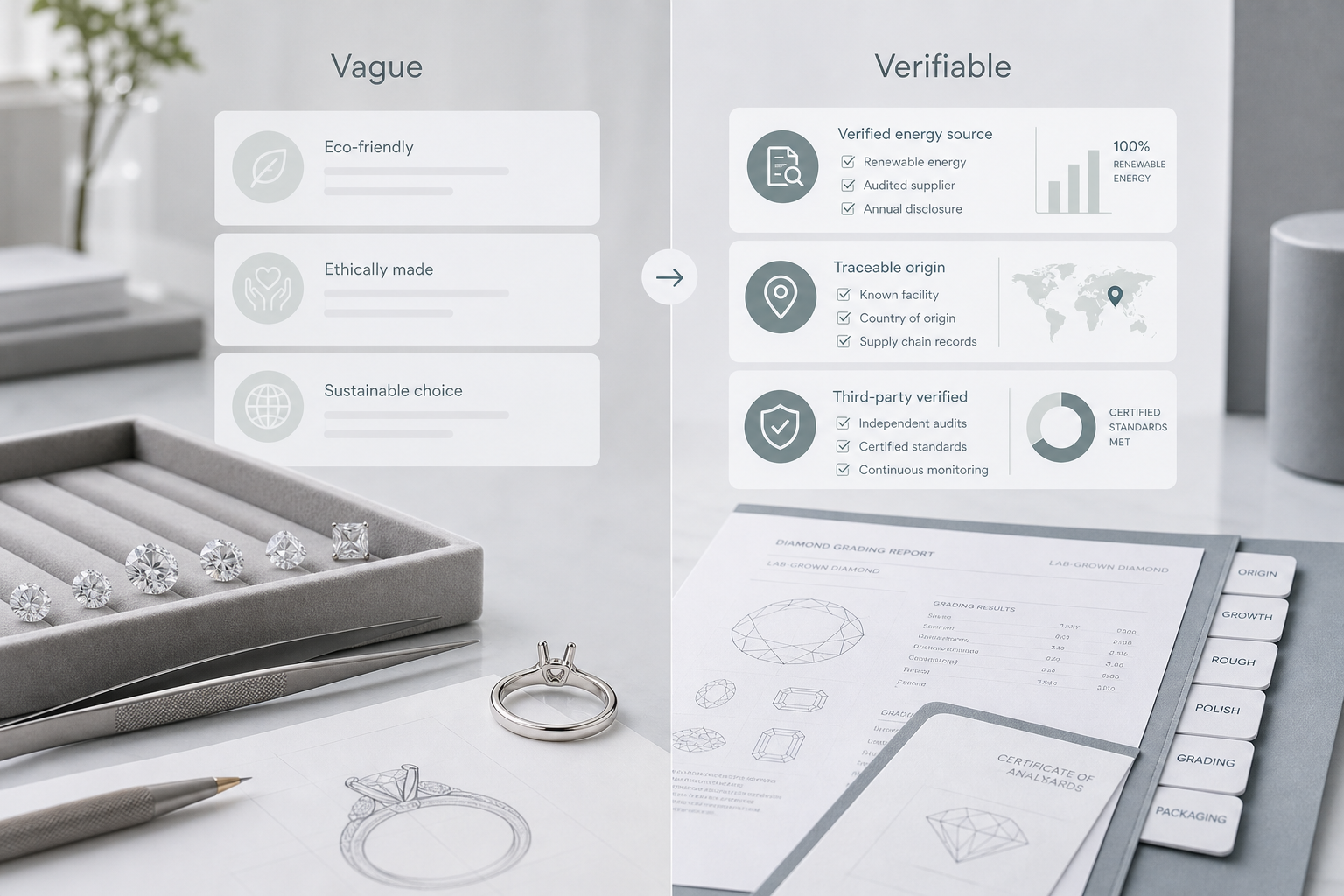
The Claim “Eco-Friendly” Is Too Broad Unless the Brand Defines It
“Eco-friendly” is one of the most common sustainability phrases in jewelry marketing, and one of the least precise. It can point to a real practice, but it can also function as a mood word. On its own, it does not tell a buyer what environmental factor was improved, reduced, avoided, measured, or documented.
The practical problem is that two brands can use the same phrase while meaning completely different things. One may be referring to recycled packaging. Another may mean recycled gold in the setting. Another may be pointing to the lab-grown origin of the diamond. Another may be describing internal company values rather than a product-level practice. Those differences matter because they affect what the buyer is actually getting.
What “Eco-Friendly” Often Leaves Unsaid
An “eco-friendly” jewelry claim can refer to many different parts of the purchase: the energy used in diamond growth, the avoidance of mining, recycled metals, packaging choices, shipping offsets, manufacturing practices, supplier selection, or a broader company philosophy. Without clarification, the phrase does not give the buyer enough information to compare one ring or diamond against another.
The biggest risk is not that “eco-friendly” is automatically false. The risk is that it can be true in a very narrow way while creating a much broader impression. A brand might use recycled mailers and describe its jewelry as eco-friendly, but that tells you little about the diamond’s production energy, the metal sourcing, or the setting’s manufacturing process.
A better product page does not make the buyer guess. It separates the claim from the feeling and explains what the claim applies to. If a brand cannot define “eco-friendly” in practical terms, buyers should treat the word as a starting point for questions, not as proof.
Evidence That Makes an Environmental Claim More Useful
Environmental claims become more useful when the brand connects them to a specific practice and some form of support. For lab-grown diamonds, energy source information can be relevant if the brand can explain what facility, production partner, or process the statement applies to. Manufacturing location transparency can also help, especially when a claim depends on how or where the product was made.
For engagement rings and fine jewelry, metal claims should be separated from diamond claims. If a setting is described as recycled gold or recycled platinum, the buyer should look for documentation or at least a clear explanation of what is being claimed. A recycled metal statement is meaningful for the setting, but it does not automatically say anything about diamond growth, cutting, polishing, or shipping.
Packaging and shipping claims should also be kept in their lane. Compostable packaging, plastic reduction, or carbon-offset shipping may be positive practices, but they are narrower than full product sustainability. The warning sign is when a small operational improvement is used to create a broad impression about the entire diamond or ring.
Third-party certification, reporting, or supplier documentation can improve credibility, but it should not be treated as magic. Buyers should still ask what the document covers, when it was issued, and whether it applies to the product being considered. A certificate or report is strongest when it narrows the claim instead of making it sound larger than it is.
Document Type Matters as Much as Document Existence
When a brand says proof is available, buyers should ask what kind of proof it is. A supplier email, internal policy, product certificate, carbon accounting summary, recycled metal declaration, and diamond grading report are not interchangeable. Each one can be useful, but each supports a different kind of claim. The existence of “documentation” is only meaningful when the document’s purpose matches the marketing statement.
For example, a grading report may help identify diamond characteristics, while a recycled metal declaration may support a setting-metal claim. Neither should be used as a shortcut for proving broad environmental responsibility. If a seller provides a document, the buyer should read the title, issuer, date, product scope, and exclusions before deciding how much weight to give it.
How to Separate Diamond Claims from Jewelry Claims
A sustainability claim may apply to the diamond, the setting, the packaging, the shipping, or the company’s broader operations. Buyers should not assume one claim covers the whole purchase. This is one of the easiest places for greenwashing to appear without using obviously false language.
For example, a product page may say that a ring is made with recycled gold. That is a claim about the setting metal. It does not automatically describe the diamond growth process, the cutting facility, the energy source, or the shipping footprint. If the page visually presents that recycled gold claim next to broader language about sustainability, the buyer may walk away with a stronger impression than the evidence supports.
The more complex the purchase, the more important the boundary becomes. A loose lab-grown diamond has different claim points than a finished engagement ring. A finished ring includes the center stone, accent stones if present, metal, setting labor, packaging, and fulfillment. A strong claim identifies which of those parts it covers instead of letting the buyer assume the best.
For custom design, this separation becomes even more important because the final jewelry item may combine a separately selected center stone with a newly made setting, accent stones, chosen metal, and specific finishing details. A claim attached to the loose diamond should not automatically be applied to the finished ring, and a metal or setting claim should not be used to imply anything about the diamond’s growth method beyond what is actually documented.
Traceability Should Be Component by Component
Traceability is most useful when it follows the actual structure of the jewelry item. A buyer should be able to separate the center diamond, side stones, metal, setting labor, finishing, packaging, and fulfillment instead of treating the ring as one single claim. This is especially important when a product page uses one responsible-sounding phrase to describe a purchase made from several different materials and processes.
For lab-grown diamonds, traceability may include the grading report, disclosed origin information where available, production or supplier information where provided, and consistency between the listed diamond details and the stone being sold. For the setting, traceability may involve metal type, recycled-content claims if made, supplier declarations, and whether the seller can explain what the claim covers. These forms of documentation should not be blended together as if they prove the same thing.
A helpful seller response should make the traceability trail easier to follow. If the seller can say, “this document supports the diamond specification,” “this statement applies only to the setting metal,” and “this carbon language applies only to shipping,” the buyer can make a clearer decision. If every question returns to a broad brand value, traceability has not really improved.
What to Ask When You See “Eco-Friendly”
- Which part of the product is eco-friendly: the diamond, metal, packaging, shipping, or business operation?
- Is there documentation, or is the claim only descriptive language?
- Does the page explain the basis for the claim in plain terms?
- Is the claim current, or is it a general brand value statement?
If the answer only leads back to the same adjective, the claim has not been clarified. A useful answer should make the claim smaller, more specific, and easier to compare.
“Zero Impact” and “No Environmental Impact” Are Claims Buyers Should Treat with Caution
Absolute environmental claims deserve the highest level of skepticism because most physical products involve some combination of energy, materials, equipment, transportation, labor, packaging, and waste. A lab-grown diamond may avoid certain impacts associated with mining, but that does not mean the diamond or jewelry item has no environmental impact at all.
The phrase “zero impact” is much stronger than “reduced impact,” “lower impact in a defined category,” or “produced using documented renewable energy at a specific facility.” A stronger claim requires stronger proof. If a brand uses absolute language without scope, methodology, or verification, the buyer should slow down.
Why Absolute Claims Require Stronger Evidence
“Zero impact” and “no environmental impact” are broad claims because they appear to cover everything. For a buyer, the issue is not whether the phrase sounds positive. The issue is whether any brand can show what was included, what was excluded, how the claim was measured, and who reviewed it.
A meaningful absolute claim would need clear boundaries. Does it refer only to shipping? Company operations? Diamond growth? The finished ring? The entire supply chain? Without those boundaries, the claim becomes too large to evaluate. It may be used to create confidence without giving the buyer a realistic way to test the statement.
Buyers should be especially cautious when absolute language appears on short ads or high-level brand pages but disappears when you reach the product page. If the product page does not clarify the claim, there is a mismatch between the emotional promise and the purchase-level evidence.
Better Language Buyers May See from More Careful Brands
More careful brands often use narrower claims because they are trying not to overstate what they can prove. That is a good sign. A claim such as “produced using documented renewable energy for this facility” is more useful than “100% clean” because it tells the buyer where to look and what question to ask next.
“Setting made with recycled gold” is also stronger than a broad statement that the entire ring is sustainable, as long as the recycled metal claim is documented or explained. The buyer can then understand that the claim applies to the setting, not necessarily to every part of the jewelry item.
Shipping claims should be framed just as carefully. “Carbon emissions offset for shipping through a named provider” is more credible than “zero-impact delivery” because it identifies the activity being addressed and signals that emissions may still have occurred before being compensated for. The distinction is not cosmetic; it changes what the buyer can reasonably believe.
Some comparative environmental statements may also be valid when framed with limits. “Lower land disturbance than mined extraction,” for example, is a specific type of comparison, but it still needs support and should not be stretched into a claim that the product has no environmental footprint. The most trustworthy language usually narrows the claim rather than expanding it.
Where Buyers Should Look for Scope and Boundaries
When evaluating absolute environmental claims, look for words that reveal the boundary of the statement: “scope,” “facility,” “shipping,” “operations,” “product,” “supply chain,” “offset,” “reporting period,” and “verification.” These terms help show what was actually measured instead of what the marketing wants the buyer to feel.
A strong claim names its limit. A weak claim avoids limits because limits make the statement less dramatic. For buying purposes, less dramatic is often better. A claim with a clear boundary can be compared, questioned, and documented. A claim with no boundary can only be accepted on trust.
| Strong Claim to Question | Proof a Buyer Should Look For |
|---|---|
| “Zero environmental impact” | Full scope, measurement method, exclusions, reporting period, and independent verification |
| “100% clean diamonds” | Definition of “clean,” energy source details, production boundary, and supporting documentation |
| “No-impact shipping” | Shipping emissions calculation, offset provider, date, and what shipments are covered |
| “Perfectly sustainable jewelry” | Product component breakdown, metal claims, diamond claims, supply chain limits, and verification basis |
The practical rule is simple: the more absolute the claim, the more complete the lab grown diamond traceability evidence should be. If a brand makes the biggest possible promise but provides only general language, the imbalance itself is the warning sign.
Red Flag Test for Absolute Claims
- The claim uses “zero,” “no impact,” “100% clean,” or “perfectly sustainable” without explaining the methodology.
- No scope is stated, so the buyer cannot tell whether the claim applies to production, shipping, operations, or the full product.
- No third-party review, supporting document, or reporting summary is linked or available.
- The same claim appears on every product regardless of diamond origin, metal type, supplier, setting, or shipping method.
If an absolute claim cannot survive these questions, buyers should treat it as marketing language rather than verified product information.
“Carbon-Neutral” Can Be Meaningful, But Only If the Scope Is Clear
“Carbon-neutral” is one of the more technical-sounding claims in lab-grown diamond marketing, which can make it feel more trustworthy than broad phrases like “eco-friendly.” It can be meaningful, but only if the brand explains what has been measured and what the claim actually covers.
The mistake buyers should avoid is assuming carbon-neutral means no emissions occurred. In most cases, it means emissions were calculated for a defined activity or product boundary, then reduced, offset, or balanced in some stated way. Without that boundary, the claim may sound precise while still leaving out the part of the purchase the buyer cares about most.
What “Carbon-Neutral” Might Refer To
A carbon-neutral claim may refer to the company’s office operations, a specific production facility, the diamond-growing process, the finished jewelry item, shipping, or selected emissions categories. These are not interchangeable. A brand that offsets delivery emissions is making a much narrower claim than a brand claiming carbon neutrality for the full diamond production process.
This is where scope matters. Scope simply means what is included and what is left out. If a product page says a lab-grown diamond engagement ring is carbon-neutral, the buyer should be able to tell whether that includes the diamond, the metal setting, the cutting and polishing process, packaging, shipping, or only the seller’s general business operations.
A common weak spot is company-level language placed near product-level buying decisions. For example, “we operate as a carbon-neutral brand” may tell you something about the company’s reporting, but it does not automatically prove that the specific 2.00 carat oval diamond in your cart was grown, cut, set, and shipped under the same carbon boundary. The broader the wording, the more important the supporting explanation becomes.
The Difference Between Reducing Emissions and Offsetting Emissions
Reducing emissions and offsetting emissions are often discussed together, but they are not the same thing. Reducing emissions means changing the process itself, such as using lower-carbon energy, improving production efficiency, or selecting partners with documented renewable power. Offsetting means emissions still occurred, but the brand supports an outside project intended to balance them, such as a renewable energy or reforestation program.
Offsets are not automatically meaningless, and they are not automatically strong. Their value depends on the quality of the offset program, the emissions that were calculated, the reporting period, and whether the brand made reductions before relying on offsets. A careful brand should be able to explain whether neutrality came from actual reductions, purchased offsets, or a combination of both.
For buyers, the practical judgment is simple: a carbon-neutral claim based mostly on process improvements is different from one based mostly on compensation after the fact. Both may have a role, but they should not be treated as equal without detail. If the brand does not say which one it used, the claim is not specific enough to carry much weight in a purchase decision.
It is also worth checking whether the carbon language is current. A dated assessment, a one-time offset purchase, or an old company-level statement may not describe the product being sold today. Current documentation does not make a claim perfect, but it helps the buyer avoid relying on sustainability language that may no longer match the supply chain, production partner, or shipping practice behind the item.
How to Read a Carbon Claim Without Becoming an Auditor
A buyer does not need to calculate emissions personally, but the claim should still be understandable. Look for three plain-language answers: what activity was measured, what time period was covered, and what action was taken after measurement. If a brand cannot answer those three points, “carbon-neutral” may be functioning more as a trust signal than as a decision-grade claim.
The most useful carbon explanations also separate reductions from offsets. A statement that production electricity came from a documented lower-carbon source is different from a statement that emissions were offset after production. Both may be relevant to a buyer, but they should be described separately so the buyer can understand what actually changed in the process and what was compensated for afterward.
What Documentation Makes a Carbon Claim More Trustworthy
A trustworthy carbon claim does not require the buyer to become a climate auditor, but it should provide enough information to understand the basis of the claim. The strongest support usually identifies the method used to calculate emissions, the boundary of what was included, the time period covered, and any outside verification or registry information.
Useful documentation may include a named carbon accounting method or reporting framework, a clear explanation of whether the claim applies to production, shipping, company operations, or the full jewelry item, and a date showing when the assessment was completed. If offsets are used, the brand should identify the offset provider or project type rather than simply saying emissions were “balanced.”
Third-party review can improve credibility, but it should not be treated as a magic stamp. Buyers still need to ask what the third party reviewed. Verification of shipping emissions is not the same as verification of diamond production emissions. A certificate or summary is most useful when it connects directly to the claim being made, not just to a broad sustainability statement elsewhere on the site.
What to Check Before Trusting “Carbon-Neutral”
- Does the claim cover the diamond, the full ring, shipping, company operations, or only a selected activity?
- Does the brand explain whether neutrality comes from emissions reductions, offsets, or both?
- Is the claim tied to a current reporting period instead of an undated brand statement?
- Can the buyer access a summary, certificate, registry entry, or methodology from a named third party where verification is implied?
- If offsets are used, does the brand identify the offset program or project rather than relying on vague reassurance?
The strongest carbon-neutral language is usually narrower than the most dramatic marketing language. “Shipping emissions offset through a named program for 2024 orders” is less glamorous than “carbon-neutral jewelry,” but it gives the buyer something real to evaluate.
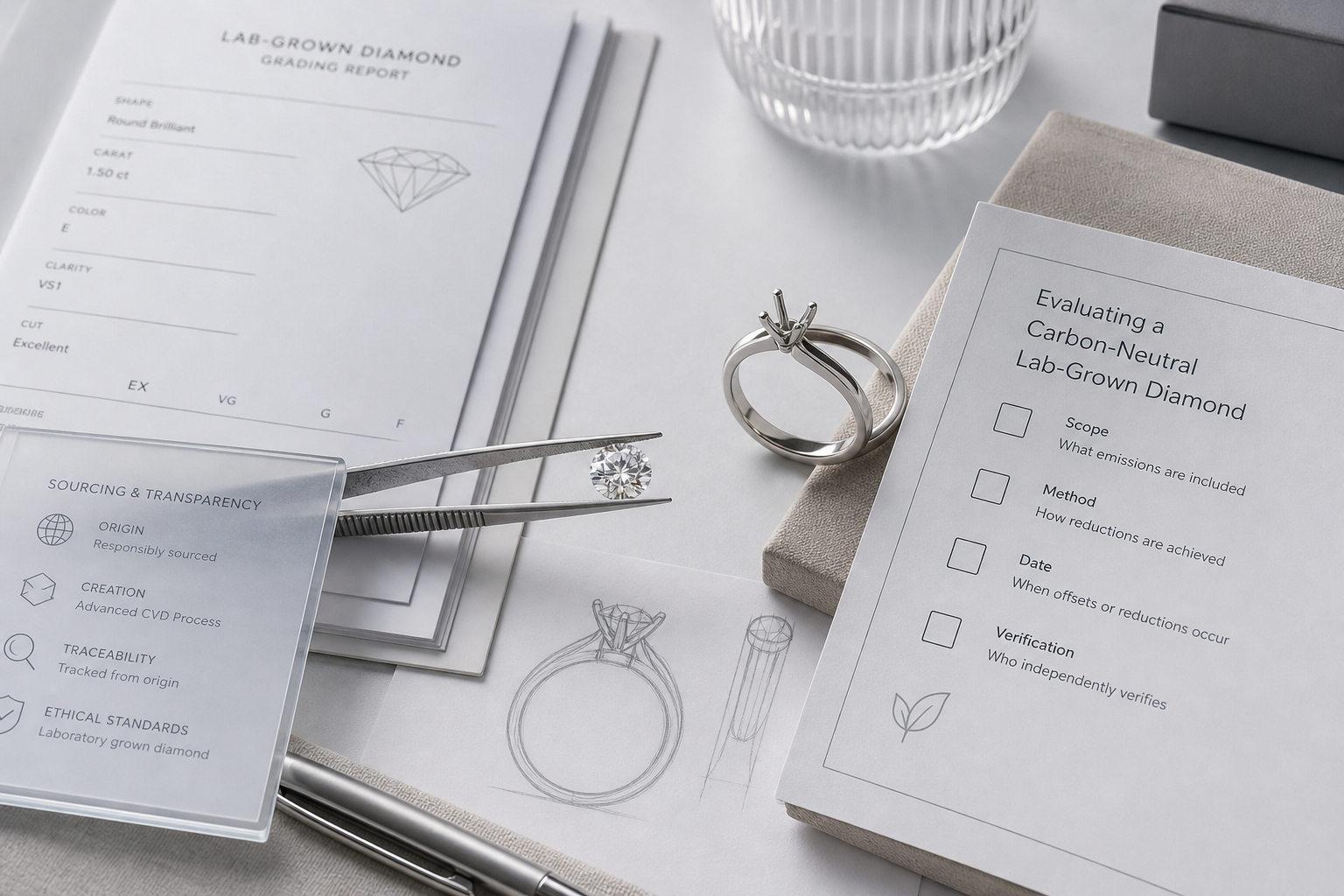
“Conflict-Free” and “Ethical” Are Not the Same Claim
“Conflict-free” and “ethical” are often used close together in jewelry marketing, but they answer different questions. Treating them as the same claim can lead buyers to accept a narrow assurance as if it proves a much broader standard of responsibility.
For lab-grown diamond buyers, the distinction matters because the non-mined origin of the diamond may reduce certain concerns, but it does not automatically answer every question about labor, energy, supplier conduct, cutting, setting, metal sourcing, or disclosure. A claim can be directionally helpful and still be too limited to support the larger ethical message around it.
What “Conflict-Free” Usually Tries to Communicate
Conflict-free language usually tries to communicate that a diamond is not connected to financing armed conflict or certain severe harms associated with conflict-linked extraction. In a lab-grown context, the claim may be easier for brands to position because the diamond is grown rather than mined from the earth.
That does not make “conflict-free” the same as “ethical in every respect.” It is a narrower claim. It may say something about one category of harm, but it does not automatically address workplace conditions, supplier transparency, manufacturing standards, metal sourcing, environmental impact, or how clearly the brand communicates limitations to buyers.
The practical takeaway is that conflict-free can be useful, but it should not be allowed to do too much work. If a product page uses “conflict-free” as the main proof behind a larger ethical claim, buyers should ask what else is being documented beyond the absence of a conflict-mining concern.
Why “Ethical” Needs More Definition
“Ethical” is a broad value claim, not a single measurable fact. In jewelry, it can refer to labor conditions, wages, workplace safety, supplier conduct, human rights policies, energy choices, recycled or responsibly sourced metals, disclosure practices, and how honestly a brand describes what it can and cannot trace.
This does not mean every jewelry brand needs to publish a long sustainability report before it can use responsible language. The better standard is proportional transparency. If a brand makes a broad ethical claim, it should provide at least some concrete practices that support it, such as supplier standards, sourcing policies, product documentation, or a clear explanation of traceability limits.
Buyers should be especially cautious when “ethical” appears only as an adjective. “Ethical lab-grown diamonds” sounds reassuring, but without details it does not tell you which people, processes, or materials were evaluated. A more useful claim might be less dramatic: the diamond has a grading report, the setting metal claim is defined, and the brand can explain what it knows about production and sourcing boundaries.
How Buyers Can Ask Better Ethical Sourcing Questions
The best ethical sourcing questions are specific enough to produce a real answer. Asking “Is this ethical?” usually invites a marketing response. Asking what the brand can document about the diamond, setting, and suppliers makes it harder for vague reassurance to pass as proof.
- Where was the diamond grown, cut, or set, if that information is disclosed?
- What standards or expectations do suppliers follow?
- Does the brand separate diamond sourcing claims from metal sourcing claims?
- Can the brand explain which parts of the supply chain it can trace and which parts it cannot?
- If the product is called ethical, what specific practices support that description?
A strong answer does not have to reveal every proprietary supplier relationship. It should, however, separate known facts from general values. “We cannot disclose every partner, but this is what we verify and this is what we do not claim” is more useful than a polished statement that simply repeats “ethical” in different words.
Buyer Verification Checklist
- Conflict-free: asks whether harm related to conflict financing is avoided or not part of the product’s sourcing context.
- Ethical: asks broader questions about people, sourcing, labor, disclosure, energy choices, and business practices.
- Transparent: asks what the brand can show, document, explain, or honestly define as unknown.
The safest buying approach is to treat these terms as related but separate. A diamond can be described as conflict-free while still needing more evidence before a buyer should accept a broad ethical claim.
“Sustainable” Should Be Backed by Specific Practices, Not Just Brand Values
“Sustainable” is one of the most appealing words in lab-grown diamond marketing, and also one of the easiest to overuse. A brand may genuinely care about sustainability, but values are not the same as verification. Buyers need to know which practices apply to the product they are actually considering.
Mission statements can provide useful context. They may show how a company thinks about responsible jewelry, sourcing, packaging, energy, or customer education. But a mission statement by itself does not prove that a specific lab-grown diamond ring has lower impact, recycled metal, documented emissions boundaries, or traceable production details.
Brand Values Versus Product-Level Evidence
The key difference is whether the claim stays at the brand level or reaches the product level. “We believe in sustainable jewelry” tells you about positioning. “This setting is made with recycled 14k gold, and documentation is available on request” tells you something you can evaluate.
Product-level evidence matters most at the point of purchase because that is where buyers make tradeoffs. A buyer choosing between two engagement rings is not only comparing brand values. They are comparing a specific diamond, a specific setting, a specific price, and specific claims attached to that item.
Prices can change with market conditions, report type, seller channel, and stone-specific details, so exact comparisons should be verified at the time of purchase.
A constructive way to read sustainability language is to ask whether the brand moves from belief to practice. If the page stops at values, the claim is weak. If it identifies the component, gives the basis for the claim, and makes documentation available, the claim becomes more useful even if the wording is less dramatic.
The Evidence Ladder: From Weak to Strong Sustainability Support
Buyers can use a simple five-level evidence ladder to judge how much weight to give a sustainability claim. This is not a legal standard. It is a practical way to separate vague language from information that can guide a real purchase.
- Level 1: Vague adjective only. A phrase like “green,” “planet-friendly,” or “conscious luxury” sounds positive but does not identify a practice, product component, or proof. This level should carry the least weight.
- Level 2: A practice is named, but not documented. For example, a brand says it uses recycled packaging. That is more specific than “green,” but it does not say whether the diamond, ring setting, or production process has any supporting evidence.
- Level 3: The product component is identified. A claim such as “setting made with recycled gold” or “lab-grown diamond with grading report available” gives the buyer a clearer boundary. It still needs support, but at least the claim points to the right part of the purchase.
- Level 4: Documentation, supplier information, certification, or methodology is included. This might mean a grading report number, recycled metal documentation, a stated carbon accounting method, or a clear explanation of how the claim was evaluated.
- Level 5: Product-specific or batch-relevant evidence includes date, scope, and verification. This is the strongest level because the claim is tied to a defined product, timeframe, and supporting source rather than a general brand identity.
The biggest jump is usually from Level 2 to Level 3. Many claims sound responsible because they name a practice, but they still do not tell the buyer whether that practice applies to the diamond, the setting, the packaging, or the company in general. If you cannot identify the component, you cannot compare the claim fairly against another seller.
Product Page Details That Signal Better Transparency
A transparent product page does not need to be overloaded with technical documents, but it should give buyers enough detail to know what they are purchasing and which claims are attached to it. The absence of basic product-level information is a warning sign when the page also uses strong sustainability language.
Useful details include diamond grading report availability, a report number where applicable, metal type, setting details, whether recycled content is claimed, and a clear explanation of any environmental or ethical terms used on the page. If the brand mentions carbon-neutral shipping, recycled gold, responsible sourcing, or sustainable production, the page should either explain the basis or point buyers toward supporting information.
Diamond origin or production disclosure can also be useful when provided, but buyers should be careful not to overread it. Knowing that a diamond is lab-grown is helpful, but it does not automatically settle the energy, carbon, labor, or supplier transparency questions. A grading report helps confirm diamond characteristics; it does not prove every sustainability claim attached to the jewelry.
A grading report should also be used for what it is designed to do: document diamond characteristics such as carat weight, color, clarity, shape, measurements, and other grading information provided by the issuing lab. It is not evidence that a diamond was produced with renewable energy, that the metal is recycled, or that a carbon claim has been verified. Treating diamond grading and sustainability documentation as separate forms of evidence helps prevent one document from being asked to prove too much.
When a grading report is available, buyers should verify the report details through the issuing laboratory’s official report-check tool where available, then compare those details with the stone’s visuals, measurements, and intended jewelry use.
What This Means in a Real Purchase
Consider Maya, who is comparing two 1.50 carat lab-grown oval engagement rings. Brand A describes its ring as “the most sustainable diamond choice” but gives no product-level evidence. There is no clear explanation of whether the claim refers to the diamond, the setting, the packaging, shipping, or company operations.
Brand B uses less dramatic language. It shows the diamond grading report details, identifies the setting metal, states that the recycled gold claim applies to the ring setting, and explains that the carbon-neutral language refers only to shipping emissions through a named program.
Brand B may sound less impressive at first glance, but it gives Maya more to verify before purchase. That is the better buying position. In responsible jewelry marketing, careful limits often create more trust than sweeping claims because they show the buyer where the evidence begins and where it ends.
Vague Comparison Claims Can Mislead Even When the General Idea Sounds Reasonable
Comparative language is powerful because it sounds like a conclusion has already been reached. A phrase such as “better for the planet” or “the responsible alternative” can feel reassuring, especially when a buyer is already leaning toward a lab-grown diamond. The problem is that a comparison is only useful if the brand tells you what is being compared and how that comparison was made.
A lab-grown diamond claim can be directionally reasonable and still be incomplete. Avoiding mined extraction may matter to many buyers, but that does not automatically answer questions about energy use, production location, cutting and polishing, metal sourcing, shipping, labor standards, or documentation. The practical mistake is treating one advantage as proof of superiority across every sustainability and ethics category.
Why Comparative Claims Need a Baseline
Any “better than” claim needs a baseline. Better in what way, compared with what, and based on which data? Without those three pieces, the claim may be more emotional than informative.
For example, a brand might be referring to land disturbance when it says lab-grown diamonds are a better option. That is a different claim from saying they have a lower carbon footprint, stronger traceability, better labor practices, lower water impact, or fewer supply-chain risks. These categories do not all move together. A product can perform well in one area and still leave open questions in another.
The baseline also matters because “mined diamonds” and “lab-grown diamonds” are not single uniform products. Production methods, energy sources, facilities, cutting locations, metal choices, and documentation practices vary. A broad category comparison can hide those differences. For buyers, the safer approach is to treat the comparison as a starting point, not as proof.
When “Better” Is Too Broad to Be Useful
Some claims should immediately trigger follow-up questions because they sound complete without actually giving the buyer anything to verify. Common examples include “better for the planet,” “the ethical choice,” “clean diamonds,” “guilt-free luxury,” and “sustainable by nature.” These phrases may be appealing, but they do not tell you what changed in the product, what was measured, or what evidence supports the conclusion.
The risk is not only that the claim may be exaggerated. The bigger issue is that broad language can make buyers stop asking more precise questions. “Clean diamonds,” for instance, could be meant to suggest non-mined origin, renewable energy, responsible labor, carbon offsets, recycled metals, or simply a modern brand identity. Those are not interchangeable claims.
A useful claim narrows the comparison. “This setting uses recycled 14k gold” gives the buyer a specific product component to evaluate. “Shipping emissions are offset through a named program” gives the buyer a defined scope. “Better for the planet” gives no such boundary unless the brand explains the basis behind it.
How to Reframe a Broad Comparison into a Useful Question
The best way to handle vague comparison claims is not to reject them automatically. It is to translate them into questions that can be answered. Instead of asking, “Is this better?” ask, “What environmental factor is being measured?” That one shift forces the claim to move from a general impression to a specific category such as energy, land disturbance, materials, packaging, or shipping.
Instead of asking, “Is this ethical?” ask, “Which sourcing and labor practices are documented?” Ethical language is too broad to verify unless the brand names the people, processes, or standards involved. A company does not need to disclose every proprietary supplier detail to be credible, but it should be able to explain what it knows, what it verifies, and where the limits are.
Instead of asking, “Is this conflict-free?” ask, “What does that term mean for this product?” For a lab-grown diamond, the answer may relate to non-mined origin, supplier controls, or broader sourcing policies. The strongest response will separate what applies to the diamond from what applies to the metal, setting, packaging, or company operations.
What to Check Before You Decide
- If the claim compares two categories, ask for the comparison basis. A useful answer should name the factor being compared, not just repeat the conclusion.
- If the claim uses emotional language, ask for factual support. Words like “clean,” “guilt-free,” and “responsible” need product-level context before they should influence a purchase.
- If the claim sounds absolute, ask for scope and verification. The broader the claim, the stronger the evidence should be.
Red Flags in Ads, Product Pages, and Brand Stories
Greenwashing rarely appears in only one place. It often starts in an ad, becomes more polished on a product page, and is reinforced through a brand story. Each format has a different job, so buyers should judge each one differently. An ad can be short. A product page should be specific. A brand story can explain values, but it should not replace evidence.
The most important distinction is where the claim appears. A vague sustainability phrase in an ad is a prompt to click through and look for details. The same vague phrase on a product page, with no added explanation, is a stronger warning sign because that is where purchase-relevant information should be easiest to find.
Ad Red Flags: Big Claims in Small Spaces
Ads simplify. That is normal. A short phrase, a green visual, or a sustainability badge may be designed to catch attention before the buyer reaches the full product information. The issue is not that an ad cannot explain everything. The issue is when the landing page also fails to explain anything.
Be cautious when an ad uses absolute claims with no link to details. Phrases such as “zero impact,” “100% sustainable,” or “perfectly clean” need more support than a lifestyle image or a short caption can provide. If the ad leads to a page that repeats the phrase but never defines the scope, the claim is not helping you evaluate the purchase.
Environmental icons can also create an impression without evidence. Leaves, green backgrounds, planet graphics, and “eco” badges may suggest responsibility, but visuals are not proof. For buyers assessing lab grown diamond sustainability, a more useful ad points toward a defined claim, such as recycled metal, documented shipping offsets, or a grading report available for review.
Discount messaging paired with vague sustainability language deserves extra caution. A low price is not a sustainability credential. If the page pushes urgency while leaving the environmental or ethical claim unexplained, the buyer may be nudged to act before asking the questions that matter.
Product Page Red Flags: Missing Details Where They Matter Most
The product page is where sustainability language should become more precise. If a lab-grown diamond or engagement ring is described as sustainable, ethical, carbon-neutral, or eco-friendly, the page should help the buyer understand what part of the purchase that claim applies to. If it does not, the claim has limited decision value.
A missing grading report or unclear report availability is a practical red flag. A grading report does not prove sustainability, but it helps establish what diamond is being discussed. Without basic diamond documentation, broader transparency claims become harder to evaluate because the product itself is not clearly anchored.
A grading report helps document key characteristics, but it should not be treated as a guarantee of beauty, value, or sourcing ethics.
Another warning sign is when the page blends diamond, setting, packaging, and shipping claims together. A ring may have a documented recycled gold setting, while the diamond production process is not documented in the same way. Or a brand may offset shipping emissions while saying little about production. These may still be worthwhile practices, but they should not be presented as if they describe the entire product equally.
A product page should also give buyers a way to ask documentation questions. If a brand makes sustainability claims but offers no practical contact path, no policy page, no report summary, and no explanation of terms, the buyer has little to work with beyond trust.
In practical buying, product media and specifications should also support the basic diamond decision. Videos, photos, measurements, and report details do not verify environmental claims, but they help confirm whether the stone being marketed is the stone the buyer is evaluating. When sustainability language is detailed but diamond information is thin, buyers should not let responsible-sounding language replace normal quality review.
Proof Should Be Easy to Find at the Moment of Decision
Evidence does not have to appear in every advertisement, but it should be reachable before checkout. If a buyer must search through unrelated blog posts, old social captions, vague FAQ answers, or unsupported badges to understand a product-level claim, the claim is not being presented in a buyer-friendly way. Important sustainability language should connect naturally to the product page, policy page, report summary, or seller response that explains it.
This matters because jewelry purchases often involve emotion, urgency, and comparison pressure. When a claim influences trust, it should be available in the same decision path as price, metal choice, diamond specifications, ring size, return policy, and delivery timing. A responsible seller should make it easier, not harder, to understand what is documented before the buyer commits.
Brand Story Red Flags: Values Without Verifiable Practices
Brand stories can be meaningful. A founder’s reason for building a jewelry company, a commitment to modern sourcing, or a desire to make diamond buying less intimidating can all give useful context. But values are not the same as verification. A story should support the evidence, not substitute for it.
Be careful when a founder story does the work that documentation should do. If the brand talks at length about purpose, care, and responsibility but never explains how diamonds are selected, what reports are provided, what metal claims apply, or how carbon language is scoped, the story may be creating trust without giving buyers a way to test it.
Repeated mission language is another sign to slow down. If the same sustainability phrase appears on the homepage, product pages, social ads, and about page with no extra detail anywhere, the brand may be relying on repetition instead of evidence. The strongest brand stories become more specific as the buyer moves closer to purchase.
Moral superiority is also a warning sign when it is not matched by practices. A brand can explain why it favors lab-grown diamonds without implying that every buyer who chooses differently is irresponsible. Careful language tends to signal better discipline. Overconfident moral language often signals that the claim is being used to close the sale rather than clarify the product.
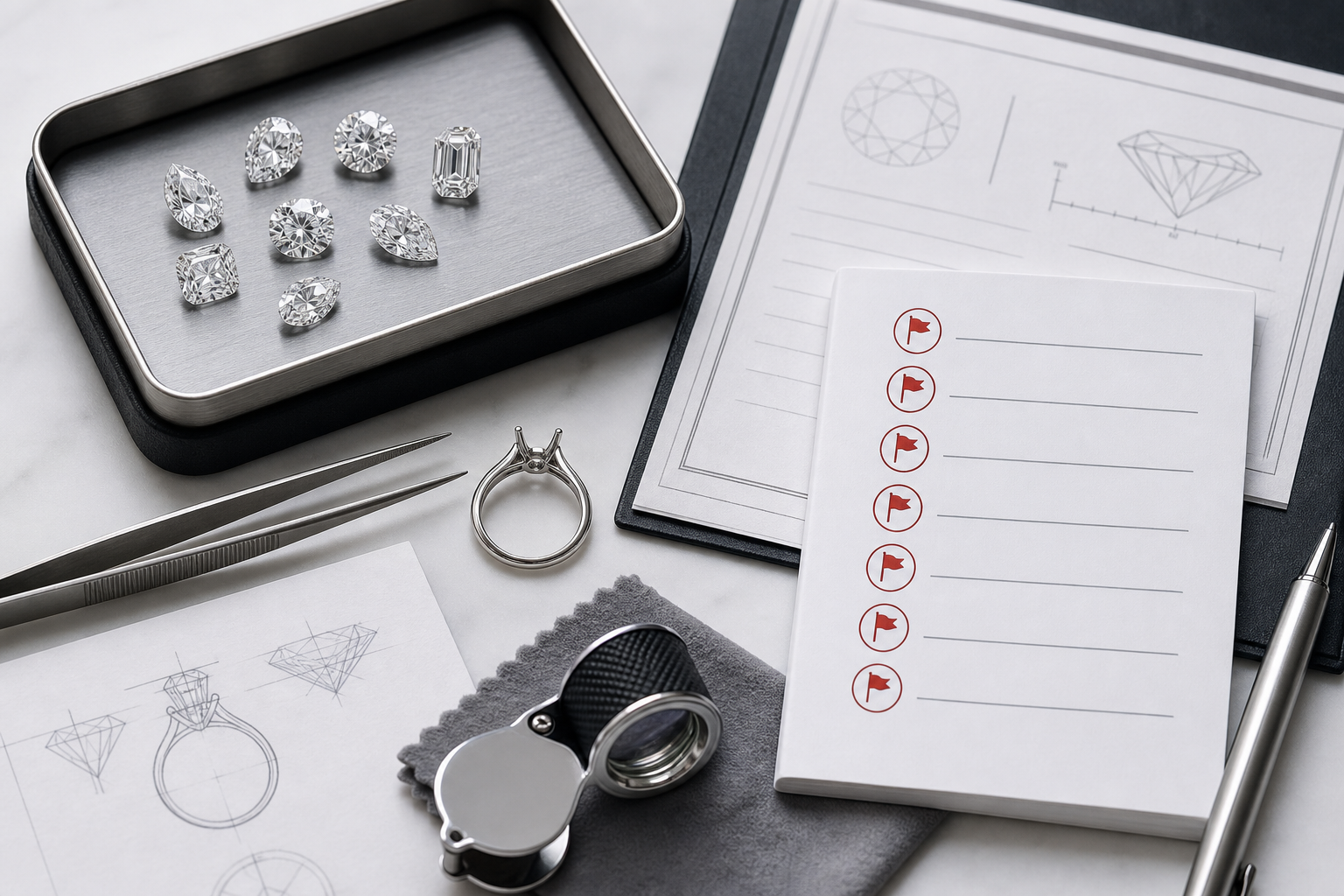
The 7-Point Red Flag Scan
- 1. Is the claim specific?
- 2. Is the product component identified?
- 3. Is the scope stated?
- 4. Is the evidence accessible?
- 5. Is there a date or reporting period?
- 6. Is a third party named where verification is implied?
- 7. Does the claim avoid absolute language?
If a claim fails one point, it may simply need clarification. If it fails several, treat it as marketing language rather than decision-grade evidence.
What More Responsible Sustainability Language Sounds Like
Trustworthy sustainability language is often less dramatic than greenwashing. It may sound narrower, more technical, or more cautious because the brand is trying not to claim more than it can support. For buyers, that restraint is a strength. A limited claim with evidence is more useful than a sweeping claim that feels better but proves less.
The clearest brands do not ask buyers to accept a mood. They define the claim, identify the product component, and show where the evidence begins and ends. That kind of language may not be as catchy as “guilt-free luxury,” but it gives the buyer something to compare.
Specific Claims Are Usually More Useful Than Grand Claims
A stronger sustainability claim usually names the object, the practice, and the evidence. “This ring setting is made with recycled 14k gold,” if supported, tells the buyer the claim applies to the setting metal. It does not pretend to describe the diamond growth process, the packaging, or the full company footprint.
“The diamond comes with a grading report from a named lab” is also useful, but for a different reason. It does not prove that the diamond is sustainable. It gives the buyer a product-specific document to review, which makes the purchase more transparent and reduces the chance of relying only on marketing claims.
Carbon language should be equally bounded. “Our shipping emissions are offset through a named program,” if the scope is stated, is more credible than “carbon-neutral jewelry” with no explanation. It tells the buyer that the claim applies to shipping, not necessarily diamond production, metal sourcing, or the entire supply chain.
Even partial transparency can be valuable when it is honest. A brand that says, “We are working to improve supplier transparency,” may sound less polished than one claiming full ethical perfection, but the first statement can be more trustworthy if it accurately reflects what the company can verify. Responsible language does not need to be grand to be meaningful.
Honest Limits Can Increase Trust
Transparency is not only what a brand proves; it is also how clearly it defines the limits of what it knows. A company that explains what is documented, what is supplier-provided, and what is not currently available gives buyers a more realistic basis for judgment.
This does not mean every credible brand must publish every supplier name, contract, or internal sourcing detail. Some information may be commercially sensitive or difficult to trace at a product-specific level. The key question is whether the brand acknowledges those limits plainly or covers them with broad reassurance.
At NUVU, we treat sustainability language carefully because a claim that sounds stronger than the evidence can create the wrong kind of confidence. For buyers, the better signal is not perfection. It is a clear explanation of what applies to the diamond, what applies to the setting, and what remains a general brand value.
How Buyers Should Evaluate Brand Responses
If you contact a brand before purchasing, pay attention to the quality of the answer, not just the friendliness of the response. A strong answer addresses the exact question asked. If you ask whether a carbon-neutral claim applies to production or shipping, the brand should not respond only with a general statement about caring for the planet.
Good responses separate verified facts from values. A brand might say, “The recycled metal claim applies to the setting, and documentation is available from our supplier,” or “The carbon claim applies only to shipping for this order.” These answers may be limited, but they give you something concrete to evaluate.
A weaker response often repeats the marketing phrase, shifts the conversation to romance or price, or implies that asking for documentation is unnecessary. Pressure is also a warning sign. A responsible seller should be able to answer reasonable questions without making the buyer feel difficult for asking.
Email Questions Buyers Can Send Before Purchase
- “When you describe this ring as sustainable, which product components does that refer to?”
- “Do you have documentation for the recycled metal or carbon claim?”
- “Does the carbon-neutral claim apply to production, shipping, company operations, or something else?”
- “Can you share the grading report details for this diamond?”
The goal is not to demand perfect proof for every possible claim. It is to see whether the seller can move from broad language to clear, product-relevant information before you commit.
How to Make a Confident Purchase Without Demanding Perfect Proof
Responsible buying does not require perfect information. If you wait for every environmental, labor, sourcing, and carbon question to be answered with complete product-level proof, you may end up with an impossible standard rather than a better purchase. The more useful goal is to separate reasonable evidence from vague reassurance, then decide whether the remaining uncertainty is acceptable for your priorities.
A strong purchase decision usually comes from three things working together: a diamond you can evaluate, a seller willing to explain its claims, and sustainability language that stays within the evidence. If one of those pieces is missing, the purchase may still be possible, but the buyer should know which part is based on documentation and which part is based on trust.
Decide Which Sustainability Factors Actually Matter to You
Before comparing brands, choose the two or three sustainability factors that matter most to you. One buyer may care most about avoiding mined origin. Another may focus on carbon claims, recycled metals, labor transparency, or whether the seller can provide documentation without vague promises. Trying to optimize every issue equally often makes the decision noisier, not clearer.
The highest-priority factor should be the one that would actually change your purchase. If a carbon-neutral claim matters to you, ask what it covers and how it is supported. If recycled metal matters more, focus on whether the claim applies to the setting and whether documentation is available. If transparency is your main concern, a seller that gives narrower but clearer answers may be a better fit than one using more dramatic sustainability language.
This is where many buyers make a subtle mistake: they treat “responsible” as one single score. It is not. A lab-grown diamond engagement ring combines a diamond, a setting, metal sourcing, production partners, packaging, shipping, grading documentation, and seller communication. A brand may be strong in one area and less specific in another. The question is not whether the purchase is perfect; the question is whether the evidence supports the claims that influenced your decision.
Use a Practical Evidence Threshold
A practical evidence threshold helps you avoid two bad outcomes: accepting every green claim at face value or becoming so skeptical that no purchase feels possible. For most consumers, the minimum standard should be clear diamond report details and no unsupported absolute claims. If a seller cannot provide basic grading information or relies on language like “zero impact” without scope or proof, that is a meaningful warning sign.
A better standard is product-level explanation. If a product page says a ring is sustainable, it should identify what that refers to: the lab-grown diamond, recycled metal, shipping, packaging, company operations, or some combination of those. This level of detail is more useful than a broad mission statement because it lets you compare one ring or diamond against another.
The strongest standard includes documentation, scope, dates, and third-party verification where relevant. That does not mean every claim needs a complex report, but stronger claims deserve stronger support. A recycled gold claim should be tied to the metal. A carbon-neutral claim should explain the boundary and reporting period. A grading claim should point to a report that can be reviewed. This follows the same logic as the evidence ladder: the closer a claim gets to product-specific, dated, and verifiable support, the more weight it deserves in your decision.
This threshold is a buying tool, not a legal standard. Its purpose is to help you decide how much confidence a claim should receive. A modest claim with clear support should usually carry more weight than a sweeping claim with no visible basis.
Balance Sustainability Claims with Diamond Quality and Fit
Sustainability language should be evaluated alongside diamond quality, not instead of it. A responsible-sounding product page does not remove the need to review the diamond’s grading report, shape, cut quality, measurements, clarity characteristics, color appearance, setting compatibility, and total cost. A purchase can be well-marketed and still be a poor fit if the diamond does not perform well visually or suit the ring design.
This matters most with engagement rings, where the diamond is not being bought in isolation. An elongated oval, a cushion, a round brilliant, and an emerald cut can all present size, brightness, and clarity differently. A sustainability claim may help you evaluate the seller’s transparency, but it will not tell you whether a stone faces up well, whether its proportions are balanced, or whether the setting protects the shape appropriately for daily wear.
Buyers who want a more complete decision should review diamond certification information, compare loose lab-grown diamonds by report and visual details, and consider how the chosen stone works with the engagement ring setting. For custom jewelry, the same logic applies with even more force: the diamond, metal, design, and documentation should be evaluated together before the order is finalized.
For custom design, trust comes from matching the stone to the setting, budget, and wearer’s daily use—not from choosing grades or sustainability language in isolation. Before finalizing a stone, buyers should confirm practical fit points such as measurements, shape compatibility, setting style, prong coverage, metal choice, and whether any documentation claims apply to the finished piece or only to one component.
For custom jewelry, stone measurements and setting compatibility should be confirmed before finalizing a purchase.
At NUVU, this is how we encourage buyers to think about transparency: a clear claim is valuable, but it should support the purchase decision rather than distract from the diamond itself. The best outcome is not a ring with the loudest sustainability language; it is a ring where the buyer understands what is documented, what is being claimed, and why the diamond is the right fit.
NUVU’s role in buyer education is to make comparison clearer, especially around grading reports, visual evidence, design fit, and documentation boundaries. Before purchase, buyers should also confirm the seller’s return, resizing, and after-sales terms in writing.
Final Buyer Decision Checklist
- The sustainability claim is specific enough to understand.
- The product component is identified: diamond, setting, metal, packaging, shipping, or company operations.
- The evidence is visible on the page or available on request.
- The diamond grading report can be reviewed before purchase.
- The seller avoids absolute claims unless the scope and support are clearly explained.
- The buyer understands what is verified and what remains a general brand value.
FAQ: Common Questions About Greenwashing and Lab-Grown Diamonds
Are Lab-Grown Diamonds Automatically Sustainable?
No. Lab-grown origin can be part of a responsible buying decision, but it does not automatically prove low energy use, renewable power, carbon neutrality, recycled metals, or full supply-chain transparency. A stronger claim explains what was measured, what part of the product it applies to, and what evidence supports it.
Is “Conflict-Free” Enough to Prove a Diamond Is Ethical?
No. “Conflict-free” is narrower than “ethical.” It usually points to avoiding certain conflict-related harms, but it does not answer every question about labor conditions, supplier practices, energy use, metal sourcing, disclosure, or business conduct. If a brand uses both terms as if they mean the same thing, ask for the difference in writing.
Should I Avoid a Brand If It Uses the Word “Eco-Friendly”?
Not necessarily. “Eco-friendly” is a prompt to ask better questions, not an automatic reason to walk away. The concern is whether the brand defines the claim. If it explains the specific practice, identifies the product component, and provides evidence where appropriate, the term may be supported. If it appears only as a mood word, it should carry little weight.
What Is the Most Important Sustainability Question to Ask Before Buying?
Ask: “What exactly does this claim apply to, and what evidence supports it?” That single question cuts through most vague marketing because it forces the seller to identify the scope, the product component, and the proof behind the statement.
Where to Go Next Before You Buy
Once you can read sustainability claims more carefully, the next step is to connect that judgment to the actual diamond or ring you are considering. A responsible purchase is not built on one phrase. It comes from comparing documentation, product fit, seller communication, and the limits of what each claim can prove.
Useful Next Research Steps
If grading reports and documentation are still unclear, review a lab-grown diamond certification guide before comparing stones. A grading report will not prove every sustainability claim, but it does help you verify the diamond’s core quality characteristics and avoid relying only on product descriptions.
If a brand makes broad comparison claims, a lab-grown versus natural diamond guide can help you understand where category-level comparisons are useful and where they become too general. The key is to avoid letting a broad comparison replace product-specific evidence.
If you are choosing a loose stone, use a loose lab-grown diamond buying guide to evaluate report details, measurements, cut quality, and visual performance. If you are buying a full ring, an engagement ring setting guide can help you judge whether the diamond shape, metal, prong style, and daily-wear needs work together. For custom engagement rings, documentation and design transparency should be part of the same conversation from the beginning.
Shape guides are also useful because sustainability language does not tell you how a diamond will look on the hand. A well-documented stone still needs the right proportions, appearance, and setting match for the person who will wear it.
A Clearer Way to Buy with NUVU
NUVU’s approach is to make lab-grown diamond buying easier to compare, not more dramatic. Clear grading information, practical education, and straightforward answers matter more than broad claims that promise too much. If a sustainability statement affects your decision, ask what it applies to before you commit.
When comparing lab-grown diamonds, start with stones that provide clear report information and enough detail to make a rational choice. If you are considering an engagement ring or custom design, bring your documentation questions into the conversation early. A good buying process should make room for those questions without pressure or vague reassurance.
What This Guide Is Meant to Help You Do
This guide is not a full lab-grown versus natural diamond comparison, and it is not a technical sustainability report. Its purpose is more practical: to help you read diamond marketing with enough clarity to know which claims deserve trust, which ones need follow-up, and which ones should not influence the purchase at all.
It is also not a certification guide, although grading reports and third-party documentation can be useful tools. A certificate helps verify diamond quality details; it does not automatically verify every environmental or ethical statement on a product page. The same restraint applies to price: a lower price does not make a sustainability claim stronger, and a higher price does not make it more credible.
The best use of this information is not cynicism. It is confidence. Careful, limited language is often more trustworthy than dramatic claims because it shows the seller understands the boundary between what can be proven and what is simply a brand value.
Reader Value Check
- You can recognize vague sustainability language in lab-grown diamond marketing.
- You know which questions to ask about eco-friendly, zero-impact, carbon-neutral, conflict-free, ethical, and sustainable claims.
- You can separate product-level evidence from general brand values.
- You understand why careful, limited language may be more trustworthy than dramatic promises.
- You can move toward a purchase with confidence, not suspicion for its own sake.
Disclosure: This article is for general educational purposes only. Diamond grading, pricing, availability, specifications, and seller policies can change, and readers should verify important details through grading reports, official laboratory tools, seller documentation, or qualified professionals before making a purchase decision. Laboratory-grown diamonds should be clearly distinguished from natural diamonds, and environmental or sourcing claims should be supported by specific documentation.