
SCS-007 can help support certain sustainability claims for diamonds, but in a lab-grown versus mined diamond comparison, it is easy to give the certificate more weight than it deserves. A sustainability document may verify a specific standard, facility, supplier program, batch, or individual stone claim, yet it does not prove that the diamond is beautiful, well cut, fairly priced, or the lowest-impact choice available.
For the full framework, read Are Lab-Grown Diamonds More Sustainable?.
This article helps separate useful documentation from vague reassurance. You will see how to read the scope of a certificate, how it differs from a gemological grading report, and when it should influence a purchase. The practical goal is simple: use SCS-007 as one trust signal, not as a substitute for comparing diamond quality, visual performance, measurements, setting fit, and seller transparency.
Evidence note: A sustainability certificate is most useful when the buyer can see the actual certificate language, not only a product-page badge. If the seller cannot provide the certificate, verification path, covered entity, claim wording, or a written explanation of how the document connects to the diamond, the claim should be treated as incomplete rather than assumed to be false or true.
| What You Are Checking | Why It Matters | Best Buyer Action |
|---|---|---|
| Certificate scope | May apply to a stone, batch, facility, supplier, or brand program | Ask what exactly is covered |
| Gemological report | Confirms identity, 4Cs, measurements, and grading details | Review separately from sustainability claims |
| Claim wording | Broad terms can hide limited verification | Look for precise, documented claims |
| Stone-level match | Decision value drops if the document cannot be linked to the diamond | Match report numbers, carat weight, and listing details |
| Price premium | Certification can add confidence but not fix poor value | Compare similar stones before paying more |
| Seller explanation | Clear answers show whether the claim is understood and supportable | Request written confirmation of scope |
Quick Questions Before You Read
Q: Does SCS-007 prove a diamond is high quality?
No. It relates to specific sustainability claims, not cut quality, beauty, grading, or value.
Q: Is a sustainability certificate the same as a grading report?
No. A grading report evaluates diamond characteristics; a sustainability certificate supports defined sourcing or impact-related claims.
Q: Should I pay more for a certified sustainable diamond?
Only if the diamond is already a strong choice and the certificate is specific, verifiable, and relevant.
Q: What is the biggest red flag?
A vague badge or claim that cannot be clearly connected to the exact diamond or documented scope.
SCS-007 Sustainable Diamond Certification: The Short Answer Buyers Need First
SCS-007 diamond certification is a sustainability-focused assessment system for diamonds. For a buyer, its practical value is that it can help substantiate certain sustainability claims through a defined standard rather than leaving you to rely on vague marketing language. It can make a diamond’s sustainability story more structured, more documentable, and easier to question.
It should not settle the entire purchase decision. A sustainability rated diamond is not automatically the most beautiful diamond, the best-priced diamond, the lowest-impact diamond in every possible comparison, or the right stone for your ring. Sustainable diamond certification can be useful, but it answers only the questions it was designed to address.
Practical buyer judgment: The most reliable way to use SCS-007 is to treat it as a documentation tool, not a quality shortcut. A buyer should still ask whether the diamond has a suitable grading report, whether the stone looks good in available media, whether the measurements fit the intended design, and whether the seller can explain the sustainability claim without stretching it beyond the certificate language.
Origin and Terminology Boundary for Lab-Grown Diamonds
When this article refers to a lab-grown diamond, it means a laboratory-grown diamond with the same basic diamond material as a diamond, but with a different origin from a natural diamond. Laboratory-grown diamonds should be clearly identified as laboratory-grown, and they should not be presented as mined diamonds. Diamond simulants are a separate category and should not be confused with laboratory-grown diamonds.
This distinction matters in sustainability discussions because origin, production context, and documentation are part of the claim being evaluated. A grading report or seller description should clearly disclose laboratory-grown origin when relevant, while a sustainability certificate should be read for the specific claim it supports rather than as a general statement that all lab-grown diamonds share the same environmental profile.
What SCS-007 Is Trying to Do
SCS-007 is intended to evaluate sustainability-related diamond claims against a diamond sustainability standard. It is not a beauty grade, a cut grade, a resale value estimate, or a promise that one stone is superior in every way. Its job is closer to claim verification: it looks at whether certain sustainability statements are supported by documentation and assessed through a third-party process.
That distinction matters because buyers often see the word “certified” and assume it carries the same meaning across every document. A lab-grown diamond certification from a gemological laboratory may tell you about the diamond’s identity and quality characteristics. A third-party sustainability rating focuses on sustainability-related criteria, traceability documentation, or responsible production claims, depending on the standard and the certificate language.
The strongest use of SCS-007 is not as a shortcut. It is a filter for better questions. If a seller says a diamond is “sustainable,” the next question is not whether the word sounds convincing. It is what was evaluated, who evaluated it, what evidence was reviewed, and how directly the claim connects to the diamond being offered.
Supportable-claim test: Before relying on any sustainability statement, separate the claim into three parts: the exact words used by the seller, the exact words used on the certificate, and the purchase item the claim is attached to. If those three pieces do not align, the safest interpretation is narrower than the marketing language. For example, a facility-level certification may support a statement about a facility or production program, but it should not automatically be read as individual stone-level verification unless the documentation says so.
What a Buyer Should Not Assume from the Certificate Alone
A certified sustainable diamond should still be judged as a diamond. The certificate may support sustainability claims, but it does not replace a gemological report, stone video, proportions, measurements, cut evaluation, or price comparison. A diamond can have sustainability documentation and still be a poor fit for a specific setting, a weak performer visually, or priced higher than comparable options.
The most common mistake is treating the certificate as a total approval stamp. If you are buying an engagement ring, the stone still needs to work in the design. If you are comparing loose diamonds, the sustainability certificate should sit beside the grading report, not above it. If the sustainability claim is broad or unclear, the certificate may add less purchase-specific value than it appears to at first glance.
This does not make the certificate unimportant. It means the certificate has a defined role. It can help substantiate specific claims, but it does not prove that every other buying factor has been handled well.
How to Verify a Traceability Claim in Practice
Traceability claims are most useful when they can be traced back to a specific document trail. If a seller says a diamond is traceable, ask what level of traceability is being claimed. Stone-level traceability should name the exact diamond or report number. Batch-level traceability should explain how the listed stone belongs to that batch. Facility-level traceability should be described as broader production or sourcing context, not as individual stone proof unless the documentation clearly says so.
If the certificate is not public, request the issuer name, certificate number, issue date, and the exact claim wording. Then compare those details with the product listing and any gemological report. A missing lookup portal does not automatically mean the claim is false, but it does mean the buyer should keep confidence limited until the seller provides a clearer explanation.
When a sustainability report or certificate is available, buyers should verify the document details through the issuing organization’s official lookup tool where available and compare the wording with the seller’s listing.
The One-Sentence Decision Framework
Use sustainable diamond certification as one trust signal, then check the certificate scope, gemological report, actual stone quality, seller transparency, and fit for the jewelry you plan to make or buy.
That order is intentional. Scope comes first because a sustainability claim is only useful if you know what it applies to. A certificate connected to an individual diamond gives a buyer a different level of confidence than a broad company-level claim. Both may have value, but they do not carry the same decision weight.
What to Check Before You Decide
- Certificate issuer: Confirm who issued the sustainability certificate and whether the issuer is clearly named.
- Certificate number: Look for a certificate or verification number if one is available.
- Standard version: Check whether the document identifies the SCS-007 standard or another sustainability standard version.
- Covered claims: Read what the certificate actually says, not just the badge or logo shown on a product page.
- Stone identity connection: Confirm whether the certificate applies to the exact diamond, a batch, a facility, a brand program, or another level of claim.
- Seller explanation: Ask the seller to explain how the sustainability rating relates to the diamond being sold.
If the seller cannot connect the sustainability document to the actual purchase in plain English, the certificate may still be real, but its usefulness for your decision is limited. The buyer risk is not only false claims; it is also overreading a real document.
What Sustainability Certification Tries to Verify in a Diamond
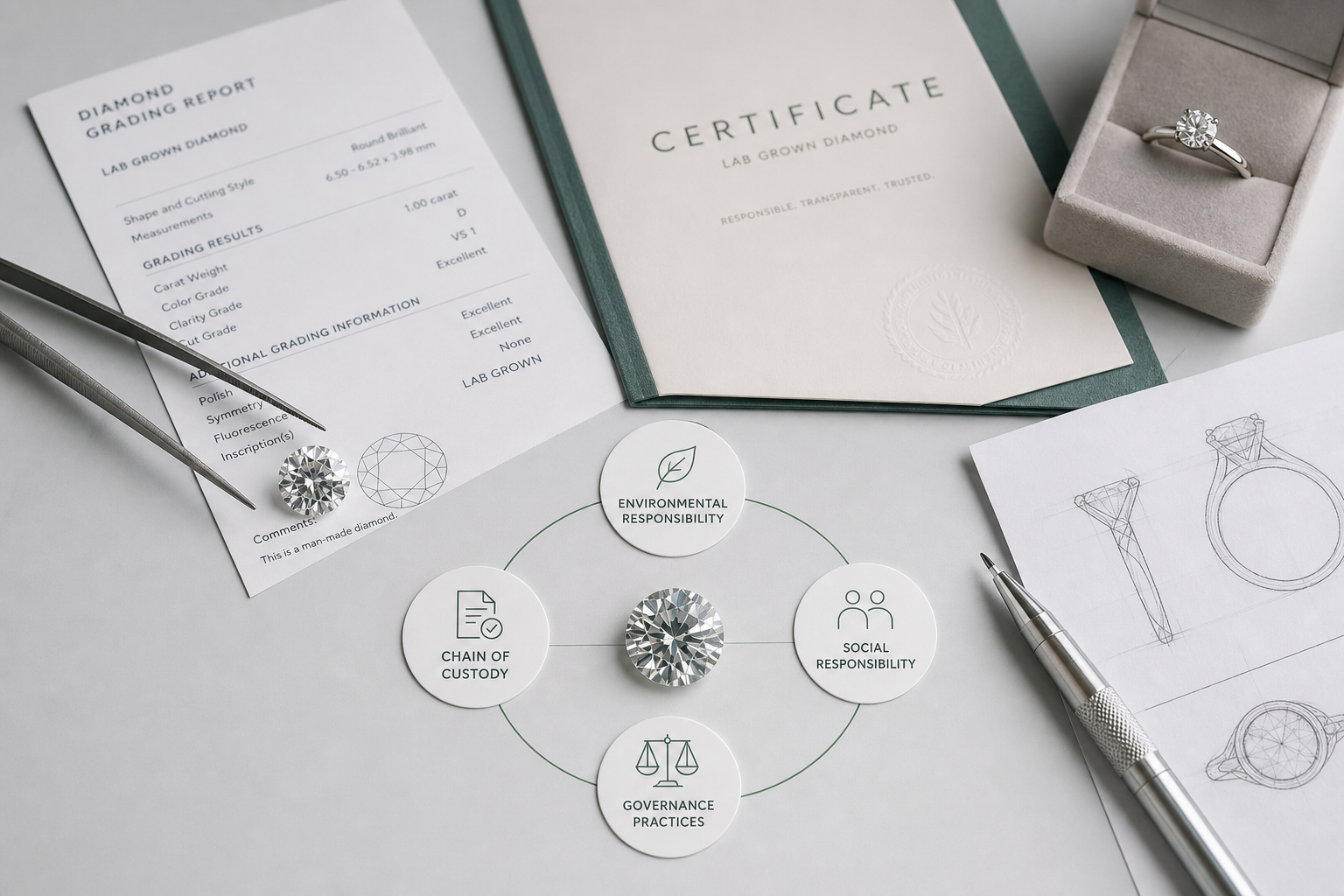
Sustainable diamond certification tries to bring structure to claims that are otherwise easy to oversimplify. A diamond sustainability rating may examine environmental impact, social responsibility, governance practices, chain of custody, or claims management, depending on the standard. The point is not to turn sustainability into a slogan. The point is to define what is being reviewed and what evidence supports the claim.
This is especially important because sustainability language can sound more precise than it is. Words such as “responsible,” “eco-conscious,” and “ethical” are broad unless they are tied to a standard, documentation, and a clear product scope. A system such as the SCS-007 standard can help organize those claims, but buyers still need to confirm what the certificate actually covers.
Environmental Factors: Energy, Emissions, and Production Practices
Environmental criteria may examine energy use, emissions-related claims, production practices, mitigation steps, or documented sustainability efforts. The exact review depends on the standard and the claim being made. A certificate that supports a climate-related statement, for example, is not the same thing as a general statement that a diamond is environmentally superior to every alternative.
The practical question for buyers is not simply, “Is this diamond sustainable?” A better question is, “Which environmental claim has been evaluated?” If the certificate refers to production practices, that is different from verifying a carbon-related claim. If it references a facility or program, that is different from identifying a specific stone’s production footprint. Those differences affect how much weight the document should carry in a purchase decision.
Buyers should be cautious with absolute language. Unless the certificate explicitly supports a claim such as carbon neutrality, low emissions, or a particular environmental rating, the safer interpretation is that the diamond was evaluated under defined criteria, not that every possible environmental question has been answered.
Sustainability Wording That Needs Documentation
Environmental and sustainability claims should be specific, documented, and limited to what can be substantiated. Broad words such as “green,” “eco-friendly,” “ethical,” “conflict-free,” or “carbon-neutral” can be meaningful only when the seller can explain the exact basis for the claim and show documentation that supports that wording. Without that context, the safer reading is that the claim is marketing language rather than verified evidence.
For laboratory-grown diamonds, buyers should not assume that origin alone proves a particular environmental result. Lab-grown diamonds offer a different sourcing path from mined diamonds, but production practices, electricity sources, facility controls, and documentation can vary. If a seller makes a specific emissions, energy, or responsible production claim, ask whether the certificate addresses that exact claim or only a broader sustainability program.
Social and Governance Factors: Beyond the Stone Itself
Sustainability certification can also include social responsibility and governance factors. These may relate to labor policies, business conduct, transparency, responsible sourcing, supplier controls, or documented management practices. In this sense, ESG diamond certification may look beyond the physical stone and into how claims are managed by the companies involved.
This is useful, but it should be read carefully. A certificate may indicate that certain policies, practices, or documentation were reviewed. It does not prove perfect behavior across every part of a business or supply chain. Buyers should treat social and governance criteria as areas of assessment, not as moral guarantees.
The clearest value appears when the certification language is specific. “Reviewed against defined responsible sourcing criteria” gives a buyer more to work with than a general claim that a diamond is “ethically made.” Specific language creates accountability. Vague language leaves too much room for interpretation.
Chain-of-Custody and Traceability Claims
Chain of custody matters because sustainability claims need an anchor. A buyer should know whether the claim is connected to the exact diamond, a production batch, a manufacturing facility, a supplier, or a broader brand program. Without that connection, a sustainability statement may describe something real but not necessarily something purchase-specific.
This is where traceability can change the strength of the claim. If documentation links directly to an individual diamond, the buyer can more easily connect the certificate to the stone being considered. If the claim applies to a batch or facility, it may still be meaningful, but the buyer needs to understand how the seller connects that broader documentation to the listed diamond.
The mistake to avoid is assuming all traceability language means the same thing. “Traceable to a facility” is not identical to “verified for this individual stone.” “Covered under a company program” is not the same as “documented through stone-level identification.” The narrower the scope, the easier it is for a buyer to apply the claim to a specific purchase.
Important limitation: Traceability is not the same as full impact proof. A document may show where a stone, batch, or claim is connected, but it may not answer every question about energy source, emissions treatment, labor controls, transportation, or downstream jewelry manufacturing. Buyers should separate “we can trace this claim” from “every sustainability concern has been resolved.”
How to Verify the Scope of the Claim
Start by identifying what the certificate names as the covered product or entity. If it lists an individual diamond, look for identifying details that can be compared with the seller listing or gemological report. If it covers a batch, ask how the seller knows the diamond came from that batch. If it covers a facility, brand program, or supply-chain claim, ask what part of the diamond’s journey is included and what part is not.
Narrower scope is usually easier to verify at the buyer level. Broader scope can still matter, especially when it reflects documented practices across a company or production system, but it requires more context. A broad claim should not be dismissed automatically; it simply should not be treated as if it gives the same purchase-specific proof as stone-level documentation.
A practical rule is to ask for the shortest clear explanation that connects the certificate to the diamond. If that explanation becomes confusing, overly general, or dependent on marketing language instead of documentation, the buyer should slow down before giving the certification much weight.
What an SCS-007 Certificate Can Actually Prove
An SCS-007 certificate can prove that a sustainability-related claim was assessed under a defined standard, provided the certificate is valid, properly issued, and clearly connected to the claim being made. That is meaningful. It gives the buyer more than a seller’s unsupported statement and creates a document that can be read, questioned, and compared.
The careful wording matters. A sustainable diamond certificate does not prove “sustainability” in a universal sense. It can support verified claims within its certification scope. For buyers, that difference is the line between useful documentation and overconfidence.
It Can Show That a Diamond Was Evaluated Against a Defined Standard
The strongest value of third-party diamond certification in this context is structure. A seller saying “this diamond is sustainable” is a claim. A certificate referencing a named diamond sustainability standard adds criteria, documentation requirements, and a review process. It tells the buyer that the claim was not simply invented for a product page.
This does not mean every certificate carries the same level of detail or that every claim has the same strength. The certificate should be read for what it actually assessed. A strong document makes the basis of the claim easier to understand. A weak presentation relies on a logo without showing enough supporting language.
For a buyer comparing options, this structure can reduce uncertainty. It does not remove judgment, but it gives you something concrete to inspect instead of asking you to trust a broad sustainability statement on its own.
It Can Support Specific Sustainability Claims
An SCS-007 certificate may support specific claims related to traceability, production practices, climate-related statements, sustainability performance categories, or responsible production, depending on what the document says. The certificate language is more important than the label attached to it. A badge may say “certified,” but the wording explains what was certified.
This is where buyers should slow down. If the claim is “sustainability rated diamond,” the useful question is the rating for what. If the claim is “traceable,” the useful question is traceable to where, and at what level. If the claim mentions climate performance, the useful question is what evidence or standard supports that statement.
The best certificates make the claim narrower and clearer, not broader and more dramatic. A specific claim that is well documented is usually more valuable than a sweeping claim that sounds impressive but gives the buyer little to verify.
It Can Help Buyers Compare Transparency Levels
Certification can be especially helpful when two diamonds look similar on paper. If both stones have comparable carat weight, color, clarity, and visual performance, but one also includes a documented sustainability rating with clear traceability details, that additional transparency may be a legitimate reason to prefer it.
The certificate should not win the comparison by itself. If the certified diamond has weak proportions, disappointing video performance, mismatched documentation, or a price that is hard to justify, the sustainability certificate should not distract from those problems. Transparency adds value when the underlying diamond is already a strong candidate.
The practical judgment is simple: use the certificate as a tie-breaker or confidence builder, not as a rescue tool. It is most useful when it confirms a priority you already care about and when the rest of the diamond still makes sense.
Certificate Language Buyers Should Read Closely
- Certified entity: Identify whether the certificate names a diamond, supplier, producer, facility, brand, or program.
- Certificate number: Look for a unique number or reference that can be checked if a verification system exists.
- Date: Review when the certificate was issued and whether any validity period is shown.
- Standard version: Confirm which version of the SCS-007 standard or other diamond sustainability standard is referenced.
- Covered product: Check whether the document applies to the exact stone, a batch, a production source, or a broader claim.
- Claim wording: Read the precise language around traceability, sustainability rating, climate claims, or responsible production.
- Rating level: If a rating is shown, understand what the rating describes before treating it as a broad quality signal.
- Limitations or exclusions: Look for language that narrows what the certificate does and does not cover.
- Verification portal: If a portal or certificate lookup is available, use it rather than relying only on a screenshot or seller summary.
A reliable certificate should make the sustainability claim easier to understand, not harder. If the document exists but the seller cannot explain its scope, connection, or limitations clearly, the buyer should treat the claim as incomplete until those gaps are answered.
What Sustainable Diamond Certification Does Not Prove
Sustainable diamond certification limits matter because a certificate can be useful and still be incomplete. SCS-007 limitations are not a flaw in the idea of certification; they are a reminder that every standard has a defined scope. The real diamond certification meaning depends on what was evaluated, what evidence was reviewed, and how closely the claim connects to the diamond being sold.
A sustainability certificate should reduce reliance on vague marketing claims, but it should not remove buyer due diligence. The risk is not that certification is meaningless. The risk is treating it as a shortcut for questions it was never designed to answer.
It Does Not Prove the Diamond Is Automatically the “Most Sustainable” Option
A sustainability certificate does not mean a diamond is automatically the most sustainable option available. Sustainability is comparative, and the comparison depends on the production method, energy source, facility practices, documentation scope, transportation, and the specific claim being made. A certified diamond may have stronger documentation than an uncertified one, but that is not the same as proving absolute environmental superiority across the entire market.
This distinction matters when buyers ask, “Does SCS-007 prove a diamond is eco-friendly?” A better question, especially in discussions of recycled gold and lab-grown diamonds, is whether the certificate supports a specific sustainability claim under a defined standard. If the document verifies a rating, traceability element, or climate-related claim, that is valuable information. It still does not prove that no other diamond has a lower footprint, better production context, or stronger evidence under a different framework.
The common mistake is turning a rating into a universal ranking. Unless the certificate explicitly compares the diamond against a stated benchmark or category, buyers should not read it as proof that the stone is the lowest-impact choice. It is evidence, not the entire comparison.
It Does Not Replace the Need to Review Energy and Production Context
Terms such as “sustainable,” “low impact,” and “climate neutral” depend heavily on details. For lab-grown diamonds, energy use can vary by facility, growth method, production efficiency, electricity source, and any steps taken to address emissions. A certificate may help document some of those claims, but buyers should avoid assuming that all lab-grown diamonds share the same production footprint.
This is where greenwashing risk often appears. A seller may use broad sustainability language while giving little information about the actual production context. If a certificate is presented, the buyer should still ask what it covers. Does it address energy-related claims directly, or does it focus on another part of the sustainability framework? Does it apply to the individual stone, a production group, a facility, or a company-level program?
The strongest buying position is not skepticism for its own sake. It is precision. If a diamond is described as climate neutral, responsibly produced, or sustainability rated, the supporting document should make clear what claim was evaluated. If the language is broader than the evidence, the claim deserves closer review.
It Does Not Grade Beauty, Cut Quality, or Value
Sustainable diamond certification does not grade how beautiful the diamond looks. It does not replace a diamond grading report, visual review, or price comparison. A sustainability certificate will not tell you whether an oval has a noticeable bow-tie, whether a round diamond has strong light return, whether an emerald cut has distracting inclusions, or whether the stone’s measurements suit the setting.
This boundary is especially important for engagement ring shoppers. A diamond can have impressive sustainability documentation and still be the wrong choice if the cut appearance is weak, the proportions look unbalanced, the color is not right for the setting, or the price is too high compared with similar stones. Sustainability documentation can support confidence, but it should not rescue a poor diamond selection.
For a purchase decision, the hierarchy should be clear: first confirm that the stone itself is right for the ring, then evaluate whether the documentation supports the claims being made. Cut, proportions, color, clarity, carat weight, measurements, images, video, and price still matter. A certificate can strengthen the decision only after the diamond works visually and practically.
Red Flags in Sustainability Claims
Buyers should be cautious when sustainability language sounds stronger than the documentation behind it. The most common warning sign is vague “eco-friendly” wording with no certificate, report, verification page, or explanation of what was actually evaluated. A logo by itself is not enough if the seller cannot provide certificate details or connect the claim to the diamond being offered.
- Vague claims without evidence: Phrases like “green,” “ethical,” or “planet-friendly” should be backed by specific documentation, not used as stand-alone selling points.
- Badges without certificate details: A sustainability logo should lead to an issuer, certificate number, standard name, date, or verification path.
- No connection to the specific diamond: If the claim applies only to a broad company program, buyers should know that before treating it as stone-level proof.
- Refusal to explain scope: A seller should be able to say whether the certification applies to the diamond, batch, facility, supplier, or brand claim.
- Absolute language: Claims such as “100% sustainable” or “the most ethical diamond” deserve scrutiny unless the certificate clearly defines and supports that wording.
The practical rule is simple: the more absolute the claim sounds, the more specific the proof should be. A well-documented sustainability claim can add confidence, but a broad claim with unclear scope should not carry much weight in the buying decision.
How to handle unsupported claims: If a seller uses a broad term such as “eco-friendly,” “ethical,” “green,” or “responsibly made,” ask them to restate the claim in document-based language. A more defensible answer would identify the certificate issuer, the covered entity, the claim category, and any limits shown on the document. If the seller cannot narrow the claim, buyers should avoid treating the wording as verified evidence.
Sustainability Certificate vs Gemological Report: Why Buyers Need Both
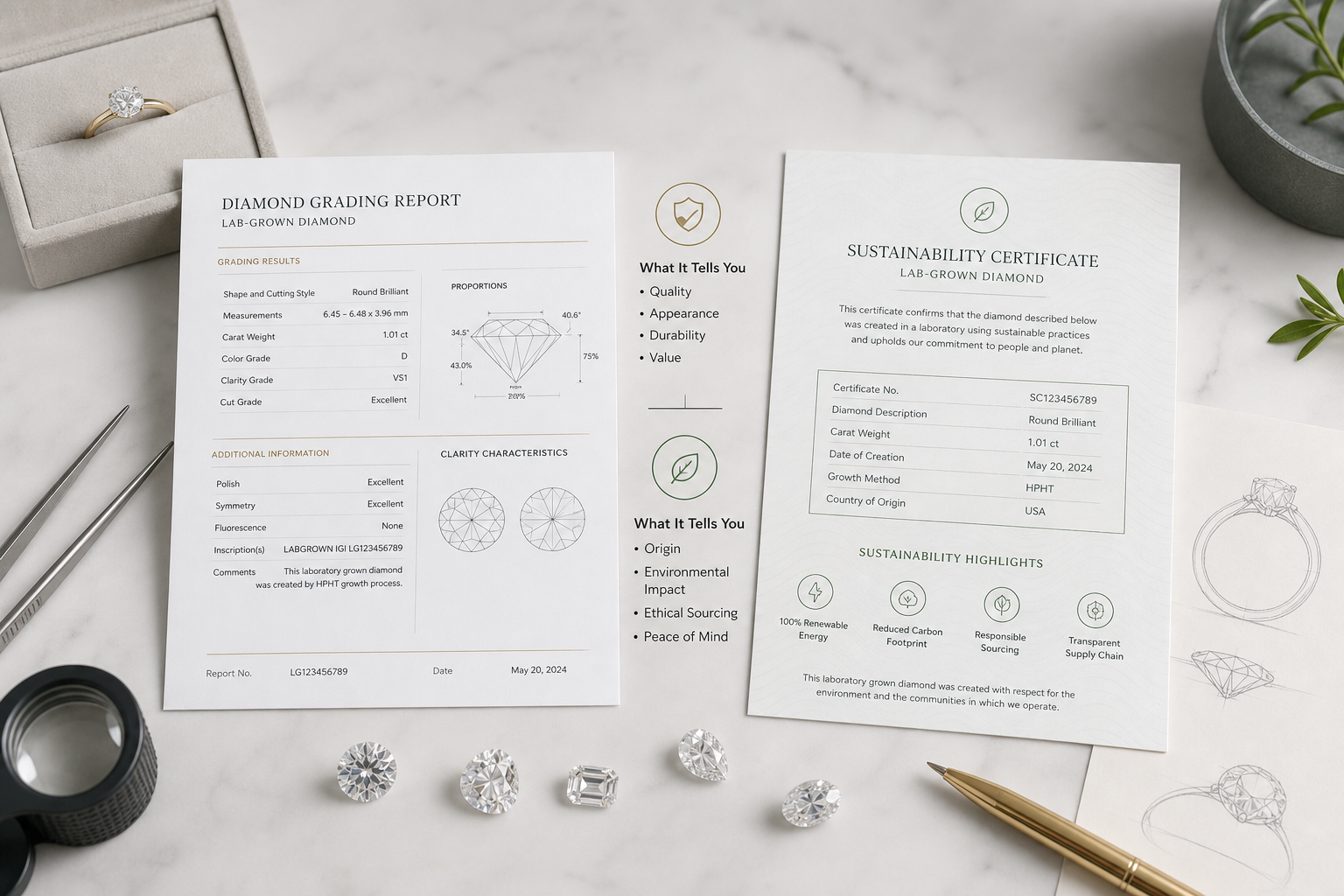
The difference between a gemological report vs sustainability certificate is not a technicality. These documents answer different buyer questions. A diamond grading report helps identify and describe the stone. A sustainable diamond rating helps evaluate certain claims about production, sourcing, traceability, or sustainability practices. One does not replace the other.
This distinction prevents a costly mistake. A buyer who relies only on a sustainability certificate may miss quality issues. A buyer who relies only on an IGI report, GIA report, or other lab-grown diamond report may assume the stone’s sustainability claims have been verified when they have not. Certificate verification should include both identity and claim review.
Useful distinction: A grading report is strongest when it helps you confirm the diamond being sold; a sustainability certificate is strongest when it helps you confirm the claim being made. Neither document proves the seller’s entire story by itself. The buyer’s job is to make sure the listing, report, certificate, stone media, and final invoice are all describing the same purchase consistently.
What a Gemological Report Tells You
A gemological report typically addresses the diamond itself. For a lab-grown diamond, it may confirm lab-grown origin, carat weight, measurements, color grade, clarity grade, and, for some shapes, cut-related information. It may also include a report number and laser inscription details if the stone is inscribed.
The buyer value is concrete: the report helps confirm what is being sold. If a listing says a diamond is 1.50 carats, F color, VS1 clarity, and lab-grown, the grading report is the document that should support those identity and quality characteristics. It also gives buyers a way to compare stones with similar specifications, though it still should not replace images, video, and proportion review.
What the report does not usually tell you is whether a sustainability claim is true. A diamond quality grading document is not designed to verify energy use, facility practices, ESG criteria, or chain-of-custody claims. Treating a grading report as sustainability proof is reading more into the document than it provides.
What a Sustainability Rating Tells You
A sustainability rating addresses a different category of information. Depending on the standard and certificate scope, it may relate to production practices, traceability, responsible sourcing, governance, climate-related claims, or other sustainability performance criteria. It is meant to support claims about how the diamond, supplier, facility, or program was evaluated.
The buyer value is transparency, not beauty grading. A sustainability certificate may help answer whether a claim was reviewed by a third party under a defined standard. It does not tell you whether the stone faces up bright, whether the shape is flattering, whether the inclusions are visible, or whether the price is competitive.
This is why “certified sustainable diamond” should not be treated as a complete buying answer. It may describe one important layer of documentation. It does not describe the whole diamond.
How the Two Documents Work Together
A useful way to separate the documents is this: the gemological report helps confirm what the diamond is; the sustainability certificate helps evaluate certain claims about how it was produced, sourced, or documented. Both can matter, but they do not compete with each other.
For example, suppose a buyer is considering a 1.50 ct oval lab-grown diamond for an engagement ring. The grading report can confirm the carat weight, measurements, color, clarity, lab-grown status, and report number. The sustainability certificate, if provided, may show that a sustainability claim was assessed under a defined standard and may explain whether the claim connects to that stone, a batch, a facility, or a seller program.
The better purchase is not automatically the diamond with more paperwork. The better purchase is the one where the documents match the listing, the stone performs well visually, the sustainability claim is clearly scoped, and the total price makes sense. Documentation should narrow uncertainty, not distract from the actual diamond.
Certification Does Not Guarantee Beauty, Value, or Sourcing Ethics
A grading report helps document key characteristics, but it should not be treated as a guarantee of beauty, value, or sourcing ethics. A report can describe laboratory-grown origin, measurements, color, clarity, and other graded characteristics, yet the buyer still needs to evaluate the stone’s appearance, setting compatibility, seller documentation, and the exact sustainability claim being made.
Similarly, a sustainability certificate should not be treated as a substitute for a gemological report. It may support a defined claim about production, traceability, or a sustainability framework, but it does not identify every physical attribute of the diamond. The safest buying process is to let each document do its own job and avoid using either one to prove more than it actually states.
Document Pairing Checklist
Before relying on both documents, buyers should confirm that they are looking at the same purchase, not two unrelated pieces of information. Start with the gemological report and match the report number, laser inscription if available, carat weight, measurements, shape, color, and clarity against the seller listing. Any mismatch should be explained before purchase.
Then review the sustainability certificate connection. Does the certificate name the exact diamond, reference the same report number, identify a batch or production lot, or apply to a broader supplier or brand claim? Broader documentation can still matter, but it should not be described as individual stone-level verification if the certificate does not support that connection.
If the seller cannot explain how the grading report and sustainability certificate relate to the same diamond or claim, the buyer should pause. The issue may be a simple documentation gap, but it is still a gap that affects confidence.
How to Read a Sustainable Diamond Certificate Without Getting Misled
Learning how to read a sustainable diamond certificate is less about becoming a technical auditor and more about checking whether the document supports the seller’s claim. SCS-007 verification, or any diamond certificate verification process, should help a normal buyer answer three practical questions: who issued the document, what was evaluated, and how directly it connects to the diamond being considered.
The biggest mistake is stopping at the badge. A badge may signal that some form of certification exists, but the certificate text is where the useful limits appear. If the wording is unclear, the buyer should treat the claim as incomplete until the seller explains it in writing.
Start with the Issuer, Standard, and Version
Begin by identifying the issuing organization. A sustainability certificate should clearly show who issued it, not only the seller using it in marketing. The issuer matters because the buyer is relying on a third-party process, not just a brand statement.
Next, check the standard name and version. If the certificate references SCS-007 or another diamond sustainability standard, the document should identify the framework used. A version number or date helps show which criteria were applied. Buyers do not need to audit the full standard, but they should know which standard their confidence is based on.
Also look for the effective date, audit date, issue date, expiration date, or validity period if shown. Older documentation is not automatically useless, but timing matters when claims involve current production practices, facility status, or ongoing programs. A certificate that is outdated, undated, or impossible to verify deserves a direct follow-up question.
Check the Product Scope and Identity Link
The most important part of certificate reading is scope. A certificate may apply to an individual diamond, a batch or production lot, a facility, a supplier, a brand program, or a broader claim. These are not interchangeable.
Individual stone documentation gives the clearest connection to a purchase because it can be tied directly to the diamond being considered. Batch-level documentation may still be useful, especially if the seller can show that the diamond came from that batch. Facility-level or company-level documentation can indicate broader practices, but it does not prove that every claim applies to every stone in the same way.
The practical question is not whether broader documentation is bad. It is whether the seller is describing it accurately. If a company-level sustainability claim is marketed as though it proves the exact diamond has a specific verified profile, the wording may overreach. Buyers should ask for the identity link: report number, certificate number, batch reference, product description, or written confirmation explaining how the claim connects to the stone.
Read the Claim Language, Not Just the Badge
A certificate badge may say “certified,” but the claim language tells you what was actually certified. This is where buyers can avoid being misled by broad sustainability language. Look for the exact wording: “rated under a standard,” “traceable to a source,” “verified claim,” “climate-related claim supported,” or “certified sustainable” may each mean different things depending on the document.
Precise wording is usually a good sign. A certificate that names the claim, defines the scope, and provides verification details is more useful than a marketing statement that simply says the diamond is sustainable. If the seller’s language is stronger than the certificate’s language, rely on the certificate, not the sales copy.
At NUVU, we usually encourage buyers to treat sustainability claims as questions first: what is being claimed, who reviewed it, and how does it connect to this diamond? That approach keeps the certificate in the right role—as a trust signal that still needs to be matched against the rest of the purchase.
What to Ask for in a Documentation Packet
For buyers comparing multiple lab-grown diamonds, a useful packet is more than a single badge. Ask for the grading report, the certificate number or verification link, the exact claim wording, and any written note explaining whether the sustainability document applies to the stone, batch, facility, or program. If the seller uses marketing copy that is broader than the documents, ask them to restate the claim more narrowly.
This approach is especially helpful for custom orders, where the setting can change the practical value of the stone. A diamond that works well in one ring may not suit another, so the documentation should support both the stone and the intended use.
Buyer Verification Checklist
A buyer does not need a legal review to check the basics. The goal is to confirm that the document is real, current enough to be useful, and connected to the claim being made in the listing or consultation.
- Certificate number: Look for a unique reference number that can be checked or cited in a seller question.
- Issuing organization: Confirm who issued the certificate and whether it is separate from the seller’s own marketing.
- Standard name: Identify whether the document references SCS-007 or another named sustainability framework.
- Effective date or issue date: Check when the certificate was issued and whether a validity period or expiration date is shown.
- Covered product or entity: Determine whether the certificate applies to an individual diamond, batch, facility, company, or program.
- Rating or claim category: Read the specific sustainability claim rather than assuming the certificate covers every possible issue.
- Verification URL or portal: Use any listed verification page if available, especially for certificate number lookup.
- Seller listing match: Compare the certificate details with the diamond listing, grading report, carat weight, measurements, and report number if connected.
- Written confirmation: If the connection is unclear, ask the seller to confirm in writing how the certificate applies to the exact diamond or claim.
If a seller can provide the certificate but cannot explain its scope, the buyer still does not have enough information. The document and the explanation should point in the same direction.
A Real Buyer Scenario: When the Certificate Should Influence the Decision
Scenario: Two Similar Lab-Grown Diamonds, Different Documentation
Maya is choosing between two 1.50 ct oval lab-grown diamonds for an engagement ring. Both stones have similar color and clarity grades, both come with a gemological report, and both appear to fit her preferred ring style. On paper, the comparison looks close enough that price could easily become the deciding factor.
The difference is documentation. One diamond has only the gemological report. The other has a gemological report plus a sustainability certificate with traceability details tied to the seller’s claim. It is also priced slightly higher. Maya’s real question is not simply, “Should I choose a diamond with a sustainability certificate?” It is whether the added documentation changes the total value of this specific purchase.
This is the kind of sustainable diamond buying decision where certification can matter. The certificate does not make the second stone more brilliant, better cut, or automatically more responsible than every other diamond available. It gives Maya an additional layer of evidence to evaluate, especially if she cares about documented sourcing and sustainability claims rather than relying on broad marketing language.
Decision Point: When the Certificate Adds Real Value
The certificate adds real value only if three things are true at the same time. First, Maya must actually care about sustainability documentation as part of the purchase. If her only priority is visual size for the budget, the certificate may be less important to her decision. Second, the certificate must clearly connect to the diamond, a defined production batch, or a specific supplier claim. A badge with no readable certificate language is not enough.
Third, the diamond still has to perform well as a ring stone. For an oval, that means the buyer should look beyond carat, color, and clarity and pay attention to shape outline, bow-tie appearance, length-to-width preference, video, measurements, and how the stone will sit in the setting. A certified sustainable lab-grown diamond with weak visual performance is still a weak choice for an engagement ring.
The most useful role for the certificate is as a trust enhancer, not as a rescue device. If both diamonds look strong, both are fairly priced for their grades and appearance, and one has a clear SCS-007 diamond certificate or another credible sustainability document, the documented option may deserve more weight. If the certificate is vague or disconnected from the exact listing, its value drops quickly.

Outcome: A Better Decision Is Not Always the Cheapest One
If the certified stone looks bright, has a pleasing oval shape, fits the intended ring design, and includes sustainability documentation that Maya can actually read and verify, paying a modest premium may be reasonable. In that case, she is not paying more for a slogan. She is paying for a diamond that meets her quality needs and gives her stronger documentation around claims she personally values.
The recommendation changes if the lower-priced stone looks better in video, has cleaner proportions for the setting, or comes from a seller who provides clearer answers overall. It also changes if the certified option has documentation that sounds impressive but cannot be connected to the stone, batch, or seller claim. A sustainability certificate should never outweigh poor transparency in the rest of the purchase.
This is where buyers often make the wrong comparison. They treat the choice as certified versus uncertified, when the better comparison is total purchase confidence versus total purchase risk. Documentation can improve confidence, but only when it sits alongside strong diamond quality, clear seller information, and a design that suits the wearer.
What This Means in a Real Purchase
Use sustainability certification as a tie-breaker or trust enhancer when the diamonds are otherwise close. It should influence the decision more when the certificate is specific, verifiable, and relevant to your priorities. It should influence the decision less when the diamond has visual issues, the price gap feels hard to justify, or the seller cannot explain what the certification actually covers.
A practical rule is simple: choose the certified option when it strengthens an already good diamond choice. Do not choose it to excuse a poor one.
Useful Numbers and Parameters for Evaluating Sustainability Documentation
The 5-Point Document Match Buyers Should Confirm
A sustainable diamond certificate checklist should start with document matching, not with sustainability language. Before relying on any claim, confirm whether the paperwork connects logically to the diamond being sold. The five match points to review are the seller listing, diamond carat weight, measurements or identifying details, gemological report number if connected, and the sustainability certificate or claim reference.
The seller listing should match the basic stone description shown in the gemological report. The carat weight should align exactly or be explainable through standard reporting format. Measurements should match closely enough to confirm that the same diamond is being discussed. If the sustainability document references a report number, certificate number, batch code, or product description, that reference should not conflict with the listing.
Not every sustainability certificate will include stone-level measurements or an individual report number. That does not automatically make it useless. It does mean the buyer should ask how the claim is connected. A product-level claim is easier to connect to a specific purchase than a broad company-level statement, and that distinction affects how much confidence the document should create.
The 3-Level Scope Test: Stone, Batch, or Company
The fastest way to interpret documentation scope is to sort the claim into three levels. Level 1 is individual stone-level documentation. This is the most directly useful for a buyer because the claim is tied to the diamond under consideration. If the certificate or verification record clearly identifies the exact stone, the buyer has a cleaner connection between the document and the purchase.
Level 2 is batch-level or production-lot documentation. This can still be meaningful, especially in lab-grown diamond production where multiple stones may be tied to a documented production group. The tradeoff is that the buyer needs to understand how the batch claim applies to the specific diamond being sold. The seller should be able to explain that connection without vague language.
Level 3 is company, facility, or program-level documentation. This may show that a business, production site, or broader sourcing program has been reviewed under a sustainability framework, which can inform broader lab-grown diamond sustainability assessments without confirming every product-level attribute. It can support general transparency, but it is less purchase-specific. A company-level claim should not be treated the same as proof that one individual diamond carries all the same documented attributes.
All three levels can have value. The mistake is giving them equal weight. For a buyer comparing two diamonds, Level 1 usually provides the clearest purchase-specific evidence, Level 2 requires a reasonable explanation, and Level 3 should be treated as broader context rather than a complete answer.
The 30-Minute Buyer Review Method
A useful diamond documentation review does not require a professional audit. For most buyers, a focused 30-minute review is enough to identify obvious gaps before making a decision. Spend the first 10 minutes checking the gemological report: report number, carat weight, measurements, shape, color, clarity, and any inscription details if shown.
Use the next 10 minutes to read the sustainability certificate itself. Look for the issuing organization, certificate date, standard name, validity period if listed, covered product or entity, rating or claim language, and verification link. For SCS-007 certificate verification or any similar documentation, the key question is not whether the certificate looks official. The key question is what claim it actually supports.
Use the final 10 minutes to compare the seller’s claims against both documents. If the listing says “certified sustainable,” the document should explain what that means. If the seller claims traceability, the certificate or supporting documentation should show whether the traceability applies to the individual diamond, a batch, or a broader supply claim. If the language on the listing is stronger than the language on the certificate, treat that as a warning sign.
Documentation Questions to Ask the Seller
Before purchase, ask direct questions that require specific answers. Can you provide the sustainability certificate or verification link? Does this certificate apply to this exact diamond, a batch of diamonds, a facility, or a broader company claim? Which sustainability claims are actually covered? Is there a gemological report as well? Can you confirm the connection between the listing, grading report, and sustainability document in writing before purchase?
Careful sellers should be able to answer without turning the conversation into slogans. If the response is only “it is eco-friendly” or “it is certified” without a certificate number, report connection, or scope explanation, the documentation is not doing enough work for the buyer.
How Sustainability Certification Should Affect Price and Value Judgment
Certification May Add Transparency Value, Not Automatic Market Value
A sustainability certificate diamond may carry more transparency value for the right buyer, but that does not mean it should automatically command a much higher price. Documentation can make a diamond easier to trust, easier to compare, and easier to explain. It does not guarantee better resale value, better beauty, or better overall quality.
The better way to think about sustainable diamond value is to separate documentation value from market value. Documentation value is personal and practical: it matters if you care about traceability, third-party review, and clearer claim support. Market value is broader and depends on factors such as diamond quality, size, shape, visual appearance, current supply, and seller pricing. A certificate may strengthen the overall purchase, but it does not replace the normal value check.
This distinction matters because sustainability language can make a buyer more willing to accept a weak comparison. If two diamonds are similar in quality and one has stronger documentation, the certified option may be more compelling. If one diamond is visibly better and the other only wins on a vague certificate claim, the certificate should not carry the decision.
For custom and wholesale decisions: The same logic applies at different scales. A custom ring buyer should consider how the diamond’s measurements, shape, and setting style affect the final piece, while a wholesale buyer may care more about repeated documentation, consistent report matching, and clear communication across multiple stones. In both cases, sustainability certification has value only when it supports a verifiable claim and fits the practical buying need.
When Paying More Can Make Sense
Paying more can make sense when the premium is modest, the diamond is otherwise competitive, and the certificate is specific enough to verify. The certified stone should still hold up on the fundamentals: attractive appearance, appropriate proportions for the shape, clear grading information, reasonable price in relation to comparable stones, and compatibility with the intended setting.
The buyer’s priorities also matter. For someone choosing an engagement ring with sustainability documentation as a meaningful part of the story, a verified certificate may add value beyond the stone’s technical grades. The premium is easier to justify when it buys clearer information, not just a more polished sales description.
A good test is whether you would still consider the diamond if the sustainability certificate were removed from the listing. If the answer is yes, the certificate may strengthen an already sound choice. If the answer is no because the stone is poorly cut, visually dull, or difficult to verify, the certification is being asked to do too much.
When Certification Should Not Justify a Higher Price
Certification should not justify a higher price when the document is vague, the claim is broad, or the seller cannot explain the connection between the certificate and the diamond. A company-level sustainability statement may be useful background, but it should not be priced like individual stone-level documentation unless the connection is clear.
It also should not distract from poor visual performance. A diamond with an obvious bow-tie, awkward outline, poor light return, or measurements that do not suit the desired setting is not made better by sustainability wording. For engagement rings especially, the wearer will live with the appearance and comfort of the ring every day. Documentation supports the purchase; it does not change how the stone looks on the hand.
Be especially cautious when a higher certified sustainable diamond price is defended only with emotional language. Phrases like “green,” “ethical,” or “responsible” should be backed by readable documents and specific scope. If the seller cannot show what was verified, who verified it, and how it relates to the diamond, the higher price is not well supported.
Price Comparisons Should Be Like-for-Like
Prices can change with market conditions, report type, seller channel, and stone-specific details, so exact comparisons should be verified at the time of purchase. A sustainability certificate may be relevant to a buyer’s confidence, but price judgment still depends on shape, carat weight, measurements, color, clarity, cut appearance, availability, seller documentation, and the final jewelry design.
When comparing a certified option with an uncertified option, avoid comparing only the badge and the price. Compare the full package: the grading report, stone media, dimensions, setting requirements, sustainability claim scope, and any written seller explanation. A higher price is easier to understand when the added documentation is specific and the diamond remains competitive on appearance and specifications.
Value Comparison Checklist
Before deciding whether certification should affect price, compare four things together: diamond quality, visual appearance, sustainability documentation, and total ring cost. Diamond quality tells you what the stone is on paper. Visual appearance tells you whether it is attractive in real viewing conditions. Sustainability documentation tells you how well certain claims are supported. Total ring cost shows whether the complete purchase still makes sense once the setting, design, and any added premium are included.
If one option wins only on marketing language, it may not be the stronger value. If it wins on documentation and still holds up on quality, appearance, and budget fit, the certificate can reasonably influence the final decision.
How NUVU Can Discuss Sustainability Without Overclaiming
Transparent lab-grown diamond buying starts with careful language. A sustainability claim should not be treated as a slogan that settles the purchase. It should be treated as a question that can be checked: what is being claimed, who reviewed it, what evidence supports it, and how directly it connects to the diamond being considered.
This matters because “sustainable lab-grown diamond” can mean different things depending on the seller, the certificate, and the scope of the documentation. A buyer should not have to guess whether a claim applies to an individual loose lab-grown diamond, a production batch, a facility, or a broader company program. The narrower and clearer the connection, the easier it is to evaluate the claim in a real purchase.
Use Sustainability Claims as Questions, Not Slogans
A responsible way to discuss sustainability is to turn every broad claim into a document-based question. What is being certified? Who verified it? Does the certificate apply to this exact diamond or to something broader? What does the certificate not cover?
This approach avoids the most common mistake in sustainability marketing: treating a badge as a full explanation. A third-party sustainability rating may add useful confidence, but it should not be stretched into claims it does not support. If the certificate addresses traceability, it should not be presented as proof of visual quality. If it addresses a company-level program, it should not be described as if every individual stone has been separately assessed unless the documentation clearly says so.
At NUVU, sustainability language is strongest when it helps buyers ask better questions rather than accept broad promises. The more specific the claim, the easier it is for a buyer to decide whether that documentation actually matters to their purchase.
Connect Certification to the Whole Buying Path
Sustainability documentation is one part of a complete buying process, not a replacement for it. A diamond can have a meaningful sustainability certificate and still be the wrong choice if the cut appearance is weak, the measurements do not suit the setting, or the price is out of proportion to comparable options.
For a loose lab-grown diamond, the practical order is simple: confirm the gemological report, review the stone’s appearance, understand the sustainability documentation, then decide whether the total package fits the intended jewelry. For a custom engagement ring, the setting adds another layer. The diamond needs to work physically and visually within the design, not just look strong on paper.
This is where a transparent diamond buying process has real value. A buyer should be able to compare the grading report, stone images or video, measurements, sustainability claim, and setting requirements together. If one part of the story is strong but another part is unclear, the decision should slow down.
Custom Design Requires Fit Verification, Not Just Documentation
For custom jewelry, stone measurements and setting compatibility should be confirmed before finalizing a purchase. A sustainability certificate may support a sourcing or production claim, but it will not tell you whether the diamond’s depth, spread, outline, girdle thickness, or shape proportions will work well in a particular prong style, bezel, halo, low-profile setting, or multi-stone layout.
Custom buyers should ask for the grading report, measurements, stone media, and design-specific confirmation before treating a diamond as approved for a setting. If a substitution is proposed during a custom process, the replacement stone should be checked again for report match, visual appearance, sustainability documentation scope, and physical compatibility with the design.
Invite Verification-Based Shopping
If sustainability is part of the reason for choosing a lab-grown diamond, ask for the documents before treating the claim as a deciding factor. A seller should be able to explain what report comes with the stone, whether any sustainability claim is third-party verified, and how that claim connects to the diamond being sold.
NUVU can help buyers compare lab-grown diamonds through that kind of documentation-first lens: quality report first, visual review second, sustainability claim checked against its actual scope, and design fit considered before the final decision. This is especially useful when choosing between similar stones where one has stronger traceability or sustainability documentation and the other is relying mostly on general marketing language.
The goal is not to make every buyer choose the most documented diamond at any cost. The better goal is to avoid paying for claims that are vague, disconnected, or irrelevant to the ring being made.
For NUVU, the buyer-first approach is to make the comparison clearer: what the report shows, what the certificate actually says, and whether the stone fits the intended piece. That keeps sustainability documentation in its proper role without inflating it into a guarantee.
For Custom and Wholesale Buyers, Documentation Should Travel With the Stone
When a diamond is being selected for a custom ring, a multi-stone order, or a wholesale conversation, ask whether the same report and sustainability details will follow the stone through approval, setting, and final delivery. Consistency across the quote, the stone media, and the paperwork reduces the chance of misunderstanding later.
Wholesale buyers especially should confirm how stones are matched to reports, how substitutions are handled, and what documentation will be available for each item. The key trust signal is not volume; it is repeatable documentation and clear communication.
Questions to Bring to a Diamond Consultation
- What diamond grading report comes with this stone?
- Is any sustainability claim third-party verified?
- Does the sustainability documentation apply to this exact diamond, a batch, a facility, or a broader seller claim?
- Can I see the certificate number, verification link, or written documentation?
- Are photos, videos, measurements, and proportions available for review?
- Will this stone fit the chosen setting and the intended style of the ring?
- If two diamonds look similar, what practical value does the extra documentation add?
These questions make the consultation more useful because they keep the focus on evidence, fit, and judgment rather than broad sustainability language.
FAQ: SCS-007 and Sustainable Diamond Certification
Does SCS-007 Mean a Diamond Is Automatically Sustainable?
No. SCS-007 certification means certain sustainability-related claims have been evaluated under a defined standard. It does not prove, in an absolute sense, that the diamond is the most sustainable option available or that every possible environmental and ethical question has been answered.
The practical next step is to read the certificate scope. Confirm what was evaluated, which claim was verified, and whether the documentation connects to the diamond you are considering.
Is a Sustainability Certificate the Same as a Diamond Grading Report?
No. A diamond grading report addresses identity and quality characteristics such as lab-grown status, carat weight, measurements, color, clarity, and cut-related information where applicable. A sustainable diamond certification addresses certain sustainability claims, such as traceability, production practices, or ESG-related criteria under a specific standard.
Do not use one document as a substitute for the other. Ask for both when sustainability matters to the purchase.
Should I Choose a Certified Sustainable Diamond Over One Without Certification?
Maybe, but only if the certified diamond also meets your quality, appearance, budget, and setting needs. A lab-grown diamond sustainability certificate can add confidence when the claim is specific and verifiable, especially when comparing two otherwise similar stones.
Certification should not rescue a weak purchase. If the diamond looks poor, has questionable proportions, or comes with unclear seller information, the certificate should not override those concerns.
Can Lab-Grown Diamonds Be Called Sustainable Without Third-Party Certification?
Sellers may use sustainability language without third-party certification, but the claim is harder for a buyer to evaluate. Third-party verification can make a sustainability claim more structured because it ties the statement to defined criteria, documentation, and review.
If a diamond is described as sustainable without a certificate, ask what evidence supports that claim. Strong answers should be specific; weak answers usually rely on broad language without documentation.
Key Takeaway for Buyers
SCS-007 certification and other sustainability documentation can be useful, but the value depends on scope, wording, and connection to the diamond being sold. The safest approach is to pair the sustainability certificate with a diamond grading report and verify both against the seller listing before making a decision.
Where to Go Next After Reading About Sustainable Diamond Certification
Sustainable diamond certification is only one part of a larger buying decision. Once you understand what an SCS-007 diamond certification can and cannot prove, the next step is to connect that knowledge to the rest of the purchase: environmental context, grading documents, stone selection, and ring design.
If your main concern is lab-grown diamond sustainability, look for broader education on energy use, production context, and responsible sourcing language. If your main concern is quality, spend more time with diamond grading reports, stone videos, and shape-specific buying guidance. If you are choosing a custom ring, documentation should support the design process rather than distract from fit, durability, and daily wear.
Helpful Related Topics to Explore
A broader lab-grown diamond sustainability guide can help explain environmental claims without making a sustainability certificate carry the entire argument. That kind of resource is useful when you want to understand how production methods, energy sources, and responsible sourcing language affect the bigger picture.
A diamond certification or grading report guide is the better next step if you are still unsure how IGI, GIA, or similar reports describe identity and quality. That topic should stay separate from sustainability certification because a grading report and a sustainability certificate answer different buyer questions.
A loose lab-grown diamond buying guide becomes more relevant when you are ready to compare actual stones. At that stage, certificate scope matters, but so do shape, proportions, spread, light performance, color, clarity, and price. For engagement rings or custom jewelry, a design guide can help connect the stone’s measurements and appearance to the setting you want.
What This Topic Should Not Be Confused With
This article is not a full lab-grown versus natural diamond comparison, and it should not be used as a complete 4Cs buying guide. It also should not be used to rank grading laboratories, predict resale value, or make broad claims about every grower, country, factory, or energy source.
The mistake to avoid is treating sustainable diamond certification as a shortcut for every other decision. It is a tool for evaluating certain claims, not a universal score for beauty, value, ethics, or environmental performance.
What You Should Be Able to Do Now
After reviewing SCS-007 and sustainable diamond certification, you should be able to separate a sustainability rating from a gemological report, identify whether a certificate applies to a stone, batch, facility, or seller claim, and recognize when sustainability language is too vague to rely on.
You should also be able to decide when certification should influence a purchase. It matters most when the documentation is specific, verifiable, and relevant to your priorities. It matters less when the certificate is broad, disconnected from the diamond, or being used to distract from weak quality information.
Compare Documents Before You Choose
Before choosing a loose diamond or custom ring, compare the stone using both quality documents and sustainability documentation where available. Ask for the grading report, review images or video, check measurements, read any sustainability claim carefully, and confirm how the documents connect to the exact diamond or design.
If you want help interpreting reports, stone videos, measurements, and sustainability claims together, NUVU can support a clearer comparison process before you commit to a loose lab-grown diamond or custom engagement ring. The better purchase is the one where the documents, the appearance, the setting, and the buyer’s priorities all line up.
Disclosure: This article is for general educational purposes only. Diamond grading, pricing, availability, specifications, and seller policies can change, and readers should verify important details through grading reports, official laboratory tools, seller documentation, or qualified professionals before making a purchase decision. Laboratory-grown diamonds should be clearly distinguished from natural diamonds, and environmental or sourcing claims should be supported by specific documentation.