
A lab-grown diamond certificate should remove doubt, but in practice, it can introduce new risks. Sellers sometimes crop reports to hide inclusion plots, inflate grades in headlines while the certificate shows lower numbers, or use reports from labs that lack a verifiable online portal. Worse, a certificate image on a website does not prove the stone you receive is the stone in the document. The central problem this article addresses is trust: how to verify that the diamond you are paying for matches its official grading report, as detailed in the IGI lab-grown diamond certificate guide, and how to spot the tactics that suggest it does not. Before you hand over payment, you need a practical system for cross-checking carat weight, measurements, clarity plots, and seller policies that might block an independent appraisal. This article walks you through exactly what to check and where most buyers get tripped up.
For the full framework, read Lab-Grown Diamond Certification Guide.
For buyers, the real challenge is not the existence of a certificate — it is learning to read it with a critical eye. A grading report is a technical document, not a guarantee. It describes the diamond’s measured characteristics at the time of grading, but it does not capture every visual detail. Two diamonds with identical grades can perform very differently in terms of brightness, fire, or how they appear in different lighting. The certificate provides a useful foundation, but the buyer’s judgment must also account for visual evidence, proportions, and the intended jewelry design. Understanding this distinction is the first step toward a safer purchase.
| Red Flag | What to Watch For | Action to Take |
|---|---|---|
| Cropped certificate image | Screenshot missing proportion data or inclusion plot | Request the full PDF report from the seller |
| Unverifiable lab | Lab has no searchable report number on its website | Treat the document as unreliable |
| Mismatched measurements | Diameter or depth on certificate differs from listing | Cross-check every number before purchase |
| Return window too short | 3–5 days that collapse during shipping and appraisal | Confirm window is long enough for third-party check |
| Seller discourages verification | Claims “no need” to unset stone for inspection | Walk away—this is the clearest warning |
Quick Questions Before You Read
Q: Can I trust a certificate if it comes from a well-known lab?
Not automatically. The certificate number must verify on the lab’s official site, and the details on the listing must match what the report says for carat, color, clarity, and measurements.
Q: What is the fastest way to check if a diamond matches its certificate?
Compare the report number, carat weight, and dimensions (diameter and depth) from the seller’s listing to the same fields on the lab’s verification page. Any mismatch means a different stone.
Q: Why would a seller crop a certificate image?
To hide the clarity plot, proportion data, or notes on fluorescence and inclusions that might make the stone less attractive to a knowledgeable buyer. Always request the full PDF.
Q: Is a 3-day return policy enough to verify a diamond?
Almost never. Shipping and scheduling an independent appraisal can take longer, and some policies void the return if you unset the stone for inspection. Look for at least 14 days.
Why a Certificate Alone Is Not Enough to Trust a Lab-Grown Diamond
A certificate image looks official. It has a logo, a report number, and a set of grades that appear to describe the diamond you are considering. That visual is enough to stop most buyers from asking further questions. But a certificate screenshot is not proof that the stone in the listing matches the document. It is only proof that someone had access to that image.
The gap between seeing a certificate and holding a verified diamond is wider than most first-time buyers realize. Understanding that gap is the first step toward avoiding a costly mistake.
How Sellers Use Certificate Images to Create False Confidence
Online marketplaces and smaller sellers regularly post certificate images that are cropped, resized, or taken as partial screenshots. The buyer sees a recognizable lab logo and a familiar layout, and the instinct is to treat the image as reliable documentation. The risk is rarely that the certificate is entirely fabricated. It is that the presentation hides information the buyer should have seen — proportion details, clarity plots, comments, or the full diamond image.
A cropped certificate is not necessarily fraudulent, but it is always a reduction of information. The seller chose to show less. The buyer should ask why.
The Difference Between a Certificate and a Verified Diamond
A grading report describes one specific stone. It is tied to that stone by a unique report number and, in most cases, a laser inscription on the girdle. A seller may show a certificate for a similar stone, or a certificate from a different diamond in the same production batch, without claiming the document matches the listing. This is not always deliberate deception — but without verification, the document and the stone are not guaranteed to match.
The certificate is a description. The diamond is the object. The two must be confirmed as the same thing.
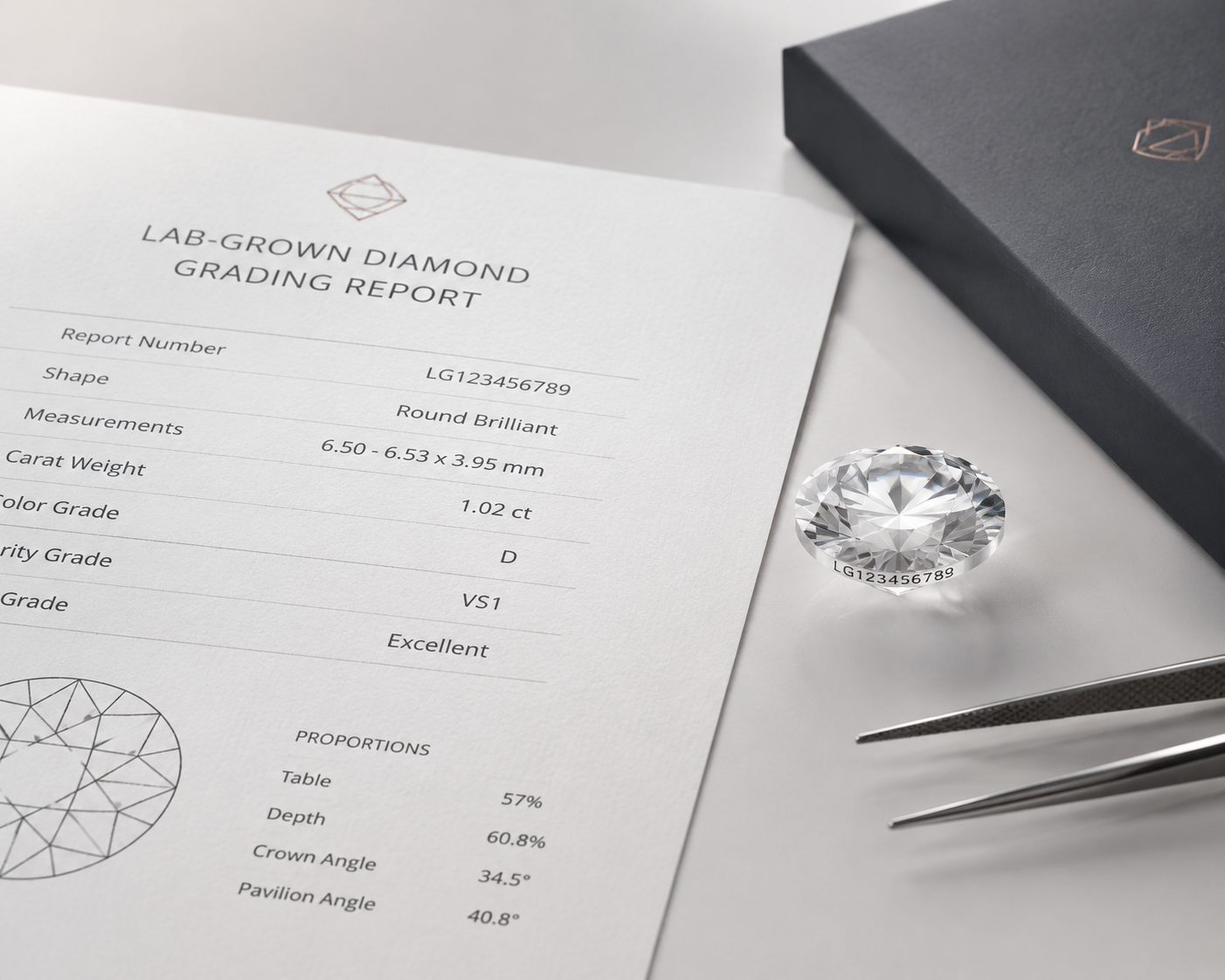
What to Check Before You Decide
Confirm the report number on the grading lab’s official verification page. Do not trust a screenshot alone. A screenshot can be edited, re-saved, or copied from another listing. The lab’s database is the only neutral source.
Check that the carat weight, shape, measurements, and color or clarity grade on the certificate match exactly what the seller lists. A single mismatch in any field is a reason to pause, not to rationalize.
If the seller shows only a partial scan, crops the report number, or refuses to provide the full document, consider that a warning sign. There is no legitimate reason to withhold complete certificate information from a buyer who is about to pay.
Distinguishing Laboratory-Grown Diamonds from Natural Diamonds in Listings
One compliance detail that buyers often overlook is whether the seller clearly identifies the diamond as laboratory-grown in both the listing and the certificate. Some listings use ambiguous language such as “cultured” or “created” without specifying the growth method, or they place the lab-grown disclosure in fine print. The Federal Trade Commission and responsible grading labs recommend clear and prominent identification of laboratory-grown origin. If a listing downplays the lab-grown status or buries it in technical notes, that is a red flag. The stone itself is still a real diamond, but the presentation may be designed to confuse buyers who are comparing natural and laboratory-grown options. Before paying, confirm that the certificate explicitly notes “laboratory-grown” or “laboratory-created,” and that the seller’s headline matches that disclosure.
—
Unclear or Unfamiliar Lab Names: When the Certifier Raises Questions
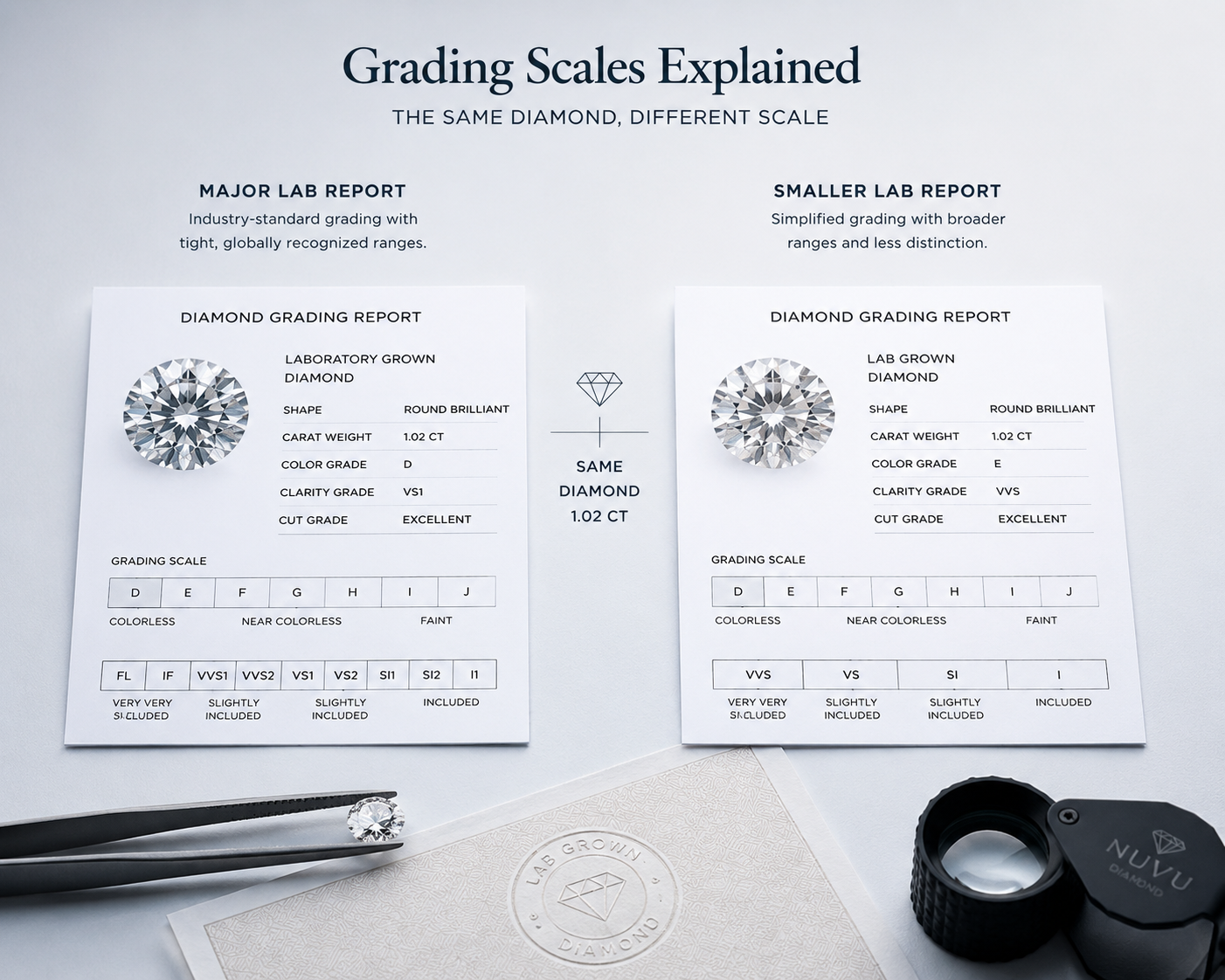
Not all grading labs operate at the same standard. Some are internationally recognized with publicly documented grading methodologies, independent verification tools, and consistent quality control. Others are smaller operations with limited reputations, no public database, or grading scales that are not directly comparable to major labs.
The name on the certificate matters because it determines what the grade actually means.
Small or Regional Labs with No Verification Portal
Some lab-grown diamonds are certified by labs that do not publish their grading methodology or maintain a public report lookup tool. A certificate from such a lab may be perfectly accurate. But the buyer has no independent way to confirm what is written on the document. This creates an information asymmetry — the seller knows exactly what the stone is, and the buyer has only a piece of paper that cannot be cross-checked.
In the context of fine jewelry and luxury collections, without a verification portal, the certificate for certified lab grown diamonds is essentially an opinion from an unverifiable source, which is not a foundation for a confident purchase, whether for diamond earrings, tennis bracelets, or anniversary gifts.
Labs That Use Non-Standard Grading Scales
A smaller number of labs use expanded or modified grading scales that make stones look better on paper than they would under a major lab. Examples include grouping DEF color into a single category, grading clarity in broader ranges, or assigning cut grades that do not correspond to established proportion standards. These reports can inflate a diamond’s apparent quality without technically being wrong — the stone meets the lab’s published scale, but that scale is more lenient.
A stone graded as “D color” by a non-standard lab may grade as G or H under GIA or IGI[1]. The buyer who does not know the difference pays for a grade they are not receiving.
Buyer Verification Checklist
Before buying, check whether the named lab has a public report lookup tool. If it does not, the certificate cannot be independently verified.
If the lab does not offer online verification, ask the seller why that report was chosen. A straightforward answer is possible — a lab may be regionally common or used for batch grading — but the response should be clear and not defensive.
Compare the grade you would expect from a major lab against what the smaller lab assigned. A significant gap — for example, two or more color or clarity grades — is not a harmless variation. It is a red flag that the report may be using a different standard than what the listing implies.
—
Mismatched Measurements: When the Numbers Do Not Line Up
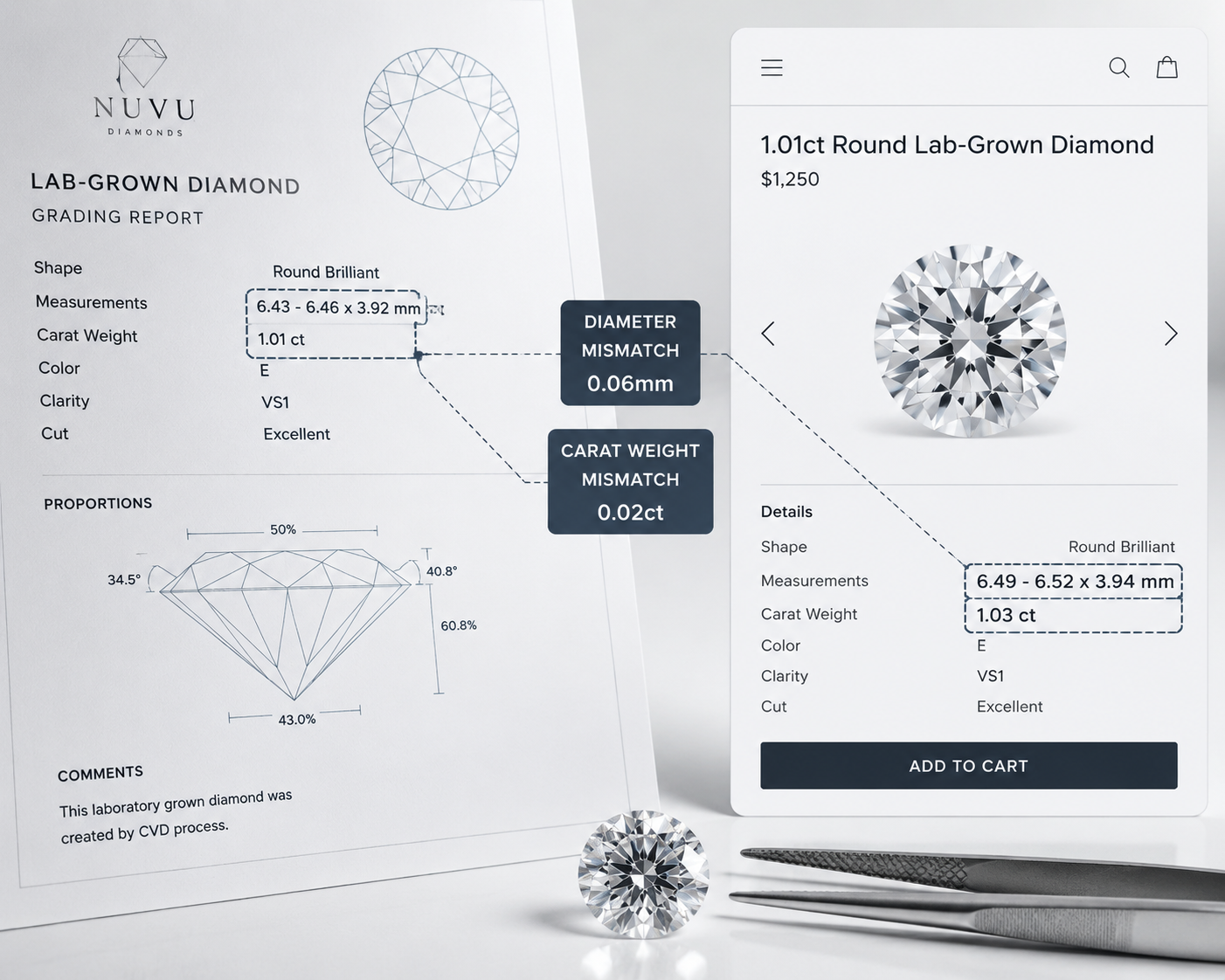
Measurement discrepancies are one of the most common and most detectable warning signs in online diamond buying. They are also one of the easiest to catch — if you know where to look. The numbers on the certificate should match the numbers in the listing. When they do not, something is wrong.
Diameter, Depth, and Table Size That Disagree
A round brilliant diamond’s diameter should match within roughly 0.01 mm between the certificate and any measurement tool the seller uses. Normal variation occurs. If the certificate shows 6.50 mm and the seller lists 6.47 mm, that is acceptable rounding or slight measurement tolerance. But a discrepancy of 0.10 mm or more is a serious warning. That degree of difference often means the certificate belongs to a different stone.
Depth percentage and table percentage are also worth comparing. These proportions define cut quality and affect how the diamond performs optically. A mismatch in these numbers means either the certificate or the seller’s data is incorrect, and neither possibility is safe to ignore.
Certificate Weight vs Seller-Reported Carat
Carat weight is the most commonly checked number, and for good reason. A difference of 0.01 carat can occur due to rounding conventions between labs. A 0.03 carat or larger difference is suspicious. Some sellers list weight from a different stone in the same production batch. Others estimate weight without actually weighing the stone. Neither practice is something a buyer should accept.
Carat weight is the easiest number to verify. If it does not match, the rest of the listing becomes unreliable.
Certificate and Visual Review Check
Write down the measurements from the certificate and compare them directly to the seller’s listing. Do this before paying.
Ask for a photo of the stone next to a calibrated ruler or a known-size reference object, such as a standard U.S. coin. A seller who is confident about the stone’s dimensions will accommodate this request.
If the seller refuses or deflects, treat the listing as high risk. Measurement verification is a basic buyer protection step. Any resistance to it is a signal that the numbers may not hold up under scrutiny.
Overly Selective Screenshots: What the Seller Did Not Show You
A certificate screenshot is not the same as the full report. Some sellers crop these images intentionally, removing critical sections that would allow you to evaluate the stone. The parts that get cut are rarely random — they are usually the details that would raise questions if you saw them.
Missing Proportion and Clarity Details
A complete grading report includes crown angle, pavilion angle, depth percentage, table percentage, and a clarity plot that maps where inclusions sit. When a seller shows only the grade summary — color, clarity, carat — but crops out the proportion data, you cannot assess cut quality or predict how the diamond will perform in light. That missing information matters because cut is the single factor most responsible for a diamond’s sparkle. A seller who hides proportion data is often showing a stone with suboptimal light return, and the crop keeps you from noticing.
No Full Diamond Image or Plot on the Report
Most lab reports include a computer-generated plot that shows the location and type of inclusions. If the seller displays only the grade summary but omits the plot, you lose the ability to see whether inclusions sit in the center of the table, cluster near the girdle, or would be visible to the naked eye at the listed clarity grade. Two stones can share the same clarity grade and look completely different — one clean to the eye, the other with a visible inclusion dead center. The plot tells you which one you are looking at. Without it, the grade alone is incomplete.
How to Verify This Before Buying
Request a full, uncropped copy of the certificate — not a screenshot, but the complete PDF or scan. When the stone arrives, compare the clarity plot against what you see in the seller’s magnified video or photo. If the plot shows a large inclusion near the center and the video shows a clean table, something does not match. If the seller cannot or will not provide the full report, do not purchase without an alternative verification method.
Report Number That Does Not Verify or Returns No Results
A valid certificate number should lead to a matching record on the grading lab’s official website. When it does not, or when the record points to a different stone, the certificate may be the problem — not your browser. This is one of the most straightforward checks a buyer can run, and a failed check should stop the purchase.
Report Number Typo or Transposition
Occasionally a seller transposes one digit by mistake. That happens. But when the number appears clearly in a screenshot, then fails to verify online, and the seller offers no explanation beyond repeating the same number, the report may belong to a different diamond — or no diamond at all. The only safe way to verify is to enter the number yourself on the lab’s site, not rely on the screenshot. A typo is possible, but a failed verification with no resolution is a clear stop signal.
Report That Returns a Matching Number but Different Details
This situation is less common but more serious. The report number exists in the lab’s database, but the weight, shape, color, or clarity does not match what the seller listed. In this case, the lab’s record is correct, and the seller’s claim is not. This can happen when a seller reuses a genuine certificate number from one stone and applies it to another. The database entry you see is real — it just belongs to a different diamond. The mismatch tells you the stone in the listing is not the stone the certificate describes.
Stone-to-Setting Fit Check
Enter the report number on the grading lab’s official verification page before you pay. Compare every field — carat, shape, color, clarity, measurements — between the lab record and the seller listing. If any field does not match, do not accept a verbal explanation. Ask the seller to correct the listing or provide a valid certificate for the actual stone. If they cannot, walk away.
Inconsistent Listing Details: When the Seller’s Description Contradicts the Certificate
Sometimes the discrepancy is not between stones — it is between what the seller writes in the product title and what the certificate actually says. This type of inconsistency is easier to spot but equally dangerous if you do not check.
Grade Inflation in Seller Headlines
A seller may list a diamond as “E color VVS1” in the product title while the certificate shows “F color VS1.” This is not a typo. It is a deliberate attempt to appear higher in search filters and attract buyers who skim titles. The certificate, as detailed in the lab grown diamond certification guide, is the authoritative document, not the seller’s headline. If you pay based on the listing without cross-referencing the certificate, you may receive a stone worth less than what the title promised.
Fluorescence and Comments Omitted from the Listing
Fluorescence can affect a lab-grown diamond’s appearance, particularly in higher color grades. A certificate may note medium or strong fluorescence, but many sellers omit this detail from the listing entirely. The same is true for comments about surface-reaching inclusions, clouds, or clarity treatment. These notes exist on the certificate for a reason — they describe conditions that affect the stone’s visual performance. When a seller leaves them out of the listing, the buyer sees only the grade, not the qualification.
What This Means in a Real Purchase
Read the certificate thoroughly — especially the “Comments” or “Key to Symbols” section — before relying on the seller’s headline. If the seller’s listed color or clarity is one or more grades above what the certificate states, that is a clear red flag. Ask for written confirmation that the diamond matches exactly what the certificate says, including any remarks about fluorescence or inclusions. A responsive seller will confirm in writing. A seller who deflects or avoids the question is signaling that the gap in the listing is intentional.
Sellers Who Discourage Independent Verification
The most serious red flag is not a mismatched measurement or a cropped screenshot. It is a seller who actively resists your attempt to verify the stone through a third party. When a seller makes verification difficult or time-constrained, the pattern is clear: the policy is designed to prevent you from discovering a problem before the purchase becomes final.
Verification Windows Too Short for Shipping and Lab Appraisal
Some sellers offer a 3-day or 5-day return window. On paper, that sounds reasonable. In practice, it is often too short. You need time to receive the diamond, take it to an independent appraiser or jeweler, have it inspected, and still have enough days left to return it if something does not match. Between shipping delays and appointment availability, a 3-day window can collapse into zero usable days. A seller who sets an artificially short window combined with language discouraging verification is building a barrier to honest checking, not protecting your rights as a buyer.
Policy Language That Discourages Unsetting or Independent Appraisal
Read the fine print carefully. Some return policies state that the diamond must be returned in “original condition” and then define any setting or unsetting as a violation of that condition. This means you cannot have a jeweler remove the stone from a temporary setting to inspect it without voiding your return rights. Other policies simply say that independent appraisal voids the return. These clauses do not protect the diamond. They protect the seller from being caught selling a stone that does not match its certificate. If the policy makes verification a risk, that is not a trustworthy seller.
Buyer Verification Checklist
Before you enter your payment information, read the return and verification policy. Confirm that the return window is long enough for you to receive the diamond, take it to a jeweler or appraiser for verification, and still return it if the certificate does not match the stone. If the seller’s policy explicitly discourages or prohibits independent verification, treat that as an immediate stop signal. No diamond is so unique or well-priced that it is worth buying from a seller who will not let you confirm what you are paying for.
How to Build a Safer Buying Process Around Certificate Verification
The goal of identifying red flags is not to make you paranoid. It is to replace anxiety with a process. If you follow a simple verification workflow on every purchase, the warning signs become obvious before you commit, not after. Here is how to turn what you have learned into a repeatable buying habit.
The Three-Step Verification Workflow
Step one happens before you pay. Go to the grading lab’s official website and enter the report number from the seller’s listing. Confirm that the lab’s database returns a record with matching details. Do not trust a screenshot of a verification page — go directly to the source and do it yourself.
Step two happens after the report number checks out. Compare every field on the certificate against the seller’s listing. Carat weight, shape, measurements, color grade, clarity grade, fluorescence — all of it should match. If the seller listed a higher grade than the certificate shows, you are looking at intentional grade inflation.
Step three happens when the diamond arrives. Using a jeweler’s loupe or even a phone macro lens, find the inscription on the girdle of the diamond. It should be a micro-laser engraved report number that matches the certificate. If the number is missing, different, or illegible, the stone you received is not the stone described by the report. At that point, stop and initiate a return.
When to Walk Away and When to Proceed
A single small discrepancy is normal. A 0.01 mm difference in diameter or a 0.01 carat rounding variance falls within acceptable tolerance. But two or more discrepancies, a missing report number anywhere in the listing, a cropped certificate image, or a seller who avoids answering verification questions are reasons to walk away. A clean match across all data points with a responsive seller who encourages independent verification is a green light. In that case, proceed with confidence.
Understanding the Role of the 4Cs in Certificate Verification
The Gemological Institute of America (GIA) established the 4Cs grading system — carat weight, color, clarity, and cut — as a universal language for diamond evaluation[2]. When you cross-check a certificate, you are verifying whether the 4Cs on the report correspond to the stone in the listing and the stone in your hand. Carat weight and cut proportions are objective measurements that should match exactly, while color and clarity grades are determined by a grader’s observation. If the listing claims a color grade two steps higher than the certificate, the mismatch is not a matter of opinion — it signals either a different stone or a deliberate error. Understanding that the 4Cs were designed as a comparative standard, not a warranty, helps buyers ask better questions about what each grade actually represents in terms of visual appearance and value.
What to Check Before You Decide
Confirm what professional verification will cost. Most local jewelers will check a loose diamond’s inscription for a small fee, and some will do it for free if you are considering a setting purchase. Know exactly what you are looking for: a micro-laser engraved number on the diamond’s girdle that matches the certificate. Keep the return policy documented in writing so you have clear recourse if the verification fails. A transparent seller expects you to verify. A seller who does not want you to check is a seller you should not buy from.
Traceability and Documentation: What to Expect from a Credible Lab-Grown Diamond Seller
Beyond the certificate itself, traceability refers to a seller’s ability to provide consistent, verifiable information about a diamond’s origin, grading history, and supply chain. In the lab-grown diamond market, traceability can be straightforward because production is usually centralized. However, some sellers obscure the chain of custody, making it difficult to confirm whether the certificate in your hand corresponds to the stone in the setting. A credible seller should be able to provide a clear account of the diamond’s path from laboratory to listing, including original grading documentation and any subsequent handling history.
Requesting Batch Documentation and Consistency Reports
For lab-grown diamonds, some sellers may offer a “batch certificate” — a single report covering a group of stones from the same production run, rather than an individual report for each stone. A batch certificate is not inherently problematic, but it creates an extra layer of verification risk. Without an individual laser inscription, you may have no way to prove which stone from that batch you actually received. If a seller offers only a batch certificate, ask for individual grading reports or confirmation that each stone has a unique inscription. If the seller cannot provide individual documentation, the stone’s traceability is limited, and you should weigh that limitation against the purchase price.
How Refinement of the Stone Affects Certificate Accuracy
Lab-grown diamonds may undergo post-growth treatments such as High-Pressure High-Temperature (HPHT) annealing to improve or change color. These treatments are common and legitimate, but they must be disclosed on the certificate. A certificate that omits treatment history is incomplete. If a seller cannot confirm whether a stone has been treated, or if the certificate has no comments section detailing such processes, the traceability of the stone is compromised. Buyers should specifically ask whether any post-growth treatment has been applied and whether that treatment is documented on the certificate. A clear, documented answer supports trust; a vague or evasive answer raises questions about how much the seller knows about their own inventory.
When a Certificate Does Not Disclose the Growth Method
Occasionally, a certificate for a laboratory-grown diamond may not explicitly state the growth method — whether High-Pressure High-Temperature (HPHT) or Chemical Vapor Deposition (CVD) was used. While the presence of a growth method note is not required by all labs, its absence can create uncertainty for buyers who want to understand the stone’s production path. Growth method is not a quality indicator by itself; both HPHT and CVD can produce high-quality diamonds. But a seller who cannot or will not disclose the growth method when asked may be less transparent overall. For buyers who want full documentation, asking specifically whether the certificate identifies the growth method — and whether the seller has that information from the manufacturer — is a reasonable step before finalizing a purchase.
In sourcing and wholesale scenarios, documentation, consistency, and communication often matter as much as the headline specification. Buyers should confirm whether a certificate covers an individual stone or a production batch, and whether any post-growth treatments have been disclosed in writing.
Traceability Check
Before committing to a purchase, ask the seller for the stone’s full chain of documentation: individual certificate, laser inscription number, treatment disclosures, and any available images from the grading lab. Compare these records against the seller’s listing. A seller with good traceability will provide this information without hesitation. A seller who cannot or will not provide clear documentation is asking you to trust without evidence, which is not a reasonable expectation in a transparent marketplace.
[1] GIA, “How to Read a Diamond Grading Report,” Gemological Institute of America, accessed 2025. https://www.gia.edu/gia-education/how-to-read-diamond-grading-report
[2] GIA, “The 4Cs of Diamond Quality,” Gemological Institute of America, accessed 2025. https://www.gia.edu/gia-education/the-4-cs-of-diamond-quality
Disclosure: This article is for general educational purposes only. Diamond grading, pricing, availability, specifications, and seller policies can change, and readers should verify important details through grading reports, official laboratory tools, seller documentation, or qualified professionals before making a purchase decision. Laboratory-grown diamonds should be clearly distinguished from natural diamonds, and environmental or sourcing claims should be supported by specific documentation. A grading report helps document key characteristics, but it should not be treated as a guarantee of beauty, value, or sourcing ethics.