
Renewable energy claims can make a lab-grown diamond feel like the clearer choice, but the wording often hides important differences. When sustainability language also covers recycled gold and lab-grown diamonds, a diamond described as “renewable-powered,” “carbon-neutral,” “low-carbon,” or simply “green” may be backed by very different evidence. Some claims relate to electricity matching through certificates, some rely on offsets, and some are too broad to verify without more detail.
For the full framework, read Are Lab-Grown Diamonds More Sustainable?.
This article helps buyers separate useful sustainability information from vague language before giving it weight in a purchase decision. The practical question is not whether a claim sounds responsible, but whether it is specific, dated, tied to the right production facility or period, and supported by documents that match the wording. Used carefully, this information can be a confidence factor between comparable diamonds; it should not replace cut quality, grading details, pricing, imaging, or seller reliability.
Laboratory-grown diamonds should be clearly identified as laboratory-grown, and they should not be presented as mined diamonds. Renewable energy language does not change the origin of the stone, and it does not turn a laboratory-grown diamond into a natural diamond. Buyers should keep origin disclosure, grading information, and sustainability documentation in separate categories when comparing listings.
| Claim or Evidence | What It Can Show | Buyer Caution |
|---|---|---|
| Renewable-powered | Electricity use may be matched to renewable sources | Check facility, dates, and matching method |
| Carbon-neutral | Emissions may be balanced through offsets or accounting | Does not prove renewable electricity use |
| Low-carbon | May indicate lower emissions than a comparison point | Needs a defined baseline and scope |
| RECs or power agreements | Can support renewable electricity matching | Must match geography, period, and electricity use |
| Brand slogans | May express a general position | Weaker than factory-level documentation |
| Unclear “green” language | Often signals a broad sustainability claim | Treat as weak until documented |
Quick Questions Before You Read
Q: Does “renewable-powered” mean the diamond was physically made using only renewable electricity?
Not always. It may mean electricity use was matched with renewable energy certificates or contracts rather than directly supplied at all times.
Q: Is a carbon-neutral claim the same as a renewable energy claim?
No. Carbon-neutral claims often involve emissions calculations and offsets, while renewable claims focus on electricity sourcing or matching.
Q: What is the strongest proof a buyer can ask for?
Look for dated, facility-level documentation tied to the production period, such as utility data, power agreements, or properly matched certificates.
Q: Should sustainability claims decide which diamond to buy?
They can help as a tie-breaker, but they should not outweigh cut quality, grading, clear imaging, comparable pricing, or seller reliability.
What “Renewable-Powered,” “Carbon-Neutral,” and “Low-Carbon” Actually Mean in Lab-Grown Diamond Marketing
Not all green-sounding language means the same thing. In lab-grown diamond marketing, renewable-powered lab-grown diamonds, carbon-neutral lab-grown diamonds, and low-carbon lab-grown diamonds can point to very different claims, and the wording alone rarely tells you how strong the evidence is.
The first mistake buyers make is treating these terms as interchangeable. They are related, but they answer different questions. One may describe the electricity used to grow the diamond. Another may describe emissions accounting after production. A third may simply suggest that the impact is lower than some comparison point, without clearly saying what that comparison is.
It also helps to keep the sustainability claim separate from the diamond’s grading report. A grading report may document gemological details such as carat weight, measurements, color, clarity, and sometimes growth-related information, but it does not normally prove how the electricity claim was calculated or whether a renewable energy statement is current. For buyers, the responsible approach is to review both layers: the report helps identify the stone, while the energy documentation helps evaluate the environmental wording attached to it.
A grading report helps document key characteristics, but it should not be treated as a guarantee of beauty, value, or sourcing ethics. Even when a report identifies a diamond as laboratory-grown and records its graded characteristics, the buyer still needs separate evidence for renewable energy, emissions, seller policy, and setting compatibility claims.
A helpful way to read any environmental claim is to separate identity evidence from impact evidence. Identity evidence tells you what the diamond is: its measurements, grade characteristics, inscription details, and whether the stone being discussed matches the report or listing. Impact evidence tells you what is being claimed about energy, emissions, or sourcing practices. A seller may have strong identity documentation and weak renewable energy documentation, or the reverse. A buyer should avoid letting strength in one category automatically excuse gaps in the other.
For traceability, the useful question is whether those two evidence layers can be connected without guesswork. If the grading report identifies the stone but the renewable energy document only describes a broad supplier program, the buyer should ask how the seller links the specific listing to the facility, batch, or production period described in the sustainability evidence. A clear chain does not need to reveal confidential manufacturing data, but it should be coherent enough for the buyer to understand why the claim belongs with that diamond.
Renewable-Powered vs Carbon-Neutral vs Low-Carbon
Renewable-powered usually refers to electricity sourcing. Since diamond growth requires controlled, energy-intensive equipment, the power source matters. A renewable energy claim may mean a facility uses solar, wind, hydro, or purchased renewable electricity for some or all of its operations. The key question is not whether the phrase sounds responsible, but whether it identifies what electricity was covered, where it was used, and during what period.
Carbon-neutral is different. Carbon-neutral lab-grown diamonds are usually presented as having their emissions balanced through some form of accounting, reduction, renewable energy certificates, carbon offsets, or a combination of methods. That does not necessarily mean the diamond was grown using renewable electricity at the production site. A carbon-neutral claim may be credible, but it needs more explanation because it can depend heavily on boundaries and assumptions.
Low-carbon is often the softest of the three terms. It may suggest reduced emissions, improved energy sourcing, or a smaller footprint compared with another production method, but it does not automatically identify a standard. If a seller says a diamond is low-carbon but does not explain compared with what, measured over what period, or verified by whom, the phrase should be treated as a starting point for questions rather than as proof.
Consider two similar listings. One says “renewable-powered,” and the other says “carbon-neutral.” The renewable-powered listing may have a narrow but verifiable electricity claim. The carbon-neutral listing may have a broader emissions claim supported by offsets or reporting. Neither is automatically better from the wording alone. The stronger claim is the one with a clear boundary and evidence that matches the exact language used.
What the Claim Can Cover, and What It Cannot
A renewable energy claim can apply to different parts of the production story. It might cover one manufacturing facility, one production period, one growth method, one batch, or only a portion of electricity use. A claim that is accurate in one of those narrow contexts can become misleading if it is written as though it applies to every diamond a brand sells.
This is where buyers need to be careful. A facility-level renewable electricity statement does not automatically prove that cutting, polishing, grading, transport, jewelry setting, packaging, or retail operations were also powered by renewable energy. It also does not prove that every supplier connected to the product used the same energy source. The claim may still be meaningful, but it should not be stretched beyond the part of the process it actually covers.
The most useful claims are specific rather than sweeping. “Produced at Facility A using renewable electricity for the stated reporting year” gives a buyer something to evaluate. “Made with clean energy” sounds better at first glance, but it gives less to verify. In sustainability language, narrower wording is often more trustworthy than broader wording because it is easier to test against documents.
Why the Wording Needs a Boundary
Marketing language becomes risky when it leaves out four basic details: location, timeframe, scope, and method. Without location, you do not know whether the claim applies to the actual production site. Without timeframe, you do not know whether it applies to current inventory or an old reporting period. Without scope, you do not know whether it covers all electricity use or only a share of operations. Without method, you do not know whether the claim is based on direct renewable power, purchased certificates, offsets, or general brand policy.
A strong renewable energy claim should not ask the buyer to fill in those blanks. It should make the boundary visible. If the claim applies only to electricity used during diamond growth, that should be stated. If it applies to a specific facility and a defined reporting period, that should be clear. If the claim depends on certificates rather than direct on-site renewable generation, the language should not imply something stronger than the evidence supports.
The practical judgment is simple: the broader the claim sounds, the more specific the proof should be. A modest claim with clear support is more credible than an ambitious claim with vague wording. Buyers do not need to reject sustainability language, but they should treat undefined terms as incomplete until the seller explains what is actually being claimed.
What to Clarify Before You Trust the Wording
Before giving weight to a renewable energy claim, ask what part of production it covers, which facility is included, and whether the wording refers to electricity use, emissions accounting, or a broader brand message. If the answer changes depending on who explains it, the claim is not yet clear enough to rely on.
The clearest version of the claim should be easy to restate in one plain sentence: this specific energy or emissions statement applies to this specific activity, at this specific place, during this specific period. If a seller cannot help you get to that sentence, the claim may still be well-intentioned, but it is not yet buyer-ready.
Which Documents Actually Support a Renewable Energy Claim
Once the wording is clear, the next question is evidence. Renewable energy documentation does not need to expose a company’s private operating data, but it should show enough detail to connect the marketing claim to a real energy source, reporting period, or certificate basis. A badge, logo, or sustainability phrase on its own is not enough.
The strongest documents are not necessarily the most polished. A simple dated disclosure that names the facility, describes the electricity source, and explains the coverage can be more useful than a glossy brand statement filled with general environmental language. What matters is whether the document supports the exact claim being made.
The same verification habit should apply to the diamond’s identity documents. A sustainability disclosure is more useful when it can be connected to a specific stone, batch, supplier, or production source, rather than floating separately from the grading report, invoice, or product listing. If the seller cannot explain how the environmental document relates to the diamond being considered, the claim may still be directionally helpful, but it should be treated as weaker than product-linked support.
Buyers can think of traceability as a set of handoffs: manufacturer disclosure, supplier communication, seller listing, and buyer-facing document summary. Each handoff should preserve the same basic facts instead of making the claim broader. If a renewable energy statement begins as a facility-level claim, the product page should not silently turn it into a full jewelry lifecycle claim. Consistent wording across the handoffs is one of the simplest signs that the seller understands the limits of the evidence.
A Practical Evidence Hierarchy for Buyers
Not every document deserves the same level of trust. A buyer can usually sort renewable energy evidence into three tiers. The strongest tier is product-linked or facility-linked documentation that names the operational boundary, reporting period, and method behind the claim. A middle tier includes supplier summaries, certificate excerpts, or third-party statements that appear relevant but do not fully connect the evidence to the specific diamond. The weakest tier is general brand language, icons, slogans, or future commitments that do not show what was actually covered.
This hierarchy does not require buyers to become energy auditors. It simply helps prevent a common mistake: treating every sustainability-looking document as equal. A one-page dated facility summary can be more useful than a long values statement if the short document answers the right questions. Conversely, a polished sustainability page can be weak evidence if it never identifies the facility, timeframe, electricity volume, or accounting method behind the claim.
| Evidence Level | Stronger Example | Weaker Example |
|---|---|---|
| Facility-linked | Dated statement naming the production site, electricity basis, and period covered | General statement that a company supports renewable energy |
| Product- or batch-linked | Document trail connecting the listed diamond or batch to the supported facility claim | Evidence that may apply to another supplier, batch, or time period |
| Method-specific | Clear explanation of direct power, certificates, power agreement, offsets, or mixed approach | Broad “green,” “clean,” or “sustainable” wording without method |
| Time-bound | Reporting period that can be compared with the stone or inventory timing | Undated statement or old document with no explanation of current relevance |
Facility Electricity Data and Utility Evidence
Facility-specific electricity evidence carries more weight than broad sustainability copy because lab-grown diamond production happens at actual sites with actual power demand. A credible document should help answer where the electricity was used, what period it covers, and how the renewable share was determined.
Useful evidence may include a facility energy disclosure, a utility reference, a supplier statement tied to a named production site, or a report showing electricity source and allocation method. The document does not have to give the buyer every internal meter reading. It does need to show that the claim is connected to a real facility rather than floating above the supply chain as a brand message.
A defined reporting window is often easier to evaluate than an undated statement. For example, a document that says renewable electricity covered a stated share of Facility A’s electricity use during a stated reporting period gives the buyer a defined period to compare against the listing. An undated line saying “we use renewable power” gives no way to know whether the statement applies to the diamond being sold now.
Power Purchase Agreements, Renewable Certificates, and Matching Periods
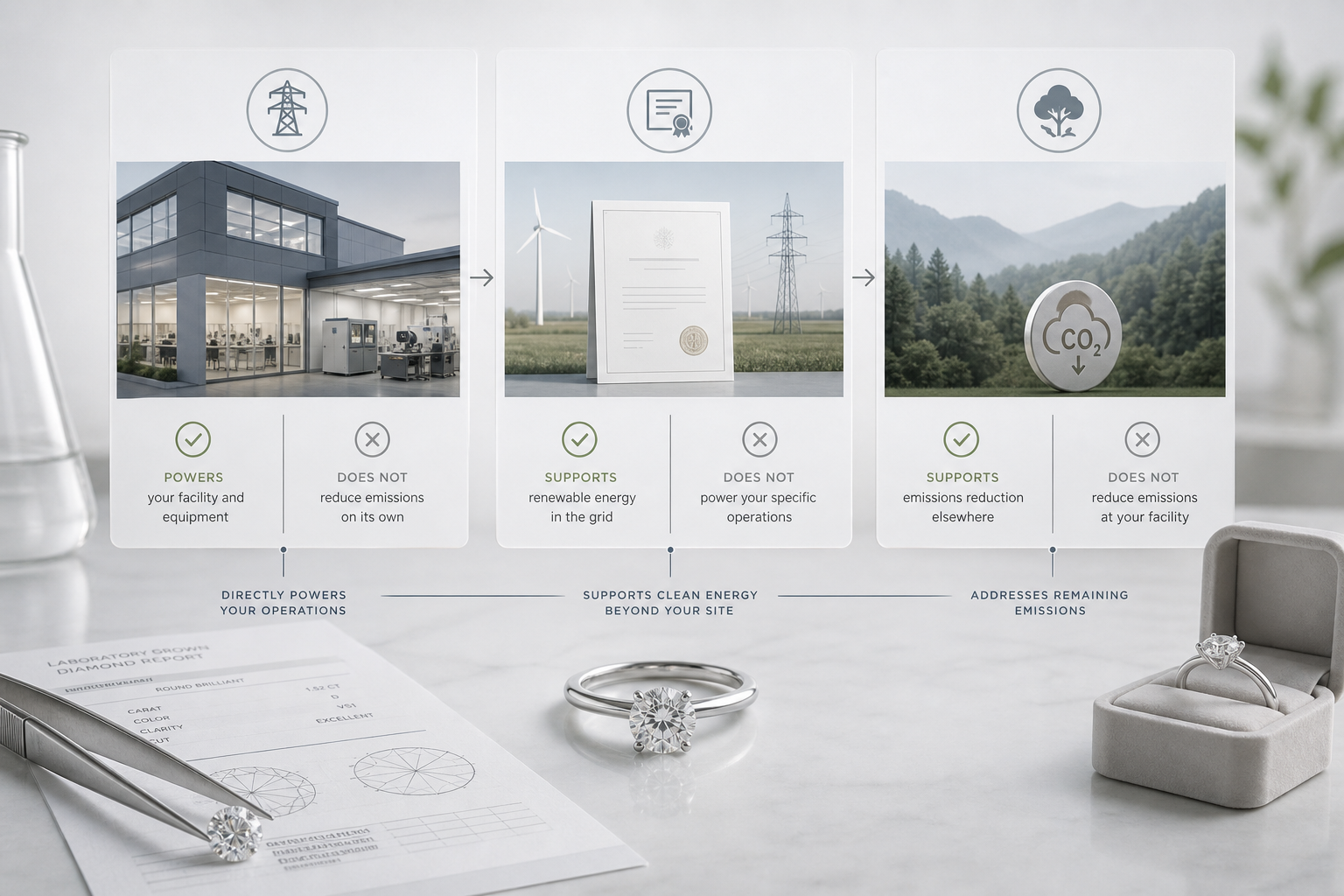
Renewable energy claims can be supported in several ways. A power purchase agreement may show that a company has contracted renewable electricity. Renewable energy certificates, often called RECs, can represent the renewable attribute of electricity generation. Utility disclosures may show the electricity mix or renewable supply arrangement for a facility.
RECs for lab-grown diamonds are not automatically weak or strong. Their value depends on matching. The certificate should match the relevant reporting period, the right geography or electricity market where applicable, and the volume of electricity being claimed. A certificate from one period does not cleanly support a later inventory claim unless the document explains that relationship. A certificate covering corporate offices does not prove renewable electricity was used for diamond growth.
The practical risk is over-reading the document. A REC may support a renewable electricity claim, but it does not by itself prove that every step in the diamond’s journey was renewable-powered. A power purchase agreement may show a serious energy strategy, but buyers still need to know whether the agreement is connected to the production facility or only to broader corporate operations.
What Buyers Can Reasonably Ask to See
Buyers do not need to request confidential contracts, full utility bills, or proprietary factory data. A reasonable request is more focused: ask for a written summary, a third-party statement, a supplier document excerpt, or a dated disclosure that confirms the basis of the claim. The seller should be able to explain the evidence without turning the conversation into a trust-me exercise.
Good lab-grown diamond sustainability proof usually has an audit trail, even if the buyer only sees a summarized version. The document should point to the entity making the claim, the facility or operational boundary, the energy type, and the reporting period. If the seller can only provide a general brand paragraph with no date, no site, and no method, the evidence is too thin for a strong renewable claim.
A document can look official and still be unhelpful. A sustainability logo with no explanation, a certificate that does not name the relevant facility, or a statement from a different entity in the supply chain may support a broader brand image but not the specific claim attached to a product listing. The test is whether the document answers the same question the claim raises.
When a grading report is available, buyers should verify report details through the issuing laboratory’s official report-check tool where available, and keep that identity check separate from any renewable energy or emissions claim.
Buyer Verification Checklist for Documents
Before relying on a document, check whether it includes the facility name or production site, a date or reporting period, the energy type, the quantity or percentage of electricity covered, and the entity responsible for the claim. The document should also match the wording on the product page. If the listing says “renewable-powered,” but the document only discusses carbon offsets, the proof does not support the claim as written.
The strongest document trail is consistent, dated, and narrow enough to verify. It does not need to prove the entire sustainability story of the diamond, but it should prove the part the seller is asking you to believe.
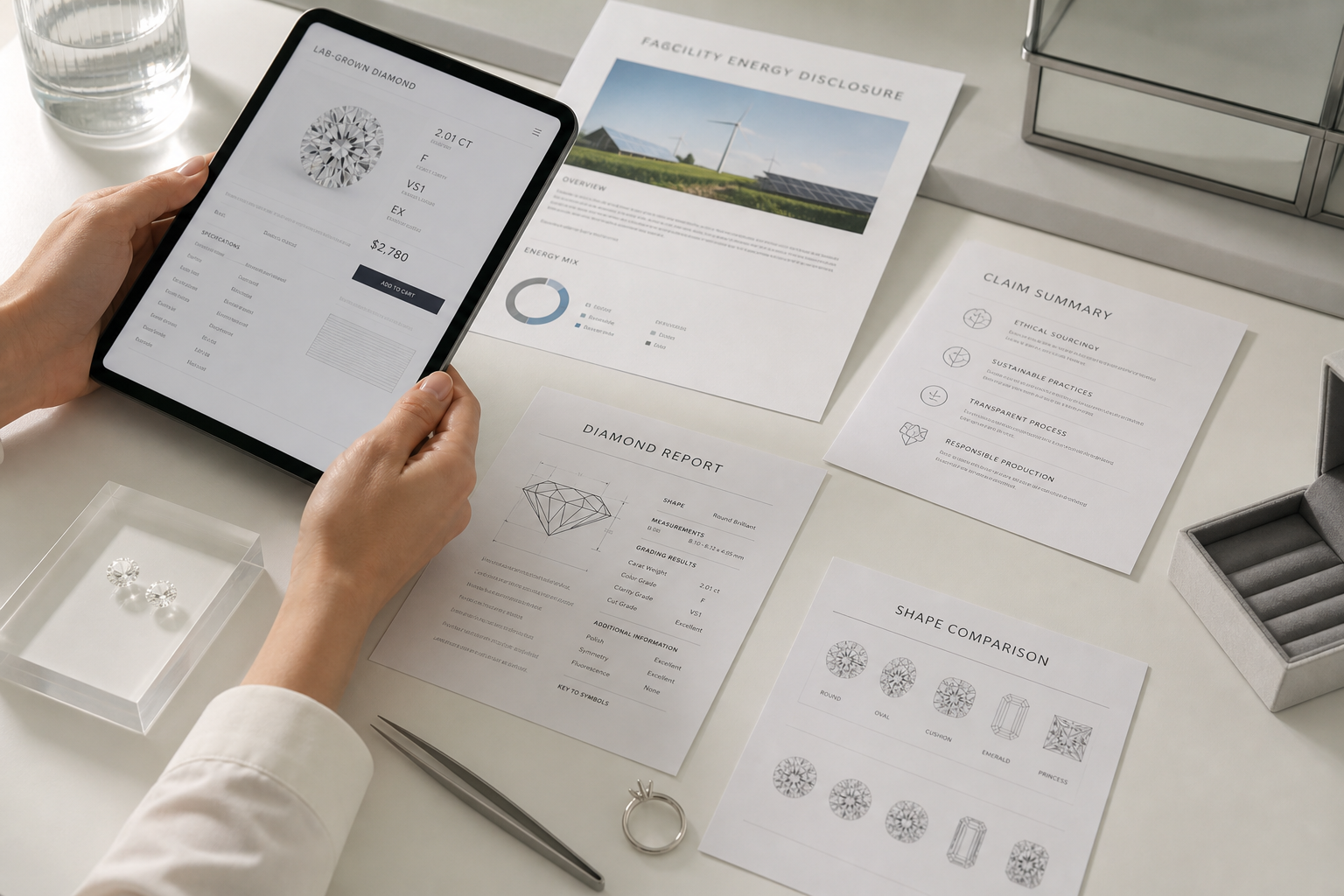
Why Factory-Level Evidence Matters More Than Brand-Level Messaging
A factory-level renewable energy claim is usually more useful than a broad brand-level sustainability claim because it gets closer to where the energy is actually used. Lab-grown diamonds are produced through manufacturing processes that depend on electricity. If the claim is about renewable power, the most relevant evidence should point back to the production site, not just the retailer’s values page.
This does not mean brand-level messaging is automatically false. It means the buyer should separate who is selling the diamond from who made the energy claim. A retailer may be repeating a supplier statement. A brand may be summarizing a manufacturer disclosure. An exporter or distributor may sit between the factory and the final seller. The more hands the claim passes through, the easier it is for the wording to become broader than the original evidence.
For custom jewelry, this distinction can become even more important because the finished ring or pendant may involve several separate decisions: loose diamond selection, setting production, metal choice, shipping, and packaging. A renewable electricity claim tied to diamond growth does not automatically describe the full custom piece. Buyers planning a custom design should ask whether the claim refers only to the center stone, to a specific production batch, or to any additional jewelry-making steps.
For custom design, trust comes from matching the stone to the setting, budget, and wearer’s daily use—not from choosing a sustainability phrase in isolation. Measurements, shape, prong coverage, metal choice, and daily wear expectations can all affect whether a diamond is the right fit for the finished piece. A renewable energy document may add useful context, but it should not replace the practical design review needed before finalizing the stone.
For custom jewelry, stone measurements and setting compatibility should be confirmed before finalizing a purchase. This is especially important when a renewable energy claim is attached to a loose laboratory-grown diamond but the finished piece will be produced through a separate setting, metalwork, or assembly process.
Manufacturer, Exporter, and Retailer Are Not the Same Claim Holder
The manufacturer is typically the party closest to the energy use involved in growing the diamond. If a renewable electricity statement comes from the manufacturer and identifies the production site, the HPHT vs CVD sustainability context gives the buyer a stronger place to start. If the claim comes only from the retailer, the buyer should ask whether the retailer has supplier documents that support it.
An exporter or supplier may provide a written statement based on factory information, but that is still not the same as independent verification unless the document explains its basis. A retailer may accurately pass along that statement, but the buyer still needs to know who measured, disclosed, or verified the energy source. Claim ownership matters because responsibility becomes blurry when every party repeats the same sentence without showing where it began.
For example, “Factory X used renewable electricity for diamond growth during the stated reporting period, according to a manufacturer disclosure” is a much stronger statement than “our diamonds are made with clean energy.” The first version shows origin, scope, and timeframe. The second may sound more appealing, but it gives the buyer no clear path to verification.
How Brand Copy Can Stretch Beyond the Evidence
Brand copy often stretches when a limited claim is turned into a universal one. A supplier document might apply to one facility, but the product page says “all our lab-grown diamonds are renewable-powered.” A report might cover one production line, but the FAQ describes the entire collection as clean-energy grown. A certificate might apply to a prior reporting period, while current inventory is presented as if the same proof automatically continues.
This kind of drift can happen without an obvious intent to mislead. Marketing teams simplify. Retail pages compress details. Sustainability language is often written to sound smooth rather than precise. The problem for buyers is that smooth language can hide the boundary that determines whether the claim is meaningful.
A brand-level sustainability claim should become less persuasive if it cannot be traced back to lab-grown diamond supplier documents, facility disclosures, or written confirmation from the relevant production source. The more general the statement, the more cautious the buyer should be. A claim that covers “our diamonds” should have broader evidence than a claim that covers one named facility or batch.
What a Responsible Disclosure Looks Like
A responsible disclosure does not need to be dramatic. It needs to be specific. The most credible format is close to this: the claim applies to this facility, during this reporting period, using this energy source or accounting method, for this portion of production. That kind of sentence may not sound like luxury marketing, but it is exactly what makes the claim easier to trust.
Good disclosure also avoids implying more than the documents show. If the evidence supports renewable electricity for diamond growth only, the seller should not suggest that the entire supply chain is renewable-powered. If the evidence is based on purchased certificates, the language should not imply direct on-site solar unless that is true. If only part of the electricity demand is covered, the percentage or boundary should be clear.
At NUVU, we treat this type of wording as part of transparency, not decoration: a claim is more useful when a buyer can see what it covers and what it does not. That discipline protects the buyer from giving too much weight to language that may only be partially supported.
What This Means in a Real Purchase
If a listing makes a strong renewable energy claim but cannot say whether it comes from the manufacturing facility, a supplier disclosure, or only the brand’s broader policy, the buyer should treat the claim as partial. Partial does not mean worthless. It means the claim should not carry the same weight as a factory-backed statement with a clear site, timeframe, and method.
When two diamonds are otherwise similar, the more credible energy claim is the one that can be traced back to the party closest to production. A polished retailer slogan may help introduce the idea, but factory-level evidence is what turns the idea into something a buyer can actually evaluate.
NUVU’s role in buyer education is to make comparison clearer, especially around grading reports, visual evidence, design fit, and documentation. A sustainability claim should be weighed only to the extent that its wording can be traced to specific support.
How RECs, Offsets, and Carbon Accounting Change the Meaning of the Claim
Many renewable energy claims in lab-grown diamonds depend on accounting tools, not only on electricity physically flowing from a renewable source into a production facility. That does not automatically make the claim weak, but it does change what the claim means. A buyer should be able to tell whether the seller is describing direct renewable electricity use, purchased renewable attributes, emissions balancing, or a combination of methods.
The practical risk is simple: two sellers can use similar sustainability language while relying on very different evidence. One may have facility electricity data tied to renewable supply. Another may rely on renewable energy certificates. A third may use carbon offsets to support a carbon-neutral statement. Those are not interchangeable, and treating them as the same can make a weak claim look stronger than it is.
What RECs Usually Prove
Renewable energy certificates, often called RECs, represent the renewable attribute of electricity generated from a qualified renewable source. In plain terms, a REC can support the claim that a certain amount of renewable electricity was generated and allocated through a certificate system. For lab-grown diamond buyers, the strongest use of RECs is not the certificate itself; it is how well the certificate matches the facility, reporting period, and electricity volume behind the claim.
A REC tied to a stated reporting year, for example, is more useful when the seller can show that it corresponds to the same production facility and the same period referenced in the claim. If a listing says a diamond was produced with renewable electricity, but the only support is a broad company statement about buying certificates at some point in the past, the evidence is too loose. The buyer does not need to audit the entire certificate registry, but the seller should be able to explain the match in a dated summary.
RECs usually do not prove that the electrons used at the production site came directly from a wind or solar project at the moment of growth. They support renewable electricity accounting. That distinction matters because “supported by renewable certificates” is a more precise claim than “made with renewable power” unless the seller can also show a direct supply arrangement or facility-specific renewable electricity data.
How Offsets Differ From Renewable Electricity
Carbon offsets are different from renewable electricity. An offset generally represents a reduction, removal, or avoidance of emissions somewhere else, used to balance emissions associated with an activity. In the context of carbon offsets and lab-grown diamonds, offsets may support a carbon-neutral claim, but they do not prove that the diamond-growing facility used renewable power.
This is where buyers should be careful with carbon-neutral language. A carbon-neutral claim may be based on electricity sourcing, renewable certificates, offsets, operational changes, or a mix of several methods. Some of those methods may be meaningful, but the label alone hides the mechanics. If the seller says “carbon-neutral lab-grown diamond” and cannot say whether the claim depends mostly on offsets, the buyer should treat the claim as incomplete until the method is clear.
The stronger wording separates the tools. “Facility electricity was matched with renewable energy certificates for the stated reporting period” tells a buyer something specific. “Emissions were offset through a carbon project” tells a different story. “Sustainable and carbon-neutral” without the method tells the buyer very little.
Why Scope Boundaries Matter
Carbon accounting for diamonds depends heavily on the reporting boundary. A claim may cover only electricity used in diamond growth, or it may include additional operations such as cutting, polishing, office use, packaging, shipping, or supplier activity. A wider boundary can be more informative, but only if it is clearly defined. A narrow boundary can still be valid, but it should not be marketed as if it covers everything.
For a buyer, the most important question is not whether the claim uses technical terms like Scope 1, Scope 2, or Scope 3. The more useful question is what is included. Direct fuel use, purchased electricity, and broader supply-chain emissions are different categories. If the seller only addresses purchased electricity at one facility, that may support a renewable electricity claim, but it should not be stretched into a full supply-chain emissions claim.
A credible carbon story has a clear edge. It says what is counted and what is not counted. If the boundary is missing, the claim may still be sincere, but it is not strong enough to compare against another seller’s documented claim.
Environmental and sustainability claims should be specific, documented, and limited to what can be substantiated. Broad green language is less useful than clear information about production, energy sourcing, certificate matching, emissions boundaries, and seller transparency. When the evidence is narrow, the claim should stay narrow too.
How to Verify the Carbon Story
Before giving weight to a renewable or carbon claim, ask whether it is based on direct renewable electricity, purchased renewable energy certificates, carbon offsets, or a combination of methods. Then ask for a dated summary that uses the same wording as the product page or seller statement. If the page says “renewable-powered,” the support should point to electricity sourcing or certificate matching. If it says “carbon-neutral,” the support should explain the emissions boundary and whether offsets are involved.
A more careful buying judgment is to prefer claims that are narrow and documented over claims that sound broader but cannot be traced. A modest claim with a clear facility-level certificate summary is more useful than a sweeping sustainability statement with no reporting period, no facility reference, and no explanation of the accounting method.
What Buyers Should Ask Before Believing the Renewable Energy Claim
The best questions to ask before buying lab-grown diamonds are not complicated. They are designed to make the seller define the claim, identify the source of proof, and show whether the statement applies to the diamond or only to broader brand messaging. Renewable claim verification works best when the buyer asks the same core questions across sellers, rather than reacting to whichever page sounds most polished.
A useful answer should reduce uncertainty. If the reply gives you a clearer facility, timeframe, document type, and claim boundary, confidence should rise. If the reply only repeats “sustainable,” “clean,” or “eco-conscious” in different language, it has not answered the question.
In practical buying, this is also where many comparisons become misleading: a seller may answer sustainability questions confidently while the stone itself still needs careful review. Keep the conversation balanced by asking for the grading report, measurements, videos or images, and setting requirements at the same time as the renewable energy documentation. A claim that is well supported can add confidence, but it should sit alongside visual performance and design fit rather than replace them.
Questions About the Facility and Timeframe
Start with the location and period. Ask which production facility the renewable energy claim refers to, what reporting period it covers, and whether that period connects to the current inventory. A claim tied to a specific facility during a defined window is easier to evaluate than a general statement about company values.
The timeframe matters because inventory can move through the market long after production. A seller may have evidence for one past production batch but apply the language too broadly to current listings. That does not mean the claim is false, but it does mean the buyer should ask whether the specific stone or batch being sold falls within the documented period.
Useful questions include: “Which facility does this renewable energy claim apply to?” “What date range or reporting year does the evidence cover?” “Does the claim apply to this specific inventory, or only to a general production program?” The strongest answers will name or clearly identify the production source without hiding behind brand-level language.
Questions About the Document Trail
Buyers do not need confidential utility contracts or internal operating records to make a reasonable judgment. They can ask for a summary sheet, a third-party statement, a certificate reference, a utility disclosure excerpt, or another written document that confirms the basis of the claim. The key is not to demand private business data; it is to ask for enough documentation to connect the marketing language to evidence.
A good document trail should answer at least three practical questions: who issued or prepared the evidence, what period it covers, and what part of the claim it supports. If a seller provides a dated document showing renewable certificate matching for a named facility, that is more useful than a sustainability badge with no explanation. A badge may be legitimate, but without the underlying claim boundary, it does not tell the buyer much.
Consider a realistic comparison. One seller responds with a summary stating that a named production facility matched a stated share of its purchased electricity with renewable energy certificates during that reporting year. Another seller sends a paragraph saying its diamonds are “created with care for the planet.” The first answer can be evaluated. The second may sound positive, but it is not evidence.
Questions About the Exact Claim Wording
Ask the seller to define the wording exactly. “Renewable-powered,” “carbon-neutral,” “low-carbon,” and “partially offset” point to different kinds of support. If the seller uses one phrase on the product page and another in the supporting document, the difference matters. The buyer’s job is to make sure the proof matches the claim being used to influence the purchase.
A seller that says “renewable-powered” should be able to explain whether that means direct renewable electricity, renewable energy certificates, a power purchase agreement, or another electricity-matching method. A seller that says “carbon-neutral” should explain whether the claim depends on offsets, what emissions boundary was counted, and whether the calculation covers only production electricity or a broader footprint.
This is especially important for lab-grown diamond sustainability questions because the language can sound similar while the evidence is very different. The most credible answer is usually not the longest answer. It is the answer that keeps the wording tight and makes the boundary visible.
Questions About Who Verified the Claim
It is also reasonable to ask whether the renewable energy statement is self-declared, supplier-declared, or reviewed by an outside party. A self-declared claim can still be useful if it is specific and documented, but it should be weighed differently from a claim that includes independent review or a clearly traceable certificate basis. The key is not the label “third-party” by itself; it is whether the reviewer, document, or system actually addresses the claim being made.
When a seller mentions verification, ask what was verified. Was the electricity use reviewed, the certificates checked, the emissions boundary assessed, or only the brand’s general sustainability language approved? These are different levels of support. A verification statement that does not identify what was reviewed may create confidence without adding much factual clarity.
Before purchase, buyers should also confirm the seller’s documentation, return policy, resizing terms, and after-sales support in writing. Those policy details are separate from the renewable energy claim, but they affect the overall buying decision because a clear sustainability explanation cannot compensate for unclear purchase terms.
Questions to Ask Before You Compare Sellers
Use the same question set with every seller you are seriously considering. Ask what the exact claim means, which facility or production source it covers, what timeframe applies, what document supports it, and whether the document wording matches the product-page wording. Comparable answers make the decision clearer because they reveal which sellers can support their language and which ones rely on general positioning.
If two diamonds are similar in cut quality, size, color, clarity, and price, the seller with the cleaner document trail deserves more trust on the sustainability claim. If a seller cannot answer basic questions about scope and evidence, the claim should not carry much weight in the purchase decision.
Red Flags That Suggest the Renewable Energy Claim Is Too Broad or Too Weak
Renewable energy claim red flags usually appear in the gap between confident language and missing detail. A weak claim does not have to be intentionally misleading to be a problem. If the buyer cannot tell where the claim applies, when it applies, or what evidence supports it, the claim is not strong enough to guide a purchase.
The goal is not to dismiss every seller that uses sustainability language. The goal is to separate claims that can be checked from claims that merely sound responsible. Vague sustainability claims should trigger follow-up questions, not automatic trust.
Vague Words Without Dates, Sites, or Coverage
Words like “renewable,” “clean,” “green,” and “responsible” become weak when they are not tied to a date, facility, or coverage level. A claim that says “made using renewable energy” is much stronger when it identifies whether the energy claim applies to one factory, one production line, one batch, or the company’s broader electricity purchases.
Date specificity matters because energy sourcing can change. A document from one year does not automatically support claims for future inventory. Facility specificity matters because one production site may have stronger electricity documentation than another. Coverage matters because “some renewable electricity” and “matched electricity for a defined reporting period” are not the same claim.
If a seller cannot say whether the claim applies to the diamond-growing stage, cutting and polishing, retail operations, or a broader company program, the buyer should treat it as a partial claim at best. The missing boundary is the red flag.
Language That Blends Renewable, Sustainable, and Carbon-Neutral Into One Blur
One of the most common carbon-neutral marketing red flags is blended language. A page may describe a diamond as renewable, sustainable, carbon-neutral, and eco-friendly without explaining which part is backed by electricity data, which part depends on offsets, and which part is simply brand language. The result can sound credible while avoiding the one thing a buyer needs: a testable claim.
This blur matters because each phrase requires different evidence. Renewable electricity should point to electricity sourcing, certificates, or facility power data. Carbon-neutral language should point to emissions accounting and, if used, offsets. Low-carbon language should explain the comparison point or boundary. If all of these words are used together but none are defined, the seller may be asking the buyer to accept mood instead of proof.
The buyer’s discipline should be simple: do not reward broad language unless the support is equally clear. A restrained statement with a defined method is stronger than a dramatic sustainability claim that cannot be unpacked.
Inconsistent Wording Across Pages or Documents
The product page, FAQ, sustainability page, and document summary should tell the same basic story. They do not need to use identical sentences, but they should not change the claim. If one page says “renewable-powered,” another says “carbon-neutral,” and the document only references offsets, trust should drop until the seller explains the difference.
Inconsistency can happen for ordinary reasons: old copy, simplified product descriptions, or marketing language that has not been updated. Even so, the buyer should not have to guess which version is accurate. If the seller cannot reconcile the wording, the safest interpretation is that the claim is not ready to carry meaningful weight in the purchase decision.
A strong seller response will narrow the language, especially when lab-grown diamond sustainability evidence is being evaluated, instead of expanding it. For example, “The current documentation supports renewable certificate matching for this facility during the stated reporting period, not a full supply-chain carbon-neutral claim” is more trustworthy than a broad reassurance that everything is sustainable.
Evidence That Stops Just Short of the Product
Another red flag appears when the seller has some documentation, but the document cannot be connected to the listed diamond. For example, a supplier may provide a facility statement, but the retailer may not be able to say whether the stone being sold came from that facility or production window. In that case, the evidence may support the supplier’s general program, but it does not fully support the product-level implication.
This gap is especially important for loose diamonds that move through multiple trading channels. The further a stone travels from the original manufacturer, the more important it becomes to preserve the link between the claim and the item. If that link is missing, the buyer should ask for a narrower statement, such as “this supplier participates in a renewable electricity program,” rather than accepting “this diamond is renewable-powered” as a settled fact.
What to Watch For in Claim Language
Be cautious when attractive words are not paired with a document, boundary, or date. “Clean,” “green,” “planet-friendly,” and “eco” are not proof on their own. They may be acceptable as general brand language, but they should not be treated as evidence of renewable energy use or lower emissions.
The strongest claims are usually less dramatic. They identify the method, the period, and the scope. If the language feels polished but cannot answer basic verification questions, it should remain a marketing claim rather than a buying advantage.
How to Judge Whether the Renewable Energy Claim Adds Real Value to the Purchase
A renewable energy claim can add value to a lab-grown diamond purchase, but only when it reduces uncertainty in a way the buyer can actually verify. It should not be treated like an automatic upgrade, the way a better cut grade or a larger carat weight might affect comparison. The claim has value when it is specific, documented, and connected to the diamond or production source being discussed.
In a lab-grown diamond value comparison, the first layer is still the diamond itself: cut quality, visual performance, color, clarity, carat weight, grading report, shape, and how well the stone fits the intended setting. A renewable claim sits beside those factors. It can improve confidence in the purchase, but it does not make a poorly selected diamond a better buy.
Prices can change with market conditions, report type, seller channel, and stone-specific details, so exact comparisons should be verified at the time of purchase. Buyers should compare like-for-like specifications before treating one laboratory-grown diamond as a better value than another.
At NUVU, this kind of comparison is treated as a practical selection question rather than a single-claim decision. The report narrows the field, the media shows how the stone performs visually, the measurements determine whether it suits the design, and the renewable energy documentation helps explain the sustainability language. A buyer gets the clearest picture when all of those pieces point in the same direction.
When Better Documentation Should Increase Confidence
Stronger documentation matters most when two listings are otherwise close. If two round brilliant lab-grown diamonds have similar grades, similar pricing, comparable videos, and similar disclosed purchase terms, a clear renewable energy claim can become a meaningful tie-breaker. The value is not emotional; it is the reduced risk of relying on vague sustainability language.
The strongest case is a claim that can be matched to a document trail. For example, a seller that provides a dated summary showing the relevant facility, the reporting period, and the basis for the energy claim gives the buyer something concrete to evaluate. That is different from a page that says “made with clean energy” but offers no facility, date, percentage, or supporting reference.
Better proof should increase confidence because it shows discipline. A seller willing to define the scope of a claim is less likely to be using sustainability language as decoration. The claim still may not cover every part of the supply chain, but a narrow, documented statement is more useful than a broad statement that sounds better than it can prove.
When the Claim Should Not Justify a Premium by Itself
A renewable claim premium becomes questionable when the sustainability statement is doing more work than the diamond details. If the stone has weaker cut proportions, unclear imaging, an unfavorable price compared with similar graded stones, or limited service clarity, a renewable energy claim should not erase those concerns. Better proof is valuable, but it is not a substitute for diamond quality or seller reliability.
The mistake to avoid is paying extra for language instead of evidence. A seller may use “renewable-powered,” “low-carbon,” or “responsibly made” in a way that sounds premium without showing why the claim should affect the purchase decision. If the wording cannot be matched to documentation, it should carry little weight in price evaluation.
A documented claim may justify choosing one comparable listing over another. It should rarely justify ignoring a significant gap in stone quality, craftsmanship, transparency, or after-sale support. The claim should support the purchase, not rescue it.
How to Compare Two Similar Listings Fairly
A fair comparison starts by separating the diamond decision from the claim decision. First, compare the stones on the fundamentals: grading report, cut and proportions, visual appearance, measurements, shape suitability, and setting fit. Then compare the sellers on clarity: what they disclose, how they answer questions, and whether their documentation matches their marketing language.
Once the diamonds are truly comparable, the renewable claim can be evaluated as an added confidence factor. A listing with modest but clear wording may be stronger than one with dramatic language and weak proof. “This production facility was matched with renewable electricity certificates for the stated reporting year” is less glamorous than “eco-conscious diamond,” but it gives the buyer more to work with.
The better choice is not always the listing with the loudest sustainability message. It is usually the listing where the diamond quality, documentation quality, claim specificity, and seller response all point in the same direction. If one of those pieces is missing, the buyer should lower the weight of the claim rather than lower the standard for proof.
What Value Should and Should Not Include
Real value can include cleaner disclosure, stronger written support, a more precise claim boundary, and more confidence that the seller understands what they are claiming. Those factors matter because they reduce ambiguity at the point of purchase.
Value should not include unsupported promises, vague environmental language, attractive badges with no explanation, or claim wording that cannot be connected to a document. A better-supported renewable energy claim can make a good listing more compelling. It does not, by itself, make the diamond better, the price fairer, or the seller more trustworthy in every other respect.
A Simple Buyer Audit Workflow for Shortlisting Lab-Grown Diamond Listings
A practical lab-grown diamond buyer checklist should make the renewable energy claim easier to judge in a few minutes, not turn shopping into a research project. The goal is to decide whether a listing belongs on the shortlist, needs a follow-up question, or should be set aside because the claim is too vague to rely on.
Use the same renewable energy claim checklist across sellers. Consistency matters because it prevents polished wording from influencing the decision more than the evidence. If every listing is judged by the same sequence, the stronger answers usually become visible quickly.
Step 1: Identify the Exact Claim
Start by copying the claim exactly as it appears on the product page, FAQ, certificate summary, email, or seller message. Do not interpret it yet. “Renewable-powered,” “carbon-neutral,” “low-carbon,” “offset,” and “sustainably made” may point to different claim types, and treating them as the same creates false confidence.
This step matters because weak claims often depend on blur. A phrase that sounds impressive at first may become much narrower when read closely. If the claim does not say what part of production it covers, where it applies, or what method supports it, the buyer should treat it as unverified until the seller gives more detail.
Step 2: Match the Claim to the Supporting Document
Next, check whether the supporting document actually speaks to the same claim. The document should name or clearly identify the relevant facility, entity, reporting period, energy source, certificate purchase, offset method, or verification basis. A general sustainability statement from the brand is not the same as evidence tied to the production site.
The strongest match is direct and easy to follow. If the listing says a diamond comes from renewable-powered production, the support should point to renewable electricity use, renewable certificates, a power agreement, or another dated energy basis connected to the relevant facility or production period. If the document only discusses company values, future goals, or broad environmental commitments, it does not fully support the claim.
A useful warning sign is a mismatch in time. A document from one year does not automatically support inventory produced later, and a certificate covering a past reporting period may not apply to current stones unless the seller can explain the connection. A claim that cannot be matched by date, facility, or method should be downgraded.
Step 3: Classify the Claim as Strong, Partial, or Weak
After checking the wording and document match, classify the claim instead of trying to make it perfect. A strong claim is specific, dated, document-backed, and clear about scope. It does not need to prove the entire sustainability story; it needs to prove the specific renewable energy statement being made.
A partial claim has some support but leaves an important boundary open. For example, the seller may provide a certificate year but not identify the facility, or the claim may apply to one manufacturing partner rather than all available inventory. Partial does not mean false. It means the buyer should not give the claim full weight without clarification.
A weak claim is broad, undated, unsupported, or impossible to match to a document. Words like “green,” “clean,” “eco,” or “sustainable” are weak by themselves unless paired with a clear basis. If the seller cannot provide a written clarification, the claim should not influence the shortlist.
Step 4: Record the Answer in Buyer-Friendly Language
Before you make the final comparison, rewrite the seller’s answer in one plain sentence. For example: “The seller says the diamond growth facility matched purchased electricity with renewable certificates during the stated reporting period, but the claim does not cover cutting, setting, shipping, or the full jewelry supply chain.” If you cannot write that sentence without guessing, the claim is not yet clear enough.
This simple restatement protects the buyer from overvaluing attractive wording. It also makes it easier to compare sellers fairly, because each claim is reduced to the same parts: activity covered, location or source, timeframe, method, and limits. A claim that survives this plain-language test is more useful than one that only works as marketing copy.
Step 5: Keep a Traceability Snapshot Before Finalizing
Before making a final decision, save or request the key pieces that explain the claim: the product listing language, the grading report details, the seller’s written clarification, and any dated renewable energy or emissions summary provided. This is not about building a legal file; it is about preserving the exact wording that influenced the purchase. If the language changes later, the buyer has a clearer record of what was represented at the time of comparison.
A traceability snapshot is especially useful when several parties are involved, such as a manufacturer, supplier, retailer, and custom jewelry maker. The snapshot should make the relationship between the stone and the claim easier to understand: which diamond is being discussed, what production or supplier evidence is being referenced, what period is covered, and what limits were stated. Clear written communication reduces the risk of relying on a claim that sounded stronger in conversation than it appears on paper.
Simple Decision Framework for Shortlisting Listings
If the diamond is strong and the renewable claim is strong, the listing deserves serious consideration. If the diamond is strong but the claim is partial, ask one focused follow-up question before giving the claim much value. If the diamond is average and the claim is weak, the sustainability language should not keep the listing in contention.
When two listings are otherwise similar, choose the one with the clearest match between claim wording and documentation, not the one with the most polished sustainability language. If the seller provides a dated, specific answer, keep it on the shortlist. If the seller responds only with a brand statement, request more proof. If the claim stays vague after the follow-up, move on.
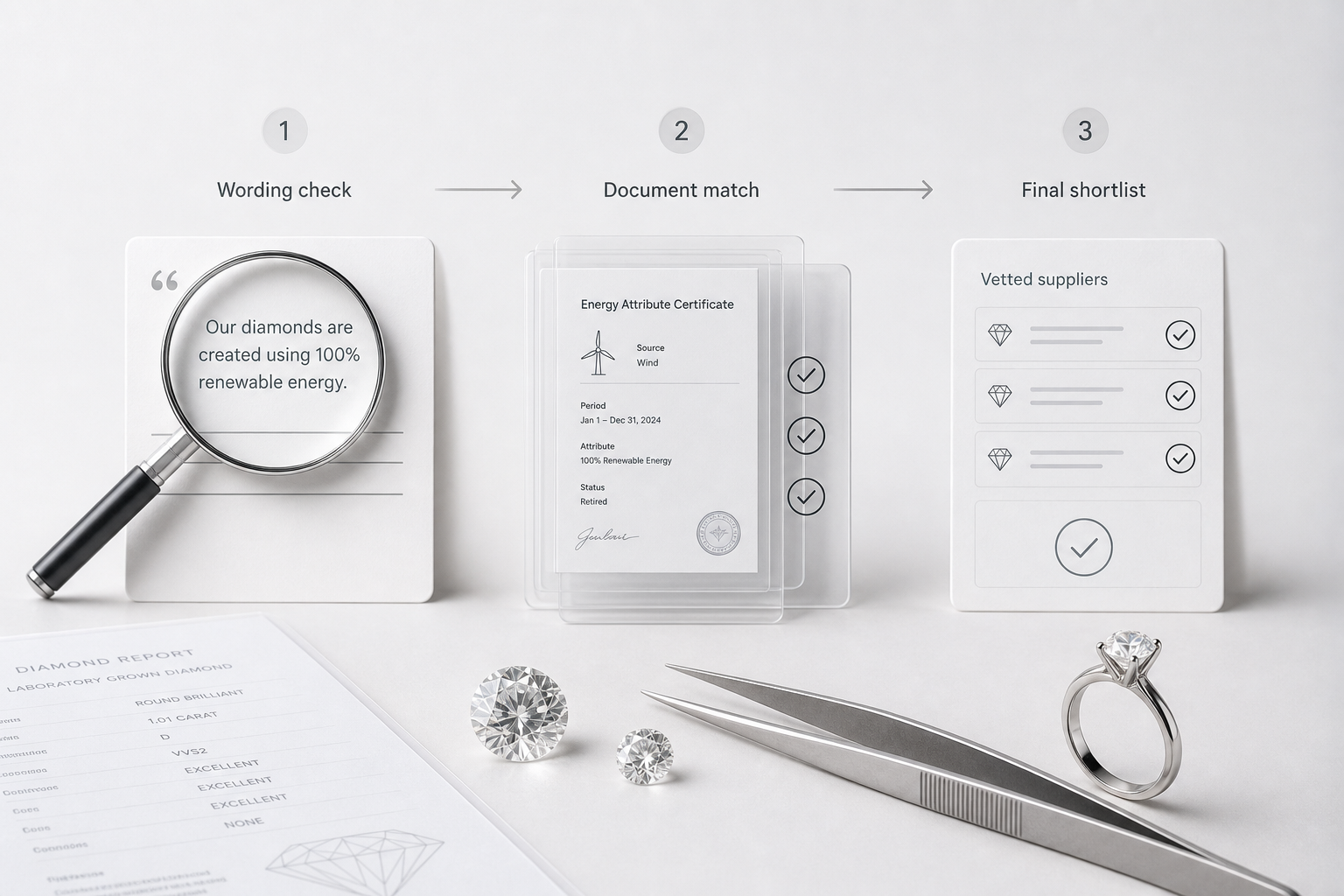
For buyers trying to verify lab-grown diamond sustainability without overcomplicating the purchase, this workflow keeps the decision grounded: identify the exact claim, match it to support, then classify it before assigning value.
How to Keep Sustainability Claims Separate From Diamond Quality Claims
A renewable energy claim and a diamond quality claim answer different questions. The renewable energy claim concerns production electricity, certificates, offsets, or emissions boundaries. The diamond quality claim concerns the stone’s measurable and visible characteristics, such as cut proportions, light performance, color, clarity, carat weight, measurements, and how the diamond looks in the intended jewelry design.
This separation matters because strong sustainability documentation does not automatically make a diamond visually attractive, well cut, appropriately priced, or suitable for a specific setting. In the same way, an excellent grading report does not prove that a renewable energy claim is accurate. Buyers should avoid letting one strong document create confidence in unrelated claims that need their own support.
When growth method or post-growth treatment is relevant, buyers should look for clear disclosure in the grading report or seller documentation. HPHT and CVD are commonly discussed as laboratory-grown diamond growth methods, while post-growth treatments are a separate disclosure issue when applicable. A seller should not imply treatment status, energy source, or environmental performance unless the relevant documentation supports that statement.
A practical final review can be simple: confirm laboratory-grown origin, review the grading report, compare visual evidence, check measurements for the setting, read the renewable energy documentation, and confirm seller terms in writing. Each step has a different purpose. Keeping those purposes separate makes the buying decision more balanced and reduces the risk of relying on a claim that proves less than it appears to prove.
FAQ: Common Questions About Renewable Energy Claims in Lab-Grown Diamonds
Is Renewable-Powered the Same as Carbon-Neutral?
No. Renewable-powered vs carbon-neutral diamonds is a common source of confusion because the terms can appear near each other in marketing copy. Renewable-powered usually refers to the electricity used in some part of production. Carbon-neutral usually refers to an emissions accounting claim, which may include offsets, certificates, reductions, or a combination of methods.
A renewable-powered claim should be judged by the energy evidence behind it. A carbon-neutral claim should be judged by the emissions boundary, accounting method, and any offsets used. One is not automatically stronger than the other; the stronger claim is the one with clearer documentation and a tighter boundary.
Can a Lab-Grown Diamond Be Low-Carbon Without Being Fully Renewable?
Yes, but the phrase needs careful handling. If a buyer asks, “Are lab-grown diamonds low-carbon?” the honest answer depends on the production method, electricity source, reporting boundary, and how the seller defines the comparison. “Low-carbon” can mean lower than a chosen baseline, lower for a specific facility, or lower within a limited reporting scope.
A diamond may have a lower reported footprint without being produced entirely with renewable electricity. That does not make the claim meaningless, but it does make the boundary important. Before giving the phrase weight, ask what emissions were counted, what period was measured, and whether the claim applies to the specific item being sold.
What Should I Do If the Brand Only Gives a Short Marketing Statement?
Ask for a dated summary or written clarification that explains the basis of the claim. A seller does not need to hand over confidential internal records, but they should be able to state whether the claim is based on facility electricity, renewable certificates, offsets, a third-party statement, or another defined method.
If the brand can only repeat the same short statement without adding scope, date, source, or document support, treat the claim as weak. That does not automatically mean the diamond is a poor choice, but it does mean the renewable energy language should not influence your decision very much.
Does a Renewable Energy Claim Prove the Diamond Is Sustainable?
No. A renewable energy claim may support one part of the sustainability conversation, but it does not automatically prove the full environmental profile of a diamond or finished jewelry piece. It may not address cutting and polishing, transport, setting production, packaging, corporate operations, or supplier practices unless those boundaries are clearly included.
For that reason, buyers should treat renewable energy documentation as one evidence category rather than a complete verdict. The most credible sellers will usually explain both what the claim covers and what it does not cover. That limitation is not a weakness when it is stated clearly; it is part of responsible disclosure.
Does a Lab-Grown Diamond Grading Report Prove a Renewable Energy Claim?
No. A grading report can document key characteristics, but it should be read alongside visual evidence, measurements, seller documentation, and the intended jewelry use. It may help confirm that the stone is a laboratory-grown diamond and record gemological details, but renewable energy, carbon accounting, offsets, and supplier energy practices require separate support.
If a seller presents a grading report and a sustainability claim together, ask which document supports which statement. The report may support identity and grading details, while a dated facility disclosure, certificate summary, or emissions document may support the renewable energy wording. Treating those documents separately helps prevent a certificate from being asked to prove more than it actually proves.
What to Confirm Before You Decide
Before purchase, confirm four things: the exact wording of the claim, the document or written source behind it, the relevant timeframe, and whether it applies to the specific diamond or listing you are considering. If those pieces line up, the claim can add confidence. If they do not, compare the diamond on its core merits and avoid paying extra for language that has not been supported.
Disclosure: This article is for general educational purposes only. Diamond grading, pricing, availability, specifications, and seller policies can change, and readers should verify important details through grading reports, official laboratory tools, seller documentation, or qualified professionals before making a purchase decision. Laboratory-grown diamonds should be clearly distinguished from natural diamonds, and environmental or sourcing claims should be supported by specific documentation.