
| What to Check | Why It Matters | Buyer Action |
|---|---|---|
| Report number and measurements | Confirms the selected diamond’s identity | Match report, listing, invoice, and final records |
| Photos, video, and proportions | Traceability does not prove beauty | Review cut, shape, light return, and ratio visually |
| CAD and setting details | Links the stone to the custom ring design | Confirm metal, size, prongs, and accent stones in writing |
| Laser inscription | Helps connect stone to report when present | Treat it as identity support, not full supply-chain proof |
| Final quality control | Verifies the finished ring matches the order | Request inspection confirmation and final images before shipment |
| Broad traceability claims | May lack specific documentation | Ask what is independently verifiable and what is supplier-level |
What Traceability Means in Lab-Grown Diamond Jewelry
Lab-grown diamond traceability means being able to connect a finished piece of jewelry back to documented stages in the diamond’s journey. For a ring, that path may include where the diamond was grown, how the rough material was handled, where it was cut and polished, which grading report identifies it, whether it has a laser inscription, how it was selected for the setting, what quality checks were completed, and what documentation arrives with the finished piece. This is different from a vague claim of transparency. A seller can use words like “responsible” or “ethical” without showing much about the actual chain of custody. Strong traceable lab-grown diamond jewelry relies on records that connect one step to the next, not just broad language about modern sourcing. Traceability may support responsible buying conversations, but it does not prove environmental impact by itself. For buyers, the practical point is to separate identity proof from broader sourcing language. A report number, measurements, and final order details can help confirm which diamond was purchased; they do not automatically answer every question about energy use, facility practices, or every supply-chain handoff. When a seller makes sustainability or origin claims, those claims are strongest when they are explained through specific documents or clearly limited to what the seller can actually verify. Terminology matters here. The Federal Trade Commission’s jewelry guidance recognizes that diamonds may be described as laboratory-grown, laboratory-created, manufacturer-created, or by similar terms when the description clearly communicates that the product is not a mined diamond; unclear disclosure can mislead buyers when the origin is material to the purchase decision. [1] For a traceability discussion, that means the first disclosure should be simple and direct: the stone is a laboratory-grown diamond, and the seller should explain what documents identify it.Traceability Is a Documented Path, Not a Single Claim
Diamond traceability is only useful when the records line up. A grading report, seller listing, report number, stone measurements, invoice, and final jewelry documentation should all point toward the same diamond. If those pieces do not connect, the buyer may have individual documents, but not a reliable traceability path. The common mistake is treating one impressive-sounding claim as proof of the whole story. “Fully transparent” is not the same as showing how to verify a lab-grown diamond. A stronger approach is more specific: what is known, what is documented, what can be checked by the buyer, and what remains at the supplier or manufacturer level. The more complete the documentation chain is, the easier it becomes to understand exactly what is being purchased.Documentation Boundaries Buyers Should Keep in Mind
Traceability should be read as a set of documented connections, not as a guarantee that every possible question has been answered. A grading report can document key characteristics, but it should not be treated as a guarantee of beauty, value, or sourcing ethics. Likewise, a seller’s order summary can connect a diamond to a ring design, but it does not prove facility-level production practices unless those details are separately documented. Laboratory-grown diamonds should be clearly identified as laboratory-grown, and they should not be presented as mined diamonds. If a listing, invoice, or conversation uses the word “diamond” without clarifying origin, buyers should confirm whether the stone is laboratory-grown or natural. Diamond simulants are a separate category and should not be confused with lab-grown diamonds, because simulants are lookalike materials rather than diamonds with a laboratory-grown origin. Environmental and sustainability claims should be specific, documented, and limited to what can be substantiated. A traceability record may help a buyer ask better questions about origin and handling, but it does not automatically prove energy use, emissions profile, labor practices, or broader environmental impact. If those factors matter to the purchase, ask which documents support the specific claim being made.Reading Traceability Claims with the Right Level of Proof
A useful traceability claim should answer three separate questions: what object is being identified, what document supports that identification, and who can check it. For example, a report number may identify a polished diamond, while an order summary may connect that diamond to a specific ring design. Neither document is weak simply because it does not describe everything; the problem begins when a seller presents one document as proof of details it does not actually cover. Buyers can make this easier by asking for claim-specific evidence. If the claim is about lab-grown status, the grading report or seller documentation should clearly identify the diamond as laboratory-grown. If the claim is about the selected stone being used in a custom ring, the report number, measurements, CAD notes, and order summary should align. If the claim is about environmental impact or production practices, broader jewelry paperwork is not enough; the seller should explain what specific information supports that statement and where the limits are.The Key Stages Buyers Usually Care About
Most buyers do not need a technical production file. They need to know whether the important handoffs are documented clearly enough to protect the purchase decision. The practical traceability path usually begins at the growth facility, where the rough diamond is produced, then moves through rough diamond handling, cutting and polishing, grading, possible laser inscription, stone selection, jewelry setting, quality control, packaging, and delivery. Each stage answers a different buyer question. Growth and origin documentation speak to where the diamond began. Cutting and grading create the measurable identity of the finished stone. Inscription and report verification help connect the physical diamond to its paperwork. Setting and quality control show whether the selected stone became the actual finished ring. Delivery documentation closes the loop by giving the buyer records to keep.Where Traceability Has Real Limits
Not every detail in the supply chain will be visible to the end buyer. Some production records are internal. Some facility information may be proprietary. Some diamonds move through cutters, distributors, or jewelry manufacturers before reaching the retailer. That does not automatically mean something is wrong, but it does mean traceability exists in levels. A realistic buyer should separate missing basic proof from unavailable factory-level detail. Refusing to provide a grading report number, measurements, or a clear connection between the selected stone and the finished ring is a real concern. Not providing every growth batch record or internal production log is more common, especially in consumer jewelry. The priority is to confirm the identity of the diamond and the documented handoffs that affect the purchase.What This Means in a Real Purchase
For a traceable lab-grown diamond ring, a buyer should not expect a complete factory production file for every stage. It is reasonable, however, to ask what proof should come with a lab-grown diamond before committing: the grading report details, report verification options, diamond measurements, inscription confirmation if applicable, and clear documentation connecting the selected stone to the finished ring. The most useful question is not “Is this traceable?” but “What parts of this diamond and ring can I verify?” A seller with a clear process should be able to explain what is documented, what can be independently checked, and where the available information stops.Traceability vs Certification: Why They Are Related but Not the Same
Lab-grown diamond certification and traceability are closely connected, but they do not do the same job. A diamond grading report describes the diamond’s characteristics and usually identifies it as laboratory-grown. Traceability describes the broader documented path of that stone through growth, cutting, selection, jewelry manufacturing, inspection, and final delivery. This distinction matters because a buyer may assume a certified traceable lab-grown diamond is fully documented from production to ring. In practice, the grading report is one of the strongest consumer-facing anchors, but it is not a complete supply-chain record. It helps identify the stone; it does not automatically prove every handoff that happened before or after grading.What a Grading Report Can Confirm
A diamond grading report can confirm the report number, lab-grown identification, carat weight, measurements, shape, color grade, clarity grade, and cut information where applicable. It may also include polish, symmetry, fluorescence, growth method, or laser inscription details depending on the grading lab and report type. For buyer verification, the most practical details are the report number and measurements. These help the buyer compare the grading lab’s record with the seller listing and the stone being offered. If the measurements, shape, carat weight, or report number do not match, the issue should be resolved before purchase, not after the ring is made. The 4Cs are a formal diamond description framework: carat weight, color, clarity, and cut are used to describe major quality characteristics, but they do not replace visual review or ring-specific fit decisions. [2] In a traceability context, those grades are most useful when they are tied to one specific report number and then carried consistently through the seller listing, invoice, production notes, and final documentation.What a Grading Report Does Not Fully Prove
A grading report does not necessarily document the exact lab-grown diamond growth facility, the full chain of custody, every distributor handoff, the jewelry setting process, or the final quality control history of the finished ring. It also does not prove that the diamond is visually ideal for a specific design. A stone can be correctly graded and still be a poor fit for a particular setting, budget, or appearance preference. This is where buyers should be careful with the phrase “certificate.” Asking “does a certificate prove diamond traceability?” leads to the wrong expectation if the seller treats the report as proof of everything. The better standard is to use the report as an identity document and then ask for the additional records that connect the diamond to the purchase and finished jewelry. It is also worth remembering that grading reports are tools, not style recommendations. Two diamonds with similar color, clarity, and carat weight can differ in proportions, face-up size, patterning, or how noticeable inclusions are in normal viewing. The report helps narrow the shortlist, but the final decision should still consider visual evidence, the intended setting, and the buyer’s tolerance for tradeoffs.How to Read Lab Names Without Overclaiming
Well-known grading laboratories can provide useful report formats and verification tools, but the name of the laboratory should not be used as a shortcut for every buying decision. A report documents the characteristics assessed under that report type; it does not guarantee that the diamond is the right visual match, the right price, or the right setting choice for a particular buyer. Buyers should avoid treating any single lab name as a universal rule. The more practical approach is to read the actual report details: whether the stone is clearly disclosed as laboratory-grown, what measurements are listed, whether a laser inscription is noted, what cut-related information appears, and whether the report can be checked through an official tool where available. A grading report helps document key characteristics, but it should be read alongside visual evidence, measurements, seller documentation, and the intended jewelry use.How Certification Supports Traceability When Linked Correctly
Certification supports traceability when the report number, laser inscription, seller listing, diamond measurements, invoice, and final jewelry documentation all refer to the same stone. That connection is what turns separate pieces of information into a usable verification chain. The strongest setup is simple: the grading lab record matches the seller’s listing; the listed measurements match the report; the laser inscription, if present, matches the report number; and the final ring paperwork confirms that this specific diamond was set. If one piece is missing, the purchase may still be valid, but the buyer should understand which part of the chain is less visible.A Practical Document-Matching Sequence
Buyers can reduce confusion by checking documents in the same order the diamond moves through the purchase. Start with the grading report or report number, then compare the seller listing, invoice or order summary, CAD or design notes, final inspection notes, and delivery records. The purpose is not to create a complicated audit; it is to make sure the same diamond identity follows the purchase from selection to finished ring. The most useful details to match are the report number, shape, carat weight, measurements, laser inscription status if applicable, metal type, ring size, and setting description. If one document uses a simplified description, such as “oval lab-grown diamond ring,” another record should still preserve the specific center-stone details. This layered approach gives the buyer a clearer trail without expecting every document to repeat every technical detail.Certificate and Visual Review Check
Before buying, verify the report number directly through the grading lab’s online report check if available. Compare the report’s measurements with the seller listing, review photos or 360-degree video, and ask whether the diamond has a laser inscription that matches the report. Visual review still matters. A report can confirm identity and grading information, but it will not show every appearance issue that may matter in real life, such as bow-tie visibility in elongated shapes, face-up spread, or how the stone looks in the intended setting.The Growth Facility Stage: Where the Traceability Chain Begins
The lab-grown diamond growth facility is where the traceability chain starts, but it is also one of the stages where buyer visibility can vary the most. Lab-grown diamonds begin as rough crystals produced through controlled growth methods such as CVD or HPHT. From a traceability perspective, the key question is not how technical the process sounds, but whether the diamond can be connected to credible origin documentation and later records. Buyers often ask, “Can you trace where a lab-grown diamond was made?” The answer is sometimes partly, sometimes more fully, and sometimes only through summarized supplier documentation. A seller may be able to confirm that the diamond is laboratory-grown, identify the grading report, and explain the sourcing path, but that does not always mean the exact facility name or full production file will be disclosed to the consumer.Growth Method, Facility Records, and Buyer Visibility
Producers may track growth method, production batch, rough diamond identity, and internal production records before the rough crystal is cut. Those records can be important inside the supply chain because they help manufacturers manage inventory, production consistency, and rough-to-polished transformation. At the buyer level, this information may appear in a more limited form. A grading report may identify the stone as laboratory-grown and may disclose the growth method in some cases. Seller documentation may describe the diamond origin in general terms rather than providing full facility records. That limitation is not automatically a problem, but it should be clear. The risk begins when a seller uses origin language confidently but cannot explain what is actually documented. GIA describes HPHT and CVD as two common methods used to grow diamonds in a laboratory environment, but the growth method alone should not be treated as proof of beauty, value, sustainability, or complete traceability. [3] For buyers, the more useful question is how the finished stone is identified after growth and how that identification continues through cutting, grading, setting, and delivery. When growth method or post-growth treatment is relevant, buyers should look for clear disclosure in the grading report or seller documentation. HPHT and CVD may describe growth methods for laboratory-grown diamonds; treatment language should be used only when a post-growth treatment is actually being discussed and documented.Why Facility-Level Transparency Can Vary
Facility-level transparency depends on how the diamond moves through the supply chain. A seller with direct sourcing relationships may have more information than a seller buying through broader distribution channels. Some suppliers protect manufacturing details for competitive reasons. In other cases, the diamond may pass from grower to cutter to wholesaler to retailer, with only part of the original production information transferred forward. This variation should be judged by relevance and documentation, not suspicion alone. For most consumer purchases, the buyer’s highest priority is confirming that the stone is accurately identified as lab-grown and that the selected diamond can be matched to its report and final jewelry. Exact growth batch records may be useful, but they are not always the deciding factor in whether a ring purchase is well documented.What Buyers Can Reasonably Ask About Origin
Reasonable questions about diamond origin should be specific. Ask whether the diamond is identified as laboratory-grown on the grading report, whether the growth method is disclosed, whether supplier documentation exists, and whether the seller can explain the sourcing path in writing. A clear answer is more valuable than a polished phrase that avoids the details. If the seller cannot provide the exact lab-created diamond origin, ask what they can verify instead. The practical goal is to understand which part of the chain is documented at the consumer level and which part remains supplier-level information. A buyer does not need every internal production record to make a good decision, but they should not have to accept vague origin claims without any supporting paperwork. When origin is discussed alongside sustainability, the same careful standard should apply. Lab-grown diamonds can offer a different production path from mined diamonds, but that does not automatically prove a lower impact or a stronger ethical outcome in every case. If environmental or sourcing claims are important to the purchase, ask what documentation, supplier disclosure, or production information supports the claim rather than relying on category-wide assumptions. Environmental language should be especially specific. FTC environmental marketing guidance cautions marketers against broad, unqualified environmental benefit claims because they can be difficult to substantiate and may imply benefits that are not proven. [4] In jewelry buying, that means a traceability claim and a sustainability claim should be evaluated separately: one may document identity or process handoffs, while the other requires evidence about environmental attributes. Sustainability claims should be specific and documented. Broad green language is less useful than a diamond sustainability comparison grounded in clear information about production, energy context, sourcing records, and seller transparency. A traceable diamond is not automatically a documented environmental claim; it simply gives the buyer a clearer path for asking what is known and what is not being claimed.Buyer Verification Checklist
Ask for the grading report and confirm that it identifies the stone as laboratory-grown. Check whether the report includes growth method or laser inscription information. Compare the report details with the seller listing, especially carat weight, shape, measurements, and report number. Request a plain-English explanation of what the seller can verify about origin versus what remains internal to the supplier. If a seller claims unusually complete diamond growth traceability, ask which documents support that claim and whether those documents will be included with the purchase records.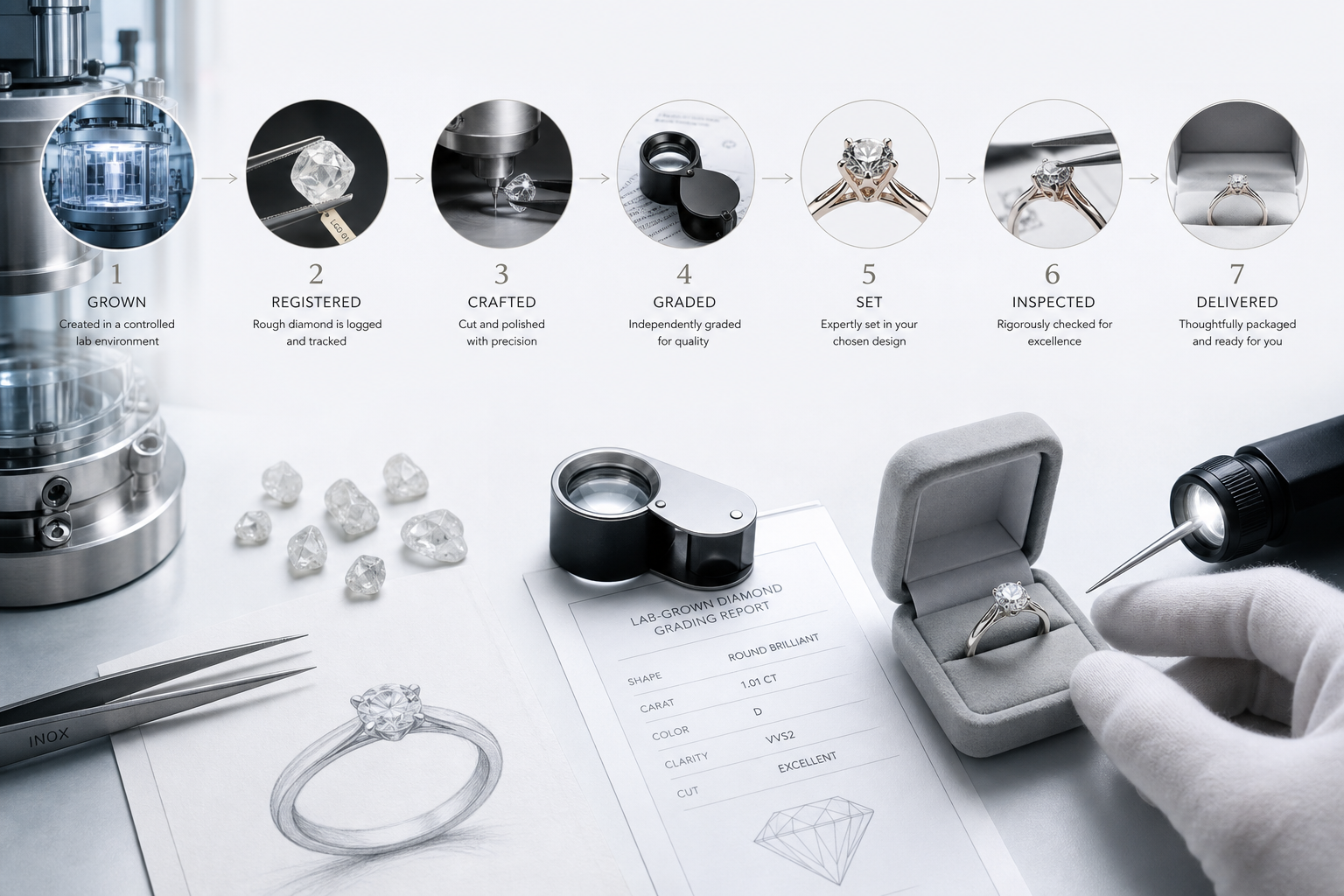
For the full framework, read Lab-Grown Diamond Traceability, Certification, and Transparency Guide.
Cutting and Polishing: The Stage That Connects Rough Origin to Visual Performance
Lab-grown diamond cutting and polishing is where traceability becomes easier for a buyer to verify. Before cutting, the rough crystal may be tracked through internal production and handling records, but those records are often not visible in full to the consumer. Once the diamond is cut and polished, it has a measurable identity: shape, carat weight, dimensions, proportions, polish, symmetry, and visual features that can be matched against photos, video, and a grading report. This matters because a polished lab-grown diamond is no longer just a claim about origin. It is a specific stone with data points that should stay consistent across the seller listing, lab report, invoice, and ring production notes. Diamond cutting traceability is strongest when those details line up cleanly. If the listing says one measurement, the report says another, and the final ring documentation does not identify the center stone clearly, the buyer has a reason to pause before approving the purchase.How Cutting Creates a Measurable Diamond Identity
Cutting turns a rough crystal into a diamond that can be recognized by its finished characteristics. Shape is the first obvious marker, but it is not enough on its own. A 1.50 ct oval, for example, could share the same general description with many other stones. The more useful identifiers are the exact length, width, depth, table percentage, depth percentage, girdle description, polish, symmetry, and facet pattern shown in the diamond’s documentation. These measurements help create a consumer-verifiable anchor in the traceability chain. If a buyer selects a loose stone listed as 1.50 ct with specific dimensions, those numbers should match the grading report and remain connected to the order record when the stone is set. Minor rounding differences can happen depending on how information is displayed, but meaningful mismatches should be clarified before payment or production. The practical risk is not that every small formatting difference signals a problem; it is that unclear documentation can make it harder to prove which stone was actually selected.Why Cut Quality Still Matters in a Traceable Diamond
Traceability does not make a diamond beautiful. A traceable loose lab-grown diamond can still have weak light return, an awkward outline, a visible bow-tie in an elongated shape, or proportions that make it look smaller than its carat weight suggests. Documentation can tell you which stone you are buying, but it does not replace visual review. This is a common point buyers overestimate: a clean traceability path reduces identity risk, not performance risk. A diamond with a verified report number and consistent measurements may still be the wrong choice if the cut is poorly balanced or if the shape does not suit the intended ring design. For engagement rings especially, the better decision is to treat traceability and cut review as separate checks. One confirms the stone’s identity; the other helps confirm whether it looks good enough to wear every day.Useful Parameter Ranges Buyers Can Use Carefully
Numerical ranges can help buyers screen diamonds, but they should not be treated as guarantees. For round brilliant lab-grown diamonds, many buyers use table percentages around 54 to 58 percent and depth around 60 to 62.5 percent as a starting point. Those ranges can help narrow a search, but they do not capture the full relationship between crown angle, pavilion angle, lower-half length, star facets, optical symmetry, and actual visual performance. For elongated shapes such as oval, emerald, radiant, pear, and marquise, length-to-width ratio often matters more than buyers expect. Carat weight tells you how heavy the diamond is, not how it faces up or whether the outline fits the setting. A 1.50 ct oval with a longer spread may look very different from a 1.50 ct oval with a shorter, wider shape. Neither is automatically better, but the wrong ratio can make the finished ring feel off-balance, especially in a custom setting designed around a specific silhouette. The safest use of measurements is comparative. If two diamonds have similar carat weight and grades, look at their dimensions, table, depth, and video side by side. A stone that looks larger on paper may have a shallow build that affects performance, while a deeper stone may carry weight where the eye does not see it. The goal is not to memorize ideal numbers; it is to avoid choosing based only on the headline carat weight. In practical buying, this is where many comparisons become misleading. A higher color or clarity grade may feel safer, but if the cut, outline, or proportions are weaker, the finished ring may still be less pleasing than a stone with slightly different grades and stronger visual performance. The better comparison is not “which report looks best,” but “which documented stone looks best for this design, budget, and wearer preference.”Stone Measurement Check
Before approving a loose diamond for a ring, compare the seller listing, grading report, and any CAD or setting notes for matching carat weight, dimensions, and shape. If the stone is elongated, confirm that the length-to-width ratio fits the intended design rather than assuming the carat weight alone will produce the right look. If any measurement or shape description does not match, ask for clarification before the stone moves into production.Grading Report, Report Number, and Laser Inscription: The Consumer-Facing Anchor
The grading report is usually the easiest consumer-facing reference point in lab-grown diamond traceability. It gives the buyer a report number, diamond measurements, grading details, and often a way to compare the seller’s listing against the grading lab’s record. For most buyers, grading report verification is the first practical step in confirming that the diamond being offered is the same diamond described in the documentation. A lab-grown diamond laser inscription can add another layer of confidence when it is present. The inscription is typically placed on the girdle and may match the diamond report number. It helps connect the physical stone to the lab report, but it should not be overstated. A girdle inscription is an identity marker, not a complete history of every supply-chain handoff.How the Report Number Functions in Traceability
The diamond report number links the stone to a grading lab record. When an online report lookup is available, the buyer can check whether the report number, shape, carat weight, measurements, color grade, clarity grade, and other listed details match what the seller is presenting. This is one of the simplest ways to catch avoidable errors before purchase. The most important comparison is consistency. If the seller listing shows a 2.00 ct round diamond but the lab report linked to that number describes a different shape or noticeably different measurements, the issue needs to be resolved before the buyer moves forward. Sometimes discrepancies are simple upload mistakes. Sometimes they signal that the wrong report, wrong stone, or outdated listing information is being shown. Either way, the buyer should not have to guess. Online report verification should be treated as a document-matching step, not as proof that every seller statement is correct. GIA, for example, provides report verification tools that allow users to look up report information, but the buyer still needs to compare that information with the seller’s listing, invoice, and finished-ring documentation. [5]What Laser Inscription Adds
A laser inscription is a microscopic marking on the girdle of the diamond. When it matches the grading report number, it helps identify the physical diamond as the one described in the report. This is especially useful after the diamond has been handled, shipped, or set into jewelry, when the buyer wants a stronger connection between the stone and its documentation. Buyers should understand the limitation: most people cannot read a laser inscription with the naked eye. It usually requires magnification, and in some mounted rings the inscription may be harder to view depending on the setting. A jeweler may be able to help confirm it. The inscription is valuable because it supports a certificate match, not because it replaces the grading report, seller documentation, or final order records.When the Report and Inscription Are Most Useful
The report number and inscription are most useful when the buyer is choosing a loose diamond, approving a center stone for a custom ring, comparing several similar stones, or receiving a finished piece after setting. These are the moments when identity matters most. If two diamonds have similar carat weight, shape, color, and clarity, the report number prevents confusion between stones that may look nearly identical in a product grid. They are also useful after jewelry manufacturing. Once a diamond is set, the buyer should still be able to connect the finished ring back to the selected center stone. The report number, seller order record, and any inscription confirmation should point to the same diamond. If that connection disappears after setting, traceability becomes weaker at the exact stage where the buyer needs confidence most.How to Verify This Before Buying
Ask whether the diamond has a laser inscription and whether it matches the grading report. Use the grading lab’s online report lookup when available to check the lab-grown diamond report number directly. Compare the report’s measurements with the seller listing, review available photos or 360-degree video, and keep a copy of the report with your final purchase records. If the seller cannot confirm basic report details, the safer decision is to slow down rather than rely on verbal assurance.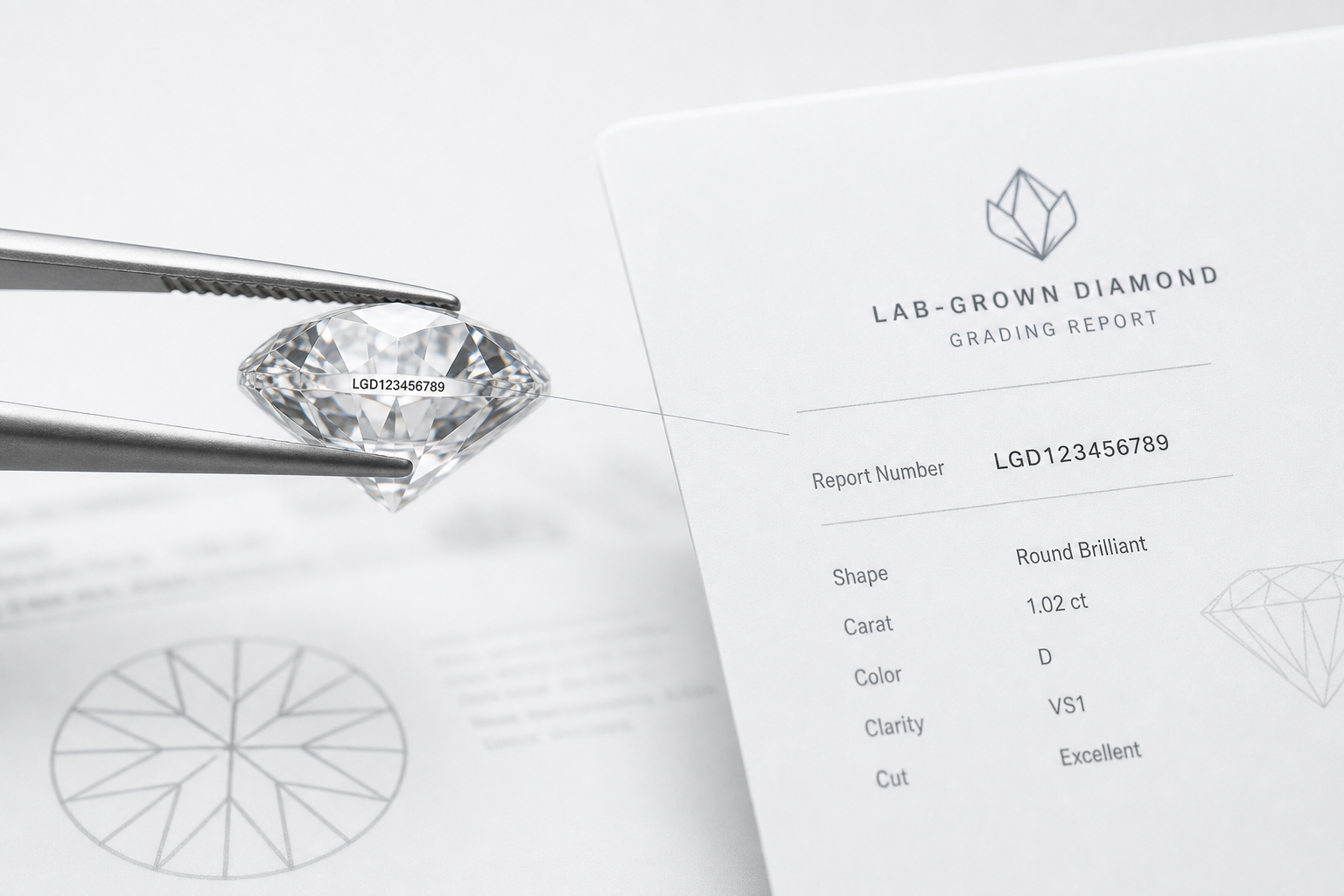
Jewelry Manufacturing: How the Diamond Becomes a Finished Ring
A traceable lab-grown diamond ring depends on more than identifying the loose center stone. The traceability chain has to survive the handoff from selected diamond to finished jewelry. This is where lab-grown diamond jewelry manufacturing becomes important: the report number, stone measurements, setting details, metal type, production notes, and final ring specifications should all point to the same piece being made. The weak point is often not the diamond report itself. It is the transition from loose stone to setting. A buyer may carefully verify a diamond, then receive a finished ring with limited documentation connecting that specific stone to the final piece. For a simple ready-made ring, the records may be straightforward. For a custom lab-grown diamond ring, the paper trail should be more specific because the design, center stone dimensions, and setting structure are being coordinated together.The Stone-to-Setting Handoff
The selected diamond should be tied to the finished ring through the report number, exact measurements, order records, and production notes. This is the core of how to trace a diamond after setting. The center stone does not stop needing identification once it leaves the loose diamond stage; if anything, the need becomes more practical because the stone is now part of a finished item. For example, if a buyer chooses a 1.70 ct radiant cut with a specific report number, the ring order should not simply say “radiant lab diamond ring.” It should connect that diamond to the setting, metal type, ring size, and any special production instructions. The more customized the piece, the more important this connection becomes. A vague order summary may be acceptable for a low-stakes accessory, but it is not ideal for an engagement ring or higher-value design.Custom Design Records and CAD Approval
CAD design records can help document what is being made, especially when the ring is built around a specific center stone. A CAD image may show the setting structure, prong placement, shank shape, stone orientation, and design proportions. It is not a grading document and should not be treated as proof of diamond quality, but it can be a useful manufacturing reference. For custom work, the center stone dimensions should inform the design. A setting made for a 9.00 x 6.50 mm oval may not be the right fit for a visibly different oval, even if the carat weight is similar. This is why custom ring diamond documentation should include the stone’s measurements, not only the carat weight. The practical risk is a ring that technically holds the stone but does not frame it well, sits too high, feels bulky, or leaves prongs looking strained. At NUVU, this is one area where the diamond and setting are treated as one decision rather than two separate purchases. A well-documented custom process should make clear which stone was selected, how it fits the design, and what specifications the buyer approved before production. For custom jewelry, stone measurements and setting compatibility should be confirmed before finalizing a purchase. A CAD view can be helpful, but the buyer should still confirm the report number, dimensions, metal choice, ring size, accent-stone description, and any design-sensitive details in writing before production proceeds.Side Stones and Accent Diamonds
Side stones and melee diamonds can complicate traceability because smaller accent stones may not come with individual grading reports. That is not automatically a problem. In many jewelry designs, individually grading every tiny accent diamond would be impractical and would add cost without giving the buyer much useful decision value. What matters is how those stones are described and documented. Buyers should ask whether the accent stones are lab-grown or natural, what general color and clarity range is being used, and how they are matched for the design. This is especially important for three-stone rings, hidden halos, pavé bands, and higher-value pieces where accent diamonds meaningfully affect the look and cost of the ring. The mistake to avoid is assuming the center stone documentation covers every diamond in the piece.Stone-to-Setting Fit Check
Before production, confirm the center stone report number, exact measurements, ring size, metal type, prong style, setting height if relevant, and whether accent stones are lab-grown or natural. Ask for these details in writing before final approval. If CAD images or design notes are part of the process, make sure they reflect the same center stone dimensions shown on the grading report or seller listing. For custom design, trust comes from matching the stone to the setting, budget, and wearer’s daily use, not from choosing grades in isolation. A ring can be well documented and still feel wrong if the stone sits too high, the prongs do not suit the shape, or the accent stones do not visually support the center diamond. The practical fit check should happen before production, while measurements, CAD details, and design expectations can still be aligned.Quality Control: What Should Be Checked Before Final Delivery
Lab-grown diamond ring quality control is the point where documentation has to meet the physical piece of jewelry. A ring can have the correct diamond, the right metal, and approved design details on paper, but the finished piece still needs to be checked for identity, construction, comfort, and presentation before it ships. The most useful diamond jewelry inspection is not just a beauty review. It should confirm that the selected stone is the one in the ring, that the setting holds it securely, and that the finished piece matches the approved order. This is where small issues are easiest to correct. Once the ring is delivered, a crooked prong, uneven stone angle, or sizing mismatch becomes more inconvenient to resolve.Diamond Identity Check After Setting
For a custom order or a loose-stone selection, the seller should be able to confirm that the chosen center diamond was set into the finished ring. The report number, stone measurements, shape, and order details should still point to the same diamond after setting. This matters most when the buyer selected a specific stone rather than choosing a pre-set ring from inventory. This check should not require a buyer to become an inspector. The seller can confirm the center stone identity in writing, and when a laser inscription is present, it may be checked with magnification before or after setting. In some ring designs, the inscription may be difficult to view once mounted, so the practical safeguard is to verify the stone before production and keep the report details tied to the order record.Craftsmanship Checks That Affect Wearability
Finished ring verification should focus on details that affect daily wear, not only on how the ring looks in a photo. Prong security is the first priority because loose or uneven prongs can put the stone at risk. Stone alignment comes next: the center diamond should sit straight, not tilted, twisted, or visibly off-center unless the design intentionally calls for asymmetry. Ring size, metal finish, polish, engraving, and comfort also deserve attention. A high-polish finish should not show obvious tool marks. Engraving should be spelled correctly and placed as approved. The inside of the ring should feel smooth enough for daily wear, especially on engagement rings that will be worn for long hours. These details are not cosmetic extras; they affect whether the piece feels finished rather than merely assembled. Symmetry in the setting should be judged with common sense. Handmade or custom-finished jewelry may show tiny variations under extreme magnification, but visible imbalance in prongs, uneven side stones, or a center stone that appears to lean in normal viewing is worth questioning before shipment. Final photos and videos are useful evidence, but they have limits. Reflections, camera angle, lighting, and magnification can make small details look more dramatic or hide issues that matter in person. A careful buyer should use final media as a prompt for specific questions: whether the stone is secure, whether the ring matches the approved specifications, and whether any visible concern has been checked before shipment.A Realistic Buyer Scenario
Maya selects a 1.50 ct lab-grown oval with a report number and asks for it to be set in a low-profile solitaire. The order summary lists the correct center stone, metal type, ring size, and setting style. Before shipment, she receives final photos of the completed ring and notices that one prong looks slightly higher than the others from the top view. The right response is not to assume the ring is defective, but it is also not something to ignore. Photos can exaggerate shadows and angles, especially with oval diamonds and polished metal. Maya should ask the seller to confirm prong alignment and stone security, request an additional straight-on photo or short video, and ask whether any adjustment is needed before shipment. If the seller confirms that the prong is secure and the apparent unevenness is only a photo angle, updated visual evidence may be enough. If the prong is actually uneven, the better decision is to request correction before delivery. This is the purpose of final QC: to catch fixable issues while the ring is still with the jeweler.Final QC Request Before Shipment
Before accepting shipment, ask for final photos or video of the completed ring, confirmation of the center stone report number, ring size, metal type, and a brief written note that the piece passed final inspection. If you are trying to verify finished engagement ring details, focus on the elements that are hardest to judge after the fact: whether the selected diamond was set, whether the stone sits straight, whether the prongs look even and secure, and whether the ring matches the approved specifications. A practical lab-grown diamond ring inspection checklist should include center stone identity, prong security, stone alignment, ring size, metal finish, engraving if applicable, and any visible concerns from the final images. If something looks off, ask before delivery. A careful question at this stage is normal buyer diligence, not a complaint.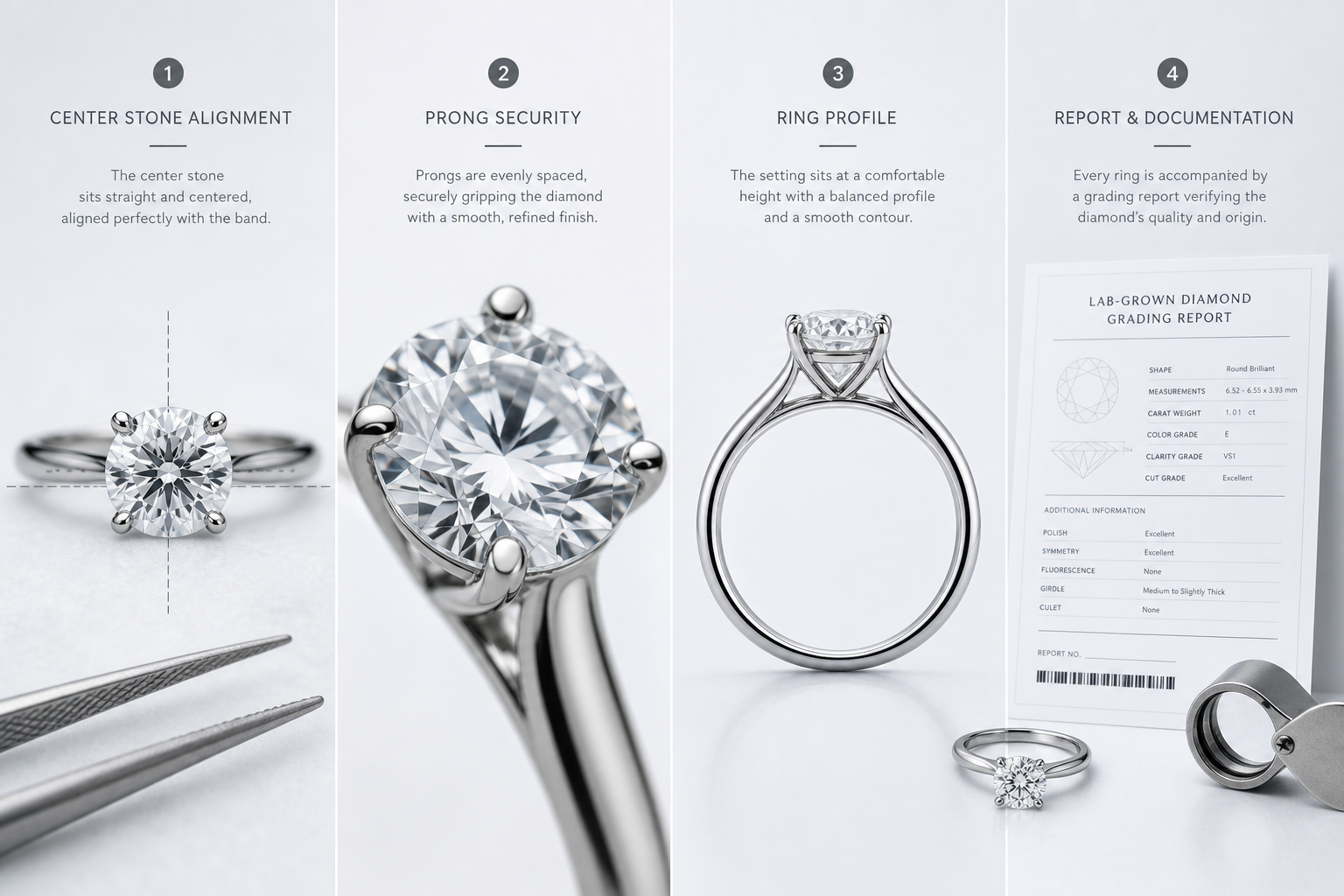
Shipping, Delivery, and Final Documentation: Closing the Traceability Loop
Lab-grown diamond documentation should not stop when the ring is finished. The final delivery package is what allows the buyer to preserve the traceability chain after purchase. A report number, invoice, order confirmation, final photos, and written specifications are useful because they connect the physical ring to the diamond and design details the buyer approved. The key is not to expect every seller to provide the same package. Policies vary. The safer approach is to ask before purchase what documents will be included, what will be sent digitally, and what details will appear on the invoice or order summary. Diamond ring delivery documentation is easiest to clarify before payment, not after the package arrives.Documents Buyers Should Keep
Buyers should keep a grading report copy or report number, sales invoice, order confirmation, and the final ring specifications. For custom pieces, CAD approvals, design notes, center stone measurements, metal type, ring size, and any final inspection notes are especially important. If the seller confirms key details by email or message, save that communication with the purchase records. Photos and videos can also be useful, particularly if they show the completed ring before shipment. They are not a substitute for formal documentation, but they help preserve what was approved and delivered. For a traceable diamond purchase, the strongest record is a set of documents that all point to the same stone, the same ring, and the same buyer-approved specifications.Why Final Documentation Matters Later
Good records are useful well beyond the day the ring arrives. Insurance providers may ask for an invoice, appraisal, grading report copy, or other value-related information. A jeweler handling future resizing or service may benefit from knowing the metal type, ring size, setting style, and stone details. If the buyer ever discusses resale, upgrade, repair, or replacement, vague memory is much weaker than organized paperwork. Documentation also protects against confusion. A buyer may remember choosing a certain carat weight, but the actual report number, measurements, and ring specifications are what settle the question. This matters even more for couples buying a custom engagement ring, where several decisions may have been made over multiple emails or design approvals.Delivery Questions to Ask Before Purchase
Before buying, ask how the ring will be shipped, whether a signature is required, what documentation is included in the package, and whether digital copies, alongside evidence for lab grown diamond sustainability, will also be provided. If insurance or delivery coverage applies, ask for the terms in writing rather than relying on assumptions. The goal is not to create friction; it is to avoid uncertainty around a high-value delivery. Buyers should also ask how post-delivery questions are handled. If the ring arrives and the buyer wants to confirm the paperwork, report number, or specifications, there should be a clear path for asking. A seller that communicates clearly before purchase is usually easier to work with if a documentation question comes up after delivery.Pricing and Policy Details Should Be Verified Separately
Traceability records can help identify the diamond and the finished ring, but they do not confirm whether a price is favorable, whether resale value will hold, or whether a seller policy applies. Prices can change with market conditions, report type, seller channel, and stone-specific details, so exact comparisons should be verified at the time of purchase. Buyers should compare like-for-like specifications before treating one stone or ring as a better value. Return terms, resizing, warranty coverage, shipping procedures, and after-sales support should be confirmed directly with the seller before purchase. These policies are separate from diamond traceability. A well-documented ring can still be subject to specific seller terms, and buyers should keep written policy information with the rest of their purchase records if those terms matter to the decision.Purchase Record Checklist
Keep digital and physical copies of the grading report or report number, invoice, order confirmation, center stone details, design approvals, ring specifications, final photos, and any written confirmation about shipping or delivery expectations. If an appraisal or insurance documentation is provided or arranged separately, store it with the same file. The most common mistake is keeping only the receipt. A receipt may prove that a purchase happened, but it may not fully describe the diamond, the setting, or the final jewelry details. For lab-grown diamond ring paperwork, the useful standard is simple: if the document helps identify what was purchased, how it was specified, or how it was delivered, keep it.What Buyers Can Realistically Request from a Traceable Lab-Grown Diamond Seller
A traceable lab-grown diamond seller should be able to answer practical documentation questions without turning the process into a mystery. Buyers do not need full factory files for every ring, but they should not have to rely on vague reassurance either. The strongest position is to ask for the information that directly helps verify the diamond, the setting, and the final purchase. Traceability works in levels. Some details are consumer-facing and should be straightforward to provide. Other details may depend on supplier relationships, production records, or proprietary information. At NUVU, the buyer-first approach is to treat documentation as part of the decision process: what can be verified should be made clear, and what cannot be provided should not be dressed up as certainty.Reasonable Requests Before Buying
A practical lab-grown diamond buyer checklist starts with the grading report number or the name of the grading lab, plus a way to verify the report when available. Buyers should also ask for photos or video of the diamond, listed measurements, shape, carat weight, and laser inscription status if applicable. These details help confirm that the stone being discussed is specific, not interchangeable. For the ring itself, ask for the metal type, ring size, setting style, prong or bezel details, side stone description, and a written order summary before production begins. If the piece includes accent diamonds, ask whether they are lab-grown or natural and how they are described in the order. Smaller side stones may not carry individual grading reports, so the important point is clear disclosure, not unrealistic paperwork for every tiny stone. Visual evidence matters because paperwork does not show everything. A report can identify a diamond, but photos or video can reveal bow-tie appearance in an oval, overall face-up impression, and whether the chosen stone suits the intended setting. Buyers who want to know how to buy a traceable lab-grown diamond ring should combine report verification with visual review and written specifications.Requests That May Require Extra Context
Some diamond transparency questions are reasonable to ask but may not always produce a simple answer. The exact growth facility name, production batch records, energy source, and full chain-of-custody documents may be available in some sourcing models and unavailable in others. Lack of consumer-facing access to those details is not automatically a warning sign, but a seller should be able to explain what level of supplier transparency exists. This is where buyers should listen carefully to wording. “We can provide the grading report and seller documentation” is a clear, limited answer. “Everything is fully traceable” without specifics is weaker, even if it sounds more impressive. Full facility-level traceability should not be assumed unless the seller can show what that claim means in documents.Red Flags in Traceability Language
The clearest red flag is a broad claim with no support. Phrases such as “fully traceable,” “ethically perfect,” or “transparent from start to finish” should be followed by actual seller documentation, report details, or written explanations. If those do not appear, the claim is doing more marketing work than verification work. Other warning signs include refusal to share basic report details before purchase, measurements that do not match across the listing and report, unclear stone identity after setting, or pressure to buy without time to verify the information. Return policy confirmation is also worth asking about before purchase, not because it proves traceability, but because it shows how the seller handles buyer concerns if the delivered item does not match expectations. Inconsistency is more serious than missing advanced records. A seller may reasonably lack production batch documentation, but the report number, measurements, stone description, and finished ring details should not conflict. If basic facts shift during the buying process, pause before moving forward.Buyer Verification Checklist
Before placing an order, ask: What grading report identifies this diamond? Can I verify the report number? Does the stone have a laser inscription? Are the listed measurements consistent across the report and seller listing? How is the selected stone connected to the finished ring? What metal, ring size, setting details, and side stone descriptions will appear in the written order summary? What final documentation will I receive? The best way to verify lab-grown diamond before purchase is to get answers in writing and make sure the documents refer to the same stone and the same ring. A seller does not need to provide every supplier-level record to be useful, but they should give you enough clear information to understand what you are buying and how it will be documented.Review Traceability Claims Before You Buy
Traceability should make a lab-grown diamond purchase clearer, not louder. For NUVU lab-grown diamonds, the useful question is not whether every detail can be reduced to one perfect claim. The better question is what can be identified, what can be documented, what can be verified by the buyer, and what still depends on supplier-level information. A responsible approach to traceable lab-grown diamond jewelry avoids broad promises that sound better than the paperwork behind them. Buyers should be able to understand the diamond they are considering, review the available documentation, connect the stone to the intended setting, and know what records will come with the finished piece. If a seller cannot explain those steps plainly, the issue is not only missing paperwork; it is a weak buying process.Transparency as a Buying Process
Transparent lab-grown diamond buying is not a single certificate, slogan, or sustainability statement. It is a sequence of clear answers before the buyer commits: what is known about the diamond, which details are documented, how the report can be checked, whether the stone has visual assets, and how the selected diamond will be connected to the finished jewelry. The most useful transparency is specific. “This diamond has a grading report, these are its measurements, this is the report number, this is the setting it will be made for, and these are the final specifications you will receive” is far stronger than a general claim that the ring is fully traceable. Strong documentation reduces the chance of confusion at the point where many mistakes happen: after a loose diamond becomes a finished ring.How Traceability Supports Loose Diamond and Custom Ring Decisions
Traceability matters most when a buyer is comparing similar stones or planning a custom ring. Two diamonds can look close in carat weight, shape, color, and clarity, but the report details, measurements, visual performance, and setting fit may point to different decisions. A traceable process helps the buyer keep the chosen stone connected to the design rather than treating the diamond and ring as separate purchases. For loose diamond selection, documentation review helps confirm that the stone being discussed matches the report and listing. For custom ring support, the key step is connecting that stone to the CAD design, metal choice, setting style, ring size, and final production notes. A custom lab-grown diamond ring with documentation is not just better organized; it is less likely to create uncertainty after production begins. At NUVU, traceability is best treated as buyer guidance rather than a blanket claim. The practical goal is to help buyers ask better questions, review the available evidence, and make sure the diamond, setting, and final jewelry details all point to the same purchase.What a Traceability Claim Can Establish
Clear wording protects both the buyer and the buying process. Instead of saying a diamond is “fully ethical,” “guaranteed sustainable,” or “completely traceable,” a more useful statement explains the specific records available: the grading report, report number, laboratory-grown disclosure, measurements, inscription status if applicable, order summary, and final ring specifications. This gives the buyer something concrete to verify. NUVU’s buyer-first approach is to make comparison clearer, especially around report details, visual evidence, setting fit, and documentation. That approach should not be confused with a claim that NUVU certifies diamonds or guarantees environmental outcomes. The buyer should still review the report, compare the documentation, and confirm seller policies directly before making a final decision.Further Reading for Your Traceability Questions
Readers who want to go deeper should move in the direction of the decision they are actually making. If the main concern is whether a diamond report can be trusted, a certification guide is the logical next step. If the buyer is still comparing stones, a loose lab-grown diamond buying guide will be more useful than a broad transparency discussion. For a custom engagement ring, the next question is usually fit: whether the selected diamond works with the setting, proportions, metal, prong style, and daily wear expectations. A custom engagement ring guide can help buyers understand those design decisions before production. If the concern is shape, spread, or length-to-width ratio, a diamond shapes guide is the better path. After the ring is made, a jewelry care or final inspection guide can help the buyer know what to check before wearing, resizing, or insuring the piece.What to Confirm with NUVU or Any Seller
Before buying, ask for the diamond report details, available photos or video, stone measurements, laser inscription status if applicable, setting compatibility, final ring specifications, and the documents that will accompany the purchase. For a traceable lab-grown diamond ring, the strongest answers are written, specific, and consistent across the report, order summary, design notes, and final jewelry details. The warning sign is not always that a seller lacks full facility-level records. In many purchases, those records may not be available to the end consumer. The bigger concern is when basic buyer-facing information is vague, delayed, inconsistent, or presented as something the buyer should not need to verify.FAQ: Traceability in Lab-Grown Diamond Jewelry
Can lab-grown diamonds be traced?
Yes, parts of a lab-grown diamond’s journey can often be traced through a grading report, report number, laser inscription, seller records, manufacturing details, and final jewelry documentation. The level of lab-grown diamond traceability varies by stone, supplier, report, and seller process, so buyers should look for specific records rather than broad claims.Is a grading report the same as traceability?
No. A grading report identifies and describes the diamond, including details such as carat weight, measurements, color, clarity, shape, and lab-grown status. Traceability refers to the broader documented path from production and cutting to setting, inspection, delivery, and finished jewelry records.Does laser inscription prove the whole supply chain?
No. A laser inscription can help connect the physical diamond to a matching grading report, which is useful for diamond certificate verification. It does not prove every step in the supply chain, and it should not be treated as a substitute for seller documentation or clear order records.What documents should I ask for when buying a lab-grown diamond ring?
Ask for the grading report or report number, diamond measurements, seller order details, photos or video if available, final jewelry specifications, and written confirmation of key setting details. For a traceable lab-grown diamond ring, those records should clearly connect the selected stone to the finished piece.Where to Find More Detail
If your main question is how to verify a lab-grown diamond, start with the grading report and inscription information. If your main concern is the finished ring, focus on the order summary, setting specifications, final inspection details, and the documentation you will keep after delivery.[1] Federal Trade Commission, “Guides for the Jewelry, Precious Metals, and Pewter Industries,” 16 CFR Part 23, guidance on laboratory-created diamond disclosure and jewelry advertising terminology.
[2] Gemological Institute of America, “The 4Cs of Diamond Quality,” GIA consumer education resource.
[3] Gemological Institute of America, “Laboratory-Grown Diamonds,” GIA consumer and gemological education resource describing HPHT and CVD growth methods.
[4] Federal Trade Commission, “Green Guides,” 16 CFR Part 260, guidance on environmental marketing claims.
[5] Gemological Institute of America, “Report Check,” GIA online report verification resource.