
The debate over lab-grown versus natural diamonds often frames the choice as a simple moral or value judgment, but this is a misleading shortcut. The real issue isn’t which diamond is objectively “better,” but which type aligns with your personal priorities. This article cuts through the polarized marketing by introducing a practical framework of six priority dimensions—from budget efficiency to heirloom narrative. It moves the conversation from abstract claims to specific, verifiable factors you can use to make a confident decision that fits your values and context.
You will learn to evaluate concrete trade-offs: how pricing structures differ, what genuine sustainability verification requires, and why resale expectations must be grounded in reality, not myth. The goal is to equip you with a clear personal hierarchy to determine your choice, not to prescribe a universal answer.
| Priority Dimension | Lab-Grown Diamond | Natural Diamond |
|---|---|---|
| Pricing Structure | Linear cost per carat; significantly more size for the budget. | Exponential cost per carat; price jumps sharply with size. |
| Resale Value | Virtually no market; value declines with falling production costs. | May retain 20-40% for high-quality stones; very limited liquidity. |
| Sustainability Verification | Requires facility-specific data on energy source (renewable vs. coal) and waste management. | Requires mine-specific audits on environmental/social impact; “conflict-free” is a bare minimum. |
| Rarity & Narrative | Identical to other lab stones of same specs; story is about technology, not natural formation. | Unique, formed over billions of years; traditional heirloom appeal. |
| Transparency Need | Demand facility audit reports (e.g., SCS-007) and chain-of-custody for the specific stone. | Demand mine-of-origin documentation and third-party social/environmental audits. |
| Long-Term Legacy | Value is purely sentimental; no inherent scarcity narrative for future generations. | Value combines sentiment with a perceived, though not financial, scarcity story. |
Quick Questions Before You Read
Q: Are lab-grown diamonds “real” diamonds?
Yes, they are chemically, physically, and optically identical to natural diamonds. The difference is their origin: one is created in a lab over weeks, the other formed naturally over billions of years.
Q: Are natural diamonds a good financial investment?
No. Both types depreciate immediately after purchase. Natural diamonds may retain a small percentage of value for exceptional stones, but they are not liquid financial assets.
Q: Which option is automatically more ethical or sustainable?
Neither. Impact varies wildly by specific mine or production facility. Ethics require verifiable data on that stone’s full chain, not broad category claims.
Q: How do I actually choose between them?
Force-rank the six priority dimensions (price, rarity, sustainability, transparency, wearing context, legacy). Your top-ranked priorities will point clearly to one type or the other.
Reframe the Debate: It’s About Your Priorities, Not “Better vs. Worse”
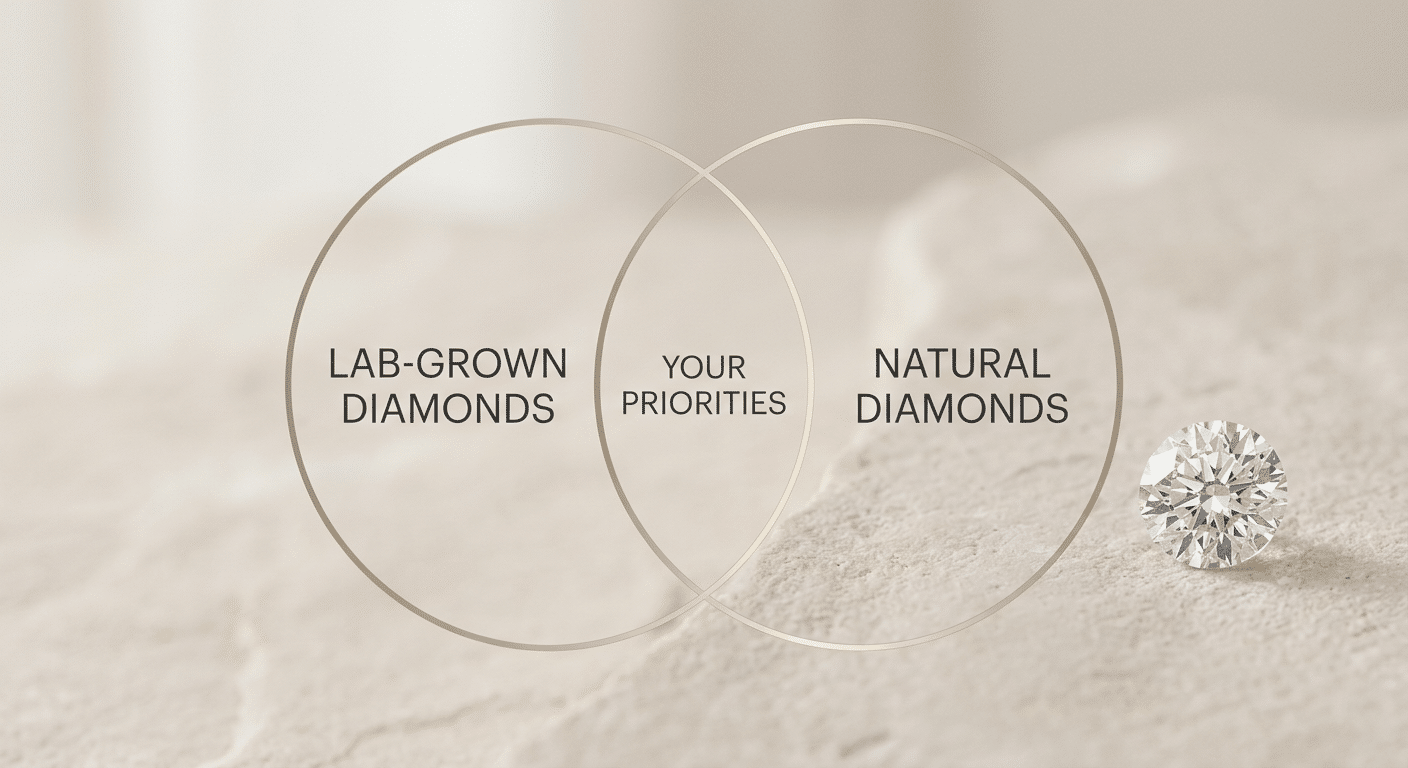
If you’re looking for a simple list of which diamond is “better,” you’ll be disappointed. This is a guide to deciding which is right for you. The lab-grown vs. natural diamond conversation is often framed as a battle between two camps, each armed with its own set of talking points. One side champions value and ethics; the other defends tradition and rarity. That framing is a trap. It forces you to choose a side in a manufactured war, when the real decision is a personal one. This isn’t about finding an objective winner. It’s about matching the unique strengths of each diamond type to your own hierarchy of values.
The False Binary: Why “Lab-Grown vs. Natural” Is the Wrong Question
The “vs.” in the headline is the problem. It suggests a zero-sum game where one option must defeat the other. But that’s not how meaningful purchases work. Asking “which is better?” is like asking “is a sedan better than an SUV?” The answer depends entirely on whether you prioritize fuel efficiency, cargo space, off-road capability, or status. The diamond industry, both traditional and modern, has a vested interest in keeping the debate binary—it simplifies marketing and justifies price premiums. Your job is to reject that simplicity. The right question is not “Which diamond wins?” but “Which diamond aligns with what I care about most?”
Introducing the Priority-Matching Framework
We will break down the decision into six distinct priority dimensions. Each dimension represents a lens through which buyers typically evaluate their choice:
- Price Logic & Budget Efficiency: Maximizing size and quality within a financial constraint.
- Rarity Narrative & Emotional Meaning: Valuing geological history, symbolism, and legacy.
- Sustainability Claims & Ethical Scrutiny: Seeking verifiable environmental and social responsibility.
- Transparency, Traceability & Verification: Demanding proof of origin and journey.
- Wearing & Gifting Context: Considering social perception, gift-giving psychology, and personal wear.
- Long-Term Value & Future Priorities: Thinking about resale, heirloom potential, and shifting perceptions over decades.
Almost no buyer has just one priority. You have a hierarchy. Maybe budget is your non-negotiable #1, but transparency is a strong #2. Maybe the rarity narrative is everything, and price is a secondary concern. The framework helps you identify that hierarchy and see clearly which diamond type serves it best.
How to Use This Guide: A Quick Start Method
Before diving into the dimensions, here’s how to get the most from this guide: Skim the six priority areas. As you read, note which ones generate a strong “yes, this matters to me” reaction. Jot them down. By the end, you’ll have a ranked list. The final Decision Matrix section will translate that list into a clear direction. Don’t get bogged down in the details of dimensions that feel irrelevant to your situation. Focus on the ones that resonate. This isn’t a textbook to be studied; it’s a tool to be used.
Priority Dimension 1: Price Logic & Budget Efficiency
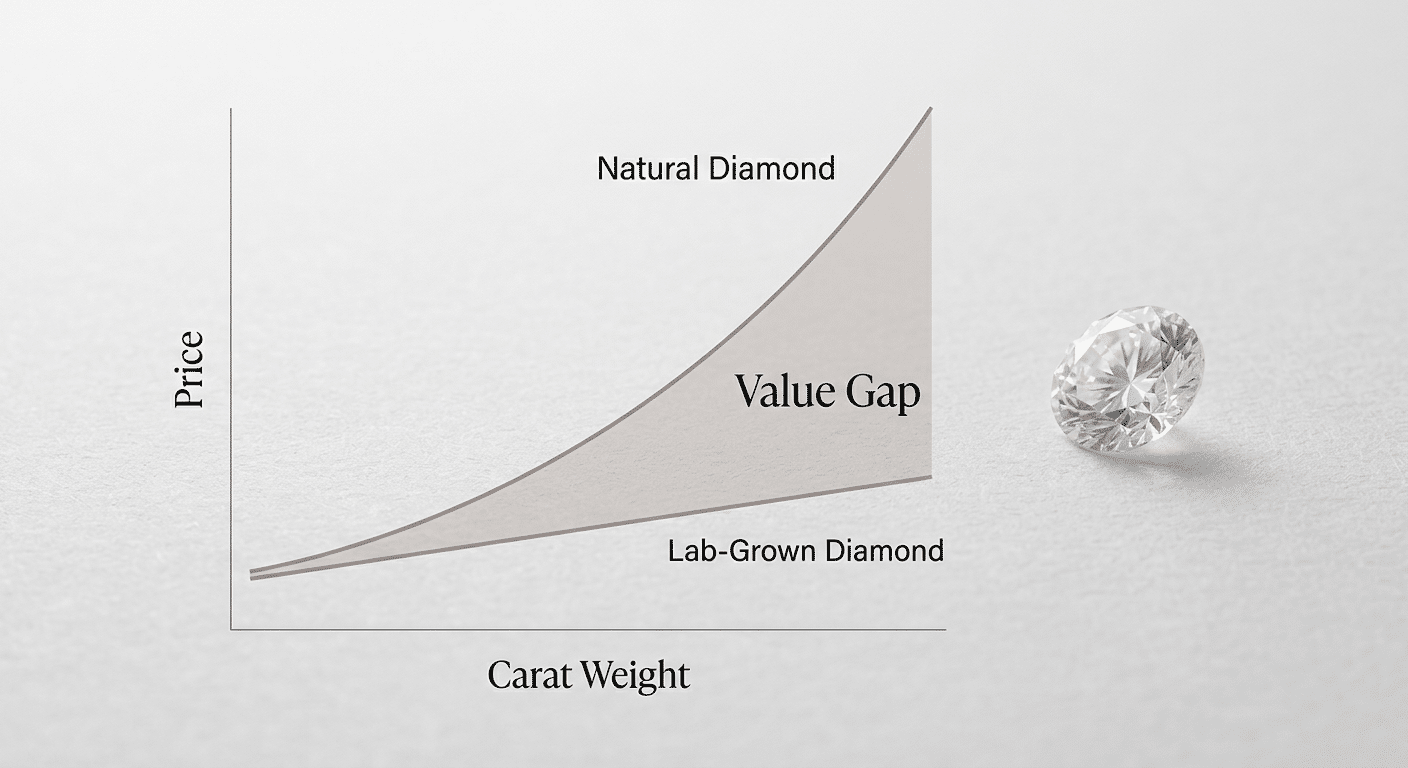
For the budget-focused buyer, lab-grown diamonds offer a fundamentally different value equation. The conversation here isn’t about “cheap” versus “expensive.” It’s about value per visual unit—how much size, sparkle, and quality you get for each dollar. The key lies in the shape of the price curve. Natural diamond prices increase exponentially with carat weight because larger, gem-quality stones are geologically rare. Lab-grown diamond prices, driven by manufacturing costs that rise more linearly with size, follow a much gentler slope. This means your budget stretches dramatically further.
The Exponential vs. Linear Price Curve: Understanding Carat Weight Cost
Think of natural diamonds like limited-edition art. A painting that is twice as large as another isn’t just twice as much work; it’s exponentially rarer, so the price jump is massive. Lab-grown diamonds are more like high-quality prints. Doubling the size means more material and time, but not a fundamental scarcity event. This structural difference means that at common budget points—say, $5,000 to $15,000—a lab-grown diamond can be 30% to 100% larger than a natural diamond of comparable quality (cut, color, clarity). You are not buying a “discount” product; you are buying a product from a supply chain with a different cost structure, and that translates directly into more stone for your money.
The “Size-for-Budget” Buyer Profile: Who Maximizes This Priority?
This buyer’s primary joy comes from the visual impact of the stone on the hand. They are driven by the “wow” factor of size and brilliance. They may be pragmatists who see a diamond as a beautiful object, not a financial asset or a geological specimen. They are less concerned with the story of how the stone arrived on Earth and more concerned with how it looks in the setting they choose. They often have a clear maximum budget and want to maximize the key specs within it. For them, the freedom lab-grown diamonds provide—to get a significantly larger stone, a fancier color, or a higher clarity grade within budget—is the paramount advantage.
Budget Freedom: What Else Could Your Savings Fund?
Choosing a lab-grown diamond for price efficiency doesn’t mean you’re “cheaping out.” It means you’re reallocating capital. The savings compared to a natural diamond of similar visual size are often substantial. That difference can fund a more intricate, custom setting in platinum or gold. It can cover a larger portion of the wedding, a memorable honeymoon, or a down payment on a home. The decision becomes not just about the diamond itself, but about the larger financial picture of the commitment being celebrated. This lens turns the choice from a sacrifice into a strategic optimization of resources for the life you’re building together.
Priority Dimension 2: Rarity Narrative & Emotional Meaning
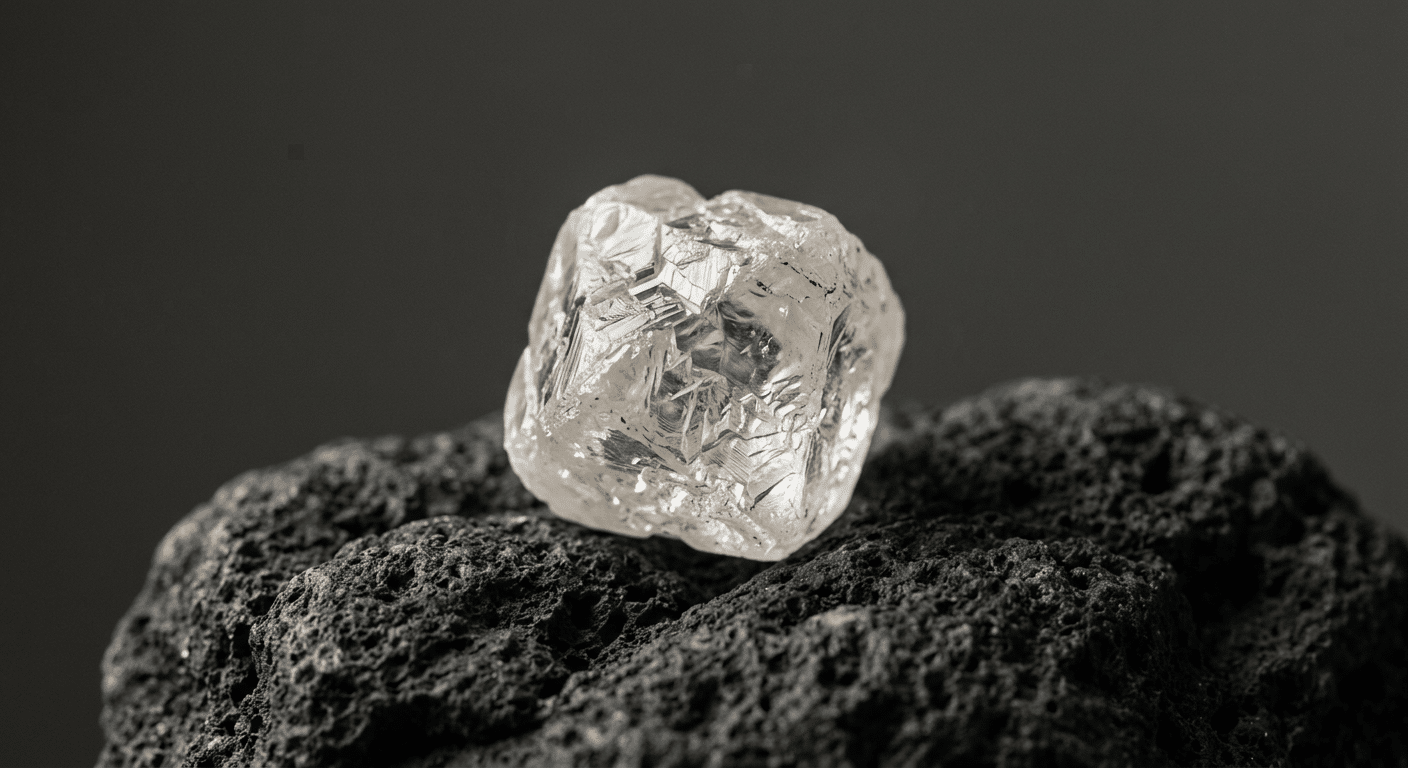
For some, a diamond’s story is its value. The “rarity narrative” is the centuries-old heart of the natural diamond industry: the idea that your stone is a unique, billion-year-old artifact, forged in the Earth’s mantle under conditions no laboratory can perfectly replicate over eons. This narrative carries immense emotional and symbolic weight. It speaks of deep time, natural forces, and a uniqueness that feels predestined. The buyer who prioritizes this dimension isn’t just buying a gem; they’re buying a piece of natural history and the traditional symbolism that comes with it. For them, a lab-grown diamond, however physically identical, may feel like a beautiful manufactured object—lacking the profound, ancient story that gives the stone its soul.
The “Billions of Years” Story: What the Rarity Narrative Actually Means
The narrative is specific: carbon, subjected to immense heat and pressure over 1 to 3 billion years, deep within the Earth, brought to the surface by volcanic activity. Each natural diamond has a unique pattern of inclusions and growth marks, a “fingerprint” of its specific journey. This story provides a sense of connection to the planet’s history and a metaphor for love that is rare, enduring, and formed under pressure. It’s a story of discovery and serendipity—you didn’t get a manufactured product; you obtained a natural treasure. The value here is intangible but deeply real to those for whom it resonates. It is the difference between a stone formed by geological time and a laboratory-grown diamond made through a controlled process; the visual result may be comparable, but the origin story and emotional meaning are not the same.
The Narrative-Driven Buyer: For Whom Symbolism Trumps Specifications
This buyer is the “symbolic traditionalist.” Their priority is the story they will tell their children and grandchildren. “This stone was born before the dinosaurs, and now it symbolizes our love.” They may view the lab-grown alternative as missing that foundational mythos. They often prioritize the “natural” label itself, seeing it as non-negotiable for an engagement ring or major milestone gift. Their evaluation criteria start with provenance, not the 4Cs. They are less likely to be swayed by arguments about size-for-budget or environmental impact if those arguments come at the cost of the geological narrative. For them, the premium for a natural diamond is, in large part, the price of admission to that story.
Heirloom Perception: Does “Natural” Equate to “More Legacy-Worthy”?
The heirloom question is a direct offshoot of the rarity narrative. The idea of passing a diamond down through generations is powerful. The narrative-driven buyer often believes a natural diamond is inherently more “legacy-worthy” because its story—spanning millennia—adds a layer of gravitas to its future as a family artifact. “My grandmother’s diamond, formed a billion years ago, is now on my hand.” The question is whether a lab-grown diamond, with a story of human ingenuity and modern technology, can carry the same weight in 50 or 100 years. Some will say yes, that the story of its creation in a lab is a story of human achievement and love’s modern expression. Others will argue that without the ancient, non-human origin, it lacks the timeless, “found” quality that makes heirlooms feel sacred. This is a personal, philosophical call, not a factual one.
Priority Dimension 3: Sustainability Claims & Ethical Scrutiny
The sustainability debate around diamonds is littered with oversimplified slogans. The idea that lab-grown diamonds are automatically “eco-friendly” and natural diamonds are inherently “unethical” is a false binary that obscures more than it reveals. For the buyer for whom environmental and social impact is a top priority, the real task is not choosing a category, but learning to dissect claims and demand specific, verifiable data. Your goal is to move beyond marketing and understand the actual impact profile of the specific stone you’re considering.
Beyond “Conflict-Free”: The Nuanced Environmental and Social Impact of Mining
The natural diamond industry successfully anchored its ethical narrative around the Kimberley Process, an initiative that dramatically reduced the flow of “blood diamonds” financing civil wars. However, treating “conflict-free” as the final word on ethics is a critical error. The Kimberley Process does not address forced labor, child labor in artisanal mines, water pollution from mining runoff, or the massive carbon emissions from diesel-powered excavation equipment and processing plants. The environmental cost of mining is inherent: moving millions of tons of earth, creating large-scale land scars, and consuming vast quantities of water. Social impact varies dramatically by mine operator and national regulations. A modern, transparent mine in Canada or Botswana may have rigorous rehabilitation programs and provide high-wage local jobs, while an unregulated operation elsewhere can devastate ecosystems and communities. The key insight is that “natural diamond” is not a single ethical entity. You must evaluate the specific mine and its operator’s practices.
The Lab-Grown Impact Profile: Energy, Chemicals, and Scale
Lab-grown diamonds are manufactured using either HPHT (High Pressure High Temperature) or CVD (Chemical Vapor Deposition) processes. Both are profoundly energy-intensive. CVD, which uses hydrocarbon gases like methane in a vacuum chamber, requires significant electricity to maintain high temperatures and plasma states. If the local grid relies on coal, the carbon footprint per carat can be substantial. Furthermore, the chemical processes involve handling and disposal of byproducts. The industry’s common defense—that lab growth uses less energy per carat than mining—is often technically correct on a direct comparison, but it ignores the exponential scale of current production. As demand has surged, large facilities, primarily in Asia, have increased total energy consumption and chemical use dramatically. The environmental equation hinges on specifics: What is the energy source for that specific facility (renewables vs. fossil fuels)? What are the waste management protocols? A lab powered by dedicated hydro or solar is a fundamentally different proposition from one on a coal-heavy grid.
The “Transparency-Driven Buyer” Profile: How to Verify Sustainability Claims
For this buyer, the primary question is not “which is better?” but “what proof do you have?” They operate with a verification mindset, understanding that any claim without a corresponding, auditable report is just marketing. Their evaluation framework is identical whether examining a natural or lab-grown stone:
- For a Natural Diamond: Can the retailer identify the specific mine or at least the country of origin? Is there a third-party audit of that mine’s environmental and social performance (e.g., a SCS Global Services report)? Does the diamond have a blockchain ledger showing its chain of custody from mine to polisher to retailer?
- For a Lab-Grown Diamond: Can the manufacturer name the exact facility where the stone was grown? What is the documented energy mix for that facility (e.g., “70% renewable”)? Are there published lifecycle assessments or carbon offset statements tied to specific production batches? Is there a batch record linking the finished stone to a specific growth run?
If the seller cannot provide this level of data, you are being asked to trust a narrative, not a fact. The burden of proof is not on you to disprove a claim; it is on the seller to substantiate it.
The Role of Third-Party Certification (SCS-007, ISO, etc.)
While no certification is a silver bullet, independent standards provide a crucial layer of verification. SCS-007 is a specific certification for diamonds that assesses both environmental impact (including carbon footprint) and social criteria like labor practices. ISO 14001 certification indicates a facility has a systematic approach to managing its environmental impact. The Transparency-Driven Buyer should look for the full audit report behind any certification logo, not just the logo itself. These certifications are evidence of a company’s commitment to processes that can be measured and verified. However, they are a floor, not a ceiling. A company can be certified and still have a higher impact than a non-certified competitor with more efficient, lower-impact operations. Use certifications as a filter for serious players, but continue to ask for the specific data relevant to your priorities.
Ultimately, navigating sustainability requires you to become an auditor of your own purchase. A lab-grown diamond from a facility powered by coal is not inherently more ethical than a natural diamond from a mine with a proven record of community investment and land restoration. The only defensible choice is the one backed by transparent, specific data you can evaluate. Without it, you are choosing a story, not an impact.
Priority Dimension 6: Long-Term Value & Future Priorities
Let’s be brutally clear about the long-term financial picture, because this is where the most persistent myths cause the most damage. The central, unavoidable truth is this: diamonds are not financial investments. Full stop. You are not buying a stock, a bond, or a commodity futures contract. You are buying a piece of jewelry whose primary value is emotional and aesthetic, not monetary. Any discussion of “value” beyond the point of sale must begin from that reality.
The Resale Reality: Why Neither Diamond Is a Financial Asset
The secondary market for diamonds is a fragmented, low-liquidity environment where you will almost certainly not recapture your original purchase price. For natural diamonds, a used stone typically fetches 20-40% of its original retail value at a pawn shop or through specialized auction houses—and that’s for high-quality stones. The market is shrinking as consumer preferences shift. For lab-grown diamonds, the resale market is virtually non-existent. There is no established pricing benchmark, and most retailers and buy-back services do not accept them. The reason isn’t about quality; it’s about supply economics. A natural diamond’s value is underpinned by geological scarcity. A lab-grown diamond’s value is tied to its manufacturing cost, which continues to decline as technology improves and scale increases. An object that can be produced indefinitely at a lower and lower cost has no inherent store of value. The moment you walk out of the store, the replacement cost of your lab-grown diamond is already less than what you paid.
Price Depreciation Curves: Natural vs. Lab-Grown Over Time
Think of depreciation not as a single event but as a curve. The natural diamond’s curve is steepest in the first few years (the “retail markup” is shed immediately) and then flattens somewhat, supported by its finite nature. The lab-grown diamond’s curve is also steep from the start, but for a different reason: its price is already closely tied to production cost, not scarcity. As new, larger, higher-quality stones flood the market, the baseline value of your specific stone erodes. The practical implication is this: if you ever need to sell, you must accept that you will lose most of the money. Plan your purchase as a final, non-returnable expense, not an asset.
The Heirloom Question: What Makes a Jewel “Legacy-Worthy”?
This is where we separate monetary value from emotional value. An heirloom is not defined by its resale price; it is defined by the story it carries and the love it represents. A well-worn engagement ring, regardless of its origin, becomes a legacy object because of the milestones it witnessed—the proposal, anniversaries, the birth of children. The physical stone is a vessel for memory. Therefore, heirloom potential is a function of design durability and sentimental significance, not geological age. A classic, timeless setting in platinum will be cherished for generations whether the center stone was mined or grown. The “Long-Term Legacy Buyer” should focus on choosing a design that will never feel dated and on creating a rich personal narrative around the piece, not on betting on its future commodity price.
Future Perception: How Will These Diamonds Be Valued in 50 Years?
This is the most speculative but psychologically significant layer. In 2050, how will a diamond purchased in 2025 be viewed? There are two plausible scenarios. For natural diamonds, the “rare natural wonder” narrative may strengthen as they become a smaller proportion of all diamonds in circulation, potentially elevating their status as a luxury artifact. For lab-grown diamonds, perception is less certain. They could be viewed as the standard, rational choice—a normal, modern product like a lab-created ruby or a cultured pearl. Or, they could be seen as a transitional technology, quaint in their early 21st-century “imperfections.” The smart approach is to buy for the present and the meaning you create now, not for some hypothetical future collector’s market. The only certainty is that the diamond you choose will be valued by your descendants for the story you tell about it, not for the story of its atomic formation.
The Integrated Decision Matrix: Mapping Your Priority Hierarchy
We’ve now examined the six critical priority dimensions. You’ve seen the logic, the trade-offs, and the buyer profiles associated with each. The final step is to synthesize these into your personal decision. This isn’t a quiz with a right answer; it’s a tool for self-clarity. Your goal is to identify your weighted hierarchy.
Step 1: Rank Your Personal Priority Dimensions
Take the six dimensions we’ve covered and force-rank them from 1 (most important) to 6 (least important) for your specific purchase. Be honest. There is no prize for having “noble” priorities. If “getting the biggest sparkle for my budget” is #1, that’s a perfectly valid and logical starting point. Write them down.
Step 2: Interpret Your Top Priorities
Look at your top two or three rankings. The direction of your strongest recommendation will become clear from these:
- If Price/Budget Efficiency is #1 or #2: The path strongly points to a lab-grown diamond. The mathematical advantage in size-for-money is overwhelming and directly serves this priority.
- If Rarity Narrative/Emotional Meaning is #1 or #2: The path strongly points to a natural diamond. The “billions of years” story is a non-negotiable element of value for you, and no amount of size or savings can substitute for it.
- If Sustainability/Transparency is #1 or #2: Your path requires deep, supplier-specific research, but the initial signal favors lab-grown. It is generally easier to verify a single, audited manufacturing facility’s energy source and practices than to fully verify the complex, multi-country supply chain of a natural diamond. However, you must still demand proof (e.g., renewable energy usage reports, blockchain origin) from your lab-grown seller. If you cannot get it, the advantage evaporates.
- If Long-Term Legacy (monetary) is a top priority: You face a difficult truth. Neither option offers reliable financial appreciation. The natural diamond has a marginally better (though poor) resale story due to scarcity. This priority may need to be reframed around emotional legacy instead.
What if your #1 priority is Price and your #2 is Rarity? You have identified the core tension of this entire debate. There is no objective, universal winner here. You must consciously choose which value matters more to you. This is the moment of personal decision. The framework doesn’t decide for you; it makes the conflict explicit so you can own the trade-off. You might decide that the narrative is worth the budget stretch. Or you might decide that the financial freedom is more meaningful for your future together. Both are rational, defensible choices. Recognizing the trade-off is more important than resolving it perfectly.
Sample Priority Profiles and Their Likely Path
To make this concrete, here are three common profiles:
- The Pragmatic Maximizer: Priorities: 1) Price Efficiency, 2) Transparency, 3) Wearing Context. Likely Path: Lab-grown, with a focus on sellers who provide full growth facility reports and batch records.
- The Symbolic Traditionalist: Priorities: 1) Rarity Narrative, 2) Long-Term Legacy, 3) Wearing Context. Likely Path: Natural, with a focus on reputable retailers who can provide mine origin information and a GIA report.
- The Ethical Analyst: Priorities: 1) Sustainability & Transparency (tied), 2) Price Efficiency, 3) Rarity Narrative. Likely Path: This buyer will need to do the most work. They will compare specific lab growers using renewable energy against specific mines with strong community and environmental track records. The final choice will hinge on which specific supply chain they can verify more convincingly.
Conclusion: Owning Your Decision with Confidence
The right diamond is the one that fits your unique priority hierarchy, not the one that wins a public debate. You are no longer looking for an abstract “better” or “worse.” You are looking for the stone that best serves the values you and your partner hold dear. A lab-grown diamond chosen for its budget efficiency and verifiable ethics is a smart, modern, and conscious decision. A natural diamond chosen for its timeless narrative and heirloom potential is a meaningful, traditional, and heartfelt one. Both are valid. Both can be beautiful. The power is in the conscious choice, made with eyes open to the real trade-offs. You now have the framework to make that choice with clarity. Use it, trust your ranked priorities, and buy with confidence.
Now that you’ve mapped your priorities, your next step is to find a seller who can meet the specific demands of your chosen path. If your priority is verified transparency, you should explore retailers who publish detailed origin and manufacturing data. If your priority is maximum size within budget, you should compare price-per-carat across quality tiers. Whatever your conclusion, approach your search with the same critical, priority-focused lens you’ve applied here.