
Every jewelry brand now claims to be sustainable, ethical, or carbon neutral. The real challenge for a buyer is separating marketing language from documents that actually prove something. Without a clear way to verify these claims, such as sustainable jewelry greenwashing red flags, it is nearly impossible to compare one piece of jewelry to another on environmental or ethical grounds. This article cuts through the confusion by focusing on a single practical question: which certificates and standards carry real verification weight, and which are simply badges with no third-party oversight?
For the full framework, read Sustainable Jewelry Buying Guide.
You will learn a straightforward system for evaluating any sustainability claim—from diamond grading reports to recycled gold assertions. The goal is to help you confidently distinguish between verified product-level certifications and vague brand promises, so you can make a purchase knowing exactly what your documents actually prove.
| Claim Type | What It Actually Proves | What to Ask For |
|---|---|---|
| Diamond grading report (e.g., GIA, IGI) | Only the 4Cs (cut, color, clarity, carat). Does not verify ethical/environmental production. | A separate chain-of-custody certificate like SCS-007 or RJC CoC. |
| Chain-of-custody certification (e.g., RJC CoC, SCS-007) | Verified tracking from mine to finished product, but not automatically environmental performance unless explicitly included. | Confirm the standard includes environmental criteria, and verify the number in the public registry. |
| Recycled gold claim | Often a marketing badge. Rarely verified per individual product. | Refiner-level documentation or a third-party certification that specifies recycled content for your item. |
| “Carbon neutral” label | Almost always relies on purchased offsets, which vary in quality and rigor. | The specific offset project name, methodology, and third-party verification body. |
| LBMA certification | Confirms conflict-free sourcing of gold, but does not address environmental impact or working conditions beyond conflict risk. | Combine with a chain-of-custody or environmental certificate for broader assurance. |
| Brand’s own sustainability badge or logo | No external standards; essentially a self-made claim. | Treat as marketing. Ask for the name of a third-party standard and a verifiable certificate number. |
Quick Questions Before You Read
Q: Does a GIA report prove a diamond is ethically sourced?
No. A GIA report only grades the 4Cs. It does not verify the source, environmental impact, or labor conditions of the stone. You need a separate chain-of-custody certificate for that.
Q: How can I check if a certification is real?
Ask for the specific certificate number and the registry where it is listed (e.g., RJC, SCS Global Services, GIA). Then look it up yourself in that public registry. If the brand cannot provide a number within one business day, the claim likely lacks verification.
Q: Is recycled gold always better for the environment?
Not automatically. Many recycled gold claims are based on generic company statements rather than third-party verification for your specific piece. You should request refiner documentation or a product-level certification to ensure the claim is substantiated for what you are buying.
Q: What is the minimum set of documents I should look for?
For a lab-grown diamond piece, a minimum is a grading report plus a chain-of-custody document for the stone, and an LBMA or source declaration for the metal. This combination covers both quality and basic source verification.
Important note before reading further: Laboratory-grown diamonds should be clearly identified as laboratory-grown, and they should not be presented as mined diamonds. Throughout this guide, the term “lab-grown diamond” refers specifically to diamonds created through controlled processes such as HPHT or CVD, not to diamond simulants. Environmental and sustainability claims should be specific, documented, and limited to what can be substantiated by the documents discussed here.
Sustainable Jewelry Certifications and Standards: Which Documents Actually Matter?
When you start researching sustainable jewelry, the first thing you notice is how many claims, badges, and logos exist. Some look official. Some look decorative. Most of them say something about responsibility, ethics, or environmental performance. But the difference between a verified document and a marketing badge is not always obvious, and that gap is exactly where confusion lives.
This guide is built around a single question: how do you tell the difference between a credible sustainability document and a claim that has no real verification behind it? The answer comes down to who issued the document, what standard it follows, and whether you can independently confirm it. Once you learn to sort documents into a few clear categories, most of the uncertainty disappears.
The FTC’s Role in Guiding Jewelry Sustainability Claims
Among the organizations that shape how sustainability claims are made in the jewelry industry, the U.S. Federal Trade Commission (FTC) plays a foundational role. The FTC’s Guides for the Use of Environmental Marketing Claims, commonly known as the Green Guides, provide a framework for how businesses should substantiate environmental benefit claims. The guidance applies across all consumer goods, including jewelry, and specifically cautions against broad, unqualified terms like “eco-friendly” or “sustainable” when a product’s actual environmental benefit is narrow or unmeasured.[1]
For the jewelry buyer, the FTC’s position offers a useful baseline: if a brand uses a sweeping green claim without specifying which attribute it refers to—energy use, recycled content, water conservation—the claim is likely out of step with current advertising guidance. The FTC does not pre-approve jewelry claims or issue certificates, but its guidance is the closest thing to a regulatory standard for disclosure in the American market. Brands that align their documentation with FTC expectations tend to avoid vague labels and instead reference specific, measurable criteria that can be independently checked.[1]
This does not mean every jewelry brand must follow the Green Guides verbatim to be trustworthy. But it does mean that when a buyer encounters a claim like “100% sustainable” with no supporting detail, there is a recognized advertising standard that discourages such phrasing. Understanding this context helps the buyer evaluate whether the brand is following accepted disclosure practices or relying on unsubstantiated marketing.[1]
Why Most “Sustainable” Jewelry Claims Are Not Verified
The jewelry industry has no single regulator for sustainability language. That means any brand can put a leaf icon, a green label, or the word “eco-friendly” on a product page without proving anything. The claim might be true. It might also be based on a general company policy that has never been audited, or it might refer to one small part of the supply chain while implying the whole product is sustainable.
Most unverified claims fall into one of two patterns. The first is a brand saying “we use recycled gold” without naming the refiner or showing a mass-balance certificate. The second is a generic “ethically sourced” label with no referenced standard and no certifying body. In both cases, the buyer receives a statement, not a verifiable document.
The key distinction is not whether the brand is honest. It is whether the claim can be checked. If there is no auditor, no standard number, and no public registry, the claim is unverifiable regardless of the brand’s intention.
Why Traceability Depends on a Clear Chain-of-Custody
When a buyer asks about a diamond’s origin or a ring’s gold source, the answer often comes back as a broad statement—”from responsible suppliers” or “sourced ethically.” These phrases provide no traceability because they lack a documented chain that connects the specific product to a verified source. Traceability is not a feeling; it is a recorded path through each step of production, processing, and distribution. Without a chain-of-custody document that can be audited, an origin claim is indistinguishable from an assumption.
In practice, this means that a brand cannot claim a specific diamond came from a particular growth facility or a particular mine if it cannot produce a document that tracks that exact stone. The chain-of-custody record, whether it is an SCS-007 certificate, an RJC CoC document, or a refiner’s mass-balance report, is what transforms a general statement into a verifiable claim. For the buyer, the question is simple: does the documentation show a path from the source to the finished product, or is it a general description of how the brand operates? The answer determines whether the claim is traceable or merely aspirational.
This traceability principle also applies to mixed materials. If a piece of jewelry contains a lab-grown diamond from one source and recycled gold from another, the traceability documentation must cover both paths. A brand that provides a chain-of-custody document for the diamond but only a recycled gold statement without a refiner certificate is offering partial traceability. Buyers who prioritize knowing the full story of their jewelry should ask for documentation that covers every material in the piece, not just the headline component.
The Three Verification Levels Every Buyer Should Know
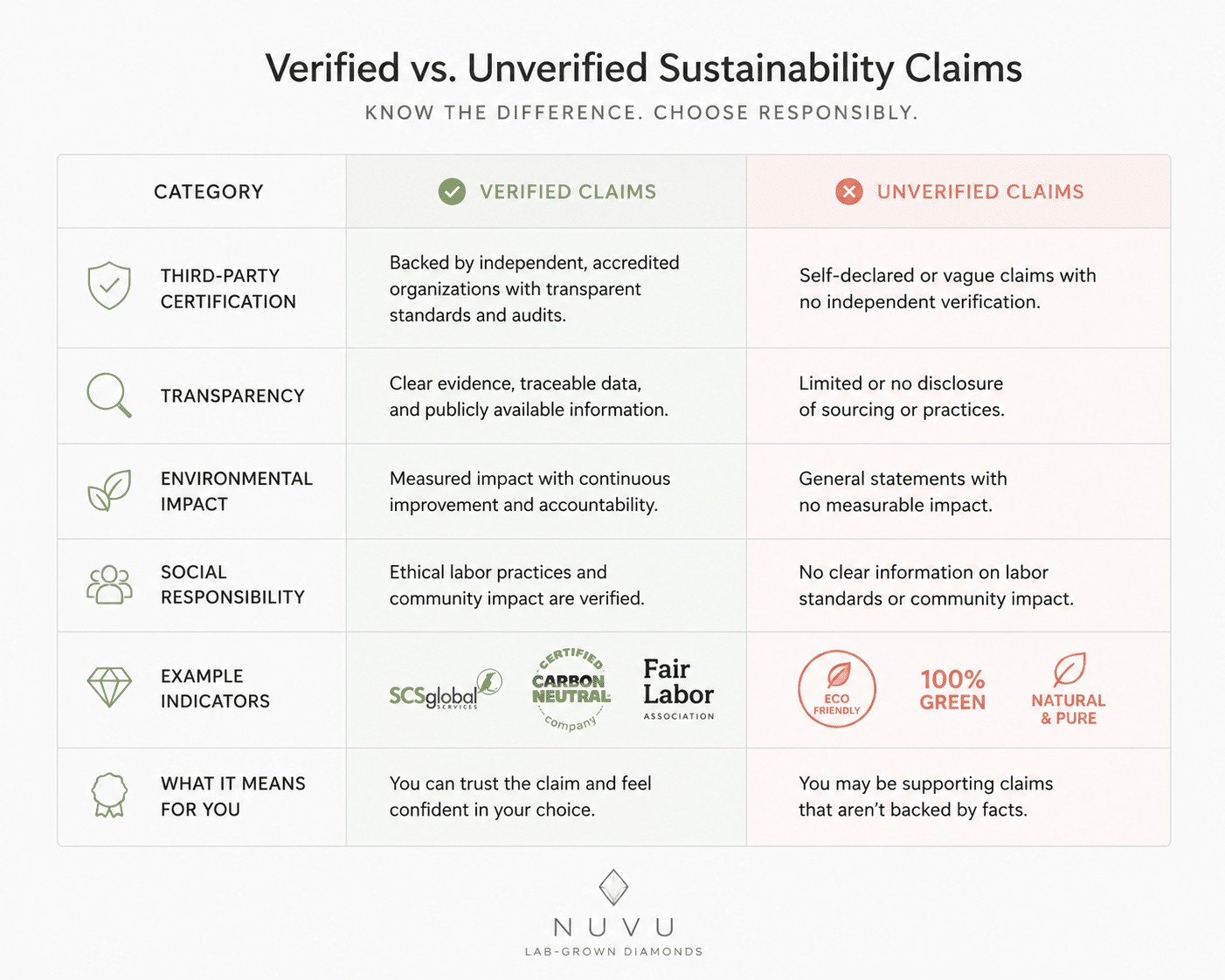
Every sustainability document or badge fits into one of three tiers. Knowing these levels lets you evaluate any claim in about ten seconds.
Level 1: Third-party audited certificate. This is the highest level. A document issued by an independent certifying body after a site audit or material inspection. Examples include SCS-007 for lab-grown diamonds, RJC Chain-of-Custody certification for metals and gems, and Fairmined certification for gold. These certificates have a standard name, an audit process, and usually a registry where you can look up the holder.
Level 2: Supplier declaration. A document the company wrote about itself. It may be accurate, but no outside auditor has confirmed it. Common examples include “our supplier confirms all diamonds are conflict-free” or “we use 100% recycled gold” without a third-party certificate. These statements can be true, but the buyer has no way to verify them independently.
Level 3: Marketing badge. A logo or label with no documented standard, no certifying body, and no audit process. These are often designed by the brand itself or purchased from a generic badge provider. They carry zero verification weight and should be treated as design elements, not evidence.
Once you sort claims into these three levels, you can immediately ignore anything in Level 3 and treat Level 2 as useful but unverified. Only Level 1 documents justify deeper trust.
How to Verify This Before Buying
Before you rely on any sustainability claim, run it through three checks.
First, check whether the certifying body publishes a public registry of certificate holders. RJC, SCS Global Services, and Fairmined all maintain searchable lists. If the brand shows you a badge but the issuing body does not offer a registry, the badge is not independently confirmable.
Second, ask for the certificate number and confirm that it is searchable online. A real certificate has a unique identifier that can be looked up. A vague reference to “membership” or “partnership” without a number is not a certificate.
Third, ask the brand which specific standard the document refers to. Many brands display a logo that looks official but covers something unrelated to the product you are buying. Ask directly: “Does this certificate apply to this specific ring, or is it a company-level credential?” The answer will tell you whether the document actually means something for your purchase.
When a grading report is available, buyers should verify the report details through the issuing laboratory’s official report-check tool where available. GIA, IGI, and AGS all maintain online portals that allow you to confirm the certificate number matches the diamond’s stated characteristics. This cross-check takes about two minutes and removes most uncertainty about the report’s accuracy.
GIA’s Clarification on Lab-Grown Diamond Terminology and Disclosure
When evaluating lab-grown diamond documentation, one important resource comes from the Gemological Institute of America (GIA). GIA has published detailed guidance on the terminology used for laboratory-grown diamonds, emphasizing that clear, factual language is essential for consumer protection. GIA’s position is that lab-grown diamonds should be described with terms that do not mislead consumers about their origin—words like “cultured” or “laboratory-grown” are recommended, while terms that imply natural origin should be avoided.[2]
This guidance is particularly relevant for sustainability documentation because it establishes a baseline for how the product itself should be labeled. If a brand uses confusing or ambiguous terminology—such as calling a lab-grown stone “real diamond” without clearly disclosing its laboratory origin—it suggests that the brand may not be following widely accepted disclosure practices. GIA’s terminology guidance is not a sustainability certification, but it supports the buyer’s ability to understand exactly what they are purchasing, which is a prerequisite for evaluating any further claim about the product’s environmental or ethical profile.[2]
The practical takeaway for the buyer is straightforward: verify that the lab-grown diamond you are considering is described with clear, unambiguous language that distinguishes it from natural diamonds. A grading report from GIA or IGI typically includes this disclosure directly on the report. If the brand’s product page or marketing material obscures the distinction, that is a signal that the documentation may not be as transparent as it should be.[2]
Lab-Grown Diamond Certificates: What Grading Reports Prove—and What They Do Not
Most lab-grown diamonds come with a grading report from IGI, GIA, GCAL, or another laboratory. That report is essential for buying a diamond, but it answers a very specific set of questions. It does not answer sustainability questions at all. This is one of the most common misunderstandings in the category, and it creates confusion even among experienced buyers.
A grading report helps document key characteristics, but it should not be treated as a guarantee of beauty, value, or sourcing ethics. Understanding the boundary of what a report verifies is essential to making a well-informed purchase.
What a Grading Report Actually Confirms
A grading report confirms the 4Cs: carat weight, color grade, clarity grade, and cut grade. For lab-grown diamonds, the report also identifies the growth method as CVD or HPHT. Some reports include proportion data, fluorescence grade, and a plotted clarity diagram. The report confirms that the stone you are buying matches the grades stated.
What a grading report does not confirm: energy source, carbon footprint, water use, waste management, labor practices, production location, or any environmental metric. The report has no mechanism for capturing these factors. It was never designed to.
This means a diamond with a perfect IGI report and a diamond with no sustainability documentation at all could come from the same manufacturer, or from manufacturers at opposite ends of the environmental spectrum. The grading report will not tell you the difference.
The Gap Between “Lab-Grown” and “Sustainable”
The term “lab-grown” describes how the diamond was created—through chemical vapor deposition or high-pressure high-temperature synthesis, rather than mined from the earth. The term “sustainable” describes environmental and social performance, which varies dramatically by producer.
Two lab-grown diamonds can be physically identical and still have very different production profiles. One might be grown on a grid powered largely by coal. Another might be grown in a facility using 100% renewable energy with closed-loop water systems and documented waste management. Both can produce a diamond with the same color, clarity, and cut grade.
The grading report captures the diamond’s physical properties, not the conditions under which it was produced. That is why a grading report alone is not a sustainability document.
When a Grading Report Is Sufficient and When It Is Not
For evaluating a loose diamond as a gemstone, a grading report is essential. You need it to confirm carat weight, color, and clarity before you commit to a purchase. It is non-negotiable.
For evaluating sustainability claims, a grading report is insufficient. It answers none of the relevant questions. If a brand presents a grading report as evidence of responsible production, that is a misunderstanding or a misrepresentation.
The buyer needs separate documentation for production conditions—specifically, a chain-of-custody certificate, an environmental audit report, or a sustainability standard certification such as SCS-007 for ethical vs sustainable jewelry. These documents exist in a different category from the grading report and serve a different purpose.
What This Means in a Real Purchase
When you buy a lab-grown diamond, the first step is to confirm the grading report covers the exact stone you are ordering. The report should include a laser inscription or a visible serial number that matches the diamond.
If sustainability claims matter to you, the second step is to ask for a separate production or chain-of-custody document. Do not accept the grading report as proof of eco-friendly production. It was not designed for that, and no amount of good faith changes what the document actually contains.
How HPHT and CVD Growth Methods Are Identified in Grading Reports
GIA and other major grading laboratories identify the specific growth method—high-pressure high-temperature (HPHT) or chemical vapor deposition (CVD)—as part of the standard grading report for lab-grown diamonds.[3] This distinction matters for sustainability documentation because the two methods have different energy profiles and facility requirements. HPHT typically uses higher sustained temperatures and pressures, while CVD relies on vacuum chambers and gas chemistry. Neither method is inherently more sustainable; the environmental impact depends on the energy source, facility efficiency, and waste management practices at the specific production site.[3]
For the buyer, knowing the growth method is useful context, but it should not be confused with a sustainability claim. A grading report that identifies the stone as “CVD” or “HPHT” is providing a technical classification, not an environmental endorsement. The buyer who wants to understand production conditions must look beyond the growth method label to the broader chain-of-custody and energy documentation provided by the brand.[3]
Chain-of-Custody Certifications: The Only Document That Tracks Origin
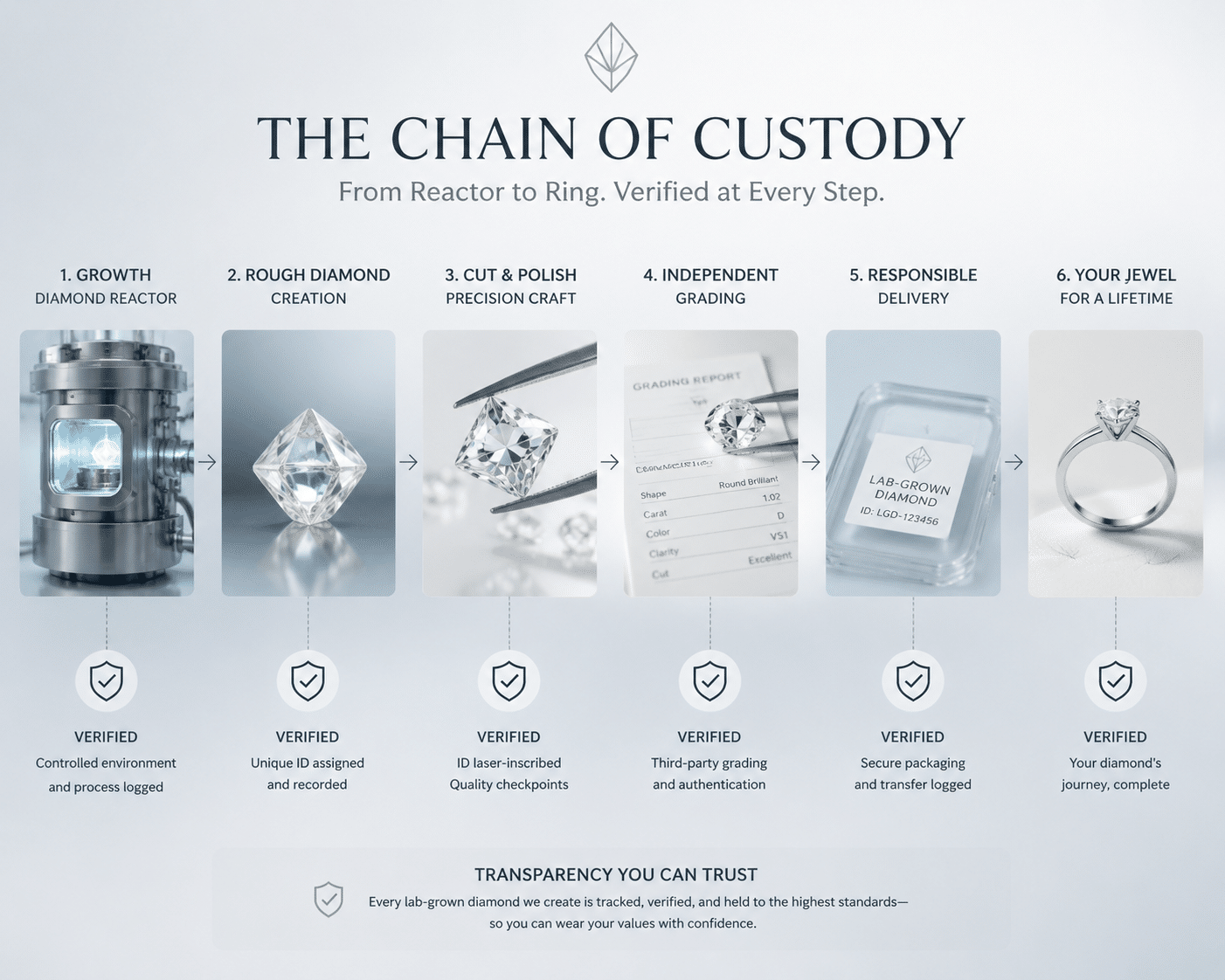
If you want to know where a diamond or metal actually came from, the grading report will not help. The only document designed to answer that question is a chain-of-custody certificate. Chain-of-custody, or CoC, tracks material from its point of origin—a mine or a reactor—through each stage of processing and manufacturing to the finished product. Without a CoC document, origin claims are essentially trust-based.
RJC Chain-of-Custody and Certification Standards
The Responsible Jewellery Council (RJC) operates two relevant programs for the jewelry industry. The first is Chain-of-Custody (CoC) certification, which tracks gold, diamonds, platinum, and other materials through each stage of the supply chain. The second is the Code of Practices (COP) certification, which covers business ethics, labor standards, and environmental management at the company level.
RJC CoC certification is audited by independent third parties. The auditor verifies that materials are tracked and documented at each transfer point, from the source through to the final retailer. A brand holding RJC CoC certification can demonstrate that its material flow is accounted for. RJC maintains a public member directory where you can check a company’s certification status.
The distinction between RJC CoC and RJC membership matters. Many brands display an RJC logo that indicates membership in the organization. That is a Level 2 claim—a membership, not a product-level certification. Actual RJC CoC certification is a Level 1 document, but not every RJC member holds it.
For a buyer, this is one of the most practical distinctions in the entire certification landscape. A membership badge tells you a company has agreed to a code of conduct. A CoC certificate tells you a specific material flow has been audited. The difference matters because you are buying a product, not a company manifesto.
SCS-007 and SCS-1017: The Lab-Grown Diamond Standard
For lab-grown diamonds specifically, SCS-007 is the most complete sustainability certification standard available. SCS-007 covers the full production chain, from the growth facility through processing, cutting, polishing, and setting. It includes audited criteria for energy source, water use, waste management, chemical handling, and labor conditions.
SCS-007 is a third-party audited standard. The certifying body, SCS Global Services, conducts site audits and issues certificates to facilities that meet the criteria. Each certified facility is listed in the SCS public registry.
SCS-1017 is a companion standard for finished jewelry that contains SCS-007 certified stones. It allows a finished ring or piece of jewelry to carry the same traceability and sustainability claims as the diamond itself.
For a buyer who wants verified sustainability documentation beyond the grading report, a diamond with SCS-007 certification or a brand with SCS-1017 jewelry certification represents the highest level of available documentation in the lab-grown category.
What Chain-of-Custody Does Not Prove
Chain-of-custody certification proves material origin and physical tracking. It confirms that the diamond or metal moved through a documented supply chain. What it does not automatically prove is environmental performance, carbon neutrality, or broad social outcomes.
Some CoC standards include environmental and social criteria as part of the certification—SCS-007 is one example. Others track only the physical flow of material without requiring specific environmental performance. RJC CoC, for instance, verifies that the material came from a responsible source under the RJC definition, but the environmental criteria are defined separately in the Code of Practices.
This means that when you see a chain-of-custody claim, you need to ask which standard it refers to and what that standard covers. Not all CoC documents are equal in scope.
Buyer Verification Checklist
Start by asking whether the brand holds active RJC or SCS certification. If the answer is yes, ask for the certificate number.
Next, confirm whether the certification covers the specific product you are buying. A brand may hold RJC certification for its gold supply chain but not for its diamond sourcing. The certificate number and scope statement will clarify this.
Finally, check the certifying body’s registry for current status. Certifications expire and can be suspended. An expired certificate is not a valid document. The registry check takes about two minutes and removes most uncertainty about whether the certification is real and current.
The Practical Role of Documentation in Sourcing Conversations
When a buyer is comparing multiple jewelers or evaluating a custom piece, the documentation itself becomes a communication tool. A brand that produces a certificate number, a registry name, and a scope statement is showing that its sourcing process is built around verifiable records rather than general intentions. In sourcing or wholesale conversations, documentation, consistency, and communication often matter as much as the headline specification. A buyer who asks for these details is not being difficult; they are applying the same standard that any responsible procurement process would follow.
For custom design projects, this documentation step is especially important because the materials are often sourced separately. A loose diamond from one supplier and a metal alloy from another must each have their own traceability documentation before the finished piece can carry a verified claim. Buyers should confirm at the outset of a custom order how the diamond and metal documents will be provided and whether they cover the specific materials being used. This prevents the situation where a beautiful custom ring arrives with a grading report but no way to verify the origin of any other component.
Metal Sourcing Declarations: Recycled, Fairmined, and Responsible Claims
Gold, platinum, and silver sourcing is one of the most contested areas in sustainable jewelry. Unlike diamonds, where grading reports at least establish identity, metal claims often come with minimal documentation. Understanding which declarations are verified and which are not saves the buyer from trusting a vague label.
Recycled Gold: The Most Common—and Least Verified—Metal Claim
Recycled gold is the most common sustainability claim in jewelry and the least verified. There is no universal certification for recycled content. Some refiners provide a mass-balance declaration, meaning recycled material enters the supply chain but is not necessarily allocated to a specific ring. The buyer often receives a general claim, not a per-product document.
This does not mean recycled gold is meaningless. It means the buyer cannot always confirm it. If the claim matters to you, the question is not whether the brand uses recycled gold in general, but whether the specific ring you are buying is backed by a refiner declaration or third-party audit. Most brands cannot answer that at the product level.
Fairmined and Fairtrade Gold: Audited, But Niche
Fairmined gold is certified by the Alliance for Responsible Mining (ARM) and tracked through a chain-of-custody system. Fairtrade gold is certified by FLOCERT. Both apply only to artisanal and small-scale mining (ASM), not to large-scale mining operations or recycled streams. The standards include environmental criteria, labor conditions, and community development premiums.
The limitation is availability. Fairmined and Fairtrade gold represent a very small fraction of global gold supply. A brand that offers it can usually name the specific mine or cooperative. If the brand uses the term loosely without a certificate number or cooperative name, the claim is likely unsubstantiated.
LBMA Responsible Gold: The Industry Standard
The London Bullion Market Association (LBMA) Responsible Gold Guidance is the most widely recognized due diligence standard for gold refiners. It requires refiners to audit their supply chains for conflict financing, money laundering, and human rights abuse. It does not verify environmental performance, carbon footprint, or recycled content.
LBMA Responsible Gold is meaningful for conflict risk, but the buyer should not treat it as a comprehensive sustainability document. Most mainstream refiners carry LBMA certification. It is the baseline, not a differentiator.
Stone-to-Setting Fit Check
Before buying, ask the brand for the specific refiner or supplier name. Confirm whether the metal claim is backed by a third-party audit or a supplier declaration. If recycled gold is important to you, ask whether the claim applies to your ring specifically, not just to the brand’s general inventory. A vague answer means the documentation is not there.
Environmental Audit Documents: Carbon Reports, Energy Disclosures, and Waste Data
Environmental claims in jewelry are the most variable and the least regulated. A brand can claim carbon neutrality, low emissions, or eco-friendly production with almost no supporting evidence. The documents that actually back these claims fall into a few categories, and the differences matter.
FTC Guidance on Environmental Benefit Claims in Jewelry
The FTC’s Green Guides are particularly relevant for carbon and energy claims in the jewelry industry. The FTC advises that environmental benefit claims must be substantiated with competent and reliable evidence, and that broad terms like “carbon neutral” should be qualified to avoid misleading consumers about the product’s overall environmental impact.[1] For a carbon neutrality claim to meet FTC expectations, the brand should typically disclose whether the claim is based on emissions reductions, purchased offsets, or a combination of both, and how those offsets were verified.
This guidance applies directly to jewelry brands that market lab-grown diamonds or recycled metal products with carbon-related claims. If a brand states that a diamond is “carbon neutral” but cannot provide a methodology report detailing scope 1, 2, and 3 emissions and the specific offset projects used, the claim may not meet the FTC’s standard for substantiation. For the buyer, this means that a carbon claim without documentation is not just an inconvenience—it is a potential advertising issue under recognized federal guidance.[1]
The practical implication is clear: when a brand makes an environmental claim, the buyer should expect to see a supporting document, not just a label. The FTC does not require every jewelry brand to publish a carbon report, but its guidance establishes that if a claim is made, it should be backed by evidence. A brand that voluntarily publishes a third-party reviewed carbon footprint report is showing a level of transparency that goes beyond what the FTC requires, which is a strong signal of documentation integrity.[1]
Carbon Footprint Reports: What a Good Report Includes
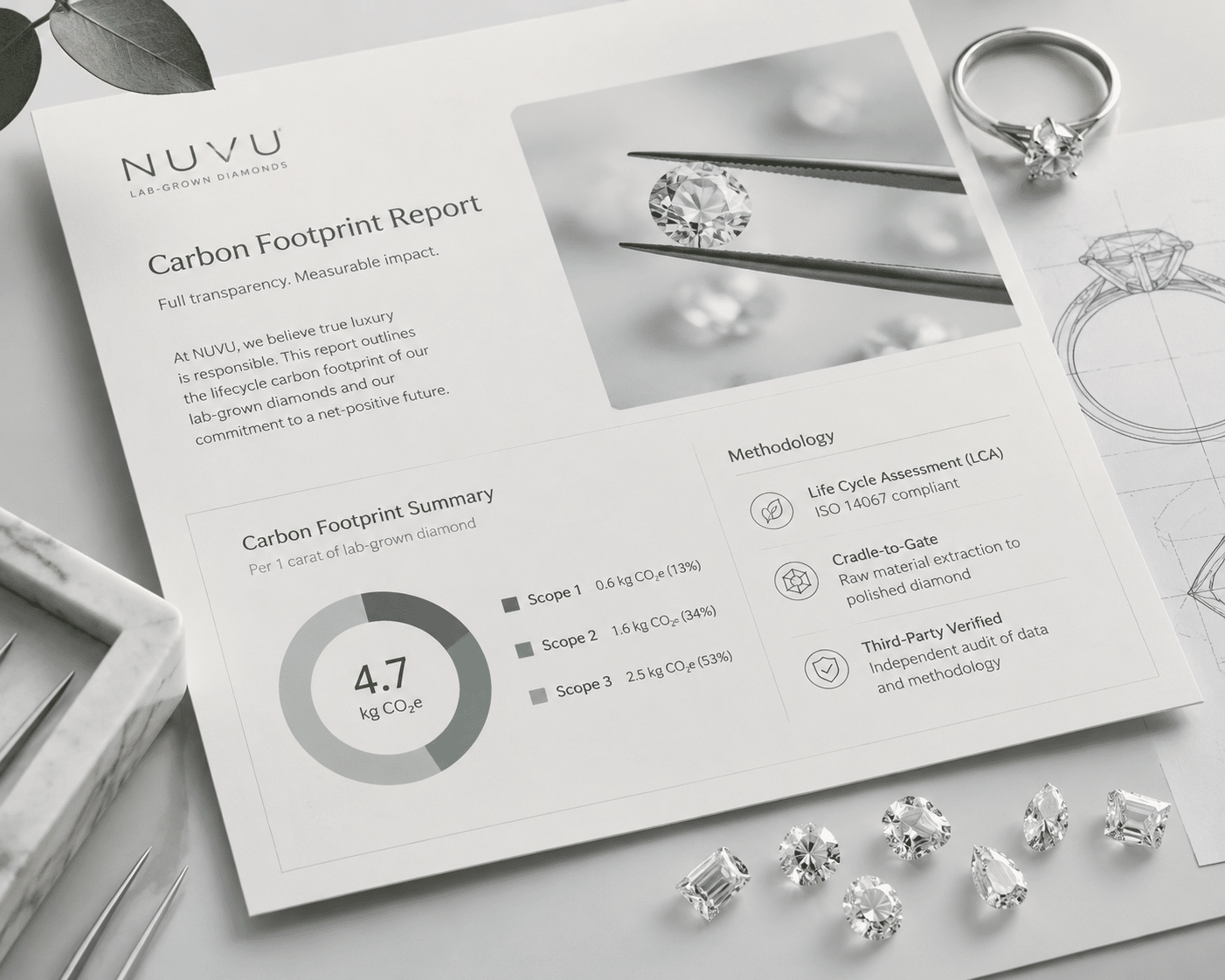
A credible carbon footprint report includes scope 1 (direct emissions), scope 2 (purchased energy), and scope 3 (supply chain) emissions. It references a recognized methodology such as the Greenhouse Gas Protocol or ISO 14064. It defines the boundary of the calculation clearly. And ideally, it includes a third-party review statement.
A single number without methodology is not trustworthy. If the brand claims a specific carbon footprint but cannot show how it was calculated, the number is essentially a marketing figure. The report should be available as a document, not just a bullet point on a product page.
Energy Source Disclosures: The Most Honest Sustainability Signal
For lab-grown diamonds, energy source is the single largest environmental variable. A brand that discloses its energy mix—grid, solar, hydro, or a combination—and provides a renewable energy certificate (REC) or power purchase agreement (PPA) is showing real data. This is more transparent than a vague claim of sustainability because it lets the buyer see the actual production conditions.
A brand that is genuinely using renewable energy will usually have documentation to prove it. If the energy claim is absent or generic, assume the production relies on grid power, which varies significantly by region.
What “Carbon Neutral” Actually Means—and Does Not Mean
Carbon neutral typically means the company measured its emissions and purchased offsets to balance them. It does not mean zero emissions. The quality of offsets varies widely. Some are verified through programs like Gold Standard or Verra. Others are unregulated and may not represent real or permanent reductions.
A carbon neutral claim without a published carbon footprint report is incomplete. If offsets are claimed, ask for the project name and registry. If the brand cannot produce both the footprint and the offset documentation, the claim should be treated as unsubstantiated.
Sustainability Claims: Specificity Over Broad Language
One of the most effective ways to evaluate a sustainability document is to check how specific the language is. A document that says “we are committed to reducing our environmental impact” is a statement of intent, not a record of performance. A document that says “our facility reduced energy consumption by 12% year-over-year, verified by an independent audit” is a measurable claim. Sustainability claims should be specific and documented. Broad green language is less useful than clear information about production, energy, sourcing, and seller transparency.
For the buyer, this means that a jewelry brand’s website should not require guesswork. If the environmental information is buried in a non-downloadable PDF or consists only of a paragraph in the “About Us” section, it is likely not backed by a formal audit. A brand that takes environmental documentation seriously will typically make the report or certificate number easy to find, because the document itself is part of the product’s value proposition.
How to Verify This Before Buying
Ask whether the carbon report is third-party verified. Confirm whether the report covers the full product or only the company. sustainable jewelry buying guide If offsets are claimed, ask for the offset project name and registry. If the brand cannot answer these, the environmental documentation does not exist.
Supplier Declarations and Marketing Badges: The Lowest Level of Evidence
Not every document has independent verification behind it. Some of the most common sustainability labels in jewelry come from the brand itself or from industry associations that do not certify individual products. Recognizing the difference saves time and prevents misinterpretation.
Supplier Self-Declarations: Voluntary, Unverified, Common
A supplier statement is a document a company writes about itself. It may be accurate, but it has no third-party verification. Common examples include “Ethically Sourced,” “Eco-Friendly,” and “Responsibly Produced” labels that do not reference a specific standard or auditor.
These statements are not useless. A brand that publishes a detailed supplier statement is showing more effort than one that says nothing. But the buyer should not treat a self-declaration as equivalent to an audited certificate. The difference is verification.
Industry Association Badges: Useful for Membership, Not Verification
Logos from the GIA, IGI, AGS, RJC (the member badge, not chain-of-custody), or the World Gold Council typically indicate membership, education, or training. They do not confirm product-level sustainability. A jeweler displaying a GIA logo means they have access to GIA grading reports, not that their production process is verified.
The buyer should check what the badge actually represents. If the badge is a membership logo, it supports general trust in the brand but does not prove anything about the specific item being purchased.
Vague Sustainability Logos: Design Without Standards
Some brands design their own sustainability logos. These have no reference standard, no auditor, and no public registry. They function as decorative design elements, not verification documents.
Once you recognize these, you skip researching them entirely. A logo without a named standard and a verifiable certificate number is not a document. It is graphic design.
Certificate and Visual Review Check
Identify who issues the badge: a certifying body or the brand itself. Confirm whether a standard document with a certificate number exists. If the badge is self-issued, treat it as marketing, not verification. The next time you see a small tree icon with no explanation, you know exactly what it is worth.
For grading reports issued by GIA, IGI, or AGS, buyers can use the online verification portals provided by each laboratory to cross-check the certificate number against the diamond’s physical characteristics. The report number and the stone’s laser inscription, if present, should match the laboratory’s record. This verification step is separate from any sustainability claim and confirms only the accuracy of the grading report itself.
How to Evaluate a Brand’s Documentation Before You Buy
The Five-Question Document Filter
When a brand shows you a sustainability document, the first instinct is to accept it at face value. A logo looks official. A certificate looks impressive. But the question is not whether the document exists; the question is whether the document verifies what you think it verifies. A simple five-question filter helps you sort useful documents from decorative ones.
First, who issued the document? An independent certifying body such as SCS Global Services, RJC, or LBMA carries more weight than the company itself. Second, is a specific standard number or name referenced? A document that says “Responsibly Sourced” without naming the standard is not useful. Third, is the certificate number searchable in a public registry? If you cannot verify it independently, treat it as unverified. Fourth, what does the document actually verify: a product, a process, the company, or the material? These are different things. Fifth, does the document cover the item you are buying or a different product line? A brand-level certificate does not mean every item in the store is certified. If a document fails these five questions, you can safely deprioritize it.
Where to Check Certifications Independently
The most reliable verification step is checking the issuing body’s registry. RJC membership and certification status are searchable on the RJC member directory. SCS-007 certificate holders are listed on the SCS Global Services website. LBMA refiner status is published in the LBMA Good Delivery list. For grading reports, IGI, GIA, and AGS all maintain online verification portals where you can enter the report number and confirm the stone details. If a brand gives you a certificate number and you find no matching record, that is a clear red flag.
When to Walk Away from a Sustainability Claim
If a brand cannot produce a document that passes the five-question filter and instead asks you to trust their word, you have reached the limit of what that purchase can tell you. Some claims are probably true but unverifiable, and some are not worth investigating further. For buyers who prioritize verification, the right move is to choose brands that already have audited documentation in place. Asking for proof is not unreasonable; it is the standard way to evaluate a sourcing claim.
What to Check Before You Decide
Run the five-question filter on every document. Confirm document numbers against the issuing body’s online registry. If no verifiable document exists for the specific claim, treat the claim as unsubstantiated. Sustainability without documentation is an intention, not a fact.
Building a Minimum Viable Documentation Set for Your Purchase
You do not need every certificate, report, and audit document in this guide. Most buyers need a small set of documents that cover the important verification points. Here is a practical minimum set based on what you are buying.
For the Diamond: Grading Report + Chain-of-Custody
The grading report from IGI, GIA, or AGS confirms the specific stone you are buying. That much is essential for any diamond purchase. But the grading report does not tell you anything about production conditions. For sustainability documentation, you need a separate chain-of-custody document such as SCS-007, RJC CoC, or an equivalent standard. Without both documents, your sustainability picture is incomplete. One confirms the product; the other confirms the production path.
For the Metal: LBMA Responsible Gold + Source Declaration
LBMA Responsible Gold certification covers conflict risk and due diligence, which is the baseline for any reputable gold supply. Beyond that, you need to know whether the metal is recycled, mined, or a mix. A recycled metal declaration or a Fairmined certificate identifies the source. You do not need all three documents. But you should know which one applies to your jewelry and be able to name the refiner or certificate holder.
For the Brand: Current Certification, Not Membership
Brand-level certification from RJC or SCS confirms that the company operates under a verified standard, with regular audits. This is not a substitute for product-level documents, but it adds confidence. A brand that holds RJC membership without CoC certification is in a different category from a brand that holds active product-level certification. Ask for the certificate number, check the registry, and confirm that the certification is current.
What This Means in a Real Purchase
At minimum, gather the diamond grading report and one chain-of-custody document. Confirm that the metal document matches the specific ring or jewelry you are ordering, not a generic company statement. Check the brand certification before placing a custom order. If you are working with a jeweler on a custom piece, ask how the documentation will be provided and whether the certificate numbers will be visible in your order confirmation.
When Documents Are Not Enough: Limits of the Certification System
Even well-designed certification systems have limits. Understanding these gaps helps you avoid over-relying on a document that cannot deliver what you expect.
Time Lags and Batch Sampling
Certifications are typically audited once per year or every two years. A snapshot audit covers a specific period, not every day of production. Between audits, conditions can change. Additionally, some chain-of-custody documents use batch sampling rather than per-product tracking. This means the document confirms that a batch of material meets the standard, but it does not guarantee that your specific stone or gram of metal was individually tracked. For most purchases, batch-level verification is sufficient. But you should know the difference.
Boundary Issues: Product vs Company vs Component
A brand may hold certification for one product line or one facility but apply the same logo to all products. A company-level certification does not automatically mean each ring in the store is certified. The buyer must ask a specific question: does this document cover the item I am buying? If the answer is vague, the document may not apply to your purchase. The certification system works well when the question is precise.
This boundary issue is one of the most common pitfalls in sustainable jewelry buying. A brand may honestly hold a high-level certification for its headquarters operations or a single facility, but that document has no bearing on a diamond grown in a different facility or gold sourced through a separate refiner. The buyer’s question must always reference the specific product, not the brand’s general credentials.
Certification Does Not Replace Visual Review
For diamonds, documents cannot replace what your eyes can see. A grading report tells you the color grade, but it does not show you how the stone looks in different lighting. A chain-of-custody document confirms the production path, but it does not tell you anything about cut precision, facet alignment, or optical performance. Sustainability documents help with sourcing trust, but they do not help with the diamond’s visual quality. This is where video, photography, and in-person inspection remain essential. For custom design, trust comes from matching the stone to the setting, budget, and wearer’s daily use—not from choosing grades in isolation.
What to Check Before You Decide
Ask which specific product each document covers. Confirm the audit date and whether it is current or more than two years old. Do not accept certification as a substitute for seeing the actual stone. Documents verify the system. You still need to verify the diamond.
Next Step: Questions to Ask Before You Commit to a Purchase
The Buyer’s Question List
The best way to cut through sustainability marketing is to ask direct, specific questions. A vague claim requires only a vague answer. A precise question forces the brand to reference real documentation. These six questions work with any jeweler, not just one with strong certifications, and they give you a quick read on how seriously the brand takes verification.
– Which specific certification or standard applies to this product, not just to your company?
– Can I see the certificate number and verify it on the issuing body’s website right now?
– Is this certification product-level or company-level? Does it cover this exact item?
– For the diamond: Is there a chain-of-custody document beyond the grading report?
– For the metal: Is the source verified by a third party, or is it a supplier statement?
– If you claim recycled gold, is there a refiner declaration or mass-balance report?
A brand that answers these clearly has documentation worth trusting. A brand that cannot answer them probably does not have a verifiable sustainability claim at all.
How a Good Brand Should Respond
A brand with real third-party documentation should be able to give you the certificate number, the issuing body name, and a registry link within one business day. The process should feel straightforward, not reluctant. Vague answers—“we only work with responsible suppliers” or “our partner guarantees ethical sourcing”—are the most common substitutes for actual documents. If the brand responds with a logo or a homepage badge but cannot produce a searchable certificate number, treat the claim as unsubstantiated. The strongest brands treat documentation as a routine customer service detail, not a special request.
For the buyer, this response time is a useful heuristic. A brand that keeps its certificate numbers on hand and can retrieve them quickly is a brand that uses those documents operationally. A brand that needs to “check with the team” or “get back to you” likely does not have the documentation readily available for the specific product you are considering.
Next Step Guidance
Buyers who want verifiable documentation should start with the diamond’s grading report and then ask about chain-of-custody tracking for both the stone and the metal. For a direct comparison, review NUVU’s SCS-007 certified lab-grown diamonds and chain-of-custody tracked precious metals. Start by examining the specific certificate numbers in your order and checking them against the issuing body’s registry.
Differentiation Note
This article stays distinct from NUVU’s diamond buying guides, pricing pages, and general education content. It focuses specifically on document evaluation, not diamond selection, price comparison, or brand positioning. It provides the reader with a verification framework that works for any brand, which builds trust before the reader reaches the NUVU specific information. NUVU’s buyer-first approach is to make the comparison clearer: what the report shows, what the visuals reveal, and whether the stone fits the intended piece. NUVU’s educational approach emphasizes transparency and clarity around documentation, helping buyers make informed decisions without relying on unsupported claims.
[1] Federal Trade Commission, “Guides for the Use of Environmental Marketing Claims,” 16 CFR Part 260, as updated in 2012. Available at: FTC Green Guides.
[2] GIA, “Laboratory-Grown Diamond Terminology and Disclosure,” GIA.edu, 2023. Available at: GIA Lab-Grown Diamond Terminology.
[3] GIA, “HPHT and CVD Diamond Growth Methods,” GIA.edu, 2024. Available at: GIA HPHT and CVD Growth Methods.
Disclosure: This article is for general educational purposes only. Diamond grading, pricing, availability, specifications, and seller policies can change, and readers should verify important details through grading reports, official laboratory tools, seller documentation, or qualified professionals before making a purchase decision. Laboratory-grown diamonds should be clearly distinguished from natural diamonds, and environmental or sourcing claims should be supported by specific documentation.