
When you shop for a diamond, you will see terms like “ethical” and “sustainable” used interchangeably. But they refer to two very different things: one governs how people are treated in the supply chain, and the other measures environmental impact. A single diamond can score well in one area and poorly in the other, yet most brands blend the terms together. This article breaks down the real distinction between ethical and sustainable jewelry, shows you why vague claims hide tradeoffs, and helps you decide which factor matters most for your purchase—so you can ask the right questions, sustainable jewelry certifications and standards, and recognize meaningful evidence when you see it.
For the full framework, read Are Lab-Grown Diamonds More Sustainable?.
| Concern | What to Look For | Red Flags to Avoid |
|---|---|---|
| Human rights & labor conditions | Third-party audits of wages, safety, and worker treatment in mining or lab production | Labels like “fair trade” or “ethical” without any certification name or audit trail |
| Environmental impact of the diamond | Lifecycle data on energy use, carbon emissions, and water consumption | Claims of “eco-friendly” or “green” without published metrics or third-party verification |
| Supply chain transparency | Step-by-step documentation from origin to finished stone | Vague phrases such as “responsibly sourced” or “sustainable” with no supporting documents |
| Impact of the metal setting | Separate certifications for recycled or responsibly mined gold and platinum | Brands that only certify the diamond and ignore metals in the setting |
| Honest disclosure | Clear descriptions of what is and is not verified, even if coverage is incomplete | Bold claims covering everything (ethics + sustainability) with no limitations mentioned |
Quick Questions Before You Read
Q: Can a single certification cover both ethical and sustainable claims?
No. No widely used certification covers labor conditions and environmental impact under one standard. You need separate evidence for each claim.
Q: Is a lab-grown diamond automatically ethical and sustainable?
Not automatically. Lab-grown stones can have a lower carbon footprint but may involve poor labor conditions in the production facility. Each claim must be verified independently.
Q: How do I know if a brand’s claims are real?
Look for third-party certifications or traceable supply chain documentation. If a brand only uses vague terms like “responsibly sourced” without specifics, treat the claim with caution.
Q: Should I prioritize ethics or sustainability?
That depends on your personal values. Decide which factor—human impact or environmental impact—matters more to you, then focus your verification efforts there. Few diamonds are perfect in both areas.
Why “Ethical” and “Sustainable” Are Not the Same Thing in Diamond Jewelry
Most diamond buyers encounter the terms “ethical” and “sustainable” as if they were interchangeable. They are not. Treating them as synonyms creates genuine confusion because each term addresses a different set of problems, requires a different kind of evidence, and leads to a different buying decision. Understanding the difference is the first step toward actually evaluating a brand’s claims.
The Practical Difference Between an Ethical Claim and a Sustainability Claim
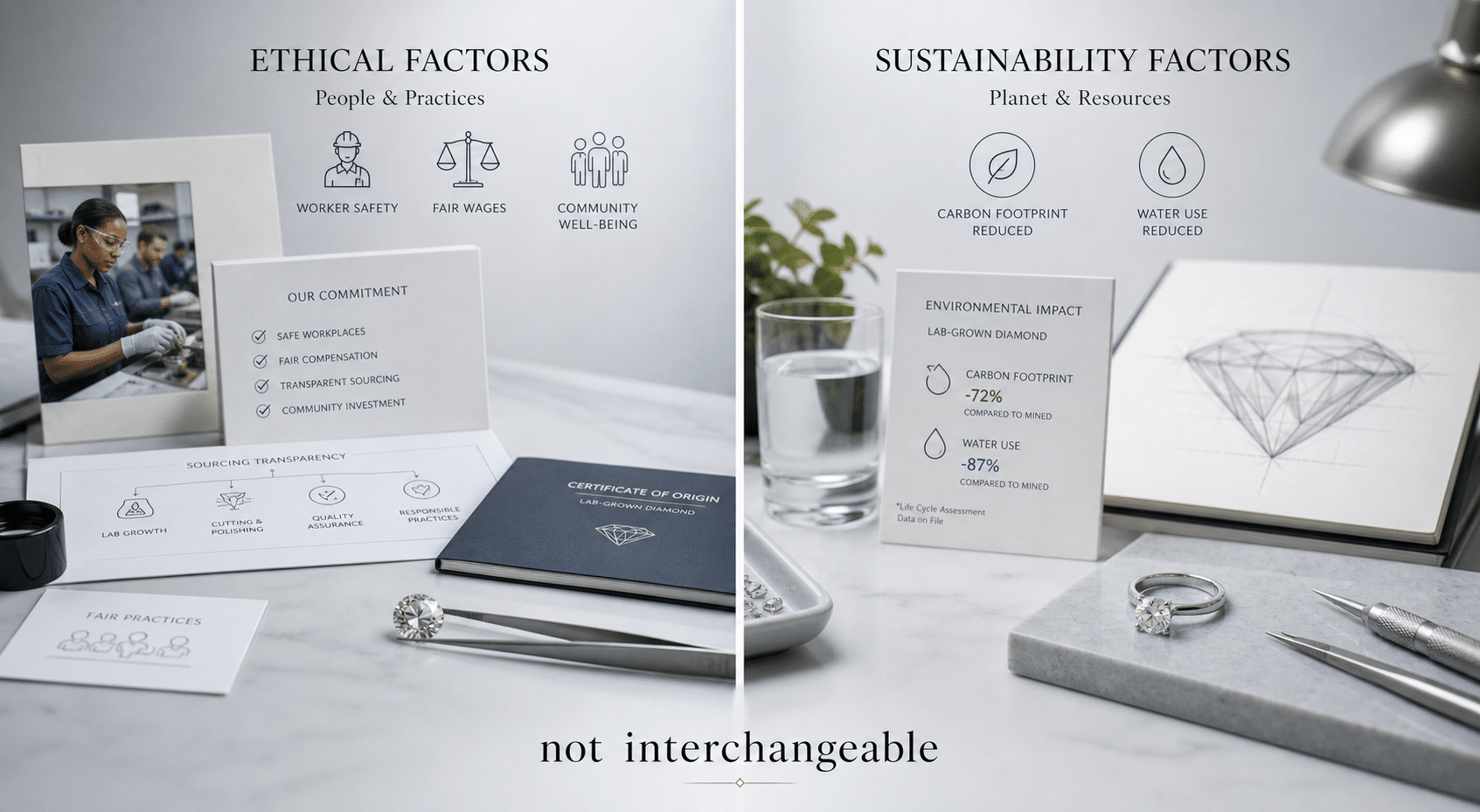
This is not a semantic debate. “Ethical” in diamond jewelry primarily governs human factors: where materials come from, who handled them, how they were compensated, and whether their labor conditions meet basic standards. “Sustainable” primarily governs environmental factors: energy use, carbon emissions, water consumption, land disruption, and waste. Both matter, but they require separate documentation. A diamond can be ethically sourced from a responsible mine while having a significant carbon footprint. A lab-grown diamond can be produced with renewable energy while coming from a factory with undocumented labor practices. Neither claim substitutes for the other.
Why the Diamond Industry Often Blurs These Terms
Many brands present a single word — “eco-friendly,” “conflict-free,” “responsibly sourced” — as a blanket claim covering both ethics and sustainability. This conflation is not accidental. It allows a brand to make one broad statement instead of meeting separate standards for human rights and environmental impact. The practical effect is that tradeoffs get hidden. A lab-grown diamond may have a strong sustainability profile but weaker transparency about how its factory treats workers. A natural diamond may come from a mine with verified labor standards but significant land disturbance. When a brand uses one term to cover both, the buyer has no way to evaluate where the strengths and weaknesses actually lie.
The One Question Most Buyers Never Ask
The most useful question a buyer can ask is also the one most buyers skip: “Can you show me the evidence for this specific claim, rather than a general statement?” Most shoppers accept a brand’s label — “ethical,” “sustainable,” “eco-friendly” — without asking what supports it. That single question changes the conversation. If a brand can produce a third-party audit for labor conditions but has no energy report, you know exactly where its transparency stops. If it provides a carbon footprint statement but cannot describe its sourcing chain, you have the same clarity. The goal is not to catch brands in gaps. It is to know what you are actually buying.
What to Check Before You Decide
Before committing to a purchase, look at how the brand itself uses these terms. Does its website or marketing material distinguish ethical claims from sustainability claims, or does it blend them into one vague phrase? Does it provide sourcing documentation, certification details, or energy reporting for each type of claim? If the brand uses one broad term to cover both human rights and environmental impact, ask for the specific evidence behind each area separately. A brand that separates them clearly is demonstrating a level of transparency that blended-language brands usually cannot match.
What “Ethical Jewelry” Really Means for Diamond Buyers
Ethical jewelry is not a single standard. It is a category of concerns centered on human rights, labor conditions, and sourcing integrity. For diamond buyers, understanding what falls inside this category — and what does not — is essential to evaluating any claim a brand makes.
The compliance-safe perspective for buyers is to recognize that terms like “ethical,” “sustainable,” and “eco-friendly” are often used without universally agreed definitions. A seller’s claim that a stone is “ethical” depends on what specific standards the seller is applying, and those standards may differ from one brand to the next. Buyers should not assume that a single word or label implies a comprehensive third-party audit. Instead, they should ask for the specific criteria that were used to evaluate the claim and whether those criteria were independently assessed.
Human Rights and Labor Conditions in the Diamond Supply Chain
“Ethical” primarily governs where materials come from, who handled them, and how they were compensated. For natural diamonds, this means mine-to-market traceability, Kimberley Process certification, worker safety standards, and community impact. For lab-grown diamonds, it means factory working conditions, wage standards, and worker rights in CVD or HPHT production facilities. Both supply chains involve real people, and both can involve labor practices that fall short of ethical standards. The difference is that natural-diamond ethics questions tend to center on mining communities, while lab-grown questions tend to center on industrial labor conditions. Neither is automatically better. Both require verification.
Sourcing Transparency Beyond Conflict-Free Claims
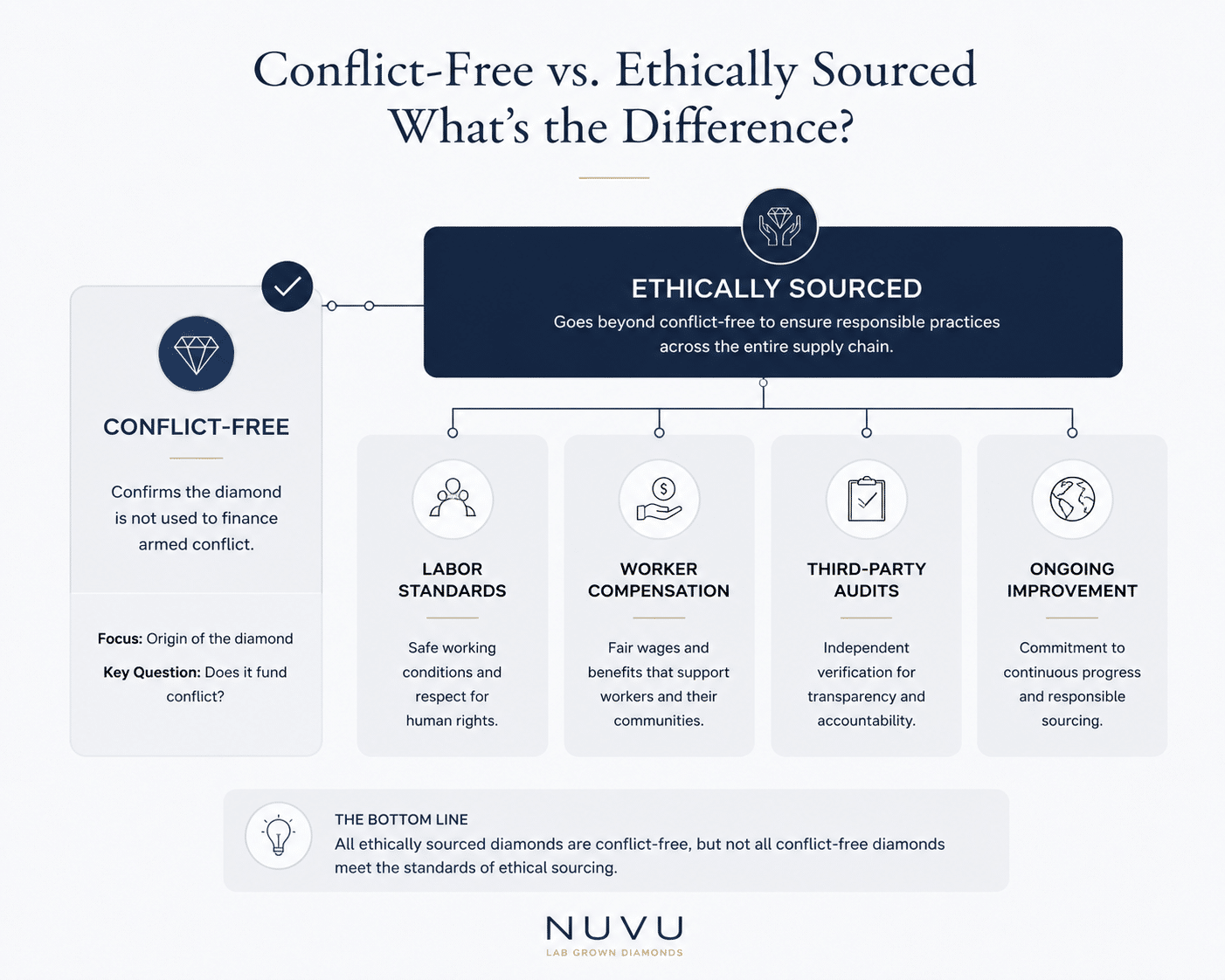
“Conflict-free” is a narrow legal term. It means a diamond has not been used to fund armed conflict, as defined by the Kimberley Process. It does not mean the diamond was sourced ethically in any broader sense. A certified conflict-free stone may still come from a mine with poor labor practices, unsafe conditions, or inadequate compensation. Similarly, a lab-grown stone may be conflict-free by definition — since no mining is involved — but may come from a factory where worker conditions are undocumented or below standard. Ethical sourcing is a broader commitment than conflict-free certification alone. Buyers who stop at the conflict-free label may be missing the larger picture.
The Role of Third-Party Certification in Ethical Claims
Not all certifications carry equal weight, and no single certification covers every ethical concern. The Kimberley Process certifies mineral origin only — it does not address labor conditions or environmental impact. The Responsible Jewellery Council (RJC) certifies business ethics and some labor standards but does not guarantee every stone is traceable to a specific source. SCS 007 covers sustainability criteria that overlap with ethical concerns but is not primarily a labor rights certification. Fair Trade certification addresses producer compensation but is far more common in colored gemstones than diamonds. Each certification has a scope. A brand that lists multiple certifications may be providing genuine transparency — or it may be listing credentials that do not cover what the buyer assumes they cover. The buyer’s job is to match each certification to the specific claim being made.
A useful approach is to review what the certification actually documents rather than assuming it covers everything. A certificate or report can document key characteristics, but it should be read alongside visual evidence, measurements, seller documentation, and the intended jewelry use. Buyers should also confirm reporting details through the issuing organization’s official verification tools where available.
Buyer Verification Checklist
Ask the brand directly: Can you trace this stone to a specific mine or factory, not just a country or region? What labor standards apply in that facility, and how are they verified? Can you provide a third-party audit or certification that addresses human rights specifically — not just product origin or mineral provenance? If the brand cannot answer these questions with specific documentation, the ethical claim is weaker than it appears.
What “Sustainable Jewelry” Really Means for Diamond Buyers
Sustainability claims address a different set of concerns: environmental impact, resource use, and production methods. For diamond buyers, the challenge is that sustainability, as comprehensively explained in sustainable engagement rings guide, is not a single property but involves multiple dimensions, each with its own evidence requirements and tradeoffs.
The Environmental Impact of Diamond Production: Natural vs. Lab-Grown
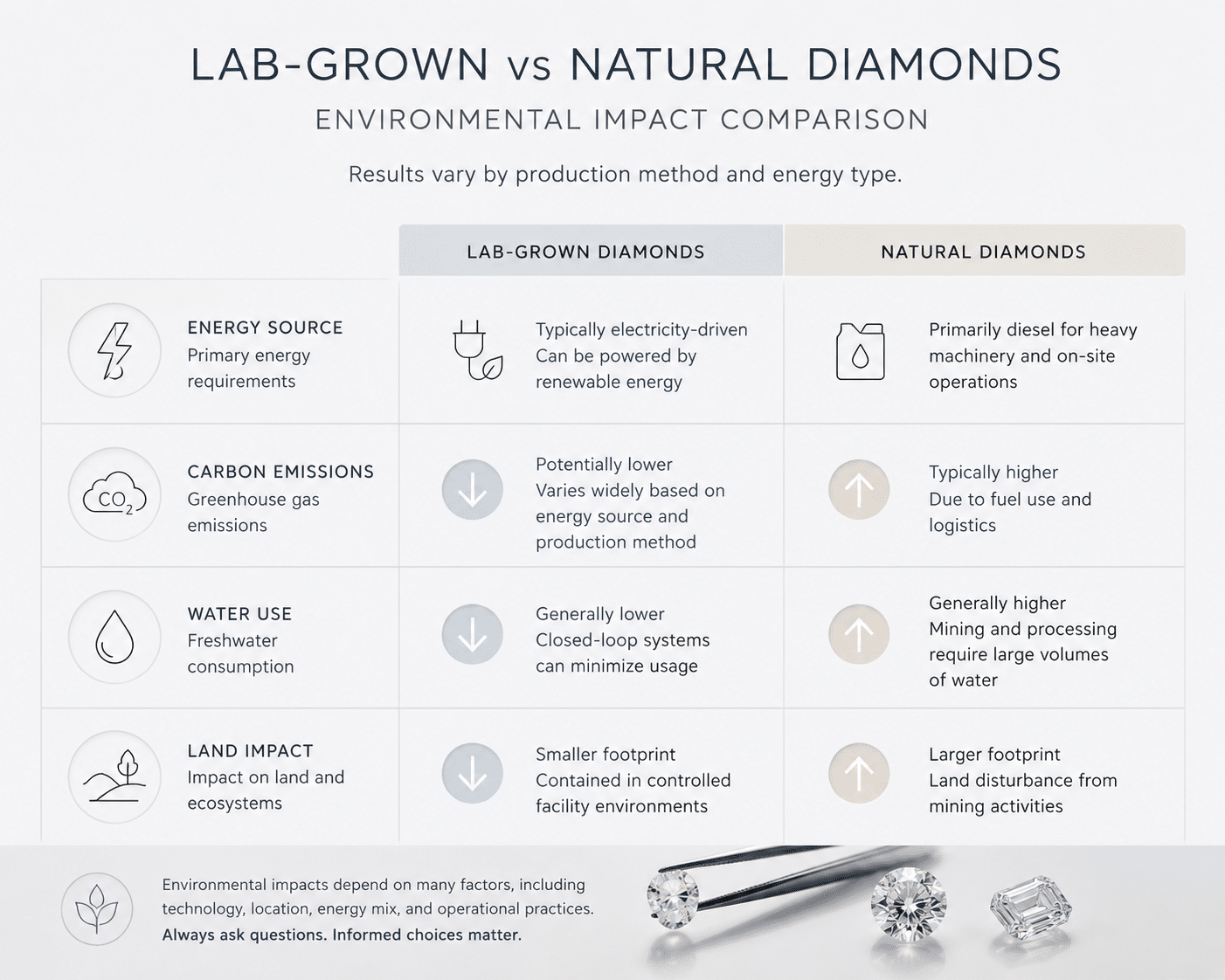
Lab-grown diamonds generally require less land, produce no mining waste, and use significantly less water than mined diamonds. Those are real advantages. But lab-grown diamonds still require substantial energy input for HPHT or CVD production, and that energy has an environmental cost. The sustainability profile of a lab-grown diamond depends heavily on whether the energy source is renewable. A diamond grown in a facility powered by coal-fired electricity has a very different carbon footprint than one grown with solar or hydro power. Meanwhile, a natural diamond from a controlled mine with active land remediation may have a different — but still valid — sustainability argument, particularly if the mine uses renewable energy and rehabilitates the site after extraction. The simple “lab-grown equals green” equation is not reliable.
Energy Source, Carbon Footprint, and Lifecycle Thinking
A truly sustainable diamond, whether natural or lab-grown, requires accounting for energy use, carbon emissions, water consumption, chemical waste, and land impact across the entire lifecycle. This is where many sustainability claims break down. A brand may highlight low water usage while ignoring high energy consumption. It may emphasize recycled packaging while using non-renewable energy to grow its diamonds. The energy source matters more than the production method alone. A buyer evaluating sustainability should ask not just whether a diamond is lab-grown, but what kind of energy was used to grow it, what the carbon footprint looks like, and whether the brand accounts for the full lifecycle of the product, not just the stone itself.
Packaging, Recycling, and Waste in Fine Jewelry
Sustainability extends well beyond the diamond. The metals used in the setting, the packaging materials, the shipping methods, and the waste generated during jewelry manufacturing all contribute to the overall environmental profile. A brand may produce a low-impact diamond but mount it in non-recycled gold mined with high environmental cost. It may use excessive plastic packaging or ship in oversized boxes with unnecessary inserts. Fine jewelry is a physical product with multiple components, and the sustainability of each component matters. A diamond that performs well on environmental metrics but is paired with unsustainable metals and packaging does not add up to a sustainable piece of jewelry.
Sustainability and environmental claims should be specific, documented, and limited to what can be substantiated. A buyer looking to verify such claims should look for third-party data rather than relying on general “green” language. Information about a brand’s energy mix, waste practices, and metal sourcing can often be found in sustainability reports or on a company’s dedicated environmental documentation page.
Certificate and Visual Review Check
Ask the brand directly: What is the energy source for your diamond production — renewable, mixed, or unknown? Do you provide a carbon footprint report for the diamond or the finished piece? Are your metals, such as gold or platinum, certified as recycled or responsibly sourced? Is your packaging recyclable or compostable? If the brand can document some of these areas but not others, you can evaluate honestly. If it cannot answer any of them with specific information, the sustainability claim is largely unsubstantiated.
When a grading report accompanies a diamond, it provides a useful baseline for comparing cut, color, clarity, and carat weight. However, a grading report alone does not verify ethical or sustainability claims. For those, separate documentation — such as a sourcing audit or an energy report — is needed. Buyers should confirm the report details through the issuing laboratory’s official verification tools where available, while also asking the brand for specific evidence supporting any ethical or sustainability-related statements.
Where the Two Terms Overlap: Responsible Sourcing and Transparent Supply Chains
Ethical claims and sustainability claims diverge in what they measure, but they share one structural requirement: traceability. Without knowing exactly where a diamond was produced, how it was grown or mined, and who handled it at each stage, neither type of claim can be verified. A brand cannot credibly assert ethical labor conditions if it cannot name the factory or mine. It cannot credibly assert low environmental impact if it cannot document its energy source. Traceability is the practical precondition for both. If a brand cannot trace its stone, neither its ethical nor its sustainability language should be accepted at face value.
Transparency as a Practice, Not a Marketing Statement
Genuine transparency means a buyer can follow the stone from production to final sale. This requires documentation at each step, third-party auditing where possible, and a willingness to answer specific questions. A brand that offers a general “ethically sourced” tagline but cannot describe its supply chain in specific terms is not practicing transparency. It is using the language of transparency as a marketing shortcut. A brand that can name its production facility, describe its labor standards, identify its energy source, and provide third-party certification for both human rights and environmental claims is demonstrating the real thing. The difference is not in the words used. It is in the specificity of the answers.
How NUVU Approaches This Distinction
At NUVU, we treat ethical and sustainability claims as separate evaluations, not interchangeable labels. Sourcing documentation, factory labor conditions, certification, and energy reporting are each discussed on their own terms. The goal is to give buyers the information they need to evaluate both dimensions independently, without having to decode blended marketing language or guess which claim is supported by evidence.
For buyers, this means that when evaluating a stone at NUVU, the relevant question is not whether the brand has a single “ethical and sustainable” label, but rather what specific documentation exists for each dimension. A grading report and a sourcing certificate are useful starting points, but they address different claims. The buyer’s job is to match each piece of evidence to the specific concern it covers.
What This Means in a Real Purchase
Before buying, ask the brand to describe its supply chain step by step. Where was the diamond produced? Under what labor standards? What energy source was used? What certifications exist for each claim? If the brand cannot separate ethical claims from sustainability claims, or if it uses one broad term to cover both, ask for the specific evidence behind each area. A brand that answers clearly is showing transparency. A brand that cannot is showing the gap between its marketing and its actual practice.
Why Most Diamond Brands Do Not Make This Distinction
Marketing Convenience Over Buyer Clarity
Most diamond brands do not separate ethical and sustainability claims because doing so is harder, more expensive, and less flexible from a marketing standpoint. A single broad claim like “responsibly sourced” or “eco-friendly” requires less documentation than two separate, verifiable claims about human rights and environmental impact. Blending terms allows a brand to make one general assertion instead of meeting two distinct standards. This is not necessarily dishonest. It is strategically convenient. But it shifts the burden of evaluation from the brand to the buyer, who is left to decide what the vague label actually covers.
Buyers should keep in mind that claims about responsible sourcing, sustainability, or ethical production can vary widely in what they actually cover. A company policy or marketing statement on its own is not the same as verifiable third-party documentation. Even when a brand provides a certification or grading report, it is worth understanding the specific scope of what is being certified. A grading report can help document key characteristics, but it should not be treated as a guarantee of beauty, value, or sourcing ethics.
The Certification Gap: No Single Label Covers Both
No single certification covers both ethical labor conditions and environmental impact comprehensively. The Kimberley Process certifies conflict-free mineral origin for natural diamonds, but it says nothing about labor rights or carbon emissions. SCS 007 addresses some sustainability criteria but does not function as a comprehensive human rights audit. Responsible Jewellery Council (RJC) certification covers business ethics and some labor conditions but does not fully evaluate environmental impact. A brand that holds one certification may appear verified across all dimensions, even though no certification actually performs that function. The gap is structural. Buyers who assume one label covers everything will likely overestimate what has actually been documented.
What This Means for Buyer Trust
A brand that deliberately distinguishes ethical claims from sustainability claims is showing higher transparency standards, not complicating the process unnecessarily. A brand that blends them without providing separate evidence is more likely relying on marketing language than on verifiable practice. The distinction itself is a signal. Clear separation suggests the brand has thought about what each term requires and has the documentation to back it up. Blending suggests convenience rather than conviction.
Buyer Verification Checklist
Check the brand’s website and marketing materials. Does it use “ethical” and “sustainable” interchangeably, or does it define each term separately? If the terms are blended, ask for specific documentation for each area. If they are separated clearly, that is a positive signal. It does not guarantee perfect performance, but it strongly suggests the brand is not relying on vague language to avoid scrutiny.
How to Evaluate a Diamond Brand’s Ethical and Sustainability Claims Separately
Step One: Separate the Claim from the Evidence
For every claim a brand makes, ask a single question: What specific evidence supports this? Whether the word is “ethical,” “sustainable,” “conflict-free,” or “eco-friendly,” the same rule applies. Identify whether the evidence is a third-party certification, a written company policy, a supply chain audit, or simply a marketing statement. Only the first three categories carry real weight. A marketing statement without supporting documentation is not evidence. It is a claim waiting to be verified, and should be treated as such.
Step Two: Verify the Ethical Claim
For an ethical claim, ask specifically about sourcing, labor standards, worker compensation, and human rights documentation. Look for third-party audits or certifications that address these factors directly. For natural diamonds, this means understanding the mine, its jurisdiction, and its labor practices beyond the basic conflict-free designation. For lab-grown diamonds, ask about factory working conditions, wage standards, and worker rights in the production facility. An ethical claim without a verifiable labor standard is incomplete, regardless of what else the brand asserts.
Step Three: Verify the Sustainability Claim
For a sustainability claim, ask about energy source, carbon footprint, water use, chemical waste, and packaging materials. Specific numbers matter here. A brand that claims “low impact” without providing data is not being transparent. A brand that discloses its energy mix, reports its carbon footprint, or holds a recognized environmental certification is offering something concrete. Lab-grown diamonds are not automatically low-carbon. The energy source used for production determines the actual environmental profile far more than the production method itself.
Step Four: Compare Documentation Across Multiple Brands
The goal is not to find a perfect brand. Very few exist, and even the best documentation will have gaps. The real goal is to find a brand whose documentation matches its claims. A brand that provides partial but honest evidence is often more trustworthy than one that makes sweeping but unsupported statements. Compare what each brand discloses. A brand that openly acknowledges limitations while providing verifiable data, sustainable jewelry buying guide, is showing more integrity than one that claims full sustainability without evidence.
Stone-to-Setting Fit Check
Apply the same framework to the jewelry setting. A diamond that is claimed as sustainable is only part of the picture. If the gold or platinum is not certified as recycled or responsibly sourced, the overall sustainability profile is weaker. Ask for documentation on both the stone and the metal. A brand that can document both is demonstrating a more complete approach. A brand that only documents the diamond is showing selective transparency, which should raise the same questions about the rest of its supply chain.
The Practical Tradeoffs: When One Dimension Outweighs the Other
Not every buyer needs to weigh ethics and sustainability equally. Your personal values determine where the emphasis should fall. Recognizing that early in the process makes evaluating brands far simpler.
When Ethics Should Lead Your Decision
If human rights, labor conditions, and sourcing integrity are your primary concerns, start with ethical verification before considering environmental factors. A diamond with a low carbon footprint still fails your standards if it came from a facility with undocumented worker conditions or unclear sourcing. Many lab-grown diamonds carry strong sustainability profiles, but that does not automatically guarantee fair wages, safe factory conditions, or transparent labor practices. Lead with ethics, and treat sustainability as a secondary check.
When Sustainability Should Lead Your Decision
If environmental impact is your primary concern, evaluate energy source, waste, and lifecycle data first. A lab-grown diamond produced with renewable energy may score well on carbon footprint, while a natural diamond from a mine with strong land remediation may offer a different but valid environmental argument. The key is that neither method automatically wins on sustainability — the details of production matter more than the category label. Start with energy and environmental reporting, then verify ethical factors secondarily.
Prices can vary because of cut precision, report type, seller channel, size, shape, availability, and documentation. For a buyer whose primary concern is sustainability, comparing energy reporting and production methods may help narrow choices, but the verification challenge remains similar regardless of budget level.
When Both Matter Equally: The Case for Transparent Supply Chains
For buyers who want to evaluate both dimensions seriously, a transparent supply chain is not optional — it is the only way to verify either claim. Without traceability, you cannot confirm where a stone was produced, how it was grown or mined, who handled it, or what conditions applied. Start by asking for documentation on both fronts. If a brand cannot provide specific evidence for both ethical and sustainability claims, treat that as a limitation, not a signal of trust.
It is also worth noting that the two dimensions are not always in conflict. A well-documented lab-grown diamond, produced in a facility with fair labor practices and powered by renewable energy, can perform credibly on both fronts. But such stones are the exception, not the rule. Most diamonds — natural or lab-grown — will have a stronger profile in one area than the other. Recognizing that tradeoff is part of making an informed choice.
What This Means in a Real Purchase
Rank your own priorities before entering the buying process. If ethics is priority one, start with sourcing and certification. If sustainability is priority one, start with energy and environmental reporting. If both matter equally, require documentation for both and reject claims that cannot be verified. This simple framework turns a vague shopping experience into a decision you can feel confident about.
Why “Better” Is Not the Same as “Best”: Setting Realistic Expectations for Diamond Buyers
No diamond product — lab-grown or natural — is completely impact-free. The goal is not to find a perfect stone, but to make an informed choice with transparent information. Understanding that distinction prevents frustration and helps you evaluate brands realistically.
The Limits of Any Single Diamond’s Impact Profile
Even the most thoroughly documented laboratory diamond has a carbon footprint. Even the most ethically managed mine has some environmental cost. Pretending otherwise sets an impossible standard. The real objective is not to eliminate impact entirely — that is generally not achievable — but to choose a stone whose documented practices align with your values. A brand that honestly discloses its limitations is often more trustworthy than one that claims perfection without evidence.
Laboratory-grown diamonds should be clearly identified as laboratory-grown, and they should not be presented as mined diamonds. When a brand uses the term “sustainable” for a lab-grown diamond, buyers should look at the specifics of energy use and production practices rather than assuming the label is comprehensive.
How to Decide What “Good Enough” Looks Like for You
Set a threshold before you start shopping. What level of evidence is acceptable? A brand that provides partial but honest documentation of ethical and sustainability practices is often preferable to one that makes sweeping but unsupported claims. For example, a facility that reports its energy mix but cannot yet provide full lifecycle data may still be a better choice than a brand that simply calls itself “eco-friendly” without any numbers. Define your minimum standard, then compare brands against it.
The Role of Personal Values in This Decision
The distinction between ethical and sustainable is not just factual — it is also values-based. Some buyers prioritize human rights over carbon footprint. Others prioritize environmental impact over sourcing complexity. Both approaches are valid. The important thing is to make the decision deliberately, not passively. When you know what matters most to you, evaluating a brand’s claims becomes straightforward.
Importantly, no brand should be expected to provide perfect documentation for every dimension right away. Supply chain transparency is still evolving across the diamond industry. What matters more is whether a brand is moving toward clearer disclosure — providing verifiable data where it exists and honestly acknowledging where it does not. That trajectory is often a more reliable sign of commitment than a perfectly polished marketing statement.
Buyer Verification Checklist
Set your own standard before shopping. For example: “I need a verified ethical sourcing claim and at least some sustainability documentation, even if it is not perfect.” Use this standard to filter brands, not to demand perfection. A brand that provides honest, specific evidence — even if incomplete — is almost always a better choice than one that offers broad claims without anything to back them up.
Documentation and Traceability: What to Request When Evaluating a Diamond
Throughout the evaluation process, the quality and specificity of documentation matter more than the brand’s general reputation. A grading report from a major laboratory provides a verified baseline for the 4Cs, but it should be read alongside any ethical or sustainability claims made about the stone. For traceability, buyers should request documentation that connects the diamond to a specific production facility or mine, not just a country or region of origin. In a wholesale or sourcing context, consistency in documentation — matching grading reports, sourcing certificates, and audit results to the same stone — is a practical trust signal. NUVU’s buyer-first approach is to make the comparison clearer: what the report shows, what the visuals reveal, and whether the stone fits the intended piece.
[1] Federal Trade Commission, “Guides for the Use of Environmental Marketing Claims (Green Guides),” 16 CFR Part 260, available at FTC.gov. The FTC guidance warns marketers against making broad, unqualified environmental benefit claims and advises that specific, substantiated claims are necessary. This supports the article’s emphasis on separating vague sustainability language from verifiable evidence.
[2] Kimberley Process Certification Scheme, “What is the Kimberley Process?” available at KimberleyProcess.com. The KPCS certifies rough diamond origin to prevent conflict diamonds. It does not address labor conditions, compensation, or environmental impact, supporting the article’s distinction between conflict-free and broader ethical sourcing.
Disclosure: This article is for general educational purposes only. Diamond grading, pricing, availability, specifications, and seller policies can change, and readers should verify important details through grading reports, official laboratory tools, seller documentation, or qualified professionals before making a purchase decision. Laboratory-grown diamonds should be clearly distinguished from natural diamonds, and environmental or sourcing claims should be supported by specific documentation.