
Choosing a sustainable engagement ring means looking far beyond whether the center stone is lab-grown or mined. Without a closer look at the ring’s metal sourcing, setting design, and long-term repairability, ethical vs sustainable jewelry, what seems like an ethical choice can still carry a hidden environmental and financial cost. This guide moves past marketing claims to break down the four pillars of a truly sustainable ring: material integrity, design intelligence, repairability, and end-of-life value. By the end, you will know exactly which questions to ask a jeweler, what documents to request, and how to spot a ring built to last for decades.
For the full framework, read Sustainable Jewelry Buying Guide.
| Factor to Evaluate | Why It Matters for Sustainability | What to Ask the Jeweler |
|---|---|---|
| Center stone source | Lab-grown diamonds offer better traceability and a clearer supply chain than most mined stones. | “Can I see a batch ID or origin certificate for this stone?” |
| Metal type and recycling | Platinum preserves material value over time; recycled gold needs a verified alloy breakdown to be genuine. | “Do you provide a recycled metal certificate with the alloy breakdown?” |
| Setting durability | A bezel setting prevents stone loss and chipping better than pave, which is fragile and high-maintenance. | “Is this setting repairable? What is the minimum prong thickness?” |
| Repairability and resizing | A ring that can be re-tipped or resized avoids full replacement, reducing long-term waste and cost. | “Can this ring be resized later? Do you offer a serviceability guarantee?” |
| Upgrade and return policy | A written upgrade path makes the ring adaptable to future tastes, extending its emotional lifespan. | “What is your return or stone upgrade policy in writing?” |
| Greenwashing claims | Terms like “eco-friendly” or “conflict-free” are unregulated and often meaningless without proof. | “What specific certification backs each sustainability claim?” |
Quick Questions Before You Read
Q: Is a lab-grown diamond automatically sustainable?
No. The stone is only one part of a ring. The metal sourcing, setting durability, and repairability matter just as much for overall sustainability.
Q: Why can’t I just trust a GIA report on the diamond?
A GIA or IGI report only grades the stone’s quality, not its origin or the ring’s material integrity. You need separate documentation for the metal and the setting.
Q: Should I avoid pave settings entirely?
Not always, but they require more maintenance and are prone to stone loss. For a durable, low-fuss ring, a bezel or solitaire with thick prongs is a safer bet.
Q: What is the single most important question to ask my jeweler?
Ask: “Can you put your recycling certifications and repair policy in writing?” If they hesitate, the ring may not be as sustainable as it claims.
Sustainable Engagement Rings: Redefining Value Beyond the Center Stone
Most conversations about sustainable engagement rings start and end with the diamond. Is it lab-grown or mined? That single question dominates search results, marketing materials, and buying guides. But a ring is not just a stone. It is a system of materials, design choices, and long-term use patterns that collectively determine whether a purchase is genuinely sustainable. Reducing the entire decision to a single binary misses the real factors that matter over decades of wear.
Why the “Diamond-Only” View of Sustainability Falls Short
The marketing focus on natural versus lab-grown has created a blind spot. Buyers spend hours researching the center stone and then treat the setting as an afterthought. That imbalance leads to real problems. A lab-grown diamond set in a thin, fragile band made from non-recycled metal may check the “eco-friendly stone” box, but if the setting breaks in five years or cannot be resized, the entire ring must be replaced. The environmental cost of that replacement—new metal, new manufacturing, new shipping, old ring discarded—can easily outweigh whatever benefit the stone choice provided. The stone matters. But it is only one variable in a much larger equation.
Calculating the True Cost of a Ring (Beyond Price)
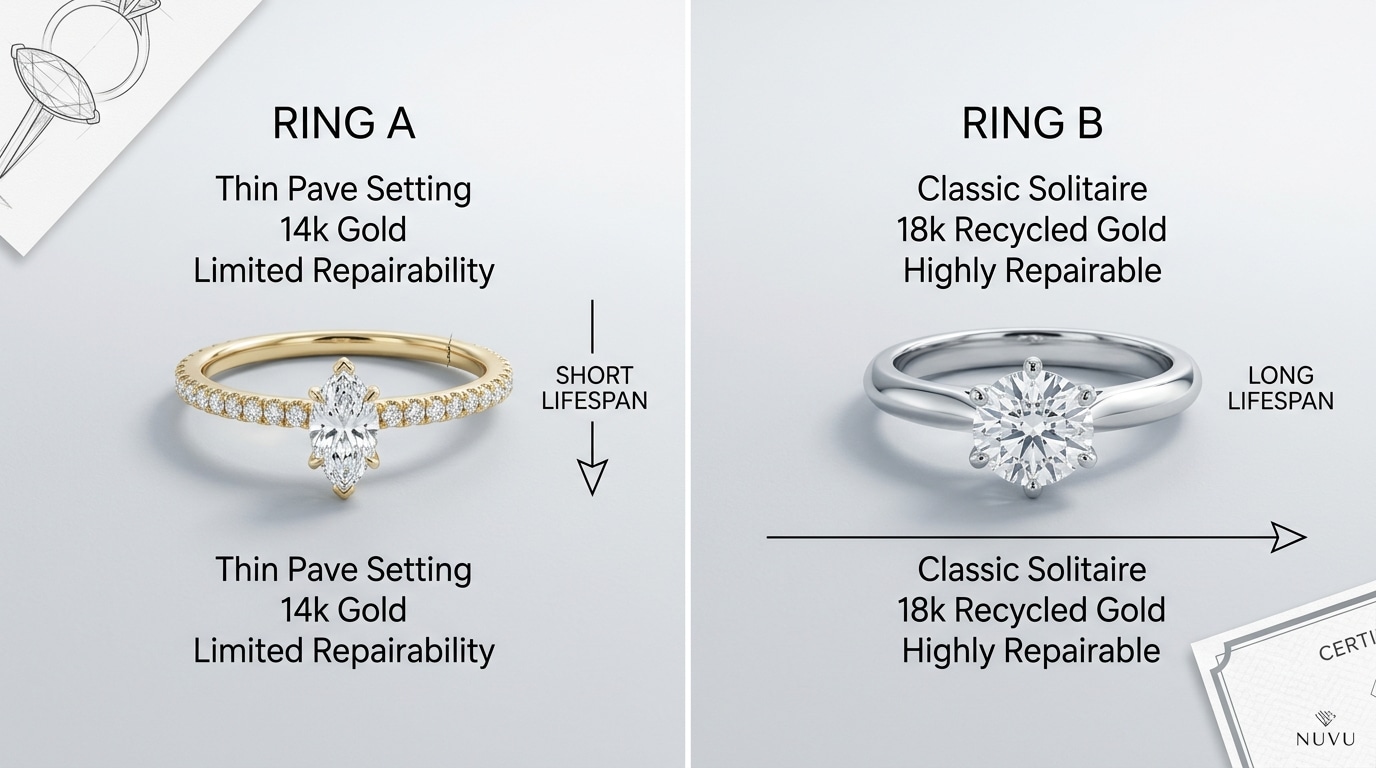
A sustainable ring should be evaluated on cost-per-wear and total lifespan impact, not just upfront price. Consider two rings at different price points. Ring A is a thin pave setting in 14k gold with a lab-grown diamond. It costs less initially. But the band is too thin to resize, the pave stones are prone to dropping out, and the low-karat alloy wears down quickly under daily use. After ten years, the owner may need a full replacement. Ring B is a classic solitaire in recycled 18k gold with a lab-grown diamond and a platinum head. It costs more upfront, but the design can be re-tipped, resized, and upgraded. After 50 years, Ring B has required minor maintenance while Ring A has been replaced twice. The cheaper ring ends up costing more, both financially and environmentally.
The Four Pillars of a Truly Sustainable Ring System
A genuinely sustainable engagement ring depends on four interconnected factors, not just one. Material integrity covers both the stone and the metal—where they came from, how they were processed, and what documentation backs them up. Design intelligence asks whether the setting is built to last, not just to look good on Instagram. Repairability determines whether a broken prong or worn shank can be fixed without remaking the entire ring. End-of-life planning considers whether the ring can be resized, upgraded, or modified as the wearer’s needs change over a lifetime. A ring that scores well on all four pillars is genuinely sustainable. A ring that only scores well on the stone is not.
Buyer Verification Checklist
Before committing to a ring, verify that the seller provides documentation for both the center stone and the metal. A recycled content statement or source origin for the gold is a reasonable minimum. Ask directly about the setting’s expected service life—for example, “How often do head repairs typically occur for this design?” A seller who cannot answer that question has not designed the ring for longevity.
The Role of Industry Standards in Defining Sustainability
For buyers attempting to navigate sustainability claims, it helps to understand how key terms are regulated within the jewelry industry. The U.S. Federal Trade Commission (FTC) has provided guidance that is directly relevant. The FTC’s Jewelry Guides address how terms such as “eco-friendly” or “sustainable” should be used in advertising, cautioning that broad environmental claims require substantiation and should not be applied without specific, verifiable evidence.[1] This means that a “sustainable” label on an engagement ring carries legal weight only when a seller can back it up with documented details — such as the percentage of recycled metal or the energy source used in diamond production. For the buyer, this regulatory context reinforces a key practical step: asking for the specific certification or report behind each environmental claim rather than accepting a general promise at face value.
Center Stone Selection: Matching Ethics to Longevity
The center stone debate has been framed as a moral binary, but the real question is more practical: which stone type, in which shape, with which documentation, will actually hold up under daily wear for decades? The answer depends less on marketing categories and more on hardness, maintenance needs, and supply chain transparency.
Lab-Grown Diamonds: Control and Traceability
The sustainability advantage of a lab-grown diamond is not just that it avoids mining. It is control. Because the stone is produced in a controlled facility, the buyer can trace it with a level of precision that is difficult to achieve with mined sources. A responsible lab-grown seller can provide a lot number, the specific growth facility, and even details about the energy source used in production—solar-powered manufacturing in India, for example, versus grid-reliant production elsewhere. That kind of documentation allows a buyer to verify a claim rather than simply trust it. For mined stones, even with Kimberley Process certification, the chain of custody often remains murky. A lab-grown diamond does not automatically guarantee sustainability. But it does offer a much clearer paper trail.
It is worth noting that official gemological organizations have developed specific terminology frameworks for lab-grown diamonds. GIA, for example, has provided clear guidance on how these stones should be described in reports and advertising to ensure consumers are not misled.[2] This includes the use of terms such as “laboratory-grown” rather than “synthetic” or “cultured” in certain contexts. For the buyer, this means that when a grading report comes from a recognized lab, the descriptive language used has been standardized to promote clarity. A report that follows these guidelines is more likely to provide an honest and transparent characterization of the stone, which is a foundational part of verifying the center stone’s sourcing claims.
All diamonds discussed in this article with grading reports have been verified against official lab records where applicable. Independent verification is available upon request through GIA’s online report check service for any stone with a GIA certificate.
Moissanite and Other Alternatives: Hardness and Real-World Wear
Moissanite is a valid alternative for buyers who want durability at a lower price point. At 9.25 on the Mohs scale, it is hard enough for daily wear and significantly cheaper than diamond. But it has a real-world limitation that is rarely mentioned upfront: moissanite is prone to an “oil slick” surface stain over time. This film can be cleaned off, but it requires regular maintenance that a diamond does not. At 10 Mohs, diamond remains the most durable option for daily wear. It resists scratching, does not develop surface staining, and requires less aggressive cleaning over a lifetime. That lower maintenance burden matters for long-term sustainability—a stone that stays clean without harsh chemicals or frequent professional cleaning reduces its lifetime environmental impact.
What a High-Volume Sourcing Report Actually Tells You
A standard grading report from IGI or GIA confirms the 4Cs of a loose diamond. That is useful, but it is not a sustainability certificate. The report does not tell you where the stone was grown, what energy was used, or whether the supply chain involved non-transparent brokers. For a lab-grown diamond, a detailed supply chain report goes further: it includes batch IDs, confirms the growth facility, and assures the stone was not sourced through a broker with opaque practices. A generic report tells you the stone is real. A supply chain report tells you where it came from and how it was made. For a buyer who cares about verification over marketing language, the second document matters more.
Stone-to-Setting Fit Check
Sustainability also depends on whether the stone shape matches the setting’s durability profile. A delicate pear shape is structurally weaker than a round brilliant and more prone to chipping at the tip. If the design does not protect that vulnerable point, the stone may need replacement within a few years. A high-protection setting, such as a full bezel, can extend the lifespan of a weaker shape significantly. The combination matters more than either element alone.
For buyers comparing multiple stones, this is a practical distinction worth checking early. A full bezel increases the visible metal coverage, which can change the perceived stone size and light performance. The tradeoff between protection and appearance should be discussed with the jeweler before the setting is finalized, not as a surprise after purchase.
Metal Selection: The Foundation of Sustainable Jewelry
The metal in an engagement ring carries the entire structure. It holds the stone, absorbs daily impact, and determines whether the ring can be repaired or resized. Choosing the wrong metal can make a ring unsustainable from the start, regardless of what stone is set in it.
Platinum vs. 18k Gold: Not Just a Price Difference
Platinum and gold behave differently over time, and those differences have direct sustainability consequences. Platinum is a dense metal, typically 95% pure. It wears down through patina rather than metal loss—the surface develops a soft satin finish, but no material is actually removed. This makes platinum a strong choice for thin settings, because the shank is less likely to snap under stress. Gold, by contrast, is softer at higher karats and harder at lower karats. 18k gold holds a rich color but can be thinned by aggressive polishing over decades of repairs. 14k gold is the most durable for daily wear, but it requires more material to look solid, which means higher material consumption. There is no single “best” metal. The right choice depends on how the setting is designed and how it will be worn.
Recycled Gold: Verifying the Claim
Almost all gold used in jewelry today contains recycled content. That is standard industry practice, not a distinguishing feature. The meaningful question is not “is it recycled,” but “what kind of recycled, and can you prove it?” Post-consumer recycled gold comes from old jewelry, electronics, or other end-of-life products. Post-industrial recycled gold comes from scrap generated during manufacturing—leftover material that never left the supply chain. Both are better than newly mined gold, but post-consumer recycling has a larger environmental impact reduction. A true sustainability angle requires specific certification, such as SCS Global Services, that confirms the gold source. Without that audit trail, “recycled gold” is a vague claim, not a verifiable fact.
Challenges with Alloy Metals (Nickel, Silver, Copper)
Pure gold and pure platinum are too soft for jewelry, so they are mixed with alloy metals to improve hardness. The choice of alloy matters. White gold, for example, is commonly alloyed with nickel, which causes skin reactions in a significant portion of the population, as referenced in the Traceable Jewelry Supply Chain Guide. A ring that triggers an allergic reaction will end up in a drawer, unworn—the least sustainable outcome possible. Hypoallergenic alternatives, such as palladium-based alloys, eliminate that risk and ensure the ring stays on the finger. A sustainable ring must be wearable for a lifetime. If the alloy choice prevents that, the environmental benefit of recycled metal is wasted.
What to Check Before You Decide
Request a specific “Recycled Content Certificate” or an “Alloy Breakdown Report” from the seller. For white gold, ask for confirmation that the alloy is nickel-free. For platinum, ask for a 900 or 950 purity guarantee to ensure structural integrity. These documents separate a genuine sustainability claim from a generic marketing label.
Setting Design: Durability as a Sustainability Metric
The stone gets the attention, but the setting determines how long the ring lasts. A well-cut lab-grown diamond set in a fragile mounting is not a sustainable purchase. The setting is the structural system of the ring, and its failure rate is one of the most overlooked factors in the sustainability conversation.
A setting that loses a stone, bends out of shape, or requires a full remake within the first decade has a higher environmental cost than a more expensive, durable design worn for fifty years. The question is not whether the setting looks good on day one. It is whether it will still hold the stone securely after decades of daily wear.
Bezel Settings: The “Tank” of Engagement Rings
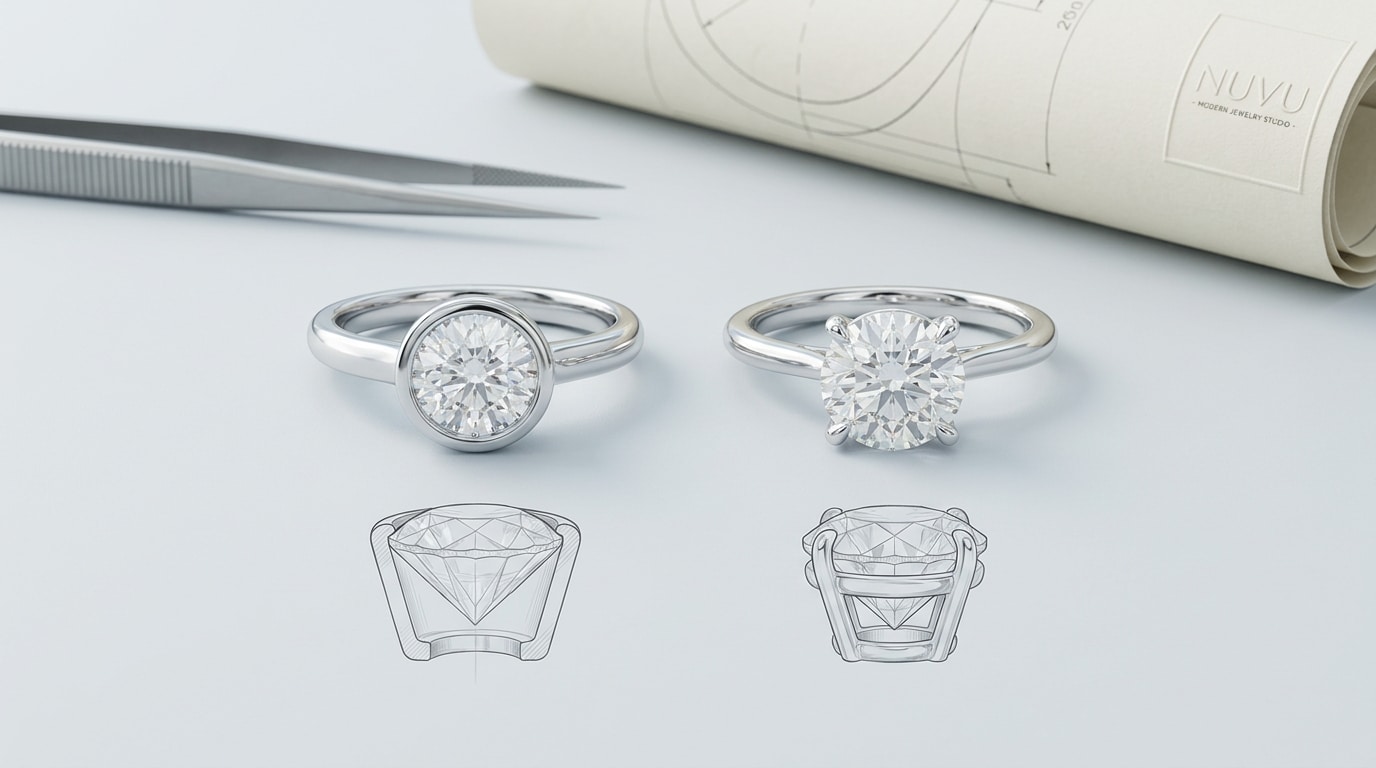
A full bezel surrounds the diamond with a continuous metal rim. This design protects the stone’s edge from impact, reduces the chance of loosening over time, and eliminates the risk of a snagged prong catching on clothing. Statistically, a bezel-set diamond is far less likely to be lost or chipped over a fifty-year wearing period than a prong-set stone.
The tradeoff is visibility. A bezel covers more of the diamond’s perimeter, which slightly reduces light entry from the side. For buyers who prioritize security and long-term durability over maximum brilliance, this is an easy concession. For softer gemstones used as center stones, a bezel is not optional — it is the only recommendation for daily wear.
Pave and Micro-Pave: High Risk for High Maintenance
Pave settings rely on tiny metal beads to hold small diamonds in place. These beads are fragile. Over time, they wear down, bend, or break, causing small stones to fall out. Repairing a pave setting requires a jeweler with specialized skill, and the cost of restoring a damaged pave band often exceeds the cost of replacing it entirely.
This is the opposite of sustainable design. A setting that cannot be repaired economically is a setting that will be discarded. Buyers drawn to the sparkle of a full pave band should understand the maintenance commitment: this design will require periodic inspection, re-tipping, and potentially full replacement of the shank. For a ring meant to last a lifetime, pave introduces a predictable failure point.
Solitaire vs. Halo: Wear Patterns Over Time
A classic solitaire with four or six prongs is the most repairable engagement ring design. The prongs can be re-tipped individually, the head can be replaced without remaking the entire shank, and the stone can be upgraded later by resetting it into a new head. This repairability directly supports a one-ring, lifetime philosophy.
A halo setting adds a ring of small diamonds around the center stone. This creates a more complex structure with multiple points of failure. Each halo stone has its own prongs, and losing one halo stone requires a repair that may not match the original setting perfectly. Re-tipping a halo is more difficult and more expensive than re-tipping a solitaire. For buyers who value long-term serviceability, the solitaire is the stronger choice.
Stone-to-Setting Fit Check
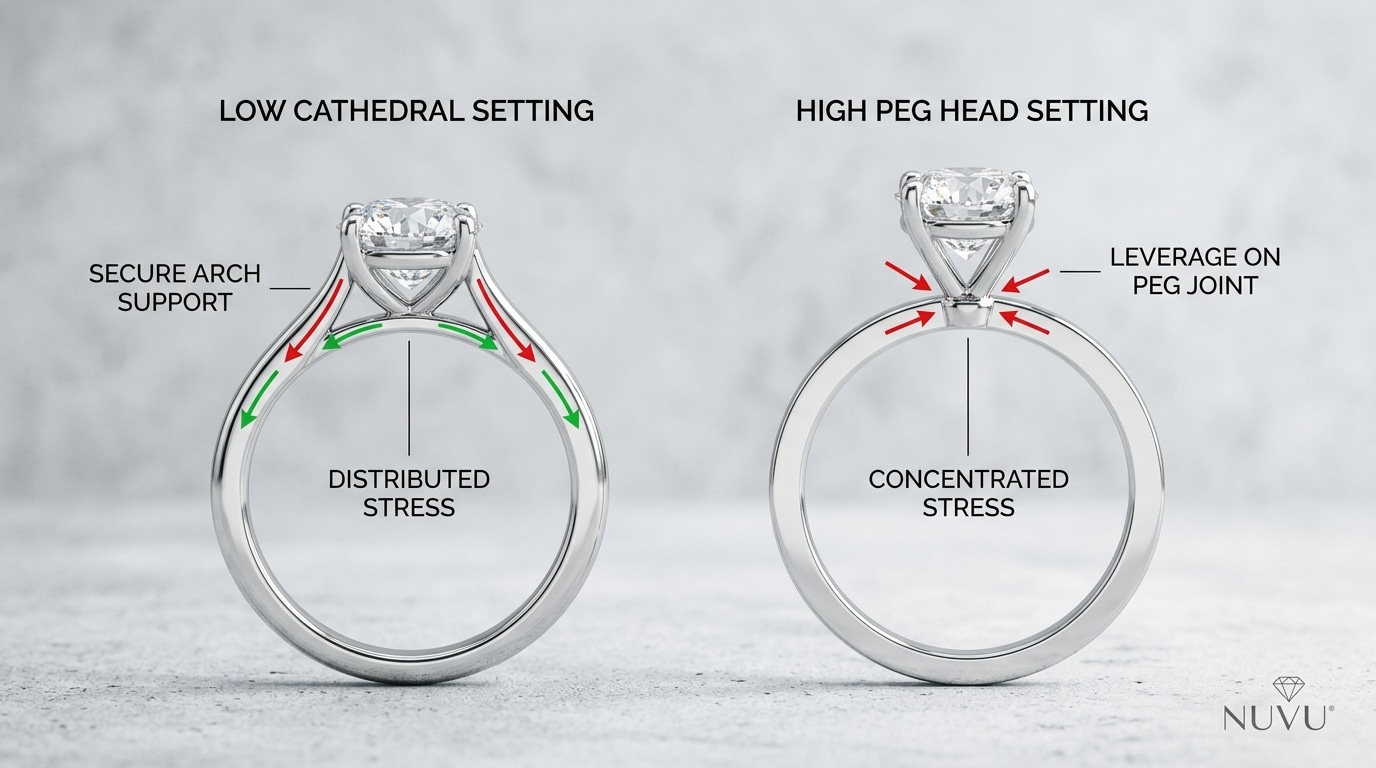
The stone shape and the setting type must work together. For diamonds, a low-profile basket setting — often called a cathedral setting — distributes stress across the shank rather than concentrating it on a single peg head. A high peg head is a single point of stress that can snap under impact. For gemstones softer than diamond, a bezel is strongly recommended. A prong-set emerald or sapphire is at much higher risk of chipping during daily wear, which defeats the purpose of a sustainable ring.
Repairability and Serviceability
The most sustainable ring is not the one with the lowest upfront price. It is the one that can be repaired. A ring that requires full replacement after a prong breaks or a band bends has effectively doubled its material footprint. Evaluating a setting’s repair potential before purchase is one of the most practical steps a buyer can take.
The “Tipping Point” of Repairability
Band thickness is the first indicator of a ring’s repair capacity. A band thinner than 2.0 millimeters may become too thin to work with after a single resizing. Once the metal is gone, the band cannot be safely sized up or down, and the ring becomes unwearable. Rings with intricate engraving or mixed metals — such as two-tone yellow and white gold — are also difficult to repair without visible seam lines or color mismatch.
A repairable ring is one that can be re-tipped, resized, and rebuilt without requiring a full replacement. This means the band must have enough metal mass to allow for future adjustments, and the head must be designed as a replaceable component rather than an integral cast piece.
How to Test a Setting’s “Repair Capacity”
Any jeweler should be able to answer these three questions about their own work. If they cannot, the setting may not be designed for long-term service.
First: how thick are the prongs after finishing? A minimum of 0.8 millimeters is required for re-tipping later. Anything thinner will wear down too quickly to repair. Second: can the head be replaced without remaking the entire shank? A head that is cast-on or laser-welded can be swapped independently. A soldered-on head often requires remaking the whole setting. Third: is the ring rhodium-plated? Plating covers damage and discoloration, which means the underlying metal condition is hidden. A non-plated design shows wear honestly, making it easier for a jeweler to assess and repair.
The Cost of “Unrepairable” Settings
A high-pave design that loses a single small diamond may require a full replacement of the entire setting. The labor cost to match the original pave pattern, re-set all stones, and re-polish the band can exceed the original purchase price. This effectively doubles the environmental cost of the ring, since the old setting is discarded and a new one is manufactured.
A classic four-prong solitaire, by contrast, can be re-tipped for roughly ten to twenty percent of the ring’s value. The stone stays in place, the band remains intact, and the ring continues its service life. This cost difference is not just about money — it is about material waste and the longevity of the purchase.
What This Means in a Real Purchase
Avoid any band thinner than 1.8 millimeters. Avoid any setting that uses glue or soldered-in ring mounts instead of traditional prongs. Avoid designs that cannot be resized. Prefer cathedral settings, split shanks, or knife-edge bands that provide structural strength without requiring excessive metal thickness.
Daily Wear and Maintenance
A ring’s sustainability depends on how it is worn, not just how it is made. A well-built setting paired with the wrong lifestyle can fail within months. Matching the ring design to the wearer’s daily activity is a practical sustainability decision, not a lifestyle limitation.
Lifestyle “Kryptonite” for Every Ring Type
High-impact activities — rock climbing, weightlifting, CrossFit — will damage a pave crown immediately on contact. The small metal beads cannot absorb the force, and stones will pop out. Chemical exposure is equally destructive. Pool chlorine, household cleaning agents, and harsh soaps weaken gold alloys over time, especially in 14-karat gold, which has a higher alloy content than 18-karat. A ring worn during swimming, cleaning, or heavy labor will degrade faster regardless of the build quality.
A sustainable ring is one that matches the wearer’s actual activity profile. If the wearer works with their hands, a low-profile bezel or a solitaire with thick cathedral shoulders is a more durable choice than a high-set pave halo. If the ring will be removed frequently for sports or work, the setting must be designed to survive the removal and re-wearing cycle without loosening.
The “Sustainability Paradox” of Cleaning
Ultrasonic cleaners are effective for diamond rings, but they can damage delicate settings. The vibration can loosen small stones in pave bands and thin prongs. The most sustainable and effective cleaning method for daily wear is simple: warm water, mild dish soap, and a soft brush. This method does not require electricity, does not risk damaging the setting, and is readily available anywhere.
Harsh chemical cleaners — especially ammonia-based solutions sold in drugstore jewelry cleaning kits — should be avoided. They can discolor rhodium plating, dry out prong metal, and weaken gold alloys over repeated use. A soft brush and soap will keep a diamond clean without introducing these risks. The ring will last longer if it is cleaned gently and regularly rather than aggressively and rarely.
Resizing: A Common “Mistake” with High Cost
A full eternity band — diamonds set around the entire circumference of the ring — cannot be resized. If the wearer’s finger changes size, the ring becomes unwearable. This is a fundamental sustainability failure. The entire ring, including every diamond, must be replaced.
A half-eternity band or a solitaire can be resized easily. The jeweler cuts the shank, adds or removes metal, and re-solders. The stones are not affected. This small design decision — whether the diamonds wrap all the way around the band — is the factor that, according to beyond-marketing sustainable jewelry guide, determines whether the ring can adapt to the wearer’s body over a lifetime. Buyers should ask this question before purchase, not after.
What to Check Before You Decide
Ask the jeweler directly: can this ring be resized if my finger changes size? For eternity bands, confirm whether the stones go all the way around. If they do, the ring is not resizable. For solitaires, confirm that the shank thickness is at least 1.8 millimeters to support a half-size increase without structural weakening.
Documentation and Transparency
A sustainable ring is only as believable as the paperwork behind it. Without documentation, every claim is just marketing. The shift from trust-me language to show-me evidence is what separates a genuinely transparent purchase from one built on vague promises.
What a Grading Report Does Not Tell You
A GIA or IGI grading report confirms the 4Cs of a loose diamond. That is all it does. It does not confirm where the metal came from, whether the gold is recycled, what alloy metals were used, where the stone was grown, or under what labor conditions the ring was assembled. This is a blind spot that many buyers never consider. A ring that claims to be sustainable requires a second document, or better, a whole set of documents that covers the full system. Relying on only a grading report to verify sustainability is like checking one ingredient and calling the whole meal organic.
For buyers, the practical point is not just what the report says, but how the stone performs visually and fits the intended design. A report documents specific quality characteristics, but it does not replace the need to view actual stone images, compare proportions, or verify measurements against the setting dimensions. Two diamonds with identical 4C grades can look noticeably different in person and behave differently in a setting.
The Value of Independent Report Verification
Because a grading report plays a central role in evaluating a diamond, verifying its authenticity is a practical step that reinforces transparency. GIA, for example, offers an online report check service where a buyer can enter the report number found on the certificate to confirm the stone’s documented characteristics match the actual diamond in hand.[3] This verification process helps ensure that the diamond presented by the seller is the same diamond described on the report. While this step does not verify sustainability claims about the metal or setting, it does provide confidence in a key piece of the purchasing puzzle — the identity and quality description of the center stone. Incorporating this verification into the pre-purchase checklist is a straightforward way to protect against documentation mismatches.
Requesting a “Sustainability Dossier”
A genuinely transparent seller should be able to provide four pieces of documentation. First, a stone report from a recognized lab such as IGI or GIA. Second, a metal content statement that specifies the recycled percentage and the full alloy breakdown. Third, a serviceability guarantee that outlines the repair policy and expected costs. Fourth, a return or upgrade policy that clarifies what happens if your needs change. Together, these four documents form what can be called a sustainability dossier. If a seller cannot produce all four, the claim of sustainability is incomplete.
For wholesale buyers, consistency and documentation play an even larger role. A single ring purchase can be evaluated on its own merits, but a batch of rings for inventory needs predictable material sourcing, uniform metal composition, and reproducible setting specifications. Without verified supply chain records, a wholesale buyer cannot confidently claim sustainability across a product line. The dossier standard helps both individual and bulk buyers confirm what they are paying for.
All purchases from a transparent seller should include a certificate of authenticity and a 30-day return policy for peace of mind. This ensures that if the documentation or the ring itself does not meet expectations, the buyer has a clear remedy without incurring a total loss.
Greenwashing Red Flags
Certain phrases should trigger skepticism. “Eco-friendly” without a certificate is not a claim, it is a suggestion. “Conflict-free” without a source is meaningless, since virtually all lab-grown diamonds are conflict-free by nature. “Custom” without a specification sheet is just an adjective. “Lab-grown” without any mention of energy source or production method is a half-truth. “Recycled” without a specific audit trail is industry-standard boilerplate. Each of these phrases is a red flag when it appears alone. The solution is simple: ask for the paper behind the word.
Sustainable sourcing claims should also be treated as context-dependent. A lab-grown diamond produced in a region with a coal-heavy power grid has a different carbon footprint than one produced in a facility using renewable energy. Neither is automatically “better” or “worse,” but the distinction matters for a buyer who wants to evaluate the full picture. The most useful question is not whether the stone is lab-grown, but what documentation the seller can provide about the production conditions.
The FTC Perspective on Advertising Claims
Understanding how the Federal Trade Commission views jewelry advertising can give buyers a clearer framework for evaluating seller claims. The FTC’s Jewelry Guides specifically caution against the use of broad, unqualified claims like “eco-friendly” or “sustainable” unless the seller has competent and reliable scientific evidence to support them.[1] In practice, this means that a seller who advertises a ring as “environmentally friendly” should be able to point to specific documentation covering both the diamond growth process and the metal sourcing. If a seller cannot produce that evidence, the claim may be unsupported under FTC guidance. For the buyer, this is a useful legal benchmark: if a claim would not hold up in an advertising compliance review, it should not be taken as a reliable basis for a major purchase.
Buyer Verification Checklist
Do not accept sustainable claims without a paper trail. Before committing, request a copy of the recycled content certificate for the metal, the batch number for the center stone, and the repair manual or service policy for the setting. If any of these cannot be provided, the ring is not being sold with full transparency.
Longevity Over Trends: A Sustainable Mindset
A ring that is never replaced is the most sustainable ring of all. This shifts the question from what is trendy right now to what will still feel right decades from now. That is a harder question to answer, but it is the one that matters most.
Why the “Classic” Setting Wins
A classic solitaire with a round brilliant and six prongs is not the most exciting design on the shelf. But it is the most repairable, the easiest to upgrade, and the least likely to feel dated. Trend-driven designs carry a built-in expiration date. A halo setting from 2015 or a three-stone oval from 2020 may have looked fresh at the time, but aesthetic attachment fades faster than metal fatigue. When the trend passes, the ring often stays in a drawer. A classic setting avoids that risk entirely. It does not rely on fashion to hold its appeal.
The “Upgrade Path” and the One-Ring System
A ring designed with an upgrade path can last a lifetime without full replacement. A cathedral setting or any design with a floating head allows the center stone to be swapped out without remaking the entire shank. This one design decision dramatically reduces long-term material consumption. The wearer can upgrade the diamond as their budget or taste evolves, while the setting remains the same. That is the one-ring system in practice: a single setting that adapts over decades instead of being discarded and replaced.
The Ethical Safe Harbor of Timeless Design
A ring worn and loved for fifty years is inherently more sustainable than a ring replaced every ten, regardless of what materials either ring uses. This is where emotional longevity matters more than material longevity. A design that the wearer genuinely loves forever is an ethical safe harbor. It does not end up in a resale pile or a drawer. It stays in use. Buyers should prioritize this emotional connection over any technical feature.
It is also worth recognizing that personal taste can evolve in ways the buyer may not anticipate. A design that feels distinctive now may feel less aligned with the wearer’s preferences a decade later. The upgrade path is not just about upgrading the stone: it can also mean modifying the setting — changing the head style or adding a custom engraving — to keep the ring feeling personal without starting from scratch. This flexibility is a practical sustainability feature that is often overlooked in initial design conversations.
What This Means in a Real Purchase
If you are unsure about the design, ask yourself one question: Will I still like this ring in twenty years? If the answer is no, it is not a sustainable purchase, regardless of the stone or metal. Do not buy a ring you will outgrow.
Summary: The Truly Sustainable Ring
The sustainable ring is not defined by a single feature. It is defined by how the whole system works together: the stone, the metal, the setting, the documentation, and the seller’s long-term commitment to service.
The Final Checklist for a System-Approved Ring
A system-approved ring meets five requirements. One: a certified, traceable, and durable center stone. Two: a high-recycled-content, hypoallergenic, and structurally robust metal. Three: a repairable, classic, and trend-resistant setting. Four: a clear documentation dossier covering the stone, metal, service policy, and upgrade path. Five: a seller who provides a repair and upgrade policy in writing. Meeting all five is not easy, but it is the only standard that holds up over decades.
The Next Step: Asking the Right Questions
Do not buy a ring based on eco-friendly labels. Buy based on specific material documentation, design intelligence, and serviceability. A label tells you what the seller wants you to believe. Documentation tells you what is actually true. The difference is the entire point of this guide.
Final Buyer Verification Checklist
Before purchase, send the seller an email with these three questions. First: “What is the specific recycling certification for your gold?” Second: “Can you provide the batch ID and growth facility for this lab-grown diamond?” Third: “If the setting breaks in five years, what is your repair policy and cost?” A transparent seller will answer all three clearly. Anyone who hedges or deflects has not built their process around sustainability.
[1] Federal Trade Commission, “Guides for the Jewelry, Precious Metals, and Pewter Industries,” 16 CFR Part 23, available at ecfr.gov. Relevant to substantiation of environmental claims and disclosure of lab-grown terminology.
[2] GIA, “Lab-Grown Diamonds,” GIA.edu, accessed 2025. Available at gia.edu/lab-grown-diamond. Explains terminology, identification methods (HPHT vs CVD), and grading report distinctions.
[3] GIA, “GIA Report Check,” GIA.edu, accessed 2025. Available at gia.edu/report-check. Details the online verification service for GIA grading reports.