
Most jewelry shoppers assume sustainability is about recycled metal and ethical stones. That misses a bigger source of waste: the industry’s habit of making jewelry nobody buys. Mass-produced lines overorder by 20–40% to keep cases full, as noted in lab grown diamond sustainability claims guide, and unsold pieces eventually get melted down or discarded. Custom design solves this problem structurally rather than symbolically. Because a custom piece is made only after you order it, there is zero inventory waste, no raw material speculation, and no pressure to buy from a display case.
For the full framework, read Sustainable Jewelry Buying Guide.
This article walks you through the real sustainability advantages of custom jewelry—material verification, build quality that lasts decades, and a design process that gives you full control over what goes into your piece. You will learn exactly how to read a CAD for wall thickness, how to verify a stone’s grading report against the finished ring, and how to decide whether custom design actually fits your situation.
| Decision Point | Mass-Produced Jewelry | Custom Design |
|---|---|---|
| Inventory waste | 20–40% overproduction to fill displays | Zero unsold stock (made to order only) |
| Material transparency | Limited; recycled content rarely verified per piece | Full visibility on metal source, recycled %s, and stone reports before production |
| Build longevity | Thinner walls (0.8–1.0mm) to reduce production cost | Stronger settings (1.2–1.5mm wall thickness) built for decades of wear |
| Cost over 10 years | Higher due to replacement cycles and trend-driven repurchases | Lower total cost of ownership despite higher upfront price |
| Verification steps | Relies on brand reputation; no buyer-side checks | Requires buyer oversight: sketch, CAD, wax model, final weigh-in |
Quick Questions Before You Read
Q: Is custom jewelry actually more sustainable than buying from a store?
Yes, if sustainability includes waste prevention. Custom eliminates the industry’s 20–40% overproduction and gives you verified material sources. It also lasts longer, which reduces long-term consumption.
Q: Do I need to know technical jewelry terms to do this?
Not to start, but you will learn a few key numbers: wall thickness (aim for 1.2mm–1.5mm), shank width (1.6mm–2.0mm for daily wear), and how to check a stone’s laser inscription against its grading report. The article explains each step simply.
Q: Won’t custom jewelry cost far more?
Upfront cost is typically higher, but total cost over a decade is often lower. Custom pieces avoid replacement cycles, unnecessary trend features, and resale losses from generic designs. You also control material choices—14k gold and lab-grown diamonds keep costs reasonable.
Q: How do I trust that a jeweler’s sustainability claims are real?
Demand written specifications: metal source documentation, recycled content percentages, and stone grading certificates. The custom process lets you verify each claim before the piece is made, not after.
Why Custom Jewelry and Sustainability Belong Together
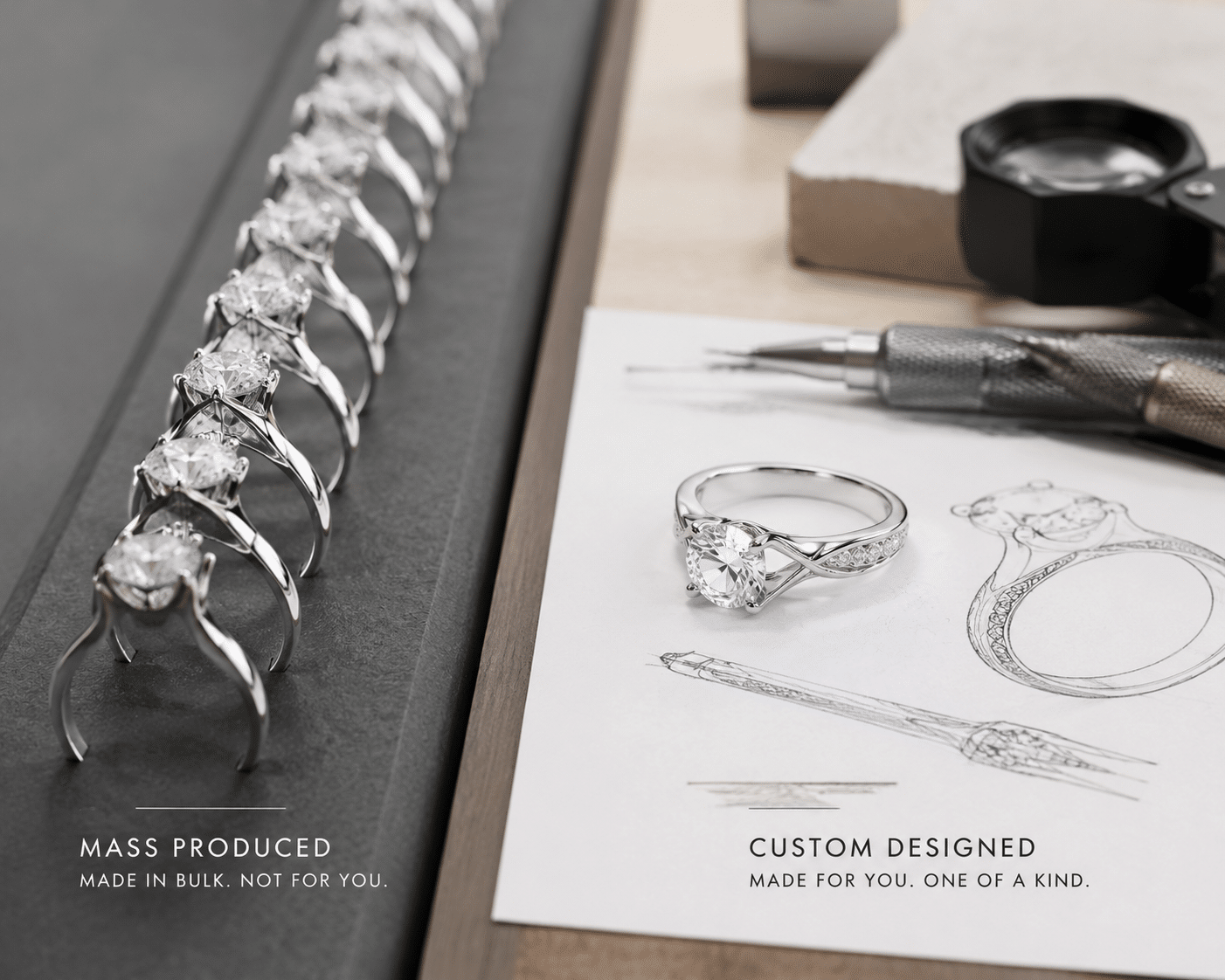
The connection between custom jewelry and sustainability is not a marketing angle. It is a structural advantage built into the way custom pieces are made. Unlike mass-produced jewelry, which is manufactured in batches and sold through inventory, a custom piece is created for exactly one person, in response to a confirmed order. That single difference changes the material, waste, and transparency dynamics from the start.
The Mass Production Waste Problem Most Buyers Don’t See
Mass-produced jewelry lines routinely overproduce by 20 to 40 percent at the factory level. These numbers are not an edge case. They are the standard planning margin used to ensure retail displays stay full and replenishment is available. What happens to the unsold pieces varies. Some are melted down for metal recovery, which wastes the labor, energy, and finishing work already invested. Others sit in inventory for years, consuming storage and eventually selling at a steep discount or not at all. A custom piece avoids this pipeline entirely because it is never made without a buyer.
Why Made-to-Order Is the Stronger Sustainability Model
Made-to-order production eliminates finished-goods warehousing as a structural requirement. No stockroom, no display units, no seasonal clearance. It also reduces raw material speculation, because the jeweler purchases metal and stones only after a specific order is placed. For metal recyclers, smaller, traceable batches become possible when production is not run in bulk. The measurable result is zero unsold stock. That is a difference that matters more than any general claim about eco-friendly materials.
What This Section Does Not Cover
This article does not argue that custom jewelry is zero-impact or fully circular. Custom production still uses metal, stones, energy, and shipping. The comparison here is relative: custom versus mass production on waste and transparency. Broader lifecycle questions about mining, energy use, and end-of-life recycling are addressed in other NUVU education pages.
Fit and Function Check
A piece that fits correctly is far less likely to be returned, resold, or left unworn. Custom sizing for rings, bracelets, and necklaces based on actual body measurements rather than standard sizes reduces the chance of that piece becoming an object of friction. Verify your ring size with a physical sizer or your jeweler’s printed sizing tool. Do not rely on online paper sizers alone.
How Custom Design Reduces Material Waste from the Start
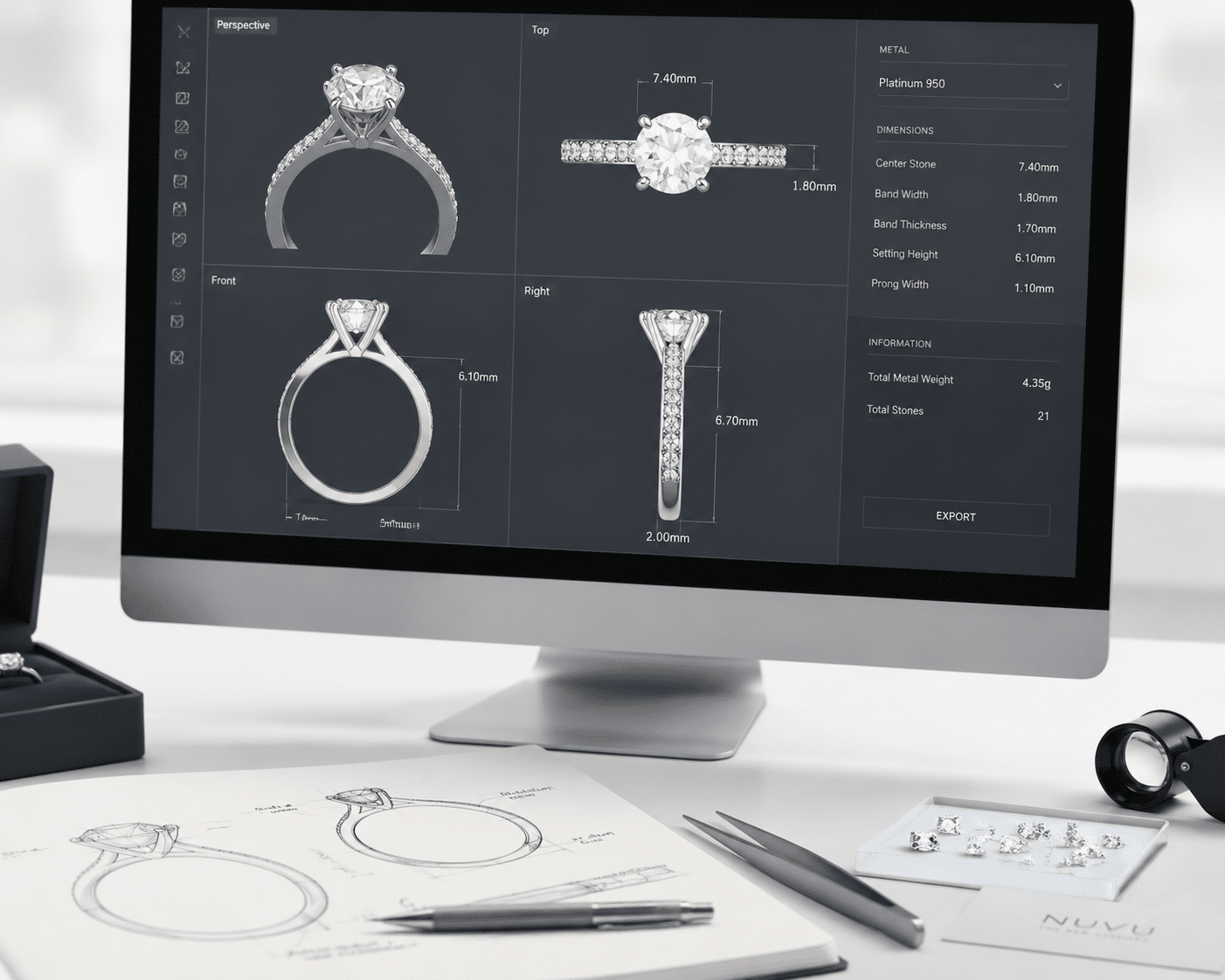
The waste reduction in custom jewelry starts before any metal is cast. It happens during the design phase, where the stone size, metal volume, and setting geometry are all decided in relation to a specific buyer and a specific stone. These decisions have measurable consequences for material use.
Modeling the Right Stone Size Instead of Guessing
Standard settings are built around stock stone sizes. If the stone a buyer chooses is slightly larger or smaller than the setting was designed for, the jeweler must resize the setting or shave metal to make it fit. Custom design reverses the order. The buyer selects the stone by carat weight or millimeter measurement, and the setting is built to match exactly. This eliminates the common retail practice of forcing a stone into a setting that was not designed for it.
CAD Optimization for Metal Conservation
CAD software allows the designer to model the piece with specific metal wall thickness, gallery height, and shank width. Standard castings often start with heavier stock metal that is later cut down, producing metal shavings and refinishing loss. A custom CAD file targets the final shape geometry directly, reducing post-cast waste by roughly 10 to 15 percent compared to stock casting blanks. The savings come from not removing metal that was never needed in the first place.
Accurate Stone Seating to Avoid Recutting
When a standard setting does not fit the stone perfectly, the jeweler must enlarge the prongs or recut the seat. Both steps remove metal and introduce the risk of weakening the setting. Custom design models the stone’s exact measurements into the CAD file, so the physical setting matches on the first cast. No unnecessary material removal is required, and the setting retains its intended strength.
Certificate and Measurement Check
Before the CAD file is finalized, compare your diamond or gemstone’s exact millimeter dimensions against the modeled setting measurements. The stone report will list the stone’s length, width, and depth. Confirm those numbers are entered into the CAD model, not just a generic table reference for that carat weight. A mismatch here can force a recast or a new stone selection.
Choosing Materials with Full Visibility
Custom design does not just reduce waste. It also gives the buyer direct control over what goes into the piece. In mass-market jewelry, the material composition is often hidden behind a tagline. In custom work, the buyer can request, review, and approve each material before production begins.
Metal Type, Color, and Alloy Control
In custom production, the buyer selects the exact gold karat, palladium content, or platinum grade. Standard jewelry lines often use a single alloy blend for cost consistency, and buyers rarely know whether their piece includes recycled metals. Custom production allows the designer to specify 100 percent recycled gold or certified fair-mined metals and include that specification in the final invoice. If a brand claims recycled content, the buyer can request it in writing before approving the design.
Stone Sourcing and Certificate Transparency
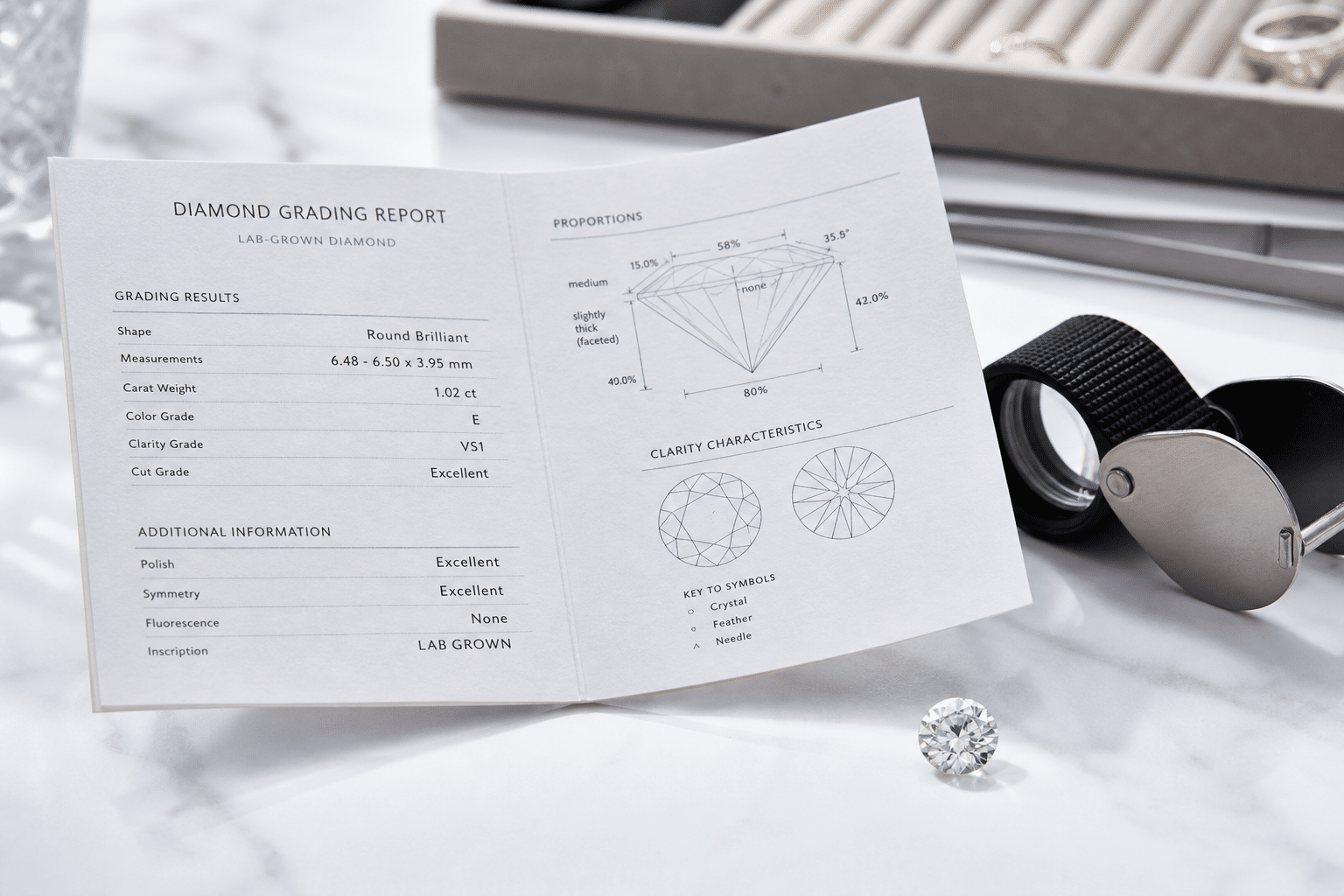
Custom design requires a specific stone to be documented before manufacturing begins. The buyer receives the grading report for that exact stone, not a representative sample from a batch. For laboratory-grown diamonds, the report includes the growth method, report number, and a visible laser inscription when applicable.[1] The Federal Trade Commission (FTC) has issued guidance on the terminology used to describe laboratory-grown diamonds, emphasizing that industry terms like “laboratory-grown” or “laboratory-created” should be clear and prominently disclosed so that buyers understand the nature of the stone.[2] This guidance is directly relevant to custom design, where the buyer can see the disclosure on the report before committing to the piece, rather than relying on a sales tag. For natural stones, origin documentation and treatment disclosure become part of the selection process. This is not optional in a well-run custom workflow. It is standard procedure.
Why “Sustainable Metal” Claims Need Written Proof
Many jewelers state they use recycled metals without showing supply-chain documentation. In custom production, the buyer can request a written material specification from the jeweler: which refinery supplied the metal, whether the metal is certified by SCS or similar programs, and how the recycled content is tracked. This level of detail is difficult to request in a mass-market purchase. In a transparent custom workflow, it is a normal part of the process.
Documentation Verification Checklist
Before approving the final materials, request the following in writing: metal type and karat, recycled content percentage (if claimed), stone grading report number, and the growth method for laboratory-grown diamonds. Cross-check the report number on the issuer’s website. This set of documents takes five minutes to verify and gives you full traceability for your piece.
When a grading report is provided, buyers should verify the report details through the issuing laboratory’s official report-check tool where available, and should also consider greenwashing red flags. This step confirms that the documentation corresponds to the physical stone selected for the piece.
Extending Product Life Through Durable and Repairable Construction
The most sustainable piece of jewelry is the one that stays out of a drawer. Longevity is not an accident. It is a design decision that begins before any metal is cast. Custom construction allows for choices that directly extend a piece’s useful life, while mass production often prioritizes thin, light frames that wear out sooner.
Setting Strength and Stone Retention
Stone loss is the most common reason custom jewelry returns for repair, and it is almost always preventable. Custom settings can be designed with stronger prong geometry, deeper stone seats, and thicker gallery rails than mass-produced pieces. A six-prong setting on a round diamond, for example, offers noticeably more security than a standard four-prong mount while remaining visually proportional. The extra metal does not change the look, but it changes how the piece performs over time. In a stock setting, the priority is often keeping the frame thin and the weight low. In custom work, the priority is keeping the stone secure for decades.
Repair-Friendly Design Decisions
A well-designed custom piece can be resized, re-tipped, or re-plated more easily than a mass-produced alternative. This is because the metal is not stretched thin, the stone is not set into an irreversible bezel without clear access, and the design structure does not rely on fragile bridges or hollow sections. Those features matter because every repair carries a cost and a risk. If the design itself makes future maintenance simple and straightforward, the piece is far less likely to be abandoned after a minor incident. Specifying these features during the CAD phase costs nothing extra and pays off the first time the piece needs adjustment.
Why Trend-Driven Pieces Have Shorter Useful Life
Mass-produced fashion jewelry is built to hit a price point and a seasonal trend cycle. Thin metal, glued stones, and standardized finishes mean that after one or two seasons of wear, many pieces are not economically repairable. The shank bends. A prong snaps. The stone falls out and cannot be replaced because the setting was not designed for it. Custom pieces designed for the wearer’s lifestyle tend to stay in rotation for years because they were built for fit and function, not for what is fashionable this quarter. A piece not tied to a trend does not become unwearable when the trend ends.
Stone-to-Setting Fit Check
Ask your jeweler how the stone will be secured. If the setting uses only two prongs or a thin bezel, ask for the exact wall thickness on the CAD drawing. For daily-wear rings, a minimum wall thickness of 1.2mm to 1.5mm for the setting and 1.6mm to 2.0mm for the shank is a reasonable range, depending on metal type. Thinner sections increase the risk of bending or stone loss over time.
How the Design Process Itself Creates Transparency
Transparency is not a document you request at the end. In custom jewelry, it is a structural feature of the workflow itself. From the first consultation to the final polish, the process produces a trail of decisions, approvals, and measurements that stock jewelry cannot replicate.
From Brief to CAD: Full Visibility Before Production
Custom design forces documentation at every stage. The initial consultation produces a written brief or sketch. The CAD file shows the exact proportions, stone placement, and metal thickness. A wax model or resin prototype can be produced for fit approval. Every approval step gives the buyer a written or digital record of what was decided and when. A stock piece has no equivalent trail. By the time it reaches the display case, the decisions about metal weight, alloy blend, stone quality, and construction method have already been made, usually by someone the buyer will never meet.
The Approval Process as a Verification System
Each approval step—sketch approval, CAD approval, stone selection, wax check, final casting approval—acts as a checkpoint. Mismatches can be caught early. If the stone does not match the setting measurements, it is discovered at the CAD stage, not after the metal is cast. If the fit is off, the wax model reveals it before the piece is finalized. This reduces rework and re-casting, both of which are wasteful and expensive. In a mass-production pipeline, these mismatches are discovered only when the finished piece fails inspection, often after dozens of identical units have already been made.
Who Made Your Piece and What That Means
Custom production typically involves a specific jeweler, setter, or workshop whose name and reputation are attached to the piece. The custom buyer can ask the brand or designer directly about their manufacturing partners, quality control steps, and material sources. Mass-produced jewelry passes through multiple anonymous hands, and the final seller often does not know who cast, finished, or set the piece. Accountability is diffused. In custom work, the chain is short enough that responsibility is clear, and that alone raises the standard for how the piece is built.
A Practical Perspective on Grading Reports
For buyers evaluating loose stones—especially laboratory-grown diamonds—a grading report documents key characteristics such as cut, color, clarity, and carat weight, but it does not prove how the stone will perform in a specific setting. The Gemological Institute of America (GIA) notes that the grading report for a laboratory-grown diamond includes the same 4Cs criteria used for natural diamonds, along with an identification of the growth method, such as HPHT (high pressure, high temperature) or CVD (chemical vapor deposition).[3] Two stones with identical report grades can appear noticeably different once mounted, depending on proportions, fluorescence, and how the setting interacts with light. The report is a starting point, not the whole decision.
Buyer Verification Checklist
During the design process, ask for the following before each approval step: the CAD file as a screenshot or PDF with measurements marked, the stone’s grading report number, the metal specification in writing, and a timeline for each production stage. This turns the design process into a documented trail. Compare final piece measurements against the approved CAD file when the piece arrives.
Total Cost Consideration: Why Upfront Investment Reduces Long-Term Waste
The most common objection to custom jewelry is the upfront price. That objection makes sense only if you compare the purchase price without considering what the piece actually costs over its lifetime. Custom design reframes the economics around lifecycle value, and in many cases, the total cost is lower.
Comparing Custom Upfront Cost vs. Replacement Cycles
A custom engagement ring with a durable setting and high-cut-quality stone may cost more initially than a similar-looking stock ring. But the stock ring may need repair—re-tipping, stone replacement, or resizing—within two to five years. A custom piece built with thicker metal, secure settings, and verified materials often requires fewer repairs and lasts longer. Over a decade, the total cost of ownership can favor the custom piece, especially if the alternative requires replacement or major restoration. The cheaper purchase price is not always the cheaper choice.
Where Custom Can Actually Reduce Spending
Custom design allows the buyer to omit unnecessary elements entirely. Skip pave accents on a solitaire. Use a high-cut-clarity laboratory-grown diamond instead of a larger but lower-clarity natural stone. Choose 14k over 18k if durability is a higher priority than gold purity. These choices lower the upfront price without sacrificing what matters most to the wearer. Mass-produced pieces do not offer this level of line-item control. You buy what the line includes, whether you want every detail or not.
The Tradeoff Between Trend and Longevity
Mass-produced jewelry is designed for immediate sale. Custom jewelry is designed for the wearer’s specific finger, hand shape, lifestyle, and aesthetic. A piece designed around long-term wear will not follow seasonal trends, so its useful life is not tied to fashion cycles. That is the single largest sustainability advantage of custom design: the piece is intended to be worn for decades, not months. When a piece is not replaceable by next season’s catalog, it stays in use, and that is where the real waste reduction happens.
Understanding the Limits of Cost Comparisons
It is worth noting that total cost over time depends heavily on the buyer’s habits. A custom piece that is never worn or is replaced by a newer design loses its lifecycle advantage. Conversely, a well-chosen stock ring that fits the wearer and is properly maintained can also last many years. The sustainability argument for custom design is strongest when the piece is built around the wearer’s actual needs, not just as an indulgence in the moment. For buyers who know their preferences are stable, custom offers clearer value. For those who expect their taste to shift, a simpler stock piece may be the more practical choice.
Cost Breakdown Check
Ask for a full itemized quote before approving production. The quote should include the stone cost, metal cost (at current market or flat rate), CAD modeling fee, casting charge, setting fee, finish and polish, and any tax or shipping. If the quote does not break out these elements, request it. An itemized quote makes it easier to compare value across jewelers and to confirm where your money goes.
The Role of Industry Standards in Verification
A critical layer of assurance in custom jewelry comes from understanding the grading standards and documentation protocols that apply to the materials you are selecting. Industry bodies such as the Gemological Institute of America (GIA) and the International Gemological Institute (IGI) have established frameworks for evaluating diamonds, but the role these standards play in a custom transaction is often misunderstood. A grading report is not a warranty of a stone’s future performance, nor is it a substitute for physical verification. Knowing how to use these documents as part of the verification trail strengthens the entire custom process.
What a Grading Report Does and Does Not Guarantee
A grading report from a reputable laboratory documents a set of observations about a diamond at the time of grading. For laboratory-grown diamonds, the Gemological Institute of America (GIA) explains that the report identifies the stone as “Laboratory-Grown” and includes details such as the growth method (HPHT or CVD), the 4Cs, and a report number that can be referenced online.[3] The International Gemological Institute (IGI) follows a similar approach, with reports for laboratory-grown diamonds that include an identification of the stone as “Laboratory Grown Diamond” and describe the characteristics of the stone.[4] What a report does not provide is a prediction of how the stone will perform in a specific setting, a measure of the stone’s visual appeal under all lighting conditions, or a guarantee that the stone will not chip or break under unusual wear. In custom design, the report serves as a baseline. The buyer’s final approval should also rely on visual inspection, the CAD model’s fit, and the jeweler’s own quality control steps.
How the FTC’s Guidance Shapes Responsible Custom Design
The Federal Trade Commission (FTC) has issued guidance specifically concerning the marketing and disclosure of laboratory-grown diamonds, which is particularly relevant to custom jewelry, where the buyer and seller interact directly about the stone’s identity.[2] The FTC’s guidance emphasizes that terms like “laboratory-grown” should be used clearly and prominently to ensure buyers are not misled about a stone’s origin. For a custom jeweler, this means that the grading report and any accompanying documentation should clearly state the stone’s nature, and the buyer should be informed before the design is finalized. Relying on a clear report that confirms the stone’s identity protects both the buyer and the seller, and it is one of the most straightforward ways to build trust in the custom process.
Report Verification Step
Once you receive the grading report for your diamond, visit the issuing laboratory’s website and enter the report number to verify its authenticity. GIA, IGI, and other major labs offer online report check services. Confirm that the report number matches the laser inscription on the stone’s girdle. If the report cannot be verified online, or if the inscription is missing or mismatched, ask the jeweler to resolve the discrepancy before proceeding with the setting.
Traceability Through the Production Chain
Beyond the stone and metal specifications, traceability in custom design extends to the production chain itself. When a piece is made through a transparent workflow, each step—from refining the metal to casting, setting, and finishing—can leave a documentation trail. Buyers can ask whether the jeweler maintains records of which workshop handled the casting, which setter mounted the stone, and which finisher applied the final polish. This level of detail is not common in mass production, where components often move through multiple facilities without a single point of accountability. In a well-managed custom process, the buyer can request a simple production log that lists each stage and the party responsible. While not every jeweler will provide this level of detail on demand, asking the question signals to the jeweler that you value traceability, and a responsive shop should be able to describe their internal quality control and documentation practices.
Production Traceability Check
Before commissioning a custom piece, ask the jeweler: “Can you outline who casts, sets, and finishes the piece, and how you verify work at each stage?” A clear answer—even a general description of their verification process—is more useful than a vague assurance. For buyers who want maximum traceability, requesting that the workshop photograph or log key milestones (such as the wax model, the pre-polish state, and the final weigh-in) can create an informal but effective documentation trail.
Distinguishing Laboratory-Grown Diamonds from Natural Diamonds in Custom Design
In custom jewelry, the buyer selects the specific stone that will be set into the piece. This direct selection process makes it particularly important to clearly understand the distinction, according to the sustainable jewelry buying guide, between laboratory-grown diamonds and natural diamonds, as well as how simulants differ from both. A clear understanding at the selection stage prevents confusion and ensures the buyer receives exactly what they intend to commission.
Defining the Categories: Laboratory-Grown, Natural, and Simulant
Laboratory-grown diamonds are diamonds that share the same chemical composition, crystal structure, and optical properties as natural diamonds, but are created in a controlled laboratory environment using processes such as HPHT or CVD. They are real diamonds, not imitation stones. Natural diamonds are formed over geological timescales under high pressure and heat deep within the earth. Diamond simulants—such as cubic zirconia or moissanite—are different materials that resemble diamonds but do not have the same atomic structure. A simulant is not a laboratory-grown diamond, and a laboratory-grown diamond is not a mined diamond. These categories should not be confused in buyer documentation, seller descriptions, or grading reports.
For custom buyers, the practical consequence is straightforward: when reviewing a stone for a custom piece, the grading report or seller documentation should clearly state whether the diamond is laboratory-grown or natural. If a stone is a simulant, that should be disclosed in plain terms. Relying on vague marketing language rather than a laboratory report can lead to a mismatch between buyer expectation and the delivered stone.
Why Clear Disclosure Matters at the Selection Stage
In mass-market retail, a buyer may see a display tag that simply says “diamond” without immediate clarification of origin. In custom design, the buyer has the opportunity to see the specific grading report before the stone is purchased. That report should include an unambiguous identification of the stone. For laboratory-grown diamonds, reports from major laboratories such as GIA and IGI include a clear statement identifying the stone as laboratory-grown, along with the growth method. Buyers should look for this disclosure and understand that it is not a secondary detail—it is a primary characteristic of the stone they are selecting.
The Federal Trade Commission (FTC) has provided guidance on this point, recommending that terms such as “laboratory-grown” be used prominently and clearly so that buyers are not misled about a stone’s origin.[2] In a custom design context, this guidance reinforces that both the jeweler and the buyer have a shared interest in clear disclosure. The buyer can verify the disclosure against the report before the setting is built, rather than relying on a sales tag after the fact.
Stone Identity Verification Step
Before finalizing the stone selection for your custom piece, confirm the following with the jeweler in writing: whether the stone is a laboratory-grown diamond, a natural diamond, or a simulant; the exact wording on the grading report regarding the stone’s identity; and the growth method (HPHT or CVD) if it is laboratory-grown. This simple confirmation step ensures that the stone you select matches your expectations and that the documentation supports that match.
Putting It Together: A Practical Custom Design Path
A sustainable custom piece does not happen by accident. It requires a structured process with clear checkpoints, so the buyer stays in control of material choices, fit, and construction quality. The following workflow is designed to preserve transparency at each stage, from the first conversation to final delivery.
Step 1: Define the Use Case, Not Just the Aesthetic
Start with how the piece will be worn before deciding how it should look. Daily-wear rings face different stresses than occasional pendants or bracelets. Occupational exposure to chemicals, frequent hand washing, or heavy physical work should inform metal choice and setting strength. A ring meant to be worn every day needs a shank thick enough to withstand regular contact — typically 1.6mm to 2.0mm depending on metal hardness — and a setting that protects the stone from impact. Write down these criteria before browsing design references. When the use case is clear first, the aesthetic decisions that follow will be grounded in practicality rather than visual impulse.
Step 2: Select a Specific Stone Before Designing the Setting
The most common rework problem in custom design is building the setting before the stone is secured. To avoid this, select and purchase the stone first. Send the exact millimeter dimensions and grading report number to the designer. The CAD file can then be modeled around those precise measurements rather than a generic table reference. This eliminates the risk of recasting or stone return, both of which waste material and add cost. Do not rely on carat weight alone as a sizing reference — two stones of the same carat weight can have noticeably different length-to-width ratios depending on cut precision.
Step 3: Review the CAD File for Material and Construction Details
When the CAD file is ready, check the metal wall thickness, prong or bezel design, gallery height, and stone clearance. For rings, verify that the shank has a slightly thicker section at the bottom where daily friction is highest. A wax or resin model should be produced for fit confirmation before casting begins. This step catches sizing errors and proportion mismatches while changes are still inexpensive to make. Approve the design in writing only after confirming that the measurements in the CAD file match the stone dimensions you provided.
Step 4: Approve the Finished Piece Against the Plan
When the finished piece arrives, verify it against the approved design before accepting delivery. Weigh it on a small gram scale and compare the result to the CAD estimate — a significant discrepancy may indicate a metal or construction error. Check the stone’s laser inscription against the grading report number using a loupe. Verify the metal stamp inside the shank. If anything does not match, flag it immediately. This is the final verification point, and it is the buyer’s last chance to catch a mismatch before the piece enters regular wear.
Pre-Purchase Checklist
Before you start a custom project, confirm the following with the jeweler: they can provide a CAD file for review; they offer a wax or resin model for fit check; they source stones with grading reports you can review before purchase; they specify metal source and recycled content if claimed; and they provide a written production timeline with milestone dates. If a jeweler cannot or will not answer these questions, that is a signal that their transparency process may not match your requirements.
Questions That Belong in Your Custom Design Conversation
Even with a clear workflow, buyers often encounter the same practical questions about sustainability claims, cost structure, and stone verification. The following answers address the most common concerns directly, without repeating earlier sections.
How do I know the metal is actually recycled?
Ask for a written metal specification that states the refinery source and recycled content claim. If the jeweler claims “100% recycled,” ask whether the metal carries certification from a program such as SCS Recycled Content Certification. If no certification is available, ask how the jeweler tracks and documents recycled content in their inventory. A written answer is more reliable than a marketing tagline or a verbal assurance. Reputable workshops that use recycled metals can typically name their refinery and describe their documentation process.
Does custom design always cost more?
Not necessarily. Custom pieces often carry a higher upfront cost for labor, CAD modeling, and the consultation process, but they avoid several hidden expenses built into mass-market pricing. Retail stock pieces include markup for inventory storage, display cases, returns processing, and unsold stock that gets discounted or melted down. For a simple design like a solitaire with a laboratory-grown diamond, a custom piece from a transparent brand can fall within the same price range once you compare stone quality, metal weight, and certification side by side. The key is getting an itemized quote so you see exactly where the money goes.
What if I want to change the design after CAD is approved?
Design changes after CAD approval may incur additional modeling fees, especially if the geometry changes significantly — altering the stone size, ring width, or setting type usually requires a new CAD file and possibly a new wax model. Minor changes to prong shape, surface finish, or engraving placement are typically less expensive to modify. The best approach is to review the CAD file and wax model thoroughly before giving final approval. If you are unsure about a design detail, request a physical sample or ask the designer to show you a side-by-side visual of your preferred option against the current file.
How do I know my stone is the one I paid for?
Verify the grading report number against the stone’s laser inscription (if applicable) using the report issuer’s online verification tool. Do this before the stone is set, while it is still unmounted and readable. After setting, the inscription may be partially hidden by a prong. Some graded stones have a second inscription location, such as the girdle, that remains visible after setting — ask your jeweler to show it before the setting is finalized. Cross-referencing the report number with the physical stone is the only reliable way to confirm identity. A certificate without physical verification is just paperwork.
In sourcing or wholesale conversations, documentation, consistency, and communication often matter as much as the headline specification. A grading report and metal specification sheet are useful starting points, but verifying those documents through independent checks—such as online report verification and requesting production records—adds an extra layer of assurance.
Final Verification Check
Before you accept delivery of your custom piece, run through the following steps: weigh the piece and compare to the CAD estimate; check the stone report number against the stone using a loupe or digital microscope if available; verify the metal stamp; confirm the prongs or bezel are symmetrical and clean; and try the piece on to confirm comfort and fit. Any mismatch at this stage should be addressed with the jeweler before the project is marked complete. A few minutes of verification now can prevent months of frustration later.
[1] Gemological Institute of America (GIA), “Lab-Grown Diamond Identification,” GIA.edu. Accessed via GIA’s lab-grown diamond education resources.
[2] Federal Trade Commission (FTC), “Jewelry, Precious Metals, and Pewter Industries Guides,” 16 CFR Part 23, including guidance on lab-grown diamond terminology and disclosure. FTC.gov.
[3] Gemological Institute of America (GIA), “How Lab-Grown Diamonds Are Made,” GIA.edu. Accessed via GIA’s diamond educational content.
[4] International Gemological Institute (IGI), “Lab-Grown Diamond Grading,” IGI.edu. Accessed via IGI’s lab-grown diamond report information.
Disclosure: This article is for general educational purposes only. Diamond grading, pricing, availability, specifications, and seller policies can change, and readers should verify important details through grading reports, official laboratory tools, seller documentation, or qualified professionals before making a purchase decision. Laboratory-grown diamonds should be clearly distinguished from natural diamonds, and environmental or sourcing claims should be supported by specific documentation.