
Buying a lab-grown diamond ring today means wading through claims of “traceable” and “ethically sourced.” But a grading report from IGI or GIA only confirms a stone’s 4Cs and growth method—it does not verify where the rough diamond was grown, who cut it, or where the metal was refined. Real supply chain traceability requires batch-level records that often break down at the cutting or assembly stage. This beyond the center stone article helps you separate marketing language from verifiable documentation. You will learn exactly which documents and supplier answers matter, where gaps typically appear, and what level of proof is reasonable for a $3,000 ring versus a $15,000 investment.
For the full framework, read Lab-Grown Diamond Traceability, Certification, and Transparency Guide.
| Traceability Claim | What It Typically Covers | What To Verify |
|---|---|---|
| Grading report included | 4Cs, growth method (CVD/HPHT) | Does it name the rough producer or cutter? |
| Lab-grown diamond origin | Statement of country or region | Is a specific reactor batch ID provided? |
| Recycled gold | General sourcing claim | Is the named refiner (e.g., Metalor) and SCS certification listed? |
| Blockchain traceable | Digital record of some stages | Does the ledger include rough batch ID and setting facility? |
| Finished ring origin | Country of assembly or seller’s workshop | Is the specific setting facility or city named? |
| Fully documented supply chain | Batch records for diamond, metal, and setting | Does documentation link each stage without broken references? |
Quick Questions Before You Read
Q: Does a GIA or IGI certificate prove my diamond is ethically sourced?
No. A grading report confirms cut, color, clarity, and carat but does not trace the rough diamond to a specific reactor or verify the cutter and setter.
Q: What is the single most important document for verifying origin?
A batch ID from the rough diamond producer, matched to the grading report number. Without this link, you are relying on general claims.
Q: Should I expect every $5,000 ring to have a fully traced supply chain?
Not always. A reasonable minimum includes a grading report, diamond origin statement, and manufacturing location. Batch-level detail is most important for matching sets or verifying environmental claims.
The Difference Between a Certificate and a Supply Chain Trace
Many buyers assume a grading report proves the diamond’s origin. This section clarifies the boundary between what a grading report confirms and what it does not, then introduces the full supply chain model.
What a Grading Report Actually Confirms
A grading report from IGI, GIA, or GCAL documents the 4Cs, laser inscription, and growth method identification for the finished polished stone.[1] The report verifies the stone is lab-grown but does not document which reactor produced the rough crystal, which cutter shaped it, or which factory set it. It is a snapshot of the final diamond, not a biography of how it got there. The GIA’s own guidance on lab-grown diamond reports emphasizes that the report is about the finished stone’s characteristics, not its production history.[2]

What the Grading Report Leaves Unaddressed
The certificate shows the final polished state only. Raw crystal origin, cutting location, polishing subcontractors, metal sourcing, and setting manufacturing are not included on any standard grading document. Buyers who want that information must request it separately from the seller. A beautiful report number does not mean the full path is documented.
Why a Certificate Is Not a Supply Chain Map
A report number links to the stone’s final inspection. It does not produce a chain-of-custody document from rough crystal to finished ring. This distinction is often missed in marketing language that treats certification as full transparency. The report tells you the stone is real lab-grown diamond of a certain quality. It does not tell you where the rough was grown, who cut it, or where the ring was assembled.
What to Ask Before Assuming Full Traceability
Ask whether the seller provides a manufacturing timeline showing each production step. Request written confirmation of which entity grew the rough, which facility cut and polished, and where the setting was fabricated. If the seller cannot name the production stages, the certificate alone does not fill the gap.
How Lab-Grown Diamond Rough Moves Through the Supply Chain
The path from reactor to polished diamond involves multiple handoffs. This section traces the concrete stages so buyers understand what is traceable and where information tends to become incomplete.
Reactor Growth and Rough Crystal Harvesting
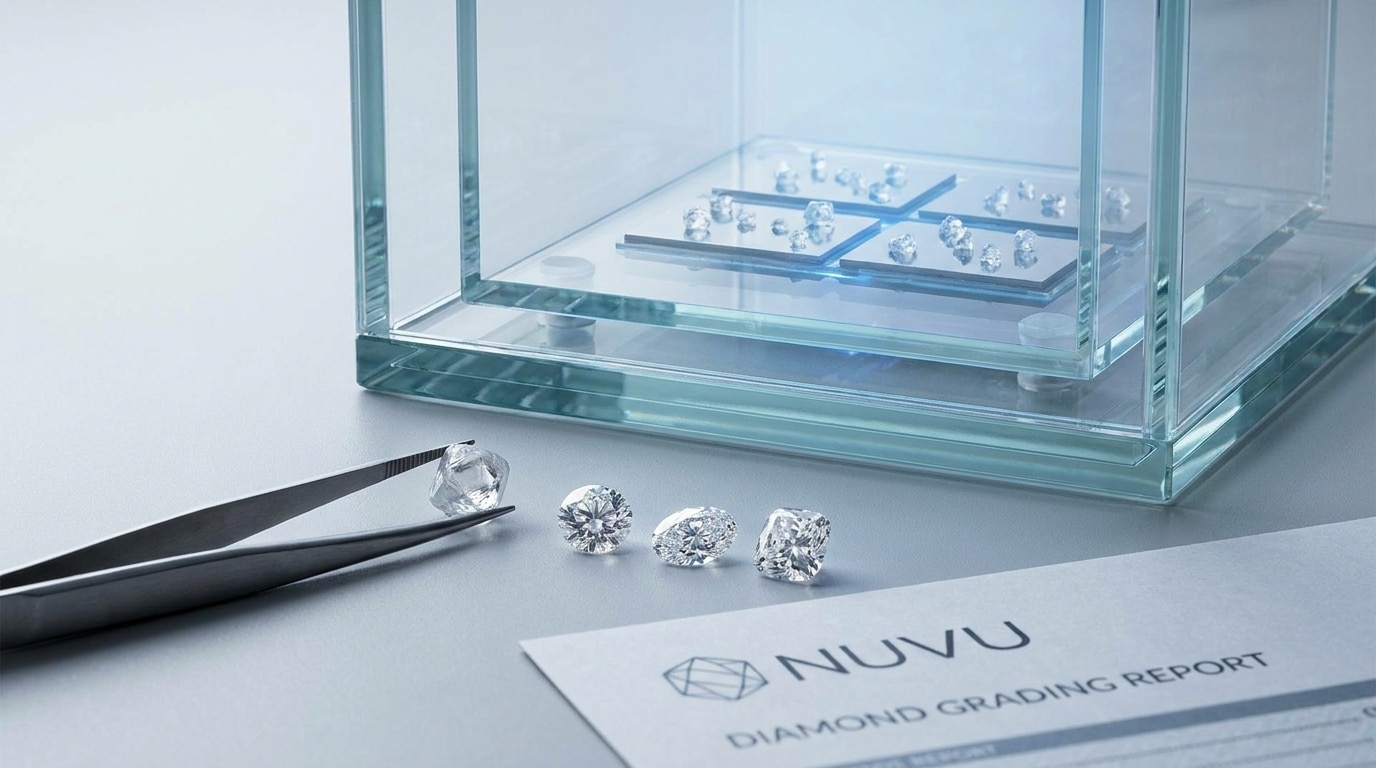
Lab-grown diamonds are produced via HPHT or CVD reactors. HPHT reactors simulate high-pressure, high-temperature conditions to form rough crystals in about two to three weeks. CVD reactors deposit diamond layers on a seed crystal over a similar time frame.[3] The rough crystal is then removed, inspected for internal quality, and graded for approximate clarity before it enters the cutting stream. At this point, a batch ID can be assigned linking the rough to its reactor run.
Cutting, Polishing, and Grading Handoffs
Rough crystals are sent to cutting centers that specialize in lab-grown diamond shaping. This step may occur in the same country as the reactor or in a separate facility. After cutting and polishing, the finished stone moves to an independent grading lab for certification. Each handoff represents a point where traceability documentation may be lost if no system tracks the batch. The more hands the stone passes through, the more opportunities there are for records to disconnect.
Information Loss Points in the Diamond Supply Chain
Common documentation gaps occur when rough is sold to a separate cutting house, when multiple polishing subcontractors are used, or when stones are aggregated from different batches before grading. Buyers who want full traceability should confirm that batch IDs are maintained from reactor through final grading without merging. A single merged batch of mixed rough sources erases any individual origin detail.
What a Batch ID Confirms and What It Does Not
A batch ID linked to the reactor run confirms the rough origin and growth method. It does not confirm which specific cutter handled the stone or what post-growth processes were applied. Ask whether the factory that grew the rough also cut and polished the stone, and whether the batch record is available upon request. The batch ID is useful, but it covers only the early part of the chain.
For buyers, the practical starting point is to treat the batch ID as a useful anchor, not a complete record. Even with a batch ID, the stone’s journey through cutting, polishing, and grading may involve separate facilities where records are kept differently. The question worth asking is not just whether a batch ID exists, but whether the seller can connect that ID to the later stages of manufacturing.
Metal and Setting Supply: The Second Half of the Ring
Traceable jewelry requires understanding the metal and setting path as well. This section covers how precious metal is sourced, refined, and fabricated, and why the metal chain is often harder to verify than the diamond chain.
Refined Gold Sources and Recycled Metal Claims
Precious metal for fine jewelry typically comes from large refiners such as Metalor, Valcambi, or Argor-Heraeus. Recycled gold is recovered from industrial scrap, old jewelry, or electronic waste, then refined to 999.9 purity. Claims of “100% recycled gold” require refiners to maintain mass-balance certified sourcing, but the term is not uniformly regulated in the jewelry industry. The U.S. Federal Trade Commission (FTC) has issued guidance cautioning that environmental benefit claims, including those about recycled content, must be substantiated and not misleading.[4] A seller can claim recycled content without a third-party standard to back it up.

Setting Manufacturing: Casting, Assembly, and Quality Control
Ring settings are fabricated through lost-wax casting, CNC milling, or hand fabrication. Casting houses receive metal in grain or bar form, melt it to customer alloy specifications, and cast into molds from rubber or printed masters. Post-casting finishing includes filing, polishing, rhodium plating for white gold, and stone setting. Each step may occur in a different facility, and the further the metal travels, the harder it becomes to track the original lot.
Where Metal Traceability Breaks Down
Many smaller jewelry brands buy pre-made castings from wholesale suppliers who source metal from multiple refiners. The metal lot used for a specific ring may not be trackable to a single refiner or a single recycled batch. Buyers who require certified recycled content should confirm whether the seller commissions custom casting with documented metal lots rather than purchasing stock settings. If the setting comes from a wholesale catalog, the metal origin is essentially anonymous.
Buyer Verification Checklist for Metal and Setting
Ask whether the metal was sourced from a specific refiner that provides an assay or certificate of origin. Request confirmation that the casting house maintains lot-level records. If recycled content is important, ask whether the seller uses a certified recycling chain such as SCS or a comparable third-party standard. A named refiner is a good start. A certified recycling chain is better. A vague sourcing statement is not verification.
The Manufacturing Bridge: From Loose Stone to Finished Ring
This is where the two separate supply chains—diamond and metal—finally converge. Understanding this stage matters because traceability gaps often appear not during rough production or metal refining, but during assembly. A buyer could have full documentation for both the stone and the metal, only to lose visibility at the point where they become a single piece.
How a Loose Diamond Is Matched to a Setting
After the grading report is issued and the setting is fabricated, the jeweler performs a physical compatibility check. The diamond’s diameter, depth, crown angle, and girdle thickness must align with the setting’s prong spacing, head size, and bezel depth. This is not a theoretical exercise—small mismatches produce real problems. A stone that is slightly too large for its seat can crack during setting. One that is too small can shift over time, creating a loose prong or an uneven appearance.
The most common failure at this stage is visual, not structural. A diamond that fits technically but sits too high or too low in the setting due to renewable energy integration changes how light enters the crown and how the ring looks on the hand. This is one reason our team treats the stone and setting as a single design decision rather than two independent choices.
At NUVU, this matching step is treated as a practical evaluation: the grading report provides the key measurements, but the final fit depends on verifying those numbers against the specific setting design. A stone that looks ideal on paper may still require adjustment if the setting’s head size or prong angle differs slightly from the standard dimensions. This is where a documented compatibility check—rather than a generic assumption—becomes a real traceability practice for quality, not just origin.
Assembly and Final Quality Inspection
The stone is set using hand tools or a micro-setting press, depending on the design and the jeweler’s preference. After setting, the ring moves through a final inspection that checks prong security, polish uniformity, stone alignment, and overall finish. A final weigh-in confirms total metal weight against the casting specification, and the piece is cleaned, photographed, and packed for delivery.
Most quality issues that reach the buyer originate at this stage: a prong that was not fully seated, a polish mark that was missed under bench lighting, or an alignment shift that went unnoticed during inspection. The presence of a documented final inspection process is a stronger indicator of quality control than any single certification.
Documentation Aggregation at the Final Stage
The seller assembles all documentation before shipment: the grading report, any metal certification or assay, and the sales invoice or warranty document. A traceable supply chain package should include the diamond’s grading report number, the batch ID or facility name for diamond origin, the refining source for the metal, and a note on where the setting was manufactured.
This is the moment when traceability either holds or breaks. If the seller tracks each component through the assembly stage, the buyer receives a cohesive record. If the seller treats the diamond and setting as unrelated purchases, the documentation will arrive as two separate pieces of paper with no connecting thread.
What a Complete Documentation Package Should Include
Request the following before purchase: the grading report number for the diamond, the name of the rough producer or batch ID, the metal refiner name, and the setting manufacturing facility city or country. If the seller cannot provide at least three of these four pieces of information, the traceability chain has gaps that no amount of marketing language can fill.
A grading report can serve as a useful starting point, but it should be read alongside the stone’s proportions, visual evidence, and intended jewelry use. When a grading report is available, buyers should verify the report details through the issuing laboratory’s official report-check tool where available. This verification step confirms the stone’s documented characteristics match the physical diamond—an important foundation before evaluating any broader supply chain claims.
Common Claims About Traceability That Require Caution
Traceability has become a selling point for many jewelry brands, which means it has also attracted inflated language. The following claims appear frequently and require scrutiny before they can be taken as reliable guarantees.
“Blockchain Traceable” Without a Working Explorer
Several platforms use distributed ledger technology to record diamond supply chain stages, and a properly implemented blockchain trace provides genuine value. The buyer should be able to enter a stone ID or batch number into a public explorer and view each recorded stage—reactor run, cutting, grading, setting. If the seller does not provide an explorer link or a public transaction ID, the word “blockchain” in this context often refers to a private database controlled by the seller. That is not the same as a verifiable public ledger, and it offers no more trust than a printed document.
“100% Ethically Sourced” Without Third-Party Verification
Ethical sourcing claims should be backed by specific certifications. For lab-grown diamonds, ISO certification for the reactor facility provides documentation of production standards. For jewelers, Responsible Jewellery Council (RJC) certification covers chain-of-custody practices. For recycled metals, SCS certification or similar third-party standards verify the recycling chain. Without a named standard, the claim is a general statement of principle, not a verified assurance. A seller who cannot name the certifying body is asking for trust without evidence.
“From Mine to Finger” Language Applied to Lab-Grown Diamonds
This phrase was developed for natural diamond supply chains that include mines, rough sorting houses, cutting centers, and trading hubs. Applying it to lab-grown diamonds does not improve clarity—there is no mine. The phrase creates confusion by using terminology designed for a different supply chain. Buyers should prefer precise language such as “from reactor to finished ring” or a specific list of supply chain stages. Precise language signals that the seller understands their own production process.
Buyers should also note that the absence of problematic sourcing—such as conflict diamonds—does not automatically mean a supply chain is well-documented or transparent. A lab-grown diamond avoids certain ethical concerns associated with mining, but the quality of its traceability depends on whether the seller maintains and shares records for each production stage. The two issues are related but not interchangeable.
How to Verify a Traceability Claim Before You Buy
Ask the seller to name the specific third-party certification or standard behind each claim. Request a public or shareable link to any blockchain record or certification document. If the seller cannot produce a verifiable source, treat the claim as a general description, not a confirmed fact.
How to Ask Better Questions Before Placing an Order
Evaluating traceability does not require technical expertise. It requires asking the right questions and recognizing when an answer is specific enough to be useful.
The Four-Point Traceability Question Set
Ask these four questions before purchase:
- Who produced the rough crystal, and can you provide a batch ID?
- Where was the diamond cut and polished, and was this done in the same facility as the rough production?
- Who refined the metal, and can you provide a certificate of origin or refining certification?
- Where was the setting manufactured, and is the casting facility owned by the seller or a subcontractor?
A seller who can answer all four questions with named facilities, cities, or document references has a documented and verifiable supply chain. A seller who answers with general assurances has gaps.
How to Evaluate the Answers You Receive
A detailed answer with a named facility, city, or batch number indicates stage-level record keeping. A vague answer such as “our trusted partners” or “industry-standard sourcing” without specific names or document references suggests the seller does not maintain traceable records. The difference is not subtle—one answer provides a trail you could follow, while the other provides a general claim.
When to Accept Partial Traceability
Not every jewelry purchase requires full supply chain documentation. For a standard-quality fashion piece, knowing the diamond’s grading report number and the metal type may be sufficient. For higher-value custom pieces, engagement rings, or commissioned designs, requesting batch-level records and facility names is reasonable and should be expected from a seller who maintains a transparent operation.
The One Question That Identifies Real Traceability
Ask the seller: “Can you send me the batch ID or production record that connects this specific stone or ring to a specific reactor run and metal lot?” A seller who can provide a concrete identifier or a linking document has a working traceability system. A seller who cannot has only a certificate and a general sourcing claim.
How the FTC’s Guidance on Diamond Terminology Supports Traceability Clarity
The U.S. Federal Trade Commission (FTC) has issued specific guidance on the use of terms like “lab-grown,” “laboratory-created,” and “synthetic” for diamonds.[5] This guidance is directly relevant to traceability because it establishes a framework for how sellers should describe the nature and origin of a diamond. The FTC’s rules require that any claim about a diamond’s creation must be clear and not misleading. For a buyer seeking traceability, this means a seller’s use of FTC-supported terminology is a baseline indicator of honest communication. While the FTC guidance does not require a batch ID, it does require that the fundamental nature of the stone—lab-grown versus natural—be disclosed in a way that is distinct from the general term “diamond.”[5] This creates a clear legal expectation for accurate documentation, which in turn supports a buyer’s ability to verify the first and most critical step in the supply chain: what the stone actually is.
A Practical Buyer Scenario: Traceability in a Real Purchase
The Scenario: Custom Engagement Ring with a Lab-Grown Diamond
The buyer is a design-conscious shopper in New York who wants an elongated cushion-cut diamond in a platinum solitaire setting. She values transparency because she has read conflicting information about lab-grown diamond sourcing. She has a budget of $6,000 for the total project.
The Traceability Request Sequence
The buyer asks the seller for the diamond’s grading report number, the growth method (CVD or HPHT), and whether the producer maintains batch-level records. She asks whether the platinum is sourced from a specific refiner and whether the setting will be cast in the seller’s facility or outsourced.
The seller provides the report number, confirms the diamond was grown by a specific CVD producer in India, and states the platinum comes from a Metalor-assayed bar. The setting will be cast at the seller’s own facility in California.
What the Buyer Learned and What Remains Unclear
The buyer now knows the diamond’s growth method and grading verification, the general origin of the rough crystal, the metal refiner, and the setting’s manufacturing location.
What remains unclear: which specific batch the stone belonged to, how many handoffs occurred between rough production and grading, and whether the platinum bar was from recycled or newly mined stock. The buyer decides the partial documentation is sufficient for this purchase because the seller provided named sources and a verifiable report.
This is a realistic outcome. Most purchases fall somewhere between full transparency and a complete documentation gap. The judgment call is whether the information provided meets the standards of a sustainable jewelry buying guide and is specific enough to trust. In this case, named facilities and a verifiable grading report outweighed the missing batch-level detail.
Building Your Own Traceability Standard as a Buyer
Defining Your Minimum Documentation Requirement
For most buyers, a minimum acceptable documentation set includes: a valid grading report from a recognized lab, a written statement of diamond origin (country or producer), and confirmation of where the setting was manufactured. Buyers who value recycled metals should add a metal refiner certificate as a requirement.
This baseline does not require batch IDs or facility-level detail. It simply ensures no major stage of the supply chain goes completely undocumented. If a seller cannot provide these three pieces of information without pushback, the chain is likely too fragmented to trust for a meaningful purchase.
When to Insist on Batch-Level Traceability
Batch-level records are most useful for buyers commissioning multiple matching pieces, buyers requesting specific growth parameters, or buyers who want to verify environmental claims made by the seller. For a single engagement ring or fashion piece, a grading report and written origin confirmation are usually sufficient.
Batch-level detail becomes important when consistency matters across stones or when the seller is making a sustainability or sourcing claim that depends on verified inputs. For a one-time purchase where the main concern is diamond quality and visual performance, batch documentation adds assurance but is not essential.
The Role of Independent Report Verification in Confirming Traceability
An underutilized tool for buyers is the ability to independently verify grading report data from the issuing laboratory. GIA, IGI, and GCAL all offer online report check services where a buyer can enter a report number to confirm the stone’s characteristics and any laser inscription details.[6] This verification step is distinct from supply chain traceability but is a critical prerequisite to trusting any broader claims. If the grading report itself is not verifiable through the lab’s official database, then any traceability documentation that depends on that report number is built on an unverified foundation. A buyer should always perform this check, even if the seller provides a printed certificate. The match between the online record and the seller’s description is the starting point for all subsequent trust in the supply chain.
The Relationship Between Traceability and Price
More documented supply chains often correspond to higher production costs because each stage requires record-keeping, verification, and potentially separate certifications. Buyers should expect moderately higher prices for fully documented pieces but should not accept inflated pricing for traceability that only consists of a grading report and a vague sourcing statement.
The premium for meaningful traceability is usually modest when the seller owns or directly controls most of the production stages. If the price jumps significantly and the documentation still lacks named facilities or verifiable records, the cost increase is not traceability—it is margin.
For buyers comparing options, it is worth distinguishing between traceability that adds genuine production cost, and a mark-up applied simply because the industry now associates transparency with higher value. A seller who provides clear, named records for each stage is likely reflecting real process costs. A seller who charges a large premium for the same level of documentation available from other sources may be adding margin rather than value.
Your Personal Traceability Checklist for Any Purchase
Before ordering, confirm:
- Grading report number available before purchase
- Diamond origin named (producer or country)
- Metal refiner named
- Setting manufacturing location named
If the seller provides at least three of these four without hesitation, the supply chain is substantially traceable. If only one or two are provided, the gaps are real and the buyer should weigh whether partial information is acceptable for the piece being purchased.
In sourcing or wholesale conversations, documentation, consistency, and communication often matter as much as the headline specification. A grading report provides a snapshot of the final stone, but the broader trustworthiness of a supply chain depends on whether the seller maintains and shares records for each production stage. For buyers seeking to verify claims, the practical next step is to request named facilities and batch-level detail where available, and to treat vague assurances as incomplete information.
How Documented Inspection Practices Support Buyer Confidence
Beyond the origin of materials, a traceability system is only as reliable as the inspection and verification practices built into each stage. A reactor facility may assign batch IDs, but if no independent quality check exists between rough production and cutting, a buyer has no assurance that the stone in hand is the same stone that emerged from that reactor. Similarly, a casting house may maintain metal lot records, but if the jeweler does not verify the alloy composition before setting, a traceability claim about the metal remains theoretical.
Buyers can ask whether the seller or their subcontractors perform third-party inspections at key handoff points—such as rough diamond verification before cutting, metal assay testing before casting, or final stone measurement confirmation before setting. A seller who can describe these inspection points, even briefly, demonstrates a practical commitment to maintaining the integrity of their traceability records. This is often more revealing than a polished document that shows only the intended path and none of the checks applied along the way.
Understanding the Distinction Between Lab-Grown and Natural Diamonds in Traceability
Throughout any discussion of traceability, it is important to maintain a clear distinction between laboratory-grown diamonds and natural diamonds. Laboratory-grown diamonds are created through HPHT or CVD processes in a reactor, while natural diamonds are formed over geological timescales and extracted from mines. These are different products with different supply chains, and they should not be presented as interchangeable. A laboratory-grown diamond should always be clearly identified as such by the seller, and buyers should expect documentation that reflects this distinction. Confusion between the two categories undermines trust and complicates any effort to verify supply chain records. For traceability purposes, the origin path for a lab-grown diamond begins with a reactor batch, not a mining concession, and the documentation should reflect that reality clearly.
When evaluating traceability claims, buyers should watch for language that blurs the line between lab-grown and natural origins. A seller who uses ambiguous terms such as “cultured” or “created” without specifying “laboratory-grown” may be creating confusion rather than clarity. The most reliable sellers will state the growth method explicitly on the grading report and in their own documentation.
Caution Around Broad Environmental and Ethical Claims in Traceability Documentation
As traceability becomes a more prominent selling point, buyers will encounter environmental and ethical claims attached to supply chain documentation. These claims require careful scrutiny. A statement such as “eco-friendly production” or “sustainable diamond” is a broad assertion that may not be supported by the underlying records. Environmental claims should be specific and documented—for example, a facility might have a published energy-use report or a third-party audit of its carbon footprint. A general “green” label without specifics is not a substitute for verifiable data.
Similarly, an ethical claim such as “responsibly sourced” should be tied to a recognizable certification or standard rather than offered as a blanket assurance. A graded report does not verify ethical sourcing, and a batch ID does not automatically prove that working conditions or environmental practices meet a particular benchmark. Buyers who care about these dimensions should ask for the specific documentation behind the claim, not just the claim itself.
A practical approach is to treat environmental and ethical claims as separate from, and additional to, traceability. Traceability tells you where the materials came from. A separate set of certifications or audits tells you about the conditions under which they were produced. One does not guarantee the other.
[1] GIA, “Guide to Lab-Grown Diamonds,” Gemological Institute of America, describes what a GIA grading report for lab-grown diamonds documents, including the 4Cs, growth method, and laser inscription.
[2] GIA, “Lab-Grown Diamond Reports,” Gemological Institute of America, explains that the report is for the finished polished stone and does not constitute a production history or origin document.
[3] GIA, “HPHT and CVD Diamond Growth Methods,” Gemological Institute of America, educational background on how lab-grown diamonds are created through HPHT and CVD processes.
[4] U.S. Federal Trade Commission, “Guides for the Use of Environmental Marketing Claims,” 16 CFR Part 260, provides guidance on substantiating environmental claims, including those related to recycled content.
[5] U.S. Federal Trade Commission, “Jewelry, Precious Metals, and Pewter Industries Guides,” 16 CFR Part 23, specifically Section 23.25, provides guidance on the terminology and disclosure requirements for lab-grown diamonds.
[6] GIA, “Report Check,” Gemological Institute of America, online tool for verifying GIA grading report data. IGI and GCAL offer similar verification tools on their respective websites.
Disclosure: This article is for general educational purposes only. Diamond grading, pricing, availability, specifications, and seller policies can change, and readers should verify important details through grading reports, official laboratory tools, seller documentation, or qualified professionals before making a purchase decision. Laboratory-grown diamonds should be clearly distinguished from natural diamonds, and environmental or sourcing claims should be supported by specific documentation.