
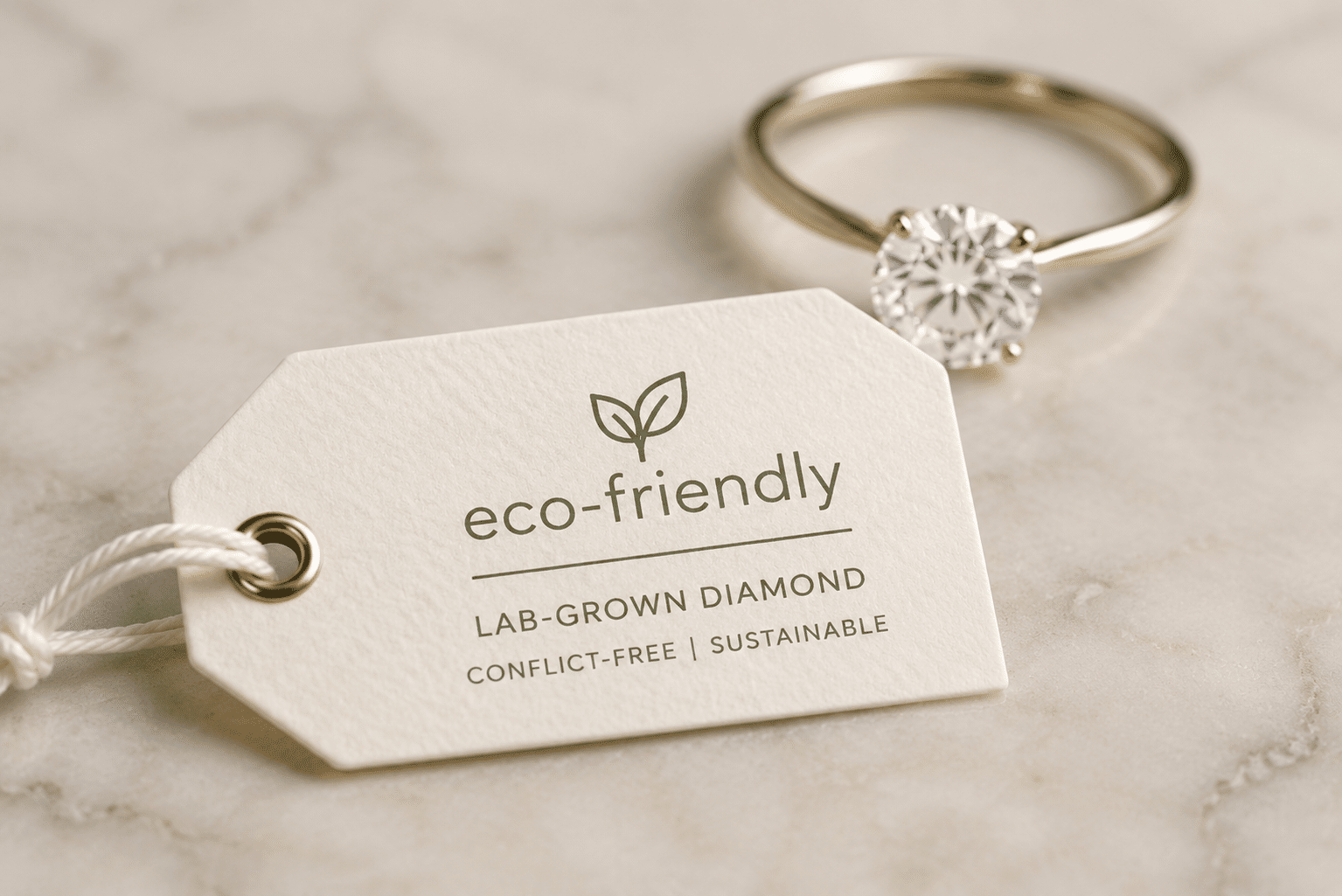
Jewelry marketing is filled with words like “eco-friendly,” “ethical,” and “carbon neutral,” but these terms can be used without clear, independently verifiable definitions or evidence. Many brands use them as a shortcut to appeal to conscientious buyers without backing them with specific, audited data. This gap between language and reality is greenwashing, and it makes it difficult to tell which purchase actually supports better practices, Sustainable Custom Jewelry Guide, and which is just paying a premium for marketing.
For the full framework, read Sustainable Jewelry Buying Guide.
This article breaks down the specific claims and promises you should question, from “zero impact” to “fully traceable.” It provides a practical framework to separate vague branding from verifiable evidence so you can evaluate a jeweler’s sustainability claims with the same critical eye you bring to cut quality or price. By reading it, you will learn what documentation to ask for and when to treat a claim as advertising rather than fact.
| Greenwashing Claim | What It Usually Implies | What to Ask Instead |
|---|---|---|
| “Eco-friendly” or “Guilt-free” | The product is harmless to the environment. | Which specific part of production is improved, and can you show data? |
| “Carbon neutral” | Emissions have been fully offset. | Which emissions were measured? Which certified offsets were purchased? |
| “Ethical” or “Responsible” | All labor and sourcing is above reproach. | Can you share third-party audits or certification reports for this claim? |
| “Zero impact” | No environmental cost exists. | No operation is zero impact. What is the actual measured footprint? |
| “Fully traceable” | Every step from mine to store is documented. | Can you provide batch numbers or facility names for each production step? |
| “Conflict-free” (for lab-grown) | The claim itself guarantees ethics. | Lab diamonds avoid rebel funding, but what about their energy consumption? |
Quick Questions Before You Read
Q: Can I trust a “sustainable” claim if it is printed on a brand’s homepage?
Not without verification. Trust claims that include specific, measurable details and point to third-party audits or certifications.
Q: Does a lab-grown diamond automatically mean the purchase is ethical?
Not automatically. Lab-grown diamonds eliminate certain mining concerns, but production still consumes significant energy. Always ask about the energy source used to grow the diamond.
Q: Is “carbon neutral” a reliable label for jewelry?
It depends on whether the brand performed a full emissions audit and uses verified offsets. Many brands offset only a small fraction of their total emissions and still call it neutral.
Q: What is the single biggest red flag in sustainable jewelry marketing?
Vague emotional language without supporting evidence. If a claim is just a word like “eco-friendly” or “green,” and no data or documentation is offered, treat it as marketing.
Sustainable Jewelry Greenwashing Red Flags: Words, Claims, and Promises to Question
Why Greenwashing Persists in the Jewelry Industry
Greenwashing thrives in the jewelry industry partly because sustainability claims can cover several different issues, and no single label or document can define or verify every aspect of a “sustainable” diamond or ring. Buyers need specific, verifiable claims and supporting evidence, not just a broad label. Ask which materials, production stages, and impacts each claim covers. At the same time, buyer awareness of the actual production details is still developing. Most shoppers know they should look for something sustainable, but few have been trained to ask what energy source powers a lab-grown diamond facility, how a refinery documents recycled metal content, or whether a “transparent” supply chain actually produces batch-level records. The gap between marketing language and verifiable operations is where greenwashing lives. Sellers exploit that gap by substituting uplifting words for hard data. Closing it requires learning which questions to ask and recognizing that good intentions do not equal verified practices.
What This Article Is Built to Do
This guide functions as a translation layer. It maps common marketing phrases to the manufacturing realities those phrases are meant to describe—or meant to obscure. Each red flag below targets a specific word or promise and explains what it would actually require to be true. The goal is not to provide a complete sustainability report on every jewelry material or process. That would be a different document. The goal here is to give you a repeatable framework for asking better questions. Once you know what a real claim looks like, you can spot the difference between genuine practice and empty language. The article is structured so that each section can be used independently. If you see a claim you do not trust, jump to the relevant red flag and compare the seller’s language against the verification check.
How to Use This Guide Before You Buy
Before you click purchase, run the seller’s claims through this list. Look for documented specifics: energy source data, third-party certification details, or audit results. If the claim is built on words like “eco-friendly,” “sustainable,” or “ethical” without supporting evidence, treat it as marketing until it is verified. Then ask the seller directly: “What exactly makes this piece sustainable, and can you show me the source?” If the answer is vague or refers to a single minor step while ignoring the rest of the production chain, the overall environmental footprint remains unknown. Documentation is the only difference between a promise and a fact.
For buyers who are evaluating multiple sellers, consider keeping a simple comparison list of claims versus documentation. A seller who freely shares third-party certification IDs, energy reports, or refinery names is making a fundamentally different kind of statement from one who relies on general phrases. Over time, this habit reveals which brands treat sustainability as an operational record rather than a sales message.
The Federal Trade Commission (FTC) has addressed this issue directly. In its Green Guides, the FTC warns marketers against using broad, unqualified environmental benefit claims like “eco-friendly” or “sustainable” without specific, substantiated evidence. The agency has also issued specific guidance on jewelry industry terminology, cautioning that terms like “conflict-free” and “ethical” carry specific implied promises that require careful documentation to avoid misleading consumers.[1] This regulatory framework reinforces the need for buyers to treat any unsupported claim as advertising rather than fact.
Red Flag #1: “Eco-Friendly” Without Evidence
Why the Phrase Is Meaningless Without Context
“Eco-friendly” carries no legal definition. Any jewelry brand can apply it to any product, even if only one minor step in the production chain has been improved. A seller might use recycled packaging while the diamond itself was grown using coal-powered energy and the gold was mined without labor oversight. The packaging improvement is real, but the phrase describes only one part of a much larger process. Without a breakdown of which steps are improved, by how much, and verified by whom, “eco-friendly” is a placeholder, not a description. It signals intent without delivering evidence.
What a Real Eco-Friendly Claim Looks Like
A specific, trustworthy claim sounds like this: “Our lab-grown diamonds are grown using 100% renewable energy, verified by a third-party certification.” The seller names the certifier, provides a report number, and identifies the energy source. The same logic applies to metals: “The gold used in this ring is 100% post-consumer recycled, certified by SCS Global.” Generic claims that lack this structure are not trustworthy. Specificity is the only reliable signal.
The Buyer’s First Follow-Up Question
Ask one question immediately: “Which part of the production process is eco-friendly, and how is that measured?” If the answer describes a single step, ask about the rest. If the answer is vague, the claim does not yet carry enough weight to influence your buying decision.
Certificate and Documentation Check
For claims tied to diamonds, check whether the seller provides a grading report from a recognized lab such as IGI or GIA. The grading report does not verify sustainability, but it does establish a baseline for traceability. Some reports include origin details. For metals, look for a third-party certification of recycled content. Ask for the report number and verify it online. Treat any unverified claim as incomplete until documentation is provided.
Red Flag #2: “Guilt-Free” or “Feel-Good” Buying
Why Emotional Framing Replaces Evidence
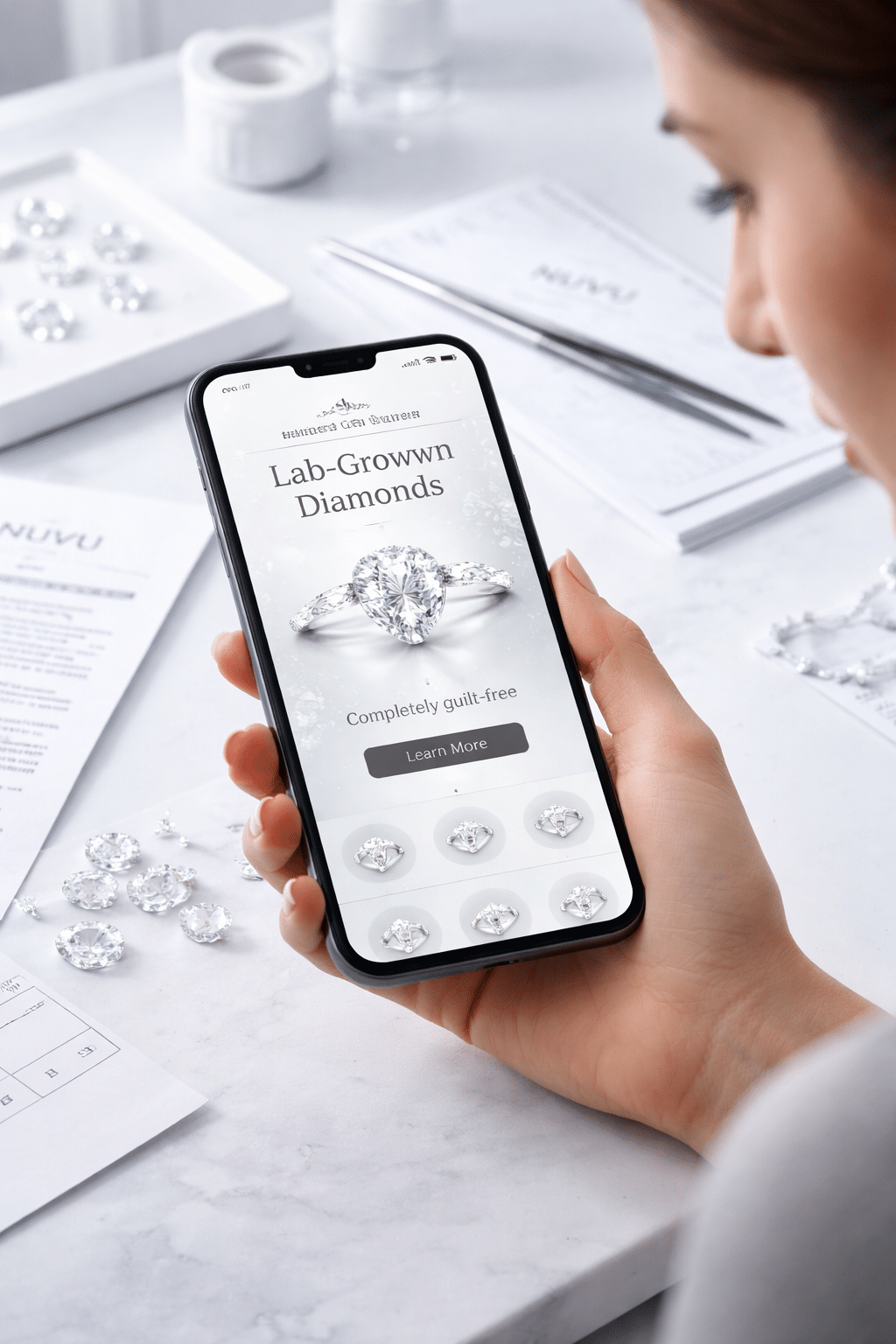
Claims that frame a purchase in emotional terms—”guilt-free,” “feel-good,” “worry-free”—are designed to bypass critical evaluation. The phrase “guilt-free” implies that all ethical concerns related to the purchase have been resolved. In practice, no single jewelry purchase resolves the complex realities of mining, energy use, labor practices, and material waste. This language shifts attention away from the supply chain and onto the buyer’s feelings. It makes the emotional experience of buying the product sound like the product’s most important feature. That is a substitution, not a proof.
What a Transparent Seller Says Instead
A seller who has actually done the work does not need emotional language. They describe specific practices that adhere to sustainable jewelry certification standards, such as “We source post-consumer recycled gold from a refinery certified by the Responsible Jewellery Council. Our diamond supplier provides energy reports showing the grid mix used for each production batch.” These statements do not try to make you feel good. They give you something concrete to verify. No emotional framing is needed when the evidence is available.
Questions to Ask Before Accepting the Claim
When you see “guilt-free” or similar language, ask: “What specific concerns does this purchase resolve, and are those concerns documented in a third-party report or internal audit?” If the answer circles back to emotional reassurance rather than specifics, the claim lacks supporting evidence. Consider that a signal, not a conclusion.
Red Flag #3: “Zero Impact” or “Fully Sustainable”
Absolute language about environmental impact is almost always a sign that the claim is built on marketing, not operations. No jewelry supply chain, regardless of material or method, currently operates with zero measurable environmental cost. Even a fully recycled gold ring resized from an existing piece involves energy for melting, refining, and setting the stone — every step registers some consumption.
Why Zero Impact Is Not Achievable
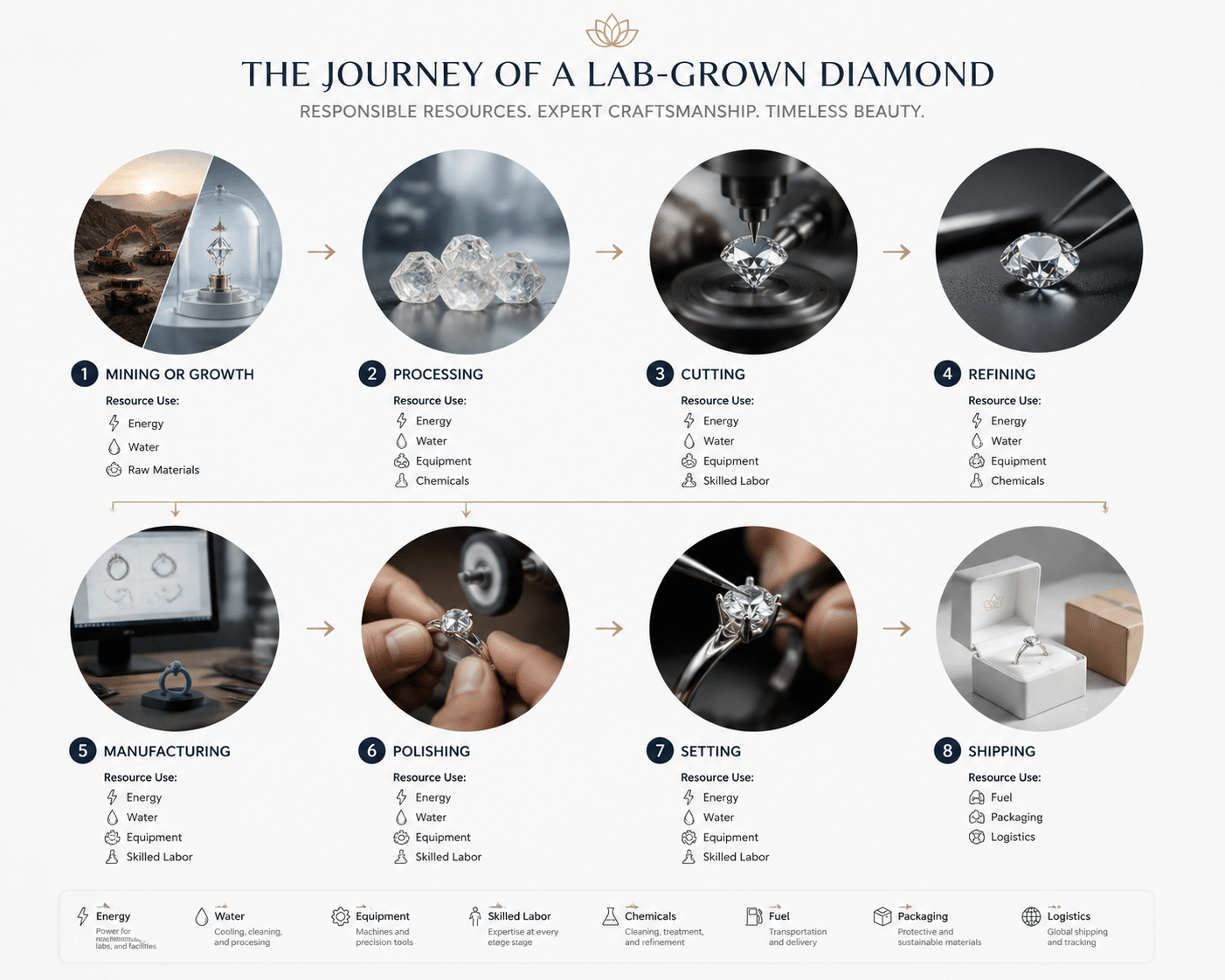
Every step of jewelry production consumes resources. Mining or growing the raw material requires energy and water. Processing, cutting, refining, manufacturing, polishing, setting, and shipping each add their own consumption of electricity, fuel, materials, and transport. None of these steps can be eliminated. Waste and emissions are inherent to the process. A seller claiming zero impact is describing something that does not exist in any current production chain. The claim itself is a red flag, not a differentiator.
What a Honest Sustainability Claim Looks Like
A credible claim describes progress, not perfection. It might say: “We measure and report our carbon emissions annually. We purchase verified offsets for 100% of our Scope 1 and Scope 2 emissions. Our water use is monitored, and we are working toward a closed-loop system in our manufacturing facility.” That statement is specific about what is measured, what is addressed, and what is still in development. It does not pretend the problem is solved. It gives the buyer something to verify.
The FTC’s Green Guides specifically caution against claims of “environmentally friendly” or “eco-friendly” when the product’s entire life cycle is not free of environmental harm.[1] A seller claiming “fully sustainable” or “zero impact” must substantiate that claim across all stages—raw material extraction or growth, manufacturing, packaging, shipping, and disposal. The FTC has repeatedly warned that such absolute claims require “competent and reliable scientific evidence” that the product’s entire life cycle is truly benign, which is practically unachievable for any jewelry item produced today.
Verification Before You Buy
Ask the seller: “How do you measure your environmental impact? Can you share the data or the report?” If the answer is “we’re working on it” without supporting evidence, treat the claim as aspirational rather than factual. Aspiration is not a reason to pay a premium or choose one seller over another.
Red Flag #4: “Carbon Neutral” Without Certification
Carbon neutrality is one of the most commonly misused terms in sustainable jewelry marketing. It requires measurement, reduction, and verified offsets. When claimed without documentation, it is usually incomplete.
What Actual Carbon Neutrality Requires
A credible carbon-neutral claim must start with a full emissions audit covering Scope 1, 2, and 3 emissions. That audit must be followed by documented reductions and verified offsets purchased from recognized registries such as Verra or Gold Standard. Without these three steps, “carbon neutral” describes an intention, not a completed state.
How Sellers Misuse the Term
Many sellers declare carbon neutrality based on a single step. Offsetting shipping emissions is common. So is offsetting the electricity used during a single manufacturing step. Meanwhile, the energy used to grow or mine the material, refine the metal, and manufacture the jewelry remains unaddressed. The buyer hears “carbon neutral” and assumes the whole product is covered, when in reality only a small fraction of the emissions have been offset. This creates a misleading impression of total neutrality without delivering it.
In practice, a useful rule of thumb is that any carbon neutral claim covering only shipping or packaging while ignoring material production is omitting the heaviest part of the footprint. The buyer’s attention should focus on whether the seller includes the diamond growth or metal refining stage in their audit, since those account for the majority of energy consumption in most jewelry items.
The FTC’s position on carbon offset claims reinforces this caution. The Green Guides state that when a marketer represents that a product is “carbon neutral,” the marketer must have competent and reliable evidence to support the entire representation, including any claims about the quality or quantity of offsets purchased.[1] This means a seller cannot simply buy offsets for a trivial portion of the supply chain and then label the entire product as carbon neutral. If the seller has not measured the full emissions footprint across production, manufacturing, and delivery, the “carbon neutral” label is unsubstantiated under FTC guidelines.
What to Ask the Seller
Ask: “Which emissions are you offsetting? Can you share the offset certificate and the registry name? What proportion of your total emissions does this offset cover?” If the seller cannot produce documentation for all three questions, the claim is unverified and should carry no weight in the buying decision.
Red Flag #5: “Ethical by Default” and “Conflict-Free by Definition”
Both phrases imply that the buyer does not need to ask further questions. In reality, neither term automatically proves responsible sourcing. Each requires specific evidence.
Why Lab-Grown Is Not Automatically Ethical
Lab-grown diamonds avoid mining-related human rights risks, but they still involve energy consumption, manufacturing labor, chemical use, and waste. A diamond grown in a facility with high grid emissions, undocumented labor practices, and no waste management policy is not automatically ethical. Without disclosure of working conditions, energy sources, and facility audits, the word “ethical” is an assumption, not a verified fact. The production method alone does not resolve every responsible-sourcing question.
The Gemological Institute of America (GIA) explains that lab-grown diamonds are created through methods such as High Pressure High Temperature (HPHT) and Chemical Vapor Deposition (CVD).[2] While these processes eliminate the direct link to conflict funding that the Kimberley Process was designed to address, GIA’s educational material focuses on identifying laboratory-grown diamonds rather than making any claim about their inherent ethical status. This distinction matters: a growth method is a technical process, not an ethics certification. Buyers should separate the factual description of how a stone was made from any value judgment about its sourcing.
What “Conflict-Free” Actually Proves
The Kimberley Process certifies diamonds as conflict-free under a narrow definition: diamonds not sold to fund rebel groups. It does not cover labor rights, environmental damage, or government corruption. A “conflict-free” claim without additional sourcing documentation addresses only one risk. It leaves most of the responsible-sourcing picture unexamined.
How to Get Past the Claim
Ask: “What does ethical mean in your supply chain? Can you share a third-party audit or sourcing policy covering labor practices, energy use, and material origin?” If the answer is “all our diamonds are lab-grown, so they are ethical by default,” the seller has not done the full work. Default status is not verified status.
Red Flag #6: “Transparent” or “Traceable” Without Detail
Transparency and traceability are not single statements. They are processes that require documentation at every production step. When a seller says a piece is “fully traceable” or that they “prioritize transparency” but cannot produce specifics, the claim is essentially empty.
What Real Traceability Looks Like
Real traceability operates at the batch level. For a lab-grown diamond, this means knowing exactly where the stone was grown, which facility processed it, which refinery handled the metal, which manufacturer set the piece, and who shipped it. Each of these steps should have a recorded date and a facility identifier that can be verified. For mined materials, the chain should include the mine of origin, the cutter, the refiner, and each subsequent handler.
When a seller can name each facility and produce a corresponding certificate or audit report for each stage, the claim is supported. When they cannot, traceability is a marketing concept, not a verified fact.
What Vague Transparency Claims Hide
Phrases like “we believe in transparency” or “our supply chain is traceable” describe intention, not practice. A seller who cannot name a single supplier, provide a batch number, or connect a stone to a specific grower or miner is describing a philosophy, not a system outlined in sustainable jewelry buying guide, and this language creates the impression of accountability without requiring any of its actual work.
The gap between the claim and the documentation is usually wide. A vague transparency statement often hides a supply chain the seller has not fully investigated or documented themselves.
Documentation Checklist for Buyers
Before completing a purchase, request four specific items: a grading report from a recognized lab, the name of the facility or supplier where the stone was grown or mined, the energy source used for lab-grown production, and a third-party certification for recycled or fair-mined metal content. If three out of four cannot be provided, the transparency claim is incomplete. Treat the missing documentation as a gap in the seller’s own knowledge, not as a minor detail.
Keep in mind that even when a seller shares all four pieces of documentation, each one applies to a different part of the story. A grading report confirms diamond quality but says little about energy use. A recycled metal certification covers the metal but not the stone. Assembling the full picture requires combining these separate documents, not assuming one covers everything.
Evaluating Traceability Through Grading Reports
When a seller claims traceability, a grading report from a recognized lab can serve as a starting point for verification. The report number is a unique identifier that can often be checked through the issuing laboratory’s official report-check tool, where available. However, a grading report is not a traceability document. It describes the stone’s quality characteristics—carat, color, clarity, cut—but does not document the full production chain from material origin to finished piece. To move beyond vague transparency language, buyers should ask whether the seller can connect the grading report to a specific production batch, facility name, and timeline. If the only evidence of traceability is a report number without any supporting supply-chain documentation, the claim remains incomplete. The report is a useful anchor, but it is not the whole story.
When a grading report is provided, buyers should verify the report details through the issuing laboratory’s official report-check tool where available. This step confirms the stone’s quality attributes match the document, but it does not verify sustainability or traceability claims. Separate documentation is needed for each layer of the supply chain.
Additional Context: Claims Around Lab-Grown Diamond Origin
A growing number of jewelry sellers use terms like “above-ground diamond,” “evergreen diamond,” or “cultured diamond” to describe laboratory-grown stones. While these words may sound more natural or appealing, they do not change the fundamental distinction: laboratory-grown diamonds are created through HPHT or CVD processes in a controlled environment, not formed geologically over millions of years underground. Buyers should look for clear disclosure that a stone is laboratory-grown, using terms such as “lab-grown diamond,” “laboratory-created diamond,” or “laboratory-grown diamond.” If a seller avoids these terms and relies on invented or poetic language, the buyer should ask directly whether the stone is laboratory-grown or mined. The distinction between origin types matters for disclosure, documentation, and buyer expectations. The FTC has issued guidance requiring that the origin of a diamond be clearly disclosed at the point of sale, and that terms like “cultured” or “created” not be used in a way that misleads a buyer about whether the stone is natural or laboratory-grown.
This distinction is not just a labeling preference. When a seller uses vague or creative language to describe a lab-grown diamond, it becomes harder for the buyer to evaluate the stone’s documented characteristics, including any grading report, growth method, or treatment disclosures. The clearest sales language is the most useful: a direct statement that a diamond is “laboratory-grown” or “laboratory-created” followed by the specific growth method (HPHT or CVD) when available. Buyers should treat any description that avoids these terms as incomplete and request explicit clarification before relying on it for purchase decisions.
How to Become a Greenwashing-Resistant Buyer
Vague sustainability language only works when the buyer accepts it at face value. The solution is not to memorize every certification or production method, but to apply a consistent framework to every claim, regardless of the seller or the price point.
The Five-Question Verification Framework
For any sustainability claim, ask five questions. First, what specific process or material does this claim refer to? Second, how is this claim measured and documented? Third, can the seller produce a third-party certification or audit to support it? Fourth, what part of the production chain is left unmentioned? Fifth, would your evaluation change if that unmentioned factor were disclosed?
This framework shifts the burden from the buyer to the seller. A vague answer to any of these questions is a signal that the claim is not yet supported.
Building a Sustainable Jewelry Buying Habit
This is not a one-time exercise. The same five questions apply whether you are buying a loose diamond, an engagement ring, a wedding band, or a piece of fine jewelry. Over time, the pattern becomes second nature. You stop relying on emotional language and start evaluating claims against documentation. The baseline builds with each purchase.
What to Do When a Seller Cannot Answer
If a seller cannot provide specific answers to two or more of the five questions, treat the claim as marketing. Before completing the purchase, request written confirmation of any sustainability promise. If it cannot be documented in writing, it should not influence your decision. The price, the stone quality, and the design should stand on their own.
FAQ: Common Questions About Sustainable Jewelry Claims
Can a small jewelry brand actually be sustainable?
Small brands often have shorter supply chains, which can make transparency easier. The key question is the same regardless of brand size: can they show you the documentation for each step? Do not assume a smaller brand is more accountable simply because it is smaller. Ask for specifics.
Is a recycled metal claim always true?
No. Recycled metal requires a certified refinery chain. Without a recycled-content certification from a recognized body such as SCS Global or the Responsible Jewellery Council, the claim should be confirmed in writing before you complete the purchase. A verbal assurance is not sufficient.
Do I need a separate certificate for sustainability?
There is no single certificate that covers every aspect of sustainability. A grading report tells you about diamond quality, not environmental impact. Sourcing documentation, energy reports, and metal certifications are separate documents. Ask for each layer individually. If a seller offers only a grading report as proof of sustainability, they are missing most of the picture.
How can I verify a traceability claim beyond a grading report?
To move beyond a single document, ask the seller for a written supply-chain summary that includes the facility name where the stone was grown or mined, the processing locations, and any third-party audits available for each step. If the seller cannot provide this, the traceability claim is unsupported. Documentation for each production stage is the only reliable evidence.
For buyers evaluating multiple sellers, a useful habit is to request this information before making a shortlist. The sellers who can produce batch-level records and facility names are providing a fundamentally different level of transparency from those who rely on general statements.
[1] Federal Trade Commission, “Guides for the Use of Environmental Marketing Claims” (Green Guides), 16 CFR Part 260, as updated 2012; and FTC, “FTC Jeweler’s Guides,” including guidance on “Conflict-Free” and “Ethical” claims, available at FTC Green Guides and FTC Jewelry Guides.
[2] Gemological Institute of America, “Lab-Grown Diamonds,” GIA.edu, educational resource section covering HPHT and CVD growth methods and identification, available at GIA Lab-Grown Diamond Overview.
Disclosure: This article is for general educational purposes only. Sustainability, environmental, and ethical claims in the jewelry industry should be evaluated by looking for specific, documented, and third-party verified evidence. A grading report helps document a stone’s quality characteristics but does not verify sustainability, traceability, or sourcing ethics. Readers should verify any claim through certification bodies, official report-check tools, seller documentation, or qualified professionals before making a purchase decision. Laboratory-grown diamonds should be clearly distinguished from natural diamonds in all sales and marketing materials.