- Shop
Diamonds & Jewelry
Loose Lab Diamonds Yellow Lab Diamonds Pink Lab Diamonds Blue Lab Diamonds Engagement Rings Fine Jewelry Shop All Loose lab-grown diamonds10 shapes · IGI, GIA or NGTC reports
- Wholesale
- Custom Design
- Education
- About
Custom Jewelry Mistakes to Avoid: Why Beautiful Reference Photos Do Not Always Make Good Finished Pieces
- Why the photo misleads
- Ten common mistakes and what to do instead
- The same ring on different hands
- Bigger is easier with lab-grown, but it has trade-offs
- How to use reference photos well
- A short brief template
- Mistakes brands make with custom collections
- Reference photo questions
- Turn your references into a design
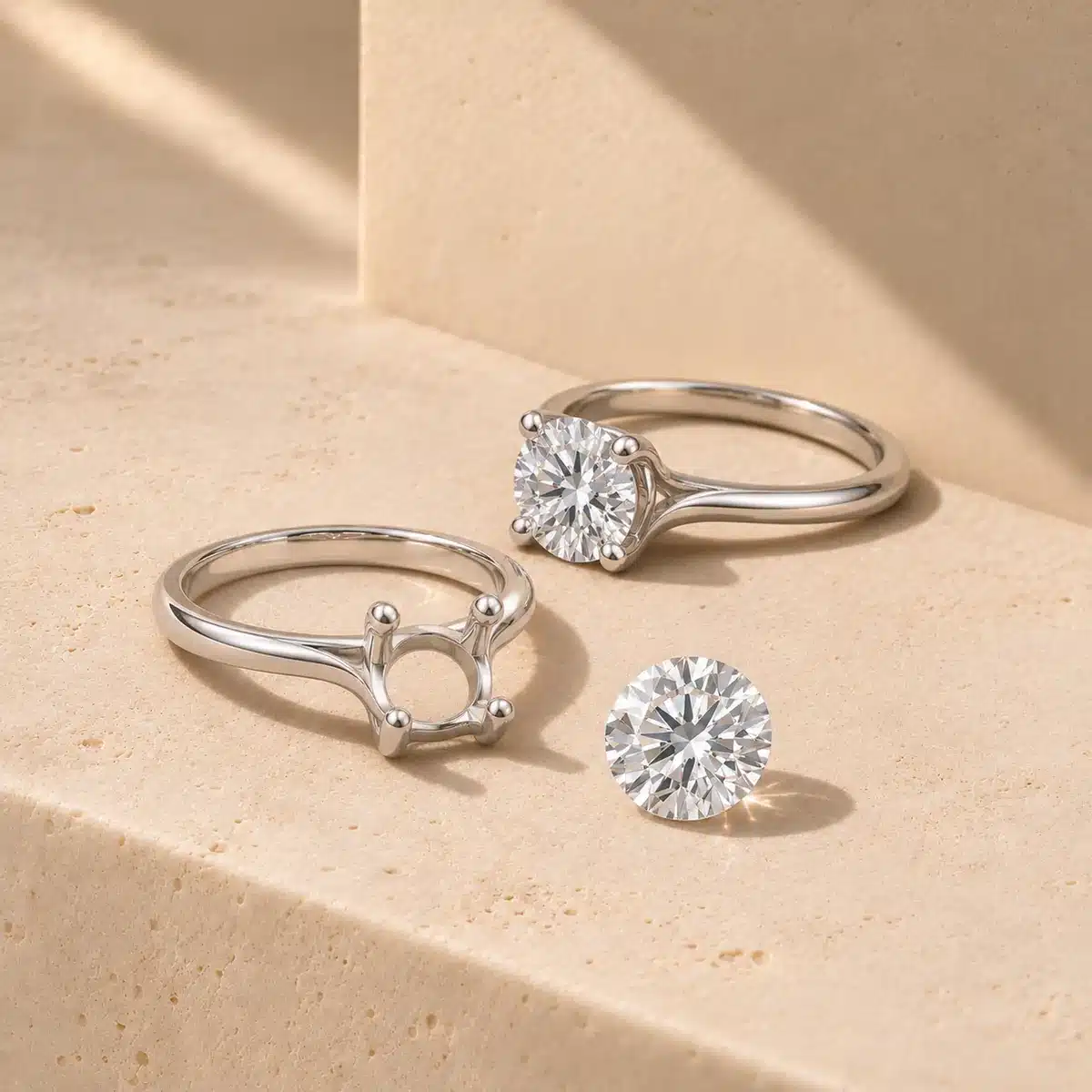
The ring in the photo has a 3 ct oval, about 11 mm long, on a 2 mm band. The buyer’s stone is a 1.50 ct oval with the same proportions. Because weight scales with volume, half the weight gives a stone about 20% shorter, close to 8.7 mm. Build the photo’s band and prongs around it unchanged and the metal now looks heavier against the stone, which is the opposite of what the buyer liked about the picture.
Reference photos are taken under studio light, from flattering angles, often on small hands and with stones of a different size from yours. Copying one without adjusting for your stone, the wearer’s hand and daily wear is the most common reason a finished custom piece disappoints. Use photos to point at specific features, then turn each feature into a measurement: stone size, band width and thickness, setting height.
Why the photo misleads
- Light. Spotlights and studio flashes make a diamond sparkle far more than office light, daylight or evening light.
- Scale. Close-ups, small hands and wide-angle lenses make stones look bigger.
- Stone size. The design was proportioned for that stone, not yours.
- Editing. Brightness, color and background are adjusted. A render is not a photo at all.
Where you can, find out what stone size and ring size the reference shows.
Ten common mistakes and what to do instead
Swipe the table to see more →
| Mistake | What happens | What to do instead |
|---|---|---|
| Copying a design made for a different stone size | Proportions look wrong | Give the designer your stone’s report measurements |
| Ignoring hand size and finger shape | The ring looks too big or too small | Send the ring size and a photo of the hand |
| Expecting studio sparkle | The stone looks different every day | Judge stones on video in normal light |
| A very thin band for daily wear | It bends or looks fragile | Check thickness at the thinnest point on the CAD |
| A very high setting | It snags and a wedding band will not sit flush | Check the height from the finger on the CAD |
| Fine prongs on a pointed stone | The tip is exposed | Use a V-prong on points |
| Too many side stones | A busy look and more upkeep | Pick one feature to lead |
| Approving from one render | Surprises from the side | Approve top, side and front views with dimensions |
| Vague words such as “delicate” | The designer guesses | Give widths and heights in millimeters |
| Changing details after approval | Delays and fit problems | A new CAD version for every change |
The same ring on different hands
A 2 mm band under a 1.5 ct stone looks delicate on a slim finger and thin on a larger one. Finger length, knuckle size and how the ring sits all change the look. Design for the wearer’s hand, not the model’s.
Bigger is easier with lab-grown, but it has trade-offs
Because lab-grown stones cost less, it is tempting to go bigger than the reference. A larger stone shows color and inclusions more readily, needs stronger prongs, and often needs a taller head. Balance the size against comfort and how the ring will be worn.
How to use reference photos well
- Choose two or three photos, not ten.
- Write what you like in each one: the band shape, the prongs, the side profile, the halo. Say what you do not like as well.
- Give your stone’s measurements and the ring size.
- Have the designer say what needs to change to suit your stone and hand.
- Check the CAD by its measurements. See the CAD checklist.
A short brief template
- Piece type and occasion.
- Wearer: ring size, hand, daily activities.
- Stone: shape, size range, quality range, report.
- Metal and color.
- Setting style and how low or high it should sit.
- What you like in each reference, and what you do not.
- Budget and date.
Mistakes brands make with custom collections
- Approving designs from renders instead of physical samples.
- Starting production before the specification sheet is fixed.
- Choosing designs that are hard to resize across a size range, such as full-eternity bands.
- Leaving packaging, tags and the “laboratory-grown” wording on listings until the end.
Reference photo questions
Why doesn’t my custom ring look like the photo?
The light, the scale, the stone size and the hand all differ. A brief in measurements and a CAD approved by its numbers close most of the gap.
How thin can an engagement ring band be?
It depends on the metal and the design. Check the thickness at the thinnest point, and avoid very thin bands for daily wear, particularly in 18K gold.
How many reference photos should I send?
Two or three, with a note on what you like in each. More photos often send mixed signals.
What should I write instead of “delicate”?
A width and thickness, for example “band about 1.8 mm wide”.
Turn your references into a design
Send two or three references with a note on each, your stone or its report number, the ring size and the metal, and we will reply with what needs to change to suit your stone and hand. Start your custom design or message us on WhatsApp / WeChat at +86 19118403930.

11+ years supporting global clients with lab-grown diamond product consultation and market analysis.
About NUVU. NUVU is the international brand of New Perspective Superhard Materials Co., Ltd. in Zhecheng, Henan, China. We grow HPHT lab-grown diamonds in-house and cut, polish and match stones in our own workshop.
Related Guides
Custom jewelry guide
How custom lab-grown diamond jewelry is made: when custom makes sense, the brief, stone selection, CAD approval…
Read more →CustomCustom gallery
Custom lab-grown diamond ring ideas by shape, setting and metal: solitaire, hidden halo, halo, three-stone and vintage.
Read more →CustomSetting styles
Solitaire, halo, hidden halo, three-stone and vintage settings compared: look, stone protection, height, wedding…
Read more →