
Buying lab-grown diamonds in pairs, layouts, or multi-stone settings is a different challenge from buying a single solitaire. Individual grading reports can give a false sense of consistency—two stones with identical 4Cs can look visibly different side by side. The real cost of a poor match isn’t the price per carat; it’s the rework, lab-grown diamond wholesale lead times, delays, and lost inventory when stones don’t align in color, clarity, or cut performance under final lighting. This guide explains why visual matching matters more than paper grades, and how shape, proportion data, and batch sourcing affect your success rate. It helps wholesale buyers and jewelry professionals evaluate suppliers on matching precision, not just price.
For the full framework, read Wholesale Lab-Grown Diamonds for Jewelers and Brands.
| Matching Factor | Why It Matters | What to Check |
|---|---|---|
| Inclusion patterns | Two VS2 stones can have visible flaws in different locations, creating an obvious mismatch when set side by side. | Request rotating video under 10x magnification for each stone. |
| Crown angle variance | GIA Excellent allows wide range; mismatched crown angles cause different sparkle and light return in pairs. | Ask for crown angle, pavilion depth, and table size on all stones. |
| Size tolerance (mm) | A 0.05mm difference accumulates visibly in linear layouts or channel settings, ruining symmetry. | Get actual millimeter measurements, not just carat weight. |
| Shape difficulty | Rounds are easiest; emerald, Asscher, and baguettes expose every proportion variance. | Confirm supplier has experience matching your shape. |
| Batch sourcing | Stones from different production runs often shift slightly in color hue or crystal quality. | Verify all stones come from the same production batch. |
| Exchange policy | Without a return or swap option for pairs, you absorb all mismatch risk. | Ask explicitly: are pairs exchangeable if visually mismatched? |
Quick Questions Before You Read
Q: Can’t I just match two stones by their GIA or IGI certificate?
Not reliably. Grading labs assign ranges, not visual guarantees. Two identical grades can differ in crown angle by several degrees or have inclusions in different spots, making them look mismatched in person.
Q: Does shape really affect how hard it is to match stones?
Yes, significantly. Round brilliants are standardized and have large inventory, making matching easier. Step cuts like emerald and Asscher expose every proportion difference, requiring tighter tolerance and more careful selection.
Q: Are matched pairs always more expensive?
Usually yes. The premium reflects the labor of visually comparing stones and the inventory cost of holding back single stones that could sell faster. A very low price per carat for a matched pair is a red flag.
Q: What is the biggest mistake buyers make when ordering pairs?
Focusing only on the color and clarity grades while ignoring millimeter dimensions and proportion data. Price savings from a cheap pair disappear when the stones don’t match and the setting needs to be disassembled.
The Sourcing Problem Most Buyers Discover Too Late: Why Matching Matters More Than Price
Most wholesale buyers start by comparing stone prices. That is the natural place to begin. But the real test of a supplier comes not when you order a single stone, but when you order two stones that must sit side by side. Earrings, tennis bracelets, three-stone rings, and any multi-stone layout impose a requirement that a standard inventory system is not designed to meet: uniformity across a batch, not peak performance in an individual stone.
This is the gap where price advantages vanish and returns begin.
Why a Single-Stone Supplier Cannot Automatically Ship a Good Matched Pair
A supplier who moves thousands of loose stones per month may still have zero matched pairs in stock. That is not a contradiction. It is a consequence of how inventory is managed.
Single-stone systems sort diamonds by their individual grades: cut, clarity, color, and carat. The system does not know how one stone compares to another in visual appearance. A wholesaler can have twenty 0.50-carat round brilliants, all graded G VS1, and none of them will be close enough to pair for a pair of earrings. The laboratory grades are the same, but the visual face-up match can still fail.
The reason is that matching requires a different kind of selection. The manufacturer or supplier must examine stones side by side, under the same lighting, at the same angle, and decide whether they look like siblings. That process requires inventory depth and visual comparison, not just a database filter. A supplier who does not maintain batch-matched inventory or who has not developed a pair-selection workflow is unlikely to produce consistent results.
The Real Cost of Poor Matching: Visual Disruption, Returns, and Lost Trust
Poorly matched stones create problems that a price advantage cannot fix. The failure modes are specific and avoidable.
Color differences that are invisible in a single stone become obvious the moment two stones sit next to each other. A half-grade shift in color, barely detectable in a solitaire, looks like a mistake when the stones are mounted as earrings or in a line bracelet. The human eye is good at comparing adjacent objects, and it will notice even a subtle warmth or coolness mismatch.
Size mismatches create physical problems. A 0.1mm difference in diameter between two stones in a tennis bracelet does not seem significant until the bracelet has thirty stones. The cumulative misalignment shifts the entire piece, creating gaps where the setting has to compensate. In a straight-line setting, that compensation often fails, and the result is a piece that looks uneven or poorly built.
Clarity variance is less obvious but equally disruptive. Under direct lighting, a stone with a visible inclusion near the table will read differently than a cleaner stone. In a line layout, that difference breaks the visual rhythm. The eye moves across the piece and stops on the stone that looks different.
The manufacturing consequence is increased return rates, rework, and lost client confidence. A low unit price on the stones means nothing if the final piece has to be disassembled and rebuilt. In practice, the lowest-priced supplier often becomes the most expensive choice once matching failures are factored in.
For buyers evaluating suppliers, it is worth distinguishing between a single-stone price list and a matched-inventory system. A supplier who cannot speak clearly about their selection process for pairs and layouts may be relying on grade-based filtering alone, which rarely produces consistent results.
What to Check Before You Buy a Pair or Layout Set
Before committing to a matched pair or layout order, verify the following:
- Ask for side-by-side photos or video of the actual stones, not stock imagery.
- Request a mounted mockup if the supplier can provide one. Seeing the stones in a setting changes how you evaluate the match.
- Confirm size tolerance in millimeters, not carat weight. Carat weight does not guarantee millimeter uniformity.
- Verify that color and clarity grades are identical on the accompanying grading reports, not just within the same letter grade. A stone graded G and another graded G may still sit at opposite ends of the grade range.
- Ask about the return policy specifically for matched pairs. Some suppliers accept returns on single stones but apply stricter conditions to paired inventory, because a returned pair breaks their batch and is harder to resell.
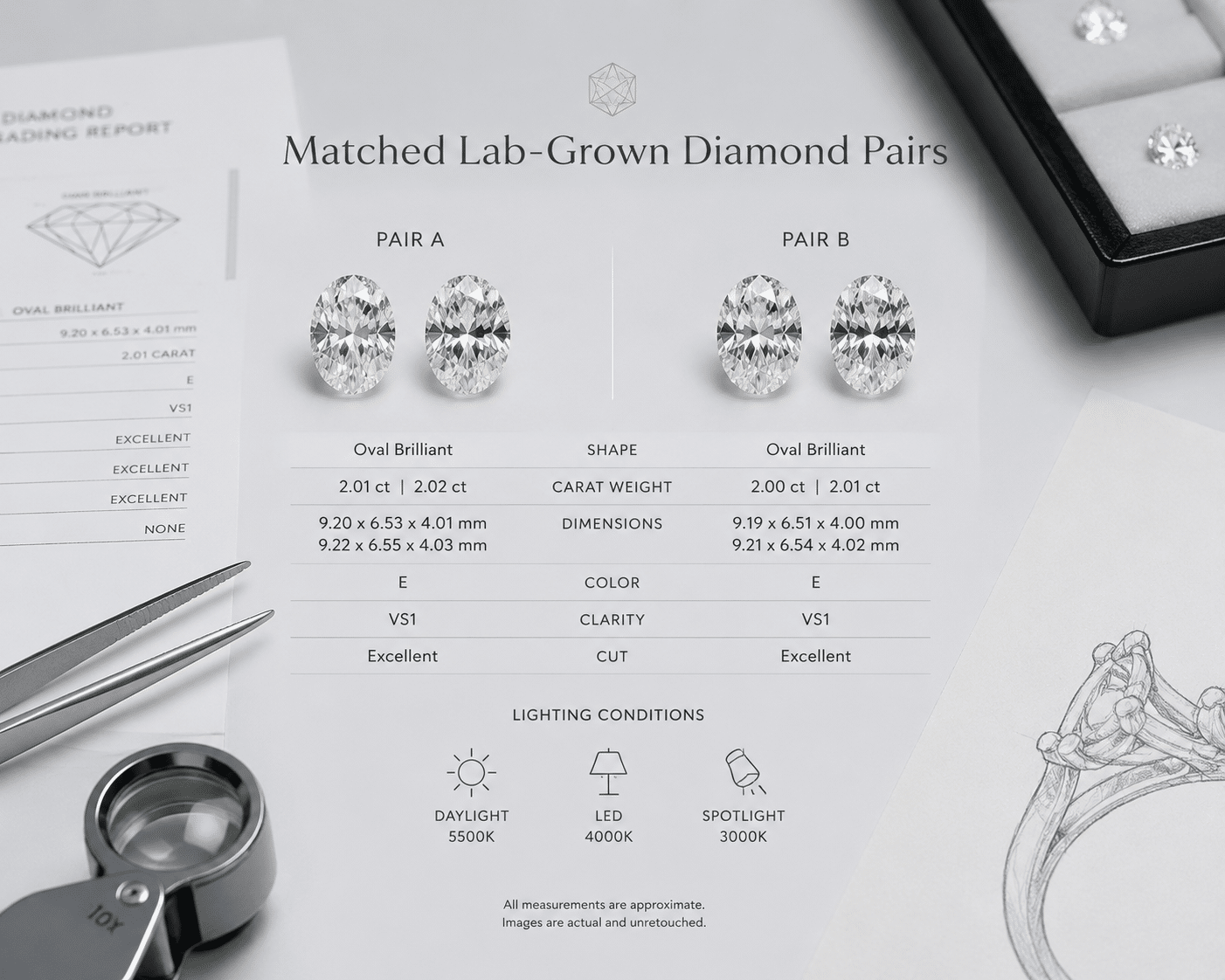
Color Consistency: The Most Visible and Most Commonly Flagged Matching Failure
Color is the single most common reason matched pairs get returned. The reason is not that suppliers misgrade stones. It is that color grading was never designed to predict how two stones will look together.
Color Grade as a Relative Scale, Not an Absolute Value
Two stones both graded G by the same laboratory can appear different when placed side by side. This is not a grading error. The GIA and IGI color scales use master stones as reference points, and the range within a single grade is wide enough that one G stone can sit near the top of the range while another sits near the bottom.[1] In a solitaire, that difference is invisible. In a pair of earrings, it becomes noticeable.
The problem is more acute in step-cut shapes. Emerald, Asscher, and radiant cuts transmit light differently than brilliant cuts. Their faceting does not scatter light the same way, so color is more saturated and more visible. A half-grade mismatch that would go unnoticed in a round brilliant becomes obvious in an emerald cut pair.
The practical takeaway is that laboratory grades are useful for narrowing the field, but they do not determine visual pair compatibility. The only reliable method is direct comparison under controlled lighting.
How Cut and Shape Affect Perceived Color Consistency
Not all shapes expose color differences equally. Step cuts, such as emerald and Asscher, hold and reflect color in a way that makes even minor mismatches evident. The broad, open facets act like mirrors, and any color variation between two stones becomes apparent immediately. Brilliant cuts, including round and cushion, scatter light more aggressively, which masks some color variation.
For tennis bracelets and line necklaces, the lighting environment matters as much as the stones themselves. Under direct showroom lighting, mismatches become visible that would not appear in ambient daylight. A pair that looks acceptable under a soft diffused light may show a clear difference under bright halogen or LED display lighting.
The most reliable test is to view the pair or layout under the same lighting condition they will be worn or displayed in. If the final piece is intended for a retail showcase with bright spotlights, that is where the match must hold.
It is also worth noting that fluorescence, while less commonly discussed in lab-grown diamonds, can introduce a color shift under UV-rich lighting that affects visual pair harmony. Buyers asking only for a letter grade may miss this variable. If the stones will be viewed in environments with strong UV or fluorescent lighting, asking about fluorescence consistency between the two stones is a useful additional check.
Certificate and Visual Review Check
- Do not rely on identical color grades on two separate grading reports. The grades alone cannot confirm a visual match.
- Request a side-by-side comparison on a white surface under consistent lighting. Natural daylight or a neutral LED source provides the most reliable evaluation.
- For earring pairs, ask to see the stones tilted to various angles. Color can shift depending on how light enters the crown.
- For tennis layouts or line necklaces, ask for a full-line visual, not just a pair. You need to see the progression across multiple stones, not just confirm that two are close.
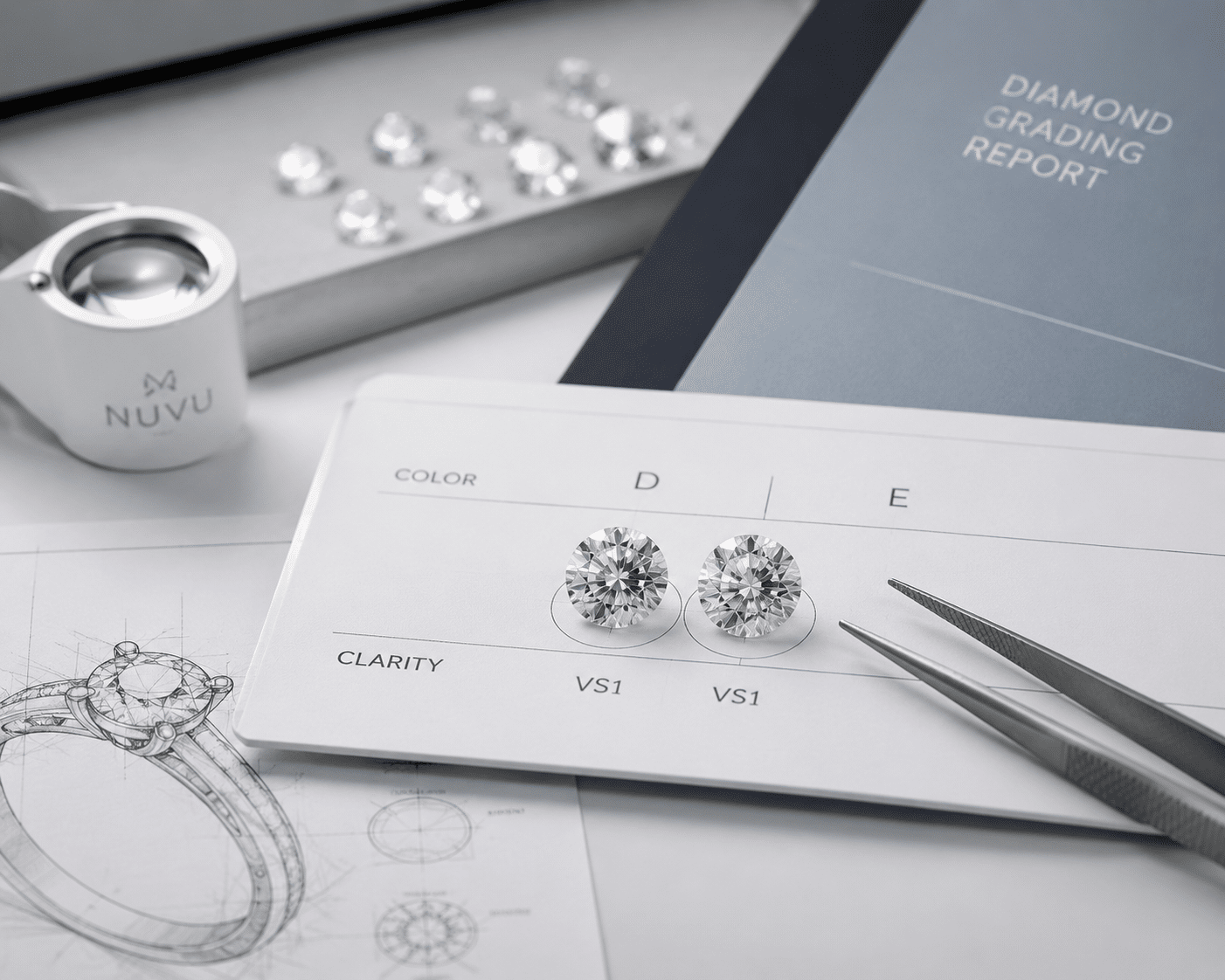
Size Tolerance: Why Carat Weight Alone Cannot Guarantee a Match
Carat weight is the most common specification buyers use when ordering layout stones. It is also the least reliable.
The Carat Weight vs. Millimeter Mismatch Trap
Two 0.50-carat round brilliants can have different table diameters, different crown heights, and different total depths. The weight is the same, but the physical dimensions are not. A 0.1mm difference in diameter means nothing in a solitaire ring. In a 30-stone tennis bracelet, it creates a cumulative offset that shifts the entire piece out of alignment, producing visible gaps and forcing the setter to compensate with uneven spacing.
The commercial standard for premium matching is 0.05mm tolerance or better. For tightly spaced layouts, even that margin can be too wide, as noted in jewelry brand sourcing. The only way to verify is to compare millimeter measurements directly, not carat weight.
Shape-Specific Size Matching: Which Shapes Create the Tightest Tolerances
Round brilliants with standard good-cut proportions are the easiest to match. The inventory pool is large, and well-cut rounds follow predictable dimensions for a given carat weight.
Princess cuts introduce more variation. The table size range is wider, and length-to-width ratios can differ even when the carat weight is identical. Two 0.50-carat princess cuts can look noticeably different in spread and proportion.
Baguettes and tapered baguettes have the tightest tolerance requirements of any shape. Any variance in length or width is immediately visible in a straight-line setting because the eye follows the edge of each stone. A 0.05mm difference that would go unnoticed in a round brilliant becomes obvious when a line of baguettes does not align.
Stone-to-Setting Fit Check
- Request the specific millimeter measurements for length and width of each stone, not just carat weight and shape name.
- Ask whether the supplier can provide measurements from a sister stone or batch average. A single tagged stone may not represent the full layout set.
- For tight layouts, ask to see an example of a completed piece using stones from the same batch. An assembled piece reveals real-world fit in a way that individual stone measurements cannot.
The Role of Grading Reports in Size Verification
Grading reports from institutions such as GIA and IGI typically include the actual millimeter dimensions for length, width, and depth, along with clarity characteristics and proportion data.[2] This is one area where the certificate contributes real value to matching. A buyer can compare the exact measurements recorded on two reports and identify a diameter or length difference before the stones ever arrive. However, the report only documents what was measured at the time of grading. It cannot confirm that two stones will sit evenly when set, because setting tension and mounting angles introduce variables the report does not cover. The practical step is to use the report measurements to filter out obvious mismatches first, then verify with visual inspection.
Understanding Distinctions in Sourcing: Lab-Grown Diamonds vs. Mined Diamonds
A discussion of matching for lab-grown diamonds benefits from a clear understanding of their origin. Laboratory-grown diamonds are produced through controlled processes and have the same crystal structure and chemical composition as natural diamonds. They are not simulants like cubic zirconia or moissanite. For wholesale buyers, the practical relevance is that matching precision for lab-grown stones draws on the same proportion data, color grading, and size tolerance methods used for mined diamonds. The key difference lies in the production batch: because lab-grown diamonds can be created in fewer, controlled runs, batch-matched inventory is often more feasible. Buyers should verify that their supplier clearly identifies the stones as laboratory-grown, and that any grading report issued for those stones follows industry protocols for disclosure of origin.
Clarity and Visual Harmony: How Inclusions Become Problems in Pairs and Layouts
When you buy a single diamond, the clarity grade tells you most of what you need to know. Inclusions matter mostly for durability risk and visible spotting. But when you buy two stones meant to sit side by side, the clarity grade alone stops being useful. What matters now is visual consistency between the two stones, not just their individual grades.
The Inclusion Pattern Problem: Why Two VS2 Stones Can Look Very Different Side by Side
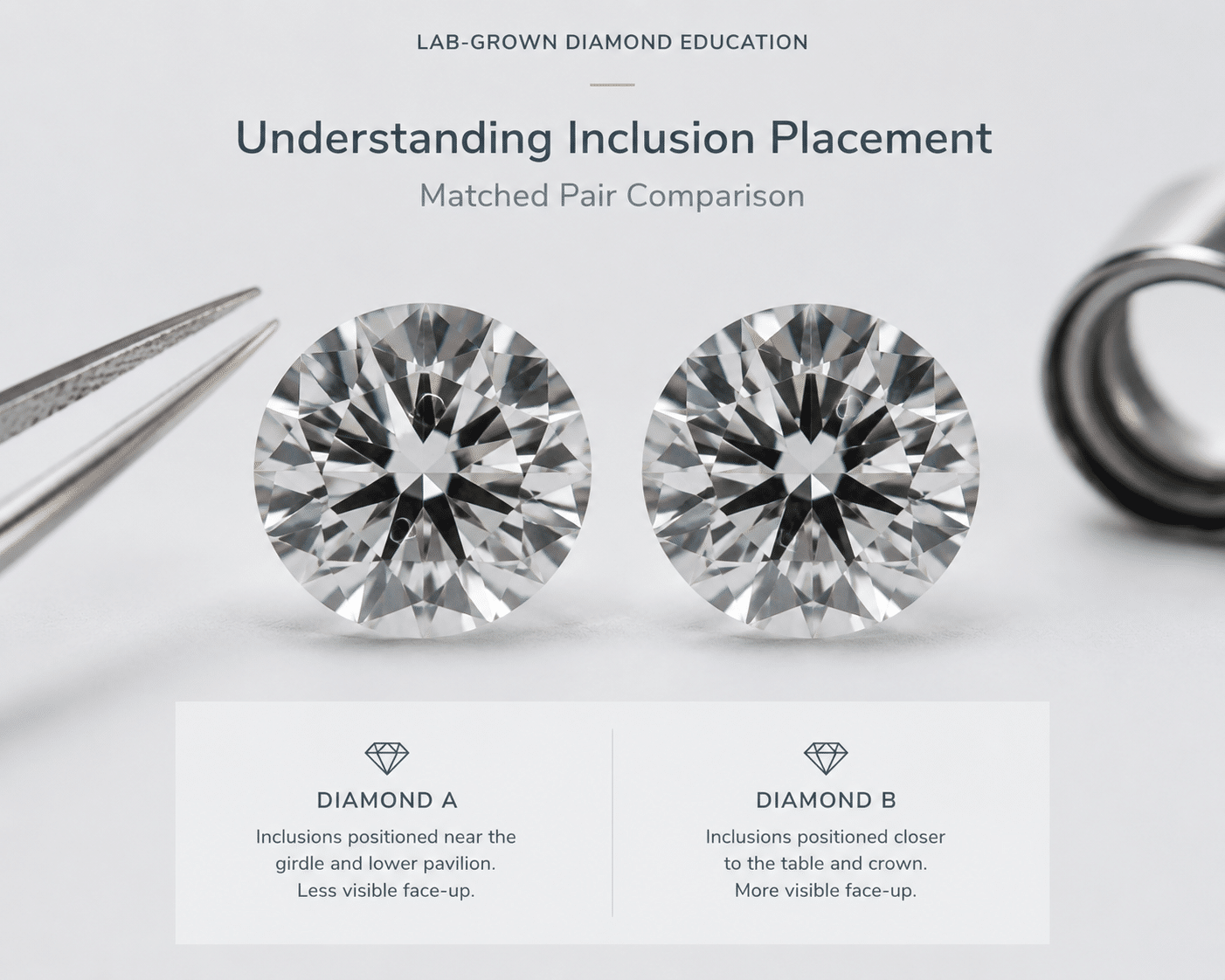
Clarity grading evaluates the size, number, and position of inclusions, but it does not evaluate visual pattern. Two stones can both be graded VS2 and contain completely different inclusion types. One may have a small crystal near the edge. The other may have a feather near the center. Under magnification, they look different. When they are mounted as a pair, that difference becomes visible.
For a pair of earrings or a three-stone ring, consistent inclusion pattern often matters more than the absolute clarity grade. A buyer is better off with two SI1 stones that have the same type and arrangement of inclusions than with one VS2 that looks clean and another VS2 that shows a different internal structure. The eye notices mismatch faster than it notices a slightly lower grade.
Brilliance Matching: The Limitation of the Clarity Grade on a Report
Two stones with identical clarity grades can return light differently because of where the inclusions sit. A centrally located inclusion reduces transparency more than an off-center one. If one stone has a central inclusion and the other has an inclusion near the girdle, the face-up brilliance will not match, even though both stones carry the same grade on paper.
This is one of the reasons premium layout work requires visual brilliance comparison that the grading report cannot capture. The report tells you what is inside the stone, but it does not tell you how visible those inclusions are in normal viewing conditions or how much light they block. Only direct comparison under controlled lighting reveals that.
For buyers working with lower clarity grades such as SI2 or I1, the matching challenge deepens further. At these grades, the location and type of inclusion can vary so widely that two stones with the same grade may look entirely different even to an untrained eye. The practical solution is to demand video of each stone rotating face-up and to request a side-by-side comparison at normal viewing distance, not under a loupe. If the supplier cannot provide this, the risk of receiving a visually mismatched pair increases significantly.
How Lab-Grown Diamond Growth Methods Affect Clarity Consistency
The two primary methods for producing lab-grown diamonds—HPHT (high pressure, high temperature) and CVD (chemical vapor deposition)—tend to create distinct inclusion types. Metallic flux inclusions are commonly associated with HPHT growth, while CVD stones may exhibit graining or growth striae.[3] When matching a pair, it is useful to confirm that both stones were produced using the same method and ideally the same production batch. A pair with one HPHT stone and one CVD stone may have the same clarity grade on paper, but their internal structures can differ in ways that become visible under direct comparison. Buyers who request batch-matched inventory from a single growth run are more likely to receive stones with consistent internal characteristics, reducing the risk of a visual mismatch.
What This Means in a Real Purchase
Ask for video of the stones rotating under direct light. Static photos can hide inclusion placement and light return issues. Request confirmation that the supplier has visually compared the pair against each other, not just selected two stones with the same grade from inventory.
For lower clarity grades such as SI1 and SI2, visual consistency becomes harder to achieve. Verify that inclusions are not in the center of the table and are not visible face-up in standard lighting. If one stone looks noticeably cleaner than the other at arm’s length, the pair will not look matched when mounted.
Cut Quality and Optical Consistency: The Hidden Driver of Visual Pair Harmony
Cut is the most important factor in a single stone, and it becomes even more critical in a pair. Two stones that look excellent on paper can still fail as a match if their optical behavior does not align.
Why Two GIA Excellent Cut Rounds Can Still Look Different When Paired
GIA Excellent is a range, not a fixed standard. Two stones can both carry the Excellent grade and have different crown angles, pavilion depths, and table percentages. One stone may be cut for maximum brightness, while the other may be cut for a larger spread. When they are mounted together, the difference becomes obvious.
Light return pattern, brightness distribution, and contrast pattern all change when proportions shift even slightly. For a single stone, the difference is rarely noticeable. For a pair, the difference becomes a distraction. The grade label is not precise enough to guarantee visual consistency between two stones.
Proportion Matching: Crown Angle, Pavilion Depth, and Table Size as Matching Criteria
Crown angle variation beyond 0.5 degrees can create a perceptible difference in how dark and bright zones are distributed across the stone. Table size variation beyond 1 percent can change the visual spread, making one stone look larger or smaller even if the carat weight is identical. Pavilion depth affects light return angle and overall brilliance intensity.
Premium matching standards include proportion range limits, not just cut grade labels. GIA’s cut grading system, for example, uses a range of crown angles and pavilion depths to define the Excellent category.[4] A supplier who seriously matches pairs compares these specific numbers, not just the letter grade on the report. The closer the crown angle, pavilion depth, and table percentage are between two stones, the better the visual match will be.
An additional factor worth checking is girdle thickness consistency. Two stones with the same crown and pavilion measurements but different girdle thicknesses can appear to have different depths when viewed from the side. In open settings like prong-set earrings, this difference becomes visible as a height mismatch. Asking for the girdle thickness notation on the grading report can help prevent this subtle but noticeable problem.
How to Verify This Before Buying
Ask for the proportion data from the grading report or the supplier’s own measurements. Compare crown angle, pavilion depth, and table size between the two stones. If the supplier cannot provide this data for both stones in the pair, the visual result depends on luck, not process. At that point, proceed with caution. A pair that looks matched under one light may look mismatched under another, and the problem will trace back to proportion differences that were never checked.
The Role of Disclosure in Supplier Communication
When discussing cut performance and matching criteria, clear communication from the supplier about what a grading report actually documents is a useful trust indicator. A grading report for a laboratory-grown diamond should clearly state the origin of the stone, and a supplier should be transparent about whether the proportion data provided comes from the report or from their own measurements. This distinction matters because a supplier’s own measurements may be taken under different conditions than those recorded by the laboratory. Buyers can ask whether the reported crown angle, pavilion depth, and table size are verified by a recognized grading laboratory such as GIA or IGI, or if they represent the supplier’s in-house data. The goal is not to claim that one source is always superior, but to ensure that the data being compared for matching is consistent and verifiable.
Supplier Capability: What to Ask Before You Commit to a Layout Stone Order
Not every supplier who sells lab-grown diamonds can deliver reliable matched pairs and layout sets. The difference between a supplier who can and a supplier who claims to comes down to process, inventory management, and what they are willing to show you before you buy.
Batch Matching vs. Individual Selection: What the Supplier’s Process Actually Is
Some suppliers maintain batch-matched inventory. In this model, stones are cut and graded together specifically for uniformity. The process costs more to maintain because it requires controlled production runs and dedicated inventory holding, but it produces more consistent results.
Other suppliers select pairs from separate inventory after grading. This model relies on having a large enough pool of stones to find good matches. It can work, but it requires rigorous comparison. The risk is that the supplier selects by grade alone and never visually compares the actual stones.
Ask which process your supplier uses. Batch-matched inventory is a stronger signal of matching capability than individual selection from general stock.
Disclosure and Terminology in Lab-Grown Diamond Sourcing
The Federal Trade Commission (FTC) has issued guidance emphasizing the importance of clear and accurate terminology when marketing laboratory-grown diamonds.[5] While this guidance primarily addresses advertising and consumer-facing communication, it has practical implications for wholesale matching as well. A supplier who uses precise, non-misleading language when describing their inventory and batch sourcing is more likely to follow thorough practices in other aspects of their operation. Buyers can use the clarity of a supplier’s disclosure language as one qualitative signal when comparing potential partners. A supplier who cannot clearly explain whether their inventory is batch-matched or individually selected may also lack rigor in the matching process itself.
Visual Confirmation Standards: Photos, Video, and Mockups
A responsible supplier should be able to provide side-by-side photos before purchase, not stock images. Rotating video under controlled lighting helps you assess color, clarity, and brilliance consistency. For tight layout work such as tennis bracelets or eternity bands, a mounted mockup using sample stones from the same batch can reveal cumulative fit issues that single-stone photos will not show.
If a supplier will not offer visual confirmation before you commit, the matching risk transfers entirely to you. In wholesale purchasing, where returns are more complicated and timelines matter, this risk is not worth taking.
Buyer Verification Checklist
For B2B buyers in the jewelry industry, evaluating suppliers for wholesale lab grown diamonds is critical. Ask these questions directly before placing an order to assess manufacturer reliability and product quality. The comprehensive guide on wholesale lab grown diamonds supply options details key factors for jewelers and brands. This approach supports effective custom jewelry manufacturing and private label programs.
Do you maintain batch-matched inventory, or will these stones be selected from separate stock?
Can you provide side-by-side video under the same lighting conditions for every stone in the order?
What is your tolerance for millimeter variance in this specific shape?
Can you send a sample set for visual inspection before I commit to the full order?
What is your exchange or return policy specifically for matched pairs and layout sets? Some suppliers accept returns on single stones but not on paired inventory. Know this before you pay.
Documentation Consistency Across Matched Inventory
When sourcing matched pairs or layout sets wholesale, documentation consistency is a practical trust signal that buyers often overlook. A supplier who can provide grading reports from the same laboratory, issued around the same time, and with consistent measurement and proportion data across the set, demonstrates a systematic approach. Inconsistencies in how reports are presented—for example, one stone graded by GIA and another by IGI, or reports dated months apart with different measurement methodologies—can introduce subtle variances that are harder to catch without direct documentation scrutiny. The practical step is to request copies of all grading reports for a set before purchase and to check that the reported measurements, proportion data, and laboratory identifiers are consistent. This does not guarantee a visual match, but it filters out documentation-level mismatches that would later create confusion during setting or resale.
How Diamond Shape Changes the Matching Challenge
Not all shapes present the same matching difficulty. Some are straightforward to pair from standard inventory. Others require dedicated production runs and tighter tolerances. Understanding which shapes fall where helps you set realistic expectations before you start looking for a supplier.
Round Brilliant: Easiest to Match, with the Widest Supplier Availability
Round brilliants benefit from the most standardized proportion sets and the largest inventory pool of any shape. Because more rounds are manufactured each year than any other cut, finding a well-matched pair or layout batch is significantly more straightforward. The main risk is proportion variance within the Excellent grade range, which is manageable as long as you request and compare the actual proportion data. For common sizes such as 0.50, 0.75, and 1.00 carat pairs, the matching process is routine for most experienced suppliers.
Princess Cut: Color and Size Variation as the Primary Challenges
Princess cuts introduce more variables. The shape has a wider range of table sizes, length-to-width ratios, and color depth variations than rounds. Color inconsistency in the G-H-I range becomes more visible because the step-like faceting holds and reflects color differently from brilliant faceting. Size matching also requires tighter tolerance. In a square-to-square layout, even a small difference in dimension is immediately visible without needing a measuring tool. If you are sourcing princess pairs, prioritize millimeter measurements over carat weight alone.
Emerald and Asscher Cut: The Most Difficult to Match
Step cuts expose every variance more harshly than brilliant cuts. The faceting pattern does not mask imperfections in color, clarity, or proportion. A 0.1mm difference in length that would go unnoticed in a brilliant cut becomes obvious in a step-cut pair. Matching requires very close color and clarity grades, nearly identical crown angles, and consistent length-to-width ratios. Expect fewer available options per batch and a higher premium for well-matched pairs. If a supplier offers a step-cut pair at the same price as a round pair of the same carat weight, the matching quality likely needs visual confirmation.
Baguette and Tapered Baguette: The Most Tolerance-Sensitive of All Shapes
Baguettes and tapered baguettes used in linear layouts—eternity bands, line bracelets, straight-line necklaces—require millimeter-level precision in both length and width. A 0.05mm variance across a ten-stone set creates a measurable cumulative offset that shifts the entire piece out of alignment. Shape consistency matters just as much: each stone must have the same taper angle. These are the hardest stones to match, and only specialized suppliers with controlled production can deliver reliable results. For tapered baguettes, ask for the top and bottom width measurements separately to verify that the taper angle is identical across all stones.
What This Means in a Real Purchase
For square or straight-edge shapes, confirm the exact millimeter dimensions in both directions. For tapered baguettes, request the top and bottom width measurements to verify taper angle consistency. For step cuts, ask for face-up video under direct light to check for color variation. If you are buying a set of more than two stones, verify that all stones come from the same production batch.
Pricing: What Matching Adds to the Stone Cost and When the Premium Is Justified
Matched pairs and layout stones carry a premium over single stones of the same grade. The question is whether that premium is a fair cost of labor or an unnecessary markup. Understanding the difference depends on knowing what matching actually requires from the supplier.
Why a Matched Pair Costs More Than Two Single Stones of the Same Grade
Matching requires additional labor and a larger inventory pool to draw from. The supplier must hold multiple stones with compatible grades, perform side-by-side visual comparisons, and reject stones that do not align within the required tolerances. The premium reflects this process cost, not an arbitrary markup. For common shapes and sizes, such as 1.00-carat round pairs, the premium is smaller because the inventory pool is wide and the demand is predictable. For rare shapes, larger carat weights, or tight tolerance requirements, the premium increases because fewer candidate stones exist to begin with.
The Layout Stone Volume Discount and the Hidden Matching Risk
Large layout orders of 20 or more stones often come with a volume discount, but that discount can carry a matching risk. To fill a large order at a reduced price, the supplier may pull stones from multiple production batches. The result is visible inconsistency across the set that would not exist if all stones came from a single batch. A general rule: if the per-stone price is significantly below the market rate for matched layout stones, confirm the matching visually before committing to the order. A discount on unmatched inventory is not a bargain if the finished piece requires rework.
A related consideration for layout orders is the supplier’s ability to provide replacement stones. If one stone in a 30-stone set is damaged during setting, will the supplier have a matching spare from the same batch? Without batch continuity, replacing a single stone becomes difficult, and the entire piece may need to be reworked. Asking about spare-stone availability from the same production run can save significant time and cost later.
What This Means in a Real Purchase
Ask for a price breakdown that separates the stone cost from the matching cost. For large layout orders, confirm whether all stones come from the same production batch. Request a visual sample of the batch before confirming the full order. Be cautious of offers that claim heavy discounting on matched pairs—matching is labor, and labor costs money. If the price seems too good for a matched set, the matching quality is likely what was sacrificed.
Traceability and Communication in Wholesale Sourcing
In sourcing or wholesale conversations, documentation, consistency, and communication often matter as much as the headline specification. A supplier who can clearly articulate the batch origin, the matching criteria applied, and the visual comparison method used provides a level of transparency that reduces risk for the buyer. This is especially important for matched pairs and layout sets, where the cost of a mismatch is high and the margin for error is small. Buyers should prioritize suppliers who offer clear documentation trails and are willing to answer detailed questions about their matching process. The goal is not to find a supplier who claims perfection, but one who demonstrates a repeatable and verifiable approach to consistency.
Summary: How to Evaluate a Supplier’s Real Matching Capability Before You Buy
The practical difference between a supplier who can deliver consistent matched pairs and one who simply claims to comes down to a few specific questions. Asking them directly before committing to an order will tell you more than any marketing description.
The Five-Minute Supplier Assessment Framework for Pair and Layout Sourcing
Run through these five points before you place an order:
Can the supplier show you the actual stones you will receive, not just stock photos or generic catalog images? If the answer is no, you are buying blind. Can they provide detailed measurements and proportion data for each stone? Carat weight alone is not enough. You need millimeter dimensions and crown and pavilion data. Do they maintain batch-matched inventory or rely on post-production selection from separate inventory? Batch-matched inventory is more consistent but more expensive to maintain. Can they show you a completed piece using stones from the same batch? A finished piece tells you more than a photo of loose stones. Is their return policy clearly defined for matched pairs and layout sets? Some suppliers accept returns on single stones but not on paired inventory.
Final Buyer Verification Checklist
Before any large pair or layout order, verify each of the above points in writing. A supplier who cannot answer these questions clearly is not a reliable source for matched or layout stones. A supplier who provides transparent, visual, and measurement-based confirmation is one you can trust to deliver a result that will not need to be returned or reworked.
When a grading report is provided for a matched pair or layout set, buyers should verify the report details through the issuing laboratory’s official report-check tools where available, and compare those details with the stone’s visual evidence and measurements. The report is a starting point for documentation consistency, not a guarantee of visual pair harmony.
[1] GIA, “A Guide to Diamond Color,” GIA.edu, describes the GIA color grading scale as a standardized system using master stones, where stones within the same grade can fall at different points within the range.
[2] GIA, “Diamond Grading Report,” GIA.edu, explains that a GIA Diamond Grading Report includes the 4Cs, a plotting of clarity characteristics, and a section for proportion information and measurements.
[3] GIA, “HPHT and CVD: The Methods for Growing Diamonds,” GIA.edu, explains the characteristics of HPHT and CVD growth, noting that HPHT stones may contain metallic flux inclusions while CVD stones may show graining or growth striae.
[4] GIA, “Diamond Cut Grading,” GIA.edu, states that GIA’s cut grading system for round brilliants uses a range of proportion values including crown angle and pavilion depth to define the Excellent category.
[5] Federal Trade Commission, “Guides for the Use of Environmental Marketing Claims” (Green Guides) and FTC Jewelry Guidance, 2018 updates, FTC.gov, discuss requirements for clear disclosure in advertising, including terminology for laboratory-grown diamonds.
Disclosure: This article is for general educational purposes only. Diamond grading, pricing, availability, specifications, and seller policies can change, and readers should verify important details through grading reports, official laboratory tools, seller documentation, or qualified professionals before making a purchase decision. Laboratory-grown diamonds should be clearly distinguished from natural diamonds, and environmental or sourcing claims should be supported by specific documentation.