
A tennis bracelet requires dozens of individually set diamonds to work as a seamless line of light. Unlike a single-stone ring, this design demands near-perfect consistency across every link. A difference in color between two diamonds that would be invisible in a solitaire becomes obvious and distracting in a tennis bracelet. Buyers who focus only on total carat weight or top-line grades often end up with a piece that looks uneven on the wrist. The lab grown diamond bracelet guide helps you evaluate the factors that actually determine visual harmony, daily wear durability, and value. You will learn how to compare individual stone sizes, verify grading reports, assess clasp safety, and choose the right metal and setting for long-term use.
For the full framework, read Lab-Grown Diamond Jewelry Guide.
| Factor to Check | What to Prioritize | Common Mistake |
|---|---|---|
| Individual stone size | 0.30+ carat per stone for visible sparkle | Judging by total carat weight alone |
| Color consistency | Tight two-grade window (e.g., G-H) | Assuming one grade on paper means visual match |
| Grading report | Full-set report with color/clarity range | Thinking certification covers visual matching or setting security |
| Clasp mechanism | Double-locking with safety catch | Overlooking clasp as a structural weak point |
| Setting type | Flexible four-prong construction | Choosing stiff settings that snag or loosen easily |
| Metal choice | 14k gold for daily-wear weight and hardness | Assuming higher karat equals better durability |
Quick Questions Before You Read
Q: Do I need D-color flawless diamonds in a tennis bracelet?
No. For a bracelet, consistent color (G-H) and clarity (SI1-VS2) across all stones matter more than top individual grades. You will not see differences visible only under magnification on the wrist.
Q: Is a grading report enough to guarantee the bracelet looks good?
No. A report confirms total carat weight and a range for color and clarity, but it does not verify visual matching, setting security, or clasp quality. You must also check individual stone measurements and the clasp mechanism.
Q: Which purchase channel offers the best value?
Online direct brands typically offer transparent documentation and pricing structures that allow for direct comparison. Retail stores provide the advantage of in-person inspection and try-on, while custom orders give full design control but involve longer lead times. Each path has tradeoffs worth evaluating against your priorities.
Q: How should I maintain a lab-grown diamond tennis bracelet?
Lab-grown diamonds share the same hardness and wear resistance as natural diamonds. Annual professional inspection for prong tightening is recommended. Separate warranty coverage for diamond defects and setting issues is worth confirming with the seller.
Why the Tennis Bracelet Demands More Attention Than Most Buyers Expect
Most diamond buyers spend weeks researching a single solitaire. They compare cut grades, study color charts, and examine certificates. But when that same buyer starts looking at a tennis bracelet, the entire decision framework shifts. A tennis bracelet is not one purchase—it is thirty to sixty individual purchases that must work together as a single piece. One mismatch in brightness, color, or size becomes immediately visible against the repeated pattern. This changes what matters most.
The Difference Between a Bracelet and a Single-Stone Purchase
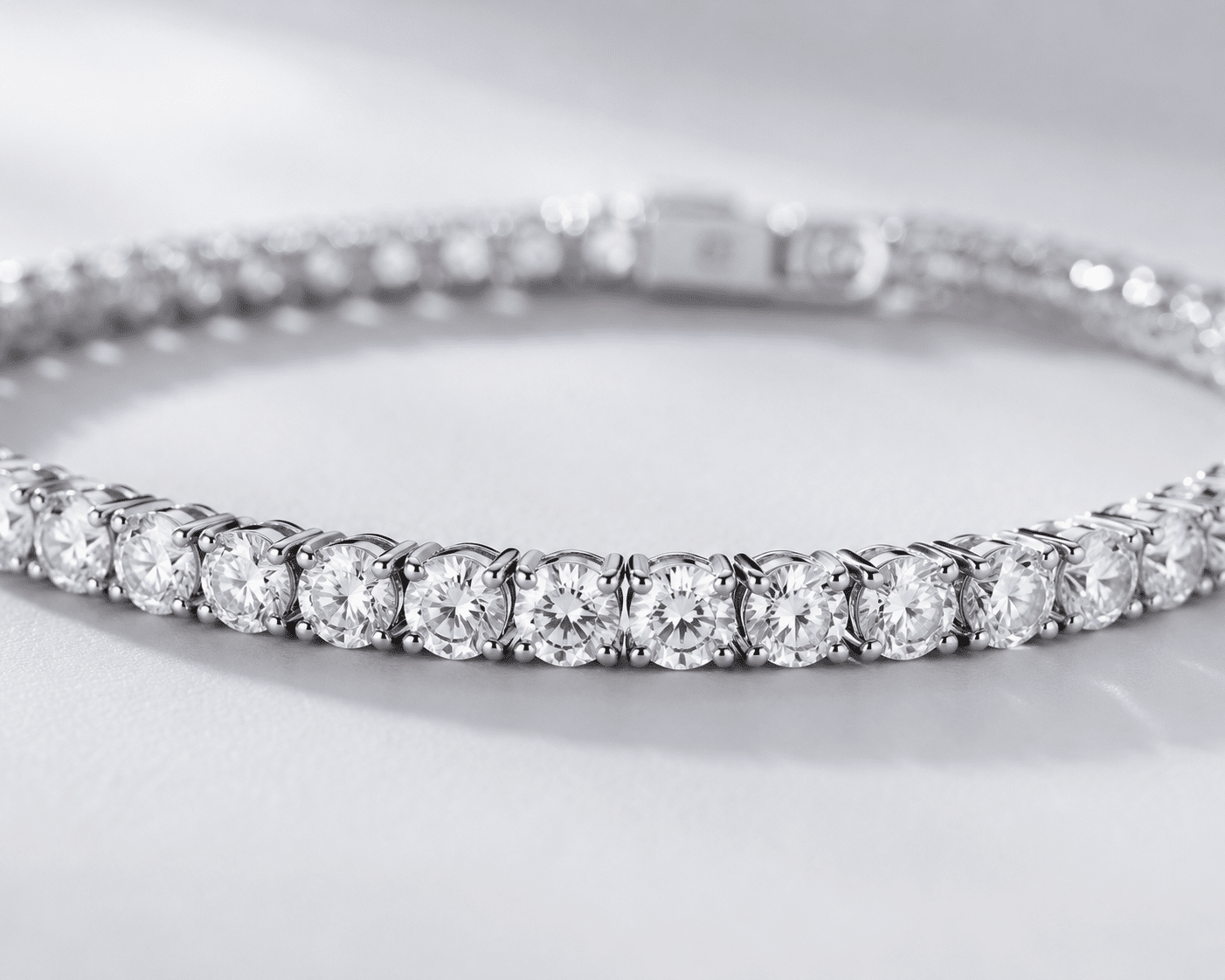
A solitaire ring depends on one diamond. If that stone is well-cut and well-graded, the purchase is straightforward. A tennis bracelet requires every stone in the set to match the others in cut, color, clarity, and carat weight. A single off-color stone or one poorly cut diamond stands out immediately against the line of its neighbors. The buyer is not selecting one diamond—they are evaluating how thirty to sixty diamonds perform together. The average grade on a certificate tells you less than the consistency across the full set.
Why Stone Consistency Becomes the Dominant Decision Factor
When diamonds sit side by side, the eye catches variation instantly. One stone with a slightly warmer tint, a dimmer return, or a fraction of a millimeter difference in size will break the visual flow. This is why matching grade matters more than headline grades. A bracelet with all stones verified at G-H color and VS clarity often delivers a cleaner look than a bracelet with individually graded D-VVS stones that were not matched as a set. The higher-graded stones may look excellent on paper but mismatched on the wrist. Buyers should ask for confirmation that every stone in the bracelet falls within a narrow range, not just the average across the lot.
How Daily Wear Physics Differs From Ring or Earring Use
A ring takes direct impact against surfaces. An earring stays mostly still. A tennis bracelet experiences constant micro-movement: it flexes with the wrist, contacts desk edges, catches on sleeves, and shifts position throughout the day. The setting must absorb this motion without loosening stones or stressing the metal. Setting quality, prong design, and overall construction are as important as the diamonds themselves. A well-graded stone is useless if the setting cannot hold it securely under daily use.
What to Check Before You Decide
Ask the seller for a full matching report or written confirmation that all stones fall within a narrow grade range for cut, color, and clarity. Inquire whether the stones were physically matched under natural lighting, not just sorted by certificate grade. Verify the total diamond weight and the individual carat weight tolerance—small discrepancies compound across thirty stones. Examine the bracelet under both direct light and diffused light to check for visible color or brightness variation. Finally, confirm the measurement range for each diamond; a 0.5mm difference becomes noticeable in a full bracelet.
For buyers, a useful distinction here is between “grade-matched” and “visually matched.” Grade-matched means the stones fall within the same certified window. Visually matched means they were also compared side by side under daylight-equivalent lighting. The latter is what actually determines how the bracelet will look on the wrist, and not every seller performs this second step.
Diamond Size, Carat Weight, and Visual Impact in a Tennis Bracelet
Total carat weight is the most common number buyers look at, but it only tells part of the story. How that weight distributes across the bracelet determines what the piece actually looks like on the wrist, how much each diamond contributes to the overall sparkle, and where your money is going.
How Total Carat Weight Translates to Individual Stone Size
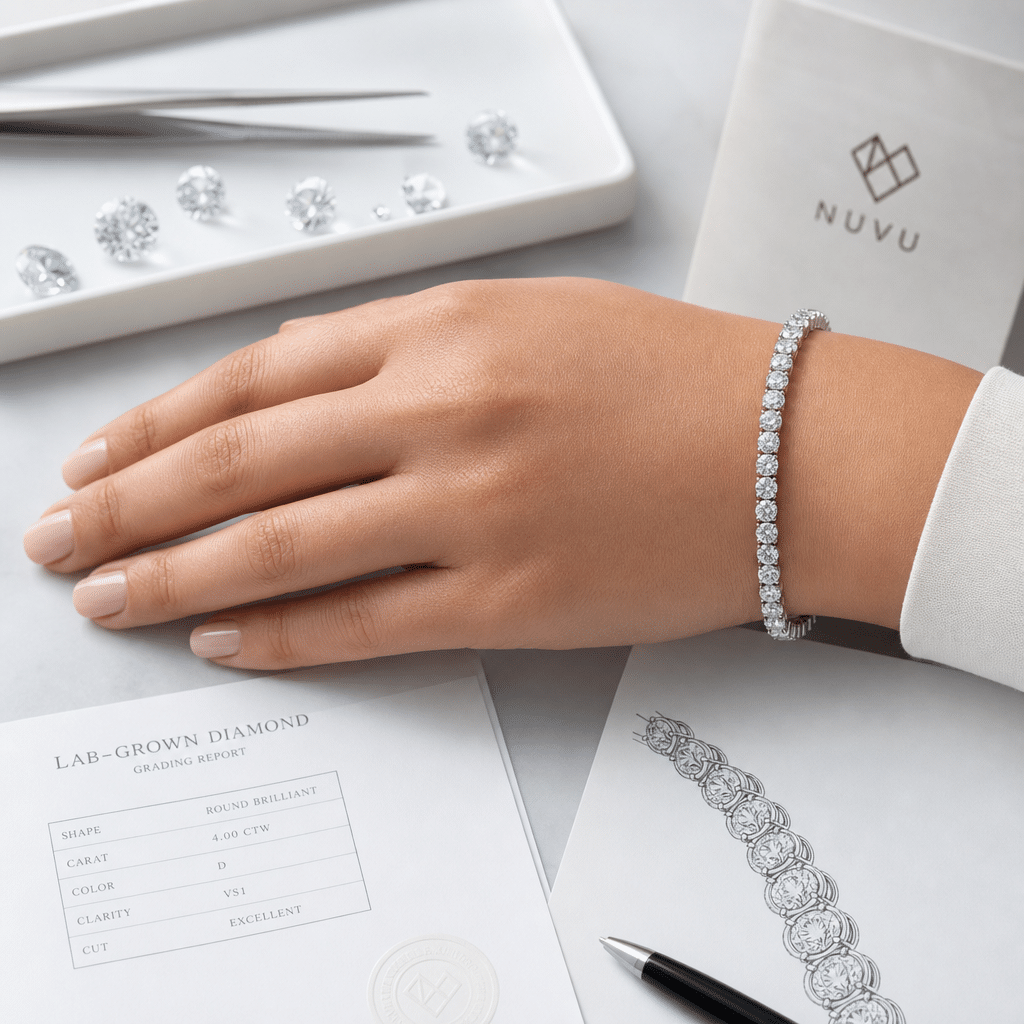
The same total carat weight can produce very different looking bracelets depending on how many stones it is divided across. A 3.0 tcw bracelet with approximately 0.10 carat per stone creates a delicate, continuous line. A 10.0 tcw bracelet with 0.30 to 0.35 carat per stone shows each diamond as a distinct element. A 20.0+ tcw bracelet with 0.50 to 0.70 carat per stone makes a substantial visual statement. As a practical example, a 7-inch setting with 32 stones at 10.0 tcw yields roughly 0.31 carat per diamond. Buyers should calculate individual stone weight, not just total carat weight, because that number determines each diamond’s visible surface area and light return.
Visual Size: Where Small Stones Underperform and Where They Shine
Stones below 0.10 carat tend to read as a continuous sparkle line rather than individual diamonds. Some buyers prefer this effect for a subtle, understated look that complements rather than dominates. Stones at 0.30 carat and above create distinct diamond-by-diamond visual impact, which is what most buyers picture when they think of a classic tennis bracelet. The catch is that cut quality becomes disproportionately important at smaller carat weights. A 0.08 carat diamond has very little surface area to compensate for poor light return. If cut quality slips, that stone simply looks dim next to its neighbors, and at small sizes, dimness is more noticeable.
Budget Tradeoffs Between Higher Carat Weight and Better Diamond Quality
This is the central tradeoff. A 10.0 tcw bracelet with I-J color and SI clarity offers dramatically more visible diamond surface than a 5.0 tcw bracelet with D-VVS stones. For most buyers, the visual impact favors higher total carat weight at good-but-not-flawless grades. Premium grades at lower carat weight may look better on paper, but a lighter bracelet with fewer carats tends to feel less substantial on the wrist and catch less light at a distance. The practical question is whether the diamonds sparkle consistently, not whether each one would earn a top grade in isolation.
One point worth repeating: total carat weight is often presented as a single number, but it does not tell you how the weight is distributed. A 10 tcw bracelet with 50 small stones will look completely different from a 10 tcw bracelet with 25 larger stones, even though both carry the same total diamond weight. Buyers should always ask for both the total carat weight and the number of stones, then calculate the approximate weight per stone themselves.
Certificate and Visual Review Check
Confirm both total carat weight and the individual stone weight range from the seller. If possible, request individual stone measurements in millimeters to verify consistency. View the bracelet at arm’s length and then close up—these are two entirely different visual tests. Finally, compare how the bracelet looks against your skin tone and wrist size in natural light. A bracelet that pops on one person may look flat on another depending on how the light hits the wrist angle.
Clasp Security: The Most Frequently Overlooked Structural Weak Point
Most buyers spend their attention on diamond quality and setting style. The clasp is usually an afterthought. It should not be. The clasp is the mechanical weak point where tennis bracelets most commonly fail. A bracelet with beautiful diamonds and a weak clasp is a bracelet at risk of being lost entirely.
Why the Clasp Bears the Highest Mechanical Load
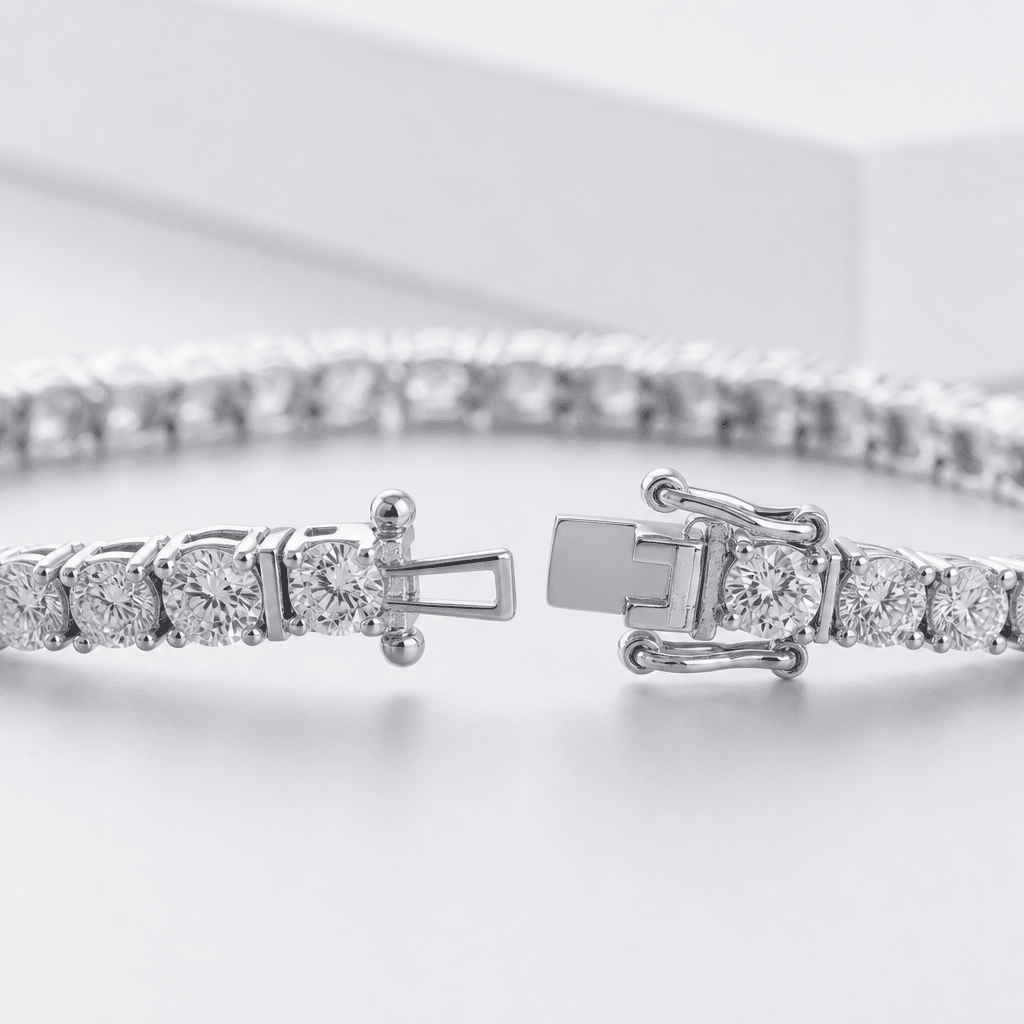
The clasp is opened and closed daily. It endures constant wrist movement pressure. It is the point most vulnerable to accidental snagging on clothing, bags, or desk edges. A standard box clasp with a single safety catch is not sufficient for a daily-wear lab-grown diamond bracelet. Buyers should look for double-locking mechanisms, hidden push-button clasps, or hinge-reinforced designs that distribute stress more evenly. A single point of failure is one mistake away from a lost bracelet.
Security Features That Actually Reduce Loss Risk
The most effective security features are those that require two intentional motions to open. A secondary safety latch prevents the clasp from releasing if the primary catch is accidentally triggered. A tension-tested hinge rated for daily use resists wear better than a standard hinge. Some bracelets include a small security chain connecting the two ends—a backup catch that holds the bracelet together if the primary clasp fails. These features add minimal bulk and significant peace of mind. A clasp that opens too easily is not a convenience—it is a risk.
How Clasp Design Affects Wrist Fit and Movement
A bulky clasp is not just an aesthetic problem. It can feel uncomfortable, move to an awkward position on the underside of the wrist, or cause the bracelet to rotate. Buyers should verify that the clasp sits flat, does not protrude noticeably, and stays centered when worn. The clasp’s metal thickness should match the bracelet body. A thin, lightweight clasp on a heavy bracelet is a clear warning sign that the clasp may not withstand the forces it will face over months and years of daily wear.
Stone-to-Setting Fit Check
Ask the seller to confirm the clasp type, the number of safety mechanisms, and the metal thickness at the clasp hinge. Request a close-up photo or video of the clasp in both open and closed positions so you can see how the locking mechanism engages. For a thorough understanding of necklace and pendant selection, refer to the lab grown diamond necklace guide. Confirm whether the clasp can be repaired or replaced separately if damaged—some designs require replacing the entire bracelet. Finally, verify that the warranty covers clasp failure specifically, not just diamond loss or setting defects.
When a grading report is provided, buyers should verify the report details through the issuing laboratory’s official report-check tool where available. A grading report can narrow the comparison, but it should be read alongside the stone’s proportions, visual evidence, and intended jewelry use.
Metal Strength, Flexibility, and Bracelet Length
The metal you choose, how the bracelet links move, and whether the length fits your wrist determine how the piece feels after an hour of wear, not just how it looks in the box. These factors are often treated as secondary to diamond selection, but they directly affect daily comfort and long-term durability.
Understanding Documentation for Metal Composition
When buying a tennis bracelet, the metal type and karat should be stated clearly in the product listing or accompanying documentation. Hallmarks such as “14k” or “750” for 18k gold are standard indicators of metal purity and are typically stamped on the clasp or a link. Buyers should ask for a clear statement from the seller regarding whether the bracelet is solid gold or gold-filled, as the two can look similar but have very different durability and value profiles. A simple request for written confirmation of metal composition is a practical verification step that avoids assumptions.
Metal Type Suitability for Daily-Wear Tennis Bracelets
14k gold is the most practical choice for regular daily wear. It offers a strong balance of hardness and weight, resisting scratches better than higher-karat alloys while still carrying a rich gold color. 18k gold contains a higher percentage of pure gold, which makes it softer. This means settings must be slightly thicker to hold stones securely, though the deeper color appeals to many buyers. Platinum is extremely durable but noticeably heavier. On smaller wrists, the extra weight can cause the bracelet to slide downward or rotate, reducing the visual display of diamonds on top of the wrist. Silver is not recommended for daily-wear diamond jewelry. It is too soft to hold small prongs securely over time and will tarnish with regular skin contact.
Gold alloy selection is partly a preference question, but the practical impact on stone security is real. A 14k setting with the same prong thickness will hold stones more securely over time than an 18k setting, simply because the metal is harder. This is one area where higher pure gold content does not automatically mean better construction for a multi-stone bracelet.
Why Flexibility Matters More Than Initial Appearance
A tennis bracelet bends with your wrist throughout the day. A rigid bracelet feels stiff and uncomfortable after a few hours. A bracelet that is too loosely constructed allows the diamond channel to droop, slap against the wrist during movement, or slide to the underside where the stones are not visible. The best designs use four-prong or shared-prong settings with flexible link connections that allow natural movement while keeping each stone oriented upward. Before buying, ask to see the bracelet flex in motion. A stiff bracelet will not break in with wear, and a floppy one will never sit properly.
Finding the Right Length for Your Wrist
Standard tennis bracelet lengths range from 6.5 to 7.5 inches, but wrist sizes vary. The correct measurement is taken around the wrist bone, with an additional 0.25 to 0.5 inches of ease so the bracelet sits comfortably without pinching or sliding. A bracelet that is too short will not clasp without force. A bracelet that is too long allows the diamond channel to rotate out of position, reducing visual impact and increasing the risk of catching on objects. Most miscues happen when buyers guess their size instead of measuring. A fabric measuring tape or a piece of string measured against a ruler takes thirty seconds and eliminates the risk.
Buyer Verification Checklist
- Confirm metal type, karat, and whether the bracelet is solid gold or gold-plated.
- Ask about setting prong style and whether the bracelet has reinforced links at stress points.
- Provide your exact wrist measurement, not a guess, and verify bracelet length from the seller.
- Request a video of the bracelet flexing naturally to assess link movement.
Setting Styles and Stone Security in Tennis Bracelets
The setting determines how much light reaches each diamond and how securely each stone stays in place. Different designs favor visibility or protection, and the right choice depends on how often you plan to wear the bracelet and under what conditions.
Four-prong settings hold each diamond with four individual prongs. This design offers higher individual stone security, because each prong only affects the diamond it grips. If a prong loosens or requires repair, only that single stone is affected, and replacement is straightforward. Shared-prong settings use one prong between two adjacent diamonds, creating a more continuous line of sparkle with less metal visible between stones. The tradeoff is structural: one loosened prong can affect two stones simultaneously. For most buyers choosing standard daily wear, four-prong settings provide a better safety margin with only a small reduction in diamond continuity.
Bezel Settings for Higher Security
Bezel settings surround each diamond with a thin metal rim. This design offers the highest level of stone protection and snag resistance because there are no exposed prongs to catch on clothing or desk edges. The tradeoff is reduced sparkle visibility, because the metal rim blocks light entry from the sides. For buyers who plan to wear their tennis bracelet during active daily routines, while traveling, or during athletic use, bezel settings significantly reduce the risk of losing a stone. For buyers who prioritize maximum brilliance and prefer the traditional tennis bracelet look, prong settings remain the better visual choice.
It is worth noting that setting choice also affects how easily the bracelet can be resized or repaired. A four-prong setting allows individual stone replacement without disturbing neighboring diamonds, while a shared-prong or channel setting may require more extensive bench work if a single stone is damaged. Buyers who plan long-term ownership may want to factor in future repair accessibility.
Setting Height and Wrist Clearance
Taller settings raise the diamonds further off the wrist, which can create a more dramatic appearance but also increases the risk of catching on sleeves, desk edges, and other surfaces. Lower settings sit closer to the wrist, reducing snagging risk but slightly limiting light entry from below the stone. A medium setting height, roughly 3 to 4 millimeters total from the wrist surface to the top of the diamond, balances visibility with practicality for most daily wear situations. If you work at a desk, type frequently, or wear long sleeves often, lower-profile settings will cause fewer interruptions.
What This Means in a Real Purchase
- Ask which setting style is used and why the seller recommends it for your wear frequency.
- Request a side-view photo to assess setting height and prong visibility.
- Confirm that each prong or bezel is checked for uniform tightness before shipping.
- Ask whether individual stone replacement is possible without re-making the entire bracelet.
Lab-Grown Diamond Quality Grading for Tennis Bracelets
The 4Cs apply differently to a tennis bracelet than to a single diamond. Because the bracelet contains dozens of stones that must look consistent together, the grading priorities shift. What matters most is not the peak grade of one stone, but how the entire set performs as a single visual unit.
A Note on Terminology: Throughout this section, “lab-grown diamond” refers to diamonds created in a laboratory setting, which should be clearly distinguished from natural or mined diamonds. Buyers should also be aware that diamond simulants — such as cubic zirconia or moissanite — are different materials entirely. Simulants are not the same as lab-grown diamonds, and any product listing should clearly state whether the stones are laboratory-created diamonds or substitutes.
Why Cut Quality Overrides Color and Clarity in Bracelet Selection
Cut quality determines how much light each diamond returns. In a tennis bracelet, every stone sits next to another, so even small differences in brightness become immediately visible. A well-cut stone at G-H color and VS clarity will appear brighter and more lively than a poor-cut stone at D color and VVS clarity. This is not theoretical—it is visible the moment the bracelet is held under direct light. Buyers who prioritize cut consistency across the full set will end up with a bracelet that looks more uniform and brilliant than one assembled from diamonds with higher color or clarity grades but uneven cut quality.
Color Matching Across the Full Bracelet
A bracelet graded at G-H color means the stones fall within that two-grade window. At this range, neighboring stones appear identical to the naked eye because the color difference between G and H is subtle even to trained observers under controlled conditions. The risk appears when a bracelet is labeled with a single grade, such as F-G, but actually contains stones that span three or four color grades, with only the average falling within that range. A single off-color stone in a full line of diamonds will stand out immediately. The seller should confirm that all stones sit within a two-grade color window, not just that the average or best stone reaches that label.
A practical observation: color matching in a tennis bracelet is partially about the grade range, but also about how the stones are arranged. Some manufacturers place slightly warmer stones at the ends of the bracelet, where they are less visible against the wrist, and the coolest stones at the center, where they catch the most light. This is a legitimate matching strategy, but it should be disclosed rather than hidden. Buyers can ask whether the stones were arranged by color placement or simply set in random order from the batch.
Clarity Requirements: Why SI1 Is Usually Sufficient
At the stone sizes commonly used in tennis bracelets, between 0.10 and 0.50 carats per stone, inclusions visible at the SI1 grade are typically undetectable without magnification. VS2 provides a comfortable safety margin with no visible inclusions under normal viewing conditions. Higher clarity grades, VS1 and above, add cost without providing any visible benefit at these stone sizes. The money is better spent on improving cut quality or total carat weight. A buyer who insists on VVS clarity across a 50-stone bracelet is paying for a specification that makes no visible difference at arm’s length.
That said, clarity matching still matters at lower grades. If a bracelet contains stones ranging from SI1 to VS2, the variation in inclusion type and location can occasionally create visible differences under certain lighting angles, even if individual inclusions are not obvious. A buyer who chooses SI1 should confirm that the seller has reviewed the stones for eye-clean consistency, not just grade range.
Certificate and Visual Review Check
- Request the bracelet’s grading report from a recognized lab (IGI or GIA for lab-grown diamonds).
- Confirm that the report includes the full set’s matching grade, not just one representative stone.
- Review high-resolution video under direct and diffused light to check for brightness or color variation.
- Ask whether the seller individually verified cut quality for each stone, not just carat weight and color.
Certification, Report Verification, and Documentation Expectations
A grading report for a tennis bracelet is not the same as a report for a single diamond. Buyers who expect individual grading for each stone will be disappointed, but the documentation that does exist is still useful when read correctly.
What a Grading Report Confirms for a Tennis Bracelet
A bracelet-level grading report confirms the total carat weight across all stones, the color range, and the clarity range for the full set. It does not assign individual grades to each diamond. For a 30-stone bracelet, the report might state G-H color and VS clarity, meaning every stone falls within that window. Some sellers also provide a matching-grade certificate that explicitly verifies all stones fall within specified ranges. This is a stronger document than a simple grade range because it confirms deliberate sorting rather than batch averaging.
It is helpful to understand what a “range” really represents. If a report states G-H color, some stones in the bracelet may be G and some may be H. Both are within the stated window, but a bracelet where all stones are G will look different from a bracelet where most are H with only a few G stones. The report alone does not tell you the distribution. For NUVU, this kind of documentation is treated as a practical starting point: the report narrows the field, but the final decision still benefits from visual review, individual measurement checks, and discussion of how the stones were sorted.
What the Report Does Not Confirm
A grading report says nothing about visual matching quality. Two stones can share the same grade and still look different side by side under natural light. The report also does not evaluate setting security, clasp durability, prong consistency, or overall construction quality. These factors must be assessed separately through high-resolution photos, video under multiple lighting conditions, seller specifications, and warranty terms. A bracelet with an impressive report and poor construction is still a poor bracelet.
Important clarification: A grading report documents key characteristics of the diamonds, but it should not be treated as a guarantee of beauty, value, or sourcing ethics. It is a tool for comparison and verification, as discussed in lab grown diamond jewelry guide, which explains how lab diamonds fit beyond engagement rings, not a certificate of perfection.
Practical Verification of Grading Reports
When a grading report is provided, buyers should locate the report number on the document and use the issuing laboratory’s online verification system where available. GIA, IGI, and GCAL all offer report-check tools that allow a buyer to confirm basic details such as total carat weight, color and clarity ranges, and any laser inscription data. This step cross-references the document against the lab’s database and is one of the simplest ways to verify that the documentation is genuine. Sellers should be able to provide the report number without delay; if they cannot, it is worth questioning why. A genuine report number is a traceable public record, not a confidential detail. For custom designs or wholesale orders, buyers should request a copy of the report before the bracelet is assembled, so that the documentation can be checked independently before the piece is finalized.
Lab-Grown Diamond Identification and Laser Inscriptions
Most lab-grown diamonds from reputable grading labs carry a laser inscription on the girdle matching the report number. In a tennis bracelet, individual stones may not be accessible for inscription due to how they are set. Some sellers provide lot-level traceability, where the full bracelet carries a collective inscription or a manufacturer certificate. Buyers should ask whether each stone is individually inscribed, whether the bracelet carries a collective identification, and whether the seller provides a manufacturer’s warranty covering diamond defects and setting issues separately. A warranty that covers both is worth more than a report that covers neither.
How to Verify This Before Buying
Confirm which grading lab issued the report and whether the report is available to view online through the lab’s database. Ask if each stone is individually inscribed or if the bracelet carries a collective inscription. Request a copy of the seller’s warranty covering diamond loss, setting defects, and clasp failure separately. Verify the return policy and whether the bracelet can be independently appraised within the return window.
A note on independent appraisal: having the bracelet appraised by a local jeweler within the return window gives buyers an objective third-party check on both the diamonds and the construction. This is not possible with every seller’s return policy, but when it is available, it provides verification that goes beyond what the grading report alone can offer.
Daily Wear Durability, Care, and Maintenance of Tennis Bracelets
A lab-grown diamond tennis bracelet is physically identical to a natural diamond bracelet in terms of hardness and wear resistance. The difference is not in how the diamonds hold up, but in how much the bracelet costs to insure and repair. Understanding normal wear patterns prevents unnecessary service and unexpected damage.
Clarifying the origin of the stones: Lab-grown diamonds should be clearly identified as laboratory-grown, and they should not be presented as mined diamonds. This distinction matters for documentation, resale expectations, and buyer awareness. Any seller who is unclear about the origin of the stones should be considered less trustworthy.
What Daily Wear Does to a Tennis Bracelet Over 12 Months
Prongs may loosen gradually from repetitive wrist movement and incidental surface contact. The clasp hinge may wear if not reinforced with a double-locking mechanism. The metal channel may develop micro-scratches from resting on desks, countertops, or car steering wheels. None of these are failure events. They are normal wear that requires periodic inspection. A bracelet that is never checked may develop a loose prong that goes unnoticed until a stone drops out.
How to Care for a Tennis Bracelet Without Over-Servicing
Routine care does not require frequent professional attention. Remove the bracelet during heavy physical activity, cleaning with a soft brush and mild soap solution, and inspect prongs monthly for visible loosening by gently pressing each stone with a fingertip. Professional inspection every 12 months is sufficient for prong tightening and clasp hinge evaluation. Over-servicing, such as unnecessary ultrasonic cleaning of a bracelet that does not need it, can wear prongs faster than regular wear.
When to Service the Bracelet and What to Expect
Most manufacturers recommend the first professional inspection at 12 months, then annually thereafter. A typical service includes ultrasonic cleaning, prong tightening, clasp hinge lubrication, and a light metal polish. Re-tipping or prong repair costs are low relative to bracelet value and extend the piece’s lifespan significantly. A bracelet that is serviced annually will outlast one that is worn until something breaks.
What to Check Before You Decide
Ask the seller for a recommended service schedule and estimated maintenance costs. Confirm whether the bracelet warranty covers prong repair or re-tipping after the first year. Request care instructions in writing, including cleaning methods and avoidable activities. Verify that a local jeweler can service the bracelet, not just the original seller.
Understanding Key Industry Standards for Lab-Grown Diamond Terminology and Disclosure
Lab-grown diamonds have been available to consumers for decades, but terminology and disclosure practices have evolved significantly in recent years. The Gemological Institute of America (GIA) provides clear educational language on how lab-grown diamonds are created, using the terms HPHT (high pressure, high temperature) and CVD (chemical vapor deposition) to describe the two primary growth methods. GIA also requires that lab-grown diamonds be clearly and permanently identified as such in any grading report, ensuring buyers are not misled about the stone’s origin. For buyers evaluating a tennis bracelet, this terminology is useful because it establishes a baseline of transparency. If a seller is vague about the growth method or does not provide a grading report identifying the stones as lab-grown, the buyer should seek more detailed documentation. The Federal Trade Commission (FTC) in the United States has also issued guidance on diamond advertising, including the importance of clear disclosure when a diamond is laboratory-created. This applies directly to marketing materials and product descriptions for tennis bracelets: any claim that a stone has a specific origin should be backed by a clear, unambiguous statement in the product listing. Buyers can use this guidance as a checkpoint: if a product page does not clearly state “lab-grown,” “laboratory-created,” or an equivalent term in a prominent location, the seller may not be following best practices for consumer transparency. Official grading documentation from a recognized lab and careful reading of the FTC guidelines can help ensure that the tennis bracelet you purchase is accurately represented from the start.
Verification Steps for Terminology Compliance
Ask the seller to confirm the growth method used for the diamonds in the bracelet. Request a copy of the grading report that identifies the stones as lab-grown. Compare the language on the product page with the FTC’s guidelines on diamond disclosure. If the seller cannot provide a clear growth-method statement or a grading report, consider this a significant red flag. Reputable sellers will have this information readily available.
Environmental and Sourcing Claims: What Buyers Should Look For
Many lab-grown diamond sellers make broad claims about sustainability, environmental impact, or ethical sourcing. These claims can be meaningful, but they should be specific and documented rather than assumed. Terms such as “sustainable,” “eco-friendly,” or “ethical” are not self-verifying; they depend on production practices, energy sources, and transparency about the supply chain. Buyers interested in these factors should ask the seller for specific documentation — such as information on the energy mix used in diamond growth, recycling practices, or independent certifications related to production standards. A general claim without supporting detail is less reliable than one backed by verifiable information. For a tennis bracelet, where the purchase involves multiple stones from potentially different production batches, this documentation becomes even more relevant, as the sourcing footprint may vary across individual diamonds.
The Retail, Direct, and Custom Buying Paths for Tennis Bracelets
A lab-grown diamond tennis bracelet can be purchased through three distinct channels, each with different total costs, tradeoffs, and documentation expectations. The right path depends on how much control the buyer wants and how much they value in-person inspection.
Retail Jewelry Stores: Convenience at a Premium
Retail stores offer the advantage of seeing the bracelet in person, trying it on, and walking out with it the same day. The premium over direct or custom channels typically ranges higher due to retail overhead, sales commissions, and inventory carrying costs. Buyers pay for convenience and in-person evaluation. The tradeoff is that retail inventory is limited to whatever the store stocks, which may not match the buyer’s preferred stone size, color grade, or setting style.
Online Direct Brands: Transparency at a Different Price Point
Direct brands offer lab-grown diamond tennis bracelets with detailed online listings including stone matching reports, clasp specifications, and return policies. The tradeoff is the inability to try on before purchase, though consistent sizing guides and return windows reduce this risk significantly. For many buyers, the combination of transparent documentation and a streamlined ordering process makes this a strong path, though pricing can vary between sellers and should be compared carefully on a like-for-like specification basis.
A note on online evaluation: high-resolution video under multiple lighting conditions is the closest most buyers can get to an in-person inspection. A good direct seller will provide video showing the bracelet rotating under direct light, diffused light, and at arm’s length. If a seller cannot provide this, the buyer is effectively evaluating the piece blind. Video is not a substitute for seeing the bracelet in person, but it is the next best tool for spotting brightness variation or color mismatch.
Custom Jewelry: Full Control With Longer Lead Times
Custom manufacturing allows the buyer to specify exact stone size, color grade, metal type, setting style, clasp mechanism, and bracelet length. Lead times typically range from 3 to 8 weeks. This path offers the highest level of specificity and is best suited for buyers who have a clear design vision or an unusual wrist size. The cost can vary depending on the complexity of the design and the stone selection, and buyers should request a detailed quote before committing.
Documentation and Communication in the Custom Path
For custom orders, trust comes from clear communication at every stage. Before finalizing a stone selection, buyers should request a specification sheet that includes the exact diamond grade range, metal type and karat, setting style, clasp mechanism, and bracelet length. This document becomes the reference point for the entire production process. Measurement and setting compatibility should be confirmed before finalizing the stone, as a stone that looks excellent in isolation may not suit a specific setting profile, especially in multi-stone designs like a tennis bracelet. Buyers should ask the seller to confirm that the stones have been physically matched under consistent lighting before they are set. A written confirmation of these details helps avoid mismatches between expectation and final product.
What This Means in a Real Purchase
Compare total cost including shipping, insurance, and any sales tax across all three channels. Confirm the return policy and whether the bracelet can be returned or exchanged if the fit or appearance is not as expected. Ask for a written specification including stone grade, metal type, setting type, clasp mechanism, and bracelet length. Verify that the bracelet is covered by a manufacturer’s warranty, regardless of purchase channel.
For buyers considering custom or wholesale orders, it is also worth confirming what documentation will accompany the finished bracelet — a grading report for the set, a list of individual stone measurements if available, and any warranty terms. Documentation, consistency, and communication often matter as much as the headline specification. For NUVU, the goal is to make diamond comparison easier to understand, especially when buyers are weighing report details, visual performance, setting fit, and budget together.
[1] Gemological Institute of America (GIA), “Lab-Grown Diamonds,” GIA 4Cs.
[2] Federal Trade Commission (FTC), “Guides for the Jewelry, Precious Metals, and Pewter Industries,” 16 CFR Part 23, updated 2018.
Disclosure: This article is for general educational purposes only. Diamond grading, pricing, availability, specifications, and seller policies can change, and readers should verify important details through grading reports, official laboratory tools, seller documentation, or qualified professionals before making a purchase decision. Laboratory-grown diamonds should be clearly distinguished from natural diamonds, and environmental or sourcing claims should be supported by specific documentation.