
Many buyers assume that HPHT and CVD lab-grown diamonds fall into different price categories, but the growth method rarely determines what you’ll pay. For buyers comparing process claims and price expectations, an HPHT lab-grown diamonds guide can help clarify why stones with matching carat, cut, color, clarity, and certification typically land in comparable price ranges regardless of how they were grown. The real cost drivers—carat weight, cut quality, shape, and certification—have far more impact on price than production method. Understanding this helps you avoid marketing narratives that inflate perceived differences between HPHT and CVD.
For the full framework, read Lab-Grown Diamond Price Guide.
This article breaks down what actually moves lab-grown diamond prices and when growth method genuinely matters. You’ll learn how to compare stones fairly, which factors deserve your attention, and how to spot sellers who may be overstating the importance of growth method to justify price premiums.
Laboratory-grown diamonds should be clearly identified as laboratory-grown, and they should not be presented as mined diamonds. Both HPHT and CVD methods produce genuine diamonds with the same chemical composition and physical properties as natural diamonds—the distinction lies in their origin, not their authenticity as diamonds.
| Price Factor | Impact on Cost | What to Check |
|---|---|---|
| Carat Weight | Strongest driver; premiums at key thresholds | Compare stones within 0.05–0.10 carat range |
| Cut Quality | Major; ideal cuts cost more due to rough yield | Review actual proportions, not just grade label |
| Shape | Significant; rounds cost more than fancy shapes | Consider fancy shapes for better value |
| Certification Lab | IGI, GIA, others affect price and positioning | Compare same-lab certificates only |
| Color & Clarity | Larger price swings within each growth method | Match grades closely when comparing |
| Growth Method (HPHT/CVD) | Minor; only matters for specific color/clarity needs | Prioritize only if seeking “as-grown” or specific traits |
Quick Questions Before You Read
Q: Should I pay more for HPHT or CVD?
Not based on growth method alone. Comparable stones with similar grades and certification typically cost the same regardless of method. Price differences usually reflect other factors.
Q: When does growth method actually matter?
Only for specific needs: HPHT offers certain color ranges and “as-grown” options; CVD excels in clarity and larger sizes. For most buyers, it’s a secondary consideration.
Q: Why do some sellers claim one method costs more?
Marketing narratives sometimes inflate perceived differences. Always verify whether price gaps reflect carat, cut, certification, or treatment status before accepting growth method as the reason.
Q: What should I prioritize instead of growth method?
Carat weight, cut quality, shape, certification, and supplier reputation. These factors affect both price and visual value far more than how the diamond was grown.
Does HPHT or CVD Cost More? The Short Answer
The honest answer: growth method can influence production cost and certain quality tendencies, but it is rarely the dominant price driver by the time a diamond reaches the retail market. HPHT and CVD stones at similar carat weights, grades, and certifications often land in comparable price ranges. The price differences buyers see between HPHT and CVD diamonds usually come from other factors—carat, cut, color, clarity, shape, certification, and supplier margin—not from the growth method itself.
This question often reflects a misunderstanding of how lab-grown diamond pricing actually works. Production method matters at the manufacturing level, but retail price reflects a chain of decisions and costs that dilute the impact of growth method. Buyers who focus heavily on HPHT vs CVD risk optimizing for the wrong variable and missing better value opportunities elsewhere.
For practical buying, this means the question “HPHT or CVD?” is usually less important than “What are the actual specifications, and do they match what I want?” A stone that fits your visual preferences, budget, and design goals should take priority over how it was grown.
Why Buyers Ask About HPHT vs CVD Price
Buyers encounter conflicting advice. Some sources claim HPHT is more expensive to produce. Others argue CVD yields better quality. Certain sellers emphasize growth method as a key differentiator, suggesting that one method produces superior stones or represents a better value. This creates a false sense that HPHT vs CVD is a primary price lever.
In reality, growth method is one factor among many. It influences certain quality tendencies and availability patterns, but it does not override carat weight, cut quality, shape demand, color and clarity grades, certification choice, or supplier channel. A buyer choosing between HPHT and CVD at comparable specifications is making a secondary decision, not a primary one.
What Actually Determines Lab-Grown Diamond Price
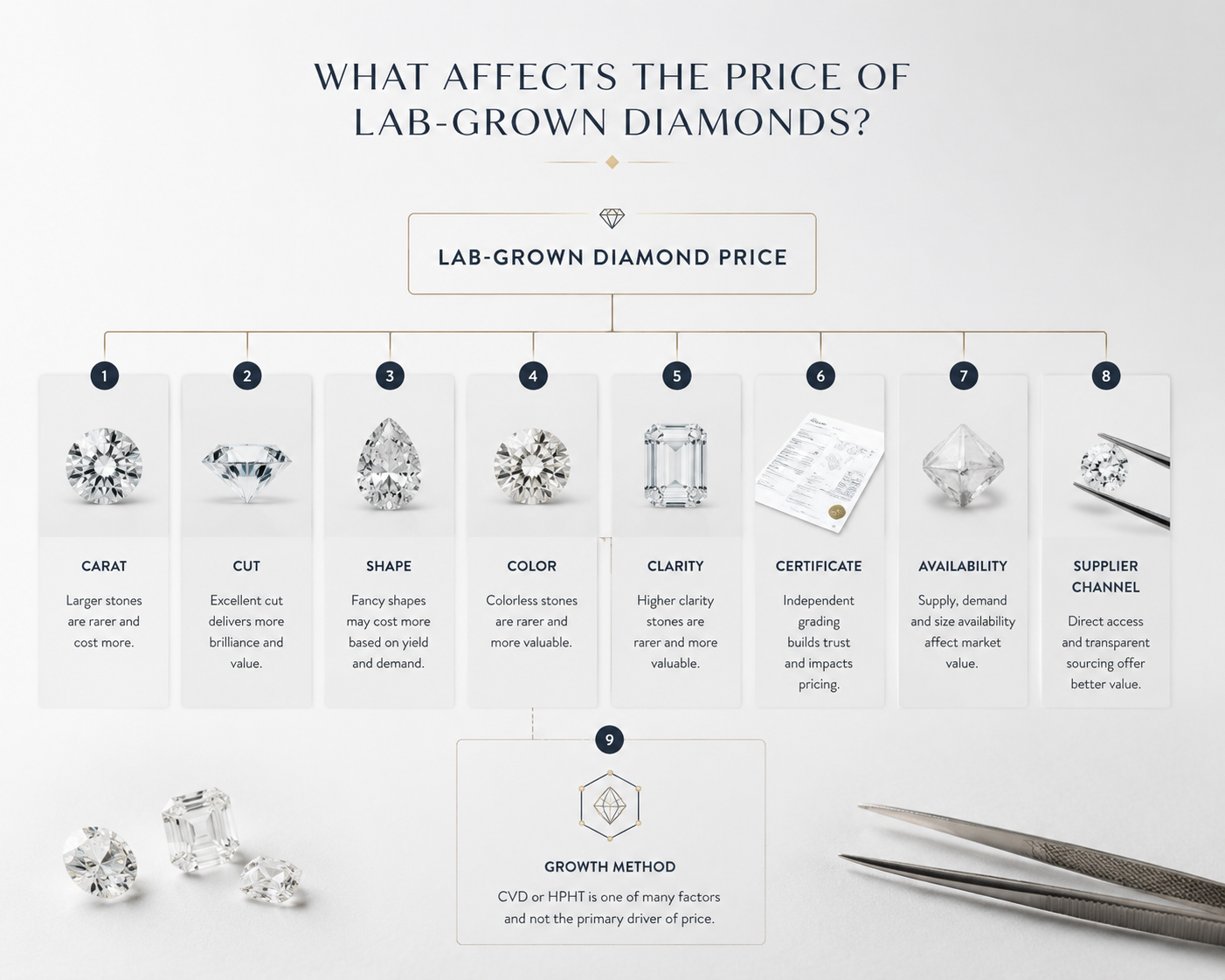
Lab-grown diamond price reflects a combination of factors, most of which have nothing to do with growth method:
- Carat weight: The single strongest price driver. Larger stones cost significantly more per carat due to yield rates, cutting complexity, and market demand.
- Cut quality: Cut grade, proportions, symmetry, and polish directly affect visual performance and price. Poor cut devalues a stone regardless of how it was grown.
- Shape: Round brilliants carry a premium due to demand and yield loss. Fancy shapes vary in price based on popularity and availability.
- Color and clarity grades: Higher grades command premiums within both HPHT and CVD categories. Grade differences often drive price more than growth method.
- Certification and lab: IGI, GIA, GCAL, and other labs carry different market recognition and cost structures. A certified stone costs more than an uncertified one.
- Market availability and demand: Supply fluctuations and demand trends affect pricing independently of production method.
- Supplier channel: Retail, wholesale, and direct-from-manufacturer channels price differently. Channel margin often explains price gaps that buyers mistakenly attribute to growth method.
Growth method interacts with these factors but rarely overrides them. A 1.50-carat D-color VS1 Excellent-cut round will be priced based primarily on those specifications, not on whether it was grown via HPHT or CVD.
What to Check Before You Decide
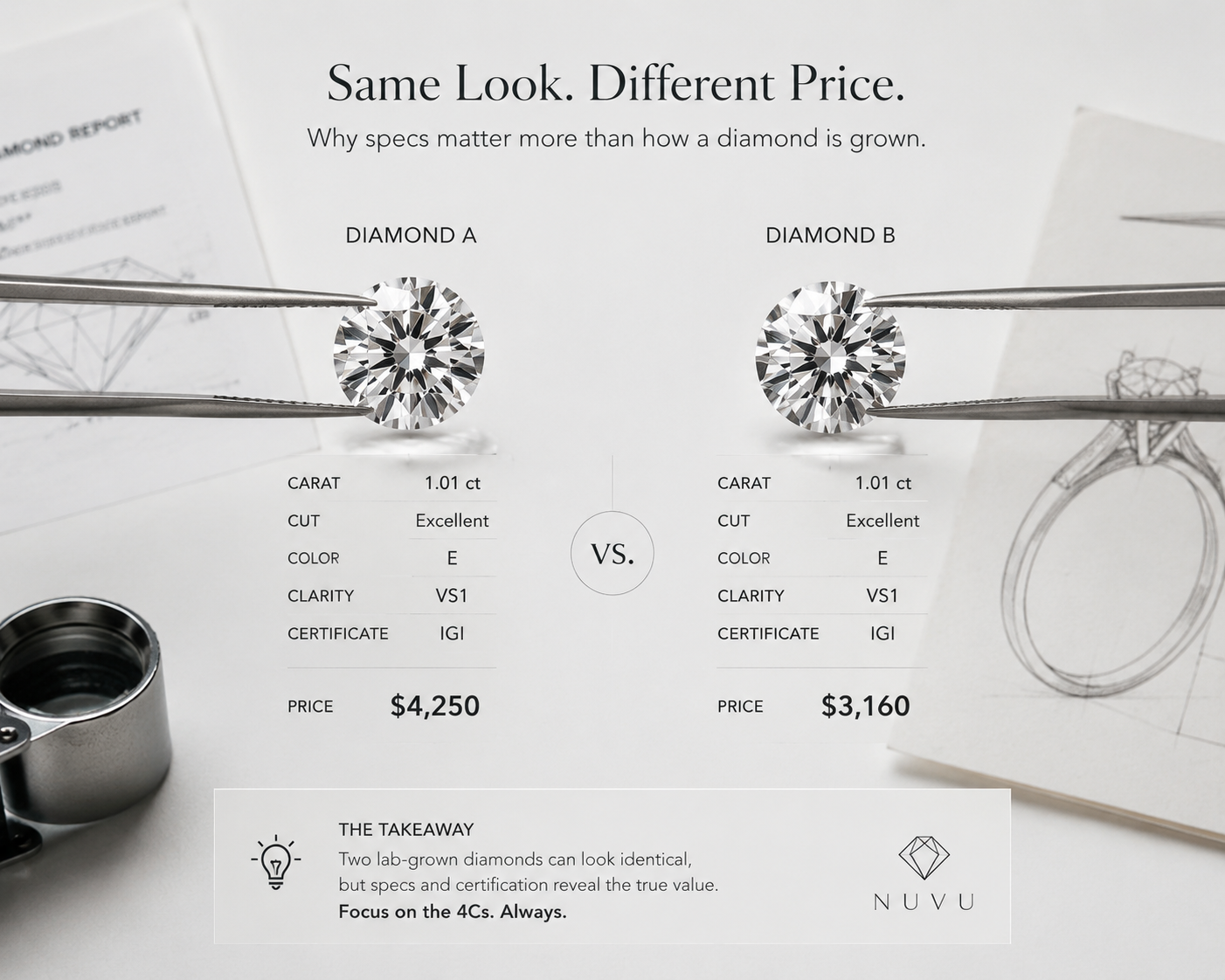
If a seller emphasizes HPHT vs CVD as the main reason for a price difference, ask for a side-by-side comparison of carat, cut, color, clarity, shape, and certificate. The price gap may come from these factors, not the growth method itself. A seller who cannot explain the difference in terms of these specifications may be using growth method as a marketing narrative rather than a legitimate price justification.
How Growth Method Influences Production Cost
HPHT and CVD differ meaningfully at the production level. HPHT (High Pressure High Temperature) uses massive presses to simulate the extreme conditions under which natural diamonds form. CVD (Chemical Vapor Deposition) builds diamond layer by layer in a vacuum chamber using gas deposition. These differences affect production cost, yield rates, and the types of inclusions or color tendencies each method may produce.[1]
However, production cost is only the starting point. By the time a diamond is cut, graded, certified, and sold through a supplier or retailer, the original growth-method cost difference is often diluted. Retail price reflects the whole chain, not just the growth chamber.
It is important to understand that HPHT and CVD are production methods, not treatments. Both methods produce genuine laboratory-grown diamonds. When post-growth treatments are applied—such as HPHT processing to improve color in a CVD-grown stone—this should be clearly disclosed on the grading report. The growth method itself is simply how the diamond was created.
HPHT Production Characteristics
HPHT mimics natural diamond formation by subjecting carbon to extreme pressure and temperature in a hydraulic press. This method requires significant capital investment in presses, high energy input, and careful control of growth conditions. HPHT presses typically produce smaller quantities per cycle compared to CVD chambers.
HPHT-grown diamonds tend to show certain characteristics. Metallic inclusions are more common, resulting from the metal catalyst used in the growth process.[1] Color tendencies can lean toward near-colorless to faint yellow or brown ranges, though high-color HPHT stones are certainly possible. These characteristics affect how stones are selected, graded, and priced, but they do not translate into a simple rule that HPHT costs more or less than CVD.
CVD Production Characteristics
CVD grows diamond by depositing carbon atoms layer by layer onto a substrate in a vacuum chamber. This method allows for larger stones to be grown more efficiently in terms of rough size, and CVD can produce diamonds with very high clarity due to the absence of metallic inclusions common in HPHT.[1]
CVD diamonds may require post-growth treatment to achieve certain color grades. Some CVD stones undergo HPHT treatment after growth to improve color, which adds a processing step and affects cost structure. Treatment disclosure becomes relevant here—buyers who care about “as-grown” stones need to ask whether a CVD diamond has been treated.
These production differences influence cost and availability, but they do not create a consistent retail price advantage for either method. Market availability, demand, and supplier pricing strategies often matter more.
Why Production Cost Does Not Equal Retail Price
Production cost is one input in a chain that includes cutting yield, certification fees, supplier margins, marketing, and retail overhead. A diamond that costs slightly more to produce via HPHT may end up priced similarly to a CVD stone after cutting and certification. Conversely, a CVD diamond with post-growth treatment may carry additional processing costs that narrow or eliminate any production-cost advantage.
Retail price reflects what the market will bear, not just what the stone cost to make. Supply and demand for specific carat weights, shapes, and grades influence price far more than the growth chamber. Buyers who focus on production method as a price indicator are looking at the wrong end of the chain.
In practice, this means a buyer cannot assume that a CVD stone is “better value” because CVD production scales efficiently, nor that an HPHT stone is “more premium” because HPHT presses require heavy investment. The retail price you see reflects cutting decisions, certification costs, supplier positioning, and market demand—factors that often obscure whatever production cost differences once existed.
Buyer Verification Checklist
When comparing HPHT and CVD stones, confirm that both have similar cut quality, proportions, and certificate standards. A price difference attributed to growth method may actually reflect differences in cut precision, grading lab choice, or treatment status. Ask the seller to explain the price gap in terms of all specifications, not just growth method.
When a grading report is available, buyers should verify the report details through the issuing laboratory’s official report-check tool where available. This confirms that the document matches the stone and that any treatment disclosures are accurately recorded.
Carat Weight: The Strongest Price Driver
Carat weight remains the single most influential factor in lab-grown diamond pricing, regardless of growth method. Larger stones cost more per carat due to yield rates, cutting complexity, and market demand. A buyer moving from 1.00 carat to 1.50 carats or 2.00 carats will see a larger price jump than switching between HPHT and CVD at the same weight.
This is where attention should focus. Carat affects material cost, cutting risk, and availability in ways that scale significantly with size. Growth method is a secondary consideration by comparison.
Why Carat Overrides Growth Method in Pricing
Carat weight directly determines how much rough material is required and how much cutting risk is involved. A 2.00-carat finished diamond requires significantly more rough than a 1.00-carat stone, and the yield rate drops as size increases. Cutting a larger stone also involves higher risk—a mistake during cutting destroys more material.
Market demand amplifies this effect. Popular carat thresholds like 1.00, 1.50, and 2.00 carats see concentrated buyer interest, which supports higher per-carat pricing. A 1.00-carat diamond commands a premium over a 0.90-carat diamond not because of material cost alone, but because buyers specifically seek the 1.00-carat mark.
By contrast, HPHT and CVD stones at the same carat weight are priced more similarly to each other than to stones at different weights. A 1.50-carat HPHT diamond and a 1.50-carat CVD diamond with comparable grades will typically fall in the same price range, while a 2.00-carat diamond of either method will cost significantly more per carat.
Carat Pricing Tiers and Thresholds
Certain carat weights act as psychological and market thresholds. The jump from 0.90 to 1.00 carat, from 1.40 to 1.50 carat, and from 1.90 to 2.00 carat often brings a disproportionate price increase relative to the actual size difference. Buyers pay a premium for hitting these round numbers.
This creates an opportunity for value-conscious buyers. A 0.95-carat diamond can offer nearly identical visual size to a 1.00-carat stone at a lower price. Similarly, a 1.45-carat diamond may provide better value than a 1.50-carat stone with identical other specifications. These thresholds matter far more than whether the stone was grown via HPHT or CVD.
Prices can change with market conditions, report type, seller channel, and stone-specific details, so exact comparisons should be verified at the time of purchase. Historical price references may not reflect current availability or market positioning.
What This Means in a Real Purchase
If budget is constrained, consider whether carat weight or growth method is the better place to adjust. Prioritizing a slightly smaller stone with better cut and certification often delivers more visual value than choosing a larger stone based on growth method alone. A well-cut 1.25-carat diamond will outperform a poorly cut 1.50-carat diamond regardless of whether either stone is HPHT or CVD.
Buyers who fixate on growth method while ignoring carat thresholds miss the factor that actually drives price. The decision should start with carat weight and cut quality, then narrow to color, clarity, and certification. Growth method belongs later in the process, if it matters at all for that particular buyer.
Cut Quality: The Hidden Value Factor
Buyers spend considerable time weighing HPHT against CVD, yet often treat cut as a secondary checkbox. This is a costly mistake. Cut quality has a more direct impact on how a diamond looks than any other single factor, and it drives significant price variation within both growth categories. A well-cut diamond commands a premium because achieving top proportions requires the cutter to sacrifice more rough material and invest more time in precision work. A poorly cut stone, regardless of how it was grown, will look flat, dark, or lifeless.
Why Cut Quality Affects Price More Than Growth Method
Cut determines how effectively a diamond returns light to the eye. Brilliance, fire, and scintillation all depend on the angles and alignment of the facets. When a diamond is cut too shallow, light leaks out the bottom. When it is cut too deep, light escapes through the sides. In both cases, the stone loses the visual impact that makes a diamond desirable in the first place.
This is true regardless of growth method. An HPHT diamond with poor proportions will underperform a CVD diamond with excellent cut, and vice versa. Within the same growth category, the price gap between a top-cut stone and an average-cut stone can easily exceed the price difference between HPHT and CVD at equivalent specifications. Buyers who prioritize growth method over cut are often paying for the wrong distinction.
The reason cut carries such pricing weight is simple: better cutting wastes more rough. A cutter aiming for ideal proportions must discard more material to achieve the correct angles, which increases the cost per carat of the finished stone. This material sacrifice is reflected in the price, and it has nothing to do with whether the rough was grown in a press or a vacuum chamber.
Cut Grade vs Proportions: What Buyers Should Check
A certificate cut grade — Excellent, Very Good, Good — is a useful starting point, but it does not tell the whole story. Two diamonds both graded “Excellent” can look noticeably different because the grade represents a range, not a single set of measurements, and HPHT vs CVD diamond quality is another technical factor to consider when evaluating color, clarity, and appearance. The actual proportions determine real-world performance.
The measurements that matter most are table percentage, total depth, crown angle, and pavilion angle. A diamond with a 55% table, 34.5-degree crown angle, and 40.8-degree pavilion angle will typically outperform one with a 61% table, 32-degree crown, and 41.5-degree pavilion, even if both carry the same cut grade. These differences show up in how the stone handles light, and they show up in price.
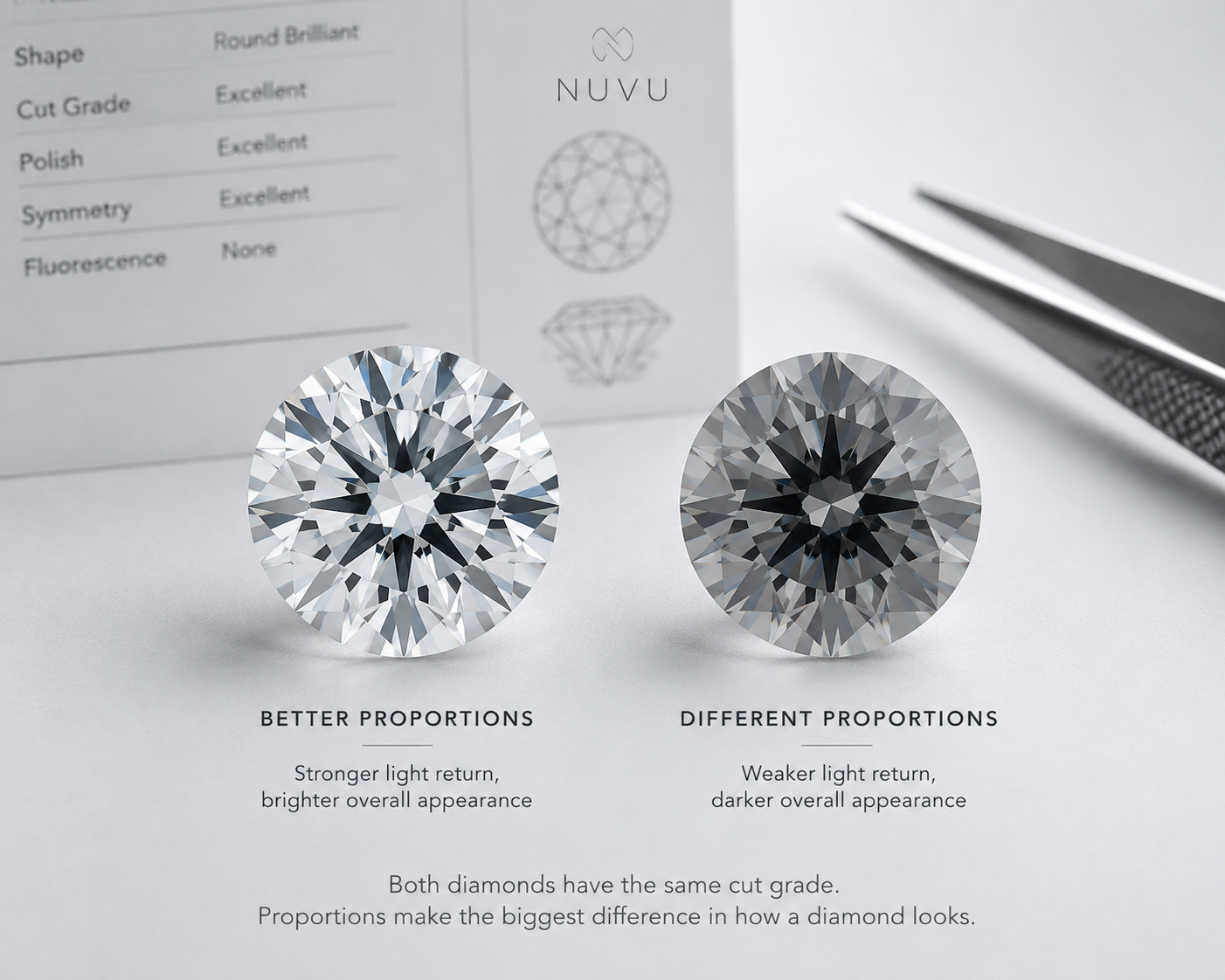
Two HPHT or CVD diamonds with identical carat weight, color, clarity, and cut grade can be priced differently because of these proportion variations. The higher-priced stone usually has tighter, more desirable measurements. If a buyer sees a price gap between two seemingly similar stones and assumes it comes down to HPHT vs CVD, the real driver may be cut precision that the grade label alone does not reveal.
What this means in practice: when a seller presents two stones at the same cut grade but different prices, the question to ask is not “Is one HPHT and one CVD?” but rather “Can I see the proportion measurements?” The difference in angles and depth often explains the price gap more clearly than growth method ever could.
Certificate and Visual Review Check
Before attributing a price difference to growth method, request proportion diagrams from the grading report. Look at the actual measurements rather than relying on the cut grade alone. If the seller provides 360-degree video or ideal-scope images, use them. A slightly lower-priced diamond may have weaker proportions — not a better growth-method deal. At NUVU, we encourage buyers to review these details because a stone that looks like a bargain on paper often costs more in visual disappointment.
A grading report can document key characteristics, but it should be read alongside visual evidence, measurements, seller documentation, and the intended jewelry use. The report provides useful information about grades and treatments, but it does not guarantee beauty, value, or performance.
Shape Popularity and Availability Costs
Shape affects price in ways that have nothing to do with growth method, yet buyers frequently encounter price differences between HPHT and CVD stones that are actually shape-driven. Round brilliants carry a consistent premium. Fancy shapes vary based on demand, supply, and cutting yield. Understanding how shape pricing works makes it easier to spot when a price gap reflects market dynamics rather than growth-method value.
Why Round Diamonds Cost More
Round brilliant cuts demand the highest per-carat prices across both HPHT and CVD categories. The reason is twofold: yield and demand. Cutting a round brilliant requires removing significantly more rough material than most fancy shapes — often 50% or more of the original rough is lost. This low yield means the cost of the raw material is concentrated into fewer carats of finished diamond.
At the same time, round brilliants are the most requested shape by a wide margin. High demand combined with high material waste creates a persistent price premium. This premium applies equally to HPHT and CVD rounds. A buyer comparing a round HPHT stone to an oval CVD stone and attributing the price difference to growth method is misreading the situation. The shape itself accounts for much of that gap.
Fancy Shape Pricing Dynamics
Oval, cushion, emerald, radiant, pear, and marquise shapes generally offer better per-carat value than rounds. The cutting yield is higher — less rough is wasted — and demand is more variable. Shapes that trend in popularity, such as ovals over the past several years, can see price increases driven by consumer interest rather than production cost.
Fancy shape pricing also depends heavily on visual quality factors that are harder to standardize on a certificate. Bow-tie effect in ovals and marquises, length-to-width ratio preferences, and facet pattern consistency all affect how desirable a specific stone appears. Two ovals with the same grades can be priced differently because one has a more attractive outline and a less visible bow tie, not because one is HPHT and the other is CVD.
Shape Availability by Growth Method
Growth method does influence which shapes are readily available at certain sizes, and this can create apparent price differences that are actually supply effects. CVD production scales efficiently for larger rough, which means larger fancy shapes — particularly elongated cuts like emerald and oval — may be more readily available in CVD. HPHT, with its typically smaller rough sizes, may have stronger availability in certain smaller shapes or specific proportions.
When a particular shape is more abundant in one growth method, prices for that combination may be lower simply due to supply volume. A buyer who sees a price advantage for CVD ovals at 2 carats is likely observing a supply dynamic, not a fundamental quality difference. The same shape at the same size in HPHT may carry a premium not because HPHT is inherently more expensive, but because fewer HPHT ovals at that weight are available.
For buyers open to fancy shapes, this supply dynamic can create genuine value opportunities—but only if the shape suits the wearer and the design. A lower per-carat price on an emerald cut only matters if the buyer actually wants an emerald cut. Choosing a shape based primarily on price, without considering personal style and setting compatibility, often leads to a purchase that looks like a bargain but feels like a compromise.
Stone-to-Setting Fit Check
A lower per-carat price on a fancy shape only represents good value if the shape suits the wearer and the intended setting. An emerald cut may offer excellent per-carat pricing, but if the ring design calls for a center stone with more brilliance and finger coverage, the shape choice works against the design goal. Confirm setting compatibility, finger coverage, and personal style preference before choosing a shape based on price alone. The right shape for a custom design is the one that fits the wearer, the setting, and the budget together — not just the one with the lowest per-carat cost.
For custom jewelry, stone measurements and setting compatibility should be confirmed before finalizing a purchase. A stone that appears ideal on paper may not fit the intended setting or may require design adjustments that affect the total project cost.
Color, Clarity, and Grade Pricing
Color and clarity grades drive significant price variation within both HPHT and CVD categories. A buyer who narrows focus to growth method risks missing how much price fluctuation exists within each method based on these grades. In many cases, the price spread between a D-color VVS1 stone and an H-color SI1 stone within the same growth category is far larger than the price difference between HPHT and CVD at matched grades.
Color Grade Pricing Tendencies
HPHT-grown diamonds often occur naturally in near-colorless to faint color ranges (G through K), though colorless grades (D through F) are also produced. CVD diamonds frequently achieve higher color grades but may require post-growth treatment to reach the D-to-F range. The key point for pricing is that color grade affects price within each growth category more than the growth method itself.
A D-color HPHT diamond and a D-color CVD diamond at similar carat, cut, and clarity will be priced closer to each other than either will be to an H-color stone of the same growth method. The market values color consistency, and buyers pay for higher color grades regardless of how the stone was grown. If a seller presents a price gap between HPHT and CVD stones, check whether the color grades match. A difference of even one or two color grades can account for a significant portion of the price variation.
Clarity Grade and Inclusion Types
Clarity pricing follows a similar pattern. The grade — VVS, VS, SI — drives price more than the growth method. However, the types of inclusions common to each method are worth understanding because they affect both visual appearance and value.
HPHT diamonds may contain metallic inclusions — small traces of the metal catalyst used during the growth process. These inclusions can sometimes give the stone a slightly different appearance under magnification and, in rare cases, may affect light performance if large enough. CVD diamonds tend to show different inclusion patterns, often related to the layered growth process, such as faint internal graining or small pinpoints.[1]
For practical buying, what matters is whether inclusions are visible to the naked eye and whether they affect the stone’s appearance in normal lighting. A well-placed SI1 in either growth method — where inclusions are off-center, light, or easily hidden by a prong — can offer significantly better value than a VS2 with a dark, centrally located inclusion. Buyers who pay for higher clarity without checking inclusion placement are often spending money on a grade that does not translate into a visible improvement.
Post-Growth Treatment and Disclosure
Some CVD diamonds undergo post-growth treatment — typically high-pressure, high-temperature processing — to improve their color grade. This treatment is common and legally must be disclosed on the grading report.[2] However, treatment status affects both pricing and buyer perception.
As-grown diamonds — those that reach their final color without post-growth treatment — often carry a premium because some buyers prefer a stone that achieved its grade naturally during the initial growth process. Treated stones may be priced lower, not because they are inferior in everyday appearance, but because the market recognizes the treatment as a step that was needed to reach the grade.
For buyers who care about treatment disclosure, the question is not whether CVD or HPHT is better, but whether a specific stone has been treated and whether that treatment is clearly documented. A price difference between two CVD stones at the same color grade may reflect treatment status rather than any other factor. Confusion arises when buyers attribute this price gap to growth method in general, when it actually comes down to whether the stone needed help to reach its grade.
Treatment disclosure is one area where the grading report really matters. If treatment preference is important to you, confirm that the report clearly states whether post-growth treatment was applied. This is a legitimate factor in pricing and personal preference—but it applies to specific stones, not to entire growth method categories.
What to Check Before You Decide
Review the grading report for color grade, clarity grade, inclusion comments, and any treatment disclosures. When comparing HPHT and CVD stones, match the grades as closely as possible. A price gap between an HPHT G-color VS2 and a CVD F-color VVS2 is not a growth-method comparison — it is a grade comparison. Only by normalizing color, clarity, and treatment status can you isolate whether growth method itself has a meaningful impact on the price you are being asked to pay.
Certification and Lab Choice
The grading lab that evaluates a lab-grown diamond affects its price independently of whether the stone was grown through HPHT or CVD. Certification cost, market recognition, and grading consistency all influence what buyers pay, and these factors can create price differences that have nothing to do with growth method.
A buyer comparing two similar stones might assume that a price gap reflects HPHT versus CVD production, when the real difference is that one stone carries a report from a widely recognized grading lab and the other does not. Understanding how certification influences price helps isolate whether growth method actually matters in a specific comparison.
Why Certification Choice Affects Price
IGI (International Gemological Institute) has become the dominant grading lab for lab-grown diamonds in the current market. IGI reports are widely accepted, recognized by major retailers, and priced in a way that allows certified lab-grown diamonds to remain competitive. Because IGI has built infrastructure specifically around lab-grown grading, their reports are common for both HPHT and CVD stones across a wide range of sizes and qualities.
GIA (Gemological Institute of America) offers lab-grown diamond reports with different market positioning and cost structures. GIA’s lab-grown reports carry strong brand recognition, particularly among buyers who associate GIA with natural diamond grading standards. However, GIA’s lab-grown report pricing and grading approach differ from IGI’s, and these differences affect retail pricing.
A certified diamond from a recognized lab commands a premium over an uncertified stone, regardless of whether it is HPHT or CVD. The premium reflects the cost of obtaining the report, the value of third-party verification, and the market’s willingness to pay for documented grades. An uncertified HPHT stone might be priced lower than a certified CVD stone not because of growth method, but because certification adds cost and perceived value.
GCAL and other labs offer additional certification options, each with different pricing, recognition levels, and grading approaches. The lab choice influences price in ways that cut across growth method categories.
Grading Lab Consistency and Buyer Confidence
Grading consistency varies by lab. Buyers paying for certification are paying for third-party verification, not just a document to accompany the stone. A grading report from a consistent, recognized lab provides assurance that the stated grades reflect an independent assessment, which supports resale value, insurance replacement, and buyer confidence.
Comparing HPHT and CVD stones certified by different labs can create misleading price impressions. If an HPHT stone carries an IGI report and a CVD stone carries a GIA report, any price difference may reflect certification market positioning rather than growth method. Similarly, comparing a certified stone to an uncertified stone introduces variables that have nothing to do with how the diamond was grown.
Grading lab choice also affects how inclusion comments, fluorescence notes, and treatment disclosures appear on the report. These details influence buyer perception and pricing, and they apply to both HPHT and CVD stones.
For practical comparison, the most reliable approach is to compare stones certified by the same lab. Cross-lab comparisons can be done, but they require understanding that grading standards and report details may differ. If you are evaluating an IGI-graded HPHT stone against a GIA-graded CVD stone, the price difference may tell you more about certification positioning than about growth method.
How to Verify This Before Buying
Confirm which lab graded each stone before comparing prices across HPHT and CVD options. Check report numbers online through the grading lab’s verification system to confirm that the report matches the stone. Ensure that price comparisons are made between stones with similar certification standards — both certified by recognized labs, or both uncertified — before drawing conclusions about whether growth method is driving the price difference.
Ask the seller to explain any certification-related price differences. A reputable seller should be able to clarify whether a price gap reflects grading lab choice, report details, or other factors beyond growth method.
A grading report provides valuable documentation, but it should be read alongside the stone’s proportions, visual evidence, and intended jewelry use. The report confirms grades and treatments; it does not guarantee beauty or performance. Buyers should verify report details through the issuing laboratory’s official report-check tool when available, and they should view the actual stone—through video, images, or in person—before making a final decision.
Market Availability, Demand, and Supplier Channel
Availability and demand dynamics affect lab-grown diamond pricing more than most buyers realize. HPHT and CVD supply levels shift based on production capacity, technological development, and manufacturer decisions. Retail, wholesale, and direct-from-manufacturer channels price differently based on margin structures and service models. These factors create price variation that often overshadows growth method as a cost driver.
Supply Fluctuations by Growth Method
HPHT and CVD production capacity has evolved differently over time. CVD technology has scaled efficiently for larger stone sizes, allowing manufacturers to produce bigger rough diamonds with relatively lower equipment constraints compared to HPHT presses. This scalability has made CVD increasingly common for stones above certain carat weights, affecting availability and pricing in those size ranges.
HPHT production relies on high-pressure presses that involve significant capital investment and energy consumption. HPHT maintains certain niche strengths, particularly for specific color ranges and smaller sizes where the method remains competitive. However, HPHT production capacity has not scaled as rapidly as CVD for larger stones.
Temporary supply imbalances can create price differences that look like growth-method effects but are actually availability effects. If CVD production floods the market with stones in a particular size and quality range, CVD prices in that segment may drop relative to HPHT, not because CVD is inherently cheaper, but because supply exceeds demand. Conversely, if HPHT stones become scarce in certain specifications, their prices may rise relative to CVD due to availability constraints.
These fluctuations are market conditions, not permanent growth-method cost differences. A buyer who assumes that one method is always cheaper or more expensive may misinterpret temporary supply dynamics as inherent pricing truth.
Demand Trends and Market Positioning
Marketing narratives around HPHT versus CVD can influence buyer perception and demand, creating price premiums for stones positioned as “better” based on growth method. In HPHT vs CVD diamonds discussions, some sellers emphasize HPHT as the method that more closely mimics natural diamond formation, while others promote CVD as the cleaner, more technologically advanced option. These narratives affect how buyers perceive value and what they are willing to pay.
Price premiums driven by marketing positioning may not reflect objective quality differences. A stone marketed as “premium HPHT” or “advanced CVD” might carry a higher price than an equivalent stone without that positioning, even if the actual grades, cut quality, and visual performance are identical.
Buyers who internalize marketing narratives may over-prioritize growth method in their decision-making, assuming that one method delivers superior value when the actual quality and price relationship depends on many other factors. Understanding that demand-driven premiums exist helps buyers separate marketing from material reality.
Supplier Channel and Price Variation
Retail, wholesale, and direct-from-manufacturer channels price lab-grown diamonds differently. A retail buyer purchasing from a jewelry store pays a price that includes the retailer’s margin, showroom costs, marketing expenses, and service overhead. A wholesale buyer or direct-from-manufacturer buyer accessing similar stones through different channels may see significantly different pricing.
A buyer comparing HPHT versus CVD prices across different suppliers may see price gaps that reflect channel margins, not growth-method cost differences. If one supplier offers HPHT stones through a wholesale channel and another offers CVD stones through a retail setting, the price difference may have more to do with margin structure than production method.
Service differences also affect pricing. A supplier who provides detailed consultation, high-resolution imaging, customization support, and strong return policies builds those services into pricing. A supplier offering minimal service and basic documentation may price lower, regardless of whether the stone is HPHT or CVD.
Before purchase, buyers should confirm documentation, return terms, resizing policies, and after-sales support directly with the seller. Service levels and policies vary significantly across suppliers and channels, and these differences affect total value beyond the stone price alone.
What This Means in a Real Purchase
When comparing prices across HPHT and CVD options, normalize for carat, cut, color, clarity, shape, and certification before attributing differences to growth method. Ask suppliers directly why a price gap exists and whether it reflects growth method, supplier channel, service level, or other factors.
A price difference that seems to favor one growth method may disappear once all other variables are matched. The goal is to understand what you are actually paying for — growth method, certification, channel positioning, service, or a combination of factors — rather than assuming that growth method alone explains the price.
In sourcing or wholesale conversations, documentation, consistency, and communication often matter as much as the headline specification. A supplier’s ability to provide clear grading reports, answer questions about treatment status, and maintain consistent quality across orders can affect the total value of the transaction. Buyers engaging with suppliers at any level should confirm what documentation accompanies each stone and how the supplier handles questions about grading, treatment, and verification.
When Growth Method Might Matter for Your Decision
Growth method is not irrelevant. There are limited situations where HPHT versus CVD might be a legitimate consideration in a buying decision. These situations typically involve specific color preferences, inclusion tolerance, treatment disclosure preferences, or availability at certain sizes or shapes.
For most buyers, growth method remains a secondary factor, but understanding when it might matter helps clarify whether it should influence a specific purchase.
Situations Where HPHT May Be Preferable
HPHT-grown diamonds occur naturally in certain color ranges during the growth process. Some buyers prefer HPHT because they want “as-grown” color without post-growth treatment. If a buyer specifically wants a diamond that achieved its color grade through the growth process itself, HPHT may offer more options in certain color ranges, particularly in the near-colorless to faint color spectrum.
HPHT diamonds may show metallic inclusions derived from the metal catalyst used during growth. While these inclusions are typically not visible to the naked eye and do not necessarily affect the clarity grade, some buyers have strong preferences about inclusion types. A buyer who accepts metallic inclusions in exchange for specific color characteristics might find HPHT preferable in certain cases.
This is a preference, not a universal quality judgment. HPHT is not inherently better or worse than CVD — it simply has different characteristics that may align with specific buyer priorities.
Situations Where CVD May Be Preferable
CVD-grown diamonds often achieve very high clarity because the chemical vapor deposition process can produce stones with fewer visible inclusions. Buyers prioritizing clarity, particularly at VS or VVS levels, may find more options in the CVD category, especially at larger sizes.
CVD technology has scaled efficiently for larger stones, which means buyers seeking diamonds above certain carat weights may find better availability and potentially better pricing in the CVD category. This is a supply and availability effect, not a quality judgment.
Some CVD diamonds undergo post-growth treatment to improve color grade. Buyers who want full disclosure about treatment status and who prefer untreated stones should check whether a CVD diamond is “as-grown” or treated. This preference is legitimate, though it applies to both HPHT and CVD — both methods can produce stones that are either treated or untreated, depending on the specific diamond and manufacturer decisions.
CVD’s advantages are situational. Larger size availability and high clarity potential do not automatically mean CVD is the better choice for every buyer. The decision depends on what the buyer prioritizes and what tradeoffs they are willing to accept.
Why Most Buyers Should Prioritize Other Factors
For most buyers, carat, cut, shape, color, clarity, certificate, and supplier choice will have a larger impact on price and satisfaction than growth method. Carat weight determines size and has the strongest influence on price. Cut quality determines visual performance and brilliance. Shape affects style, finger coverage, and per-carat pricing. Color and clarity grades affect appearance and price. Certificate choice affects verification and market recognition. Supplier choice affects service, pricing transparency, and support.
Growth method is a valid consideration, but it should be treated as a secondary filter rather than a primary decision axis. Buyers who over-prioritize HPHT versus CVD risk paying for a distinction that does not meaningfully affect their experience, or missing better value opportunities because they eliminated options based on growth method alone.
A well-cut, well-graded, certified diamond that fits the buyer’s budget, style, and quality expectations will perform well regardless of whether it was grown through HPHT or CVD. The growth method becomes relevant only when specific characteristics — treatment preferences, inclusion types, size availability — align with one method over the other.
Buyer Verification Checklist
If a seller strongly emphasizes HPHT or CVD as the main reason to choose a particular stone, ask for a full comparison of all other factors: carat weight, cut grade and proportions, color grade, clarity grade and inclusion comments, shape, certificate and grading lab, and price. Request an explanation of why the growth method matters in this specific case and what characteristics differentiate the stone from alternatives.
Growth method is a valid consideration, but it should not override cut quality, certification, and overall value alignment. A seller who cannot explain the price difference in terms beyond growth method may be relying on marketing narrative rather than material reality.
How to Compare HPHT vs CVD Prices Fairly
Comparing an HPHT diamond to a CVD diamond at random tells you almost nothing about whether one growth method costs more than the other. If the stones differ in carat, cut, clarity, or certification, any price gap reflects those variables first. A fair comparison requires controlling for the factors that actually drive cost, isolating growth method only after everything else is matched.
Normalize for Carat, Cut, and Certificate
Start by locking in the three variables that swing price the hardest: carat weight, cut quality, and grading lab. A 1.50-carat Excellent-cut CVD diamond certified by IGI cannot be meaningfully compared to a 1.20-carat Very Good-cut HPHT diamond certified by a lesser lab. The price difference is overdetermined—too many variables differ to assign causation to growth method.
Match carat weight as closely as possible, ideally within a narrow range like 1.45 to 1.55 carats. Verify cut quality beyond the grade label—request proportion data, because two diamonds both graded “Excellent” can perform quite differently depending on table size, depth, and angles. Confirm that both stones carry reports from the same grading lab, since IGI and GIA apply slightly different standards and market recognition to lab-grown stones.
Only when these three anchors are aligned does a price comparison begin to isolate the actual influence of growth method. In most cases, you will find that similarly specified HPHT and CVD stones are priced closer together than expected.
Check Color, Clarity, and Treatment Disclosure
Even with carat, cut, and certificate matched, color and clarity differences can distort the comparison. A D-color VVS1 CVD stone will naturally carry a premium over an F-color VS2 HPHT stone, regardless of how either was grown. Match color and clarity grades directly, or at minimum account for the price step between them.
Treatment disclosure is a critical but often overlooked factor. Some CVD diamonds undergo post-growth treatment to improve color, and treated stones typically trade at a discount to “as-grown” equivalents. If you compare an as-grown HPHT diamond to a treated CVD diamond without accounting for this, the price difference reflects treatment status, not growth method. Always confirm whether a stone is as-grown or treated, and compare within the same category when possible.[2]
Use Total Project Cost, Not Just Stone Price
Isolating the loose diamond price makes sense for analytical comparison, but most buyers are purchasing a finished piece of jewelry. The total project cost—stone, setting, customization, and supplier service—matters more than the per-carat price of the diamond alone.
A supplier offering a slightly lower stone price may charge more for setting work, provide fewer customization options, or offer weaker return policies. Conversely, a slightly higher stone price from a supplier who includes design consultation, precise setting execution, and reliable post-purchase support may deliver better overall value. Focusing narrowly on whether HPHT or CVD saves a few percentage points on the stone can distract from whether the total purchase delivers what matters to you.
What to Check Before You Decide
Before attributing any price difference to growth method, request full specifications for each stone: a copy of the grading report, exact measurements, and 360-degree video. Compare stones that are as similar as possible across all variables. If a seller claims HPHT or CVD justifies a price premium, ask them to explain the gap in terms of carat, cut, color, clarity, shape, and certification first. A seller who cannot break down the price difference beyond growth method may not be giving you the full picture.
For custom design, trust comes from matching the stone to the setting, budget, and wearer’s daily use—not from choosing grades in isolation. A stone that looks ideal on paper may not suit the intended ring design, lifestyle, or personal style. Before finalizing any loose diamond purchase for a custom project, confirm that the stone’s measurements work with the chosen setting, that the design accommodates the wearer’s daily activities, and that the total project cost aligns with the budget. The best value is not the lowest per-carat price, but the combination of stone, setting, and service that meets the specific needs of the piece.
Conclusion: Growth Method Is a Factor, Not the Answer
The HPHT versus CVD distinction is real. These methods produce diamonds under different conditions, and each carries certain tendencies in color range, inclusion type, and production scale. But by the time a diamond reaches the retail market, growth method is rarely the variable that determines what you pay.
Carat weight drives the largest price steps. Cut quality determines whether a stone performs well enough to justify its cost. Shape popularity, color and clarity grades, certification choice, and supplier channel each shift price independently. These factors interact in ways that matter far more than whether the diamond formed in a high-pressure press or a vacuum chamber.
Buyers who treat growth method as a primary decision axis risk paying for a distinction that does not deliver proportional value, while overlooking the variables that actually control price and visual satisfaction.
Key Takeaways
Carat weight and cut quality affect price more than growth method in nearly every practical scenario. Shape and availability create meaningful price variation within each growth category, and a round brilliant carries a premium regardless of whether it is HPHT or CVD. Certification and supplier channel shift price independently of how the stone was grown. HPHT versus CVD becomes relevant only in specific preference situations—when as-grown color matters to you, when certain inclusion types are acceptable, or when availability at a particular size or shape favors one method over the other.
Environmental and sustainability claims should be specific, documented, and limited to what can be substantiated. Lab-grown diamonds offer a different sourcing path from natural diamonds, but broad environmental claims require supporting documentation about production practices, energy use, and seller transparency.
Next Steps for Buyers
Define your priorities before you start comparing stones. If visual performance matters most, focus on cut quality and proportions before growth method. If size within a fixed budget is the goal, understand that carat weight and shape will determine your options more than whether the diamond is HPHT or CVD. If certification confidence is a priority, compare grading labs directly rather than treating growth method as a proxy for quality.
When comparing prices across growth methods, normalize for carat, cut, color, clarity, shape, and certification first. Ask sellers to explain any price differences in terms of all variables, not just growth method. A transparent supplier should be able to break down exactly what you are paying for.
At NUVU, we encourage buyers to apply this framework directly when browsing our loose diamond inventory or starting a custom design consultation. The right stone is the one that fits your specifications, budget, and design intent together—growth method is simply one detail in that larger equation.
[1] GIA, “Lab-Grown Diamonds,” Gemological Institute of America, describing HPHT and CVD growth methods, production characteristics, and typical inclusion types for each method.
[2] Federal Trade Commission, “Guides for the Jewelry, Precious Metals, and Pewter Industries,” 16 CFR Part 23, requiring disclosure of treatments that affect diamond value, including post-growth color enhancement processes.
Disclosure: This article is for general educational purposes only. Diamond grading, pricing, availability, specifications, and seller policies can change, and readers should verify important details through grading reports, official laboratory tools, seller documentation, or qualified professionals before making a purchase decision. Laboratory-grown diamonds should be clearly distinguished from natural diamonds, and environmental or sourcing claims should be supported by specific documentation.
Last updated: January 2025