
Lab-grown diamond reports contain essential information, but knowing where to find the growth method—and understanding what it actually tells you—can be confusing. HPHT and CVD, as detailed in post growth treatment, refer to manufacturing processes, not quality grades, yet many buyers assume one method produces better diamonds than the other. In reality, cut quality, proportions, and symmetry determine visual performance far more than how the stone was created.
For the full framework, read Lab-Grown Diamond Certification Guide.
This guide explains exactly where HPHT or CVD appears on major lab reports like GIA and IGI, what other disclosures to check before purchasing, and how to verify that your diamond matches its documentation. You’ll learn which report details matter for value, what post-growth treatments mean for your purchase, and why visual assessment remains essential even with a complete grading report.
Laboratory-grown diamonds and natural diamonds share the same physical and chemical properties but have fundamentally different origins. A grading report for a lab-grown diamond will always identify it as such, and this distinction is critical for accurate valuation, insurance, and resale. Buyers should never assume that a laboratory-grown diamond is a natural diamond, and grading reports should never be interpreted in a way that blurs this line.
| What to Check | Where to Find It | Why It Matters |
|---|---|---|
| Growth Method (HPHT/CVD) | Report body or comments section | Confirms origin; neither method guarantees better quality |
| Report Number Match | Girdle inscription, document, and lab database | Verifies diamond matches its documentation |
| Post-Growth Treatments | Comments section | Affects value, durability, and resale potential |
| Cut Grade & Proportions | Grading results section | Determines actual light performance and beauty |
| Origin Disclosure | Report header or identification | Confirms lab-grown vs. natural status |
| Visual Documentation | Seller-provided images and video | Shows real appearance beyond report data |
Quick Questions Before You Read
Q: Does HPHT or CVD produce better diamonds?
No—growth method describes manufacturing process, not quality. Cut grade and proportions matter far more for visual performance.
Q: What if the report doesn’t list the growth method?
Some labs don’t determine or disclose method. Request written confirmation from the seller, or choose a diamond with complete documentation.
Q: Are all treatments disclosed on the report?
Reputable labs disclose post-growth treatments like HPHT annealing or irradiation in the comments section. Coatings may be non-permanent and affect value.
Q: Can I trust the report alone when buying?
Reports verify data but can’t predict real-world beauty. Always request high-resolution photos and 360-degree video to assess actual light performance.
What a Lab-Grown Diamond Report Actually Tells You
A lab-grown diamond report serves three core functions: it confirms the diamond’s origin, documents its measured attributes, and discloses any treatments applied after growth. It does not rank quality, predict beauty, or tell you whether the diamond will look impressive in person. Understanding what the report is designed to do—and what it cannot do—prevents misreading the document as a complete buying guide.
Origin Identification: Lab-Grown Disclosure
Every major grading laboratory—GIA, IGI, GCAL, AGS, and others—explicitly identifies a laboratory-grown diamond on its report. The language varies slightly, but the intent is the same: clear separation from natural diamonds. You will see terms such as “Laboratory-Grown,” “Lab-Created,” or “Man-Made” prominently displayed. This is not marketing language. It is a disclosure requirement designed to protect consumers and maintain market integrity.
The prominence of this disclosure matters. Federal Trade Commission guidelines and trade regulations require that lab-grown diamonds be clearly distinguished from natural diamonds at every stage of the supply chain.[1] A grading report that fails to state laboratory-grown origin is either incomplete or non-compliant. If you are reviewing a report and cannot find a clear origin statement, treat that as a warning sign rather than a formatting quirk.
What does a lab-grown diamond certificate show at a minimum? It shows that the stone is not natural. It shows the 4Cs—cut, color, clarity, and carat weight—as graded by that laboratory. It may show additional measurements, proportions, and fluorescence. But the origin statement is the foundation. Without it, the document cannot serve its primary purpose.
Laboratory-grown diamonds should be clearly identified as laboratory-grown, and they should not be presented as mined diamonds. This distinction is not just a regulatory requirement—it is a practical one. The two categories have different market values, different supply chains, and different buyer expectations. A grading report that accurately discloses laboratory-grown origin protects both the buyer and the integrity of the broader diamond market. When reviewing any report, the origin statement should be the first detail you confirm.
Growth Method Disclosure: HPHT or CVD
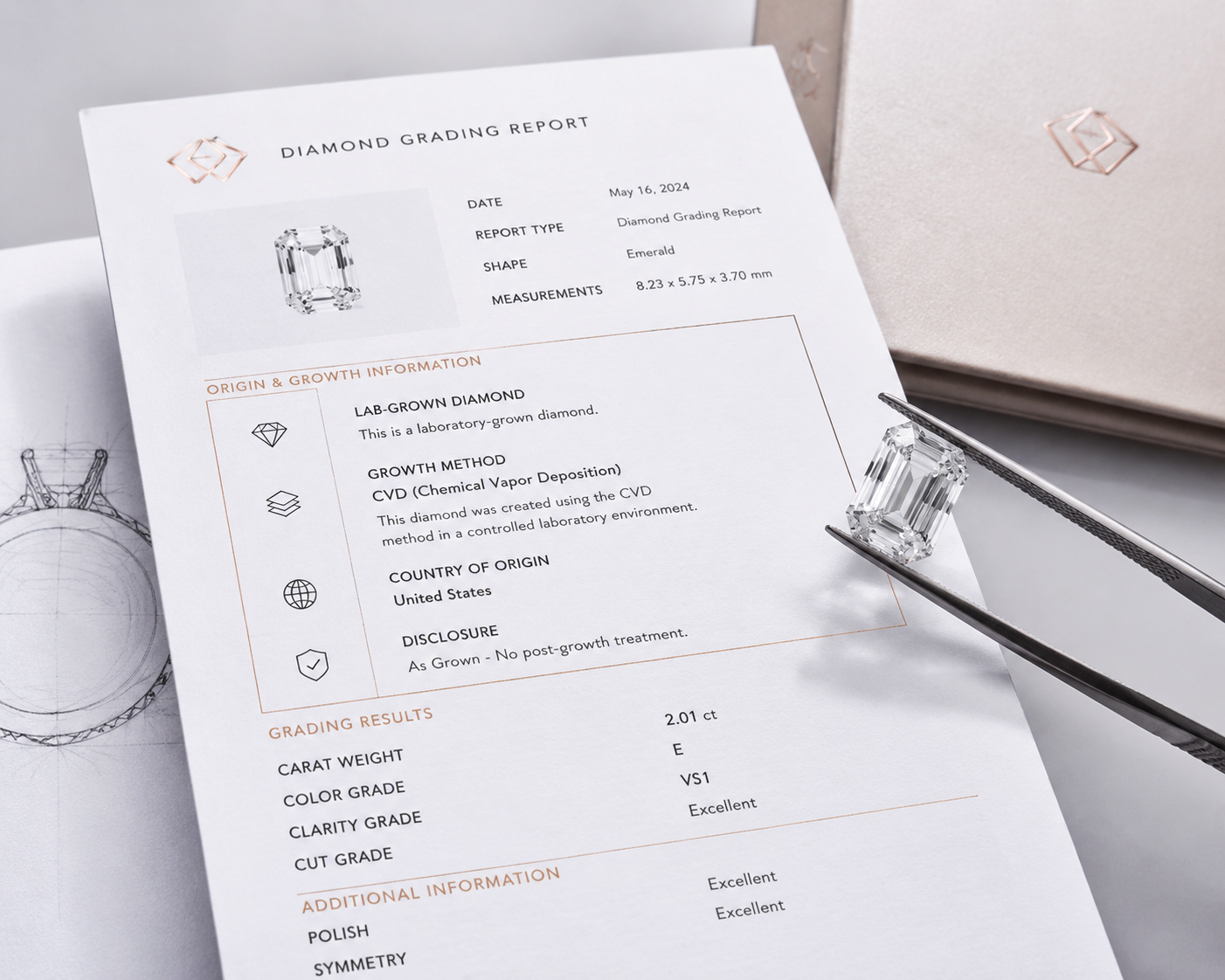
Some reports go further than origin identification and specify the growth method: HPHT (High Pressure High Temperature) or CVD (Chemical Vapor Deposition). When this information appears, it is usually located in a section labeled “Origin,” “Comments,” or “Additional Information.” The terminology may read “Growth Process: CVD” or “Method of Growth: HPHT,” depending on the laboratory’s format.
This disclosure describes how the diamond was manufactured. It is not a quality grade. A diamond labeled CVD is not automatically superior or inferior to one labeled HPHT. Both methods produce stones across the full spectrum of quality. The growth method tells you about the process, not the outcome.
Not every report specifies growth method. Some laboratories include it routinely. Others may omit it if the method was not definitively determined or if their reporting format does not require it. If growth method matters to your decision, you cannot assume its absence from the report means anything about the diamond itself. It may simply reflect lab policy or detection limitations.
It is important to understand the difference between a growth method and a treatment. HPHT and CVD are production methods—the processes by which a laboratory-grown diamond is created. A post-growth treatment, such as HPHT annealing to improve color, is a separate process applied after the diamond has already been grown. When growth method or post-growth treatment is relevant, buyers should look for clear disclosure in the grading report or seller documentation. Confusing growth method with treatment can lead to misinterpretation of what the report actually states.
Treatment and Post-Growth Disclosure
Lab-grown diamonds may undergo treatments after growth to improve color or alter appearance. Common post-growth processes include HPHT annealing to improve color, irradiation to create fancy colors, and surface coatings to mask tints or enhance brilliance. A responsible grading report discloses these treatments when detected.
Treatment disclosure typically appears in the “Comments” section or under a dedicated “Treatments” heading. Language such as “HPHT Annealed,” “Irradiated,” or “Surface Coating” indicates that the diamond was modified after initial growth. This matters for several reasons. Treatments can affect value—treated stones generally trade at lower prices than untreated equivalents. Some coatings may wear over time or require special care. Treatments can also complicate re-grading or resale, since future reports may detect or interpret them differently.
The presence of a treatment does not make a diamond unacceptable. Many treated lab-grown diamonds are attractive and fairly priced for what they are. The issue is disclosure. A report that accurately notes a treatment allows you to make an informed decision. A report that omits treatment information—or a seller who downplays it—creates a gap between what you think you are buying and what you actually receive.
For buyers, the practical point is not just what the report says, but how the stone performs visually and fits the intended design. A treatment disclosure helps you understand the stone’s history, but the final decision still depends on whether the diamond meets your expectations in person.
When a grading report is available, buyers should verify the report details through the issuing laboratory’s official report-check tool where available. This confirms that the document matches the laboratory’s records and has not been altered.
What to Check Before You Decide
Before committing to a purchase, confirm that the report explicitly states “laboratory-grown” or equivalent language. Locate the growth method field if present, and note whether it specifies HPHT, CVD, or remains unstated. Check the treatment disclosure section for any post-growth processes. Match the report number to the inscription on the diamond’s girdle—the inscription should be visible under magnification and correspond exactly to the document. If any of these elements are missing, unclear, or inconsistent, pause and request clarification before proceeding.
Where HPHT or CVD Appears on Major Lab Reports
Finding growth method information on a grading report is not always straightforward. Different laboratories use different layouts, terminology, and disclosure standards. Some reports state the method prominently. Others bury it in fine print or omit it entirely. Knowing where to look—and what to do when the information is absent—helps you verify what you are actually buying.
GIA Laboratory-Grown Diamond Reports
The Gemological Institute of America (GIA) has evolved its approach to lab-grown diamond reporting. Current GIA Laboratory-Grown Diamond Reports identify the stone as laboratory-grown in the header and throughout the document. Growth method, when specified, typically appears in the “Comments” section or under a dedicated “Origin” field. The language may read “This is a laboratory-grown diamond created by the CVD process” or similar wording for HPHT.[2]
GIA’s earlier lab-grown reports used different terminology and formats. If you are reviewing an older report, the growth method may be less explicit or located in a different section. GIA has moved toward more detailed disclosure over time, but not all reports in circulation reflect the current standard. If you are uncertain whether a GIA report specifies growth method, check the full document carefully rather than assuming the information is absent.
One practical note: GIA reports include a report number that can be verified through GIA’s online database. This verification step confirms that the document matches the laboratory’s records and has not been altered.
A grading report can document key characteristics, but it should be read alongside visual evidence, measurements, seller documentation, and the intended jewelry use. GIA reports are widely recognized, but recognition alone does not guarantee that a particular diamond is the right choice for every buyer. The report provides data; the buyer still needs to evaluate how that data translates into real-world appearance and design fit.
IGI Laboratory-Grown Diamond Reports
The International Gemological Institute (IGI) is one of the most widely encountered grading services for lab-grown diamonds, particularly in the retail jewelry market. IGI reports typically state the growth method more explicitly than some other laboratories. You will often find a field labeled “Growth Process” or “Method of Growth” directly on the main body of the report, specifying CVD or HPHT without requiring the reader to dig through comments.
IGI’s format is designed for accessibility. The origin statement (“Laboratory-Grown”) appears prominently, and the growth method is usually positioned near the 4Cs or in a dedicated technical section. This does not make IGI a superior grading authority—it simply means the layout is optimized for quick reference. As with any report, the presence of growth method information depends on what IGI was able to determine at the time of grading.
Other Labs: GCAL, AGS, and Independent Reports
Other grading laboratories vary in how they present growth method information. GCAL (Gem Certification and Assurance Lab) typically identifies laboratory-grown origin and may specify growth process in the comments or technical details. AGS (American Gem Society) reports follow a similar pattern, with origin disclosure required and growth method included when determined.
Independent or smaller laboratories may have different standards. Some specify growth method routinely. Others may not include it at all, either because their format does not require it or because they lack the equipment to definitively distinguish HPHT from CVD. A report from an unfamiliar lab should prompt additional questions: Does this lab routinely disclose growth method? Is the method stated anywhere on the document? If not, can the seller provide supplementary documentation?
The key point is that you cannot assume all reports follow the same disclosure logic. HPHT vs CVD on certificate layouts varies by issuer. If growth method is important to you, verify that the specific report in front of you states it clearly.
When comparing reports from different laboratories, focus on what each document actually states rather than assuming uniformity. A GIA report may place growth method in the comments section, while an IGI report may display it prominently in the main body. Neither approach is inherently better, but the difference means you must read each report carefully rather than skimming for a familiar format. The absence of a dedicated “Growth Method” field does not mean the information is missing—it may simply be located elsewhere on the document.
Buyers should also be aware that grading standards and terminology can evolve over time. A report issued five years ago may use different language or disclosure practices than a current report from the same laboratory. When reviewing older documentation, it can be helpful to check whether the lab has updated its reporting format or disclosure policies since the document was issued. This context does not change the diamond itself, but it can affect how you interpret what is and is not stated on the report.
Buyers who want broad recognition may prefer a GIA report, but the better choice still depends on the stone, report details, visual evidence, budget, and intended design. No single laboratory’s report is universally superior for every buying situation. What matters is that the report clearly discloses laboratory-grown origin, provides accurate grading data, and includes treatment and growth method information where available. The laboratory name carries weight, but it should not be the only factor in your decision.
Buyer Verification Checklist
If growth method is a factor in your purchase decision, take these steps before finalizing. First, confirm that the report explicitly states HPHT or CVD—do not rely on a seller’s verbal claim or a website description. Second, if the report does not specify, ask the seller for written confirmation of the growth method, either through additional documentation or a formal statement on company letterhead. Third, if the seller cannot or will not provide this information, decide whether you are comfortable proceeding without it. For some buyers, growth method is a curiosity. For others, it is a meaningful purchase criterion. Know which category you fall into before you commit.
What the Report Does Not Tell You About Visual Performance
One of the most persistent misconceptions about lab-grown diamond certification is that the growth method disclosed on a report predicts how the diamond will look. It does not. HPHT and CVD are manufacturing processes. They describe how the diamond was created, not whether it is well-cut, brilliant, or visually appealing. A grading report confirms identity and documents attributes. It does not—and cannot—guarantee beauty.
Growth Method Is Not a Quality Grade
Knowing that a diamond was grown by HPHT or CVD tells you nothing about its cut quality, light performance, or overall appearance. Both methods produce stones across the full range of quality. An HPHT-grown diamond can be exceptional or mediocre. A CVD-grown diamond can be stunning or dull. The growth method is a process description, not a performance indicator.
Some buyers develop preferences for one method over the other based on technical characteristics they have read about—HPHT’s historical association with certain colors, or CVD’s reputation for fewer metallic inclusions. These generalizations contain fragments of truth but collapse when applied to individual stones. Each diamond must be evaluated on its own merits. The report tells you the method. It does not tell you whether that specific diamond was cut well, polished properly, or proportioned for optimal light return.
A buyer who chooses a CVD diamond over an HPHT diamond—or vice versa—based solely on growth method may end up disappointed. The deciding factor for visual appeal is almost always cut quality, not the growth process. A poorly cut CVD diamond will underperform a well-cut HPHT diamond, and the reverse is equally true.
Cut Grade and Proportions Matter More Than Method
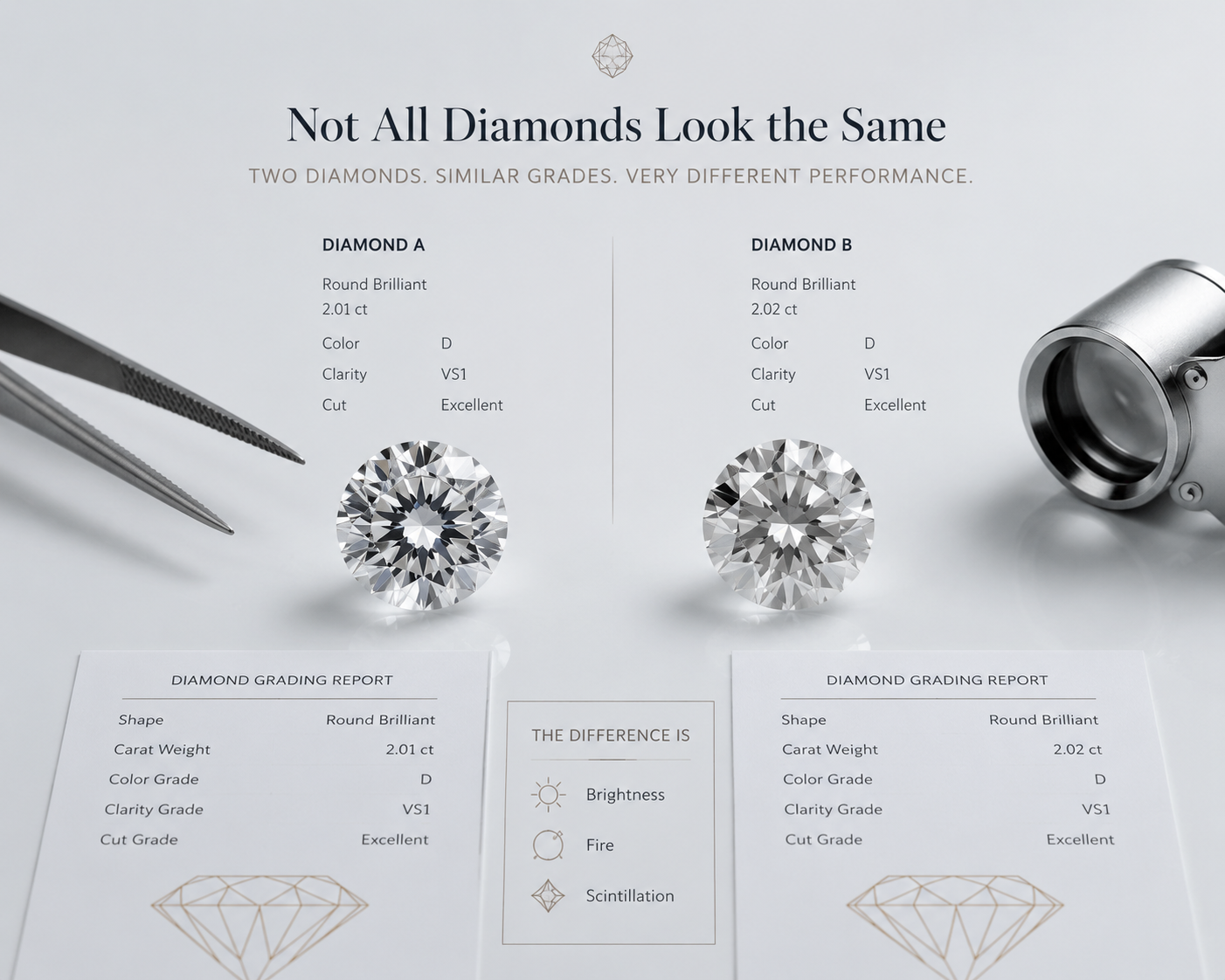
If you are evaluating a lab-grown diamond for visual performance, the attributes that actually matter are cut grade, proportions, symmetry, and polish. These factors determine how the diamond handles light. A diamond with excellent cut, strong proportions, and good symmetry will typically show better brilliance, fire, and scintillation than a diamond with lower grades—regardless of whether it was grown by HPHT or CVD.
The grading report provides the raw data: table percentage, depth percentage, crown angle, pavilion angle, girdle thickness, and measurements. Some reports include a cut grade that synthesizes these factors. However, even a strong cut grade is a summary, not a complete picture. Two diamonds with identical cut grades can look different in person due to factors such as subtle variations in proportions, fluorescence, HPHT vs CVD lab diamond price, or the way each stone interacts with specific lighting conditions.
For buyers focused on beauty, the priority order is clear: evaluate cut and proportions first, then assess visual evidence. Growth method is a secondary data point—relevant for disclosure and documentation, but not a shortcut to predicting how the diamond will perform.
Why You Need Images and Video Beyond the Report
A grading report is a static document. It records measurements, grades, and disclosures at a specific point in time. It does not show you how the diamond looks under different lighting, how it handles motion, or whether it has the brightness and sparkle you expect. This is why images and video are essential supplements to the report—not optional extras.
High-resolution photos reveal inclusions that may not be obvious from a clarity grade alone. They show the diamond’s face-up appearance, color distribution, and any visible characteristics that affect beauty. A 360-degree video allows you to assess how the diamond performs as it moves—how light reflects and refracts, whether there are dead spots, and whether the brilliance is consistent across angles.
Some buyers assume that a high cut grade guarantees strong light performance. In practice, cut grades are based on proportion ranges and symmetry assessments, not direct measurement of brilliance. A diamond can have excellent proportions on paper and still appear lackluster if the cut execution is slightly off or if the stone has unusual light behavior. The only way to know how a diamond actually looks is to see it.
In practical buying, this is where many comparisons become misleading. A buyer comparing two reports side by side may see identical grades and assume identical beauty, yet one stone can appear noticeably more lively than the other. The report narrows the field; visual evidence closes the decision.
A grading report can narrow the comparison, but it should be read alongside the stone’s proportions, visual evidence, and intended jewelry use. For engagement rings and other pieces worn daily, how the diamond performs in real lighting conditions often matters more than minor differences in documented grades. The report is a starting point, not the final word on whether a diamond is right for your needs.
It is also worth noting that diamond simulants—such as cubic zirconia, moissanite, or other non-diamond lookalikes—are fundamentally different from laboratory-grown diamonds. A lab-grown diamond is a genuine diamond with the same crystal structure and properties as a natural diamond. A simulant is not a diamond at all, regardless of visual resemblance. Grading reports are issued only for genuine diamonds, whether laboratory-grown or natural. If a stone is a simulant, it will not have a diamond grading report from a reputable laboratory. Buyers should be cautious of any seller who presents simulant documentation as if it were a diamond grading report.
What This Means in a Real Purchase
Use the report to verify origin, treatments, and specifications. Confirm that the diamond is laboratory-grown, check for any post-growth disclosures, and ensure the documented attributes match what you expect. Then go further. Request high-resolution images, 360-degree video, and ideally an in-person or virtual viewing. Evaluate the diamond’s visual performance with your own eyes. Do not rely on growth method, cut grade, or any single metric to predict beauty. The report is one piece of evidence. Visual evidence is the other.
Report Number, Inscription, and Matching Your Diamond
How Report Numbers Work for Lab-Grown Diamonds
Every grading report issued by a reputable laboratory carries a unique identifier. This report number is the primary link between the document and the specific diamond it describes. No two diamonds share the same report number, which means this number serves as your verification anchor throughout the buying process and beyond.
Major grading labs such as GIA, IGI, GCAL, and AGS maintain online databases where you can input a report number and retrieve the official record. This allows you to confirm that the report you have matches the laboratory’s records. If a seller provides a digital or printed report, you should be able to cross-reference that number on the issuing lab’s website within minutes.
The report number is not the same as a stock number or inventory code used by a retailer. Stock numbers are internal to the seller and have no verification value. Only the grading report number connects to an independent laboratory’s database. When you receive documentation, confirm that the number on the report matches what the lab has on file. If the number does not appear in the database, or if the details differ from what the seller claims, this is a warning sign that requires clarification before you proceed.
Girdle Inscription: What It Says and How to Read It
Most lab-grown diamonds sold to consumers include a microscopic inscription on the girdle, the thin outer edge of the stone. This inscription typically contains the report number and often text such as “Lab-Grown,” “Laboratory-Grown,” or a brand-specific identifier. The inscription is laser-etched and permanent, providing a physical link between the diamond and its documentation.
Reading the inscription usually requires magnification. A 10x jeweler’s loupe can reveal the text in many cases, though some inscriptions are easier to read under a microscope. If you are purchasing online, you can request a high-magnification photograph of the girdle from the seller. This image should clearly show the inscription matching the report number.
The lab-grown diamond inscription serves several purposes. First, it confirms that the stone matches the report you are reviewing. Second, it provides proof of laboratory-grown origin, which matters for disclosure, insurance, and resale. Third, it offers protection against accidental substitution if you ever need to leave the diamond with a jeweler for repair or resetting.
Not all inscriptions follow the same format. GIA lab-grown reports typically include “GIA” followed by the report number. IGI often uses “IGI” and the number along with “Lab-Grown” text. Some manufacturers add their own brand inscription in addition to the lab report number. The key detail is that the report number on the girdle matches the report number on the document.
When the Inscription Does Not Match or Is Missing
Some lab-grown diamonds are sold without inscriptions. This is more common with smaller stones, certain wholesale transactions, or diamonds that were graded before inscription became standard practice. An absent inscription does not automatically mean anything is wrong, but it does remove a layer of verification that most buyers should expect.
If the inscription is missing, you must rely entirely on the seller’s representation and any matching documentation they provide. This requires more trust and more caution. You should request written confirmation from the seller that the diamond you are purchasing is the same stone described in the report. You should also verify that the seller has a clear return policy that allows you to have the diamond independently verified after purchase.
If the inscription exists but does not match the report number, this is a serious problem. The stone and document are mismatched, and you should not proceed until the discrepancy is resolved. This could indicate an administrative error, a swapped report, or something more concerning. A mismatch is not something to overlook or assume will be corrected later.
In some cases, an inscription may be partially legible or worn. Inscriptions can become harder to read if the girdle has been damaged or if the stone has been handled extensively. If you cannot read the inscription clearly, ask the seller to provide a verification image or have the stone examined under professional magnification.
When purchasing a lab-grown diamond, the inscription serves as your primary tool for verifying that the stone in hand matches the document provided. GIA, IGI, and other major labs offer online report verification tools that allow you to enter the report number and view the laboratory’s official record.[3] This cross-reference takes only a few minutes and can reveal discrepancies before a purchase is finalized. If the online record does not match the document you were given, or if the report number does not appear in the database at all, you have grounds to question the authenticity of the paperwork before proceeding.
For custom jewelry design, the verification process extends beyond matching the report to the stone. Measurements, setting compatibility, and design integration all affect whether a particular diamond is suitable for the intended piece. A diamond may have accurate documentation and still not be the right fit for a specific setting or design concept. Buyers should confirm that the stone’s dimensions, proportions, and characteristics align with their design plans before finalizing the purchase.
For custom jewelry, stone measurements and setting compatibility should be confirmed before finalizing a purchase. Even when a report accurately documents a diamond’s specifications, the practical question is whether those specifications work within the intended design. A stone that is slightly too deep, too shallow, or unusually shaped for its carat weight may present setting challenges that the report alone cannot anticipate. Discussing measurements and design constraints with your jeweler before committing can help avoid costly adjustments later.
How to Verify This Before Buying
Before finalizing any purchase, take these verification steps. Request a high-magnification photo of the girdle inscription that clearly shows the report number. Cross-check that number against the report document you have been provided. Then verify the report through the grading laboratory’s official website using that report number. Confirm that the online record matches the physical or digital report in your hands.
If the diamond is inscribed, the numbers should align across all three sources: the girdle, the report document, and the lab’s database. If any of these do not match, pause and ask questions. If the diamond is not inscribed, ask the seller for written confirmation that the stone matches the report, and confirm that you have a return window long enough to have the diamond independently verified if you choose.
Do not assume that a report document alone proves anything about the stone in front of you. The document is only valuable if it accurately describes the specific diamond you are buying. Matching the inscription to the report number is one of the simplest and most reliable ways to close that gap.
Treatment Disclosure: What Reports Reveal About Post-Growth Processes
Common Post-Growth Treatments for Lab-Grown Diamonds
After a diamond is grown, some stones undergo additional processes to improve their appearance or color. These post-growth treatments are distinct from the growth method itself. The most common treatments include HPHT annealing for color improvement, irradiation to create fancy colors, and in rare cases, surface coatings to alter visual appearance.
HPHT treatment after growth is sometimes used to improve the color of a lab-grown diamond. This is different from HPHT as a growth method. A diamond grown by CVD can still undergo HPHT annealing afterward. The treatment applies high pressure and high temperature to alter the crystal structure in ways that can reduce brown or gray tints, making the diamond appear whiter.
Irradiation is used to create or intensify fancy colors such as blue, green, or pink. This process involves exposing the diamond to controlled radiation, followed in some cases by heat treatment to stabilize the color. These treatments are permanent under normal wear conditions.
Surface coatings are less common but sometimes appear in the market. A coating can mask undesirable color tints or add a temporary hue. Coatings are not permanent and can be affected by heat, cleaning, or wear over time.
These treatments are not inherently negative. Many natural diamonds also undergo treatments, and disclosure is the industry standard. What matters is that the buyer knows about the treatment and understands how it affects value and long-term expectations.
How Treatment Disclosure Appears on Reports
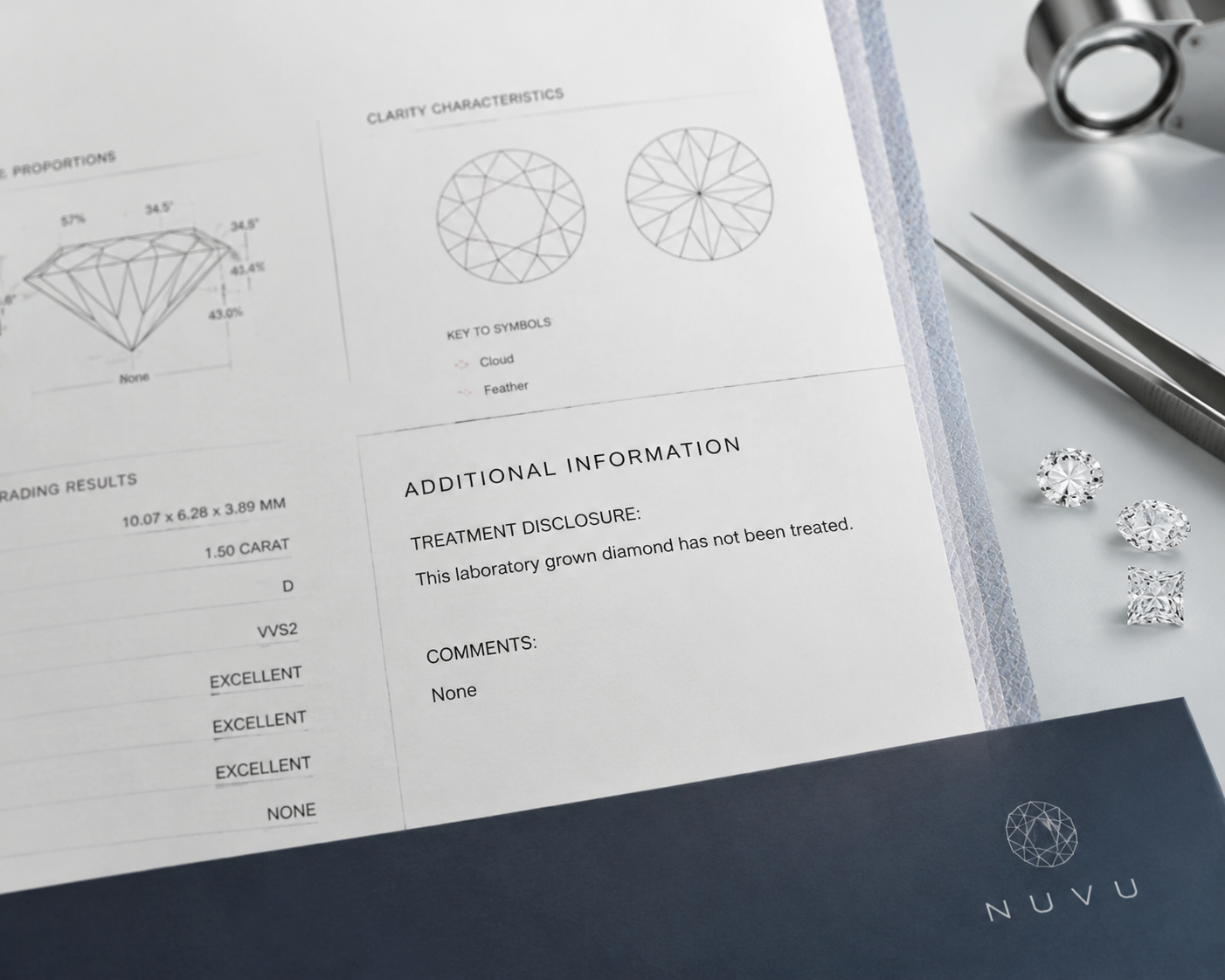
Grading reports are required to disclose any treatments that have been applied to a diamond. This information typically appears in a “Comments” section, “Additional Information” field, or a dedicated treatment disclosure area of the report. The language used may include terms such as “HPHT Annealed,” “Irradiated,” “Surface Coating,” or “Treated Color.”
If a diamond has undergone treatment, the report should state it clearly. If you see no treatment disclosure, this generally means no post-growth treatments were applied, or none were detected. However, treatment disclosure practices can vary slightly between laboratories, so it is worth reading the entire report carefully rather than assuming absence of mention means absence of treatment.
The location of treatment information varies by lab. GIA typically places treatment disclosures in the comments section. IGI often includes a specific field for treatment or additional comments. GCAL and other labs may use different layouts, but the principle is the same: look for any mention of processes applied after growth.
Treatment disclosure matters because it affects how you interpret the diamond’s value. A treated diamond is not inferior in any moral sense, but it may be priced differently than an untreated diamond with similar visual characteristics. Transparency allows you to make an informed decision rather than assuming you are buying something you are not.
Understanding what a treatment disclosure means in practical terms helps you evaluate whether the price reflects the diamond’s characteristics accurately. A diamond described as “HPHT Annealed” has undergone a permanent color improvement process that is stable under normal wear conditions. A diamond noted as having a “Surface Coating” requires more careful consideration, as coatings can wear off over time or be damaged during jewelry repair. The key is matching your expectations to what the treatment actually delivers. If a report notes irradiation for a fancy-color diamond, you can expect that color to remain stable, but you should also understand that irradiated diamonds are valued differently than natural-color diamonds in the market.
Why Treatment Matters for Long-Term Ownership
Most treatments applied to lab-grown diamonds are stable under normal conditions. HPHT annealing and irradiation produce permanent color changes that will not fade or shift with wear. This means a treated diamond can be worn, cleaned, and maintained like any other diamond.
However, treatments can affect how the diamond is perceived in the future if you decide to resell or trade. Some buyers prefer untreated stones, and some appraisers may note the treatment in their valuation. This does not mean the diamond is worth less in absolute terms, but it may affect the pool of potential buyers or the price you can command.
Surface coatings are an exception. If a diamond has been coated, the coating can wear off over time or be damaged by heat during repair work. This is why coating disclosure is particularly important. If you are considering a diamond with a surface coating, understand that the appearance may not be permanent.
For insurance purposes, treatment status should be accurately documented. If you ever need to file a claim, the insurance company will rely on the grading report and any treatment notes. Inconsistent or missing disclosure can complicate this process.
A grading report helps document key characteristics, but it should be compared with visual evidence, proportions, and the intended setting. For custom design, the stone cannot be evaluated separately from the setting—measurements, durability, and aesthetic integration all affect the final result.
For custom design projects, trust comes from matching the stone to the setting, budget, and wearer’s daily use—not from choosing grades in isolation. A diamond with documented treatments may still be an excellent choice for a particular design, but the treatment history should be part of the overall evaluation alongside setting durability, lifestyle considerations, and long-term maintenance needs.
Prices can vary because of cut precision, report type, seller channel, size, shape, availability, and documentation. Buyers should compare like-for-like specifications before treating one stone as a better value. Treatment status is one of the factors that can influence price—a treated lab-grown diamond may be priced differently than an untreated stone with similar visual characteristics. Understanding how factors including treatment disclosure and the HPHT vs CVD growth method affect pricing helps you evaluate whether a quoted price fairly reflects the diamond’s documented attributes.
What to Check Before You Decide
Before purchasing any lab-grown diamond, locate the “Comments” or “Additional Information” section of the grading report. Read every word in that section. Look for any mention of treatment processes, even if the language is technical or abbreviated. If you see terms like “annealed,” “irradiated,” “treated,” or “coating,” ask the seller to explain what this means in plain language.
Confirm that the price you are paying reflects the treatment status. Treated diamonds are not necessarily a bad value, but they should be priced appropriately. If you are comparing two diamonds with similar visual characteristics and one is treated while the other is not, the treated stone may be priced lower. This is normal market behavior.
If the report does not mention any treatments, you can generally assume the diamond is untreated. However, if treatment status is important to you, you can ask the seller for explicit written confirmation. A reputable seller should be able to provide this without hesitation.
When Growth Method Is Not Clearly Stated
Why Some Reports Do Not Specify Method
Not every lab-grown diamond grading report explicitly states whether the stone was grown using HPHT or CVD. This can happen for several reasons. Some laboratories have historically not included growth method as a standard field in their reports. Others may only specify the method when they can detect it with confidence, leaving the field blank if detection is inconclusive.
Detection is not always straightforward. Both HPHT and CVD produce genuine diamond material with the same crystal structure. Distinguishing between them sometimes requires advanced testing that goes beyond standard grading procedures. In some cases, the laboratory may not have been provided with manufacturer documentation stating the growth method.
Report formats also evolve. A diamond graded several years ago may have a report that predates current disclosure standards. If you are looking at a diamond with an older report, the absence of growth method information does not indicate anything suspicious. It simply reflects the reporting practices at that time.
If growth method matters to your purchase decision, you should not assume that a missing field means the diamond is one method or the other. The information may simply not be available through the report itself.
How to Ask the Seller for Clarification
When the report does not specify growth method and you want to know, ask the seller directly. Use specific questions that require specific answers. Ask whether the seller can confirm the growth method in writing. Ask if they have additional documentation from the manufacturer or supplier that states the method. Ask if the growth method is disclosed anywhere in their internal product information.
A seller who knows the growth method should be able to provide this information without difficulty. Many retailers receive manufacturer documentation that includes growth method details even when the grading report does not. If the seller can provide written confirmation from the manufacturer or from their own records, this is useful for your decision-making.
If the seller cannot provide the information, this does not automatically mean you should walk away. It means you have an information gap, and you need to decide whether that gap matters for your specific situation.
When to Accept Ambiguity vs. When to Walk Away
Whether an unspecified growth method is acceptable depends on your priorities. For some buyers, growth method is a point of curiosity but not a deciding factor. If you are choosing a diamond based primarily on visual appearance, cut quality, price, and overall value, the growth method may not change your decision. In this case, you can accept the ambiguity and move forward.
For other buyers, growth method is important. You may have read about differences between HPHT and CVD and formed a preference. You may want to avoid certain characteristics sometimes associated with one method or the other. In this case, an unspecified growth method is a problem. If the seller cannot confirm the method in writing, you may want to choose a different diamond with clearer documentation.
The decision framework is straightforward. If growth method is a factor in your decision, you need it confirmed. If it is not a factor, you can proceed without it. What you should not do is assume or guess. A seller saying “I think it’s CVD” without documentation is not a reliable basis for a purchase decision.
Buyer Verification Checklist
If growth method matters to you and the report does not state it, take these steps. Ask the seller for written confirmation of the growth method. This could be an email, a product specification sheet, or manufacturer documentation. If the seller cannot provide this, ask yourself whether growth method is truly important to your decision or whether other factors such as cut, visual appeal, price, and return policy outweigh the missing information.
If you decide to proceed without confirmed growth method, document your communication with the seller. Keep records of what you asked and what they told you. This protects you if you later discover a discrepancy and need to rely on the return policy.
If growth method is a deal-breaker and the seller cannot confirm it, choose a different diamond. There are plenty of lab-grown diamonds on the market with clearly documented growth methods. You do not need to accept ambiguity on a factor that matters to you.
How NUVU Approaches HPHT and CVD Disclosure
What We Provide on Every Lab-Grown Diamond
Every lab-grown diamond at NUVU comes with a full grading report from a recognized laboratory. This report clearly identifies the diamond as laboratory-grown and, when available from the grading lab, discloses the growth method—HPHT or CVD. We present this information directly on product pages, so you do not have to hunt for it or request additional documentation.
Origin disclosure is non-negotiable. The report states “laboratory-grown” or equivalent language in a prominent position. If the growth method is specified by the grading laboratory, we include that detail in the product listing. When a report does not specify HPHT or CVD, we indicate that the method was not disclosed by the lab, and we can often provide additional context from the manufacturer if you request it.
Buyers should confirm the seller’s return and resizing policies before purchase, and verify that any grading report matches the issuing laboratory’s records through official report-check tools where available.
Helping You Read and Understand Your Report
A grading report contains useful information, but the format varies by laboratory and the terminology can be unfamiliar. We help you interpret what the report actually says—where to find the origin statement, how to read the growth method field if present, what treatment disclosures mean, and how to verify the inscription against the report number.
If a report includes treatment notes such as HPHT annealing or irradiation, we explain what that means in practical terms. Treatment disclosure is not a warning sign; it is a standard part of transparent documentation. What matters is that you understand what you are buying, and that the price reflects the diamond’s characteristics accurately.
When You Want More Than the Report
The report confirms origin, specifications, and treatments, but it does not show how the diamond performs in real lighting conditions. For that, you need images and video. We provide high-resolution photos and 360-degree video for our lab-grown diamonds, so you can assess brilliance, fire, and overall appearance before making a decision.
If you are comparing multiple diamonds or trying to decide whether a particular stone fits your expectations, our team can walk you through what you are seeing. The report gives you the data. The visuals give you the reality. Both matter.
At NUVU, this kind of comparison is treated as a practical selection question: the report narrows the field, but the final decision still depends on visual performance, measurements, and design fit.
NUVU’s buyer-first approach is to make comparison clearer, especially around report details, visual evidence, setting fit, and documentation. We do not certify diamonds ourselves, and we do not guarantee that any grading report proves more than what the issuing laboratory has documented. Our role is to present the information transparently so that you can make a confident, informed decision based on both the data and the visual reality of each stone.
What This Means for Your Purchase
Whether you buy from NUVU or another retailer, the same verification principles apply. Confirm that you have access to the full grading report, not just a summary. Check that the origin is clearly stated as laboratory-grown. Locate the growth method field if it matters to your decision. Review any treatment disclosures. Request images and video if they are not already provided. Ask questions before you commit, and make sure you understand the return policy in case the diamond does not meet your expectations in person.
Before purchase, buyers should confirm documentation, return terms, resizing policies, and after-sales support directly with the seller. These details vary by retailer and are not standardized across the industry. Knowing your options before you commit can prevent frustration later, especially if the diamond does not match your expectations once you see it in person.
Using Certification Wisely: A Buyer’s Framework
What the Report Is For
A lab-grown diamond report serves three core functions: verification, disclosure, and documentation. It confirms that the stone is laboratory-grown rather than natural. It discloses any post-growth treatments that affect how the diamond was altered after creation. It documents the measured specifications—carat weight, color grade, clarity grade, cut grade, and proportions—along with the report number and inscription that link the document to the physical stone.
The report is an identification and disclosure tool. It protects you from misrepresentation and gives you a reference point for insurance, resale, or future appraisals. It does not, however, predict whether you will find the diamond beautiful.
What the Report Does Not Replace
A grading report cannot show you how a diamond handles light in real-world conditions. Two diamonds with identical grades can look noticeably different in terms of brilliance, fire, and overall appeal. The report does not replace visual assessment through photos, video, or in-person viewing.
The report also does not assess seller reliability, return policy fairness, or whether the diamond fits your aesthetic preferences. Those judgments require additional information. A strong report is a good starting point, but it is not a complete buying decision.
A grading report helps narrow the shortlist, but it does not replace visual review. For wholesale buyers, consistency often matters as much as the headline price—documentation, communication, and reliability across multiple stones can be more valuable than a single exceptional grade.
In sourcing or wholesale conversations, documentation, consistency, and communication often matter as much as the headline specification. Wholesale buyers should ask about matching standards, documentation practices, and communication expectations before committing to a supplier. A single well-documented stone does not guarantee consistency across multiple orders, and understanding how a supplier handles grading, treatment disclosure, and quality control can prevent problems later.
China-linked supply chains can offer manufacturing depth and scale in some categories, but buyers still need to evaluate consistency, documentation, communication, and quality control. The presence of a grading report from a recognized laboratory is an important data point, but it does not by itself guarantee uniform standards across every stone in a wholesale order. Buyers sourcing lab-grown diamonds from any region should establish clear expectations about documentation, treatment disclosure, and quality consistency before placing orders.
A Practical Checklist Before Purchase
Before finalizing a lab-grown diamond purchase, confirm the following:
- Origin disclosure: The report explicitly states “laboratory-grown” or equivalent language.
- Growth method: If HPHT or CVD matters to you, check whether the report specifies it. If not, ask the seller for written clarification.
- Treatment notes: Review the comments or additional information section for any disclosed treatments. Understand what they mean.
- Report number and inscription: Verify that the report number matches the inscription on the diamond’s girdle. Use the grading lab’s website to confirm the report is valid.
- Visual documentation: Request high-resolution images and 360-degree video. Assess how the diamond actually looks, not just how it is graded.
- Seller questions: Ask about anything unclear on the report. A transparent seller should answer directly.
- Return policy: Understand your options if the diamond does not meet expectations in person.
Prices can change with market conditions, report type, seller channel, and stone-specific details, so exact comparisons should be verified at the time of purchase. A diamond that appears favorably priced today may not represent the same relative value weeks or months later, and grading report availability can also shift. Buyers should treat pricing comparisons as snapshots rather than fixed reference points.
Final Verification Before You Buy
Run through the checklist one last time. Confirm that the diamond matches the report, that you understand any disclosed treatments, that you have seen visual documentation, and that any claims not on the report are provided in writing by the seller. If something is missing or unclear, pause and ask. The report is your verification tool—use it fully, then go beyond it to assess the diamond with your own eyes.
A grading report helps document key characteristics, but it should not be treated as a guarantee of beauty, value, or sourcing ethics. The report tells you what the laboratory measured and disclosed. Whether the diamond is the right choice for you still depends on visual performance, design fit, budget, and personal preference. Use the report as one important input—not as the final authority on whether a diamond is worth buying.
[1] Federal Trade Commission, “Guides for the Jewelry, Precious Metals, and Pewter Industries,” 16 CFR Part 23, revised 2018.
[2] GIA, “Laboratory-Grown Diamond Reports,” Gemological Institute of America, accessed 2025.
[3] GIA, “GIA Report Check,” Gemological Institute of America, accessed 2025.
Disclosure: This article is for general educational purposes only. Diamond grading, pricing, availability, specifications, and seller policies can change, and readers should verify important details through grading reports, official laboratory tools, seller documentation, or qualified professionals before making a purchase decision. Laboratory-grown diamonds should be clearly distinguished from natural diamonds, and environmental or sourcing claims should be supported by specific documentation.